




Abstract
Efforts to remedy existential anxiety and the sense of ‘homelessness’ permeating modern life invariably invoke ideas and practices swirling around dwelling and nostalgia. Geographies probing the materiality of loss and memory have elaborated and critiqued nostalgia in both regressive and progressive postures. We argue that amorphous and sensual qualities of nostalgia make it a propulsive force in dwelling. Moving beyond nostalgia as a representation of, or personal longing for, ‘the past’ or ‘home’, we engage historic practice as transpersonal, affective currents coursing through bodies, objects, and things. Nostalgia is an enchantment with distance that cannot be bridged. We explore nostalgic distance vis-a-vis practices in residential historic preservation in the Coronado district in Phoenix, Arizona. Practice, performance, and materiality of historic inhabitation illuminate nostalgic distance as an undertow in the making of historic sensibilities, subjectivities, and places. The elusiveness of nostalgia whispers enchantments, engendering attentiveness to what is near, to sensing closely. Nostalgic practice, performance, and materiality give rise to an everyday aesthetic of pastness, an embodied ethics of care rather than strict adherence to historic preservation codes and guidelines. We contribute to rethinking nostalgia and residential historic preservation as modes of sensing in which all bodies, objects, and things – human–nonhuman, animate–inanimate – have capacities to affect and to be affected.
In the sunset of dissolution, everything is illuminated by the aura of nostalgia. . . Milan Kundera, The Unbearable Lightness of Being
1
Matterings
Nostalgia – longing for the past – is intoxication, a cloying elixir, and a romance with one’s own fantasy. Despite derision and peril trailing the expression, nostalgia persists. Even the city of incessant rebirth, Phoenix, Arizona, houses a cozy cityscape of period revival rooflines: pitched Tudors, low-slung bungalows, and tiled Spanish Colonial silhouettes seemingly resting in tranquil repose. The smattering of 35 residential historic districts in the central core of Phoenix engenders this infamously ahistorical city with temporal ambiguity. The cobbled-together remnants of the City’s first suburbs exude a desperate absence of ‘real’ history and the captivating charm of history in the making. Are the personable accoutrements adorning each house, such as dusty Adirondack chairs on the porches of worn bungalows, exuding or awaiting a simpler time?
Residential historic districts ostensibly preserve ordinary landscapes and homes through inhabitation. Yet the very practices that gave rise to the size, form, and aesthetic of these homes are not – and cannot be – the same as contemporary practices and performances in maintaining them. Ideas, memories, and imaginings emerge as sense is made in the present. Historic homes and the residential historic districts they reside in necessitate an everyday corporeal attunement to the present needs of past things. Decisions about repair, restoration, maintenance, and furnishing evolve through domestic practice, the sensual directives of things. 2 Bodily attentiveness to what feels right often supersedes architectural and historical accuracy. As a practice born from loss, historic preservation demonstrates a curious intersection of nostalgia and dwelling. We direct our attention to one Phoenix historic neighborhood, Coronado, where nostalgia melts, softens, and creatively reshapes any efforts to freeze time in place.
Following repeated criticisms of ‘bad history’, there have been recent attempts to awaken nostalgia from its dream state to make it critical and productive. 3 Rather than viewing nostalgia as diffuse longing for an imagined past, these approaches orient nostalgia to the present and future while ‘placing’ nostalgia within a specific geographical frame: the home. In our inquiry, nostalgia’s romance with the past is not derided nor is it found to generate conscious, analytical evaluation of the present. We argue that it is precisely the amorphous and sensual qualities of nostalgia that make it a propulsive force in dwelling. Moving beyond nostalgia as a representation of, or personal longing for, the past or home, we engage nostalgia as transpersonal, affective currents coursing through bodies, objects, and things. Nostalgia, we assert, is less about time (a specific history) and more about diffuse longing – less about home (a specific geography) and more about cultivating sensual environs (pastness).
In our approach, the elusive affective and sensory experience of nostalgia is brought to the fore. The experience of nostalgia, we propose, is enchantment with distance, an unbridgeable yet distinctly felt spatio-temporal chasm between now and then. Encounters of affective distance engender attentiveness to what is near, to sensing closely. We make the case that nostalgic practice, performance, and materiality in historic Coronado give rise to an everyday ‘aesthetic of pastness’. This is a mode of urban sensing and practice premised on an embodied ethics of care, not adherence to strict preservation guidelines or historical fact. We embrace the Greek etymology of aesthetic: to feel, sense, and perceive. 4 This form of ‘social’ aesthetics, says Highmore, ‘is primarily concerned with material experiences, with the way the sensual world greets the sensate body, and with the affective forces that are generated in such meetings’. 5 Aesthetics is necessarily entangled with everyday sensorial perception, affect, and diverse materialisms. In these ways, we contribute to the rethinking of nostalgia and residential historic preservation from the perspective that all types of materiality – human–nonhuman, animate–inanimate – have the capacity to affect and to be affected. 6 All matter is lively and expressive. 7 A lineage of ‘new’ materialists championing presentational practices offers guidance in thinking–writing encounters between people and things as creative cultural geographies. 8
Our inquiry in the Coronado historic neighborhood (hereafter referred to as simply Coronado) rethinks nostalgia as an urban sensibility. 9 This work heeds calls to make sense of the everyday 10 through inquiry into the sensible and infrasensible modalities of urban materialisms. 11 In this work, we aspire to Anderson and McFarlane’s ‘ethos of engagement with the world, one that experiments with methodological and presentational practices in order to attend to a lively world of differences’. 12 Our affirmative, creative-critical approach accords with Woodyer and Geoghegan’s recent call to eschew postures of rationality for enchanted modalities in both theory and praxis. 13 In twinning the words and images that follow, we present nostalgia as everyday enchantment, 14 an aesthetic encounter engendering sensual attunement toward remnants and historic homes.
We begin by situating nostalgia as material expression afoot in the world. The experience of nostalgia, we then assert, takes place as enchantment with distance, a sensate encounter that, paradoxically, engenders practices of nearness between people and things. We situate this framework within Phoenix’s historic Coronado neighborhood where historic preservation and nostalgia entwine in cultivating an aesthetic of pastness. In three vignettes, we pair imagery, qualitative research, and the literature in conjuring Coronado’s aesthetic. As a performative, ‘ornamental’ photographic technique, vignetting involves ‘softening or shading away the edges of the subject’. 15 Our nostalgic aesthetic approach abstains from demystifying 16 the very expression we make gentle contact with in presenting Coronado’s sensibilities. We conclude by outlining nostalgia and historic preservation as urban sensibilities with ethical–aesthetic implications.
Materializing nostalgia
Industrialization, modernization, and militarization in the 19th century medical discourse have been credited with influencing meanings of nostalgia from a physical ailment (a painful longing for a lost home) to a mental disorder and, finally, to the bittersweet emotion of longing for a past time. 17 As such, nostalgia has been mobilized in several ways: as a modernist tool of suppression against the protests and memories of displaced communities, 18 as subversive to the modernist agenda, 19 as associated with many post-revolution conspiracies of the 20th century, and, ultimately, as having the potential to serve disparate political agendas. 20 The widespread deployment of nostalgia as political tool and marketing ploy has brought about regressive associations with an imagined past, sometimes called ‘bad history’. 21 In recent years, negative perceptions of nostalgia have been supplemented with critical conceptualizations challenging nostalgia as displaced, ahistorical, and apolitical. 22 Broadly speaking, much of the writing on nostalgia continues to fall into two schools of thought: ‘backward-looking’ nostalgia, understood to be revisionist, regressive, and debilitating, and ‘forward-looking’ nostalgia, considered to be productive, critical, and therapeutic.
We pose an alternative ‘view’ in rethinking nostalgia as affect with sensual effects anterior to conscious meaning. We situate our inquiry into the agency of nostalgia within the ongoing project of new materialisms. 23 Ontologically, this collection of approaches takes (re)presentations and all forms of matter seriously, seeking to dissolve distinctions between material and immaterial, human and nonhuman, subject and object. Whether an object, an idea, or a meteorological event, all materialities have agency, the capacity to affect. In this way, calls to ‘re-materialize the urban’ 24 recognize that all forms of urban matter (infrastructure, thoughts, events, objects) are expressive and interact. In this sense, beings called human are always already more than human. 25
One vein of urban materialisms brings habitation to the fore. Dwelling is the performative enactment of everyday habitual life, becomings of self, place, home, and world. 26 To apprehend everyday life in such a way, the too familiar, the unseen, and the messy minutiae of everyday life must be attended to. 27 The senate is the ‘surface and limit of everyday life’, the emergent interface between self and world, at once enframing perception, constituting subjectivity, and disclosing the remainder. 28 Many authors attending to habitual material relations comprising everyday life disclose the ways we are touched – affected – by something fleeting or seemingly absent, such as memory, 29 ruins, 30 heritage, 31 spectral remains, 32 and atmospheres. 33 Common in these works is attention to the infra-ordinary, the affective intensities which are at once ‘determinate and indeterminate, present and absent, singular and vague’. 34
Toward this aim, qualitative research methods conducted between 2007 and 2012 (participant observation, interviews, archival research, and a structured survey) were employed in conjunction with collaborative art–geography approaches through partnership with Phoenix Transect, the long-term visual research project in the Herberger Institute for Design and the Arts at Arizona State University. 35 Images and video from different artists contributed to our sensory ethnographic research in Coronado. 36 The photographs of Katie Lehman, who was present during many interviews with residents, and Mark Klett, who explored Coronado’s homes and inhabitants during several home tours, are displayed in this article. Their keen aesthetic sensibilities in apprehending the agency of ordinary objects and the ambivalence of historic homemaking were critical and generative in the dynamic and distributed process of research-creation. 37
Image making, in this approach, is a source knowledge production and expression rather than illustration (re-presentation), and the images themselves are afforded agency, inventiveness, and expressiveness. 38 Following Fisher and Paterson’s development of haptic aesthetics, we approach vision as a multi-sensory experience in which a sense of touch is necessarily activated. 39 Sensory attunement to the materiality of historic homes and objects depends upon haptic registers of texture, weight, and proximity. Following earlier theorists of everyday life, this approach strives to ‘become aware of the unseen’ 40 and ‘make different things significant and worthy of notice’. 41 Such inquiries rely on an everyday ‘activist politics of disclosure’ through which the closest things – the insignificant, the ephemeral, and habitual – are elevated.
Enchanted distance
Nostalgia, from the vantage point of new materialisms, is a lively, pre-personal affect which registers in and through the sensory contact of bodies and things. The sensory experience of nostalgia, we contend, is a form of enchantment – enchantment with distance. Jane Bennett theorizes enchantment, a fleeting state of captivation and wonder, as entrée to the immanent agency of matter and its ethical potential, what she terms ‘vital materiality’. Bennett articulates the felt sensory experience of enchantment ‘to be simultaneously transfixed in wonder and transported by sense, to be both caught up and carried away’. 42 In moments of enchantment, she argues, we simultaneously encounter ‘pleasurable feelings of being charmed’ (caught up, transfixed) and ‘a more unheimlich (uncanny) feeling of being disrupted or torn out of one’s default sensory-psychic-intellectual disposition’ 43 (carried away, transported). Succumbing to a wash of affective intensities and sensations beyond our control proffers a momentary glimpse of the vital materiality with which we are always already entangled.
Drawing on Bennett, we propose that the sensory experience of nostalgia is an enchantment with distance, a felt encounter that engenders practices of nearness. Central to the experience of nostalgia is an affective spatiality and temporality of loss, a distance between now and then that cannot be bridged. Unquantifiable yet felt intimately, this sensate gauge of proximity is a ‘structure of feeling’ floating at ‘the edge of semantic availability’.
44
Oscillating between feelings of distance (irretrievability of the past) and proximity (sensations felt in the present), nostalgia is the sensory experience of desire for something that is unnamable and unreachable, momentarily present in fleeting fragments. Susan Stewart intones nostalgia as the ‘desire for desire’ that cannot be quelled:
45
As in an album of photographs or a collection of antiquarian relics, the past is constructed from a set of presently existing pieces. There is no continuous identity between these objects and their referents. Only the act of memory constitutes their resemblance. And it is in this gap between resemblance and identity that nostalgic desire arises. The nostalgic is enamored of distance, not of the referent itself. Nostalgia cannot be sustained without loss.
46
The impulse to collect and preserve material remnants begins with the felt loss of a moment, a sentiment, a shape, a feeling, and a way of life. Yet through acts of keeping, of seemingly holding oblivion at bay, the loss of a moment, a thing, is most pronounced. In nostalgic distance, suspended in fleeting memories, vague imaginaries, and barely felt sensations – neither here nor there – we momentarily float in a paradoxical state of longing for the sake of longing.
The felt desire of an unbridgeable distance is by definition affective, an increase in a body’s capacity to affect, and to be affected. 47 Affective desire multiplies intensities, generating potentialities of bodies – what Gilles Deleuze and Félix Guattari describe as ‘nonhuman becomings’. 48 Nostalgia is defined by relational spacing, a kind of desire Luce Irigaray describes as demanding ‘a sense of attraction: a change in the interval, the displacement of the subject or of the object in their relations of nearness or distance’. 49 Pre-personal and immanent, nostalgia is an affective meeting of subject and object, a summons between bodies human and nonhuman. 50 The nostalgic, says Boym, ‘directs his gaze not only backward but sideways and expresses himself in elegiac poems and ironic fragments, not in philosophical or scientific treatises. Nostalgia remains unsystematic; it seduces rather than convinces’. 51
Nostalgia assembles disparate materialities in partial and prismatic ways; we – subject and object – become bewitched, afflicted, and enchanted. Enchantment, says Bennett, strengthens the ‘agentic capacities’ of all bodies, human and nonhuman, increasing their capacity to affect when perceptions of human mastery are diminished. 52 Bennett points toward ‘pre-modern’ comportments such as superstition, animism, and anthropomorphism as holding potential to cultivate a capacity for naiveté, a suspended state of wonder. 53 It is no coincidence, we argue, that efforts to articulate the felt experience of nostalgia invariably enlist language of the occult and medical discourse. Beyond human volition, nostalgia has long been depicted to affect by means of enchantment, infection, contagion, and possession. Integral to the expression of nostalgia has always been the capacity for naiveté, the relinquishing of intellectual control to the senses. We are momentarily captivated and carried away. In pairing the Greek roots nostos (to return home) and algos (a painful condition), Johannes Hofer’s 17th-century neologism was intended to audibly and performatively conjure nostalgia’s affects. 54 Fred Davis echoes these mystical, performative powers in writing ‘It is almost as if . . . the word sought of its own accord that murky and inchoate amalgam of sentiments to which so homely a word as homesickness could no longer render symbolic justice’. 55 Nostalgia’s chirality occasions its recursive and conjunctive status as both sickness (originally a disease) and cure (later a therapeutic practice). Even those who bemoan persistent medical tropes in nostalgia discourse turn to the expression’s earlier literary ‘origins’ where magical beings, such as Homer’s Sirens, cast the first nostalgic spells. 56
Such an unwieldy expression captivates and assembles disparate and fleeting materialities, including human bodies. Building on Nadia Seremetakis’ argument that nostalgia is memory of the senses, 57 we contend that the defining effect of nostalgia is aesthetic, sensing that is neither ‘backward’ nor ‘forward’, but closely. Cognitive registers such as continuity, depth, and factual accuracy succumb to texture, grain, tone, and detail. From this vantage point, the ‘past’ is felt in fine-grained texture, a quality of light, the weight of objects, and an excess engendered through propinquity (bringing near). A fleeting glimpse, a faint scent, and a rough textile weave are momentarily present and (re)membered in olfactory registers, limbs, and skin. Such encounters are not limited by a specific past, place, or memory. Their distinctiveness arises through viscerally felt modulations of distance – subject–object spacings, an event of ‘praesentia’, 58 or ‘refracted enchantment’. 59 For these reasons, nostalgia’s felt contours, as simultaneously present and absent, are often characterized as pleasurable and melancholy, bitter-sweet. 60 Enamored with distance, the nostalgic body cultivates practices of nearness: collecting, repairing, restoring, displaying, and maintaining remnants. Yet practices of sensate ‘spacings’ can only fleetingly suspend, not bridge, the distance between subject and object.
Historic Coronado
Coronado refers to both one of the largest and oldest historic districts in Phoenix (designated in 1986) and the Greater Coronado community, a one square mile area in east central Phoenix housing three historic districts (Coronado, Country Club Park, Brentwood), plus the ‘non-historic’ sections in-between. Coronado was built as a working class streetcar suburb comprising small, modest homes. Its significance lies in ordinariness, not as a legacy for the wealthy or social elite of Phoenix. 61 Mid-century legacies of federal subsidization of the suburban periphery and disinvestment in the urban core have transitioned Coronado to an inner-city neighborhood.
As freeway construction sliced through the urban core in many American cities, inner-city neighborhoods like Coronado employed local historic preservation ordinances as a neighborhood survival strategy. While the first regulatory historic district was established in 1931 in Charleston, South Carolina, the practice was not widely employed until after the 1966 National Historic Preservation Act. 62 During the last decades of the 20th century, historic preservation became the purview of local citizens (rather than professionals) seeking to preserve entire collections of ordinary homes as neighborhoods (at least 50 years old), rather than elite, nationally significant sites. 63
This legacy is evident in Coronado. With architectural significance dating between 1907 and 1942 in Coronado, between 1939 and 1946 in Country Club Park, and between 1926 and 1956 in Brentwood, zoning boundaries corral half a century of diverse architecture. With side-by-side variation in architectural style, great jumps in period of construction, and homes displaying varying states of disrepair and maintenance, it is impossible to trace the narrative of Coronado to any singular history – even an early suburban one. Owing to its eclectic ‘funky’ character (Figure 1), Coronado exudes a delightful sense of pastness, an atmosphere of historic character more so than a feeling tethered to actual events. In Coronado and the broader historic preservation community, there seems to be ambivalence as to whether the difference in these feelings matters. 64

Emblems of diversity in religious affiliation (Catholics, Sikhs, Buddhists, etc.), gay pride, and historic fabulation frequently adorn homes in historic Coronado. Photographs by authors, 2009.
The cohabitation of dilapidated turn-of-the-century farmhouses, rejuvenated bungalows, revivified Spanish Revivals, Tudor rehabs, and scattered newly constructed modern, minimalist homes seems charmingly improbable. Akin to Stewart’s phenomenological description of the contents of a drawer, ‘it is as if, under the spell of an internal time system, [the homes] . . . summoned like to like, gathering things to things under some magnetism that human volition does not know’.
65
Relics, remnants, and remains have the uncanny ability to captivate and enchant in ways that contemporary, completed objects simply cannot.
66
Historic homes, even those with strong architectural integrity, exist as ruins of another time and place; their assemblage into districts is an entirely modern arrangement. The seduction of ruins, asserts Boym, is that they enable ‘one to experience historicity affectively, as an atmosphere, a space for reflection on the passage of time’.
67
The pace of modernity generates conditions of perpetual loss as new remnants are always in the making. The allure of historic homes is the promise of sensual seduction. Don, an active Coronado resident and historic district realtor, sells it this way:
These ‘one-of-a-kind’ properties beg to be lived in, loved and cherished . . . Memories of weddings, births, graduations and reunions are woven into the tapestry of these historic homes with every dent in the floor, chip in the tile, or crack in the window. Unintentional time capsules are sometimes exposed while peeling the years from a dining room wall, or re-tiling a bath. Other times, these artifacts sit entombed and undiscovered while still managing to give their surroundings a warmth that we can’t quite put our finger on . . . These are fabrics interwoven throughout our historic areas, our senses and our hearts.
68
Coronado’s enigmatic historic sensibility makes it difficult to discern whether historic preservation status simply ‘sets the stage’, with appropriate props and script for nostalgic performance to ensue, or whether preservation is nostalgic stagecraft. David Lowenthal cleaves toward the latter, asserting that guidelines and practices of historic preservation arise from the nostalgic impulse. Social, ecological, and economic benefits aside, the preservationist’s desire to rescue and rehabilitate remnants, Lowenthal argues, is (negatively) nostalgic:
Preservation has become a rampant cult. All over the world, individuals and institutions save more and more from every possible past. The resources devoted to salvaging and celebrating surviving remnants mount exponentially. Few cultures are exempt from, few individuals uninfected by, the mania for memorabilia. Why is this so? It reflects a wider modern preoccupation with the past – the nostalgic temper.
69
Nostalgia’s mystical affectivities and alluring, cult-like practices are enchantments. The earliest transitions of nostalgia from disease to aesthetic, asserts Austin, occurred through therapeutic treatments of associative performance – the nostalgic substituted return home with pleasurable, sensual home-like enactments. 70 Nostalgia is not encountered cognitively, but rather through sensual performance and everyday practice.
Visitors and residents of historic places, the heritage literature finds, are primarily drawn to experientially rich – but not necessarily accurate – historic environs. 71 Yet rarely are these findings – that nostalgia and sensual materiality matter – taken seriously by preservation institutions. Consider, for example, Cameron and Gatewood’s findings that visitors to historic sites seek numinous experiences and spiritual encounters with something of quasi-religious or magical agency (objects, places, phenomena). 72 Numen-seeking motives identified in their study include the impulse to experience ‘harmless escapism’, encounter first-hand ‘authenticity’, or gain personal connectivity ‘with events or people of the past’. 73 Similarly, DeLyser finds that perceptions of authenticity for visitors to historic ghost towns are primarily based on experiential atmospherics, the presence of dust and observable decay, even if these are performatively staged environs. 74 For DeLyser, this perceived authenticity in the present (not necessarily historical accuracy) affords more rich and impactful associations, memories, sensations, and fantasies. In their study of what people remember from historic sites, Farmer and Knapp find that the primary takeaways are visceral impressions of the architectural ambience (‘awe-inspiring’) and details of the structure’s craftsmanship and character (‘something you don’t see these days’). 75 Or, finally, consider the findings that the public supports both historic preservation and fake historic architecture (contextual replicas), but does not support rigid prescription in historic architectural styles alone. 76 We read these motives of visitors to historic sites as surface expressions of nostalgia – enchanted distance. Historical and architectural accuracy in the built environs is supplanted by desires for sensual encounters and creative imaginings.
Historic home touring
One such nostalgic practice is the performance of home, history, and preservation at the annual Coronado Home Tour (Figure 2). Once reserved for viewing elite residences, the home tour has become an annual event in many residential historic districts celebrating the architectural distinctiveness of ordinary homes. In their study of the ‘Twentieth Century Society’ in the United Kingdom, Craggs, Geoghegan, and Neate consider the social and emotional aspects (namely, enthusiasm) in architectural touring as integral to the practice. 77 They situate guided architectural tourgoers alongside a wide spectrum of urban exploration practices and figures. Even for the duration of a two-hour guided tour, they argue, ‘architectural enthusiasts’ function as ‘agents with the potential to shape and transform the built environment’. 78 We concur with the significance of embodied ‘architectural touring’ in shaping places. Our materialist perspective pushes a more sensate, object-oriented engagement and transformation in both inhabiting and touring residential historic districts. The sensual affordances and imperatives of homes and built environs – first and foremost – summon, guide, and direct inhabitants and architectural tourists. Historic homes, objects, and materials generate affective intensities across sensual registers and modalities. To be seduced and enthralled is to be always already caught up in a swirl of material expressions beneath, before, and beyond human volition. Affective, emotional, and social currents course through spaces, objects, and touring bodies singular and collective.
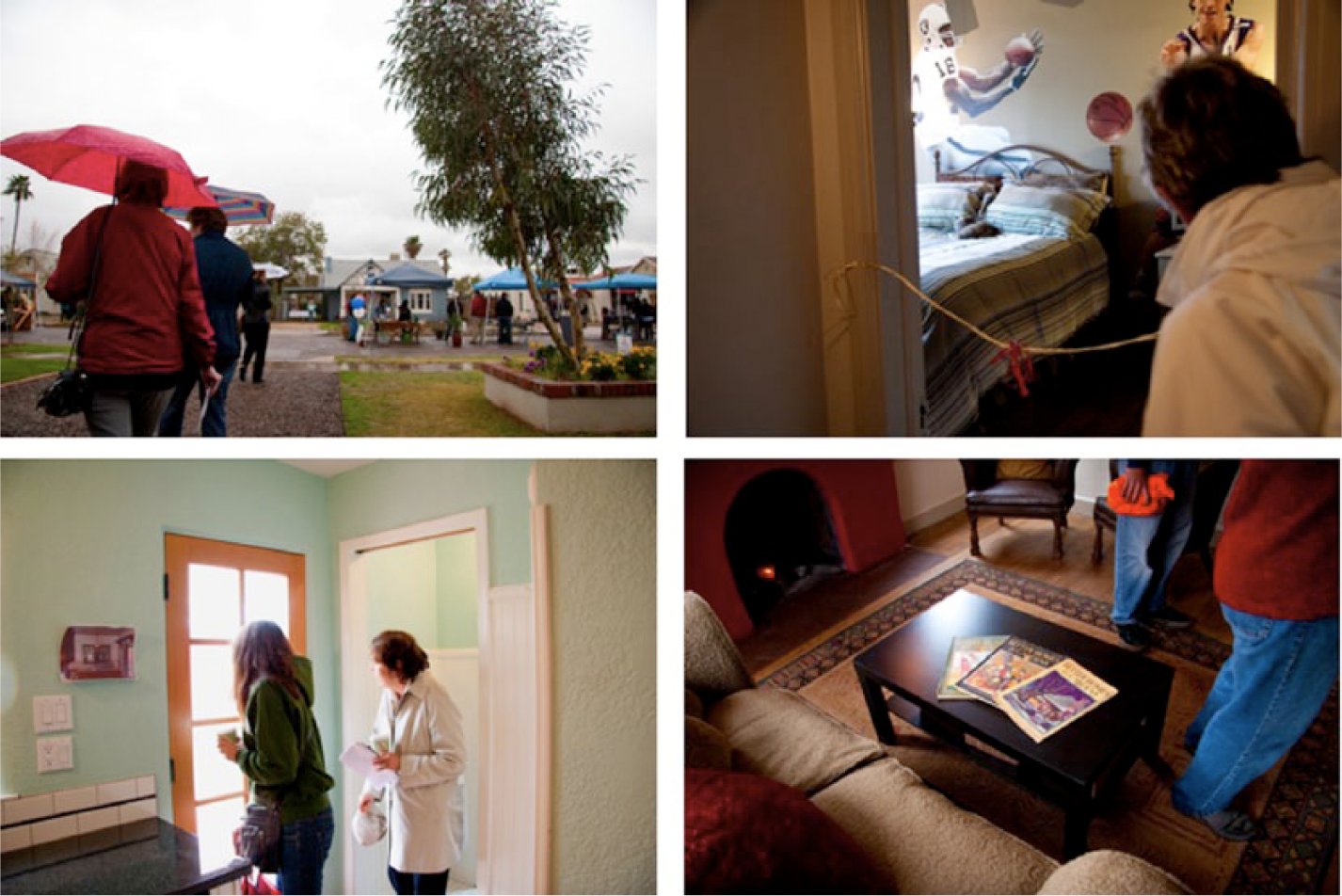
Coronado Home Tour on Willetta Street. Photographs by Katie Lehman, 2010.
The ubiquity of domestic touring in Phoenix warrants an entire ‘home tour season’ each spring. On the one-day Coronado event, private homes are opened to the public, and much more than the ogling of historic architecture occurs; bodies jostle in family-photo-laden hallways, drawers are opened, rugs are lifted, nods of homemaking approval are exchanged, memories surface, and tales are told (Figure 2). The bodily act of touring a domestic space facilitates both intimacy and distance from daily home practices, past and present, rendering the mundane remarkable. The spectrum of materiality on offer, from the original 1920 bathtub to the flat screen TV, transmits ways of inhabiting temporal disjunctions. A sense of pastness emerges on home tours through practices of arranging, displaying, remembering, looking, and touching. 79 Such a collective sensory experience holds potential for disrupting bodily habits as new ones emerge. This collision of technologies, building materials, and social interactions echo Walter Benjamin’s study of the Parisian arcades, where the quickening pace of urban life generates new perceptual modalities. 80 Harrison writes, ‘alternation in dwelling may be produced by potentials in the combinations of materials, alterations in the texture of the weave’. 81 Nostalgia circulates and ‘passes through us’, 82 cultivating historic sensibilities and subjectivities.
The Coronado home tour began in 1982 when Neighborhood Housing Services initiated the practice as a community development strategy. As such, the annual ritual in Coronado highlights an eclectic array of homes both in and out of official historic-zoned areas of the Coronado community. The architectural and socio-cultural diversity of both the homes and residents lends Coronado its unique inclusive atmosphere. The demographic composition of Coronado residents is diverse, mirroring that of the City of Phoenix overall (approximately 47% White, 41% Latino, 7% Black, 3% Asian, 2% Native American). Historic home touring in Phoenix attracts predominantly, but certainly not exclusively, English-speaking, White attendees. Middle-aged women and gay men, said to be plentiful at home tours, are referred to in a Phoenix New Times (alternative newspaper) article as the ‘NPR tote bag crowd’. 83 The vignettes and images presented here center on interviews (pre-tour, day-of, and post-tour) with Willetta Street residents undertaken during 2010 (Figure 3). We feature three Willetta Street residents: Debbie is a White, middle-aged, educator who lives with her dog Max; Carah is a 30-something Latina union activist and first-time homeowner; and Terry is a White, middle-aged homeowner and do-it-yourself (DIY) landscaper, refurbisher, preservationist, and interior decorator. We also draw on formal and informal interviews (2007–2011) with ‘active’ residents residing throughout Coronado and local preservation officials (interviewees gave permission for using their names). Interviews were restricted largely to residents who attended, participated in, or helped to organize community events such as neighborhood association meetings, monthly social events, and the annual home tour. Accounts by residents are supplemented with our own immersive participant observation as both authors resided in Coronado at differing times and for varied durations.
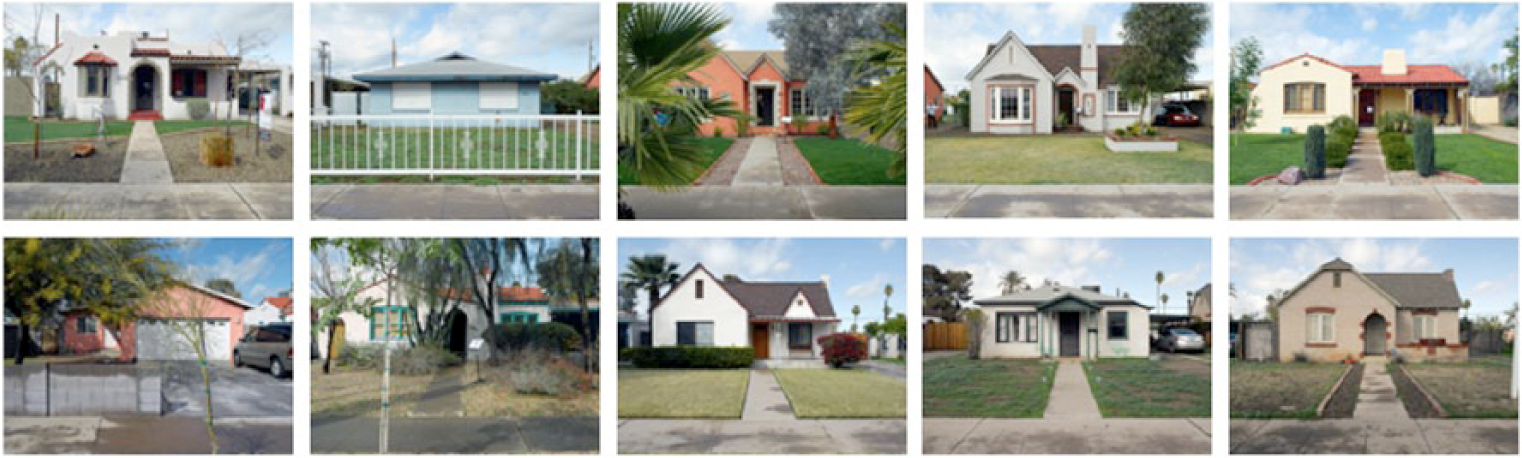
The north side of the 1800 block of Willetta Street on Tour day. Photographs by Mark Klett, 2010.
Functioning as a microcosm of the community at large, two themes repeatedly bubble to the surface before, during, and after home tours: nostalgic enchantment with remnants twinned with ambivalence toward linear notions of history and preservation. Chris, a Willetta Street resident whose home was open to the public on the 2010 tour, puts it this way:
I went on the tour because I’m completely fascinated with older homes. You go into a home these days, a modern built home, and it’s square and boring and there is no personality, and you can tell it’s cheaply made – they don’t have any life in them, you know? My folks are from the Midwest and we go visit my grandparents and . . . everybody back there lives in all these old homes – and it just like, personally, blows me away – there’s so much detail in every little part of it. It’s like what happened to the world? Where did all this go? And that’s why I go, I’m assuming that there’s a little bit of that in other people and that’s probably why they go – it’s just like – that stuff, it’s just gone and there’s remnants of it, of that era, there’s remnants of it. People are intrigued by it and they want to see it. That’s why I do it; I’m guessing that’s why other people are into it.
84
This sensual disposition toward remnants – corporeal attentiveness to craftsmanship, texture, detail, temporality, and uniqueness – characterizes preservation practices in Coronado. We contend that this sensual attunement arises from enchantment with nostalgic distance, not strictly personal memories (vignette 1), ‘the past’ (vignette 2), or ‘history’ (vignette 3), per se. We frame this sensual attunement in Coronado as an aesthetic of pastness, the creation of historic sensory environs divorced from any specific memory, past or history.
Vignette 1: Enchanted orbs
Prior to her arrival on Willetta Street, Debbie began collecting glass doorknobs anticipating the day when she would have an old house, with old doors in which to place them (Figure 4). The doorknobs she collected, long removed from their place of origin, were desirable in their own right – without door, house, or key – as aesthetic objects with special weight, shape, and sensation in the palm of the hand. After decades of neglect, no longer the handheld threshold of movement between rooms, the doorknobs seemed to forget their innate purpose. Now, as artful objects, handled with admiration and intention, they become capable of opening worlds of imaginative potential. Unrestricted to the confines of memorable experience and lacking the burden of a historian’s knowledge of doors and doorknobs, Debbie feels a tinge of glamour, romance, and mystery emanating from the glass orbs. What is it like, we ask, to live in a world in which doors and doorknobs are magical?

Debbie and her doorknobs. Photographs by Katie Lehman, 2010.
‘Things’, says Nigel Thrift, ‘answer back’. 85 Peter Schwenger elaborates, ‘Not only does our existence articulate that of an object through the language of our perceptions, the object calls out that language from us, and with it our own sense of embodied experience’. 86 A sensate awareness of loss, viscerally encountered in palms and fingers, cannot be affirmed intellectually. Yet magic in glass doorknobs persists, and not just for Debbie. Brad Kittle, vice president of the Antique Doorknob Collectors of America, attests to the craftsmanship and quality of a well-worn knob: ‘The old glass has a watery look and refracts light differently. And when you hold it in your hand, it just feels better’. 87 But, in the event the original feature is lackluster, failing to play the part, modification or replacement in Coronado is commonplace. A transplanted doorknob or newly built door works performatively to suffuse environments with pastness, an affective assemblage beyond the original.
Debbie’s old house, a 1930s Tudor Revival on Willetta Street, came with many original features – original wood floors, built-in cabinets, tile, and, in a stroke of good luck, glass doorknobs. Also of much pride to Debbie is a collection of her grandparent’s artifacts: her quilt, his framed rosary, and the toy hutch he built for her as a child. Unlike the original ‘salmon terracotta’ colored tile she went to great lengths to protect during extensive plumbing repair, the petit hutch she played ‘house’ with as a child has undergone aesthetic improvement. Debbie changed the original color, removed original doors, and replaced the original metal fixtures with, not surprisingly, glass pulls and knobs. We pause – attempting to make sense of her decisions to both preserve and degrade a family heirloom – she hurries to explain:
I love old. I think I lived when Al Capone lived, I was one of those flapper girls, you know, cause I just love that era. I was always intrigued with the mafia and gangsters and then I hear the mafia used to settle in this neighborhood – did you hear that? . . . I learned that down in the second house . . . where they had all the problems . . . the prostitute house – they said that this was an area where the shady characters, when they moved to this city, lived . . . in this neighborhood because they knew each other and did shady things. Isn’t that interesting?
88
Debbie’s explanatory remarks, delivered in earnest, sit comically. How to explain a passion for glass doorknobs likened to a romance with Al Capone and the mafia? Nostalgia is meandering, adrift, unwieldy. It is not, ultimately, a longing to return to a particular place or time. Lacking in referent, it is longing for the sake of longing. The illusive, shifting surface of a nostalgic home is predicated on creative assemblage of imagination, texture, tone – not recreation, but creation. Debbie’s mafia fantasy in Coronado, for example, was gleaned from the new owner of a Spanish Colonial Revival, Carah, who rescued her house from its former life of prostitution and pornography. The remnants of this criminal element and a 1930s-ish streetscape are just enough to craft lineage to Al Capone.
Vignette 2: Architecture of porn and prostitution
According to the Coronado Home Tour brochure, Carah’s painted brick Spanish Colonial (Figure 5) ‘wears a mix of roof styles; a flat roof with stepped parapet at center, two low-pitched gables, and a shed roof over the entry combine to create the curb appeal of this darling home’. 89 But Carah fell in love with this house ‘because it was old’, because it was nothing like her suburban upbringing where ‘there is no history, everything is BRAND NEW . . . and made in a factory’. 90 Rebounding from the sterility of the outer suburbs, like many Coronado residents, Carah wanted a house with ‘character and stories’. She got more than she bargained for. The storied excess of Carah’s house enabled Debbie to resurrect the mafia on Willetta Street, satiated the appetite of hundreds of tourgoers, and still, Carah needed time away from the too-intense personality of her darling home.

The house of porn and prostitution. Photographs by Katie Lehman, 2010.
While the 80-year-old house undoubtedly accumulated the dispositions of its many occupants, its most recent inhabitants made the greatest impression. As a former house of pornography and prostitution, says Carah, the illicit activities were literally built in. The new alterations included a paved alley entrance, complete with an electronic gate for discrete entry, and a recently dug basement (sans windows) accessible only through a secret door opened with the turn of a fake electrical box (the door also features locking options from either side). When the plumber discovered a 3-foot block of multi-colored prophylactics blocking the original pipes, all the rumors swirling around Carah’s house were instantly confirmed. ‘I’ve always felt like there are some houses that are sad houses’, says Carah, ‘and I kind of feel like my house is a sad house’:
Sometimes I sit in the living room and think, gosh it’s so sad that I love this house so much and the people that live here mean so much to me and that at one point nobody appreciated this house whatsoever, it was just a place for prostitutes to bring tricks, really that’s what it was you know? And I mean it’s even built right into the house, that that is what the house was for.
But sadness, clarifies Carah, is not the only sentiment expressed: ‘the house’, she asserts, ‘is definitely haunted’. Strange voices, the auto-activated shower and doorbell, and most disturbingly, the morning Carah awoke with sheet imprints on her back spelling ‘evil’ went beyond benign spectral shenanigan:
I don’t even believe in this stuff and we ended up having a priest come over and bless the house, and I paid way too much money to have a psychic come and do a cleansing of the house also, because it got to the point where it was scary. Like, I was scared to live there.
Luckily, the spiritual interventions seemed to work. On tour day, information displayed at Carah’s house jovially informed viewers that the home’s original owner, Albert M. Austin, a bookkeeper for the Phoenix Gazette, purchased the property for US$3,900 in 1930. It also states that Carah is on the hunt for glass doorknobs because hers were removed by the previous owners, and to check out the secret basement built for illicit activity! Her house became instant legend, the hands-down favorite on the home tour. Abuzz with whispers and ogling, tourgoers touch the fake electric box, descend the steep stairs, and stand in the basement, retelling the story to those who have not yet heard. Moving between the original wood-beamed ceiling, built-in niches, contemporary furnishings, and xxx-rated happenings, a sense of pastness emerges out of this material choreography, each object made present in enchanted distance. Fact and fiction, old and new, crime and drama are rendered indiscernible by such sensual encounters. ‘The ability to oscillate between near and far’, says Laura Marks about haptic visuality, is erotic. 91 In nostalgic distance, contact is made through sensual touch, and bodies resonate with increased affectivities.
In the course of researching the history of the homes on tour, two intriguing details were uncovered by Donna Reiner, Coronado resident and historian: Albert M. Austin’s wife committed suicide in Carah’s home, and what was rumored to be the oldest house on the block, the aerial photographs evidenced, was not. Carah, who learned these shocking details just prior to the home tour, immediately wove the suicide into the home’s history: a suicide began the unfortunate chain of events leading to porn and prostitution. Haunted indeed. The historical detail, that the oldest house was not the oldest after all, fell flat. Despite the factual proclamation in the tour brochure, the original claim to fame – the oldest – cast a halo of distinctiveness, a presence. Tourgoers and the home’s owner prefer this version. What sort of magic ensues from demystification? None. Nostalgia is antidote.
Vignette 3: Historic hyperbole
The ideal historic home experience, assert many on Willetta Street, can be achieved through careful historical research and ostensibly ‘factful’ preservation efforts – just look at Terry’s 1930 Tudor Revival (Figure 6), says Carah:
I think that Terry, who lives across the street from me, knows more than anyone else on this street about the [1930s] time period . . . I mean, you’re not born knowing those things . . . these things take research, they take knowledge and then, to redo them properly . . . I mean his house is the best on the block, you walk in and it’s exactly how it would have been in the ’30s.
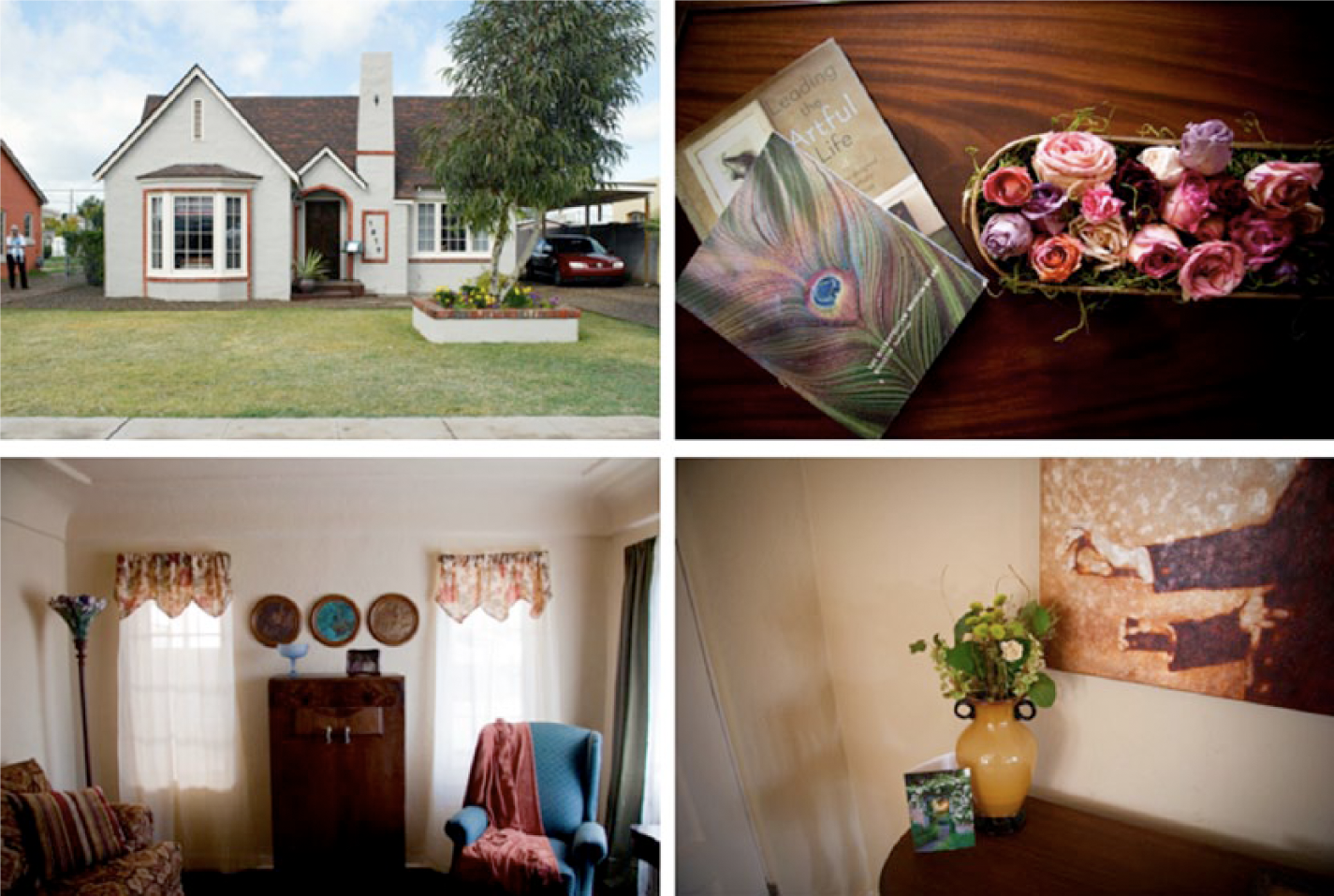
Terry’s Tudor. Photographs by Katie Lehman, 2010.
The artfully crafted, 1930s-ish atmosphere exuded by Terry’s Tudor exemplifies the ambiguities of historical and architectural authenticity in residential preservation. Terry’s historic inhabitation – lengthy and laborious practices of identification, protection, maintenance, repair, replacement, and retrofitting advocated by preservation guidelines – necessitates attunement to the lively materiality of remnants. Other than the 18 historic windows restored in accordance with preservation grant guidelines, almost every interior feature and furnishing underwent more creative transformations in accordance with sensual directives. The experience of one dresser aptly describes the tale of everything in Terry’s home.
This is a dresser from a burned down house that was completely ready for the garbage, and I completely restored it, lowered the drawer down, and made it a TV cabinet. And once I put the stain on it, it came to life. TVs weren’t a predominant feature back then so I didn’t want a big glowing TV in your face.
92
From artwork on the walls, to matching vintage pink glassware, to the 1930s DVD images circulating on a computer screen, Terry’s Tudor does, in some moments, feel exactly how it would have been in the 1930s. Or, at the very least, it feels achingly familiar and warm, like the copy of a copy it is: a 21st-century take on a 1930s American Tudor Revival that was made in the image of a British mid-1800s Mock Tudor, itself a reimagining of a medieval Tudor. Mimesis, asserts Michael Taussig, involves ‘copying or imitation, and a palpable, sensuous, connection between the very body of the perceiver and the perceived’. 93 This sort of ‘sympathetic magic’ attests to the power of sensory resonance across periods and places. 94
While the reach of preservation guidelines extends only to the visible exterior architectural features of the home, many residents, like Terry, reside here precisely because historic character radiates inside and out. The blurring of public–private domains is a central feature in historic districts where the very act of inhabiting a private home is a commitment to the public good. 95 Most notably, the historic home tour reworks inside-out notions in the public experience of touring private spaces (looking, touching, discussing). The Phoenix architectural preservation guide summarizes the essential rule (and paradox) laid out in the Secretary of the Interior’s Standards for Rehabilitation and Guidelines for Rehabilitating Historic Buildings: ‘the guidelines suggest that new work be architecturally compatible with and reflective of, though not necessarily imitative of, the original features’. 96 Worries of false historical appearance consume preservationists and historians; 97 they want a compatible copy, not an imitative one.
Committed to their house, not the preservation guidebook, residents have no such fears; atmosphere, ambience, and character are often best achieved by muddling boundaries between original, new, and the much loved old. Moreover, in closely apprehending the felt needs of a historic house and its materials, the house itself often reveals and dictates its own needs. Auratic objects not only return the gaze, they ‘speak’ affectively, without signs, symbols, or linguistic means.
98
‘The ruin calls the tune that the visitor is to follow’.
99
Despite the destruction and debris wrought by drug-using squatters in the near past, Terry sensed the kind of atmosphere his home wanted; it spoke to him, he said. Terry puts it this way:
This isn’t my personal style, the house dictated this, you know? I think when people see a 1930s house they’re kind of expecting for the inside to have that element, and so it’s almost like that gives it a character in and of itself. So, it’s not really about who lives there, it’s about the house.
What directives are given by remnants?
100
What does the remainder of an original oak wood floor or a burned, discarded old dresser decree? Save me. The practices arising from nostalgia and historic preservation are a symbiotic dance of search and rescue, lost and found. The remnant body (wood floor, old dresser) is resuscitated and rescued, and the human body experiences lost, longed for sensations. They press upon each other in a material exchange of wood grain and finger pads, and they part; Terry, more wood-like and the old dresser, more Terry-like – becoming historic:
I’ve gotten several comments from many people that have been in my house since [home tour] that they feel like it’s so comfortable. And I think that that has to do with the period of time that it was, probably an easier, softer, gentler time then. And since I’ve generated the [1930s] furniture everyone just feels so comfortable, and that’s great.
The ‘sensory connection between perceiver and artifact’, says Seremetakis, has ‘unintended historical after-effects’, 101 the senses are awakened, and their resonance supersedes other modes of knowing. Terry’s description of the 1930s as an ‘easier, softer, gentler time’ evidences nostalgia’s hyperbole; ‘the largely unexamined belief that things were better (more beautiful) (healthier) (happier) (more civilized) (more exciting) then than now’. 102 Undoubtedly erroneous at a factual, historical level, assertions like these arise from logic of the senses. ‘The movements that feel the grain of wood or the nap of fur are neither desultory and spasmodic nor preprogrammed and willful; they organize as they proceed’. 103 Immanence characterizes sensory attunement – ordinary things magnified becoming twinkling ‘marginalia’. 104
Aesthetic of pastness
Objectivity is commonly, but erroneously, attributed to distance. The view from afar is necessarily obfuscated. Rather than ‘seeing more clearly’, distance makes it difficult to see; details go undetected, features merge, and shadows loom. Nostalgic distance is illusory; imagination and somatic memory are at work. In this sense, history in Coronado is shallow; surfaces, not lines, of history are attended to. Untethered to linear history, nostalgic practice can be at odds with the historian’s agenda and the preservationist’s rule. Original features are the oft-cited merits of historic homes and their interior accessories, but they can be compromised in the quest for sensual pastness. As an assemblage of architectural remnants, each modified through the pragmatism and whimsy of multiple generations of inhabitants, it is impossible to limit Coronado to any singular narrative, history, or preservation code. Nostalgia, in the case of Coronado, speaks to openness, the ‘unfinished nature’ of dwelling. 105
To the dismay of some preservationists and historians, residents of historic districts continue to wield history and preservation as means to an end. And what is this end? The meaning of historic place is the desire for sensual experience. The nostalgic impulse to rescue historic objects, houses, and neighborhoods is a somatic impulse, felt receptivity to imperatives of a sensual world. Had Debbie’s house come with original, yet homely, metal doorknobs, she would have surely replaced them with glass knobs collected from other places and times. The sensory commands of glass orbs, for Debbie, supplant preservation concerns. She is not alone. Attempts to rationalize the sensate desires of Debbie’s doorknobs, Carah’s cathouse, and Terry’s Tudor under banners of history and preservation are inevitably exposed for what they are – sugarcoating, air brushing, romanticizing – an aesthetic of pastness.
Cleaving toward the ‘lightness of being’, 106 nostalgia enacts what Schwenger describes as ‘a precapitalist intimacy with things. Yet it is only in such a nostalgic return [distance] that this intimacy occurs’. 107 Nostalgia’s proximal sensibilities are obtained as a result of seeking to bridge nostalgic distance. To see a likeness in glass doorknobs and the mafia, rational thought is relinquished for heightened sensitivity to a suite of lost somatic sensations. ‘Sensory changes occur microscopically through everyday accretion’, writes Seremetakis, only reappearing ‘after the fact in fairy tales, myths, and memories that hover at the margins of speech’. 108 An enchantment with nostalgic distance heightens sensitivity to what Benjamin calls ‘the petrified unrest of things’. 109 In this way, acts of rescue, repair, display, and inhabiting history extend the nostalgic encounter to the everyday, as new subjectivities, new ‘styles of living’. 110 In the case of Coronado, historic homes furnished with domestic objects afford opportunity for engaging in a suite of urban ‘micro-movements’, 111 from tip-toeing around creaky floorboards, polishing silver, carefully cleaning uneven surfaces, to wondering how a particular architectural oddity came to be. In Coronado, somatic re-membering and re-imagining are cultivated (Figure 7).
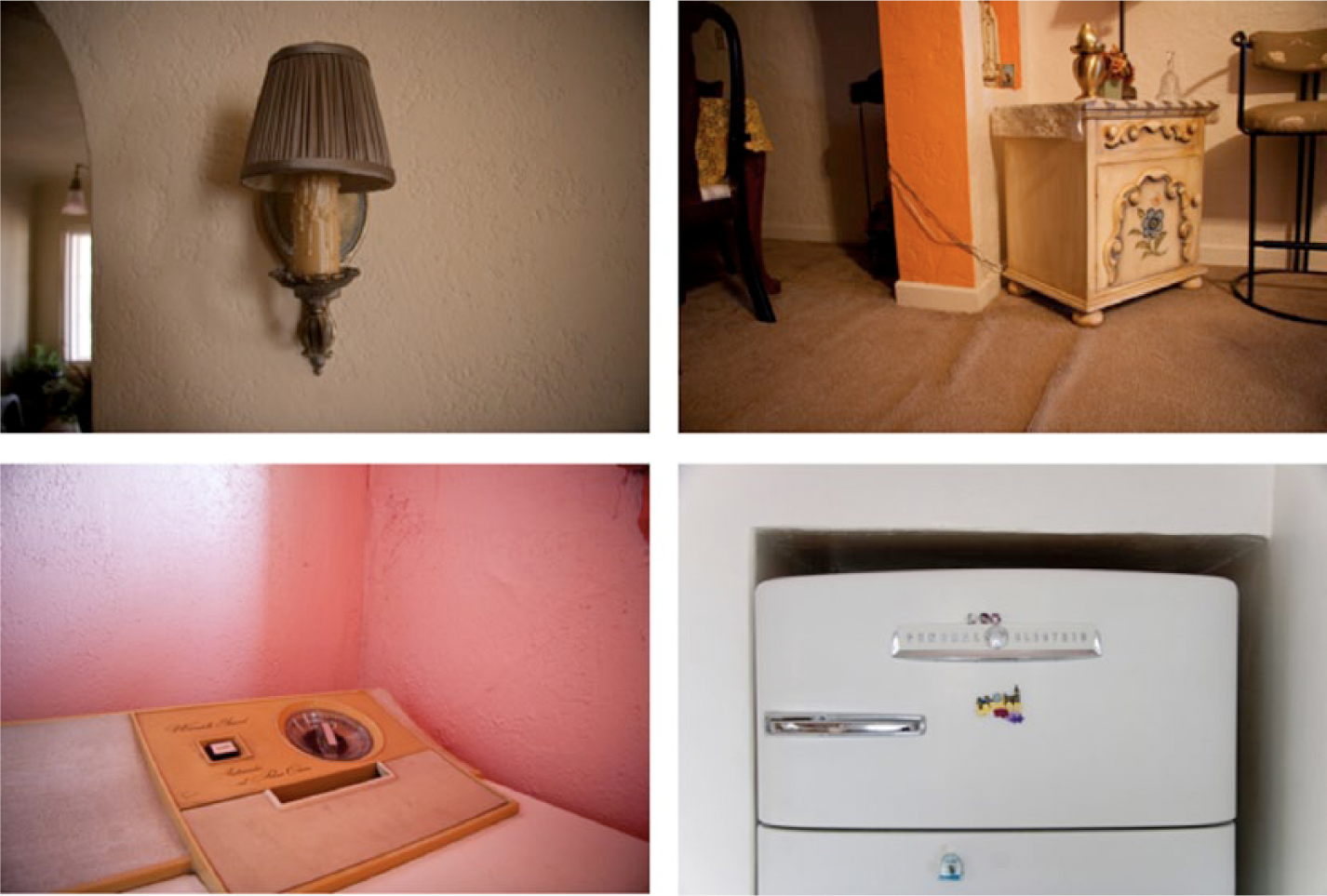
Twinkling marginalia. Photographs by Katie Lehman, 2010.
In supplanting historic linear logic and fact with what feels right – pastness over the past – Debbie, Carah, and Terry cultivate ethical dispositions toward objects, things, and place. Unreflexive and spontaneous response acquired through everyday bodily comportment and coping is the basis of embodied ethics. 112 Jane Bennett contends that a code of obligation and adherence is ‘still not sufficient to the enactment of ethical aspirations, which requires bodily movements in space, mobilizations of heat and energy, a series of choreographed gestures, a distinctive assemblage of affective propulsions’. 113 Ethical comportment, not a written code of conduct, is the basis for ethical subjectivities. Through recovery, refurbishing, and re-imaginings, an ethical disposition toward matter emerges. Love at first sight, loving restoration, and other amorous expressions push nurturing relationships between people and things. 114 ‘The disease of nostalgia is rooted in facets of our humanity whose “cure” would leave us deeply impoverished, even horribly mutilated’. 115 Historic homes pass through us, as we pass through them, ‘for a style’, writes Lingis, ‘is not something that we conceive but something we catch on to and that captivates us’. 116
Sense-making is at the heart of nostalgic practices in Coronado. Material relations in historic Coronado engender aesthetic sensibilities beyond rule-based preservation codes, toward the ethical consideration of other materialities. Preservation discourse often avoids the messy materiality of everyday historic habitation despite the fact that residents and visitors to historic sites repeatedly assert desires for nostalgic encounters, numinous experience, and sensual delight. The enthusiasm surrounding historic environs is pervasive, extensive, and often obsessive, as demonstrated in Coronado and in the work of Craggs, Geoghegan, and Neate on architectural touring. Such generative affective and emotional expressions arising from engagement with historic places, and the materialities (human and nonhuman) which they assemble, deserve attending to. Moreover, an enchanted comportment is integral in apprehending encounters of charm and uncanniness erupting and permeating historic practices; 117 one must first be ‘bitten’ to sense the possession in others. The intellectual logics of historic preservation are insufficient to apprehend sensual practices arising from such amorphous and ephemeral experiences. Our contention is that the nostalgic inhabitation of historic homes ‘makes sense’ as a form of enchantment, cultivating sensory attunements to historic materiality. Historic enchantment destabilizes fantasies of human mastery, affirming the ‘ethical insufficiency of the intellect’ 118 alone in creating meaningful places. Nostalgia and its effects reverberate in the delicate interstices between mindfulness and obsession.
Footnotes
Funding
This research was supported by a Graduate College Dissertation Fellowship, Arizona State University, held by Jennifer Kitson 2011-2012.