




Abstract
The tracks people leave behind in the landscape are more than mere imprints on the ground. They are traces that can work to shape peoples’ claims to particular spaces, both materially and semiotically. This article examines the ways in which such mark-making is caught up in contestations over the legitimate use of spaces deemed ‘wild’ and ‘natural’. It draws upon a mobile and video ethnographic study of walkers and mountain bikers in the Cairngorms National Park, Scotland, to explore how the marks made on the ground through outdoor recreation become caught up in struggles over appropriate ways to move one’s body in nature. Here, a process of informal zoning is identified whereby walkers belong in mountains but mountain bikers do not. Emerging from the analysis are the ways in which footprints and tyre-tracks are constituted and contested as ‘damage’ in relation to mountain spaces, and thus used to ascribe or distance culpability from different modes of mobility: walking versus cycling. Particular attention is paid to how such configurations serve as the grounds for excluding certain recreational users from particular outdoor spaces. This article thus identifies traces of movement, and the ways in which they are rendered ‘visible’ or ‘natural’ in talk, action and terrain, as key territorialising devices. In particular, a social and cultural treatment of the environmental impacts of outdoor recreation highlights how absence, as well as presence, of traces can be a powerful device for staking claims to space. The analysis also prompts a greater appreciation of the role of surfaces in constituting particular natures (such as mountains) as natural and wild, and how particular subjects, ways of moving and technologies are implicated, (de)naturalised and disciplined therein.
Keywords
Contesting the environmental impacts of different outdoor recreation activities
The first thing we need to accept is that mountain biking as a sport relies on erosion. Without the feet of past generations of walkers we have no trails to ride on. All evidence we have so far . . . suggests that a bike ridden ‘optimally’ causes no more erosion than a walker’s foot. So is riding a bike along an already eroded path abuse? Is the only way to respect a sensitive area to not visit it on a bike? Or not at all?
1
Mountain biking is a popular example 2 of increasingly novel and technologically innovative ways of moving one’s body in nature. 3 It is also practised in areas traditionally used for walking, 4 leading to tensions on a number of fronts, including complaints regarding speed, noise, ignorance, clothing, use of technology, modes of bodily encounter and environmental impacts. 5 Such material, performative and emotional traces 6 produced by riders generate a sense among other recreational users and land managers of mountain bikers as pollutants of nature. 7
One of the most hotly contested issues is the relative agency of different recreational practices in causing unacceptable surface erosion. This emerged as a key theme in the ethnographic study of outdoor recreation in the Cairngorms National Park, Scotland, from which this article draws. While erosion is often clearly materially manifested, the debate over acceptable versus unacceptable forms of erosion and by whom or what it is caused is inescapably culturally bounded. In this study, it became clear that the footprints and tyre-tracks left behind by walkers and mountain bikers were mobilised as key devices for differentiating the legitimacy of their claims to outdoor space and especially to uplands and other places considered quintessentially ‘wild’ or ‘natural’.
The effects of recreational practices on terrestrial surfaces are an issue of long-standing concern in outdoor recreation. 8 Iconic mountain areas such as the Cairngorms have often featured as particularly potent spaces in such debates, 9 with surface erosion, footpath widening and infrastructural development all identified as detracting from the wild land qualities that attract recreational use in the first place. 10 Yet, the debate surrounding the impacts of recreation has taken an extra twist as advances in mountain bikes have allowed riders to explore higher and rougher ground, raising the issue of whether mountain bikers belong in mountains at all. This article explores one of the key points of contention: what constitutes acceptable and unacceptable ways to leave one’s mark the mountain terrain through recreational practice. It is part of bigger questions of what counts as unacceptable environmental impact and how and by whom is it caused. 11
The relative impact of walking and biking on the ground has been the subject of a number of studies. 12 Yet, this research paints an inconclusive picture, often complicated by the web of non-human elements acting on surfaces, such as weather, geology, soils, gradients and vegetation. 13 The resulting ambiguity allows lay understandings and representations of environmental impacts to hold sway in shaping what constitutes the acceptable and unacceptable inscription 14 of trail surfaces. However, the debate on path erosion has tended to treat unacceptable environmental impact as no more than self-evident biophysical fact. As this article illustrates, surface inscriptions matter in ways beyond the ecological. Inscribing surface matter can help assert a moral claim to space, as when repeated footfall helps wear away a path which aids, invites and signals passage. 15 But, clearly, if such inscription becomes deemed ‘too much’, the ‘wrong’ kind, or in the ‘wrong’ place, legitimacy can be undermined. In this way, inscriptions become caught up in a wider politics of mobility. 16
Legally, too, constituting surface inscriptions as ‘damage’ can inform the boundaries of entitlement. In Scotland, outdoor access is underpinned by a principle of multi-use, which means that rights 17 apply to all forms of non-motorised practices, provided they are ‘responsible’ and ‘not causing unreasonable interference’. 18 This includes not doing ‘damage’ to the environment and taking ‘proper account of . . . the features of the land’. 19 Where and with which mode of mobility subjects can move is left purposely fluid, with emphasis placed on adapting practices to the conditions or circumstances as required to fulfil the condition of ‘responsibility’. This framework contrasts with the a priori spatial segregation of many other models of outdoor access, such as those found in England, Wales and North America (e.g. footpaths for pedestrians, bridleways for horse riders and cyclists). Nevertheless, some extra geographical considerations are highlighted for areas of Scotland that are particularly ‘sensitive’ and ‘natural’, for example, riverbanks, loch shores, blanket and raised bogs and mountains tops. To underline their sensitivity, a moral language of ‘damage’ and ‘natural’ is employed. 20
The human inscription of surfaces is an inescapably social and cultural construction, 21 although outdoor recreation scholarship has often failed to see it as such when attempting to describe objective measures of ‘impact’. Recent work in geography has drawn attention to the importance of surfaces as constellations of material and semiotic enactments, 22 caught up in broader contestation over how bodies, technologies and spaces become configured in ethical relations. 23 Some of this scholarship looks at how surfaces are inscribed by outdoor activities such as running and walking. It elucidates the role surfaces play in making movement meaningful, 24 as well as the complex relations of ephemerality, presence and absence existing between inscriptions and inscribing practices. 25 However, unlike their counterparts in urban studies – who address the spatial politics of surface inscriptions such as graffiti 26 – many of these authors leave implicit the consequences for how space is claimed beyond the urban sphere. I contend in this article that valuable insights can be made if we extend the debate surrounding recreational impacts to how surfaces and their inscriptions are mobilised in situated, power-laden ways to delineate spatial practices.
This article is therefore considering forms of recreation as contested inscribing practices which inform moral geographies of acceptable ways of moving and being in particular spaces. Taking heed of Anderson, 27 we need to examine how the coming together of multiple traces involves surface inscriptions being interpreted, translated and put to work by different mountain users in the making and taking of place. This includes traces left in hearts and minds as well as those sculpted in the dirt; the traces asserting and resisting prevailing spatial orderings. This entails investigating how traces left on the ground by different subjects are enrolled and made visible (or not) in talk, action and terrain and how this works to assert or resist culpability in generating unacceptable environmental impact. Mountains may be thought of as rock-like and solid, timeless and unchanging in their wildness and naturalness. But examining the threat the surface inscriptions of mountain bikers pose to purified outdoor spaces foregrounds how precarious – and sometimes paradoxical – a cultural accomplishment it is to sustain mountains as wild and natural 28 and the great efforts powerful actors make to maintain fictions of them as pristine and untouched.
Contested mountains and the territorialising practices of surface inscription
Doing mountains naturally
Mountains have long engendered a mesmeric thrall in the western imagination. Connotations of high places may have changed over time as different people have sought to enrol, order and ‘fix’ them in particular ways, yet ascriptions of the characteristics of purity, wildness and naturalness, have proved to be particularly durable. 29 Recreational practices are typically informed by the quest to experience such special qualities, with mountains widely regarded as the epitome of all that is natural and wild. 30 Accordingly, there has been much contestation over the most ‘natural’ ways to do mountains recreationally, with questions of technology often centrally implicated. 31 Different people set different limits of what constitutes an appropriate enrolment of technology in the body–environment relationship – for example, whether it is acceptable to use a helicopter to access remote mountains for snowsports 32 or whether or not climbers ought to place permanent or temporary gear into a cliff face to protect them if they fall. 33 But often underpinning these boundaries are notions of certain human or technological presences as polluting a pristine and natural nature. 34 Such boundaries require notions of a nature as ‘other’ to the social or technological, which is a fiction if we accept that ‘there is no sense of nature, of human subjectivity, of the body . . . that can effectively be thought outside of, or separable from, ever more technologised societies and social relations’. 35
Of critical importance, then, is where and how such boundaries are drawn, how such fictions are accomplished and with what effects. For example, the ‘natural’ way of ascending Everest is held to be without the use of supplementary oxygen, 36 despite the fact that numerous other technologies are used unquestioningly. Thus, some technologies become problematised as conduits for the ‘illegitimate transposition’ between categories such as urban and wild, 37 while others become so mundane that they are easily overlooked, as Michael underlines in relation to walking boots. 38 He describes how ‘ironic spatialities’ can be produced when dichotomies such as natural–unnatural or rural–urban are simultaneously enacted and collapsed, as technologies become selectively visible in complex and contradictory enrolments. 39
Implications for territorialisation
As with any fixing of nature, the bounding of mountains in relation to particular spaces, qualities, people and things is not only a relational achievement 40 but also a political device. 41 For example, configuring ‘wild’ in contrast to ‘domestic’ or construing certain spatial practices as ‘natural’ or ‘unnatural’ are active and precarious accomplishments. 42 It involves not only purifying the characteristics of spaces but also purifying subject categories in ways that enable or disenable those subjects in territorialising those spaces. 43
How we constitute mountains as particular purified natures matters because it shapes the way we can engage with them. 44 For example, invoking mountains as wild, pristine and ‘fragile’ environments or areas of ‘ecological conscience’ 45 works to position them as places we ought to protect. Likewise, seeing various outdoor recreation practices as particular ways of doing nature cannot be separated from bringing specific natures (e.g. the countryside) into being in particular ways (e.g. unspoilt). 46 Therefore, a key implication for outdoor recreation is that by working to make and keep mountains pure, certain ways of engaging with and laying claim to those mountains can be deemed polluting or be naturalised. So, we must pay attention to exactly how bodies, natures and technologies become configured and privileged as different recreational users seek to enact their rights of access.
When it comes to contestation surrounding path erosion, it is helpful to think of the traces of boots and tyres as just one of many kinds of traces that come together in the making and taking of mountains as a particular place. Traces thus conceived are ‘marks, residues or remnants left in place by cultural life’, 47 which are not only material visible marks (e.g. signs, statues, buildings) but can also be manifested as practices, emotions, thoughts, memories and non-visual sensations. Traces, however, are never neutral and must be interrogated in terms of how and for whom they have meaning and significance and how they shape the claiming of space in a variety of ways. 48
Traces relating to the inscription of surfaces can be a particularly effective territorialising device. On one hand, inscriptions made in mapping and law – materialised as, for example, fencing or cultivation, title deeds or legislation – have facilitated practices of land appropriation for hundreds of years. 49 Indeed, the aesthetic power of an array of surfaces continues to be harnessed in the service of commodification and ownership. 50 On the other hand, surface inscriptions also work to territorialise in ways that transgress prevailing legal orderings, as demonstrated clearly in relation to graffiti as a way of inscribing and laying claim to the city. 51 By symbolically and literally taking place through discernible and relatively durable surface inscription, ‘graffiti defiantly issues a challenge to the question “whose place is this?”’. 52 In this politics, the role of space is crucial. 53 The spaces with which such inscriptions are constituted – and their legal and moral orderings – are pivotal in whether they are considered in place or ‘out of place’. 54 Thus, surface inscription becomes tied up with questions of identity and difference, subjectivity and belonging, 55 where particular social groups are sanctioned to leave marks in the landscape, while others are not. 56
Marking surfaces through outdoor recreation
Practices of outdoor recreation, and walking in particular, have been identified as forms of ‘territorialising process’ 57 and examples of ‘embodied and mobile expression of claims to place’. 58 The powerful symbolic work done by the act of walking 59 often goes hand in hand with the material work of inscribing the ground, which if done repeatedly, creates and sustains the assemblage of matter that we know as a ‘path’. 60 Movement produces marks and deformations on surfaces and over time, this can create ‘a desire line through the landscape: the force and weight of bodies, and traction of boots, wearing away ground vegetation, even creating areas of soil erosion and slippage’. 61 Such traces, therefore, shape the lay and texture of the land that are ascribed significance, and make motion meaningful, in the act of recreation. 62 The condition of the ground may be interpreted and translated pejoratively (e.g. as erosion, damage, wear and tear) or more positively as a form of ‘terrestrial attachment’, such as that arising through sensations of ‘the runner’s passionate exchanges with the ground beneath’, 63 or the mountain biker’s haptic reverie of surface texture. 64 Either way, how the terrain looks and feels is central to how recreationists ground their experience.
Coupling and decoupling movement and its mark
The creation of imprints and traces in the ground is never a superficial matter; it always implicates practice, as well as non-human agency. 65 An important corollary is that attempts may be made to infer aspects of movement or practice from inscriptions, flagging the need to pay critical attention to the relationship between knowing and imprinting. However, it is possible for inscriptions to become decoupled from the movements and practices through which they were created. 66 The transient nature of movement can lead to the privileging of form over process, 67 and such obfuscation of practice is consequential in struggles over landscapes. 68 When the work of making a mark on ground (e.g. workers planting crops) is subordinated to the product of the imprint left in the surface (e.g. neat rows of produce growing), ‘the former is hidden from view so that the latter alone becomes an object of contemplation’. 69 This already underscores what a challenging, political and potentially contentious act it is to try to ‘read’ practice from morphology. 70 But it is complicated still further by the mutability of surface morphology, which means that the original impression made by a moving subject can be altered or obliterated by the vagaries of the elements, according to the biophysical qualities of soil, geology and vegetation and cumulative use. 71
The natural–cultural politics of surface inscription
Ingold 72 indicates that the visibility of material inscriptions is important due to the possibility of decoupling movements from their traces but does not expand too far on what the political implications might be or precisely how such visualities might matter. Furthermore, the focus of research on paths in outdoor recreation has, to date, been largely biophysical and uncritical in terms of the territorial function of surfaces. Drawing insights from work on the spatial politics of urban inscription, 73 I assert that more needs to be known about the ways in which the inscription of surfaces are witnessed, interpreted, translated and mobilised beyond the urban sphere and in relation to various mobilisations of ‘nature’. This means looking in particular at how surfaces and traces become actively associated with or distanced from specific subjects, practices and spaces and the consequences for the traces and trace-makers considered in and out of place.
In this regard, it is useful to draw upon an emergent debate in geography that has begun to explicitly and critically consider surfaces not only as earthly material interfaces between particular substances, bodies, technologies and environments but also as complex, multifarious zones of exchange where such materialities become entwined with representations, sensations and affects. 74 This work flags up that surfaces do work to make and remake spaces in particular ways: ‘Surfaces work in many different ways, and they require effort – scholarly, activist, or otherwise – to look beyond them, to try to demystify their fetishistic qualities and unpick their aesthetic effects’. 75 My quest here, therefore, is to better understand struggles over terrestrial surfaces by examining what constitutes acceptable and unacceptable ways to mark mountains through recreational practice.
Approach and geographical background
The article is based on material collected from ethnographic research conducted between 2006 and 2012, which examined the contested practices of outdoor access and recreation in Scotland in the wake of major legislative change (Land Reform (Scotland) Act 2003 Part I conferred and clarified rights of outdoor access for all non-motorised forms of mobility). The main focus was walking and mountain biking in the Cairngorms National Park (see Figures 1 and 2) and adjoining areas within the north-east of Scotland.
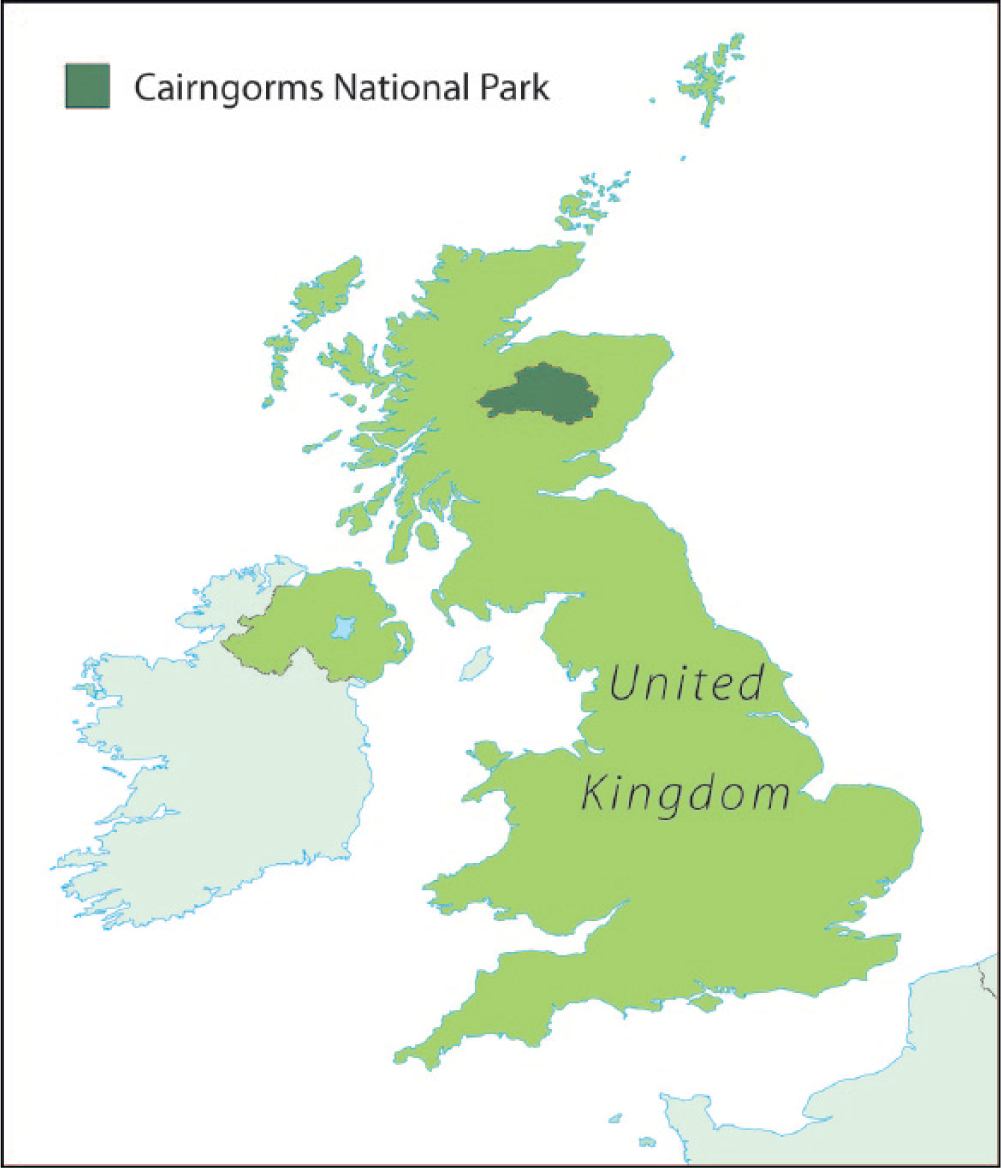
Location of the Cairngorms National Park.
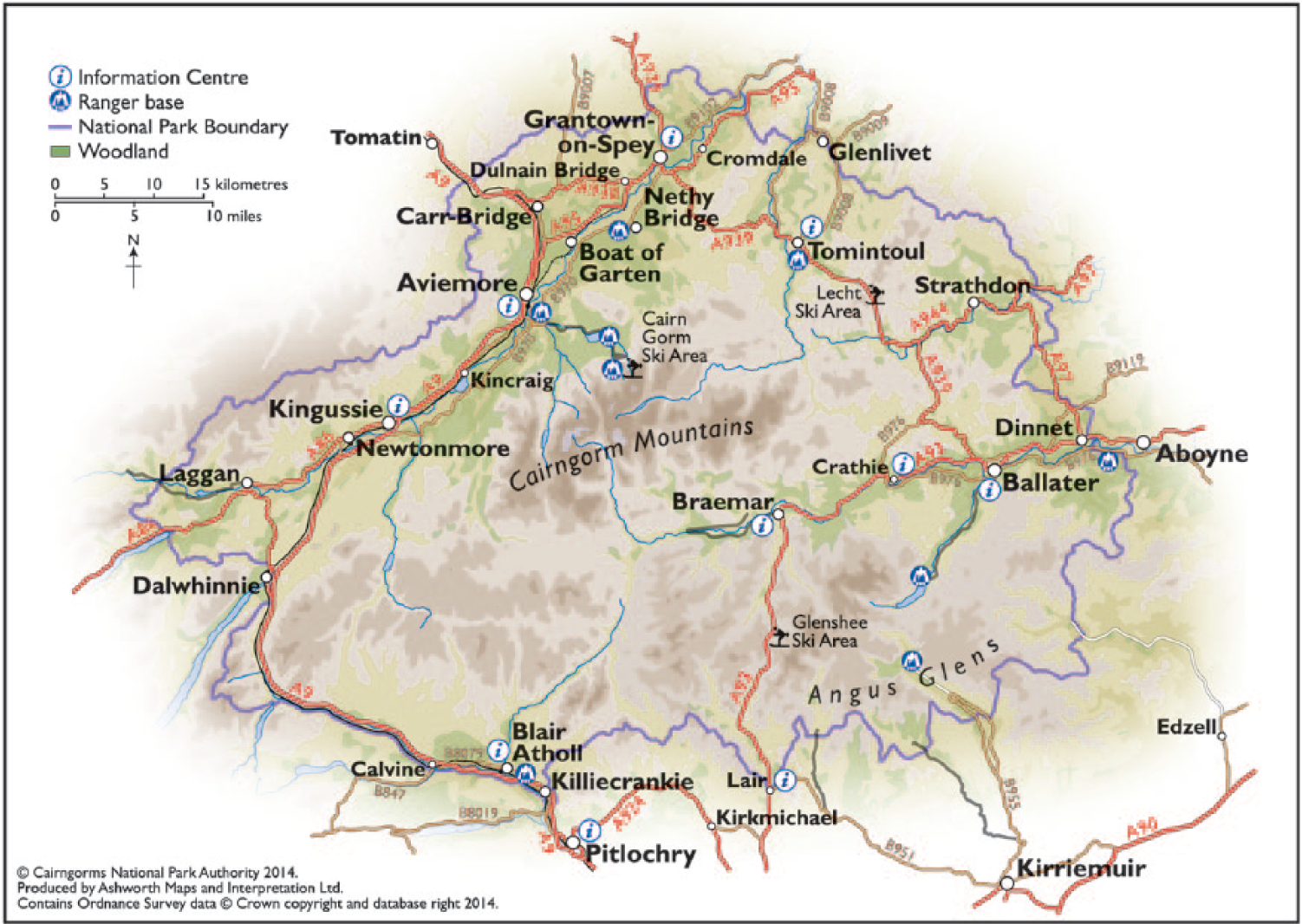
Location of mountain areas within the Cairngorms National Park.
The Cairngorms National Park covers 4528 km2 and features a wide range of habitats, including cultivated fields, pine forest, moorland and mountain plateau, much of which is considered of international conservation importance. 76 The largely granite high mountain area is the dominating centrepiece of the Park – 36 per cent of the Park is over 800 m and includes the largest continuous area over 1000 m in the United Kingdom, numerous ‘Munros’ 77 and five of its six highest peaks 78 – with vegetation cover, including areas of alpine health, blanket bog and nutrient-rich rocks, important for a variety of plant, bird and insect species. 79 The mountains are well renowned as destination for outdoor recreation, with its wild qualities acknowledged as central to its appeal and sense of place. 80 Outdoor activities have increased in popularity in recent decades, providing a substantial proportion of employment opportunities locally, although generating tensions in the process, including ‘erosion of paths, and associated problems of the impact on the landscape and damage to vegetation’. 81 These problems are felt to be particularly acute with regard to the plateau area given its sensitive soil and vegetation. 82
The approach taken in this study included the use and development of techniques of mobile ethnography and video ethnography. The aim was to interrogate the practices of walking and mountain biking in situ with the researcher doing the practices together with participants, in order to give agency the places and modes of mobility under scrutiny in the generation of knowledges about them, and the attempt to capture the more-than-verbal dimensions of participants’ engagement with human and non-human others. 83 First, we conducted 10 audio-recorded ‘go-along’ interviews, informed by the ‘walking with’ techniques increasingly employed in geography 84 and, in the case of mountain biking, adapted to become ‘ride-along’ interviews. In a second phase, we enrolled head-mounted video cameras (minicam or ‘headcam’) into the research encounters with 17 walkers and 17 mountain bikers. 85 Mobile video ethnographies were conducted in three key stages: a pre-outing, semi-structured biographical interview, a walk or ride outing where the participant would wear a head- or helmet-mounted minicam video camera and a post-outing interview in which the unedited audio-visual recording was used as prompt to in-depth discussion. The third component was analysing fieldnotes and verbatim transcripts from observation of the quarterly meetings of the Cairngorms Local Outdoor Access Forum (LOAF or ‘the Forum’) between 2006 and 2011. In analysing the material, 86 the aim was to identify themes emerging from attending to, and coding for, the discursive and bodily practices of participants. Particular attention was paid to the relationship between the often taken-for-granted doing of the recreational practices (as witnessed by the researcher and the camera) and the differently situated ways talking about them (before, during and after the outing) 87 and trying to understand something of the thoughts, feelings and meanings surrounding those practices.
The role of surfaces in the differential territorialisation of outdoor recreation practices
All the recreationists and land managers in the study generated a strong sense of the appropriateness of mountain biking being normatively bounded in relation to higher ground (denoted variously as ‘uplands’, ‘mountains’, ‘plateau’ and ‘the high ground’), whether reinforcing or resisting the prevailing ordering that mountain bikers are out of place in mountains. Such moral geographies were evidenced in a number of ways.
Mountain biking polluting mountains
Gordon, a member of the LOAF and walker, spoke passionately at a Forum meeting to convey his feeling that ‘mountain bikers have no business on the plateau’ 88 and was met with nods from all but one of the other Forum members (comprising walkers, mountain bikers and land managers). The thrust of this discussion was repeated again in several meetings, including one with mountain biking access as its main agenda item. 89 Many individual participants too, even regular mountain bikers such as Paula, 90 refrained from mountain biking in mountains and felt others should do the same, stating, ‘I would have a huge issue if you were taking your bike up onto the Cairngorm Plateau’. In common, they had a notion of a certain point of a journey into the hills – with increasing elevation and remoteness – beyond which they felt bikes should not be ridden.
Some identified distinct locations en route where they would or have made conscious decisions to ‘bike here but walk there’ (Chris). A few mentioned that a bike could ease the drudgery of the notorious Cairngorm ‘long walk in’ 91 but be jettisoned where the track became narrower (Duncan). While some felt they should not even stray beyond forest tracks onto open ground (George), most found it difficult to describe the boundary as if a line on a map. Rather, such bounding was more notional, knowable more through fragmentary real and imagined examples of transgression and implied in relation to a number of moral axes. Some of these moral axes are dealt with elsewhere, such as problems surrounding bodily encounters between walkers and mountain bikers 92 and associations of mountain bikers with ignorance and delinquency. 93 Here, I expand on the role of surfaces and negative impacts upon them, which was repeatedly articulated by participants as grounds upon which the legitimacy of mountain biking in mountains rested.
Doing damage
A central issue was the prospect of mountain biking doing damage to mountain surfaces or at least more damage than established users. Regarding people riding round the rim of Lochnagar, one of the iconic peaks of the eastern Cairngorms, Sarah says, It’s going to be doing more damage than possibly walking I may be wrong on that but that’s my perception of it . . . [ . . . ] . . . I’ve got no evidence whatsoever, but I just feel places like that isn’t, isn’t really what mountain biking, or in my view, is.
Others echoed her positioning of mountain biking as an agent of terrestrial harm – or at least greater harm than walking – articulated variously and pejoratively as ‘wear and tear’ (Gavin), ‘erosion’ (Alan) or ‘damage’ (all participants) to the ground, in ways that worked to disqualify or demote it as a legitimate way of producing upland spaces (e.g. for Sarah riding on this mountain is not what mountain biking is). Some participants, including Sarah, often began their indictment of mountain biking in relation to the Cairngorms in particular, or a specific peak in the Cairngorms, but often by implication extended their logic to apply to all higher ground. The Cairngorms in particular have been extensively articulated in relation to environmental fragility and damage, in large part due to the struggles surrounding various ski developments, 94 and often participants invoked similar discourses.
Indeed, some accounts deemed mountain biking transgressive in relation to notions of the fragility of mountain surfaces. One mountain biker explained her refusal to ride in mountains in terms of the terrain’s vulnerability to ‘damage’, underlining that ‘Once you hit seven hundred metres you’re getting into an environment that’s a lot more fragile’ (Paula). Others concurred
95
and underlined the point by contrasting mountain surfaces with those of purpose-built mountain biking trail centres,
96
which they portrayed as robust: ‘the trails like Glentress . . . [ . . . ] . . . you can’t really damage them’ (Fiona). Some thought mountain biking acceptable as long as on a ‘proper’ path, which was assumed to peter out the higher up or further into the hills one goes. This was expressed most clearly by Sarah: I would sort of cycle in as far as you could to point of, you know, you’re still on path, a track whatever, but once that runs out I just sort of think, you know, this is the time you leave the bike rather than sort of saying we’ll still try and go along here.
Although it was often less clear precisely what participants meant by a ‘proper’ path. For some, it was a path that was ‘maintained’ or ‘managed’: biking on a maintained trail, fine. It’s just that wear and tear, well it can ruin natural trails. (Duncan) mountain bikers should be nowhere near the high ground . . . [ . . . ] . . . I don’t mind them if they just stick to managed paths . . . [ . . . ] . . . [but] not in the hills. (David)
Underlying assumptions that cropped up in these and other participants’ accounts 97 were that the further and higher into the hills one goes, the less maintained and managed the tracks are and the more natural the trail surfaces are.
Sometimes, the softness or the hardness of the ground was invoked as part of judging whether particular terrain was suitable for riding over. One walker said, I wonder whether mountain bikers should be on natural trails at all. They’re just too soft to hack it . . . [ . . . ] . . . well maybe it’s OK in the forest, where the big forestry machines are going to carve it up in the end anyway . . . [ . . . ] . . . but not up in the open ground. (George)
For the riders who did, or were prepared to, ride on the Cairngorms plateau, the surfaces – even if natural – seemed firm and thus robust (see, for example, Figure 3).
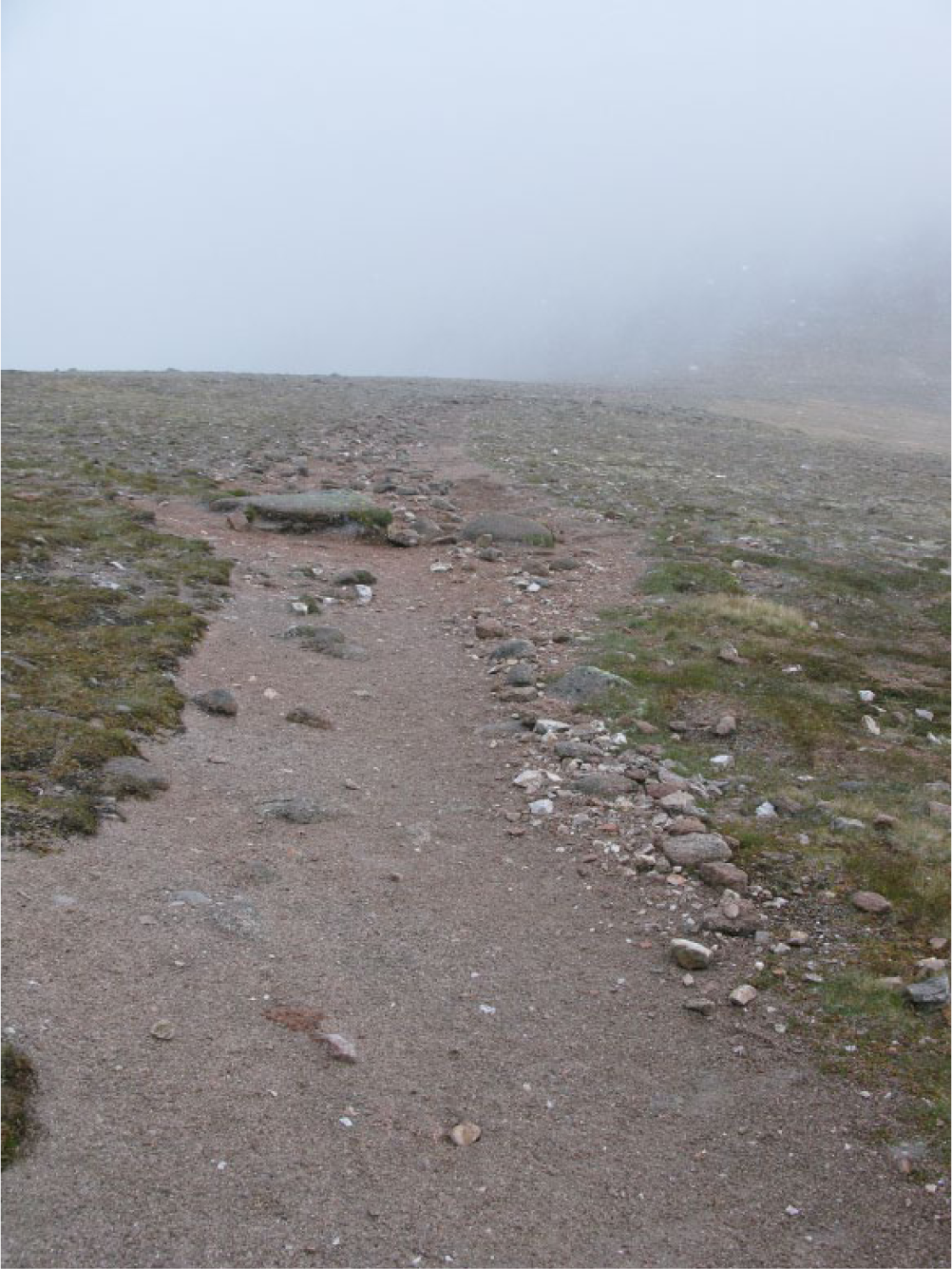
Path and surrounding surfaces on the Cairngorms Plateau.
Sam, for example, explained why he was comfortable with cycling there: I know some people don’t like it, but . . . all the rock and gravel, even where the path disappears, well that’s all the trail centres are made of, rock and gravel. It’s hard wearing. You can always walk around any boggy patches like you would when you’re walking.
For him, hard terrain signalled acceptability because it was strangely reminiscent of the surfaces found at purpose-built mountain biking facilities. The Cairngorms have heterogeneous surfaces made up of mosaics of shattered rock, thin soil and peat bogs, 98 making them softer in some places and harder surfaces in others. Sam illustrated how the decision to change between cycling and walking modes within an outing could depend on such changes in surface quality. Observations of the other mountain biking participants getting off and on at particular points showed that they too recognised and responded to this, although some of them questioned whether they would actually do less damage by riding their bike on the path straight through the middle of a boggy section, rather than make the boggy section wider and wider by getting off and walking round. 99
Sensing and signalling environmental damage
For most participants, the inappropriateness of mountainous biking on the grounds of surface damage was signalled visually: just from evidence walking around, seeing the evidence on the ground that some mountain bikers obviously don’t get off and walk when it is way too boggy and you are harming the bog and you can see that the tyres have gone through. (Chris)
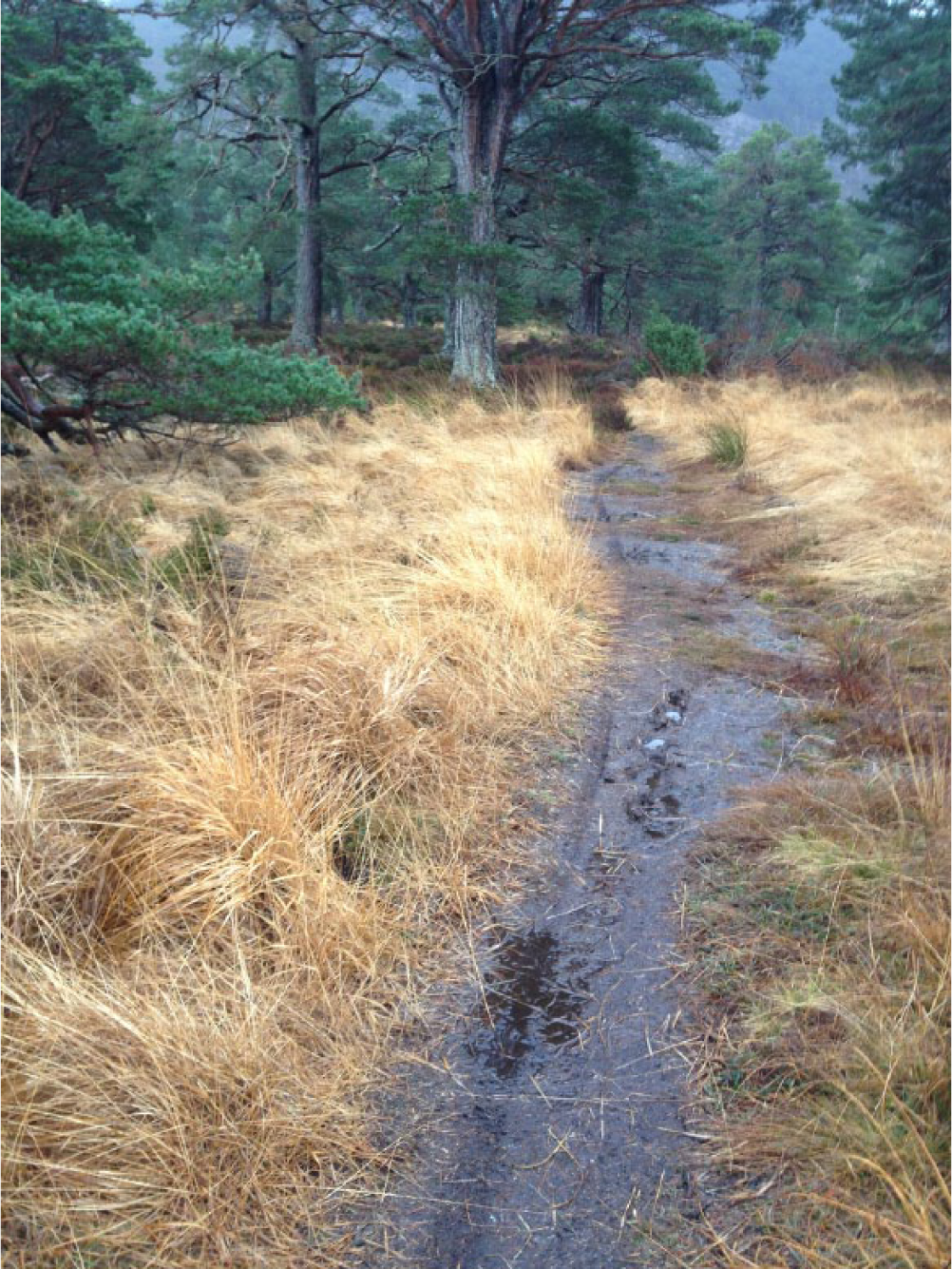
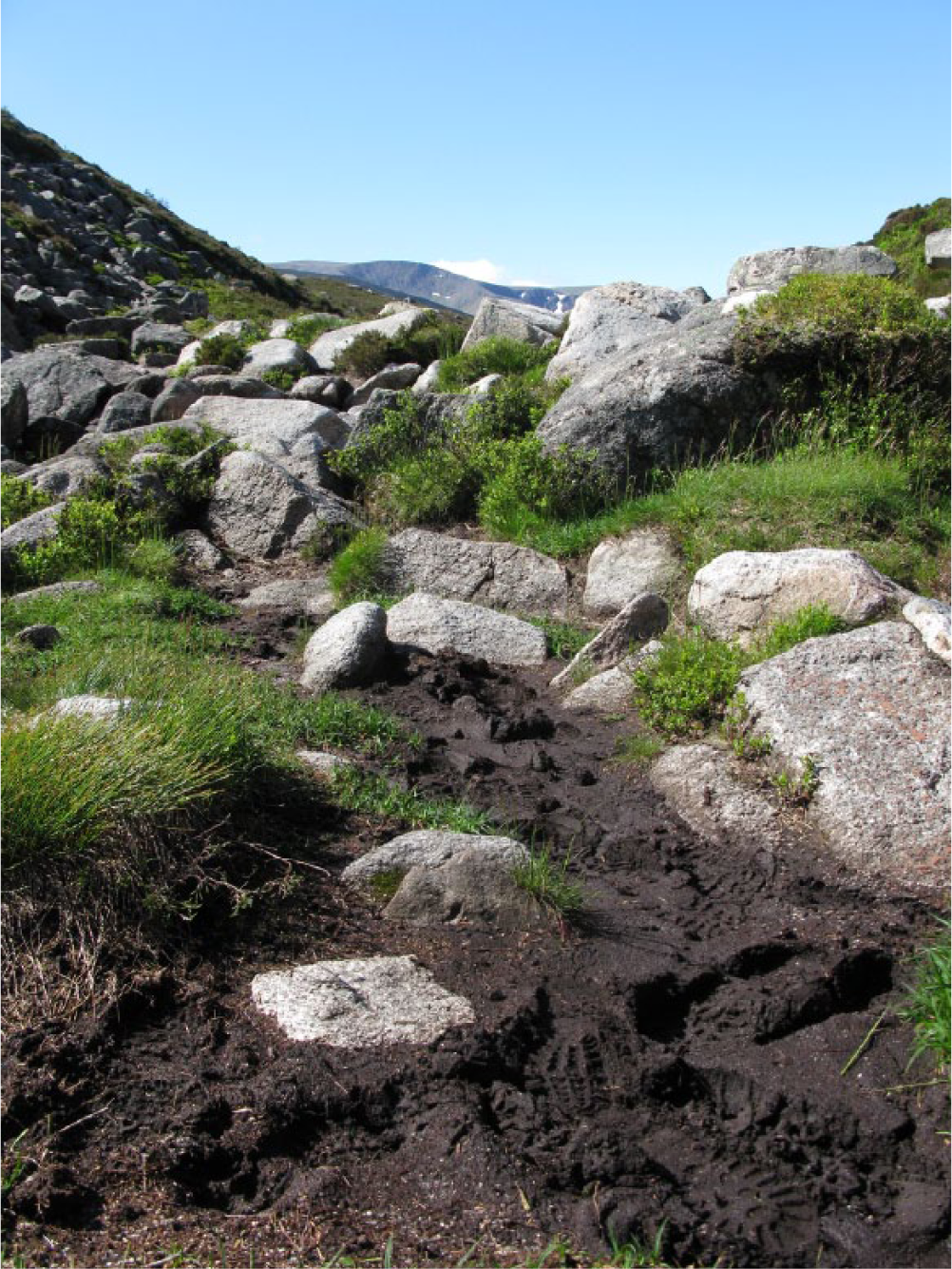
For Chris, avoiding inscribing tyre-tracks into these soft sections was the main reason he chose not to ride his mountain bike in mountains. Sometimes in the muddy morass of areas considered damaged, especially in comparison to indistinguishable amalgams of countless footprints (see, for example, Figure 4), other participants too found individual tyre-tracks especially conspicuous and remarkable (see, for example, Figure 5). To some, they were troubling in that their patterned regularity and linearity smacked of mechanic modernity of the city. One walker mentioned ‘all the straight tracks . . . [ . . . ] . . . it promotes erosion and, you know, it just seems odd, with this nature’ (David), while another (Geoff) stated simply that ‘a bike is a machine’ and, while comparing it to the Cairngorms Funicular, felt that ‘there is no place for them in these wild places’. Gordon felt it to be an unwelcome reminder of the urban realm: ‘seeing those [bike] tracks carved into the ground, well it’s just like the town coming in [to the countryside]’. One participant, Andrew, suggested an element of irony in that, without the erasure or distortion of footprints through sheer volume of walking traffic, the traces of mountain biking took on a greater visibility. This made it easy to ascribe them greater culpability in causing damage, even if the reverse were true.
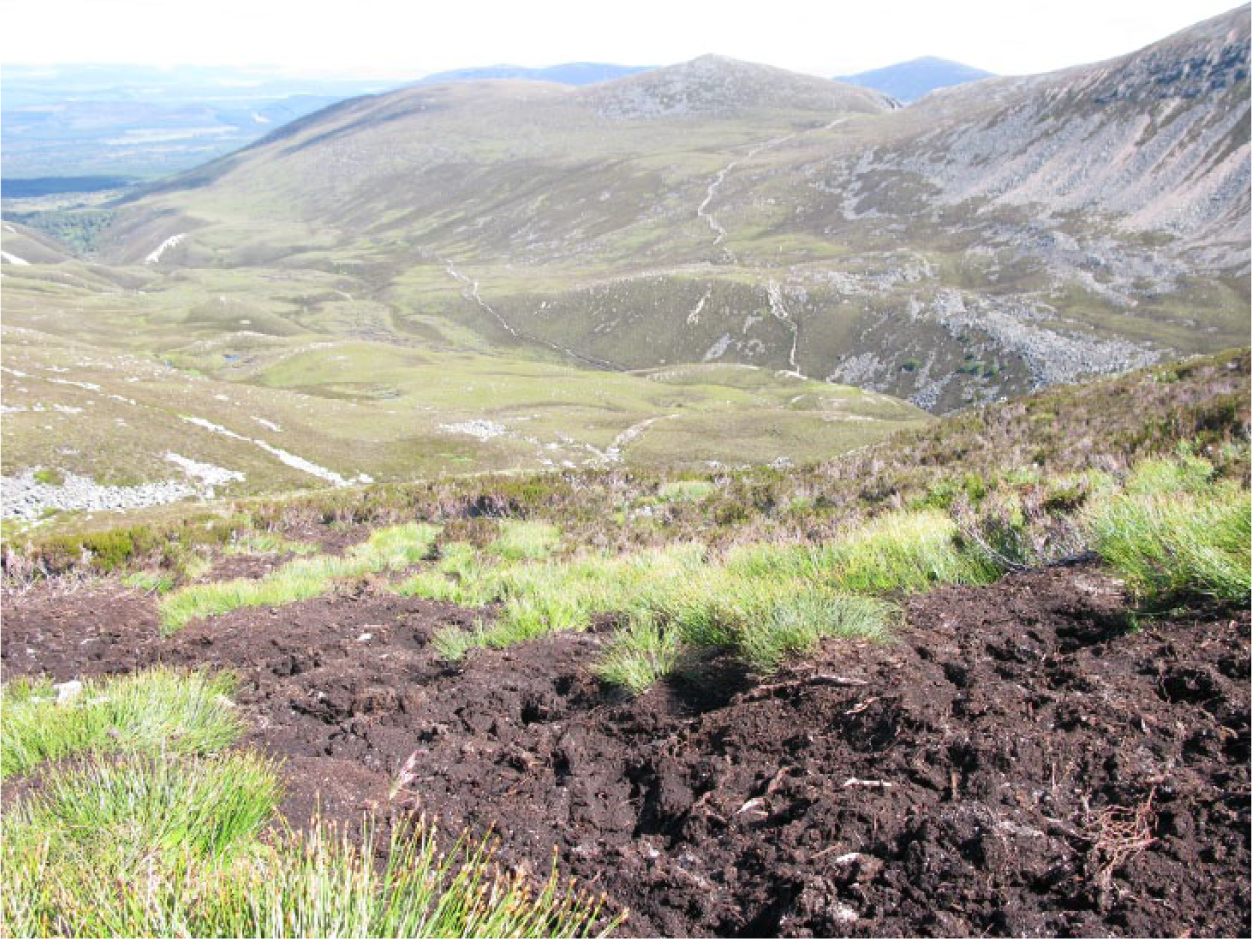
Main path up Braeriach.
Mountain bike tyre tracks.
A terrestrial transgression could also be signalled by the somatic sensation of cycling over particular surfaces. Sarah did not like feeling the softness of the terrain while riding and the possible effects upon it: ‘you know you’re chewing up through, or you feel like you’re chewing up through’. Another echoed this, when he said while riding through a soft, muddy section of trail ‘ooh . . . not good . . . shouldn’t really be . . . not really happy about, well, cutting the trail up like this’ (Dean). Other participants articulated similar notions of ‘feeling bad’ while leaving a trace, 100 showing how bodily feelings of inscription became conjoined with feelings of guilt. These feelings can be understood as the ‘short-lived moments of bodily misalignment’ that Gordon Waitt et al. identify as the sensory troublings that shape contours of belonging and harbour territorialising potential. 101
Leave only footprints
It was notable that imprinting surfaces in similar ways on foot did not generate any discernible comparable piquing of sensual and ethical registers; even though in some outings we were traversing terrain in which we were perceptibly cutting through the ground with our boots (see Figure 6).
Footprints.
As Jon and I walked through a soft peaty section on our return journey that we had cycled through on the way out, I asked whether he felt as guilty walking through it as he had riding through it. He replied: no . . . no. You know I really don’t . . . [ . . . ] . . . I guess I don’t mind with on foot. But I know the tyre-prints, you know, if you leave tyre-tracks it makes the ramblers go a bit ballistic and they try to ban you.
It seemed he was worried as much about how the traces left behind would look to others as about the environmental impact itself. Similarly, Rob explained while watching the video footage of his ride shown in this clip <http://youtu.be/Tj0tMF76G6c>
102
the vexation of knowing the right thing to do: I know if I went round the edge of the soft bit, you would never know I was there, but, like, if I go through the middle – like you are officially supposed to – then there is a tyre-track for all to see.
Again, it was the thought of what tyre-tracks would signal to walkers that engendered the greatest affective response. Crucially, there seems to be no similar fear among participants that their walking traces would be leveraged as an argument to exclude walkers. It was taken for granted that it was an infrastructural issue rather than the grounds for prohibition: Sometimes the path, there are lots of feet and it’s getting in a state . . . then they need to do something about it . . . get the boys in to do some repairs. (George)
In the instances where pedestrian traces were discussed, it was noted that people tended to talk about ‘feet’ and ‘footprints’, not boots or bootprints. Footwear, as a core technology with which imprints and impacts were created through the act of walking, was notable by its absence. This was also true of other technologies such as GPS or Gore-Tex that had been enrolled in most of the walking outings. This stood in stark contrast to the regular mention of tyres, wheels and bikes. 103
Disrupting naturalisations of mountain surfaces and subjects
However, the prevailing moral orderings did not go untroubled. The associations made between recreationists and the traces of recreation were complicated by uncertainties, ambivalences and contradictions, in a number of ways. At times, participants made tangible the possibility that walkers create as much, or more, negative impact on mountain surfaces than mountain bikers. For example, in a previous quote, Sarah wavered in her surety that mountain biking was more damaging, acknowledging that her perceptions of the issue ‘may be wrong’. Paula too acknowledged an element of doubt: it would be tough to argue that you were doing any more or less damage than the hundreds of pairs of feet that were going up there. I don’t know if that’s right or wrong, it feels wrong, and that’s why I’m not really into it but I don’t argue that from a factual base. It’s just more of a personal feeling.
They seemed to grapple with a disjuncture between the feelings of transgressing norms of acceptable surface engagement and their ability to mobilise ‘factual’ or scientific knowledges to substantiate them.
Some of the mountain bikers openly resisted the notion that they cause greater erosion problems than walkers. One begrudged ‘bikers just being scapegoats’ (Ben), and another conveyed his umbrage at mountain bikers being singled out for particular blame, saying how he resented: walkers complaining that mountain bikers wreck the paths, the quality of them, ‘cause I know as a walker, when you go walking on Munros in the Cairngorms or whatever, you’ve got loads of walkers and it’s wet and it’s muddy. Walkers all start walking next to the path and the path gets wider and wider . . . walkers can destroy a path just as easily as mountain bikers do. (Henk)
Other riders entertained the possibility that mountain biking has more surface altering potential but continued to mountain bike in upland areas nonetheless on the basis that it causes no more damage overall due to the greater prevalence of walking practices: I suspect that mountain biking does more damage, but you’ve got that against the fact that there are more walkers than mountain bikers, so like while one bike will probably do more damage than one person, in reality that, you’ve not got that one to one ratio . . . [ . . . ] . . . so the two things sort of cancel out. (Fiona)
Framing the issue as a ‘numbers game’ is an effort to redistribute to walkers the culpability typically assigned to mountain biking practices. It works by diverting judgement away from individual imprints of particular modes of mobility and towards their collective impact. The implication of participants using this logic was that if entitlement to mountain spaces were allocated on the basis of cumulative surface ‘damage’, then it would be walking rather than mountain biking that would have to be curtailed: ‘walkers make a mess, but no-one’s saying ban walkers’ (Jon).
Furthermore, some participants raised the possibility that biking is not necessarily damaging just because it takes place on the high ground, for two reasons. First, it was highlighted by some participants that many upland paths were actually highly engineered and therefore more robust than commonly assumed. After Paula’s universalisation of mountain biking as too damaging for the ‘fragile’ high hills, she then seemed to contradict herself, stating: I’d be really uncomfortable seeing a mountain biker at the top of Ben McDhui but it would be entirely possible to ride a bike up there, and actually with very minimum harm, because you could take a path from the car park at Cairngorm, up to the Cairngorm summit, down over the plateau and you’re not really going to be causing any damage. (Emphases added)
In this, she conceded that the extensive pathworks in the area had made the surfaces more hardwearing. Others too countered the naturalisation of upland paths by making the material constructedness and hardiness of upland paths highly visible in their accounts and, moreover, mobilising such engineering as something to be appreciated: I’m aware they [mountain bikers] destroy it [the ‘natural’ surface], but it is really good all the work that has been done to make the paths better so that they are much more weather resistant. It is amazing the engineering they do with all the canals for drainage and everything. (Henk)
The work that reinforced surfaces did in making code-compliant ‘responsible’ access much more achievable was acknowledged, for example, in wet conditions where one ‘can worry less about doing damage’ [Tom]. However, a ranger for the area noted that the intentionally naturalised appearance of engineered trails in the plateau area had the perverse and unintended side effect of making it very difficult for recreationists to discern and keep to the official path. The worry that traces of use might be spread over wider areas found justification in the study material which indicated that users kept to paths where obvious, but that ‘sometimes it’s tricky because they just blend in’ (Scott).
Second, some participants made space for the possibility that the damage bikes do in particular areas depend on precisely how and when they are ridden. Riders in the study acknowledged the need to ride differently (e.g. ‘sensitively’, Paul) in mountain areas. The legitimacy of riding in mountains tended to be qualified in various ways, as Ryan does with respect to curtailing group size and frequency of visit: I wouldn’t go frequently onto the plateau. I wouldn’t necessarily take a big group up onto the plateau or things like that.
Other specific measures mentioned by participants included avoiding skidding, avoiding certain routes after heavy rain, avoiding widening the path by riding through the centre of puddles and dismounting for stretches of soft peat. They echoed Sam when he emphasised the variety and changeability of mountain surfaces and how it required judgement in planning and executing the ride, ‘exactly where I go . . . [ . . . ] . . . [and] how I ride, like where I choose to get off or just go back . . . [ . . . ] . . . totally depends on the conditions’. Alistair concurred while bringing walking back into the picture by stressing that whether you are walking or biking, if ‘the going gets too bad’, the answer is ‘short term, avoid it. Longer term, repair it’.
Framings of inscription also emerged in which erosion and damage were not necessarily seen as negative. In the LOAF meeting in which one man cited the upland erosion and path damage as a reason to exclude mountain biking, another man resisted this territorial claim by reconfiguring such inscriptions as a ‘good thing’. He highlighted their evidencing of demand for outdoor participation, urging the others to remember that it ‘means people are actually going out there and using the hills’. 104 He stressed that in society’s current predicament regarding health and the rural economy, ‘we should be delighted’ for any such evidence, even if currently manifest in the ‘damage’ of paths. For him, ‘erosion’ was ‘still something we may have to respond to’ but that any response that lessened demand rather than improving infrastructure would be ‘rather perverse’.
Mountain surfaces – untouched or untouchable?
In the moral order prevailing in this material, walking and mountain biking are not considered equally acceptable ways of moving over high ground, even though legal orderings 105 purport them to be so, insofar as they are ‘responsible’. Surfaces and remnant traces of particular modes of mobility inscribed into them emerge as a key moral axis along which the normative boundaries of environmental damage are drawn. Mountain bikers are often cast as inevitable destroyers of the terrestrial fabric of mountain areas, with tyre-tracks positioned as transgressive in a way footprints are not. Anderson discusses how traces ‘function as connections, tying the meaning of places to the identity of the cultural groups that make them’. 106 The findings here underline how such connections between traces and trace-makers are fluid and contested. The erosion or damage 107 of paths can be pejoratively constituted as matter out of place. Yet, as this study shows, not all surface inscriptions are implicated and considered unacceptable in this regard. Rather, the imprints and desire lines etched into surfaces through the passage of boots, and tyres became mobilised in different, spatialised ways in relation to erosion and damage. What counted as unacceptable inscription in relation to mountains mattered because ‘damage’ done to surfaces by walking and cycling as inferred from terrestrial inscriptions was used as a basis for adjudicating claims of entitlement to perform mountain spaces in those ways.
After Nandrea and Anderson, 108 we can ask what tyre-tracks and their contested configuration tell us about mountains, the sense of place attached to them by different users and thus who belongs there. Exposing the contingencies upon which mountains are fixed and given apparent stability is the first point to note. Struggles over the visibility, feel and appropriateness of particular inscriptions are simultaneous struggles over the appropriateness of walking and biking as particular ways of inscribing. Selectively stabilising configurations of surfaces and ecologies described as ‘damaged’ with mountain bikers and walkers requires enrolments of bodies, boots, tyres, terrain, not to mention the weather, soils, plants, rock and gravel of the high ground, to be dis/connected, highlighted and denied in particular ways.
First, mountains and their surfaces are brought into being – in talk, action, feeling and terrain – in ways that emphasise their naturalness and fragility. Both walkers and mountain bikers were found to articulate the Cairngorms – and the plateau in particular – through established categories of a pure, delicate environment that requires defence from unacceptable erosive recreational practices. 109 Implicit here were hints of the ‘leave no trace’ ethic that is well established in outdoor recreation management. Such ascription of mountain surfaces with qualities of damageability becomes a powerful territorialising device when co-configured with judgements of how damaging or otherwise a particular form of subjectivity is.
Second, mountain-going subjectivities are made differently visible in relation to surfaces. On one hand, mountain biking subjects, bicycles and the traces they make are constituted predominantly as pollutants to the purity of mountains. On the other hand, walking subjects are constituted as more natural, non-contaminating and outside the realms of threat or damage to surfaces, which renders their belonging in mountains immune to questioning. Participants tended to notice and remark upon tyre-prints and position them as unacceptable inscriptions, while footprints were often conspicuous by their absence, discursively and affectively, if not always materially. On certain fieldwork outings, footprints were visible in the same places as tyre-tracks, but only tyre-tracks were present in related discourse.
Technologies implicated in generating environmental impacts can likewise be selectively visible, as can be seen in the prominence bikes-in-nature have in contrast with Michael’s ‘boots-in-nature’. 110 Rendering the surface traces of walking (along with the technological enrolments of their creation) invisible, and thus natural, in this way enabled mountain biking to assume prominence as ‘the damaging one’. Where walking inscriptions were made visible, they were typically rendered unproblematic in ways resonant of the other common recreation management ethic, ‘leave only footprints’. Crucially, they did not work to preclude the whole mode of mobility of walking from mountain areas, merely as a prompt to infrastructural intervention, in marked contrast to mountain biking.
Predominating moral contours were not only discursively realised but materially and affectively rendered. Tyre-tracks, like graffiti, evoke an ‘affective process that does things to writers’ bodies (and the bodies of onlookers)’ as much as to surfaces. 111 Some participants found the sight of traces of biking upsetting because they disrupted an established (and decidedly rural, wild and untouched) sense of place. Tyre-tracks and bicycles seemed to broadcast the incursion of technology and the straightened, rolling, mechanical signifiers of machinic efficiency and other such connotations of the urban that such people are trying to escape in mountains. Embracing objects positioned as overtly urban, artificial or technological, and accepting their traces, would seemingly risk constituting the Cairngorms as a domesticated rather than a wild and natural nature. It was therefore untenable, and also explains the desire to obscure the urban and technological dimensions of walking, as the hegemonic and long-established mode of outdoor recreation.
Furthermore, we know that inscription is a sensual practice in more-than-visual ways, 112 and it was clear that normativities of unacceptable damage were differently embodied. For example, the sensual feelings of inscribing (e.g. kinaesthetic sensations of ‘chewing up through’) became evocative of certain emotional feelings in ways that were clearly different for different modes of mobility. For mountain bikers, the sensation of inscribing the ground was embroiled in guilty feelings of ‘touching’ a nature that is supposed to be untouched. Yet, participants marking surfaces on foot conveyed no similar affect or perceptible moments of bodily misalignment 113 or dissonance with embodied notions of how responsible access should feel. This raises issues of how ‘audiences are imagined and experienced’ 114 by the inscribers of the surfaces of mountains. The mountain bikers seemed to anticipate and dread negative judgements from those witnessing their traces; the walkers did not.
The materiality of mountain paths and surfaces was also implicated in signalling fragility, robustness or damage and in suggesting culpability in causing damaging traces. The way participants’ words and experiences became configured with surface softness or hardness was one example, especially as softness or high ground often became conflated with natural surfaces. The overall rocky, gravelly, hard and durable way in which the Cairngorms present themselves to some people, allowed a forgetting or overlooking of the soft or otherwise fragile dimensions of the mountain surfaces. Peat bog sections, for example, were conveniently forgotten by some until encountered. And what looked to some riders like the hardwearing gravel of a purpose-designed mountain bike trail on the Cairngorms plateau is actually considered part of a unique, sensitive and delicately balanced sub-arctic alpine ecosystem of international ecological importance. 115 To users, surface hardness thus signalled a hardiness not corroborated ecologically. Such environmental impacts were simply not as sensually discernible to participants there as on the softer surfaces where impressions being made could be bodily felt and readily seen.
To complicate this, however, mountain surfaces may not always be as fragile and natural as prevailing discursive and affective relations imply, especially when pathworks have been carried out to engineer a surface more resilient to recreational use, as in many mountainous areas of the Cairngorms. It seems that the design of paths to look natural feeds into their discursive naturalisation and combines to sustain notions of mountains as natural. This can help to prioritise access and belonging for pedestrian users, as here where a number of participants deemed mountain biking practices acceptable as long as they were confined to a ‘proper’ or ‘maintained’ path. Yet, such paths were not associated with higher ground and, rather, were assumed to ‘run out’ the further or higher one travels into or up mountains. The active coupling of mountains with fragile, soft, ‘natural’ or ‘unmanaged’ surfaces by some participants, and playing down the possibility of their robustness (as foregrounded by others), thus worked to universalise mountain surfaces and in turn render mountain biking practices in mountains illegitimate.
However, these prevailing moral boundings could be disturbed and resisted. Henk’s was one of a number of accounts that in foregrounding numerous footprints and their cumulative impacts, 116 reinscribed the possibility of walking as a (and perhaps the most) damaging activity, and worked to deny walkers impunity in surface inscription, or at least disturbed notions of mountain biking as the only or major source of destructive agency. The way the material agency of surface processes could obscure footprints, and thus, the culpability of walkers, was also exposed. The more footprints had morphed and congealed into undifferentiated coalescences of surface matter through repeated imprinting, compacting and weathering, the more scope there was for the kinds of slippage between inscription and practice highlighted by Ingold. 117 With it grew the political possibility of selectively disassociating and re-associating particular modes of mobility. Just as mountain bikers could be condemned by foregrounding the distinct and recognisable individual imprint, a key mode of resistance was to move attention away from the individual imprint to the collective impact of many inscribing walking bodies.
Some also raised the notion that mountain biking does not necessarily harm mountain surfaces, for two key reasons. First, riders like Sam and Ryan made visible some of the contingencies of doing damage (e.g. route choice, line choice, mounting and dismounting, weather conditions, frequency, group size). This made space for the possibility of mountain biking being performed with regard for the specificities of particular surface types and conditions in relation to damage. 118 Making space for greater dynamic co-agency of human and non-human processes here aligns with Ingold’s critique of western notions of inscriptions as imposition ‘of conceptual form upon material substance . . . [as if] . . . imprinted upon the substrate of external nature’. 119 A refusal to see mountain surfaces and paths as fixed or given but instead requiring ongoing judgement and negotiation disturbs prevailing assumptions of a universalised (damaging) mountain biking subject engaging with a universalised (fragile) mountain surface.
Second, even some of the participants resistant to mountain biking in mountains granted the possibility that it may not actually be that damaging due to the robust surfaces of engineered paths increasingly found there. Giving visibility to engineered path infrastructure highlights an irony in the prevailing relationality between recreational practices and harm, in that it both exposes and ruptures a conflation of mountains with untouched, natural and universally soft or fragile – and therefore untouchable – surfaces. The possibility of mitigating infrastructure also links to the point made most forcefully by a LOAF member, but echoed by Henk and others, that damage does not have to be a ‘bad’ thing, whoever causes it. Their counter-position portrays damage as a mere indicator of the need to invest in pathworks, and that restricting access to prevent damage misses the point that outdoor participation is a greater good that does not need to be foregone. This not only unsettles the idea of mountains as pure, untouched nature but also questions whether untouched mountains and surfaces are even desirable.
Conclusion: the case for recreational–relational ecologies
Mountains are often considered self-evidently natural and untouched. 120 For all their apparent timeless, substantive presence, however, mountains construed as natural are revealed as a surprisingly precarious accomplishment. Mountain biking emerging as a new claimant to mountain spaces threatens this fiction and thus renders it visible. Through transgression, a prevailing moral geography transpires in which mountain bikers, ironically, do not belong in mountains. 121 This allows us to examine one of a number of ways in which the enrolment of moving bodies and technologies with particular spaces becomes normatively circumscribed. 122
What is especially interesting here is how terrestrial surfaces become mobilised and normatively encoded in conjunction with the making and remaking of particular natures and, in so doing, serve as an important device through which the spatial ordering of mobility is done. Mountain biking is considered an affront to the purity and wildness of mountains in part because of the traces it leaves behind, which are considered damaging to fragile mountain surfaces, or at least more damaging than walking traces. In the absence of expert knowledges that can definitively arbitrate relative impact, it is lay knowledges that hold most sway in the ensuing contestation.
McAuliffe and Iveson stress the importance of considering critically how presences and absences are used to link mobile subjects to the traces made on the ground. Likewise, my study foregrounds how such configuring of trace and trace-maker lays the ground for spatialities of inclusion or exclusion. The slippage between inscription and inscribing practice made possible by the ephemerality of traces of movement 123 – generated and complicated by the liveliness and the vagaries of the elements and the land itself 124 – opens a contested space in which the re-coupling of ‘damage’ with particular mobile subjects is up for grabs in the process of territorialisation. Attention to footprints and tyre-tracks helps us better understand their selective problematisation and its consequences: how matter and meaning become enmeshed to signal unacceptable environmental damage, how culpability in producing damage is coupled and decoupled with different modes of bodily and technological engagement and how this shapes the moral and legal legitimacy of particular subjects to make spatial claims. It also prompts interrogation of what Anderson might call more-than-material ‘“trace-chains” of things, activities, emotions and contexts’, to see how they work to appropriate particular natures. 125
Participants ascribed walking in mountains greater legitimacy by mobilising surfaces together with physical, discursive and affective relations in three key ways. First, they worked to constitute the surfaces of Cairngorms as natural, fragile and pristine. Paradoxically, the massive efforts to materially engineer the surfaces of mountains seem to be matched only by efforts to obscure their engineered-ness. Second, walkers did not assume the same prominence as pollutants of mountains as mountain bikers. Rather walking tended to be naturalised as its traces and technologies (e.g. boots, sticks, GPS, Gore-Tex) were rendered invisible in discourse and bodily affect, if not always materially. Mountain biking bodies, traces and technologies were denied this naturalisation and hence were easily positioned as incompatible with ‘natural’ mountains. Even where acknowledged, walking traces were conceived as evidence of the need to repair the ground, not as reason to prohibit walking subjects from mountains, as often asserted regarding mountain bikers. Third, the materialities of surfaces themselves informed processes of selective naturalisation. Surfaces helped to configure natures that were differentiated by how ‘untouched’, damaged or damageable they were by presenting qualities of hardness or softness or by obscuring or preserving particular imprints.
Such selective mobilisations of surfaces and the tools of their inscription enable mountains to be sustained as natural while allowing belonging solely for walkers. These are examples of ironic spatialities, 126 whereby natural–unnatural binaries are mobilised in contradictory ways to make technologies and traces selectively visible in relation to particular places. Some participants reframed the higher ground as comprising complex and dynamic surfaces, subject to an array of contingencies; from biophysical processes to particular ways of enrolling bodies, equipment and engineering infrastructure. In so doing, they disrupted the dual naturalisation of walking and mountains by exposing the underpinning universalisation 127 of subjects, surfaces and spaces. Likewise, when mountain bikers were repositioned as capable of making judgements in relation to these shifting affordances, impact was then construed as dependent on precisely how one mountain bikes not just where. A clear distinction was made between mountain biking as a generic mode of mobility versus a form of situated, responsive mobile subjectivity. Some participants also attempted to make walking visible as a/the most damaging mountain use. As they struggled to shatter notions of mountain surfaces as universally fragile and mountain bikers as singularly and universally damaging to them, they complicated the fixing of subjects with particular terrains and with ascriptions of fixed agency in causing ‘damage’.
This article thus highlights that there is an important cultural as well as biophysical dimension to the path erosion debate. Indeed, a case can be made for re-centring recreation ecology debate away from its traditional applied focus to an approach embracing relational–recreational ecologies. Through this lens, mountain surfaces, paths and tracks are understood as hybrid assemblages encompassing bodies, technologies, matter, inscriptions, movements and affordances, whereby connections between traces and trace-makers can be highlighted or obfuscated in situated, power-laden ways.
Accordingly, questions are raised for outdoor access management, such as what makes traces of outdoor recreational use unacceptable and ought it be the surfaces or the trace-making practices that change in response? If the solution envisaged involves modifying surfaces, two fundamental issues arise regarding for whom particular surfaces and paths exist and for whom and by whom ought they to be made and remade. Mountains are often articulated as needing protection, 128 but precisely which inscriptive or ‘damaging’ practices mountains need protection from are crux points of contention. Likewise, changing practices could involve encouraging responsiveness to the contingencies of specific areas (i.e. access on basis of appropriate judgement of conditions). But it could equally entail the prohibition of whole modes of mobility. If the latter, decisions would have to be made about whether to prohibit the modes of mobility deemed to cause most negative impact per individual or those associated with greater negative collective impact.
These insights also contribute to an emergent debate in geography which explicitly and critically considers surfaces as configurations of semiotic, as well as material, exchange. By connecting this work to the politics of mobility, we can see not only that surfaces do work to make spaces in particular ways 129 but also that they are critical to how subjects embodying different forms of movement and technology negotiate moral and legal claims to space. Identifying the ways in which traces of movement are made differently ‘visible’ or ‘natural’ foregrounds the political implications of the fluidity between trace, trace-maker and the discourses and feelings that associate or create slippage between them. Building on Ingold, 130 we see that any attempts to generate knowledges of mobile practices from the inscriptions left behind – such as attempts to ascribe and resist culpability in causing ‘damage’ – are complicated by the temporal and cumulative effects of myriad forms of human and non-human agency continually reworking the terrain.
The selective forgetting of practices or technologies creating particular traces can act as a powerful territorialising device, as shown by the naturalisation of walking (but not mountain biking) traces and technologies in mountains. But by exposing it thus, the seemingly self-evident relationship between surface inscription and knowing – between damage and culprit – is problematised. This prompts us to pay critical attention to the cultural as well as material constitution of any form of unacceptable environmental impact and more specifically to interrogate how traces are mobilised in relation to particular subjects and natures. It is not always just a case of how touchable a nature is, but who is allowed to touch it and how. The need to look critically at any simplified ascription of complicity in generating unacceptable environmental impact is thus underlined.
Tyre-tracks can be understood as horizontal graffiti in that they are a terrestrial form of surface inscription that unsettles established visions of who belongs; in this case who belongs within particular natures. 131 In these contested geographies of inscription, traces work – and are re-worked – in struggles to bound how movement is both authored and authorised, 132 which requires consideration in more-than-urban realms. However, unlike graffiti, 133 tyre-tracks (and indeed footprints) tend to be unintentional surface markings. They are felt by some to be the regrettable, but to a degree inevitable, side effects of outdoor participation. Indeed, in contrast to other traces such as graffiti, fences, cultivation, statues, flowers and broken windows, which signal appropriation by their prominence or conspicuousness, recreational imprints work differently to claim space. In a moral economy where environmental damage matters to entitlement, it is the absence and invisibility, not presence, of traces that confer most legitimacy. Surface inscriptions work as inadvertent and undesired by-products as well as purposeful markers of identity or territoriality, depending on how they are mobilised and made legible. This article thus shows that traces can work in subtle and complex ways to claim space, operating through the disavowal and erasure of traces in discourse and embodied experience, if not always in the surface matter itself.
Future research might consider other domains of nature politics in which spatial claims are (or could be) based on the ascription of absent or minimal environmental impact to particular subjects. This could include examining how traces, trace-makers and the technologies they enrol are made sense of and made (in)visible as contaminants of particular spaces, and what the consequences are in terms of territorialisation or management response (e.g. whether to manage through excluding subjects, changing their behaviour or changing the material qualities of the environment). There is also scope to explore issues of how environmental impact becomes entangled in questions of identity and difference and how it might matter whether individual or collective impacts are made most visible and possible complications and obfuscations, such as when more use makes individual markers of use less legible.
Footnotes
Acknowledgements
I am hugely grateful to Justin Hopper and Gunhild Setten for the comments and insights they fed into the writing process. I also extend sincere thanks to Kirsty Blackstock and the three reviewers who provided extremely useful feedback on the manuscript.
Funding
This research was funded by the Scottish Government’s ‘Environment – Land Use and Rural Stewardship’ Research Programme, 2006–2011.