



Abstract
In an era of increasing access to digital technologies, Indigenous communities are progressively more able to present sophisticated and differentiated narratives in order to maximise their long-term survival. In this article, we explore how Indigenous communities use participatory video and participatory photography as tools of Indigenous media to enhance, adapt and/or reinforce their collective social memory. This social memory is key for identity formation and self-representation, and the ways in which Indigenous representations are performed promote particular interests and worldviews to the local, national and global scales. Working with the Makushi and Wapishana communities of the North Rupununi, Guyana, the current social memory ‘in use’ was surfaced through the participatory video and photography process led by the Indigenous community. Through an iterative process of analysing images (photos and video clips) and text (written material, narration and spoken word), we identified key narratives of the communities’ social memory. We show how communities provide different messages to different actors through the way they use participatory video and participatory photography, revealing how self-conscious multiple identities shape differing purposes. We suggest that our ability, as non-Indigenous stakeholders, to perceive, appreciate and act upon these more complex and nuanced narratives is critical to help address environmental governance in a rapidly changing social–ecological context.
Keywords
Introduction
As Indigenous communities around the world face increasing acculturation, the homogenising effects of globalisation and changing environments, they are confronted with the dual challenge of maintaining their cultural distinctiveness while engaging with the conventions of the dominant society and modernity. These tensions are particularly acute in Amazonia, where global imaginations of lush untouched tropical forest inhabited by immutable Indians belie the complex and diverse groups of people who live in the region and their interactions with their natural environments and one another. 1 As Laurel Smith points out, 2 ‘the global politics of local identity rely upon shared images of custom, community, and ethnicity, and though these may be marshalled in defence of cultural resources, they may also be reactionary, and deeply gendered, classed, and racialized’ (p. 89). At the same time, this intimate link to tropical forest environments and associated territories through ‘place-belonging’ 3 and ‘strategic essentialism’ 4 is also frequently used by Indigenous groups seeking legitimisation of territorial claims and related resources. This symbolic use of place identity as a means of authentication can be particularly relevant in cases where Indigenous peoples successfully control media images 5 and thus self-representations to a wider national and international public. Indeed, Sarah Radcliffe shows how official representations of Indigeneity in Ecuador often remarkably overlap with Indigenous groups’ representations of their struggles for place and identity. 6
Jackson and Warren 7 argue that in Latin America, the appropriation by Indigenous peoples of ‘non-Indigenous’ tools, such as video and photography, has been used by state actors to challenge Indigenous claims or marginalise their movements through ‘a process of freezing, and reifying an identity in a way that hides the historical processes and politics within which it develops’ (p. 559). This fixation and objectification of Indigeneity in time and place becomes heightened when there are conflicts over resource extraction and development interventions on Indigenous territories. For example, McCreary and Milligan 8 describe the ontological politics of Carrier Sekani protests against a proposed pipeline system for delivering diluted bitumen from the Alberta tar sands to the Pacific coast of British Columbia, Canada, passing through tribal lands. They show how the reification of Indigeneity in environmental governance threatens to continue traditions of colonial dispossession and suggest that Indigeneity should be better understood as an iterative becoming over time, instead of an essentialised being stuck in the past.
Indeed, a large element of becoming is linked to complex sets of local knowledge which have in most cases grown from changes and influences over time and generations.
9
Borrowing Tim Ingold’s words,
10
what ‘excavations into the formation of knowledge have revealed is not an alternative science, “indigenous” rather than Western, but something more akin to a poetics of dwelling’ (pp. 25–6). Indigenous knowledge is not in opposition to modernity. As Agrawal
11
points out, What is today known and classified indigenous knowledge has been in intimate interaction with western knowledge since at least the fifteenth century. In the face of evidence that suggests contact, variation, transformation, exchange, communication, and learning over the last several centuries, it is difficult to adhere to a view of indigenous and western forms of knowledge being untouched by each other. (p. 422)
Indigenous knowledge is not only varied and evolving, it is also a dynamic response to changing contexts of situated agents, 12 where people are actively engaged in the production, acquisition and transmission of knowledge ‘which occurs in cultural, economic, agroecological, and sociopolitical contexts that are products of local and external processes’ (p. 275). 13 Similarly, ethnicity is not easy to identify and isolate. Rather than being something earned by birth, ethnicity is a constructed identity shaped through relations of power and difference. 14
The developing nature and transmission of Indigenous knowledge increasingly bind Indigenous histories to the rapidly evolving present for its survival – a dynamic and transformative spiral of unconsciously and continually readjusting of the past to fit the present.
15
This shared, emerging and dynamic ‘social memory’
16
has the potential to maintain an intimate relationship with place, constructing Indigenous worlds around vibrant social/spiritual/physical relationships with particular landscapes and locations,
17
while incorporating new, foreign, modern practices, reinterpreting and reshaping these in order to reinforce Indigenous identity.
18
These landscapes and locations are what Paul Ricoeur in his work on memory, history and forgetting
19
refers to as memory places, which function for the most part after the manner of reminders, offering in turn a support for failing memory, a struggle in the war against forgetting, even the silent plea of dead memory. These places ‘remain’ as inscriptions, monuments, potentially as documents, whereas memories transmitted only along the oral path fly away as do the words themselves. (p. 41)
The social memory holds the collective knowledge of a group, which is jointly remembered and shared through processes of participation and reification,
20
which then inform both individual practices and group identities. The knowledge of place varies according to the identity of people,
21
and ‘the tie between memory and place results in a difficult problem that takes shape at the crossroads of memory and history, which is also geography’ (p. 41).
22
Thus, the shared social memory acts as a frame of reference by which to engage with the past (through, for example, recounting and sharing stories), while providing a conduit for integrating the changing present by reinventing novel non-Indigenous cultures and artefacts as ‘Indigenous’. This also means that social memory is not an independent body of context-free knowledge, which is available for transmission prior to the situations of its application.
23
It is also important to bear in mind the risks of crystallising the past in the present, as discussed by Ricoeur:
24
[h]auntedness is to collective memory what hallucination is to private memory, a pathological modality of the incrustation of the past at the heart of the present, which acts as a counterweight to the innocent habit-memory, which also inhabits the present. (p. 54)
This expression of Indigenous ontology has been explored through dance, music and theatre and how they strengthen traditional cultural identity, self-determination and visibility in the national and global world (see, for example, the 2013, 15(2) special issue of journal Interventions). However, with the widespread dissemination of information and communication technologies, Indigenous peoples in the remotest areas are increasingly using the Internet, video and social media to assert their identities through the promotion of their culture and raising awareness on land and human rights issues.25,26 One could argue that the use of advanced audio-visual technologies is not such a radical departure from traditional Indigenous modes of communication and culture. Audio-visual approaches to communication take a marked departure from the linear logic of the written form, enhancing existing Indigenous systemic and relational logic, thus allowing more information to be perceived simultaneously, with the positioning of components becoming as important as the components themselves. 27 Although Indigenous media, particularly in the form of filmmaking, has a long tradition,28–31 the literature has largely tended to focus more on ‘what goes in’ to the production of Indigenous media and its circulation and consumption, rather than understanding relationships between the aesthetic and socio-political by looking at ‘what is in’ Indigenous media. Salazar 32 points out that Indigenous media is ‘a representational form embodied in processes that extends beyond the completed product’ (p. 509), calling for an understanding of cultural products within the social and cultural systems in which they are produced.
In this article, we explore how Indigenous communities use video and photography, and associated text, as tools of Indigenous media to enhance, adapt and/or reinforce their collective social memory, focusing on ‘what is in’ audio-visual material produced by Indigenous participants. In doing so, we also explore the relationship between visual representations and memory. To use Ricoeur’s words, 33 ‘[h]ow are we to explain that memories return in the form of images and that the imagination mobilized in this way comes to take on forms that escape the function of the unreal?’ (p. 50). ‘[I]s a memory a sort of image, and if so, what sort?’ (p. 44). In particular, we are interested in how Indigenous representations promote particular interests and worldviews to the local, national and global scales and their implications for environmental governance in a rapidly changing social–ecological context.
Context and methodology
Our research focuses around the Community Owned Best practice for sustainable Resource Adaptive management (COBRA) project – a research project funded by the European Commission 7th Framework programme with the mission to ‘find ways to integrate community-owned solutions within policies addressing escalating social, economic and environmental crises, through accessible information and communication technologies’ in the Guiana Shield region of South America (see http://www.projectcobra.org). We worked with various Indigenous communities of the Guiana Shield, but the most in-depth research took place with the Makushi and Wapishana of the North Rupununi, Guyana, of which we report here. Our investigations were framed by participatory action research 34 where adaptation, reflection and action informed our research practice. Using the visual methods of participatory video (PV)35,36 and participatory photography (PP),37,38 Indigenous communities explored their current survival strategies with the aim to identify local solutions or ‘best practices’ that could be shared with other Indigenous groups. PV and PP not only engaged people directly in the research process but also supported self-representation and encouraged reflection and collective involvement.
Through a series of initial consultations with the North Rupununi District Development Board (NRDDB) (the local umbrella organisation) and the Iwokrama International Centre (national-level non-governmental organisation (NGO) in charge of managing 371,000 ha of the Iwokrama forest reserve, with long-term community engagement in the region), three Indigenous communities, Apoteri, Rupertee and Fairview, situated in the North Rupununi region of Guyana, chose to participate in the project (see Figure 1). These three communities share many characteristics, but also have clear distinct contextual attributes that influence their survival strategies. Rupertee is situated in the savanna, right beside the only road that links Brazil to Georgetown (the capital). It is one of the five villages that make up the regional administrative hub of Annai. These villages are well connected and exposed to the outside world, having one of the main airstrips of the region, a relatively dynamic eco-tourism centre, and well represented at the regional political level. Rupertee is also located close to the Bina Hill Institute, a centre that facilitates local research and training in the North Rupununi District. Fairview is also close to the Brazil–Georgetown road, but is situated in a forested setting away from the regional hub. It has, however, a strong relationship with Iwokrama, as the community is situated within the NGO’s reserve while supplying a significant workforce to the organisation’s field centre. Apoteri is a forest- and river-dependent community that can only be reached by a 30-minute car ride followed by 3-hour boat journey from the main Brazil–Georgetown road. Although it has an airstrip, planes do not land on a regular basis.
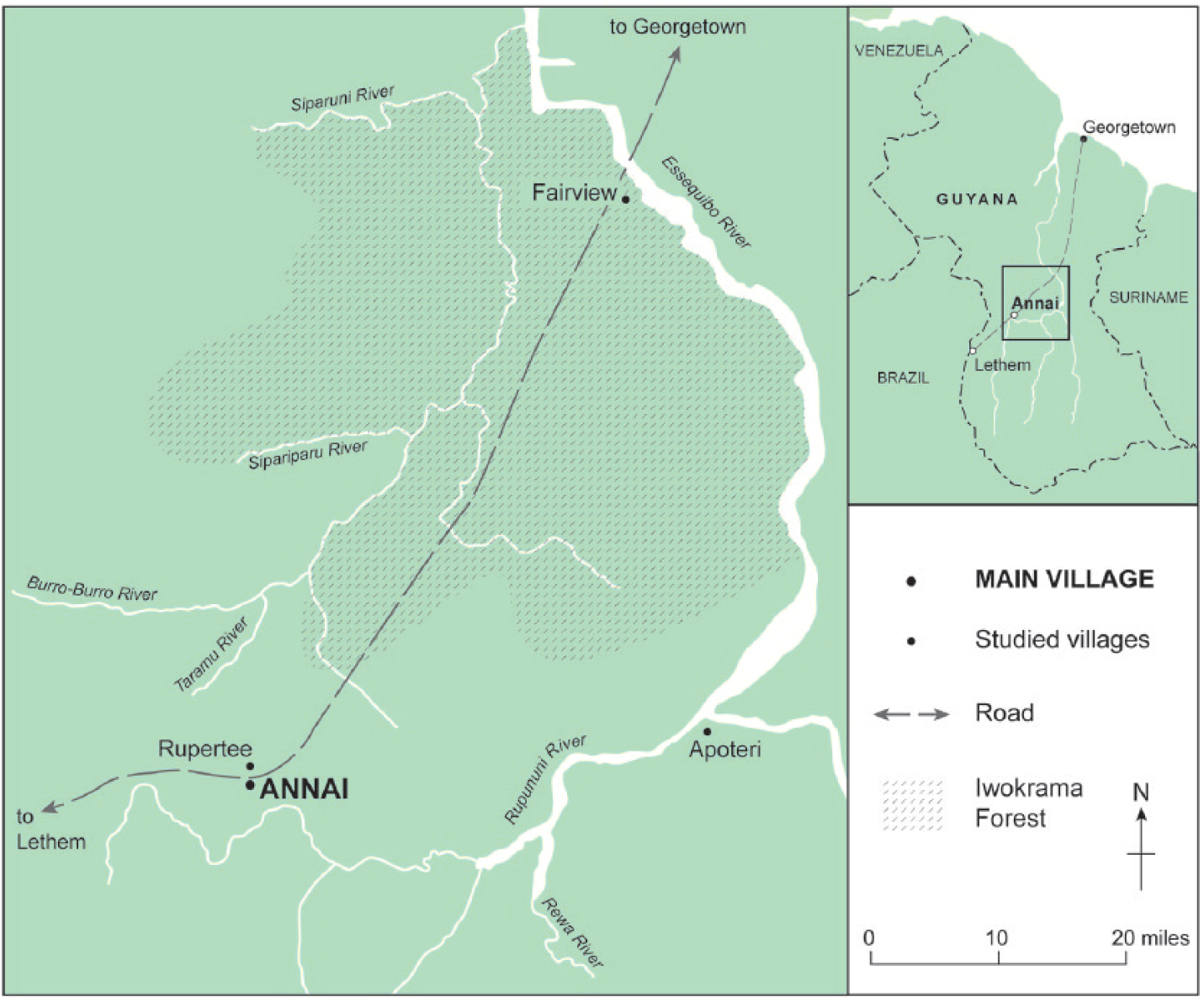
Location of three Indigenous villages in the North Rupununi, Guyana, that participated in the research.
It is important to note that our methodological approach was underpinned by a ‘system viability’ framework. 39 This framework directs participants to explore survival strategies that are not unidirectional: from poor health to good health, from resource scarcity to sustainable management, from prehistoric to technologically advanced. Instead, the system viability framework recognises that every system, be it an ecosystem or an Indigenous community, requires a careful balance between at least six distinct survival strategies: to resist or to adapt, to secure resources for oneself or to share, to specialise or to promote flexibility. Expending effort in one survival strategy can undermine other strategies, although synergistic interventions are also possible. Thus, participants were not encouraged to arrive at a single harmonious representation during their deliberations. Indeed, tensions in perspectives were appreciated and participants were asked to respect contrasting opinions, as long as these perspectives could be shown to make a contribution to community survival. Participants from the three North Rupununi communities were therefore able to identify a total of 149 indicators of community survival, including 40 main indicators, from which were elaborated a system of nested indicators. 40
The system viability framework and the PV and PP processes were facilitated by five local Indigenous researchers directly employed by the NRDDB who received training in system viability and the visual methods at the start of the project. As part of the community engagement, these Indigenous researchers developed an accessible ‘consent form’ so that any material recorded had the participants’ free, prior and informed consent to be shown publicly, to specific decision-makers and uploaded on the Internet via the project website. Guided by an Iwokrama research assistant, they set about visiting the villages in order to engage community members in discussing challenges affecting their communities, identifying community owned solutions to these challenges and documenting these solutions using visual technologies.
The groups involved in capturing video and photo material from each community were composed mainly of young people (both males and females). Because of their higher motivations to learn technical skills, young people were the ones volunteering to join the PV and PP recording activities. Nevertheless, old people were often the ones in front of the lens (telling stories, being interviewed, passing on their knowledge, etc.). This allowed an important exchange to occur between young and old people during the filming/photographing process. The editing of the videos was materially done by the five local Indigenous researchers employed by the NRDDB. Lack of time and competences in editing within the community members made this choice necessary. Nevertheless, the five Indigenous researchers discussed draft versions of the videos and photostories with the communities in order to modify them according to their comments. In three formal cycles of action learning, the community researchers reviewed the visual materials, edited them into films and photostories and then returned to the villages to screen the drafts and gauge feedback.
To facilitate this process, meetings open to all villagers were held, where the videos/photostories were shown for community comment. These meetings were organised in advance by contacting the village leader through the local radio and defining a date suitable for the community. The debate during these meetings revolved around what people wanted to show about their communities and why. Participants focused mainly on what they felt was ‘good’ and ‘positive’ and ‘working properly’ in their community and what was not, and then on how to represent it. Both young people and elders, as well as males and females (with a slight majority of women attending with their children, the average numbers were 20–25 people per meeting), participated in these meetings.
By combining photos with videos and adding narration and music, the communities in the North Rupununi produced stories (or representations) about themselves, their lives and issues that are important to them. In the form of films and photostories (1 film and 5–8 individual and collective photostories were produced in each community), these were screened in the local villages and also posted on the project website to be shared nationally and globally. It is important to emphasise here that the final films and photostories analysed are as close a representation of a shared social memory as could be compiled within the logistics and timeframe of the project. At the same time, we recognise the limitations of our approach. First, it was not always easy to get peoples’ comments during the meetings when we showed the draft videos (e.g. some people were shy, others were afraid their comments would not have been useful). Second, it was sometimes complicated to translate the community comments (often general and regarding the overall story that was told in the visual materials) into practical indications on how to change the video/photostory. Another problem we experienced is that in some cases different people would attend different meetings dependent on work/livelihood commitments, lack of transportation to the meeting, misinformed and/or lack of communication about dates and so on. This caused loss of continuity in the construction of the visual materials: for example, some people who commented on the first draft of a video were not present in the second meeting, during which someone else would come up with different comments. This made the work of building a consensus around the PV/PP materials much more complicated and drawn out for the local Indigenous researchers. Moreover, with different people participating in different phases (first meeting introducing the project, second meeting with the filming, third meeting showing the draft video, etc.), some people did not participate fully in the whole process. This contributed in partially limiting the ownership some people felt of the representations that were built. In addition, our roles as Western and Indigenous researchers working with participatory visual methods in Indigenous communities affected the way local people interacted with us and thereby the final PV/PP products. An in-depth, critical discussion of our positionality has been documented elsewhere.41–43 Nevertheless, we feel that the process of the three cycles of filming/editing/screening allowed a range of community members to engage with some of the ‘memories’ represented in the screenings and then provide feedback to the Indigenous researchers with regard to what they felt was important to retain and emphasise. Thus, the final products, which we analyse in this article, represent a distillation of community social memory after several cycles of community engagement and feedback.
Our data analysis aimed to explore the emergence of dominant narratives from the visual and audio materials, and how this was received and modified by the local community. Inspired by grounded theory, 44 our process involved assigning a large pool of preliminary themes to images (photos and video clips) and narration (written material and spoken word). We then analysed the resulting spread and diversity of themes in order to identify plausible arguments. This was an iterative process as emerging themes evolved and changed, often involving a reappraisal of photostory and film sections. Our results therefore report on the dominant discourses which emerged from the data through an adaptive and emergent process of analysis. 45 Although this provides a snapshot of social memory evolution within the community, the approach can provide a framework for evaluating how video and photos form a vehicle for Indigenous social memory, representations and identity.
It is important to note here that when we refer to ‘identifying dominant narratives’, we were not seeking to produce a harmonious and homogeneous interpretation of the collective social memory from the Indigenous participants. Our system viability framework allowed contrasting perspectives to emerge. A ‘collective social memory’ does not imply ‘collective harmony’. Tensions between perspectives are in fact a healthy prerequisite for sustaining the long-term prospects of survival within an unpredictable and changing environment. Yet, it would be naive to assume that there were no internal and external social pressures in operation to direct community members towards certain dominant narratives. 46
In the following sections, we present the diversity of visual narratives portrayed in the participatory films and photostories, supplemented by informal discussions and conversations with the local community researchers and screening participants, and our observations, reflections and project research diary entries to date.
Results
‘Traditional’ and ‘modern’ identities
From the videos and photostories produced, we see that the North Rupununi communities perform a variety and multiplicity of identities. ‘Traditional’ is a key term used in all of the audio-visual materials and is used synonymously with ‘Indigenous’, accounting for their unique culture and identity. It is repeatedly used as a prefix to discussions on language, practices, rituals, beliefs, celebrations and when recounting events from the past (such as the founding of a particular village). Visual performances show people doing or participating in traditional activities (Figure 2), whether it is fishing, farming, making baskets, preparing traditional medicines and food or telling stories.
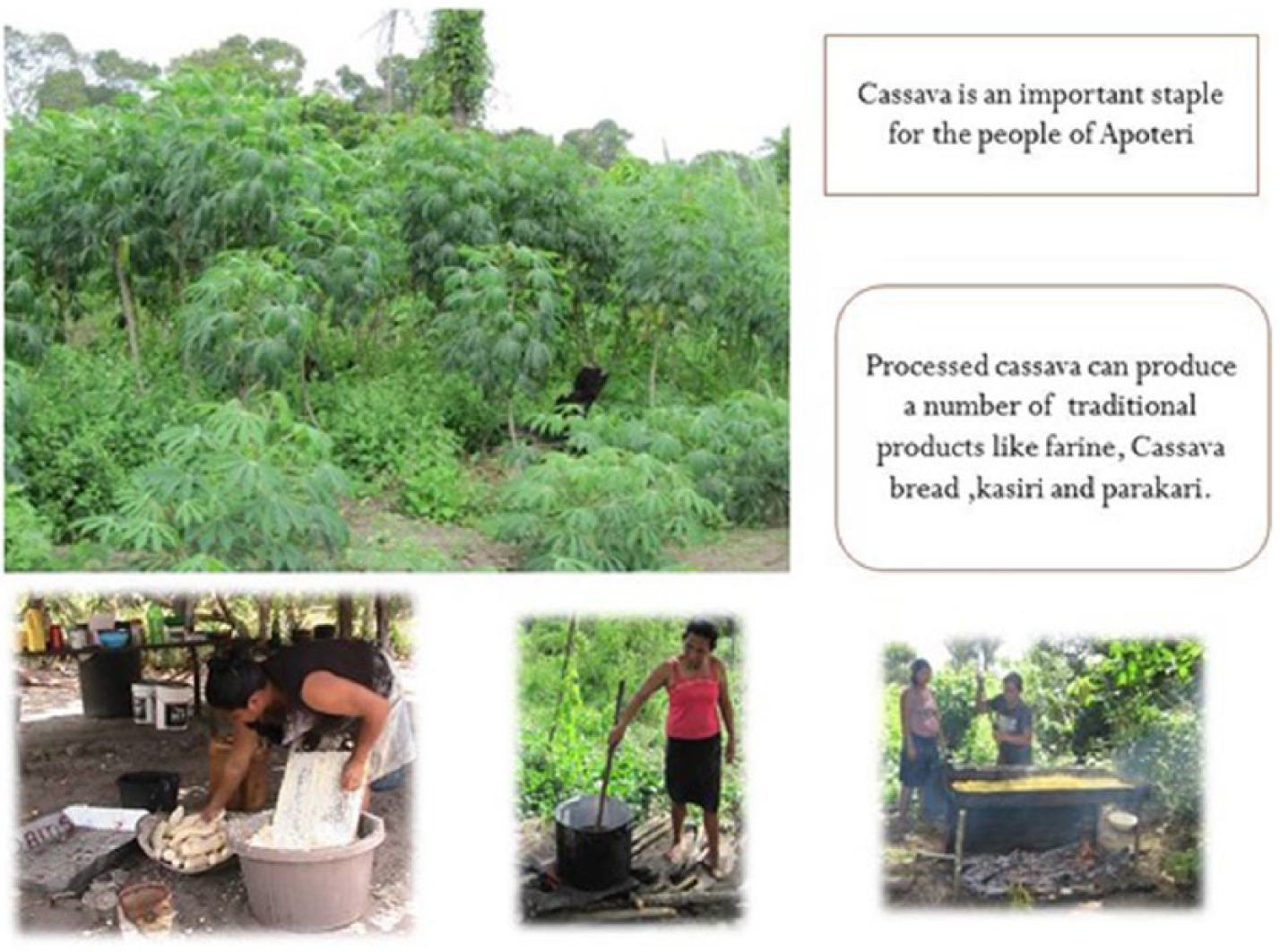
Section of Apoteri’s photostory showing ‘traditional’ activities.
At the same time, we see images of ‘modern’ people doing ‘modern’ activities using ‘modern’ tools. People are working on computers, practising dentistry, using machinery for farming, wearing the latest fashionable Western clothes and shoes and interacting with representatives of the Guyanese government and national and international NGOs (Figure 3). For some people, these symbols of modernity are equated with progress as exemplified by a young lady from Fairview: In Fair View right now, it’s like a lot of people trying to put their selves better. People seeing that they can’t remain living like that. People putting their selves better. Everybody fighting for that right now in Fair View, nobody want no leaf house or nothing like that, everybody want zinc, generator, TV, music set.

Representation of ‘modern’ elements in Rupertee’s photostory.
Yet, the visual material shows that the communities are not one or the other and that the varying nature of how ‘traditional’ and ‘modern’ coexists in people’s everyday lives is defining their identity. For example, the staple food cassava and its by-products (bread, drinks) are featured highly in all the films and photostories (particularly women’s). Couched as a ‘traditional’ food which also plays a significant role in ‘traditional’ rituals and ceremonies, we see cassava production as a blend of traditional and modern tools and practices, grown and harvested using traditional knowledge, but processed using ‘modern’ tools such as electric and bicycle-pedalled grinders, as shown in Figure 4. In Apoteri, for example, where they are heavily reliant on forest resources, many of the (men’s) photostories featured machinery of some form. Interestingly, sometimes the ‘traditional’ and ‘modern’ are juxtaposed in the same images, for example, photos/clips of homes with traditional thatch roofs and homes with tin roofs.

Traditional and modern medicine in Rupertee’s photostory.
Places and landscapes
Traditional and modern Indigenous identities are complemented by an inherent physical connection to places and landscapes. The videos and photostories show that the North Rupununi communities have a strong sense of place and believe deeply that their everyday activities and lives are very tightly connected to their natural environment. The different parts of their territories, including the forests, savannas, mountains, wetlands and bush islands, are important places mentioned and represented, and suggest that these form part of their identities as North Rupununi peoples. The connection to territory is particularly apparent in the relationship they have with the land and its resources. This is demonstrated through complex Indigenous practices, captured in great visual detail, including farming activities, fishing hunting and gathering techniques (Figures 5 and 6).
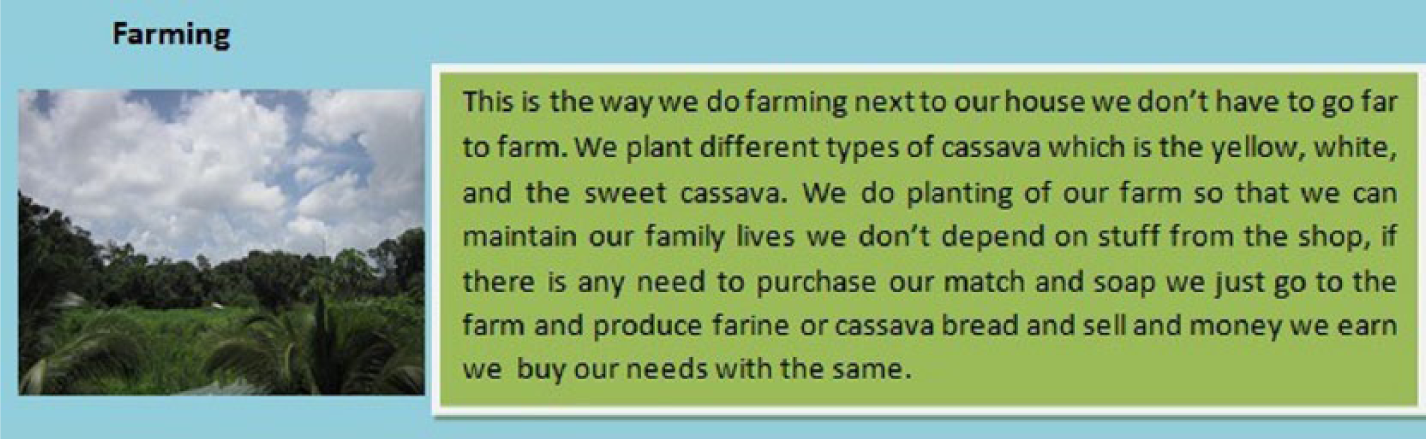
An extract on farming techniques from a photostory from Fairview.

An extract on the ‘soap tree’ from a photostory from Fairview.
In addition, people are strongly connected to territory through in-depth knowledge of place names (Figure 7), which are variously designated through plants, animals, spirits, ancestors and historical events and encounters: Here is not Rupertee. The name Rupertee comes from Rapo which means the place of bamboo. Here is Syni yen. This is called so after the hawks that catches chickens. Instead of calling it after the hawk, the people called it Rapo. And the English speaking people suit their selves and called it Rupertee. (Older lady from Rupertee) This mountain is Ywomei yen. The area where Fransico [founder of the village] lived is called Wrara yen tamu, a place of Scarlet macaws. (Older lady from Rupertee) Apoteri is given the name by Arawak language coming from a plant that was in the centre of the village. Arawak say Akutari but the English speaking people suit their selves and call it Apoteri. (Older man from Apoteri)

Introduction to Rupertee’s photostory showing the landscape in which the community is embedded.
At the same time, the audio-visual material represents a strong attachment to the village, namely, occupying a particular location in living memory. This comes out through long introductions to the videos that narrate the village’s history, interspersed with interviews of elders and other members of the community who have this knowledge. This narration highlights key individuals and/or events that led to the community-building process and includes, for example, a road, a school, a teacher, a health centre, founders of the community and titling of land.
In Fairview, this attachment to place appears through the telling of an extremely vivid story that explains a belief in the dreams of the ancestors: Even though our grandfather get sick and died, daddy never moved. Plenty people advise to move because they say that the company [working on the cattle trail] close and go away and they live like lonely in the forest, things might happen to him, people might kill him but he never decided to move anywhere, he decided to hold his father land until now, where we are today. He decided to stay because he said he had a dream that this place would become bright again, he wouldn’t try to move and go anywhere, he said he had a dream that they would be having a road, and this place would become bright again so it’s no use moving and going somewhere else, so he decided to stay one place, until now. (A grand-daughter of the founder of Fairview)
This story is strongly illustrated by a picture of the Fairview cemetery, exemplifying how the son of the founder decided he would die where his father was buried.
Local social memory trajectories
By focusing on the videos and photostories as a whole, we see overarching themes of identity emerging, as discussed above. However, at the same time, we also find differences between the ways the three villages portray themselves.
In Rupertee, there is a strong narrative of resistance to outside influences, and retaining and maintaining their traditional culture. Of all the villages, they are the only ones that regularly refer to their Indigenous Makushi ethnicity, particularly for emphasising their traditional lifestyle: This is how I live my Makushi life unto today by planting and eating variety of crops. (Older Rupertee woman)
and When the tablets do not work, I ask my mother to do her Makushi way of curing and we believe it works. (Middle-aged Rupertee woman)
They are also the only village to speak in Makushi (their Indigenous language) throughout most of their video recordings. External influences are viewed mostly as a threat; for example, many people talk about the introduction of modern tools and items as detrimental to their culture, linking, for example, television to young people taking drugs and then migrating out of the villages. Images of the Georgetown to Lethem road feature highly in Rupertee’s film and photostories, and it is mostly associated with negative consequences: New things are coming in our village. Since the road had improve, non residents are entering our village. Television is one that our children is influence by. People are bringing in unwanted drugs, young people are migrating in search of jobs. (Middle-aged lady from Rupertee)
At the same time, PV and PP materials from Rupertee display a range of traditional activities including traditional dances and handicrafts to reinforce their Indigenous identity (Figure 8). This representation seems to have two purposes: directed at asserting Indigenous rights aimed at an external audience, yet at the same time responding to the loss of traditional Indigenous knowledge in younger members of the community.
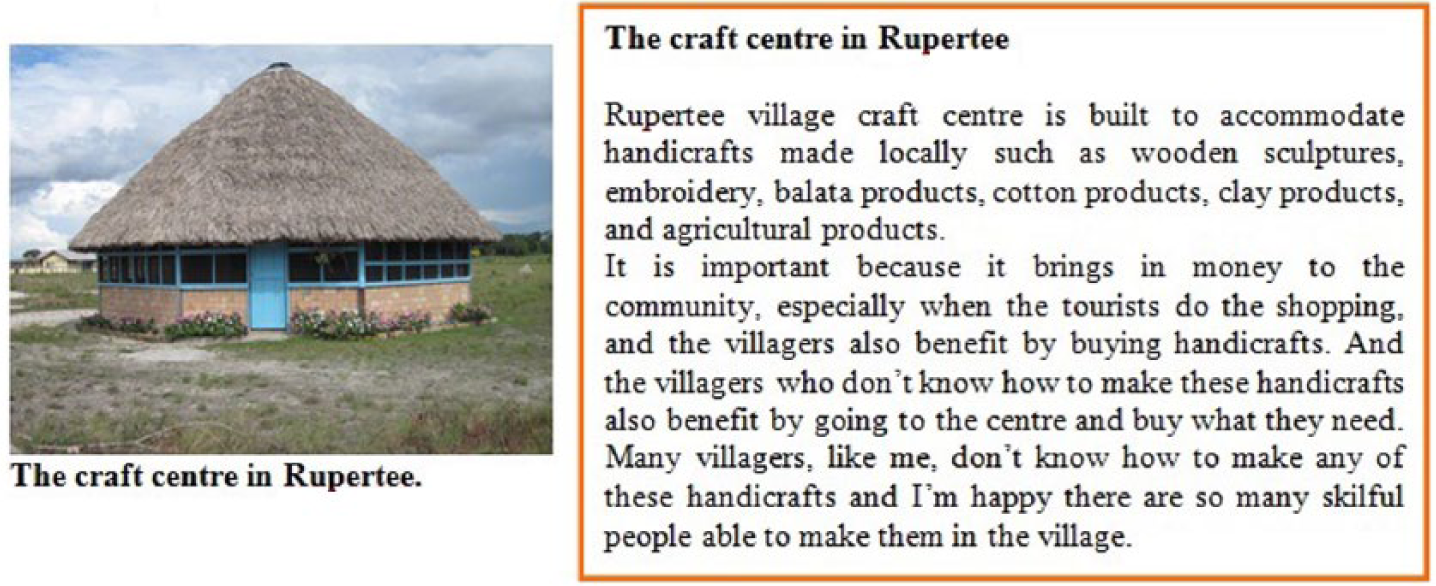
An extract on the craft centre in Rupertee from a photostory from Rupertee.
Rupertee members also express keen awareness of their political rights, locally and nationally. They refer directly in their video to the Amerindian Act (Guyanese act from 2006 giving a series of rights to Indigenous communities) and the need to strengthen it further: There is an Amerindian Act that we forget about. Long ago there was no Act but people lived in unity. Now we have the Amerindian Act but we’re not adhering to the Act, we should start doing that now. (Middle-aged lady from Rupertee) Rules and laws should be done in Makushi understanding, so that we can use and be strengthened by that. (Middle-aged lady from Rupertee)
Reinforcement of the local social memory is further exemplified by the values and rules (and their associated objects) discussed and shown in the videos and photostories. For example, in individual photostories, the majority of photos taken by both men and women in Rupertee are of infrastructure, for example, the Village Office, the Craft Centre (see Figure 8), an abandoned chicken and gardening project, an abandoned agroforestry area and a disused community kitchen building (Figure 9).

Extract from Rupertee photostory showing dismantled village kitchen and an abandoned UNICEF project.
When referring to activities taking place around these buildings, they are usually associated with governance issues (sometimes lack of) at the community level: Leadership has been an issue in the community, however when the villagers were not satisfied with the performances of their leaders, they have taken the step to ask the resignation and a new leader was voted into place. Such actions are overseen by the village Toshao. (Film narration co-developed with community members) The Village Council makes sure that the rules developed by the community are being respected and resources are used sustainably. (Middle-aged Rupertee woman) Village office is important because that is where any activity taking place in the community will be recorded so as to update all the community members about what is going on in the village. (Middle-aged Rupertee man) Good leadership is needed for the efficient running of the community. Following the last elections, community records were handed over from the former village council to the new council so that they would have those records to refer to for village activities. (Middle-aged Rupertee woman) Leaders need to meet and negotiate together and everything will go good. But if there is no representation and discussion, our community will not have control over our resources. (Middle-aged Rupertee woman)
In these quotes, Rupertee community members are showing us examples of what they perceive as keeping their community strong and being able to cope with outside influences. We see a similar narrative of resisting change and keeping strong in Fairview, a village that has had a long-standing relationship with Iwokrama. Here, as in Rupertee, they speak at length about preserving their traditions, seemingly aimed at an external audience, but in contrast to Rupertee, they communicate knowing their rights through what they perceive as ‘official’ channels rather than oral/customary modes. This is best exemplified by their reference to, and use of, maps and legal documents. Both in videos and photostories (particularly men’s), several maps are shown, delimiting their titled land, showing their resources. In addition, they explicitly show examples of related legal documents including the Environmental Protection Act, the Forests Act and the Fisheries Act (Figure 10).
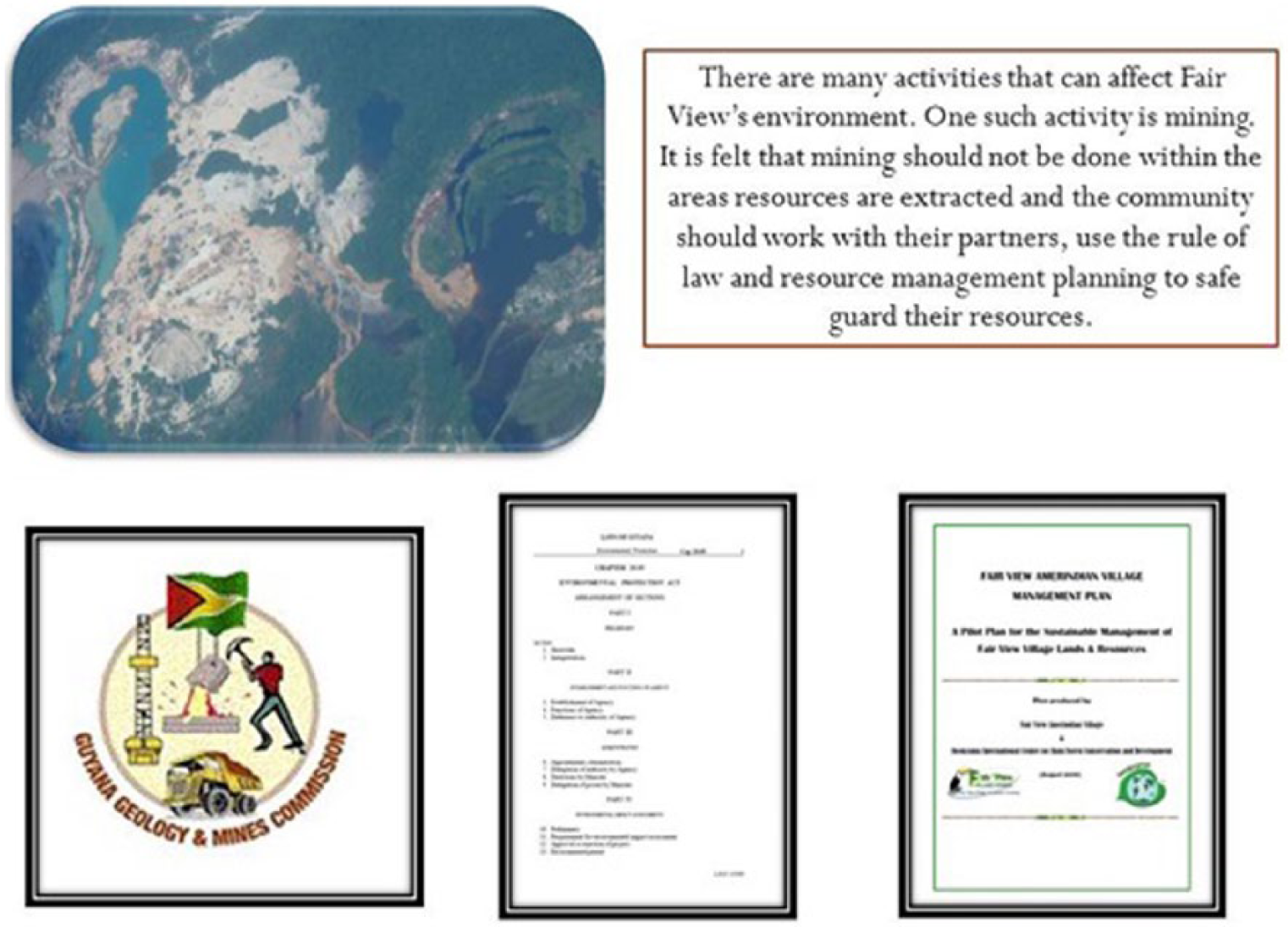
Fairview’s photostory showing its awareness of laws and rules.
We also see images of both local leaders and community members (mostly male) handling and discussing maps, invariably with expressions of authority and knowhow. Here, we see Fairview visually inscribing a framing of their space, where the maps act as signifiers of territory and the legal documents as the rules of how that space should be managed. This is supported by statements such as the following: Community leaders encourage villagers not to show outsiders where their resources can be extracted. (Middle-aged lady from Fairview) Let the people know how important it is not to show outsiders our resources area, like keep talking to people and let them see how important it is because we’re suffering now. (Middle-aged Fairview woman) People know where they have to go, which area on the map showing the land, the farming areas, the logging areas. (Young Fairview woman)
Compared to Fairview and Rupertee, Apoteri presents a narrative of a community that is vulnerable to challenges linked to the natural environment and relatively disempowered when it comes to ‘development’, relying on projects from external stakeholders to ‘improve’ the community in its very remote context. These ideas of remoteness and isolation are exemplified by the dominance of images of the river and forest, which play a central role for many day-to-day activities, including fishing, agriculture and transportation (see Figures 2 and 6): It has been a continuous difficulties for the people of this village in getting their needs because of the distance. (Older Apoteri man) Apoteri’s isolation makes it more dependent on the resources available from the land, forests and river. Having and maintaining access to land is key to survival. (Film narration co-developed with community members)
This reliance on natural resources comes across strongly through both their videos and photostories, which show images and provide explanations of many ‘traditional’ resources, particularly food and medicinal plants.
Apoteri’s perceived danger and helplessness against the environment is shown in the telling of the 1998 and 2004 flooding ‘disasters’, where many people in the village lost their staple cassava crops. However, interestingly, following the recounting of the 2004 event, the villagers also explain their response to this event, including changes in cassava variety and movement to different farming locations, indicating they have community owned solutions to problems (Figure 11). Nevertheless, the majority of the narrative is focused on needing external help and showcasing the funds and ‘aid’ received from various NGOs and the government for village development.
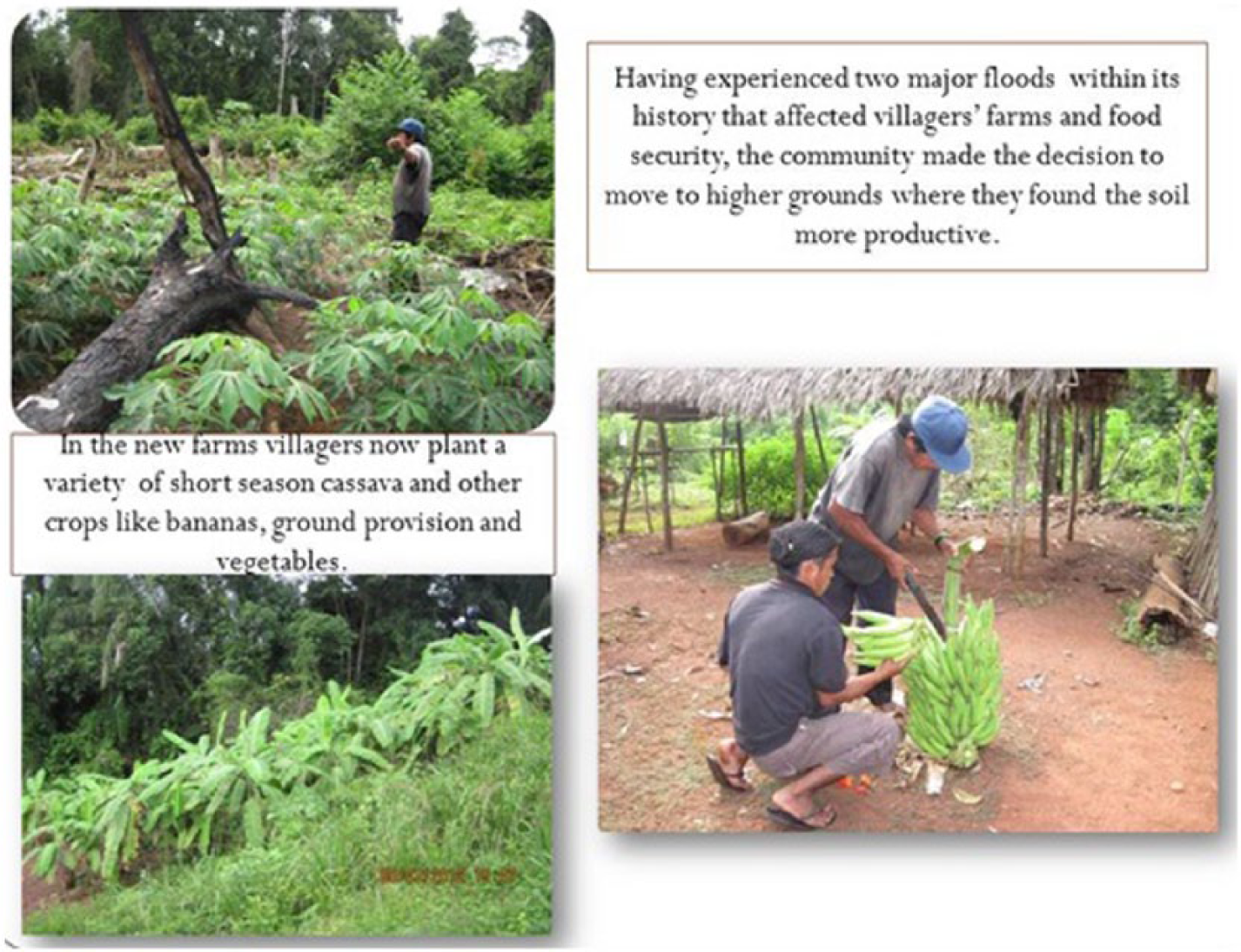
Apoteri’s photostory showing its strategies facing floods.
Talking to multiple audiences
When we look at who the photostories and videos are ‘speaking to’, we find that the focus is primarily on the local audience which includes people’s own families, their own villages and the wider Indigenous communities of the region. When the project started, it was assumed that participants would have a certain consciousness of a global and political audience and that the visual materials would act as pieces of Indigenous advocacy, that is, an act of influencing the external ‘social memory’ in how the communities would want to be ‘remembered’ by others. However, it seems that the maintenance and reinforcement of the local social memory seem paramount in peoples’ minds. One of the challenges mentioned in all the communities is the struggle to pass on identity and culture to young people. All three videos start with an introduction investigating the story of the community, which many people really enjoyed making, as a way of reinforcing the community’s identity, and exploring their own individual identities as a member of their community. As indicated by this older Rupertee man, I like this [COBRA project] because it relates to our way of life, especially our identity and culture which we are already losing.
There is a strong sense in all the visual materials that the knowledge represented is communal, shared: We could not talk lies about our community because everyone will see or read it. (Middle-aged Rupertee lady)
Linked to this, there are repeated references to the ‘values of the community’, ‘working cooperatively’ and ‘sharing knowledge’. The aim of participants, therefore, is not only to confront concerns with the current loss of culture but also to retain a social memory which is constantly evolving. This is supported by a non-Indigenous project assistant when she says, Part of the informed consent process was explaining that the videos would be distributed far and wide including the Internet through the project website. But given all that I think their focus was to preserve information for themselves and share with other communities.
There are clearly different ‘local’ audiences towards whom the visual materials are aimed. In some cases, the audience is the community today where issues reflect current concerns and the current situation in the villages. In other cases, people are talking to future generations, those who will be stewards of the land and its resources. There is also a conscious direction of material towards leaders and the NRDDB, particularly with regard to future development of the community: Photostories that were developed will remain in the village office, craft centre and village shop. Even though the village council will change, these photostories will remain as information for the new councillors. (Middle-aged Rupertee lady)
Yet, among this, men, in particular, show a political and development-focused narrative that goes beyond the confines of their own village and region. There does seem to be an acknowledgement that people external to the communities will be viewing the visual materials, exemplified by this older lady from Fairview: I tell them that this project to me is like all about sharing your knowledge to help the future generation, not we children alone, but all the communities and even around the world, you know if you share this thing, people could help themselves.
Discussion
Indigenous peoples are framed as either heroes and champions of avant-garde politics or vulnerable casualties of colonial pasts and environmentally destructive futures. Neither caricature provides an adequate representation of the complex material, political and cultural characteristics of emergent Indigenous geographies.
47
Under the colonial and post-colonial policies of the Guyanese government, many Indigenous customs were regarded as backward, uncivilised or even barbaric practices which should be discarded as soon as possible. 48 As such, there was, and still is, a strong notion that the national government and other external bodies are the main agents of ‘progress’ and change, while Indigenous people’s main concern is with keeping their tradition from being destroyed by modernity. The visual materials produced by the North Rupununi communities show that neither of these views is able to capture Indigenous performative actions: the representations made in the films and photostories illustrate symbolic border crossings between Indigenous and ‘modern’ identities 49 in ways that are both self-aware and that serve to reproduce the image of a simultaneously traditional and progressive peoples. 50
Our research reveals the complex and imbricated identities that compose a self-conscious Indigeneity, where ‘traditional’ and ‘modern’, flowing landscapes and strict territorial boundaries, different spoken languages, the village community and the North Rupununi communities, nature and infrastructure are all captured within the same material. This rather chaotic big picture formed through our specific research approach vividly reveals the complexity of Indigeneity, shared by all three villages where the narrative strategy of juxtaposing the past with the present undermines conceptions of Indigenous ‘authenticity’. Through the films and photostories, participants are shaping an image of themselves and their Indigeneity that is ‘becoming’; 51 bringing together past and present for the future, in other words, social memory is at work.
However, within this larger framing of what it is to be Indigenous, there are multiplicities in the way different communities portray themselves. Our investigations show that the idea of Indigeneity and of tradition needing to be preserved is stronger in the communities more used to communication with the exterior (Rupertee and Fairview). For these communities, performing through the videos and photostories reinforces both an internal and external social memory where representations of Indigenous as ‘traditional’ and ‘ecological guardian’ are aimed at the community itself and to future generations, but with a clear message of self-determination to audiences at other levels. 52 Fairview, in particular, has the strongest connections to a range of outside interests (e.g. politicians, tourists, national and international NGOs) through its long-standing relationship with Iwokrama. From the visual representations, it seems that to a certain extent, its social memory has been shaped by these external actors, and particular constructs of ‘Indigeneity’ may have been ‘imposed’ onto the community by particular interest groups in order to further their own interests. For example, there are frequent references in the film and photostories to the importance of tourism and to Iwokrama, and the use of expressions more typical of external actors such as tourists and NGOs. However, the relationship with Iwokrama, in particular, seems double-edged – Fairview is clearly benefiting from its relationship with Iwokrama through jobs and income and seeks to capitalise on this synergistic relationship. However, it is also aware that its autonomy and freedom to operate is at stake because the village is part of the Iwokrama protected area and potentially their access rights to significant resources could be compromised. Thus, their representations are a careful balancing act between showing their associations with Iwokrama while insisting on their traditional rights to the territory.
This show of tradition and guardianship has particular relevance for the growing opportunities to access national and international funds linked to climate change mitigation and deforestation, through, for example, payment for ecosystem services (PES) schemes such as Reducing Emissions from Deforestation and Forest Degradation (REDD+) and associated territorial and resource rights. In Guyana, for instance, the Low Carbon Development Strategy (LCDS) – a national-led initiative to operationalise PES and REDD+ – aims to achieve socioeconomic development goals through foreign capital investment and trading in ecosystem services provided by the country’s forests. 53 Although the initial focus of the LCDS is on ‘state lands’ (which also includes extensive territories traditionally used by Indigenous communities), Indigenous communities will later have the opportunity to ‘opt in’ through the limited areas which they have been given land rights to, with potential financial benefits that could be used for education, healthcare and other development projects. Utilising discourses of cultural identity, such as the ‘ecologically noble savage’ or ‘stewards of the forest’ in strategic ways, 54 therefore, could influence political agendas and bring financial benefits.
But here, we need to ask questions regarding the role of identity representation in the political process. Our study illustrates that for most community members, self-identification is embedded within an array of everyday practices and beliefs. If community elites and institutional members represent the Indigenous population and Indigeneity in a reified form through an image of a static and unchanging Indigenous ‘being’, attracting development funds may come at the expense of dealing with genuine Indigenous concerns and realities. For example, sharing knowledge across communities and between generations not only helped to surface possible contestations of representations (particularly between the older and younger members of communities) but also generated a shared cultural knowledge to conserve traditional identity which could be used to counter colonial tactics of denigrating or commodifying Indigenous cultures and diversity. 55
That is not to say that other Indigenous stereotypes are not present within the visual materials. Our results show that the community of Apoteri has had limited opportunity to develop the Indigenous ‘traditional’ narrative and instead portray themselves as a vulnerable community in need of external help (with limited mentioning of ‘Indigenous’). This ‘helplessness’ and ‘dependency’ narrative has played well among some stakeholders who see Indigenous peoples as needing ‘protection’ from outside cultures and influences. 56 Indeed, it is difficult to disengage the Indigenous and non-Indigenous from this ‘deficit’ discourse, not only because of ‘the tenacity, subtlety and pervasiveness of this mode of discourse, [and] its powerful currency in the current socio-political climate’ 57 but also because of the potential of ‘negating the presence of real disadvantage and exposing people and communities to further misrepresentation and outside attack’. 58
Both the strategic essentialism and deficit narratives are frequently used by Indigenous groups for seeking support, particularly to an audience (national and foreign) which may be sympathetic to the causes of Indigenous rights and environmentalism. This is illustrated by an Indigenous leader of the Tumucumaque Indigenous reserve in Brazil making a presentation to project partners at the start of the COBRA project: Today it is not only the Indigenous people . . ., but also you who are not Indigenous, who want that the forest remains standing. . . . It’s not only the Indigenous people who participate to protect the forest.
On the other hand, the ‘traditional with modernity’ seems more contentious as a discourse as it potentially allows external bodies to question the entitlement of Indigenous people to their traditional territories and resources, which is intimately bound to legal rights of ownership enshrined within national and international legislation. If Indigenous people appear to be ‘too modern’ and comparable to non-Indigenous society, could this influence perceptions of their ability to ‘do the job’ for forest conservation? Would they still be entitled to vast tracts of territory, even if they no longer used the resources through traditional modes of land use, for example, by engaging in intensive mining activities?
In representing different identities, we do not wish to claim that Indigenous people are in some way intentionally manipulating their various audiences to gain funding or other forms of aid from national and international development and conservation agencies. Instead, we believe that ‘collective identities are constructed and reproduced by a nexus of social relations (rather than being immutable ontological qualities of a group) and that they may be, in certain circumstances, strategically mobilized to achieve particular ends’. 59 The self-conscious building and capturing of social memory will undoubtedly affect local as well as national to global audiences, and it is clear that these national and global audiences need to be able to engage with more complex and nuanced narratives of ‘Indigeneity’ which could transform ways of collaborating with Indigenous communities and provide relevant perspectives, experience and solutions to the management of natural resources in the face of emerging challenges. 60
At the same time, it is important to recognise that although PV and PP allow communities to constantly build, re-build and re-visit their audio-visual material, creating and re-creating their own images endorsed by themselves, the process is not ‘clean’ and scripted. It is messy, contested, dynamic and constantly evolving, where people appear to recall individual events, which when screened to the wider community can initiate a cascade of memories that then form the new shared social memory of the community. For example, the Indigenous researchers planned 2-day community visits. Some people may have been away at their farms or hunting, so they engaged in recording the views of the people they could find in the village on those days. And the people showing up at COBRA project meetings were often the village élite – the people more active in the community, the ones elected as village councillors or involved in community projects/activities. However, once edited and then screened back to the village, which may partially comprise a different set of people in the community, the feedback received allowed the films to evolve and take on a role of their own. This illustrates that we, as researchers, are actively shaping the shared memory through the PV process; 61 we are not independent observers or recorders.
Our findings indicate that PV and PP, as forms of Indigenous media, can ‘create a new self-confidence from which to pressure national governments to think about and negotiate alternatives to the global neo-liberal market paradigm by thinking precisely from indigenous cultural traditions, ethics and ways of knowing’. 62 However, the decolonisation of authoritative knowledge production is not just about access to visual methods and technologies, but the ability to become critical producers of content63–65 through participatory ‘creative engagement’. 66 This can help to re-stabilise the right for different knowledge systems to coexist and have equal weight in decisions that affect peoples’ lives.
Conclusion
Worldwide, Indigenous peoples are utilising culture as a self-conscious and articulate value, adopting ‘tradition’ as a means of empowerment. 67 However, rather than equating this cultural self-consciousness with inauthenticity or to assert that cultural revitalisation ideologies, particularly at national levels, primarily reflect and serve other dominant hegemonies, we agree with Yang 68 who attributes the renewal and strengthening of tradition in the present to ‘creative and dynamic expressions of [self] that seeks to highlight the agency and autonomy of indigenous peoples in the processes of engaging with modernity’.
Self-representation through the films and photostories shows how communities are able to portray different messages to different actors and that ‘indigenous media should not be understood in a narrow, technical sense, but rather as a set of cultural practices in which media makers and audiences actively produce their own, often divergent, meanings’. 69 Indigenous communities, through the way they use PV and PP, reveal that they shape their identities to serve their purposes – communicating to future generations, maintaining community cohesion and advancing claims to an international audience. Our aim now is to convince national and international governing bodies that Indigenous representation in the form of creative visual research methods should influence and guide policy development.
Footnotes
Acknowledgements
We would like to thank all the community members from the North Rupununi, Guyana, who participated in this research, particularly the people of Rupertee, Fairview and Apoteri. Thanks also to the two anonymous reviewers for their extremely detailed and insightful comments.
Funding
This research has been funded by the Environment Programme, Management of Natural Resources, DG Research and Innovation, European Commission 7th Framework.