



Abstract
What would it mean to understand nationalism as an atmosphere? This article makes a theoretical contribution to cultural geographical works on ‘affective atmospheres’ as well as to critical approaches to the study of nationalism by addressing this question. It examines how nationalism operates affectively and atmospherically through a discussion of the event of the London 2012 Olympic Games and the ‘happy atmospheres’ of being together that circulated in the course of those Games. The key claim of the article is that addressing the nation’s affective, emotional and atmospheric resonances is critical for understanding how nationalism endures and, furthermore, how it appears especially difficult to critique. As such, the article points to different ways in which thinking about nationalism as an ‘affective atmosphere’ builds upon the notion of ‘everyday nationalism’ but also takes it further by inviting an attentiveness to the different tonalities and intensities of nationality and shifting the focus from a subject identity or bounded community to the question of how affective forces congeal around particular objects and bodies and echo as part of an assemblage. Finally, this article makes a contribution to debates around the relationship between affect, atmosphere and politics by asking how national affective atmospheres might be resisted.
Introduction
It was repeatedly said that there was something special, electric and moving about the ‘atmosphere’ of the London Olympic Games of 2012. 1 Such was the buzz about the Games that empty plastic water bottles containing 100 per cent Olympic Bottled Atmosphere started retailing on eBay for a buy it now price of £50. 2 For this short period of time in the United Kingdom, the event of the Olympic Games permeated several different parts of everyday life as banks and shops displayed miniature versions of the British flag and Olympic themed events were introduced in schools and nurseries. What took people by surprise was just how popular the London Olympic Games proved to be, even with people who had been previously critical of them. As one commentator in The Guardian noted, the Games ‘reminded those suspicious of raucous patriotism of how great the union flag suddenly looked when it was ripped out of the hands of the extreme right and wrapped around the shoulders of Jessica Ennis or Mo Farah’. 3 In this article, I reflect on the connection between claims about an ‘extraordinary atmosphere’ and this short period of happy flag-waving. I do so in order to ask what might it mean to think seriously about nationality as a set of feelings circling in the air? And how might thinking about nationality as something that is felt and experienced affectively help us in understanding the suspension of critique by those usually suspicious of raucous patriotism?
Drawing on the concept of ‘affective atmospheres’ currently circulating in cultural geographies, this article asks how ideas about nationality are felt and how they become ‘installed in the soft tissues of affect, emotion, habit, and posture’. 4 It also addresses the spatial geographies of nationalism and argues that national feelings cannot be traced back to a single sovereign source but rather emanate from multiple constituencies as part of a nebulous, diffuse atmosphere. Taking these two points about the feelings and spatialities of nationalism together, this article examines how nationalism takes hold and becomes infectious, and asks how this makes it occasionally difficult to voice critical perspectives, as was the case during the ‘party atmosphere’ of the London 2012 Olympic Games (Figure 1). 5 But this question has broader implications: take for example how difficult it is to voice critical perspectives against conditions of ‘heightened nationalism’ that follow terrorist events, as Judith Butler notes in reflecting on the collective moods that followed the events of 11 September 2001 in the United States. 6 As scholars of nationalism have long argued, the idea of the nation carries profound ‘emotional legitimacy’ 7 and forms a persistent ‘object of intimacy and affect’ 8 – a point that has been especially well recognized by cultural geographers. 9 This article connects these points about the nation’s affective force to the challenge of asking how nationalism might be resisted.
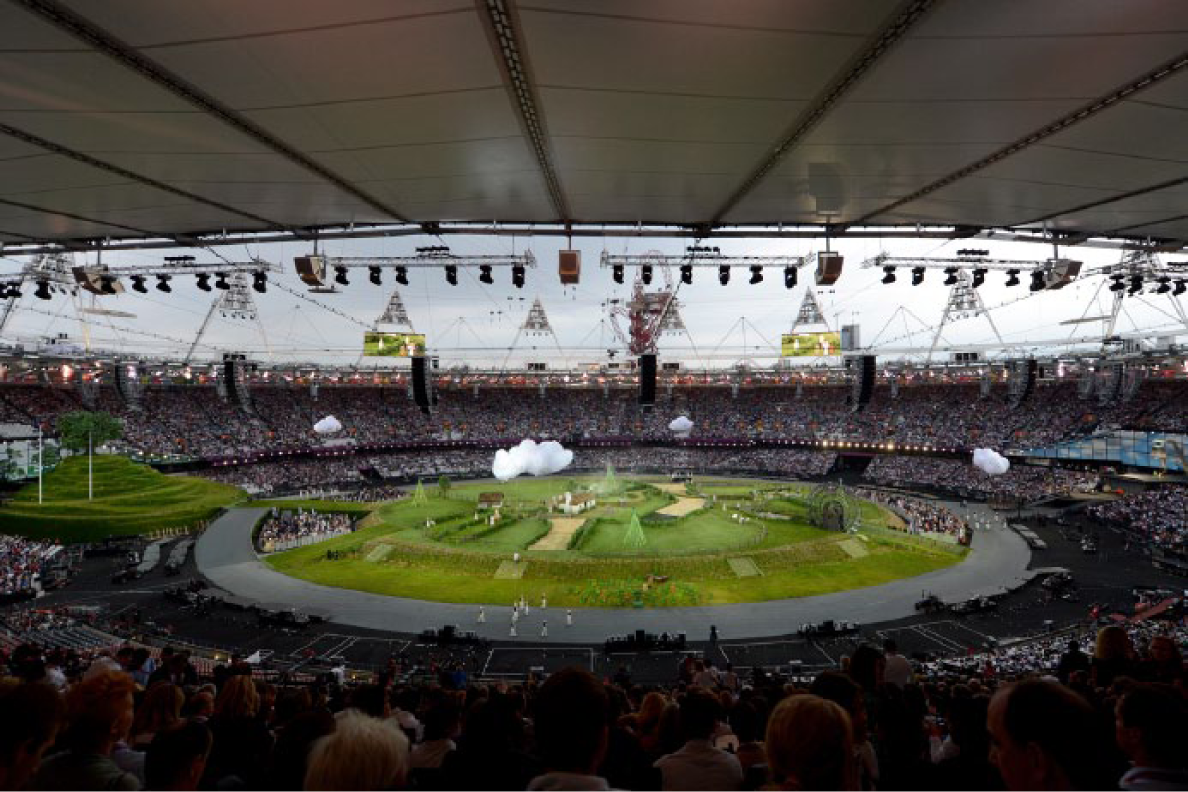
London 2012 Olympic Games Opening Ceremony, 27 July 2012.
Towards the atmospherics of nationalism
A burgeoning body of literature in Geography is asking how the notion of ‘atmosphere’ might enrich and enliven longstanding academic debates in cultural and material geographies. 10 Such interest is partly inspired by the claim that the concepts of air/atmosphere have been overlooked in favour of the study of earth 11 and that geo-graphies have dominated over what might be termed ‘aerographies’. 12 The notion of ‘affective atmospheres’ presents an especially interesting provocation for cultural and political geographies and for the study of nationalism specifically as it brings together arguments in cultural geographies about the emotional power of national identity 13 with insights from political geographies about the importance of developing a more relational understanding of national territories that is attentive to the associations between people and things. 14 While the concept of atmosphere can be used to point to a broad array of phenomena, including ‘transpersonal intensity’, ‘environment’, ‘aura’, ‘tone in literature’, ‘waves of sentiment’, as well as ‘a sense of place’, 15 I treat it as a provocation that invites us to address the role of ‘moody force fields’ in the making and shaping of collective publics. 16 For example, nationality is often – if not mostly – experienced as a feeling. 17 This might include feelings of togetherness experienced at a stadium or concert hall, the act of singing as part of a crowd noting the currents that pass between bodies or the ‘forcible affect’ of sharing a language with others. 18 None of these examples will seem especially surprising as sites of nationalist practice, and they may involve ambivalent relationships to any particular nation. However, foregrounding ‘affective atmospheres’ places such affective feelings centre stage and invites us to address how they matter politically.
As Derek P. McCormack argues, the concept of ‘atmosphere’ can be understood both in its meteorological sense ‘as a turbulent zone of gaseous matter’ and in an affective sense as ‘a quality of environmental immersion that registers in and through sensing bodies whilst also remaining diffuse’. 19 The fact that these Olympics Games took place over a sunny 2 weeks in August (something that cannot be taken for granted in the United Kingdom) suggests that the meteorological and affective aspects of atmospheres are intimately connected. Furthermore, the fact that most people experienced these Games as a television event, and/or through social media, watching a crowd of bodies watching other athletic bodies move in synchrony, indicates that atmospheres must also be understood as sensed through technical objects. 20 While these contributions help us consider what an ‘atmosphere’ is and how atmospheres are sensed, in this article, I raise questions about the politics of ‘affective atmospheres’. How do we account for the ways in which bodies are moved by national feelings circling in the air without dismissing such moments as examples of ‘mass hysteria’ 21 or of the people being ideologically lured by the state? While others have noted how these Olympic Games formed the ‘most expensive security operation in recent British history’ 22 and that at an estimated cost of £11 billion (£9 billion of which was public money) 23 they were obscenely expensive, such critical arguments, although powerful, fail to explain how so many people were moved by this event. For example, a Guardian/ICM poll carried out at the end of 2012 reported that 78 per cent people were still happy with the £9 billion price tag and that the Olympics ‘did a valuable job in cheering up a country in hard times’. 24 Critical arguments based around costs seem to wash away under the emotional tides of sharing in a mass event with others. Likewise, while explanations of nationalism as a claim about territory, 25 as an experience of time as linear 26 or as the invention of tradition 27 are important and useful, none of these prioritizes a ‘sensorial approach’ that addresses ‘the mobilizing potential of a place’, ‘the articulatory value of a gesture’ or ‘the implicit in ordinary practices’ in the way that, J. P. Thibaud argues, the concept of ambiance does. 28 I use the idea of national affective atmospheres as an opening for engaging with the ways in which national feelings touch us, take hold and become infectious: how they are felt through bodies but surpass any individual body. How, then, might such seemingly ‘banal’ feelings – moods that we simply ‘go along with’ – be identified as always already political and as laden with power and resistance?
Beyond everyday nationalism
The affective qualities of nationalism are best evoked by the literatures on ‘everyday nationalism’: take for example Michael Billig’s comment that there is an ‘aura [that] attends the very idea of nationhood’. 29 As he notes, there is something affective and auratic about sovereign nationhood which makes it difficult to pin down and to resist. Approaching nationalism atmospherically builds upon Michael Billig’s argument that nationalism shouldn’t be understood as involving ‘dangerous and powerful passions’ and ‘extraordinary emotions’ but rather as a background noise that is always already there and which erupts from time to time. 30 While Rhys Jones and Peter Merriman argue that Billig is overly concerned with ‘hot’ rather than mundane instances of nationalism, 31 the London Olympic Games show us that distinctions between the ‘hot’ and ‘mundane’ are difficult if not impossible to maintain. These Games resonated with people in both spectacular and mundane ways and involved a combination of macro- and micropolitical moments. As Achille Mbembe argues in his study of ceremonial displays in postcolonial Cameroon, occasions which ‘state power organizes for dramatizing its own magnificence’ reveal the difficulties of distinguishing between the ‘the state’ and ‘civil society’, ‘resistance’ and ‘passivity’, as well as between ‘hegemony’ and ‘counter-hegemony’. 32 Indeed, what is interesting about the spectacle of the London Games is precisely the ways in which they seemed to draw so many people in, albeit to different degrees, making it difficult to determine the boundaries between ‘everyday life’ and orchestrated displays of sovereign power. This suggests that binary categorizations would be better replaced by an attentiveness to the many varying tonalities and intensities of nationality. The concept of ‘affective atmospheres’ better captures ‘the messy dynamics of attachment’ 33 as well as the messy dynamics of power. 34 It also suggests that national feelings can tremble between the ‘happy’ and the ‘ugly’.
Of course, not all of the feelings of being together unleashed by the London Olympic Games are reducible to nationalism: this event was performed through the co-presence of capitalist, militarist, cosmopolitanist 35 and neo-imperialist atmospheres, which all have their historic links with sport and nationalism. 36 For example, the Opening Ceremony, directed by film-maker Danny Boyle, struck a cosmopolitan tone, but it also revived imperialistic themes about how the whole world could be visited through a journey to London. 37 While there are important points to be made about the representations of the nation (as well as the international) circulating in and through that ceremony, 38 the provocation of ‘affective atmospheres’ prompts a renewed engagement with nationalism’s ‘everydayness’ and ‘everywhereness’ at the time of these Games. It invites us to consider the ways in which sound, music, colours, patterns, postures and gestures worked to generate national affective experiences. It also suggests that collectivities do not precede but are produced through the circulation of emotions: for example, ‘it is through the movement of emotions that the very distinction between inside and outside’ emerges. 39 Finally, it prompts us to reflect on how the nation was not only seen but experienced and felt through the rhythms, memories and affects of this mass sporting event and that these feelings weren’t simply orchestrated from the top-down but rather skipped between different sites and moments.
Studying affective atmospheres
Significant amounts of energy and capital were spent on securing ‘happy feelings’ at the London 2012 Olympic Games. From the British government’s perspective, as well as the London Organising Committee of the Olympic and Paralympic Games (LOCOG), it was critical that people enjoyed the Games. Given the lack of enthusiasm in the run-up to the event, 40 people’s emotions needed to be worked upon, and in the course of the event they were continuously monitored and reflected back to ‘the nation’ by way of opinion polls, images, graphs, collected tweets and even art installations. For example, the ‘Mood-o-Meter’ formed a collaboration between McDonalds restaurants and The Sunday Times and was designed to record the emotions for each day of the Games, which could range between ‘awestruck’, ‘delirious’, ‘drunk’, ‘jubilant’, ‘excited’, ‘hopeful’, ‘bothered’, ‘sulky’, ‘gutted’ and ‘inconsolable’. 41 This resonated with an interactive online art installation by a group called EMOTO, which drew on twitter feeds to chart an emotion-graph, ranging from 1 (‘slightly negative’) to 6 (‘enthusiastic’). 42 Sound was also an important atmospheric, and the BBC made regular reference to the decibel count in the stadium, and how close it came to the 140 dB or equivalent to a plane taking off. 43 These kinds of emotion graphs and polls resonate with new governing initiatives such as the ‘well-being index’ of the UK Office for National Statistics and the Organisation for Economic Co-operation and Development’s (OECD) key priority of ‘Measuring Well-being and Progress’ and as such can be understood as a mode of governing where ‘affect becomes a mode of categorizing, classifying and coding’ populations. 44 They weren’t designed to register negative feelings about the Games and weren’t able to record disinterest or silence. In pointing to ways in which national affects might be measured, the problem is that these examples treat emotions and feelings as substances that derive from a community that is already assumed to exist.
The focus on affective atmospheres, on the other hand, attends to those unpredictable affective encounters that cannot be traced back to the feelings or emotions of an individual or (national) group. As other cultural geographers have argued, affect necessarily exceeds attempts at engineering and directing feelings and can, momentarily at least, seem outside attempts at control. 45 This is why ideas about nationality can be mobilized through fun and laughter as much as through the politics of fear. 46 Literatures on affect therefore invite us to begin our analyses of national collectives not with the ‘psychoanalytically informed criticism of subject identity’ 47 or idea of ‘human individuals coming together in community’ 48 but with the ‘the ebbs and swells of intensities that pass between bodies, enabling bindings and unbindings, jarring disorientations and rhythmic attunements’. 49 This approach draws our attention to the transmissions between the singular and the collective, 50 how ‘waves of affect are [both] transmitted and received’ and enables us to question how this comes to matter politically. 51 Indeed, according to Teresa Brennan, it helps us to understand the the behavior of groups and gatherings but in a way that refuses the taken-for-granted notion that emotions and energies go no further than the skin – as most of the literatures on crowd psychology tend to assume. 52 Attending to the affective transmissions between subjects means addressing ‘surges of emotion or passion’ 53 and their contagious qualities and how, for example, smells, sounds, chemicals, rhythms and vibrations work to align people with others and against other others. 54 These interventions are interesting and important for the study of nationalism which has struggled to break free of assuming ‘national groups’ that pre-exist political relations. 55
There is, then, a difference between studying attempts at stage managing an ‘affective atmosphere’ – such as at the Opening Ceremony, and examining those ‘rhythmic qualities’ 56 that escape those highly orchestrated moments but which nevertheless resonate alongside them. This demands that we address those unpredictable moments of attachment and detachment, generated through waves of intensity, which might include ways of being that are generous and hospitable as well as competitive and hostile. 57 Take for example the moment when the Chancellor of the Exchequer George Osborne, in presenting the medals for the Men’s 400 metres T38 Paralympic event, was booed by the crowd – ‘the first booes to be heard all week’. 58 This moment formed a break from the codified emotions of the Games, and as such echoed with protests against the pressures of ‘austerity’ and in particular, cuts to disability benefits, driven by the Chancellor. Significantly, something unpredictable was escaping ‘the overcoding machine’ and disrupted the otherwise carefully choreographed atmospheres. 59
This act of booing may be understood as an attempt at contesting Osborne’s claim to represent the nation. But in seeking to make sense of this moment, we might also miss something. The participants didn’t necessarily set out to stage a protest. Something happened, and as Derek McCormack argues, the work of ‘interpretive sense making’ can be ‘inadequate to the task of apprehending the affective and processual logics of the spacetimes in which moving bodies are generative participants’. 60 The collective affects, energies and noise of this moment might thus also be read as generative of nationhood, or what Kathleen Stewart describes as a ‘weirdly floating “we” snap[ping] into blurry focus’. 61 The question then becomes, how do we attend to these sorts of moments? Rather than seek to record and document feelings about a nation that is already assumed to exist, the provocation of affective atmospheres invites an alternative way in – one that requires a ‘haptic description in which the analyst discovers her object of analysis by writing out its inhabited elements in a space and time’. 62 In the next two sections, ‘National relays’ and ‘National attractors’, respectively, I shift focus towards ‘writing out’ some of the affective atmospheres of the London 2012 Olympic Games.
Writing affective atmospheres
National relays
Although the London Games officially began with the Opening Ceremony held on 27 July 2013, they were preceded by the Torch Relay, which formed a countdown towards the Games themselves and toured all parts of the United Kingdom – from Derry to Aberystwyth to the Shetland Islands (Figure 2). The relay proved surprisingly popular, as enormous crowds gathered to watch it pass through towns and villages, and each street in the journey was mapped in advance on local authority websites as well as on the BBC and official Olympic Torch website with a precise timetable outlining when the torch would arrive at each location (e.g. Day 1, 07:15 Land’s End; 07:31 Sennen; 08:00 Newlyn; 08:20 Penzance; 09:01 Marazion; 09:26 Rosudgeon). The 70-day relay began in Cornwall (having arrived from Olympia, Greece, on a British Airways aircraft), travelled to 1,018 towns, villages and cities; and was carried by ‘8,000 inspirational torchbearers’. 63 The torch came within 10 miles of 95 per cent of the population, 64 and approximately one-third of the British population watched it visiting their communities. 65 By way of the torch, the idea of a bounded nation was performed through a journey, as it travelled to the most northern isles in Scotland, the deepest parts of Wales and Northern Ireland and even crossed beyond UK borders from Belfast to Dublin. 66
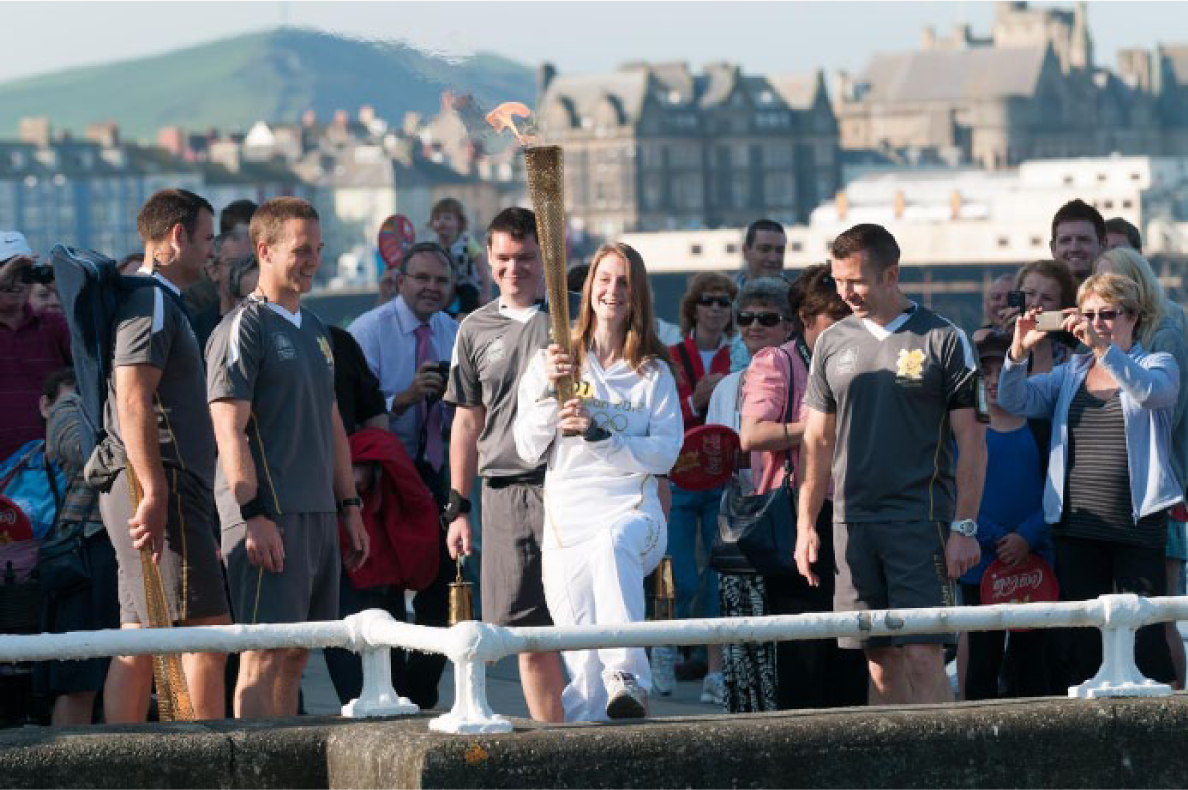
The Torch Relay, 28 May 2012, Aberystwyth.
The torch relay worked to smooth over some of Britain’s colonial histories, yet it resonated deeply with echoes of the state’s ambitions as a global power. Britain’s current role as a colonizing force was seen and sensed in the injured bodies of soldiers back from Iraq and Afghanistan selected to carry the torch through their hometowns. Ideas of an ‘imagined community’ were thus performed by way of this journey which affirmed London’s position – the torch’s final destination – as the ‘presumptive location of “the national”’. 67 Feelings of happy belonging were reinforced on the ground with bunting, flags and ‘Your 2012’ merchandise – supported by a £32 million ‘Look and Feel’ budget to dress town centres in the Olympic spirit. 68 This ‘atmosphere’ wasn’t produced within an architectural building such as a sport stadium or concert hall, 69 and it didn’t rely on ‘being there’ on the ground. Rather, the BBC played a crucial role in building the sense of excitement by showing pictures of the torch relay’s progress on its daily news, launching maps and lists of street by street routes on their website, and blogging and tweeting about the torch’s journey. In sum, the BBC played a significant role in ‘semiconducting’ the affective atmospheres of the Games.
The idea of ‘semiconducting’, which Derek McCormack develops from Michael Serres’ work, captures well the role of the BBC in this context. As McCormack argues, sport commentators don’t simply mediate or represent a state of affairs to the viewer/listener; she (but more often, a he) leans into the flow of activity and in doing so ‘performs the liveliness of affective modulation by operating upon the virtual cusp of the event’.
70
We can read a similar process of performing the liveliness of the event in the blog updates from the BBC website as they followed the torch on its journey: May 28, Day 10, Aberystwyth to Bangor
Other corporations including relay sponsors Samsung, Coca-Cola and Lloyds TSB played similar roles – with Samsung inviting people to tag pictures and post videos of themselves with the Torch to their website. Newspapers including The Guardian and, significantly, the Foreign and Commonwealth Office also blogged and tweeted about the Torch’s journey. In this sense, the feelings of national belonging created through the Torch relay were produced and reinforced by several different institutions, each with varied and complex relationships to the state, and it was enacted materially as well as virtually through hashtags including #olympic, #torch, #relay, #torchbearer, #london2012, #day35. What is significant here is that the feelings of national togetherness cannot be traced back to the work of a single sovereign authority directing people’s feelings but rather must be understood as emanating from several different constituencies. They worked as part of what political theorist William Connolly describes as a ‘qualitative assemblage’, involving ‘affinities of spirituality’ that jump across ‘different professions of creed, doctrine and philosophy’ and acting as part of a ‘resonance machine’, drawing people together despite creedal differences. 72
Connolly’s vocabulary becomes useful in considering the complex connections between austerity politics, capitalism, the British military, popular culture, the BBC and LOCOG over this particular summer, working in association to crystallize and amplify the affective atmospheres of the London 2012 Olympic Games. Arguing that it is insufficient to portray political leaders as manipulating their followers, Connolly points to the ways in which ‘motivations and sentiments whirl in a ‘hurricane out of heretofore loosely associated elements’. 73 This concept of the ‘resonance machine’ and its spiritual dimension is in part developed by Connolly through the work of Max Weber, who famously described how nationalism emerges against the mounting sense of the rationalization of social and economic life and thereby offers a sense of meaning. 74 Of course, the contemporary conditions of capital are very different, but Weber’s attempt to situate the nation as a ‘value orientation’ that can provide meaning in meaningless times is significant for understanding the emergence of these Games against the backdrop of ‘austerity’. For Weber, nationalism also emerges alongside the idea of the ‘heroic individual’, which is equally important in reflecting on ‘London 2012’ where ideas about self-determination, self-control and being a self-starter combined with governmental ideas about austerity and were anchored physically in objects such as the torch and experienced viscerally in the act of watching bodies move at speed and compete in carefully measured segments of time.
The point here is that the torch relay’s popularity cannot simply be understood as a state engineered affect. Although it required enormous amounts of state sponsorship, corporate funding and media support, the fact that exceptionally large gatherings of people went to see it, and got up at dreadfully early hours in the morning in order to do so, suggests a coming together of micro-elements that flowed beyond a centralizing machine. How can we appreciate the collective enjoyment experienced at national events such as this one while developing an argument that such moments matter politically? We might say that people didn’t necessarily see the torch relay as a state-organized event so much as a local attraction, thanks in part to the ‘local heroes’ selected to carry the torch. Yet, the relay worked because it followed a recognizable national-territorial journey and offers a good example of how the spectacles of state nationalism cannot be separated from ‘everyday life’. In the case of the torch relay, the macro- and the micropolitical operated together: while the journey wouldn’t have been recognizable without macropolitical elements including state-sponsored marketing campaigns, as well as the work of semiconducting carried out by the BBC among other institutions and corporations, it took hold through affective forces which resonated in excess of attempts at engineering feelings. As the anthropologist Kathleen Stewart puts it, ‘a world of shared banalities’ can simply appear as the relief of being ‘in’ something with others, 75 and these ‘little experiences’ of feeling part of a ‘we’ take place before any conscious ‘decisions’. 76 The micropolitical moments of feeling part of a collective ‘we’ might therefore be prosaic and ordinary, but the fact that so many seem ready to follow suggests that they also matter politically. In the event of the London 2012 Olympic Games, it was these ‘little experiences’ of ‘shared banalities’ that enabled the sense that national affective atmospheres were penetrating ‘every cell of society’ 77 and which made it so difficult to imagine going against the national mood.
National attractors
Key figures such as Mo Farah, winner of the 10,000 and 5,000 m races at the London 2012 Olympic Games, emerged as central to ideas about British identity in cosmopolitan times of austerity. Farah was born in Mogadishu, Somalia, and moved to the United Kingdom when he was 8 years old to join his father who was born and raised in London. He emerged as an ‘attractor’, to borrow Jasbir Puar’s term, 78 that focused ideas about the national imaginary and also anxieties about difference – ideas that are more powerful than him and which, of course, have complex histories. For example, Farah was repeatedly asked in television interviews about his feelings of belonging to Britain. The social commentary wavered between celebrating him as emphatically British and yet queried him about the depth of his Britishness, confirming Stuart Hall’s point that ideas about difference vacillate between the positive and the negative. 79 It also shows how racism works in accordance with the nation-state and with capital, seeking to determine a ‘stable distribution of places, times, identities and competencies’. 80 The shift to affect enables us to extend these critiques: for example, Jasbir Puar draws on Sara Ahmed’s work to discuss how emotions ‘stick’ to certain bodies, materials and objects under particular conditions, which displaces the idea that particular bodies will in each case be understood as potentially other – be that as high achieving, or threatening. In the case of the London Games, ideas about striving, working hard and playing by the rules temporarily stuck to images of Farah’s highly athletic body, to the perceived sensation of pressing a body to its limits, and combined with flashes of red, white and blue in a swirl of ideas about ‘British values’. But there is also a specific temporality to the process of othering in this context. Whilst celebrating Mo Farah as a Black British athlete tapped into familiar ‘racially-coded regimes of intelligibility’, 81 in the constant questioning of his feelings about ‘home’, he was pre-empted and anticipated as potentially other, 82 in an attempt to fix the lines between inside and outside.
In addition to these high-profile figures, 70,000 people worked as volunteer ‘Games Makers’ at the London Olympic and Paralympic Games and were honoured by the British Prime Minister David Cameron for their contributions towards citizenship and nationhood.
83
Alongside objects such as the torch, and figures including Mo Farah, the Games Makers gathered and radiated particular ideas about belonging, nationhood and responsible citizenship, ideas that of course travel beyond the specific individuals themselves. This was all useful in a context where the current Conservative–Liberal Democrat coalition government in the United Kingdom is celebrating ‘strivers’ and divesting the work of running local libraries and children’s centres onto volunteers in the name of ‘austerity’. But the idea of ‘ordinary people’ taking their place and playing their part is of course central to the activation of nationalist feelings.
84
For example, consider the list of ‘ordinary people’ read out by the US President Barack Obama in the aftermath of the bombings at the Boston Marathon on 15 April 2013: The brave first responders . . . The race volunteers . . . The determined doctors and nurses . . . May God bless the people of Boston and the United States of America.
85
‘We’ residents of ‘Western’ 86 nation-states are accustomed to the familiar words deployed in response to terrorist events because of the work they do in conjuring an imagined national community. But such speeches are also familiar because they rely on a recognizable cadence and a distribution of accents, syllables and silences that form a distinctive rhythm: ‘we . . . pre-hear . . . a foreseeable sonic context’. 87 As Gearóid Ó’Tuathail argues in his discussion of the affective politics of songs sung to entertain American troops in Afghanistan and the Middle East in 2001, a focus on text and language doesn’t fully capture how such songs move people. 88 ‘We’ – national audiences – are moved and also created through such speeches and songs. However, a focus on rhythms helps explain why the speech given by Obama in response to the bombings in Boston echoes with the rhyming couplets of a McDonalds advert, called ‘We All Make The Games’, that ran throughout the London 2012 Olympic Games.
This television advert, which formed part of a broader marketing campaign,
89
featured a series of images of recognisable members of a ‘national community’, including groups of friends, office workers, and heterosexual families. It formed another element in the machine that activated and amplified national feelings during the course of the London 2012 Olympic Games. The text, read aloud in accompaniment to the images and background music, is interesting for the way in which it operates a familiar rhythm of accents, sounds and silences, and in so doing, evokes distinctive ‘national groups’. It works to configure space, ‘displacing and replacing the lines between inside and outside’.
90
Take for example the following extract: The punchers, the peekers, the hero-meeters; the snogger, the blogger, the relive the week-ers; the clapper, the napper, the ‘xcuse-me-squeeze-paster; the whistlers, the quenchers, the sat-down-at-laster; . . . the glued-to-the-screen-er, the edge-of-seat-leaner, the snapper, the chatter, the not-really-keen-er . . . We All Make the Games’.
Only some listeners will note the reworked version of the Tears For Fears song, ‘Everybody Wants To Rule The World’ that accompanies the text and the visuals, but this hardly matters because many more people will know this song by anamnesis – that is, by the ‘effect of reminiscence in which a past situation or atmosphere is brought back to the listener’s consciousness, provoked by a particular signal or sonic context’. 91 Thus for some viewers/listeners, this song will evoke pictures, sensations and memories of the political and cultural lives of 1980s Britain – memories which will be entirely missed on others, as it works to position some as insiders and others as outsiders. Overall the advert is expertly designed to evoke, stir and produce the sense of a distinctly national audience, but the key point here is that any sense of disagreement evoked by the atmospheric memories of 1980s Britain is forgotten as the affective national community is affirmed as a space of ‘happy feelings’. 92
‘We All Make The Games’ offered a powerful television advert, but as with the torch, it must also be read in the context of a broader ‘resonance machine’ 93 and, thus, not as a straightforward source or cause of national affects. For example, the refrain ‘We All Make The Games’ echoed with the British Chancellor George Osborne’s claim that, under austerity, ‘We’re All In This Together’. 94 None of us can position ourselves as untouched by these sorts of refrains, and we may all find ourselves moved by them from time to time: indeed, they are designed to move us. But adverts such as this one do not straightforwardly represent the nation: it also ‘semiconducted’ 95 the particular affective atmospheres of London 2012 by performing the liveliness of the event. In a further example, these adverts were deliberately produced using hand-held cameras, which were used to record spectators in different parts of the country enjoying themselves in real time. This ensured that the adverts had an improvisational tone. The digital images were then used to revitalize the original advert, as new versions of the basic melodic rhythm, sequence of images and final closing motto were released at distinctive stage during the course of the Games to coincide with and magnify key moments, such as ‘Super Saturday’ – when Britain won its highest number of Olympic medals in 1 day. New text was added to the lyrics to capture the event as it unfolded, such as to acknowledge Usain Bolt winning the 100 m sprint. The idea of a national community was in these ways produced through a ‘repetitious’ and ‘performative’ experience of time, and by tapping into historical moments, refrains and moods it produced the sense of a ‘continuist, accumulative’ temporality. 96 National life was presented as a performative iteration of present atmospheres shot through with affective feelings about the past. While McDonalds, a restaurant that serves fast food, might not seem an appropriate sponsor 97 for a global event celebrating fitness, physique and health, this relationship worked because both McDonalds and the Olympic Games share ‘the shape of a dominant cultural form’. 98 This much is understood by the advertisers – who worked to position McDonalds as ‘The People’s Restaurant’, as ‘democratic’ and ‘populist’, and who significantly, understood that the Games ‘were about more than sport’. 99
In contrast to studies of nations and nationalism which approach particular images, bodies or objects (e.g. the flag) as symbolic of the nation, and thus as necessarily nationalistic, the provocation of ‘affective atmospheres’ suggests ways in which we might think about the circulation of key figures, images, sounds and moving images as more than symbolic. First, rather than read the emergence of nationalist affects as traceable to an essence, we can read them as a temporally and spatially specific encounter of swirling affects, memories, sounds, rhythms and images sticking to particular assemblages of bodies and materials. 100 Second, we can say that images, songs, lyrics, bodies or objects don’t operate in isolation, in that they don’t in themselves project a national aura. Rather, they work as part of an assemblage of constituencies and assume different intensities at various moments and localities. 101 This means that an image or an object does not assume the same political charge in each context and may not be charged at all. It also implies that national feelings and affects can stick to many different kinds of objects, materials and bodies – far beyond the familiar examples of flags, monuments and memorials offered in most studies of nationalism. Ideas about nationality, autonomy, austerity and self-determination didn’t simply congeal around one object – such as the torch – but rather worked by ‘skipping from point to point’, 102 resonating and amplifying in relation to different parts and constituencies.
The affective atmospheres of the Games also echoed in gestures such as Mo Farah’s trademark ‘M’ victory sign, which was copied and performed in several sites including children’s playgrounds and workplaces. This ‘M’ gesture took off in a way that was not predictable in advance and which is not reducible to nationalism. However, it activated particular ideas about being with others that resonated alongside the national affective atmospheres of the Games. Objects, materials, sounds and gestures all suggest different ways in which the nation was seen, heard and felt. But none of these examples can be understood as simply symbolic; their meanings were multiple. They carried their own affects, 103 and if and when they assumed an affective charge, they did so because of the reverberations that jump between the different parts of the assemblage, activating national feelings in contingent atmospheric bubbles. Finally, it is important to note that the reverberations didn’t in each instance play into, or heighten a national affective atmosphere; they also, occasionally, cut out, or dispersed in the formation of other affective communities, as was the case with the ‘M’ gesture, which pointed towards potentially alternative experiences of being together, which were co-present throughout the London Games and which troubled attempts at containing feelings within a coherent national sphere.
Nationality, affect, resistance
What happened to the atmospheres that were formative of the London Olympic Games of 2012? On the 7 February 2014, Prime Minister David Cameron returned to the Olympic Park in East London to make a speech to the people of Scotland in advance of a Referendum on the 18th September asking whether the people of Scotland wanted it to become an independent country. In his speech, David Cameron decided to spell out the ‘emotional, patriotic case’ for staying in the United Kingdom, by stating, ‘We want you to stay’. 104 National leaders are well aware that the nation has a profound ‘emotional legitimacy’. 105 But Cameron’s decision to return to the Olympic park also suggests that the idea of putting some of the atmospheres of the London 2012 Olympic Games in a bottle is not so far-fetched. The feelings of nationality associated with ‘London 2012’ can be recalled and claimed for other political causes. National feelings take hold because they are familiar, and because they tap into past emotions and affects, which return in a swirl of pictures, musical refrains, key colours, gestures and postures. The provocation of ‘affective atmospheres’ offers ways of loosening the grip of the language of identity, essence and belonging in the study of nationalism and attend instead to the currents and transmissions that pass between bodies and which congeal around particular objects, materials and bodies in specific times and spaces. But bearing in mind that we all find ourselves touched and moved by national affects from time to time and that we cannot position ourselves as ‘for’ or ‘against’ nationality, we are still left with the question of how we might challenge national affective atmospheres at work.
In order to respond to this question, I want to turn to a more unusual critical response to the Games – a short experimental film project called ‘Swandown’ (2012), developed by the film-maker Andrew Kötting and the pyscho-geographer Iain Sinclair. In it, Sinclair and Kötting set sail on the back of a giant fibreglass swan (called Edith) (Figure 3), from Hastings to Hackney and the site of the Olympic Park. 106 This voyage, via canals and eventually the river Thames, forms an alternative kind of Olympic journey which could be followed on Facebook, Twitter and the project website. Although it drew on similar mapping tools to the Torch relay, it questions the sovereignty of that vision. For example, although the Swan’s journey had to be scheduled to time, this was not a military-inspired schedule but a celebration of slow time, evident in the fact that they keep getting stuck on mudbanks and that the swan is at the beginning of the film overtaken by a UK Border Agency boat. Pedalling this plastic swan is visibly hard work, but it is not hard work that has recognition as a ‘sport’; it nevertheless draws gasps of delight from those who encounter it and indirectly raises questions about the absurdity of many of the Olympic competitions. While both this film and the London Olympic Games celebrate endurance, they do so in different ways. In the film, this concept is more about humility than super strength. Kötting argues that the journey does not represent a protest against the Olympics so much as a reflection on the ridiculousness of pedalling a plastic swan. But the film does of course form a critical act, in that it reveals the difficulties of resisting the all-encompassing atmospheres of the London 2012 Olympic Games. This slow journey forms a perturbation that briefly escapes the ‘overcoding machine’ of the 2012 Olympic Games. 107 This is because it is unrecognizable within the terms of order, precision, speed, reason, heroism and sovereignty promoted by that event. This act of resistance doesn’t rely on the language of uniting against the Olympics and thus reproduce the us/them logic that is constitutive of nationalism. Rather, it launches a humble yet defiant disturbance into the consensual affective atmospheres of the London 2012 Olympic Games.

Swandown, directed by Andrew Kötting, written by Andrew Kötting and Iain Sinclair.
In reflecting on the broader question of the relationship between affect, atmosphere and politics, I want to argue that it is not so much the ‘Left’ that is the problem, as others have claimed. 108 Oddly, these Olympic Games kept being referred to as a ‘good games for Lefties’ – perhaps because of the ways in which an image of cosmopolitan Britain was mobilized. Taking this point seriously would mean concluding that a critical politics needs to take charge of national affects – ensuring that these are mobilized for progressive rather than exclusionary causes. However, in reflecting on the event of the London 2012 Olympic Games, I have suggested that, first, these fine distinctions between the happy and the ugly, the hot and the mundane, are slippery and we cannot with any confidence suggest that we inhabit one of these forms rather than the other. Furthermore, nationalism operates by way of these distinctions – in the very suggestion that happy feelings are secured inside and ugly feelings come from outside, and thus cannot be resisted by reproducing the logic. Second, a political atmosphere is diffuse and nebulous, and there is no single sovereign figure that we can identify and hold responsible for an atmosphere. The problem, therefore, lies with this model of the political as anchored in the nation – a model that we are all heavily invested in, which recurs and takes hold at particular moments and which has a persistent affective force.
However, we are not invested in the nation because of a traceable series of decisions. As Lauren Berlant argues, we are invested because people will mostly ‘ride the wave of the forms they know, even when there is no water beneath them not air to float them’. 109 Given this point, Berlant claims that the political task lies in developing alternative compelling forms of sociality which can tempt people to take a chance on a world beyond their familiar comforts. What is needed is ‘a projection that reorients us to a different, better mode of the reproduction of life, a different sensus communis, a different structure of feeling associated with the good life’. 110 Berlant’s comments chime with a point made by Nigel Thrift about how ‘the move to affect . . . allows us to . . . brew new collectives in ways which at least have the potential to be progressive’, 111 and Amin and Thrift, who conclude their book on affect and politics calling for the ‘active cultivation of alternative feelings so that new affective connections can be forged and a general desire for other ways of being in the world can emerge, and can be built into new political causes’. 112 These comments tap into the question of how we might resist particular affective atmospheres and broadly suggest that we need alternative structures of feeling that will help brew other kinds of political community. But what the Swandown journey shows us is that other structures of feeling are already present or latent, even when particular politicized atmospheres seem pressurized and overbearing. Significantly, the Swandown journey doesn’t rely on cultivating a new collective ‘we’. It doesn’t therefore mimic the sovereign logics of nationalism so much as break or interrupt intensified national affects at work. In conclusion, nationalism cannot be resisted with calls to identify another set of affective forces that will hold us all together. Other affects are always already present, shadowing and troubling unifying affective atmospheres. The joy of the Swandown journey is that it evokes a line of flight cutting through the intensified nationalist atmospheres experienced at the London 2012 Olympic Games.
Footnotes
Acknowledgements
Thanks to the Games Makers and creative team at Leo Burnett for sharing their experiences of the London 2012 Olympic Games; to Pete Adey, Louise Amoore, Ben Anderson, Jen Bagelman, Mike Crang, Paul Harrison, Debbie Lisle, Colin McFarlane, Phil Steinberg, Delacey Tedesco, Daniel Williams and Rachel Woodward for listening to several articulations of the article; and the anonymous reviewers and editor John Wylie for especially useful comments.
Funding
This work was supported by a Fellowship at Durham University’s Institute of Advanced Study.