




Abstract
Creative Geographies, methods of experimental ‘art-full’ research that have creative practices at their heart, have become increasingly vibrant of late. These research strategies, which see geographers working as and in collaboration with a range of arts practitioners, re-cast geography’s interdisciplinary relationship with arts and humanities subjects and practices as well as its own intradisciplinary relations. Amidst the vibrancy of this creative ‘re-turn’, a series of important questions are cohering around how exactly, and for whom, these methods are creative and critical. If the potential of creative methods for both researching and living differently is to be achieved then it is important we spend time reflecting on these and other questions. To begin these reflections this article tells three stories of creative doings that concern knowing, representing and intervening in place. These creative doings came about in the course of ethnographic work with the participatory arts project Caravanserai led by artist Annie Lovejoy, and among other outputs resulted in the collaborative artists’ book insites (2010). From a focus on these three sets of creative doings come larger concerns, principally around how the materialities, technologies and aesthetics of different art forms might enable various ways of knowing and conceptual experiments, as well as concerns around skill and expertise. These latter query what it is that geographers do and what it is that visual artists do, seeking to appreciate the expert as well as the amateur and what might be gained through learning to practice – in other words, how our creative methods might not only focus on finished products but also what can be learned in the processes of creative doings. Drawing the article together is a concern to understand better the work creative methods can do in the world in terms of enabling us to research and to live differently.
Introduction: placing creative practices
My period as geographer-in-residence began in early summer 2009 when I arrived at the Porthscatho campsite (Cornwall, SW UK). The project I was involved inverted the idea of artist-in-residence, situating me as a geographer in the midst of Caravanserai, a participatory arts project run by artist Annie Lovejoy. 1 Setting up base in one of the campsite caravans I laid out my standard ethnographic field kit: notebook, pens and pencils, digital single-lens reflex (DSLR) camera (with the option to record film) and voice recorder. Alongside this was some perhaps less likely ‘equipment’ including a range of mark-making media such as watercolour paints, charcoal, a collection of different grades of pencils, as well as a cutting board, Stanley knife, tracing paper, a range of needles and threads and variously sized notebooks containing different types and weights of paper. The expanded nature of this field kit was a response to pilot visits during which it became clear that working with Lovejoy would offer opportunities to challenge my more ‘normative’ ethnographic practices and open up possibilities to produce rather different outputs.
From the vantage point of some 5 years since this creative geographical project began, I want to tell three stories of creative doings from within it; these stories offer a lens onto some of the key questions that are cohering amidst geography’s current creative (re)turn. I am concerned to query how exactly these creative geographies are critical and creative, and for whom? To ask in short, what work do creative geographies do (and how do they do it) in response to both current methodological and conceptual questions within geography and wider concerns with how our research goes to work in the world?
Geography’s recent creative (re)turn has seen scholars across the discipline coming to embrace creative geographical methods – including visual art, image-making, creative writing, performance techniques – both as the means through which research can proceed and by which it can be communicated and presented. 2 Creative, experimental, artful, call them what you will, these methods find a natural home in the ‘cultural geographies in practice’ section of this journal. 3 This venue provides a key site for the exploration of these projects, taking account not only of outputs but also of the practices and politics of their making, including reflections on collaboration. 4 Such written spaces combine with an extension in the sites and practices normally considered as those of geographical knowledge-making. Exhibitions, installations, collections of poetry and plays (among other forms) are taking geographical knowledge beyond the realms of the book, journal and geography department to both specialist arts audiences and into wider public domains. 5
Primary among the justifications for geography’s creative (re)turn is the potential of creative practices as a response to the discipline’s ongoing orientation towards embodied and practice-based doings. Such an orientation demands the means by which to engage, research and re-present the sensory experiences, emotions, affective atmospheres and flows of life. 6 For others, engagement with the artful proffers the means to grasp the messy, unfinished and contingent – in everything from spatial imaginaries to knowledge-making practices – that a more scientifically inclined geography might orient us away from. 7 Elsewhere, developing the long appreciated possibilities that creative practices offer for enrolling non-specialist audiences in geographical causes, scholars explore the participatory and communicative potential of these practices together with their ability to constitute new and engaged ‘publics’. 8 Furthermore, we find arts practices being valued for their interventionary possibilities, offering the chance to compose worldly relations (between humans and non-humans, and their environments) differently. 9
What is certainly clear is that as creative doings become more popular within geography, there is a need to remain ‘aware of and be thoroughly respectful of the often hard won sets of skills and expertise that denote these different fields . . . to take seriously the skills involved and the political and intellectual responsibilities’ that inhere in these practices. 10 This is both a question of attending to the differences between forms of creative practice and of guarding against a collapse, often born of enthusiasm, of the differences between what geographers generally do and what, in the case of this article, visual ‘artists generally do’. 11 Caught up in the excitement of practices and themes shared, we perhaps risk losing sight of (and so devaluing) our own disciplinary and practice schoolings. For geography and the arts alike, these bodies of knowledge and practice involve long apprenticeships including much repetition and critical reflection. Such temporalities and practices do not always mesh with the demands of contemporary scholarship. 12 Importantly though, this is not to fetishize skill, to somehow confine the practice of creative geographies to the already expert, but it is rather to ask for self-reflection on the part of skilled and amateur practitioners alike. Such reflections enable both a respectful valuation of skill sets and the expertly produced creative output, but also make space for a consideration of what can be gained in the doing and in the course of learning to do. 13 In the absence of close attentions to our creative doings, we risk geography’s creative re(turn) becoming yet another, albeit practice-based, example of the discipline’s trend towards ‘research tourism’.
To label some methods or ways of making geographical knowledge as creative brings a dual danger: that of both falsely denoting other methods as uncreative and that of marking out the research produced through creative methods as somehow different and therefore, depending on your perspective, more or less worthy/political/rigorous. To unpack these ideas, more attention and care is perhaps needed to the different modalities of the idea of creativity. At its most rarefied, creativity refers to a suite of expert cultural practices of fine art, music, film-making, writing and so on, whereas in its most expanded form to be creative denotes novel or innovative thinking in any domain. 14 In the context of creative geographies, we might also reflect on distinctions made between creativity universally deemed as such and those more individual forms, wherein what might be creative and experimental to one person or discipline is normative practice for another. 15 A forensic examination of creativity is beyond the scope of this article, but the ambiguities of such understandings frame issues of skill and expertise as well as concerns with technical and aesthetic knowledge that are central to its preoccupations.
The creative geographical project described here did not begin as with the idea of producing a creative output, but rather evolved as a collaborative endeavour with the artist Annie Lovejoy over the period of nearly a year. It was conceived in the midst of the two larger projects that had brought us together, on the one hand, my own wider ethnographic research concerning artistic engagements with place and, on the other, Lovejoy’s context-led responsive arts project Caravanserai. I had met with Lovejoy initially to explore the potential of studying Caravanserai as part of a varied ethnography of creativity practices and place that also saw me working with painters, jewellers and potters, as well as exploring the institutions that supported them. Lovejoy welcomed me into her participatory arts project as a participant observer within her vision to engage in a creative way with local issues, to listen to and take seriously what is on the doorstep. 16 As my working relationship with Lovejoy developed, my ethnography took a decidedly more creative turn, such that when Lovejoy suggested that to work together might mean making something together, this seemed like a very natural evolution of the process we were developing. As such, our mutual concerns with place came together in the context of our research processes, but also in the collaborative production of the artists’ book insites.
The discussion that follows is based around three stories of creative doings that move from the wider frame of Caravanserai to the production of insites and back to Caravanserai. Tying these stories together is not only their engagement with wider issues of concern to creative geographies but also their engagements with place. Exploring ‘knowing’, ‘representing’ and ‘intervening’ in place in turn, each story explores place as both a geographic concept and a specific place – the locus of Lovejoy’s project Caravanserai in Cornwall, UK. While discussion necessarily explores contemporary ideas of place the advancement of the latter is not my core goal here. I am concerned instead to engage with three broader issues for creative geographies. The first concerns the question of the creative ‘doings’ themselves. Many accounts of creative and experimental geographies offer reflections on what it means to develop creative practices, and oftentimes discussion of collaboration is key, but in most cases such accounts are mobilized in reflections on the production of a finished piece of sound art, a play, poem or installation. In the first empirical section of the article – ‘composing place’ – I focus instead on creative doings in and of themselves. Exploring my drawing practice discussion is focused ‘in the field’, examining what happens in that space rather than foregrounding a discussion of creative doings as a means of producing an output. Linked to this is a set of issues concerning expertise and skill. I am not very good at drawing and as such questions are raised concerning whether this matters when the focus is on what happens in the course of experiencing creative doings, rather than attention being given to the output with associated questions of quality and communicative ability. These questions of skill and expertise are taken up in the second empirical section ‘composing page’, which explores the production of the artists’ book insites. Here, discussion focuses on how creative geographies mobilize aesthetic and formal questions to conceptual ends. It asks how, in short, a concern with composition – here of pages – is also a concern with conceptual thinking – here about place? The third empirical section of the article moves back out to the wider frame of Caravanserai to tell a story of how creative geographies can involve ‘recomposing place’. As such, it queries how geographers’ own creative practices might make worlds in ways we have long appreciated the creative practices of others to do. Ahead of these three stories however, I want to reflect further on existing creative geographical engagements with place and the lessons we might learn from them.
Composing places: ‘creative’ solutions to geographic problems of knowing, representing and intervening in places
In his 1962 presidential address to the Royal Geographical Society, H.C. Darby mused on the problems of geographic description. 17 In the course of his discussion, Darby articulated the analytic force he found within the literary and visual arts, calling on geographers researching place and the region to look to the arts for the means to ‘transcend the painstaking compilation of facts with an illuminating image’. 18 For Darby, arts practices – whether writing or visual arts – offered geographers the means to escape humiliating attempts to describe places by way of the ‘banalities of inventory form’. As such, his call to the arms of creativity proffered the means to counter the chorographic tradition and challenge the ascendency of spatial science within the Anglophone geographic context. For several centuries prior, artistic and literary sources had provided quantitatively inclined geographers data points within an array of information constituted by a range of ‘descriptive practices include[ing] counting and measuring, comparing and classifying, mapping and illustrating, and precisely written prose’. 19
Darby’s address and the subsequent written paper signal the long tale of shifting epistemological ground upon which geography’s relations with creative practices have been cast. This is a tale in which the conceptualizations and representations of place play a central role and where any number of tropes – packets of information, nuggets of experience, textures – are deployed as a means to understand the value the arts bring to geographical thinking about place. 20 It also involves appreciating the differing forms of ‘illuminating image’ that the arts have offered geographers concerned with place. 21 These might be mimetic images or more experimental engagements that not only re-present place in ways that tackle its non-representable elements but might also be part of place-making processes. 22 In the absence of a longer account of geography–art relations, what follows centres on recent discussions and practice-based explorations of these relations to explore how creative geographies have come to enable both the researching of place differently and opened up possibilities for living differently too.
Experimenting with knowing and representing place
Even a cursory glance at the history of geography’s image-making and writing practices reveals a history riven with productive tensions between the informational and the aesthetic, the mimetic, the creative, the impressionist and the expressive. 23 The genesis of the geographical turn to the creative for ways of thinking about place can be found in a Pre-Enlightenment and Enlightenment concern with visual and literary arts as providing ‘packets of information’ about a place. 24 While such 17th and 18th century concerns with creative practices as accurate records seem to belong to a rather different era of understanding place, the valorization of image-making and writing practices for their mimetic qualities are perhaps not so far distant from many of geography’s contemporary concerns. While mimesis is, on the face of it at least, no longer a driving force, we see many geographers turning to image-making as enabling the formation of archives of material about a place to be revisited at sites and spaces distant from the field. Looking to the lense-based often digital practices of still photography and video-making, we find geographers deploying images as the means to explore the co-constitutive flux and flow of places, their materialities and atmospheres – that might normally pass us by. 25 Valued as more than visual field-notes, images are touted as more accurate, more complete presentations of phenomenological experience. In a sense, this might also be considered to update the approach of humanistic geographers who turned to literature and painting as a source for ‘nuggets of experience’ of places, bolstering their study of more subjective ways of knowing the world. 26 In more contemporary accounts however, images do more than record life-worlds as experiences ‘given’ to running, waiting, cycling, exploring bodies, but rather enable us to ‘get at’ the co-constitutive nature of experience. 27
In addition to images providing knowledge after the fact, the very processes of image-making itself is slowly coming to be considered as a means of producing geographical knowledge. In a rare example of contemporary geographical engagement with drawing, artist-geographer Helen Scalway demonstrates how the process of image-making can be a coming to know. 28 For Scalway, tracking patterns (on fabrics, buildings and skin) around London offers tracings (in the multiple sense) of the inter-mixings and movements that compose the city’s diasporic heritages. 29 In the process of this practice-based investigation of the capital’s cosmopolitan compositions, different forms of drawing – she writes evocatively of the slice of pen against steel rule or the free-hand drawing of floral forms – constitute a bodily enactment of different paces of place. As she concludes, the performance of practices of hand drawing enacts and thus helps us come to know how different ‘designed purposes (rational, traditional) developed in different cultures interact to produce the cosmopolitan city’. 30 If to draw is to come to know, how does this work if one is coming to know how to draw as one is also coming to know place? Furthermore, Scalway’s work enables us to appreciate the importance of creative doings, but also how the formal aesthetics, in short the compositional elements, of creative practices might prove to be interesting conceptually.
Conceptual/compositional experiments
Potent new conceptual imaginaries of places within and beyond geography take form in visions of places as ‘constellations of lines of becoming’ or as ‘mesh-works’. 31 Such imaginings find in places linked movements of gathering and dispersal that are akin to recent propositions for an ethos of assemblage. The spatialities and temporalities of such conceptual re-imaginations bring representational challenges and with them renewed methodological ambition, such that geographers seek alternative methods to research and re-present the textures and complexities of place.
Recent calls for a renewed practice of place-writing capture the force and potential geographers are finding in written experiments with representation, moving beyond mimetic practices and testing the boundaries of normative academic writing practices in search of ways to do things with words (in written and spoken form) that are equal to the conceptual challenges posed by recent imaginaries of place. Such conceptual experiments find compositional form in experiments with ‘gatherings’, montages of created and found texts such as those Tim Cresswell explores to tell of the becoming and dissolving of place on both a daily basis and in terms of the longue durée. 32 For Caitlin DeSilvey and Frasier MacDonald juxtapositional and fragmented narrative forms enable the exploration of conflicting histories and uncertain futures, while for Patricia Price multiple destabilizing stories tell tales that disrupt ideals of stable, unitary, univocal places. 33 Cohering these different experiments with words, fonts, the spatialities of the page and the performative soundings and orderings of narrative form is, following Allen Pred, a bringing of language and writing to geography as a conceptual form.
While geographers have long been image-makers, it is perhaps fair to say we have yet to see a comprehensive practice of image-making being brought to geography as a conceptual form. While the discipline clearly has an evolving valorization of the visual, as yet geographers are perhaps less conceptually skilled with images than they are with words. As we start to explore these conceptual possibilities of image-making with respect to evolving epistemologies, we would do well to attend to how others have explored these possibilities. From Modernist practices onward, challenges to representation have been standard artistic fare, with Cubism, for example, offering geographers rich empirical material to study artistic experimentation that challenge representations of time and space.
34
Perhaps most closely aligned with contemporary preoccupations with place as assemblage might be the rich site-specific practice of deep mapping. Mobilized by visual artists and performance practitioners, deep mapping aims in the words of some of its principal developers to
record and represent the grain and patina of place through juxtapositions and interpenetrations of the historical and the contemporary, the political and the poetic, the discursive and the sensual; the conflation of oral testimony, anthology, memoir, biography, natural history and everything you might ever want to say about a place.
35
Both the logics of accumulation and the dangers of banality H.C. Darby ascribes to the inventory form are resisted here by way of the conceptual force of compositional strategies of collage and montage. 36 This is not a gathering that renders equivalent so much as the creation, after Walter Benjamin, of novel disjunctions of the dissimilar. Information and ideas are overlain with differences retained as a means to generate instability, thus creating energies of interruption and disruption from which the new can emerge. 37 For artists and geographers alike, the ‘new’ that emerges from deep mapping’s compositional practices is importantly not just an alternative means of representing place but also a means of intervening within place.
Intervening
Embracing what it means to understand place as ongoing and in process is not only to raise a series of representational challenges (as explored above) but also to open up a series of possibilities to intervene within and so potentially to change the course of such places in process. Across fields as varied as memory studies, urban planning and place-making, and radical arts practices, we find a welcoming of the possibilities of creative practices for intervening in the becoming of places.
Understandings of creative practices – art, literature, film, music and so on – as productive, as doing work in the world, have long been crucial to geographers’ interest in these practices. 38 In other words, close readings or listenings – whether for cadence, rhythm, rhyme, timbre, colour, the decodings of iconography or even attunements to affect – are not just conducted for their own sake but as the means to understand how these creative practices go to work in the world. We see this as much in concerns with the power of 18th century imaginations of the South Pacific and the ways these shaped geographical imaginations of the Western world with significant material effects, as we do in the ways that contemporary community-based art intervenes in places to create communities. 39 What perhaps remains to be engaged substantively by geographers is how mobilizing arts practices might enable self-conscious forms of place-based intervention.
To return to deep mapping, geographer Karen Till and artist Julian Jonker have experimented with how this alternative representational practice might also enable interventions into ‘wounded cities’. 40 Harnessing deep mappings’ logics of generative instability they develop new memorial cartographies for traumatized urban spaces. Interweaving manifold spatial stories with their pasts, presents and possible futures, they both acknowledge these multiple stories and implicate them in the co-creation of new futures. 41 Creative geographies therefore not only offer chances to meet representational challenges of contemporary ways of thinking place, but they potentially become the means to intervene in the processes of place-making. 42
The ground is laid for these discussions across geographical scholarship on art, whether this be in respect of urban planning, community-based art and participatory practices, or processes of memorialization, wherein creative practices are accorded place-making, community-shaping potential. 43 Less common, however, is to find geographers’ own creative engagements being a part of these interventionary practices. Notable examples (joining the deep mapping and memory work above) include explorations of the possibilities of participatory theatre and challenges and benefits of amateur creative practices as part of participatory methods. 44 The third empirical section of the article reflects on insites and with it the wider frame of Caravanserai in terms of exploring these questions of intervening in place, responding to Marston and De Leeuw’s concerns that in addition to developing alternative ways of doing research creative practice–based geographies should have political and critical-radical force in the world. 45
Composing place 1: knowing place, drawing in the field
Working at Caravanserai my getting to know place and project began from a common ethnographic process that I had deployed in other explorations of art–place relations. I became a participant/observer; I listened and talked with Lovejoy, her project participants and the local community. Lovejoy and I walked and explored together, we took photos and wrote together, swam in the sea and dug in the garden and we read together, sharing art works and articles that interested us. We found points of resonance and dissonance among our artistic and academic biographies. Over several months we generated a collection of material wherein different informational forms and different modes of knowing sat alongside one another in non-hierarchical ways. The geologic, botanic and folkloric came to sit alongside oral histories and drawn, painted and written accounts of embodied experiences, creating a richly diverse ‘gathering’ of different knowledge about a place.
As modes of place-comprehension and place-making, ethnographic practices often embrace visual and creative techniques. Sarah Pink urges us to keep as many different forms of ethnographic record as possible with ‘multi-sensory, multi-model experience . . . represented with different intensity in different media’. 46 Our ‘record’ felt as much ‘created’ as collected, some sources were found, some were generated through ‘traditional’ techniques such as interviews or small focus groups, others involved more ‘creative’ methods. This last group included sound files recording multiple voices and soundings of place and a constellation of images constituted by still photography and videos, but also drawing, sketching and more abstract practices. This ‘created’ material was made alone, together and in collaboration with members of the local community. We tried to remain sensitive to the singularities of how these bits and pieces accumulated and aligned over time, rather than contain and sort them into different registers of material.
In valuing such multi-media collections and their possibilities for revisiting the field site at a distance in space and time, geographers have perhaps overlooked what actually happens in the course of making and assembling these collections of material. To take a closer look at the value of such creative processes for geographical scholarship, I want to focus on my own experiences of drawing practices as part of my ethnographic research.
Drawing in the field
Drawing is an end in itself. Sometimes it is a means of thinking, sometimes it is about looking, sometimes its about taking notes, sometimes its imagining the future, sometimes a discussion.
47
I am not ‘good’ at drawing, if ‘good’ might mean either the accurate picturing of place or deft sketches that quickly capture views, processes and experiences in either spare lines or densely hatched forms. For me, though, however frustrating I found the process of not being able to draw, especially when working alongside very accomplished image-makers, my drawing practices served a rather crucial field-based function.
Amidst my own frustrations with not being able to get things to look like anything, my experiments with issues of composition, form and texture, and my attempts to learn how to accumulate marks in ways that build up images, I was forced to question the function of my very unskilled drawing practices. As I fought the urge to scrap page after page when the marks did not go on right, it became important to ask what use were these practices given that they were clearly not a very good record (mimetic or otherwise) of anything, aside maybe of my own frustrations? Much writing on drawing ponders a distinction between the drawing as finished thing (an object designed for communication) and the process of drawing: a private process based around the event of looking. Such questionings often see artists, philosophers and ethnographers asking what drawing does if it does not mimetically represent? 48 In exploring this question, John Berger reflects on drawing a tree. He observes, ‘to draw is to look, a drawing of a tree shows not a tree, but a tree being looked at’. 49 He expands, a tree might be registered in an instant, seen but not seen, ‘the tree being looked at not only takes minutes or hours instead of a fraction of a second, it also involves diversions from and refers back to much previous experience of looking’. 50 Challenging narratives of mimetic ‘improvement’ from drawing to photography’s instantaneousness and video’s moving images, Berger reflects on the loss of the meaning of the static image. 51 The drawn image, he notes, contains the experience of looking, encompassing time and space it engages us with the process of making. It presents both the temporal engagement with the object being drawn and the impossibilities of mimesis; drawing draws us to realize the impossibility of ever capturing everything. 52 As a ‘momentous assembling of moments in the process of looking’, the totality of a drawing (good or not) proposes an impossible simultaneity of the process of looking that must be carried out. This is a process that is also of course about much more than just ‘looking’.
Embodied discovery
By recording scenes before me so carefully I remember them more clearly. I become more deeply connected to the things I draw and more concerned about them. A richer life issues from this more intimate relationship with the visible world.
53
There is almost a fetish (indeed Taussig names it as such) of drawing that focuses on its corporeality – image-making understood as a sympathetic practice in which to make an image of something becomes to be connected to it, to know it, ‘to provide the image-maker bodily access to its being’. 54 To draw is to discover, to be led to see, to be drawn into an intimate relationship with the object. So it was with my drawing in the field, this was a practice of slow careful looking that was not so much about recording the place but discovering it, coming as with Scalway’s project (although with much less skill) to know.
So often in these discussions of drawing, the focus falls on seeing, on the development of ‘an eye’. With respect to my practices, it was perhaps less an ‘eye’ that was developed and rather more a concern with whole-body feeling attuning me to the particularities of a place. Drawing required me to sit and engage with a place for extended periods of time, a quiet still process of sensing that developed a sensitivity towards experiences and affective atmospheres. 55 Writing of the challenges of researching urban assemblages, McFarlane is struck by the difficulty of ‘describing the eventful and everyday encounters of the city, the diurnal rhythms of reoccurring practices and the thrown togetherness of noise, exhaust and peace’. 56 What is needed, he proposes, is an ‘education of attention’, an attunement of perception through combinations of tactile, sensual and explicit knowledge. Drawing, I want to argue, provides a way for developing such dispositions towards places.
To sit in one place and look was not just to look at a tree, at part of a landscape but was to become attuned to being in that place; to become aware of what the ground beneath me felt like – cold and damp or warmed by the sun; what it smelt like – salt on the wind from the sea; what it sounded like – the noises of the birds, the distant waves, the wind through the grass. To sit and draw in the same place for several days in a row sensitized me to the shifting patterns of the morning sun and to the rhythms of people around me. It was also to attend to things that might be missed, the smaller details that emerge through prolonged looking, things caught out the corner of an eye that could become the site of detailed focus and incidentals magnified under a watchful gaze. For Pink visual methods are mediating practices wherein ‘mediation is a process that allows us to attain richer and fuller translations of bodily experience and materiality that are located, multi-textured, reflexive, sensory and polysemious’.
57
While taking issue with notions of ‘richer’ and ‘fuller’, what do resonate are those multi-textured and sensory experiences. The intimate relationship with the world that is drawn is as much felt as seen:
you move your hand in keeping with what you are drawing, as the hand moves so does the body, which changes and keeps changing. The angle of vision aligns with the angle of the head looking at the same scene and then back at the page.
58
Hands and eyes together become the means to access the immediate environment.
Or do they? There is a danger here of reproducing drawing as a romanticized act, as an easy or effortless process in the course of which mark-making practices enact an almost phenomenological collapse of self and world. In Berger’s description of drawing a tree, drawing emerges as a process of confirmation and denial, an oscillation of place and page, sequences of looking up at the thing and then back again, ‘bring you closer to the object until you are, as it were, inside it, the contours of what you have drawn no longer mark the edges of what you have seen but the edges of what you have become’. 59 Such apparently smooth enfoldings are perhaps belied by those frustrations I felt in my own drawing practices, points where far from being lost in a process of becoming alongside the thing being drawn, I grew more and more frustrated with not being able to represent it.
Ineptitude
In drawing, Taussig writes, ‘you observe keenly, like never before. . . this can be the “golden road to realism”’. 60 As he goes onto note however, through ‘ineptitude or quirks in your realist armor, something else takes over’. 61 My drawing practices were by no means a ‘road to realism’ (nor was that necessarily what was desired), rather ineptitude was central, but this was not to render drawing invalid as a method. Drawing here was more important for what was apprehended of place through practice, rather than what was represented in the finished piece. Of course this is not to say that developing an aptitude for drawing would not further hone these skills of sensing and attunement. Indeed, ethnographers accomplished at video-making talk of a desired state in which the equipment is but an appendage of their body, where skills are habitual and they are free to be immersed in their subject, lost in the flow of practice. 62 In considering creative practices as geographical methods, we should perhaps neither fetishize expertise nor should we neglect the acquisition of skills. Rather, we might want to acknowledge that while skilled practitioners might produce creative outputs that are able to communicate to others, we should also recognize how creative practices might make geographical knowledge in the process of doing. In this case, less understanding finished drawings as providing ‘packets of information’ or ‘representing nuggets of experience’, but rather appreciating the very process of image-making itself as a means to come to know.
Composing 2: representational experiments with the page
I want to switch focus now, to tell a second story of creative doings that occurred during my work with Annie Lovejoy. This second account concerns the production of the book-work insites (Figure 1) and the conceptual work we sought to do through experiments with composition. At its simplest, insites presents packets of information about a particular place. Arranged into short sequences composed of three- or four-page spreads, its content interweaves elements of the materiality, practice and meaningfulness of Porthscatho, a small coastal village located in the rural county of Cornwall, UK. The sequences juxtapose different ways of knowing this place, composing geological diagrams alongside parish maps (Figure 2) and splicing these multiple mappings with local lore, myth and embodied accounts – our own and others – of the same cliffs, rocks and paths (Figure 3). Our primary concern, however, was not with faithful mimetic representations of a place nor with trying to evoke experiences of that place; instead, we were trying to re-present the complex materialities, spatialities and temporalities of place.

Insites: A notebook, Lovejoy and Hawkins (2009).
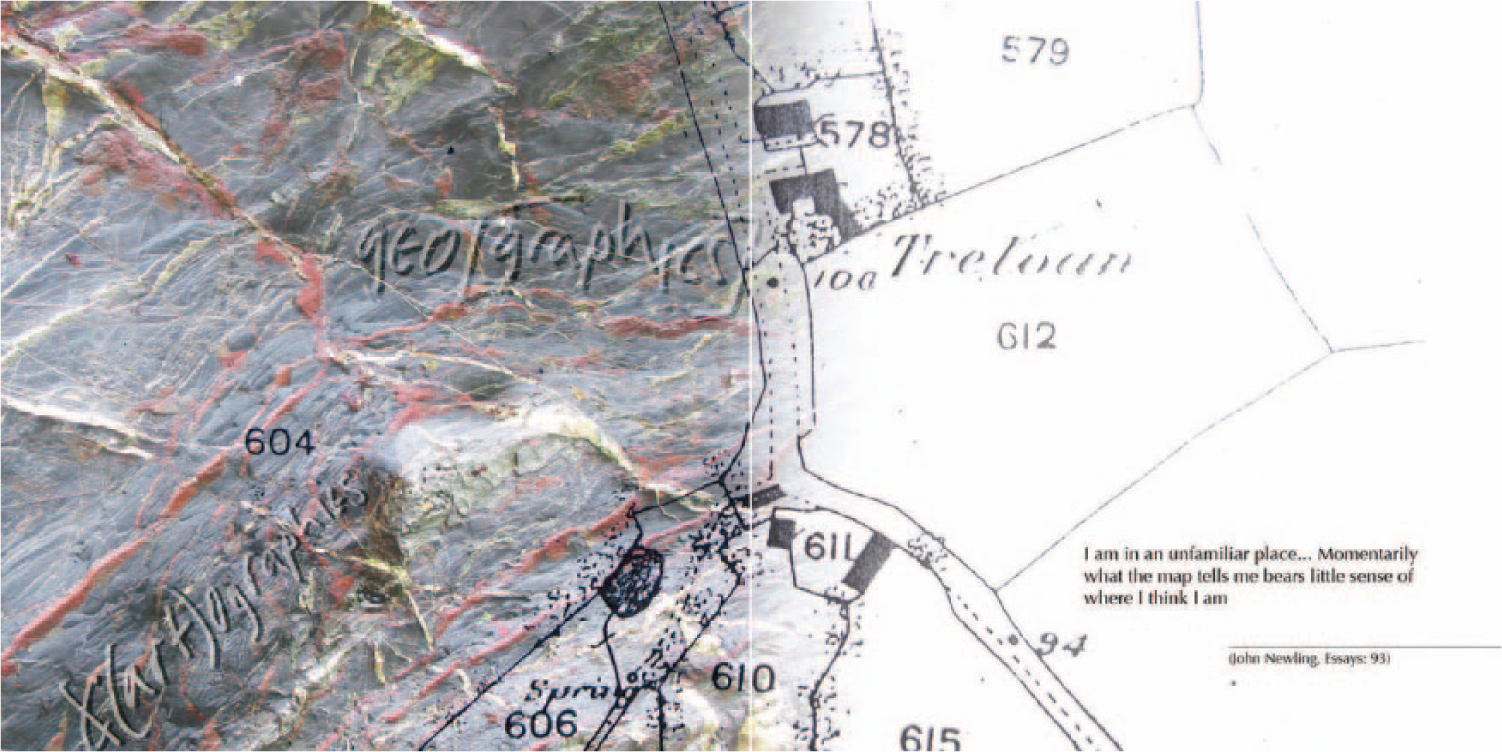
Insites (detail).
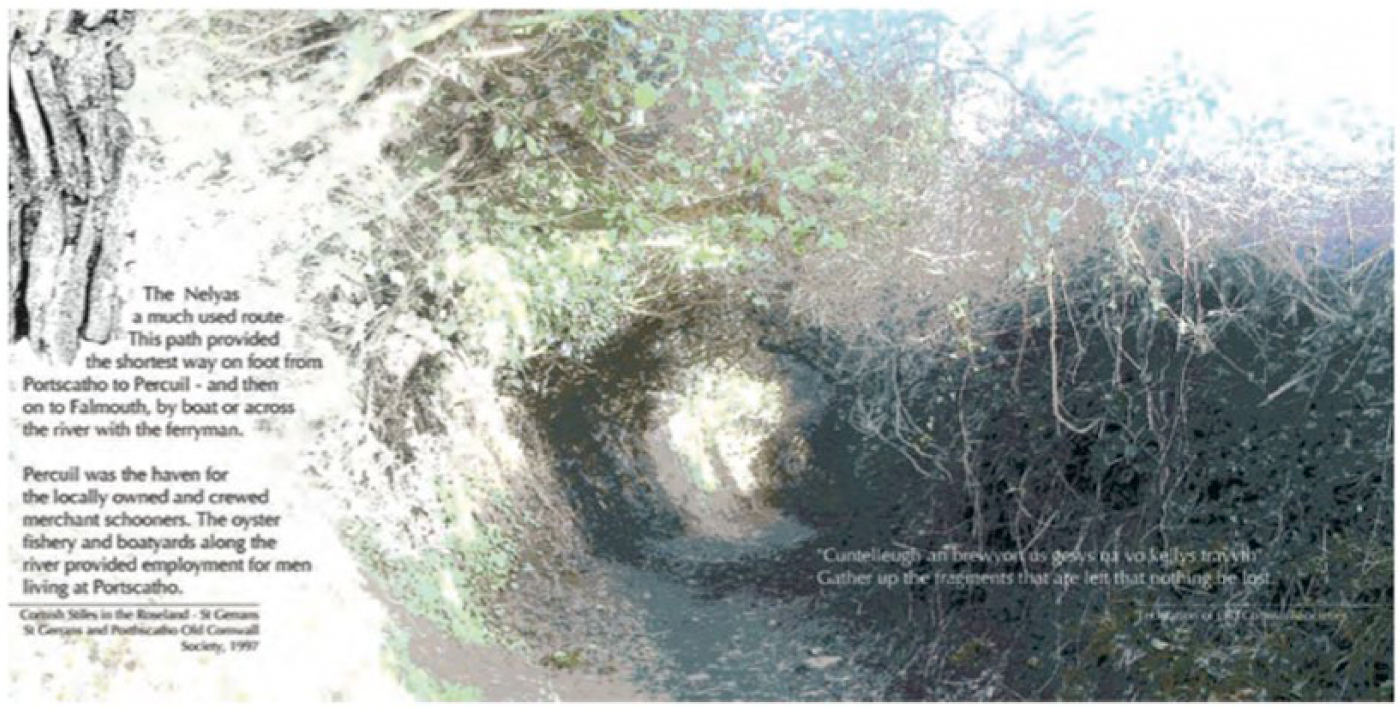
Insites (detail).
Drawing together Lovejoy’s artistic expertise with my geographical scholarship, insites could be described as an experiment in, following Pred, bringing images and their composition to geography as a conceptual force. What follows explores two representational experiments Lovejoy and I developed to try to meet the challenges posed by contemporary ways of thinking place. If Cresswell, St Pierre and others ask of writing practices, what might it mean to ‘write’ becoming rather than to present place as a static, finished achievement we experimented with what it might mean to compose pages and volumes in this way. 63 The first experiment considers how the practices of composing pages and sequences might enable a presentation of place as gathering. The second explores how critiquing the book as a volume might enable an exploration of the temporalities at stake in contemporary understandings of place. Given both of these experiments make use of the affordances of artists’ books, it seems appropriate to begin by reflecting on the medium itself.
Why make an artists’ book?
The notebook provides an apt vehicle for conserving this knowledge, not so much as an inert record, but something quite different, something alive. 64 The decision to make an artists’ book was guided by the conceptual affordances of the medium. Not much studied within geography, 65 book-works emerged in the mid-20th century as sites for artists looking to work outside art-world spaces, economies and structures. 66 As experimental spaces, they combined the spaces and sequences of the page, the cover and so on into an expressive unity, wherein the conceptual ‘message’ is ‘the sum of all materialities, content and formal, compositional elements’. 67 Artists’ books are valued as sites where the boundaries and conventions of art and art worlds (but also of text and book) could be critiqued, stretched and morphed, and where new text-image-based worlds can be developed. 68 Within the rich history, it is the play with the ‘bookishness’ of the book and conventions of representation and presentation that is of most importance here. As such, we see artists adopting and adapting the book as an object of associations and histories, cultural meanings and production values and as a space of the poetic and the possible. 69
As a material object, insites is 5 inches square, designed to be roughly palm-sized and covered in stiff black card. Its 52 pages of text and images were produced by the digital manipulation (using Photoshop and Indesign) of materials mostly generated during the period of shared ethnographic research described above (none of my drawings were included). Like many artists’ books insites was produced as a limited edition multiple, in this case of 1,500. Several hundreds of these were distributed at the 2009 Royal Geographical Society conference in response to the conference theme of ‘Geographical Knowledge’. Some were handed out during artists’ conferences and seminars prompting discussions about the intersection of geography and art making. A portable document format (PDF) version has become part of a curriculum pack on geographical knowledge for secondary school teachers to encourage them to think ‘outside the box.’ Others were handed out to villagers and left in the local shops and other venues that were the inspiration for the pages and the sources of the discussion in the book.
The design of insites was informed by its overall ethos. We wanted it to be pocket-sized like a notebook, echoing its subtitle. We envisioned creating page spaces in which our jottings, reflections and observations sat alongside those of the local community and those people might add to the book later on, creating an ‘alive’ rather than inert record. Given the environmental imperatives of Lovejoy’s wider project the paper we chose was recycled, an off-white that would keep its texture when printed on, and the textual inlays describing the project were printed on tracing paper. Originally, we wanted the inlays stitched into the text and to make use of transparencies, cut-throughs and folds to develop rich formal explorations of the ideas of place we were working with. These features proved too costly for our budget, being more suited to the production of a smaller number of books or a single volume. In tune with history of the artists’ book as a (relatively) democratic art object and our sense of the multiple stories of place we were committed to tell we wanted the books to circulate locally, which meant on our budget simpler formal features so that we could produce more copies. 70 Within these budgetary limits we experimented with how our thinking about place might take form in the composition of the book and its pages, moving beyond an unordered amalgamation of information or a visual-textual inventory to develop concepts in aesthetic form.
Composing the page – gathering and becoming
One of our experimental challenges concerned how to create a sense of place as gathering, how to compose pages to develop an awareness of the rich organic togetherness of beings, humans and non-humans. Extending the space the artists’ book makes for creative play with the codified elements of books, we experimented with academic conventions of referencing and with the interplay of images and text. 71
In the design of insites, aesthetic concerns often faced-off against academic conventions, posing what were eventually productive mismatches of design and concept. For instance, much discussion was had around the question of references, did we need/want them, if so as in-text citations or as footnotes or endnotes? 72 Footnotes ended up being a formal conceptual device as well as an essential carrier of information. Floating free from the base of the page, sometimes coming to rest across images, they functioned as a formal assertion of the multiply authored nature of the text. Delinking source material from its marginal place in the form of these floating footnotes enrolled this material in creating the poly-vocality we were interested to explore; local voices came to sit alongside quotes from our field-notes, from artists who had participated in the project and from anthropologists and place theorists who had informed our thinking.
Such floating footnotes were just one example of how the normal conventions of the page shifted during our experiments; perhaps more common was an unsettling of the relationship between image and text, often undercutting the primacy of text. We treated text akin to images, rendering its appearance malleable rather than set in terms of format, font and size. As such, it was subject to manipulation through formal means, and methods more often reserved for pictures. Images and text often became one compositional unit, passing in front of and behind one another. So, for example, weaving their way along the scribbled out contour lines and tracking the gradually fading maps of coastline paths are quotations from anthropologist Tim Ingold concerned with way-finding as story-telling rather than map-using. The line of text leads us over the page to a story of vernacular knowledge in the form of a long-used local pathway, a short-cut that does not appear on any map. Left to right movement is dominant here but every now and then is broken by sequences that cut back and forth across a series of pages or that force the re-orientation of the book in the reader’s hands.
We made use of material dissolves and blank spaces on the page. We were literally looking to make space not just for the thickness of things or a multiplicity of stories but also for ‘an open-ended interest in a multiplicity of trajectories (themselves ever in transformation) and the concomitant fractures, ruptures and structural divides’. 73 For to think about places as gatherings is not only about presenting an ecology of relations based in coming together, but, as assemblage theorists remind us, it is to think about compositional processes of dispersion and change. It is to question how did these occur, take hold, endure, but equally, how are they fragile precarious, provisional achievements.
On exploring our material, we realized we needed compositional forms that would enable the engagement with enduring traditions and orders of people, practices and things, but that could also make space for thinking through place in terms of becoming and processuality. On first look, the material we had gathered composed a sense of place shaped by a celebration of those historical practices that had once characterized this local rural economy, for example, willow-weaving, or traditional forms of working the land (figure 4). There was a real danger of failing to engage with perspectives beyond the local and of privileging the past, mobilizing it as solace from the lived realities of community life. Engaging the critical visual and textual languages and forms of the book-work enabled us to explore how materially and aesthetically we might begin to come to terms with this tension. We explored the formulation of visual-textual narratives that resisted closure, completeness and seamless coherence in favour of image-text narrative forms that opened out the possibilities for embracing the ongoingness of place.
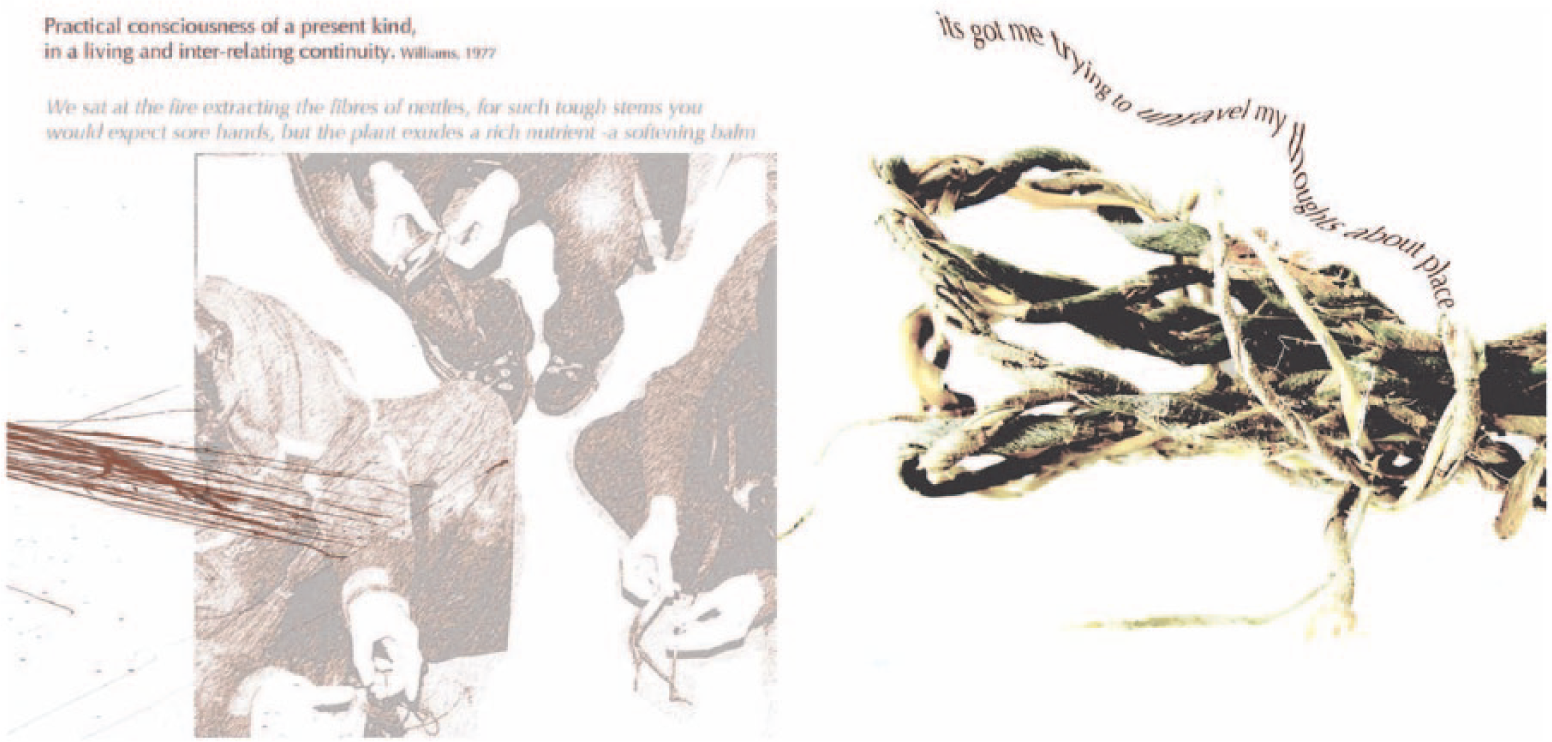
Insites (detail).
Key to our experiments were the tensions book-works encapsulate between the finite form and structure of the codex (a set of bound pages organized into a fixed and intentional sequences wherein sequence, spine, gutter and margin are de-limiting factors) and the critical operations of the book-work as an object with infinite forms and inexhaustible possibilities. 74 We sought to compose an experience that resisted a straight-forward page-by-page sequencing. The material form of the codex resists narrative to a certain extent, as unlike a scroll that unrolls in a directional manner one can open the book at any page and move back and forth; there is, however, still an assumption of a narrative directionality. Exploring the sequencings of image and text elements formally and conceptually across the volume enables the turning of the pages to be a dynamic act that develops a particular narrative form – in this case looking to resist the sense of a closed, fixed narrative through the installation of instability and ongoingness.
Exploring the aesthetics of sketching became one means by which we enhanced ideas of incomplete and ongoing places always in process. As a process of making marks on paper, sketches mediate between different registers of material but also have a particular temporality. Sitting alongside words, sketches by their ‘intimate, sketchy and suggestive’ nature serve a different function to words; they prompt an exploration of ideas of truth, of record and of witnessing. 75 Sketches, for Taussig, ‘intervene in a reckoning of reality in ways that writing and photography do not’. 76 This is a reckoning that links drawing as a process of discovery (explored in the second story) with a sense of its incompleteness. For Taussig, drawing surpasses the will to ‘realism’ of the fieldworker’s notebook ‘that drive to get it all down in writing just as it was, that relentless drive that makes you feel sick as if the very words you write down seem to erase the reality you are writing about’. 77 By contrast drawings, he argues, check realism, not because they make up the shortfall of words but because they have the capacity to ‘head off in another direction . . . butt [ing] against realism and a desire for completeness’. 78 The value of field-sketches for Taussig is that they ‘come across as fragments that are suggestive of a world that does not have to be explicitly recorded’, a world in fact all the more ‘complete because it cannot be completed’. 79 By their nature fragmented and partial, sketches never aim to be complete. That very incompleteness is a not a depictive failure but is the very value of the sketch, coming here to query the sense of ever being able to completely ‘picture’ place. Alongside including actual sketches, we expanded this philosophy to create layouts that celebrated blank spaces where images and text fade out. Missing elements, suggestive scribbles and overlays were deployed to formulate indeterminacies with the aim to destabilize any sense of closed or coherent accounts, and to retain the possibilities of alternatives not pictured, not yet come about.
Composing place 3: intervening, making place?
One of the first sequences to take shape during the design of insites juxtaposed second homes with conditions of rural poverty to explore the social concerns that dominated local discussion, including issues of the changing rural economy, declining farming practices and seasonal labour. Prompted by Caravanserai’s intention to engage with and help build the ‘interdependent relationship between local residents and visitors, between village and campsites and between many local networks and societies’, a pivotal sequence in insites opens with the two photographs shown in Figure 5. 80 Both images depict North Parade in Porthscatho and were taken from the same point 5 years apart, in 2004 and 2009. The remainder of the sequence collages newspaper articles, local stories and more images to explore local poverty and the adverse effects that an influx of second-homers has had on the community. The area is a prime tourist destination and is one of the most expensive areas for property in the South West of England. Every summer, its resident population of 900 swells to many thousands, and in 2009, the second homes of millionaires outnumbered those of local residents, with 85 per cent of the housing stock being second homes or holiday lets.
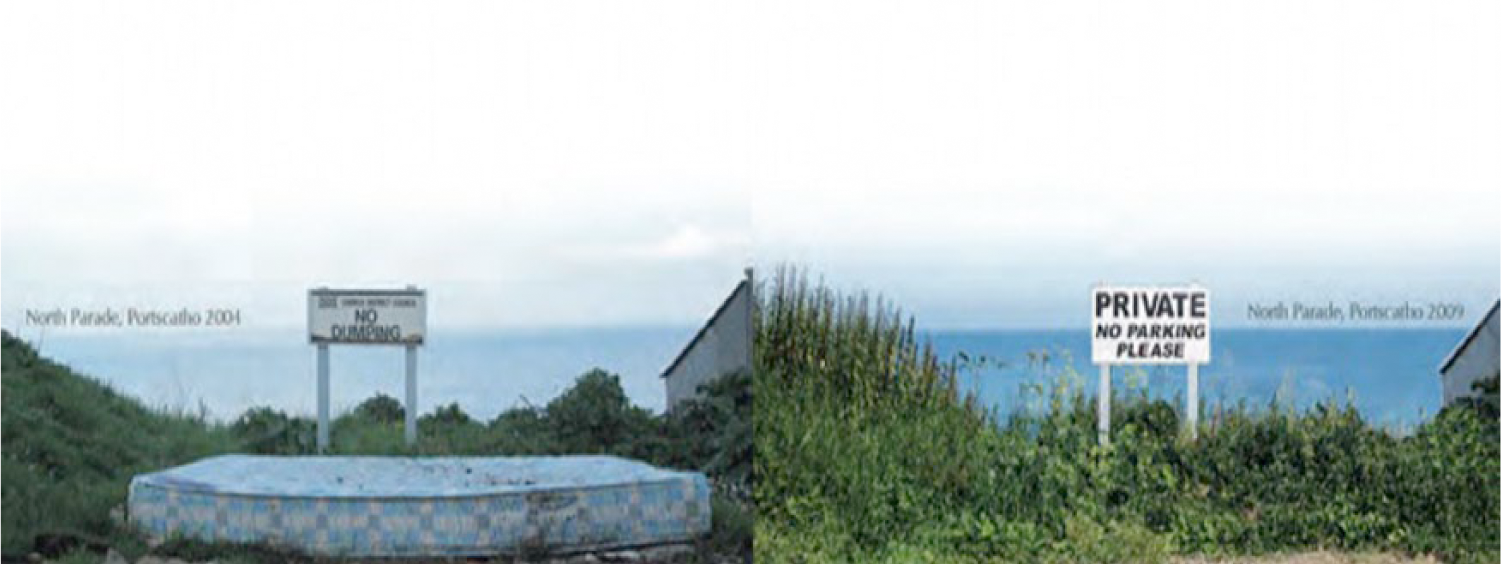
Page from insites, Lovejoy and Hawkins (2009).
This third empirical section moves back to the wider frame of Caravanserai to tell a third story of creative doings. This story replaces the focus on researching differently that guided the first two discussions with an exploration of how creative practices might be part of place-making processes that bring about local, community transformation. This is not the place for an in-depth discussion of the nature of these transformative processes, but rather, and ahead of a wider set of conclusions, I want to take the time to assert the potential that geography’s own creative practices might have for living differently.
Caravanserai is critical of that increasingly common genre of art works that have variously been called socially-engaged art or relational aesthetics. 81 As such, its focus is on configuring social relations between humans and between humans and non-humans, finding in aesthetics the resources to effect transformations in subjects and their relations. 82 Caravanserai translates as ‘a place where caravans or companies of people meet, a place of shared exchange and conviviality’, and at its core is a commitment to developing social events that generate different gatherings of bodies within the local community. The project is constituted by a suite of activities and events (e.g. local food feasts and craft workshops) that seek to create situations for shared exchanges. These temporary events are joined by a selection of sited works that take more permanent material form, including an allotment garden, poetry works and redesigned communal spaces that aim at being conducive to conviviality. In place of skills of drawing or other techniques of visualization, artistic skill lies in the orchestration of social relations. Aesthetic labours and skill sets are those of organization and management, and many note the exhausting nature of this ‘social work’ and its maintenance. 83
A reoccurring image throughout insites is a woven skein of nettle string, one length of many made during the course of my time at Caravanserai. In one particular sequence, the individual strands take us from the end of one section, exploring the histories of place and into a sequence that introduces the sorts of craft-based activities that Caravanserai coordinated, focusing on willow coppicing and the hurdle making. The sequence explores the collective efforts at doing, recording and transmitting craft practices that were instigated by residents. These involved learning from books in the project caravan as well as working alongside members of the local community. Among the different community events organized, some of the most popular were ‘do tanks’, involving experiments with hurdle making and crab pot weaving using local willow stocks and deploying techniques of willow-weaving specialist to the area. This collective crafting also extended to a fleece knitting workshop that saw looms set up in the fields during the local summer festival, inviting everyone to participate in the collaborative production of cloth.
At work in Caravanserai is an understanding of craft practices akin to the contemporary view of the power of making as a means of engaging with and cultivating new relations and subjectivities. 84 Participants commented on how these events ‘brought the community together’, reflecting that many activities saw local community members, holiday-makers and other people from the surrounding villages working alongside one another. 85 Commenting on their experiences, participants offered thanks ‘for giving people the opportunity to try something new together’, with one noting the effects of ‘bonding the village, the people in it and the people that come to visit’, observing ‘I have never seen so much love toward others’. 86
Even this brief account demonstrates how Caravanserai intervened in place, creating events where people could come together differently, potentially transforming themselves through collective creative doings. 87 More could be, and in other locations is being, said about the potentials and challenges for thinking through art and craft practices and other forms of amateur creative doings as forms of social architecture or technologies of connection. 88 This short example was, however, worth noting as it indicates how these multiple forms of creative practice can become folded together. Here, Lovejoy’s own professional creative doings and the amateur collective creative doings of those who took part in these activities came to reshape community, to recompose in some small way the relations that constitute place.
Conclusion: researching and living differently?
Creative Geographies, modes of experimental ‘art-full’ research that have creative practices at their heart, have become increasingly vibrant of late. These research strategies, which see geographers working as and in collaboration with artists, creative writers and a range of other arts practitioners, re-cast geography’s interdisciplinary relationship with arts and humanities scholarship and practices and its own intradisciplinary relations. This article has used one project to begin to explore the different forms of ‘work’ that these creative geographies can do with respect to place, namely, knowing, representing and intervening. In doing so, it has sought to tell three stories of creative doings that open out onto key questions in the wider field of creative geographic methods. To close, I want to restate the questions that tied these stories together and explore key lessons with respect to each of them.
A key question working across all three stories has been that of the skills and techniques of these creative geographies. What should be clear across the discussions presented here is the breadth of skills that we are talking about, from mimetic drawing through a range of forms of aesthetic and technical knowledge and conceptual know-how, as well as the social skills demanded by some forms of contemporary art practices. In short, creative geographies require a whole gamut of skills, and to not be skilled in some aspects is not necessarily to preclude the practice of these geographies, rather it is to encourage reflection on purpose and possibility. In other words, my drawing might not be of much use as a mimetic record of place nor did it display any great aesthetic skill, but its value for me was in the doing. In the case of the artists’ book, the finished object was a combination of skills from artist and geographer and at times represented a sense of not-knowing as we experimented with bringing together aesthetic form and conceptual questions. In sum, less important than gate-keeping some sort of expertise in creative practices, concerns with skill and technique might better attend to queries around the different forms of creative labour at stake here. We might explore the different kinds of ‘work’ that various forms of art and creative making involve, including the demands that they place on those who practice them, whether expert or amateur. While an appreciation of and respect for skilled practice are undoubtedly vital, to not be skilled is not necessarily to preclude the practice of creative methods, just to perhaps foreground what is gained in the doing rather than making claims for the aesthetic or communicative force of outputs.
Not delinked from this is a need to explore how creative methods rarely stand alone but are often situated as part of a tool-box of investigative techniques used by geographers and artists alike. For just as geographers turn to creative practices as research methods, so artists are in turn adopting social science research methods within their own creative practice. 89 In this discussion, creative methods came clearly to sit alongside interviews, participant observation and forms of meeting that were not dissimilar to focus groups. This is not surprising, visual methods practitioners have long noted the importance of accompanying interviews or periods of participant observation. 90 But what was interesting was to recognize how just as I sought to enrol creative methods within my social science research practice, so Lovejoy’s creative practice–based research had space within it for methods of interviewing, focus groups and participant observation. Importantly, this is not to collapse geographical and artistic practices into one another, differences were still clear and importantly so. Rather, this is to open up a space to begin to think through rich currencies of transformation and exchange at work in these methods. For both these sets of adoptions are often also adaptions, and the transformative possibilities – on the methods and on the researcher-subjects – of these shared doings warrant, I would argue, further consideration.
Second, exploring the practices of drawing ‘in the doing’ as well as recounting some of the compositional decisions made in the production of an artists’ book has enabled the examination of how it is that the materialities, technologies and aesthetics of particular art forms become the means to experiment conceptually. Drawing came to be understood as a situated means to know, rather than primarily as a mode of making a mimetic record that communicates information at a later date. When it came to exploring the composition of the book itself, discussion examined how the affordances of the medium enabled an aesthetic critique of representation that made possible conceptual experiments with knowing place. What such perspectives draw out is a need to think about the possibilities of image-making conceptually, rather than only think of the image as some sort of record. More broadly, it is to point to the importance of appreciating the processes of creative practices, and what it might mean to think of these as sites of knowing and thinking, rather than only as a means of production leading to an output.
A final question, and one that has in a sense framed the article, is the concern with the ‘work’ that geographers’ creative doings do in the world. 91 While geographers might be increasingly astute in analysing the productive affordances and capacities of the creative products of others, too often the work our productions do in the world – at times beyond our control – can become overlooked. 92 As creative practices increasingly become a part of the making of geographical knowledge, it is important that we remain alert not only to the potentials but also to the responsibilities of these practices. 93
Marston and De Leeuw, Hawkins and others ask us to reflect on why it is that our creative geographical practices appear so distanced from the critical-radical possibilities they contain, from models of such practices within the art world and from the histories of geographical engagements with the arts. 94 The third story took a very brief look at how Caravanserai was focused less on representing place than on intervening within it. This is in no way to suggest that representations do not do work in the world, decades of scholarship tells us otherwise. It is, however, to note that future trajectories for our creative geographies, and concerns with their variously skilled nature, might do well to pause and reflect on the potential of such practices not just for researching differently but also as a source of hope for living differently in the world. .
Footnotes
Acknowledgements
I would like to acknowledge the support from the research council and organisations listed above who made the production of insites possible, David Harvey and Nicola Thomas at the University of Exeter who ran the larger AHRC research project of which insites was a part, the partcipants in the research process, and of course Annie Lovejoy with whom I produced the book. Without her enthusiasm, skill and dedication the project would not have come about. I would also like to thank audiences at Universities of Durham and Newcastle, and at UCL who have commented on spoken versions of this paper and Brad Garrett who read an early written version, the paper is much improved by all of their comments. I would also like to thank John Wylie and the anonymous referees for their supportive, engaged and very helpful comments, any errors and misrepresentations in the paper are entirely my own.
Funding
This research that enabled the development of the artists book was funded by the AHRC (Research Grant Reference: AH/E008887/1) the production of the book was funded grants from the Social and Cultural Geography Research Group of the Royal Geographical Society (With IBG ) and the Historical Cultural Geography Research Group at the University of Exeter.