



Abstract
In previous engagements with political ecologies, cultural geographers have been interested in intersections between place making and environmental health, nature, environment and landscape interrelations, and their mutually co-constituted, socially constructed and contested nature. This article explores these themes through the experiences of urban activists in George Town, Penang, who have been involved in resisting the proliferation of ‘swiftlet farms’ in residential areas. ‘Swiftlet farms’ are typically converted shophouses or other buildings which have been modified for the purpose of harvesting the nests of the edible-nest swiftlet. They have generated significant controversy in George Town given their perceived impacts on urban health, quality of life, and (in)tangible forms of urban heritage. In examining spaces of the city that have been transformed through the ‘swiftlet farming’ industry, this article aims to highlight the ways in which individuals experience everyday landscapes of swiftlet farming, and how they might engage in reshaping them. In tracing this controversy, the article develops the conceptual framing of landscape political ecology, which allows for a closer understanding of the socio-natural production, transformation and contestation of urban landscapes. The research is based on 6 months of participatory ethnographic fieldwork conducted in Malaysia, much of which was developed in collaboration with local stakeholders. The article concludes with a reflection on how the particular approach set out here can shed important light on the role of praxis and everyday lived experience in shaping contemporary urban environmental politics.
Keywords
Introduction
In the summer of 1998, the Southeast Asian financial bubble imploded. Global capital moved spasmodically from place to place, leaving cities like Jakarta with a social and physical wasteland where dozens of unfinished skyscrapers are dotted over the landscape while thousands . . . roam the streets in search of survival. . . . Puddles of stagnant water in the defunct skyscrapers that had once promised continuing capital accumulation for Indonesia became breeding grounds and ecological niches for mosquitoes . . . Global capital and the technoscapes of the world’s financial architecture fused with global climate, with local power struggles, and with socio-ecological conditions to re-shape Jakarta’s social ecology in profound, radical, and deeply troubling ways.
1
The particular moment that Erik Swyngedouw and Nik Heynen discuss in the above excerpt is also the very same moment, and combination of various socio-economic conditions, that led to the rise of edible birds’ nest harvesting (or ‘swiftlet farming’) in Malaysia. Edible birds’ nests are considered a Chinese delicacy and are a common ingredient in Chinese medicines, consequently attracting over US$2,000 per kilogram on the global market. The nests are constructed by the saliva of the edible-nest swiftlet (Aerodramus Fuciphagus), which are native to Southeast Asia. Traditionally, these swiftlets would breed in caves across the region, where their nests have been harvested for hundreds of years. However, over the past two decades, a new phenomenon of urban harvesting has proliferated in Indonesia, Malaysia, Vietnam and southern Thailand, where buildings are converted (or constructed anew) into cave-like structures designed for attracting swiftlets and ‘farming’ their nests. In Malaysia alone, there are now an estimated 30,000 swift houses contributing an estimated US$400 million to the national economy. The industry is thus promoted under the Malaysian Economic Transformation Programme (ETP), as it is seen as a key industry for raising employment and income levels across the country. 2
However, since many of the buildings used are converted pre-war heritage shophouses in urban residential areas, the industry has generated a considerable amount of controversy regarding its impact on urban health, (in)tangible heritage, and the urban environment more broadly. Among the concerns regarding swiftlet houses are their potential to spread disease from bird droppings, sick birds or pools of stagnant water (which can act as breeding grounds for dengue infected mosquitoes). 3 In addition, swiftlet houses have been criticised for preventing a healthy environment for other businesses and residents to operate and live in; devaluing neighbouring homes and businesses; while also creating noise pollution through the swiftlets and loud speakers (or ‘tweeters’) used to attract them. 4 This article focuses on George Town, Penang, which has experienced the most intense controversy of all Malaysian cities related to this industry. This is largely because of George Town’s status as a UNESCO (United Nations Educational, Scientific and Cultural Organization) World Heritage Site (WHS) (jointly listed with Malacca) since 2008, which was perceived to be jeopardised by the widespread conversion of heritage shophouses into swiftlet farms, and their impact on the urban landscape.
The analysis in this article utilises the conceptual framing of landscape political ecology (LPE), which, as the name suggests, draws from the political ecology literature, and studies of landscape in cultural geography, offering dynamic ways of understanding the socio-natural production, transformation and contestation of urban landscapes. 5 The research is based on 6 months of multi-sited, participatory ethnographic fieldwork conducted in Malaysia, of which over 3 months was spent in Penang. Much of the time in George Town was spent on secondment with the Penang Heritage Trust (PHT), which has been a primary civil society organisation involved in lobbying against the proliferation of swiftlet farms in George Town. Given that the primary objective of the research was to investigate how swiftlet farms are perceived and contested in everyday life, the combination of research methods used was designed to highlight the ways in which individuals experience everyday landscapes of swiftlet farming, and how they might engage in reshaping them. 6 As I will argue, the lens of landscape, in particular, allows for more inquiry into the nuance and detail of local political ecologies and enables a closer examination of how the local and global are intertwined in particular places. 7
In the following sections, I will describe the various research methods that were used, and have structured the article around one particularly illustrative walking interview conducted in George Town in November, 2013. I first discuss the conceptual framing of LPE and how this has influenced the particular methodological approach used for this research. In particular, I have adopted the methodological strategy of ‘tracing the controversies’ developed by Yaneva and Heaphey, which aims to examine the social and spatial dynamics of social controversies on a lived basis. This also explains the decision to frame the article around the walking interview, as it is useful for exploring the everyday, quotidian impacts and personal experiences of swiftlet farming in Malaysian cities. The research presented in the article is also fleshed out with other research material collected during the broader fieldwork in Penang and discussing the wider implications and relevance of the sites visited. Finally, I conclude with a consideration of how the particular approach set out here can shed important light on the role of praxis and everyday lived experience in shaping contemporary urban environmental politics.
Towards a landscape political ecology: tracing controversies over the urban landscape
Controversies over the form and function of the urban landscape are important to study from a political ecology perspective because they reflect uncertainties regarding the costs of particular instances of socio-natural transformation on the built environment and are frequent symptoms of cities in the making. 8 Following this framing, struggles over the aesthetics of landscape are at the core of material struggles over the environment. 9 While Brenda Yeoh has asserted that most urban landscapes can be interrogated as terrains of quotidian conflict and negotiation, she maintains that this is particularly true of colonial cities given the divergence in perceptions of the urban environment. 10 Indeed, George Town’s rich colonial and mercantile history has created a society with divergent cultural and economic interests, and environmental subjectivities, which have resulted in the conflict at hand.
In previous engagements with political ecologies, cultural geographers have been interested in intersections between place making and environmental health; 11 nature, environment and landscape interrelations, and their mutually co-constituted, socially constructed and contested nature. 12 As Tony Bebbington and Simon Batterbury observed over a decade ago in the pages of this journal, the eclecticism and diversity of political ecology makes the field ‘an important meeting point’ for work in environmental politics and cultural geography. 13 In examining such controversies over urban and regional transformation, political ecologists have highlighted the material and discursive aspects of landscape from multiple angles. For example, Maria Kaika has studied the role of iconography and symbolism of dam constructions in reconfiguring the relationship between ‘nature’ and the city in Athens, Greece. 14 Similarly, Omaira Bolaños’ writing on land disputes and forest conflicts in the Amazon region illustrates how emerging socio-cultural dynamics and power struggles between indigenous and non-indigenous groups have reshaped the Central Amazonian landscape. 15 Such work has been inspirational in conceptualising this project, which emphasises the discursive representations of the environmental transformations associated with urban swiftlet farming in peninsular Malaysia.
Some scholars have thus begun to call attention to the conceptual synergies between landscape and political ecology while falling short of developing LPE into a distinctive conceptual approach. 16 Moreover, much of the existing empirical work in this area has focused primarily on rural (or ‘exurban’) landscapes. This includes a previous study in this journal by Peter Walker and Louise Fortmann titled, ‘Whose landscape? A political ecology of the “exurban” Sierra’, which examined rapid in-migration and gentrification in a former mining and ranching community in California. 17 Their paper provides rich insights into how ideas about the ‘proper’ form and function of the landscape are key flashpoints in the (re)development of cities and regions. It has also provided much inspiration for the approach taken here, but is also different given my focus on urban landscapes and the networked relations connecting ‘the city’ with other ‘agricultural’ or ‘natural’ spaces.
The term ‘landscape’, as readers of this journal will be aware, has been used in cultural geography to refer to the appearance or physical characteristics of a certain place, with particular reference to the social, cultural and political processes that shape these places. 18 Thus, as Batterbury has pointed out, landscapes are well suited for political ecological analysis because they are simultaneously cultural and ‘natural’. 19 Moreover, the new urban forms created through the swiftlet farming boom in Malaysia are important to study from the perspective of landscape because they bring to light the normative values and ideologies associated with particular urban landscapes in the country. For scholars such as Don Mitchell, the production of such landscapes is a matter of ongoing struggle and conflict between different social and economic groups; it thus typifies a contentious, compromised product of society. 20 What is at stake in these struggles, as I demonstrate in this article, is precisely the issue of people’s livelihoods, which are often dependent upon the construction or maintenance of particular landscape forms.
Given that there have as yet been no sustained attempts to utilise an explicit LPE approach in empirical work, this research has also involved developing a compatible methodological approach for this framework. In generating such insights, many political ecologists and cultural geographers have used ethnographic methods to consider the importance of cultural context in shaping the perceptions of stakeholders to the issue at hand. 21 As such, my approach loosely follows that set out by Brenda Yeoh, who suggests grappling with how the urban landscape is differentially perceived and utilised by various social groups, and to examine why conflicts over the use of this space arise, and how they are resolved. 22 The focus here, as in Yeoh’s work, is on ‘the practical nature of everyday life’, and aims to illustrate how the look and function of the landscape affects the lived experience of the people who live and work within them. 23 This strategy of emphasising both sensible and relational forms of knowledge has been integral to my effort to demonstrate the partial and sometimes contradictory aspects of everyday experiences of the swiftlet farming industry in Malaysia.
The term ‘everyday life’ can be traced back to de Certeau’s theorisation of the concept, explicated in The Practice of Everyday Life, in which he foregrounds the repetitive and unconscious practices of everyday life. 24 Relatedly, Alex Loftus’ recent book Everyday Environmentalism, considered how practical experience can form the basis of everyday resistances to hegemonic power relations and the production of unequal urban environments through praxis. 25 Other scholars, such as Kevin Dunn, have argued that everyday, local spaces are key sites for the symbolic contestation of unequal power relations. 26 In his study of opposition to mosque development in Sydney, for example, Dunn interrogates how the everyday becomes a critical site for the reproduction and contestation of religious and racial stereotypes. 27 These works demonstrate how particular ‘strategies and tactics’ of everyday life are useful for considering the ‘elements of creative resistance’ to dominant power relations in society, employed by people such as city residents, urban activists, and even researchers. 28 This explains the participatory, ethnographic nature of the research presented here, which intends to contribute to the academic literature on coproduction by addressing how academics can engage with civil society organisations to address socio-ecological issues in everyday life.
In achieving this goal, I have employed a range of participatory ethnographic methods, which have been used to provide unique insights into ‘the processes and meanings that sustain and motivate social groups’. 29 Through such a focus, it is possible to bring to light the ways in which different people might challenge unequal power relations and injustices through everyday, place-based practices. The central component of this research was the secondment period spent with the PHT, where the council members – in particular Rebecca Duckett-Wilkinson (introduced in the next section) – actively guided the direction of the empirical research, providing research material, and identifying relevant stakeholders. ‘Co-production’ is the term increasingly used to describe such forms of encounters and engagements, and is increasingly shaping research agendas, institutional practices, and forms of governance. 30 I maintain that such ‘co-productive’ research has enabled a more situated view of socio-ecological transformations that have transpired through urban swiftlet farming in Malaysia, and the controversies surrounding them.
Additionally, I have adopted a methodological approach to ‘tracing the controversies’, which is in line with the interests of both urban political ecology and landscape research in highlighting the dominant ideologies and discursive struggles bound up with the reconfiguration of the urban environment. As Albena Yaneva and Liam Heaphey have pointed out, this approach contains three primary steps: to follow, trace, and map the controversy. 31 First, to follow controversies requires being able to trace the dynamics of the controversy in time including the relevant stakeholders, their arguments, differing positions, and how these change or progress over time. Over 40 formal and informal interviews and focus groups were conducted with 25 different stakeholders among four key research sites in Malaysia (Penang, Malacca, Kuala Lumpur (KL), Kota Kinabalu and Sitiawan). Most interviews and focus groups lasted for approximately 1 hour on average and were conducted with swiftlet farmers, heritage activists, municipal officers and government officials. A central component of the research was the use of mobile methods, specifically walking or ‘go along’ interviews. 32 These involve walking or driving with informants through the spaces in which they live and work on a daily basis. As such, they are intended to capture the socio-spatial character of lived experience ‘in situ’, that might not come out in traditional interview settings. 33
Second, to document the controversy has a similar aim as the above step, but relies on documentary analysis, including blogs, newspaper Articles, and online comments to such Articles. Newspapers included were English dailies in Malaysia, including The New Straits Times, The Star and The Sun. These newspapers were examined as they contained the most Articles concerning swiftlet farming in the country, as compared to Chinese, Tamil or Malay dailies. In addition, I consulted specific sources such as CSO (Civil Society Organisation) and government reports, letters and emails between different stakeholders, as well as photos and even quantitative data pertaining to swiftlet farming in Melaka and Penang, which was made available through the PHT and other CSO resource libraries in Malaysia. Yaneva and Heaphey and other scholars maintain that the analysis of such materials is still quite ethnographic, as it allows a glimpse into the lived experiences, viewpoints and positionalities of key informants, which would not always be accessible through other means. 34
Given the importance of the relationship between knowledge, place and environment, Yaneva and Heaphey argue that it is also important to map the controversies, which involves visualising and analysing the spacial dynamics of the conflict, and indicating their implications for urban health and well being. 35 This was done through mapping the location of swiftlet farms in George Town based on a personal survey of active swiftlet farms in the city, which was conducted in March, 2014. This survey was based on previous surveys done by PHT members and other researchers, which were conducted in 2008 and 2011. The surveys focused on the Core and Buffer Zones of George Town’s WHS, which occupy the central area of the inner city.
As various scholars have pointed out, the research methods outlined above are also integral to participatory research approaches. 36 For example, the material used for mapping the swiftlet farms in George Town was only available through collaboration with the PHT, and in turn, their relationship with the State and City Government and local researchers. This was also the data that was the most useful to them in carrying out further action on the remaining swiftlet farms in the city. Therefore, the relevant research materials collected during this project were added to the PHT resource library, findings of the research was published in PHT newsletters, and were also used to put pressure on the State Government to uphold their promises to remove swiftlet farms from George Town’s WHS (see below). In addition, walking or ‘go-along’ interviews are also highly suited to work with environmental activists, in that their focus on ‘praxis’ and ‘lived-experience’ help with understanding concrete political struggles of various kinds. 37 For these reasons, Roderick Neumann rightly suggests that participatory ethnographic research can play an important role in approaches to political ecology which seek to highlight the conflicting perspectives on different forms of socio-environmental transformation. 38
The ‘go-along’: everyday experiences of swiftlet farming in George Town
My first meeting with Rebecca was one month into my fieldwork in October, 2013.
39
Rebecca – an artist, resident of George Town, and former council member of the PHT – has been the primary voice advocating for the strict regulation of swiftlet farming in the city since 2008. She originally purchased her (former) home on China Street in 2006 on the basis that the swiftlet farms would be cleared out by 2008, as was promised by the State Government at the time. Indeed, in 2005, the Municipal Council announced that no more licences were issued to swiftlet farmers, so no more farms could be (legally) established. The government also announced a 3-year ‘grace period’ for the removal of swiftlet farms from the WHS by the end of 2008. However, for a variety of political reasons, as I have documented elsewhere, no enforcement action took place in this period, and the deadline was extended until 2009, and then 2010.
40
In 2010, the Federal Government of Malaysia announced that all swiftlet farms would be prohibited in the UNESCO zone of George Town and Malacca, which initiated the implementation of another 3-year action plan to remove the remaining premises. Enforcement action in George Town began promptly in 2011 and loud speakers playing recorded swiftlet calls (or ‘tweeters’, which were used by swiftlet farm operators to attract birds) were also banned at this time. In January 2014, the State Government of Penang proudly announced that all swiftlet farms had been removed from the UNESCO zone, despite a personal survey conducted in March, 2014, which found at least 42 active premises.
41
This incongruousness is ultimately due to the contradictory position of the Government in Malaysia, which was simultaneously responsible for promoting and regulating the swiftlet farming industry. The Government’s delayed enforcement action on swiftlet farms in George Town – in addition to health and safety issues – is also one of the factors that has led Rebecca to actively campaign against the presence of swiftlet farms in the urban area. In our interview, Rebecca recounted her personal experience with the industry, how she and her family had been personally affected by the industry over the past several years, and her role in lobbying against the pervasive swiftlet farming in George Town. As she has explained in a letter to UNESCO,
this has not been a mindless campaign on my part but has been from a sense of frustration at the lack of recourse to law when it comes to my right as a citizen to have basic health and safety, no fear of disease and no noise pollution etc.
We also visited her gallery, adjacent to her home, which was on the ground floor of a three-story building that previously functioned as a highly successful (though unlicensed) swiftlet farm. It also shared a party wall with a neighbouring building that was an active swiftlet farm. Rebecca took me upstairs to see some of the water damage and mould growth on her side of the wall, which was caused by the sprinklers on the other side – constantly running to keep the neighbouring building damp and humid.
Our next meeting was nearly a month later, which is what much of this article will be based upon. In order to illustrate the significant landscape transformations that swiftlet farming has brought about in George Town, and the impacts of these changes on everyday life, Rebecca offered to take me for a walking tour of the most affected areas in the inner city area. 42 Figure 1 documents the route we took, which was entirely within the core zone of the WHS. As mentioned in the introduction, this walking interview primarily serves as a framing device for the article, and the research presented here is based on broader fieldwork in George Town, conducted from February through May, 2014. This section is divided into two further sub-sections, which will focus on different themes: the first, ‘urban environments, landscapes and livelihoods’, and the second, ‘everyday landscape political ecologies of health’.

The ‘go along’ (author’s map).
urban environments, landscapes and livelihoods
We started the walk at the Seven Terraces, a new boutique hotel that was opened shortly before my arrival in George Town. As the name suggests, it is formed from seven adjacent shophouses, some of which used to be swiftlet farms. It is located on Lorong Stewart (Stewart Lane), which has been one of the prime swiftlet farming areas in George Town. At the time of my fieldwork, there were approximately two active swiftlet farms on Stewart Lane itself and three on Muntri Street, which is a continuation of Stewart Lane. Mary, a friend of Rebecca’s used to own a boutique hotel on Muntri Street which had an open courtyard for guests to use. However, since it was adjacent to the swiftlet farms on the street, she would often get swiftlets flocking above her courtyard in the mornings and afternoons. Not only would they release their droppings into the courtyard, but they would also create a nuisance due to the high pitched noises that they would emit. As one news article put it,
apart from not allowing residents, hotel and restaurant operators and other businesses to operate in a healthy environment, swiftlet houses are also being feared in George Town for their potential to cause damage to properties and result in the devaluation of these units [sic].
43
According to Rebecca, the neighbouring swiftlet farm was unlicensed, and the owner even added an illegal extension on top of the building to accommodate more birds. Nonetheless, despite Mary’s complaints to the City Council, action was never taken on the premise. Such stories, particularly regarding the lack of responsiveness by the State Government, are quite common in Penang, as I will discuss in the following section in relation to Rebecca’s own property.
Rebecca was also concerned about the high numbers of swiftlet farms on Muntri Street, given the equally high concentration of guest houses and hotels in the area. ‘You have to question that, don’t you?’ she asked rhetorically. Indeed, according to a detailed land use and population survey of George Town conducted by the local consultancy firm Geografia, Stewart Lane and Muntri Street are in a precinct characterised by tourism, entertainment and food services. The report also notes, therefore, that the abundance of swiftlet houses on Muntri Street ‘are not well suited to a tourism and food precinct’. 44 Rebecca told me that the swiftlet farmers would often use the rhetoric that no one actually lives in the George Town WHS – that it is all restaurants and shops – and so the swiftlet farms are not a problem. However, this could not be further from the truth, given that the Geografia report found that residential properties made up 2,353 of the 7,413 properties (31.74%) in the George Town WHS. 45 Furthermore, 59 buildings were tourist accommodation, which means that there are constantly thousands of visitors staying there as well. These issues reflect one of the central tensions highlighted by Walker and Fortmann’s earlier study, mentioned in the previous section, regarding the landscape changes and social controversies sparked by the emergence of ‘new’ economies or industries in a particular place. Swiftlet farms have thus been caught up in competing understandings of how George Town’s urban landscape should be ordered, given their implications for alternative livelihoods in the city.
A short distance from Stewart Lane, we came to an unnamed alleyway behind the buildings facing Jalan Masjid Kapitan Keling (Pitt Street) which contained a high concentration of swiftlet houses in the past, which were no longer active. 46 From this alleyway, it was possible to see the ‘jack roofs’ of the two swiftlet farms on Pitt Street (see Figure 2), as well as the two openings on the back of the Eu Yan Seng building (158 Chulia St; hereafter, EYS; see Figure 3), which faces Chulia Street. A ‘Jack roof’ refers to a (traditionally tiled) roof raised above the ridge of an existing roofline. Traditionally it would allow for covered ventilation into the main roof space, but in swiftlet farms they have largely been converted to concrete blocks on top of the roof to allow for birds to enter the building. In mornings and early evenings each day, there would be hundreds of swiftlets flying in and out of the EYS building, which was, at the time of my fieldwork, the largest and most active of all swiftlet farms in George Town. EYS is also the oldest swiftlet house in the city, established in the early 2000s, but is disguised as a Chinese medicine shop, even though the swiftlet nesting area occupies most of the three storey building.
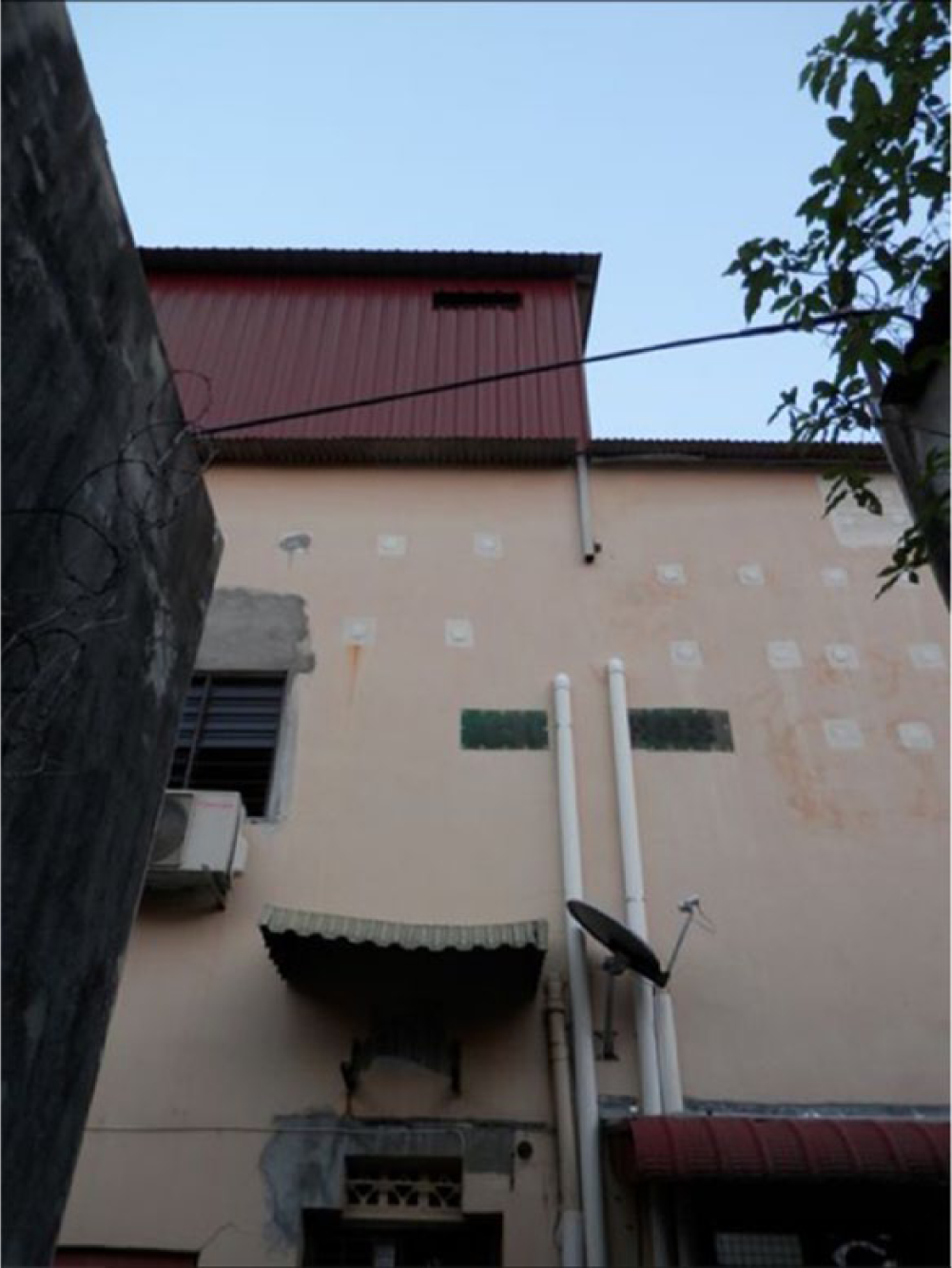
The ‘jack roof’ on a (former) swiftlet house behind Pitt St. Notice the sealed up air vents, revealing the building’s former purpose (author’s photo).

Side and back view of the Eu Yan Seng building. Notice the faux windows and metal fencing atop the building, to secure and conceal the swiftlet farm in the back (author’s photos).
Nonetheless, following the end of the Penang State Government’s deadline for eliminating swiftlet houses within George Town’s WHS at the end of 2013, it was asserted that the EYS building had ‘ceased operation’. According to an official state document from February 2014 detailing the status of swift houses within the inner city, EYS was noted as having ‘no activity’ on the upper floor. I later questioned the relevant officers about this during a meeting at George Town World Heritage Incorporated (GTWHI – the State Governmental Agency in charge of monitoring the WHS), and they told me that I must have been referring to the building next door. I responded that the neighbouring property had ceased operations according to my observations, but that EYS was still very active. Yet the city councillor in charge of the swiftlet house operations still remained defensive, asking, ‘how can you be sure? Maybe it’s the same bird flying in and out? . . . Even if there are birds does not mean [it] is active’. As suggested by several key informants, due to the intense pressure on George Town and the State Government to maintain its world class, World Heritage image, there was little official willingness to recognise the persistence of swiftlet farms, as this could embarrass the government for its failure to successfully handle the issue. 47 Instead, it was easier to simply convey the image that George Town was swiftlet farm free.
Since swiftlet farming is a government sponsored industry, the government has been actively supporting the industry and (potential) investors in it. As one MBPP (Majlis Bandaraya Pulau Pinang – George Town City Council) officer explained, ‘we are the government of the swiftlet farmers too, and must represent their interests’. Similarly, Rebecca related that Lim Guan Eng (the Chief Minister of Penang State) ‘is apparently very much for the swiftlet farming industry, and has been influenced by the wealthy Chinese swiftlet farmers’. Yet, this has created a significant conflict of interest for the state, who also need to account for the significant negative externalities arising from the industry. As a result, some stakeholders that I interviewed suggested that this created an impression that the government is either apathetic or complicit with the industry. For instance, another PHT member opined that if the State was actually serious about removing all swiftlet farms in the WHS, then they would shut down the EYS building: ‘if EYS was shut down, that would have a massive impact on the local swiftlet farming industry, because people would see that “oh shit, these guys [MBPP] are serious!”’. 48 This episode thus serves as a prime example of how exploring controversies over the urban landscape can reveal the myriad contradictions inherent in urban governance.
The EYS building is also significant for the impact that swiftlet farms have had on George Town’s urban fabric and (in)tangible heritage. As Ms Cardosa, Director of Malaysia’s National Heritage Trust (Badan Warisan Malaysia – BWM) explained in an earlier interview, ‘it’s a short-sightedness, they see the economic benefits now, but don’t see the long term effects on the urban landscape or public health’. According to Rebecca, EYS ‘actually used to be a really nice building, and then about three or four years ago [2010/2011], they removed the windows, added an extra level and put the big banner up, as well as the fake windows/vents’. This has been one of the main arguments against swiftlet farming in George Town, in that the owners completely transform heritage buildings in an irreversible manner. As Rebecca lamented, ‘When it’s natural [in caves] I don’t care so much, but when it’s these 5-foot bunkers in cities that have been converted – it just offends the eyes!’. Such comments underscore the centrality of aesthetic landscape consumption to George Town’s economy, which was threatened by this new form of natural resource production in the city.
Further into the tour, entering George Town’s Little India district, we walked down Lorong Pasar (Market Street), which is another active swiftlet farming street. Rebecca pointed out a building at 12–18 Market Street, which used to contain Edible Birds’ Nest Industries (EBNI). The EBNI building was located directly behind her former house (25 China St), and the two properties were separated by a small alleyway (Lorong Chee En). The EBNI building is another prime example of the wider social and economic impacts that swiftlet farming has had on the urban environment. As seen in the two photos below (Figure 4), EBNI purchased two adjacent shophouses for their birds’ nest business, which previously contained two independently owned small businesses: a Chinese-run auto-parts shop (left) and an Indian textile and garment business (right). Moreover, it is a category II heritage building, yet was significantly transformed on the inside, despite more or less maintaining the previous facade of the building. 49 However, EBNI suffered during the imposition of China’s embargo on Malaysian birds’ nests, which lasted from 2011 to 2013, resulting in the business being closed before my arrival in George Town. 50

Before and after shot of the EBNI building on Lebuh Pasar (Market St). 51
This was the fate of many swiftlet farms in George Town, which highlights the inherent economic and social unsustainability of the Malaysian swiftlet farming industry, given that it is dependent on unstable commodity markets. The proliferation of swiftlet farms displaced an array of other businesses (many of which had been operating for decades), yet ultimately resulted in a landscape of (largely) abandoned swiftlet farms throughout the country. This process resulted in a high impact assessment (HIA) being conducted on the swiftlet farming industry in George Town, which concluded that continuation of the business ‘will lead to urban flight, loss of traditional trades and serious deterioration of urban space’. 52
The issues discussed so far reveal how such transformations not only affect the physical landscape, but also the cultural landscape and lived experience of a place. This controversy also elucidates how modifications to the form and function of the urban landscape are deeply embedded within competing landscape and property interests as well as differing understandings of place. As Duckett-Wilkinson put it more acutely, ‘swiftlet farming is a great worry for the residents and investors . . . because people have put hard earned money into their long term homes and developments’. Clearly, then, this controversy is not only about heritage, aesthetics, or health concerns, but also very much about money and livelihoods. The discussion thus far also demonstrates the unevenness inherent in government attempts to regulate economic activities in urban areas, which arise in part due to different understandings of which (economic) activities are seen as acceptable or desirable for a particular place. The next sub-section will complete the discussion of the walking tour, and discuss the alleged health implications that the swiftlet farming industry has brought about for urban residents living and working in George Town.
Everyday landscape political ecologies of health
In addition to its impact on the urban fabric of George Town, the EBNI building was also a nuisance to nearby residents given that it was retrofitted with several large compressors on the back of the building, which were connected to the humidifiers inside. Rebecca complained to the City Council about the considerable noise generated by the compressors (and from the birds themselves), but again did not manage to generate any enforcement action. This is one example of the way in which swiftlet farms not only have a detrimental impact on human health, but also on general quality of life and mental health, related to noise emitted from the premises. Accordingly, noise has been the number one complaint from residents throughout Malaysia regarding swiftlet farms, which are actually more prevalent than health concerns. 53 This is because of the use of tweeters, which were legal in George Town, prior to 2013, and are still widely used in other Malaysian cities.
At the corner of China Street and Beach Street, there was (at the time) a small vegetarian restaurant which also contained a very active swiftlet farm above the restaurant. This is something that Rebecca expressed concern about – having swiftlet farms right above restaurants. Indeed, as Chow Kon Yeow, the Penang State official who has been in charge of controlling the swiftlet farming issue in the city told me in an earlier interview,
Those places that operate a restaurant or café at the bottom, with a swiftlet house on the top, this is totally unacceptable I think – with the health issue and all that. Personal view: it’s very unethical to operate the eatery below, but if you put a sign at the top, that says the top is a swiftlet farm, then the customer can choose to go, knowing full well, but deceiving people is not ethical.
Nonetheless, such business patterns are not uncommon in George Town, as there was a popular noodle shop on nearby Chulia Street which also had a very active swift house operating on the upper levels (see Figure 5). 54 Yet, due to the intense resistance exerted by swiftlet farmers towards the State Government’s enforcement action, the State Government often only paid lip service in their attempts to close down such illegal premises.

Active swiftlet farm above a popular Tomyam Noodle shop on Chulia St, George Town WHS. Notice the tell-tale ventilation holes and boarded-up windows on the upper stories (author’s photo).
Rebecca also pointed out that the building next to her home, which was an active swiftlet house for the duration of my fieldwork, made a number of illegal modifications which disrupted the public space around the building. First, the owner blocked off the public lane behind the building (Lorong Chee En) with a large fence, which curtailed access of pedestrians in addition to the water and utility companies. The owner also blocked off the public 5-foot way with a metal gate to prevent anyone from potentially breaking into the building. Both of these modifications are illegal according to local bylaws, yet the City Council did nothing to enforce them, despite numerous complaints from Rebecca and other residents. The 5-foot way is a distinct form of architecture common to Malaysia, Singapore and Indonesia, designed to shelter pedestrians from sun and rain while also improving ventilation in the city. 55 Their blockage, along with the clustering of swiftlet houses thus creates a health hazard in the city, as the 5-foot ways were initially implemented on the basis of improved circulation and sanitation.
Therefore, many residents of Malaysian cities like George Town were concerned with the ‘unknown diseases’ that the public could be exposed to as a result. As one anonymous doctor from KL commented, ‘it seems that the owners of these shophouses are willing to jeopardise the health of their neighbours and the public for monetary gain’. 56 In light of these possible risks, a George Town resident’s group also claimed following the 2013 bird flu out break in China, ‘we think the people of Penang need to be warned about the possible risk. The Penang Government is not clearing out the swiftlet houses in inner George Town. Are they waiting for an outbreak?’. 57 Given the 104 recorded swiftlet houses in the George Town WHS at the time, the PHT argued that this event should serve as a warning to the State Government and Malaysian authorities to take the health threats posed by swiftlets seriously and renew their actions to eliminate swiftlet farms from residential areas. Yet, as the PHT charged, the Malaysian authorities have been negligent regarding the potential health threats of swiftlet farms. This echoes a finding highlighted by Mulligan et al. in their study of dengue fever prevention in Putrajaya Malaysia, noting that health is not the top priority for the government, as economic factors tend to prevail. 58 Nonetheless, as Cardosa underscored in an earlier interview, ‘this is their responsibility. The government is responsible for the safety and security of the people, and this is a safety issue’.
Rebecca also pointed out that there was a pool on top of the roof on the four-story EBNI building behind her, which is commonly used on top of swiftlet houses for the birds to drink out of, or on the interior of buildings to keep the humidity levels up. This is another way in which swiftlet farms have an impact on urban health. Rebecca explained that such stagnant pools of water – if untreated – can create a risk of dengue fever, which is endemic in Malaysia. In fact, Rebecca caught dengue twice between 2011 and 2012, the second of which was the haemorrhagic strand, which was nearly fatal. At that point, Rebecca and her family decided to sell their home on China Street, and move outside of the UNESCO zone, away from the swift houses. As she remarked, ‘if it was my 14 year-old daughter who contracted it instead, she most certainly would not have made it’.
59
As a result of this experience, Rebecca believes that there is a direct link between swiftlet farming and dengue fever, as she explained in the following statement:
Just on China Street [her street] we had 5 cases of dengue but in the small area from China Street, Stewart Lane, Love Lane and Muntri Street, which, according to 2005 figures, have 23 swiftlet houses, there were too many cases of dengue. I personally know and work with 5 of the people who contracted dengue just in this area. There has just been more dengue on our street. This is appalling! Studies have to be done to see if there is a correlation between dengue cases and location of swiftlet farms.
60
However, there has been no research done to link cases of dengue to the location of swiftlet farms, despite repeated attempts to get this information from the State Health Department, who seemed unwilling to divulge figures in this regard. Yet, dengue is not the only health hazard that Rebecca attributed to swift houses. In addition, she noted that there has been an extraordinarily high incidence of lung disease among inner-city residents in the heritage zone, which she believes is a result of the swiftlet farms.
61
The reason for this is that dried bird droppings have been known to harbour the yeast spore Cryptococcus, which forms colonies at 20–37°C (making Malaysia’s tropical habitat ideal) and is known to cause meningitis and lung infections in human beings through inhalation of the spores.
62
One resident elaborated on this danger by noting that
bird hotels are well ventilated. Some have exhaust fans on rooftops. Dried bird droppings, dried skin and muck are disposed of through these fans. The naked eye may not be able to see these fine airborne pArticles. Those living nearby breathe and eat this muck. These pArticles are also virus carriers.
63
These deleterious aspects of the swiftlet farming industry were even acknowledged by the Malaysia Bird’s Nest Association President: ‘some members have no experience in the industry and their operations might cause pollution that would harm the environment and health of residents living near their farms’. 64 Not surprisingly, then, the Malaysian Department of Wildlife and National Parks (PERHILITAN: Jabatan Perlindungan Hidupan Liar dan Taman Negara) Law Enforcement Director reported that their office did receive numerous complaints about the cleanliness of swiftlet farms in urban areas, yet, as with other instances reviewed here, no action was taken in response to them. This reluctance to address such issues could also stem from the Malaysian Government’s disposition to portray a positive image of the country, with a strong and capable government, as noted by related studies on urban governance in Malaysia. 65
After inspecting the remaining swiftlet houses on China Street, and the surrounding area, Rebecca and I continued back to the Seven Terraces, where we ended the tour. The final concluding section will now review the insights generated through the conceptual and methodological approach utilised here, and reflect on the crucial role of praxis and everyday lived experience in shaping contemporary environmental politics.
Conclusion
The case of urban swiftlet farming in cities like George Town serves as a salient example of how a focus on everyday lived experience can highlight the myriad social problems posed by such transformations to the urban environment. So far, research on EBN cultivation has not integrated socio-ecological implications of swiftlet farming, nor documented its impact on everyday life in any of the countries where the industry currently takes place. This is a significant omission, as considerable levels of social mobilisation and contestation have unfolded in response to the negative externalities posed by the industry, its implications for alternative livelihoods, and the seeming unwillingness of governments to adequately regulate the industry. Far from being a mundane or esoteric phenomena confined to the Southeast Asian region, the case brings to light socio-ecologically unjust processes of metabolic urbanisation and the significant social controversy bound up within them. Moreover, it demonstrates how attention to everyday experience can become the basis for a performative politics of embodied struggle and resistance to such transformations.
The methodological approach to tracing the controversies was selected based on its potential to capture the more subtle forms of activism in everyday lived experience and praxis. I have demonstrated how walking (or ‘go along’) interviews are able to point out features of the landscape that would otherwise remain invisible if one were to simply conduct personal observations of the city. For instance, Rebecca was able to point out which buildings had formerly been swiftlet farms (but had since changed use), or about personal experiences of herself and others who had been impacted by the nearby farms. She was also able to tell me about the (often illegal) changes that the buildings had undertaken in their conversion into swiftlet farms, and how this has impacted urban life-worlds and forms of (in)tangible urban heritage. The framing of the article around the walking interview was thus used to demonstrate how space and place are bound up with general health and well being in urban areas.66 The personal stories – and the interweaving accounts of others elicited through the analogous methods employed – shed some important light on the wide-ranging implications of swiftlet farming in George Town’s inner city.
The wider analytical lens of LPE has also been useful because of its recognition and consideration of the power relations manifest in the production of urban environments.67 The landscape component of LPE is particularly important particularly because it renders visible the social struggles over how the landscape is (or should be) made, thereby revealing the contrasting landscape interests and cultural politics at stake. What is at stake here, is precisely the issue of competing livelihoods, which are dependent upon particular landscape forms, and the associated implications for socio-ecological well being. In previous work, particularly within the Marxist tradition, the landscape is treated as a commodity in that it actively hides (or fetishises) the labour that goes into its production.68 However, in the case of swiftlet farming in Malaysian cities, these struggles have been going on in a highly visible way over the past two decades, resulting in the (re)construction of landscape form over time. This illustrates the pertinence of both the urban swiftlet farming case and analytical framework of LPE.
In this sense, a focus on landscape is highly compatible with the interests of urban political ecology, while also emphasising the relationality of urban landscapes, and the constellations of different actors involved in shaping them. This was seen, for example, in the various political, cultural and economic aspects resulting in the Penang State Government’s reluctance to fully deal with the problems posed by the swiftlet farming industry in George Town. In such a way, the LPE framing provides a productive lens through which to analyse the material manifestations and struggles embedded within the landscape.69 While several studies over the past decade have hinted at the potential synergies between these diverse theoretical approaches, only a few studies have made an explicit attempt at synthesising the two. Yet, as this article has aimed to illustrate, there is considerable potential for the continued development of this field, given the pivotal role of landscape in changing urban environments.
Footnotes
Funding
The author(s) disclosed receipt of the following financial support for the research, authorship, and/or publication of this article: The research for this paper was supported by the People Programme (Marie Curie Actions) of the European Union’s Seventh Framework Programme under REA agreement N 289374 - ‘ENTITLE’.