




Abstract
This article traces the making of a pastoral landscape in sound in Chris Watson’s Inside the Circle of Fire: A Sheffield Sound Map, a temporary sound installation commissioned by Sheffield’s Millennium Gallery in 2013. In accordance with pastoral tropes, Watson forges a liminal space for retreat where figurations of nature, traditional labour practices and civic rituals help to celebrate the local sonic scene. This article finds in Watson’s work not a sentimental pastoral but a critical and complex pastoral, which speaks to the pressures and anxieties of the present, in this case to environmental pressures in their ecological and sonorous manifestations. The pastoral offers a mode of critique for unpacking a sonic imagination made up of particular historic and situated sonic engagements with sound and sound technology, brought to bear on Watson’s ways of hearing and handling both sound and landscape. The article answers recent calls to situate celebratory discourses surrounding environmental field recording practices within their cultural, historical and technological contexts. Detailed contextual and critical interpretation also build a broader argument concerning the ongoing need for field-based discussions to supplement the now expansive work on sound’s affectivities in cultural geography and beyond.
Introduction
Interviewing Chris Watson in a seaside café in Blyth, Northumbria, my attention is directed by the recordist-composer towards the sound system broadcasting a set of familiar pop songs. As part of a broader ambient sonic background, which included the conversations of other diners and the crashes, clatters and general din of a frenetic café environment, this was a sound that, to me at least, had gone completely unnoticed. To a finely tuned ear like Watson’s, however, these sounds seemed to stir more than a mild sense of irritation:
You know how many people are listening to this – to this music that’s being played? They should just turn it off, it’s irrelevant, it’s noise. People hear it but they don’t listen. Listening to it and deciding that actually it’s really annoying . . . you could ask to turn it off or take your business elsewhere.
1
Watson speaks in a manner characteristically calm and considered, yet these quietly affirmative comments prompt recollection of the sounds outdoors – the sounds of birdsong, of sea air and seawater – encountered during a short walk along the coast just half an hour earlier. Our return to the café had shifted conversation from the sounds of the natural world, captured during his many assignments for the BBC, to the subject of sonic disorder and to the potentially deleterious effects of those sonic conditions in which music is transformed into noise. This episode, a brief eruption of emotion at the beginning of an interview with Watson on the subject of his sound installation Inside the Circle of Fire: A Sheffield Sound Map, conjures a well-established motif and metaphorical device and alludes to some of the central tenets of a complex and critical sonic imagination. The contrast of harmony and dissonance, as marked out in space by a journey of retreat and return, hinted at a series of contrasts underpinning the pastoral mode which carries a moral message corresponding to, in this case, the irritating and potentially damaging effects of a very particular set of sounds, sound technologies and sonic environments.
This article considers the pastoral in its sonic manifestation through an in-depth account of Chris Watson’s Inside the Circle of Fire: A Sheffield Sound Map. Through detailed study of a single sound installation, this article exposes the critical potential of the sonic pastoral as a tool for mobilising the meaning and political agency of sound when marshalled in the making of landscape. Commissioned by Sheffield’s Millennium Gallery, a free public arts venue in the city centre, in association with the Sheffield and Rotherham Wildlife Trust, Inside the Circle of Fire took listeners on a journey from the moorland outskirts of Sheffield down, vortex-like, to the civic city centre, loosely following, at any one point, one of several watercourses and its attendant gravitational pull. The piece transported listeners to a set of geographical locations whose vivid and distinct acoustics acted as sequential musical phrases in the 36-minute long composition. A dawn chorus, an historic water wheel, two lively football matches, a steel works, a Buddhist meeting, the sounds of the civic city centre, the railway station and an underground storm drain, each provided sonic environments whose distinct component sounds made up what Watson refers to as the ‘signature sounds’ of Sheffield. An immersive installation space with 360° surround sound speakers provided the point of interaction between audience and sound. Watson refers his work as a ‘landscape piece’, an extension of recording and compositional approaches enrolled in the making of works released via the record label Touch since the mid-1990s. If, as David Matless asserts, ‘the question of what landscape “is” or “means” can always be subsumed in the question of how it works [. . . ]’, then critical analysis of the sonic landscape made by Watson necessitates an understanding of the historically, culturally and technologically contingent ways in which sound is put to work in the organisation of landscape. This article journeys through the constellation of Chris Watson’s unique sonic imagination in order to unpack the pastoral sensibilities through which the recordist-composer listens to, and argues with, sound. For Watson, the pastoral provides a framework for developing a particular set of arguments about the state of today’s sound world, understood as being characterised by poor acoustic design, a blasé attitude to listening and the loss of fidelity of locally specific sounds. 3 Exploring Watson’s sonic imagination reveals a set of historically, geographically and technologically specific engagements with sound that have shaped the precise ways in which sound is apprehended, recorded and reproduced. In so doing, this article adds to the now expansive field of sonic geographies the kind of empirical detail that has tended to be deemphasised in scholarship engaging with the non-representational and affective attributes of sound. 4 An account of sonic affect and the role of the body in landscape experience is therefore situated here alongside critical interpretation of a particular set of sounds and situated sonic practices.
Following a review of relevant literature on the pastoral and recent geographical scholarship on environmental field recording, the article works in turn through several key pastoral tropes that echo through Inside the Circle of Fire. Analysis begins with a discussion on the civic and sentimental nature of the artwork that celebrates established representations of Sheffield as green and rustic and as a locus for craftsmanship in the fields of cutlery and steel-making industries. This section pays attention to Watson’s use of the abstract which assigns agency to the natural world. The following section points to another set of abstract forces, this time corresponding to the spiritual attributes of landscape where sound is used by Watson to recover the perceived latent energy in the landscape. It is a belief in sound shaped by a technologically mediated life lived with sound beginning with Watson’s sonic experiments in his childhood home in a Sheffield suburb and later as part of Sheffield’s local electronic music scene. The article, then, moves onto highlight Watson’s Sheffield Sound Map as bearing a generalised sound signature corresponding to the historic modernities of electronic music, associated with sonic abstraction and a reduced kind of listening practice. The final section turns to the subject of sound installation as Watson’s chosen medium for broadcasting and to the role of the body and performance in the mobilisation of the meaning and authority of the sonic pastoral.
Pastoral landscapes and sonic landscapes
The pastoral has provided an enduring and powerful resource for cultural commentators of the English landscape since the 16th century in the fields of literature, poetry, painting, architectural and garden design and in music. 5 A highly durable and adaptable genre, the pastoral has retained spatial and structural integrity when enrolled for a range of ideological ends, each making its own claims to landscape. 6 Often considered to be a retreat from the city as site of avarice, alienation or moral degeneracy, the pastoral can nevertheless be found in urban as well as rural enclaves, in spaces often carved out as stepping off points from the very modernities the pastoral sets out to critique. 7 As Leo Marx has argued, the pastoral can either provide an escape from the tensions of the city or it might also seek to critique those very tensions. This distinction parallels what Marx refers to as either a ‘sentimental’ or a ‘complex’ pastoral, to a general sense of the pastoral, and its literary use where, as Raymond Williams observed, pastoral elements of elegy and idyll are appropriated and adapted for political engagement in the present. 8
The musical and sonic manifestations of the pastoral have echoed through the now expansive field of the geographies of sound and music. Stephen Daniels, for example, has traced the refraction of the pastoral through the Beatles’ double A-sided single Strawberry Fields Forever/Penny Lane, released in 1967. 9 The version of the pastoral mobilised in these works, as Daniels illustrates, is based upon a vernacular suburbia, place of childhood retreat for innocent abandon, creativity and imagination and of special biographical significance to both Lennon and McCartney. Daniels situates these works alongside strains in Pop culture at the time, characterised simultaneously by a celebration of modern technologies and a longer tradition of English landscape art and architecture. In studies on the development of the English musical renaissance from 1880 to 1941, George Revill discerns progressive strains too in compositions by Ralph Vaughan-Williams and Edward Elgar. 10 Vaughan-Williams’ The Lark Ascending, for example, stands as a celebration of nature’s abstract formations and forces, and emerged from the composer’s Darwinian upbringing and his growing interest in the philosophy of A. N. Whitehead. 11 As Revill demonstrates, this work represented a shifting away from the picturing of folk culture that characterised the English National School (whose formation was due in no small part to the musical activities of Vaughan-Williams himself) and moved towards evocations of spiritualism that dissolved the division between material and transcendent worlds. Revill’s observations echo those of musicologist Eric Saylor who likewise detects a progressive impulse in Vaughan-Williams’ post–World War 1 works that runs counter to dominant understandings at the time of their composition. 12 For example, in its use of pastoral signifiers as well its overarching sense of rural serenity, Vaughan-Williams’ Pastoral Symphony prompted contemporary critic Philip Heseltine to describe the work as ‘a little too much like a cow looking over a gate’. 13 As Saylor shows, however, the pastoral offered Vaughan-Williams a framework for self-reflection on the experience of war as member of the Royal Army Medical Corps in France, such that sonic quietude conjures not escapism but rather the stillness and desolation of landscape in its post-conflict state. Thus, the anxieties of Vaughan-Williams are, according to Saylor, ‘those of a modernist, driven by the need to make sense of an alienating postwar world while armed only with pre-war artistic experience’. 14 What Revill and Saylor’s works share is an attention to the pastoral as that which straddles the real life of direct experience and the fields of the moral, the intellectual and the allegorical in a manner that hints as disciplinary reflections on the term landscape within cultural geography, understood as noun and verb, matter and process, landscape as both destination and journey. 15
For Revill, the subject of the English musical renaissance and more recently the subject of sound composition have provided departure points for thinking through landscape as both ontology and epistemology, as ‘object and interpretation, conscious arrangement and random scatter, “raw material” and “artful construction”’. 16 Revill has shown how music shuttles between the affective and the reflective attributes of landscape, and in so doing gives rise to the pastoral’s persuasive and authoritative qualities. 17 Pastoral music is shown by Revill to structure the contours of both nature and culture within a single framing of landscape, with much broader significance beyond the local in shaping, and being shaped by, the cultural politics of subjectivity, nationalism, community and environment. 18 Drawing upon Chris Watson’s album, El Tren Fantasma (The Ghost Train), a sonic impression of a decommissioned railway in Mexico, Revill demonstrates the way in which sound, like music, straddles the material-imaginal continuum that underpins what we know and perceive as landscape. 19 Sounds, for Revill, mediate between the immediate and virtual, the proximate and the distant, thereby echoing works by pastoral composers in their negotiation of the real and the abstract, the particular and the universal. Furthermore, in a move that makes an important connection between the geographies of sound and music and the interdisciplinary field of sound studies, Revill draws upon Brandon LaBelle’s concept of the ‘arc of sound’, which highlights the potential of sound to connect listeners to one another as well as to landscape via processes of mediation and transformation. Thus, a single moving train captured by Watson in sound ‘connects cyclical processes and singular events, spatiality and temporality with experiences of location, regionalisation, flow and circulation’. 20
Revill’s work on the sonic organisation of landscape retains an understanding of sound that, as Lorimer and Wylie assert, ‘shapes its own topologies and conformations’, in manner that disavows topographical verisimilitude. 21 This article similarly acknowledges the phenomenal properties of sound, holding a critical lens to sonic practice that seeks to organise, order and govern landscape. As such, this article revives the cultural politics approach underpinning Revill’s earlier work on the musical pastoral, which itself corresponds to wider works on the relationship between sound and governmentality in factory, 22 primary school, 23 post-industrial 24 and scenic settings. 25 It is a rapprochement between the sensory and the political that Revill enacts in a recent paper on the making of space in sound, which moves through a range of conceptual frameworks, each uniquely equipped to articulate the possibilities of sound as spatial mediator. 26 Similarly, in his paper on the street music debates of Victorian London, Paul Simpson demonstrates sonic affect as generative of, not reflective of, socio-spatial relations. 27 Extending his reflections on sound, prompted by close readings of Jean Luc Nancy’s work on listening, Simpson’s focus on the cultural politics of sound echoes observations by Anja Kanngeiser concerning the role of the vocal affectivities on the political ecologies of class, gender, race and nation. 28 This article contributes to the development of such a critical phenomenological approach to sound, able to retain, on one hand, the inimitable characteristics of sound as a sense-making tool and, on the other hand, the political agency of sound as a force in the governance, cultivation and reproduction of power relations at a range of scales. It is an approach to sound study that accounts for, and makes connections among, the corporeal, discursive, technological, social and performative, echoing scholarship on the geographies of mobility and the geographies of sound and music. 29
Like Revill, this article also takes from the now expansive field of sound studies to inform interpretations of Watson’s sonic rendering of Sheffield as pastoral landscape. Brandon LaBelle’s ‘Background Noise: Perspectives on Sound Art’, 30 for example, which traces sound as it weaves in and out of art’s expanded field in the second half of the 20th century, offers historical context for a sound composition exhibited and accessed as sound installation. As LaBelle explains, sound surfaces in minimalism, conceptual and installation art forms, playing central parts in projects that set out to dematerialise and decentre the art object. Artists working within these fields drew attention to the phenomenological and social relationships between body and exhibition space in the production of artistic meaning. 31 Inside the Circle of Fire emerges a history of installation art aimed at transforming exhibition spaces into environments, where artistic meaning is differed, dispersed and diffused and where participation is activated in the mobilisation of artistic meaning. Positioning cultural geography in dialogue with a history of art’s expanded field, the work of Harriet Hawkins and Nina Morris has shown how the developing foci of arts practice during the 1960s and 1970s is consonant with approaches to landscape within recent cultural geographical enquiry, characterised by engagements with post-phenomenology. 32 Morris’ work in particular departs from the early post-phenomenological engagements with landscape by John Wylie and Mitch Rose in its documenting of the polyvalent nature of art experience whereby each audience member is granted the status of expert. 33 This article contributes to the geographies of art’s expanding field an acknowledgement of the auditory, of the role of sound within schemes that set out to defer, disperse and unmoor the site of artistic meaning in order to relocate sound within the set of relations between artwork and audience. 34 As such, this article contributes to the geographies of sound and music a critical engagement with sonic art forms, which have played a relatively minor part in the geographies of sound and music beyond soundwalking as medium for urban exploration. 35 Michael Gallagher’s recent work has gone some way to redress this absence, highlighting the creative use of worldly sounds in compositions for radio, public art, CD publications and soundwalking practice. 36 Gallagher’s arguments regarding uncritical and celebratory readings of field recording practice by artists and audiences alike are particularly relevant here. Like Gallagher, this article unpacks certain claims to the sound world, drawing attention to the situated sonic engagements, technologies, spaces and listening bodies that mobilise and sediment particular valuations of the auditory.
Structured simplicity
A set of common signifiers configure the pastoral as a distinct landscape formation, the most recognisable of which is a sense of simplicity afforded to landscape courtesy of the natural world. The sounds of the natural world ebb and flow throughout Watson’s ‘Inside the Circle of Fire: A Sheffield Sound Map’, which commenced with the sounds of a dawn chorus captured at Blacka Moor on the moorland peripheries of Sheffield. The calls of curlew, lapwing and redshank were quickly joined by the sounds of a stream, marking the first appearance of one of the composition’s key components: water and the riverine conduits running from moorland border to urban centre, which offer fertile habitats for a diversity of wildlife. Organised in part to promote the work of the Sheffield and Rotherham Wildlife Trust, the text greeting visitors to the installation space made reference to ‘two little bits of wilderness’ managed by the Trust: Blacka Moor, a 180-ha moorland and Site of Special Scientific Interest, and the woodland nature reserve of Wyming Brook. The prevalence of birdsong as part of Watson’s composition represents the protection of these environments from what were loosely referred to in the exhibition text as ‘development pressures and climate change’. It represents, too, the valuing of rivers as natural landscape features, providing woodland corridors that draw the natural world right into the heart of the city.
Rivers feature regularly in representations of Sheffield’s urban landscape. Venerated as playing a pivotal role in the city’s industrial development, rivers have also been celebrated for shaping urban topographical character, carving steep valleys and providing stretches of green open space connecting Peak District periphery to urban centre. This image of greenery might surprise those for whom the ‘steel city’ conjures a vibrant industrial past. Yet, since the 19th century, artistic representations of Sheffield have regularly sought to negotiate the boundaries between the city’s industry and its green open spaces.
37
It is a contrast that has been apprehended in the region’s history of urban design, a history explored by Watson as part of his research for Inside the Circle of Fire.
38
In his 1924 ‘City of Sheffield Plan’, urban planner Patrick Abercrombie emphasised the importance of rivers, ‘to a right understanding of the plan of the city’.
39
Abercrombie’s observations were echoed in a report commissioned in 2008 by Sheffield City Council’s Sheffield Waterways Strategy Group and produced by Edinburgh-based Urban Regeneration Consultants, Yellow Book:
The rivers shaped the development of Sheffield as a great industrial city, and defined its topography. The extraordinary landscape setting of the city has had a profound effect on the distinctive character and personality of Sheffield, and its unique sense of place.
40
Uncovering reports by Abercrombie and Yellow Book during preparatory fieldwork prompted Watson to harness rivers as a sound signature, but rivers also provided a structural role for carrying the piece forward in time and for connecting disparate environments that provide the building blocks for the pastoral aesthetic around which the Sheffield urban landscape was made and mapped out. 41 Tracing those sites to which listeners were transported in their journeys from circle periphery to circle centre conjures two further distinct pastoral signifiers. 42 The first relates to local labour practices and the second to communal and civic ritual which, alongside the sounds of nature, acts as cartographic resources in mapping out the pastoral a space for retreat.
Leisure and labour
A particular atmospheric phrase in Watson’s piece corresponded to the depiction of the Shepherd Wheel, a restored riverside water wheel built in the 16th century to power two grindstones responsible for the sharpening of cutlery. Watson’s field recordings capture one of the few remaining craftsmen skilled in traditional methods of grinding and shaping knife blades. The diverted water, which runs right through the workshop, was once used for the cooling, hardening and tempering of freshly sculpted steel. The creaking and groaning of wood in Watson’s piece captured the latent energy of the river water, while the dull, thundery and echoic sound of water hitting wood mapped the dimensions and contours of an enclosed and industrious space. Water also accompanied a phrase dedicated to the acoustic atmospheres of Forgemasters, one of Sheffield’s last remaining factories dedicated to the mass manufacture of steel. Here, the booms and clatters of metal hitting metal were brought into dialogue with the trickling of water and the song of a single blackbird.
In evoking the history of traditional industries, perceived within collective memory and touristic discourse as being native to Sheffield, Watson performs a central trope of the pastoral tradition which relates to a sense of timelessness in representations of labour and rustic life. 43 Watson positioned industrial sounds as immemorial, poised in a perpetual state of motion and productivity and therefore as active agents in the formation of civic identity. The presence of a local sound signature known as the ‘one O’clock siren’, for example, aimed at establishing links between industrial past and post-industrial present. Installed in 1874 outside the jewellers H. L. Brown in Sheffield’s city centre, the ‘one O’clock siren’ once relayed telegraph signal from Greenwich enabling watchmakers to set watches and clocks to standardised Greenwich Mean Time. 44 In Watson’s composition, city centre dwellers could be heard responding to this diurnal sound signature, and in one of just a handful of moments in the composition featuring human voice, a male voice exclaimed, ‘it’s two minutes slow’. These words signalled a time out of joint with standardised measurement of time on a national scale, signalling the role of listening in navigating and knowing local life and landscape.
In addition to the daily cycles of labour, the annual cultural calendar offered several useful subjects for Watson’s urban-pastoral, pointing to local leisure practices and to a set of recognisable communal and civic rituals and their associated sound signatures. Two key phrases in the composition, for example, were given over to the representation of two lively football matches, one at Sheffield Wednesday’s Hillsborough ground and the other at Sheffield United’s Bramall Lane. To the acquainted local listener, the phrases corresponded to football grounds in distinct geographical locations, with ‘The Greasy Chip Butty Song’, performed by football fans in a perceptibly packed Bramall Lane, while a recording of ‘Hi Ho Silver Lining’ blasted through a loudspeaker system at Sheffield Wednesday’s Hillsborough stadium. Children too contributed to a pastoral of innocence and communal leisure activities. Laughing and splashing, and the dull thud of water striking the hull of a boat, conjured the image of summer activities, evoking a sense of nostalgia that may point to the family outings of Watson’s childhood in Sheffield.
In its sounding out of a set of identifiable scenes and settings that appeal to the habitual, the real and the familiar, Watson’s sound map might easily be understood as representing a broadly simple, unadorned and pictorial version of the Sheffield landscape. As George Revill has argued, however, in studies of the English Musical Renaissance, the power and persuasiveness of the pastoral lie in its ability to reach beyond the here and now and to conjure those abstract and universal forces governing life and landscape. 45 Nature constitutes one such abstract force, with agency and autonomy conferred to the rivers of Sheffield which shape topographical character and which nurture wildlife and industry, which themselves rub alongside one another in apparent harmony. For Watson, the spiritual world represents an additional abstract force, which is accessed through a particular kind of listening practice and captured through a particular set of sound technologies.
Abstract forces
For Watson, sound not only pictures landscape but also captures what are perceived to be the inherent spiritual attributes of landscape: ‘the sense and spirit of place can be, is often bound up with a place, and in particular the acoustics of certain places [. . . ]’. 46 An extended section of Inside the Circle of Fire, for example, featured a performance by a local Buddhist choir. The recording was simple and unadorned and yet distinctly plaintive. Human voice took on a sacred quality, a ritual celebration of the actions, sensibilities and creative practices afforded by the latent energy and spirit of landscape. Such spiritual engagement with landscape is a subject to which Watson has returned on many occasions in compositional work released by Touch since the mid-1990s, the label providing a platform for the recordist’s self-styled ‘landscape pieces’.
In 1996, Watson released his first landscape work entitled ‘Stepping into the Dark’. 47 The CD comprises field recordings captured in remote locations across the world and was inspired by the writings of Cambridge antiquarian, Thomas Lethbridge. 48 Archaeologist and museum keeper of Anglo-Saxon antiquities at the Museum of Archaeology and Ethnology in Cambridge, Lethbridge was known for his interest in folklore, for his work in parapsychology and for his fascination with occult and supernatural phenomena. In 1967, Lethbridge published a book entitled A Step in the Dark, 49 dedicated to the methodological practice of dowsing, where a pair of divining rods are held over the ground and are said to cross over another in the presence of phenomena underfoot such as ground water, minerals, ley lines or human burial sites. In Watson’s CD ‘Stepping into the Dark’, a clear nod to the title of Lethbridge’s work, the archaeologist’s divining rods become the wildlife sound recordist’s microphone; both are instruments believed to expose the patina of history and the latent energy of the landscape. Watson’s next landscape piece for Touch, ‘Outside the Circle of Fire’, 50 comprised a series of recordings investigating contrasting uses of sounds by animals in habitats around the world: deathwatch beetles in Norfolk, elephants in Kenya, red deer in Scotland and spider monkeys in Costa Rica. The CD’s title was inspired by artist Juan Downey’s anthropological work into the Yanomami tribe in Venezuela and Brazil. In 1978, Downey published a video work called ‘Circle of Fires’, a name taken from the dwelling structure of the Yanomami tribe which takes the form of a series of concentric rings, each divided according to social function. In contrast to Downey, it was the territory outside the circle that held Watson’s interest: ‘the unknown, mysterious, potentially hostile and dangerous place, but also the world that was inhabited by animals and spirits of animals [. . . ]’. 51 Watson’s belief in the ability of sound to capture the sacred and the spiritual relationship between animals and landscape echoes through his Sheffield sound map, within the safe and habitable spaces of an urban-pastoral scene.
A formative memory, which is regularly recalled by Watson in interviews,
52
relates to an early sonic experiment conducted in his childhood home in the leafy Sheffield suburb of Totley. As a young teenager, Watson received a tape recorder as a gift from his parents and he recalls taking the device into the garden to capture the sounds of birds feeding on a bird table. Observing the birds from inside the kitchen prompted the young naturalist to reflect upon the technology’s ability to transport the ear to a sound environment ordinarily beyond the range of human audibility:
I remember I could watch the birds through the kitchen window, it was like watching a silent film. [. . . ] It really was a remarkable moment. I like to think I can remember it well, I was transported into this other world, a place where we can never be, because our behaviour influences it. I had this magical sense of being somewhere else. That was it really, from then on I’ve always been interested in working with sound.
53
Technology captures what is perceived by Watson to be a sacred and spiritual relationship between animals and their natural environments, a relationship potentially severed by the presence of the human. The image of Watson as a young teenager is reflected in many of the photographs, accompanying reviews and press materials which invariably depict the recordist and composer focused and attentive, ears close to the ground, listening through headphones and clutching an elaborate microphone. The image supplementing press reviews relating to the installation and distributed by Museums Sheffield is no different (Figure 1). At work and out in the field in Sheffield’s General Cemetery, Watson is pictured waist deep in thick green foliage, his field recorder just visible above the tops of the leaves. One hand is poised dexterously tuning the field recorder, while the other holds a shotgun microphone pointing in the same direction as the recordist’s gaze. The image encapsulates a sonic imagination shaped simultaneously by technologically mediated listening practices and by a belief in the propensity of sound to expose the spirit, as well as the particularity, of place.
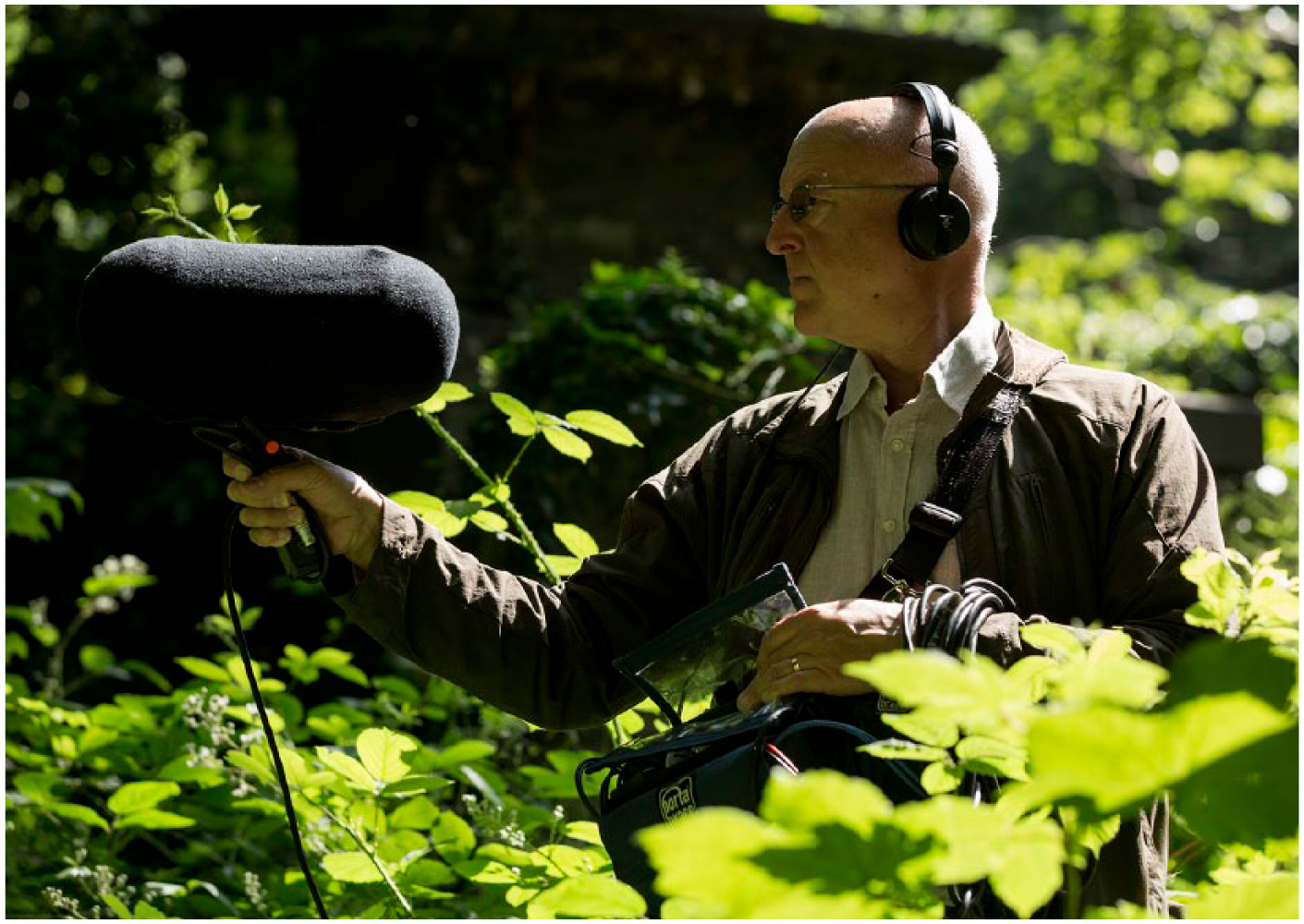
Chris Watson recording in the General Cemetery, Sheffield, copyright Museums Sheffield.
When writing on his environmental field recording practice, Watson is explicit about the part played by technology in the way in which sound is approached, heard and recorded. The capturing of sonic distinction, he writes, emerges through a combination of careful listening and the careful selection of and placing of microphones.
54
For Watson, the production of sonic meaning is only possible through sonic abstraction, in distancing sounds from their various points of origin. As in the pastoral tradition of music making, it is within such processes of abstraction and reincorporation that the meaning and authority of the work reside.
55
Writing on the subject of environmental sound recording, sound art scholar Brandon LaBelle comments as follows:
As a listener I hear just as much displacement as placement, just as much placelessness as place, for the extraction of sound from its environment partially wields its power by being boundless, uprooted, and distinct.
56
Sonic abstraction, facilitated by a sophisticated toolkit of acoustic technology enrolled at various points along sound’s trajectory from point of origin in the field to destination in the exhibition space, allows Watson to bracket out other sensory referents and extraneous sounds which would otherwise interfere with the channels of communication along which sound operates. The result is the amplification and intensification of sonic particularity, where the familiar is rendered simultaneously both significant and strange. 57 Such treatment of sound conjures a broader history of the use of field recordings as compositional tools, in particular the development of musique concrète, which shaped Watson’s early sound practice in the field of electronic music.
Electronic Arcadia
To the sonic imaginations of those associated with the rise of electronic music during the 1960s and 1970s, musique concrète had a profound impact.
58
The availability of mass-produced and affordable tape recorders during the postwar years allowed a range of musicians, both professional and amateur, to capture environmental sounds for reproduction in musical works. So prevalent was the tape recorder at that time that, in 1971, British musician Terence Dwyer published a book entitled Composing with Tape Recorders: Musique Concrète for Beginners
59
aimed at school teachers, students and amateur musicians. Reviewers at the time picked up on the text’s popular appeal:
An unpretentious beginner’s manual, its content is restricted to tape technologies first developed by Pierre Schaffer and Pierre Henry in the 1950s. Accompanying the discussion of the techniques are many suggestions, tips and activities developed through fifty-seven specific exercises.
60
One avid young reader and owner of Dwyer’s manual was Chris Watson, whose compositional practice as part of Sheffield-based electronic band Cabaret Voltaire drew upon the tape recorder as a versatile and sophisticated compositional tool. 61 The band came to prominence through its innovative musical experiments using newly affordable electronic equipment – analogue tape recorders, electronic keyboards, rhythm machines and processors – in a manner favouring experimentation and intuition over traditional instrumentation, musical study and concert hall performance. Its members harnessed found sound as a musical and aesthetic category, echoing the earlier sonic experiments of John Cage and extending the principles of musique concrète pioneered by the work of French composers Pierre Schaeffer and Pierre Henry during the 1940s and 1950s. Schaeffer coined the term ‘acousmatic’ to describe the practice of isolating sounds from their points of origin, making atomised sounds available for compositional experimentation. The term derives from the ancient Greek ‘akousmatikoi’, ascribed to the disciples of Pythagoras who famously gathered behind a curtain during the philosopher’s lectures in order to cut off interference from the outside world. 62 The curtain thus served as a technology intended to focus attention upon the philosopher’s speech alone. In sonic terms, ‘acousmatic’ refers to the screening off of sounds’ spatio-temporal contexts, thereby reducing interference from wider sensory referents. 63 For Schaeffer, in their isolated or ‘reduced’ form, sounds could then be valued in terms of their unique phenomenal properties – pitch, timbre, tone, rhythm, sonic attack and decay – outside of their normative representational fields.
A host of technologies shaped the installation space at the Millennium Gallery, each devised to support a reduced listening experience. Sounds were broadcast via a bespoke Ambisonic sound system, made up of a complex arrangement of speakers facilitating the broadcasting of sound in three dimensions: width, depth and height (Figure 2). The speakers, 20 of which were arranged in a circle evoking the title of Watson’s work with several more fixed into the walls and ceilings, gave the impressions responsible that certain sounds were gathered in certain parts of the room. Sounds were replayed within the installation at the same volume as their real-world counterparts, a choice that Watson qualifies in terms of a desire to retain sonic ‘integrity’ and ‘authenticity’. 64 Watson admits that technology constructs a semblance or myth of reality. It is a precarious spell, one broken should the recordist ignore how sounds are heard in their real-world contexts. The dimly lit and gently heated installation space offered further sensory modifications aimed at freeing listeners up to focus on sound uninterrupted by extraneous distractions, sensations or feelings of discomfort. The architectures of sonic encounter thus recall the sensorium of the acousmatic tradition, aimed at intensifying sonic meaning and affect.

Inside the Circle of Fire installation plan devised by Tony Myatt, copyright Museums Sheffield.
The biographical text greeting visitors to the exhibition space made explicit the influence of musique concrète to Watson’s ongoing work with sound. Importantly, the text alluded to the lack of distinction made by Watson between early work in experimental music and work in the field of environmental sound recording, which commenced following Watson’s departure from Cabaret Voltaire in 1981: ‘Chris sees the composition of a soundtrack for a film, installation, CD or radio feature to be the same as creating a piece of music’. Watson describes the field recorder as a ‘compositional tool’, 65 as an instrument engaged in a process of aestheticisation, of removing sounds in order to harness those sounds as materials with which to compose. Where environmental field recording departs from musique concrète is in the isolation of sounds and their use as media for speaking back to the spaces in which they were originally captured. In their reduced form, with extraneous sounds cut off or bracketed out, the result is the amplification and intensification of sonic effect which attributes those sounds encountered in Inside the Circle of Fire with their palpable sense of hyper-reality. It is a familiar sonic signature that carries its own historical and regional geography, cultivated in the electronic music scene in Sheffield during the 1980s in which Watson played a central part. The melodic tones punctuated by great piston hisses of the River Don Engine, the dull thud of water striking wood at Shepherd’s Wheel and the echoic hammering at Forgemasters are sonic equivalents to the industrial sounds – factories, coal mines and steel works – recorded by Watson and used as cut-ups within earlier electronic compositions. Virtuosity in the technological treatment of sound thus galvanises a sound signature synonymous with the histories of the local electronic music and with a period of reduced listening practice. A culture of concentrated and critical listening practice is thereby contrasted directly with the sonorous present typified by sonic disorder. Watson’s hyper-real sounds correspond to a biographical sound signature which, when reproduced, signals the return to Sheffield of local sonic expert with moral goal of recapturing listening as a corrective to poor acoustic design.
At the end of their journeys in sound, visitors to Watson’s sound installation were taken down into a subterranean storm drain located beneath Sheffield’s main railway station known colloquially as the Megatron. This watery cavern is off-limits to the general public and known about only through photographs published on forums dedicated to the clandestine activities of urban explorers. Dripping water echoed in a cavernous space, while the faint sounds of a busker singing with guitar accompaniment trickled down from the civic space over-ground to the unfrequented liminal spaces beneath the city. Trains rumbled across tracks overhead, engines hissed, a guard blew a whistle and the dull unintelligible words of automated announcements, known by their familiar machine-like cadence, all filtered down from over-ground to underground. It is a scene that points to the pastoral sensibility evident in folk ballads and their lyrics: ‘their sad refrains beckoning the listener down sunken lanes to various scenes of illusory enchantment’. 66 Imaginations were taken down to a manmade space where water flowed through concrete channels not verdant valley sides. Moorland peripheries seemed far away, so too the broadly defined environmental aims of the Sheffield Wildlife Trust. No sense of nostalgia here, no retreat to moorlands and woodlands, rather the celebration of the abstract forces and forms of sound and a tangible sense of technologically mediated sonic play. The Megatron scene demonstrated a personal flourish, an exertion of artistic licence, which carried the sound signatures and historic modernities of Sheffield’s local electronic music scene. Electronic virtuosity turned ears back towards a time of focused listening practice that contrasts directly with the present typified by, according to Watson, a blasé attitude to listening. The Megatron scene thus underscores the moral message of the composition which goes beyond environmental and ecological debate.
Listening lessons
The text on the wall at the entrance to Watson’s sound installation read as follows: ‘Chris Watson has created this sound map to encourage us to stop and listen’. To ‘stop’ here belies the principle of mobility upon which the persuasiveness of Watson’s pastoral in part relies. Nevertheless, the text evoked a shift in pace that marked the boundary between the frenetic real world of sonic cacophony and a space dedicated to showcasing the possibilities of attentive listening and good acoustic design. The contrast captures a complex pastoral that speaks to the tensions and anxieties of the present. In Watson’s work, these tensions correspond to, on one hand, issues of climate change and associated risks to biodiversity and, on the other hand, to the loss of sonic fidelity in those urban spaces lacking in any serious attempts at acoustic design. As Watson asserts in a interview, ‘recognising your own sonic environment is the first step to having some sort of control over it’. 67 Watson’s pastoral landscape made in sound represents a pedagogic device which encourages listeners to embody a critical approach to sound and listening. As the previous sections have highlighted, it is that pastoral looks to familiar sounds, to a set of abstract forces – natural and spiritual – and to the modernities of the local electronic music scene with its focused study on the phenomenal properties of sound. Peripheral to the discuss thus far, however, has been the role of the listening body in shaping the pastoral aesthetic, as well as the governance of that body by the technologies of the installation space.
At Sheffield’s Millennium Gallery listeners were invited to engage in two kinds of listening practice, both exercises in developing a critical ear. Sofas and scatter cushions arranged in the centre of the room encouraged listeners to engage in focused listening practice from a still point. At the same time, the Ambisonic technology encouraged listeners to move around the space to seek out sound sources. These embodied acts recall the figures of the ‘akousmatikoi’ engaged in a reduced form of learning cut off from worldly distractions; the installation space provides an acousmatic experience, elevating everyday sounds to the status of the monumental. Embodied acts also recall the figures of listeners of the pastoral music of the English musical renaissance where artistic meaning and cultural authority were garnered through individual and collective acts of listening, dancing and music making. 68 Just as the music’s rhythms and melodies of English pastoral music signalled lives based around regional and recognisable labour processes and social activities, the slow development of Watson’s sonic scenes compelled a similarly slow, or even static, mode of listening practice. Static bodies and mobile bodies thus both performed a focused listening practice, conforming to the kinds of listening conduct deemed by Watson to catalyse a rapprochement between people and place in a sound world understood as being characterised by poor acoustic design. The installation space so designed provided an arena for the performance of the pastoral where quiet listening, slow movement around the installation space, a focus on where sounds come from and where they go and the very occupation of bodies in the Millennium Gallery as consecrated site of civic gathering helped to cement the sonic pastoral landscape as a lesson in positive listening practice.
Conclusion
Sounds do not always give us pleasure according to their sweetness and melody; nor do harsh sounds always displease.
This quote from Gilbert White’s 1788 The Natural History of Selborne, reprinted on a wall in a corner of the installation space occupied by coffee table books on local and natural history, hints at the particularities of Watson’s pastoral made and mobilised in sound. Watson’s pastoral, as this article has demonstrated, comprised natural sounds and rustic sounds, the sounds of labour and leisure, as well as urban sounds and industrial sounds which bear the impress of the technologies responsible for their capture and reproduction. The peripheral presence of White, familiar naturalist and ornithologist, coupled with his reflections on sound, is suggestive of the extension, by Watson, of the category of good sounds beyond the natural world. At the same time, the invitation of White inside the circle of fire demonstrates a recasting of a familiar pastoral aesthetic for political agency in the present.
This article has critically examined the pastoral sensibilities embedded within Watson’s Sheffield Sound Map. It has considered the technologies of sound recording and reproduction, both in the field and in the spaces of exhibition, which shaped the pastoral as political and pedagogic device aimed at promoting active listening as part of a broader campaign for good acoustic design. A biographical approach has revealed a set of engagements with sound and sound technology that together shape a unique sonic imagination. Early engagements with field recording and with a sonic culture in part based on the principles of musique concrete have been highlighted as playing central parts in Watson’s ongoing sonic practice, premised upon the study of sounds as signifiers of relationships between human and nonhuman selves and landscapes. A local knowledge of landscape, its histories and topographies, and a belief in the possibilities of sound to disinter ancient and spiritual landscape features have been marked out as critical mediating forces shaping Watson’s particular ways of listening to, and dealing with, sound.
In highlighting the pastoral aesthetic around which Watson’s sonic landscape is made, this article has drawn attention to the moral geographies of sound and listening and to the cultural politics concerning certain valuations of sound. Key compositional signifiers of the pastoral included the familiar sounds of the natural world and those corresponding to local civic life. The elevation of familiar sounds to the status of the monumental, through sonic abstraction and through the technologies for reduced listening, shifted Watson’s work from a ‘sentimental’ pastoral to a ‘complex’ pastoral, enabling Inside the Circle of Fire to operate as a critique of the modern-day sound world. The body too, positioned in the installation space, provided a force in landscape’s making, enacting a visceral kind of remembering and imagining. Listening bodies, whether through sitting or by seeking out sound sources on foot, were called upon to engage in collective acts of citizenship, to reclaim listening as a corrective to, as Watson would have it, noisy environments made up of meaningless sounds.
In harnessing the pastoral as a mode of critique, this article has responded to calls to situate celebratory discourses surrounding the practice of environmental field recording and soundscape composition within a set of technological, historical and cultural contexts and relations. In contrast to work emerging from the burgeoning field of sonic geographies, which has tended to favour conceptual breadth over empirical depth, this article has attended to the biographical and situated sonic engagements underpinning a very particular approach to sound and landscape. A focused study of a single artwork has demonstrated the possibilities for navigating the constellations of sonic imaginations, for offering critical and contextual interpretation alongside discussions of affectual and non-representation approaches to sound and listening when put to work in the organisation of landscape.
Footnotes
Funding
The author(s) disclosed receipt of the following financial support for the research, authorship, and/or publication of this article: The article is based on the author’s AHRC-funded PhD research (Doctoral Award:I014772/1).