




Abstract
Vancouver’s ‘revitalization’ has been characterized by the influx of upper-end restaurants and bars into parts of the city home to marginalized communities. We argue that some of these establishments code Vancouver’s complex racial and colonial present as a benevolent remembrance of things past. We employ and compare three modes of analysis to underscore the relationship between the historical geography of colonialism/imperialism and its modern guise in Vancouver. First, critical toponymy looks at the connection between place names and meaning. We then take a postmodern framework to explore the production of authenticity and heritage in bars emphasizing a colonial era decor. Finally, we draw from Stoler’s notion of ‘imperial debris’ to argue that these places are literally the detritus of empire revitalized as the material markings of nostalgia. In each part of the article, we demonstrate the critique offered by a different means of historical analysis. We conclude that the deployment of historical markers in the gentrification of Vancouver ultimately demonstrates the use of history as a claim to locality.
It has become commonplace to assert that Canada may be entering a postcolonial era heralded by positive changes in settler–colonial relations unfolding across the country. Within this narrative, the state is fixing past wrongs. Rather than expropriating First Nations lands, courts are providing the mechanisms for resolving claims disputes, while the dimensions of government-sanctioned injustice have been detailed in reports of the Truth and Reconciliation Commission; rather than stigmatize ethnic neighbourhoods, cities are recognizing the integral role played by non-European peoples and cultures. Many of the most public efforts to ‘de-colonize’ Canada have been acknowledgements of historical presence, particularly through the naming of new territories like Nunavut or the re-designation of the cities of the provincial and territorial norths to their Cree and Inuit names. Recently, the City of Vancouver designated the first street named after a Chinese Canadian: Lilian To Way. These efforts ask the public to consider the past, evaluate the origins of privilege, and seek ways to a more equitable future by acknowledging and apologizing for historical wrongs. Yet, scholars have asked whether such moves help redress, or if they actually entrench colonial attitudes – one of the effects of these renaming practices can be to make historic injustices appear solved, releasing people from the need to think about the continuities of colonialism in the present. 1 For Glen Coulthard, such efforts are examples of the ‘politics of recognition’ preferred by White, liberal, non-Indigenous Canadians: he sees the acknowledgements of First Nations struggles as the continued extension of colonial ordering and differencing. 2
In this article, we look at examples of naming that touch upon the question of postcolonialism in Canada, but which also express a markedly different ‘politics of recognition’ regarding the past. From The Mackenzie Room to Imperial Vancouver and ‘Colony’ on Main, a new set of commercial establishments have appeared in recent years that, rather than de-colonize space, seem to be recovering and re-imagining colonial imagery and taxonomy. We examine the urban and cultural geography of development in downtown Vancouver to assess this resurgence of the past (Figure 1).
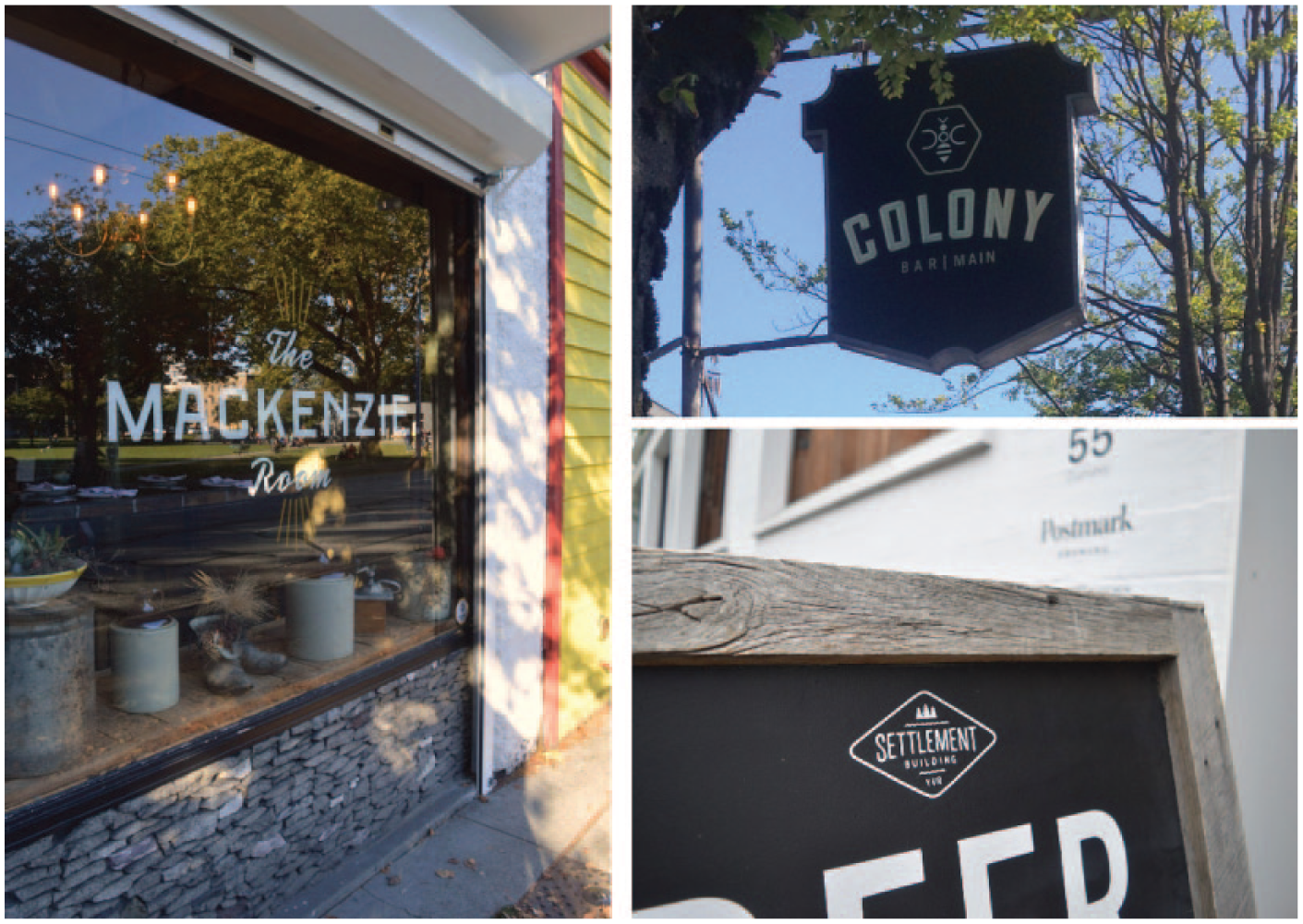
The resurgence of imperialism in bar and restaurant names.
Consider The Settlement Building, an upscaled former warehouse that houses a ‘brand collective’, including a craft brewery, urban winery and high-end restaurant. 3 The group is dedicated to ‘building the idea of craft’ that they associate with a ‘West Coast lifestyle’ anchored by a set of aesthetics: wooden casks, brass knobs on all the doors and brick wall interiors. 4 It hearkens a time when people made things with their hands and used materials from the natural world rather than plastics and synthetics. Emphasizing connections to locality and history, photographs of Vancouver’s early resource economies on the walls offer visitors to the building windows into the lost virtue of craft. High above the pictures of fishing boats and logging operations, a mechanical crane still hangs from the ceiling, a bright red marker of the original industrial purpose of the site. Many of the buildings and the artefacts they house refer to the colonial era of the city, wherein pioneers brought ‘civilization’ to the Northwest Coast, making wealth by carving the landscape into private property and replicating elements of Anglo-European cities at the ‘edge of empire’. 5
The photograph in Figure 2 captures the earliest beginnings of that civilizing enterprise. The fresh stumps filling the frame offer a narrative of progressive ordering and use of nature, while the wood dwellings and makeshift roads appearing in their midst presaged the future growth of a modern city. This image is meant to capture the dream of those pioneers, showing an inviting frontier ready to be harvested and inhabited. In some senses, it is not surprising to find images like this on the walls of The Settlement Building, where they offer a kind of nostalgic reverence to a period where land and resources were plentiful, and self-reliance and hand craft skills were at a premium. Yet, we contend that the idea that the frontier disappeared when the city replaced it is erroneous. 6 Today, the material and discursive logics of progress, transformation and civilization are mobilized in a contiguous frontier between the past and present that brings the same types of changes under the aegis of gentrification, revitalization and renewal, all while specifically pointing to history and locality.
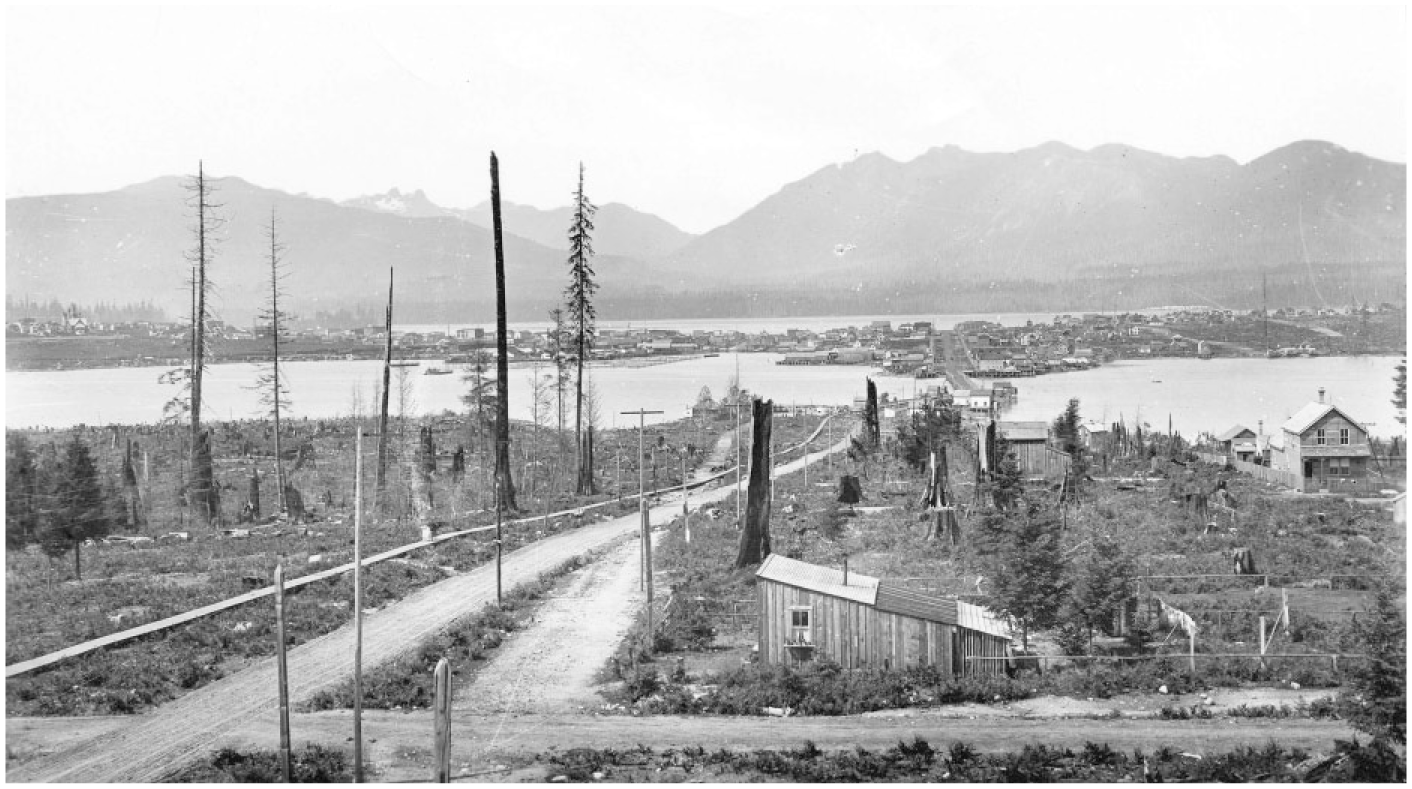
‘Vancouver BC from the South’. 1889. City of Vancouver Archives. AM54-S4-: Van Sc P147. This image is from a location six blocks from the Colony on Main bar.
While The Settlement Building proclaims that it represents a deeply rooted ‘West Coast lifestyle’, for Kyle Chayka, writing in The Guardian, this aesthetic has no geography. He finds similar restaurants, bars and cafes all over the word ‘mimicking the same tired style, a hipster reduction obsessed with a superficial sense of history and the remnants of industrial machinery that once occupied the neighbourhoods they take over’. 7 The irony of appeals to local history is that The Settlement Building is simply an example of the global gentrification of cities: the predatory movement of wealthier residents and businesses into areas that formerly served low income and socially marginalized groups. In this respect, The Settlement Building may simply be a variety of neoliberal growth, where cities are forced into economic competition with one another. 8 Under these terms, the urban is redefined as a brand: epitomized by its hosting of the 2010 Winter Olympics, Vancouver has sought to define itself as the ‘greenest’ city, the embodiment of youthful and socially inclusive values, a promising global real estate venture, the home to a ‘creative class’ and a global marketplace. 9
Ultimately, the uneven development incurred by neoliberal globalization has a leavening effect on the cultural landscape: even as cities seek to distinguish themselves, they are ever more characterized by familiar corporate outlets producing ‘placelessness’, alongside an emphasis on manufacturing artisanal ‘local’ products and experiences to fit the expectations of the global consumer. 10 At the same time, it would be a mistake to suggest that The Settlement Building is not connected to history and locality. Indeed, its location on the corner of Alexander and Dunlevy Streets across from two social housing projects is steps away from Indigenous encampments cleared to make room for sawmills on Vancouver’s waterfront in the late 19th century. 11 The building is essentially located where the city’s colonial order began to take shape around timber and milling. Clearly, the patterns and preferences of gentrification reflect a global process, but they are guided in specific ways by the local historical geography of place, finding their way through the ruins of an empire already fading at the end of the 19th century.
In The Settlement Building, the problem is not that the history is ‘superficial’, but that it is all too real. Two stories seem to run parallel here: the story told in the images and aesthetics of British settlers arriving at the northwest coast, civilizing and colonizing the frontier; and the contemporary tale, where White businesses and brands push into the development frontier of low-income housing, upscaling and gentrifying. Through selective presentation, the building positions not only itself at a nexus between the past and the future but also as a sieve able to separate the nobler aspects of the past for their customers from those darker elements of imperial history – the aesthetics allow the virtuous aspects of work and craft in the colonial period to be accessed freely, and the violence, inequality and racism of empire that sustained them left a distant echo in the past. Upon closer inspection, the name ‘settlement’ is clearly not intended to conjure up the glories of colonial expansion or the spread of British civilization but meant to point to the recovery of a more meaningful, authentic means of living and consuming in an urban environment. While the visible semblances of what is historic about the building – the masonry, old photographs, the craftspeople inside – present themselves as history, the echoes of violence can still be heard.
Many geographers have demonstrated the links between gentrification and colonialism, providing examples of dispossessions of space of the ‘other’ largely under the logic of renewal. 12 Others have looked at this very process in Vancouver, even noting the role of restaurants and bars as agents of settler colonialism driving the social and material transformation of urban life. 13 Yet, what is often disregarded is how the historical geography of place is employed as a reference in the colonial/gentrifying project, ‘revitalizing’ buildings that sat for years as neglected talismans of the city’s position at the centre of a booming resource frontier and its role in a broader colonial project that planted British civilization at the frontiers of the European globe: what Ann Laura Stoler calls ruins or ‘imperial debris’. Our article draws attention to the connection between colonial Vancouver and the contemporary restaurant geography of the city by overlaying the production of authenticity and locality with a material account of the city’s growth. The map in Figure 3 shows how clearly situated the restaurant frontier is on the colonial frontier of the early city. One frontier is from 1898, the bird’s-eye view of the cartographic illustrator, who pictured a city full of industrial activity, shipping and growth into the beckoning hills in the background. The next is from the present day, where the locations of the restaurants serve as indicators of how clearly the geography of contemporary gentrification matches the historic contours of the city.
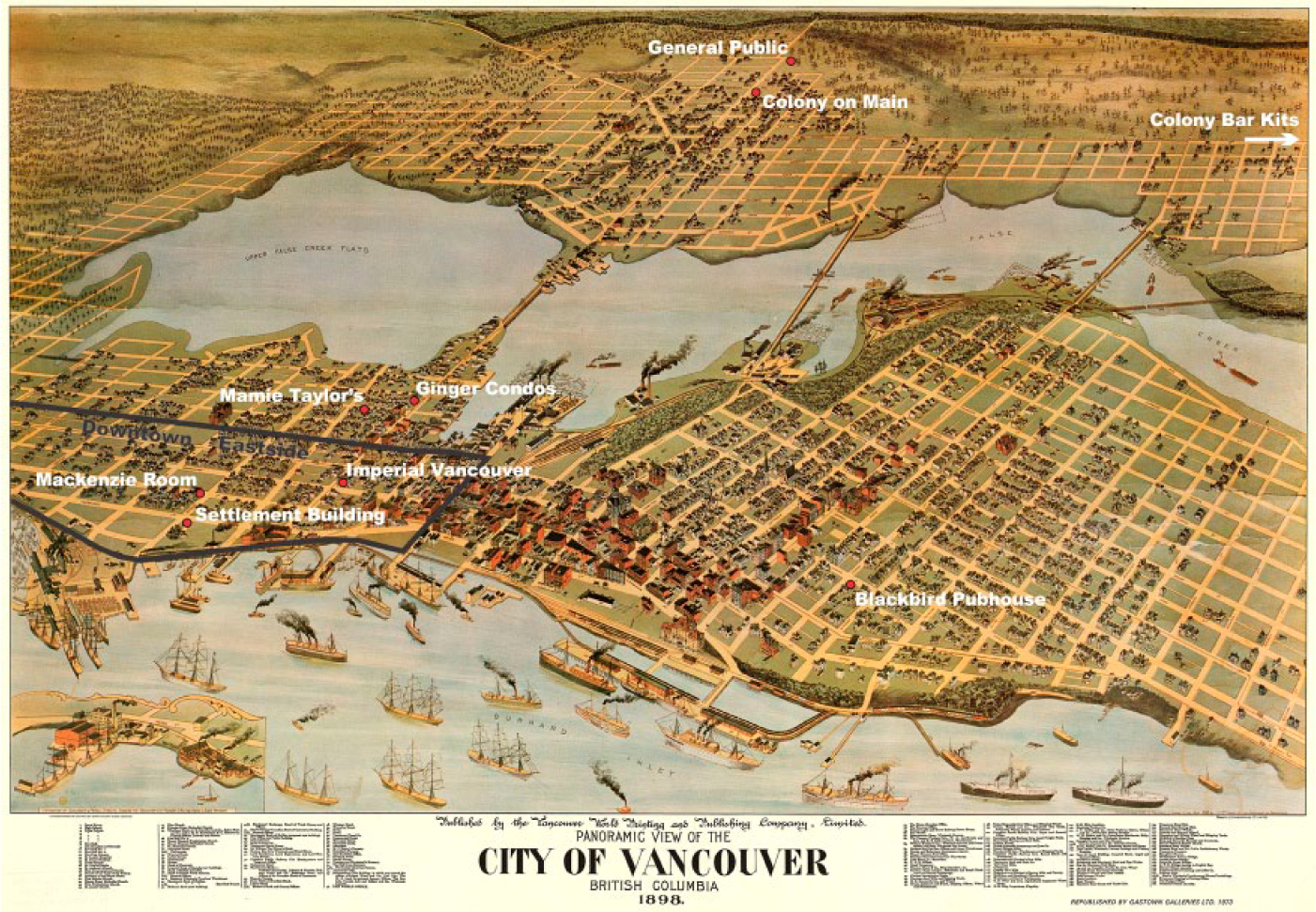
Locations in the ‘restaurant frontier’ overlaid on a bird’s-eye view commercial map from 1898.
In this study, we use 10 restaurants that consciously highlight the past in order to analyse the re-emergence and re-animation of this debris through names, iconography and values in the contemporary landscape of Vancouver’s redevelopment. To do so, we test three perspectives from cultural geography. First, we investigate the ‘critical toponymy’ of imperial nomenclature, exploring how naming changes the meaning of places and simultaneously establishes/erases continuity in practices of dispossession. The second section of the article asks what appeals to history are being made. Drawing from postmodernist theory to analyse the re-purposing of history as ‘pastiche’, we examine the discourses of grit and authenticity that run through evocations of the past. Finally, we return to consider Stoler’s ‘imperial debris’ in the third section. She suggests that the common understanding of ‘ruins’ as old buildings and structures hides empire’s ‘ruination’; the ongoing relationships of force that sustained and built the imperial world. 14 We end with the conclusion that these three analyses in cultural geography all reveal strategies of localizing empire based on the dispossession of land and denial of belonging: the erasure, elimination or assimilation of the other. Ultimately, as Patrick Wolfe reminds us, ‘contests for land can be – indeed, often are – contests for life’. 15
Critical toponymy: the rebirth of imperial Vancouver
Whereas many ‘British’ pubs play on historical emblems such as firkins, kings, lions and other symbols of British royalty and Olde England, the new bars appearing in Vancouver summon the colonial era and ‘New World’ geography from the mid-19th century to the nation-building era, when British Columbia and Canada were created as political-economic territories with corresponding social identities. Their names testify to certain values perceived to correspond to this period. While The Settlement Building anchors commercial development in this erstwhile past, The Mackenzie Room directly borrows a storied surname from Canadian political and business history to conjure ideas of industriousness, importance and prestige. The Imperial Vancouver, a music venue, plays on ideas of power and dominion to assert itself, whereas Colony on Main and its partner Colony in Kitsilano employ the notion of a remote outpost where reinvention, enrichment and subordination are possible. These are part of a new lexicon of bars and restaurants that deliberately invoke past places and values by referencing a narrow period in Canadian history when the vast spaces of the interior were connected, reconnoitered, exploited and brought under the dominion of Anglo-British rule.
The historical trajectory of Vancouver and the Province of British Columbia can be summarized very broadly as first the imperial subjugation and dismantling of an Indigenous socio-cultural network and interwoven set of territories in the Pacific Northwest, followed by the reconnoitering and reorganization of that space as a colonial frontier, and finally its modernization and integration into the territorial nation state of Canada. 16 From time immemorial, Stó: lo and Coast Salish peoples occupied the resource-rich Fraser river delta and adjacent Pacific coastlines. The first contact with newcomer Europeans was in the late 18th century, organized around the economic prospects of trading sea otter pelts for European manufacturers. 17 Geopolitically, these encounters were situated in a rivalry between Spanish, Russian, American and British claims to the northwest coast, which eventually resulted in the creation of British colonies on Vancouver Island and the mainland in the 1840s. For the British administrators, Vancouver was not initially seen as a site for a major city. However, its deep harbor, location on the flat inland river valley and exploitative colonial economics led to rapid growth, such that by the late 18th century the region had transformed from a remote Pacific colony relatively isolated from the British Empire to a central focus of the new Dominion of Canada beckoning from across the continent. Formal political integration into Canada and provincial status arrived in 1871.
The national mandate hastened the removal of Indigenous peoples to reserves and the dispossession of territory through a largely deceitful allocation process. 18 Another element of national union included connecting a transcontinental railway, which would provide economic and transportation links between eastern and western Canada. Originally planned to connect with Port Moody, business leaders in Vancouver offered a series of ‘incentives’ to the directors of the Canadian Pacific Railway to make their city the railway’s western terminus, which it did in 1887. The line’s construction also required a large pool of cheap and pliant labour. Many people who arrived in British Columbia to fill the need were from countries in the Pacific Rim, including a large number from China. For these migrants, Vancouver became home, though the population of the city was deeply divided between a frontier open to British Canadians and those denied access or limited to labour. In the early 20th century, Vancouver settled into a role as a processing and shipping point for the timber, fish and coal being harvested along the coast and in the provincial interior. Resource economies dominated the life of the city for most of the 20th century, outlining the limits to growth in terms of how much material could be laded through the port. Vancouver’s renewed ascendance began when these economic boundaries were overcome in the 1980s, heralded in the prosperous future imagined in a world’s fair hosted by the city. Expo ‘86 has come to mark Vancouver’s entrance into postmodern period, where the old sawmills and canneries were replaced by glass skyscrapers. Propelled by an economic shift to financial speculation, tourism, and media services, Vancouver has stepped into a role as a ‘world city’, the cultural and economic hub connecting Canada to the Pacific Rim.
Very little of the city’s colonial past seems to be reflected in the mirrored glass of high rises that dominate the city’s modern skyline, yet imperial histories still suffuse the place in obvious ways. Beneath the towers and mountains that characterize the city’s international brand, a city of lingering imperial tensions exists: Anglo-British institutions encroach on the perseverance of historically Chinese districts; dispossessed Indigenous populations walk among the appropriation of a broadly west coast First Nations art aesthetic in public life. 19 For instance, Katharyne Mitchell has connected the city’s past racial geographies to modern-day xenophobia around real estate, while Renisa Mawani has provided an illuminating study of the genealogy and use of sites around Vancouver by Indigenous peoples, as the historical iconography works to erase Indigenous presence. 20 These authors show the imbricated relationship between history and the present day that continues to shape both the city’s public persona and the more discrete individual spaces.
As the past is exhumed to provide meaning in the present, the literal map of the city’s geography changes. The study of these place names, called ‘toponymy’, has long interested antiquarians fascinated by the honorific significance of city street names or the local features in landscape from which a town got its name. 21 This can show why large sections of Vancouver’s urban grid bear traces of the British imperial past, where streets such as Trafalgar, Balaclava and Waterloo commemorate imperial military victories, while Dunsmuir, Cambie and Robson lionize colonial administrators and wealthy capitalists. However, geographers have pointed out that the character of such names and their symbolic associations also shape and contour the experience and meaning of ‘place’ or the lived perception of dwelling in an area. 22 Critical toponymy claims that when colonial names overwrote Indigenous ones, colonial power was consolidated in space and new meanings were conferred upon the landscape, erasing prior presence and rendering Indigenous peoples ‘out of place’ in their traditional territories. 23
In Vancouver, reassertions of Indigenous presence like renaming the Georgia Straight to the Salish Sea, or a much-debated proposal to change the city’s iconic Stanley Park to its original X̱wáýx̱way, aim to de-colonize the British landscape of history by altering its toponymy. 24 However, new restaurants like The Mackenzie Room are reviving colonial names within the same landscape, promoting another view of what the past should mean to the present. The owners have emphasized that ‘Mackenzie’ is an ancestral name of one of the partners, insisting that the space is above-all a family establishment. 25 However, a host of ‘Mackenzies’ are attached to the designation. The oldest and perhaps most famous man conjured here is Alexander Mackenzie, a North West Company fur trader and explorer. ‘Mackenzie’ is also freighted with associations to Canada’s past such as William Lyon Mackenzie King, who has served as Prime Minister of Canada over 22 years from the early 1920s to the late 1940s.
‘Mackenzie’ looms large in the imperial past, and is directly linked to significant moments of the making and remaking of Vancouver. The fur trading Mackenzie gained renown as the first European to cross and map the Rockies to the Pacific, laying cartographic claim to the origins of the British Imperial Canada in the West. Later, Mackenzie politicians presided over a period where Canada gained political independence from Great Britain and more fully developed its own colonizing infrastructure. Unrelated by blood, they are tied together by a record of repute for many Japanese Canadians. Mackenzie King’s World War II legacy included the property seizure in Vancouver and elsewhere in the province, and forced removal of their communities to camps in the provincial hinterland using legislation passed after the bombing of Pearl Harbor. During the same period, Ian Mackenzie, a prominent member of the British Columbia legislature and an even more overtly racist political figure, proclaimed that there would be no Japanese ‘from the Rockies to the sea’. 26
The properties of a toponym come into still sharper relief when the local situation of The Mackenzie Room is explored. Its present site is in a neighbourhood east of downtown Vancouver home to a large portion of socially and economically marginalized groups, including a large percentage of Indigenous peoples and other racialized minorities. The restaurant sits adjacent to Oppenheimer Park, known familiarly as ‘the Heart of the Downtown Eastside’. This was also the centre of the once thriving ‘Japantown’ community uprooted in the 1940s under the policies of W.L. Mackenzie King and Ian Mackenzie. It is also not far from Chinatown, where many early railway labourers settled after working on the Canadian Pacific Railway. 27 Through this neighbourhood, the actual namesake of The Mackenzie Room was connected to the colonial making and unmaking of Vancouver. In the late 19th century, Sir William Mackenzie founded the Canadian Northern Railway, and his sprawling railway empire helped to establish Vancouver as a regional hub for the movement of goods and people. He also negotiated the acquisition of land for a rail terminal at False Creek, opening up further land for settlement. 28 Today, the remaking of urban space pursued by historic Mackenzies is reflected in the present geography of The Mackenzie Room. As part of a set of pricey dining establishments ushering in ‘revitalization’ around Oppenheimer Park, it has priced out or displaced many long-time residents. 29 Not willing to be part of the lower income Downtown Eastside, it signals geographical allegiance to an upscaled neighbourhood – in 2016, their website claimed the restaurant is ‘in the heart of Strathcona and loving it’. 30 Through The Mackenzie Room name, critical toponomy shows how following the appearance of the name ‘Mackenzie’ in this space reveals a long history colonial expansion, dislocation and accumulation by dispossession (Figure 4).

The Mackenzie Room adjacent to Oppenheimer Park.
It is worthwhile noting that new names and labels are important in branding efforts to increase property values and encourage development. However, these processes are often supplemented by the imposition of uncontested generic names that subvert existing social relations on the landscape. 31 Lawrence Berg cites places such as ‘Adventure Bay Resort’ or ‘Desert Cove Estates’ in his analysis of tourist destinations in Vernon, British Columbia, finding that these ‘banal’ toponyms obscure local histories, impose a sense of placelessness and subtly reinforce market-based development agendas. Dispossession is thus mobilized through uncontested naming practices in ways that ‘elide the true character of these landscapes of dispossession’. 32 A similar stream of naming can be found in the reappearance of colonial names in Vancouver’s Chinatown, where a host of establishments make banal references to the imperial past.
Many of the patrons of The Mackenzie Room and The Settlement Building may find themselves living in ‘Ginger Condos’, a redevelopment of Historic Chinatown. The toponym ‘Ginger’ here is key to seeing how banality evokes the feeling of the imperial past as it also elides its meaning. Promoters mobilize the superficial meanings of Chinese food to remove politics from their development: as the promotional copy promised, ‘Some like it hot. You like it spicy. Add Ginger to the mix’. As an orientalized discourse, these vague allusions to illicit sexuality trade on the dual sense of desire and taboo that characterized 19th-century colonialism, yet are simultaneously made ‘banal’ by the reference to food. 33 The developers invite us to experience the ‘seventy-eight zesty homes, coming to Chinatown, a playground rich with history, bustling with energy and loaded, with worldly pleasures’. 34 Yet, the historical effect sought by the Ginger Condos marketers elides the real experience of those who built Chinatown, including the troubling legacy of xenophobia that saw Chinese immigration to Canada banned in the early 20th century, or the 1886 and 1907 race riots targeting Chinese people and businesses. Ginger Condos uses a banal toponym to conjure a landscape of unproblematic diversity by emphasizing and obscuring historical forces at work in the property market.
Creating postmodern authenticity
The places evoking colonial tropes by transforming the toponymic landscape are also responding to the desires of new kinds of consumers. Areas slated for gentrification are often linked to alternative lifestyles sought by affluent homeowners, who appropriate from the cultural signs of the very groups being displaced. In turn, gentrifying restaurants often draw on imaginaries of grit and authenticity to ‘attach symbolic value’ to reanimated urban neighbourhoods. 35 Most geographical critiques suggest that areas prized for their grittiness and diversity quickly become polished enclaves of conspicuous consumption. 36 Less attention has been paid to the overt relationship between the landscape of contemporary gentrification and the historical precedents set by the imperial geography of cities. In Vancouver, the Blackbird Lounge and Oyster Bar suggest the ways a generic ‘pastness’ can end up drawing from and generating geographies of colonialism. The layout of the bar is roughly a British pub. Yet inside, rather than fish and chips or beer posters, the visitor finds mainstays of imperial England. In one corner of the room, a world map hangs on the wall, dim lit by ceiling lamps and hung above plush leather benches. A table has a bust of Queen Victoria, while another section of the room displays a wall-sized painting of handsome black horse presiding over an open pasture (Figure 5).

Representations of empire at the Blackbird.
While none of the items found in the Blackbird ‘speak’ the imperial past in symbolic terms today, their historical meanings would have been abundantly clear to owners. The map was the central symbol of Britain’s vast colonial domain, when ‘the sun never set on the British Empire’ was made evident by a layer of pink territory stretching around the earth – a trading empire guaranteed by the awesome power of the British navy. Imperial power also resided in the bust of Queen Victoria, whose reign from 1837 to 1901 presided over the conquest of India and the scramble for Africa, as well as the resettlement of most of Canada. The wall-sized painting of the magisterial black horse exemplifies the aristocratic tradition of commissioning paintings of beloved animals or places. 37 Paintings like this one could signify many things – the gentlemanly status of the owner, the connection between land and wealth, dominion over the agricultural or natural landscape, or simply the commemoration of a particularly handsome gelding. 38 But while assigning the historical meaning of these material objects is relatively easy, understanding the relevance they have in the contemporary world is less clear. They entreat debates about whether the resonance of colonial violence is carried in objects or is perpetuated through social reification, and they require careful consideration of how to deal with the legacy of objects like the map of the British Empire. On the other hand, if the map is merely supposed to be a ‘semblance’ of pastness, then it warrants asking why the ‘past’ (and which past) should be evoked in the first place.
The appearance of fashion and architectural trends from the 1890s should not come as a surprise, at least according to those who suggest this is an aspect of ‘postmodern’ society. Postmodernism signifies an architectural and artistic trend that evinces a break with tradition and history, emphasizing qualities of play and irony, and rejecting the formal austerity of modern design. In this respect, Vancouver abounds with postmodern buildings. 39 However, the prefix ‘post’ signifies a deeper break or crisis point in social fabric sometime during the 20th century, when foundational anchors of the modern era became circumspect. The general account of postmodernism offered by Marxist critics such as Fredric Jameson and David Harvey is one outlining a process where religion, politics, history and nationalism have been unseated as foundations of truth in western societies, and where a once centralized manufacturing economy shifted to a diffuse, global consumer society. Under the conditions of postmodernity, the knowledge economy and corporate advertising have become the main purveyors of stories and meaning in our everyday lives, with any notion of ‘truth’ becoming increasingly relative as a result. 40
Whereas modernity used history to tie people into the linear past through notions of progress, civilization and nationalism, the postmodern uses of history are invoked mainly to sell goods and experiences. This difference helps illustrate the function of imperial sentimentality in places named ‘Colony on Main’ and ‘The Settlement Building’, and suggests why wood and brick aesthetics, black and white photographs or old paintings are used to furnish their interiors. Often, this is done without reference to any historical lineage, but with an eye to the aesthetics of either ‘looking’ historical and authentic, or the ironic ‘wink’ – intentionally mashing up the past in a way that distorts history as progression. Indeed, the Blackbird’s design presents history as an authentic feeling or atmosphere: elite pictures of horses alongside workboats and lumberjacks, mixing subjects that would have never colluded with one another in the actual past, but look great assorted on a wall.
Conducting a cultural geography of the postmodern landscape can be a useful means of interpreting the representation of history at places like the Blackbird. In Jameson’s analysis of postmodern culture, historical styles are predicted to return as ‘pastiche’ – dehistoricized and depoliticized appearances of the ‘past’ plastered together in ways to fit the aesthetics and economics of the present. 41 This opens an ambiguity where the object histories told in the Blackbird bar may be pastiche fantasies about the past, or they may be part of a material unfolding historical colonial present. Most likely, what the designers aimed for was sense of elite space for refinement and leisure, and a connection to the origins of capitalism in European history. This is not surprising, considering that the bar is owned by the Donnelly Group, proprietors of 17 ‘proper pubs, cocktail clubs and barbershops’ around the city. 42 The Blackbird represents the convergence of international finance and local expressions of empire. Located in the heart of Vancouver’s financial district, the self-consciously imperial decor draws direct connections between 19th- and 21st-century values of globalization and capitalism. In their words, the bar has ‘a classic lounge feel . . . the perfect place to land after a tough day of trading? Yes!’ 43
The Blackbird example shows that one purpose of employing history is signifying authenticity – the apprehension of realness that popular culture cannot deliver and consumerism seems to be actively destroying. However, the ironic result is that often this search for the ‘real’ ultimately leads to commodification of things that were innately so. 44 Many new bars and restaurants seem keenly aware of this paradox. For instance, Mamie Taylor’s invites its customers in with a playful mixture of the modern and traditional: their walls are adorned with mounted animal heads wearing toques, while their menu proclaims ‘We have vegetables, we also have taxidermy’. 45 These bars take a seemingly ironic stance on the notion of authenticity, like The General Public, where re-appropriation of past icons is again intentionally subversive. Under the guise of being a ‘funky sushi lodge’, patrons are led to think this is a postmodern deconstruction of a 19th-century gentleman’s hunting chalet. The bar relies papier mâché taxidermy and fluorescent-painted rifles to conjure a historical connection between masculinity, guns and dead animals, and by reproducing them with ‘fake’ materials attempts to blur their gendered histories. 46 Despite the guise of ironic detachment, these bars are like the others; they provide the same window into colonial past as fundamentally different than the present era. In effect, they amount to the suggestion that colonial history is something seen on the brick facades of the buildings, or the photographs and paintings hung on the wall (Figure 6).
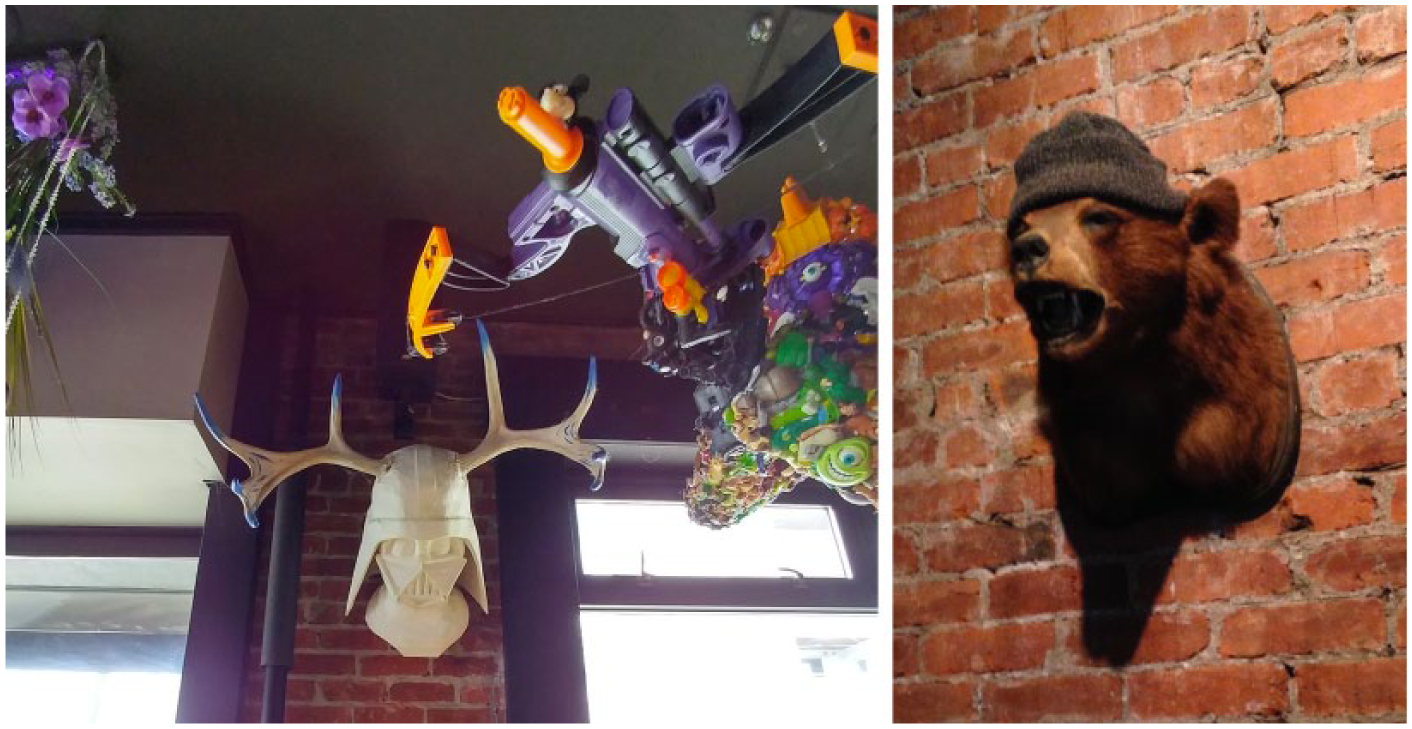
The General Public “funky sushi lodge” and Mamie Taylor’s.
These restaurants can tell us much more about the uneasy slippage where postmodern irony works to depoliticize ongoing relations of power. For instance, Mamie Taylor’s clearly presents itself as a mashup of historical periods and styles: it appears to be a kind of Black southern antebellum chicken shack frequented by lumberjacky Edwardian gentlemen. The restaurant simultaneously commemorates and exploits archetypes at the intersection of colonialism, race and gender by self-consciously styling itself within the framework of the colonial frontier. 47 But in presenting themselves as both authentic and transgressive, Mamie Taylor’s actively spreads mainstream culture, and commodifies a marginalized neighbourhood and its residents. They fit the postmodern case clearly: a group of White restaurateurs have co-opted Black food like the po’boy or shrimp and grits to sell at marked-up prices. But the appropriation of southern culinary history is only the obvious linkage to history and geography. Mamie Taylor’s is also only steps away from Vancouver’s once thriving Black neighbourhood of Hogan’s Alley, bulldozed in the late 1960s as part of an urban renewal project to build a freeway from the Trans-Canada highway into downtown Vancouver. 48 As the oral histories of former Black residents recount, many of whom had settled in Vancouver from the southern United States, southern food existed there too: Vie’s Steak and Chicken is the authentic exemplar that Mamie Taylor’s proposes to be representing. 49 There is a kind of double irony here, where the stereotype presenting itself as authentic is actually produced on the ruins of what it destroyed.
Analysing the relationship between the shape of the built environment and its changing social meanings will seem familiar to cultural geographers. A strength of the discipline has been its demonstration that the ‘landscape’ may be read as a kind of text that emanates symbols and values. This claim emerged in the 1980s and 1990s as the ‘new’ cultural geography was formulated using ideas from poststructuralism. The cultural geographer would no longer take the built landscape for granted but rather read it as a representation: a semiotic device through which power is disseminated. Denis Cosgrove demonstrated this by showing how the landscape perspective – the earth evaluated from the perspective of a terrestrial observer – is also a way of seeing and organizing space that corresponded with the development and social values of early modern capitalism. The ‘new’ cultural geography uses historical study to uncover and trouble the commonplace, and show how the landscape and ways of reading it are the social constructions and reifications of power. 50 As such, it has much to offer in thinking about Vancouver.
In most of the new bars that emphasize colonial or imperial symbols or names, the skeletons of old industrial or domestic spaces are incorporated into reimagined designs in ways that purposefully create landscapes full of historic meaning. However, the employment of these ruins speaks to many different ideas about the meaning of the colonial past to the present. For example, at The Mackenzie Room, diners eat expensive meals in a room that has barely been updated, with holes in the walls and cracking paint. By openly celebrating the decay of the plaster walls, the restaurant emphasizes the relationship between progress and destruction. At The Settlement Building, the industrial past is set alongside wine barrels and visible brewing infrastructure. Here, people drink wine under the watch of images of resource workers and late 19th-century maps of the growing city, while sitting underneath a re-purposed industrial crane still attached to the roof. In this instance, the relationship between past and present turns on the value attached to similar kinds of manual labour. The resource workers of yesteryear, whose images adorn the walls, are meant to invoke the value of craftsmanship exhibited in the aesthetics and products available in the establishment. At the Blackbird, we find the difference between past and present as both a break and a continuity. The presentation of objects as curios of the past gives the semblance of being in a museum – the bar is full of historical atlases under glass cases, giving the impression of an important relic preserved for posterity. These present the notion that progress and modernity evolved out of the past, a relatively common story in many museums that celebrate Anglo-British industriousness as the origin of contemporary wealth in the modern age. Clearly, the colonial ruins that the bars are built in open the possibility of thinking more carefully about the relationships between the past and present in contemporary culture.
In each case, it is the presentation and meaning of relics and ruins from the colonial past that allows meanings to appear between past and present. As Caitlin DeSilvey and Timothy Edensor note, ruins possess a ‘fundamental semiotic instability’ that enables them to represent different iterations of power – the dangers of excessive capitalism or the emancipatory nature of global trade; the violence at the heart of imperialism or the good work of the colonial order. 51 But there seems to be an even simpler meaning that emerges from these old structures: the simple fact that there is a difference between ‘now’ and ‘then’. In this final section, we consider that it may be this very distinction – the one at the heart of the idea of the faded ruin – that allows these places to camouflage themselves within the ongoing colonial project of gentrification.
Ruins and the frontier mentality
When gentrification transforms the city to fit modern tastes, it connects with the colonial past in myriad ways – reclaiming fashion styles and buildings and recovering codes about what is valuable and desirable. But by ‘reinvigorating’ or ‘revitalizing’ neighbourhoods, gentrification by its nature also strikes a divide between the present and a past before the ‘decline’ of neighbourhoods into blighted ghettos, and works to justify the same pernicious strategies of accumulation by dispossession that characterized settler–Indigenous social and economic relations in the colonial era. In her two interventions on ‘imperial debris’, Ann Laura Stoler calls our attention to the difficulty of thinking though the contradictions of living in a world with so much seemingly antique material from the age of imperialism. 52 She argues that the finality with which empire is treated and memorialized has left us with material and psychic ‘ruins’ that testify to the grandiose scale of violence and the power that maintained it. These obscure the power relationships and ‘formations’ central to empire that manifest in the present, such as racialized allocations and differential rights. What Stoler sees as the continual ending of empire and the emergence of imperial formations she describes as ‘ruination’, a process that allows the debris of empire to signal its disappearance but paradoxically also reaffirms its power in the present. In this conclusion, we identify how the continual ruination of empire reappears through the contemporary landscape of bars and restaurants in Vancouver.
As we have argued, borrowing a craft lifestyle from the 19th century, placing hunting trophies on the wall, or decorating with the material embellishments of empire like maps or busts of Queen Victoria selectively accesses only ‘benign’ aspects of the past and de-historicizes the violence associated with these symbols. While they serve as ruins of a supposedly distant imperial past, Stoler’s notion of ruination asks us to consider how imperial formations are continually established through these objects and spaces. The craft lifestyle celebrated by The Settlement Building is an example. Part of the authentic experience it offers appeals to a kind of urban homesteader who prefers handmade clothings, artisanal foods, on-site breweries and hand-churned ice cream.
One aspect of the appeal here is the decidedly anti-modern coding of handmade objects; they have historically stood in opposition to mass production and industry, and are therefore more authentic. 53 However, the notion of handmade industry as a salve to the indolence of modernity also hearkens back to moral coding developed during the apex of the colonial project, and has particular resonance in British Columbia. Learning craft and industry was widely distributed as a means of social reform throughout the colony. The best known example of this was the model Christian village of Metlakatla on the north coast of British Columbia, part of a mission to the Tsimshian. The village was intended to ‘civilize’ Indigenous peoples through training in skills such as carpentry or sewing, to reorient their supposed lassitude. 54 Throughout the province, generations of Indigenous children were removed from their families and communities, and placed in a national network of residential schools where boys were trained to use lathes, make shoes or work on a farm, and girls were shown how to sew, make handicrafts or complete domestic chores. 55 Teaching children craft became a way of recovering an ‘indolent’ nature, enfranchising them into western civilization. The spirit of moral reform at the centre of the village was the doctrine of ‘self-help’, a widely accepted idea in the 19th century that offering charity or assistance to the poor was misguided since it cultivated indolence and dependence. Leaving people to their own devices would encourage them to be thrifty and industrious, and by learning the value of hard work they would valorize God and improve society in general. 56
With this notion of craft in mind, turning to accounts of how people feel and experience the restaurants in question shows the importance of the perceptual and embodied nature of human encounters with space. Over the last 20 years, the ‘new’ cultural geography has been critiqued for favouring highly structured accounts of signification and symbolic meaning, while overlooking the uncategorizable and emotional nature of life that is sometimes called ‘affect’. The previous focus on representation as such is seen as symptomatic of what Hayden Lorimer calls a broader ‘tendency for cultural analyses to cleave towards a conservative, categorical politics of identity and textual meaning’, ignoring the affective, bodily nature of life lived, which concerns reactions, emotions or practices, and both overflows and remains out of reach of distanced academic accounts. 57
Bringing ‘affect theory’ to the restaurant frontier can be productive. At many colonial-themed Vancouver restaurants, both the renewal of a craft narrative and the attempt to provide affective experiences of history are highly correspondent with these reminders that culture is something performed and participated in. Yet, cultural geography’s strong focus on representational historical analysis also shows that performances are not easily separated from the social and moral pairings that value and valorize the individual effort of the craftsman. 58 These key hallmarks of late modern liberalism underpinned a capitalist ideology valorizing the ‘free labourer’ unfettered by government interference. Individual skill and perseverance hold the same place in contemporary neoliberalism, which runs through the affective ways many of these restaurants are practiced and celebrated. In this instance, the valorization of the entrepreneur, of individual, hardscrabble effort, is key to the reproduction of imperial logics in the gentrifying restaurant landscape of Vancouver. Hence, the same buildings that house craft breweries are also the home of the ‘creative class’ valorized by Richard Florida, who differentiate their businesses as ‘start-ups’. 59
Many authors have noted how the moral values of individual effort, entrepreneurialism and productivity associated within 19th-century liberalism are recovered within the current neoliberal paradigm of urban (re)development. 60 We claim that the notion of colonial ruination clearly connects these same moral values to the height of imperialism; not least through the longstanding imperial formation that has equated poverty with moral failings. Paige Raibmon describes this in her description of the fad of late 19th-century tourism to Indigenous villages on the northwest coast. 61 Tourists visited the communities to witness the dilapidated buildings but saw the outward appearance of chaos as a sign of the inner moral failings of Indigenous peoples. Two 19th-century equivalencies were at work here: on one hand, poverty and moral failure were blended together as nearly the same thing. On the other, the immediate visual appearance of something was equated to be evidence of its innermost character.
The same colonial framework exists at the heart of the process of gentrification and neighbourhood social cleansing that these restaurants foster, where businesses rely on the moral messages of colonialism. The neat lines, clean wood and white walls of both Colony on Main and Colony in Kitsilano trade in the semiotic codes of Victorian colonialism. The emphasis is on thrift in use of space, the absence of clutter, the austere white walls and polished wood beams emphasizing the humility of the operator. The retrofitting of old and decaying buildings as part of the neoimperial aesthetic is a hinge of the continual relationship of force that privileges a highly visual, aesthetic morality. They promise not only an end to the moral failings, evident in the chaos and dilapidation of inner city buildings, but also a return to the moral order of the 19th century. These establishments code the morality of gentrification using 19th-century regimes of vision.
By calling attention to ‘imperial debris’, Stoler asks us to think about the relationship between past/present in the material remains of empire. Paying attention to the aesthetics of the buildings and their architecture is an important place to begin uncovering the imperial formations laid bare when restaurants and bars specifically name or emulate establishments from the colonial period. Yet, the analysis should not be limited to the physical structures or designs. Returning to the photographs and paintings on the walls symbolizing ‘history’, with an eye attuned to look for formations of colonial power, shows another formation of empire. The fishing boats, axe wielding lumberjacks and hard rock miners on display in these photographs interpolate present-day subjects who fetishize ‘historical’ labouring practices such as working with one’s hands. Many of these appearances are replicated in the sumptuary codes of what Lindsay Brown has called ‘heritage hipster’ aesthetic. 62 Her critique is of hyper-masculinity in young adults dressing like stylish lumberjacks and coal miners, whom she argues are fixated on varieties of resource development and elitism from Canada’s colonial past. It is plain to see why the promise of ‘manly’, morally rewarding work, the ability to gain social mobility and rise in standing, or to reinvent yourself through personal industry might appeal to modern-day neoliberal attitudes that rest on independence and self-making. But inside the black and white photographs lies a deeper affinity with the economic-intellectual origins of the early colonization of British Columbia and the dominance of what might be termed a ‘frontier mentality’ at work in the province.
Many of the photographs portrayed show the early development of Vancouver out of the plenitude of nature that was available to it. This providential story of European settlers arriving at untamed space and transforming it into wealth and cities is a popular narrative underpinning the moral position of imperial rule; if foreign lands were not being used, they were therefore open to colonization. Daniel Clayton has demonstrated how for early British colonizers of the northwest coast, ownership and possession did not rest on discovery alone – a claim running contrary to Spanish territorial ambitions in the area. Rather, possession revolved largely around a liberal economic argument presented by John Locke that nature transformed by labour into wealth was constitutive of property and ownership. 63
The Lockean view not only galvanized the political-economic idea that the natural world was essentially subdividable into resources for production, but it also supported a broader narrative of colonization relating to the distinction between spaces of civilization and spaces beyond the frontier waiting for colonization in the northwest coast, the prairie interior, the southern hemisphere. 64 By rendering the frontier within a narrative of property and productivity – hunting wild game, cutting timber and damming rivers – the work European settlers did set the imperial conditions for ownership. 65 Hence, the photographs that hang on the walls demonstrate how, for the average colonist, the frontier was less about claims to territory and political control and more about individual potential: it embodied an empty, disorganized and disaggregated space full of threats and possibilities. 66 The frontier contained the space, untapped resources and potential to re-make yourself and raise your status through the transformation of nature, your culture and your economic destiny; it became a place of religious refuge, capitalist entrepreneurialism and settlement of a new agrarian, commercial and extractive landscape.
Different elements of the ‘frontier mentality’ run through the contemporary landscape of gentrification and dispossession of space in Vancouver today. Nicholas Blomley identifies a mentality of property at the centre of gentrification in Vancouver. He argues that the social conflict embedded in the process of gentrification is based on competing notions of property. Capitalist redevelopers evoke property as a tangible category anchored in place by value and legal frameworks hearkening back to Lockean systems, whereas many residents associate it with feelings of belonging, identity and historical-cultural ties. 67
Equally present are the ‘frontier mentalities’ of transgression into foreign space – the photographs on the wall literally re-frame the spaces of gentrification as frontier spaces. By evoking wilderness, rough seas or the forests, they re-frame the socially impoverished parts of the city as spaces of exploration and adventure for middle-class pioneering gentrifiers. Steven High found much the same in his study of ‘urban exploration’ of working-class sites by middle-class youth. They used the same exotic narrative to cast old factories as mystic wilderness spaces, framing themselves in colonial tropes of intrepid explorers. 68 The black and white photographs of pioneers literally reflect the narrative of gentrification – the moral narrative of the transformation of unused spaces through industry and labour. For all the emphasis on being ‘local’ and signification of authenticity, the photographs are the most telling examples of the relationships between the incoming pioneers, and their belief that it is right to transform and change the Indigenous landscape with the tools and technology of gentrification (Figure 7).
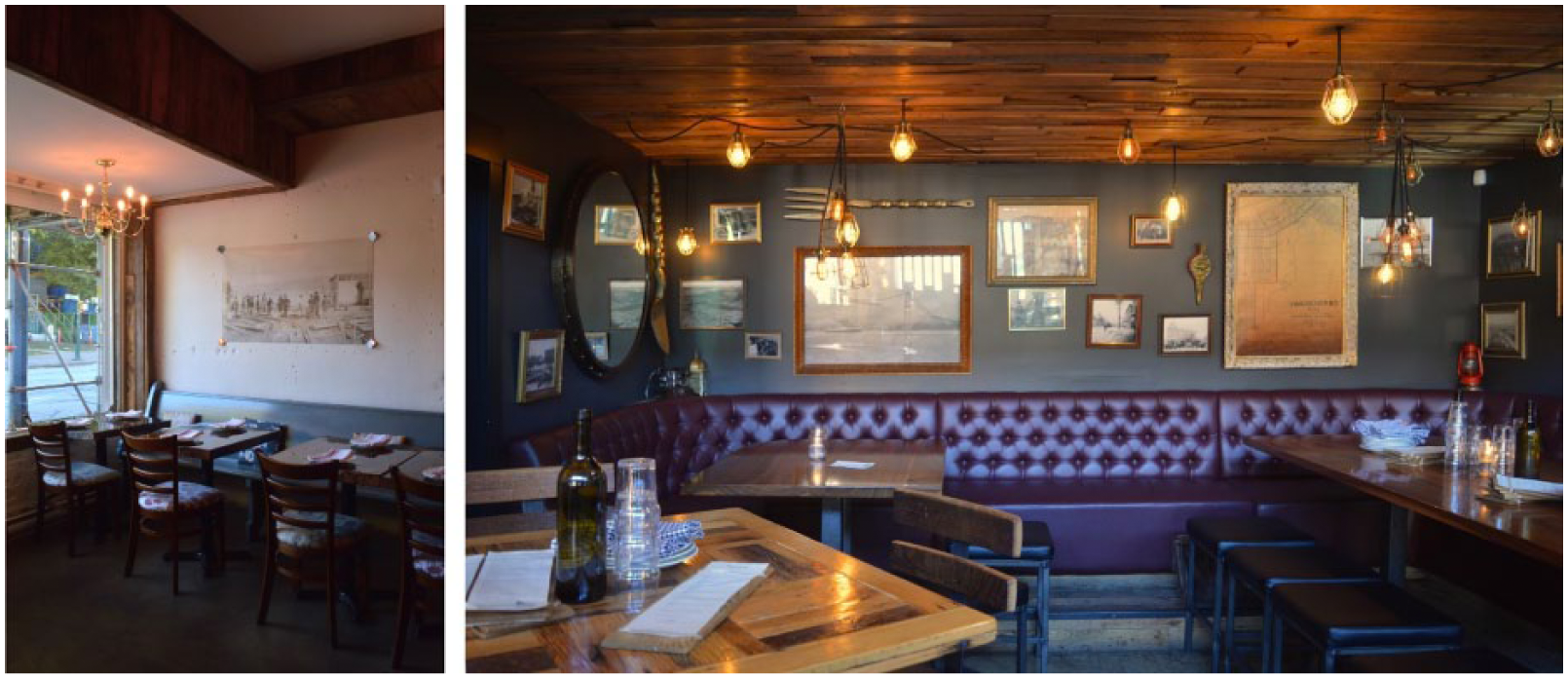
Historic surroundings at The Mackenzie Room and The Settlement Building.
Conclusion
It is in these gentrified colonial spaces that we can see the nexus of toponymy, postmodern authenticity and the ruins of imperialism producing one of the most persistent relationships of rule that continues to form in the ruination of empire. They present the story of distant Europeans arriving and making themselves local, naturalizing themselves by transforming the rough landscape into European space and by displacing Indigenous peoples, naming, claiming, and erecting signs and symbols of their historical memory. 69 Paradoxically, it shows how colonists often draw from colonial discourses on the meaning of Indigeneity to assert their own naturalization in space. For instance, one of the most persistent colonial tropes was the romantic idea of the ‘noble savage’, a counterpoint to celebrations of colonial modernity. Viewing the industrial city as destructive, European culture celebrated aspects of physicality, honesty, integrity, self-sufficiency that Indigenous peoples seemed to display. 70 A real and imagined binary presented the noble savage trope as the expected stereotype of Indigenous persons, meaning that people who did not dress in traditional garb were seen as victims of modern civilization. 71 The effect was to colonize the ontological space of Indigeneity with White European imaginings, then use that knowledge to localize Whiteness.
These same values have been displaced onto the gastroimperial culture of restaurants in Vancouver. One key selling point of food for the incoming gentrifiers is that it should be local, hand grown, and produced outside modernity. The Mackenzie Room earnestly serves ‘honest food’ because they ‘think a delicious local beverage paired with food from around home should be your routine’. Mamie Taylor’s ‘makes delicious things out of ingredients’. They revolve around the same colonial frame of reference that operated on the noble savage: noble food is lean, beautiful, produced in local space, untrammeled by modernity’s polluting effects. Part of the purpose here is to clearly appropriate indigeneity: the emphasis on the local not only stands against corporate culture but also claims space and belonging for the colonial project.
In her study of ‘food justice’ movements in California aimed at bringing fresh foods to marginalized communities in disconnected food deserts, Julie Guthman found evidence of three narratives reflecting the cultural ‘Whitening’ of food discourse. Participants spoke of the aesthetic qualities of local and organic fare, the regenerative value found in ‘putting your hands in the soil’ and the political principles of finding ‘alternative’ food sources. 72 As Guthman relates, none of these resonated with the primary African American communities they sought to help, and as a result the upper-middle-class participants were dejected by the idea of helping any further. The discourses Guthman identified are easily mapped onto the values of the restaurant frontier in Vancouver: the naturalization of Whiteness through naming practices; the neoliberal valuation of craft and embodied practice; and the postmodern rejection of corporatism in favour of a supposedly more ‘authentic’ alternative. As we have shown, these values ultimately find their place in the historical landscape of race and empire that continue to wend their way through the postcolonial present. 73
Linda Colley observes that ‘We may be living in post-colonial times, but we are not yet living in post-imperial times’. 74 These words can be mapped onto the landscape of contemporary gentrification in many North American cities. Indeed, in being properly postcolonial, many of the restaurants and bars in Vancouver make no mention of the actual process of colonialism, preferring to simply highlight ‘history’ as an ambivalent thing that took place sometime earlier and left us with some material remains. Ultimately, we suggest, the historical geography of 19th-century colonialism determines what is possible in the contemporary gentrification script – it allows for a selective sorting of recoverable aspects of colonialism and an obfuscation of others. Whereas Canada may seem to be ‘de-colonizing’ the darker elements of the past by bringing them to light and atoning for wrongs, if that decolonization proceeds outside critical attention it risks obfuscating the persistence of colonial relationships in everyday life and the very real practices of dispossession they reproduce.
Footnotes
Funding
The author(s) received no financial support for the research, authorship, and/or publication of this article.