



Abstract
Seseña is the main residential project in Spain that was interrupted due to the 2008 financial crisis, though some parts of it were actually accomplished and people are now starting to move there. By using the symbolic figure of an ‘archaeological park’, the author recounts a trip he made in May 2016 to reflect on whether such a place ceases to be a ruin only for the fact of being inhabited. The material and sociological aspects of this type of urban development are tackled from an ironic and critical perspective to finally conclude that Seseña is a set of ruins ‘come what may’.
Travel diary
Have you ever read ‘Alice in Wonderland’? No I don’t think so. Isn’t that a children’s story? A children’s story? Not at all! Alice thought that everything that went on there was pretty absurd but because everyone else took things quite seriously she wouldn’t dare laugh. (Antonio Gómez Rufo, Madrid. La Novela, 2016)
I am aware that in Spain everybody knows about Seseña, though only few people have visited it. Seseña is known for being the main interrupted urban project during the financial crisis – a ghost town in capital letters – and only its scale makes this case special. The rest fits a narrative with which all of us became too familiar during the last few years: a developer purchased a piece of land in the middle of nowhere, he built some residential buildings (5,000 out of the 13,000 units initially projected) and he went bankrupt. The developer disappeared and his half-dream remained etched into landscape.
I had also read that next to Seseña resided the biggest tyre graveyard in Europe, but I could not have expected that the day before my trip was planned someone would burn it, setting a fire that lasted for 2 weeks. 1 ‘What a beautiful coincidence!’ I told myself, as I decided not to change my plans. In any case, I have no intention of speaking about this timely incident because what truly catches my attention is the notion of ‘ruins’, just like Romantic travellers explored Pompeii, Cambodia or Michoacán. This time, however, I do not have to travel that far, since a 30-minute bus ride from Madrid is enough to take me to the biggest archaeological park in the world.
Prior to departure, I had already been bombarded with the images of my destination and, in order to fulfil my expectations, I am willing to follow in the footsteps of previous adventurers that have visited Seseña before me. Even so, on this occasion, I have calculated something that I was unable to read anywhere else, something that is misleading when you only look at Seseña from the motorway. The fact is that the archaeological park has a surface the equivalent of 150 football fields, and such monumentality makes me excited. For me, like for everyone, a ruin is the remnant of a place where one day there was some activity. However, the ‘bubble burst era’ has taught us that a ruin could also be the remnant of a place where there never was an activity. 2 And since it seems that, little by little, people are starting to buy an apartment and move to Seseña, 3 I face my trip with the objective of responding to whether such a place ceases to be a ruin only for the fact of being inhabited. 4
I did not know that the bus would not take me directly to Seseña. I am very confused when I realise that the closest I can get is a small settlement formed by traditional one-family houses and a bar that is still 3 km away from my actual destination. I have serious doubts as to whether I could take a second bus to finally reach Seseña, but I then opt for not waiting anymore and start walking. Throughout the 1-hour route on foot to the archaeological park, I have to pass through an unfinished industrial area and, like Robert Smithson in the peripheries of Passaic, I am happy to contemplate the first ‘monuments’. 5 They are quite mundane and ordinary as they were certainly not erected to become symbols of anything, but when observed as if they date from an ancient time, they are definitely sublime. I am delighted by roads that separate empty lots from other empty lots, and I fantasise imagining that, from a bird’s-eye view, the unfilled grid may well look like the Cartesian version of the mysterious Nazca Lines. A half-finished warehouse takes the form of a modern Acropolis due to its skeletal steel structure. Besides, I find a building under construction surrounded by a fence upon which hangs a handwritten poster that says ‘Vigilante Gitano’ (‘Gypsy Guard’). One could think that this is a way of threatening eventual intruders, but I naively prefer to interpret it as a subtle demonstration of the popular Spanish folklore. Also, the municipal vehicle pound stores hordes of cars like the Chinese Terracotta Army and many more monuments litter along my path: the sound of transmission towers, a sequence of lamp posts illuminating the nothingness, and the functionality of a wastewater purification plant recall the beauty of the industrial typologies portrayed by Bernd and Hilla Becher. 6 On the horizon, the archaeological park’s splendour is now visible without anything disturbing the wide perspective of the characteristic flat landscape of central Spain. I know I am closer as I cannot help looking at the promotional billboards offering what could be my very own slice of paradise from just €246 a month.
I stumble upon what in other historical cities would be the majestic entrance gate, though in this case, it takes the form of a ‘national roundabout’, a symbol of the urban development of recent years. 7 In the middle of it, there is an enormous sculpture made of steel and stone that greets me. Written in huge letters, I can see the name of the Midas King developer, who made all this possible, including devoting a roundabout to himself: ‘Francisco Hernando’ (Figure 1). This kitsch megalomania reminds me of the colossal golden statue of the deceased dictator Saparmurat Niyazov in Asjabad, capital of Turkmenistan, which has a rotating mechanism so it is always facing the sun. As if it were a mystic experience, some rays of sunlight filter through the thus-far cloudy sky to illuminate a country where developers are glorified in monuments, which now we take to mean ‘monument’ in its traditional sense – welcome to Seseña, the capital of Spainistan. 8
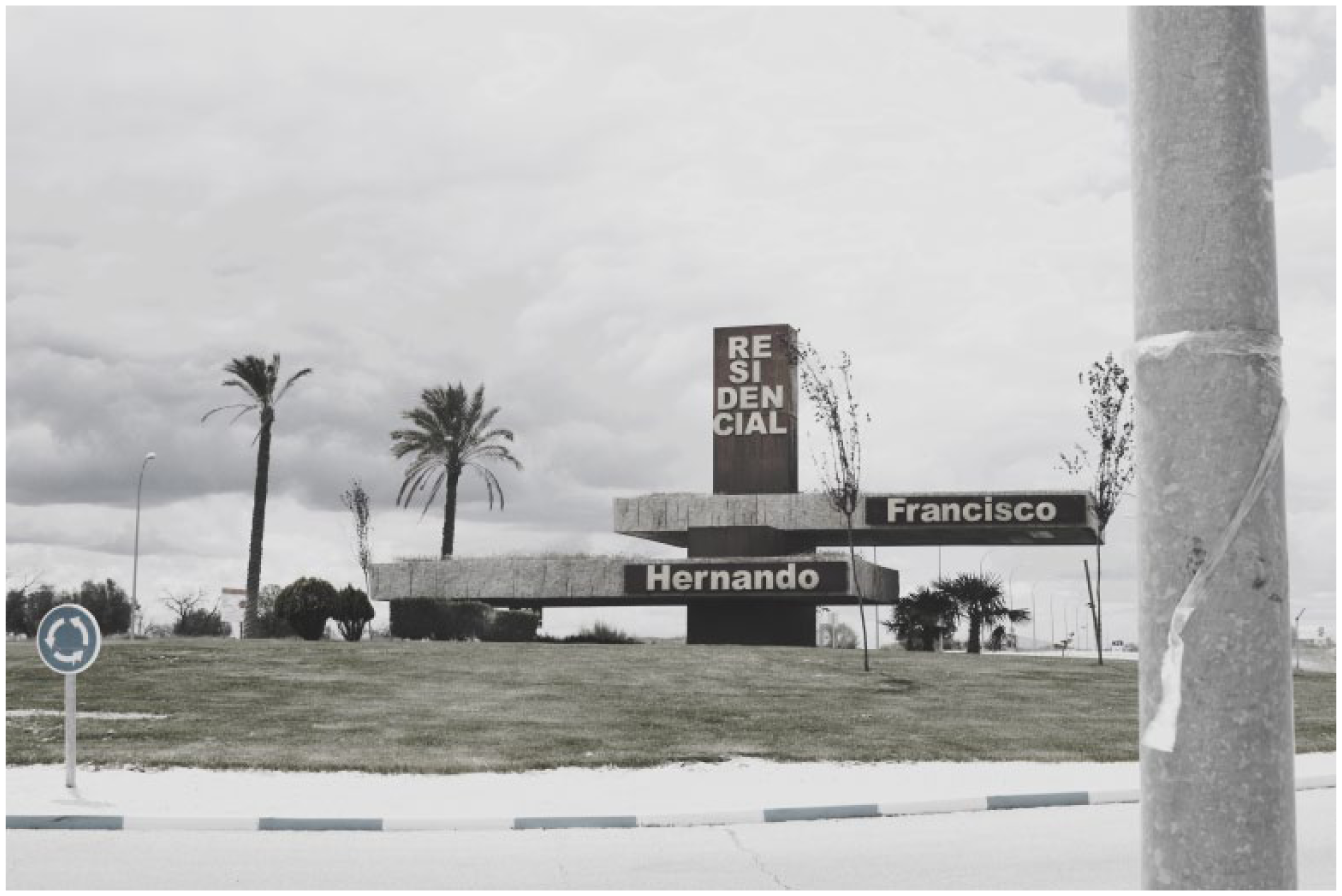
Midas King developer’s roundabout (photograph by author, 2016).
After reading the names of the avenues (Velázquez, Leonardo Da Vinci or Rembrandt), I all of a sudden comprehend that the archaeological park is a place of art. The avenues offer wide perspectives as if Haussman’s Paris were made with buildings of exposed brick (Figure 2). But since I do not see anyone else wandering, the pictures of some North Korean motorways that I saw not so long ago come to my mind. If, according to Lefebvre, every society produces its own kind of space, 9 how is it possible that two societies that are so different one from the other (such as Spain and North Korea) end up producing spaces that are so similar? I suspect that, perhaps, these societies are not that different after all. As far as my eyes can see, the archaeological park is an ode to another dictatorship, that of neoliberalism and its promised ‘excess’, 10 where the shaping of the urban landscape remains in the hands of a tyrant who is convinced that his actions will provide the maximum economic benefit as long as he relies on the bare minimum of legal limitations. The tyrant purchases a piece of land and, from then on, this gives full rein to his desire. Only now, I do understand the reason behind this archaeological park in the middle of nowhere. It all follows a speculative logic where high revenue is inversely proportional to low-cost land. That is why developers opt for the periphery of the periphery, with no connection to public services or basic infrastructures. 11 The developer buys cheap and sells cheap: the pound-shop of architecture. All this causes excessive land consumption, which ultimately results in an exponential energy demand. Hence, I laugh when I read a sign that says ‘Pueblo Sostenible’ (‘Sustainable Town’) and conclude that it should rather be written ‘Pueblo S.O.S.tenible’.
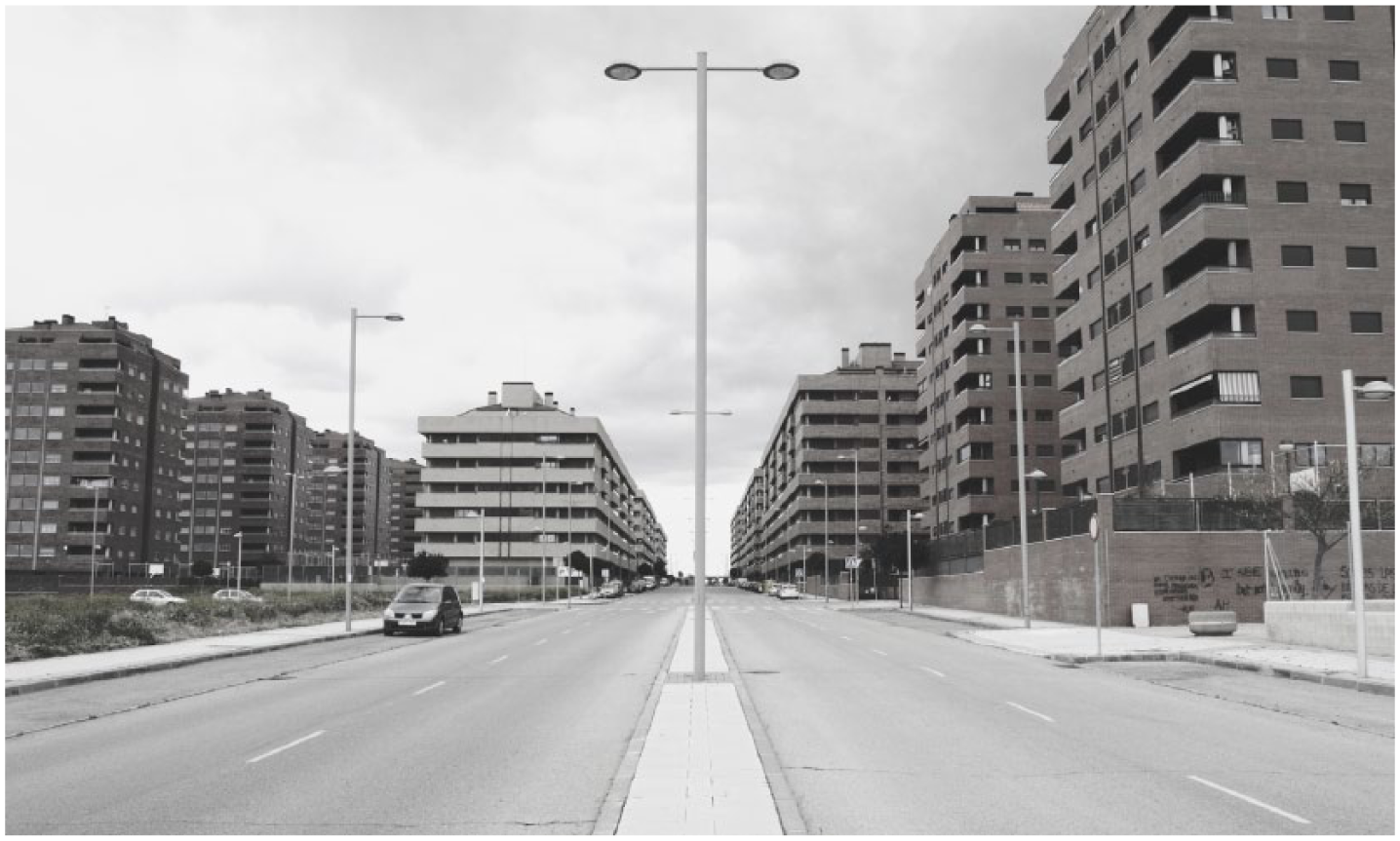
Haussman’s Paris made with buildings of exposed brick (photograph by author, 2016).
The walking distances here are too far and I realise that the archaeological park was not designed to be traversed on foot. Zooming in, it seems evident to me that the architecture here is extremely simple and monotonous. It is a sort of postmodern Doric style which is repeated over and over, where nothing makes the listless wandering a bit more exciting. Like cave paintings, even the inscriptions on the walls saying ‘Se Alquila o Se Vende’ (‘For Rent or For Sale’) seem to be always the same. I finally comprehend that architecture, as it became a mere consumer good, relies on homogeneous typologies that allow an easy exchange. Everything is built in the same way, no matter the context in which it is located. It is a matter of a lack of creativity hailing neutrality and standardization. 12 I think that somewhere there must be a robotic architect who designs and distributes residential blocks in a mechanical way, making the absolute most of an imaginary grid on the territory. I go further in assuming that such an ‘urbanalisation’ 13 ultimately generates social behaviours which are also uniform: architecture of prototypes for prototypical lives (Figure 3).

Architecture of prototypes for prototypical lives (photographs by author, 2016).
Surrounded by closed shutters, I take pictures of everything that attract my attention, and I am overwhelmed when I find out how difficult it is to frame something without capturing a traffic sign. I cannot resist thinking that I am actually in a transitory place which, paradoxically, is labelled as residential. Although conceived of as a place to live and stay, the archaeological park rather works as a site to keep moving. It is well known that when Marc Augé coined the term ‘non-places’, 14 he made reference to those anonymous spaces such as motorways, airports or shopping centres, where every behaviour involves a sort of mobility that is planned and controlled in advance. Yet, non-places contribute to the depletion of the particular identity of each individual, limiting their movements and minimising their interaction with other individuals. Suddenly, I realise that, during my trip, I have not talked to a single person because I simply did not have the chance to do so; the archaeological park is designed so one does not have such an occasion. This is aligned with what Manchón calls ‘territorism’, a clever play on the words ‘territory’ and ‘terrorism’. 15 Territorism is the meeting point between political slackness and the private sector’s greed. It is a system that offers the illusion of an individualised life embedded in a reality in which all lives are the same. Territorism ultimately provides inhospitable environments where a person has no choice but to behave in an inhospitable manner. Isolation and lack of time shape what Manchón, by quoting Kant, refers to as ‘unsocial sociability’, meaning the society in which everyone lives together but each individual lives for himself. I, staring at deserted pedestrian crossings, interpret it as the palindromic mantra of contemporaneity: home–car–work–car–home.
I am interested both in fullness and in emptiness, and I am amazed by the poetic vision of corrugated iron emerging from uncompleted foundations (Figure 4), not far from where blocks were demarcated, earth was extracted and yet they never poured a single drop of concrete. I am fascinated because, due to the recent rainy days, these cavities are now lovely ponds surrounded by wild bushes. It all acquires a sense of spiritual retreat in which the silence is only broken by sporadic birdsong. All this forms a spontaneous type of nature, born in the interstices, creating an involuntary green space that is just the unplanned negative of what was not to be. I am aware that this kind of space has even been filed away with an aura of positivity. Solà-Morales defines his ‘terrain vagues’ as the vacantness within the city, emerging as areas full of possibilities, experimentation and alternative uses. 16 I downgrade these expectations when I observe that here there are only some remnants of the construction materials that were never used. A pile of broken bricks reminds me of the disorderly aesthetics of the white fragments in David Caspar Friedrich’s painting The Sea of Ice. The landscape composition, formed by chaotic bricks and the archaeological park’s skyline in the background, is a metaphor so easy to make that I cannot avoid it (Figure 5).

The poetic vision of corrugated iron (photograph by author, 2016).
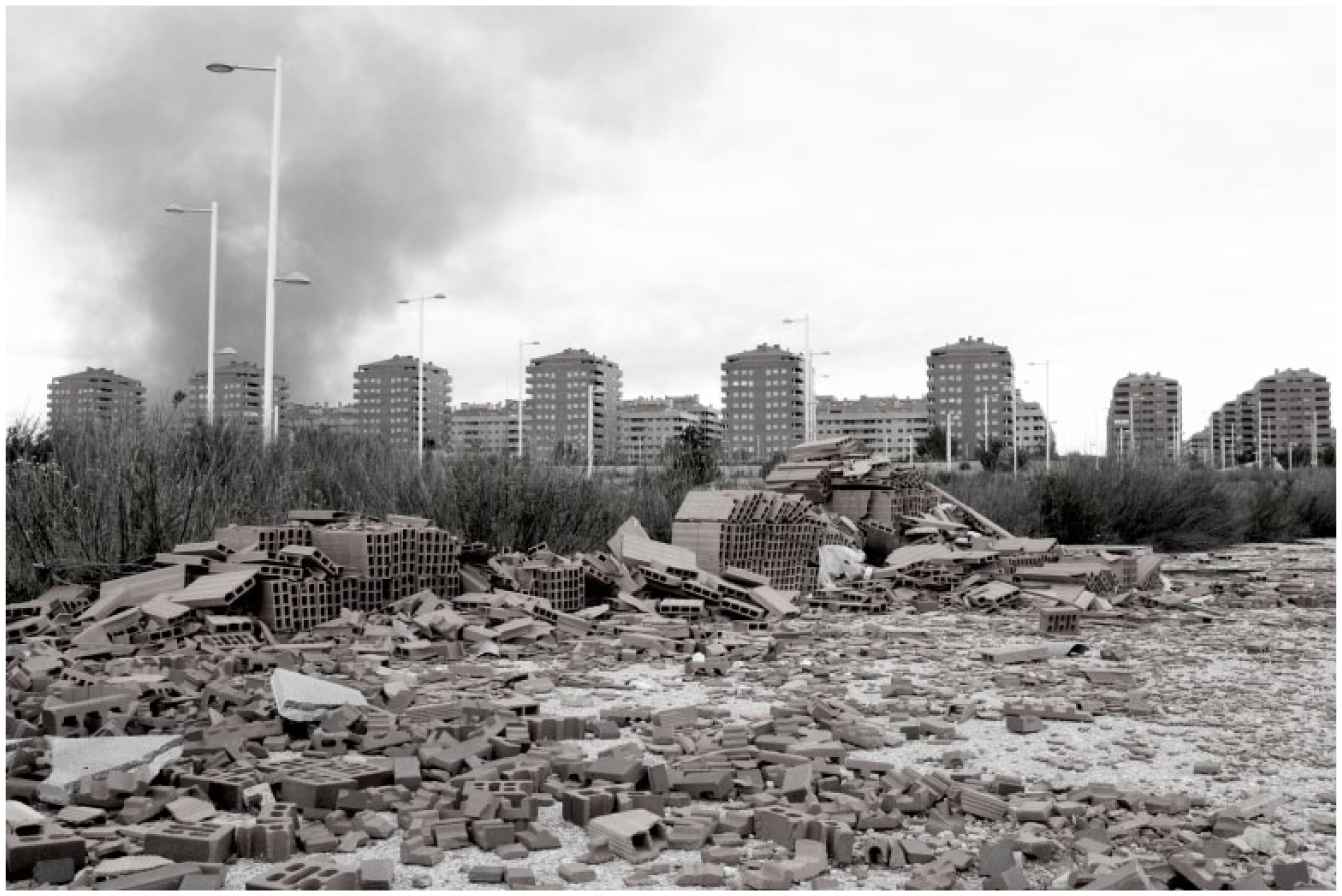
The Sea of Bricks (photograph by author, 2016).
For years, they referred to the housing boom in Spain as ‘the economic miracle’. Contemplating its results, I do not consider that such terminology is appropriate, since labelling the offering of low-cost apartments in the middle of nowhere a ‘miracle’ is, commonly speaking, pretty ridiculous. Miracles are miracles because they are exceptional, but there is actually a lot of architectural parks of this kind, not only in Spain but also in the rest of the world. 17 During the last couple of decades, many countries have erected their own archaeological parks with the blind faith – almost a magical premise – that a newly built space would automatically generate activity by default. 18 However, the archaeological park that I visited today demonstrates how such a thought is erroneous – the park, a manifestation of a vanished illusion. 19 In urban planning and architecture, a bad decision remains in the landscape for many years. I reach the point of almost blessing the crisis, because it thankfully contributed to stopping this. With the prevailing inertia, we could not have expected anything better but more of the same. Moreover, considering the way of life that these buildings supposedly advocate for, I do not perceive the fact that they are increasingly inhabited a success at all. It is true that the buildings are not deteriorated, they are not ruined ruins. But they are ruins so long as they host ruined lives: they are ruins come what may.
I am overwhelmed after such a heavy dose of weird beauty, and I retrace my steps elated by a Stendhal anti-syndrome. With swollen feet after 4 hours wandering around, I have visited the 21st-century Florence, to which I have no reason to return as I am bored of always seeing the same. Back at the bus stop, I decide I will stay in the bar nearby until the bus comes. I am finally surrounded by people, who are shouting at a football match on the TV. And though Seseña is already a toponym associated with a disastrous period, like Hiroshima or Pripyat, I am confident that my gaze may serve as redemption. I think about this while I am reconciled with a world in which they give you a free ‘tapa’ when you order a beer. ‘What a wonderful world’, I think. ‘And not at all Kantian’.
Footnotes
Funding
This contribution has been developed while the author was awarded with the Thüringer Graduiertenförderung scholarship, granted by his university.