



Abstract
The authors trace the physical and cultural history of two iconic buildings in Havana, Cuba: the Havana Biltmore Yacht and Country Club and the Buena Vista Social Club. The ‘Biltmore’, now renamed the Club Havana, flourishes after several periods in which its survival was doubtful. The ‘Buena Vista’ had already long ceased its original functions at the time the film of that name was made in 1997. The article illuminates the enormous cultural significance with which certain buildings may be invested when the emotional title to the past is magnified by revolution and social turmoil.
Havana values its architecture. Conscious of the 1982 United Nations Educational, Scientific and Cultural Organization (UNESCO) World Heritage Listing of the city and the need for hard currency, the City Historian since 1982 has endeavoured to defend the cityscape under the criteria of ‘Patrimony and Community’. 1 And indeed much of Old Havana has been saved, though at some cost to 20th century, especially art-deco, architecture. Our article concerns two buildings, one great, one humble, which satisfied neither of the City Historian’s criteria. Both still stand, though their original purposes have vanished, not through neglect but government fiat. Our article investigates the curious history of both buildings, and speculates on the emotional attachment carried by those who were once associated with them, of whose values the City Historian is not required to charter at all.
Jack Bowman, the famous American hotelier, established the Havana Biltmore Yacht and Country Club in Cuba in 1928 (Picture 1). He placed it in Quinta Avenida in the most exclusive beachside address. 2 He designed a spacious hacienda-style edifice of two sprawling storeys, elegant pillars supporting the enormous orange and cream terraces. Havana was already the playground of the well-heeled southern United States, now Bowman intended his hotel to rival anything in the French Riviera. While certain other clubs associated with Americans in Cuba brought to mind ostentation, alcohol, prostitution and the Mafiosi, the Biltmore attracted wholesomeness and families. By its heyday in the 1950s, the Biltmore was primus inter pares among the elite. Only the best of the white (Spanish-descended) Havana families were members, though more than half the others were from the United States. Wealthy matrons and their families gathered by day for canasta, bridge and swimming. Men paid the subsidies but transacted their business elsewhere. Weekends were for the young people. A 1950s Bacardí club advertisement depicts a glorious Cuban winter’s day. A dashing, apparently US, naval officer, Hatuey beer in hand, leans over a perfectly coiffeured Cuban woman sipping a rum cocktail (Picture 2). Behind them, nautical flags flutter from the masthead of the unmistakable club while swimmers frolic in the breakwater. 3 Sport remained the club’s official raison d’être. Photographs of young people, sports teams and yacht races adorned every public wall.

Club Havana, front view, 2015 (Peter Read).
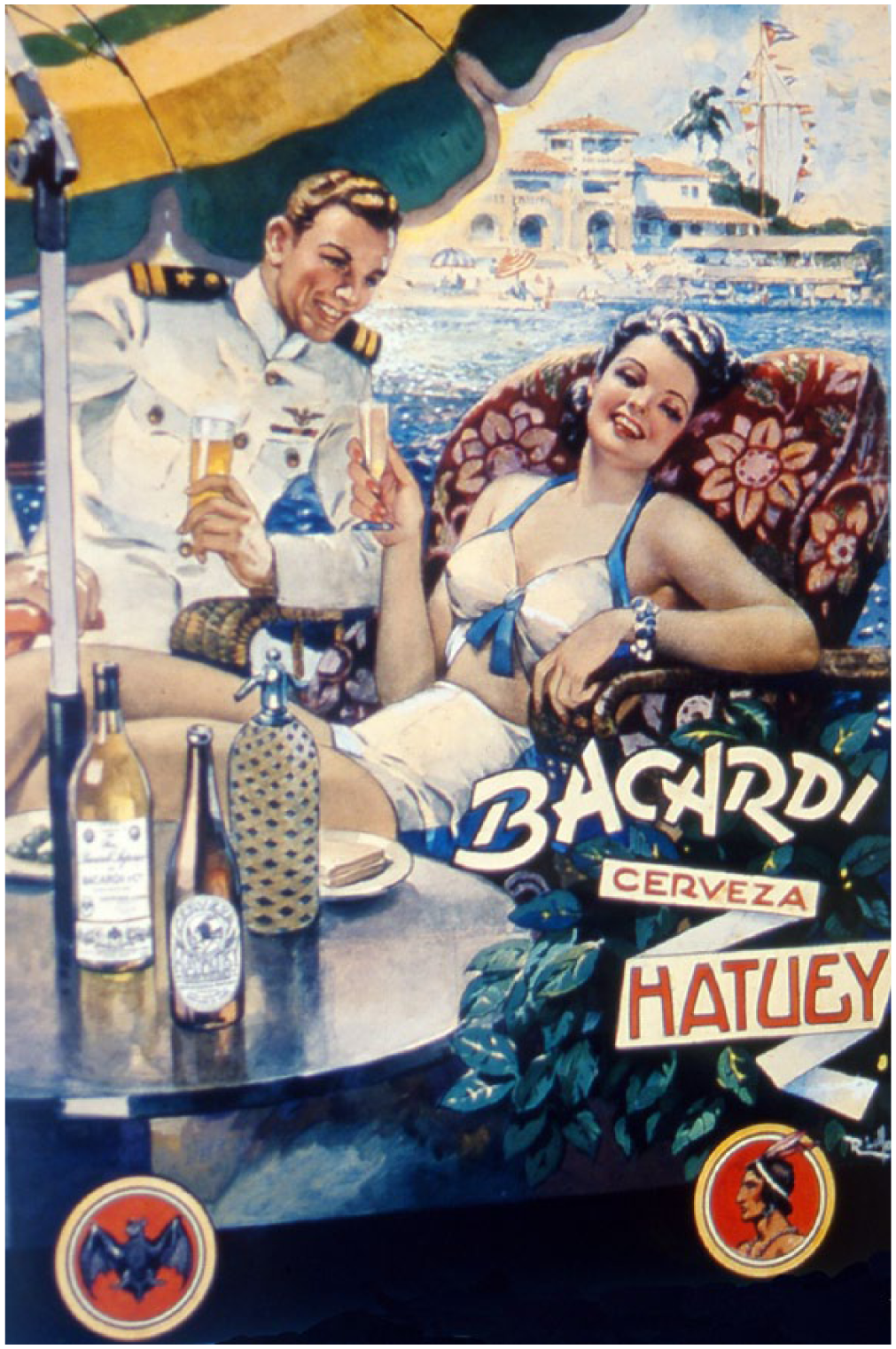
The Biltmore (rear view). The man on the left appears to be an American Naval Officer, the woman a Cuban. Poster c. 1955 in the Bacardí Factory and Museum, Puerto Rico. Photographic artwork Con Boekel.
By the later 1950s, Castro’s guerillas were already making their way towards the capital, and all was not well at the Biltmore. Club member Carlos Eire, later exiled to Miami, remembers the family maid Caridad threatening him, ‘Pretty soon I’ll be seeing you at your fancy beach club, you’ll be cleaning out the trash cans while I swim’. 4 In January 1959, Castro’s revolution claimed any and all public buildings in Havana in the name of the people. Confiscations followed throughout the city. A particular destiny awaited the Biltmore, which after a brief period as a Rest and Recreation centre for officers and as an Olympic swimming team training venue fell into decay and ruin. The Biltmore and its environs had become ‘a huge glittering ghost town’. 5
A workman, Benigno, whom the authors spoke with in 1996, strongly defended the Biltmore’s decay. Some of the patrons of the club, he said, had gone overseas; the rest had been ‘dealt with’ by the revolution. Gracias a Fidel – thanks to Fidel – who overturned the tyrant Fulgencio Batista and for ridding society of those who had enslaved him and his class. He told a climactic tale about himself as a small boy on a night errand. His dying grandmother needed medicine. Desperately, he rode the streets on his bicycle until at last he found the medicine. Without funds, the chemist refused to part with it. His grandmother died. Again and again Benigno repeated that mantra, ‘I will never forget the bad old days. I will never forgive these people’. The grim and silent presence that was once the Biltmore would pay for its members’ follies. Benigno’s despised Biltmore deserved to be closed. It deserved to be destroyed.
In fact, the Biltmore had not needed to be formally closed, for most of its former members had fled to Miami, or had been jailed or executed. 6 Dust settled in corridors, paint began to peel, rain blew in to discolour the walls. The golf course vanished beneath weeds and undergrowth. When the last Olympic swimming trainee left, the pool was drained and the premises abandoned. In 1996, the Biltmore was a wreck. The guard house was deserted, the perimeter fence holed, the doors unbarred, the electricity disconnected leaving the downstairs passages in darkness. Photographs of famous sporting teams that once adorned the walls gathered upside down and broken on the floor. The terraces overlooked the destroyed marina and a dirty, deserted soccer pitch.
Produced in 1999 by Ry Cooder, the 1997 album Buena Vista Social Club and the 1998 feature film of the same name were an instant success. 7 Eight million copies of the album were sold, the film nominated for an Oscar. Although analysts have critiqued the film as presenting a false and ahistorical view of the island’s recent history, it remains unchallenged as the sunny and archetypical depiction of Cuban music. 8
The actual building that housed the Buena Vista Social Club stood at 42, Street 9, in the unremarkable lower class Havana suburb of Almendares (Picture 3). Its shape was geometrical and utilitarian, a square façade of fading white paint, a small garden and a narrow awning. In 1999, the rear of the house held not a garden but a spacious partly roofed cement area. Although the club had not functioned since 1960, in 1999, there remained a bar still advertising, in faded letters, the beers Tropical, Cristal and Hatuey. Yet while the club premises remained close to their original condition, nothing in the street told the passerby – or searcher for the club premises – that this was the site of the music which sponsored the film, broke world records for the sale of Cuban music and made the performers international stars.

The Buena Vista Social Club, November 2000 (Peter Read).
The official story of the Club is that the American guitarist and composer Ry Cooder discovered the retired musicians, organised the recordings, put down the tracks in a week, produced the album and named it after the club associated with them. The truth, though it is hard to unravel, is more complex. The club was never precisely social, nor was music ever the club’s raison d’être. Its first ‘mission statement’, framed on its establishment in 1932, was to entertain and amuse young people ‘of colour’.
9
Its intention was primarily to ‘defend its sons [including women] against a society that discriminated against Negroes’. Like other ‘social clubs’, it fostered the ideals of respectability, honesty, faith, dressing well, family, sobriety and self-education within the wider family of its Afro-Cuban neighbourhood. By 1950, these aims had focussed more explicitly: a manifesto of about this time describes the club as ‘a group of men who could contribute their honesty and faith in the triumph of the ideal of the self-improvement of its membership, as a positive contribution towards the progress of education and youth and family of the neighbourhood’. Despite the generic Spanish collective noun, membership included women. The club’s stated goals were Instruction, Recreation and Sport, with special attention to English language classes, sewing and tailoring, table-tennis, soft ball and volleyball. Such were the pre-revolution urban working-peoples’ values of trade, shared interests and racial solidarity. Unstated, because it was obvious, was the club’s Afro-Cuban solidarity (Picture 4). A brief history, published in a local newspaper in 1977, stated that The name memorialises a part of Cuban racism. This club was to foster one of those societies which sheltered the negroes’ sufferings and encourage their efforts in a society which reviled them owing to the colour of their skin.
10
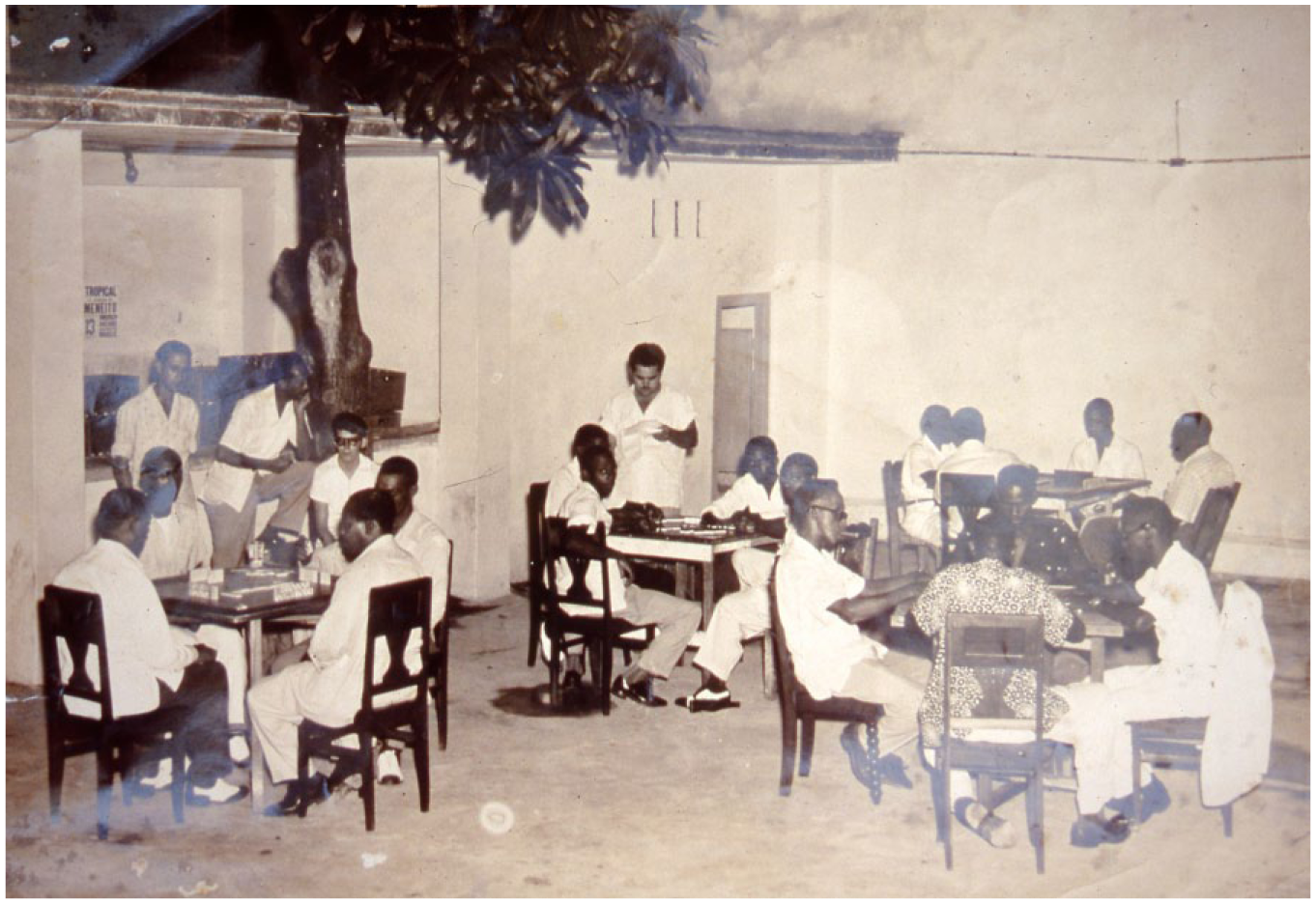
Afro-Cuban men, respectable and dressed in their guayaberas, enjoying a game of dominos in what is now the rented-out gymnasium of the old Buena Vista Social Club.
Music-making, however, was not a stated goal. In time, Eugenio, the nephew of the club treasurer, inherited the building and continued living there with his family. In 2001, Eugenio revealed that despite the building’s rather tenuous connection to the film, he had been delighted at the attention that he expected the publicity to bring. He stuck documents about the club to an interior wall for visitors to read, and prepared himself for the tourist influx. They never came. The club’s location remained a virtual secret. Mysteriously, and in the absence of tourist information, aficionados had to use taxi drivers and neighbours to locate the building which remained unsignposted and unmentioned in any public information.
The downward trajectory of the club itself within these premises had in fact begun long before 2001, at the time of the revolution itself in January 1959.
First to go were the classic Castro targets of revolutionary scorn, the elite clubs like the Biltmore, the nightclubs, brothels and gambling dens. Yet social clubs like the Buena Vista soon followed, for if the Biltmore’s clientele represented an unwanted class, then so did the Afro-Cubans who frequented Buena Vista. The people’s republic was now to be one united people. No longer was it to be composed of the warring elements of many races, classes, professions or income levels.
The proscriptions infiltrated every part of the island.
11
Jan Cruz, former President of the Marianao Social club, recalled, Well, as everything was shut down, the societies of classes [races] were shut down to form other types of societies to which all of us should belong, that was how the societies were shut down.
12
The journalist Eugène Gottfried, based in Guantánamo, searched for any constitutional decree requiring the abolition of the Afro-Cuban ‘improvement’ societies but found none. The only reference he could find was ‘those [societies that] were eliminated with the first discourse of Fidel after he came down from the Sierra Maestra’. 13 Thus, in 1960, the new government had unceremoniously slotted the Buena Vista Social Club into a bureaucratic pigeon-hole: ‘book 22, folio 385, number 23332’. A year later, the club supposedly ‘dissolved itself’. The working men found themselves in work brigades, youth cells, the people’s militia, workers’ social clubs and revolutionary cadres. Some of the impressionable younger members, according to Eugenio, volunteered to go into the interior to cut cane or to join literacy campaigns. 14
In 1996, while the many un-maintained older buildings of Havana were collapsing under their own weight throughout the city, the revival of the Biltmore was already in process as one of a series of income-generating measures. The revolutionary government planned to repair the club and build apartments to attract Cuba’s international diplomatic and business elite. The Department of Public Works commissioned a Spanish architect to re-create the club as it was from the original photographs to the original paintwork. This was the new Club Havana, not for Cuba’s despised bourgeoisie, but for the Cuba’s international elite, the equal of the best clubs of Miami. By 2002, the Biltmore that now presented itself was the face of new Cuba. It was represented by the tourist guide Gretel, young, blonde, slim, female, smartly dressed, of impeccable manners. The old regime had ceased to gather here more than a generation before she was born. Unlike Benigno, she bore them no ill will.
Gretel explained to tourists that the Club Havana had ‘once’ been the Havana Biltmore Yacht and Country Club, an exclusive sports and leisure centre for Havana’s ‘privileged classes’. Its membership, ‘restricted to whites only’, had sponsored the nation’s most sumptuous balls and its most successful aquatic achievements. The building’s new purpose was to attract ‘diplomats, executives and entrepreneurs’, offering them ‘the best option for services’. Only a single photograph of Castro greeting the club workers alluded to revolutionary Cuba. The rebuilt Biltmore, to Gretel, represented continuity with a luxurious and glorious past passing from entrepreneur to entrepreneur, a symbol not of class domination but national pride. Of all the singular features of the restored building, none was more striking than the restored but unidentified photographs of young people in baseball, softball, swimming and yachting uniforms; photographs which the authors had last seen, only 4 years before, lying in broken heaps in the corridors. Many of the men so photographed must actually have fled the country, returned with the Bay of Pigs invasion or died in a Cuban jail. Mostly unidentified and untraceable as they were, these beautiful young sports people acted powerfully to legitimise the restoration. Within these walls, the revolution had not happened, it had stopped at the gate.
In the same year of 2002, 10 km away, the Buena Vista Social Club treasurer Eugenio still held out hope for his club even if the tourists were not arriving. Possibly it could function as a youth and cultural institute. ‘Life goes on’, he observed, ‘and we are returning to our Afro-Cuban roots and social values’. He hoped that the building might continue as a club for ‘black and brown’ but now incorporating what he called a ‘new perspective and social context’. He did not grasp the improbability of such a venture. To outsiders, it was obvious that the Cuban government had no intention of allowing the revival of any kind of cultural institution professing values not intimately rooted in Marxist-Leninist-Guevarist ideology, particularly one premised on that racial discrimination which the triumph of the revolution had supposedly abolished. The government’s directives had not changed. Known to the Cuban-American journalist Sujatha Fernandes, but not to Eugenio, was the fact that a large number of other African-American consciousness-raising groups had not only been silenced but remained silenced by the revolutionary government. 15
Thirteen years later, in 2015, Eugenio still lived at home in the old club, but the momentum of film and album was comprehensively past. He had removed all the memorabilia to the club that had once adorned the walls of the living room, which he had returned to its original purpose. He now confessed to have abandoned hope of the club’s re-establishment in any form. To help the weekly budget, he had rented as a gymnasium the rear section of the premises where the musicians and socialisers once used to gather. The Buena Vista Social Club was dead. His suburb was just as much a black suburb as it always had been. The building remained, but its values had fled.
The Biltmore, however, is enjoying its resurrection. Open to diplomats and professional clientele, the condominiums are full and the waiting list long. The paint is more durable, the building sparkles. By day it is virtually empty; at night its patronage is mostly male. The families have vanished, Club Havana has arrived. Its restoration seems complete. Only those who never knew it think that it is the same as what it was.
In 1996, Peter Read researched the mental anguish of people whose place of deepest affection had been destroyed in war, fire, inundation, cyclone, road construction or sale. He concluded that in assessing the value of a threatened site, both the European and Australian criteria for registration relied too narrowly on aesthetic, religious, spiritual, symbolic and educational values plus those of ‘a community’. 16 Decades later, the emotional attachment of individuals, families or club members to a site threatened with destruction remains discounted among heritage criteria.
In the face of the Cuban government’s determination, neither the Biltmore nor the Buena Vista Social Club could have been preserved as they were. Yet we may speculate that the members of the Biltmore were more attached to their club because the materiality of the building itself spoke the values of class, wealth and social status. Eugenio’s building by contrast was, in essence, more a place where certain agreed values could be transacted. Should they have been allowed, many members of the Buena Vista might have been content to find new premises, but of course they were not. But the clientele of the former Biltmore held another option, and used it. In 1967, a number of exiles felt so strongly about their club’s demise that they pooled their resources with members of other former exclusive Havana clubs, to re-establish themselves – in Miami. The main purpose of the ‘Big Five’ purpose was none other than ‘to preserve the Cuban traditions and culture in exile’. 17
Many cultural geographers have long recognised the limitations of national and international criteria of valuations that rely too heavily on ‘Patrimony and Community’. 18 It may also be worthwhile for us to consider the kinds of emotional attachments that people bring to public spaces and places. To what extent are emotional attachments linked to the values that are transacted within them?
Footnotes
Acknowledgements
The authors acknowledge the assistance of the Australian Research Council and the University of Technology Sydney in the preparation of this project. They also thank Benigno and Gretel for participating in discussions at the Biltmore, and Eugenio at the Buena Vista Social Club.
Funding
The author(s) received no financial support for the research, authorship and/or publication of this article.