




Abstract
There has been a literary tradition supporting the restoration of Glen Canyon in southern Utah ever since construction began on Glen Canyon Dam in the late 1950s, and the canyons began to disappear behind the rising waters of Lake Powell. While some of Glen Canyon’s literary protagonists put forward a strong political and anarchical refrain for a ‘Glen Canyon restored’, this article considers those writers and texts that instead look to the power of appeals to emotion in defense of the desert. In particular, this article considers the evocative capacity of environmental writing to convey emotional and affective landscapes. This article examines the desert writings of Ellen Meloy and Terry Tempest Williams, and the ways in which they employ rhetoric, myth, story, motifs, metaphor, symbolism, and allegory to speak back to the environmental condition, and the ongoing call to restore Glen Canyon. Meloy’s and Williams’ works present individual testimonies molded by personal engagement, experience, and investigation in the desert – but also contribute to ecological and political discourse in the Glen.
Introduction
desert, n. des·ert \ˈde-zərt\ Desert Southwest. The Four Corners region. Redrock canyon country. Plateaus. Mesas. Gulches. Washes and arroyos. Juniper. Cottonwood. Turkey buzzard. Canyon wren. Cougar. Mule deer. Desolation Canyon. Glen Canyon. Grand Canyon. The Colorado River. The Green, Yampa, White, and San Juan Rivers. Bears Ears. The Wasatch Range. Uinta Mountains. Book Cliffs. La Sal Mountains. Henry Mountains. The Anasazi. The Fremont. The Hopi. The Navajo. Petroglyphs and pictographs. Cliff dwellings. Kivas. Hogans. Potsherds. Arrowheads. The reclamation of the American West. Dam building. Reservoirs. Gold mining. Uranium mining. Nuclear testing. Drought. The Gold King Mine and Animas River spill. Water politics. John Wesley Powell. Wallace Stegner. Katie Lee. Edward Abbey. Ellen Meloy. Terry Tempest Williams. Voices crying in the wilderness. 1
Although the list above is not exhaustive, it serves to introduce and illustrate the complexity and tensions inherent in the landscapes of the American West – and some of the writers and commentators who have storied the desert. Nowhere in the Desert Southwest are these voices louder, or a ‘desert imagination’ more powerful, evocative, and emotive, than in Glen Canyon in southern Utah. When Glen Canyon was submerged behind Glen Canyon Dam and the rising waters of Lake Powell in the late 1950s and early 1960s (Figure 1), there was little indication then of the ecological, political – and, indeed, literary – legacies that would unfold a half century later. For Glen Canyon’s last stand might most closely align with T. S. Eliot’s anticipation (foreboding, even) that ‘This is the way the world ends/Not with a bang but a whimper’. 2 Conservation groups never defended Glen Canyon during the closing years of the Bureau of Reclamation’s golden era of dam-building, for the canyon fell outside the national parks and monuments system. Yet, the call-to-arms to restore the Glen emerged almost as soon as construction began of Glen Canyon Dam, and found its voice in an unexpected place – the literary imaginary.
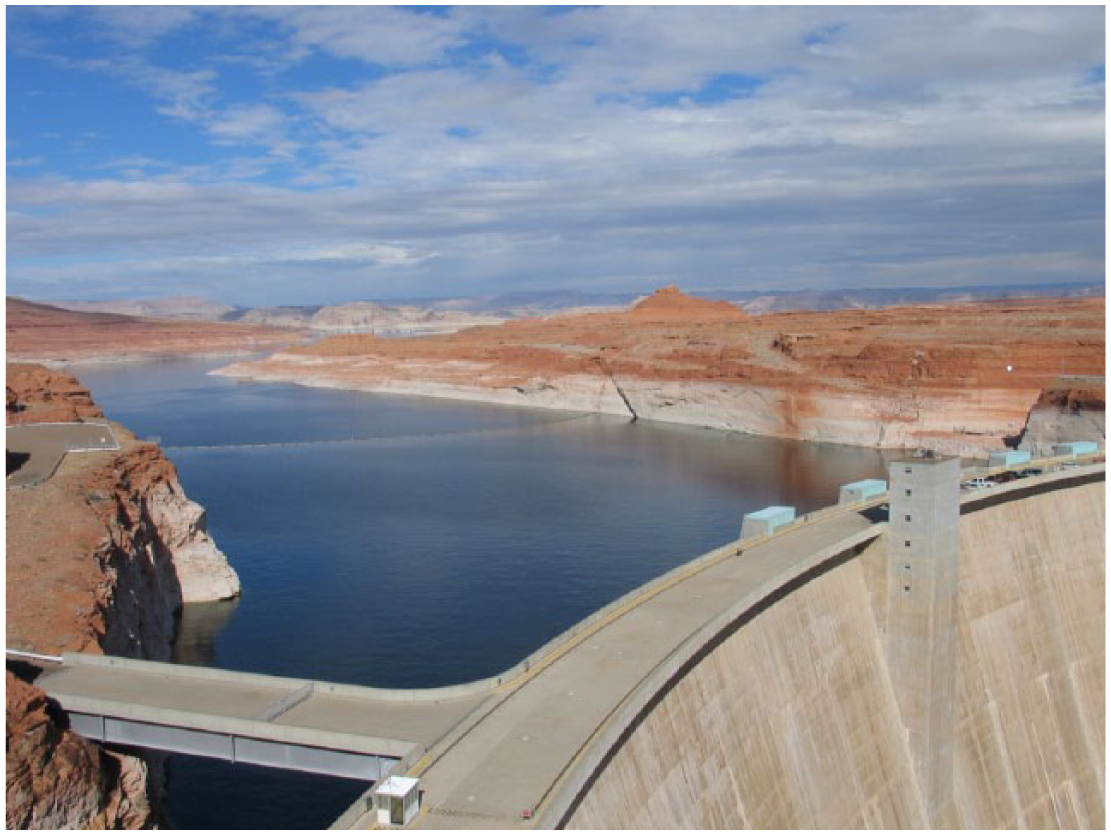
Lake Powell and Glen Canyon Dam on the Colorado River, taken from the Carl Hayden Visitor Center at Glen Canyon Dam, Page, Arizona, November 2012. Photograph by the author.
The use of literature and the literary imaginary as a tool in the arsenal of US conservationists is not new. One might look to Henry David Thoreau’s mid-19th century writings at Walden Pond, and the different campaigns to protect, conserve, and restore Walden Woods from the 1950s onwards; or to John Muir’s writings at the close of the 19th century calling for the designation of Yosemite National Park; or Muir’s failed campaign to prevent the construction of O’Shaughnessy Dam on the Tuolumne River in Yosemite’s Hetch Hetchy Valley, and contemporary efforts to decommission the dam and restore Hetch Hetchy. One of the earliest literary campaigns in Glen Canyon followed on from a successful campaign by the Sierra Club in Dinosaur National Monument earlier in the 1950s, opposing dam construction on the Green River. But this Glen Canyon campaign was, by contrast, a swansong, eulogizing the already disappearing canyon (and echoing Muir’s Hetch Hetchy loss). The fiction and non-fiction writings of Edward Abbey are perhaps most closely associated with the anticipated restoration of Glen Canyon – especially his fictional ‘Monkey Wrench Gang’, and the gang’s shared fantasy of the obliteration of Glen Canyon Dam – but his writings are frequently political, radical, and incendiary in their call for restoration. 3 This article instead considers how an emotional register of place is revealed through literature, and how this emotionality is subsequently employed, both in praise of and in defense of the land.
This article engages with the writings of two authors firmly rooted in the American West – Ellen Meloy and Terry Tempest Williams – and employs their polemic for a ‘Glen Canyon restored’ as a means of critiquing the evocative capacity of environmental writing to convey emotional and affective landscapes. As Christine Berberich et al. attest,
attending to affect does not preclude consideration of wider politics or the “social,” but might actually draw us closer to a new understanding of its workings on the human, lived scale of the everyday; the scale we all exist within.
4
What Williams and Meloy are asking through their desert writings is, what might it mean to care about, to value restoration in Glen Canyon?
This article also builds on other recent studies that have engaged with affective responses to environmental change, and the cultural politics of ecological restoration and rewilding. But whereas, for example, Wendy Shaw and Alastair Bonnett examine environmental loss through a reframing (and defense) of narcissistic responses to the environmental condition as grief responses, 5 and Paul Robbins and Sarah Moore address an ecological anxiety in confronting loss, 6 this article turns to a creative, literary – and highly personal and intimate – response to loss, and to anticipated restoration. What makes both Meloy’s and Williams’ desert writings particularly interesting for this discussion is the prioritizing – and politicizing – of gentleness, compassion, and hope throughout their works. For cultural geographers interested in the ways environmental loss and grief are expressed and made manifest, Meloy and Williams use their curiosity, concern, and love for southern Utah’s canyonlands to creatively tell of taking action, taking responsibility in the face of environmental loss and trauma. These works present a working through of grief, where the desert imagination becomes cathartic and purgative, a retaliation against environmental anguish.
The slickrock desert surrounding Ellen Meloy’s (1946–2004) home in Bluff, Utah, provides the inspiration for her wider natural history studies amidst the deserts and rivers of the Colorado Plateau – with a different desert signifier explored in each of her four books: turquoise, bighorn sheep, the Green River, nuclear test sites. Terry Tempest Williams’ (1955–) writings are molded by the redrock canyon country of Castle Valley, Utah, and its environs, and by her Mormon faith. Across several books and collections of essays, Williams returns to themes of natural history, wilderness, religion, mythology, the atomic West, family, women’s health, politics, and activism. As a conservationist and activist, Williams has spoken out against nuclear testing, oil and gas leases in the West, and against weakening wilderness protections. I have selected these two authors because of their attention to producing a ‘deep map of Place’, 7 with both authors placing a particular emphasis on the purposes and processes of seeking awareness and paying attention 8 through the desert imagination. This article thus considers how affective landscapes in literature – told here through a sense of place, rootedness, and the complexities of ‘home’ – are retold in, and contribute to, environmental politics.
Returning to Meloy’s idea of a deep map of Place, she argues,
Anyone who writes a deep map of Place fears her words will detonate that place. Incited by books of love, thousands already adore Utah’s canyon wilderness to death despite gnats, scorpions, rattlesnakes, black widow spiders, thorns, poison ivy, rock slides, wind, mud, mammals, missionaries, and mosquitoes, and the indignity of having their vehicles and televisions surgically removed from their persons. Better a vacation at the EPCOT Center, which has rest rooms.
9
Rather than detonation, I argue in this article for the emotive power and authority of this literary imagination to inform public discourse surrounding ecological restoration in Glen Canyon.
The first part of this article offers provocations on a ‘desert imagination’, and discusses Meloy’s and Williams’ (meditations on) commitment to place, especially attachment and value in the desert. Discussion centers on the power and authority of story, and storying the land, and how this contributes to environmental and political conversations on Glen Canyon. The second part explores the place of spirituality, mythology, and tradition in Meloy’s and especially Williams’ works, and how this plays out through a reprioritizing and reconfiguring of ecological concerns and values – advocating compassion and hope in ecological restoration narratives. The third part of the article considers Meloy’s and Williams’ commitments to bear witness, and share stories and speak on behalf of place, and examines how their literary support for Glen Canyon restoration might translate into political action and reform.
Provocations on desert solitudes and a redrock desert imagination
The desert’s forms – bare, sensuous slickrock, labyrinthine canyons, blue islands of mountains, the omnipresent ghosts of wind and water, the extreme clarity of light – feed an internal aesthetic as ingrained as instinct: they create the perfect crucible for imagination’s hunger, for the ecstasy and despair of solitude, the delicious terror of becoming lost, an inexplicable lucidity at the moments of worst bloodletting and fury. The desert hides nothing. Perhaps it has no nerve. Or is it all nerve itself, a tautness that carries sensation at constant high pitch?
10
Meloy’s description above, of the character of desert, offers a useful segue to discussion on her and Williams’ place in, on the desert, and representations of the desert in their writings. The writings of both Ellen Meloy and Terry Tempest Williams are deeply embedded in, and informed and molded by, the redrock canyon country of southern Utah. Both authors write out of their own understandings of the arid land around them, in works that combine memoir and natural history.
Revealed through this writing is an embeddedness and emplacement – a sensual immersion – that promotes commitment, investment, and intimacy with the land. This is a central theme of Williams’ essay collection An Unspoken Hunger: Stories from the Field, and as she writes in ‘Winter Solstice at the Moab Slough’,
A man or woman whose mind reins in the heart when the body sings desperately for connection can only expect more isolation and greater ecological disease. Our lack of intimacy with each other is in direct proportion to our lack of intimacy with the land. We have taken our love inside and abandoned the wild.
11
One illustration of this intimacy with the land and its stories can be found in Williams’ Pieces of White Shell: A Journey to Navajoland, which unfolds and is told through the contents of a ‘small leather pouch, weatherbeaten, full of mementos of the desert’ 12 – with each chapter named for a memento, including a sprig of sage; rocks, sand, and seeds; yucca; deerskin; a potshard; and some corn pollen. Elsewhere, Meloy also speaks to a desert intimacy in her detailed study of turquoise, and in tracking bighorn sheep across Utah’s canyonlands. 13
With this deep rootedness in place follows the importance of home, and of staying home. When Meloy comments how ‘I looked at our desert plot as a kind of slut’s Walden Pond’, 14 it is Henry David Thoreau’s ‘wish to live deliberately, to front only the essential facts of life’ at Walden which is echoed on this plot, but I am also reminded of Thoreau’s deep rootedness in his hometown of Concord, Massachusetts, and his claim that ‘I have travelled a good deal in Concord’. 15 These home roots are also political – and politicized – for as Williams argues, ‘It just may be that the most radical act we can commit is to stay home. Otherwise, who will be there to chart the changes?’ 16
I would suggest that one of the great strengths of both Meloy’s and Williams’ writing is their commitment to place, and the close attention to home – and what Williams sees as the need for ‘home work’ and ground truthing. The importance of ‘home work’ is reflected in the title of both the opening section and essay of Williams’ essay collection Red: Passion and Patience in the Desert. On home work, Williams calls for
a participation in public life to make certain all is not destroyed under the banner of progress, expediency, or ignorance. We cannot do it alone. This is the hope of a bedrock democracy, standing our ground in the places we love, together.
17
Yet, caution, too, is required: a deeper knowledge of home may overwhelm, and elicit, ‘not resurrection but a collapse of faith’, with Meloy questioning, ‘Was I on the verge of an apostasy of place?’ 18
The concepts of place, rootedness, and home have a long and checkered history in cultural geography, with these contested entanglements revealed in, for example, Yi-Fu Tuan’s topophilia, or Doreen Massey’s ‘global sense of place’, or through a recasting of ‘home’ as not only a safe but also an alienating or violent place. 19 But where Meloy and Williams contribute to a place-making and home rhetoric is in their aligning of the emotional, affective landscape with understandings – and, importantly, a politics – of place. Williams tackles the idea of place-making not only through her embeddedness in the canyon country but also through her relationship with Utah, the L.D.S. church, and her family. While Meloy shares Williams’ intimacy with the land, her own place-attachment is also frequently overshadowed, and thus defined, by an ecological violence wrought by the desert’s nuclear, atomic history.
The desert lies at the epicenter of many of Meloy’s and Williams’ writings, and in these literary explorations across the canyonlands of southern Utah so too rests Glen Canyon. This close attention to desert-as-home also sees Meloy, in The Last Cheater’s Waltz: Beauty and Violence in the Desert Southwest, challenge the desert as ‘empty’ or ‘spare’ space. This myth of emptiness 20 is interesting for Glen Canyon, for it challenges and recasts the Glen’s ‘empty’, ‘vacant’, ‘barren’, ‘desolate’ status outside of or beyond the parks system.
When Williams asks, ‘When Edward Abbey calls for the artist to be a critic of his or her society, do we live on the page or do we live in the world?’, 21 I think this reveals the opportunity held by the literary imagination and a desert imaginary in stoking – and contributing to – environmental and political conversations on a ‘Glen Canyon restored’. In underscoring the power of imagination, Williams further notes, ‘I don’t think about hope much anymore. But I do think about imagination. That’s where we have the capacity to shift’. 22 Perhaps not least because imaginations – and memories – endure: ‘Landscape may be erased but not the memory of it’. 23 And so it might be that the desert imaginary forms part of the arsenal in the Glen’s restoration.
Story, and a storying of the land, plays a powerful part in the desert imagination of Meloy and Williams, and is frequently woven through personal testimony and narrative. William Cronon celebrates a ‘place for stories’ in geographical inquiry, and as Stephen Daniels and Hayden Lorimer explain in the introduction to cultural geographies’ 2012 Special Issue, Narrating Landscape and Environment,
This new narrative space across the humanities provides scope to address and question official or established stories of places, [. . .] Narrative here is a question, or a generator of questions, in a critical space between the differences and dilemmas of self and other, rhetoric and reality, shadowed by a critical scepticism of storytelling as well as its creative potential.
24
In ‘The Storyteller’, named for a clay figurine, Williams reflects on the affective power of story, noting how
We have all been nurtured on stories. Story is the umbilical cord that connects us to the past, present and future. Family. Story is a relationship between the teller and the listener, a responsibility. After the listening, you become accountable for the sacred knowledge that has been shared. Shared knowledge equals power. Energy. Strength. Story is an affirmation of our ties to one another.
25
For Glen Canyon, the significance of story rests in its capacity to invoke a Future Glen Canyon or a Once and Future Glen, 26 for ‘A story allows us to envision the possibility of things’. 27 But story in Glen Canyon is also a remembrance, for ‘It draws on the powers of memory and imagination. It awakens us to our surroundings’. 28
But why is story so important for Meloy and Williams? Perhaps because it combines allegory with environmental activism – and celebrates this coalescence. Where Meloy and Williams succeed is in storying place and placing stories. As Mark Tredinnick notes in a discussion of story in Williams’ work, ‘The better they resound with that one place on earth, the more powerfully they may also protest and celebrate and warn. All those things are the work of telling the truth about beloved places and their people’. 29 Such situated storytelling articulates the affective capacity of experience and imagination. The desert imaginary becomes a ‘therapeutic landscape’ 30 almost, for it offers a place where Williams and Meloy can not only mourn the lost canyon but also mobilize, anticipate its restoration. Indeed, Williams points to the ‘sorcery of literature. We are healed by our stories’. 31
Spirituality, a desert mythology, and restor(y)ing Glen Canyon
When Ellen Meloy and Terry Tempest Williams write of the desert – and of Glen Canyon – they often do so within two narrative tropes: pitting beauty (e.g. the sacred and sublime) against violence (e.g. the profane and monstrous). 32 The former is framed around mourning the loss of the sacred – the loss of Glen Canyon – while the latter speaks to a rallying against the profane – against Glen Canyon Dam and Lake Powell. Within this desert imaginary, the dam becomes an act of ecological violence against the canyon country – a moment of abhorrence – that these writers attempt to articulate, disrupt through a storying of the land.
Much of the literature on Glen Canyon is synonymous with a literature of loss, and Meloy’s and Williams’ desert imaginary encourages – perhaps demands – an embracing of loss, and of revisiting the landscape of grief. As Williams argues,
And I think we’re afraid of inhabiting, of staying in this landscape of grief, yet if we don’t acknowledge the grief, if we don’t acknowledge the losses, then I feel we won’t be able to step forward with compassionate intelligence to make the changes necessary to maintain wildness on the planet.
33
Lesley Head’s work on the process of grieving – and of practicing hope – as a response to climate change and other environmental challenges, catastrophes 34 continues this idea of learning to live with, and within, ecological loss. Meloy’s and Williams’ works offer ways of mitigating (ecological) loss, grief, and pain.
At Glen Canyon, there is, however, a mourning of the landscape-invisible (Glen Canyon) and the landscape-visible (Lake Powell), which further complicates and compounds this landscape of grief. As Meloy comments,
Suddenly I am weeping. I cry because I cannot smell the heady musk of cottonwoods or feel the quiet movements of water in the unlikely ribbon of paradise that curls through acres and acres of bare, baking slickrock. I cry because three million people a year love the Blue Death and I don’t. I weep for Glen Canyon and I have never seen it.
35
The complexities of the Glen Canyon landscape – of a past, present, and future Glen; of the canyon-dam-reservoir trifecta – are sustained and reinforced, yet also challenged, through Meloy’s (sensual) immersion, practice, and (symbolic) representation. 36
A history of spirituality and tradition in the Desert Southwest is written into the works of Ellen Meloy and especially Terry Tempest Williams, paying particular attention to the spiritual, the holy, the sacred (and sacred reason), and the mythic.
37
These works offer insights into personal spiritualities and theologies in the desert – where story is an ‘attempt to make the sacred concrete’.
38
This spirituality can be understood through a desert mythology, a mythology, Williams argues,
born out of this spare, raw, broken country, so frightfully true, complex, and elegant in its searing simplicity of form. You cannot help but be undone by its sensibility and light, nothing extra. Before the stillness of sandstone cliffs, you stand, equally bare.
39
What is required, Williams argues, is a spiritual resistance born from a quiet listening to, and learning from, the land:
I believe that spiritual resistance – the ability to stand firm at the center of our convictions when everything around us asks us to concede – that our capacity to face the harsh measures of a life, comes from the deep quiet of listening to the land, the river, the rocks. There is a resonance of humility that has evolved with the earth. It is best retrieved in solitude amidst the stillness of days in the desert.
40
Through this quiet scrutiny – of listening in the desert – Meloy and Williams present a literature of compassion. As Williams comments, ‘I think that anytime you go into a landscape of story or art, hopefully, the outcome will be a literature of compassion, something that causes us to pause and think about something in a different, fresh way’. 41 And it is perhaps compassion which is key to understanding the call for a ‘Glen Canyon restored’. But as Meloy concedes, such compassion and love for the land cannot be presumed, and is often hard-fought, noting, ‘my fatal naïveté: to believe that if you simply look at this wild desert, use all your senses to respond to it, you would reflexively love it, save it, care for it, behave yourself in it’. 42
In both Meloy’s and Williams’ discussions of compassion, a further narrative trope emerges – that of hope – and it is through this hopeful narrative that the call for a ‘Glen Canyon restored’ plays out. Hope is so entwined with restoration for Williams that she remarks, ‘you ask what gives me hope. Two words: forgiveness and restoration’. 43 It is in a storying of landscape where restoration, story, and imagination can coalesce, as a storying – restorying – restoring of the land. Indeed, as Edward Leuders observes, such storying ‘means restoring relationship, and in this, perhaps, might lie our redemption, both ecological and political’. 44
In Leap, Williams uses the landscapes of Hieronymous Bosch’s triptych El jardín de las delicias (The Garden of Earthly Delights, c. 1490–1500) as the backdrop against which to interrogate her own Mormon faith. Williams navigates both personal memories and El jardín’s landscapes (spending a number of months in Madrid, to observe the triptych in the Museo Nacional del Prado), with the first three sections of Leap addressing each panel of the triptych in turn: beginning with Paradise, then Hell, and Earthly Delights. But it is Leap’s final section that has much command over this discussion of Glen Canyon, titled simply ‘Restoration’.
‘Restoration’ begins with Williams returning to the Prado with her father, only to discover that El jardín had been removed from the gallery for restoration. The close attention to narratives of restoration – and ecological restoration – followed Williams’ witnessing of (and brief participation in) the restoration of the Bosch triptych in the Prado, and her shock at its deterioration and vulnerability. It is interesting that Williams’ support for ecological restoration should emerge out of her encounter with an art restoration, when one considers that in environmental philosophy and ethics debates, the process, product of art restoration is often used to reject the potential of ecological restoration. For Robert Elliot, restoring nature is analogous to an art forgery rather than an art restoration – producing a replica, and so ‘faking nature’ – while Eric Katz considers restored nature to be an artifact – a product of intention and design. 45
Leap is political in its intent, and especially in its demand for advocacy on restoration.
46
For Williams, restoration requires ‘a reversal of our sensibilities. It will require listening in a way that we never knew possible. What is it that the land wants? What is it that the land knows? What is it that the land needs?’
47
Phrased another way, ‘Reflection leads to restoration’.
48
Restoration requires a reframing, reprioritizing, and reimagining of value and myth in the desert. Although excited by the promise of an emergent new sensibility toward the land, Williams also notes the concomitant challenge:
it will require an upheaval of institutions as we know them: political, judicial, religious and educational. [. . .] We are in a tremendous period of transition, and I think if we can embrace the idea of sacrifice and compassion, and include the other, the non-human communities, then we can move into this era of restoration of the spirit and the land. I think we can enter the world with a sharper sense of the Sacred, and certainly a deeper politics – where there is no separation between our internal landscape and the external one.
49
To restore the land, one of the first acts, Williams argues, must be to heal the separation from the sacred. There is a resonance with Aldo Leopold’s belief that restoration can heal a ‘world of wounds’ when Williams writes of ‘Our wound, separation from the sacred, the pain of our isolation, may this be the open door that leads us to the table of restoration’. 50 Restoration as an act of healing might thus be read as producing a particular type of redemptive, ‘therapeutic landscape’, with Chris Maser noting, ‘as we learn how to restore the land, we heal the ecosystem, and as we heal the ecosystem, we heal ourselves’. 51 Indeed, Williams’ and Meloy’s encounters with the canyon point to processes of restorative (emotional, spiritual) healing already being enacted.
The power of the desert imagination in restoring Glen Canyon lies in reaffirming (and anticipating) the promise of a Future Glen Canyon, for as Meloy comments, ‘Each time we say “the River” we seem to resurrect the lost wild country’. 52 Even if it is a power wielded only by ‘metaphorical monkey wrenches and shovels’. 53
From a poetics to a politics of Glen Canyon restoration
It is a simple equation: people + place = politics. In the American West, the simplicity becomes complicated very quickly as abstractions of philosophy and rhetoric turn into ground scrimmages – whether it’s over cows grazing on public lands, water rights, nuclear waste dumps in the desert, the creation of Grand Staircase-Escalante National Monument, or the designation of wilderness. This territory is not neutral. The redrock desert and canyon country of southern Utah provokes powerful divisive opinions.
54
A politics of place is emerging. Not radical, but conservative, a politics rooted in empathy in which we extend our notion of community, as Aldo Leopold has urged, to include all life-forms – plants, animals, rivers, and soils. The enterprise of conservation is a revolution, an evolution of the spirit.
55
The idea of a politics of place is particularly interesting for Glen Canyon restoration, for it asks hard questions of desert values, while rebuking the ‘empty’ desert myth. Perhaps the most powerful discussion of a politics of place in Terry Tempest Williams’ writings can be found in her memoir Refuge: An Unnatural History of Family and Place, where, through dual narrative, she chronicles the loss of the Bear River Migratory Bird Refuge to the rise and fall of the Great Salt Lake against her mother’s declining health and death from ovarian cancer. It is in the powerful epilogue, ‘The Clan of One-Breasted Women’,
56
that Williams discloses that she was witness to nuclear testing in Nevada in the late 1950s, as her family drove home to Utah from California. This revelation – learned shortly after her mother’s death – served as a galvanizing action for her engagement with place. A politics of place as a response to the West’s nuclear legacy is also echoed in Meloy’s The Last Cheater’s Waltz, when a ‘chunk of old highway’ mistaken for yellow cake triggers her visits to test sites of the nuclear West.
57
Williams often comments on the genesis of her politics of place: how ‘my poetics of place evolved into a politics of place’.
58
Elaborating on this, she further comments,
I think that the naming of things, the poetics of place, the passion that we feel, is naturally translated to a politics of place – standing our ground in the places we love. And that, too, is sensual because it is about passion, and we are so fearful and frightened of that. [. . .] And that we began to engage in this politics of place born out of compassion, a deep love, and a deep sense of rootedness.
59
My interest here is how a poetics might translate into a politics of Glen Canyon restoration – how Williams’ advocacy of ‘home work’ and a ‘bedrock democracy’ might manifest and play out in the Glen.
Interwoven with a politics of place is a commitment to bear witness, and of having the courage to pay attention. 60 Literary expression offers one articulation of bearing witness, and as Williams acknowledges, ‘I write as a witness to what I have seen. I write as a witness to what I imagine’. 61 These two statements form part of a much larger dialogue in ‘A Letter to Deb Clow’, responding to the question why I write, and I include them here for they alone epitomize the rationale driving much of Glen Canyon’s literary canon – of loss and anticipated restoration. The desert imaginary reveals an environmental courage 62 and, in turn, becomes a place of quiet retaliation.
To bear witness is to share stories and speak on behalf of place. Bearing witness is not a passive act for Williams – it is ‘its own form of advocacy. It is a dance with pain and beauty’. 63 This commitment and courage has shifted from page to place, from poetics to politics, and within southern Utah, one example of bearing witness emerges as a response and reaction to the 1995 Utah Public Lands Management Act. The Act proposed the protection of only 1.8 of 22 million acres of lands administered by the Bureau of Land Management. Disappointed and increasingly disillusioned with the disregard given to conservation and environmental voices in the congressional hearings she participated in, Williams – together with Stephen Trimble – set out to produce a chapbook to celebrate Utah wilderness. As Williams concedes, ‘Perhaps Congress can’t hear one voice, [. . .] but maybe they can hear a community of voices’. 64 With an impassioned letter that began, ‘We need your help’, Trimble and Williams wrote to friends, and within 3 weeks ‘had twenty original pieces from a community of writers committed to language and landscape’. 65 One of the contributors was Meloy.
Trimble and Williams’ edited volume Testimony: Writers of the West Speak on Behalf of Utah Wilderness opens with the following statement:
To bear testimony is to bear witness; we speak from the truth of our lives. How do we put our love for the land into action? This book is one model, an act of faith by writers who believe in the power of story, a bedrock reminder of how wild nature continues to inform, inspire, and sustain us.
66
Glen Canyon features in Testimony, in a poem by Richard Shelton about its loss beneath Glen Canyon Dam and Lake Powell. For Trimble and Williams, the poem offers ‘a mirror of the stakes in the current discussion’ 67 over Utah’s Redrock Wilderness. Testimony reveals a literary ‘act of faith’ by these desert writers – ‘We believe in the power of story to bypass political rhetoric and pierce the heart. We live in the geography of hope’. 68
Copies of Testimony were distributed to Congress, and it was instrumental in the designation of the Grand Staircase-Escalante National Monument in Utah in September 1996, with President Bill Clinton declaring, ‘This little book made a difference’. 69 The enduring legacy (both ecological and political) of Testimony extends beyond southern Utah, for it has inspired other collections, anthologies, and chapbooks across the United States. 70 Testimony’s legacy has also gone full circle and returned to Utah, with the recent publication in mid-2016 and presentation to Congress of Stephen Trimble’s edited collection Red Rock Testimony: Three Generations of Writers Speak on Behalf of Utah’s Public Lands, intended to challenge the Public Lands Initiative and call for the designation of a Bears Ears National Monument, 71 while in Red, Williams advocates and campaigns for America’s Redrock Wilderness Act. 72
In acknowledging and embracing the challenges that lie ahead for Glen Canyon restoration, Meloy again returns to the question of how to map, plot the desert imaginary onto ecological and political reform:
There is always talk, monkey wrencher hallucinations, of removing the big dams, fantasies of a muddy river that once more bears its burden to the Sea of Cortez not across a dessicated, petrified floodplain, but across a fecund delta that again erupts with snowy egrets not in flocks but in blizzards. It is far easier to decry a dam and sing of egrets than it is to unseat a culture drunk on plenty, impatient with restrictions, and determined to make the desert support more people than it possibly can. Few of us muster restraint and moderation, the will to scale down the size and reach of our tools, to back off our faucets and end the river mining. The nails pin the snake to the earth.
73
Meloy’s confession above exemplifies and reaffirms the crux of the argument put forward in this article. For what this study of the desert writings of Meloy and Williams reveals is an effort to recast – and politicize – the literary evocation of a desert imagination and an emotional register of place in stories, conversations, and discussions on the ecological restoration of Glen Canyon. And if that fails, there remains in reserve, Meloy jests, the option to instead ‘crack some land vandal over the head with the collected works of Henry David Thoreau’. 74
Conclusion
Ellen Meloy and Terry Tempest Williams are not the first writers to use literary evocations and explorations of place to comment on landscape protections in the United States. Nor are they the first writers to use the literary imaginary to call for the restoration of Glen Canyon. But in beginning with their personal rootedness and intimacy with the desert, and connecting that to desert values, histories, myths, and stories, both Meloy and Williams reveal how a mythopoetics can galvanize and recast the need for conservation and restoration actions. Their works offer a new reading of the environmental advocacy of literature, paying close attention to an emotional register – to empathy and empathic sensibilities.
Through works of creative non-fiction, lyrical essays, and (landscape) prose poetry, Williams and Meloy demonstrate how affective landscapes in literature inform not only understandings of place but also an environmental politics. It is through story that a desert imagination is crafting landscapes for conversation: this literary imaginary offers a platform for the discussion of ecology, natural history, and ecological restoration; emotion; faith, religion, and theology; and a politics of place. Through storying the desert, Meloy and Williams put forward new ways of valuing, thinking about, engaging with, and responding to the labyrinthine canyon country of southern Utah.
The Glen Canyon literary canon is of necessity one of ecological loss, anxiety, grief, and mourning. But what both Meloy and Williams contribute to this canon, and in turn to a wider cultural geography dialogue on affective responses to environmental change, is an attentiveness and alertness to compassion and hope in ecological restoration narratives. This gentleness and care in environmental activism offers one approach to mitigating the loss of the canyon, and encourages a (renewed) intimacy with the land.
For Glen Canyon – and the promise of a ‘Glen Canyon restored’ – the strength of Meloy’s and Williams’ writing rests with its signaling to a quiet politics. To the importance of bearing witness, of paying attention, of valuing the stillness, slowness, quietness, silence, and solitude found in the desert. The writings of Meloy and Williams present a rebuttal and reactionary stance to the desecration and degradation of the Desert Southwest – with Glen Canyon but one protagonist in their narratives. Meloy’s and Williams’ commentary on the Glen Canyon controversy sits within a wider narrative that spans the American West, where they also ask questions of the legacy of nuclear testing, reclamation, public lands management, and water politics.
Footnotes
Acknowledgements
I would like to thank David Harvey, James Ryan, and Joanne Mildenhall for comments on an earlier version of this article; and colleagues at the 2016 Vibrant Localism symposium at the University of Exeter for productive discussions on Meloy’s and Williams’ desert writings. Thanks also extend to the two anonymous reviewers for their detailed comments and suggestions for this article.
Funding
The author(s) received no financial support for the research, authorship, and/or publication of this article.
