




Abstract
This article reflects on creative arts practice as a means to research the interrelationships of creativity and faith through discussion of a textile-based arts project undertaken with women of diverse religious backgrounds in West London. Building on research on the significance of vernacular religious textiles in community space and in domestic religious practice, the arts project developed a collective embroidery installation exploring the theme of prayer and its intersections with embodied practices of creativity and biographical narratives of faith, migration and home.
Introduction
My life is but a weaving is a popular prayer which uses the metaphor of woven threads, some visible, others hidden, to evoke the role of the transcendent in the making of ordinary lives. This line was chosen by one of the sixteen women participants from a collaborative textiles project in West London led by the authors which explored the relationship between creativity and faith. 1 Archival and ethnographic research on creative practices among diverse local faith communities uncovered a wealth of religious needlework made for both congregational and domestic familial religious practice, including church kneelers and banners, mosque table cloths and challah bread covers, a neglected and almost invisible archive of ‘devotional creativity’. 2 Developed by artist Katy Beinart, the collaborative creative project used practices of shared and collective making to explore biographical narratives of faith, place and creativity (Figure 1). 3

Stitching.
A conceptual starting point for the project considered prayer as a shared practice of devotion for all the participants which, like the making of religious textiles, linked both domestic and congregational spaces. Embodied and repetitive acts of prayer were compared to the bodily knowledge of embroidery, as Goggin and Tobin suggest ‘the feel of fabric, thread and needle as well as the movement of the hand require a kinetic familiarity’. 4 Stitching was also understood as a shared language which might be used as a medium of translation. Bringing together women from different faith backgrounds within the same locality the project centred on themes of exchange, text and mapping. Textile maps provided an initial inspiration foregrounding a shared locality, as did the idea of a collective table cloth, referencing gatherings for shared meals in different faith communities. 5 Thus, the initial concept for the project was a shared textile map which used lines of thread and text to map the locality and trace individual migration journeys. Inspired by Tim Ingold’s Lines, Katy also drew on her earlier piece, Pattern Language (2012) using thread and trace to map journeys and stories.
Textile workshops: stitching exchange
The textile project was organised around a series of workshops held at St Thomas’ Church Hall in Hanwell, West London. The venue already hosted two groups who joined the project the church’s Over Fifties Fellowship and the Asian Women’s Sangham group, while also deliberately evoking the ‘Working Party’ the church’s sewing group in the 1930s. Joined by participants from wider local faith communities, the group gathered around a shared table foregrounding hospitality and sociability. The timing of the workshops, followed immediately after the Sangham group, built on this distinctive space of feminine sociability – with workshops sometimes punctuated by spontaneous Punjabi folk-singing. At an initial meeting, participants were invited to share examples of their previous creative work with others. Through this process, a productive dialogue and practice of exchange was established between a group of women who, although largely not known to each other, quickly found points of connection through shared gendered biographies and migration trajectories and the mutual appreciation of textile skills. This meeting also revealed an important narrative of loss and memory – of neglected or forgotten textile pieces hidden away in storage or unfinished and the challenges for elderly women of reduced dexterity and sight loss (Figure 2).

Workshops.
Introducing the project as a shared textile map, Katy invited participants to choose and trace a line of text to be embroidered onto linen strips which would form a local ‘map’. Starting with lines of text, individuals quickly adapted the project both embellishing lines of text and suggesting images which would better convey ideas about faith and identity. Work was continued at home with the appreciation of the group important in sharing work completed and learning new skills. Participants expressed their pleasure in sharing a creative enterprise and in recovering embodied skills: ‘I’ve enjoyed this so much. It’s been years since I did work like this’. Although frailties of sight and dexterity sometimes provided challenges in the execution of the work, these were contextualised in a pride both in what had been accomplished in the past and achieved in the workshops. The embodied act of sewing together, engaging the material properties of thread and needle, prompted autobiographical storytelling: discussions about learning to sew opened up the sharing of life histories. These narratives were also sewn back into the project, for example, one participant contributed the embroidery silks she had brought home from the Caribbean on the death of her mother, and another brought the button box given by her godmother. Struggles with the material properties of fabric, thread and needles prompted recollections about resistance to gendered assumptions too, sewing trousseaux was sometimes an act of rebellion rather than conformity. Participants also offered insights into the distinctiveness of sewing for religious use. Some described how their stitched prayers became a form of devotion as they sewed, while others ascribed a ritual significance to the embroidery of sacred text requiring carefully washed hands and a particularly calm and focused disposition. The dynamics of the workshop as a space of co-production and shared making opened up a distinctive space within which sometimes very emotional biographical narratives were shared. 6
My life is but a weaving installation: connecting threads
The first exhibition of the collective work of art was in the Church of St Thomas the Apostle in Hanwell in April 2017, with subsequent exhibitions at the Phoenix Gallery in Brighton (May 2017), University College London (June 2017) and Tate Modern (May 2018).
7
The initial installation was set up at the east end of the church at the far end of the nave adjoining the font.(Figure 3). The central focus of the installation was a large low table with the map of Ealing made up of embroidered lines of prayer and poems mounted onto dark blue velvet cloth. Individual pieces from the workshop were mounted inside books, recycled photograph and stamp albums and placed on wooden prayer stands on and around the table. Prayer mats from West Ealing Islamic Centre and kneelers from St Thomas’ Church were placed around the table. Visitors were invited to kneel and engage with individual pieces and could also contribute their own prayers on pieces of paper which were attached to tapes running from the edges of the map. The exhibition thus brought together the individual pieces and represented the relationships between them (Figure 4). As Katy explains, the table represents the shared space of the table we worked around and the hospitality the group provided to one another, whether in cups of tea, emotional support or spiritual support. This is a link between the domestic, everyday realm of making and the enchanted realm it linked to for the participants. The poems and prayers became lines on the map, a geographical emblem of locality, while other pieces became more hidden in the albums. For me this also recognised the intimacy of the space we created where many words were shared, some of them more private and others more public.
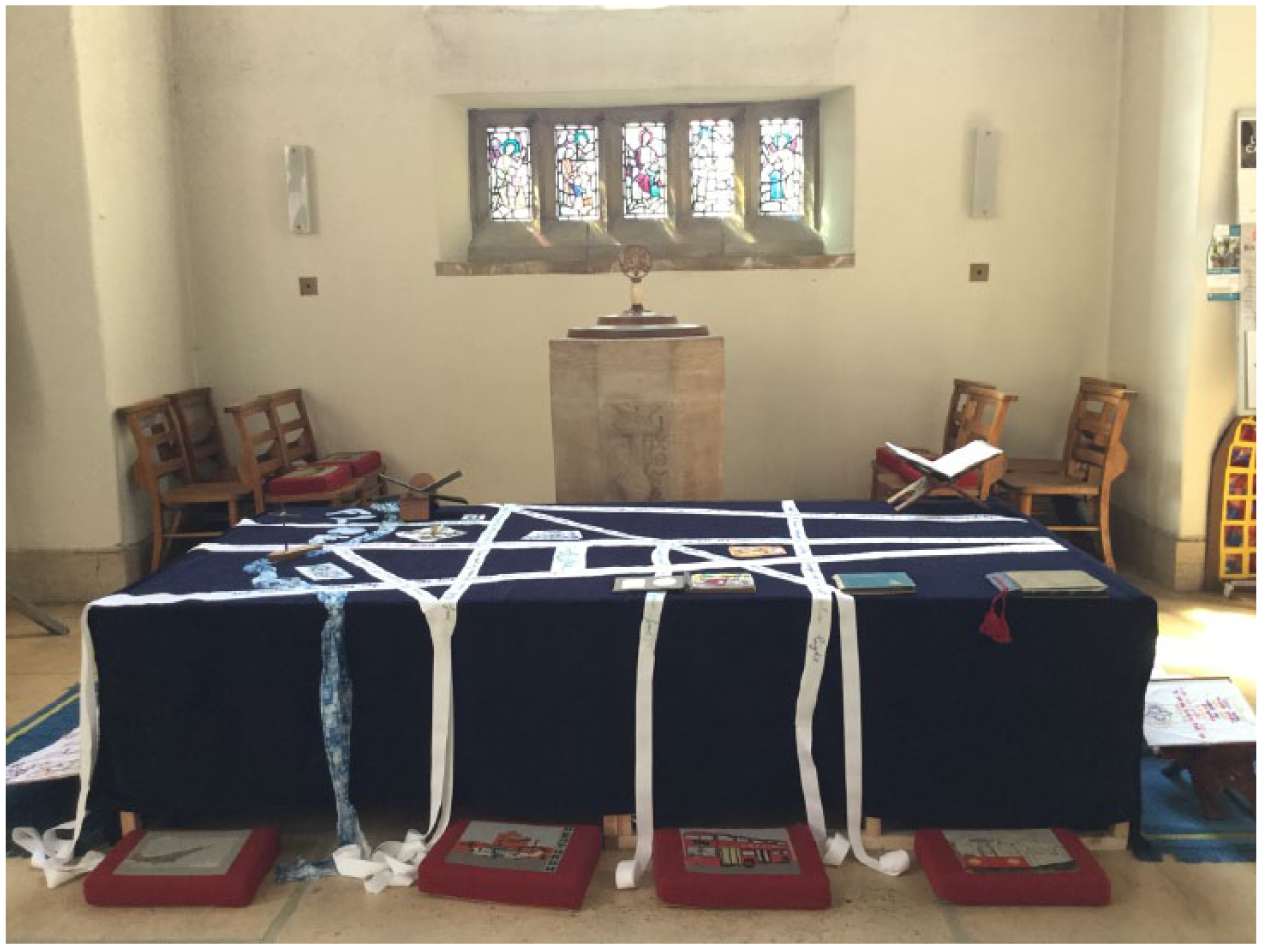
Installation at St Thomas the Apostle Church.
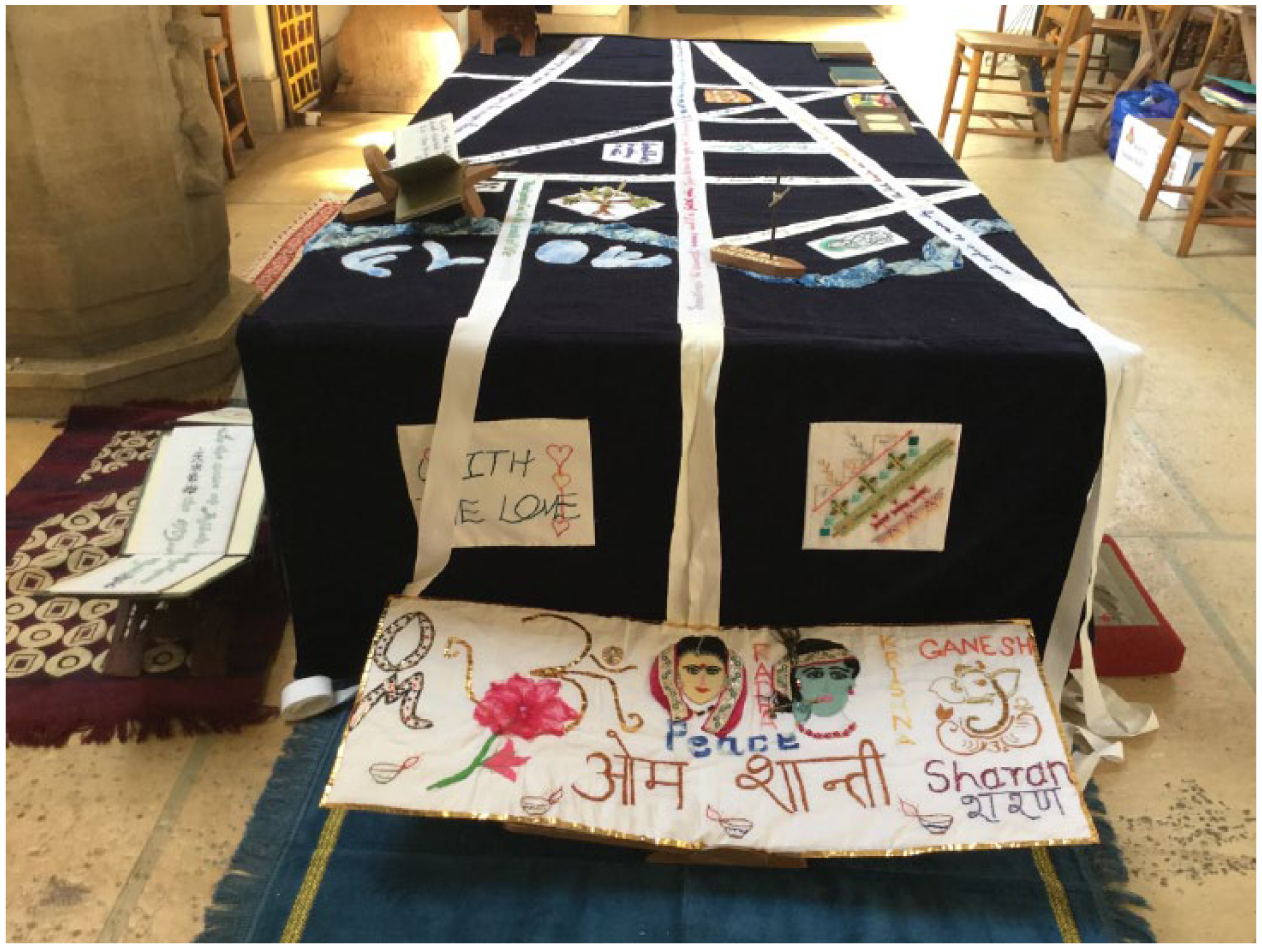
Embroidery installation detail.
Responding to the aesthetics of the art works with which we had started the project, Katy drew on her earlier project Pattern Language (2012) suggesting that a textile map both ‘reveals and hides. As the threads are knotted and stitched, stories are told. The knot or stitch acts as a maker and holder of memory, but what appears is only a part of the story’. After the first exhibit of the installation, Katy developed this idea of absences and untold stories further with a second embroidered layer which she added to the map. This embroidery traced the outlines of the work brought by participants to the first workshop to create a ‘constellation’ of past works, evoking words from W.B. Yeats’ ‘had I the heavens embroidered cloths’, a line chosen to be embroidered onto the map by a participant. This new embroidery layer referenced a recurrent theme in the workshops about the gaps and absences in peoples’ lives as they had migrated, and lost or left behind both their homes, and physical objects made in the past. The imagined absences of past work brought to mind other absences (Figure 5).

Embroidery detail.
Alongside the exhibition, we provided boards detailing the workshops and the wider academic project as well as also providing some quotes from the respondents about their experience and involvement in the project. We also reproduced short quotes from each participant with her reflection on what she chose as her contribution to the project.
Conclusion: embroidering geographies of faith and place
My Life is but a weaving can be reflected on as both an arts installation and as a process of co-created creative research. As an arts installation, it presented challenges to Katy since its outcome was not always fixed, as new pieces were decided and completed over time. The need to exhibit the installation in different public venues also shaped its dimensions and possibilities. As an arts installation My life is but a weaving was really successful; audiences at each venue found inspiration in both the artistry of the creative work and in the narrative of the project about bringing different faith communities together. For many visitors to the artwork, particularly when it was in the church, it had a spiritual quality and at times almost became a devotional object as prayers were added. The installation also resonated more widely as visitors connected with their own narratives of learning to sew. As a series of creative workshops, the project demonstrated the efficacy of a creative research method which used a process of shared making to reflect on the meaning of making for the participants. 8 Bodily recollection of sewing together offered a stimulus to think and reflect on sewing biographies which connected to narratives of home and migration, while the emphasis on producing a shared object from different faith groups allowed reflection on what were the most important elements of devotional practice to share with others. The final created piece uses embroidery to produce an aesthetic piece which moves beyond the individual pieces capturing the processes of connection, stories told, intersecting biographies, memories shared in the workshops and anchoring them together in place through a multi-layered installation (Figure 6). Visitors are given a context for the story of the installation but remain free to respond to its messages. For the participants, it has been rewarding to have been able to continue to share new versions of the installation in different venues, with their continued participation in sharing their work with visitors. A professionally produced photographic record of the work was also produced for each participant.
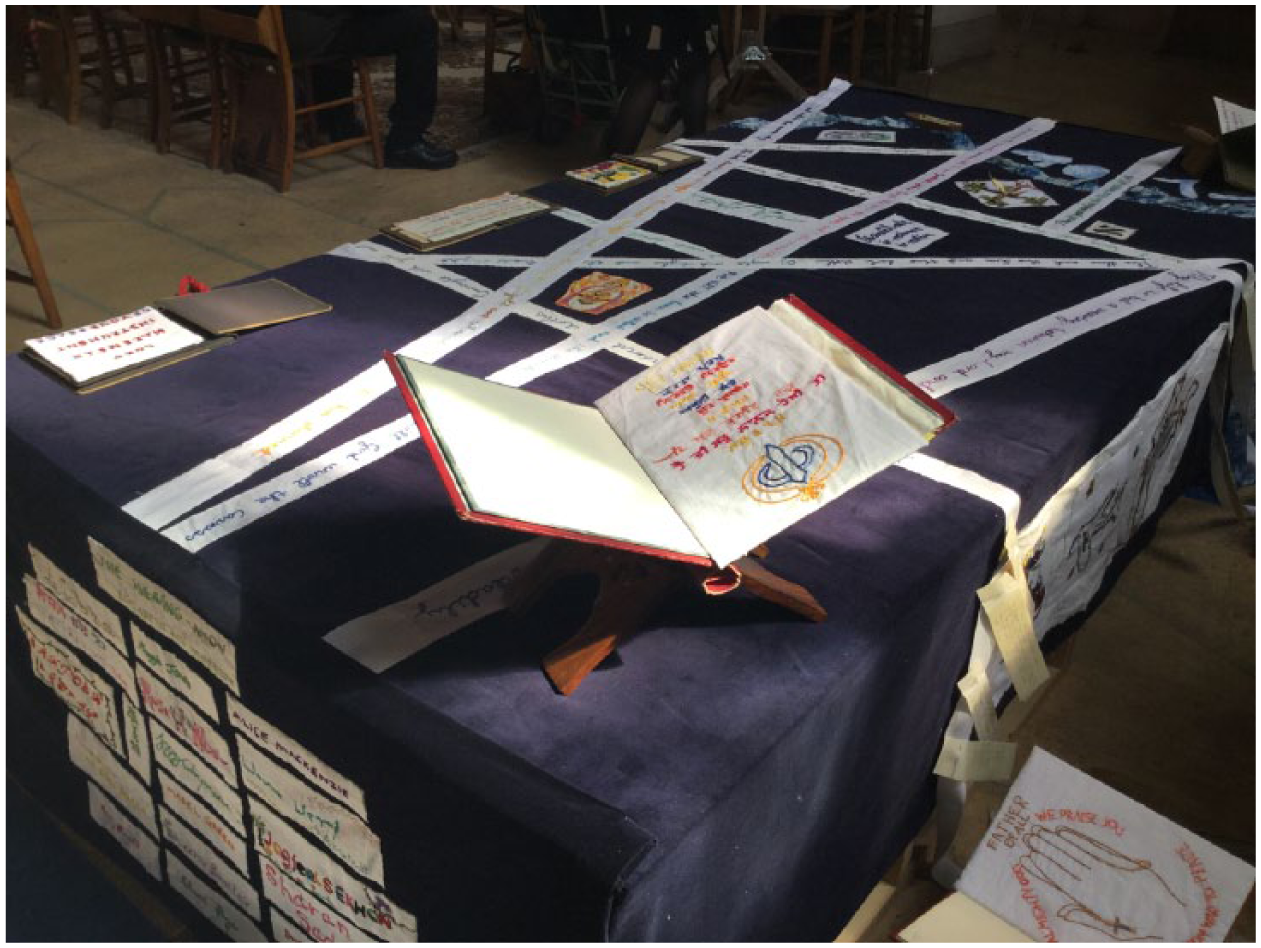
Installation detail.
Footnotes
Author’s Note
Katy Beinart is also affiliated to the University of Brighton.
Funding
The author(s) disclosed receipt of the following financial support for the research, authorship, and/or publication of this article: The project was funded by the Arts and Humanities Research Council as part of the research project: ‘Design, material culture and popular creativity in suburban faith communities’ (grant reference: AH/M001636/1).
Notes
Author biographies
 ).
).