




Abstract
On a bleak winter’s Saturday evening, I find myself along with many others in the middle of a suburban park located in a small town in North Somerset, singing, shouting and toasting to an apple tree, otherwise known as ‘wassailing’. The practice of wassailing the orchards has become increasingly popular since the early 2000s with the custom being performed in community orchards, city farms and public gardens across the United Kingdom and beyond every January. Yet, this tradition which emerges in rural villages to protect the valuable crop of the fruit-producing regions is now practised in built-up areas, often with little or no history of fruit farming. Through in-depth interviews with organisers of local wassails, this research explores how the historic customs of orchard wassailing have been translated into contemporary set of practices that responds to the needs of the organisers and the interests and attitudes of the participating audiences. Events in this research critically engaged with and drew upon historic traditions of wassailing, modifying certain elements due to contemporary regulations or attitudes towards gender and identity. I argue that despite this critical reflection, the notion of ‘tradition’ was mobilised to authenticate and reassert the local identity of the event, even in cases where the wassail was recently ‘reinvented’. The article contributes to the theoretical discussion of ‘tradition’ as a symbolically static reassertion of identity while simultaneously fluid and responsive to the social values of the time. Empirically, the article responds to a lack of coverage in academic literature of this custom, contributing an account of how the wassailing ‘tradition’ is reinvented for a contemporary audience.
On a bleak winter’s Saturday evening, I find myself, along with others, in the middle of a suburban park located in a small town in North Somerset, singing and toasting to an apple tree. The tree is decorated rather fantastically with fairy lights and is at the centre of attention of our merry band of adults, children, a ‘Butler’ and a ‘Green Man’. A short time later, after several enthusiastic shouts of ‘waes hail’ that are returned by an equally impassioned ‘drink hail’, we bang pots and pans together to protect it from malevolent spirits who may threaten its bloom. Next to our rowdy bunch, there is a house on the end of a residential estate, the occupants of which, I can only imagine, are struggling to watch Saturday night television through the cacophony of our merriment.
To go apple or orchard wassailing or to ‘waes hael!’ is to toast good health to an orchard or a tree, usually apple producing varieties, awakening them for the season ahead sometimes with offerings of cider and warding off malevolent forces that would bring them harm. 1 Apple-producing regions such as Somerset, Sussex (known as ‘howling’) and Gloucestershire have a long history of wassailing, if patchy and discontinuous in places, and many of these ceremonies have either been maintained over the centuries or are returning to the calendar. Coming just before ‘Plough Monday’ and near the Twelfth Day, wassails signalled the beginning of the agricultural year and the need to take care of the trees that were so vital for the livelihoods of the local villages and farms. The exact customs vary between counties, towns and villages but some key features involve the songs, pouring of cider on the roots of the apple tree, bowing to the tree, placing of toast or cake on its branches and, of course, the consumption of mulled cider!
While the custom declined during the 20th century, there has been a significant increase in such events during the early 21st century. 2 This article addresses a lack of research into apple wassailing practices (rather than a related version whereby villagers sing carols on the doorsteps of the middle class and landowners for rewards of food, drink or money 3 ) and investigates the new wave of events that occur every winter across the United Kingdom and occasionally beyond. Drawing on in-depth interviews with organisers, as well as participant observation of wassails in the south of England, the study, first, explores the events as they occur in five wassails across southern England and, second, seeks to understand how these events are researched by the organisers, and the modifications made to wassailing traditions ensure relevance to their message and adaptations for a contemporary audience.
The reinvented, or as Cater and Cater suggest, ‘re-awakened’, wassailing events also differ from the previous iterations in context, style and motivation. 4 Wassailing events are not only held in rural areas known for apple farming but also in urban and suburban locations such as community orchards, schools, hospitals or civic centres. Yet the notion of ‘tradition’ is still present and works to authenticate and localise the custom. The following section will first seek an understanding of what ‘tradition’ is and how it is mobilised before reviewing the current state of research into contemporary wassailing followed by a discussion of the methods and findings of this project. The article will argue and demonstrate through the empirical and secondary material that wassailing, as an example of a re-discovered folk practice, provides an illustration of how ‘tradition’ is reinvented through drawing on a range of different historical resources that must be negotiated and modified for a contemporary context, including social attitudes – significantly, how tradition can become established even in situations such as contemporary wassailing events where there is little local heritage of the custom.
Tradition
The notion and study of ‘tradition’ is considered the raison d’etre in the study of folklore and folk practices; 5 however, it has been operationalised in different disciplines with the aim of understanding tourism and the construction of local and national identities. For example, social groups rely upon the continuation of folk traditions to construct identities and promote or transmit values and beliefs; 6 to aid social cohesion; 7 to preserve community or collective identities 8 and to legitimise current cultural or political discourses and institutions. 9 In its common-sense usage, ‘tradition’ implies a sense of fixity and authority and, in contrast to the term ‘custom’, a notion that it (recurrent ceremonies, rituals and practices) has been transmitted from one generation to another; 10 Shils argues that there is an underlying essence and set of values with tradition that, while allowing for some modifications, remain unchanged during transmission from one generation to the next. 11 However, modernity questions the accepted authority of ‘tradition’; reflexivity inherent within modernity means the individual no longer unquestioningly accepts tradition on the basis of it being simply tradition alone. 12 Shils criticises this late 20th-century rejection or neglect of cultural ‘traditions’ by western youth culture, arguing that the post-war generations had been misled by the consumerism and let down by the parents, teachers and other authorities. 13 Consequently, he warns, young people are being led into disillusioned, purposeless and fleeting pleasures, denied the accumulative satisfaction of membership of community and collective experience. While Shils may be unduly pessimistic and negligent of the formation of new sources of tradition or collective experience, he does highlight a social need for collective meaning that traditions or perceived traditions can afford. In addition, he asserts that a custom or ritual becomes a tradition when it has been passed down through three generations in an essentially unchanged format. This rather exclusivist approach to tradition has been challenged by more recent literature, for example, Hugosen’s work on the emergence of an Easter Tree custom in Sweden, that, while has only emerged in the early 2000s, is discursively framed as a ‘tradition’ by many of its participants. 14
More recent commentators have suggested that it is not the materiality or performance of customs that are essential to tradition but the symbolism of continuity that is sought.
15
For example, Hobsbawm argues symbols and imagery of previous, idealised iterations of regional or national ‘golden ages’ can help establish legitimacy even within ‘invented traditions’: … which seek to inculcate certain values and norms of behaviour by repetition, which automatically implies continuity with the past. In fact, where possible, they normally attempt to establish continuity with a suitable historic past.
16
The (re-)presentation of tradition in the form of ritual, dance or other performances can never fully replicate previous iterations, and so, each new version re-invents tradition to some extent. 17 Glassie adds here ‘that tradition is the creation of the future out of the past’ as societies seek to assemble history from the resources of the past, excluding that which is not conducive to their ideology. 18 In this view, tradition is recognised as being constructed for specific purposes of reinforcing and authenticating cultural values by illustrating their presence in the history or mythology of a social group. On this note, Noyes summarises scholarly discussion of tradition into three models. Tradition as (a) communicative transactions; (b) temporal ideology and (c) communal property. 19 As communicative transactions, folklorists are interested in how certain traditions travel and are modified by local contexts. Like Hobsbawm and Ranger’s notion of invented traditions, temporal ideological models of tradition perpetuate social and political values, sometimes ‘purified’ and ‘restored’ by nationalist movements to restore society to a mythical ‘golden age’. The third model, communal property, recognises the institutionalisation, commercialisation and packaging of ‘tradition’ for deterritorializing ideas or practices, yoga being a prime example in a globalised world. Wassailing is presented as ‘traditional’ ceremony, yet many of the contemporary events are relatively recent. Such events present an opportunity to explore the reinvention of tradition in a contemporary setting and how it is negotiates contemporary challenges using the framework established by Noyes. It is to the resurgence of wassailing that is now addressed.
Reawakening
Apple wassailing customs can be traced to a Saxon drinking toast ‘waes hail’ with sporadic accounts of ceremonies and practices taking place through the centuries 20 until various reports from newspapers and the Folklore journal among other publications provide a more thorough set of observations in the 20th century. 21 As part of the 20th century ‘Folk Revival’, observers began to document rural life, detailing what they considered were rituals, customs and traditions that had somehow survived mass urbanisation and industrialisation of the 19th century. Later scholars such as Boyes challenge the motivations and ‘authenticity’ of the participants and argue that the Folklorists work codifying diverse and localised sets of folk practices into imagined national ‘traditions’ for a middle and upper class audience. 22 By the early 20th century, a loose set of customs had emerged that defined many wassail ceremonies. The newspaper and folklorist reports centred on village-based wassails predominantly in Somerset, describing not only the events that took place in relation to their similarities but also the local and regional differences to the customs. As an activity which is extremely localised to specific villages or towns with limited, informal advertising, the number of wassailing events that occur on a year to year basis is difficult to ascertain. Promotion for these events can often be focussed on social media accounts such as Facebook or Twitter or posters near where the event is taking place, reflecting the local focus of globalised technologies. 23 Despite these issues regarding the register of wassails, there is considerable witness to the ‘resurgence’ or, as Cater and Cater term, ‘re-awakening’ of these events across the United Kingdom. 24 Cater and Cater’s Internet survey finds more than 170 different events reported in 2012. While the informal and localised nature of events means there is little data regarding the number of events during the previous peaks of wassailing, the number and geographic spread of these events to regions little known for apple growing suggest that the custom is at least in very rude health. A resurgence has also been reflected in media coverage of the custom as reports in The Independent 25 and The Telegraph 26 illustrate. In a 2009 interview with The Telegraph, Kevin Nicholls states that before his arrival as the landlord of the Butcher’s Arms in Carhampton, Somerset, the wassail was dying before he renewed the custom. Furthermore, his concern was that in an age of mobility, the annual custom creates some stability: ‘It’s good for the village, especially in changing times when so many people move into an area and don’t know its traditions’. 27 The ceremony and ‘tradition’ in Carhampton thus provides an opportunity for newcomers to integrate and reinforce the identity of the village.
Reasons for the reawakening of wassailing customs are manifold: from the ‘Folk Revival’ of songs and dances to the rise of community orchard groups to increased consumption of ciders; however, a common theme underlying these suggestions is that of resurgent local identity. Industrialisation in the 18th and 19th centuries led to a shift of scale of popular consciousness as the rural working class began to move into the rapidly growing towns and cities of the United Kingdom. The accompanying fragmentation of the community led to the decline in wassailing and other folk performances, as seasonal celebrations were relegated to the private spaces of the home and the local disappeared from the public sphere to be replaced by national and later global celebrations, corporations and products. 28 Concerned for the loss of these traditions and identities, Folk Revivalists such as Cecil Sharp and Ralph Vaughn Williams began to document and reinstate folk songs and dance with a desire to preserve a ‘purer’, pre-industrial and spiritually superior rural culture. 29 Later, during the early and middle parts of the 20th century, folk songs and dances such as Maypole and Morris were employed as symbol of English identity at a time in which the nation’s pre-eminence was diminishing politically, militarily and industrially. 30
Around the same time, food and the spaces in which it was produced and consumed were divorced 31 resulting in a dislocation and eventual erosion of agricultural land-use, including orchards. As cheaper fruits, including apples but additionally pears, plums and cherries, were produced abroad and imported to the United Kingdom, the need for orchard space reduced with 90 per cent of orchards in England and Wales disappearing since 1950. 32 In recent decades, movements such as Common Ground, The Orchard Project and others have rejuvenated and established all new orchards to stimulate civic participation and provide community spaces. 33 In addition, changes in public attitudes towards food and drink production in the United Kingdom is also likely to have contributed to an interest in festivals surrounding fruit. Apple production in the United Kingdom has also soared on an industrial level with the rise in demand for ‘premium cider’ nearing £1 billion per year. 34 To promote their distinctiveness, premium cider brands emphasise their traditional and ‘authentic’ heritage, mobilising the rustic imagery and regional and national origins. 35 ‘Authenticity’ is positioned in opposition to ‘inauthenticity’ of modernity, industrialisation and urbanisation that mass produce (commercial and cultural) goods and communities without a sense of roots or memory in contrast with the originality and authority of the local, firsthand creation of objects, foods or cultural goods; 36 authenticity is unchanging and stable in this discourse. 37 Many commercial cider producers alongside Community Orchards and other voluntary groups have drawn on the folk authenticity of wassails to promote themselves.
A surprising feature of the reawakening of wassails across the United Kingdom is that many of these events take place in regions or areas which have little or no history of wassailing. Historical accounts of wassailing situate these customs in rural contexts closely related to local agricultural economies, yet many of the contemporary wassails are urban or suburban in land use, such as the wassail referred to in the opening section of this article that takes place in a largely residential area in North Somerset. While this part of North Somerset has a heritage of cider production, the wassail referred to is not connected to any preceding wassail, being performed for the first time in 2011. The research presented here, therefore, explores how the ‘tradition’ of wassailing is being reinvented in this and other wassail events along with the modifications that are being made by organisers to ensure their relevance to contemporary times.
Methods
Data for this research were generated through in-depth and semi-structured interviews with organisers of wassail events that occurred in 2017. As the research was interested in wassails as an urban phenomenon, wassail events were selected from areas that were either urban or suburban in character. Five wassails in Bristol and Bath in the South-West, and Milton Keynes in the South Midlands, of England were selected as key areas due to their urban/suburban characteristics. In addition, the research focussed on relatively new wassails that had either no prior historical precedent or a heritage of a previous wassail. The wassails featured here have all emerged since the late 1990s and, therefore, required organisers to perform some initial research in wassailing customs in order to develop their events.
The timing of the research in June and July 2017 did not allow for participant-observation at the events (although the author has participated in some of the events prior to research), although photographic and written material was accessed via event websites, social media pages and material provided during the interviews. Interviews with the organisers ranged in length from 40 minutes to nearly 80 minutes, the shortest of which was due to the participant being a peripheral member of the organising committee for his group’s event.
Wassails in cities and towns are often organised by non-commercial or local volunteer groups, which in this research included two community orchard groups, one city farm, one community arts centre and a branch of the Transition Town Network (TTN) listed in Table 1 along with attendance estimates. The sample therefore combined a diversity in aims and objectives with a depth in terms of the motivation: to connect local urbanised communities with environmental and local food production concerns with heritage-based cultural events.
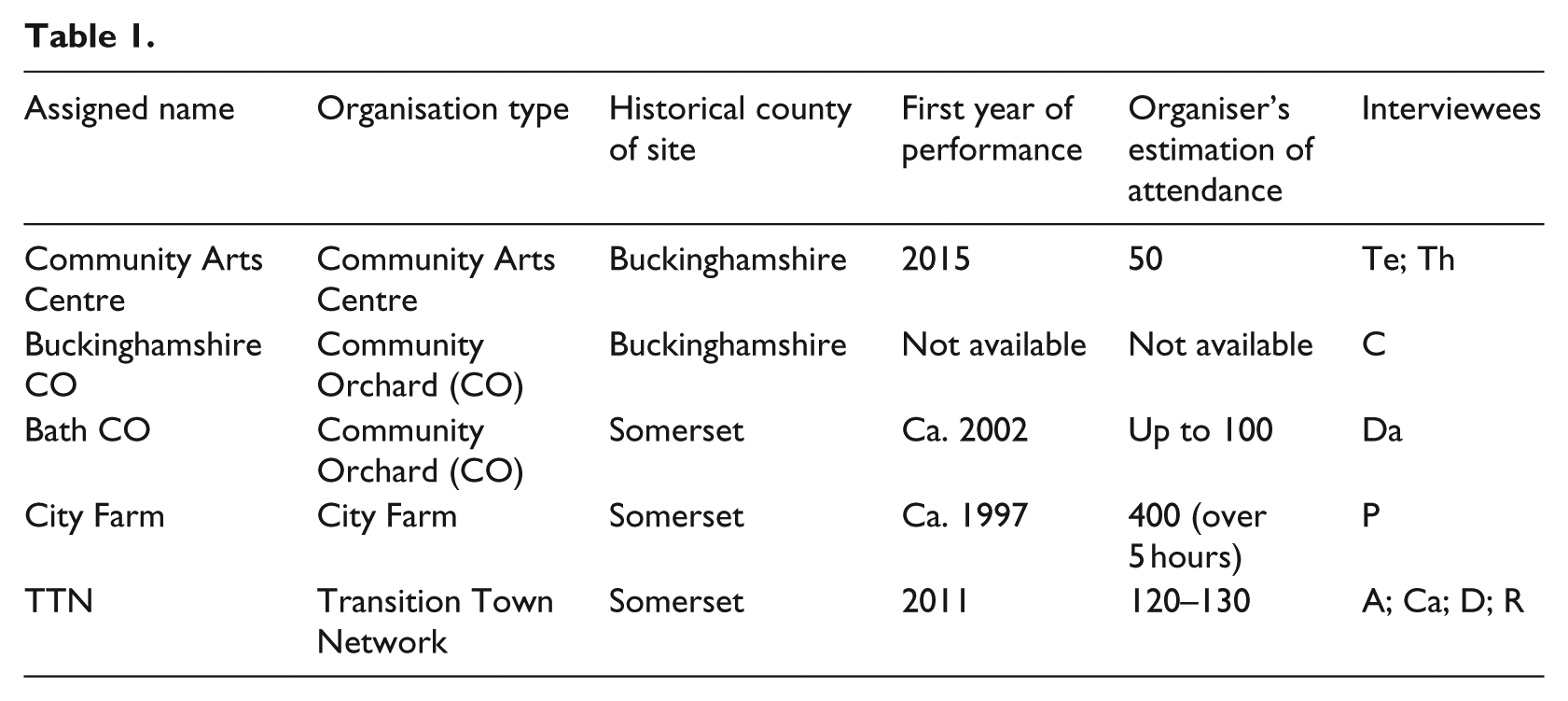
Audio recordings of the interviews were transcribed, and these were then thematically coded using NVivo qualitative data analysis software. While participants were consented to being named in this research, to provide some degree of privacy, initials have been assigned and their organisations names converted into more generic names as detailed in Table 1.
Contemporary wassailing
This section first outlines the presentation of the wassail events researched here, relating their formats to historical accounts of other wassail events mostly from the Somerset region. The following sections will delve more deeply into the interviews with the organisers to reveal the background to their wassails: how these events are (re-)constructed from traditional iterations with adaptations and modifications for contemporary audiences. The five wassails featured in this research utilised the custom as part of a wider programme of events, often designed to raise the profile of their organisation or mission in the local area.
Historical and contemporary wassailing ceremonies
Apple wassailing encompasses a variety of different practices, often dependent on local variation or circumstances – indeed, the ceremony itself has many different iterations and names according to the specific geographic region of the United Kingdom. However, there are a core set of different elements to the wassailing ritual of which events will incorporate a selection. First, the orchard tree or trees are usually prepared for the wassail beforehand. This can include the decoration of the tree or trees with items such as fairy lights but traditionally will include toasted bread or cake that is hung on the trees. 38 Toast or cake, sometimes soaked in cider, is supposedly used to attract robins to the orchard, not only signalling the return of visible biological life to the trees but may also contain since-forgotten symbols of fertility. 39 The hanging of toast and cake may be sometimes incorporated into the wassailing ceremony, may be part of other activities (often for children) that occur before the ceremony and extend the event into the preceding day or may otherwise just be part of the organiser’s preparation before the event.
Wassailers will often congregate before the ceremony away from the orchard or trees to be awakened – sometimes at a nearby public house or community centre – and once gathered together will proceed to designated site. 40 Wassailing songs may be sung and led by a designated group – often a choir or local Morris dancing side. The wassails featured in this research generally had a congregation point, separated from the site where the wassail would take place, from which the wassailers would begin to walk. At the TTN wassail, the meeting point was at a local pub where a local community choir would sing wassailing songs, and the master of ceremonies, ‘The Butler’ alongside his companion the ‘Green Man’, would announce the proceedings and set the rules, from where attendees would walk approximately 300 m to the site. Elsewhere, the orchard may be separated by just a short distance from the meeting point. Thurgill asserts the significance of this mobility of walking to the location of the ceremony to the ritual itself as the time lapse between meeting and performing helps generate the atmosphere in which the ceremony takes place. 41
Once assembled in the designated space, it is common that a ‘King Tree’ is established. In some cases, the King Tree maybe the largest, the oldest or most productive in the orchard;
42
it may be the tree that has enough space for wassailers to gather around or simply be the only apple tree in the area. C from Buckinghamshire CO elaborates on their selection method: And there was a tree which we chose as the king of the orchard in that particular year; you normally choose the most senior tree or the biggest tree, or the tree with the biggest girth, the sort of most worthy tree, as the king of the orchard and it’s that tree which stands in for all the other trees in the orchard. So, we actually perform the ceremony really around that particular tree. That’s the traditional way to do it.
As with Hugosen’s Easter Tree example, C discursively frames the selection process as ‘tradition’ here to link this with a historical continuity – an imagined continuity with the past that affords legitimacy to the practice, given the recentness of Buckinghamshire CO’s wassail ceremony.
Songs will continue to be sung and at some point, the formal toast to the tree ‘waes-hail!’ will be made. Libations of the cider, apple juice or ‘lambs wool’, 43 preferably including the fruit of the previous year’s produce, will be poured on to the roots of the tree. This part of the ceremony encourages wassailers to pour part of their drink on the roots as libation and to take a sip of their drink together. The drink is often taken in individual cups or glasses although many historical accounts suggest that wassailers should take a sip from the wassail cup – a specially commissioned vessel, usually carved from wood and intricately decorated. Cider, sometimes mulled or warmed, is the beverage of choice for many, however, in some localities, ‘lambs wool’ – heady warm mix of ale, cream, eggs, roasted apples, sugar and spices is consumed. 44 Mulled cider was still a key part of the wassails featured in this research but, as will be discussed later, the presence of families and children also meant that hot apple juice was offered alongside alcoholic refreshment. Two out of the five groups in this research had a specially commissioned wassail cup – both carved in wood – although only one of these groups shared the drink using the cup. As with C’s reference to ‘tradition’ in the earlier quote, sharing drinks acts as a temporal ideology 45 whereby the community (however fleeting in this case) reinforces shared values and identity through established custom. After the songs, the toast and the tributes are made; one final and important custom is performed to ensure the trees are awoken and to scare away the demons or malevolent spirits which may attack the trees: the firing of rifles into the air or more recent iterations that involve shouting and banging pots and pans together – basically, just making a noise!
Researching ‘traditions’ for new wassails
Given that the oldest wassail discussed here was only in its 20th year, the ‘tradition’ or customs detailed have been discovered or invented by the organisers, based on their knowledge of historic wassails.
46
The most recent of the wassails here was organised by the community centre and had been going for just 3 years. The organisers, Th and Te, had, alongside Cater and Cater’s 2013 book Wassailing: Reawakening an Ancient Folk Custom, used a mixture of previously acquired knowledge of wassails and folklore: I already knew some wassail songs that I’d come across when being involved in folk quads and things, and I had a couple, as I said, wassail stories and apple-based stories, and I had been to a few wassails down in Hampshire and Somerset, so I knew the general principle. I was like, ‘Well, you need an MC. You need people to bring along pots and pans and make lots of noise to chase away the evil spirits from the apple trees and the whole, kind of, giving some back to the trees’. (Te, Community Arts Centre)
Th and Te’s event took place on the outskirts of Milton Keynes in Buckinghamshire with a less visible history of wassail, and so, Te here is looking to prior experiences that have taken place in Hampshire and Somerset which have richer history of wassail. The TTN group, based in Somerset, was also a relatively young wassail, having been going for about 6 years, and the researcher had utilised the Internet and books as well as contacts in cider local companies to develop their tradition. While the City Farm wassail had been going for around 20 years and the current organiser has inherited many of the customs from his predecessor, he also searched the Internet to gather new ideas: I know that probably when we have been planning our event we have probably done a search of what other people do around the country, and just taken the bits that work best for the farm. […] certainly when it comes to the wassail song that we sing around the tree, we usually end up googling Christian wassail songs and just picking the one that works best for us. (P, City Farm)
Later, P expanded on not only the selection process but also factors to consider including ensuring that the audience can participate as there can be a lack of familiarity among contemporary audiences with the traditional wassailing cannon of songs. 47 Elsewhere, P notes that the City Farm’s solution is to sing the songs to the melody of the socialist anthem ‘The Red Flag’.
So, that is a good example where we perhaps kind of bend tradition to suit our purposes as it were, so yeah we are kind of inventing a, or our new tradition is going down a certain route of always doing it to that tune, because organisationally it is a good idea to do it that way.
The interviewees express a need to maintain the local sense and heritage of their wassails – for instance, in the above quote, the City Farm reveals an egalitarian persuasion evident in its wider work and mission. For two of the wassails in particular, there was great significance placed upon reflecting local character within the event. The Community Arts Centre felt some pressure to ensure locality was included as the community had a strong folk scene including a well-established folk music club, Morris dancing side and Mummers group. However, wassail organisers also utilised materials and elements from across the country – assembling nationally available resources in new local configurations, responding to the needs of the community. P from the City Farm wassail below acknowledges the modifications of their ceremony, untroubled about diluting the ‘purity’ or ‘authenticity’ of the custom: I know that probably when we have been planning our event we have probably done a search of what other people do around the country, and just taken the bits that work best for the farm. […] And, like with tradition over time, it becomes the things that people enjoy most and work in our particular setting, and the things we end up kind of continuing with I guess, and I guess that is kind of evolution of tradition in action I suppose, that kind of thing. (P, City Farm)
Instead of a vertical transmission of knowledge whereby one generation is passing on the rites of the wassail down to the next generation, contemporary wassails are more likely to feature a horizontal transmission where this knowledge is spread from one geographical location to another as ideas are shared and modified for each site. Migration, rather than generational transmission, of ‘tradition’ was evidenced here and resonates with Noyes’ model of tradition as ‘communicative transaction’ 48 as ideas were borrowed and adapted to local contexts. The very heterogeneity of ideas inherent within the custom, Kennedy asserts, makes it difficult to explore the linear development of wassailing to be found. 49 Indeed, as well as receiving new ideas from other wassails, the TTN wassail also lent a hand in helping other nearby wassails to take place when they were invited by a neighbouring TTN group to advise them in creating a wassail. Of course, in researching and performing the wassail, new iterations, adaptations and modifications are made to the found tradition, detailed in the next section.
Modifying tradition
Effort is made to shape the events towards the interests and requirements of stakeholders including those who attend as visitors. Generally, some of the perceived darker or scarier elements such as ‘evil spirits’ of the wassail event are diluted. Some wassailing ceremonies were once upon a time riskier as an uncredited account of the Carhampton, Somerset, ceremony published in a 1931 volume of Folklore reports: When all the preparations were complete the chief wassailer sang the incantation to exorcise the powers of evil, and afterwards men fired their guns and the villagers cheered loudly, making noise and hubbub enough to scare every’ evil spirit’ within hearing.
50
Contemporary wassails seek to water down the discussion about the demons or evil spirits that might seek to cause malevolence in the orchard as C from Buckinghamshire CO states, […] because our audience is very much a family audience and, like, influencing young children, I suppose, we’ve toned down the concept of the evil spirits.
Evil spirits were displaced from the ceremonies in favour of discourse around the ‘waking up’ of the trees and the seasonal cycle of fruit production. The ritual of scaring away evil spirits still remained. Historically, at least according to Somerset lore, this was accomplished by the firing of a rifle into the air. As Whistler points out, guns are a more recent innovation than wassailing, and so, their employment within wassailing was an innovation to the custom. 51 Firing shots into the air, of course, presents some administrative challenges in the terms of local health and safety regulations as well as anxiety caused to those taking part in the event such as at the TTN:
We don’t fire guns into the apple trees any more.
We’re not allowed to fire, because we’re on Council [land] … We’ve got an offer from the farmer, but … We had to say, ‘Thank you, but no thanks’.
While all the groups in the research had decided against using rifles for this element of the ceremony, this had not stopped a particularly enthusiastic participant at Bath CO:
And you mentioned as well [that] you use pots and pans; is that in place of the traditional gunfire that would happen?
Well, actually, yes, a few years ago, we did have someone who did bring along an old gun, which he fired, much to our horror!
[…]
We didn’t know he was going to do this, and he came along with this old firing piece, so yes, we didn’t invite him back the following year …
Contemporary wassails, including those in this research, favoured a safer method of banging pots and pans together in order to make a cacophonic din. Other groups had experimented party poppers and another with popping balloons one year but found that the cold weather caused the balloons to perish and burst prematurely. The symbolic performance of creating a startling loud sound remained, albeit translated from gunshot to pots and pans (with some assorted screaming and shouting). A further modification made to safeguard the health of participants was in the use of a ‘wassail cup’: the traditional vessel in which the wassail drink is kept and shared among participants. Concerns were raised that the sharing of the wassail cup among strangers in the height of winter may lead to germs being spread, so while the mulled beverage might be ladled from a communal flask, the drinks were individually glassed.
As with most public events, health and safety and compliance to regulations was a key concern to organisers. The modification of using rifles and its contemporary translation to a safer and more participatory banging of pots and pans has already been discussed above. Accessibility of the site was also a consideration for many groups. Wassails occur in orchards or gardens and parks, which as spaces that cultivate nature can present issues such as unsteady or uneven ground and impede people with mobility difficulties. Organisers therefore had to ensure that branches, trees and ground-space were tidy without trip obstacles. This issue could be heightened, if, as on several wassails, a walk was involved either around or to the orchard from a different location. On wassails where a walk was involved to the orchard, road crossings needed to be monitored by the organisers. The TTN group relayed a story that one year snowfall had made the wassail, held in a nearby park, inaccessible:
So, just getting back to that year when it … so, it snowed too much, you couldn’t do the Wassail at the normal tree, so you did it at the pub instead?
Well, we just deemed it unsafe, because you cross a road, as you’re probably aware; so we decided, with children around and older people, that we just stay put, but it worked just as well, didn’t it?
It did, yeah. There were lots of people there, and there were even apples hung on this little tree covered in snow, so …
Yeah, very picturesque.
In this instance, the wassail occurred in an entirely different location to the orchard and apple trees illustrating that the wassail’s value was symbolic on how it could bring together people from the local community. Contemporary wassailing has been adapted to prevailing concerns regarding public health and safety, yet, as the discussion above reveals, still has the capacity to surprise from unexpected gunfire to picturesque scenery. In these cases, the organisers have demonstrated concern for inclusion of the whole community together from the families with younger children to individuals with mobility difficulties. The symbols and meaning of ‘tradition’ of wassailing are retained but with a modern concern for inclusion of participants from a wider geographical area; ‘tradition’ here is reconfigured to serve the requirements of the local environment. To investigate this aspect of inclusion further, the next section will explore contemporary attitudes to gender refracted through wassailing.
Gender in contemporary wassails
Another area of modification reflected recent social discussions around gender identity and roles, illustrating a shift from Boyes’ assertion that as folk customs became gentrified in the early 19th century, women were relegated to roles ‘servicing’ folk performances by providing the food, drink and costumes rather than being active participants.
52
A popular custom within wassailing was for a pre-adolescent (usually male) child to be crowned as wassail king or queen, usually then to be placed into the branches of the orchard trees.
53
Whistler’s description of the Twelfth Night tradition of mock crowning a Bean King and Pea Queen side by side with the depiction of early 20th-century wassailing
54
illustrates the syncretism between the two customs. Three of the wassails here had some form of this tradition: the City Farm let their storyteller announce the wassail king or queen: I know some places crown a wassail king and/or queen, so it kind of suited us with the children […] So, we kind of do that, so I guess that is a good example of where that kind of thing probably would have happened in the past, so where we have kind of appropriated that and made it into what we need. (P)
Election of the King and Queen in traditional iterations was decided by baking a cake with a bean and a pea (or alternatively coins), with the child who found them being crowned. If the gender of the child and found object did not match, then the finder would also choose an attendee of the opposite gender to be crowned. 55 The Buckinghamshire CO responded to some previous gendered iterations of this practice (whereby only a ‘king’ had been nominated), and so had made a determined effort to announce both a ‘king’ and ‘queen’. The Community Arts Centre also included both a king and queen selected by drawing lots for both ‘Bean King’ and ‘Pea Queen’ roles. The child who drew the lot could then select to be the role or nominate another, allowing the opportunity for boys to play the role of queen and girls to play the role of kings. An effort then was made to defuse gender-determined roles, reflecting recent social and political debates in the United Kingdom around the gender identities of both adults and children. Buckinghamshire CO also went further in wassailing both a ‘king tree’ and a ‘queen tree’:
This year, we actually had a king and queen trees because we were trying to be more inclusive, which seemed to be jolly reasonable [laughter] so we decorated both of them. We decorate our trees as well. We don’t just-
What prompted the inclusivity?
What prompted that … ? Well, I think it’s just the right thing to do really. Traditions are great, but they’re also rooted in the belief system at the time and the belief system of time also includes the exclusions of the time.
Yeah.
And we wanted to reinterpret that and make it, kind of, make it right really and also demonstrate through introduction of habit to, especially the younger people who came along, that actually inclusive and fair for everybody is actually the right thing to do and the way ahead.
There is a confrontation with tradition in this passage; a ‘tradition’ which has reflected and perpetuated what Noyes terms a ‘temporal ideology’
56
is challenged. As noted by Giddens, modern societies question preexisting relations and rituals, not simply accepting ‘tradition’ for tradition’s sake alone.
57
Above C demonstrates, along with the Community Arts Centre, this critical relationship with tradition, appropriating certain elements where appropriate but modifying others when they are antithetical to contemporary social attitudes. As suggested by Boyes regarding folk performances, historical accounts of wassailing illustrate the gendering of the custom and of orchards. Wassailing was typically considered to be performed by the men of the village, renewing the socio-economic relationships between the farmers/landowners and their labourers.
58
In Palmer and Patten’s account of the Crowcombe wassail, the women are relegated to a domestic role: Then all [the wassailers] ran back to the farmhouse where the women, who had been left behind, had locked the doors. The women tried to keep the men out and when they finally got in they would sit and drink more cider.
59
Whistler does refer to the presence of both men and women during wassailing events, but it is the men who have the lead role, particularly when firing gunshot into the trees. 60 The wassails in this research varied in approach to gender positions: some relied heavily on male leadership of the event with masculine characters (the Butler and the laddish drinking behaviour of the sneaky Green Man) while others included women in central roles of storytelling or MCs. Through these attempts to address the gendered dimensions of wassailing folk practices from the increased prominence of women in the leadership of the events or the inclusive categorisations of King and Queen trees, there is an attempt to modify the tradition of the naming a king tree, removing the assumptions of gender and including a feminine to the masculine.
Conclusion
Wassail organisers interviewed here, for the most part, used the custom as a way of drawing attention to their group’s causes through celebrating the turn of the seasons and imaginatively connecting to a historic tradition. However, the tradition that is being claimed does not always originally belong to the group. In no instance here did the wassail have a lineage of over 20 years and connected to a local tradition, even if, in some cases, a wassail had occurred nearby in the past. Rather than a vertical transmission of ritual knowledge common to traditions from one generation to the next, these wassails had required a great deal of research by their organisers, often using books and the Internet and attending other wassail events to find information about the ceremony, the songs and the meanings behind some of the symbolism, resonating with Noyes’ notion of ‘communicative transaction’ of tradition. Neither did any of these events occur in wholly rural locations historically associated with wassailing, often found in green spaces located in the suburbs where the town meets the countryside. Those who attended the ceremony, while likely to be local as with traditional wassails, are also more likely to live further away as the events occur in towns and cities rather than smaller rural villages. Hence, the social bonds and closeness of the community are further extended – reflected in the challenges facing organisers regarding audience knowledge and participation of songs, once known to budding wassailers as well as the need for conformity to health and safety regulations of public events.
Wassail organisers here had a creative approach to the customs performed, employing certain elements and modifying others as appropriate for the audience, local environment and community. Whereas the historical wassails recorded in the articles and books occurred in smaller villages with a limited number of locals in attendance, 61 contemporary urban wassails may feature between 50 and 100. The inclusion of so many attendees combined with the diversity of the city and the organisational need to demonstrate equality have led to critical engagement with the tradition, evidenced in the attitudes towards gender. The ‘tradition’ of wassailing is thus consciously mined and modified for a contemporary audience as part of Noyes’ ‘temporal ideology’ model. There is an acknowledgement of the malleability of the tradition as organisers are not concerned about maintaining an imagined ‘purity’ or ‘authenticity’ of their custom; instead, they employ a localised version of the wassail ceremony to communicate and reinforce the values of the group.
Footnotes
Author’s note
Edward Wigley is now affiliated to University of Reading, UK.
Funding
The author(s) received no financial support for the research, authorship, and/or publication of this article.