



Abstract
This article foregrounds the pilgrim, as a relational identity, to explore the co-emergence of self and world through embodied spatial practices. The pilgrim, as a liminal and mobile figure, is aligned with Maurice Merleau-Ponty’s phenomenological concept of the ‘flesh’, which presents subject and object as co-incipient. An auto-ethnographic study of the Croagh Patrick pilgrimage in the west of Ireland combines interview accounts from research participants and my own fieldwork experiences. This journey into the performative and liminal aspects of pilgrimages examines of how pilgrim and path emerge in an intermeshing of body and landscape, the spiritual and material and culture and praxis. In mobilising the figure of the pilgrim, this article contributes to disciplinary discussions concerning phenomenology/post-phenomenology, while highlighting the significance of pilgrimage as a purposeful performance.
Introduction
A pace emerging. Steps becoming aligned with the path, or by the path. Moving individually and collectively, the path stretches and compacts. We [are] responding to the terrain, and to each other. We have reached a rhythm . . . It feels peaceful – reflective. Purposes mixed with a common goal. Meaning? This is called a pilgrimage. Is it really one? Are we pilgrims? (Field notes summer 2013)
My thoughts while walking a pilgrimage path reflect my performing the route with others. We are following Tóchar Phádraig a 35-kilometre trail to Croagh Patrick, one of Ireland’s main pilgrimage sites (Figure 1). The carnalities and materialities of the path prompt considerations of our performance. In enacting a pilgrimage, are we aspiring to the status of pilgrim? Throughout the day, I considered our role as ‘pilgrims’. This article stems from these sentiments.
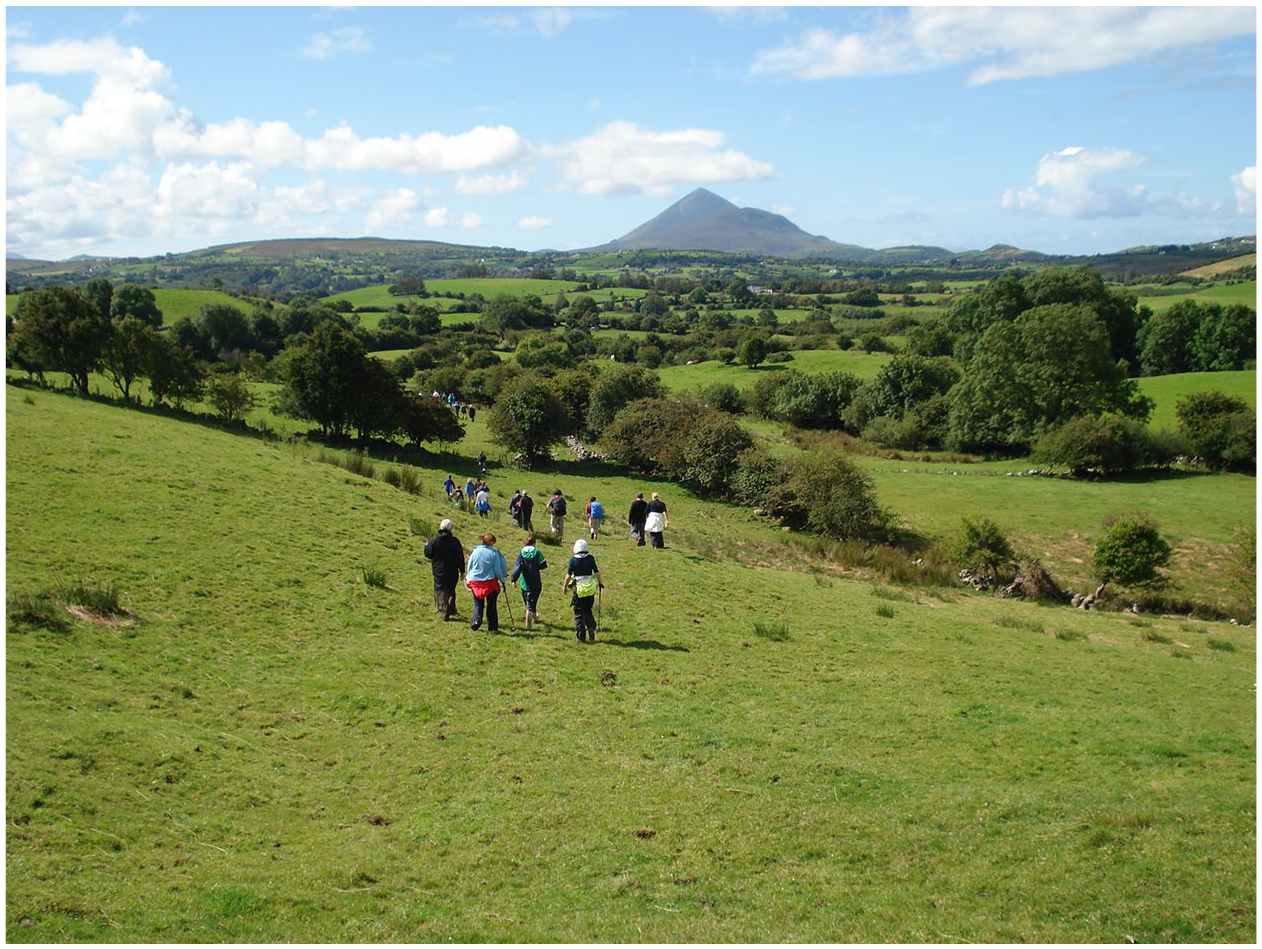
The pilgrim group walking towards Croagh Patrick along the medieval cross-country path Tóchar Phádraig.
The pilgrim, as a cultural/spiritual role and a lived experience, has gained considerable prominence recently. Historically this status was assigned to individuals and groups undertaking arduous religious journeys, while the figure is now seen as embodying ‘many aspects of contemporary mobility and identity’. 1 Spiritual and secular motivations coalesce in the pilgrim who journeys for traditional spiritual reasons, as well as social or personal intentions. 2 Symbolically, it offers a means of moving beyond normativity by ‘looking for an experience outside the margins of material interest and the simplistic pursuit of gain’. 3 Moreover, there has been a ‘marked resurgence [of pilgrimage] around the globe over the last few decades’. 4
Pilgrimage studies has also grown, as the subject has attracted attention from different disciplines. Research, emerging in the 1960s, was initially concerned with categorisation and the development of mega-theories. 5 Examinations across the social sciences illustrated the circulations of people, ideas and materials as well as the multitude of routes and nodes generated resulting in distinct forms of political economy. 6 Later, more specific frameworks examined communal and individual motivations and experiences appreciating the range of religious, spiritual and secular influences which animated these activities. 7 Significantly, the space of the ‘journey’ has become an important feature, with researchers following the routes and engaging with participants during the performance. 8 Both the wider ‘mobilities turn’ 9 and the more-than/non-representational focus in cultural geographies 10 have fuelled this trend providing conceptual and methodological tools to consider the embodied spatial practices involved. 11 While research in this arena continues to have a critical interest in the larger socio-political dimensions, my focus falls on the more granular level of being a pilgrim. This article contributes to the broader field by examining the manifestations of this transitionary identity through a traditional trail in contemporary Ireland.
I draw on these vectors to explore the pilgrim as a relational figure. My emphasis considers the interrelationships between participants, places, materials and other presences as a generative process. Using the writings of Maurice Merleau-Ponty, I articulate a phenomenological-informed approach that engages with pilgrimage as an interplay. 12 His concept of ‘the flesh’ is deployed to examine how self and world come to be as pilgrim and pilgrim path. In particular, his argument that subject and object are innately intermeshed is articulated to consider how subjects are of the world. The experience of being a pilgrim is a rich example to consider our awareness of this emergence.
As a walking pilgrimage, Croagh Patrick and Tóchar Phádraig, ground this examination. The route leading to the mountain on the west coast of Ireland is an historic trail that incorporates Bronze Age sun worship and the hagiographical accounts of St Patrick’s miracles. 13 It is representative of the growth in popularity of routes such as the Camino de Santiago that serve a variety of spiritual and recreational functions for religious groups, walkers and tourists alike. 14 This multifaceted role distinguishes it from other prominent Irish pilgrimage centres, with Knock, a Marian apparition site, and Lough Derg, acting as more traditional religious sites. While the route and mountain are walked throughout the year, the main pilgrimage day is ‘Reek Sunday’, the last Sunday in July, when up to 20,000 people ascend and Catholic masses are celebrated on the summit. Roman Catholicism, although declining in Ireland, provides the context in which the pilgrimage is embedded. The route is enacted by a range of people from the religious to those with more personal spiritual or emotional intentions. The variety of motivations prompts my examination of the nuances involved in being a pilgrim by engaging with people who are participating for self-described religious or spiritual reasons, while the performative nature enables considerations of how pilgrims and path emerge together.
My departure point is an exploration of the pilgrim as a relational figure, who exists at the intersection of different features. Next, I link this approach to Merleau-Ponty’s concept of the flesh which provides a theoretical foundation to examine the co-emergence of self and world. Then, we move to the performance of the path, where the journey itself is the site of significance. This enables a sense of being present in which myself and others speculate on located feelings of mindfulness which arise on our walk. The article then leads up Croagh Patrick where a more visceral journey generates distinct meanings through the meeting of pilgrim and path. This trail ends with a reflection on the phenomenological examination of this pilgrimage, and potential new directions for further work.
Pilgrim
I am saying that a pilgrim must accept the hardship that the road imposes on him. The difficulty of the walk is inherent in walking. We needn’t artificially add more hardship than is already there . . . Each of us assumes the hardship that the road demands of us. That is enough. (Hitt, Off the Road: A Modern-Day Walk Down the Pilgrim’s Route into Spain)
Jack Hitt, in his book that informed the 2010 film The Way outlines a conversation about being a ‘real’ pilgrim. 15 He captures some of the complexities around the (self) definition. It is understood as being ‘more than’ walking, there is a quality beyond related to socio-cultural expectations. 16 In a European context, there is increasing recognition for the role of post-secular pilgrimages in which the profane, spiritual and religious intermix. 17
A confluence of seemingly contradictory features defines this relational identity. The pilgrim is both rooted and mobile. It is a status defined by the act of performing a journey or ritualised practices at places associated with sacred or supernatural events, or with historic/cultural activities. 18 These movements also contain frictions with contestations accompanying the establishment and changes in pilgrimages, as well as the resultant circulation of objects and ideas. 19 Related to this is another dichotomy, the merging of the tangible and the immaterial. Pilgrimage involves beliefs in ‘the notion that the material world can make manifest the invisible spiritual world at such places’. 20 For religious people, it is worship seeking blessings, while secular pilgrimages involve a search for a connection with a force, person or community. 21 Enactments facilitate a spiritual/emotional journey through which the participants have a meaningful experience. 22 Finally, the pilgrim’s journey is both personal and social. While each participant has their own motivations, they also partake in a temporary communitas becoming part of a whole, a larger undertaking occurring at the same time, but also linking to the historical. 23 This fellowship offers an additional element to pilgrimages as the shared experience can act as a catalyst for spiritual/personal rejuvenation. 24
Pilgrims occupy a mutable position in which these characteristics intermix to produce this state of being. Thematically, this understanding is supported by the purposeful ambiguity that surrounds pilgrimage. Its liminal nature enables journeys of meaning. 25 Pilgrims, as antistructural figures, intentionally leave behind the normative by entering into a liminal phase in which they become a ritual subject. 26 My case study encapsulates these characteristics enabling their exploration as interconnecting features.
Ambiguities surrounding the title ‘pilgrim’ are useful for researchers, as it is often a term participants are more comfortable with, rather than formal religious affiliations. On Croagh Partick, there are those who are definite in being Roman Catholic, reflecting the context of the pilgrimage, others are less certain preferring the looser categories of spiritual or pilgrim. My understanding in this area is guided by Anna Fedele’s detailed work with pilgrims to Mary Magdalene French shrines which shows how a label of spiritual enables those from Christian religious background ‘to embrace a new set of beliefs without abandoning the well-known divinities of their religious background’. 27 Comparably, studies of the Camino have found that participants usually identify with diffuse definitions, with some embedded in religious frameworks while others tend to construct their own meanings using aspects of different traditions and their own experiences. 28 This article, therefore, engages with people I encountered who were comfortable with a pilgrim identity, which incorporated a range of religious and spiritual positions. I have drawn on strands of (post)phenomenology to understand what it is to be a pilgrim.
The Flesh
My exploration of being a pilgrim draws on Maurice Merleau-Ponty’s concept of the ‘flesh’. Phenomenology has been adapted by geographers since the 1970s as a means of examining the subjective and lived aspects of place and challenging prevailing positivistic views. More recent developments have deployed phenomenology and post-phenomenology to speculate on and provoke new understandings of the fundamental interrelationship of subjectivity and place. 29
Merleau-Ponty, in his unfinished text The Visible and the Invisible, develops a relational ontology that disrupts a pervading subject–object dichotomy. In his early work, The Phenomenology of Perception, he defined consciousness as an embodied and located process through the notion of the body as the ‘vehicle of being in the world’. 30 Building on this concept, he brought the relationality of self and world to a more foundational dimension: ‘one of reciprocal influence . . . more radically, of constitutive coingredience: each is essential to the being of the other’. 31 The (embodied) self and world exist together, through each other.
In particular, the concept of the ‘flesh’, which has been attended to by other geographers, 32 serves as a significant lens to articulate this process. He argues that the ability to perceive and to be perceived renders the embodied self both subject and object: ‘our body is a being of two leaves, from one side a thing among things and otherwise what sees them and touches them’. 33 The self, as an embodied entity, is a component of the world. The body is our means of perceiving the world, but the world is our means of perceiving our body. This is a participation with the world, rather than a being-in-the-world. Merleau-Ponty describes this interinvolvement as the sharing of a common flesh. As a ‘thing among things’ 34 the embodied self is recognised as ‘of the same flesh as the world’. 35 The flesh is the ‘ontological ground’ from which individual and world co-emerge. 36 He uses the example of two hands touching involves a ‘crisscrossing within it of the touching and the tangible’ 37 demonstrating the elemental connection and awareness of this mutability. It is an ongoing incipience from which participant, place and meaning continuously emerge and converge.
My use of the flesh has an additional alignment with pilgrimage as the term has religious connotations. Within Christianity, the flesh is used as a metaphor for human weakness drawing on the writings of Saints Paul and Augustine, and the more carnal aspects of Christ’s life being emphasised in Roman Catholic traditions – in which Merleau-Ponty was raised. Deleuze and Guattari critiqued it as a ‘pious’ notion seeing it is a plunging into the ‘mysteries of the incarnation’; 38 Derrida makes a similar point locating Merleau-Ponty within a Christian ontotheology. 39 In contrast, Shusterman sees his use of the flesh as giving the term a positive meaning instead of the derisive Christian association. 40 . For this article’s purpose, the flesh, as a connective concept, dovetails with pilgrimage performances that forge links between the spiritual and the material.
In my considerations of pilgrimage, the flesh presents a means of reorientating understandings of how self and world relate through the practice. It has both phenomenological and post-phenomenological aspects. The latter’s intent to ‘move away from a subject-centred approach to experience’ 41 is reflected in the disruption of a priori subjectivity. 42 It also opens potential for the fundamental roles of places, materials, sensations and forces in defining experience. 43 However, there is a ‘lingering humanism’ whereby although ‘copresent with the human body, the flesh of the world is always in a subservient relation to the human’. 44 The co-emergence of self and world is a process that is articulated from a human perspective. The flesh approaches subjectivity as actively being formed through and with the world. 45 By appreciating how subjectivity is ‘flesh participating in the flesh of the world’ new intersubjective and trans-subjective fields open up. 46 In integrating aspects of Merleau-Ponty’s phenomenology and its treatment with cultural geography, I can examine the pilgrim as a relational being who emerges in conjunction with a world-in-formation.
This approach is informed by processual understandings of human–environment relations which have been deployed in strands of cultural geography. 47 Considerable attention has been rendered to how embodied geographies of faith are produced through practices. 48 More specifically, I draw on recent discussions that illustrate how pilgrims and pilgrimage spaces ‘coconstitutively come into being in this process of physical interaction’. 49 Attention then falls on the ‘intimate, participatory relationship between people and land and a continuous process of creation in which both are cooperatively involved’. 50 This opens up pilgrimage as a ‘more-than-representational spiritual process’ 51 in which ritualised and practised meanings become embodied in pilgrims and objectified in locations. 52 These strands illustrate how a co-emergent interpretation is appropriate for the pilgrim. The inherent relationality of self and world is distinctly pronounced in this temporary identity which is performed through the emergence of the two.
Methodologically, the performative nature of pilgrimage and the processual focus of the flesh, require an active intervention. I use an ‘observant participation’ 53 which has been deployed in recent pilgrimage studies. 54 My fieldwork consisted of walking Tóchar Phádraig twice and climbing Croagh Patrick six times, during the summers of 2013 and 2014. The article draws on six in-depth interviews I conducted with research participants who called themselves pilgrims, as well as photographs and my fieldnotes and research diary. 55 This is an autoethnographic approach that blends the experiences of research participants, qualitative fieldwork, and the researcher’s own perspective to produce located synthesised accounts. 56 It enables a reversible position recognising the ability to observe the world and participate in it. 57 The flesh as the ambiguous state of ‘a single thing folded back on itself’ 58 enables the appreciation of the subtleties of embodied being of the world. By linking this lens with the pilgrim experience, I articulate a form of co-emergence using pilgrimage tropes and Merleau-Ponty’s writings.
An Tóchar – being present
Stillness occurs. Because of the movement – ironically. There’s a convergence of forces: a rhythmic pace, countryside, co-embodiments. I feel still, can feel it in others . . . Walking together silently, aware of pace, breathing, landscape. Awareness of the self – thoughts turn inwards – a moving pause. Thoughts pervade. (Field notes summer 2013)
Leading to Croagh Patrick, Tóchar Phádraig is ‘the genuine article – a prehistoric, druidical pathway that . . . remains stubbornly untamed and much as it was for medieval pilgrims’. 59 The route was revived by the Ballintubber Abbey Roman Catholic parish in the 1980s. I walked it as part of a group with volunteers supporting us (Figure 2). Fr Frank Fahey, the curate at the abbey, acted as a spiritual guide for the day emphasising the sensibility of pilgrimage: purposeful movements, mindfulness and fellowship. Structurally, the day reinforces these aspects. As a facilitated pilgrimage along a predetermined linear route, all we need to do is to walk the path. It is a modulating process, as the path and its performance shape us. The standard registers of time and space are softened in a form that subverts the rush of the ordinary and creates a distinct rhythm of being. 60
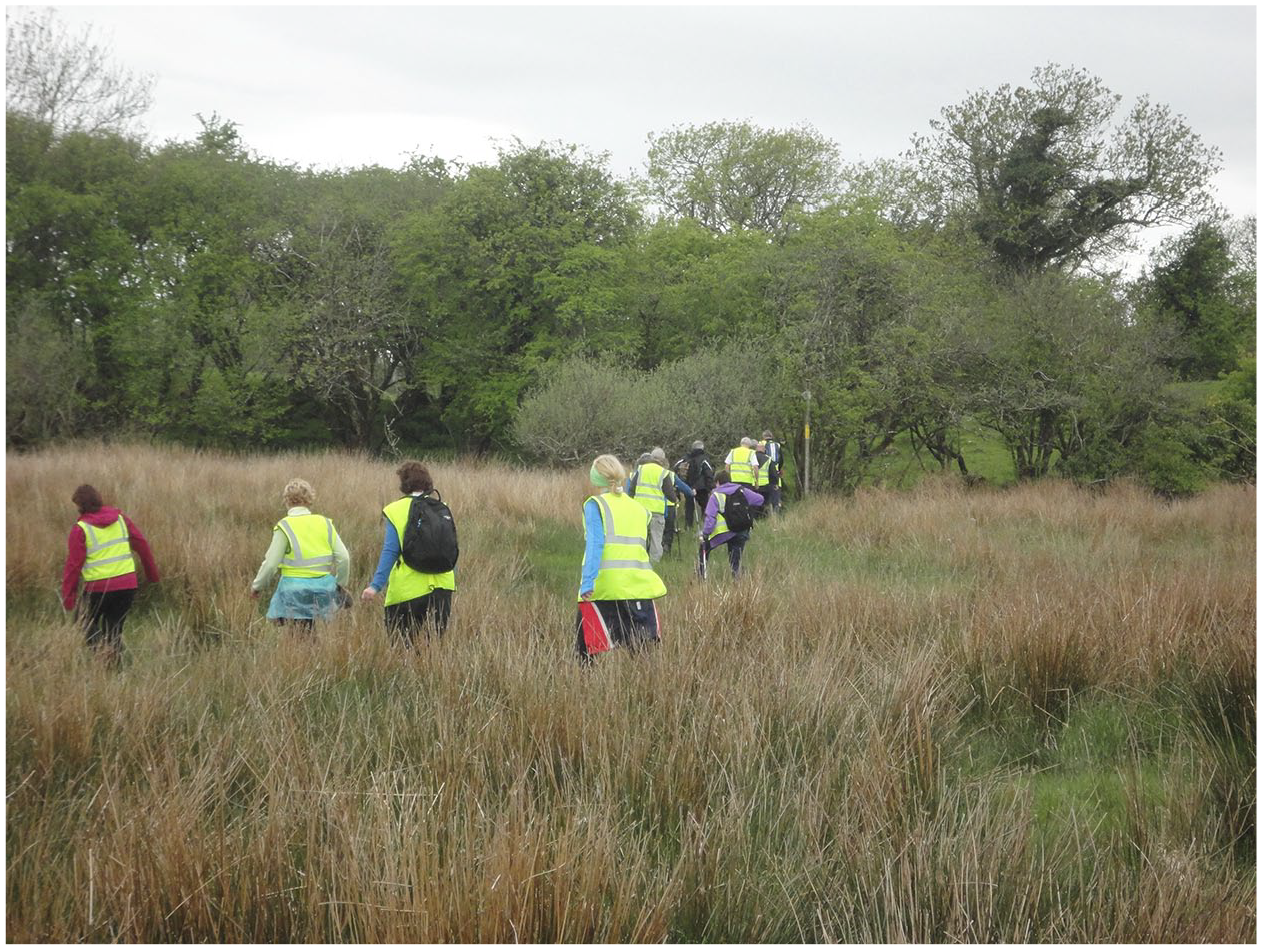
Performing Tóchar Phádraig: the group of pilgrims cluster in a boggy patch of the trail, our embodied spatial practice responding to the terrain.
My positioning of the pilgrim as an avatar of the flesh is most clearly manifested in performing the path. It is an entwining liminal environment, we enter into and generate through our purposeful practice. The aspiration is to become ‘present’ or mindful, which facilitates the transformative character of pilgrimage. Feelings of sacredness or encounters with immanence open up parts of ourselves which are freshly experienced within these affective landscapes.
61
Crucially, this process is facilitated and shaped by the sensual and enacted encounters with the natural, spiritual and cultural environment.
62
We are slowed down, both physically and mentally, enabling more contemplative outlooks. It encourages a practice that ‘stretches out the moment’ expanding ‘the ‘size’ of consciousness, allowing each moment to be more carefully attended to’.
63
Ronan, one of the research participants, makes direct reference to this type of experience:
Once a rhythm is found, we usually forget about the stress and start to immerse ourselves in the surrounding environment.
His corporeal capacities are shaped by the path as he becomes primed to new located experiences. 64 I also feel this synchronicity of being as subject and place are in tune. It is an immersive state the settles almost naturally, as if prompted by the interlacing. It is me and the path: pilgrim and landscape. Within this liminal state, the spiritualities of the route and the event seem to resonate. My experiences of feeling present are moulded by the context of pilgrimage through my awareness of the historical route, the affective elements of path and Fr Fahey’s framing of the day.
This aspect of pilgrimage unfolds in the inherent relationality of subjects and surroundings. By interweaving with the path, the pilgrim is liberated to reflect on more significant matters that would otherwise not be accessible. It is contradictory and reversible. It is going out to the world, to go into the self; it is to be both firmly grounded in the setting and in the self. The ‘flesh’ helps locate this as the fusing of the subject and object. The embodied self is of the world: ‘its own movements incorporate themselves into the universe they interrogate, are recorded on the same map as it’. 65 Merleau-Ponty’s existential approach overlaps with the sensibility of the pilgrim’s journey, providing a means of not only framing it, but entering into it afresh.
The lens of the path can blend with personal faith to create a strong Christian spiritual experience for some pilgrims. Meaning is generated in the co-emergence of participant and place.
66
In these cases, feelings of being present become moments of awareness of the presence of God. Claire, who I talked with in her office, a few weeks after her pilgrimage, outlines her reflections on walking the tóchar several times: It’s very in the present. Like, I’ve come back here [workplace] now and I’m all, I’ve got emails from all over the place, I’ve got stuff from, like, it’s in my mind, the only thing that concerns me on that walk is that we will get from A to B safely . . . You know, and we’re totally in the moment, yeah; and, then you get into your own moment, I imagine as you trudge along . . . you do get into the very moment about your toes, about your knee, it’s about the bag on your back, it’s just very present, yeah. (Research participant)
This context enables Claire to enter into the present, in an embodied state register in located modalities. Spiritual significances are deeply engrained in this process as the pilgrimage is embedded within her Roman Catholic faith. Path and divinity intermesh, drawing the immaterial and the tangible together through her experience. There is a refreshing freedom to her considerations as the route offers a time-space that is not only free from the clutter of everyday living, but also the structures of formal religion in which time for personal reflection can be difficult. Within this space, Claire is a pilgrim, experiencing the liberation to contemplate which is inherent to the role.
Emerging significances can take different forms connected to the experiences and dispositions of the participants. The historical and cultural materialities encourage journeys into the imaginative and the authentic. Louise, who is a good example of someone from a Roman Catholic background but is distanced from it defining herself as spiritual, describes the sense of connectivity that these elements provide in her pilgrimage: You know the path has been trodden, literally and metaphorically, for hundreds and hundreds of years by people long gone. It’s almost like an emotional safety net . . . it provides a level of peace and comfort and stability . . . So in one it’s me connecting up with generations and, em, getting a sense of continuity for myself. (Research participant)
Louise’s interconnection with the path evokes historic and spiritual sensibilities illustrating how ‘landscape comes with the weight of numerous past associations’ 67 reflecting her cultural and religious history. She is brought into the landscape not only in its present natural form but also as an historical constant, offering emotional and spiritual reassurance. This is the intimacy of the flesh with Louise locating herself within the folds of the path, merging with the pilgrimage in her being a pilgrim.
Walking the path enables us to feel present. Aligning with the sensibilities of this pilgrimage route, we become pilgrims through a palimpsest of past and present, nature and the numinous and performance and sensation – all coalescing and overflowing. It is the ambiguous state of the flesh as we entwine with the landscape and vice versa. Our situated experience emerges ‘as embodied perception where materiality and social interaction intertwine in culturally structured worlds’. 68 We understand our environment as pilgrims, a pilgrimage setting that grants us this performed identity. The ‘flesh’ emphasises the experiential significance of this practice that is afforded by the reversibility of subject and object. Crucially, it involves a concurrently incipient awareness of the process: the flesh is ‘the visibility of vision [original emphasis]’. 69 Not only is it a consciousness of the world, it is a consciousness of and through the world as pilgrims. Our temporary identity is felt and understood via the landscape and our unfolding environmental context. Within these conditions, we are pilgrims: knowing and experiencing ourselves, our fellows, and our landscapes in this being. It is the combination of spiritual or emotional encounters arising through praxis and registers by which they are interpreted and experienced.
Croagh Patrick – awareness
Lines of pilgrims trailing up and down – feet on path, staves on rock [Figure 3]. Mountain pushes to more extreme, challenging climb, climbing crowds, heightened sensation. New rhythms, new pilgrimage . . . Intermixing of myself and others, us and path, path and mountain. (Field notes summer 2013)
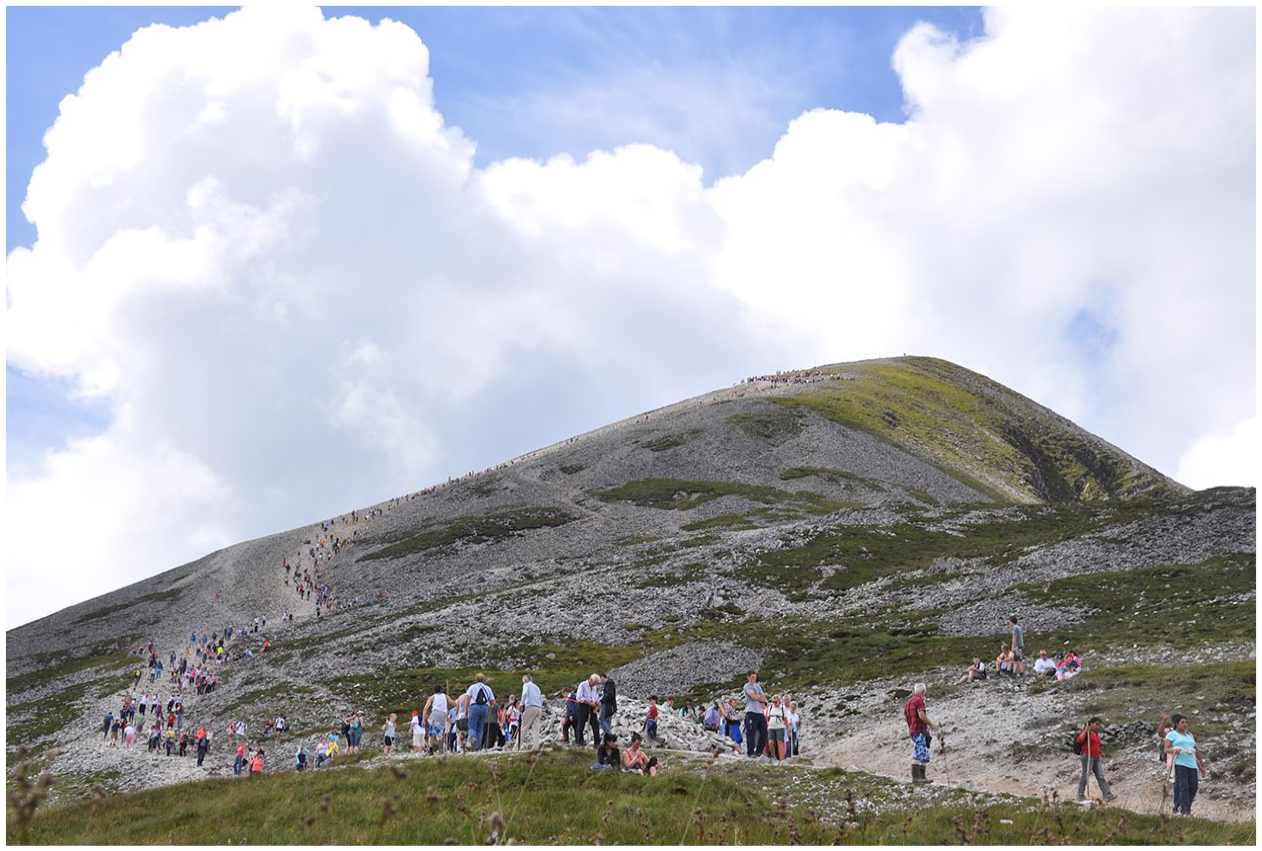
Croagh Patrick on Reek Sunday: the path crawling up the side of the mountain is evident both in its clear topographical imprint and also in the line of pilgrims. Pilgrim and path intermix and part together.
Tóchar Phádraig’s gentleness and solitude are replaced by the collective performance of Croagh Patrick. A small group treading a path is subsumed into a multitude ascending and descending the sharp features of the peak. The hardship and effort of the climb embodies the penitential tropes of an ‘authentic’ pilgrimage. Moreover, some pilgrims also perform sets of prayers called the ‘Stations of the Reek’ involving circling features while reciting Catholic prayers. This eventful place is encountered both as a discrete cacophony and a process we become embroiled with – we are both inherently located and dislocated, freed to experience and reflect.
Trailing up Croagh Patrick, the path is a living entity. Steep terrain and scree assert their influence, as thousands of pairs of feet perform the trail. The contours of the mountain enable this understanding; it is the basis of my experience. I ascend with and through the peak; I move with and through other people. I am the climb; we are the climb. As a member of the crowd, I am intimately involved in the ascent along with others in an empathetic and connective disposition. I perceive and understand the movements, struggles and progress of others from my own embodied perspective of the path. I become aware not only in my interrelationship with the path but with it as a shared practice in which I am participating. The flesh is manifest in these actions. At a range of scales, from the meeting of feet and path to the streams of participants appreciated at a distance, the ‘point at which the limits of the body come into contact with the world are lost in the folds of a common element from which both devolve’. 70 Although my fellow pilgrims remain subjects, they are also objects, among many others (landscape, stones, staves, weather and so on), for me and vice versa. Pilgrim and path are the same substance. My being of the path enables my appreciation of their being of the path (with the reverse facilitating their understanding). My embodied appreciation emerges from this dovetailing.
Along the way, many people demonstrate a fellowship generated in glances, passing words of encouragement and hands offering assistance. The path is our mutual understanding; it is a connective tissue permeating our movements, forging this passing communitas. As pilgrims, we have an intersubjectivity: ‘when the other speaks, I recognise that his [sic] world is mine’. 71 We are breathless together; we struggle together; we perform the path together. This is an interchangeable experience as individual and communal enactments intertwine with each other and with the landscape.
Croagh Patrick is the experience. It is not only a physically demanding undertaking, but one that is interlaced with cultural and spiritual significances that emerge in the performance. Awareness of the tradition merges with the energy of the crowds to enable us encounter the Reek not as hillwalkers but as pilgrims participating through and with a larger located meaning. Lilly explains this understanding as part of her motivation for completing the climb: Pilgrimages are not meant to be an easy task and I feel every single stone, every twist in the path makes it what it is. Of course it’s tough, it’s a mountain not a Sunday drive. But that makes the whole experience more real, more encouraging. Some people just do it to see if they can and if/when they do, it’s one of the best feelings in the world. (Research participant)
This is more than an acceptance of the difficulties involved; it is a valorisation of them.
While Lilly was not a religious pilgrim, she nonetheless adopted the sensibility of understanding the inherent nature of the challenge as enlivening. Her appreciation was forged in the practice with the path, with Croagh Patrick. Being a pilgrim is a relationality generated through the performative environment. Mountain and pilgrimage being performed together combine to generate the atmospheres and shared experiences that mark out Reek Sunday. Megan, who loosely defines herself as a Christian, describes her emotions on the summit: On reaching the top and seeing all those people standing sweating in the rain I think it’s hard not to get a feeling of religion and community. The tiny chapel at the top symbolises for me a total image of simple ‘awesomeness’. Thousands of people push themselves year after year to stand outside it getting wet, some not even getting to attend a mass and I think it’s amazing. (Research participant)
She perceives and moves with the milieu. Her journey is marked by these encounters with the features and conditions on the summit instilling meaning and framing her experience. The vertical aesthetics, inclement west coast weather, the religious infrastructure and the presence of so many people merge to make her feel like a pilgrim. Her subjectivity (as a pilgrim) is a condition of these objects, which are themselves subjectivities in their own right. Croagh Patrick is all of these things. It is elevated and elevating.
The cumulative events on the mountain-top also impacted on Angelica whose Roman Catholicism was strengthened by her interactions with the journeys and religious expressions of others (Figure 4). Croagh Patrick was a manifestation of faith for her. Her awareness of the strains and carnalities of the undertaking enabled a distinct understanding on the seen as a numinous ebullience. She had participated in the pilgrimage several times, as part of a larger group, and perceived events through the lens of her beliefs: You see the faith of the people . . . coming here, it’s not a, a, you know, it’s not easy coming up here but they keep coming: you see people of all ages, from old and young, you’re amazed at the old people being able to climb and also that the same time, you’re amazing to see young people trying to climb it. So it has been a great kind of way of revving or renewing that sense of ‘Yeah, people. God is in the heart of the people’. That faith, that they are looking for something and they are always wanting to, em, kind of express that. I think this is a great expression of that faith, so it’s great to be here, especially in this kind of weather. (Research participant)
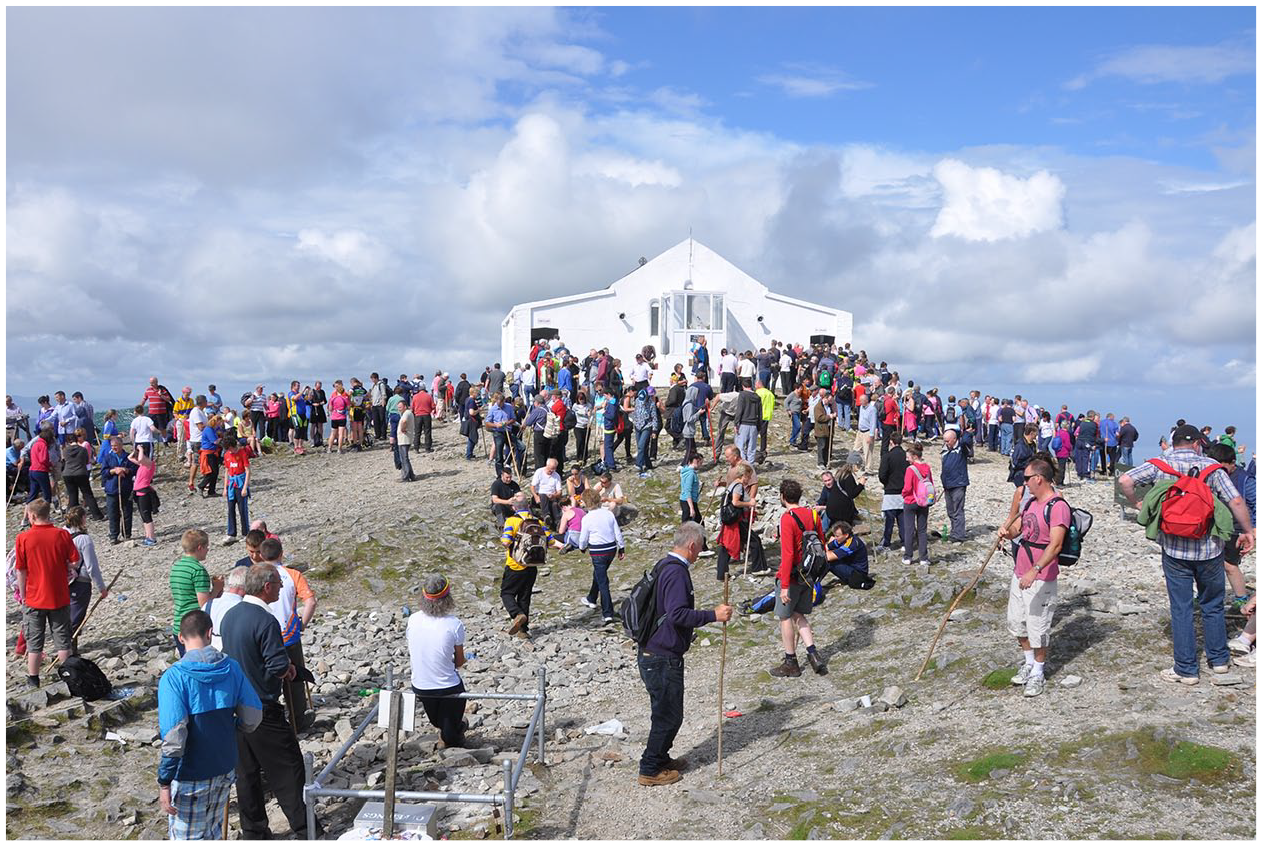
A crowd on the summit during Reek Sunday: a range of activities occur in and around each other with pilgrims queuing for communion or confessions after mass at the chapel, while other participants pray privately, and other people chat and have food. In addition, most people will take photos of the views offered.
Her experience is a faith-affirming one with the active richness of the pilgrimage embodying a religious vibrancy which countered dominant narratives of the demise of Roman Catholicism. The abstraction of belief becomes a felt immanence in this liminal location with the collection of participants gathering on a mountain for a shared tradition. Within this trans-subjective field, Angelica’s faith is real and present in the practice, bodies and landscape as well as her experience of this world. The summit becomes a sacred space for her – one she blends into joyously as a faith-filled subjective shaped by the totality of the environment.
Croagh Patrick is an interlacing. Individual journeys blend into a flowing crowd. We form the path together with the terrain, enabling a collective enactment and shared understanding. In each of the quotes from research participants, the performative environment enables personal and shared awareness which generates meaning and faith. It is an amalgamation of religious, spiritual and cultural motivations weaving together. 72 Our embodied intersubjectivities, the challenges of steep path, the prayers of others, the landscape and atmospheres are our aggregated lens. It is our ability to participate and perceive this participation that is the essence of our understanding. Merleau-Ponty’s flesh is this unfolding: I am ‘at the same time of the world and the perceiver of the world; body and world are of the same flesh and it is through this flesh that we know the world’. 73 Subjectivity is inherently, and necessarily, of the world. This is the texture of the flesh, a mutuality from and through which each of these aspects are interrelated from their beginning. The pilgrim as an embodied temporary presence merges with and from the performed landscape in an active becoming articulated in each step.
Closing
The return is part of the journey. It is the completion. The final stage of being a pilgrim is to leave being a pilgrim. Return to the world renewed. Appreciating this idea afresh, albeit, [in a] tired way. I’ve an uplift, an earned satisfaction, and some reflections on the day and the people met. (Field notes summer 2013)
As the pilgrimage ends, located awareness fades with normativity reasserting itself. Nonetheless, insights have inscribed themselves. In our reflections, particular moments, feelings or encounters stand out. In the aftermath, these are the pilgrimage – the crystallised points at which meaning, practice and place coalesced. This corresponds with ritualistic understandings of pilgrimage as transformative experiences from which we return emotionally/spiritually reinforced. 74 Understandings forged in the interactions of the journey resonate, and while we are shedding the role of pilgrim, part of that temporary identity abides.
My focus on being a pilgrim contributes to broader pilgrimage studies by considering the elements this temporary status. While research across the social sciences and humanities examines the socio-political characteristics and impacts of the activity at different scales, I deploy Merleau-Ponty’s flesh to explore lived personal experiences of individuals who self-identified as pilgrims. Croagh Patrick presents a case study of a pilgrimage walked by a variety of people for different religious/spiritual and personal reasons, which can be connected with other examples gaining increasing prominence across Europe. While the article builds on strands found in recent human geographies highlighting the embodied spatial practices involved, it demonstrates the value of connecting qualitative work with larger frameworks. My journeying has been enriched by the flesh enabling the articulating of forms of located being at the confluence of different features. Commentators have pointed out its carnal and religious associations, which adds an aptness to my interpretation, and also highlights the need for other traditions, philosophies and ontotheologies to be applied to examinations of pilgrimages and other religious/spiritual topics. This process must also disrupt the dominance of Western Christian thought and ideologies (an entanglement many of us have a role in). Non-Christian pilgrimages and faith practices are embedded in their own theologies and cultural settings demanding distinct ontologies, while environmental philosophies and post-secularities are increasingly necessary to explain Western pilgrim practices. Attending to a diversity of outlooks and conventions will only serve to enrich and variegate the cultural geographies of these arenas. Our future theorisations and representations of pilgrimages and religiosities need to incorporate these approaches to more accurately understand and reflect the complexities involved across a range of scales and modalities.
Phenomenology has enabled me to tell geographical stories, to explore existence as a relative condition. Through the example of a walking pilgrimage, I have highlighted how the awareness of located performance reveals the imbrication of self and world and interleafing of subject and object in a mutual definition. Being a pilgrim was not merely a matter of enactment but an embodied engagement with environment and the concurrent consciousness of it. It was in the synergy of participation and reflective capacity that we were incarnate as pilgrims. This article’s significance beyond Croagh Patrick lies in relational cultural geographies that examine identities, everyday practices and embodiments as being-with-the-world. This processual approach simultaneously values the human subject, while also unbounding this subject as one presence among many who is influenced and defined by a cacophony of presences. It articulates relationalities, as subjects and objects become features among a multidimensional web of orbiting and connected elements. Post-phenomenology presents a new path that attends to this lacework by prioritising the range of elements – especially the role of the non-human – and worlds that occur between them. It also enables the expansion and reframing of phenomenological concerns with the openness to multiple forms of agency and their intersubjective, spatial and corporeal implications for the emergent self.
In mobilising the pilgrim, I centred the role of participants and participation within the active environment. Through this register, the pilgrimage landscape, rather than being an exceptional space, becomes an illustration to a relational and patterned way of being. Cultural geographers must be encouraged (as they are in the pages of this publication) to attend to and give voice to the diverse elements, presences and sentients that shape our social and political worlds. These capacities become ever more relevant as everyday being is increasingly influenced by socio-cultural, technological and climatic influences. Shifting landscapes from the local to the global are shaping and changing subjectivities requiring more fluid interpretative frameworks. Our telling of geographical stories will be enriched by examinations of how livelihoods, genders, sexualities, faiths, leisure, belongings and creativities – to name but a few – are generated, experienced and encountered in conjunction with the world, as a constellation of people, creatures, places, materials, affects and energies.
