



Abstract
This article explores the multiple and multifarious encounters of and with Globe, a 1-metre-diameter copper spherical sculpture hosting four cameras that has been rolled by the artist Janetka Platun and others in London, Shrewsbury and Delhi. Situating Globe in relation to Janetka’s art practice and the wider ‘art of rolling’, and extending broader debates about globality, encounter and relational aesthetics, the article argues that Globe’s journeys generated ‘meaningful content’ beyond an aesthetic moment of interaction by inspiring people to share stories, ideas and reflections on home, migration and belonging through their encounters with her. Globe’s encounters were inspired by curiosity, often sparked by her materiality, mobility and ‘globe-ness’. Rather than merely act as a prompt for people to reflect on home, migration and belonging, Globe has also been marked by her own journeys and encounters, reflecting their unpredictable and often transformative nature.
I
Synthesized from giant stars, copper is a natural forming metal found in the earth’s crust. A native metal, it was the first to be used by humans; to be smelted from its ore; and to be moulded into a shape.
Copper is malleable: it doubles in strength when heated and cooled down but can become vulnerable to cracking if it hardens prematurely. As it oxidizes, it develops a patina in response to its surrounding environment. This protective outer layer prevents further corrosion. The process of transformation is unpredictable and involves risk.
* * *
This could represent the planet as a whole that we live on. [W]e’re standing here apparently stock still but meanwhile the planet is hurtling around in its little orbit of 25,000 miles an hour. We feel like we’re rooted to the spot, but we’re not, we’re travellers. Member of the public, Kingsland Road Home? Oh my god. That’s a big philosophical question. Home is everywhere where you belong, where ever you feel in your element, so home is everywhere. Janetka: Where do you feel in your element? Far from here I’m afraid but commitment brings you here [ . . . ] We always think we’re in a hologrammatic kind of world [ . . . ] The world will never change, as it was and as it is. Stall Holder, Whitechapel market
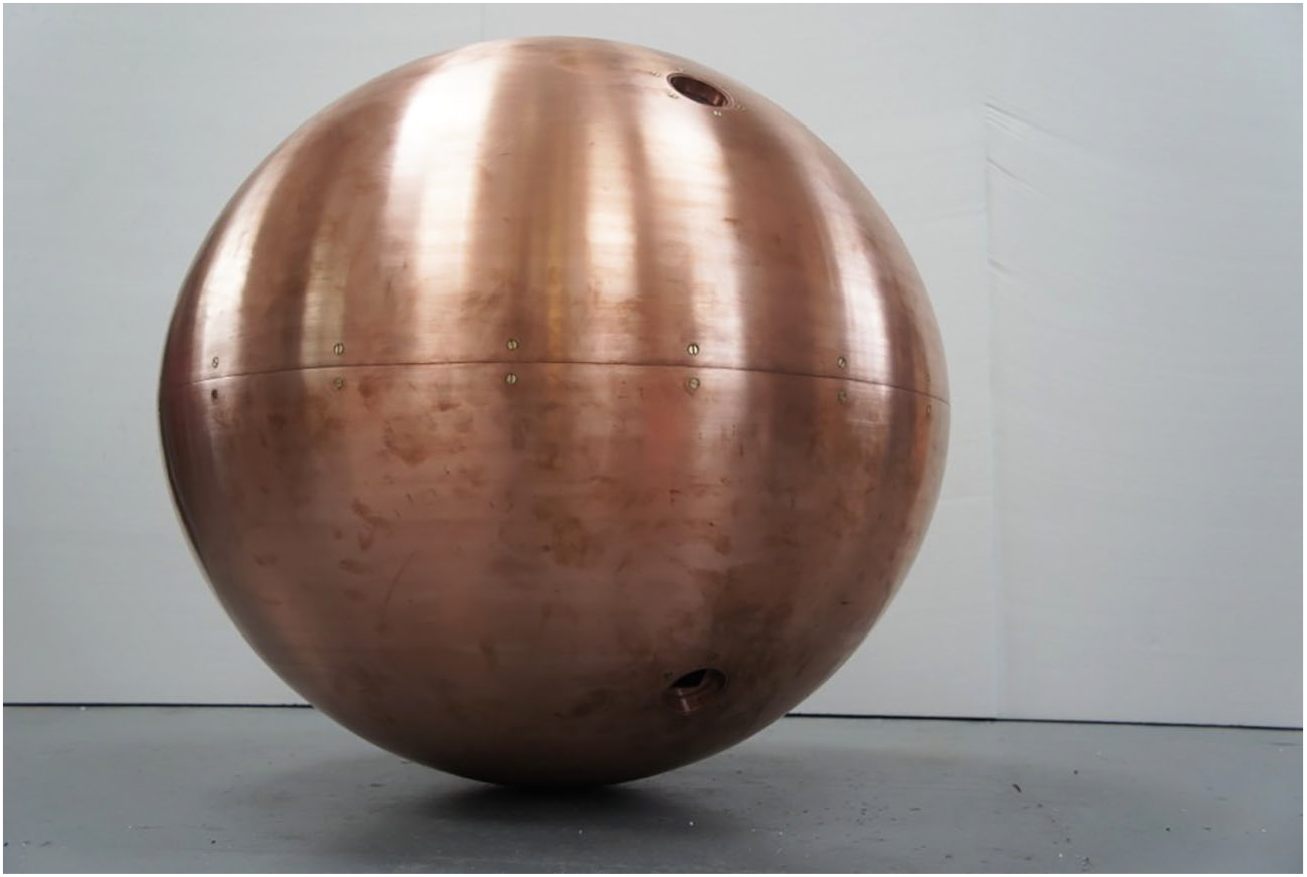
Globe, June 2016.
These two excerpts are taken from encounters with Globe – a 1-metre-diameter copper, spherical sculpture hosting four cameras – as she 1 was rolled around the streets of East London. These rolling journeys were part of a collaborative film and sculptural project created by artist Janetka Platun during a residency in the Schools of Geography and English and Drama at Queen Mary University of London from January to October 2016. 2 Seeking to explore questions of home and belonging in the context of an increasingly ‘hostile migration milieu’, 3 Globe was rolled around the streets by the artist, collaborators and members of the public, tracing the routes taken by Janetka’s parents who arrived in the East End as post-war migrants from Poland, as well as embarking on new journeys around the area’s rapidly changing neighbourhoods and beyond. Starting her life free of imperfections, Globe’s surface has degraded and scarred, marked by her excursions through the city and her engagement with people who were invited to share their own journeys and (hi)stories of home and belonging. As the above citations suggest, people engaged with both Globe’s physical form – representing ‘the planet as a whole’ – and the wider questions that an encounter with a scaled down version of the world may invite – ‘home is everywhere where you belong’. These reflections also point to the close entanglements of the local and the global that shape the contemporary city and the multiple temporalities at work 4 in a world that may be both ‘hurtling around its little orbit’ and yet ‘will never change’.
Globe’s encounters have been multiple and multifarious. Her first journeys were in and around East London, tracing the temporary dwellings of Janetka’s parents following their arrival in the United Kingdom (her father in 1946 and her mother in 1962). Globe followed different routes radiating from Queen Mary University of London – including through Globe Town 5 in Tower Hamlets – and visiting Mulberry School for Girls. Subsequent journeys in London included following the meridian line to the Royal Observatory in Greenwich – an invisible line that, ‘through maps and clocks . . . [has governed] the life of every human on Earth since 1884’ 6 – and visiting Torridon Primary School, which is located on the line. Globe has also visited the Geffrye Museum of the Home and been on display at Tate Exchange, the National Maritime Museum and the Royal Geographical Society (with Institute of British Geographers), the latter two of which are homes of important globe collections. Beyond London, Globe re-traced Janetka’s parents’ move to Shrewsbury in 1966 and visited the village where she grew up. Globe also travelled to India in 2017, where Janetka led a globe-making workshop at Nahra School near Sonipat, Haryana, as part of a visit to O. P. Jindal Global University 7 facilitated by Jayani Bonnerjee, and rolled Globe in Old and New Delhi. The footage from Globe’s journeys has been edited by Janetka and Alice Forward into two films, ‘Here be Dragons’ (2016) and ‘Terra Incognita’ (2017), which have been screened in different locations in London and beyond to diverse audiences. In addition to serendipitous encounters on the street, during workshops and film screenings, people have been invited to roll Globe themselves, to make their own hand-held ‘global worlds’ using different materials, and to watch – and listen to – the sometimes disorienting and uncomfortable footage taken from Globe’s rolling journeys.
Following Sara Ahmed (and others), we understand encounter as ‘a meeting, but a meeting which involves surprise and conflict’. 8 In what follows, we unpack and reflect on Globe and her wide-ranging encounters, with a particular focus on her ‘globe-ness’ and new understandings of home, migration and belonging. In doing so, we extend debates on encounter in three key ways. First, by bringing research on geographies of encounter 9 into dialogue with ideas about relational aesthetics and participatory arts practice, 10 we explore the extent to which Globe’s journeys generated ‘meaningful contact’ in ways that moved beyond the aesthetic interactive moment of encounter to what was revealed through encounter. Second, we consider the ways in which Globe’s encounters were prompted by ‘genuine curiosity’ 11 that was often inspired by her materiality and mobility and allowed experiences and ideas about home, migration and belonging to emerge. Third, reflecting on the new spaces, encounters and knowledge created through the artistic process, and the artwork’s potential to ‘make visible experiences, hopes, ideas’, 12 we consider Globe’s agency and the ways in which she has been marked by her encounters as much as her movement and presence may have affected those who encounter her. We begin by situating Globe in relation to Janetka’s art practice and the wider ‘art of rolling’ before turning to the wider literature on thinking globally and encounter. We then explore the ways in which Globe both responds to and extends ideas about globality, focusing on people’s engaged, tactile and often intimate encounters with her ‘globe-ness’. Finally, we turn to the ways in which Globe’s encounters offer new ways of conceptualizing migration and the multi-layered and multi-scalar nature of home and belonging. The interplay of Janetka’s artistic practice and our cross-disciplinary perspectives, rooted in Geography and Theatre and Performance Studies, inform both the content and form of this article – itself an encounter, iterating our collaborative research process. 13
II
There is no one around.
The slight buzz of a warm summer’s day is the only noise. I start to roll Globe down the street. The internal beat of my heart matches the external impact of metal moving over course ground.
Globe has never sounded so loud.
I reach the house I lived in for the first 15 years of my life.
I spin Globe round and look at the house opposite my childhood home where I recall a father instructing his son to hit me repeatedly while he, an adult, physically held me down. I remember the child reluctantly carrying out his father’s wishes as he shouted ‘Go back to your own fucking country, go home!’
There is no one around.
The art of rolling
Janetka’s art practice is shaped by phenomenological ideas, posing questions about people’s existential and moral relationship to their surroundings, and how they survive and communicate their internal worlds. Her works include Beneath the surface (Longmead Estate, Surrey, 2008–2009), Not hat is this (Ynyslas Beach, Ceredigion, 2013) and Cuming: a natural selection (Peckham Platform, London, 2015), which all, in different ways, attend to the inter-relational complexities of people, place, time, memory and desire. 14 Like Globe, they have a conceptual framework realized through engagement and collaboration with participants, shared with a wider public audience. Janetka rolls Globe through the streets, often accompanied by collaborators and members of the public. Globe can be contextualized within a long tradition of walking performance in rural and urban locations (e.g. Janet Cardiff’s The Missing Voice (Case Study B), 1999; Francis Alys’ Seven Walks, 2005) 15 and within a significant body of geographical work that engages with walking through engagement with existing walking art practice 16 or through exploring the possibilities of walking as research practice in cultural geography. 17 Globe also makes a distinctive contribution to new understandings about site-specific art work that is not necessarily located in one particular place 18 and, through this, extends ideas of embodiment and affect raised in Springgay and Truman’s consideration of walking as a research methodology. 19
Globe also contributes to a smaller body of walking performance work that involves pushing, carrying or dragging an object through the street (see Mona Hatoum’s Roadworks, 1985; Francis Alys’ Paradox of Praxis 1, 1997), of which a handful of examples involve the rolling of a spherical object or globe. In Michelangelo Pistoletto’s performance piece Walking Sculpture (1967), the artist rolled a sphere through the streets of Turin, which was made of contemporary newspapers containing stories of Italy’s turbulent political climate at the time. The piece has been re-enacted over the last 50 years, most recently being rolled down the streets of Cold Spring, New York (Sfera de Giorni 2017). Like Globe, Walking Sculpture is a globe without borders, its spherical design evoking ‘the concept of circulation’, using newspapers ‘which circulate information’ 20 through which to physically and metaphorically create a connection between a material, everyday object and the wider socio-political context.
In Yielding Stone (1992), the artist Gabriel Orozco rolled a large ball of plasticine through the streets of New York. For Orozco, Yielding Stone, currently owned and on display at the Walker Art Center in Minneapolis, was a representation of a human, ‘a vulnerable mass’, that gathered detritus and was impressionable, carrying the marks of its encounters. Orozco identifies himself with the sphere of plasticine – it was the same weight as the artist – and critical commentary reiterates this in framing the sculpture as being about the artist’s presence and absence. 21 While Globe shares many similarities with Yielding Stone – she is marked by her travels and her identity is closely intertwined with that of the artist – she is distinct in her intention to invite reflections on home and migration, and to inscribe these into the fabric of the project through interactions on the streets and through films that curate these documented encounters. Like Globe, Steve McQueen’s Drumroll (1998) employs cameras to capture its rotating journeys. In McQueen’s piece, a metal oil drum is rolled through the streets of Manhattan, with cameras mounted on the side and two ends. The rotating images were exhibited as part of a triptych, provoking a sense of nausea, encapsulating the disorientating lived experience of the city. Drumroll includes a soundtrack of the oil drum rolling, the ambient sounds of the city and the sound of McQueen calling out to passers-by to warn them about the approaching object and to apologize for obstructing their pathway. Globe’s visual and sonic footage works in a similar way, evoking a sense of discomfort and dislocation. Yet, as well as evoking the urban experience and the negotiations of the city’s topography, Globe’s form invites people to reflect on their place in the world provoking questions about who belongs.
III
The courier van swings into the shaded north entrance of the Royal Geographical Society. A young woman in her 20s jumps out of the driver’s seat. I roll Globe towards her and she instinctively joins me. She opens the van doors and just as we’re about to haul Globe inside she stands up straight and says in a familiar accent:
‘Hang on a minute . . . what is this?’
‘This is Globe’,
She is laughing.
‘Of course it is’.
We’re now driving through central London and a large van cuts across our lane. She brakes and I hear Globe thud against the rear doors. The offending vehicle is now alongside us. I roll down the window and shout out the phrase my parents would use when I was being told off. She is laughing again. I tell her what I think the phrase means. Still laughing, she replies, ‘yes, it means something like that’.
There is a pause and I ask ‘Have things got worse since the referendum vote?’
There is another pause. She looks at me, her expression now transformed to one of profound sadness. She nods.
Thinking globally
The concept and image of the globe is, according to Denis Cosgrove, ‘a figure of enormous imaginative power’.
22
In his cultural history of the globe in a Western imagination from ancient to digital worlds, Cosgrove argues that its spatiality and visibility – and, crucially, the distanciation that underpins both – distinguishes it from ‘earth’ or ‘world’. As he explains, Globe associates the planet with the abstract form of spherical geometry, emphasizing volume and surface over material constitution or territorial organization. Unlike the earth and the world, the globe is distanciated as a concept and image rather than directly touched or experienced.
23
The ‘Apollian gaze’ on the globe – viewing the planet from a distant, single, apparently unmarked and authoritative vantage point – is bound up with the desire for order or control which, for Cosgrove, ‘is implicitly imperial, encompassing a geometric surface to be explored and mapped, inscribed with content, knowledge, and authority’. 24 And yet, even though the globe may be ‘visual and graphic rather than experiential or textual’, 25 implying a distance from earthly environments and worldly lives, ‘the Apollian image also recalls the earthly globe enclosed within other spheres, a home or dwelling, thus implicitly local and rooted’. 26 Globe not only disrupts the distanciated claims to knowledge of an ‘Apollian gaze’ through her journeys and encounters in East London and beyond, but also unsettles an assumption of dwelling as ‘implicitly local and rooted’, 27 through her engagement with wider questions about home, migration and belonging. Doing so resonates with postcolonial critiques of a global cosmopolitanism and attempts to conceptualize local–global connections, particularly in the context of understanding what it means to live within a ‘global’ city.
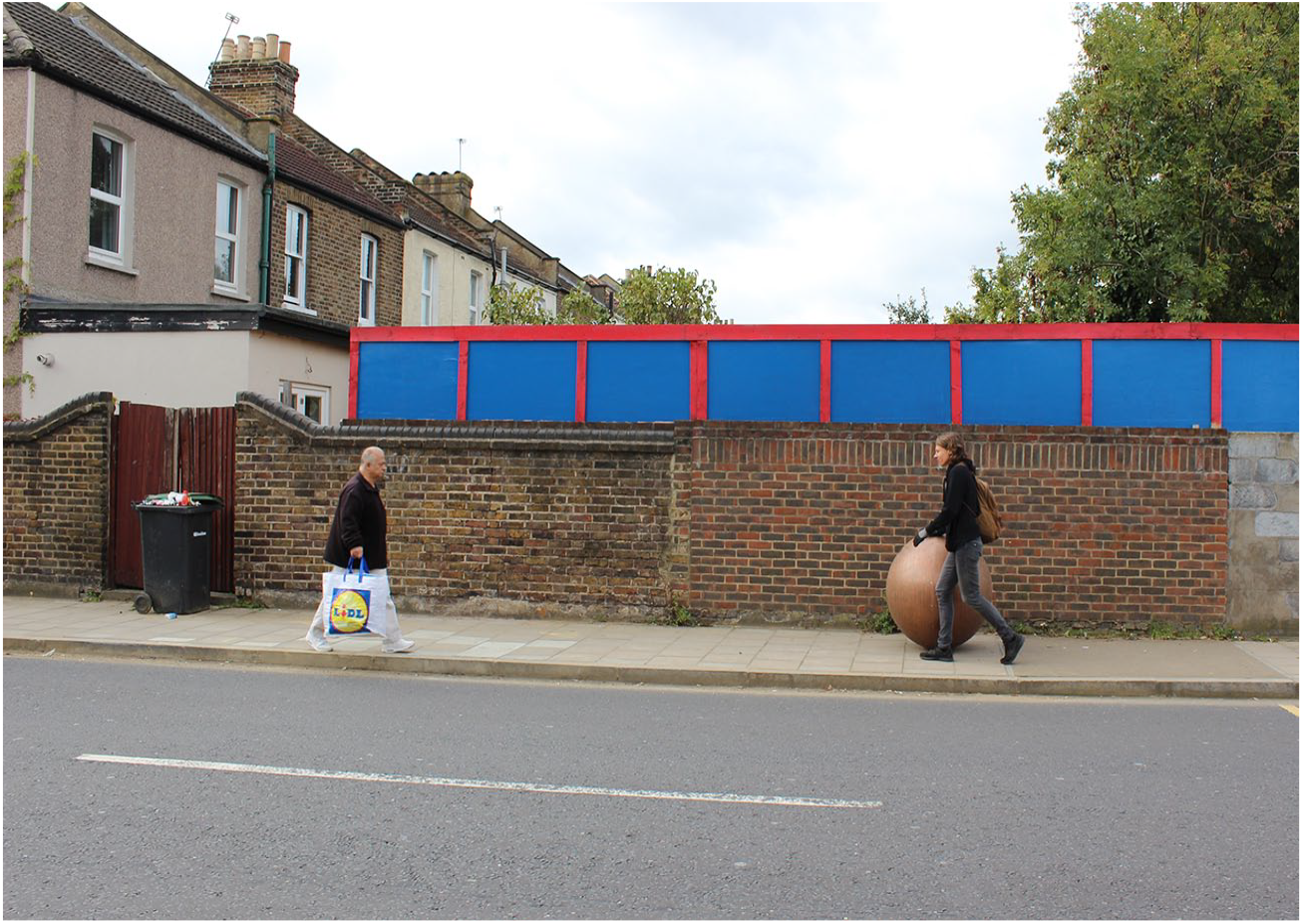
Globe, meridian line, London, UK, October 2017.
From ancient cosmography to the Apollo space photographs and beyond, the spatial imaginary of whole-ness that characterizes an Apollian view of the globe has inspired claims to – and critiques of – a ‘planetary consciousness’. 28 In his interrogation of the universalist claims of the ‘cosmos’ implied by ‘cosmopolitanism’, for example, Tariq Jazeel critiques the ways in which ‘the image of “the planet” becomes central to Gilroy’s invigorating vision of a more cosmopolitan future’. 29 One particular image – NASA photograph AS17-22727 from the 1972 Apollo 17 space flight 30 – becomes emblematic ‘for a cosmopolitanism that articulates a new humanism’ 31 as it encapsulates Gilroy’s argument for a ‘cosmopolitanism-from-below’ that is framed by an appeal to – and yearning for – a global humanity that transcends the nation-state, race or culture. And yet, as Cosgrove and Jazeel show, this photograph – like other global images – is partial, situated and deeply political: ‘it was North American democracy’s redemptive world-historical ambit that delivered this persuasive photographic appeal to realize the universal brotherhood of a common humanity’. 32 Moving beyond a ‘planetary consciousness’ to develop the idea of ‘planetarity’, Gayatri Spivak 33 ‘poses the challenge to decolonize our knowledge of the world by extending an invitation to know it from outside the categories of western thought’. 34 Jazeel describes the uncertainty, openness and situatedness of such an attempt to decentre knowledge as ‘a perpetual process of de- and re-inscribing the whole earth image’. 35

Video still from one of Globe’s cameras, London, UK, July 2016.
Globe puts these ideas into practice in a range of ways: through the creation of the sculpture as an unmarked copper sphere; the inscription of her surface as she rolled through East London and beyond; and the multiple situated views not only from people who engaged with – or passed by – Globe but also views from the inside looking out through four cameras that filmed rolling footage of her journeys and encounters. Globe’s four cameras allow for four shots of the same moment, capturing – and recording – multiple moments of encounter. These filmed encounters are not staged by Janetka or her collaborators who are rolling Globe but rather continue to happen beyond any human control. The resulting footage contains manifold surprises – an aeroplane flying over as someone recounts a story of a distant home; a busload of people gazing curiously as Globe passes by – allowing for new visual and sonic perspectives and connections. These new perspectives reveal some of the possibilities of art ‘to capture alternative vocabularies and visual grammars that are not always encountered or expressible in oral interviews’. 36
Globe’s journeys and encounters resonate closely with ideas about local–global connections and what it might mean to feel at home, or not at home, in a ‘global’ city. 37 In her classic account of a ‘global sense of place’ and the uneven power-geometries of globalization, Doreen Massey vividly describes the local–global connections and displacements as she walks along her local high street, Kilburn High Road in North West London. 38 Similarly focusing on the scale of a street, but this time the Calle Ocho latinidad street festival in Miami’s Little Havana neighbourhood, Patricia Price argues that ‘human encounters at the scale of lived, quotidian experience’ are generally overlooked in favour of ‘flux’ in research on global cities. 39 Inspired by Jane Jacobs’ work on the ‘sidewalk choreographies’ of American cities, 40 Price explores the encounters shaped by the festival’s ‘pause and flow’ and argues that ‘the very local scale provided by street studies provide a heuristic that grants insight into spaces of heightened inflection found in global cities’. 41 Rather than view the globe as an object of distanciated visibility and control, Globe is similarly characterized by ‘pause and flow’ as she encounters a range of people and places through her journeys along the streets of London, Delhi and Shrewsbury, and her visits to different institutions. The materiality, mobility and ‘globe-ness’ of Globe invoke local and more distant connections and displacements through her encounters with people and their ideas and experiences of home, migration and belonging.
IV
We leave the gated grounds of the Geffrye Museum. At a crowded bus stop, people turn round and look at Globe. They are laughing, volunteering each other to respond.
Can you be anywhere in the world and feel at home, is that what you mean?
Home can be anywhere but it doesn’t feel like home. Most of my dreams are dreams of me back home. Here is still a home, but I’ve got something missing.
Are you all from Martinique?
No Gabon, they are killing my brothers and sisters in my country at the moment.
From where I come from they train you from the word go to know home to be your home. Home is where you come from. Home is where you get back to. No matter where it is you go to in this whole world, home is still your home. We used to sing back home:
Oh my Home, Oh my home, where can I see home my beautiful home, oh my home, oh my home, where can I see my Beautiful Nigeria, I will never forget Nigeria.
Their bus arrives.
Encounters
Globe’s multiple ways of engaging with the city (its sounds, topography and visual landscape including pavements, sky and buildings) and the subsequent narration of these through her films invite a consideration of the politics and geographies of encounter 42 within a frame of socially engaged, relational arts practice as well as in relation to creative and collaborative research. 43 Globe welcomes and depends upon encounter without anticipating or prescribing its form or outcome. It raises pertinent questions about ‘relational aesthetics’, a term coined by French curator and art theorist Nicolas Bourriard, where ‘art is theorised in terms of co-operation, community and a broad definition of public spaces’. 44 We argue that Globe is, in different contexts, relational, interventionist and confrontational. 45 Building on Kye Askins and Rachel Pain’s work on how objects can ‘actively mediate relations between people’, 46 Sue Mayo’s work on creative engagement with objects, 47 and Danny McNally’s discussion of encounters with an art object in the home, 48 interactions with Globe are shaped by her distinctive characteristics, including people’s visual and haptic responses to her aesthetic, materiality, dimensionality and mobility.
To interrogate the nature of Globe’s encounters is to contribute to a wide cross-disciplinary literature that has often focused on passing encounters with different (human) bodies in urban spaces characterized by diversity – or the ‘throwntogetherness’ of difference 49 – including markets, 50 public transport, 51 school playgrounds 52 or cafés. 53 While much of this work has been important in foregrounding cities as sites for the negotiation of difference, the urban encounter has come under scrutiny by scholars such as Gill Valentine who have noted a ‘worrying romanticization’ of these meetings among strangers and the related risk that such work can ‘reproduce a potentially naïve assumption that contact with “others” necessarily translates into respect for difference’. 54 Indeed, as Valentine suggests, not all encounters with strangers are meaningful or positive and the tolerance of others in public spaces may mask – and entrench – private feelings of prejudice.
Taking this critique further, recent work has called for more ‘sustained critical attention’ to the concept of encounter, such that it is understood as more than the ‘coming together of different bodies’, 55 but rather as something that has ‘the ability to make and transform difference in unpredictable ways’. 56 Important here is attention to the multiple temporalities that shape encounters, and the role of ‘memory and previous experience’ as well as habits, place-attachments, desires and expectations. 57 Such an insight is crucial for understanding the nature of Globe’s encounters with places and people that are marked by their own histories and past encounters. Far from being temporally, spatially or politically isolated, Globe’s manifold encounters are always ‘fully-loaded’ 58 – marked by her own (hi)stories as well as drawing in those of the people and places she comes across on her journeys.
Another important feature of recent conceptual interventions on encounter has been a call for engagement with the non-human for, as Swanton observes, ‘in cities we never only encounter other human bodies’. Rather, he continues, our experience is shaped by ‘encounters with myriad material things [ . . . ] visual cultures [ . . . ] soundscapes; smells; atmospheres; ‘structures of feeling’; memories; ghosts’. 59 For Swanton, attention to these ‘often overlooked’ aspects of encounter allows for greater attunement to ‘the messy realities of lived experience’ 60 and is fundamental to understanding how difference – and differentiation – is produced and re-produced. While for Swanton, such closer engagement with this messiness is allowed for through the more creative form of psychogeographical writing which, he suggests, moves away from a tendency in social science writing to ‘distort in their desire for clarity and order’, 61 other scholars have pointed to the possibilities of art as a site for interrogating geographies of encounter. 62
People’s engagement with Globe as an art object and their response to it is helpfully framed by Siri Hustvedt’s work on art, audience, memory and emotion that acknowledges the ‘fully loaded’ nature of encounter with an artwork. She writes, The experience of art is made only in the encounter between spectator and art object. The perceptual experience of art is literally embodied by and in the viewer. We are not the passive recipients of some factual external reality but rather actively creating what we see through the established patterns of the past [ . . . ] We bring ourselves with our past to artworks, selves and pasts, which include not just our sensitivity and brilliance but our biases and blind spots as well [ . . . ] A work of art is always part person.
63
In Globe, encounter is not limited to a person’s engagement with a completed artwork, but rather contributes to the artwork’s realization – on the street, in the workshops, in the audio-visual documentation and in the films. Curiosity plays an important element in initiating meaningful encounter with and through Globe, allowing for important connections to be made to recent calls for reimagining and opening-up new ‘space for curiosity’. 64 As Phillips suggests, the concept of curiosity has tended to be associated with historical geographical expeditions – an encounter between (male, privileged) explorers with ‘terra incognita’ 65 – or sanitized and controlled through its cooption by institutions or governments. Yet, he argues, ‘more inclusive and progressive, risky and dangerous curiosities are both possible and desirable’. 66 We propose that the kind of curiosity that Globe’s encounters invite relates to this latter kind, a genuine curiosity which may mean ‘embracing risk and confronting danger’ but is ‘full of creative possibility’. 67
Our engagement with relational aesthetics and its relationship with ‘geographies of encounter’ chimes with Danny McNally’s recent discussion of another East London–based artwork – I am Tower of Hamlets by artist Amalia Pica – in which he argues that there is an ‘anthropocentric’ tendency that disregards the ways in which ‘“meaningful” encounters can involve objects’. 68 This article, to some extent, responds to McNally’s call to scholars to ‘continue to unpick the relationship between the aesthetic encounter as a site of distinct meaning’ and ‘with the potential to enact a “politics of possibility” leading to counter-hegemonic openings’, 69 in this case about home, migration and belonging. Globe’s constructive work of social relations 70 took place on streets, roads and alleys. In these contexts, the art object – the copper sphere – was not contained by the architectural framing of a gallery where social and cultural capital shape people’s access to it. Rather, encounters with Globe on the street were shaped by chance and circumstance, where curiosity was more powerful than people’s (potentially limited) sense of cultural capital and entitlement. Building on Jen Harvie’s work on the social and material contexts of socially engaged art practice, 71 Globe reveals complex narratives of durational social interdependence at a time when issues of regulation and restriction potentially impede communication and mobility. Globe prompts questions about how power is exercised upon people (their mobility, their awareness of their family’s and friends’ mobility) and how they position themselves in relation to social, economic and cultural forces that shape power.
V
Virender drives us to the Delhi neighbourhood of Karol Bagh. A police officer asks us to move away from a large crowd gathered around us. Three small children start to roll Globe with Olivia. An elderly man is selling jewellery in a tray lined with red velvet. He raises his arm to the skies and declares Globe a meteorite that might fly back to from where it had come.
Alison and Jayani join us.
What are you carrying inside it? It’s a mystery, a mystery metal.
It’s copper . . . we used copper to represent the world.
Oh, I see it’s a globe.
But there are no countries on this globe.
We can make the countries.
Do we want to make countries?
No, no that’s the beauty of it.
Before dismantling Globe and packing her back into the crate for her return to the United Kingdom, I wipe her surface with a damp white cloth. I want to document Globe’s tumultuous journey through the city’s streets. I remember an encounter from the previous day with a woman who looked and said, ‘I see, so you are rolling India’.
The ‘globe-ness’ of Globe
Globe responds to and extends ideas about globality in a variety of ways. In this section, we consider the ‘globe-ness’ of Globe in terms of her conceptualization, construction and the processes of ‘de- and re-inscribing the whole earth image’ 72 through her journeys, films and a series of globe-making workshops. Throughout, we explore not only the ways in which people’s engaged, tactile and often intimate encounters with Globe’s ‘globe-ness’ contrast with the Apollian distanciation of the global image, 73 but also the ways in which Globe herself becomes marked by such encounters. We consider the ways in which people’s curiosity about the ‘globe-ness’ of Globe inspired a wide range of encounters and creative responses as she rolled through streets and visited various institutions.
Globe’s spherical form and copper construction are integral to her ‘globe-ness’. Present in the earth’s crust, copper was the first metal to be used by humans and the first to be cast into the shape of a mould. Globe was also partly inspired by the Hunt-Lenox Globe (held in the collections of the New York Public Library), a small, copper, hollow globe dating from c. 1510, which is one of the earliest terrestrial globes to show the New World. It has a single sentence etched above the coast of South East Asia, ‘Hic Sunt Dracones’ – ‘Here be dragons’: a phrase that inspired the title of the film of Globe’s journeys in East London. Unlike other globes, Globe was created as an unmarked sphere, with the softness of her copper form enabling her to become marked as she rolled through the streets of East London and beyond. Also unlike other globes, Globe was designed to roll and to film her journeys and encounters. Following her display alongside some of the globes and ship’s figureheads at the National Maritime Museum in London, the national collection of globes in the United Kingdom and one of the most significant in the world, Megan Barford, curator of cartography, reflected that ‘The museum’s globes were generally made to stay in one place: purporting to show the world; going nowhere. Globe’s is a geography of movement, one of traces gathered on the journeys she herself has made’. 74

Globe and ‘Here Be Dragons’ on display at the National Maritime Museum, London, UK, September 2017.
While Globe’s journeys have involved movement – negotiating different routes and around obstructions in London, as well as through wheat fields and along the town walls in Shrewsbury, and crowded streets and lanes in Old and New Delhi – they have also involved long periods of immobility, notably when held in her crate by Indian Customs for 3 weeks on arrival and 5 months prior to departure from India. Each journey has left its mark on Globe, from the scratches and other lines etched onto her surface by London’s streets, the smooth striations and chaff from wheat fields near Shrewsbury, to the dust and a dent from Delhi’s streets, smog and a drop from a van. Just as migrants and other travellers neither arrive nor return unmarked by their journeys, Globe too has been marked not only by the places she has visited but also by the process of rolling. For a woman encountering Globe in Shrewsbury, ‘everyone gets scarred and matted by journeys’, and, as a woman in London reflected, ‘just like us, we become more and more weathered in life’. Globe’s enforced stasis also left its mark: she returned to the United Kingdom with a green patina that developed following oxidization to prevent further corrosion. In Massey’s ‘a global sense of place’, she discusses Geography’s preoccupation with ‘defining regions’ through ‘drawing lines around a place’.
75
As an unmarked sphere, Globe does the opposite: Places in East London [and beyond] draw lines directly onto her surface, challenging our perception of home territory and geographical boundaries. Each rotation refers to the local and the global, questioning ideas of who falls inside and outside, them and us.
76
At the same time, through the films of her rolling journeys and encounters, Globe not only projects a view of wide skies and tumbling buildings, traffic, people, legs and feet, but also projects the surfaces over which she rolls – in sometimes microscopic and geologic close-up – as the curvature of the earth, connecting the local with the global through each rotation.
People’s curiosity about Globe often revolved around her materiality and mobility – what she might be, how she was made, why and where she was rolling – and often involved touching her – stroking, patting or tapping her surface, peering into her cameras and participating in rolling. Encounters with Globe were open, questioning and conversational, with a wide range of responses. For some, she was ‘other-worldly’: the Moon, Venus or Mars, an astro-capsule or satellite receiver from outer space. For others, she was ‘the largest ballcock’ they had ever seen. An encounter with two people in Shrewsbury revolved around her elemental, astronomical globe-ness and the need for connection. As Globe rolled towards them, the man said ‘The world is moving towards us, the world is moving towards us . . . Inter-spherance, that’s what’s going on here. People should connect beyond one sphere. We belong to gravity, electricity and light’. In response, the woman replied ‘That’s inter-galactic talk . . . Welcome to planet earth. Knows no bounds’. For a pupil at Torridon Primary School on the Greenwich meridian line in London, ‘Globe is like a spy because you can’t see a map of countries on its surface but, if you look carefully, you can see where it has travelled to’.
As well as serendipitous, street-based encounters, Globe visited a range of institutions and provided the catalyst and inspiration for a series of globe-making workshops in London and near Sonipat in India, where participants responded to Globe and created their own hand-held worlds.
77
At each workshop, Janetka provided Perspex spheres in two halves, together with a range of other materials including black and white, copper balls, wire, wooden sticks, magnets, iron filings, miniature figures and other items with different textures and scales. At Mulberry School for Girls in East London, for example, a group of 15- and 16-year-old Geography students, many with Bangladeshi heritage, reflected, through the process of making their globes, on questions about (dis)connection, power, exclusion, borders and the difficulties of finding a place in a ‘messy, complicated world’: Initially I was thinking about globalisation and how the world developed over time – this is our own world and through the internet and social media we are able to connect with other people. On the other side is all the issues of the world, the copper balls are like tumours, the tumours of the world, the problems people have, that they made themselves. And the idea of the price tag is that the world can’t be claimed [ . . . ] by one person. My world shows two people on the outside, they are supposed to be superior to the people on the inside and they are the ones who make the people on the inside feel like outsiders. Globe making workshop, Nahra School, Haryana, India, November 2017. My globe is trying to represent the world as it is now, it’s messy, we live in a messy, complicated world where nothing is as it used to be . . . the people and balls inside, people are still trying to find their place, trying to find where they fit in. On half of the globe I did how it shows the latitude and longitude lines, that’s how everyone would see it in science and geography and on the other side it’s showing the different countries. And my question is where is the border? What if there were no borders? So if the earth was for everyone, no one would be telling people to get out and go home because there’s no such thing as home really – everyone’s home is earth, there’s no separate countries and borders.
VI
Two men with ‘Staff’ emblazoned on the back of their t-shirts are standing by the inflatable football shootout. They walk towards Globe:
Hey lads we’ve got a bigger ball.
Kick this one.
This is not my home. Everyone lives in a foreign country, there’s so many cultures here. Put it this way I don’t think of myself as a cockney no more, and I was born down the road to the sound of Bow Bells. I’m not against all the colours, I’ve got mixed race grandchildren. It’s just they’re going to keep coming, all religions.
We’re going to get overcrowded.
I tell you what a mini cab driver, a Pakistani, do you know what he actually said to me – if all of us stepped off this island it would raise three inches.
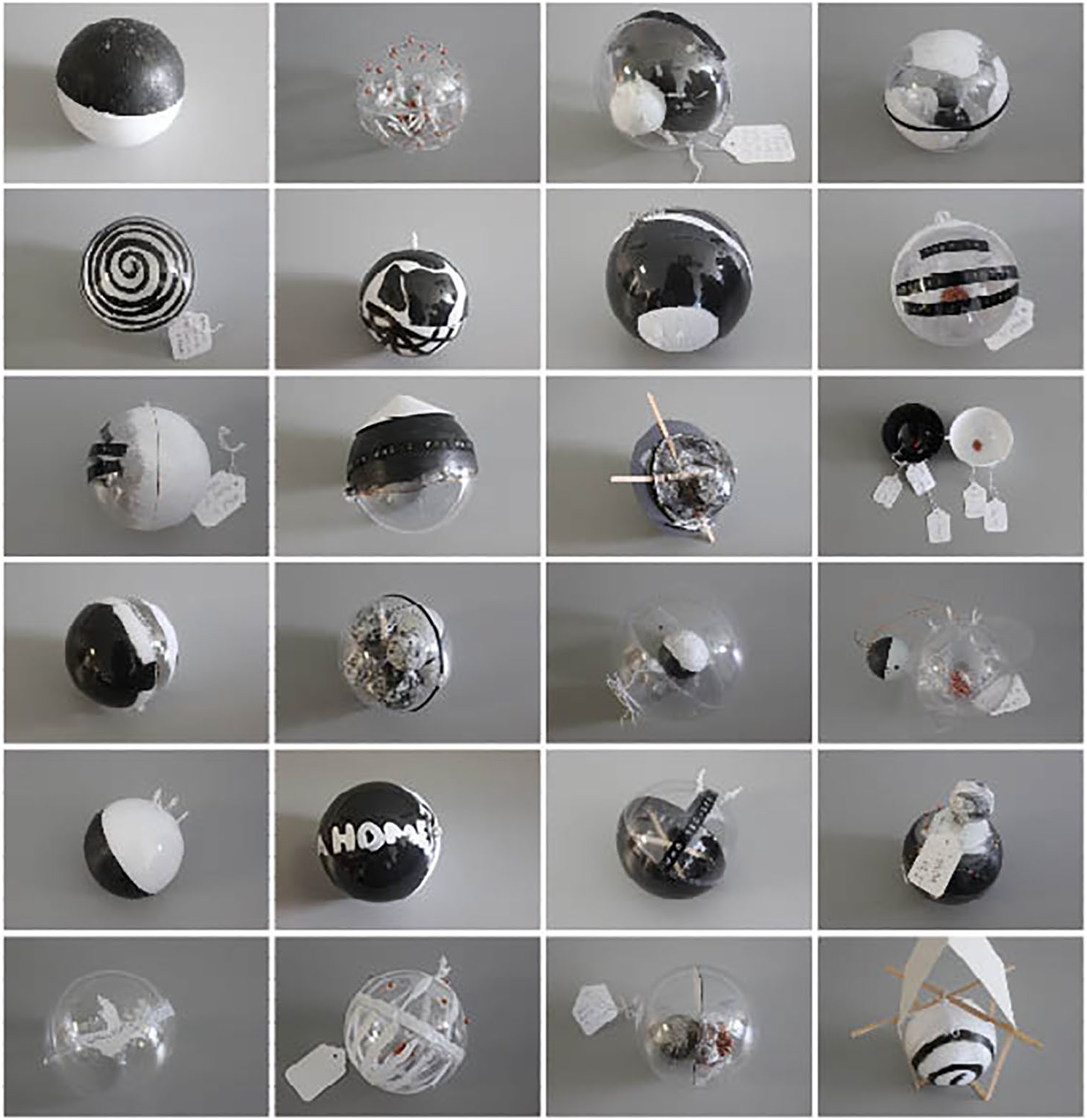
Globe making workshop, Mulberry School for Girls, London, UK, July 2016.
Home, migration and belonging
Globe’s physical form in many ways works as a kind of material articulation of Massey’s notion of a ‘global sense of place’ which invites a more relational understanding of the local as rooted but always connected to, and shaped by, multiple ‘elsewheres’. 78 Indeed, as Massey argues, far from being bounded or static, places are ‘events’ where multiple ‘spatial narratives meet up or form configurations, conjunctures of trajectories which have their own temporalities’. 79 Moreover, we argue that just as place is relational, so too are the encounters that take place within them: deeply embedded in particular spatial contexts, as well as always bearing ‘traces’ of broader relationships of ‘power and antagonism’. 80 In this section, we extend this analysis to explore the ways in which Globe’s encounters – and the encounters facilitated by Globe – have the potential to open up new understandings of migration and to capture the multi-layered, multi-scalar nature of home and belonging. Rather than thinking about how the themes of migration, home and belonging informed the content of the work, we explore how Globe’s multifarious encounters offer new ways of conceptualizing these themes and the dynamic and porous boundaries between them.
The importance of material objects in the lives of migrants for creating a sense of home in new contexts as well as creating connections with past homes has been an important theme in migration research. 81 Possessions including photographs, souvenirs or sacred objects often become, as Tolia-Kelly suggests, ‘connective markers to geographical nodes of identification. Through their prismatic nature, “other” lives, lands, and homes are made part of this one’. 82 A key theme to emerge within this literature is the ways in which objects can function as mnemonics – sensory or imaginary prompts which may conjure up a memory of a past experience, person or home. 83 Elsewhere, scholars have drawn attention to the ways in which the city, or particular urban neighbourhoods, can work as sites of diasporic memory, whereby material engagements with particular places can evoke memories of urban homes and neighbourhoods left behind, or imagined for future return. 84
Globe’s materiality is central to her encounters: as a 1-metre-high sphere she is difficult to ignore. While some people choose to cross the street or to take a slight diversion on the pavement to avoid Globe as she crosses their path, others confront her head on and either stop to enquire about this large copper ball or make a passing comment. Echoing Askins and Pain’s call for more attention to be paid to ‘the role of material objects in effecting encounters in embodied and affective ways’, 85 Globe prompts, captures and holds multiple stories of migration through her encounters. People’s engagement with Globe’s physicality – her globe-ness and her copper surface – at times conjured up memories or stories of past homes. Such was the case with two Bangladeshi men who encountered Globe in the streets of East London and were struck by the fact that she was made of copper. They took it in turns to tap on Globe’s surface and one of them exclaimed, ‘Back home people used to use copper plates, copper jars. Hindu people used to think it was good for health’.
Unlike the ‘domestic setting’ of encounter, unsettling the boundary ‘between viewer and object’ in I am Tower Hamlets, as described by McNally,
86
Globe’s encounters took place in public or semi-public spaces – primarily urban streets, and also schools, universities and museums – and inspired personal reflections on home and belonging. For one woman who encountered Globe in East London, home was the womb, while for another, home was where she will be buried: My ex-husband from Africa, Nigeria, and I lived there for five years. Wherever you are and your family are is where your home is basically. But somebody died that we knew, and I said ‘don’t you ever bury me here. I want to go home to be buried. I live here, but this will never be my home’.
As these examples suggest, Globe’s encounters in the streets not only unsettle ideas of home as ‘local and rooted’ but they also challenge a separation between public and private, home and the city 87 as people often shared their private, and often painful, stories of past and present homes. Globe encountered not only people with a wide range of experiences of migration but also people with different perspectives on migration and who has the right to belong. Asked if he considered East London to be his home, one man in Whitechapel responded, ‘No, no, this area to much Indians and Bangladeshi, I’m thinking I’m living in Bangladesh, you know what I mean’. During an encounter in Shrewsbury, a man was asked if there was anything about the area that makes him feel he doesn’t belong, to which he replied, ‘Maybe the change in population, yeah, what’s the word, different nationalities. It’s changed from predominately white to Asian, Eastern Europeans. You feel like a minority’. While Valentine (2008) critiques the ways in which discussions of public encounters often mask more negative feelings felt towards those perceived as other which, she argues, are often ‘only allowed to leak out in “privatized” spaces such as home’, 88 Globe’s physical presence allowed these ‘private moralities’ to surface in the more public spaces of the street.
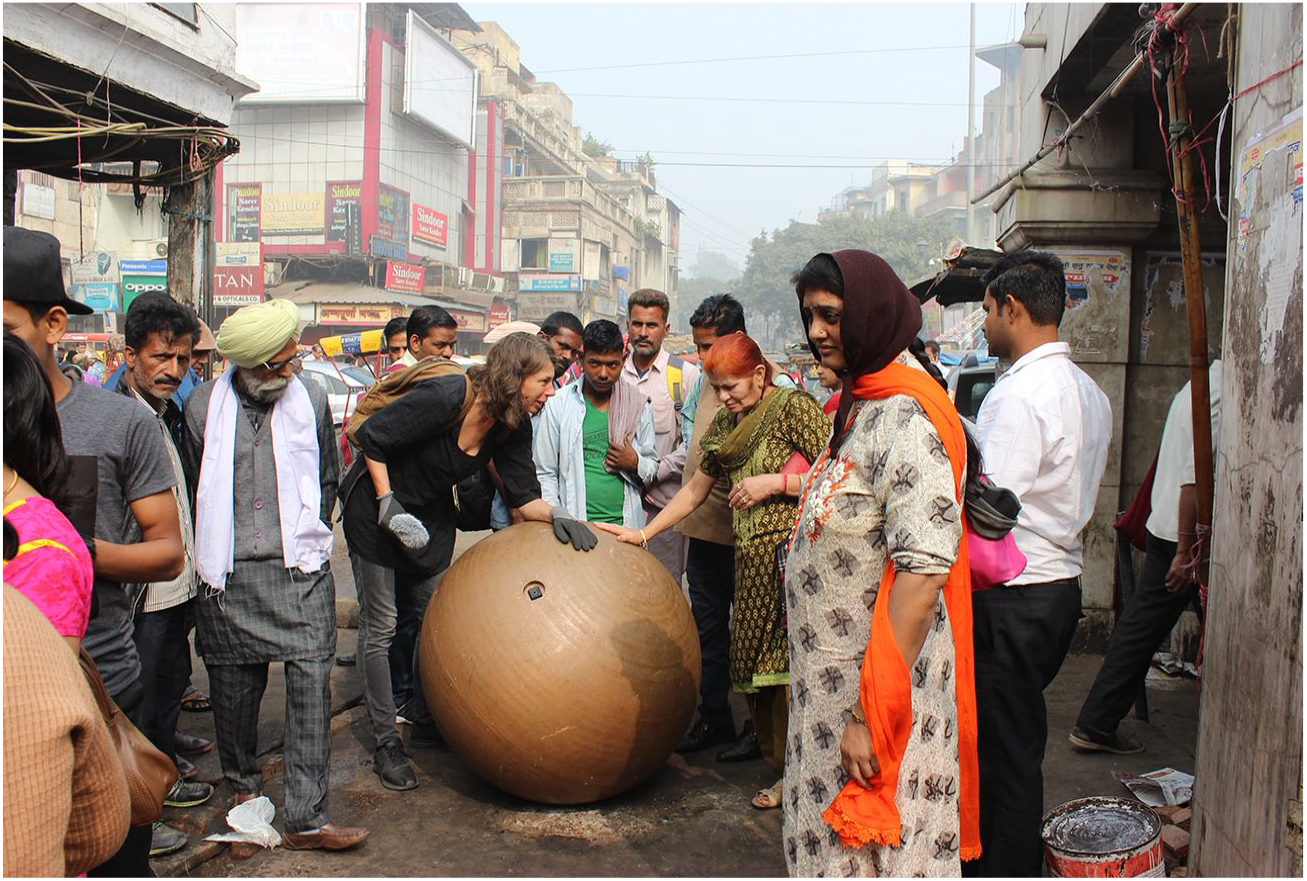
Globe, Old Delhi, India, November 2017.
The girls at Mulberry School responded to the question ‘where is home?’ through the creative process of making their own globes, with recurrent themes revolving around the relationships between home and migration, home and (in)security, and home on different scales, including the nation and the wider globe. As one girl explained, If you think about it, as humans we’re not used to staying in one place . . . But to say a country is my home – [it’s] not really your home because you don’t really own a country . . . If there’s wars going on, you don’t exactly feel like that’s your home.
Another girl reflected on the relationships between home, migration and borders: I was thinking about where is home if you are the immigrant? There’s an invisible borderline between the western side and the eastern side of the world and because black and white make grey I thought this would be how miserable the world is.
Contrasting the ‘darkness’ of displacement and alienation with the ‘purity’ of the sense of freedom at home, another girl described how she created her own globe: One side is the darkness, there’s a cage with a rope around it, the side where how it feels when you are away from home and people. The other side is more pure. There’s people and it’s more free. It’s how you feel when you are at home.
As Globe was rolled through Whitechapel on her way to Mulberry School, she encountered David Fertig, a 93-year-old who had left Germany on the Kindertransport in 1939. David was visiting the area with his son and was standing outside the house where he lived when he first arrived in the United Kingdom. David tapped Globe and explained that ‘It was only after Kristallnacht the British Government agreed to take over some children. Before that as a Jew you could leave Germany but you couldn’t find a country to take you in’. This encounter forms the closing sequence of the film ‘Here be dragons’ and also inspired a new film by Janetka called ‘Fertig’ (2017) as part of the QMUL CritiQues project on ‘Home for refugee children’. In the former film, we hear David’s voice over the rolling footage of Globe as she rolls past his first home in London: ‘I think the world has not learnt anything and I don’t think they ever will’. This encounter took place in the context of the current Conservative government voting to close the Dubs scheme, 89 with the intention of limiting the number of refugee children allowed into the country. This encounter – and its filmic portrayal – was spatially and temporally loaded, capturing memories and emotive ties to people and places as well as predictions and future ideas. 90 It opens up connections between past and present, between ‘here’ and ‘elsewhere’, and between a personal and traumatic history of migration and wider historical and contemporary contexts of power.
VII
It’s the day of the EU referendum. We pass a group of students wearing Vote Remain t-shirts waving Euro flags – a circle of 12 gold stars on a blue background. We have left the boundaries of the university campus on Mile End Road and a group of teenagers take a strong interest in the copper sphere crossing their path.
‘Home is the area we live in; a place where we feel wanted’.
The conversation is coming to an end and we start to go our different ways. I can see one of the boys still staring intently at Globe.
‘How did you build that then?’
I explain the back and forth process of annealing, spinning, forming and pressing the metal over a wooden hemisphere; how the metal is heated and shaped as the tool on the lathe presses against the hot surface forcing it to distort as it spins.
‘How did you know it would be thick enough? What if you rolled it and straight away it was too heavy and it collapsed?’
Conclusion
Globe has not only inspired but also been produced through multiple encounters with people and places. Exerting what might be described as a gravitational pull, Globe’s physical presence has drawn people to her, often then to engage in conversation about home, migration and belonging. Our understanding of Globe’s serendipitous and planned encounters extends broader debates about encounter in three main ways. First, Globe’s journeys generated ‘meaningful content’ beyond an aesthetic moment of interaction by inspiring people to share stories, ideas and reflections on home, migration and belonging through their encounters with her. At the end of one conversation about home, security and insecurity, for example, a woman asked what Globe was ‘supposed to do’. Janetka replied that, ‘she just did what she is supposed to do’. Second, Globe’s encounters were prompted by curiosity, often sparked by her materiality, mobility and ‘globe-ness’. Bringing ideas about curiosity and encounter into dialogue with each other is a productive way of thinking through the spaces, practices and socialities of both, whether in serendipitous or more planned contexts. Third, rather than merely act as a prompt for people to reflect on home, migration and belonging, Globe herself has been marked by her own journeys and encounters, reflecting their unpredictable and often transformative nature. In each case, Globe both responded to but also extended ideas about globality. In contrast to an Apollian view of the globe as an object of distanciated visibility and control, Globe was created as an unmarked sphere, designed to be rolled, and to become inscribed by her journeys and encounters. Finally, Globe not only contributes to the small body of artwork that involves rolling a spherical object but also extends and advances wider debates about participatory arts practice and its potential for enhancing geographical research, in particular in relation to questions of home, belonging and migration. People’s curiosity about the ‘globe-ness’ of Globe revolved around her materiality, mobility and what she might represent, and inspired engaged, tactile and often intimate encounters with her. As a globe with no delimited landmasses, borders or lines of longitude or latitude, Globe facilitated conversations about the security and insecurity of home, the presence and absence of borders, and the personal stories and wider politics of migration, inclusion and exclusion. At the same time, Globe herself was touched by many hands, recorded her encounters, and came to be marked by each of her journeys. Her ‘globe-ness’ was produced in part through rolling, her surface – like the people she met – becoming marked by traces of her past and present journeys and encounters.
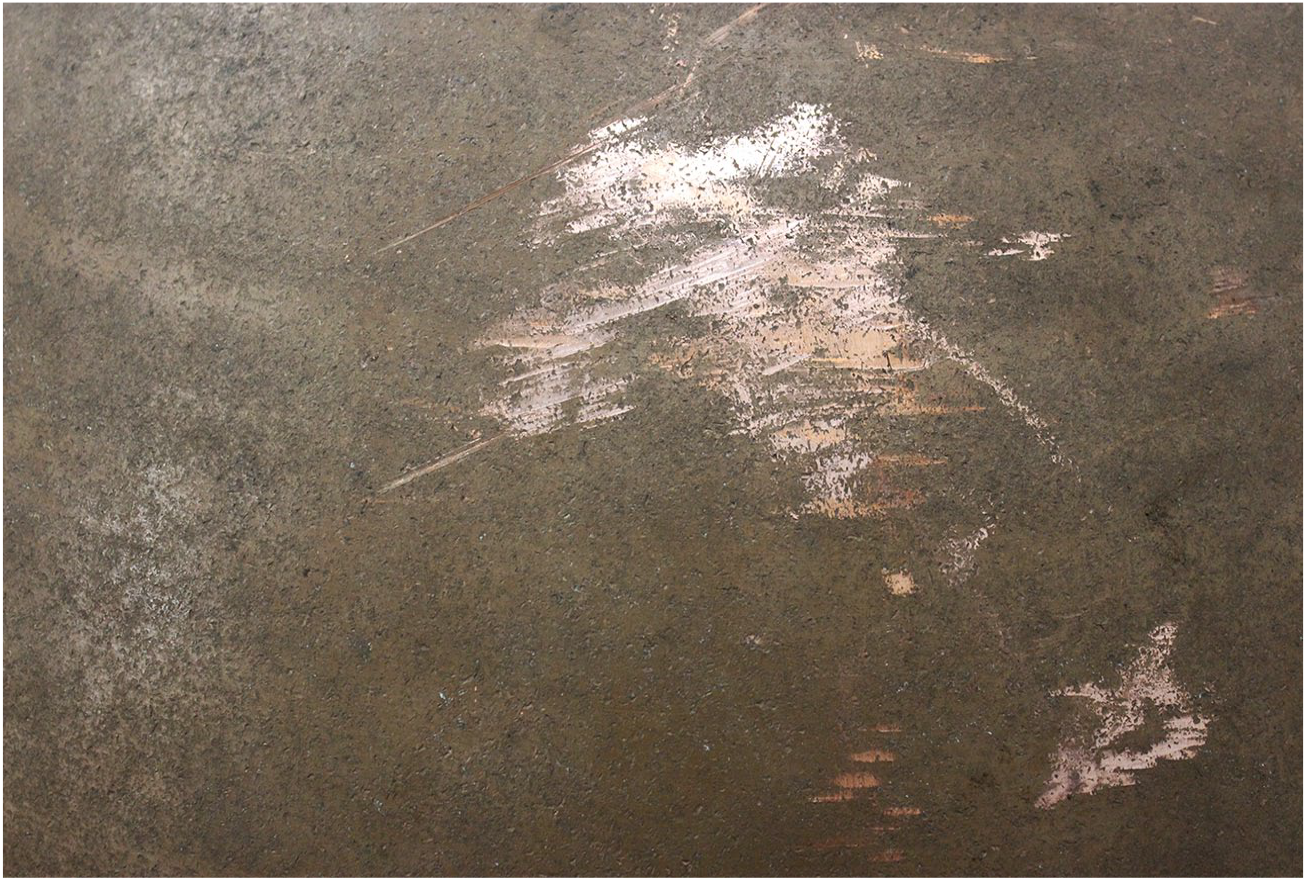
Close-up of Globe’s surface, May 2018.
VIII
Globe’s customized timber crate has noticeably darkened. Its exterior is now adorned with new stamps, a mysterious set of footprints and paperwork declaring her ‘TEMPORARY EXPORT’ status has now been changed to ‘IMPORT’.
I unscrew the lid.
I run my fingers through the thick layer of dust that has accumulated on her surface in the 5 months she has been detained at Delhi Customs. From her axis run newly formed longitudinal lines of green patina.
Globe is back.
Footnotes
Acknowledgements
The authors would like to thank Jen Harvie, Bridget Escolme and Jayani Bonnerjee for their insightful contributions to discussions of the Globe project, and John Wylie and two anonymous reviewers for their useful comments on drafts of this article. The authors would also like to thank Mulberry School for Girls, the National Maritime Museum, the Royal Geographical Society (with the IBG), the Tate Exchange and O. P. Jindal Global University for hosting Globe and extend their thanks to Lee Wildman, Shrewsbury Museum and Art Gallery, The Geffrye Museum of the Home, Torridon Primary School (London) and Nahra School (Haryana, India).
Funding
The author(s) disclosed receipt of the following financial support for the research, authorship and/or publication of this article: This study was financially supported by the Leverhulme Trust, Arts Council England, QMUL Centre for Public Engagement and QMUL Schools of Geography and English and Drama.
