



Abstract
Indigenous research has demonstrated how Indigenous ontologies are political and how they have been articulated politically to express counter-narratives to modern understandings of human–nature relations. This article argues that current characterisations of political ontology, particularly in relation to environmental conservation, have yet to fully take account of African Indigenous spiritualities. Current thinking on Indigenous ontologies and decolonial scholarship, and their political manifestations, faces two problems: (1) they assume the visibility and availability of Indigenous ontologies to ‘doing politics’ and (2) presumptions are made about the comparability of place-based Indigenous ontologies and wider attempts to reform the state, and that the political goals of Indigenous people will straightforwardly align with those of the researcher. Drawing from research on sacred natural site protection among the Nyiha in Mbozi District, southwestern Tanzania, I examine how these problems might be addressed in a context where notions of Indigeneity are articulated quite differently to those predominantly evident in current writing on Indigeneity and decolonial scholarship. Nyiha ontologies, although already-political at the local scale, resist becoming ‘available’ to environmental politics at wider scales, making straightforward notions of solidarity problematic. Through a particular encounter with Christian groups attempting to spatially appropriate Nyiha sites, I explore the various ways in which ontologies are made politically available and visible and how the Nyiha analyse Christianity as colonial. Finally, I turn to how Nyiha ontologies and their sacred forest sites are replete with ‘episodes of concealing’ and variable invisibilities, which call into question how visible practices are utilised as ‘evidence-of-ontology’, or as part of a wider decolonial project.
Introduction
Indigenous ontologies of human–nature relationships, such as those expressed through ‘sacred natural sites’, have been frequently co-opted by international conservation and development institutions for the purposes of local conservation. 1 Aligning these ontologies simplistically with conservation goals has, some argue, de-politicised them. 2 Relationships between environmentalists and Indigenous people are often ambivalent at best, 3 and there is now substantial research which seeks to re-politicise Indigenous ontologies. Many of these studies emerge from the Americas and settler-states, particularly in Latin America, 4 where Indigenous movements have demanded a place for ‘earth beings’ on the political stage, and where Indigenous rights are being bolstered, although not unproblematically, in a range of contexts. 5 Blaser 6 has called this framing of the ontological turn ‘political ontology’.
I argue in this article that current characterisations of political ontology, particularly in relation to environmental conservation, have yet to fully take account of African Indigenous spiritualities. Re-assessing political ontology from this perspective questions the ways in which ontologies are made visible and available, and interrogates how such ontologies are articulated as political towards the state, or might be aligned with the solidarity politics often sought by decolonial and Indigenous scholarship. This article therefore draws from the crossing of parallel and overlapping bodies of writing: the ontological turn, Indigenous research, decolonial and decolonising scholarship, and research on witchcraft, spirituality and sorcery in Africa.
Two problems for political ontology and decolonial scholarship
Attempts to politicise Indigenous ontologies and democratise environmental conservation emerge from the broader intellectual development of the ‘ontological turn’. 7 For some, the crux of the ontological turn concerns the place of other ‘worlds’ in the apparent single-world of Western relational/materialist ontologies. 8 Although there are some notable congruences between relational and materialist theories and Indigenous ontologies, such as understandings of nonhuman agency, 9 in Western materialism and relationality, the ‘stuff’ of spirituality is neglected. The ontological turn in anthropology and human geography, alongside Indigenous scholarship, instead assumes a starting point of there being ontologically distinct worlds which do not necessarily have unmediated access to each other, 10 and where spiritual matters are taken seriously.
Some decolonial and Indigenous writers have alternatively argued that ‘ontology is just another word for colonialism’, 11 a continuation of colonial violences whereby professional researchers persist with speaking for Indigenous peoples, imposing categorisations from elsewhere, 12 when in fact many of the insights of the ‘ontological turn’ (e.g. nature-culture synergies) should be credited to, and are better articulated by, Indigenous peoples. 13 In this sense, the ‘ontological turn’ facilitates the continued exploitation of Indigenous peoples. 14
A more sympathetic reading of the ontological turn is as an (imperfect) attempt at doing decolonial scholarship, supporting rights to ontological self-determination and articulating alterity so as to trouble knowledge production and wider power structures. 15 Others argue that decolonial theory itself gestures towards ontological pluralism. 16 These readings might conclude that decolonial scholarship and political guises of the ontological turn broadly share an advocacy for the alignment between the political goals of Indigenous groups with those of the (Indigenous or non-Indigenous) researcher. This shared standpoint creates two problems for thinking about Indigenous ontologies in the African context, and perhaps beyond: (1) they assume the visibility and availability of Indigenous ontologies to ‘doing politics’ and (2) presumptions are made about the comparability of place-based Indigenous ontologies and wider attempts to reform the state, and that the political goals of Indigenous people will straightforwardly align with those of the researcher.
The problems of visibility, revealing and practice
One prominent way in which Indigenous ontologies have been framed as political is through their practices. Blaser’s 17 notion of ‘political ontology’ is grounded in the supposition that multiple worlds are produced through historically situated and ongoing practices. 18 Although the Indigenous ontological turn is partly founded on a critique of materialist writing, some have drawn heavily on theories of materiality and practice, such that ontologies ‘perform themselves into the world’ 19 as ‘place-specific practices’. 20 Along these lines, ontologies are enacted, performed and made visible for the analyst. Decolonial scholars have similarly argued that the ‘use’ of Indigenous ontologies by the Western academy erases their practices and embodied aspects. 21 Yet, the current emphasis on the practiced and embodied as-evidence-of-ontology lays grounds for the privileging of the visibility and availability of ontologies as ‘performed-in-the-world’.
The politics of Indigenous movements appears also to demand visibility. De la Cadena, 22 for example, urges that Indigenous groups must assert themselves ‘in public stages’ to make their political claims and challenge the nation state. Moves towards the observable visibilities of ontologies also emerge in writing on the geographies of religion, where some argue that spatially embodied enactments of rituals contribute to religious place-making, 23 or the spatial appropriation of religious places, 24 such that ‘belief . . . is grounded upon practice’. 25 In African settings, such as Goldman et al.’s 26 discussion of ontologies of drought in Tanzania, Maasai enact their ontology of drought through moving through space. The expectation is that ontological world-making is, and should be, made available and visible through practices.
There is a need to interrogate what this turn to practice as evidence-of-ontology means for how ontologies are articulated through a diversity of representations, not least scholarly ones. Joronen and Häkli 27 argue that an orientation towards the ontology should not only be concerned with the relationality between humans, non-humans and ‘Indigenous entities’ but also the ways in which these relationalities are revealed and structured, such that ontologies are understood as ‘events of revealing’. This conceptualisation begins to question the assumption that what is made visible in practice is what constitutes ‘an ontology’ for the analyst, but leaves open how to understand what is ‘concealed’.
These analyses seemingly bypass Indigeneity in African contexts, 28 which may explain the lack of attention to concealing. Typically, African Indigenous ontologies express a reciprocal relationship between the visible and invisible forces of everyday and wider politics. 29 In Ashforth’s 30 study of Soweto, invisible forces (ancestors, spirits and witches) are deeply embedded in everyday community life and power relations. Murrey 31 addresses the ‘diverse visibilities and obscurities that provoke distinctive modes of resistance’ in her exploration of witchcraft accusations along the Chad-Cameroon oil pipeline. Her analysis characterises the political elements of visible and invisible features of reality as a local resistance to, and a metacritique of, the ‘invisible actors’ of hydrocarbon extraction globally. In African contexts, spiritual actors transcend the bounds of invisibility/visibility, known to the world through material consequences, and being visibly available to some people, while invisible to others. There are vital tensions between invisibility and revealing: diviners, witchdoctors, chiefs and community members navigate between secrecy and disclosure in their everyday encounters. 32 This tension is also reflected in the domains in which ontologies are expressed – most commonly in the private domain, and more occasionally in public politics. 33 Invisibility also marks the nature of Indigenous entities in contexts outside Africa, for example, groups in the Philippines and India relate to invisible forest-dwelling beings. 34 If political ontology hinges on the visible and embodied practices of revealing, how can invisibility and secrecy be taken into account?
Some decolonial and Indigenous scholars have asked different questions about the ‘visibility’ of ontologies. If the colonial project made visible and governable Indigenous peoples and lands, 35 then to not consent to becoming visible is to deny colonial ‘revealings’. Indigeneity, as a categorical form of recognition is, as Simpson 36 puts it, ‘indebted to deep philosophical histories of seeing and knowing’. For Indigenous communities in north America, resisting this ‘seeing and knowing’ can include refusals to participate in the state, but also the refusal to participate in practices of knowledge production. Simpson 37 speaks of her own ethnographic refusal to tell of the internal struggles of her community: to not speak is to retain a dominion over representations that emerge from events. These refusals actively move away from forms of recognition offered by the state, 38 which speaks to a need to consider how and why ontologies are made available (or not) to politics across scales. However, Ortner 39 argues that taboo’s around analysis of the politics of Indigenous or Subaltern groups reifies romanticised forms of resistance and sanitises internal political complexity and cultural authenticity. Ortner 40 also warns against analysing ethnographic refusals, or ‘invisibilities’, as acts of resistance, when such refusals may be an analytical byproduct. In the African context, if ‘it is from the essential secrecy of witchcraft that arises its most significant powers’, 41 then ethnographic refusal may too be embedded in Indigenous spiritualities.
Nasady 42 argues that Indigenous peoples may only be comfortable in revealing experiences when they know such episodes will be analysed on their own terms. Addressing Indigenous people’s own analysis has a long-standing precedent in anthropology. What their own analysis is may not be what is practiced and therefore observable to the analyst, although, of course, such analysis may be highly practical. Later, this article will explore how the turn to practices risks making an ontological claim about how ontologies are evidenced through the visible, observable and accountable.
The problem of place-based Indigenous ontologies, solidary and scale
If ontologies are political, how has the political been conceptualised in relation to ontologies? How have ontologies been articulated politically, and at what scale? The political engagements that have informed conceptualisations of political ontology have largely been between those of Indigenous movements and the ontology of modernity associated with the state. 43 This makes considerable sense in the Americas, where the ‘modern contract’ of inclusion still does not tolerate Indigenous ‘ways of being’, 44 and Indigenous demands for self-determination explicitly question the state, as do Indigenous scholars. 45 Nonetheless, there have been some explicit connections made between everyday realities and national politics. 46 Nasady 47 details how Indigenous individuals have significantly different opinions on acts such as wolf killing, which are not articulated in wider struggles over environmental and land sovereignty. Yet even where everyday politics are explored, Indigenous analysis remains commonly articulated as critique of state or global powers and ongoing settler colonialism. 48 At wider scales, Indigenous transnational movements have demonstrated, to some, that Indigeneity offers space for political action in contexts where previously it has not. 49 There is an imperative that Indigenous political ontologies can, and should, be mobilised at wider scales, especially to reform the state.
Theorisations of political ontology have emerged from a focus on Indigenous struggles that oppose settler-state oppression, and this leads to a particular formulation of how scholars represent Indigenous ontologies. Although many writers are careful to avoid romanticised articulations of Indigeneity, there is a solidarity politics associated with expressions of ontological difference. Sundberg 50 advocates for ‘walking with’ Indigenous groups in pursuit of shared political goals. 51 Similarly, de la Cadena 52 argues for the building of alliances between environmentalists and Indigenous politicians. These positionings make the researcher a ‘scholar-activist’, such that attending to the political in Indigenous research becomes normatively associated with solidarity politics. Decolonial writing has, at times, normatively aligned Indigenous resilience and caring kin and human–nature relationships with progressive anti-capitalist politics. 53 Indigenous peoples are frequently enlisted as allies in environmental struggles, yet for every productive alliance, ‘there is a matching horror story, a story of misunderstanding, and of conflict’. 54 Murrey 55 suggests that the scholar-activist engaged in a ‘politics of compassion’ risks reproducing victimhood and marginalisation, and that a decolonial research ethic should seek to move beyond this.
The adhering of Indigenous political ontology towards state reform, and in solidarity with environmentalist and anti-capitalist struggles, becomes unstuck in African contexts. First, the term ‘Indigenous’ is often used with caution. In Tanzania, discretely identifiable tribes did not exist as is commonly assumed, instead there were a series of ongoing social and political re-organisations. German and British colonisers partially reorganised groups into ‘tribes’ for the purposes of administration and later indirect rule, but in the post-colonial state the nationalist project viewed tribal identities as counterposed to a ‘Tanzanian’ identity, partly formed around the national language of Kiswahili. 56
While the settler societies of the Americas and Australasia are engaged in ‘the ongoing work of settlement’, 57 in post-colonial states such as Tanzania this might be better characterised as the continued echoes of the colonial project. 58 Here, Indigenous groups may not be articulating their ontologies directly in opposition to a settler-state, but instead continue to face erasure from the legacies of colonialism, and the ‘developmentalist’ project which straddles the colonial and independence eras. 59 The colonial bifurcation of rule, between the law of the state and its ‘citizens’, and ‘customary’ authority, has echoes in the continued separation of local village elders and elected village governments, begun under late-colonial rule in the 1950s and finalised by the independent state in 1963 when ‘Native Authorities’ were abolished. 60 Similar trends are also seen in other post-independence states, such as Mozambique, where discourses of development and modernisation marginalised ‘traditional’ ontologies. 61 The missionary work of major religions also continues in both rural and urban contexts, while the educated elite of Tanzania are disproportionately made up of Christians, making the articulation of Indigenous ontologies at the state level difficult. 62
Indigenous ontologies in Africa have an ambiguous relationship with wider politics, making assumptions about ‘solidarity’ in a wider political project problematic. Although it has been well documented that occult ontologies have thrived in modernity, such ontologies do not have a straightforward relationship with power and politics. 63 Sorcery, witchcraft, and the invisible powers of African Indigenous ontologies can be linked to wider political forces, but sit equivocally alongside the solidarity commonly advocated by scholarship on Indigenous ontological politics. For example, Thornhill 64 examines how witchcraft accusations in Liberia are leveraged at political actors, associated as they are with child rape and ritual bloodlust. For Ngozi spirits in Zimbabwe, often (mistakenly) named ‘vengeance spirits’, Jeater and Mashinge 65 argue that while such spirits do harm individuals, they are equally associated with community healing. In some contexts, there is no simple distinction between Indigenous ontologies and ‘imposed’ ones. As Storer et al. 66 find in the Uganda/South Sudan borderlands, while sorcery via poisoning is still common, violence against perpetrators has been replaced by ‘modern’ collective voting. Inter- and intra-community and individual violences are embedded in witchcraft practices or may reify wider violences associated with capitalism. 67 Ultimately, ontologies inclusive of witchcraft can be paradoxical and ambivalent to the categories of ‘resistance-activism’ sometimes thrust upon other Indigenous ontologies.
Walking with Indigenous groups risks becoming the ‘idealised resistance’ 68 that many scholars are at pains to avoid, while framings of political ontology as Indigenous-versus-nation state risks a normative formation of the scalar politics at which ontological debates can take place. What is striking about the examples presented above, and from what I will discuss below, is how Indigenous ontologies may, in places, resist romanticised notions of solidary politics and, variably, resist becoming available to particular articulations of ‘the political’ at different scales. There is a second danger, that in aligning Indigenous ontologies with resistance to the state, what might be glossed over is how certain ontologies have come to be with regard to their own analysis of other ontological positions, or how they analyse ‘other’ worlds.
Methods
This article is based on research conducted in 2015 in Mobzi District in southwest Tanzania. The study focused on the role of sacred natural sites among the Nyiha tribe. The landscape of the region is characterised by undulating hills and plateau highlands, dissected by the rift valley. The land is relatively fertile, with native vegetation characterised by miombo woodlands and wetland forest along rivers. Although the Nyiha people might be regarded as the ‘Indigenous’ inhabitants of the Mbozi District (with the caveats discussed above), the area became ethically plural in the 1920s with immigration from other tribes in search of work on growing agricultural estates.
Six villages were part of the study: Ilembo, Hasamba, Malonji, Namwanga, Ipapa and Masoko (Figure 1). The methods were ethnographic and qualitative, including nine field site tours with chiefs around spiritual sites, three interviews with local environmental officials, 28 in-depth interviews with local people from the villages, including elders, which focused on spiritual protection of natural sites. In four of the villages (Ilembo, Hasamba, Malonji and Namwanga), focus groups were conducted separately with men, women and young people, featuring participatory mapping of sacred sites. A total of 66 adults took part, 35 men and 31 women, and 16 young people. I was accompanied throughout by a research assistant who is of Nyiha descent, who grew up in the area, and whose family remains in Mbozi. The research assistant facilitated with interview translation (in Shinyiha, the Nyiha language, or Kiswahili), and with initial analysis in the field. Through a decolonial lens, this relationship and mode of interpretation may still be problematic, given the positionality of myself as a White, male researcher from elsewhere, even if mediated through, and guided by, a researcher with greater connection to the participants.
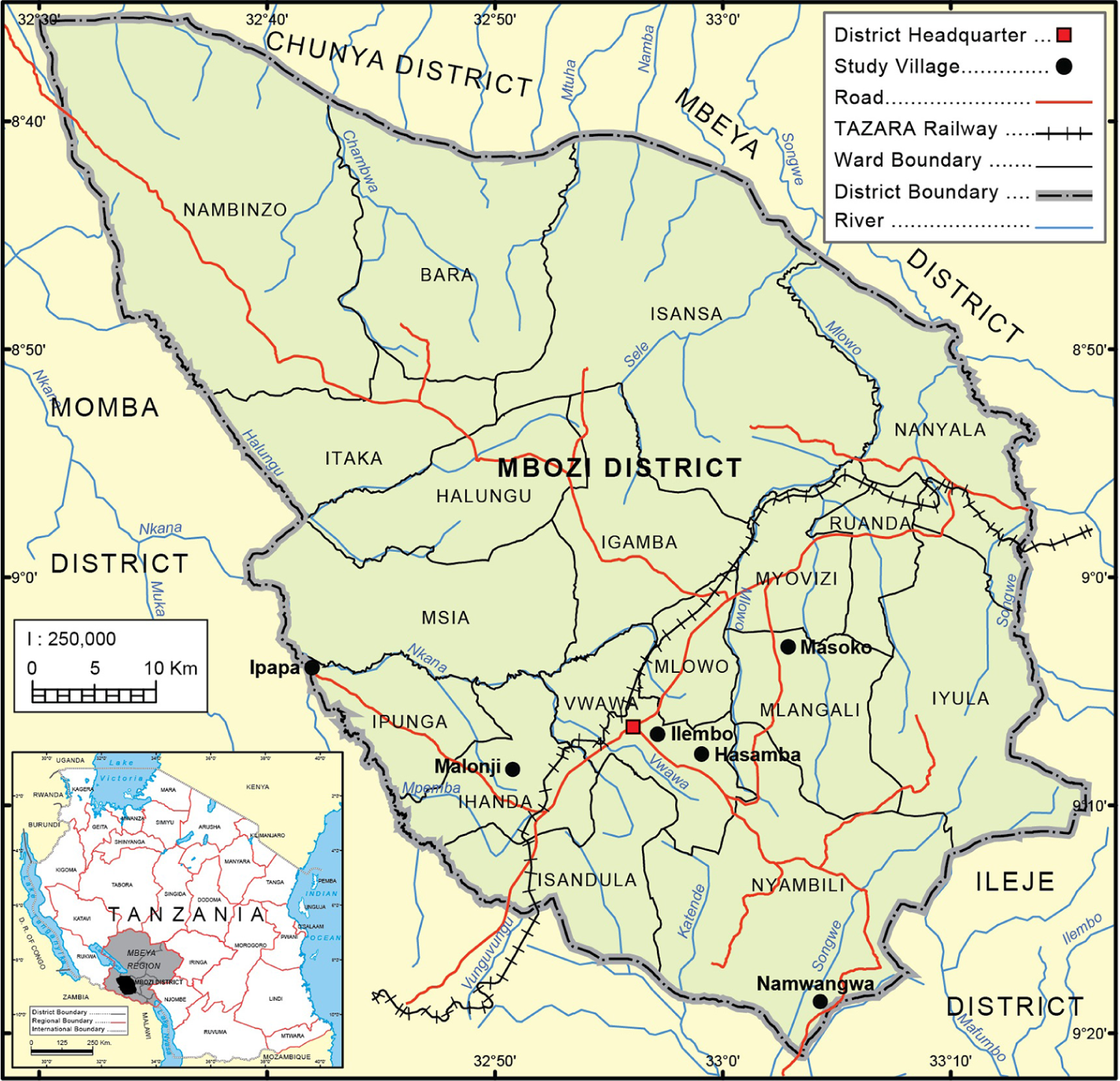
Map of Mbozi District, showing location of six village sites.
The study found that sacred natural sites are significant in this region. Natural sites are protected by villages because they are associated with past-chief’s, or ancestral burial site, and these sites can range from a single tree or small grove, to a 70-acre forest. The number of sites associated with each village varied from 4 (Ilembo) to 14 (Malonji).
Setting out: an ontological politics of the local
Nyiha ontologies include a god (Mulungu), spirits and ancestors, to whom villagers pray and make sacrifices. Local chiefs and elders play an important role in rituals, and prior to and during the colonial system, chiefs, elders and kinsmen provided village governance, with chieftainship passing down through a male lineage. Although chieftainship was abolished after independence, replaced by elected village councils, the position of chief is somewhat retained as a symbolic spiritual leader, along with their spiritual governance over sacred natural sites.
To protect forests that contain sacred sites, chiefs can call snakes to ward off intruders. These snakes embody the spirits of ancestral chiefs often buried at the sites. Protecting the ancestors-as-snakes involves maintaining their woodland habitat. Local people feared to clear or encroach on forest sites because if the habitat was destroyed, then the snake and associated spirits would move to another area, causing problems for the village, such as with rainfall. The chief and elders retain the authority to allow or deny access to forests, but this authority is fundamentally that of the ancestors with whom the chief acts as an intermediary. Entering sacred sites without permission will result in misfortune occurring in the forest, and examples included the chief calling on snakes to attack people, or other frightening, mysterious happenings, such as woodcutters being cut by their own axe, or those penetrating the forest becoming blind, lost in the forest or seeing unusual things. For example, In the forest, if you don’t have permission, the spirits make these people disappear. The people get lost, they are blinded, and they can’t see their way out . . . they can just be roaming around inside . . . Although it is not a very big forest, they can’t see where to go (Chief, Ilembo) If you go into the forest without permission, you might see a white chicken which can disappear immediately, or a big snake – you might see it and then it disappears . . . that kind of disappearance is what frightens people, it’s unusual. Seeing the chicken in the thick forest is one thing that would make you wonder, where did it come from? But then when it disappears you would become frightened. (Local Healer, Ipapa)
While across the six villages these spiritual ontologies had similarities, they operated in a world of multiple ontologies at the local scale. Ancestral chiefs-as-snakes would, for example, appear in disputes between villages: The other village from Ileje district were claiming to own some of the forest in Mobozi district. Those from Namwanga and the other place met at the boundary, to see who owns the forest. When they were discussing, all the elders from the other village found snakes in their pockets . . . they were frightened and started to run . . . That’s one of the powers [the chiefs] use to . . . protect their territory. (Village Chairperson, Namwanga)
The two villages in this dispute were of the same tribe, Nyiha. That the chief of Namwanga could call upon ancestor-snakes in this forest certifies the claim that the forest belongs to Namwanga, because the ancestors of Namwanga reside there. Similarly, several interviewees recounted that it was not always possible for incomers to adopt the local ontology, including from other tribes, but also Nyiha people from other villages: For incoming tribes, who are migrating to these areas, sometimes they do not respect [our rituals]. For example, the one who is buried here is from our village, but if I am from a different village, I cannot kneel down around the grave . . . so it is forbidden to take part in these rituals. (Chief, Ipapa)
While there are similarities between the ontological worlds of different Nyiha villages (ancestral burial, chiefs-as-snakes and forest site protection), in other respects each village, with its own spiritual world, and drawn across a particular territory, has its own partially exclusive, place-based ontology. The spiritual and material clash between villages, as well as the ongoing inaccessibility of local ontologies to incomers, attests to multiple ontologies at the local scale, and an already-political framework of Nyiha worlds. The Nyiha, for as long as they have been in Mbozi, have lived in a world of locally multiple ontologies, where the spiritual, political and ecological are entangled. The political dimension to these ontologies historically extends beyond conflict between local villages: During the Ngoni
69
invasion, our people were scared and hid in this forest. So we believe that the spirits protected us in the forest during this time, and because it is a very thick forest we believe that the spirits are also here, and were protecting them. (Chief, Ilembo)
Other-worlds, other-ontologies and the conflict between these and the Nyiha are therefore deeply implicated in the foundation of particular forests as spiritual sites. Here, protection from the spirits in the forest, against the intrusion from the Ngoni, established this forest as a spiritual site, making historic tribal conflict significant for the place-based establishment of Nyiha ontology.
Unlike much of the emphasis from research on ontological politics in North and Latin America, 70 which has focused on Indigenous ontologies as opposed to those operationalised by international, state and non-governmental organisation (NGO) actors, in Mbozi there is a historic and ongoing ontological politics operating at regional and local scales. Yet, it is not only a politics of everyday social mediation, as previous studies of witchcraft and sorcery have stressed, 71 but an ontological politics embedded in place-based spatial and spiritual organisation. The boundary dispute between villages, and between Nyiha and other incoming tribes, described above as historical examples, is now rare. More frequently, the role of chiefs and ancestors in protecting local forests becomes relevant when local farmers encroach on spiritually significant woodlands. Several chiefs argued that they are increasingly ignored by farmers, either because they are incomers or because they have converted to Christianity, and no longer respect the chiefs’ rule in determining forest boundaries. This is compounded by the fact that chiefs have been supplanted by local village governments and are no longer the authority over the extent of agricultural land.
The ontology in which the chief is a mediary between ancestors and the village is politically at odds with the democratic system of elected village leaders. The ontology of the Nyiha is already-political in its tie to the chieftainship system, already-political in the multiple ontologies between villages and tribes and ontologically political in the disjunctures in authority between chief and village government. While the protection of sacred natural sites associated with Nyiha ontology offers ecological protection within its earthly political manifestation, it is precisely the already-political nature of the ontology which makes any form of walking with, 72 or solidary, problematic, given that chieftainship denotes an undemocratic, patrilineal politics. Political ontology, to adopt Blaser’s 73 term, here acts at a scale within the village itself, between villages and tribes and between forms of political authority at these scales, not between an Indigenous group and an outsider, settler authority as such, or rather mobilised nationally as opposed to other ‘global’ or ‘national’ ontologies, such as conservation science. Yet, that Indigenous ontologies are not mobilised nationally in Tanzania itself reflects that such spiritualities remain antithetical to the nationalist identity politics of the developmentalist post-colonial Tanzanian state, 74 further complicating representation at wider scales.
At the hilltop: Nyiha analysis of colonial Christianity
Within the territory of Malonji village, there is a prominent hill standing out from the surrounding plains, visible from the main highway west of Vwawa town. The top of the hill, and various places around the hillside, are sacred sites, such that the forest covering the hill is protected by various spiritual prohibitions.
The hill is only occasionally visited for ritual purposes. Two of the Malonji village elders took me to the hillside to replicate the typical ritual. The ritual journey begins in the village. Normally in times of trouble, such as drought, an elder touches a tree to decide whether they should first perform a ritual on the hill: To decide if we should go, I ask if I should slaughter a chicken or not? So I touch the branch like this, and then if we are going to slaughter a chicken it will split in two. If it does not split, we have to postpone the journey. (Elder, Malonji)
A group then make their way to the hilltop, which they pass over, dropping down to an ancestor’s burial site near a water source. They bring an animal to slaughter, and in doing so may ‘see things that are unusual’ or ‘see magically’ (Elder, Malonji). Sometimes the animal might go missing, and they hear a dry tree rustling or a branch breaking. Once the animal is slaughtered, they traverse the hillside to a rock outcrop. This second site is significant because it is where an elder’s grandfather was able to ‘operate on himself’, cleaning the inside of his own stomach with river water, covering it again with a rope and performing other feats of a strong traditional healer. The group then return to the village and prepare alcohol, distributing a new fire to others so that they can prepare alcohol too. This is then distributed to the burial sites of other ancestral chiefs around the village.
Following the path of the ritual, on reaching the top of the hill, we came across a camp of three makeshift tents (Figure 2). There were two men staying in the tents, both were Christians who were camping over several days to pray and fast. Realising our presence, the two men appeared and engaged in a sharp and lengthy exchange with the two elders about their right to worship there. The Christian’s claimed that they have been coming to the hilltop for over a decade, some reputably travelling from as far afield as Tabora, and from other countries, including Malawi and the Democratic Republic of Congo. When asked to explain their presence, one of the Christian men stated, We are driven by the Holy Spirit. When the Holy Spirit says we should go then we come here . . . people come with very difficult problems, like when they are seriously sick. So when I am in church praying, sometimes the holy spirit can tell me to go to the mountain to pray, so that I can get answers for the disease. (Christian Pilgrim, Malonji)
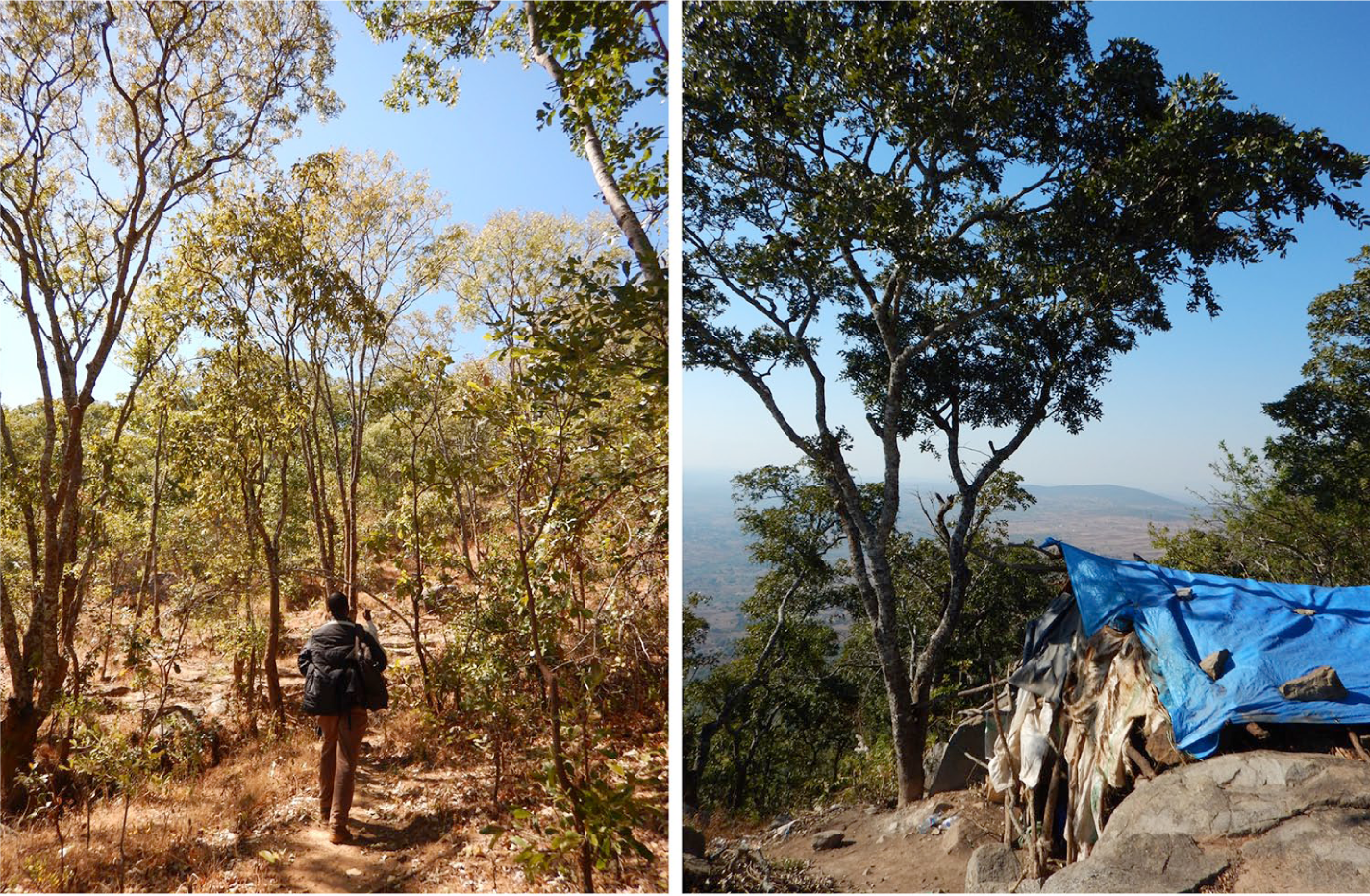
Left: The path through the protected woodland to the hilltop. Right: A Christian makeshift tent at the summit.
The village elders challenged him about his claim that Christians had been coming to the site for some time, and their specific choice of this hill, in Malonji: I have been coming here since 1946 and these people [Christians] are very recent . . . every year I bring a sheep or chicken, and every year I have not seen them, only in recent years have they started coming here . . . In this area there are a lot of hills, so why do these Christians not use any of those, they just decided to come to this hill where our people are worshipping . . . Why do they choose to use the same place for worship? . . . they decided to create these tents, so now we realise that they want to take this as their own place of worship. (Elder, Malonji)
The Malonji elder contests the Christian’s claim to this hilltop. While he does not deny the Christians will to worship at hilltop sites, he challenges their need to worship at this hill partly through positioning their choice of this hill among many others, ‘they just decided’, and, given that there are so many possible hills, ‘why do they choose’ this one. The Christians are accused of making a choice, rather than having legitimate spiritual authority to claim this site. This dispute is heightened when the elder draws attention to the increased frequency and length of time of occupation, further raising the stakes through criticising the creation of physical structures, to ‘make it their own place of worship’. Through the erection of makeshift buildings, the Christians insert an illegitimate physical practice into the place. The ontological conflict is not only one of spiritual authority, but of spatial claims to the hilltop as a place of worship. The Nyiha elders are driven by their local spiritual authority, but for the Christians this authority and claim to place comes from wider Christian discourses: In the Bible those who studied the word of God went to the hills [he reads from the bible, fetched from the tent] Then Jesus, being filled with the Holy Spirit, returned from the Jordan and was led by the Spirit into the wilderness, being tempted for forty days by the devil. For those days he didn’t eat anything, when those 40 days were up, he felt hungry . . . Even Moses was going up to the hill . . . so this is why we Christians are going to the hill to pray . . . If these villagers want to worship here, they have to create their own place of worship. God created the mountain, so we have to worship here. We are here to pray to God and all of you should feel God. (Christian Pilgrim, Malonji) These people are coming from a place where there are a lot of hills, so now why didn’t they use any of those? . . . There is not a specific place for us to worship here, and there is no evidence to prove that we have been using this as a place to worship, like the markers for the chief’s graves. (Elder, Malonji)
References to the Bible, the word of God, and ‘we Christians’, make a global claim to all hills as places in which Christians should and can pray. This global claim is then supposed as authority to a place-specific claim, to ‘the mountain’ which ‘God created’, but more so, the Christian pilgrim points to the lack of physical ‘place of worship’ as undermining any legitimacy that villagers have for spiritual worship. The elder admits that there is no physical evidence to prove their worship at the site.
This exchange takes place within the wider context of ongoing Christianisation in Mbozi and throughout rural Tanzania. A multitude of Christian denominations have made inroads into these rural communities, and almost all elders, chiefs and local people themselves felt that as Christianity grew, so local ontologies fell away. If we take these two ontologies to be defined by their embodied, world-making, place-specific practices, 75 then we might analyse the space in which politics between ontologies opens up as the visible space that both physically co-habit, 76 and, indeed, come into conflict over the legitimate practices of place-making on the hilltop. These practices evidence the visible ways that ontologies occur differently, but also suggest points of alignment, including the joint-orientation to the hilltop as a place-to-worship.
The spatial meeting point of two ontologies at the hilltop might therefore be understood as an ‘event of revealing’, 77 as two worlds are made partially visible to each other in particular articulations, such as the universal claim to hilltops because of the word of God, and the specific nature of this hilltop to the Nyiha. The way in which the place is made for the Nyiha is not through physical occupation, in part because the hilltop is only ever passed over as they walk to other sacred sites, while for the Christians occupation of space and physical building is necessary for their commitment to praying and fasting over many days. The debate itself is a visible and grounded expression of ontological questioning from perspectives of other ontologies – why is it that Christians can worship at any hilltops, but have chosen this one? Why is it that the Nyiha have never built a physical structure here? It is also therefore an articulation of different ontological understandings of other ontologies. Nyiha elders, who already live in a co-habiting world of multiple local ontologies, do not deny the Christian’s right to worship at hilltops, just not this hilltop. The Christians, conversely, through insisting that ‘all of you should feel God’, enact a universal world, alongside globalising claims to all hilltop spaces, consistent with the conversionary mission of many Christian groups.
However, to characterise this dialogue as a time- and place-specific ‘event’ displaces how such an exchange echoes ongoing coloniality. Active elimination of local ontologies (viewed as ‘witchcraft’) dates to the colonial missionary period in Tanzania. 78 Although the continued spread of Christianity in Tanzania does not straightforwardly eliminate other ontologies, as Christian groups often reproduce spiritual causality, 79 the universalised claims made here by the Christians attempts a despatialisation of place-based spiritual ontologies at the hilltop, hinged around explicit reference to the lack of universality and visibility of Nyiha ontologies. Christianity, as the colonial, universalising and despatialising religion, continues, through such episodes, the erasure of place-based ontologies like those of the Nyiha. This particular episode echoes not only the spatial appropriation of colonialism but also erases Nyiha ‘attempts to write their own histories, to claim their own intellectual and material space and to exercise dominion over it’. 80 There are material consequences of the coloniality of Christianity: The miombo woodlands are important for Nyiha ancestors, but have little relevance for the occupying Christians, whose interest is only in the hilltop itself, hence their harvesting of trees for shelter and firewood. Nyiha analysis of other ontologies is a more generous one – living in an already-multiple world of local ontologies, the existence of others is tolerable, and indeed it is not uncommon to be Christian and observe local ontologies in Tanzania 81 – but for universalising colonial ontologies, such as Christianity, globalising claims to spaces and minds are intolerant of other ontologies. At the hilltop, Christianity has been analysed by the Nyiha as colonial.
Into the woods: invisibility and concealing
Not all elements of Nyiha ontologies are revealed in practice, or visible ‘events of revealing’, which might better be described as episodes in ongoing coloniality. The hilltop becomes highly visible through its occupation by others, and the resulting conflict. Other hillside sites are less visibly available. While the rock outcrop is evidently marked by the outcrop itself, there is no visible sign that it is a site of worship. Less visible is the sacrifice site, buried well within the forest. Only these elders know where it is. While the bible is drawn upon as a visible resource by the Christian pilgrim, Nyiha elders have no such resource to display, nor do they have built structures to make visible, available and accountable to non-Nyiha, their relationship to these sites. Similarly, Nyiha rituals are typically performed under shade, as the elder described: ‘whenever we want to perform a ritual there must be shade’. In other villages, ancestors are ‘attracted to shade. They don’t stay in the sun’. Chiefs are buried in woodlands or under a tree. The connection between the presence of ancestors and shade is partially responsible for the protection of woodlands as sacred sites, and in part why the Malonji elders were so incensed to see Christian pilgrims cutting wood around the hilltop for tent construction and firewood.
Other elements of Nyiha ontologies are far less visible and available. When the elders in Malonji come to their sacred sites, they report seeing unusual happenings, but these are not available to those who are visiting: When I come here to bring the sheep, I usually see things which are unusual . . . but when we are coming like this, it is not possible to see them. (Elder, Malonji)
The identity of these unusual things is not reported to visitors, their form is vague and ambiguous. Sometimes their identity is not even revealed to the elders, as in Masoko village: When going there [the ritual site] I was seeing very strange people. If you look at them you cannot identify them, they are just coming and then they disappear right in front of me. (Elder, Masoko.)
Although these happenings occur in relation to visible and observable practices (ritual visiting and walking), critical components of these practices are unavailable, they relate to invisible, unusual experiences which do not necessarily make themselves known to others. Even when Nyiha create small grass-hut structures to mark ancestor graves, these structures mark the often-invisible presence of ancestors, hidden in the shade, only making themselves available in certain circumstances.
The invisibility of Nyiha ontologies is also evident in the ways that certain happenings are told to specific individuals. In an interview with an elderly couple, who had previously lived in Ilembo, although now resident in Vwawa town, I was told about an incident in Ilembo: There was a man raising pigs in the village. The chief told him to keep his pigs indoors because they were destructive and would damage the sacred area if they entered the forest . . . The pigs escaped and attacked one of the snakes in the forest, they ate it. When they killed that snake, one of the snakes went to the chief and told the chief that one of the other ancestors had died . . . The chief, to replace that snake, performed a certain magic. The mother of the man who lived near that forest, who had the pigs, went to collect firewood in the forest and disappeared, she never came back. They searched for her and couldn’t find her. They were fearful, and left the area. People were then fearful of the chief, that if you go to that area you will be turned into a snake. (Older Resident, Ilembo)
Later, my research assistant informed me that the couple had not told the whole story: the conclusion was far more frightening. When the man had been searching for his mother in the forest, he saw a snake appear. This snake transformed, and the head and front part of the snake metamorphosed into a grotesque version of his mother, who tried to kill him. He fled the area, and this is how the villagers knew she had been transformed into a snake.
These different recountings speak to the ways in which Nyiha ontologies are made visible, through discourses of re-telling which are altered depending on to whom they are being told. The secrecy, invisibility or deliberate absences from these discourses signal how visible practices, and the visible makings of particular places, are only the observable, available practices of this ontology, not representing in their entirety the various manifestations of absence in any particular practice or moment of revealing. My research assistants’ ability to elaborate on the Ilembo snake encounter was due to his personal knowledge from childhood, and it was likely that similar narratives we heard in other villages were only partial in their re-tellings.
Invisibility and the unavailability of worldly explanations for certain happenings play a consequential role in Nyiha ontologies, perhaps not surprising given the significance of secrecy and invisibility to African spiritualities. 82 The behaviour of animals in the forest, of white chickens and snakes mysteriously appearing and disappearing, speaks to how the conduct of spiritual beings transcends between being available and unavailable to human witnessing. Many other manifestations of Nyiha ontologies are also invisible, or occur in times and places which hide their presence from visible practice. These include the abilities of chiefs to change into a hawk and fly at night when they cannot be seen, and the burial process of chiefs, which takes place in secrecy inside forest sites. Historically, the isolation of the chief from villagers added to his mystery and was symbolic in asserting his authority. 83 Chiefs, and their actions, are therefore typically shrouded in degrees of secrecy and invisibility. While these silences and invisibilities might be read as a ‘posture of refusal’ 84 to having land put into the care of local village governments, or refusal to partake in the ‘opening up’ implicated in research, invisibilities are also integral to Nyiha ontologies, working locally between individuals and villages, before seeming to work as refusals to outsiders. The invisibility and unavailability of Nyiha ontologies befogs an interpretation of them as being ‘mobilised’ to refuse, and we return to Ortner’s 85 warning that ethnographic refusals should not always be straightforwardly read as ‘acts of resistance’.
Conclusion
If the hilltop dispute partially reveals a spatio-temporal politics of ontologies, as well as the Nyiha analysis of other ontologies, it also reveals what is made available to the political in this episode, and potentially, over longer durations of coloniality. At any episode (rather than ‘event’) of revealing, there are concurrent invisibilities, things that remain concealed and left unavailable to the political, or a particular articulation of the political which is relevant to this episode. If multiple realities are theorised to be manifest through embodied practices and discourses, 86 then what is left out is the concealed, invisible and the process through which making-invisible happens, the ongoing episodes of concealing. Concealing is not just an active process of representation directed towards ‘outsiders’, as I have demonstrated above, Nyiha ontologies are suffused with invisibilities, from hidden ritual sites, to mysterious happenings where entities shift from visible to invisible. To read Nyiha concealing as resistance or refusal risks missing how place-based ontologies integrally avoid being revealed and instrumentalised for the purposes of wider politics.
This is not to dismiss that ontologies are political. 87 Nyiha ontologies are political, but they are not necessarily always available to be assembled politically in the ways discussed by some proponents of Indigenous political ontology and decolonial activism. 88 Ontologies do not pre-exist ontological politics, they are entangled with politics at all scales, in their own making and in all their relations between humans and the world. Nyiha worlds are brought into being and sustained through place-based political relations with other local ontologies: the politics between and within villages, and re-articulated in politics, at the hilltop, with Christianity and its claims to universality, echoing a historical politics with a colonial religion. Yet Nyiha place-based ontologies, such as sacred natural sites, resist becoming available to other manifestations of the political at other scales. Notions of ‘walking with’, 89 or state-versus-Indigenous or national and international attempts at forest conservation around such sites 90 seem inappropriate in this complex and partially concealed place-based politics. Various projects demand the visibility of Indigenous ontologies. 91 In Tanzania, asserting Indigeneity on the ‘public stage’ works against the post-colonial, nationalist state project of Tanzanian identity and the concealed nature of Indigenous ontologies themselves. It is the existing politics of Nyiha ontologies that appears to resist availability to the kinds and scales of political ontology foregrounded elsewhere. 92 Ontologies do not therefore wholly ‘give’ themselves to the political or to the analyst.
Calls to take Indigenous ontologies seriously as part of the wider decolonisation project may therefore involve acknowledging the unavailability of ontological politics to attempts to theorise political ontology, particularly at the scale of state-versus-Indigenous. This is not to suggest that there is no scalar politics at stake beyond the local: the role of Indigenous ontologies in contemporary Tanzania (and other African nations) remains somewhat politically taboo, as Indigeneity runs counter to post-independence nationalism.
93
It is this taboo that emboldens the ongoing coloniality of Christianity. Rather than make ontologies available to the political, decolonial scholarship may instead approach concealing with some caution. Decolonial writing has established that Western modes of data collection and interpretation, including those employed in this article, are limited in their dependence on ‘events of revealing’,
94
just as I have critiqued certain manifestations of political ontology for their reliance on visible practices. The concealings of Indigenous ontologies in Africa are an ongoing challenge to decolonial scholarship’s aim of reforming knowledge production. Creative engagement, such as Mosurinjohn’s
95
discussion of contemporary museum pieces designed to critique the racist ideologies of object exhibits from colonised peoples, or of collaborative Indigenous-researcher writing, such as that of Bawaka Country,
96
offers alternatives which might address concealing without assuming the need for public revealings. Concealing should not, always, be read as acts of resistance or refusal and should not preclude analysis of the politics of place-based ontologies, but this analysis could be re-orientated to their analysis. Facets of Nyiha ontologies are revealed and concealed, made invisible or visible and it is the analysis of Nyiha people themselves that is also the episode of concealing: You might see a white chicken which can disappear immediately.
Footnotes
Ethical Approval
This research was conducted in line with the ethical approval procedure at Cardiff University. Research permissions were gained from COSTECH in Tanzania and at relevant local authorities.
Funding
The author(s) received no financial support for the research, authorship, and/or publication of this article.
