



Abstract
Gentrification studies have well-documented how gentrifiers’ alternative consumption practices of seeking ‘authenticity’ lead to retail gentrification. However, they pay scant attention to the paradoxical subjects of gentrification who continue to take part in gentrification by consuming authenticity, even as they criticize the gentrification-driven loss of authenticity. Drawing upon Lacanian psychoanalysis and ethnographic research in one of the gentrifying neighborhoods in Seoul, South Korea, this article demonstrates how the fantasy of authenticity sustains this paradox while facilitating the continuing retail gentrification. As part of the process, various subjects of gentrification name the neighborhood differently – Seochon and Sejong Village – and claim that their own name is more authentic than the other. In and beyond this toponym debate, the fantasy of authenticity allows the subjects to constantly cross the borders of authentic/inauthentic and gentrifier/gentrified, and thus, reinvest their endless desire for ‘something more authentic’. Ultimately, by bridging psychoanalysis and gentrification studies, I argue that we, as the subjects of gentrification, should bear responsibility for our compelling desire for and fantasy of authenticity to challenge the cycle of the ongoing retail gentrification.
Introduction
Since David Ley 1 underscored cultural dimensions in gentrification by focusing on the choice and agency of consumers, gentrification literature has frequently employed the concept of authenticity to explain gentrifiers’ preference for old, humble, and underdeveloped urban neighborhoods 2 and their practices of commercializing and excluding original communities. 3 In the same vein, emerging retail gentrification studies habitually use the adjective ‘authentic’ when they describe middle-class, bohemian, or hipster gentrifiers who seek ‘alternative consumption possibilities’. 4 As tasteful consumers, these gentrifiers tend to eat exotic foods, 5 drink craft beers, 6 and live and hang out in old neighborhoods 7 in pursuit of an experience of authentic urban life. In these typical narratives of retail gentrification, gentrifiers are reduced to their shared tastes and practices of ‘consuming authenticity’. 8 Even though this heuristic use of authenticity enables us to grasp elusive gentrifiers as conscious consumers, authenticity is more than an object of consumption. Indeed, the ambiguity of authenticity intertwines with the paradox of retail gentrification, which previous gentrification studies have barely discussed.
From a constructivist perspective, authenticity is neither a singular nor essential quality. 9 Rather, plural authenticities are socially constructed and politically contested by multiple stakeholders through ongoing authentications that decide what is authentic. 10 Therefore, in gentrification dynamics, authentications should be analyzed as open-ended processes where the heterogeneous relations and interests are constantly reworked. Although most gentrification studies agree with the social construction of authenticity, they pay scant attention to the psychic process of authentications and unexpectedly reproduce the problematic dichotomy between the authentic gentrified and the inauthentic gentrifier. For example, as manifestations of authenticity, local communities are often described as passive objects that are observed within the gentrifiers’ gaze. 11 On the other hand, gentrifiers are regarded as observers who appreciate and consume the authentic communities where they do not belong. 12 However, various subjects of gentrification not only objectively consume external authentic others but also existentially desire internal authentic selves. 13 They identify themselves with the authentic neighborhoods and criticize their own practice of gentrification because it might lead to the loss of authenticity that they pursue. Consequently, the psychological desire for authenticity blurs and distorts the boundaries of the authentic/inauthentic and the gentrifier/gentrified, while creating the paradox of retail gentrification: gentrifiers continue to take part in gentrification by consuming authenticity, even as they recognize the indispensable risk of the gentrification-driven loss of authenticity.
In what follows, I examine this paradox of retail gentrification by revisiting literature regarding authenticity through a psychoanalytic lens. Particularly, with Lacanian concepts of subjectivity, desire, and fantasy, this article offers a nuanced interpretation of the paradoxical subjects of gentrification which constantly cross the borders of the authentic/inauthentic and the gentrifier/gentrified. Like a Möbius strip, whose inside and outside are inseparable and keep reshaping one another, the Lacanian subjects of gentrification emerge in a twisted circuit of selves/others. 14 They desire and internalize others who are imagined more authentic than themselves; at the same moment, they mirror and externalize themselves onto those authentic others. Accordingly, the subjects’ desire for otherness leads them to retain and change their positions of the gentrifier/gentrified. Here, a fantasy of authenticity sustains this external/internal desirousness of the subjects, as it displays a fantasmatic unity of the gentrifier/gentrified and constitutes the desire for authenticity. 15 The subjects continue to (re)imagine the authentic selves/others, and thus, perpetually renew their desire for something more authentic in and through the fantasy of authenticity. 16 Therefore, the fantasy of authenticity facilitates the continuing retail gentrification by inspiring the subjects’ endless desire for authenticity.
Based on this Lacanian theoretical framework and ethnographic research in one of the gentrifying neighborhoods in Seoul, South Korea, this article empirically demonstrates this psychic dimension of gentrification dynamics. To be specific, I explore how various subjects of gentrification – old-timers, newcomers, visitors, academics, governments, media, business owners, property owners, local communities, and so on – employ the psychological discourses and practices of (in)authenticity for their right to the neighborhood. As part of this process, they name the neighborhood differently – Seochon and Sejong Village – and claim that their own name is more authentic than the other. Aligning with different toponyms, the subjects mirror themselves onto the fantasy of the authentic neighborhood while excluding and, simultaneously, including their imagined (in)authentic others. In and beyond the authentications of place-naming, the subjects of gentrification defend themselves as the innocent guardians of the authentic neighborhood at the same time as they are complicit in its commercial reformation and upgrading. The fantasy of authenticity supports these paradoxical practices by allowing the subjects to continuously reinvent the authentic objects of desire, and thus, reinvest their eternal desirousness for authenticity. Ultimately, following the psychoanalytic revisit to authenticity, this article suggests a way to move beyond the paradox of retail gentrification. I argue that we, as the subjects of gentrification, should bear responsibility for our compelling desire for authenticity to escape from the cycle of the ongoing retail gentrification. And this would be possible only through traversing the fantasy of authenticity and challenging ourselves, not the others.
Achieving retail gentrification through consuming authenticity
Benjamin defined authenticity as stemming from the authority and permanence of the original, which exists in a particular ‘here and now’. 17 He explained that because authenticity is irreproducible, it engenders aura, a ‘unique apparition of a distance’ in a ‘strange tissue of space and time’. 18 This aura’s symbolic distance from the beholder requires authenticity, which makes the original symbolically unapproachable and thus, imbues it with a magical and sacred force. This understanding of authenticity became controversial in the modern era, when the capitalist system of mass production allowed infinite replications of originals, thereby separating objects from their spiritual and moral power. Nevertheless, scholars in cultural anthropology and tourism studies have contended that this transformation has not necessarily diminished the significance of authenticity, but instead has complicated the ways of understanding and pursuing authenticity. 19
Tourism studies, in particular, have contributed to developing a sophisticated concept of authenticity. As the most famous example, MacCannell defined modern tourism as one’s moral journey in search for authenticity. 20 Based on the division between front- and back-regions, he coined the term staged authenticity; a touristic front-region is ‘cosmetically decorated with reminders of back-region activities’ to attract tourists who want to experience a mystified, authentic back-region. 21 Cohen also highlighted the role of authenticity in tourism. Yet, contrary to the idea of staged authenticity, which somewhat assumes an objective authenticity of the back-region, Cohen considered authenticity to be a socially constructed, negotiable concept. 22 By focusing on beholders’ perspectives and interpretations of the authentic, he theorized emergent authenticity. According to this notion, patently inauthentic objects and performances can nonetheless become symbolically authentic once they are widely recognized and appreciated as vital components of local culture. In other words, authenticity in tourist destinations keeps being (re)constructed, experienced, and evaluated in relation to tourists’ expectations and imaginations. 23
This symbolic (or constructive) authenticity expands a spectrum of authenticity by inviting individuals and societies into the creation and consumption of authenticity. Most retail gentrification studies – which focus more on the commercial upgrading of the former low-income neighborhoods than the demographic change of residents – have employed this symbolic authenticity in relation to gentrifiers’ tastes and practices. Most notably, Zukin suggested that gentrifiers are ‘united by their consumption of authenticity’ which is the way of ‘performing their difference’. 24 At this point, gentrifiers’ consumption of authenticity entails the exclusion of others. This connection between consumption and exclusion has been explained with the classical logic of distinction. Bourdieu suggested that individuals’ practices, typically consumption, aim to distinguish themselves from one another. 25 Accordingly, practices of consumption bespeak one’s habitus, which is a comprehensive personality structure, consisting of one’s dispositions, lifestyle, values, and taste. 26 Habitus is inculcated and embodied in individuals through everyday practices in a certain environment – the material and symbolic conditions of social relations. Hence, it mirrors one’s socioeconomic status and vice versa. With their unique habitus, gentrifiers’ tastes and practices have been dialectically analyzed not only as emancipatory aspirations in postindustrial society 27 but also as another class-based revanchist urban strategy of excluding others. 28
In archetypal narratives of retail gentrification, gentrifiers share a yearning for the real, beyond fake modernity. They discover old, disregarded urban neighborhoods and recover them to serve their own demands and pleasures. Neighborhoods have been upgraded as hip consumption places, while old retail stores that provided daily necessities and social space for residents have been transformed into hipster-oriented businesses. As a result, retail gentrification establishes exclusive social spaces that exclude old-timers who cannot afford to patronize them or who feel unwelcome in them. 29 Here, it is noteworthy that this transformation does not explicitly exclude or physically displace the original community because the community is ‘part of [gentrifiers’] image of an authentic urban experience’. 30 The authentic community is selectively preserved and socially, emotionally, and symbolically disempowered. 31 Therefore, displacement happens in slow, subtle, and indirect ways by evoking a sense of ‘loss of place’ 32 or restructuring new everyday rhythms of neighborhoods. 33 Consequently, consuming authenticity is hardly an apolitical ambition for self-expression, but rather a value-laden, socio-political process of more-than-physical displacement.
Gentrifiers initiate and naturalize this appropriation by drawing on a discourse of authenticity and highlighting their aesthetic taste and knowledge about neighborhoods and communities. Brown-Saracino describes them as ‘authenticators’ who are inauthentic themselves, but have authority over authenticity; they are assumed to be able to recognize, analyze, and appreciate authenticity better than others. 34 As rightful tasters, gentrifiers objectify and evaluate the authenticity of things, places, and experiences in accordance with certain criteria of quality, value, and meaning. 35 Through this social construction of authenticity, ‘only selected aspects of the authentic’ are qualified and legitimized in the neighborhoods. 36 In sum, gentrifiers’ capacity to identify and celebrate authenticity supports their right to recreate the authentic urban neighborhood. Overall, through applying the concept of authenticity, previous studies examine gentrifiers’ tastes and practices as schemes for not only differentiating their aesthetic awareness but also justifying moral authority.
Revisiting the concept of authenticity
These previous studies succeeded in theorizations of retail gentrification by presenting the links between the motivations for and the results of retail transformation in terms of authenticity. Although I agree with their arguments in general, these studies have rested on a limited understanding of authenticity. First, they have simplified the complicated processes of socially constructing authenticity. For this reason, the cultural politics regarding authenticity are frequently depicted as tacit victories for gentrifiers while marginalizing other struggles and possibilities. To be specific, the agency of long-time residents in authentication has been disregarded, although they actively mobilize the discourses and practices of authenticity on the ground. Tourism studies have shown how multiple stakeholders engage in the social construction of authenticity ‘behind the scenes’ 37 by grappling and negotiating with each other in the ‘politics of authentication’. 38 Such work demonstrates that ‘natives’ are important actors in the production and consumption of authenticity. 39 Therefore, it is important to take into account how various stakeholders construct plural authenticities within gentrification dynamics.
Second, previous studies have often overlooked the subjects’ psychological desire for authentic selves, which continuously stimulates the subjects to consume authenticity. Retail gentrification studies usually take constructivist and consumerist approaches. Multiple qualities and styles of objects are socially constructed as the embodiment of authenticity and symbolically consumed through those ‘authentic’ objects – persons, things, places, or activities. However, the tastes and practices of consuming authenticity are fundamentally based on the existential aspiration of the subjects who desire to find and experience authentic selves with respect to others. 40 Hence, authenticity is not only embodied in objects but also inheres in the psychological interaction between the subjects and objects. Relying on diverse philosophies from Marx to Lacan, tourism studies consider this desire to be the authentic motivation of tourism. 41 Nevertheless, gentrification studies tend to neglect this existential impetus of the subjects and the complex relations of the gentrifier/gentrified, which become a setting for the endless circuit of desire for authenticity beyond consumption.
Finally, flat assumptions about authenticity as a cultural commodity and gentrifiers as consumers of that commodity have obscured the nuances of exclusion/inclusion in retail gentrification. Gentrification inevitably requires a reciprocal relation between the displacers and the displaced. 42 This relation of displacement is twisted in retail gentrification owing to the complex nature of authenticity: authenticity itself relies upon inauthenticity. As MacCannell addressed, an object ‘becomes authentic only after the first copy of it is produced’; thus, the authenticity of an ‘original object’ is nothing more than the ‘socially constructed importance’ that it grains in its juxtaposition to something inauthentic. 43 From this view, authentic neighborhoods are constituted by and constituting inauthentic gentrifiers. However, once the neighborhood is gentrified, it becomes inauthentic, like the gentrifiers themselves. Authenticity thus dissolves at the same moment that it comes into being by gentrifiers who define it as authentic. Put another way, even though authenticity has been their constant driver, gentrifiers never have it and they never will. This paradox of retail gentrification distorts the relation between the authentic gentrified and the inauthentic gentrifier while creating various ironies on the ground. To sum up, the gentrifier and the gentrified do not represent fixed positions of inauthentic outsiders or authentic insiders. Rather, both continue to become (in)authentic by internalizing the Other and externalizing the Self.
The Lacanian subjects of gentrification
A Lacanian perspective offers a creative way to construe this paradoxical desire and exclusion/inclusion of retail gentrification. According to Lacan, desire is the essence of being, which positions the subject in relation to the Other.
44
It is inspired by an irreducible lack of the subject based on alienation and separation. To be specific, the confrontation between the alienated, split subject and the Other’s desire causes the subject’s desire. In the Mirror Stage, the child realizes that she/he can never fully articulate nor fulfill the (m)Other’s desire; this lack induces the child’s own ‘desire to be desired by’ (m)Other; meanwhile, a rift in the hypothetical mother-child unity ‘leads to the advent of object a’: Object a can be understood here as the remainder produced when that hypothetical unity breaks down, as a last trace of that unity, a last reminder thereof. By cleaving to that rem(a)inder, the split subject, though expulsed from the Other, can sustain the illusion of wholeness, by clinging to object a, the subject is able to ignore his or her division.
45
The subject tries to be associated with object a, as a ‘[f]antasmatic partner’ which enables the subject to ‘sustain him or herself in being, as a being of desire, a desiring being’. 46 The subject can (re)cover its inherent split and absence by sticking to the rem(a)inder through a fantasy of wholeness. At this point, object a does not indicate a particular missing thing but is rather the cause of desire. It denotes an inevitability of missing itself, which the subject is unable to completely grasp but can constantly feel. In short, ‘there is always something more we desire; we cannot quite pinpoint it but you know it is there’. 47 Therefore, object a is something more within the fantasy which ensures eternal desirousness of the subject.
Based on the Lacanian subjectivity, Knudsen et al. define authenticity as a fantasy which ‘can never be fully integrated into our lives, but is an always present motivation for seeking out the extra-ordinary’. 48 Nevertheless, a fantasy of authenticity does not help us to escape from our ordinary reality in a hallucinatory way. Rather, it supports reality by constituting our endless desire for something more authentic and thus, protecting us from our inescapable lack (inauthenticity). In other words, as the illusion of wholeness, the fantasy of authenticity positions the objects that ‘we encounter in reality’ in fantasmatic (authentic) spaces to sustain our reality. 49 This Lacanian perspective on authenticity offers vital insights into this study. Drawing on the fantasy of authenticity, the alienated, split subjects of gentrification (gentrifier/gentrified) continue to desire their external/internal counterparts who are imagined more authentic and enjoyable than themselves. The fantasy of authenticity enables the subjects to maintain their desirousness by constantly reinventing the authentic objects of desire and renewing their desire for object a.
This subjectivity based on desirousness only relationally appears with respect to the Other; the gentrifier/gentrified is a desiring being toward the Other as well as a being of the Other’s desire. Through this external/internal desire, the subjects’ intimate feeling becomes strange and exotic to them while they feel that the external others are more intimate with them. 50 This extimacy of the subjects is topological because the subjectivity is maintained under its continuous deformation. 51 Put another way, the topological subjects keep enduring and switching their positions in the twisted circuit of the gentrifier/gentrified, like the inside/outside of a Möbius strip. This subjects’ self-varying distortion constantly recreates external selfness and internal otherness while maintaining their integrity as a desiring being. Accordingly, the subjects of gentrification emerge in the topological processes of extimate desire and exclusion/inclusion between the gentrifier/gentrified.
This topological (continuing and changing) subjectivity of the gentrifier/gentrified stretches our understanding of the paradox of retail gentrification. Most retail gentrification studies have assumed that gentrifiers distance themselves from the existing community and stand in their position of ‘virtuous marginality’ by objectifying, consuming, and preserving others’ authenticity. 52 Contrary to these previous findings, the subjects of gentrification do not always differentiate themselves from their counterparts, but rather sometimes identify with them; they internalize others through their subjective fantasies of authenticity – by mirroring others as well as they themselves – and thereby, (re)imagining themselves to be authentic. Therefore, this paradoxical subjectivity of gentrification provides a new explanation for why gentrifiers adhere to their tastes and practices of pursuing authenticity at the same time as they criticize the gentrification-driven loss of authenticity. As the sublime object, the fantasmatic authenticity sustain – and simultaneously threaten – the subjects’ desire and enjoyment in gentrification dynamics. 53
Drawing on this theoretical framework and archival and ethnographic research, the following section addresses how psychological discourses and practices regarding authenticity intersect gentrification dynamics by (re)shaping relational and topological borders of the authentic/inauthentic and the gentrifier/gentrified. Collected data include field notes of participant observation and transcription of 27 interviews with 31 participants from September 2017 to August 2018. Specifically, I partook in local communities, Seochon Eaters most prominently, 54 and worked at a newly launched restaurant, Seven Fortunes, as a server. These involvements in the neighborhood allowed me to create a good rapport with locals as well as regular visitors. Long-time residents appreciated – and sometimes suspected – my enthusiasm about ‘their’ neighborhood. At the same time, visitors treated me like a quasi-local who knows the neighborhood better than them and thus, seemingly belongs to it. My ambiguous positionality was helpful to recruit a wide range of interviewees and to make them feel comfortable in talking about the neighborhood. As a result, I recruited interviewees consisting of 15 residents, 9 business owners, and 7 visitors, who were consciously and unconsciously associated with the discourses and practices of authenticity. All interviews were conducted in Korean and then translated by the author; a cultural consultant edited and verified the translation of quotations.
Emerging retail gentrification in Seoul
In South Korea, ‘gentrification’ was an unfamiliar loanword that people rarely heard until the 2000s. However, since the early 2010s, it has become an overused buzzword. According to Naver News Search, there was only one news article that mentioned gentrification before 2010, but the number has rapidly increased to 41 in 2014, and 3,941 in 2018. Undeniably, the discourse on gentrification, referring to the revitalization of old urban neighborhoods and the exclusion of original communities, has been extensively reproduced through traditional and social media. The dominant public narratives of gentrification have been distinguished from the large-scale, top-down residential urban renewal projects of the 20th century, which have been introduced as an indigenous Korean mode of gentrification in Western academia. 55 Rather, the contemporary gentrification is characterized as the small-scale, bottom-up retail transformation of urban neighborhoods, which valorizes the original, unique, and ‘authentic’ place identities of each neighborhood.
The West Side of Gyeongbok Palace (WSGP) is a typical example showing what Seoul’s emerging retail gentrification looks like. This neighborhood in Jongno-gu, downtown Seoul, lies at a historically and politically significant conjuncture; it is right next to the Gyeongbok Palace, the main royal palace of the Joseon dynasty, and the Blue House, the executive office of the President of South Korea. For this reason, the development of WSGP was strictly limited by the government until the 2000s. Nevertheless, its marginalization from modernist urban renewal allowed the neighborhood to retain the unique, retro vibe of an old urban village. Since the late 2000s, its landscapes – including hanoks (Korean traditional houses), narrow alleys, and traditional street markets – have been applauded as a manifestation of authenticity in the concrete jungle of downtown Seoul (Figure 1).
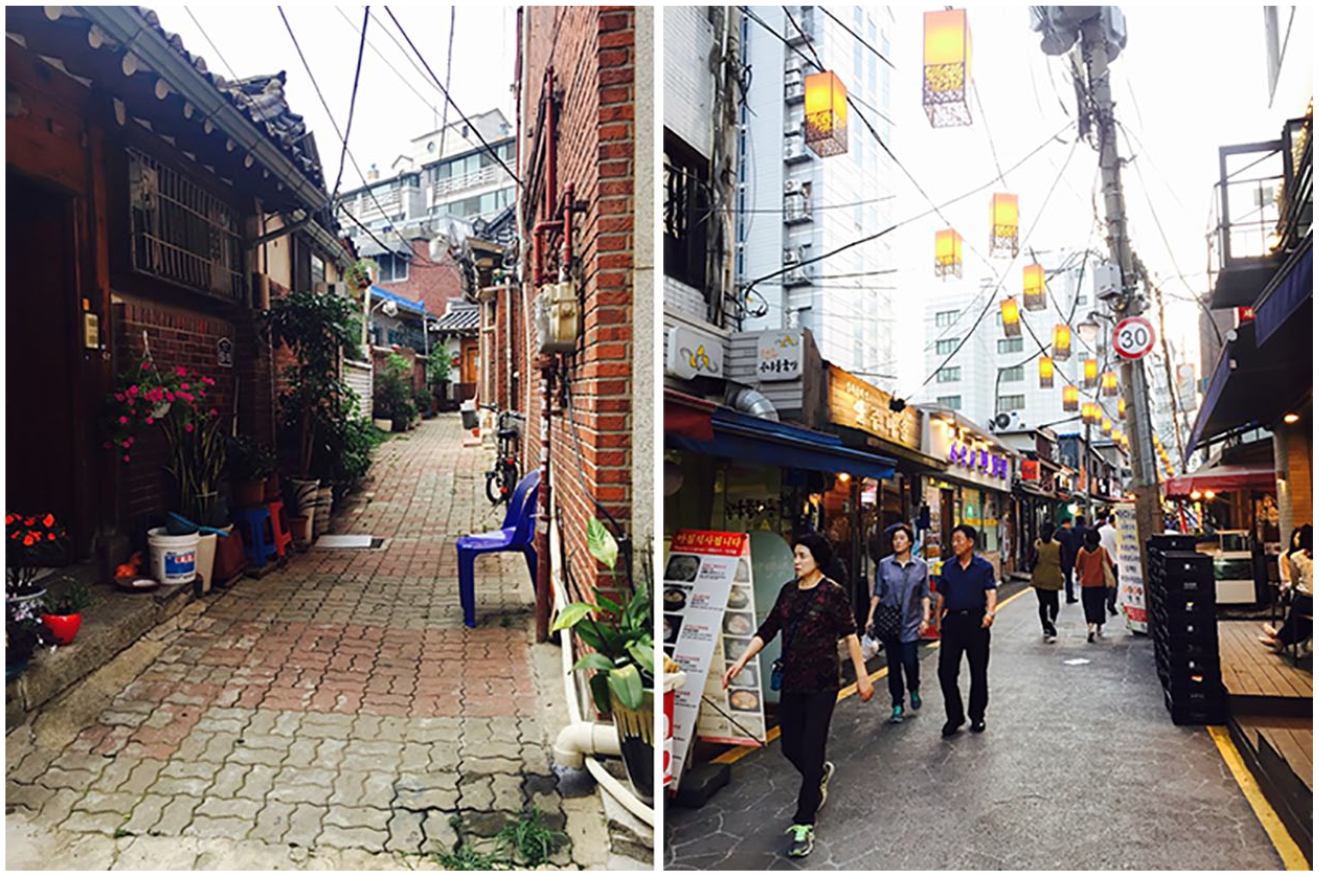
Everyday landscapes of WSGP.
Its symbolic landscape 56 represents a fantasy of an authentic urban village lodged in the past and simultaneously engenders nostalgic auras, thereby attracting people who want to discover and recover meaningful places by escaping from contemporary Seoul. Those urban adventurers have moved to WSGP and refashioned it based on their taste. Consequently, the hipster-oriented, socio-spatial transformation initiates the commodification of place identity and the comprehensive commercialization of the neighborhood. In other words, the intangible charm of authenticity becomes an asset that yields tangible profits. Meanwhile, various stakeholders of WSGP – old-timers, newcomers, visitors, academics, governments, media, business owners, property owners, local communities, and so on – have contested each other for the right to the neighborhood. 57 To be specific, they create different names of WSGP and claim their own name is more authentic than others for promoting their diverse interests. 58
Mirroring authentic selves onto the fantasy of ‘Seochon’
WSGP consists of 15 legal districts. Even though these separate districts function as one neighborhood, there was no comprehensive place-name on behalf of the whole neighborhood. In this context, the shift of urban planning has driven the toponym debates. Originally, the Seoul Metropolitan Government (SMG) designated WSGP as the Prospective Housing Renewal District in 2004 to improve dilapidated housing conditions and infrastructures. However, during the 2000s, the SMG switched the urban planning agenda from urban renewal to historic preservation. Since this time, vast restoration and preservation projects have been implemented in historic downtown Seoul. 59 This postindustrial turn aimed to draw more global investment and increase tourism by branding and marketing Seoul as a historic and cultural city. 60 Following the shift, the original renewal plan of WSGP was withdrawn and replaced by the District Unit Plan in 2010, which regulates the redevelopment and rezoning of old buildings. 61 In the official documents about this new plan, the SMG tentatively named the neighborhood WSGP.
The term West Side organically emerged as a nickname of the neighborhood: Seochon. In Korean, Seochon literally means the west village which carries nostalgic, idyllic suggestions. In the 2010s, Seochon became the most well-known toponym representing WSGP and its symbolic landscape. This successful naming was made possible through internal and external authentication processes. Numerous books and academic articles about the history, culture, and landscape of Seochon were published. 62 Countless movies, TV shows, and newspaper and magazine articles have introduced Seochon and promoted its nostalgic atmosphere. Several local communities were created with the name of Seochon. Typically, the Seochon Neighborhood Society has hosted festivals, distributed newsletters, and provided local tour guides in an effort to inform residents and visitors about the meanings and values of Seochon. These discourses and practices of Seochon have supported the governmental shift toward historic preservation and vice versa.
Various individuals have contributed to the authentication of Seochon by sharing their knowledge and aesthetic senses. Dr. Fouzer is one of Seochon initiators. As an aficionado of hanoks, he moved into WSGP in 2008 and founded the Seochon Neighborhood Society in 2011 to protect the valuable landscape from the redevelopment. 63 Based on his lived experience, he also published a book, Seochon-holic, which promotes hanoks as an attractive, competitive brand of traditional Korean culture. 64 Public media paid attention to this foreign preservationist, partially because of his interesting background as the first non-Korean professor in the Department of Korean Language and Literature at Seoul National University. Like Dr. Fouzer, Seochoners advocate the conservation of existing urban fabrics by branding Seochon as the authentic urban village. However, for them, the authenticity of Seochon is not an inherent, fossilized history; rather, it continues to be reshaped by and lived through people. For example, Dr. Fouzer rebuilt his hanok in 2012 to adapt it to his lifestyle and needs. Photos of his hanok were published in a famous lifestyle magazine in South Korea as an example of a contemporary hanok that has been modernized but remains faithful to the traditional Korean-style in its exterior/interior. 65 Therefore, a fantasy of Seochon embraces the authentic lives of people in the present beyond the socially constructed, authentic objects reflecting certain styles of the past.
Here, ‘people’ refers not only to old-timers but to all those who constitute daily rhythms of WSGP. Captain Seol, another famous Seochon initiator, argued that Residents are limited, but I think caretakers are infinite. For me, everyone who loves the neighborhood is the caretaker. Neither place of birth nor time in residence matter. I think the concept of native is too outdated for our generation. We need a new concept.
66
Captain Seol refuses the exclusive boundaries between natives/newcomers and residents/visitors. His promotion of Seochon orients toward all caretakers of the neighborhood. For example, he restored the one-and-only game arcade in WSGP in 2015, which had been closed in 2011. He used a crowdfunding platform for financing and marketing while inspiring people’s nostalgia for the old-style arcade with his own childhood memory. 67 The significant portion of donors consisted of those who were not residents yet felt affection for the neighborhood and its disappearing life history. Through successful fundraising, his renovated retro arcade became a playground for local kids as well as one of the most famous tourist destinations. In this sense, Seochoners – whether they are old-timers or newcomers – project themselves onto the fantasy by reinventing Seochon’s authenticity.
Meanwhile, Seochoners’ sweat equity, in the form of aesthetic renovation and economic revalorization, has facilitated retail gentrification. New restaurants, bars, and cafés opened up along winding alleys after old buildings were remodeled. According to the Seoul Metropolitan Statistics, the total number of restaurant and accommodation businesses in Cheongunhyoja-dong – one of the administrative districts of WSGP – increased from 91 in 2006 to 258 in 2016. As the aesthetically restyled WSGP magnetizes more urban adventurers, naming Seochon becomes a marketing strategy. Local stores reorganize their businesses to reflect and reinforce the fantasy of Seochon, which motivates customers’ desire for authenticity. They implicitly and explicitly promote Seochon through their names and exteriors/interiors with new but retro items for the creation of authentic and attractive vibes (Figure 2). A bar owner (40s age group) explained that ‘restaurants with a vintage atmosphere catch on with customers because they are harmonious with the nostalgic mood of Seochon’. By referring to these new-retro businesses, numbers of interviewees highlighted the coexistence of traditional and modern styles as one of the distinctive charms of Seochon. A visitor (50s age group) stated that ‘Seochon is a place where the past and the present are well-mixed. It has a nostalgic atmosphere, but also a new culture’.
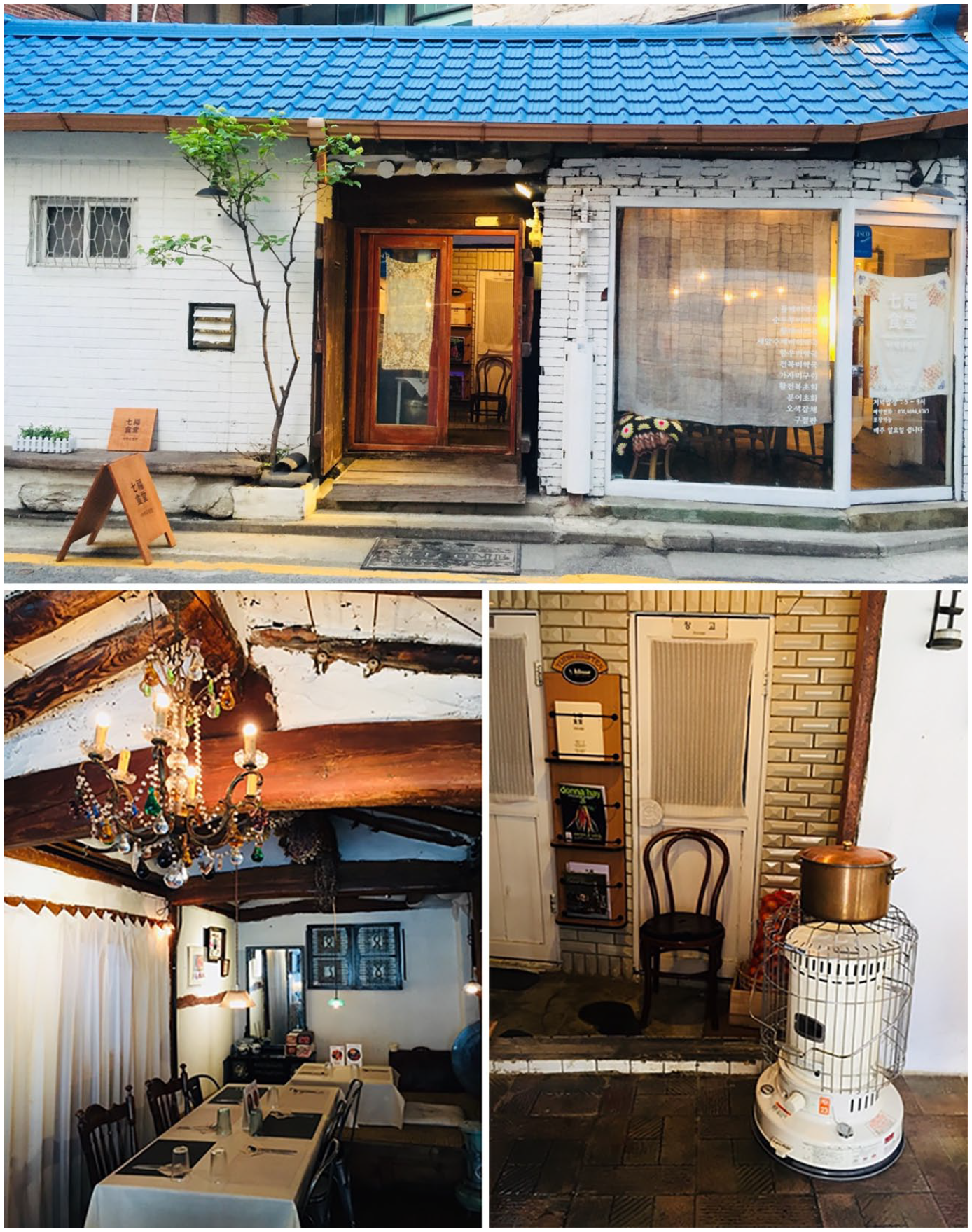
The exteriors/interiors of a newly opened, hanok-renovated restaurant.
To sum up, even though the authenticity of Seochon relies on the history, culture, and nostalgic landscapes of the past, it also involves Seochoners in the present who bring new cultures into the neighborhood and mirror themselves onto the fantasy of Seochon. Seochoners’ desire is toward not only the authentic others but also themselves who are folded into the fantasy. On the one hand, the naming of Seochon has created it as a brand that denounces slash-and-burn urban renewal and advertises the historic preservation of WSGP by underscoring its authenticity. Through the authentication, Seochon is socially constructed to echo the fantasy of the authentic village that must be protected and cherished in a distance. On the other hand, the authentication of Seochon legitimizes the domination of Seochoners’ tastes and practices. They keep physically and symbolically refashioning WSGP by subjectifying the authenticity of Seochon and objectifying themselves onto it; and, the fantasy of authenticity mediates these topological processes of extimacy. As a result, naming and branding Seochon sublimate WSGP by placing the twisted (in)authentic gentrifier/gentrified in the fantasmatic authentic village.
Authentication of ‘Sejong Village’ by excluding/including others
Some welcome this retail revitalization of WSGP. Nevertheless, there are others who are marginalized in the process. Most notably, old-timer seniors – especially those who are house owners – express their displeasure with the name of Seochon as well as the associated historic preservation initiative.
68
In alliance with the Jongno District Government (JDG), they have been eager to redevelop WSGP from a pre-modern village into a modernized apartment complex. Yet, contrary to what they anticipated, the SMG implemented the preservationist urban policy and implicitly supported the brand of Seochon. Through the discourses and practices of historic preservation, Seochoners can maintain their fantasy of authenticity and authority over WSGP. As a result, the original resident association, which has been pushing for urban renewal since the 1990s, becomes politically and symbolically disempowered. In this context, the long-time residents and the JDG renamed WSGP to take back the power from Seochoners and to recover their pride. The establishment of the Sejong Village Organization (SVO) led to intense debates about the toponym. During an interview, Sooho (70s age group),
69
the head of the SVO, explained the naming of Seochon in vexation: They decided to call this neighborhood Seochon and to preserve hanoks. But, that decision is nonsense because it hasn’t been discussed with residents. In deciding the name of the place where we live, we have been completely excluded and ignored from the beginning. [. . .] Our pride has been seriously insulted by that ridiculous naming. But, we, residents are not blind and neither are we fools. We cannot approve their name because it is far from the historical place-names and is without identity and authenticity.
The name of Sejong Village is taken from King Sejong the Great (reigned 1418–1450 CE) of the Joseon dynasty. On 15 May 2011, the SVO held a ceremony to declare the name, Sejong Village, relying on the historical fact that Sejong was born in WSGP. Through the reenactment of the Joseon dynasty parade, the SVO attempted to authenticate Sejong Village. Senior long-time residents participated in the ceremony as performers as well as audiences (Figure 3). The authentication also depends on publication and promotion. For example, the SVO published local guide books and maps with the name of Sejong Village. The JDG officially renamed one of the famous traditional street markets in WSGP as the Sejong Village Food Culture Street. Throughout the authentication, the SVO and the JDG continuously denounce the name of Seochon, as lacking historic testimony and resident involvement, and promote Sejong Village as the rightful name. 70 Moreover, they often describe Seochoners as uninformed, foreign invaders, who have neither knowledge nor right to the neighborhood while condemning native Seochoners as the enemy within the gate.

The historical reenactment for declaring Sejong Village in 2011.
In their argument, the authenticity of the designation Sejong Village is entrenched in the past, especially the Joseon dynasty. However, despite their stress on the historical background of WSGP, the group does not necessarily aim to preserve the existing urban fabrics. In an interview, Misook, a member of the SVO, expressed her thoughts and feelings on historic preservation and urban tourists. She said, People who really live in hanoks actually don’t like the preservation plan because it is an infringement of private property. [. . .] From our view, hanoks in our neighborhood are too small, shabby, and not good at all. They don’t deserve to be preserved. I really cannot understand people who come here, say ‘hanok is so pretty’, and take a lot of pictures of our neighborhood. (Misook, 60s age group)
In this sense, the naming of Sejong Village is not an apolitical, historically oriented movement. Rather, it expresses the disappointment and discontent of old-timers with the recent transformation of WSGP. In short, the authentication of Sejong Village is the counter-branding by senior residents who aim to regain their self-esteem and control over WSGP by emphasizing its deeper historical roots in the Joseon dynasty and refusing the contemporary dominance of historic preservation, hipster-oriented businesses, and the name of Seochon that represents all these new changes.
Interestingly, supporters of Sejong Village learn and internalize the strategies of naming and branding Seochon. They acknowledge that comprehensive urban renewal is nearly impossible in WSGP because the economic benefits from the commercial revitalization fundamentally depend on historic preservation initiatives. Indeed, senior local landlords, most of whom take part in the SVO, have gained substantial profits since the late 2000s. Therefore, the SVO’s goal is not to destroy Seochoners’ desire for and fantasy of the authentic village, which have made real estate thrive, but to make them their own. In order to change the brand from Seochon to Sejong Village, long-timers actively participate in negotiations on authenticity while excluding/including their (in)authentic others. Indeed, Sejong Village is pouring old wine in a new bottle; the authentication processes and contents of Seochon and Sejong Village are almost identical. Even though perspectives are slightly different – Seochoners focus more on the life history, whereas Sejong Villagers focus on the origins of the Joseon Dynasty – both emphasize the history and culture of the neighborhood, by showcasing the same cultural heritage sites in WSGP, and thus, reinforce the fantasy of the authentic village. Consequently, the authenticity of Seochon and Sejong Village is a void itself; it continues to be socially constructed and reinvented. Because the authentication allows participants to have political, economic, and cultural powers, the key is not what is authentic, but how it becomes authentic. Put another way, the fantasy of authenticity organizes a socio-political battlefield where diverse stakeholders compete with each other for the authority over WSGP.
Endless desire for something more authentic
At the same time, the fantasmatic authentic village serves as a setting for people who consume and desire WSGP. Korean urban tourists are particularly inspired by that fantasy. In general, they first encountered WSGP with the name of Seochon through traditional or social media that present the must-go-hip-places of Seoul. Because their fantasy is based on a simplified and beautified version of Seochon, they rarely recognize the conflicts regarding place-names or even the name of Sejong Village. Indeed, the less knowledge they have about the neighborhood, the more it inspires their adventurous spirits. For them, WSGP is an interesting place not because of the names – although the brand of Seochon certainly draws them into the neighborhood – but because it stokes their imagination of authenticity. Hence, what matters most to the visitors is not how authentic the neighborhood is, in terms of its history or place-name, but how it gives them authentic experiences.
Yumi is one of many visitors who are fascinated by the fantasy of Seochon. Since the early 2010s, she has frequently hung out in the neighborhood. For her, Seochon is a unique place where she can feel a retro vibe in contemporary Seoul. She appreciates the oldness of the neighborhood as a new attraction: In Seoul, I usually visit heavily urbanized places in my everyday life. So, Seochon is, for me, a strange place that is different but not too far from my everyday life. I mean it is right there, but still strange. (Yumi, 30s age group)
Yumi emphasizes the strangeness of Seochon as the motivation for her visits. Like Yumi, most visitors come to the neighborhood because they expect to experience an unknown authenticity. Through subjective fantasies, they consume certain objects and activities that they imagine to be authentic and enjoyable. Some drink a craft beer in a hip microbrewery (30s age group); some enjoy a view of hanoks and the scene’s harmony with the surrounding mountains (50s age group); some eat street foods in a traditional market (20s age group); some take pictures of the neighborhood which seems like the old village in the 1980s (30s age group). Even though they have different preferences and sensibilities in consuming authenticity, they share a fantasy of the authentic village which is understood to be quiet, cozy, humble, warm, and thus, extraordinary compared to their ordinary lives in bustling, soulless Seoul.
Nevertheless, their visits do not satisfy their fantasies for authenticity. There is always a gap between the ‘implicit’ fantasy and the ‘explicit symbolic texture sustained by it’.
71
Yumi (30s age group) further explained her visits to WSGP since 2012 and how they have changed over time: At that time, there was not much information [about Seochon] on the internet. But, because I like to discover a strange place, I explored Seochon by myself on foot. [. . .] I visited Seochon very often from 2012 to 2014, but after that, this place became so famous, I haven’t been by as much. Especially on the weekend. Because there are so many people on the streets! I don’t want to feel crowded in Seochon. That’s what I expect in Gangnam or other downtown areas, not in Seochon.
A number of visitors – especially those who considered themselves to be pioneers, discovering Seochon earlier than others – mentioned and worried about excessive commercialization and a loss of the unique charm. They described the ongoing retail gentrification with long line-ups for famous restaurants, rent increases, fast-changing retail stores, crowdedness, and rising levels of noise and pollution due to too many visitors. These visitors often located themselves on the side of the gentrified, not the gentrifier, although they themselves are one of those ‘too many visitors’. They felt very distant from their practices of urban tourism and simultaneously showed strong sympathy for the gentrified neighborhood – which follows from their own practices – by expressing a sense of loss. Songju (30s age group), another visitor, stated, As one of the consumers of urban culture and food, I think of gentrification negatively. After all, I do not want all the places to be changed and made the same by commercial capital. That reduces the cultural diversity we enjoy. I think the cultural diversity comes from the local atmosphere. I feel bad about losing that unique atmosphere due to gentrification.
These visitors see themselves as having lost something authentic that they once had and enjoyed. Yet, the authenticity of Seochon is their subjective fantasies; they have not lost it because they never had it in the first place. The main reason why they feel loss is that they become familiar with the strangeness of Seochon that first inspired them as an exotic authenticity: ‘now I feel a sense of familiarity with Seochon, rather than the new discovery which I felt three to four years ago’ (Songju, 30s age group).
This imaginary feeling of missing seems to threaten visitors’ fantasies of Seochon and their desire for and enjoyment of it. However, it rather sustains their desire by renewing the authentic objects of desire. In the fantasy of authentic Seochon, there is always impenetrable something more (object a) that motivates their never-fulfilled desire. After an interview in a café, Yumi and I walked along the shopping street of Seochon. During the walking interview, she pointed out several stores that had been changed since her last visit and explained how fast this neighborhood is transformed and commercialized. On the way, we dropped by a bakery that I patronized during my fieldwork. I gave the baker a friendly greeting and bought my favorite roll cake as a thank-you gift for the interview. When we were about to leave the bakery, the baker gave us extra morning bread and wished me good luck with the interview. After leaving the bakery, Yumi said to me, ‘I think I should change my statement a little bit. Seochon still seems like a warm village which is really rare in Seoul, despite the commercialization’. She said that she loved to see my close relationship with the owner because she has never experienced it in Seoul. I explained to her that it might just be because I visited that place a lot, to which she responded, ‘You’re right. More visits seem to lead to a different experience’. She believed that if she made a deeper connection with the locals, this would give her a new experience of Seochon and, thus, once more make Seochon strange and special to her. And so the circuit of desire continues. Her fantasy of authentic Seochon never goes away; it just continues to be reconfigured.
Conclusion: beyond the paradox of retail gentrification
I have explored the paradox of retail gentrification by reviewing the concept of authenticity through Lacanian ideas of subjectivity, desire, and fantasy. Revisiting authenticity through the lens of psychoanalysis enables us to expand our understanding of retail gentrification and its subjects, who have frequently been identified based on their tastes and practices of consuming authenticity. Indeed, authenticity is not only an object of consumption, something that the subjects can have, but also a fantasy that veils their irreducible lack and motivates the endless desire for an elusive something more. In other words, longing for authenticity is more-than-consumption, which is inculcated in gentrifiers as a habitus for distinction. More notably, it is the existential desire of the subjects, which creates the various nuances and ironies of retail gentrification on the ground. For this reason, in gentrification dynamics founded upon authenticity, subjects cannot simply displace the Other. Subjects troubled by their own inauthenticity (lack) are constituted in relation to the ‘authentic’ Other – the Other whom they imagine not to lack and to be able to confer authenticity upon them.
This article dismantles the dichotomies of the authentic/inauthentic and the gentrifier/gentrified by illustrating the toponym debate in WSGP. WSGP vividly exhibits the scene of cultural politics taking place where various stakeholders claim the authenticity of different place-names to attain political, economic, and cultural powers over the neighborhood. For both names, Seochon and Sejong Village, authenticity is a socio-politically constructed and psychologically sublimated fantasy, which reflects and reproduces people’s imagination of and desire for the authentic urban village. Through reinventions of the authentic objects of desire, various subjects participate in and live through retail gentrification in postindustrial Seoul. Even though urban pioneers play a critical role in the processes, local governments, long-time residents, business owners, visitors, and media are also heavily involved in the authentications. Of course, it should be noted that all subjects of gentrification relationally and topologically emerge; they sometimes overlap with one another and sometimes split internally. Therefore, there is no fixed category of stakeholders, such as inauthentic newcomers in Seochon or authentic long-timers in Sejong Village. Rather, the subjects of gentrification keep internalizing others and externalizing themselves onto those others in and through the fantasy of the authentic village. Their extimate desire continues to exclude/include the Other while facilitating retail gentrification and enduring the topological relation between the gentrifier/gentrified.
Finally, this Lacanian interpretation helps us to grasp the reason gentrifiers continue with their tastes and practices although they know its outcomes. To borrow Žižek’s words, ‘they know very well what they are doing, but still, they are doing it’. 72 We cannot overcome this paradox of retail gentrification without demystifying our desire for and fantasy of authenticity. Nevertheless, the critical point is not to devastate the fantasy of authenticity. This attempt rather provides important momentum of reinforcement of our desire. If we (imaginarily) damage the authenticity, we will desire it more strongly because we (imaginarily) miss it. Consequently, the matter is not how to destroy our fantasy of authenticity but how to deal with it. In this regard, the first step to move beyond the paradox of retail gentrification is to concede our compelling desire by going through the fantasy. In a Lacanian term, it is traversing the fantasy; we need to confront ourselves, not the Other, by admitting that there is nothing behind our fantasy. 73 In retail gentrification, the fantasy of authenticity is actually invested with our own desire. Put another way, otherness is from ourselves who constantly desire something more authentic. Although we expect a friendly greeting from a local baker will make us authentic, our desire will still be waiting for more authentic things, places, and experiences. There are, however, again no authentic others but ourselves on the other side of the fantasy. Therefore, we need to assume responsibility for our desire and challenge ourselves as the gentrifier/gentrified through traversing the fantasy. 74 This would open up a new cultural politics that escapes the cycle of the ongoing retail gentrification.
Footnotes
Acknowledgements
I am deeply grateful to everyone who shared their time and stories with me while I was in Seochon and/or Sejong Village. They made this research possible. I am also thankful for the generous guidance and feedback from Richard Schein and Anna Secor, along with Dydia DeLyser and three anonymous reviewers, throughout the writing and review process. Their insights greatly improved this article. Finally, special thanks go to Jonghee Lee-Caldararo, Jess Linz, Erin Clancy, and Joe Blankenship for their comments and critiques on early drafts.
Funding
The author(s) disclosed receipt of the following financial support for the research, authorship and/or publication of this article: Barnhardt-Withington Research Funds from the Department of Geography, the University of Kentucky.
