



Abstract
The COVID-19 pandemic has brought about massive changes in religious landscapes across the world. Recent research has focused on whether religions create problems or are sources of solution or support in these extraordinary times. Although some studies document religious leaders’ and institutions’ innovative responses to preserve ritual practices and foster members’ sense of belonging, they fail to highlight lay practitioners’ bottom-up religious transformations. Noting this, this article draws on the case of Lufeng city in south China to examine how local residents inventively reconfigured the temporal-spatiality of their ritual practices during temple lock-downs. Through an ethnographic-style exploration, we reveal multi-faceted spatial changes in the ritual performance, including the reconfiguration of home spaces, the performance of worship practices outside temple doors and the mobilization of digital spaces of communication to accumulate good fortune. Apart from these spatial strategies, local ritual transformation also produces temporal adaptations. Through these temporal-spatial reconfigurations, local residents innovatively cope with new social circumstances and articulate religion’s continual significance. This study foregrounds an agentive and flexible understanding of religion in times of crisis.
Keywords
The COVID-19 pandemic has significantly affected religious gatherings, places of worship and rhythms of ritual practices. Academic commentary published in the early stages of the pandemic has focused on whether religious gatherings create problems or solutions relating to the spread of the virus. 1 One line of commentary considers religious gatherings as problematic, and likely to compound the health crisis. 2 In countries such as South Korea and Malaysia, large religious congregations have been blamed as ‘clusters’ of viral contagion. In contrast, other academic commentaries on responses to the crisis among faith groups identify religion as an important source of hope, health, psychological and emotional support, charitable service and welfare. 3
Beyond the immediate identification of problems or potentials in light of the crisis, an emerging area of commentary is investigating the ongoing transformations of religions and spiritual practices. 4 If these studies consider the position of religious institutions and perspective of faith leaders, as yet they shed little insight on the responses of lay practitioners. A lay perspective is important because it can not only move beyond the focus on centrally sanctioned changes prompted by powerful authorities but also appreciate the multiplicity and flexibility of religious responses.
Since the coronavirus outbreak in China, different religious organizations have cooperated with the government’s directive to close physical spaces of worship and suspend activities and operations. 5 During the lockdown period, visitors have been prohibited from entry and congregation at religious sites. While these measures have created challenges for religious individuals and communities to continue their traditional ritual practices, they have generated notable transformations and innovative adaptations.
This article examines instances of such innovations through a case-study consideration of Lufeng, a county-level city located in Guangdong Province, southern China. It first introduces the landscape of temple rituals and discusses state regulation on ritual performance during China’s COVID-19 period. It then analyses how local residents adopted various spatial and temporal reconfigurations to conduct ritual performances. It concludes with a call for an agentive and flexible understanding of religion in times of crisis.
Lufeng’s religious landscape
Lufeng has a thriving temple culture, with over 200 Buddhist, Taoist and ancestral temples and other religious buildings. Most residents participate in local communal religion, 6 and perform various temple rituals: providing offerings, lighting incense and candles, burning incense paper, and praying for the good health, prosperity and life of their loved ones.
The emergence of coronavirus cases in Lufeng in late January 2020, coincided with the Chinese New Year period, significantly disrupted local people’s customary ritual practices. Anticipating the potential widespread transmission caused by religious congregations during the festive period, the government ordered temples to shut and suspended their activities and operations (Figure 1). To prevent visits to temples, the government organized village cadres to block routes to the temples (Figure 2). Additionally, they established several patrols to monitor the immediate area around temples. These measures made it virtually impossible for locals to conduct any on-site temple rituals.
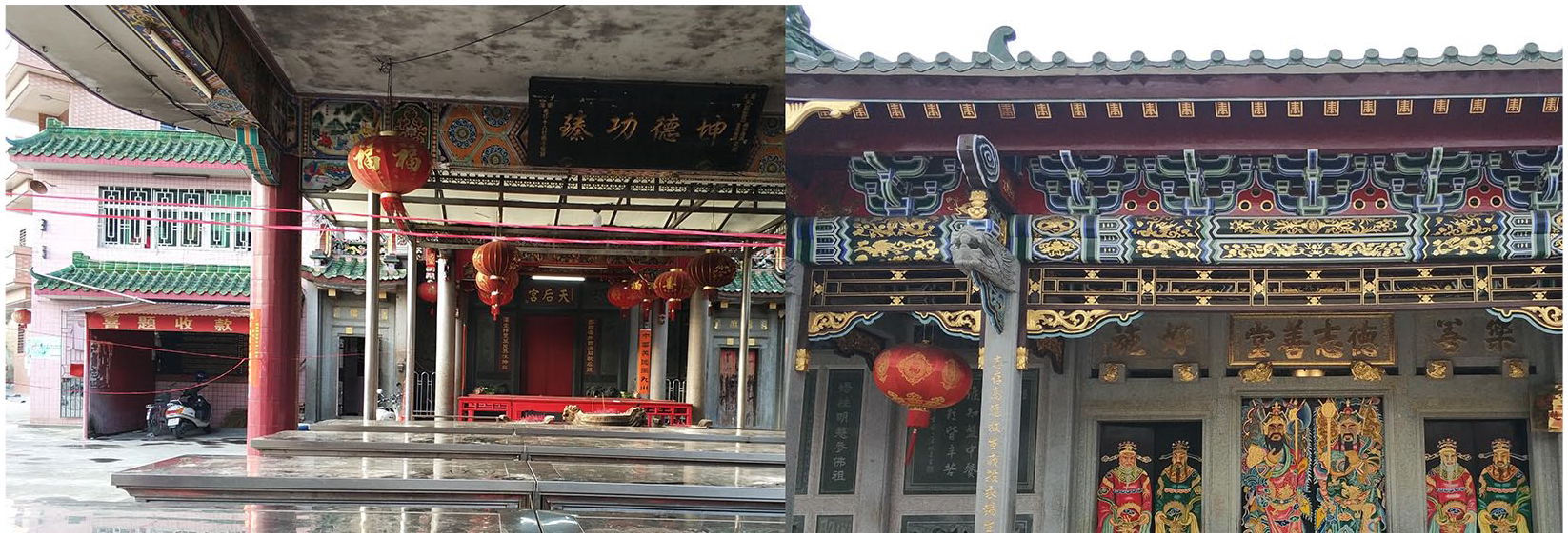
Closure of Chinese temples during Lufeng’s COVID-19 lockdown (left: Empress of Heaven (Muzu, 妈祖) Temple; right: Patriarch (Zushiye, 祖师爷) Temple) Photo by Ms Ershuang Chen.

Village cadres blocking the way to Qishan Buddhist Temple Photo by Ms Ershuang Chen.
The temporal-spatial reconfiguration of temple rituals
Because of the COVID-19 lockdown measures, locals had to find alternative ways to continue practicing customary rituals. These practices were imperative as they helped religious individuals and communities maintain a sense of belonging and identity, and obtain the assistance of the gods in stressful times. 7 Consequently, Lufeng residents adapted their performance of temple rituals through three novel spatial strategies.
First, residents shifted the temple spaces into their homes. As the temples were closed, some local residents reconfigured part of their domestic spaces into religious spaces. They redesigned and converted their homes to accommodate home shrines (Figure 3). This allowed them to continue their regular deity worship during Chinese New Year. For families whose homes could not accommodate permanent shrine installations, they conducted similar ritual practices in open spaces (such as balconies) within their homes. These spaces enabled them to continue worshipping and praying to the God of Heaven (Tiandiye, 天帝爷) (Figure 4). Through ritual practices, the home space becomes what della Dora (2018) terms as ‘infra-secular space’: a space which blends the sacred and secular. 8 Homes operate as social and familial centres as well as sites for religious performances.
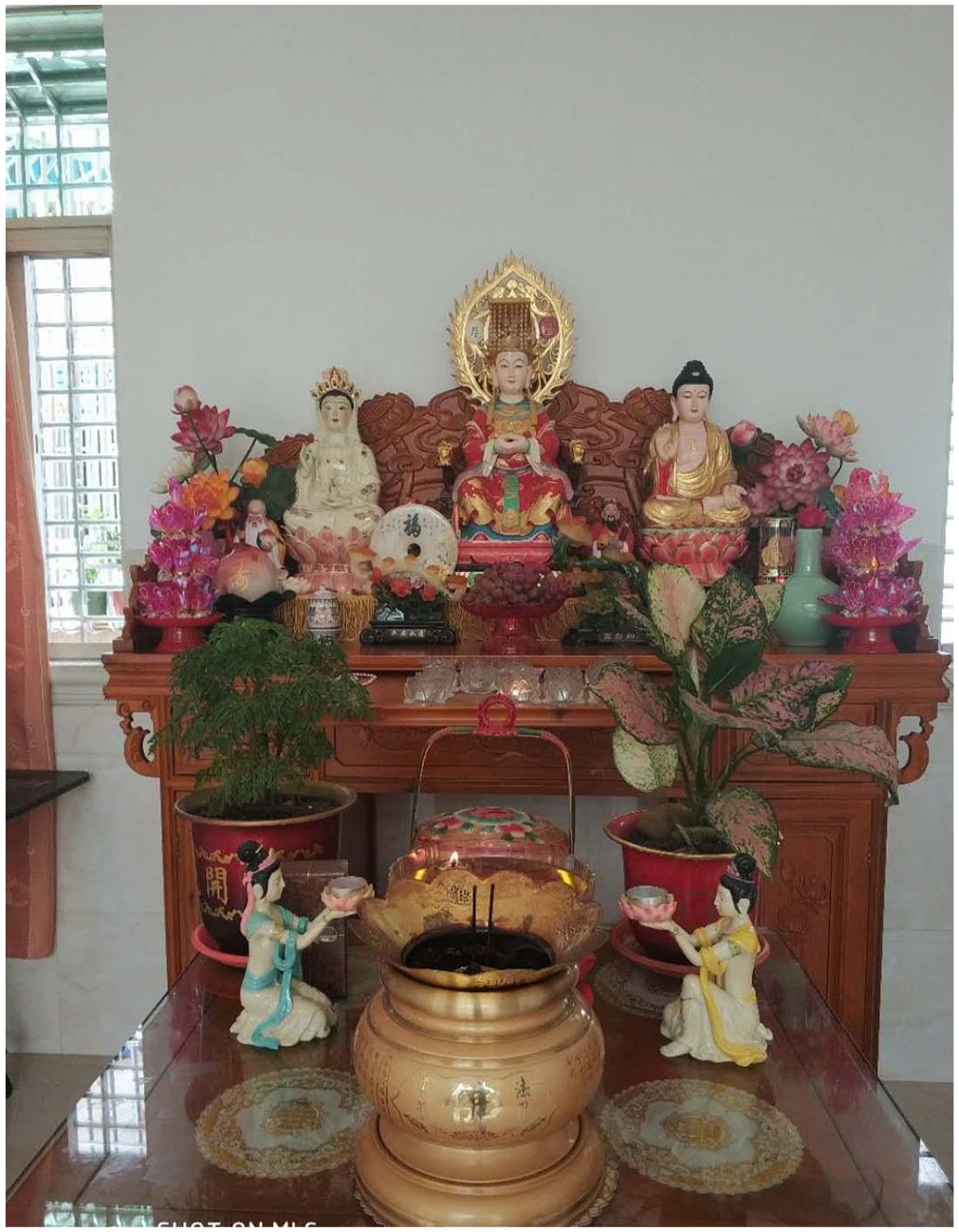
A home shrine Photo by Ms Ershuang Chen.
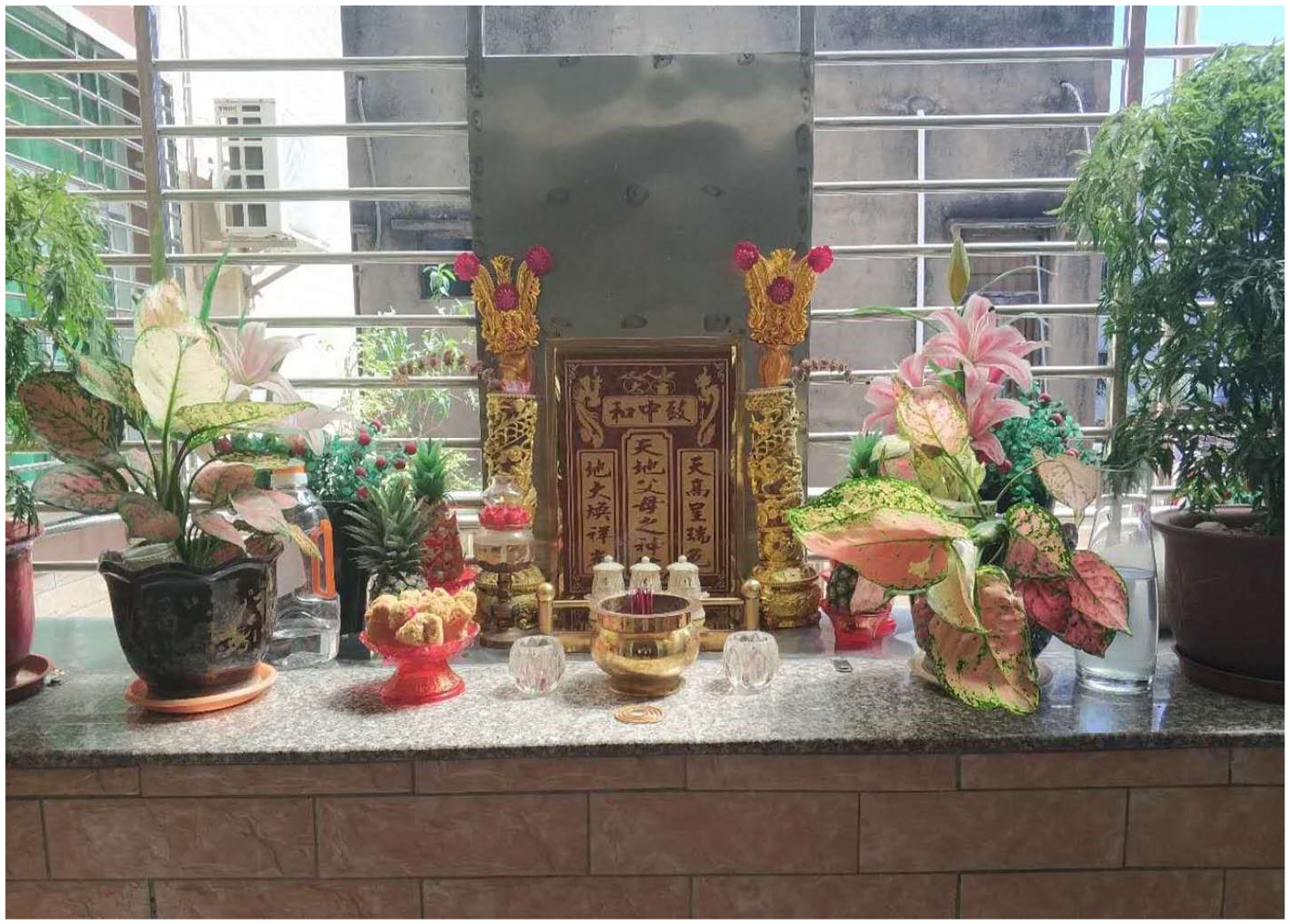
Home balcony altar for the God of Heaven Photo by Ms Ershuang Chen.
Second, some residents extended religious spaces beyond temple doors. These residents preferred to practice rituals in large temples such as Mt. Qingyun. They believed fortune telling in religious spaces that host many Buddhas and deities was more efficacious (Ling, 灵). Yet, because of the temple closures and blocked routes, they resorted to innovative strategies. Some found ways to visit small temples located within residential communities. For example, residents visited the City God Temple (Chenghuangmiao, 城隍庙) before 8 am, when no patrols were present. They prayed, gave offerings and drew divination sticks outside temple doors (Figure 5). Although unable to enter the temple, the residents considered their practice of drawing divination sticks within the extended religious space efficacious, especially because they demonstrated piety by visiting the sacred space in person and in such challenging times. Instead of interpreting their divinations sticks (Jieqian, 解签) at the temple, residents did this at the homes of professional divination interpreters. Through these spatial shifts, the residents continued their ritual practices during the temple lockdown.
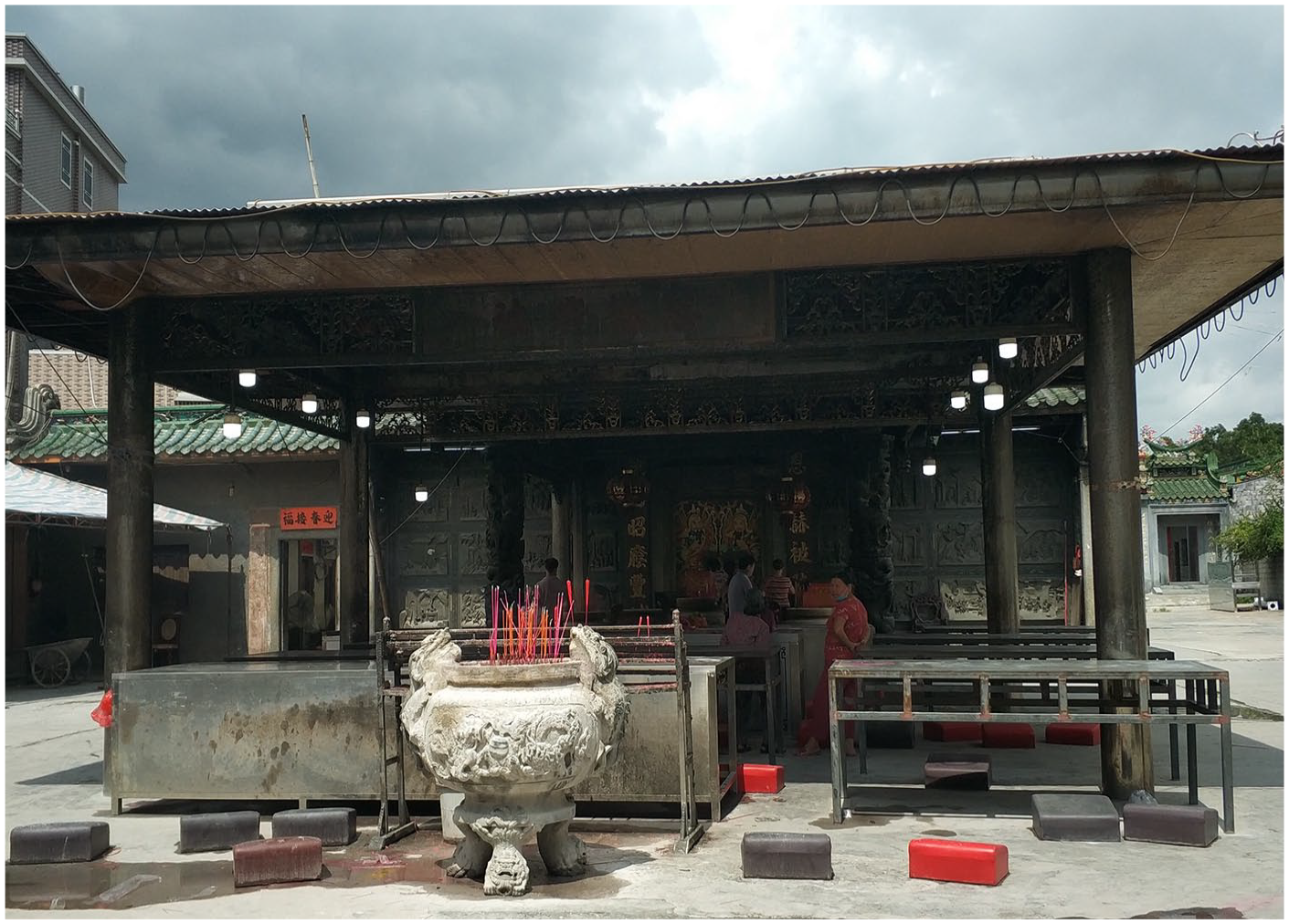
Locals conduct ritual activities outside the City God Temple’s main door Photo by Ms Ershuang Chen.
Third, locals mobilized novel digital methods and spaces to perform temple rituals. As large temples were shut, locals took advantage of the popular social media networking app, WeChat, to donate to these temples. Monks who live within these temples consequently conducted ritual activities such as chanting and providing offerings to Buddhas for these donors. In addition, some followers used WeChat to donate to temples holding large-scale collective ritual events. For instance, during the 49-day Dharma Assembly for the Elimination of Disasters (Xiaozhai Fahui,消灾法会), Qishan Buddhist Temple received many donations. Through online donations, locals not only created virtual spaces for religious beliefs and practices, but also continued to actively perform meritorious deeds through these spaces to accumulate good fortune (Jifude, 积福德).
Apart from the above spatial reconfigurations, the locals’ performance of temple rituals during COVID-19 also produced temporal adaptations. Since the COVID-19 situation came under control in Lufeng in May 2020, many socio-economic activities have resumed. Yet, because religious activities were not classified as essential, local temples were still awaiting further government directives regarding reopening. Some caretakers of smaller temples were staunch religious believers themselves and sympathized with the locals’ predicament. They secretly opened up the temples’ side doors early every morning – usually between 6 am and 8 am – before patrols came. After learning about this, many residents came during this time period for ritual performances. Although it was in the early morning, those living far away even got up before dawn to finally undertake their temple visits.
Moreover, the temporal reconfiguration of temple rituals manifested in reduced visit frequencies and durations. Although followers could re-visit certain temples with the assistance of temple guards, their early-morning visits had to be completed before 8am. Hence, they spent most of their time praying to temple deities. Accordingly, they simplified the rituals by reducing offerings and placing incense paper directly into collective burners. They also avoided resting in chairs and drinking tea or water, usual practices during normal times. Despite facing temporal constraints, local residents fulfilled their religious duties through condensing and simplifying their ritual practices.
Towards an agentive and flexible understanding of religion in times of crisis
By bringing local voices to the fore, we highlight an agentive, open-ended and flexible approach to understanding religion in times of crisis. Religion is not what the mainstream media and some initial academic commentaries have highlighted: intrinsically conservative, non-compliant, or fundamentally opposed to technology. 9 In fact, geographers have moved from a fixed conceptualization of religious/scared space as a container for religious people, objects and phenomena towards a more fluid and unbounded understanding. Religious/sacred space can be re-appropriated for pragmatic uses and vice versa. 10 The concept of sacred space can be reinvented and negotiated by individuals to cope with contextual constraints. 11 Moreover, sacred space is not confined to any physical site: it can be temporally generated through networks of worshippers who assemble in homes for prayer. 12 With the adaptive use of communications technology and social media platforms, the space of religious practices can even be extended online. 13 All these emergent social formations suggest that religious people have always been creative in initiating temporal-spatial transformations, adapting to new socio-spatial circumstances and articulating religion’s continual significance in their lives.
Footnotes
Acknowledgements
We thank Dr. Carola Lorea for her comments and edits in an earlier version of this manuscript. We also thank Ms Ershuang Chen for her fieldwork assisstance.
Funding
The author(s) disclosed receipt of the following financial support for the research, authorship, and/or publication of this article: We acknowledge that research for this commentary was funded by Asia Research Institute, National University of Singapore as part of a collaborative research project: ‘Religion going viral: pandemic transformations of religious lives and ritual performances in Asia’.
Ethics Statement
We followed ethical guidelines of NUS Institutional Review Board (IRB) during the conduction of this research.
