




Abstract
The Anthropocene problematic calls for imaginative aesthetic experiments fostering more-than-human thought and sensibilities. In this thought experiment, I draw on a sensing device in conjuring a thermal imaginary that decenters the human, espying a glimpse of a strange and uncanny world-without-us. The imaginary is a speculative performance in elemental attunement – becoming-molecular, becoming-imperceptible in the generative potentia of planetary heat – opening a pathway in rethinking bodies and worlds as emergent in, and through, forces elemental and cosmic in scope. The thermal imaginary accentuates the elemental as exorbitant, anonymous, and nonpossessable, an earthly plenum beyond any final capture, possession, mastery and control. Elemental alterity, the very strangeness of the earth, rises in the thermal imaginary as a summons, a calling from the “outside,” gesturing toward an immanent ethics of radical openness working in, and through, earthly bodies always already exposed and vulnerable in the force of the elemental. We must be open to the elemental summons, expanding capacities for what a body can do, moving beyond spinning reductive and redemptive Anthropocene narratives for saving this world. There can be no new bodies and worlds to come in the absence of an elemental ethics worthy of the earth itself.
I proposed in the past the constitution of an objective institution, the WAFEL, whose initials would mean in English not men, nor nations, nor the species, but the world: Water, Air, Fire, Earth, and the Living. One more step, and we have a cosmocracy. – Michel Serres, Malfeasance: Appropriation through Pollution
1
. . . I think I am justified in characterizing the four elements as the hormones of the imagination. – Gaston Bachelard, Air and Dreams
2
World-without-us
It’s a long journey from the cosmogenic theory of the four elements in pre-Socratic Greek philosophy – earth, air, fire, water – to the modern geosciences, posthumanities, and Anthropocene “talk” of today. 3 The elemental is a promiscuous term with a serpentine history in philosophy and science relating with forces of nature as medium and substrate of all matter. 4 In the trauma of an ungrounded earth 5 and the intrusion of Gaia 6 we might say that resurgence in elemental thinking is return of the repressed. No matter the distance we (humans) have come, or think we may have advanced, there is no escaping the elements.
My interest in pushing more-than-human thought and elemental thinking is driven by a speculative question: how might human bodies cultivate sensory attunements with exorbitant elemental forces of the earth? How might we respond to this pressing geoethical challenge in the Anthropocene? Fostering more-than-human sensibilities, I argue, necessitates imaginative aesthetic experiments in rethinking materialities and bodies, living and nonliving, as emergent in relations elemental and cosmic in scope. 7 This thought experiment rose as a challenge to anthropocentrism in response to a question posed by Claire Colebrook in her extinction-induced meditation, Death of the Posthuman: “Can we imagine the world without us, not as our environment or climate?” 8 I take note that Colebrook’s provocation chimes with Steven Shaviro’s challenge of thinking a “world-without-us” expressed in his speculative realist work, The Universe of Things. 9 Shaviro writes: “We learn about the world-for-us through introspection and the world in-itself through scientific experimentation. But we can only encounter the world-without-us obliquely through the paradoxical movement of speculation.” 10 Eugene Thacker raises a similar challenge in darker relief in his horror of philosophy volume, In The Dust of This Planet. 11 Thacker presents a tripartite framing: (1) the world-for-us (World), (2) the world-in-itself (Earth), and (3) the world-without-us (Planet). 12 The world-without-us, for Thacker, lies in a “nebulous zone” between subjective World and objective Earth, a cosmic abyss, “impersonal and horrific.” 13
These provocative invitations to imagine a world without us resonate with a thought experiment in more-than-human geographies I have been pursuing: becoming-thermotropic in planetary heat. 14 Elaborating elemental touchstones in this ongoing sensory experiment charges this essay. The paper explores elemental thinking through a thermal imaginary that decenters the human, providing a fleeting glimpse of a world without us, pushing toward a post-phenomenology and elemental ethics in the Anthropocene. The thermal imaginary does not express a world that would “naturally” regenerate and flourish if humans, the malignant species, suddenly disappeared as elegantly written by Alan Weisman in The World without Us. 15 Nor is it a scientifically-driven account of the earth in the far distant future, The Earth After Us, as masterfully crafted by geologist Jan Zalasiewicz. 16 I emphasize that the thermal imaginary is a speculative experiment in elemental attunement, accentuating the elemental as anterior to, and generative of, all bodies and agencies of the earth. Fostering attunements in elemental worlds is crucial in facing challenges of living and dying with human and nonhuman others on a damaged planet. 17 This entails decentering and rethinking, not erasing, the human. I concur with Derek McCormack who argues that post-phenomenological experiments, such as the elemental thought explored here, “make the human more, not less, interesting; more, not less, wondrous; more, not less, alluring.” 18
The paper is organized in three sections. In the first, I introduce the aesthetic force of the elemental through a thermal sensing device, troubling and moving beyond human-centric reasoning and representational logics. This serves as prelude to the second section elaborating the thermal imaginary as attunement in extremis: becoming-molecular, becoming-imperceptible in the generative potentia of heat. Broader elemental and ethical implications of the thought experiment are traced in the final section, sounding the elemental as a summons or imperative in the Anthropocene, edging toward an immanent ethics worthy of an alimentary and volatile earth.
Thermal device
Art does not reproduce the visible; rather, it makes visible. – Paul Klee, Creative Confession, 1920
19
This aesthetic experiment in becoming-elemental revolves around a FLIR Systems i5 infrared (IR) camera, a handheld device with acute thermal sensitivity (⩽.10°C). The i5 renders visible that which is invisible to the human eye: heat. Heat is expressed both numerically (with a temperature range −20°C to +250°C or −4°F to +482°F) and aesthetically in thermograms (infrared images) displayed on a high color contrast liquid crystal display (10,000 pixels with a refresh rate of 9 Hz). Thermograms are generated by the i5 using an algorithmic color palette drawing on thermo-optical associations, ranging from the cooling sensations of blue and green through the warming sensations of yellow to the extreme heat of red and white.
The i5 is a device for experimentation in “doing atmospheric things,” 20 for what is more atmospheric (elemental) than heat? I spend lots of time with the i5; for a long while I took the instrument nearly everywhere I went in the thermal metropolis of Phoenix, across deserts of Arizona and New Mexico, and journeys to cosmic elsewheres. More truthfully, my body drifts where the device leads, for the i5’s insatiable appetite for sensing heat directs bodily movements in experiencing worlds anew in infrared, an uncanny experience in de-familiarizing the familiar. 21
At first blush, one might be tempted to say that the i5 device is a prosthesis that enhances human perception. Exploring technologies as extensions of the human body is a productive line of inquiry, but does not in my view accord recognition to the i5 as an object or thing-in-itself. 22 In the parlance of object-oriented ontology (OOO), the i5 is irreducible to instrumental means and ends; it is “withdrawn.” 23 Harman’s term “withdrawn” refers to the OOO argument that the sheer existence of objects cannot be exhausted by what humans know of them, the sum of their properties, and how they function and are put to work as tools ready-at-hand. What humans “know” of objects is the tip of an iceberg of an unfathomable depth. Vague feelings of this depth – a reality beyond what is knowable and delineable – Harman calls “allure.” 24 Is allure the uncanny, inchoate sensation felt in being proximal with the i5 device? This is the allure of the elemental, 25 registered as a murmuring at the edges of the insensible, 26 whispers that the i5 is finely attuned with heat, an excessive force beyond human apprehension, understanding, and control. In this thought experiment, it is refreshingly paradoxical that a scientific instrument precisely designed to measure and convert electromagnetic radiation to temperature simultaneously unsettles and eclipses representational thinking and the “knowing” human subject.
From the get go, one is bewildered by the strange non-representational aesthetics of the i5’s infrared images. This is an unruly haptic “vision” that confounds figure-ground relations and disrupts representational and scalar logics, such that identifying and naming “things” in infrared is difficult, often impossible (Figure 1). What on earth is the i5 up to? Inducing perplexity, the i5 signals Deleuze’s maxim: “Something in the world forces us to think. This something is an object not of recognition but of a fundamental encounter.” 27 A sensation that opposes recognition and eludes common sense is discordant and imperceptible. This is Deleuze’s shock to thought. 28 Human reason rooted in language and common sense compels us to think that effects must be conditioned by, and attributable to, a named subject. 29 Fluxing and flowing heat, like Nietzsche’s lightning, 30 is first and foremost inhuman movement in expression, elemental “doings” in a virtual field of potential, agency without agents, “subjectless subjectivities,” 31 exorbitant intensities radiating across planet earth.
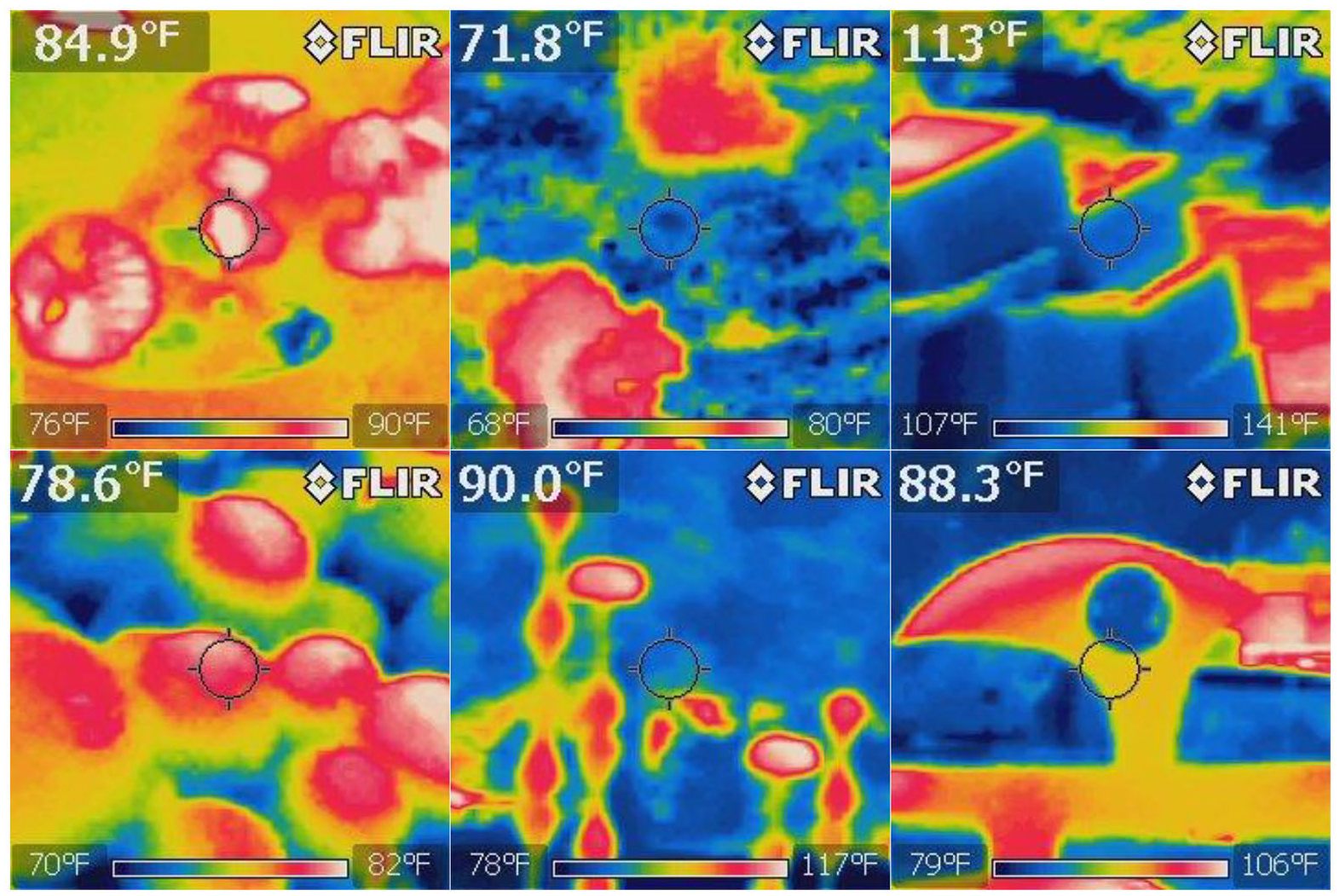
Non-representational aesthetics: disrupting representational and scalar logics. IR image: author
Moving alongside the i5 infrared camera, something strikes with aesthetic force 32 : the i5 is an artful device, rendering sensuous geoaesthetics, 33 painting heat sensations, nothing but ceaseless difference-producing heat sensations (Figure 2). In What is Philosophy? Deleuze and Guattari write that “Painters go through a catastrophe, or through a conflagration, and leave a trace of this passage on the canvas, as the leap that leads from chaos to composition.” 34 I cannot conjure a more apt description of the aesthetics of the i5 and its painterly infrared images. Moving with the aid of a bipedal companion species (i.e. humans), the i5 captures and composes slices of the chaos of heat, painting thermal sensations as percepts and affects. 35
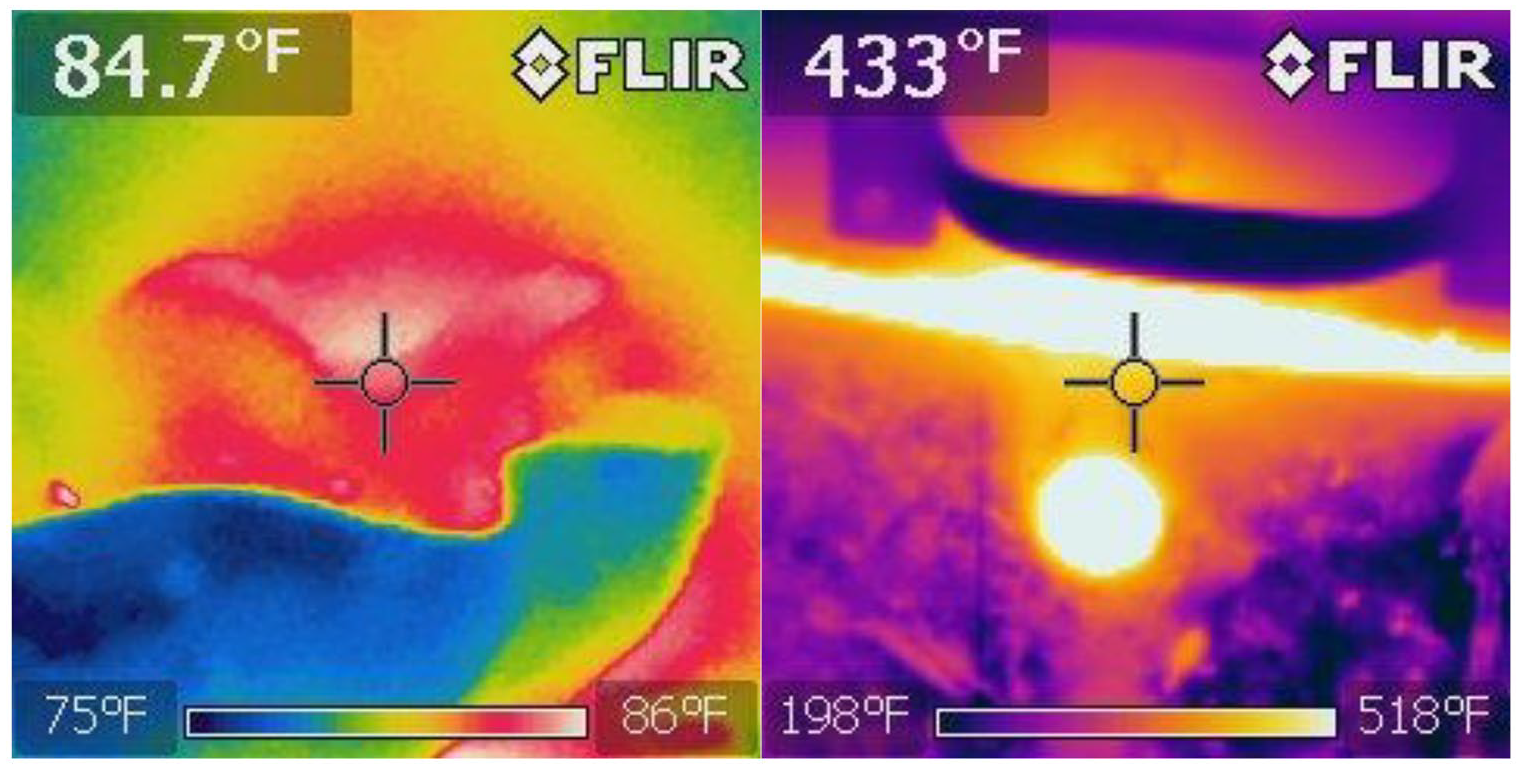
Geoaesthetics – painting heat sensations (rainbow and iron color palettes). IR image: author
Becoming-heat
A fiber stretches from a human to an animal, from a human or an animal to molecules, from molecules to particles, and so on to the imperceptible. – Gilles Deleuze & Félix Guattari, A Thousand Plateaus, 1987
36
In the thermal imaginary, infrared images are not representations of an “already there,” an already given world. IR images are virtual powers to create, to differ and relate, generative of connections or what Deleuze and Guattari call “anorganic” life.
37
Moving in tune with Deleuze,
38
Colebrook offers an insight about releasing art from its human-centric, representational homeland. This resonates with the infrared device and thermal sensing expressed here: But the power of art to stand alone, to be released from the human eye’s tendency to synthesize its experiences into a world of its own, is given stunning form in cinema [infrared sensing]. Once we can think of an [IR] image that is not the image of this located human observer, then all art, can be understood not as expressions of humanity but the release of imagination from its human and functional home.
39
In other words, infrared images subvert human perception, providing a portal for imaginative thinking along elemental, inhuman lines. In this radical mode of thought it is not human consciousness nor intentionality, nor any body, that illuminates as presupposed in phenomenology and representational thinking. Rather, it is in the cosmic flow of matter-light, virtual images in themselves, that all bodies, subjectivities, points of view, and worlds are brought to light (actualized). 40 This is a mind-bending realization – the virtual force of the elemental. 41 These are elemental conditions that make possible ongoing crystallizations (“becomings”) called molecules, matter, bodies, subjectivities, worlds. The radically inhuman haptic “eye” of the i5 device expresses chaotic geothermal forces of the earth, short-circuiting the anthropocentric perception of world folded around the human subject. IR images are compositional tracings of the chaos of heat, exemplary of what Elizabeth Grosz calls “geopower.” 42
In the thermal imaginary, infrared images are elemental acts of heat, sensuous-aesthetic events in themselves, anterior to human awareness, perception, and possession. 43 Immersed in infrared, all bodies – human and nonhuman – are nothing more (and nothing less) than sensations of the elemental, anonymous plenum of heat, fluxing and flowing, “radiating everywhere and forever.” 44 In scientific terms, heat is the excitation (vibration) of particles and molecules, the transfer of energy via processes of radiation, conduction, and convection. Immersion in the excessive plenum of heat is, tout court, elemental attunement in extremis: becoming-molecular, becoming-imperceptible. 45 The thermal imaginary accords with Rosi Braidotti’s expression of becoming-imperceptible, moving against anthropocentrism and limitations of the egotistical self. 46 The elemental is evoked here as an inhuman, unqualified life-force (zoe) that generatively embraces a “vitalist notion of death” (thanatos) as part of life. 47
Becoming-imperceptible is “the moment of ascetic dissolution of the human subject (Figure 3), the moment of its merging with the web of inhuman forces that frame him/her, the cosmos as a whole.” 48 This remarkable moment of ekstatis, the evanescence of bounded selves, is registered in this thought experiment as becoming-imperceptible in the impersonal generative force of heat, potentia of all matter and life; in short, “the radical immanence of the earth itself and its cosmic resonance.” 49 In this Deleuzian line of thought, “becomings” conjure impersonal, anonymous forces of the earth. These are multiplicities proliferating ad infinitum along nonhuman and inhuman dimensions, coursing through bodies: becomings-animal, vegetal, mineral, bacterial, and celluar, traversing borderlines in a delirious line of flight, “from the howling of animals to the wailing of elements and particles,” to the vanishing point in becoming-imperceptible. 50
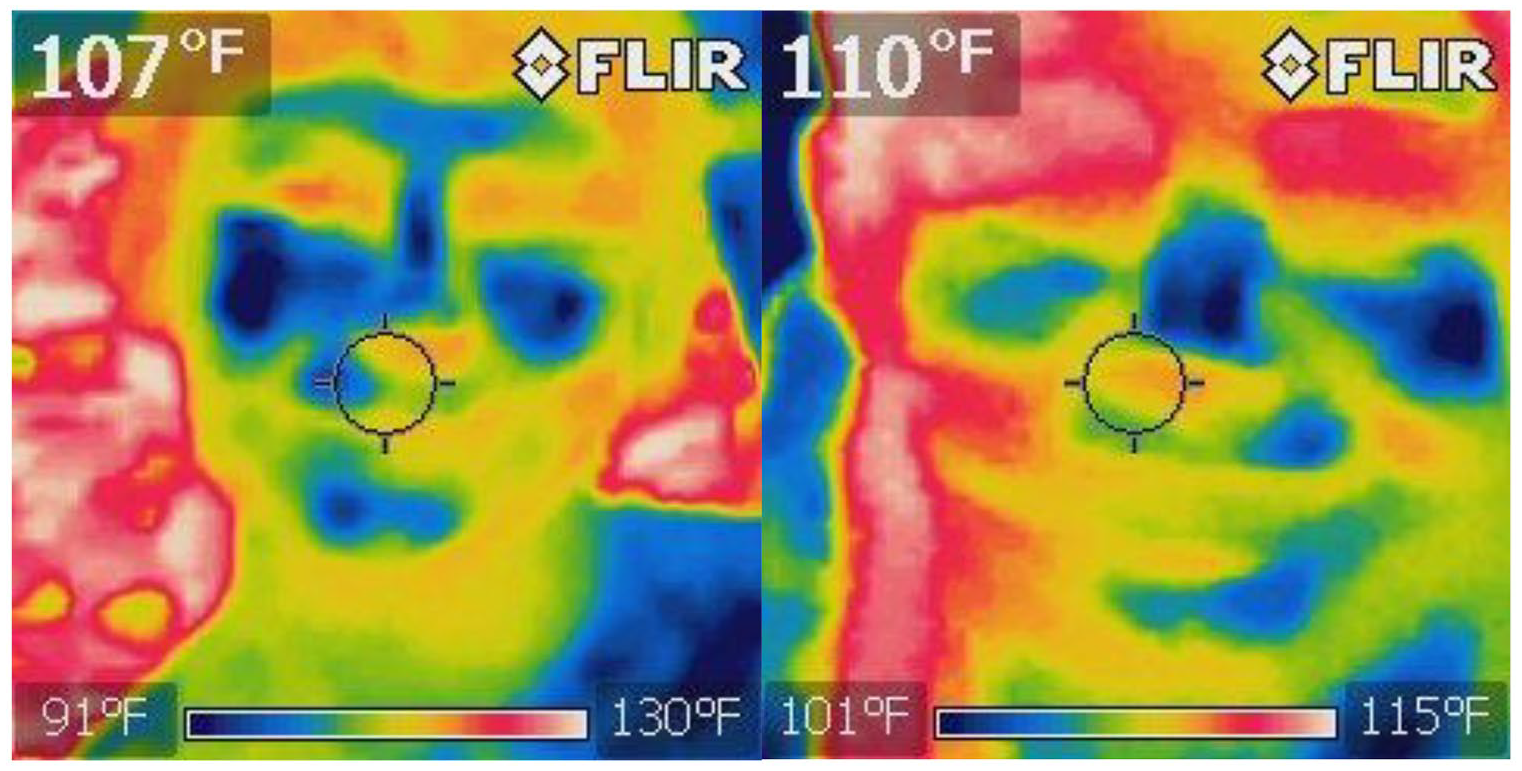
Becoming-imperceptible. IR image: author
At this juncture, it is instructive to clarify elemental attunement in extremis as presented here in relation to a more customary biocentric view of attunement. Timothy Morton’s articulation in Veer Ecology provides a productive point of departure.
51
Morton defines attunement as the dynamic adaptation of an organism in relation with other living beings and environs. Camouflage, for example, is an adaptation of the octopus in avoiding predators. He writes: “to be alive is to adapt, without disappearing completely – to be protected by one’s attunement, but not to the point of dissolving altogether.”
52
For Morton, perfect adaptation (disappearing or dissolving) equals death of the organism. “Death,” writes Morton, “is a term for when a thing actually or wholly becomes its surroundings.”
53
Rather than thinking in terms of the life and death of an individuated organism, as Morton does here, might a broader view of ecological processes suggest that becoming-imperceptible in the elemental flux of heat is attunement par excellence? I think, for example, of Matthew Gandy’s “saproxylic geographies” of decaying wood which trouble separation of the organic and inorganic, life and death. Gandy writes: What are the ontological characteristics of saproxylic geographies? The process of decay poses difficulties in delineating a clear boundary between the organic and inorganic, and between life as a force or process and death as an individuated change in state. The saproxylic realm captures a sense of life as a series of perpetual re-combinations that is underpinned by multiple manifestations of both human and nonhuman agency. If a mycorrhizal fungal network continuously reproduces itself, and dying trees are gradually absorbed into their offspring, then the boundary between life and death is rendered uncertain.
54
More generally, heat is an excessive force generative in ecological and earth-atmospheric systems, ceaselessly composing, decomposing, and recomposing matter and bodies of planet earth. This calls to mind Robin Mackay’s striking expression of solar excess: “Thus we can say that all forms of life are solutions to the same problem; managing the excoriating excess of solar energy which will eventually consume them in death.” 55 Becoming-imperceptible in the generative flux of elemental heat troubles Western metaphysics governing the separation of Life (bios) and Nonlife (geos, meteoros) critiqued by Elizabeth Povinelli in Geontologies. 56 A grand biocentric production marks or stains philosophy and science, elevating and privileging life, especially white, westernized modes of human life. Racialized and Indigenous peoples are dispossessed and marginalized, and elemental castings of nonlife gain significance primarily as supporting props in the ongoing biodrama called Life. Elemental thinking pushes against the walls governing the separation of life and nonlife, and injustices embedded in these onto-epistemological orderings.
Becoming-elemental, as pursued here, is a post-phenomenology affording glimpses of what I call inhuman “perception.” These are uncanny experiences, “passings” strange, wonderful, and horrifying (Figure 4). In selfsame gesture the inhuman moment rises and collapses in the phenomenological illusion of world (object) folded around the perceiving human (subject). We live this phenomenological conceit as habituated beings; that is, beings “human” in a world that anthropocentrically and perversely exists for us, rather than we for it. In becoming-elemental, imagining a world without us, the anthropocentric spell is broken, however fleetingly. This accords with Deleuze and Guattari’s geophilosophy, which critiques subject-object thinking in phenomenology with oblique reference to Merleau-Ponty’s intertwining or chiasm of the flesh. 57 They write: “Subject and object give a poor approximation of thought. Thinking is neither a line drawn between subject and object nor a revolving of one around the other. Rather, thinking takes place in the relationship of territory and the earth.” 58 The geophilosophy of Deleuze and Guattari strikes a resounding elemental chord: “The earth is not one element among others but rather brings together all the elements within a single embrace.” 59

“Passings” strange and horrifying. IR image: author
Becoming-heat, becoming-imperceptible stirs nonhuman temporalities at the limits of thought. How can we cultivate what geologist Marcia Bjornerud calls a sense of “timefulness” through imaginative thinking and storytelling?
60
This is a daunting challenge. The Anthropocene invokes a deep past before the human and far-flung futures in the wake of human extinction, an imagined time when there will be no geoscientists to “read” human-induced changes inscribed in the stratigraphic record of the earth. Along these lines, Colebrook raises an imaginary that jibes with this thought experiment in thermal sensing: In the era of extinction we can go beyond a self-willing annihilation in which consciousness destroys itself to leave nothing but its own pure being; we can begin to imagine imaging for other inhuman worlds. . . .we can look positively to the inhuman and other imaging or reading processes.
61
Scientists read an inhuman past in the geological record. Colebrook is suggesting that an Anthropocene imaginary might endeavor to read “our present as it will be without us.” Might we imagine, she asks, “images in the present that extinguish the dominance of the present?” 62
This trippy paradox, images in the present which dislocate the present, resonates with the thermal imaginary explored here through the i5 device. How so? Infrared images do not strike a succession of countable instants, the measured linear time of Chronos. In the thermal imaginary, the i5 summons inhuman solar time, an untimely time, “the time of the pure event or of becoming,”Aeon. 63 This cosmic temporality reverberates with Ray Brassier’s Nihil Unbound, in which solar catastrophe is not something “lying in wait for us in the far distant future.” 64 Solar extinction in this radically inhuman rendering “needs to grasped as something that has already happened,” marking “the aboriginal trauma driving the history of terrestrial life as an elaborately circuitous detour from stellar death.” 65 In this cosmic reading, thermal images are elemental tracings of the elongated detour or deferment of solar death.
A traumatic story in deep time can be felt roiling through the charged and unruly thermal images. Thinking with Nick Land and Robin Mackay, the thermography of the i5 reminds us that the earth is a fiery body, a planetary body with a 4.5 billion-year history of geotrauma driven by excessive solar and geophysical forces, as the superheated molten metallic core of the earth is a repressed “anorganic memory” of the earth’s traumatic solar birth, accretion, and encrustation 66 (Figure 5). One can say in an adamantly non-teleological sense, all that has ever taken place through, on, and enveloping the earth is haunted by echoes of this primal cosmic scream: turbulent hysterics of conduction and convection, cathartic tectonics and crustal eruptions; radiating solar energies agitating atmospheres, winds, and waters; generative bio-matters, mutations, and extinctions; erosive decay, rot and ruination; sub-plutonic returns to infernal foldings of “Chtelll,” the molten “inner nightmare.” 67 Geotrauma is resoundingly a solar (external) and geophysical (internal) affair, perpetually altering and transmogrifying an ungrounded earth. 68

Geotrauma of an ungrounded earth. IR image: author
Toward an elemental ethics
. . . heat is a force like color that sets aside the understanding in place of something less conscious and more overflowing, radiance instead of line, immanence instead of that famous bird’s-eye view. As our planet heats up and the Tropics [and deserts] spread, is it not possible that not only a new human body but a new type of bodily consciousness will be created . . . a consciousness that reattaches the body to the cosmos? – Michael Taussig, My Cocaine Museum, 2004
69
What might one take from this uncanny aesthetic imaginary, becoming-elemental in heat, stranger in a strange land, moving in unfathomable temporalities of a turbulent earth, espying a glimpse of the elemental world without us? Global warming and the swarm of ecological injuries and anxieties swirling in the airs of the Anthropocene are signals of human estrangement from the elemental earth and cosmos. Michael Taussig’s felicitous image – a new type of consciousness reattaching the body to the cosmos – is captivating. Taussig’s invocation can be felt undulating through the thermal imaginary as a summons, a call from the “outside,” an elemental imperative (Figure 6). The voices of Emmanuel Levinas and Alphonso Lingis can be heard wafting in the summons. In this final section of the paper, I follow the summons, tracing contours in elemental thinking rising in the thermals, edging toward an immanent ethics for an alimentary and volatile earth.
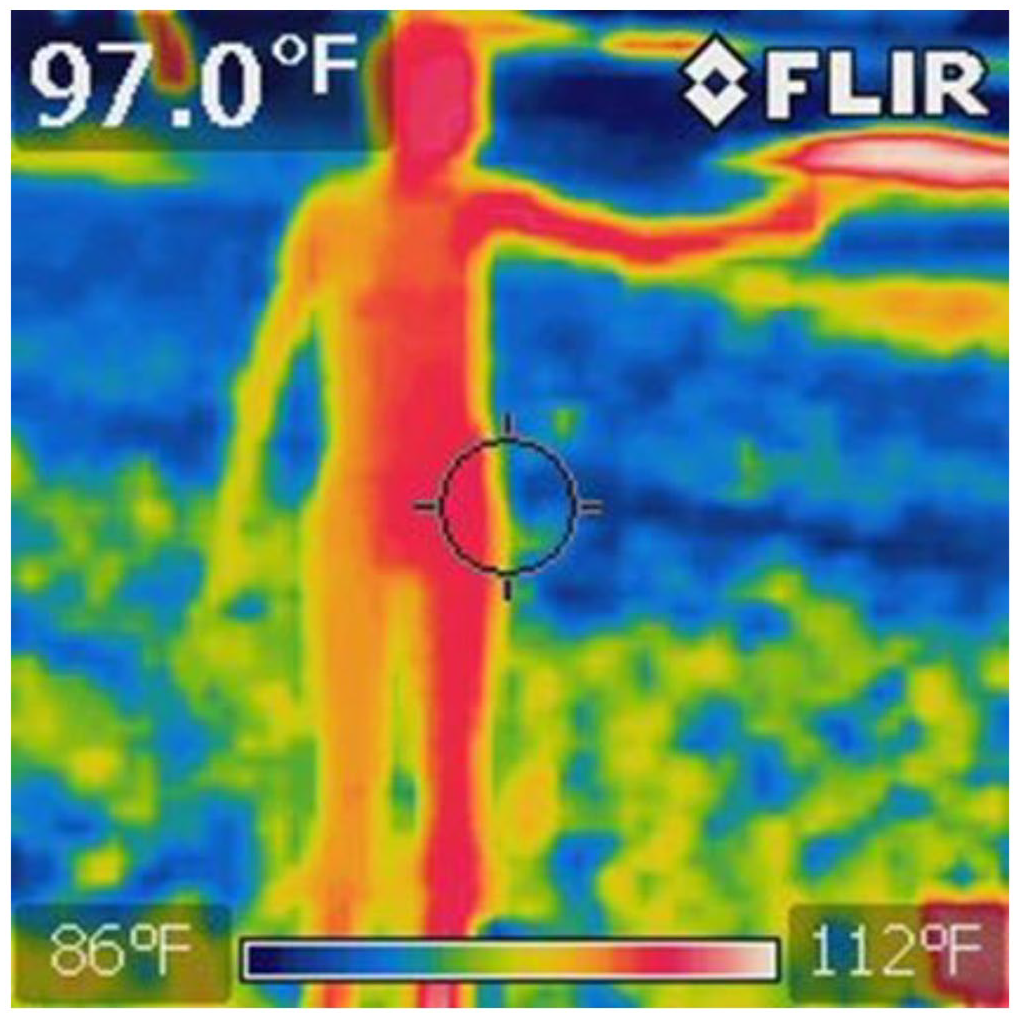
Cosmic body – summons from the “outside.” IR image: author
First and foremost, the thermal imaginary accentuates, pace Levinas, the elemental as exorbitant and overflowing, an anonymous plenum “coming from nowhere . . . coming always, without my being able to possess the source,” 70 for “the sky, the earth, the sea, the wind – suffice to themselves.” 71 The elemental in this post-phenomenological mode of thought is irreducible to discrete things or substances that can be possessed, manipulated, and controlled as in reductive scientific thinking and instrumental reasoning. Levinas writes: “Every relation or possession is situated within the non-possessable which envelops or contains without being able to be enveloped or contained. We shall call it the elemental.” 72 In metaphysical terms, impersonal and non-possessable elemental Being (Levinas’s elusive il y a or “there is” from his work Existence and Existents) is beyond our grasp or reduction, antecedent to and constitutive of all bodies, things, and relations. 73
For Levinas, the elemental is alimentary, source of nourishment and enjoyment, even as it remains anonymous, excessive, and non-possessable, moving beyond any final capture or fixed determination in thought. The body is always already exposed, receptive, and vulnerable in alterity. 74 I argue that Levinas’s ethics of corporeal openness and sentient vulnerability extends beyond the face of the human “other” to surfaces in elemental alterity, what he calls “the impersonal par excellence . . . the very strangeness of the earth.” 75 This is a relational sensibility (sensation) prior to conscious awareness, intention, and willful action. 76
Levinas’s thought fosters radical openness and vulnerability in the face of elemental forces exceeding possession and control. This is crucial, I think, in fostering a measure of humility in challenging anthropocentrism and questioning inflated universal notions of Anthropos as “master” of externalized nature and “maker” of worlds. In The Natural Contract, Michel Serres writes: “Through our mastery we have become so much and so little masters of the Earth that it once again threatens to master us once in turn. . . . Even more than we possess it, it will possess us.” 77 We catch a whiff of human exceptionalism and hubris in techno-scientific claims for managing a sustainable earth and geoengineering the massive heat-driven, hyper-complexity called global climate, chimerical aspirations wrapped up in speculative neoliberal capitalist ambitions. 78
Learning to feel, think, and live “otherwise” is an imperative in the shadowed light of the Anthropocene, evidenced by global warming, mass extinction, damaged ecologies and ecosystems, environmental toxins, and pernicious environmental injustice and racism. Roy Scranton’s unflinching critique of the predicament comes to mind, as he calls for facing deep-seated human limitations, fears, and denials in “learning to die in the Anthropocene.” 79 By learning to die, Scranton means nothing less than letting go of a way of life and its undergirding humanism predicated on the egotistical bounded self, a crippling fear of (individuated) death, the myth of perfectibility of the human “animal,” belief in progress as an inexorable march toward full knowledge and mastery, entangled in carbon-fueled global capitalism fomenting parasitic relations, social injustice, and ecological destruction.
A second voice, that of Alphonso Lingis, rises in the thermal currents. Lingis fuses the elemental alterity of Levinas and the fleshiness of the lived body of Merleau-Ponty in creating a novel post-phenomenology. 80 The elemental, for Lingis, moves in interrogative mode as a summons or imperative, for “sensuality is awakened from the outside.” 81 Sensuous bodily attunement is a movement of involution in a medium or plenum, for the “outside” is always already working “inside,” folding and turning conditions of possibility. “One finds the light by immersion, one is in atmosphere, in sonority, in redolence or in stench, in warmth or in cold.” 82 Lingis elevates sensations and sensuous bodies in conjoining worldly material encounters and affective transpersonal experience. His writings are choreographed as a kind of sensuous dance in the elemental – “life lives on sensation: the elements are a nourishing medium.” 83
Lingis is an intrepid traveler, impassioned thinker, and lyrical writer of sensual warmth and exultant wildness, never losing touch with the elemental earth as a wildness in being and becoming. This is expressed in an astonishing passage in the essay, “Catastrophic Time,” which in my ears rings as a rallying cry for the kind of elemental ethics espoused here. I quote the paragraph in full to impart its impact: Far from the world of work and reason, we are nothing but a euphoria in the limitless bliss of the earth, sky, and ocean. And this elation produces in us the brutal strength to face the agony of a universe not made for our contentment and indemnification. From inhuman distances, with the fearsome farsightedness of birds of prey we see that sinister spectacle of stupidities and deceits, pillage and tortures that is the history of our species. With soaring raptor eyes we see ourselves devouring plants, birds, fish, and fellow mammals, our earthbound organisms trampling exquisite micro-ecosystems with each step. With fierce eyes, we see the lethal tides of summer and winter which exact agony from all living things. In the remote distances we see the skies emptied but for the stars burning themselves out as fast as they can.
84
Lingis’s prose lifts and suspends the reader in the loftiness of the elemental and cosmic, affording a glimpse of fearsome elemental and inhuman forces. In this passage, the inhuman and elemental are not posed in opposition to the human – obstacles to overcome – but as fearsome forces running through the human, summoning awareness and response. The wildness and ferocity of the elemental is generative of sensuous attunements and resistance to biopolitical forces circumscribing, injuring, and destroying vulnerable bodies and ecologies. 85
Returning to Taussig’s provocative image, how might the body be thought anew in face of global warming and the Anthropocene problematic? Taussig’s incantation, in my reading, is more than a hope or dream for a distant future; it is a pressing matter of concern in the “here” and “now,” an elemental imperative. As expressed by Levinas and Lingis, bodies are always already exposed, receptive, and vulnerable in excessive elemental forces and relations of a rumbling earth. This immersion is anterior to, and productive of, awareness, perception, reflection, and action. I argue that, paradoxically, it is through decentering the human, and dissolving the egotistical self, that diffracted bodies feel the alterity and wildness of the elemental moving as a summons or imperative, opening up possibilities in thinking and living otherwise. Responding to the summons, expanding capacities for what a body can do, 86 begins with letting go, letting go of human exceptionalism and a presumption of possession and mastery. Letting go is the liberatory strangeness felt in the thermal imaginary afforded by the i5 device: elemental heat, impersonal and exorbitant, coursing through all earthly bodies.
A chorus of voices is telling us that responding with compassion and care to human and nonhuman others – immersed in elemental forces of the earth – does not require anything close to full knowledge, understanding, and mastery. 87 In fact, it is an elemental earth eluding capture and possession that touches, provokes, and summons. Response and responsibility, an immanent ethics, is enlaced in the summons itself. Elemental imperatives are riven through all bodies, living and nonliving, of this turbulent and fragile planet. We must be open to the summons and move beyond spinning reductive and redemptive Anthropocene narratives for saving this world. 88 There can be no new bodies and worlds to come, no movement toward Serres’s far-reaching cosmocracy, 89 in the absence of an elemental ethics worthy of the earth itself.
Footnotes
Funding
The author received no financial support for the research, authorship, and/or publication of this article.
