



Abstract
This article discusses social spaces within Bunurong Country, Australia, and the production and recording of Aboriginal cultural values. Among the broader Australian community, there is a considerable appetite for the incorporation of ‘authentic’ Aboriginal cultural values into various Western processes, such as the planning, heritage and environmental sectors. This article argues that by establishing Aboriginal control of how these values are produced, significant cultural meanings and connections can be made in relation to Country. Utilizing a ‘two toolbox’ approach as a way to integrate Aboriginal and Western structures, it outlines and explains a framework for discussing Aboriginal cultural values, as defined by Bunurong knowledge holders, as a tool to record and link the context of these values to community-generated outcomes. This framework is designed to be applied as a method for recording Aboriginal cultural values within cultural landscapes, to produce social spaces with meaning and dignity for Bunurong people.
Keywords
Introduction
This article has two purposes: first, to discuss what Aboriginal Cultural Values (ACVs) are and, second, to demonstrate how these values can be produced to further support Aboriginal political recognition within commercial projects and broader government legislation and policies. One authors of this article (David) is an embedded (non-Aboriginal) researcher at the Bunurong Land Council Aboriginal Corporation (BLCAC) in Australia, which is an inclusive Aboriginal corporation that represents the Bunurong people in the First People’s Assembly of Victoria. The BLCAC is also a Registered Aboriginal Party (RAP) and, therefore, a statutory decision-maker under the Aboriginal Heritage Act 2006. 1 This short article will demonstrate a method for how techniques based within cultural geography and place-making can be used to produce ACVs; the study on which it is based has been collaboratively produced with the BLCAC in Victoria, Australia.
Recognition of Aboriginal people as part of the Australian population did not occur until 1967,
2
and since then, the full acknowledgement of their dispossession has been a slow process which remains as necessary now as it did then.
3
However, ACVs can be used as a tool to assist in Aboriginal self-determination and political recognition within the conceptual framework ‘Country’, as expressed by Deborah Bird Rose: Country in Aboriginal English is not only a common noun but also a proper noun. [Aboriginal] People talk about country in the same way that they would talk about a person: they speak to country, sing to country, visit country, worry about country, feel sorry for country, and long for country. People say that country knows, hears, smells, takes notice, takes care, is sorry or happy. Country is not a generalised or undifferentiated type of place, such as one might indicate with terms like ‘spending a day in the country’ or ‘going up the country’. Rather, country is a living entity with a yesterday, today and tomorrow, with a consciousness, and a will toward life. Because of this richness, country is home, and peace; nourishment for body, mind, and spirit; heart’s ease.
4
The Country of the Bunurong is extensive and includes the Mornington Peninsula, south of the city of Melbourne. Through the use of informal workshops and an ACV framework, Aboriginal people’s meanings and connections to their cultural landscapes, and Country, can be used to produce mutual (both Aboriginal and Western) spaces. Within such spaces, the inherent power imbalance between Aboriginal people and colonial institutions can be partially addressed by redefining social spaces along a trajectory toward greater Aboriginal self-determination and political recognition.
This discussion begins from the understanding that ACVs are a Western construct. As notably put by Peter Sutton, ‘Objectifying and putting values on “culture” is indeed a Western idea’, 5 and the framework presented here aims to decolonize how these values are produced and communicated. If Aboriginal people produce ACVs from within their own agenda, ACVs can be a powerful tool to further Aboriginal political recognition.
The BLCAC’s daily work includes several avenues in which Aboriginal people are engaged during planning processes, such as involvement in cultural heritage management, strategic involvement in policy and planning, and interpretative artwork. Within Victoria, there are considerable requirements within heritage 6 and marine and coastal legislation to incorporate ACVs. 7
What are Aboriginal cultural values?
When BLCAC knowledge holders are asked to contribute their cultural values to various projects run by an external consultant, often, the values framework or themes for such projects have already been developed. 8 As an example, ‘Victoria’s Framework of Historical Themes’ 9 is regularly used in Victoria, often with the best of intentions. 10 The proceeding conversations are then controlled by the external consultant, who, by defining the themes, removes BLCAC knowledge holders’ opportunity to own the direction of the process. By providing a framework to assist in defining what ACVs are for Bunurong people, we hope to decolonize the approach to recording ACVs in a way that empowers the Bunurong people. The following is a discussion of what ideas surround ACVs and how they are understood and produced.
The nature of values has been discussed for some time in anthropology and cultural geography 11 but is a recent topic of academic debate within the international environmental sustainability community. 12 The definition and meaning of ACVs, as used in these contexts, are informed by academic discussions related to heritage values, social values and cultural values. 13 However, what is more important in the context under study here is how Bunurong people define ACVs for themselves. Dan Turnbull (BLCAC Chief Executive Officer) defines Bunurong ACV as being ‘about things that really matter within a culture like connections and making meanings. Aboriginal cultural values are about respect to the old people and defending what the old people would want, through both traditional and contemporary Bunurong perspectives’. 14 As this definition shows, ACVs are about connection to and respect of both pre-colonial and contemporary understandings for Bunurong people. They connect the past and the present to meanings produced by Bunurong people, not for or about them.
As this explanation demonstrates, within Bunurong Country, ACVs can add meaning to various aspects of the cultural landscape for both Bunurong people and the broader Australian community. ACVs can be used as contemporary tools to assist in understanding how intangible Aboriginal heritage is defined. Currently, the Aboriginal Heritage Act 2006 79B (1) defines intangible Aboriginal heritage as: any knowledge of or expression of Aboriginal tradition, other than [tangible] Aboriginal cultural heritage, and includes oral traditions, performing arts, stories, rituals, festivals, social practices, craft, visual arts, and environmental and ecological knowledge, but does not include anything that is widely known to the public.
Consequently, the Aboriginal Heritage Act 2006 creates a significant space for recording and protecting Aboriginal knowledge and practices as expressions of culture that can be given meaning and connections through ACVs.
Bunurong cultural landscapes as social spaces
ACVs have their basis within individual and communal values. 15 Consequently, they exist within social spaces and can be contextualized within a framework oriented around the concepts of cultural landscapes, 16 places and Country. 17 There are thousands of Aboriginal Cultural Heritage Places (ACHPs) registered within Bunurong Country, many of which were recorded after 2006. These physical reflections of Bunurong people are registered on the Victorian Aboriginal Heritage Register, which is currently managed by the state government body, First People’s State Relations. Figure 1 demonstrates the approximate known spatial distribution of ACHPs within the BLCAC Registered Aboriginal Party area, although the majority of such ACHPs have been destroyed or impacted by the development process. These ACHPs’ existence illustrates the cultural persistence of Bunurong people during a range of periods, both before and during the colonial era.

Map of ACHPs places in BLCAC area (September 2020). As of July 1, 2021, this area has expanded (David Tutchener).
European colonial spaces within the BLCAC RAP area are demonstrated in the mapping produced during this era (see Figure 2), as colonialism within Victoria resulted in the displacement and attempted elimination of Bunurong people. 18 Colonial-era mapping also renamed the Bunurong cultural landscape, producing a settled and cultivated European landscape (Figure 2). Numerous researchers have recorded the process of cultural dominance through the renaming and reimagining of cultural landscapes, both within and beyond Australia. 19 Other colonial histories have also claimed that the Bunurong were last seen on the southern Peninsula in 1856, expunging them from the historical record altogether. 20
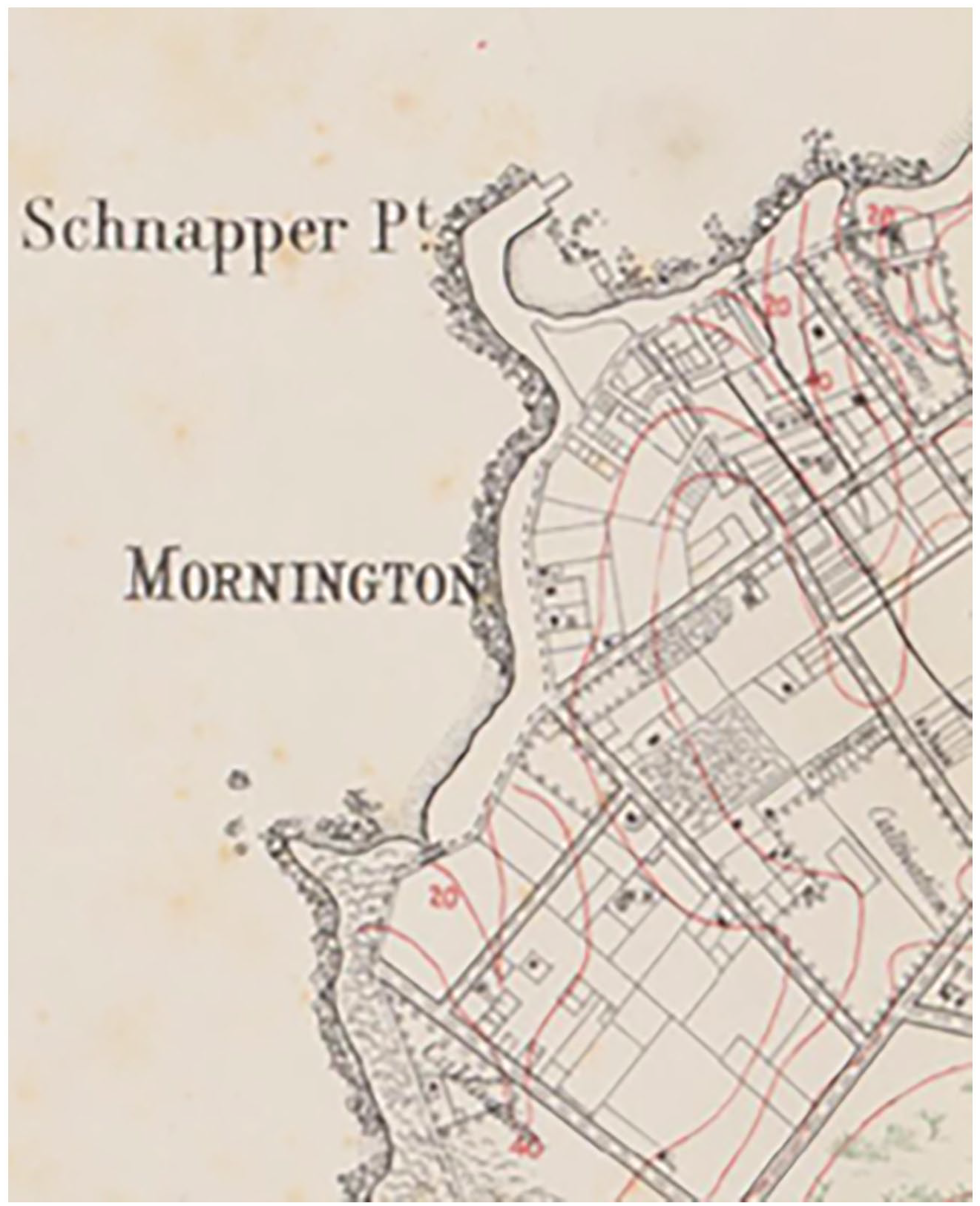
Early Colonial Map of Mornington (1890s). 21
The most glaring tension between the archaeology and colonial history of Bunurong Country is the invisibility of Bunurong people within the colonial landscape. This invisibility and the silence surrounding Aboriginal people in Australian colonial spaces are reflected in the substantial work of anthropologists Rose 22 and Stanner. 23 The archaeological record and recently written histories clearly demonstrate Bunurong people’s extensive use and production of this cultural landscape. 24 As such work drives home, Bunurong people have persisted into the colonial era, and the production of ACVs can be used as a tool to gain further political and cultural recognition for them.
To record and communicate ACVs, the method must be decolonized such that the BLCAC can direct and control ACV production and link them directly to community-based outcomes. This process is producing not only a space in which the Bunurong people exist but also social spaces that they are reclaiming, including the official renaming of places and reinterpreting colonial spaces. In practice, this political and actual reclaiming of social spaces promotes self-determination, employment, conservation, and the protection of spiritual and cultural practices and places.
The ACV framework
The ACV framework is a tool used for several purposes. First, it helps record the meanings that connect Bunurong people to cultural landscapes and the places within them. Second, as Bunurong people record ACVs, they are producing connections and meanings to intangible cultural heritage under the Aboriginal Heritage Act 2006. This framework permits Bunurong people to construct their ACVs in a way that allows them to clearly contribute to various pieces of legislation and projects. ACVs provide ‘hooks’ and ‘levers’ within Western structures that link ACVs to better community outcomes. The categorical recording of ACVs using this framework as defined by Aboriginal people, we predict, will, over time, provide a direct measure of the decolonization of Aboriginal cultural heritage management legislation.
Engagement between Aboriginal groups and aspects of Western culture can be explained using a ‘two toolbox’ approach (Figure 3). Crucial to this approach is, first, recognition of Aboriginal people and their sovereignty, thinking, governance, social practices, priorities, meanings and values. A second crucial element of this approach is recognition from non-Aboriginal parties that to decolonize these spaces, there must be acknowledgement of the structural inequality caused by colonial processes. Conversely, for a ‘two toolbox’ approach to work, there must be recognition and respect of Western practices, even just at the level of their utility by Aboriginal people.
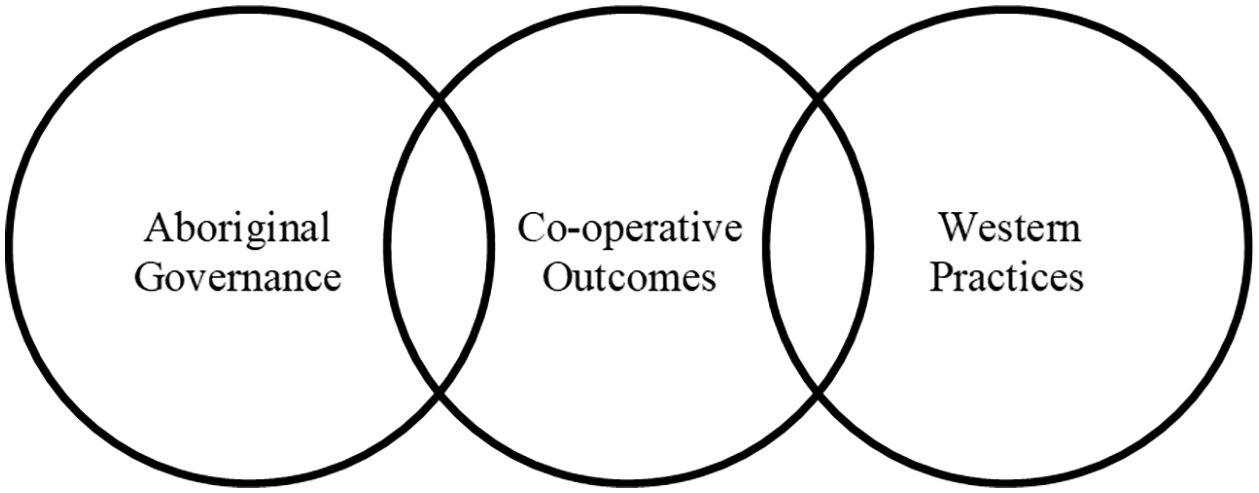
Two toolbox approach. 25
The following approach promotes recognition of Aboriginal sovereignty and governance. Table 1 demonstrates how this method is used to define how ACVs can be produced and contextualized.
BLCAC ACV template (example only).
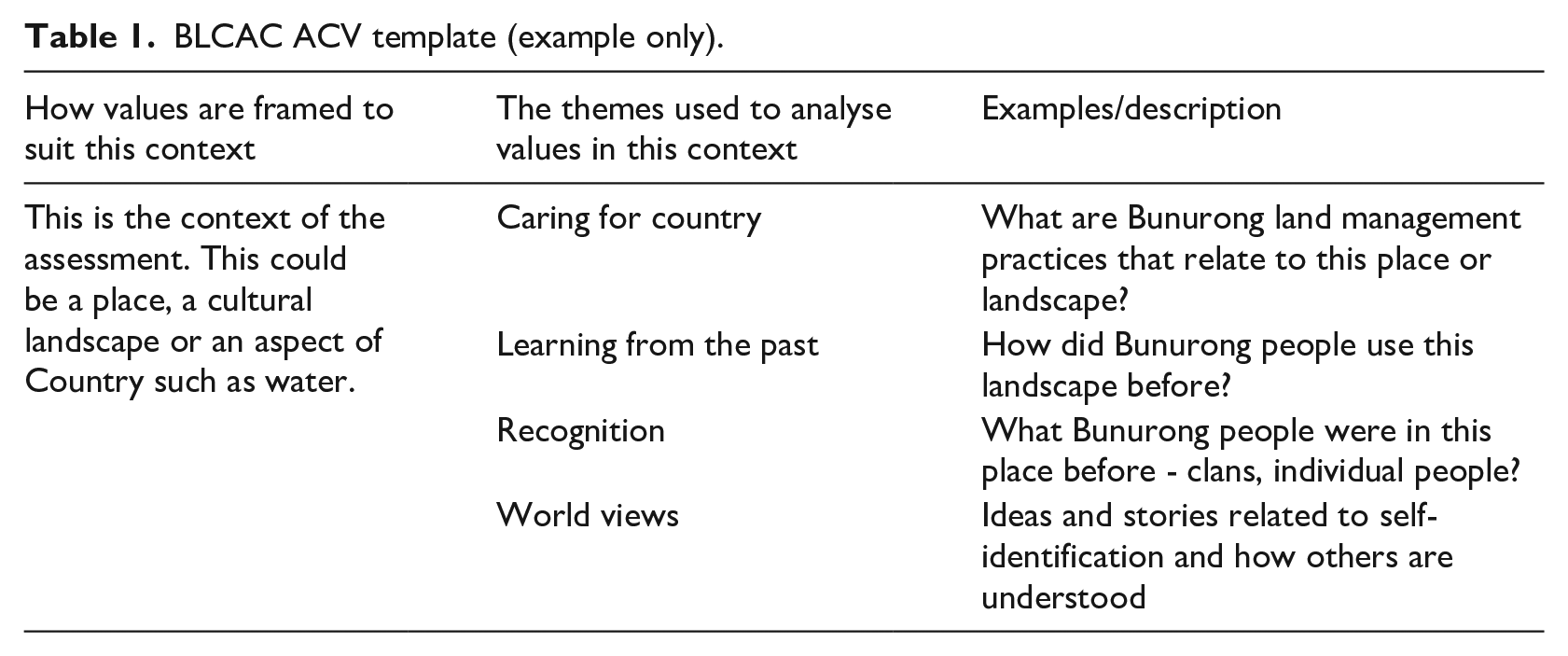
The approach outlined in Table 1 uses six questions that populate the ACV framework:
What is the context of these values?
What will be the umbrella themes used to analyze values in this context?
What are examples and descriptions of these themes?
How can we record these values?
What do these values mean to Bunurong people?
How can we link these themes and values to outcomes for the community?
The overall context of the assessment determines the answers to these questions, as they are specific to aspects of that place, and builds upon a format used by the Intergovernmental Science-Policy Platform on Biodiversity and Ecosystem Services (IPBES). 26 Each answer must be generated through a ‘workshop’-type discussion, where Bunurong knowledge holders’ answers are recorded by the values recorder (an employee or someone contracted by BLCAC). If it is easier for the group to discuss examples in a less structured way, these discussions can be recorded first and themes agreed upon later. From here, depending upon the values outlined, other methodologies are used by the values recorder – for example, ethnohistorical, archaeological, oral histories or historical evaluations. It is essential to let the themes and values drive further research methods, not the reverse. It is also crucial to recognize that any Western research methods can be tools used and integrated into Aboriginal ways of knowing, thinking and valuing. It is now the task of the values recorder to research these topics or themes in collaboration 27 with Bunurong knowledge holders. These recordings may involve site visits and further workshopping of results and any recommendations or desired outcomes. The themes and examples in the framework must relate to outcomes and recommendations that reflect the Bunurong community’s views. Crucially, this tool is not designed to be static, and like Aboriginal cultures, the meanings represented as an outcome of this project are continually changing and adapting.
In this example, a ‘two toolbox’ approach is used in the production of ACVs to demonstrate how these values can add meaning to cultural landscapes and as a tool for decolonizing social spaces through the use of Western practices within Aboriginal governance. Aboriginal people’s invisibility within their cultural landscape is demonstrated in the difference between the colonial historical record and the archaeological record. However, through recognizing and working within these differences, Bunurong people can explore how ACVs can be used to further drive contemporary Aboriginal political agendas.
Conclusion
The production of ACVs using the above approach has been co-designed to assist Bunurong people in controlling the recording and communication of their values in ways that contribute to their political agenda and cultural persistence. Importantly, this method is also designed to articulate with broader Western frameworks of values, promoting ACVs inclusion in wider decision-making processes. ACVs are held by Bunurong people and can be informed and change by whatever avenues or processes Bunurong people choose to use. They may be produced through a range of research methods that include Western and Aboriginal sciences. In this way, ACVs can reflect the combination of both Aboriginal and Western processes. However, the production and application of ACVs are controlled by Aboriginal people, even though associated research may be carried out by the cultural values recorder. Colonialism’s effects on the Bunurong people have been dramatic; consequently, some ‘classical’ or traditional knowledge has been lost. One motivation behind designing this tool is to enable Bunurong people to reclaim the knowledges that have been collected through Western processes. This approach has been co-designed by the authors to limit the search for ‘authentic traditional Aboriginal’ values and meanings and to, instead, reflect whatever contemporary Bunurong decision-makers choose these values to be. This approach to producing ACVs within the field of cultural geography is intended to cultivate symbolic contemporary Aboriginal meaning within the cultural landscape of the Bunurong, contextualizing these meanings within the idea of place. This framework is not intended to measure or quantify ACVs but, rather, to promote a space in which ACVs can be discussed, communicated and shared in ways that allow the Bunurong community’s priorities to be more widely recognized.
Footnotes
Acknowledgements
The authors would like to thank the Bunurong community that we work with every day and Dr Melinda Hinkson, Professor Jon Altman and Professor Jamie Winders for invaluable comments.
Funding
The author(s) received no financial support for the research, authorship, and/or publication of this article.
