




Abstract
A neighborhood bazaar run by a community organization in Saint-Denis in the Greater Paris region, an ‘informal’ cultural street market in downtown Mexico City run by the oldest members of the Punk-Rock community. . . Two spaces that have in common the circulation of objects and a dense web of affective interactions between people and commodities. This article shows how the circulation of objects creates interstitial spaces between the public and the domestic. But it goes further by demonstrating that these interstitial spaces also challenge market and gender norms. Through a participatory methodology involving photography and comparative dialog, the article analyzes the place of objects in the creation of interstitial spaces and their subversive potential.
Keywords
Let us begin by presenting the two places from where this paper emerged: a neighborhood bazaar run by a community organization in the Saint-Denis area of Greater Paris, and an ‘informal’ cultural street market known as the Chopo in downtown Mexico City run by the oldest members of the Punk-Rock community. Two places that are seemingly very different, if only because they are located at more than 5,700 miles from each other in two culturally, economically, and politically different cities. Yet, both these spaces are shaped by the cluttering and circulation of objects, and by affective interactions between people and commodities. The bazaar is located in Saint-Denis, a racialized working-class city in the northern suburbs of Paris, characterized by the presence of large-scale housing projects identified as ‘priority’ neighborhoods by the French State. The Chopo takes place in the center of Mexico City. Circling the formal perimeter of the Historic Center are a series of working-class neighborhoods. 1 Like in Saint-Denis, the State constructed large modernist housing estates in the latter half of the 20th century.
We argue in this paper that the constant shift between publicness and intimacy, visibility and invisibility in publicly-owned yet privately-negotiated spaces, makes the bazaar and the Chopo interstitial spaces: neither solely public nor domestic spaces. We understand the public/private relation in its broader sense, including property and land use, open (visible) and closed (hidden) spaces, and types of social relations (publicness and intimacy). The bazaar is formally a private space, operating in a building owned by a public housing corporation. However, it extends out to the street during opening hours. The interior space of the bazaar is also something of a public space. It is a place of conviviality where (mostly) women come to chat. The Chopo is a public space, extending across Aldama Street. Objects are displayed on many stalls managed by a private organization charged with negotiating street occupation with city authorities. The moment of exchange creates intimacy in a public setting as vendors explain how the Rock-Punk culture impacts directly on their domestic lives (their marriages, their houses).
What is it about the circulation of objects in these in-between private and public places that makes them interstitial? And what do interstitial spaces do in their respective urban and sociopolitical contexts? What are their social, cultural, and political effects? We suggest that because of the nature of the objects that circulate and the attachment that connects objects and people, the bazaar and the Chopo become interstitial spaces allowing individuals to (partially) redefine dominant gender and capitalist norms. This very interstitiality generates transformative and political practices. Following other studies of second-hand markets, our analysis of the rules of object exchange and valuation points to alternatives to dominant capitalist norms because of their reliance on personalized and affective relations. 2 Similarly, the contrasted gendered logic between our two sites of study alerted us to the opening of alternative in-between spaces where gender norms are partly challenged, partly reproduced. However, these places are only incomplete alternatives to how gender norms are spatialized (in particular with relation to the public/private divide), and to how capitalist norms maintain working-class tastes and practices as culturally undesirable.
Engaging with object-oriented ontology, we begin with reflections on material culture and spatial production, followed by a short description of our comparative approach. The core of the paper empirically explores: (1) the modalities of object circulation and valuation in the bazaar and the Chopo where giving, bartering, and negotiating are common practices, while affective, intercultural, and pedagogical values take precedence; and (2) how affective atmospheres created by the exposition and circulation of objects produce the interstice between the public and the private. We discuss how the process of valuation and circulation and the constant shift between publicness and intimacy generate incomplete alternatives to capitalist and gender norms. This is where the comparison between the bazaar and the Chopo becomes interesting because it enables us to reflect on the difference between an alternative interstitial space geographically located in the center of the city, and thus very visible culturally and politically, versus an interstice located in the periphery, and thus much more unassuming and invisible.
Interstitial spaces challenging capitalist and gender norms
In the past two decades, Object-Oriented Ontology (OOO) has gained influence in the humanities and social sciences. 3 In cultural geography, this had initially been heard as a call for ‘rematerialization’, engaging with new materialism and actor–network theory (ANT). 4 The starting point of these early calls for more-than-human materialism was a relational and processual philosophy. However, more recent OOO is more about engaging with objects in their own terms, beyond human mastery. OOO rejects processual and praxeological accounts. Graham Harman insists on the need to separate objects from human consciousness, because objects are much more than what we can humanly grasp about them, they have mysterious depths. 5 According to him, ANT failed to consider the essence of objects when they are not in relation to other actants and actors. Focusing on this ‘uncanny essence’ of objects, OOO searches for the ‘irreducible dark side’ of things, what is hidden and can always erupt and surprise. 6
OOO’s conceptualization of objects as autonomous rather than relational, has important consequences for geography. Firstly, by ignoring subject-object relations, OOO leaves aside the forceful effect of affects and emotions in the cultural and political process of transformation. In a recent article published in this journal, Lucas Pohl uses Lacan to call for ‘object-disoriented geographies’. 7 According to Lacan, anxiety is generated by the impossibility to locate the object of unease; it is object-disoriented. Through a fascinating analysis of the Ghost Tower in Bangkok, Pohl argues that OOO’s complete rejection of subjectivity cannot help ‘to understand why certain objects can have disturbing effects on the subject’. 8 By reintroducing the subject in relation with objects, it becomes possible to analyze the emergence of affective spaces.
Antoine Hennion shows how an ‘“object” is not an immobile mass against which our goals are thrown. It is in itself a deployment, a response, an infinite reservoir of differences that can be apprehended and brought into being’.
9
Objects exist for humans only if there is a mutual response between subject and object. An example from Octave Debary and Arnaud Tellier’s study of a French bazaar will make this clearer: (In a bazaar), buyers who do not purchase anything have the feeling of having “not seen anything”. They are abandoned by objects that they were unable to perceive, that do not “speak” to them. Because no objects have chosen them, they find themselves marginalized in a market which produces community.
10
Here, Debary and Tellier are describing a feeling that anyone who has ever visited a bazaar has experienced: the feeling of not having seen anything among a clutter of objects. It is not that one has not seen ‘anything’, but rather, that the objects have not chosen them. The very phrasing implies that objects ‘act’, that they ‘choose’ to whom they will present themselves, making themselves perceivable. This constitutes the ‘event’ in Milton Santos’ sense, establishing a relationship with an object triggers a feeling of belonging to the community of the bazaar. Santos argues that space is essentially defined as a system of objects. 11 In Santos’s thought, the ‘event’ is the vehicle through which a latent possibility emerges through objects. Events can be of varying importance, but they always occur in a place and are mediated through objects. These object-subject relations, these ‘events’ produce the space of the market, affectively and geographically.
We find this pragmatist methodology attentive to bodily gestures and affective flows between subjects and objects, useful to illustrate how the circulation of objects in the bazaar and the Chopo is entangled in a web of affective relations between people and commodities and among people. This is why these places have such an intimate character. Our argument here is that this web of affective interactions between objects and people in the bazaar and the Chopo creates a specific spatiality: the interstice. In-between public and private, the interstice is situated both within and outside the norm. Wendy Steele and Cathy Keys define interstitial spaces as ‘both physical and conceptual spaces located at the edges of urban form and practice’. 12 The interstice is generally synonymous with disorder and transgression, but it is also a place for sociability, navigating between the anonymity of the city and the familiarity of private spaces. As such, interstitial spaces are more than residues of the city, they contribute to transforming it from within. We find in the Chopo and in the bazaar this in-betweenness: between private and public, between intimacy and publicness, between monetary transactions and gift.
It is the political dimension of the bazaar and the Chopo, in the sense of their ability to generate social transformation through materialized practices and affective interactions, that appealed to us. King and Dovey consider that ‘it is in these gaps that one looks for the emergence of new dissent, resistances, aesthetic expressions, and, accordingly, creativity’. 13 The political dimension of interstitial spaces emerges in the conflict between control and subversive logics: it is because they are ‘contested sites’ that they have ‘the potential to produce new conceptions of self and place’. 14 If we follow Steele and Keys, the interweaving of formal and informal in interstitial spaces ‘offers a site for quasi utopian dreaming’. 15 Erik Olin Wright speaks of an ‘interstitial strategy’ to designate alternatives that develop from the margins, as opposed to the revolutionary strategy of overturning the social order from its center. 16
The literature on interstitial spaces does not refer to OOO. Nevertheless, following Ian G.R. Shaw, some of OOO’s insights are very useful for understanding how the interstice can generate (cultural and political) transformation. 17 By insisting that objects can never be fully understood by humans, Harman suggests that objects always have hidden properties in excess of their ‘public face’. ‘When objects affect one another, that affecting does not exhaust the potential range of affects possible’. 18 What Shaw calls a geo-event occurs when the excess of objects, their hidden ‘dark side’ comes to the fore and replaces the objects that stabilize a particular world. ‘In doing so’, writes Shaw, ‘they completely redraw the ontological cartography of force relations within the world’. 19
In other words, to explore the political dimension of interstitial spaces implies determining to what extent they constitute alternative spaces, and alternatives to what? In the case of the Chopo and the bazaar, we will focus on two dimensions of the social order that these interstitial spaces seem to reshape: capitalist norms of exchange and gender norms. In both places, objects enter alternative circuits, through reuse, barter, gifts, or through their appearance in a circuit where such objects were prohibited (as during the import-substitution system in Mexico). Alternative spaces emerge, not only because objects are diverted from mainstream circuits, but also because these deviated, slower, and more localized circuits are affectively charged. Both places are also clearly gendered. There is a long tradition of research exploring gendered objects in the domestic space. 20 What is less developed, however, is the relationship between the circulation of objects and the emergence of spatialities challenging gender norms. By focusing on affective subject-object relations, we will see emerging the bazaar and Chopo as interstitial spaces where actors can ‘escape’ gender norms that regulate both domestic and fully public spaces.
As we shall see however, these interstitial spaces are incomplete alternatives: they challenge capitalist and gender norms at the same time as they reproduce and sometimes even reinforce them. This ambiguity is also what makes them interstitial. Indeed, interstitial spaces exist through a movement that is both antagonistic and constitutive. 21 Through their (incomplete) challenge to dominant capitalist and gender norms, they are antagonistic. As they are constantly emerging and reinventing themselves, they are also constitutive. These are spaces of becoming where the ‘dark side’ of objects affect subject-object relations and come to the fore. In doing so, they relax the constraints that normally stabilize the capitalist and gender order of Greater Paris and Mexico City.
‘Intimate distances’: a note on our object-oriented collaborative comparative method
What follows is based on a dialogical comparative process initiated within TRYSPACES, a research and artistic community that covers four cities. 22 This community is based on the premise that the intersection of different types of language – spoken, expert, artistic – allows for the production of scientific knowledge. It is part of a long tradition of participatory research, concerned with giving a voice to those who are little heard (including objects). This involves less a series of techniques than a redefinition of the researcher’s posture in the conduct of research. 23 At the bazaar, Léa Billen was a researcher and a volunteer, tidying, sorting objects, and welcoming the public. She took part in this tangle of emotional connections between objects and people that constitutes the bazaar. At the Chopo, Julie-Anne Boudreau became a regular visitor as of 2018 and organized a series of community archive and intergenerational oral history workshops with vendors, founders, and young Punk-Rock lovers. Jordi Agüero had known the Chopo as a child when he often accompanied his father. He joined the research after the workshops and organized a radio program to celebrate the Chopo’s 40th anniversary. 24
The selection of the bazaar and the Chopo as sites of study is based on two criteria. Firstly, we were looking for spaces where transgressive practices converge. Identified as a countercultural space, the Chopo is clearly transgressive. In the case of the bazaar, we arrived there because we had identified Saint-Denis as a stigmatized space, and this very stigmatization enabled us to comparatively reflect on intentional and unintentional transgression. The second criteria, perhaps less ‘scientific’ but much more powerful, is that we felt a strong attraction to these places based on the curiosity they provoked for us.
What brought us together in writing this paper is a simple question: what function does the accumulation of objects serve in these two spaces? We began this comparative dialog by describing our informants’ and our own affective relationship to these objects and how they circulate. We also described in detail who these informants are and the spatialities they generate. This is where the visual material produced during the research became very useful. In both cases, we used photography as a methodological tool to implement participatory research. At the bazaar, a photo studio was set up in the kitchen at the back of the building. Visitors were invited to pose with an object they had bought or donated. The portrait was preceded by an interview. This collection of sounds and images were assembled into a photo exhibition which took place in the bazaar and was an opportunity to visibilize the special atmosphere that unites objects and people in this place. In the Chopo, photography was used during the community archive and oral history workshop. Choperos were invited to pose with their stalls, outfits, and collections, while young workshop participants were trained in photography and interviewing techniques. 25
In both cases, photography was not simply used as an observation tool, it was used as a device for creating meaning with the person who posed in front of the lens. The choice of the object, the way of posing with it was up to them. The images produced are first of all images of the social: they aim to describe social phenomena and to constitute a database. But they have also become social images, following Becker’s distinction 26 : given to be seen in an exhibition or on an Internet platform, they become media for valorizing popular knowledge and making working classes visible.
From these descriptions and images, we familiarized ourselves with the case study we did not know. In this process, we were inspired by the Castleden’s art project ‘Intimate Distances’, where she took ‘half a rock’ from ‘a site exactly half a world away’ 27 with the goal of juxtaposing them from distant places in order to create a sense of intimacy. Each author immersed in their very distant cities, we sought to produce intimacy between two interstitial places through numerous conversations. This is when we entered the ‘translation’ phase of this comparative process with linguistic translations from French and Spanish to English, as well as contextual and cultural translations, as Mexico City and Saint-Denis are inarguably two very different places. This translation inductively led to the argument presented here.
The circulation of objects: circuits, rules of exchange and valuation
Circuits, speed, and scope
“That day, Fernanda donated a pink plastic chair for children. When I asked her where it came from, she explained that “instead of buying toys at 50 euros, I come here, I buy small toys for whatever price the lady decides, the children play with them three or four times, and when they get tired of them, I bring them back.” She does not know the person who donated the chair, but she “trusts the people in charge of the store, they say that they are clean, that they are good. [. . .] Had I seen it outside, or somewhere, I would not have taken it. Never in a million years!”” (Léa, December 18, 2019, field diary)
Objects in the bazaar have two origins. Some, like this pink chair, are donated by residents of the neighborhood looking to get rid of objects that are cluttering their domestic space. Other objects arrive through an initiative by the organization, usually attic clearances. Objects are not washed or repaired by the organization. However, donors are usually people known to the bazaar’s volunteers. They are careful to clean the objects before giving them away, or to inform the volunteers if they are damaged. This relationship between volunteers and donors and the care given to the condition of the objects explains the trust Fernanda mentioned above (Figure 1).

Fernanda is showing the pink chair she bought at the bazaar and donated back a few days later. Photo by Jean Larive. 2019.
In this circuit, objects circulate from domestic (or more rarely institutional) spaces to the bazaar through a system of donations. From the bazaar, objects return to other domestic spaces to be reused. In the case of Fernanda, for whom the bazaar functions as a library of objects, the speed of circulation in this circuit is rapid. Its scope is generally local. However, some objects come from far away, brought back from donors’ country of origin, and some are shipped abroad if they are bought in bulk by a charity organization.
In the Chopo, the circuit of exchange functions at a slower speed. Collectible objects or objects prohibited on the mainstream circuit because of restrictions on imports until 1994 in Mexico are cherished and do not exchange hands very rapidly. ‘Independent’ countercultural products are explicitly positioned on an ‘alternative’ circuit distinct from major record companies. They are often produced locally, independently, and they circulate on underground circuits.
“As Jorge (a founding Chopero) is presenting his CD collection, he delicately pulls a box-set from his shelf. It is a collection of eight CDs from the German band Popol Vuh. He remembers how in the mid-1980s he was curious about this band. There was no way he could listen to Popol Vuh because it wasn’t the kind of music that would be played on TV or radio. So, he went to the Chopo, just to find out that the Popol Vuh vinyl was really expensive “′cause it was imported.” Was it worth the money? What if he didn’t like it? Luckily, a few stands further down the street, an old man had the same album on cassette, at a tenth of the vinyl’s price!” (Julie-Anne, March 31, 2021, field diary)
Although at different speeds, the Chopo and the bazaar both function on circuits parallel to the mainstream market: the bazaar systematizes exchanges that would take place in a more informal and domestic way between neighbors or members of a family, while the Chopo contributes to providing a countermarket for subversive objects (Figure 2).

Jorge’s original Popol Vuh CDs. He listens to the ‘pirated’ version on cassette and leaves the original CDs in their wrapping. Photo by Rodrigo Olvera. 2019.
Rules of exchange: ‘catching the eye’ and negotiation
Before objects can be exchanged, they need to ‘choose’ their buyer and make themselves perceivable by them. 28 ‘Catching the eye’ is key to establishing a relation between subject and object. The bazaar, just like the Chopo, opens the possibility to discover strange objects from elsewhere, to imagine their origin and their history. Aurélie explains that she first entered this place by following her daughter, who, attracted by the objects outside, walked through the door: ‘I used to come here a lot because my daughter is very curious. When she saw this place, she went in and, it’s a bit like Ali Baba’s cave, she started rummaging around’. Something ‘caught Aurélie’s daughter’s eye’, an object ‘chose’ her. Volunteers seek to create the conditions for this encounter between objects and people by displaying the strangest or most beautiful objects outside, so as to invite passers-by to enter.
Similarly, the Chopo is all about making objects visible. Instead of ‘beauty’, what is most common here is provocation (Figure 3). Among this visual surcharge of provocative aesthetics, exchange of objects will occur when the visitor discovers something unexpected. However, at other times, visitors come searching for something very specific, a missing piece in a collection, a rare edition.
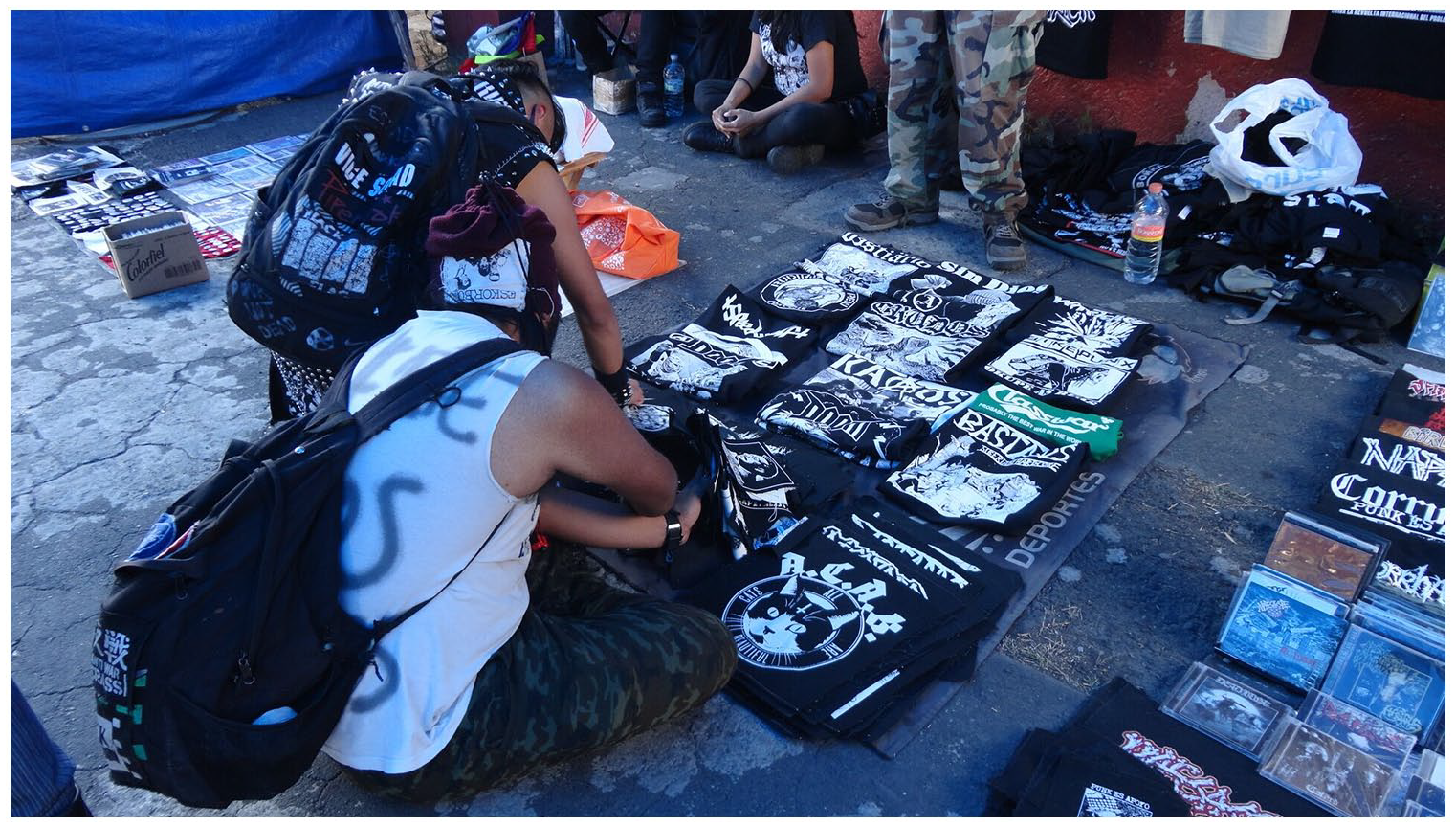
Anarcopunk space at the rear of the Chopo. Photo by José Eduardo Ortinez. 2019.
In Mexico, prices are never displayed in street markets, or if they are, people always expect them to change according to the location of the market in the city or the buyer’s apparent level of wealth. The outcome of the negotiation depends on the rarity of the object in the case of collectibles but for the vast majority of objects, other considerations are just as important, such as how much the seller has made that day. If they absolutely need to sell to cover their costs for the day, prices will be more willingly lowered in order to secure the transaction.
In the bazaar, prices depend less on the nature of the object being sold than on the person buying it. The monetary value of the object depends on the relationship between the volunteer and the buyer, which allows the volunteer to have an idea of the buyer’s income level, family or residential situation, and to adapt the price accordingly. When volunteers know little about the buyers, they go ‘by feel’ and set prices according to the appearance of the person and the informal talks they may have exchanged during the visit. This intuition, based on visible social markers, is not infallible and prices are regularly renegotiated.
In sum, exchange always begins with a relationship between the object that ‘chose’ the buyer whose curiosity is awakened. Once this affective relationship emerges, an exchange can take place through modalities that differ from mainstream circuits, that is, negotiating or offering solidarity prices. This exchange engages an emotional relationship between the buyer, the seller, and the object. Such alternative configuration of the rules of exchange is also reflected in the valuation of objects.
Valuation: knowhow, travel, and history
“Samia donated a teddy bear at the entrance of the bazaar. It was a gift from her boyfriend when she was a teenager. It crossed the Mediterranean Sea 25 years ago. The teddy bear landed in the arms of her younger daughter, who chose to donate it to the bazaar. A bit worn, the bear remained in the pile of stuffed animals available to children entering the main room of the bazaar. For the mother and daughter, who are regular visitors, recognizing their bear in this place full of objects gives it an intimate character, like an extension of their home populated with familiar objects. When I asked the teen if the bear had a name, she says, “No, I never named it. Maybe its story was enough.”” (Léa, January 22, 2020, field diary)
What is interesting in this vignette is the affective value attached to the bear (Figure 4). The object is part of a personal story that the donors are inclined to tell and that visitors are curious to know. A visitor to the bazaar told Léa that she was shocked by the destruction of objects by the shredder trucks that collect the bulky items. She experienced this scene as a form of violence against the people who owned these objects. Among these objects, older items are highly valued in the bazaar, especially when they remind older visitors of their childhood. Objects can also have an intercultural value when they refer to unusual uses in the French context (a couscous maker, a loincloth). Through these objects that have traveled and make people travel, it is the diversity of origins of the neighborhood’s inhabitants that is reflected by the bazaar. Handmade objects, especially those that bear the mark of time, have a creative and educational value.
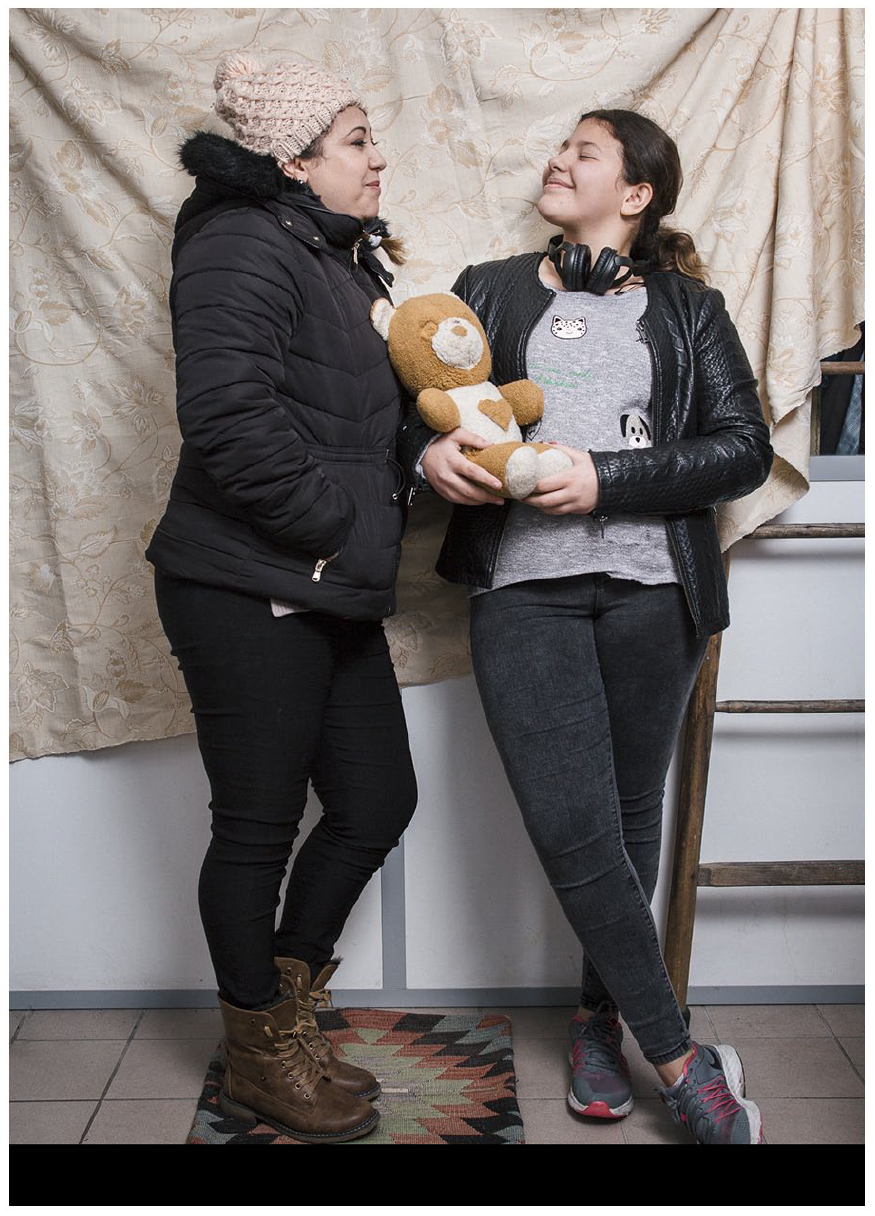
Samia and her daughter share the memories they associated with the teddy bear. Photo by Jean Larive. 2020.
In the Chopo, prices vary according to the knowhow displayed by buyers. Every exchange is an occasion to transmit cultural information about the history of a band, a new trend, or a concert being held somewhere soon. More than information, exchange of objects occurs through the exchange of stories and anecdotes about the object.
“I met Juan Heladio today. A man of probably 65 years old, he is THE living repertoire movie encyclopedia of the Chopo. Entering his stand is like entering one of those beautiful art deco movie theatres where cult films are projected. Although the stand has the same structure as the others with metal poles and an improvised plastic roof, I can easily imagine entering Cine Paraiso in Italy, or one of those old theatres on Wilshire Boulevard in L.A., or perhaps a small projection room in the Quartier Latin in Paris. It’s not just the selection of movies that is attractive, however, it is Juan Heladio’s exuberant body language and tone of voice when he narrates the story of François Truffaut. I am seduced!” (Julie-Anne, June 6, 2019, field diary) (Figure 5)

Juan Heladio in his cinephile realm in the Chopo. Photo by Rodrigo Olvera. 2019.
Many objects sold in the Chopo come from elsewhere. The street market serves as a node for the circulation of countercultural products in all languages. Returning to the example of the Popol Vuh CDs cherished by Jorge, he explains the value of intercultural translations: ‘That’s right, that’s the name of the group, it’s a German group, Popol Vuh. Interestingly enough, they were the ones who first translated the Popol Vuh’. 29 Similarly, as in the bazaar, value in the Chopo is assigned to heritage, especially in relation to counterfeited versions.
Emotional, historical, intercultural value. . . We see here that symbolic value takes precedence over the market value of objects: even if in the end there is a price for each object (except for donated objects), it is never fixed in advance and fluctuates according to the relationship between buyer, seller, and object. The object has no value ‘in itself’, which would be defined by its production cost or by its marketing value. Its value is determined within the interstitial space, according to a given configuration of social relations.
Incomplete alternatives to capitalist norms
However, when objects that are highly valued on the mainstream market are sought after by antique dealers, or are branded objects, capitalist norms of valuation take over in the bazaar. For example, a volunteer explains that she refused to negotiate the price of a dress because it was a Prada. In the Chopo, sellers who form the community organization carry much more weight than barterers, who are confined into an increasingly smaller space of the market. In other words, in both the bazaar and the Chopo, mainstream capitalist logics continue to exist.
More than a logic of revolutionary rupture that is characteristic of the labor movement, many countercultural movements (such as the punk counterculture) function through ‘interstitial’ logic. 30 They build alternatives on the margins of capitalism and in doing so, reveal other possible pathways. However, such marginal alternatives are critiqued. Some consider that interstitial strategies are insufficient to ensure social transformation because capitalism can only be defeated through a revolutionary rupture; for others, these interstitial spaces depend on capitalism and serve its interests by opening up avenues for adaptation that ensure its resilience. A second argument is more interesting to us here: these interstitial spaces would not really be alternatives because they reproduce capitalist norms and reinforce the hegemonic model by absorbing its negative externalities. 31 In the cases of the bazaar and the Chopo, we speak here of incomplete alternatives. Both places help produce alternatives to capitalist norms by creating circuits, rules of exchange and modes of valuation different from those of the mainstream market. But these interstitial spaces remain connected to the mainstream and depend on it to function.
The accumulation of objects and gender norms: tension in domestic and public spaces
“The first draft of the flyer which aimed to make the photo project known was designed by the photographer based on a portrait he had previously taken. It depicts a Black man wearing a Rasta hat. But the volunteers did not agree: “It doesn’t reflect the population of the bazaar, people won’t understand.” The bazaar, they tell me, is mostly visited by women, who might not recognize themselves in this image. I understand that this flyer might put the photo project at risk, but it might also create mistrust towards the bazaar. A volunteer tells me on this occasion that a man hesitating to enter the bazaar had once asked her if a “men’s” bazaar would ever be opened. I agreed with their arguments and the following week I proposed another flyer. This version of the flyer was validated by the volunteers.” (Léa, December 18, 2019, field diary) (Figure 6)
As this anecdote illustrates, the bazaar is a gendered space. While men are not absent, they are definitely in the minority. Volunteers are exclusively women. Visitors are mostly women: among the 26 portraits taken during the photo project, only 6 are portraits of men. However, men are still welcome and some come every week and regularly donate objects.
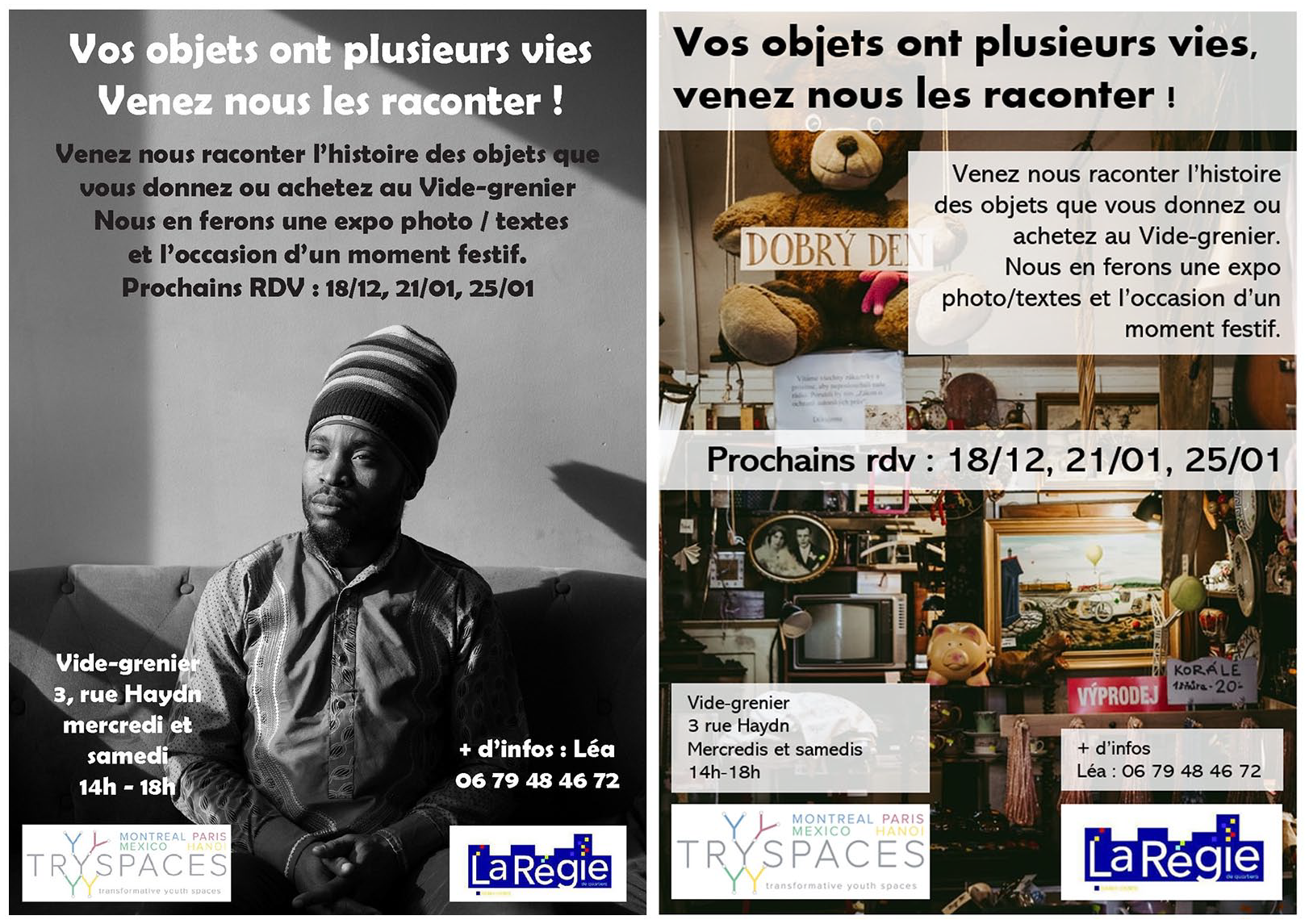
On the left, the first version of the flyer. On the right, the second version. Photos by Jean Larive and Léa Billen.
The Chopo, by contrast, is a predominantly masculine space. Women are welcomed, but definitely less visible than men. Abraham remembers the 1980s: ‘Attendance by women was zero, they didn’t even come, that is to say that one was in love with the records, not with the ladies who passed by. No, no, there were no women, very few, until the Punketas arrived and little by little girls began to show up’. 32 Indeed, women started to attend the Chopo when the Punks were able to secure a space for themselves. While the masculinity of the Chopo is something visible, it is rarely discussed or problematized.
The contrast between these gendered spaces in Paris and Mexico is what intrigued us when we began working on this comparison. Both cases, as we came to see them, constitute interstitial safe spaces of encounter between the domestic and the public. We begin by describing how attendees escape domestic spaces, or perhaps better said in the case of the bazaar, how the interstitial space becomes the extension of domestic space. We then turn to analyzing the relation of the bazaar and the Chopo with public space.
Escape from, and extension of, the domestic space
“Jorge had invited four friends for a collective memory workshop. Guillermo (a research colleague) was responsible for bringing the paperboard. But Adriana (also a research colleague) kept repeating she didn’t know where we would put it. She had gone to Jorge’s apartment once and said there was no space. I was insistent that we would certainly find a corner to put the stand in and write while we brainstorm collectively. So, Guillermo arrives, sweating, with the big stand we had borrowed from the university. It is difficult to describe how I felt when we entered the apartment. I immediately knew what Adriana was trying to tell us and regretted that I had not listened to her. There really was no space to put the stand. I felt dizzy trying to figure out where to even put my foot, let alone how to organize the space so eight people could fit there to discuss. Every single centimeter of the apartment was used. Walls were painted black and covered with posters; the fridge was covered with magnets, photos, concert tickets; all the surface space was covered with objects: CD players, sound boxes, screens, piles of paper, books, CDs, mugs, and other concert souvenirs. . . The total apartment space must have measured 40m2. It is an open studio space on the ground floor of the complex. Jorge has separated the room with walls made of his CD collection. We couldn’t see what was behind these walls of CDs, but the space left on the other side included the kitchen and something like a 2x2 meter space for a round table, which served as a work desk and eating space with 3 chairs. The others stood or sat on piles of paper lying on the floor.” (Julie-Anne, April 13, 2018, field diary)
As we were getting to know many Choperos and were invited to their homes, we realized that they shared a common habit of accumulating objects. And this, many confided, caused much tension with their family, their wives in particular. ‘My wife says I love my records more than her’ 33 And he is not the only one. . . Jorge presented his collection to Julie-Anne, speaking of himself as a sick man: ‘Can you imagine the strength of the disease, how your disease evolves as well, it is not like a degenerative disease, but rather an evolutionary one, if you want to call it in some way. So, for me it is very necessary to have all the albums of such a group’. 34 Describing collectors, Abraham compares the ‘sickness’ of the men who gather in the Chopo: ‘The record people are very, very sick, very crazy, but they found a home (here in the Chopo)’. 35
Among the women who visit the bazaar are mothers, often from the Maghreb or the Middle East, often veiled. The bazaar plays a role of proximity trade and sociability for them: accompanied by their children, they generally come with friends and spend a long time strolling around the place. For example, Sarah comes to the bazaar twice a week, accompanied by her youngest son, Ismaël, 3 years old. She fills her house with goods from the bazaar (dishes, furniture, etc.) and finds clothes and toys for her children. The bazaar mainly offers everyday objects. Dishes, kitchen utensils, clothes, furniture, books, jewelry, toys: these are objects used in the domestic space. As Sarah’s case illustrates, the bazaar satisfies basic needs. Many visitors come to the bazaar to buy a specific object, which they could have bought at a supermarket. Unlike a superstore, however, the bazaar offers domestic objects that have belonged to other people. It functions as an extension of the domestic space. Donors are likely to recognize objects that were previously in their homes, while visitors are likely to imagine the use that others have made of objects before them. Unlike in a superstore, objects have a history, and this brings people and objects closer. The accumulation of everyday objects that have been used by others creates familiarity, and this makes the bazaar feel like home.
The bazaar is also visited by older women. Some say that the bazaar constitutes a step in the emotional work of preparing for mourning. A 62-year-old woman says that she would have liked to pass on her dishes to her children but that they recommended that she throw them away. The bazaar thus appears to be a respectable place to give away objects to which they remain attached. One does not ‘get rid of’ objects at the bazaar, they are given a second life.
For some women, the bazaar also constitutes an alternative allowing them to escape the tension of domestic space. It is a place of confidence where women can share difficult personal situations such as health problems, domestic violence, economic difficulties, children dropping out of school. . . The informality of the relationships that are developed in the bazaar is essential to the creation of a safe space. Volunteers are able to put people in touch with social services, as the women concerned would not have turned to these services without the aid of an intermediary.
The extension of domestic space by interstitial spaces has a double function from a feminist perspective. First, it opens up ‘safe places’ of refuge for women affected by situations of violence or discrimination in their domestic space or in public space. Interstitial spaces are also transitional places between the civic and the political, places of sociability in which politics is likely to be embodied through everyday gestures. Eleanor Jupp emphasizes the place of ‘community space’ in the paths of women for whom the passage from the private to the public sphere remains a challenge and for whom neighborhood places constitute gateways to the political. 36
Mostly visited by women, the bazaar provides a space situated between public and domestic spaces, and this intertwining is, in itself, a move away from the capitalist model of gender relations based on a clear distinction between the domestic sphere associated with reproduction and the public sphere associated with production. However, the bazaar reproduces a gendered distribution of tasks: volunteers are exclusively women, and they ensure the daily order of the bazaar. The place also relies on tasks associated with masculinity, such as moving bulky and heavy objects to free up space, collecting donations and the delivery of objects. These tasks are most often assigned to men. The bazaar is a place of care, offering visitors sociability and informal mutual aid in a context as familiar as the domestic space. However, care work is conducted exclusively by women, thus reproducing an unequal distribution of care. 37
Shelter from public space
The bazaar is a space of sociability at the edge of domestic and public space. There aren’t many spaces for sociability in the neighborhood, especially for women. The café, which has been closed for a few years, has not been taken over, and was mostly attended by men. The community center welcomes children and families for recreational activities, but it remains an institutional facility. The public space of the neighborhood is marked by masculinity, and women are not always comfortable there.
While women who attend the bazaar may feel stigmatized, ignored, or excluded from public space, a comparable feeling of stigmatization is felt by Choperos. In the early days of the Chopo, rock music and appearances were highly stigmatized in Mexico by the Catholic Church as much as by the authoritarian government. Ramón remembers: ‘It was a tremendous pressure because when we were walking on the street, my neighbours, well some neighbours would cross themselves when they saw me and shout, “here come the hippies!”’ 38 Faced with such restrictions on cultural and political expression, the Chopo became a safe space.
“When I was 13 years old, my dad took me to the Chopo. He always loved rock music, and he wanted to share that with me. At around 5:00 p.m., he stopped walking and said: “I’m really thirsty, I could go for a cold beer right now.” But how was he going to do that? They didn’t sell beer at the Tianguis, and I was underage, so we wouldn’t be able to enter a bar. He took me to an “ordinary” grocery store near the Chopo. An old and thin woman was there and right after my dad asked her for a couple of beers, she opened a small door behind the counter and invited us to go through. I was confused because we were in the yard of a really old building. Then, the old lady led us to a small living room, where almost all the seats were occupied by Rockers and Punks, drinking beer, and talking. My dad and I sat next to them, and he started to make friends with all the other guys, and I was also included in the conversation.” (Jordi, June 6, 2021, field diary)
This is the ‘invisible’ Chopo, also an extension of domestic space for these men, a place of sociability, while the visible Chopo slowly packs up at the end of a busy day on the street. Entering the street market provides a sense of shelter from stigmatization, because everyone is Rocker or Punk. The initiated also know the secret passage to this vecindad (old building) where they can relax (Figure 7).

La Vecindad. Benjamín’s personal archive. 1999. Photo by unknown photographer.
The Chopo functions through a masculine logic not only because it is visited and run almost exclusively by men, but also through certain forms of socialization around beer, through the gender division of who sells what, or who cares for whom. Many women visit with the companionship of a Chopero. For the few women who do have a stand, they tend to sell clothing or crafts instead of the more highly valued cultural products such as records, movies, or books. Angelica, who sells crafts, describes the Chopo vocation in a maternal way, concerned with the personal development of youths: ‘So for me, the place we offer young people is very important. It is a platform for them to confirm their personality and their identity without commercial repression and the whole issue of globalization’. 39
The bazaar, just like the Chopo, is squeezed in between public and domestic spaces. This interstitiality which blurs the use and status of spaces is what makes them feel safe. The literature on safe places is abundant, here we refer to The Roestone Collective’s critical review, where they distinguish between separatist and inclusive safe spaces. The bazaar, although not explicitly separatist, is largely experienced by women as a space of their own, where they can be themselves, away from domestic and public constraints. The Chopo, on the other hand, tends to define itself as an inclusive space, where all styles, opinions, and bodies are welcome and mingle. However, the masculine gender logic of the space is very rarely problematized, except from anarcho-punk-feminist-Choperas. 40 The Chopo and the bazaar are considered safe spaces by the men and women who attend them because they feel they can be themselves there, protected from violence or stigmatization. These feelings come from the circulation of meaningful objects and the sense of identity the objects generate.
Conclusion
Through a comparative immersion in two off-the-mainstream urban markets, we sought to contribute to object-centered geographies by showing how interstitiality challenges, albeit imperfectly, intertwined dominant gender and capitalist norms. In conversation with OOO, we described how the circulation and valuation of objects is affectively charged and how that affective atmosphere generates interstitial spatiality. This interstitiality originates from the constant play between publicness and intimacy. The Chopo and the bazaar provide shelter from stigmatization and discomfort in public spaces, escape from tensions in the domestic space, and an extension of the intimacy of domestic spaces. The relationship to objects that emerges in these interstitial spaces reconfigures the values of objects, which questions market value without completely eliminating it.
These are nevertheless incomplete responses to gender and capitalist norms. While the Chopo, rooted in the Punk-Rock counterculture, explicitly claims to be an alternative space, the bazaar does not claim political significance. Research on non-capitalist forms of organization has shown that often times these markets are not marginal ‘alternatives’; they are what is available locally. The term ‘alternative’ gives capitalism a central place that it does not always have, and makes ordinary non-capitalist forms of organization invisible. Attending the bazaar does not feel transgressive or political, it feels quite ordinary. The bazaar is anchored in practices (donation, reuse, recycling) characteristic of peripheral neighborhoods where affordable and culturally-relevant capitalist options are not always available. In contrast, the Chopo’s political intentions are clear. The interstice is a political strategy for the Chopo, and that interstitiality materializes in the visible and provocative occupation of the street, challenges to the import-substitution restrictions, and the constitution of alternative exchange circuits (including pirating). If in this case challenges to capitalist norms are more visible, the lack of problematization of the masculinity of the place makes it less clearly a challenge to gender norms. Whether explicitly claimed or unassumingly functioning, the alternative is incomplete in both cases.
The literature on interstitial spaces rarely focuses on objects, but what we know from that body of work is that these spaces are generally transformative. By focusing on interstitial spatiality, we can highlight their (sometimes very banal and unassuming, sometimes provocative and ephemeral) transformative nature. This is where the conversation with OOO becomes fruitful because by zooming in on object-subject relations we can see how the interstice is generated by a constant play with publicness and intimacy in the process of object exchange. As mentioned earlier, Shaw suggests that when the ‘dark side’ of objects comes to the fore, they ‘completely redraw the ontological cartography of force relations within the world’. 41 Shaw is thinking here of large-scale geo-events such as the Paris commune or hurricane Katrina. In this paper, we have explored much smaller events such as the exchange of a teddy bear or a vinyl. Yet, the circulation of these objects involves many affects that have an impact on the people and objects involved, the spaces generated, and the functioning of the city. In short, the interstitial nature of these spaces has transformative effects that are visible at smaller and more ephemeral scales, and not necessarily societally or structurally.
Footnotes
Ethics statements
This research was approved by the Ethics Committee of the Institut national de la recherche scientifique in the context of the TRYSPACES project.
Funding
The author(s) disclosed receipt of the following financial support for the research, authorship, and/or publication of this article: This research was funded by the Social Sciences and Humanities Research Council of Canada, grant number 895-2017-1019.
