




Abstract
In 2024, the Geography Zine Organizing Network (GEOZONe) was formed to collect, archive, and distribute zines engaging geographic thought and activism within and beyond the boundaries of disciplinary geography. Zines – self-published booklets emerging from subcultural and activist communities – have much to offer cultural geography as a medium of geographic theory, communication, and praxis. In this brief article, we describe how zines have been taken up in the academy and in geography in particular and how GEOZONe has participated in and built upon these engagements. In particular, we describe zine fairs hosted by GEOZONe in disciplinary spaces throughout 2025, including the annual meetings of the American Association of Geographers and Royal Geographical Society/Institute of British Geographers. We recount how we brought together a decentralized network of scholars from across the globe to create and participate in alternative spaces at the conferences and share lessons learned from these activities. We advocate for zine fairs as a promising opportunity to amplify spaces of creative and critical knowledge production in our field, while also noting some of the limitations of engaging zines in disciplinary spaces.
Zines are cheap, portable, do-it-yourself (DIY) booklets that constitute an ‘underground culture’ of ‘vernacular radicalism’, in defiance of increasingly concentrated control over communications and knowledge-production infrastructure. 1 Building on the power of zine production and distribution to disrupt hierarchical knowledge economies, scholars have positioned zine-making within the academy as a way of ‘seizing the means of [knowledge] production’ 2 that can bypass the gatekeeping of academic disciplines and the corrosive imperatives of the neoliberal university. 3 Geographers use these DIY publications to ‘take account of those that do not count’ as valid subjects of geographical inquiry, 4 to ‘repurpose’ the space of the university classroom, 5 to document campus activism, 6 and to make research findings accessible to multiple publics. 7 More recently, geographers have taken up zines to organize for change in our field, including to challenge our complicity with the information infrastructure of carceral violence 8 and to critique the exclusionary tendencies of our professional communities. 9 In short, zines are crucial tools for critically engaged knowledge sharing and for efforts to build community and challenge the status quo of geography and the academy at large. Within the scholarship and spaces of cultural geography in particular, we see zine-making and sharing as inspired responses to calls for a politically engaged and creative cultural geography that not only reflects on the world ‘out there’ but also plays with disciplinary spaces and conventions. 10 We hope that creating spaces for collective engagement with zines in our professional domains can inspire more experimentation in the methods, genres, aims, and praxis of cultural geography within and beyond the academy.
We have been excited to encounter zines and see a resurgence in zine-making within and beyond the academy. In June 2024, in an effort to recover existing geography zines and encourage the creation of new ones, Eden, Wiley, and Willow formed The Geography Zine Organizing Network (GEOZONe) – a transnational zine archive focused on geographic topics and spatial politics and activism. 11 We came with many aims: to make and share zines, to use zines to trouble academic cultures, to connect zinesters and other creative types in geography around the world, and to amplify the creativity, imagination, and intellect of geography as a practice. Moreover, as a group of early-career trans scholars, we envisioned GEOZONe as a project of friendship and mutual care that manifests Smyth et al.’s feminist call to ‘live with our beloved friends in the glimpses of a radical future that we create where we are in this very moment’. 12
At the time of writing (December 2025), we have collected 81 zines in 4 languages that are from/connected to 32 countries, 13 facilitated 3 online workshops on zine pedagogy, and organized 3 zine fairs for geographers to share and connect over zines and print ephemera. Here, we focus on aspects of our zine fairs at the 2025 meeting of the Association of American Geographers (AAG) in Waawiyatanong, Anishnaabe Lands (Detroit, Michigan, US), the associated Palestine solidarity pre-conference, and the 2025 Royal Geographical Society annual conference in Birmingham, UK. We describe how we organized the fairs and how they became spaces of radical friendship, creative connection, and critical imagining at our discipline’s largest academic gatherings (Figure 1).
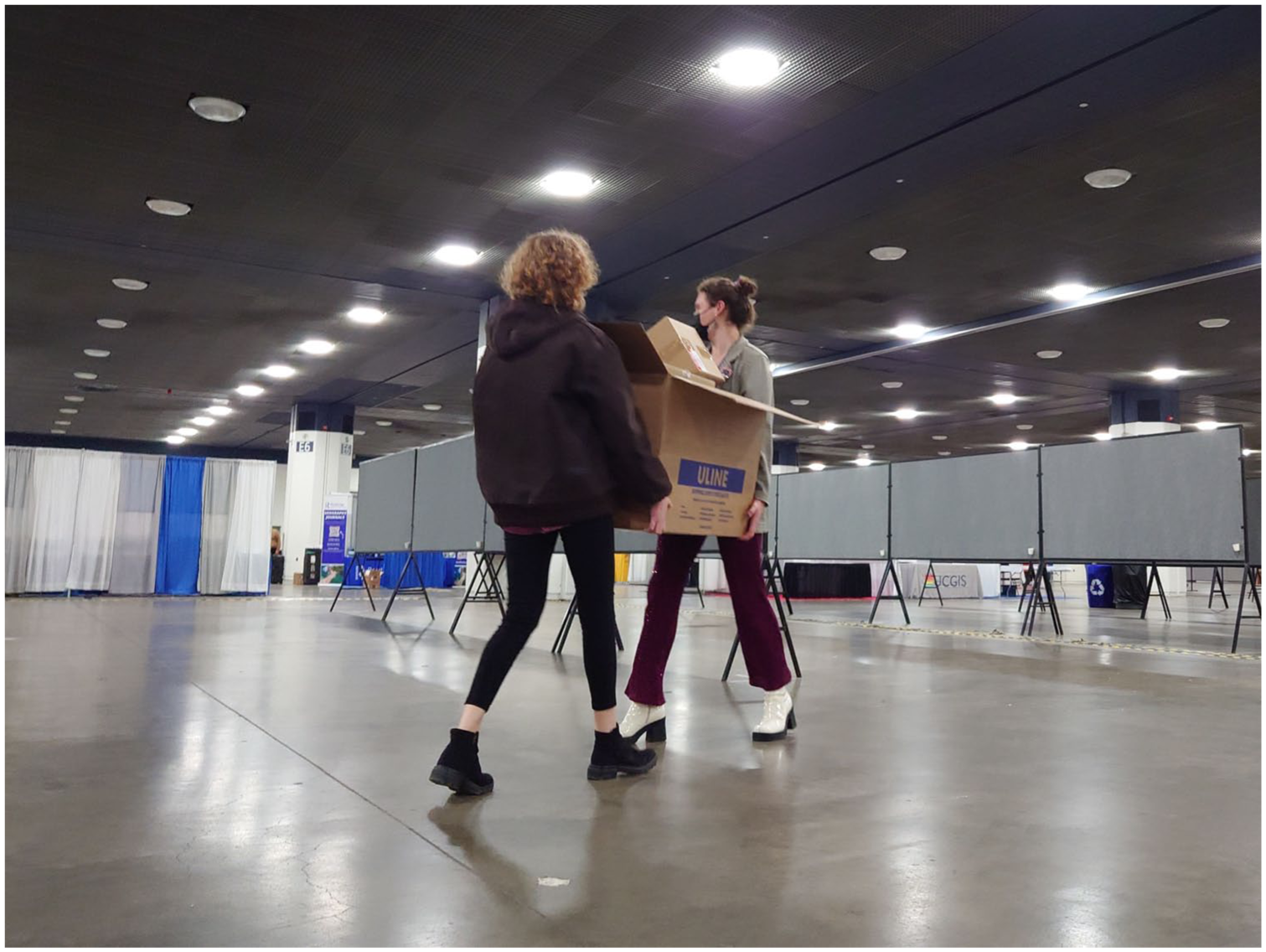
Nick Koenig and Ellen Bergan hauling zine supplies around the exhibit space in style. Photo by Wiley Sharp.
The idea to host a zine fair at the AAG Annual Meeting came about in conversation with Lisa Schamess, the AAG media and communications director, who served as our liaison throughout the process of planning the event. We imagined an in-person zine fair as a way for our transnational network – existing up to this point mostly on the internet – to coalesce into a physical space. While expecting this process to be relatively simple, we quickly learned that there are lots of constraints at these large conferences: venue policies and prohibitions, lack of accessibility to broader publics, and growing problems of access for ourselves, our peers, and our colleagues (issues to which we return momentarily). While our place within the conference space was being arranged, we began hustling geography organizations for funds and circulating a call for zine submissions through social media, AAG listservs, and other spaces. Participants could sign up to bring zines in their luggage, ship them to our mail guy, Rae Baker, in Waawiyatanong, or ask us to print them on their behalf. We then issued a decentralized call to print zines, where volunteers signed up to use their department printers to print and assemble a run of zines. Some zines were forgotten, some were misprinted, and some – those focusing on university activism – had to be ditched before crossing into the US from other countries, due to heightened border security in March 2025. Yet unexpected zines appeared, too. Folks who had brought their own zines for unrelated conference sessions managed to find us and add their zines to the collection, much to our delight (Figures 2 and 3).
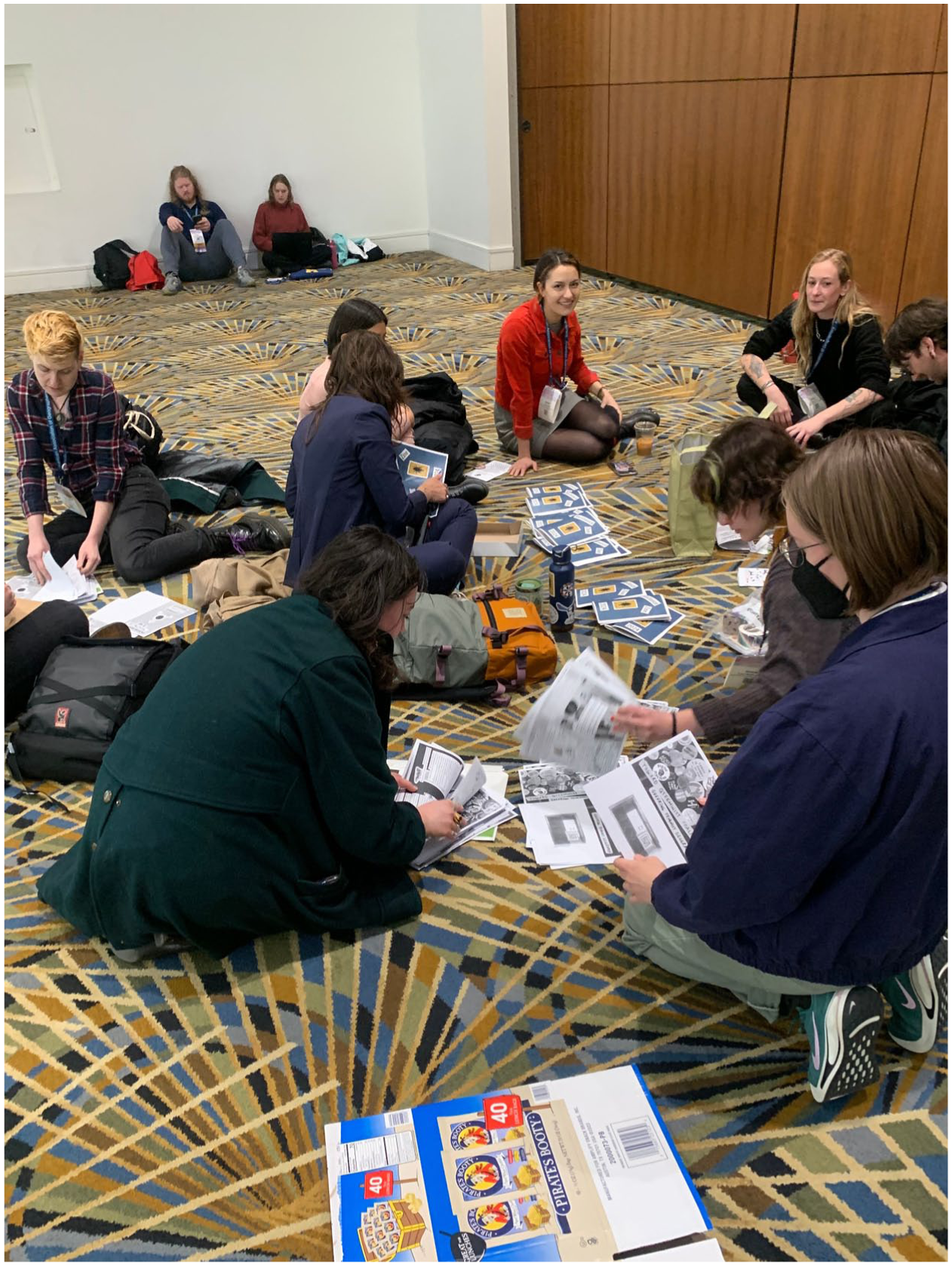
Volunteers squat on the floor outside of the exhibit hall folding and stapling zines on the day before the zine fair opened. Photo by Eden Kinkaid.

Zine fair flyers posted around the conference. Photo by Eden Kinkaid.
We managed to haul reams of print material to the conference, but much of it was yet to be assembled. We quickly activated a WhatsApp group of on-site volunteers, who crawled out of the woodwork to help us fold and staple. As we were not allowed early entry to the exhibit hall where the zine fair was set to take place (our impromptu group could not be verified as official vendors), we camped out on the floor outside and got to work. Others were sent off with a roll of tape and stack of flyers, in an attempt to get the word out about the fair, although we were later informed that it was against the venue policy to hang materials on conference center walls. In no time, the zines were stapled and folded, and we dispersed again into the hubbub of the conference. By Monday evening, we had assembled the fair, with hundreds of free zines, buttons, and stickers, a map reflecting the locations of zine contributors, and a craft table with fold-a-zine activities, markers, and stickers supporting Black Lives Matter, Palestine, trans pride, and disability pride that attendees could use to decorate their AAG badges (Figures 4 and 5).

Zine display on one of many tables. Photo by Wiley Sharp.

Map showing where the zines in our collection are from or about. Photo by Wiley Sharp.
The fair ran Tuesday through Thursday, with an official launch event on Tuesday afternoon. We heard from participants that the space we created felt substantively different from the rest of the conference. For those who could attend the AAG, it offered somewhere to share knowledge and research in a different way than the conference as a whole: rather than share professional posters and give formal presentations, people could explore creative projects that beckoned engagement through the use of colors, textures, styles, and different voices. It was a place to take a breath, relax, and feel at ease beyond the strictures of ‘professional’ embodiment, self-presentation, and ‘networking’. In other words, it was a space of curiosity and connection. It was no coincidence that the zine fair attracted queer people and others at the margins of geography’s dominant cultures. In this sense, our zine fair became a nascent heterotopia: an ‘other space’ that is different from, yet embedded within, the broader culture and its norms. 14 In contrast to a utopia, a perfect society displaced in space and time, the zine fair was a real space, sitting alongside and in friction with its surroundings (Figures 6 and 7).
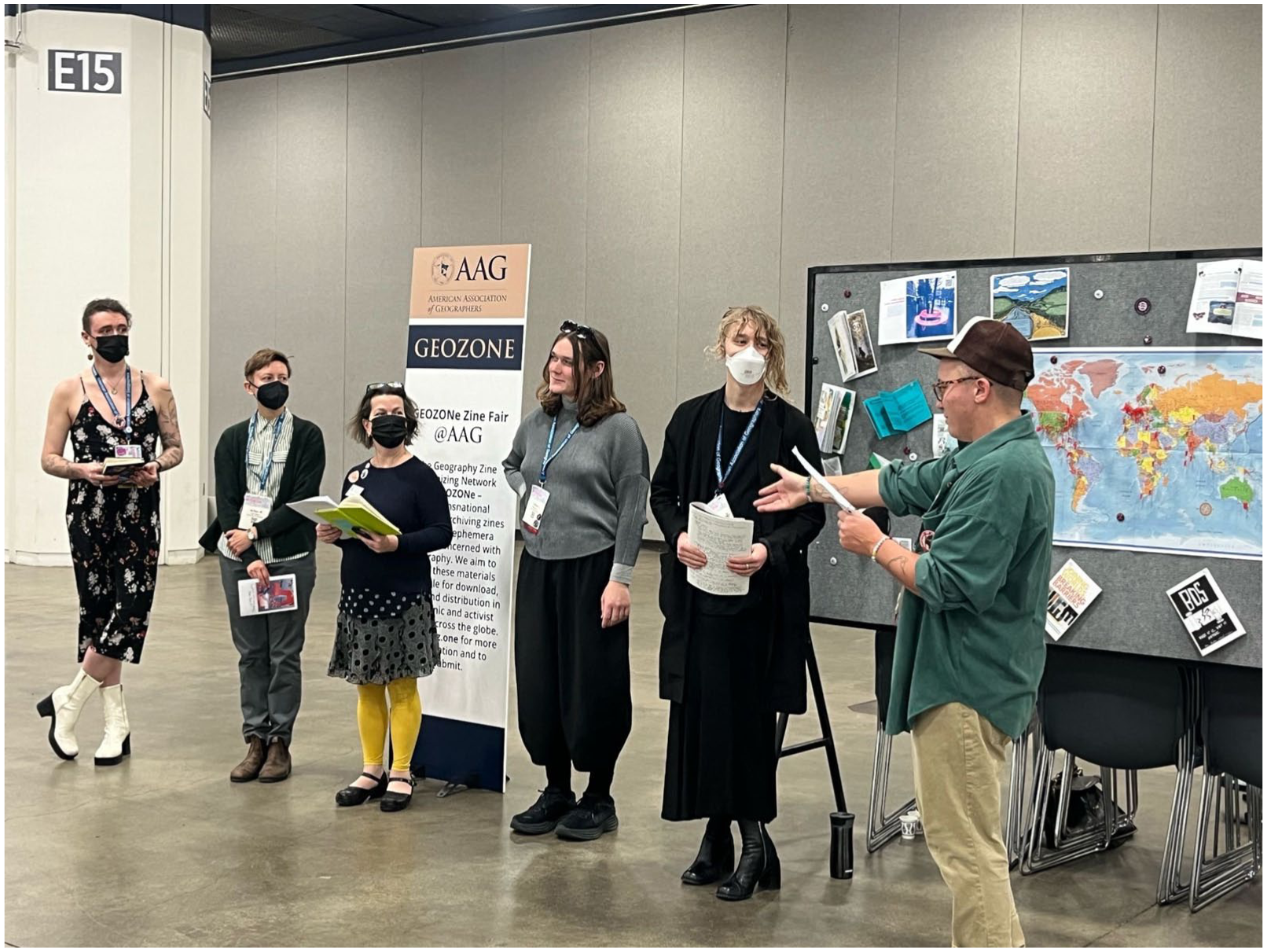
The GEOZONe zine fair organizers – Nick Koenig, Rae Baker, Lisa Schamess, Willow Ross, Wiley Sharp, and Eden Kinkaid (left to right) – address attendees at the official zine fair launch. Photo by Eden Kinkaid.

Conference-goers browsing zines and chatting at the launch event. Photo by Wiley Sharp.
Under the fluorescent lights of the cavernous exhibition hall, the zine fair was an insistent interruption, a break, and something new and necessary. We arranged hundreds of zines on a wide arrange of topics, from political ecology 15 to feminist geography 16 to abolition geography. 17 We chose to spotlight zines that addressed our discipline and its spaces directly. ‘Beyond ESRI’, a handbook for using open-source mapping tools that do not contribute to the military or carceral systems, sat within view of the booth of ESRI, the conference’s biggest sponsor, telling a markedly different story about geographic technologies. 18 Zines about campus organizing and academia brought political struggles at the university into the conference space. 19 Together, the zines represent the vitality of critical and radical geographic conversations occurring in the gaps, margins, and outsides of the mainstream discipline: a creative means to push back on the exclusions and limitations of our field and imagine it otherwise (Figure 8).
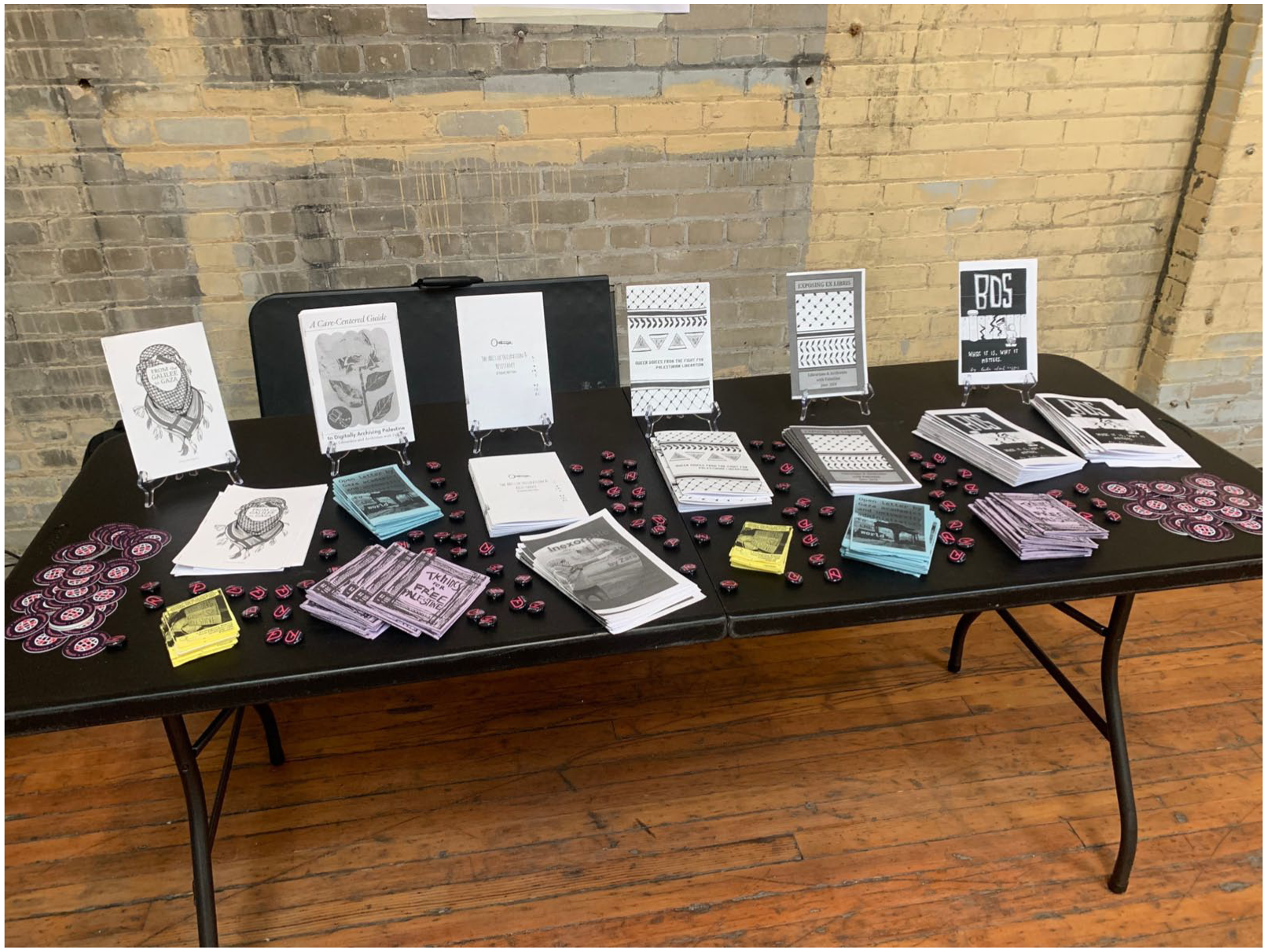
Zine table organized by GEOZONe at the Geographers for Palestine pre-conference event. Photo by Eden Kinkaid.
As the fair went on, unanticipated materials appeared on the tables, making it an ad-hoc community space for attendees to share information and resources. The fair became a hub to distribute information about the boycott, divest, and sanction campaign being led by Geographers for Justice in Palestine. 20 The fair also became a place to share masks, snacks, and COVID-19 test kits. We found flyers for lesbian conferences, zine groups, print labs, ‘know your rights’, and more. There was even a plan to create an ad-hoc food pantry to provide food for conference-goers burdened by the high and ever-rising costs of attending the annual meeting, although this pantry did not come to fruition. These ideas and actions opened up our individual and collective imaginations about what a conference space was for, what we could do with it, and who we could be in this space together, even amidst its limitations, barriers to entry, and institutional inertia (Figure 9).

Priya (left) and Willow (right) hosting the GEOZONe exhibit at the 2025 RGS-IBG. Photo by Willow Ross.
Inspired by our experience at the AAG annual meeting, members of GEOZONe struck out to set up zine fairs elsewhere. Nick brought our work beyond the academy to Punk Palouse, a DIY music and (counter)culture festival in Idaho, US. Meanwhile, Willow hauled materials back to Britain and recruited our new friend Priya to organize a smaller edition of our zine fair at the Royal Geographical Society and Institute of British Geographers (RGS-IBG) 2025 Birmingham conference. The RGS-IBG zine fair ran for 3 days of the conference, highlighted work by radical and creative British geographers (and others!), offered a place to share zines and ideas, and facilitated new connections among conference participants. During the conference, we heard from radical and creative researchers who dropped off zines about agroecology, cultural geography, and plant identification, as well as stories of censorship and surveillance from recent conferences across Europe in the context of Israel’s genocide in Gaza. Resisting these cultures of fear, we proudly distributed zines about Palestine, including those created by academics pushing to clarify and change the IBG and Institute for Australian Geographers (IAG) positions on the Gaza genocide, making it a space, however small, to push back on the status quo of silence within our discipline and to share knowledge and strategies about ongoing struggles within our regional associations. As at the AAG in Waawiyatanong, the RGS-IBG zine fair in Birmingham became a gathering space for critical conversations about and beyond our discipline as well as a site of refuge and connection for ‘misfit’ geographers.
While we celebrated these connective and disruptive moments, we were well aware of the limits and constraints our vision ran up against. Needless to say, the potential of these spaces is limited by the broader professional, political, and economic questions of who can be there. In the case of the AAG, we wanted a space that could be accessed more publicly and considered satellite events at local bookstores and venues outside the AAG exhibit hall. These locations ended up being unfeasible for the time being, as they required too much time to manage during the conference. Thus, we chose to operate within a space in the exhibit hall, which was offered as an in-kind contribution by the AAG and did not need to be staffed by us. This trade-off raises the question: with limited resources, are the benefits of organizing within an institution worth the costs of admission? In this case, we thought that the zine fair was a meaningful intervention in this space, and this judgment was affirmed by feedback from precarious and early-career colleagues who participated in the space. We came to see our presence at the conferences as a tactical engagement with the spaces of our discipline as they currently exist and a moment of heterotopic space-making that pushes us to envision otherwise. Indeed, as discontent about the annual meeting grows – from the rising cost to issues of climate justice, decolonization and Indigenous reparations, queer/trans safety, disability access, and more – we need to reimagine these meetings to be more accessible and aligned with our values. Zines can offer some alternative visions. For instance, the DIY methods conference is an entirely zine-based remote conference and summons a network of people into shared engagement through the mailing of zines. 21 What kinds of gatherings can we imagine that begin from the creativity, intimacy, and political engagement present in zine culture?
Limitations notwithstanding, our experience organizing zine fairs at these major disciplinary gatherings taught us that a small core of organizers working within a larger, emergent collective can activate impactful alternative spaces amid rigid professional gatherings that often elicit feelings of alienation and foster competition. We were thrilled that the spaces we facilitated at these conferences created opportunities for peer education, mutual aid, creative visions, and solidarity actions and for ‘nursing wounds, soothing aches, building each other up, [and] gaining strength to lean into the trouble rather than away from it’ in the belly of the academic beast. 22 GEOZONe will continue to experiment with the potential of zine-making and zine fairs to support myriad efforts to transform geography and the university, though these spaces are not the primary sites and audiences of our work per se. Indeed, we are wary of the potential for the discipline, and the neoliberal academy more broadly, to appropriate zines and DIY culture into a trendy commodity. We are also struck by the ambivalence, or contradictions, of the inclusion of ‘radical’ cultures while our institutions remain complicit with carceral and imperial violence, as demonstrated by ESRI’s strong presence at the AAG annual meeting and the AAG’s refusal [at the time of writing] to allow members to vote on a BDS resolution. 23 Yet we remind ourselves that in the end, it is our labor that sustains professional associations and academic institutions and that we can and must act to change them. Zines, zine fairs, and other modes of grassroots knowledge production give us hope that another geography – and perhaps another university – is possible.
Footnotes
Acknowledgements
The zine fairs would not have succeeded without everyone who volunteered for to setup and tear down, particularly those who helped fold zines outside the AAG exhibit hall! Thank you to the staff at the AAG and RGS-IBG who supported these zine fairs. Finally, special thanks to everyone who has shared their work with the GEOZONe archive: your work is what makes all of this possible.
Funding
The authors disclosed receipt of the following financial support for the research, authorship, and/or publication of this article: Thank you to the University of Kentucky Department of Geography, the University of Delaware Department of Geography and Spatial Sciences, the Bonham Centre for Sexual Diversity Studies at the University of Toronto, the Socialist & Critical Geography Specialty Group, and Sol Grant Partners for their financial support.
