




Abstract
This article reflects on the ethics and craft choices of writing about the at-risk ancient temperate rainforests of Coed Felenrhyd and Ceunant Llennyrch in North Wales. These are sessile-oak-predominant biomes, their light-dappled understory supporting rare plants, animals, fungi and lichen. These habitats are increasingly at risk. This article draws on critical plant studies to reflect on the ethics of plant representation via Patricia Vieira’s concept of ‘phytographia’, to inform both theory and creative practice: namely, centring plants’ particularity and form, and doing the imaginative work to – albeit always inadequately – honour plant specificity and locatedness. My creative writing project was comprised of two parts: a creative prose ‘Litany of Hesitations’ which uses an incantatory register to hold a sense of suspense, impossibility and urgency; and second, a short series of flash/micro written works, each describing a vivid moment between two beings. Temporality is key to the project’s formal choices, using litany and flash form to create and occupy a vivid present tense of relationship. The project yielded two transferrable writing techniques which could be adapted to other creative practice: the use of a cautious, paradoxical incantation to hold open the aspiration and conscious labour to reach for less human-centred framings; and the use of present tense, a ‘lyric now’, to enhance micro-attention to specific relationships beyond the human.
Introduction: Honouring Woodlands
‘Grieve . . . / for the Brown Hairstreak in love with blackthorn / and the honeydew of aphids in the ash’. 1 These words by the Welsh poet Gillian Clarke command lamentation, but I also find in them the seeds of a not-solely elegiac creative practice, one focused on relationships within vulnerable biomes. In this article, I will discuss how this framework of relationality has shaped a creative writing project seeking to honour ancient oakwoods in North Wales. This focus on relationship responds to the need to resist focus on ‘last individuals’. 2 By centring plants, lichen and fungi, I resist taxonomic bias, and this article reflects specifically on the plant dimension of the project. 3
The creative project consists of two parts. First, a 192-word prose ‘litany’ (see below) of incantatory sentences, listing perils as a kind of inverse manifesto, a litany of hesitations: ‘I walk with caution as I speak of love, of desires that are not my own and that I cannot know’. The prose is followed by 9 works of ‘flash’ writing, brief prose less than 200 words, each describing a vivid moment between other-than-human beings/collectives. Rather than write in either the aftermath of loss or within the awareness of imminent loss, in this creative practice I use litany and flash to honour the present tense of a moment of encounter.
The biomes
Located in Wales, United Kingdom (UK), Coed Felinrhyd and Ceunant Llennyrch are sessile-oak-predominant temperate rainforests and Ancient Semi-Natural Woodlands (ASNW). Their light-dappled understorey is highly biodiverse, supporting rare plants, fungi, lichen, insects, birds and mammals. These habitats are at risk due to conifer forestry and climate crisis. 4
In 2024, I received Lancaster University research leave to visit these sites as a pilot flash-writing practice. Prior to the woodland journey, I identified some of the narratives already implicit about the sites by studying three influential lists of species within them: a list of species in Ceunant Llennyrch; an ‘indicator species’ list for Ancient Semi-Natural Woodland and a list in the 14th-century Welsh poem the Cad Goddeu in the Llyfr Taliesin, associated with the myth of Blodeuedd, a doomed woman made from flowers. 5
The work was threefold and simultaneous: (1) September field work in the woodlands, limited due to disability but involving sitting, listening and noticing relations between very specific plant beings in the woods, including what I could not notice; (2) following Tsing’s concept of ‘passionate immersion’, studying scientific insights into these plant species and their relationships, to better honour their particularity 6 ; (3) developing a creative framework to adequately respect not only what relationships I discern, but also the ethical choices I must navigate in representing such relation. As such, a key output of the project was a prose ‘Litany’, which, through register and shape, held in suspense the risks and imperatives of the project – the need for recognition of plant alterity, the need for very specific, consciously non-anthropocentric imaginative effort, and recognition of presumption and inevitable failure, while also establishing a structure to create a sense of vivid richness of relationship beyond human perception.
To communicate that richness, alongside the Litany, I developed 9 flash works, short prose pieces less than 250 words long. 7 Each flash work was conceptualised as a ‘dyad’, each imagining a vivid moment of encounter between beings/collectives of beings. My term ‘dyad’ does not denote a stable, exclusive union between two individuals; rather, it conveys a contingent, non-exclusive intimacy. To begin the dyads I took a single species from each of the three aforementioned lists, and in choosing these species I was driven by what I could not readily witness in the woodland: the species exceeded me. From the list about Ceunant Llennyrch, I wrote of/with Parmelinopsis horrescens lichen, Signal Moss and Hymenophyllum tunbrigense Filmy Fern; from the ASNW indicator list, Ramsons, Bluebell and Hazel Gloves Fungus, and from the Cad Goddeu, Oakflower, Primrose and Nettle (Figure 1). 8
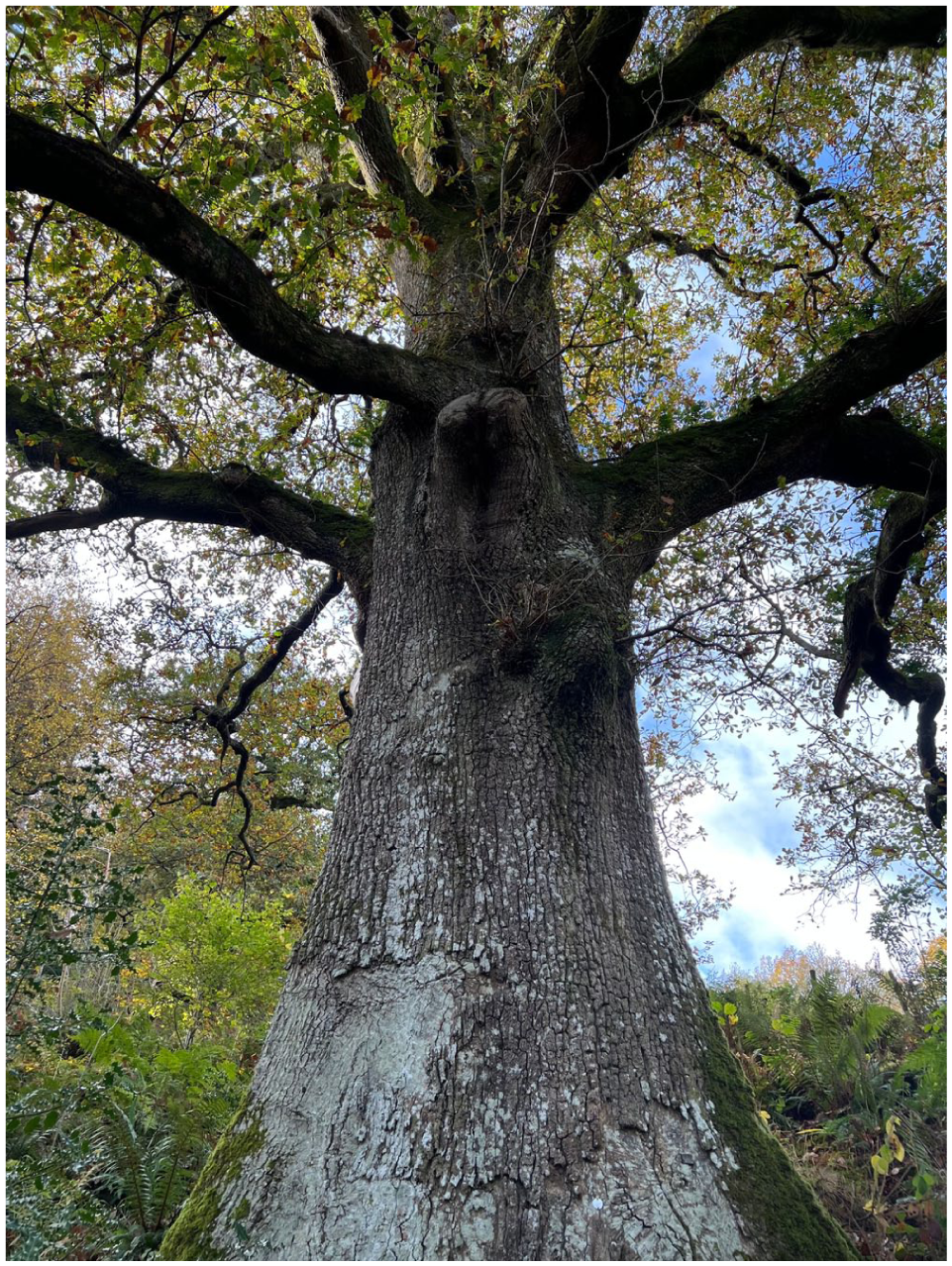
Oak Tree in Coed Felinrhyd (2002). Photograph by Graham Boyd.
A litany of hesitations
I walk with caution as I speak of love, of desires that are not my own and that I cannot know.
I shape the writing to also frame bright silence.
I resist making plants a background for human action. I honour their particular forms, awarenesses and decision-making, the vitality and creativity of root and leaf and branch.
I resist sole focus on above-the-ground. I honour the Rhizosphere as a place of encounter, creativity and dream.
I turn towards the brightness of a moment of encounter. I acknowledge that the past veins any moment with lines of force.
I resist writing plant movement perceptible on my human timescale. I honour the sessile.
I will not approach the encounter as timeless on a featureless plane. I will honour its position in place and time.
I resist illusions of the individual and honour the entanglement within all beings.
I heed the lessons of Blodeuedd and Daphne: not to make plants speak with a woman’s voice, and to shift the direction of change.
‘Empathy’ and its perils, and craft choices for heeding plant particularity
In my creative practice, I do not claim to ‘empathise’ with plants. Michael Marder and Patrícia Vieira warn that ‘empathising’ problematically presumes a commonality with the other being. In the case of plants, we not only cannot know what they experience, we do not even know their modes of experience. 9 Instead of ‘empathy’, I follow plant scholars who call for other kinds of feeling-with which honour plants’ material being. Ryan, Vieira and Gagliano urge ‘fresh ways of seeing—of feeling and of being with . . . photosynthetic personae’. 10 Core to this is noticing specific plant presences. Vieira speaks of the ‘phytographia’ of plant ‘inscription’ on the world around them, enduring from moment to moment in ‘a yearning that leaves traces in and through other entities’. 11
I took yearning, reaching and surfaces of contact as guides for the writing. Micro attention inspires my micro practice. For example, in identifying a dyad partner for Tunbridge Filmy Fern, I initially expected the partners might be an insect, but when I dwelled with the inscription of these located beings I felt I must honour yearning for an inorganic partner, a body of water – the airborne vapour amid the rocks of Ceunant Llennyrch which makes the gorge a permanent caress of mist. For this flash ‘dyad’, I wrote:
Every part of us is open to you. No cuticle, no barrier, we welcome air-and-water, silky habitat of sky. The water-echo of the gorge is thick to touch. There is no division: we drink the air.
Staying with the particular also impacted how I wrote Bluebell. The spectacular flowers made it tempting to contemplate its flower moment, but when I centred what we know of Bluebell, the rhizosphere called out to be the site of encounter. Bluebell seeds spend 5 years or more underground before they flower, contract their root to descend at least five inches, and at such depth are reliant on their fungal partner Scutellospora dipurpurescens, the partner I chose for the flash dyad. I wished to challenge the traditional poetic trope that when something is in the soil it is ‘asleep’. Humans privilege the aerial portions of plants, but so much plant experience, whether joy or threat, occurs within soil. 12
For the dyad of Bluebell/Scutellospora dipurpurescens mycorrhizae in the soil five inches below the ground, I wrote:
We brought food with us, snug inside, but it’s gone now and we’re hungry. You brought treasure and you changed us. We don’t sleep in this dark. We work, and work together. We hold you-as-us in the warmth of Here, sweet Home of years, for us-now-forever-always-two.
To honour mystery and humility, I installed silence within the structure. The nine flash works are titled ‘Dyads and Silences’, and I refrain from giving a reply from the other participant in each imagined moment. Between each of the flash trios is white space, and the refrain: ‘Here is bright silence, for I cannot know’. The silences do not denote death; they have a fullness, reinforced by the use of poetic apostrophe, in which a speaker addresses another being directly. I am inspired by the way that such apostrophe evokes not only longing on the part of the speaker but also the potential of reply. 13
Writing plants as ‘speakers’ risks ignoring plants’ own methods of communication. 14 Yet the poetic device of using a plant persona is accepted by some critical plant studies scholars, provided that the persona does not evacuate the plant to hold human hopes and fears and instead attends to the plant’s own particularity. 15 For this reason, I also use plural first person, acknowledging plants’ collective and distributed being – like the bluebells’ ‘we’, and indeed the ‘us-now-forever-always-two’ of their mycorrhizal bond. 16 Writing in lyric first person echoes the traditional lyric’s elevation of human love for beloved, and this tradition is part of the reason I experiment with this form. Min Hyoung Song’s work on ‘climate lyricism’ encourages ‘reviving’ lyric not to focus on human interiorities but to use its apostrophes to ‘challenge . . . hierarchy of value that . . . privileges the well-being of the human over the nonhuman’. 17 Flash sequences can be valuable for writing polyphony. 18 The ceremonial quality of lyric intensifies a sense of a reaching that matters, that affects things, occurring within a responsive, entangled world. Lyric can be incantation making a space for the possibility of reply – a cautiously-hopeful making in a time of extinction.
All this reaching occurs within a specific temporal position, a form of ‘lyric now’. Lyric is often described as having a problematic timelessness, but I find Jonathan Culler’s analysis helpful: he sees the lyric nonprogressive present tense as about potential iterability.
19
The moment may be repeated. This iterability makes it powerful for writing amid a time of biotic diminishment. The lyric ‘now’ is not timeless, but iterable; it is not inevitable. It is fragile. I wrote:
I turn towards a moment of encounter. I acknowledge that the past veins any moment with lines of force.
Reflections: creative forms to hold hesitation and vivid present tense encounter
Writing amidst a time of extinction may require us to inhabit an urgent present tense, and this project offers two practices that can be transferrable for others. For others working to honour multispecies and other-than-human encounter, a ‘litany of hesitations’ can dwell with the suspense of the pause before and during the writing, an incantation to install humility at the heart of such a project. Likewise, for others wishing to honour the vivid, particular life of such encounter, short-form, fragmented, pieces can facilitate focus on a present moment of encounter. I write in the lyric temporality of ‘now’, hopeful of ‘nows’ to come – on this planet, in this woodland, vivid life, ongoing.
Footnotes
Acknowledgements
I would like to thank Eline Tabak and Milo Newman for bringing the Making Amidst Extinction group into being, and the fascinating work that it has facilitated. I also gratefully acknowledge the term of research leave funded by Lancaster University’s faculty of Arts and Social Sciences, which enabled me to pursue this creative-critical project. Finally, enthusiastic thanks to Oliver Langmead and Jenn Ashworth, whose haunting fiction and fascination conversations have been influential beyond words.
Funding
The author received no financial support for the research, authorship, and/or publication of this article.
