




Abstract
In this article, I reflect on zine-making as a creative research practice for tracing memories in and of public libraries. These reflections draw on a collaborative project I developed with two local zine artists at the Central Library of Bremen, Germany. Together, we organised two open workspaces in 2024, inviting library visitors to create zines that capture their memories of libraries. The resulting collection, distributed in early 2025, forms both the empirical material and the methodological focus of this essay. Rather than treating zines as representations of memory, I understand them as a practice that can generate, mediate and spatialise memory. Through five examples, I explore how zine-making brings into view the sensory, emotional and everyday dimensions of library experience, how it surfaces intimate and biographical narratives and how it foregrounds the fragmented, layered and often ambiguous character of memories. Zines, as both method and outcome, emerge here as a way of attending to the lived and felt ways in which libraries are remembered and made meaningful. As a research practice, I suggest that zine-making can redistribute authorship, invite multimodal expression and shape the forms through which memories become knowable. In doing so, this article ties in with discussions on creative methods in cultural geography by asking what kinds of knowledges such practices enable and how they inform imaginaries of public spaces, such as libraries, as lived and remembered settings.
Introduction
Across two Saturday afternoons in 2024, visitors to the Central Library of Bremen, Germany, were invited to sit down, fold paper, cut, draw, write and assemble small booklets – zines – about their memories of libraries. Some people stayed for hours, settling into the process, while others paused briefly, contributing only a page, a drawing or fragments. What emerged was a collection 1 of 143 zines (Figure 1), combining a book-like format with foldable 8-page zines that trace how libraries are remembered, felt and lived. These zines were not just the outcome of my project but its starting point, shaping what could be said about libraries, how memories were expressed and what kinds of knowledges could emerge. Rather than offering a full analysis of this material, I use this article to ask what becomes possible when using zines, and zine-making, to trace the geographies of memory in public libraries.
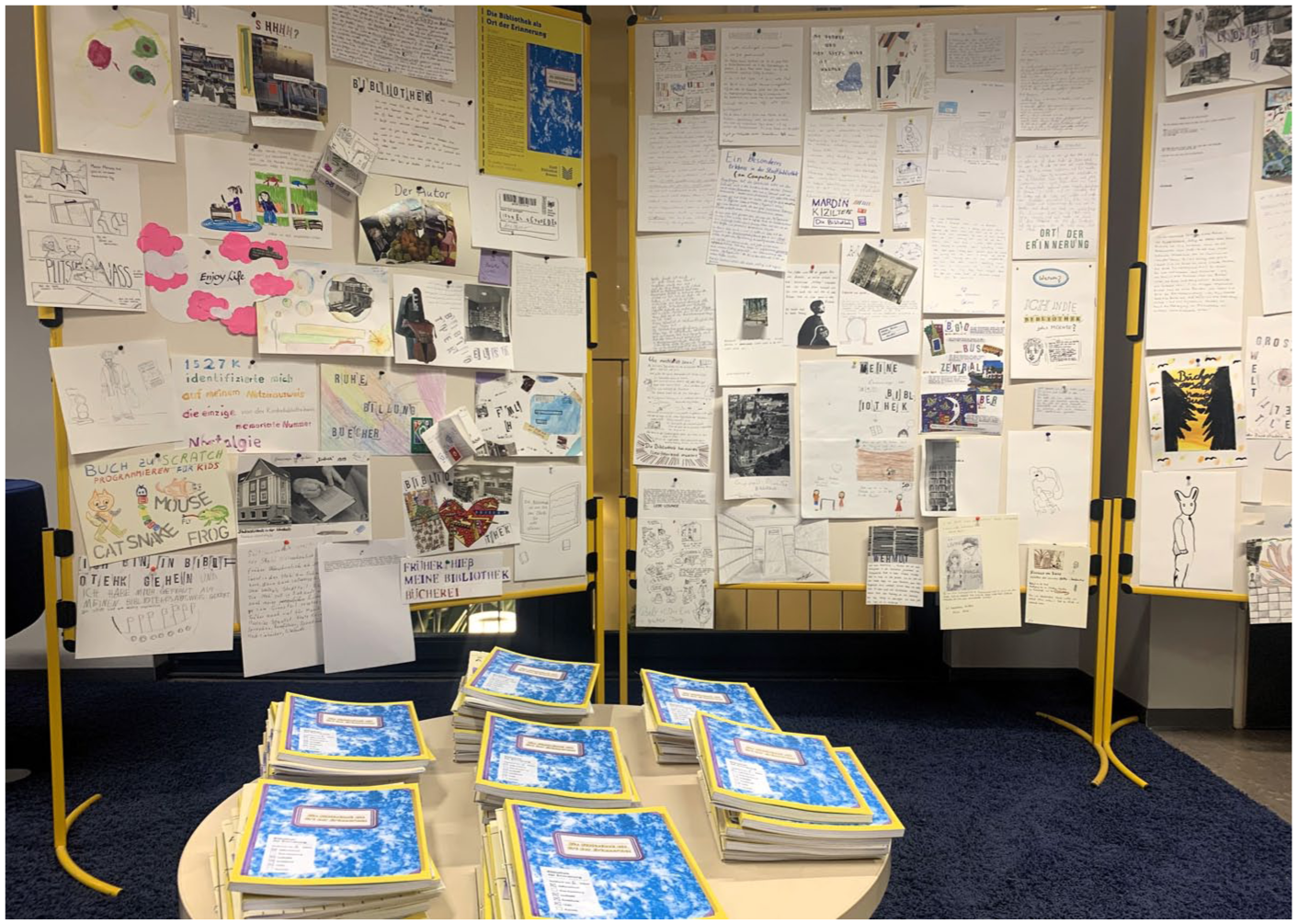
Zine collection with original zines in the back at the Central Library in Bremen. Photo by Melike Peterson.
Zines – non-commercial, self-produced and often DIY publications 2 – have increasingly been taken up as creative forms of knowledge production, 3 reflecting broader debates on the value of creative methods in geography. 4 For me, their appeal lies in their openness. Zines make space for intimate and multimodal experiences that may exceed more conventional forms of academic expression. 5 They also shape how stories are told, what becomes visible and how memory takes form. In my project, I came to think of zines as both method and output, enabling library visitors to articulate sensory, emotional, fragmentary and deeply personal memories, and as designs 6 that render libraries as lived spaces of memory.
While public libraries are often framed as institutions of collective memory, 7 the zines pointed me towards libraries being remembered in subjective, lived, intimate and often deeply personal ways. 8 Memories of routines, encounters, atmospheres and everyday life histories shape how libraries are experienced in the present and imagined into the future. 9 Working with zines made these quieter and felt dimensions of memory more accessible and visible, both to participants and to me as a researcher.
My turn to zine-making was, in part, a response to earlier moments in my research on libraries, 10 where participants often drifted into stories about past library experiences and into stories that were not easy to put into words alone. Wanting to find a way of working with these qualities rather than smoothing them out, I was inspired by Danielle Drozdzewksi and Carolyn Birdsall’s suggestion that ‘in memory’s varied meanings is the potential of “memory work” to animate, energise, and inspire, and reveal new and different methodological approaches and methods’. 11 Zines offered one such way. Their open form combining text, image, collage and material experimentation enabled library patrons to articulate their memories on their own terms. 12 What quickly became apparent was that their zines did not simply capture memories but also played a role in making those memories. Folding, cutting, (re-)arranging and sequencing became ways of (re-)ordering experience, while fragmentation, juxtaposition and visual emphasis mirrored the partial and associative nature of memory. The resulting zines are not stable accounts but situated and interpretive traces, often ambiguous and sometimes contradictory, aligning them with geographical approaches that emphasise the emotional, embodied and everyday dimensions of memory. 13
Zine-making also unfolded as a social and spatial practice. The open workspaces I co-designed with two local zine artists created a setting that was intentionally informal and flexible. Library visitors could join briefly or stay longer, with conversations emerging between participants, artists, myself and passers-by. These interactions shaped both the process and the zines themselves. Following the artists’ suggestion, we also gathered contributions at the 2024 Zine Festival in Bremen, Germany, which brought in additional voices and expanded the range of library memories. Participants were not limited to libraries in Bremen but were invited to explore any library that held meaning for them. The resulting zines varied widely, from single-page compositions to comic-like narratives and eight-page mini-zines, as well as from text-heavy reflections to abstract, visual and collage-based pieces. This openness was important to me, since it reflects an ethos of zine-making that resists standardisation and privileges self-expression, 14 while also allowing different forms of memory to surface.
Making zines and tracing memories
In what follows, I stay close to a small number of zines from the collection to explore what zine-making can do in practice. As I spent time with these contributions, I became aware of how the act of making zines shaped what was remembered and how it took form. What stood out to me across many zines was how strongly they foregrounded sensory experiences of being in and engaging with the library. Colour, texture, sound and atmosphere often carried as much weight as words. One zine, for example, depicts a first visit to a public library as a child (Figure 2). What struck me was how this formative moment is characterised as overwhelmingly grey. As the panels progress, the narrator details repeated childhood visits, sketching out stairs, carpet and shelves, alongside the presence of their mother and young brother. The zine closes with a reflective note – ‘when I think about that time now, it feels so close’ – which folds past and present into one another.
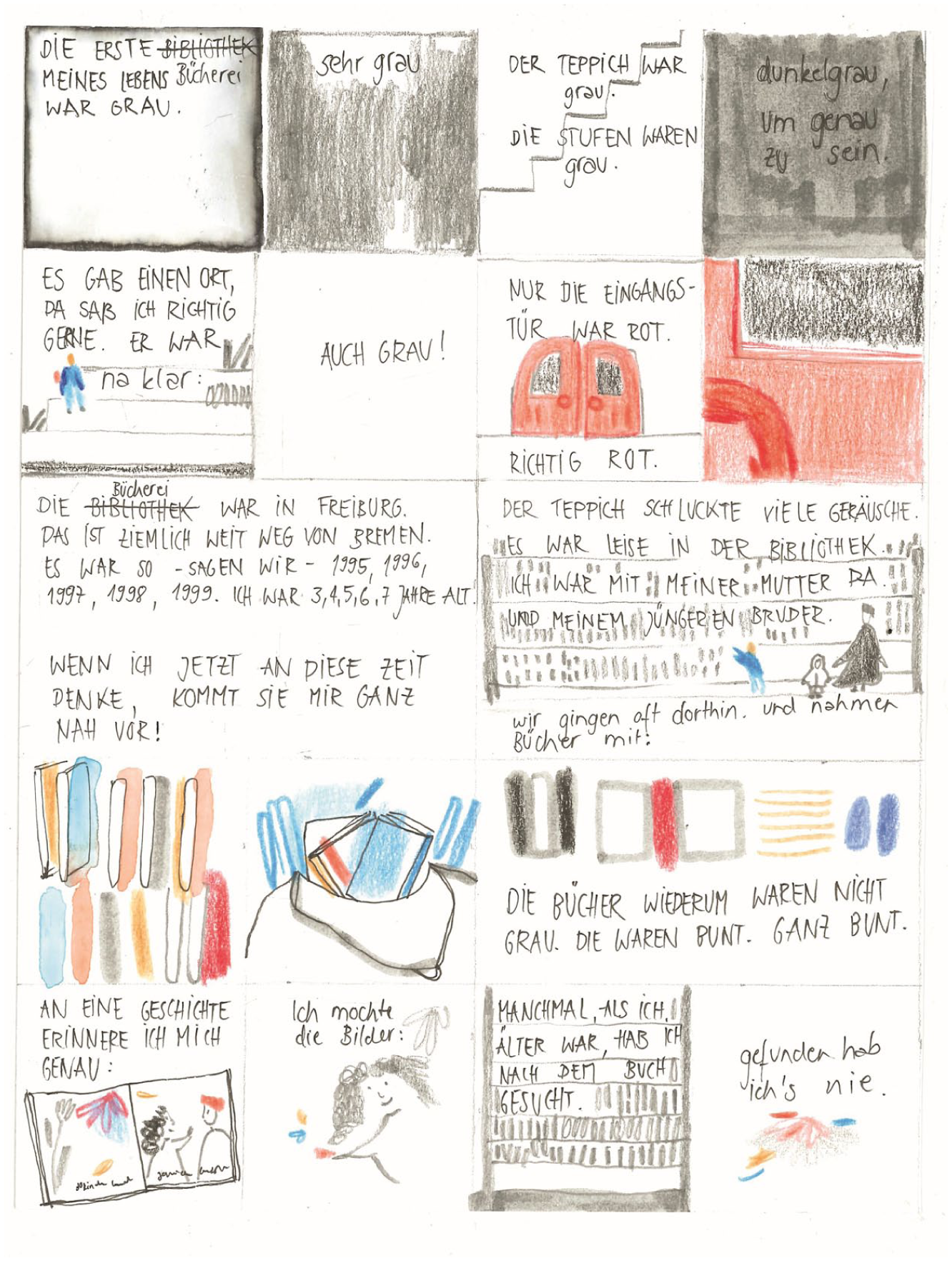
My first library was grey with a red door and colourful books. Photo by Melike Peterson.
What stays with me in this zine is not so much a coherent story but a set of sensory impressions. Colour, in particular, becomes a way of working through/with memory. The library’s greyness may suggest a muted, perhaps even subdued atmosphere, 15 while a bright red entrance door marks a vivid threshold, repeatedly described as ‘really red’. Colour also appears in the books, imagination and hand of the child as something that could be held, rendering memory as something tactile and graspable. As I (re-)read this zine, I found myself thinking about how the format itself makes this possible. The arrangement of panels, the interplay between image and text and the emphasis on certain details over others all contribute to this sense of memory as partial and emotional. The narrator notes simply that they ‘really liked being there’, with the greyness beginning to feel like a calm backdrop to experience, holding together routine visits, family presence and a quiet sense of attachment. There is also a subtle tension, with the narrator recalling that they liked the pictures in a particular book but can no longer remember or find it again. What remains are fragments of colour, texture and feeling, rather than complete images or narrative. The zine, in this sense, does not just recount memory but actively composes it.
Other zines drew my attention to the importance of routine and the everyday. One text-heavy contribution, resembling a short diary entry, recounts a Saturday morning waiting for the library to open (Figure 3). Presented bilingually in German and Turkish, the zine situates the narrator’s experience across their different identities and belonging. What I found compelling here is the attention to time. The narrative is structured around timestamps (9:30, 9:57 and 10:00), which mark the slow unfolding of a familiar routine. As I followed these moments, the repetition of times and inter/actions began to mirror the rhythms of library life itself. The zine both begins and ends at ‘9:30 on a Saturday morning’, giving the account a cyclical quality, as if this moment might repeat week after week. Despite very little direct interaction, a sense of togetherness quietly emerges. The narrator observes others waiting and rushing to books, noting: ‘I don’t know their names, but I trust them more than anyone I have met in 40 years’. This line stayed with me. It captures something subtle about the library as a public space, where familiarity and trust can take shape through proximity, routine and shared presence.
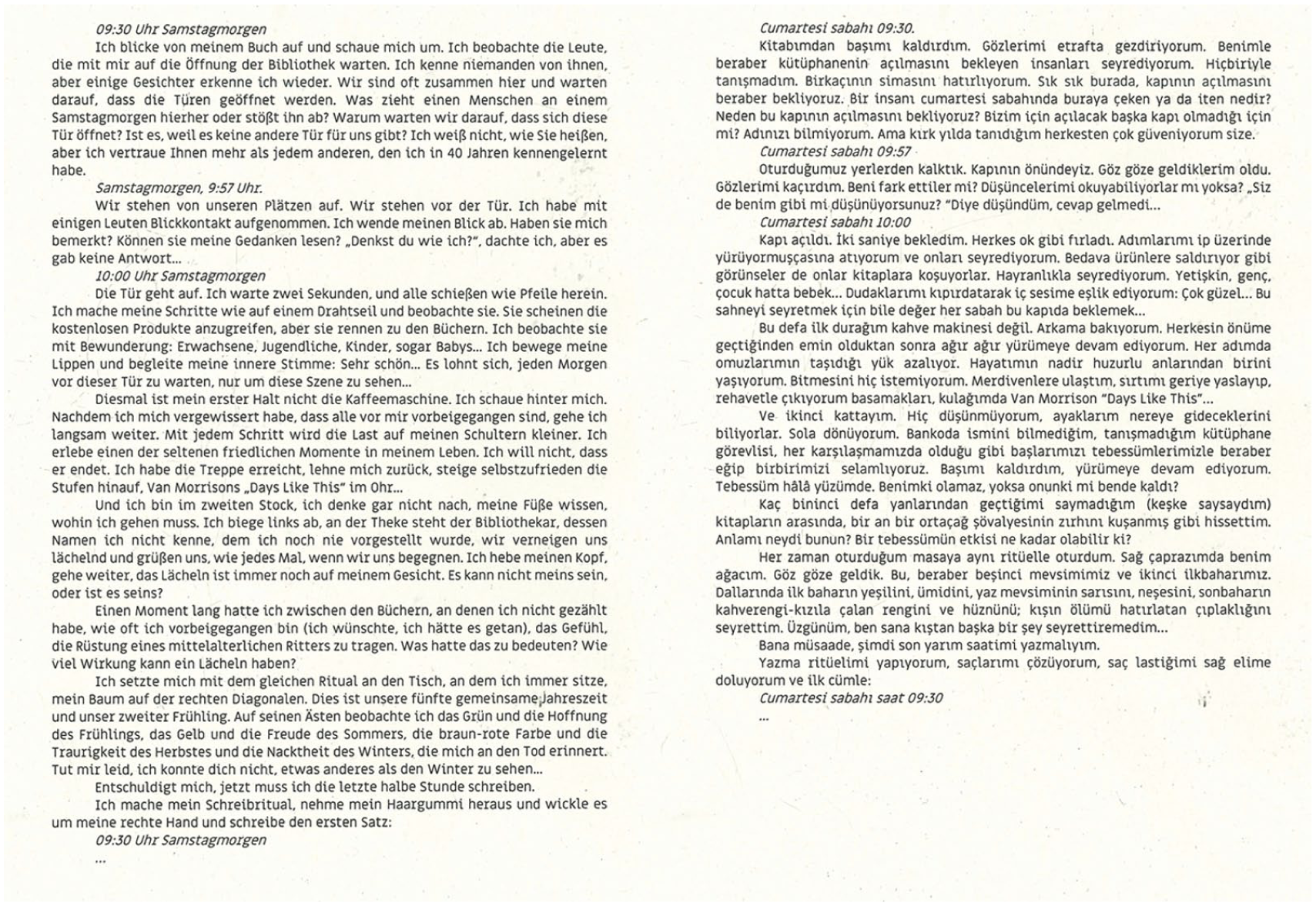
Saturday morning before the library opens its doors. Photo by Melike Peterson.
In this zine, small gestures and observations, like wrapping the hair tie and walking slowly, take on weight. 16 The narrator wonders, ‘Did they notice me? Can they read my thoughts?’, turning an ordinary moment into something reflective and slightly uncertain. Even non-human elements, like a tree outside, marking seasonal change and life lived, anchor the narrator’s routine in broader temporal and emotional contexts. What might otherwise go unnoticed, here, becomes something worth attending to. The zine renders these repeated inter/actions, such as waiting, entering, greeting a librarian and sitting, as part of a personal and everyday history that is both ordinary and deeply meaningful, feeding into the library’s ongoing story.
A different kind of temporality emerges in a zine that uses stitched thread to trace a life course of library use (Figure 4). When I first saw this piece, I was struck by its materiality. Memory here is not only described but enacted through the act of stitching. The thread moves across the page, marking phases of life in colour and texture. The zine begins in childhood, with dense pink stitches accompanying visits ‘with mom’. These early sections feel rhythmic and continuous, reflecting routine and repetition. A key moment, ‘getting a library card’, appears almost like a milestone, followed by a period of immersion in ‘borrowing and reading lots’. Then, quite abruptly, the thread is torn. The page falls blank, and the continuity is interrupted. When the thread resumes, now in yellow, it does so unevenly. This phase corresponds to university, where visits appear less frequent and more irregular. Another rupture follows, noting a longer pause in which the library receded from the narrator’s life. Towards the bottom of the page, a new thread appears in green, introduced by the words ‘got a child’. Here, the stitching becomes dense and regular again, suggesting a renewed routine, though one reshaped by parenthood. This phase evokes a subtle closing of a circle or the (re-)entering of a cycle. Where the narrator once explored the library with their own mother, they now return with their child, introducing them to the same space and guiding them through it, perhaps beginning the cycle anew.
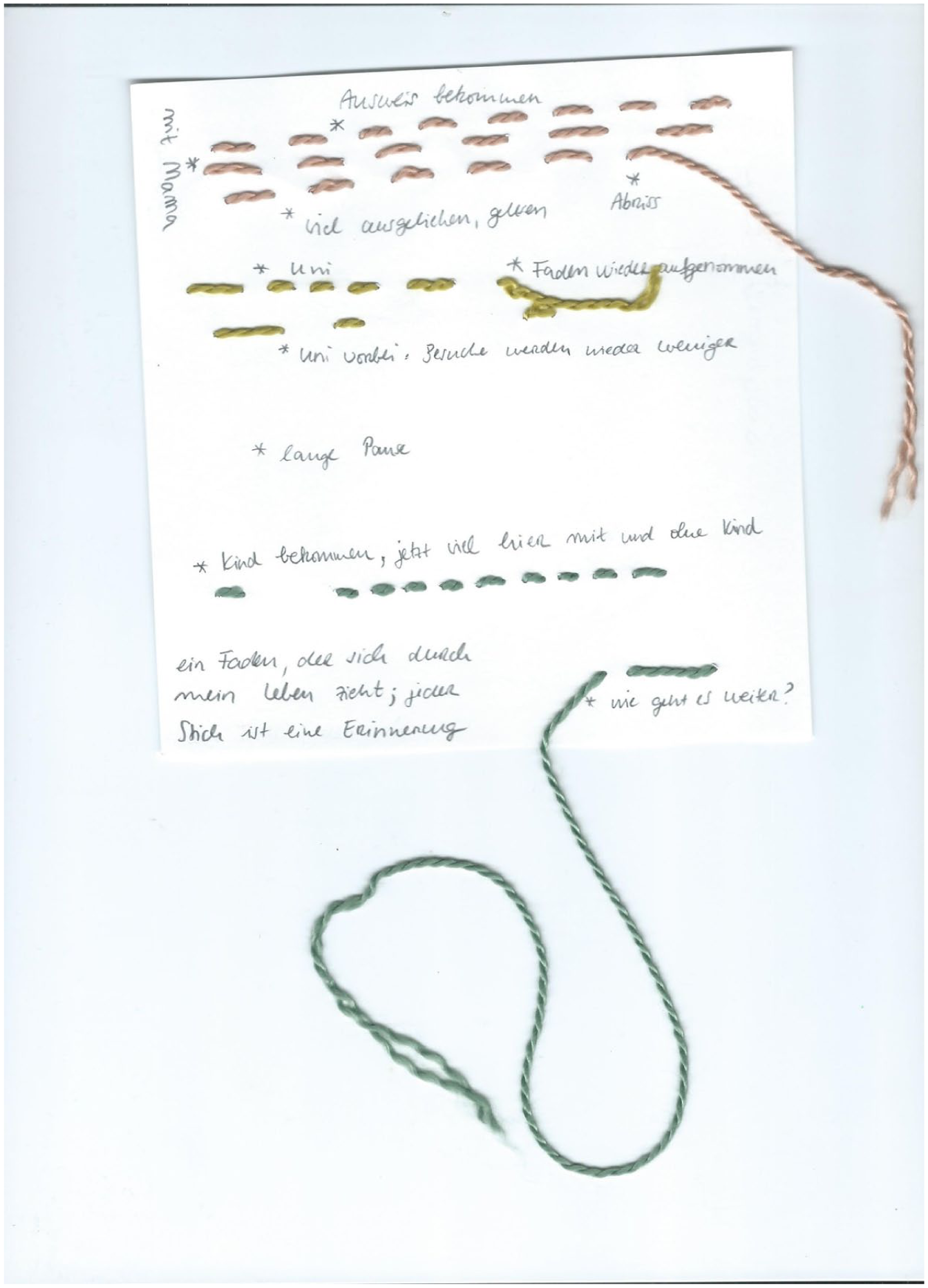
A thread throughout my life, every stitch a memory. Photo by Melike Peterson.
As I traced this thread with me eyes and hands, I became aware of how the zine invites a different kind of reading. The narrative is not only visual but tactile. The final section leaves the thread hanging beyond the page, accompanied by the question ‘what’s next?’. There is no closure here. Instead, memory is presented as ongoing, open-ended and entangled with future possibilities. A small note in the corner reads, ‘a thread that strings through my life; every stitch a memory’, offering a reflection on the process itself. Zine-making, in this case, becomes a way of thinking through time, rupture and continuity of library use in a deeply embodied and emotional way.
Finally, some zines foregrounded the relational and sometimes ambiguous dimensions of memory. One piece, titled ‘time with dad’, recounts a biweekly routine of visiting the library together (Figure 5). Through short passages and small illustrations, the zine traces the ordinariness of browsing, borrowing and travelling by car. What emerges is not a dramatic story but a quiet sense of familial exchange and connection. The car journey, in particular, stands out as a space of conversation, described as a moment of ‘genuine exchange’, even if the content of the depicted conversation is remembered as somewhat superficial. Another zine offers a much more subdued and ambiguous account (Figure 6). Visually sparse, it centres on a simple drawing of a bulky computer and a brief narrative about playing a video game with the narrator’s sister. In the game, they create a family ‘that isn’t fighting’. The minimalism of this zine, both in text and in image, leaves much unsaid. As I sat with it, I found that its simplicity intensified its emotional weight. Here, the library appears less as a fully described setting and more as a space that makes possible a temporary distance from tensions at home, or perhaps even a reworking of strained relationships.
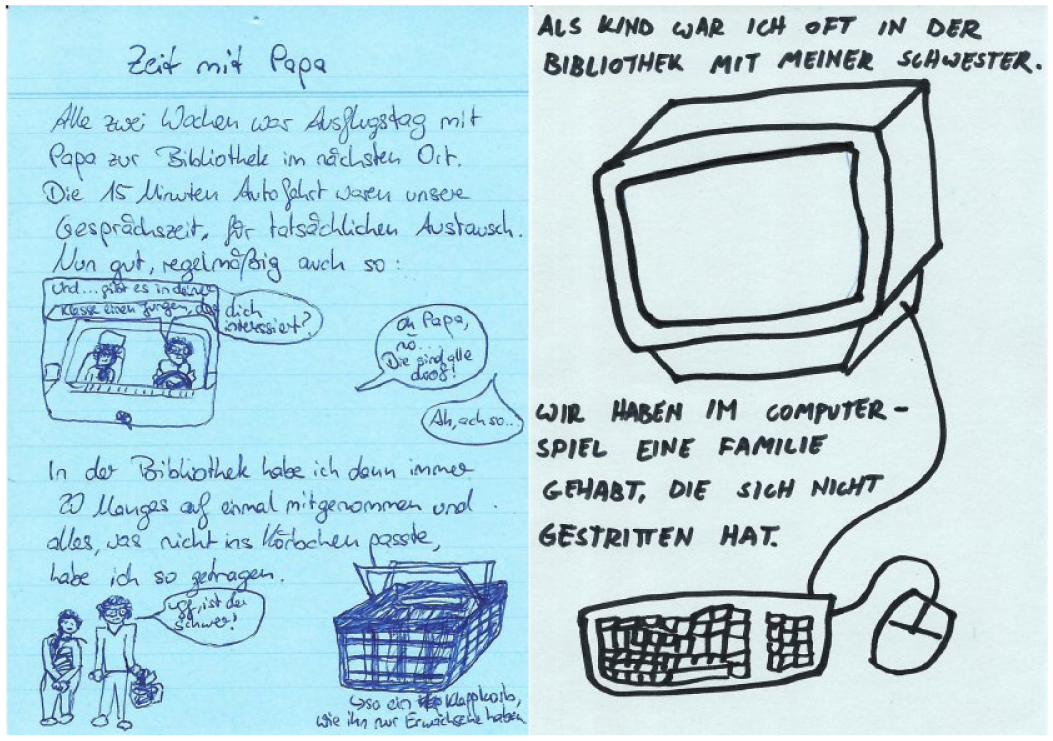
Time with dad (left) and having a family that isn’t fighting (right). Photos by Melike Peterson.
Read together, these zines reminded me that memory is often neither straightforward nor stable. It is relational, layered and sometimes unresolved. Zine-making, with its openness and flexibility, seems particularly suited to holding these ambiguities, allowing connections and tensions to coexist without forcing them into a single narrative.
What zines can do
Looking back on this project, I find it difficult to separate the zines themselves from the process of making them. They are not simply outcomes that illustrate memories, but part of how these memories were generated, shaped and shared. Working with zines in the context of a public library allowed me to engage with forms of remembering that felt sensory, fragmentary and emotionally charged, often beyond what more conventional methods could hold. As both method and outcome, zine-making shaped the way this research could unfold. It shifted authorship away from me as the researcher and towards those who participated and created the zines, though never completely, as I am writing this article now. It also invited experimentation, not only in how memories were expressed but also in how they were encountered and interpreted. And it drew attention to the material and emotional dimensions of knowledge production, to paper, colour, thread and (hand- or machine-) writing, 17 to pauses, hesitations and omissions. 18
At the same time, working in this way also raises questions. Zine-making, for all its openness, does not automatically include everyone. It depends on who feels comfortable participating, who has the time to stay and who is drawn to or put off by the format. Additionally, there are questions about how zines are read, valued and evaluated within academic contexts that are often still oriented towards more conventional forms of output. 19 These tensions, for me, are not drawbacks so much as they are part of what it means to take creative methods seriously as research practices.
What the zines in my project made visible are public libraries as lived and remembered spaces. Across the collection, libraries appear not only as institutions, but as places shaped through routines, encounters, sensory impressions, emotions and personal life histories. They are spaces that hold meaning in people’s memory 20 and that are valued in the present and imagined into the future. Zines, then, do not simply offer an alternative way of representing memories but can play a role in making memories knowable in particular ways. As a creative geographic practice, zine-making opens up ways of researching that are attentive to the fragmentary, the emotional and the in-between and of approaching remembered spaces, such as public libraries, as ongoing, lived and felt geographies.
Footnotes
Acknowledgements
I would like to thank the visitors of the Central Library in Bremen for so generously sharing their memories and stories with me. I am also grateful to Jasmin Richter and Lisa Buskühl of the zine collective VON WEIT HER (GEHOLT), with whom I greatly enjoyed making zines. I further thank the library management and staff for facilitating this research, as well as the anonymous reviewers for their valuable comments on earlier versions of this paper.
Author contributions
Melike Peterson: Conceptualisation, Methodology, Data curation, Formal analysis, Investigation, Writing – original draft, Writing – review & editing.
Consent to participate
The zine workspaces described in this paper were intentionally designed as open, low-threshold formats that did not require prior registration or written consent. However, all participating library visitors were verbally informed about the aims of the research, how their zines would be used and that contributions would be included in the published zine collection. Participants retained full control over their contributions and could choose not to include their zines in the collection by taking them with them at the end of the workspaces.
Consent for publication
All participants were verbally informed that their zines would be included in the zine collection and could also be used in academic publications. Similarly to participation, contributors had the option to withdraw their work by taking zines with them at the end of the workspaces.
Ethics statement
The broader research project, of which the zines form one part, was reviewed within the relevant institutional framework, where it was considered low-risk and to be in accordance with general ethical guidelines. Formal ethics approval was not issued for this project. Throughout the research process, I followed widely recognised standards for ethical conduct, including principles of transparency, informed participation and careful handling of research materials. Participants were informed about the aims and scope of the project and about how their contributions would be used. They were given opportunities to engage with and reflect on their materials. Anonymity, confidentiality and respectful representation were ensured at all stages of data collection, analysis and dissemination.
Funding
The author disclosed receipt of the following financial support for the research, authorship, and/or publication of this article: This research was supported by the Central Research Development Fund (CRDF) of the University of Bremen, which funded the open workspaces and the publication of the zine collection.
Declaration of submission
The submitted work has not been published previously and is not under consideration for publication elsewhere. The publication of this work is approved by me, the sole author of the submitted work. If successfully published, I will not publish this work in the same form, in English or in any other language, including electronically without the written consent of the copyright-holder.
Data availability statement
While no digital version of the zine collection exists, a limited number of free copies remains available from the author upon request.
