



Abstract
In challenging Marxist theorists to confront the radical rebirth at the core of the fascist revolution, Roger Griffin has carried fascist studies to a new and valuable plateau. Likewise, David D. Roberts’s elaboration of Griffin’s model offers a provocative and fruitful avenue to rethink fascist political culture. This article seeks to advance the dialogue to the next level by considering what an international approach can add to these primarily nationalist interpretations of generic fascism. Drawing on examples from the history of the United States, I argue that fascism is a fundamentally cosmopolitan process and that it needs to be placed on a broader continuum with the histories of slavery, racism and nationalism.
‘But what about Romania?’
Let me be clear: Griffin’s analysis of generic fascism as a form of ‘palingenetic ultranationalism’ is tremendously fruitful and represents a major advance over orthodox interpretations of extreme nationalist movements. Likewise, David D. Roberts’s challenge to probe the historical consciousness of both fascism and communism provides a helpful conceptual refinement. These theories of fascist politics are not wrong. At the same time, they do not capture the full range of historical processes at play. Because historical materialism recognizes the broad geographical framework generated by capitalist modernity, because it seeks out underlying trends and interconnected processes, historians working within this tradition tend to be more sensitive to the transnational dynamics that lay the groundwork for and that condition the experience of fascist movements. I will sketch some of the benefits and limitations of the Griffin and Roberts theories, especially as they relate to the vexed yet crucial concept of ‘revolution’. I will then take a closer look at the relationship between the United States and European fascism as a case study of how a more cosmopolitan approach can enrich and expand on the innovations of Griffin and Roberts.
First, some disclaimers: I am not arguing for some kind of facile determinism that reduces all history to economics. Nor am I claiming that a materialist interpretation is the only valid interpretation of politics or society. Nor am I interested in endorsing any particular flavour of Marxist praxis. I refer to historical materialism and not to Marxism because, while Marx helped to develop and to refine this particular methodological framework, subsequent innovations make it possible to speak of it separately as a comprehensive theory of history. For similar reasons, scientists refer to the unifying theory of biology as evolution by natural selection, and not simply as ‘Darwinism’. In both cases, the original 19th-century framework has been contested and elaborated as a living, empirically grounded reality. Most importantly, like evolutionary theory, historical materialism is non-teleological. Instead of attempting to cram facts into a single stadial progress governed by orderly laws, it seeks out polyvalent developmental processes. 2
To be honest, I find Big Theory too coarse for much of my work. What does a slave’s decision to escape or an abolitionist mission in the African hinterland have to do with surplus value or the tendency of the rate of profit to fall? I suppose I am similar to Marx in this regard. The old man hated the ‘intellectual laziness’ of reducing history to a single set of determinants. 3 At the same time, just as portrait painters and landscape artists rely on similar techniques to develop their unique perspective, all history is guided by underlying assumptions. Whether macroscopic or microscopic, implicit or explicit, all narratives, all datasets, all attempts to place boundaries on the limitless horizon of the past require a theory. In fact, the powerful analytical tools I developed in my tutorials with Roger Griffin have helped me to make better sense of the history of slavery and abolition. Before exploring this crucial connection, though, it is necessary to step back for a moment to examine the contributions of Griffin and Roberts and to ask what does and does not work about their macroscopic interpretations.
In his bid to forge a new synthesis for fascist studies, Griffin asks practitioners of historical materialism to accept four fundamental truths: the significance of fascist ideology as an autonomous driving force, the ‘genuinely “mass” appeal’ of fascist movements, the forward-looking nature of fascism’s mobilizing myths and its authentic desire to birth ‘a new order and a new era’. 4 Each of these tenets revolves around the central concept of ‘paligenesis’, or radical rebirth, in which a previous era of decadence is wiped away and the national community regenerated in what amounts to a fundamental, qualitative break with previous history. Here Griffin sees a point of comparison with communist revolutions, which, he argues, also embraced a kind of collective rebirth that would launch a qualitatively new historical trajectory. ‘As forms of political modernism’, Griffin writes, both Soviet and fascist revolutions ‘offered totalising solutions to the problem posed by the decadence of liberal society’. 5 In his rejoinder to Griffin, Roberts suggests a closer look at this brand of revolutionary consciousness. Downplaying palingenesis, Roberts emphasizes totalitarianism, which he defines as ‘a set of assumptions, aspirations and practices’ galvanized by a radical voluntarism and a collapse of the notion of historical predictability. 6
Both Griffin and Roberts oppose the ‘class reductionism’ of the 1933 Comintern definition of fascism, which famously categorized the movement as ‘the open, terrorist dictatorship of the most reactionary, most chauvinist and most imperialist elements of finance capital’. 7 While this definition has tended to dismiss fascism as essentially conservative or pseudo-revolutionary, Griffin and Roberts point to a genuine impulse to construct an alternative modernity – a different reality that would compete with socialist and liberal capitalist projects and (according to fascist ideologues) would eventually outpace and outlive them. To their credit, Griffin and Roberts do not simply dismiss the class content of fascist regimes. Griffin even admits ‘the collusion of the reactionary elements of big business and the traditional ruling classes in its revolutionary “movement”’. 8 But both emphasize cultural dynamics over class interest or economic context.
The concept of historical, or temporal, consciousness is key to this approach. For Roberts, a loss of faith in historical progress and a will to intervene immediately to create a new history triggers the ‘totalitarian mode’ characteristic of fascist regimes. 9 Although he criticizes Griffin’s use of palingenesis, this perspective seems broadly consonant with a sense of radical rebirth. Both culminate in what Emilio Gentile perceptively terms ‘the sacralization of the state’. 10 In 1932, Benito Mussolini furnished what is perhaps the best synopsis of fascist historical consciousness as ‘sanctity and heroism’ sublimated by the state – a Sorelian autonomy that was directly opposed to ‘historical materialism’. 11 Mussolini and his coauthor, Giovanni Gentile, confused historical materialism with what could charitably be described as a caricatured economic determinism. Yet the revolutionary temporality inherent to Marxism, as both Griffin and Roberts note, is more complex.
Griffin points to a ‘highly mythicized’ primitive communism at the core of Marxist ideology, while Roberts draws attention to ‘a deeper doubt . . . about the direction of history’ among certain communist leaders. 12 Both are correct. Marxism, especially in its Leninist idiom, reads history as a balance of social forces and differentiates between ‘revolutionary situations’ and ‘revolutionary consciousness’. Marxist revolutionaries assiduously measure the gap between the objective or structural crisis and the subjective or ideological crisis. Only when the balance has shifted, only when these two crises align in the constellation of the present, is it possible to make ‘the leap in the open air of history’ that Walter Benjamin identified as the revolutionary moment. 13 This tactical sensitivity explains the difference between, for example, the Lenin of 1917, the Lenin of ‘the direct path’, the utopian, palingenetic Lenin of The State and Revolution, and the considerably more circumspect author of ‘Left-Wing’ Communism, the Lenin who scolded his comrades that nothing would be accomplished ‘by doing things in a rush’. 14
Griffin is correct to foreground Antonio Gramsci’s analogy between trench warfare and revolutionary politics. According to Gramsci, who followed Lenin closely, the ‘war of position’, the ideological struggle in the trenches of popular culture, provides the groundwork for the ‘war of manoeuvre’, or the revolutionary moment of truth. Hence his famous dictum: For a mass of people to be led to think coherently and in the same coherent fashion about the real present world, is a ‘philosophical’ event far more important and ‘original’ than the discovery by some philosophical ‘genius’ of a truth which remains the property of small groups of intellectuals.
15
This amounts to a special emphasis on culture, rendered historically as an educational conversation, or in more technical terms as the ‘counter-hegemonic’ public sphere. And this emphasis has significant ramifications for both revolutionary activism and materialist methodology. Education and leadership, understood as a dialogue between the elite and the everyday, are the essence of historical change. Although he did not intend it, Gramsci provided a compelling model for fascism’s development from disparate ideology to radical mass movement. 16
Of course, in the last analysis, authentic revolutions involve a shift in class power, ‘the expropriation of the expropriators’. 17 And this is the crux of the matter. Unless Griffin and Roberts are willing to concede the structuring role of class in historical development, they will remain at loggerheads with those who see social struggle as the engine of history. At issue is the concept of ‘revolution’ itself. Revolution is both a normative term, used to justify or denounce, and a category of historical interpretation. For classical Marxism, it means something very specific. But it also has a more general, or phenomenological, meaning. Thus the Great Soviet Encyclopedia, as good a barometer as any of the classical position, differentiates between social revolution, in the narrow class sense, and generic revolution, ‘a profound qualitative change in the development of any phenomena of nature, society, or knowledge’. 18 ‘A profound qualitative change’ may prove too broad to be useful – a floating signifier that means everything and nothing. Still, I think there is room for consensus.
Since both Griffin and Roberts are preoccupied with what they call the ‘modern revolution’, it might be worth taking a brief detour to consider exactly what this means. Steve Pincus’s reinterpretation of England’s Glorious Revolution, ‘the first modern revolution’, offers a good starting point. In an ambitious and wonderfully lucid overview, Pincus argues that revolutions are more than just the old succumbing to the new: they are rival articulations of modernity. More specifically, they are ‘the often-violent working out of competing state modernization programs’. Such programmes require the development of four features: a centralized state bureaucracy, military transformation, economic interventionism and sophisticated modes of information gathering, all joined together with a sense of radical newness, an ‘ideological break with the past’. Contrasting this concept of revolution with traditional bottom–up approaches, Pincus points to the crucial role of the state as both incubator for and locus of revolutionary struggle. ‘Class conflict’, he declares, ‘is incidental to revolutions’. 19
Modernizing states, according to Pincus, bring more and more people within their orbit, thus creating ‘new publics that suddenly care about national politics’. 20 This is a crucial insight for the understanding of a revolutionary situation and very compatible, I think, with the perspective outlined by Griffin and Roberts. It also fits well with a materialist conception of history. As Griffin points out, materialist philosophers were the first to model revolutions as alternative trajectories of modernity and the first to map the temporal consciousness, or ‘ideological break with the past’, central to the revolutionary project. This temporal consciousness seems to reflect the extremely fluid material conditions of modernity itself. ‘Modernity is permanent transition’, argues Peter Osborne (following Marshall Berman), an endless apocalypse of creative destruction. 21 Indeed, Frederic Jameson recommends ‘substituting capitalism for modernity in all the contexts in which the latter appears’. Pincus does not go this far, but it is not difficult to imagine a materialist analysis of the dislocating forces of capitalism, its ‘everlasting uncertainty and agitation’, operating in tandem with an analysis of the tendency of modernizing states to generate revolutions. 22
If the emphasis on state transformation raises productive and valuable questions, it also creates some odd contradictions. Despite his insistence that class conflict is ‘incidental’ to revolution, Pincus argues that the revolution of 1688 centred around two competing economic interests – one championing the ‘manufacturing sector’ and the other the ‘agrarian sector’. 23 His suggestion that ‘merchant communities’ create democratic revolutions seems perversely Whiggish, given the critical role that merchant capital played in the entrenchment and expansion of chattel slavery after the American, Dutch and Glorious Revolutions. 24 What could be more authoritarian than slavery? In other areas, Pincus seems to emphasize form over content. His dismissal of the English Revolution of 1640–60 as ‘ephemeral’, rejecting any continuity with later events, raises some troublesome questions. For how long must a revolution succeed before it can safely be called a revolution? What is the relationship between revolution and counter-revolution? What about the ‘revolt within the Revolution’ of the middle decades, described by Christopher Hill, and the key role of earlier revolutionaries in sparking further rebellion that reverberated for centuries across the empires of the Atlantic? 25
This does not mean that Pincus’s interpretation is wrong – just incomplete. Like Griffin and Roberts, his attempt to define revolution generically leads to a false dichotomy between revolutionary style and revolutionary substance. Instead of examining the developmental interrelationship between form and content, these theories extrapolate from one or the other. Thus, for Griffin, modern revolution is mythic palingenesis; for Roberts, it is the ‘totalitarian mode’; and for Pincus, it is rival articulations of a centralized state. All three revolve around the same common element – a self-conscious attempt at social engineering – that seems to be indicative of the ‘modern revolution’. This common element serves as an excellent starting point for a shared, pragmatic definition of revolution. At least it moves beyond bland generalities like ‘a profound qualitative change’. But what about the content of this generic form? How does actual empirical evidence fit with all this eclectic theorizing?
Rather than examine the fascist revolution as a static entity to be compared or contrasted with other static entities, what if we view fascism as a process – as a historical moment deeply embedded in a larger history and a larger international context? In the loaded jargon of contemporary scholarship, what if we expand the geographical and temporal boundaries of palingenetic ultranationalism? When I moved from fascist studies to the history of slavery and abolition, I was shocked at the similarities between these two fields. Chattel slavery was the Great Evil of the 19th century, as fascism was for the 20th. Slavery encompassed genocide, aspects of totalitarian control and imperialist conquests, and sparked wide-ranging and sophisticated resistance movements. Even the interpretative debates were the same. Was slavery a barbaric throwback or deeply, even essentially, modern? Were slaveholding regions archaic, semi-feudal enclaves or vibrant cogs in the world economy? Was abolition driven by capitalist development or relatively autonomous cultural momentum? 26 All of this begs the question: could American slavery and European fascism be linked across space and time, as contingent moments in the same historical process?
Like the fascist movements described by Griffin, antislavery activists in the United States developed a strongly regenerative, even palingenetic, historical consciousness. Energized by the intersection of utopian longing and apocalyptic anticipation, abolitionists shared a unique experience of time that placed emphasis on the present as a moment of radical opportunity. At stake, they recognized, were competing, alternative trajectories of modernity. An especially vivid rendition published in Boston in 1831 used time travel to counterpose two different possible futures: in one, a slave rebellion, backed by Haiti and fuelled by centuries of injustice, engulfs the continent in a bloody race war; in the other, a ‘wonderful revolution’ has abolished slavery and established universal equality in a nation peacefully united under a black president. 27 Abolitionists used material like this to construct, in Gramscian terms, a counter-hegemonic, counterpublic sphere, which sought the revolutionary overthrow of the slaveholding class. Their opponents, equally sensitive to the politics of time, responded with starkly dystopian visions of compulsory equality. 28 This is not to say that abolitionists were proto-fascist, of course, but that their cause shared certain structural features common to all revolutionary movements.
The United States Civil War of 1861–5, sometimes referred to as ‘the Second American Revolution’, also looks eerily familiar in light of the fascist revolutions of less than a century later. 29 As James Moorhead and others have argued, the Civil War became a kind of secular apocalyptic event, with both sides interpreting the carnage as prelude to a ‘redeemed’ America. For many in the pulpit and on the ground, the war was linked with the Battle of Armageddon, the final conflict prophesied at the end of the biblical New Testament – it would lead to a purification of sin and allow the country to fulfil its special millennial role in history. 30 Attachment to the Union, sneered Confederate Vice President Alexander Stephens, ‘rose to the sublimity of a religious mysticism’. 31 Secular nationalism and the Christian eschatos collided in a whirlwind mix of blood, myth and politics.
Abolitionists, the radical core of the war, the ‘revolt within the revolution’, read the conflict as a ‘historical, divinely rendered break between two distinct ages’. 32 Confronted with two competing futures, one slave and one free, antislavery propagandists framed the war as an epochal struggle to cleanse and renovate the nation. Thus a poem published in 1861 presents the hauntingly modern image of a Union soldier shot in the chest. At the moment the bullet splits his heart, the soldier receives an apocalyptic vision of a future grounded in universal brotherhood and community, where ‘self-needs’ yield ‘to large, unselfish ends’, a future he is building through his death. Returning to Earth, as the bullet rends its way through his body, the enraptured martyr shouts out ‘All hail the Stars and Stripes!’ and dies. 33 Patriotism and utopianism, individual death and communal rebirth, the soldier and the nation, all become one in the crucible of the war.
It seems perverse to compare America’s ‘new birth of freedom’ to the rebirth of the national community under fascism. 34 One resulted in the emancipation of millions of slaves and enshrined new democratic rights; the other wrought unspeakable suffering and death on an industrial scale. On the one hand, this is a testament to Griffin’s analytical prowess; the model he has pioneered to explain fascist political culture can be adapted to explain the political cultures of diverse revolutionary movements. On the other hand, it raises once more the troubling issue of style over substance. The United States Civil War may have been a nationalist revolution, but it was not ultranationalist. It may have elevated chauvinism to the level of a secular religion, but it did not demand collective renewal mediated by an aggressive, totalitarian state. Surely, Griffin would say, this is what marks the fascist revolution as unique, the point at which cultural style and political substance collide. But where does one draw the line? At what point, exactly, does everyday, run-of-the-mill nationalism transmute into ultranationalism? Where on the spectrum of systematic domination does authoritarianism cross over into totalitarianism? Such murky pejoratives, recent work suggests, more often serve to forestall thought than to enable it. 35
Perhaps the greatest challenge of fascist studies is not to explain what is unique about fascism, but what makes it so familiar. To do this, it is necessary to reach beyond superficial similarities, such as the apocalyptic style common among revolutionary movements, to the shared patterns of exploitation that facilitated the rise of a new global economy. Like the fascist regimes of interwar Europe, the system of slavery that dominated the southern United States was profoundly modern, rigidly hierarchical and aggressively expansionist. 36 At least for the slaves and their descendants, it was a ‘total’ institution. Laws directly curtailed the economic and civil rights of free blacks, prohibited the education of slaves and restricted their movement with special passes. While armed posses threatened constant surveillance over slave communities, slaveholders maintained tight control over the circulation of printed material, educational curricula and political parties. 37 Behind it all, the ‘cold, rational mentality’ of the slave trade, its special combination of sophisticated technology and brutal dehumanization, directly anticipated the finely tuned, business-like acumen of fascist terror. 38
Despite a romantic nostalgia for the Middle Ages, antebellum southern intellectuals framed their system as exceptionally avant-garde – an alternative modernity. In a move that would become typical of fascist ideologues, their yearning for a mythical past served to energize a new order, allegedly more authentic and unapologetically exclusionary. George Fitzhugh, one of the South’s foremost social theorists, attacked capitalist decadence, what he termed ‘the complete failure of free society’, and celebrated the corporatist, paternalist ‘socialism’ of slave society as the only solution to the crisis of the present. 39 Much as fascist regimes represent a radical counter-revolution in Griffin’s formula, historians argue that southern secession constituted a counter-revolution to the triumph of antislavery ideology in the northern states of the Union. 40
Although there are important differences between the Confederate States of America and the fascist states of interwar Europe, as Robert Bonner points out, there are also important similarities. Nazi and Confederate propagandists relied on the same texts to bolster their racial rule, and German fascists admired the ‘lost cause’ of southern secession. 41 Confederate nationalism itself developed at the crest of a rising tide of ethnic essentialism throughout Europe and the Americas. Read against later events, the massacre at Fort Pillow, in which Confederate troops murdered scores of black soldiers, was not an isolated excess of war, but the harbinger of an age of genocide. 42 ‘It is arguable’, suggests Robert Paxton, ‘that fascism (understood functionally) was born in the late 1860s in the American South’. 43 Indeed, historians have appropriated interpretive concepts from fascist Europe to explain the violent white supremacist regime established in the wake of the Civil War. Segregation, disfranchisement, ritualistic lynching and ethnic cleansing combined under the auspices of a ‘Herrenvolk nationalism’. 44 By the time D. W. Griffith’s Birth of a Nation was screened at the White House in 1915, white supremacy had reached a crescendo. The film depicted heroic Klansmen purifying the land of degenerate and corrupt blackness in what amounted to a mythic new birth, America’s racial palingenesis. 45
National Socialists, argues Domenico Losurdo, looked to ‘the American model’, despite its rhetoric of equality, as a shining example of the embryonic ‘racial state’. Oswald Spengler, one of the intellectual forefathers of European fascism, cited with approval Theodore Roosevelt’s vision of ‘race suicide’ and ethnic cleansing. Adolf Hitler called The Passing of the Great Race, by American anthropologist Madison Grant, ‘my Bible’. In fact, it was Grant’s protégé, Lothrop Stoddard, who first coined the term ‘Under Man’ (later transformed into Untermensch). 46 Stoddard, who earned his PhD at Harvard with a detailed study of French Saint-Domingue, forms a direct bridge between the era of slavery and abolition and the era of fascist nationalism. The Haitian Revolution of 1791–1804, the only successful slave revolution in the western hemisphere, which so frightened American slaveholders, which so urgently stoked the flames of civil war in the United States, became, for Stoddard, the opening salvo in the coming race war. ‘It was the first real shock between the ideals of white supremacy and race-equality; a prologue to the mighty drama of our own day’. 47
Stoddard was an extraordinary public intellectual, but hardly anomalous in the annals of American racism. Heinrich Himmler announced that he did not realize ‘the danger of Judaism’ until after he had read Henry Ford’s anti-Semitic compendium The International Jew, which he also claimed had a ‘decisive’ impact on Hitler’s ideological development. 48 Although American Southerners registered their distaste for German fascism, members of the Nazi elite did not hesitate to draw attention to the similarities between the New South and the Third Reich. American eugenic practice, as Stefan Kühl and Edwin Black have discovered through meticulous investigation, formed a key element of German social engineering. 49 Emilio Gentile points to a similar ‘fascist Americanism’ in Italy. Wartime propaganda obscured an abiding affinity for the United States that saw Franklin Roosevelt as the epitome of the fascist ‘new man’. 50
If fascist revolutionaries recognized a kinship with the United States, the feeling was mutual. American businesses, including Ford, General Motors and IBM, forged strategic partnerships with fascist regimes and profited from the tidal wave of militarization in the years leading up to the Second World War. Facing an unprecedented economic crisis, the architects of America’s New Deal admired the corporatist state established by Mussolini, who was known as ‘that admirable Italian gentleman’. 51 Stephen Norwood has exposed widespread sympathy for European fascism among America’s educational elite. Popular ambivalence about fascist Germany, especially, made it difficult for the Roosevelt administration to construct ‘a compelling enemy image’ of the regime. 52 Indeed, this explains why Americans described those who opposed the movement prior to 1941 as ‘premature anti-fascists’. 53
To examine the American dimensions of interwar fascism, which can only be superficially sketched here, is to reposition the movement both geographically and historically as part of a wider process – what might be called the nationalist international. To be clear: I do not mean that the United States should be branded as fascist or totalitarian, or that one can simply draw a straight line from American history to Nazi Germany or Mussolini’s Italy. While George Fitzhugh anticipated elements of fascist ideology and Henry Ford contributed more or less directly to a global fascist milieu, it is worth remembering that most Klansmen had to wear hoods. Nor do I refer to the abortive attempts to establish an international body of fascist movements or the formal agreements between various fascist and para-fascist governments that culminated in the Axis alliance (although these are important). 54 By the nationalist international, I mean the sorts of cultural and ideological exchanges already mentioned. But also, on a much deeper level, I mean the shared economic, social and cultural structures that give rise to fascistic politics. Such a framework looks beyond the nation state to broader, supranational processes.
The mass movements that solidified in the first half of the 20th century to combat the fascist threat were among the first to theorize that threat as a universal phenomenon. The tactical alliance that became known as the Popular Front expressed a growing awareness that fascism constituted a new and far-reaching danger. This awareness ‘was not concocted in a Moscow laboratory’, as Dolores Ibarruri put it, but reflected ‘the crystallization of the political experience of various Communist parties’. 55 In fact, it reflected the common experience of diverse individuals and groups in countless locations. By its very existence, the Popular Front argued for the international nature of the forces that generated fascist politics.
Black activists in the American South, as Glenda Gilmore and Johnpeter Grill show in fascinating detail, recognized elements of the revolutionary Italian and German regimes in their own backyard. Confronting strict hierarchies, ritualistic lynchings, state censorship, mass arrests and detention camps, some argued ‘that Fascism was not a trend but a fact for African Americans’. It was, to borrow a line from W. E. B. Du Bois, ‘but a local phase of a world problem’ (Figure 1).
56
As a result, black Americans played a leading role in the movement against the Italian invasion of Ethiopia and in the Spanish Civil War as members of the Abraham Lincoln Brigade. Cutting across lines of class, race and geography, the Lincoln Brigade made an explicit connection between the global struggle against fascism and the Union victory over the Confederacy in the United States Civil War.
57
William C. Chase, ‘Another Klansman’, New York Amsterdam News, 29 March 1933. Courtesy of the Archives of the New York Amsterdam News. My thanks to Glenda Gilmore for this reference.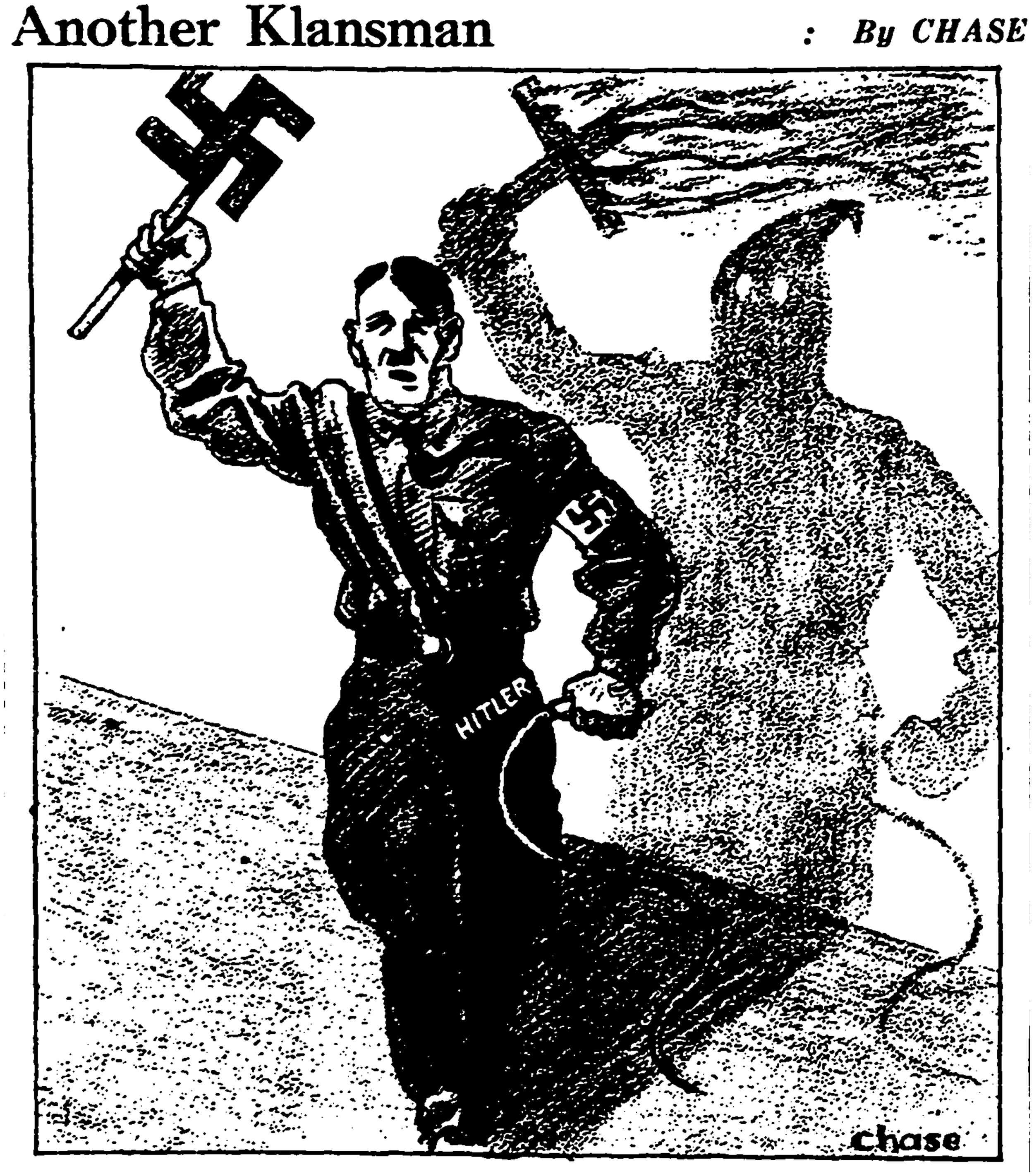
Nikhil Singh points to a ‘black popular front’, which, in the tradition of its abolitionist predecessors, mobilized the common experience of racial oppression to articulate a global challenge to the fascist menace. Black commentators interpreted the rise of fascism as just one moment in an ‘age of hate’ that stretched from the slave trade through white supremacy and colonial adventurism, culminating in what Singh calls ‘the racialization of the world’. 58 Lawrence Dennis, the most prominent fascist intellectual in the United States, offers poetic confirmation of this extended historical trajectory. Dennis, who began life as a ‘globetrotting Negro child preacher’, successfully ‘passed’ as white, met with prominent fascists in Italy and Germany, and referred to himself as the ‘American Rosenberg’. Although he hoped for a nationalist revolution that would topple the Roosevelt administration, he served for years as a diplomatic official in the United States Foreign Service, and his distinguished public career exemplifies the cosmopolitan roots of ultranationalism. 59
The Hungarian Marxist Georg Lukács was among the first postwar theorists to seek a broader genealogy for fascism, especially in its most acute German iteration. His idiosyncratic attempt to locate Nazism as the cumulative product of Germany’s ‘reactionary irrationalist traditions’ created some pitfalls – he viewed fascist ideology as a false revolution predicated on pure demagogy and cynical manipulation, whose own proponents did not take it seriously. At the same time, he saw a qualitatively new development. Under fascism, he concluded, ‘one bourgeois government was not simply replaced by another, but . . . a change of system ensued’. 60 Most importantly, Lukács perceived the National Socialist state as the product of an international complex. It was, at least in part, the ‘fusion of German vitalism and American advertising’, an extreme cultural expression of ‘monopoly capitalism’. 61 But this rendition seems vague and incomplete.
Moving well beyond Lukács, the British sociologist Paul Gilroy offers one of the most sophisticated and provocative ways to theorize fascism internationally. Gilroy, who grounds his work explicitly on Griffin’s model of palingenetic ultranationalism, differentiates between fascist states and ‘fascist cultures’, which, he argues, exert ‘a continuing stylistic appeal’. Like Lukács, Gilroy recognizes that ‘fascism is not to be separated from normality by a question of degree’. 62 At the same time, he searches out the deeper roots of fascist style in an age of militant imperialism and ethnic essentialism. It is impossible, in this space, to summarize Gilroy’s extremely innovative and nuanced analysis. But his argument for continuity between the mechanisms of colonial rule and fascist political culture is worth special attention. The relationship between the German colonial experience in Namibia and the Nazi Lebensraum in Eastern Europe, for example, has recently occasioned an important historical debate. 63
Gilroy’s emphasis on style over substance raises some old problems. These are most obvious in his discussion of Marcus Garvey’s Universal Negro Improvement Association (UNIA), which he regards as incipiently fascistic. By placing Garvey on an equal plane with fascist ideologues, Gilroy overlooks the UNIA’s militant anti-colonial stance and the counter-hegemonic efficacy of its pan-Africanist vision. Without denying the overtly nationalist, masculinist and even palingenetic aspects of Garvey’s politics, it should be clear that the UNIA encountered a fundamental difference in power and social position relative to fascist mass movements. 64 Gilroy, to be fair, intends his analysis to be provocative, not definitive, and he makes a convincing case for the formal affinity between various ethnic absolutisms. Indeed, his repositioning of generic fascism within a colonial, or neocolonial, matrix raises the issue of the structuring role of the world economy in germinating the nationalist international. ‘At the end of capitalism’, argued the Martiniquan anti-colonial activist Aimé Césaire, ‘there is Hitler’. 65
The relationship between capitalism and fascism, especially in its German idiom, has generated endless controversy. Barrels of ink have been spilt, and in at least one case, careers have been lost, over this question. 66 As David Baker has established, fascist political economy positioned itself as a ‘third way’ between communist materialism and capitalist excess. Although, in practice, fascist regimes embraced a controlled ‘neo-capitalism’, they were not mindless shills for ‘finance capital’, as the Comintern definition implies. 67 It seems clear, as Baker admits, that fascist regimes emerged within a decidedly capitalist economic structure and were, at least in some sense, functionally capitalist. Yet any analysis of fascist political economy that persists in a nationalist frame remains artificially truncated.
Here students of fascism have something to learn from the historiography of American slavery. Moving beyond stale debates about whether or to what extent individual slave regimes were capitalist, some of the most exciting new scholarship repositions slavery within a broader regional, hemispheric or even global economic context. 68 Recent work also pushes the temporal boundaries of the institution, connecting the structured horrors of the slave trade to the blood-soaked terrors and dislocations of the ‘long twentieth century’. Paul Gilroy, Ian Baucom and Marcus Rediker, among others, have argued convincingly that the slave trade is ‘a (perhaps the) foundational event in the history of modernity’. 69 Taken as a whole, these histories prompt a reappraisal of Immanuel Wallerstein’s suggestion that slavery is ‘the heart and essence of capitalism as a mode of production’. 70 Could the same thing be said, then, for fascism?
Adam Tooze’s award-winning investigation of ‘the making and breaking of the Nazi economy’ represents one of the first major attempts to transcend the nationalist divide in fascist studies. Drawing on an astonishing array of material, Tooze provides a sweeping, even breathtaking, panorama of actually existing fascism. Crucially, he situates Nazism within the context of American hegemony. Hitler’s regime, Tooze argues, regarded the United States as one of its chief rivals in the epic Malthusian showdown that was to determine the fate of world history. Hitler himself was fixated on the economic threat emanating from North America, which explains both his embrace of American-style mass production and the urgency of his genocidal thrust into Eastern Europe. Hitler’s geopolitical perspective also sheds light, however obliquely, on the Reich’s quest for what Himmler termed ‘worker slaves’ to construct its vast eastern empire. Although this constituted a special kind of slavery, in which workers were considered utterly disposable, it recalls older trends. 71 ‘The aggression of Hitler’s regime’, Tooze concludes, ‘can . . . be rationalized as an intelligible response to the tensions stirred up by the uneven development of global capitalism’. 72
An emphasis on developmental imbalance can be found outside of Europe as well. Margaret Clinton argues persuasively that Chinese fascism was infused with an acute sense of economic and imperial vulnerability. Anxiety about national weakness, she points out, stood at the heart of Chinese fascists’ drive for a regenerative ‘cultural revolution’. For fascist ideologues in China and elsewhere, the price of national survival during the interwar period was ‘total mobilization’. 73 This does not mean that cultural factors, such as extreme nationalism or palingenesis, are mere epiphenomena of more profound economic relations. Structural imbalance alone cannot account for the success or failure of mass movements calling for national rebirth. At the same time, the globalizing nature of capitalist development demands that any account of the genesis and reception of fascist movements be firmly rooted in a transnational historical framework.
The menacing presence of the United States within the Nazi worldview offers an interesting counterpoint to the international affinity between American and German racism. Nazi leaders stood aghast at American decadence and economic might, while simultaneously praising its racial state and forging successful partnerships with American capital and technological expertise. This love–hate relationship was not unique to fascist movements. Even as they decried its exploitive immorality, early 20th-century communists showed a keen interest in American global hegemony. Beginning in the 1920s, Russian revolutionaries adopted a platform of ‘Soviet Americanism’. As he mouldered in Mussolini’s prison, Gramsci filled page after page of his notebooks with reflections on what he called ‘Americanism and Fordism’, a sensitive and complex analysis of the economic and cultural significance of the United States. 74 Without a proper understanding of the American or broader global context of both fascism and communism, neither movement is fully intelligible. Indeed, without a theory to explain the vibrant international affinities of interwar fascism, there is only the outmoded (and highly questionable) resort to fascist exceptionalism – the notion of ‘an unprecedented relapse into barbarism’. 75
This is not to say that Griffin falls into the trap of fascist exceptionalism. His syncretic model of fascist ideology explains Nazism’s embrace of technological modernity, a phenomenon investigated most forcefully by Zygmunt Bauman and too often ignored by those seeking to dismiss the movement as a barbaric aberration. Looking at ‘fascism itself as a political variant of modernism’, Griffin is able to trace the evolution and persistence of fascist movements beyond the interwar period in a move that few other historians have attempted. 76 The Oslo bombings of July 2011 offer a prime example of the efficacy of his approach. Anders Breivik, the alleged mastermind of this crime against humanity, is a poster child for palingenetic ultranationalism; his homicidal campaign against ‘multiculturalism’ was apparently framed by a mythic European essentialism stretching back to Charles Martel and Vlad the Impaler and fuelled by the anticipation of a revolutionary ‘rebirth’. Strict adherence to a nationalist framework, however, might miss the fact that Breivik copied large swaths of his manifesto almost verbatim from Theodore Kaczynski, the American Unabomber. 77
Instead of comparing fascist cultures in static isolation, I suggest that historians and theorists alike need to reposition the rise of fascism as a key determinate moment in the long history of slavery, racism and nationalism. In short, I am asking for a return to the grassroots insight of the black popular front, to locate fascist praxis on a much wider chronological and geographical continuum. Such an approach acknowledges that fascism is endemic to the contradictions of capitalist modernity. ‘Fascism is the inherent “symptom” (the return of the repressed) of capitalism’, argues Slavoj Žižek, ‘the key to its “truth,” not just an external contingent deviation of its “normal” logic’. 78 Without denying the unique horrors conjured by particular fascisms, this method calls for a more expansive genealogy of atrocity. Most importantly, it demands an international lens. And so I pose the question to Roger Griffin: ‘What about America?’
Footnotes
Acknowledgement
I would like to thank Joseph Fronczak, author of a forthcoming international history of the Popular Front, for his exacting and insightful assessment. I would also like to thank Domenico Losurdo, whose prolific work at the intersection of history and theory proved inspirational at every stage of this project. Finally, I would like to thank Roger Griffin and David D. Roberts for being such good sports. I hope readers will see past the blustery polemic to the tremendous respect I have for their foundational contributions to fascist studies.