




Abstract
Liberal multicultural education policies have traditionally viewed religious freedom and equality as complementary aspects of state support for majority and minority groups. This complementarity has been undermined internationally by securitisation policy discourses, which portray Muslim minorities as potential extremists needing restrictions, and right-wing populist portrayals of majority religious freedom and minority religious equality as antagonistic. Internationally, we lack knowledge at scale about young people’s perceptions of support for their religious freedom and about their levels of commitment to religious equality. Such knowledge could inform efforts to interrupt potential antagonisms. Drawing on survey data from 3156 14–15-year-olds in England, this paper examines how youth perceive support for religious expression at school, what factors impact that perception, and its association with their commitment to religious equality. Using multinomial logistic regression, we find that teacher preparedness, rather than school secular/religious ethos, impacted participants’ largely positive perceptions of support for religious expression. Most indicated support for religious expression to be complementary to their commitment to religious equality. Drawing on a Critical Secular perspective, we argue that while these findings challenge current attempts to claim British Christian identity is under threat, they still indicate the normalisation of Christian-centric expectations about religious expression amongst youth.
Keywords
Introduction
This paper presents findings from surveys of 3156 14–15-year-olds in England to illustrate (a) what factors influence their perception of support for religious expression at school, and (b) the extent to which youth experience the relationship between religious expression and equality at school as more or less complementary. Both support for religious/non-religious expression (defined here as positive religious freedom), and commitment to faith 1 equality (defined here as equal life chances and equal respect for religious and non-religious groups), are traditionally understood as integrated aspects of liberal democracies (Malik, 2011). Here, the state balances questions of religious expression and inclusion by supporting diverse forms of expression in public, and by protecting religious communities – and minoritised communities in particular - from discrimination, enabling for them the same/similar freedoms as others. A broadly liberal multicultural policy and socio-political context theoretically supports the pluralisation of forms of religious and non-religious identification, affiliation and belonging (Modood, 2013).
However, a mix of securitisation and religious heritage political and policy discourses have undermined such principles, in their emphasis on renewing national hierarchies of religious (non-)belonging. For example, in a key speech on counter-terrorism and specifically, the perceived exceptional vulnerability of young Muslims to extremism, the then Conservative UK Prime Minister David Cameron (2011) claimed state multiculturalism had failed (BBC, 2011; Kandemir, 2022). Cameron separately stated, “we should not be afraid” to say “we are a Christian country” (Cameron, 2011). Alongside, several European countries have supported Italy’s legal efforts to protect the display of Christian crosses in schools (Breskaya et al., 2022), France has banned “conspicuous” religious clothing in schools in ways that particularly affect Muslim girls (Chrisafis, 2023), and Hungary has iteratively incorporated Christian nationalist values into education policy (Neumann, 2023). Governments such as those in contemporary Hungary are part of a trend of variously right-wing populist and authoritarian nationalist movements that explicitly politicise majority religious freedom to (re)gain governmental control. Such movements have been resurgent in the US, Russia, Türkiye, India, Brazil, and Poland. Despite their variety, they often present an antagonistic relationship between majority religious freedom and equality protections for religious minorities, women, and/or lesbian, gay, bisexual, transgender and queer (LGBTQ+) communities (Butler, 2024; Pally, 2022; Vickers, 2011). In such antagonistic narratives, secular/religious support for reproductive rights and same-sex marriage rights are represented as a threat to national values and/or majority religious freedom, and religious freedom is narrowly defined as freedom to discriminate (Butler, 2024; Leigh, 2009).
The bulk of the literature examining questions of religious freedom and equality together in education is found in policy, philosophical and legal studies of pluralism, human rights, teacher religious expression, and institutional limitations on religious education (Hand, 2003; Jackson and Everington, 2017; Nussbaum, 2007; Rosenblum, 2000). A substantial body of qualitative empirical research on religious and non-religious agency and equality at school exists (Hemming, 2015; Moulin, 2016; Strhan and Shillitoe, 2022). But we lack knowledge at scale of young people’s perceptions of support for their religious freedom, what affects that perception, and the degrees to which they experience religious equality and support for religious expression to be complementary. The generation and use of such at-scale empirical data could help interrupt the potential use of majority religious identity to make spurious, exclusionary claims. Where youth report problems regarding religious freedom in schools, our survey methodology could also help identify which particular factors (e.g. secular/religious ethos, teacher preparedness) policy might focus on to address them.
The case of youth experiences in English schools is interesting in this respect. UK political culture over the past decade has been dominated by a mix of right-wing populist and centrist anti-immigrant and anti-Muslim discourses. These discourses have partly argued that the freedom of speech of the majority is under threat from minorities and those that seek to protect minorities. Yet the majority of research on free speech in education has been focused on universities, and not on schools or young people (Kitching et al., 2025; Smith, 2020). Mainstream anti-immigrant and anti-Muslim discourses in the UK have not been led by an explicitly religious nationalism. Yet exclusionary use of Christian identity is a strand of various British far-right movements (Strømmen and Schmiedel, 2020) that has regained visibility recently. For example, a recent “Unite the Kingdom” rally of over 150,000 people in London, led by openly anti-Islam far-right groups, saw prominent use of flags with Bible verses, wooden crosses, and claims that Christianity is under attack (Camapanale, 2025; The Guardian, 2025).
At the same time, Christianity remains institutionally privileged in England’s school system, when compared to other religious and to non-religious identities. The ongoing centralisation of Christianity in the school system in a polarised socio-political context raises further empirical questions regarding whether religiously minoritised groups experience support for religious expression any differently to their peers. Below, we draw on Critical Secular theory alongside the limited, largely field-adjacent quantitative literature to hypothesise what factors may shape youth perceptions of religious expression and equality. We then delve further into the English education policy context and qualitative research to consider how the national policy and socio-political context might shape youth views and experiences at school.
Conceptual framing and literature review
The paper is situated in the field of Critical Secular Studies in Education (Gholami, 2018; Kitching, 2024; Kitching and Gholami, 2023). This field is not focussed on secular or non-religious worldviews in education per se. Rather its starting point is a critique of the liberal multicultural view of the state as neutrally mediating between religions and non-religions. While state secularism is often associated with the relative privatisation of religion, as Brown (2014: p. 112) argues, “secularism is a way of stipulating, organising, and producing” religion. Critical Secular Studies in Education shares the well-established critical study of religion focus on challenging the normalised “secular” use of Christianity (or other majority religions) as the reference point to understand religion and therefore, other religions and non-religiosity (see Berglund’s, 2013 work in Sweden and Alberts, 2019 work on small “i” indoctrination across English, German and Norwegian contexts). It also understands secular governance as context- and often nation-specific. For example, French laïcité differs from the British liberal multicultural tradition in their differential support for public religious expression, despite converging via anti-Muslim securitisation policy discourses (Kundnani, 2017).
But Critical Secular Studies goes further to forge a critical theory of secular sovereign (state) assemblages as seeking to regulate, rather than eliminate the violence of religion-related conflicts and inequalities in education as part of efforts “to shore up power in the never-ending quest to define national and civilisational identities” (Sheedy, 2022: 11). In other words, this perspective argues that the portrayal of majority religious norms as politically neutral, or as naturally belonging to the nation is actively maintained rather than a legacy that secularisation will eventually erase. In the next section for example, we explore how the defining of English or British identity in schools involves the continued privileging of Christianity in school provision and the de-privatising surveillance and encouragement of “moderate” Muslim people’s religiosity and politics through counter-terrorist legislation. Importantly, this deployment of discourses of acceptable religion(s) in education is shot through not just with the politics of race, but also class (e.g. desirable school provision/choice), gender, and sexuality (e.g. debates over British values in relationships and sexuality education; Kitching, 2024). From a Critical Secular perspective, youth religious and non-religious expression at school, and concepts of religious freedom, are not the preserve of autonomous citizens and (non-)believers. Rather they are already caught up in and produced through the complex governing rationalities and discourses of secular sovereign power.
Quantitative research on factors shaping youth views on religious freedom and equality
There is limited quantitative research internationally that addresses how youth view, experience or value the principle of religious freedom itself at school. Barrett et al.’s (2007) large-scale analysis of US 7th and 12th grader data from the mid-1990s indicates that school secular/religious norms systematically influence children and young people’s religious beliefs and behaviours. Based on the literature below, we hypothesise from a Critical Secular perspective that the normalisation of “religious freedom” primarily for the national/heritage (Christian) religion in the English school system, blurred distinctions between the secular and Christian therein, and a consumerist approach to secular/religious schooling in England may impact young people’s levels of expectation of support for minority religious and non-religious expression at school. Notably, Breskaya et al. (2023: 258) indicate the “national religious freedom regime,” characterised by state policies and jurisdiction regarding religion, political culture, and societal norms around pluralism, also have an effect on how youth value religious freedom (including whether they value religious equality). Using surveys of 20–21-year-olds, Breskaya et al. (2023) found Italian participants emphasised human rights (freedom to establish a religious group, express religious views publicly) and socio-legal (non-discrimination for minorities, equality of religions before the law) dimensions to religious freedom. Alternatively, Russian participants focussed on individual autonomy (the search for individual truth, personal fulfilment, and dignity). They attribute the socio-legal valuing of religious freedom in Italy to a more prevalent public culture of human rights, whereas lesser public freedom in Russia is theorised as leading to a more private orientation regarding the value of religious freedom 2 Breskaya and Botvar’s (2019) surveys of 16–20-year-olds in Belarus and Norway also found statistically significant differences between religious majority, minority and non-religious youth views on religious freedom in both countries. 3 Hence we seek to analyse the impact of national majority and minority religious identity on youth perceptions of support for religious freedom below.
UK-based research has found favourable views towards religious freedom for others amongst youth, as a function of wider secular civil liberties and/or minority rights (Tenenbaum and Ruck, 2012). The favouring of a balanced approach to social inclusion and individual speech rights has also been evident amongst youth in Belgium and Canada (Harell, 2010). Research with Australian youth has found substantial support for others to practice their religion, but also concern about militantly conservative religious freedom discourses which legitimise discrimination against others, including LGBTQ+ communities (Halafoff et al., 2020; Jones, 2023; Singleton et al., 2019). Yet none of the above studies examine how youth perceive support for religious expression in the school context, or how their views on faith equality impact this perception. Given the absence of an empirical research tradition in this area, it is beyond the scope of one paper to definitively assess how various complex policy, political, practice and identity factors impact on youth experiences of religious freedom at school and its relationship to their commitment to equality. Nevertheless, the paper will break ground by offering important quantitative baseline data at scale on these questions. To aid interpretation of our findings, the following section unpacks the complexity of these factors in the English context.
School-based freedom and equality in England’s “religious freedom regime”
The formal principle of protection from religious imposition and provision for education in one’s religion is longstanding within UK education legislation (Fancourt, 2022). Legislative instruments such as the Human Rights Act (1998; incorporating the European Convention on Human Rights) and the Equality Act (2010) are designed in principle to protect freedom of religion, prevent direct and indirect religious discrimination, and defend the right to faith-based education or to withdraw from such education in accordance with (parents’) worldviews. Thus, in principle, religious freedom and equality are officially viewed as complementary in UK, in an ostensibly liberal manner. Yet, reflecting intersecting dynamics of class and religion, the English school system’s religious freedom regime views religious freedom in quasi-marketised terms, rather than as a question of purely following religious/non-religious conscience. Changes brought in by the landmark 1988 Education Act reflect both an ongoing symbolic privileging of Christianity amongst other religions in the school system, and the prioritisation of a distinctively secular set of expectations regarding school, pupil and teacher performance. The 1988 Act confirmed that, subject to local exceptions, an existing collective worship requirement of schools should “wholly or mainly be of a broadly Christian character.” At the same time, Fancourt (2022) argues, the 1988 Act reconfigured the meaning of religious freedom from a matter of personal religious autonomy, towards the consumption of educational brands. Here, school religious ethos is one factor for parents among several in an education quasi-market.
Christian faith schools have maintained their historic position as significant players in this ever-evolving quasi-market. In 2023, 28% of primary and 18% of secondary pupils attended faith schools. Thirty four percent of England’s state-funded schools were faith schools, and less than 1% of these were non-Christian (Long et al., 2024). The Academies Act (2010) enabled schools (including faith schools under local authority control) to convert to academy status, and thus gain more control over their curriculum. The National Secular Society (2024) argues the emergence of Multi-Academy Trusts (MATs), which govern and manage more than one academy school, has brought secular schools under the influence of faith schools, and blurred the line between them. They contend 48% of non-faith schools are part of religiously affiliated MATs. Approximately one-third of all MATs have a religious character, and the Church of England is the biggest provider of academies in England (House of Commons Debate, 2024a). Yet the 2021 Census found that less than half (46%) of England and Wales’s populations identified as Christian, with over 50% of those in their 20s identifying with no religion (Booth and Goodier, 2023).
Countervailing trends in England towards personal non-religiosity, and the continued prominence of Christian faith schools thus underline that the reasons pupils attend particular religious/secular schools in a quasi-marketised system exceed a pure desire for freedom to practice religion, or freedom from religion. They will likely incorporate factors such as locality, and academic performance (Levitt and Woodhead, 2020). Our state-funded school sample also does not include those who have opted for private or home-based schooling at least in part for religious reasons (Bhopal and Myers, 2018). At the very least, there is a likelihood of mixed expectations among both religious and non-religious pupils regarding the question of support for religious expression in state-funded schools. This makes it difficult to predict at scale how religious/secular school-level characteristics and pupil religious identity will impact youth perceptions of support for religious freedom.
Qualitative research in English schools with youth for whom religion is an important part of their identity further indicates there are multiple layers to how young people experience support for various dimensions of religious expression. Moulin (2015) found that while having adult and peer co-religionists at school was helpful, schools (including those young people share the same religious affiliation with), could be a support or a challenge to young people’s religious expression due to denominational or faith differences, familial preferences, lack of teacher knowledge and peer prejudice. Strhan and Shillitoe (2022) present empirical evidence that religious education at primary level does not offer non-religious pupils the opportunities to meaningfully engage with non-religious worldviews, or helping them make sense of their own non-religious experiences and commitments. Indeed, English education policymakers have been historically reluctant to acknowledge worldviews like humanism in RE (Wareham, 2022). Research on religious education teaching indicates some opportunities for youth religious identity to be expressed in secular terms, that is, where youth can share their religious worldviews in inclusive religious education practices (Fancourt, 2007; Jackson and Everington, 2017). Yet, echoing international research on Muslim youth experiences (Zine, 2008), Vincent (2018) argues a mix of secular Christian-centred civic virtues and securitisation policy discourses frame Muslim communities as the extreme religious other in the English education landscape. Winter et al. (2022) also found a peer-based chilling effect for Muslim youth around discussing socio-political issues.
No quantitative data exists on how the above factors, that is, pupil religious identity, pupil religious beliefs/practices, school secular/religious ethos, and teacher preparedness impacts young people’s perceptions of support for religious expression at school. Due to the lack of systematic collection of data on school-level religious composition in England at school and national level, it is not currently possible to ascertain whether being in the majority/minority religious group in an individual school impacts youth perceptions of support for religious expression. Yet as alluded to earlier, we can examine the impact of pupils’ membership of national majority or minority groups on such perceptions. The factors we address below are the impact of the schools’ secular/religious ethos, pupils’ religious identities, pupils’ religious belief/practices, and pupils’ commitment to faith equality (dependent variables) on their perceived support for religious beliefs and practices at school (independent variable). We ask the following questions:
(a) What factors influence pupils’ perceptions of support for religious expression (in terms of support for religious beliefs and practices) at school in England?
(b) To what degree is pupils’ commitment to faith equality related to their perception of support for religious beliefs and practices at school?
Methodology
This paper is based on the data from a wider study on freedom of expression in schools in England on race and faith equality issues. The study received ethical approval from University of Birmingham, number ERN_22-0703. To answer the above research questions, we use quantitative survey data from 2909 Year-10 (14–15-year-old) pupils from 29 state-funded mainstream secondary schools across 8 of the 9 regions of England. 4 The survey was developed in September 2022 through a review of existing relevant surveys and survey items, including those from international and national studies on civic education and free speech (Hillman, 2022; Losito et al., 2018; Naughton et al., 2017). Consultation with our Project Advisory Board, composed of school and local authority education professionals, third sector equality and children’s rights advocates, and academics with expertise in the field, helped refine the survey questions.
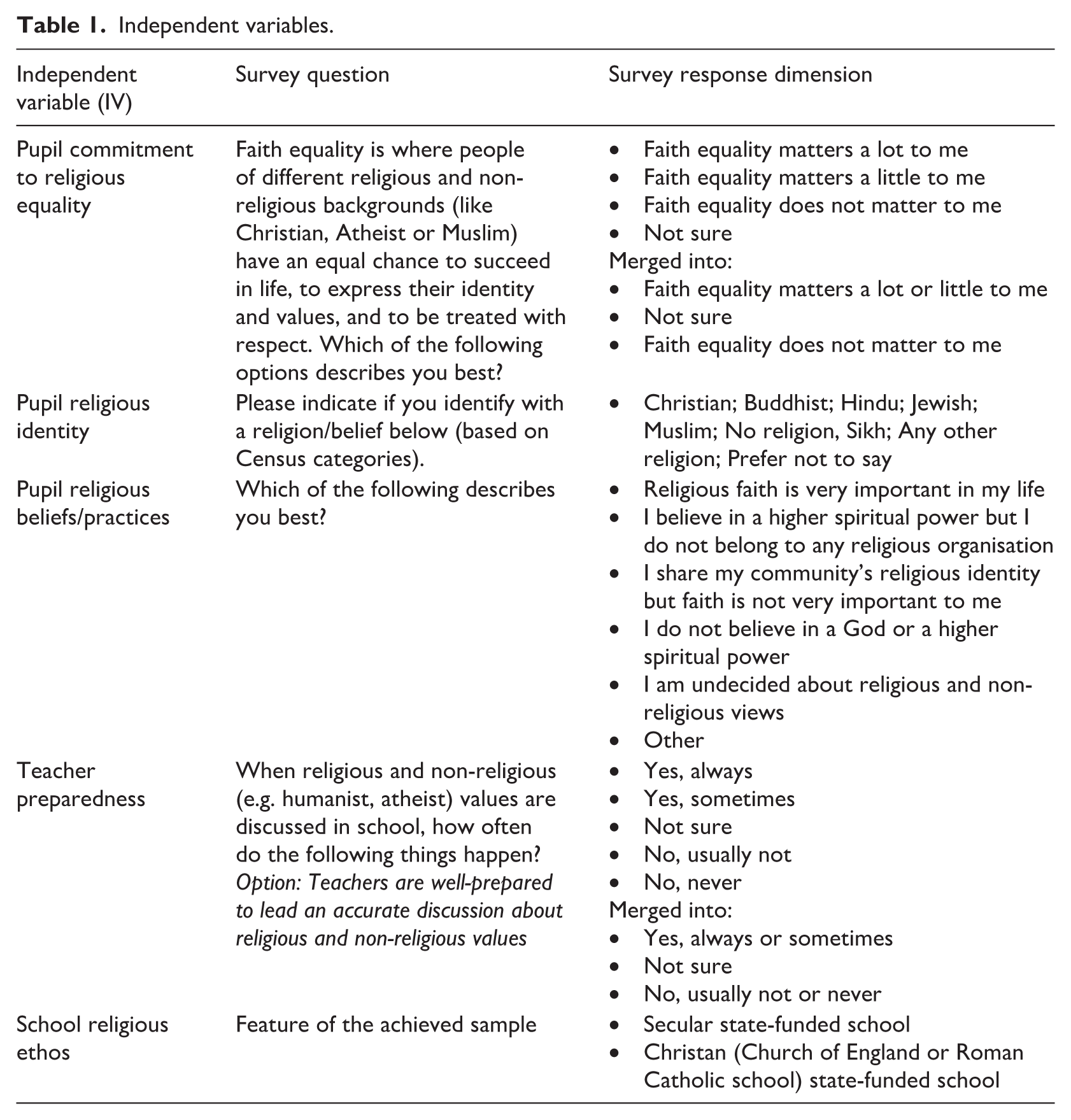
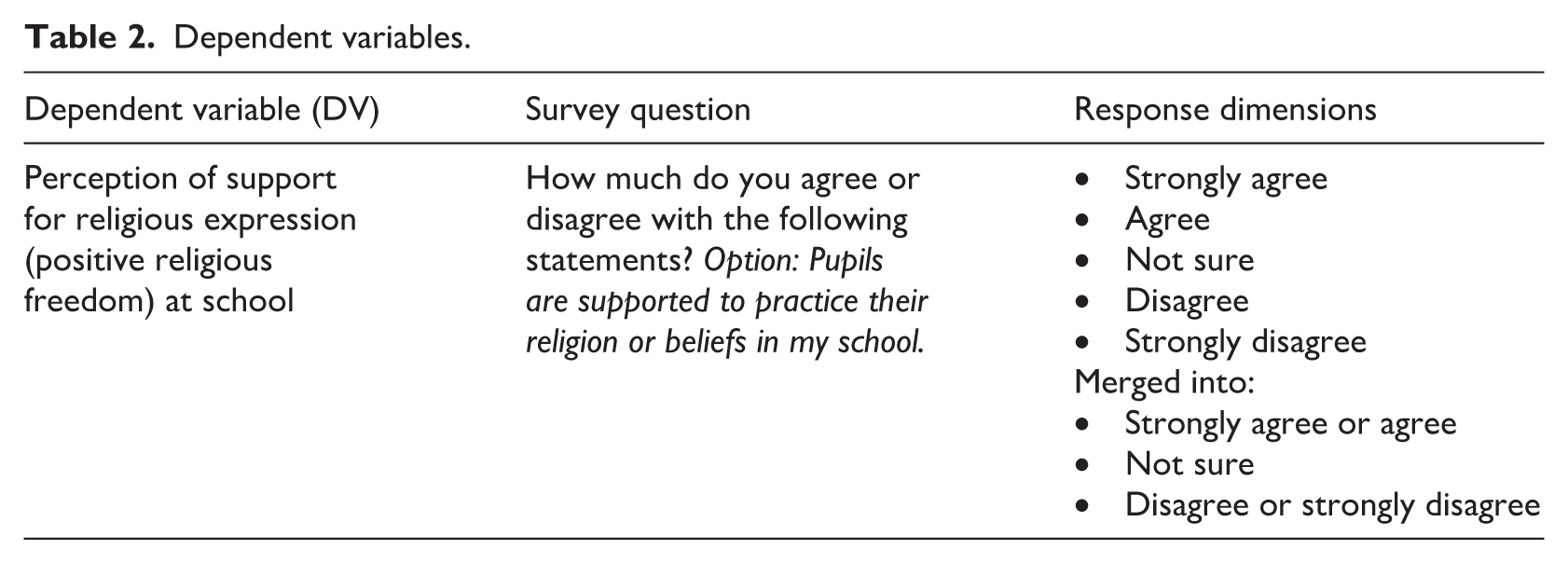
The survey comprised 20 questions with a total of 108 items that sought to understand young people’s perspectives on free expression around race and faith equality at school. 65 more items were used to collect the respondents’ demographic information including their religious identity and religious practice/beliefs. The items included single answer, multiple choice and Likert scale questions. We conducted piloting in two phases in October and November 2022 with Year 10 pupils in two secular secondary schools and one Catholic secondary school, assessing survey administration, timing, and question accessibility. The pilot study indicated that the survey’s internal and external validity and reliability were strong. However, we adjusted some items based on our analysis of the pilot quantitative data, and discussions with pilot participants of their experiences of the survey. The items analysed in this paper are outlined later in Tables 1 and 2.
Independent variables.
Dependent variables.
A stratified and random sampling strategy was applied to recruit schools to the survey from the National Pupil Database (National Pupil Database, 2022). Region of England, geographic location (urban/rural), and state-funded school type (based on control over curriculum) were used as strata (Rahman et al., 2023). The data below was collected between January and July 2023 through an online survey administered in schools by teachers or school staff who were given guidance materials and email/phone support by the research team. In total, 29 schools agreed to administer the survey to as many of their Year 10 pupils as possible. 22 schools were officially secular, and seven schools had a Roman Catholic or Church of England ethos. The survey gathered quantitative data from 3156 Year-10 respondents overall.
Although our sample is not nationally representative, it exhibits strong alignment with national demographic distributions for 14–15-year-olds (see below and Rahman et al., 2023). Our sample includes approximately 0.5% of the national Year 10 population. Ethnicity in our sample closely resembles national figures for all ethnic groups (Source: Office for National Statistics [ONS], 2024). While religious affiliation shows minor discrepancies (e.g. Christian youth are slightly underrepresented at 32% vs the national 37.6%), other large groups like non-religious youth are nearly aligned (our 42% vs the national 41.6%; Source: ONS). Although gender is not a factor in our analysis, our sample also reflects the national pattern in which boys and girls are present in almost equal numbers in the Year 10 population. Nationally, there are 311,145 boys and 304,695 girls, and our sample captures 0.4% and 0.5% of these groups respectively. The primary issues impacting full statistical representativeness were the non-participation of one region (Yorkshire and Humber), our inclusion of a non-binary gender category (totalling 1% of our sample) which precludes direct comparison with the national binary statistics, and our inclusion of a “Prefer not to say” option on demographic questions. Despite these differences, the overall strong demographic alignment supports the generalisability of our findings.
Across the key independent variables, the extent of missing data was generally low to moderate. The number of valid responses ranged from 2909 to 3156 out of a total sample of 3156 pupils. Two variables—pupil religious identity and school religious ethos—had complete data with no missing responses. Missing values were most common for items related to teacher preparedness (247 cases, 7.8%) and pupil religious beliefs/practices (176 cases, 5.6%), while pupil commitment to religious equality had 114 missing responses (3.6%).
We used Missing Value Analysis and the Expectation-Maximisation (EM) function to deal with the missing data. While the overall level of missing data is low (3.6%–7.8%) the Little’s MCAR test showed that the missing data is not completely random (χ2 = 48.037, df = 29, p = 0.015). The missingness is likely to be related to the response of the respondents’ commitment to faith equality. Hence, to avoid potential bias related to the missing data, we adopted a Multiple Imputation (MI) approach that created five complete datasets using a step-by-step estimation and included all variables used in the final analysis. The regression analysis was then carried out on each dataset, and the results were combined to produce the final estimates. This procedure ensured that our findings were as accurate and reliable as possible.
Analytical approach
Alongside descriptive statistical analysis, we analysed the relationship between key variables outlined in Table 1 below with the dependent variable in Table 2, using Multinomial Logistic Regression (MLR). MLR is a suitable statistical method when a dependent variable (e.g. perception of support for religious expression at school) may be influenced by several independent variables (e.g. pupil religion, pupils’ perception of teachers etc.; Osborne, 2015; Vittinghoff et al., 2005). It is suitable for analysing relationships between both nominal variables, where the response options do not have a given rank (e.g. gender, race, religious affiliation) and ranked variables (e.g. where the response options include agree, neutral and disagree).
The choice of MLR over an Ordinary Least Squares (OLS) analysis was necessary because our dependent variable is an ordinal Likert Scale. OLS assumes the interval between all response options are equal and treats the outcome as continuous. This assumption does not reflect our dataset. MLR, by contrast, models the outcome as discrete categories, allowing us to estimate the distinct factors that drive a pupil towards “agree” versus “not sure” versus “disagree”—a key nuance that would be lost in an OLS model. Moreover, we conceptualise pupils’ experience of religious freedom as shaped simultaneously by multiple factors, rather than in isolation. MLR is a suitable statistical method for estimating the effect of each predictor (e.g. pupil religion, teacher preparedness) while accounting for the presence of others (Vittinghoff et al., 2005).
As Tables 1 and 2 illustrate, our Likert scale items follow an apparent order (always, sometimes, not sure, usually not, never; strongly agree, agree, not sure, disagree and strongly disagree). However, the intervals between points are not static (e.g. participants’ age differences offer a static numeric difference between them, whereas agreement/disagreement differences amongst participants do not remain static across questions). MLR can be used with any number of independent variables that are categorical (e.g. race, religion) or continuous (e.g. age; Hilbe, 2016). Here, the log odds of outcome (dependent) variables are modelled as a linear combination of independent variables (Hosmer et al., 2013; Vittinghoff et al., 2005). An example of a log odds calculation is the analysis of the extent to which pupils of a particular religion (independent variable) are likely to agree that they are supported in expressing their religious values (dependent variable or outcome variable) compared to pupils of a different religion. To conduct this form of analysis, we assign one category (e.g. strongly disagree) of the outcome variable as the reference category. The choice of this as the reference category is typically based on the research question or the specific comparisons of interest. The last category (e.g. strongly disagree) is typically chosen as the reference category because, as the most negative response category, it allows us to identify the degree to which those who respond most positively do so in comparison to those who respond most negatively. The analysis then compares each category of the outcome variable (e.g. strongly agree, agree, not sure, disagree, strongly disagree) to the reference category, allowing for a comprehensive understanding of the relationships between predictor variables and outcome categories.
Model specification
Suppose Y is the categorical dependent variable with K categories, and let

Here k indicates a specific category of the dependent variable among the all categories,
Findings
As reported in Rahman et al. (2023), and mirroring Census 2021 data for 14–15-year-olds (ONS, 2024), the largest group of participants identified as having no religion (42%). Christians, including Church of England, Catholic, and Protestant denominations made up 32% of participants. Muslims constituted 8% of the respondents, while smaller percentages identified as Hindu (2%), Jewish (1%), Sikh (1%), and Buddhist (1%). Additionally, 7% identified with other religions, and 7% preferred not to disclose a religious affiliation. Regarding participant religious belief and practice, 29% did not believe in a god or higher spiritual power. 22% were undecided about religious and non-religious views. Approximately 21% stated that religious faith is very important in their daily lives. Another 11% believed in a higher spiritual power, but did not belong to any religious organisation/group. Around 9% shared their community’s religious identity but did not consider faith very important. An additional 8% identified with other religious beliefs/practices.
The data highlights somewhat positive responses towards the religious expression and equality questions, and the teacher preparedness question. The majority (59%) also either strongly agreed or agreed with the statement “pupils are supported to practice their religion or beliefs in my school.” However, a notable proportion (22%) were unsure, and another 19% disagreed with the statement. The majority of respondents (78%) also indicated that faith equality matters a lot or a little to them. 10% said it does not matter to them at all, and 12% were unsure. The majority (67%) also perceived teachers as being always or sometimes well-prepared to lead accurate discussions on religious and non-religious values. A smaller proportion (18%) believed teachers are usually not or never prepared. The remaining respondents (15%) were uncertain about teachers’ preparedness.
Robustness of MLR analysis
We applied MLR, based on pooled estimates from the Multiple Imputation procedure averaged using Rubin’s rules, to examine the effect of the independent variables in Table 1 on pupils’ perception of support for religious expression. The MLR analysis shows a highly significant improvement from the intercept-only model, indicated by the Likelihood Ratio χ2 value of 771.83 (df = 36, p < 0.001; see Table 3 below) suggesting that the selected predictors (i.e. the independent variables) reliably explain variance in pupils’ perceptions of school support for religious expression.
Pooled MLR model fit summary.
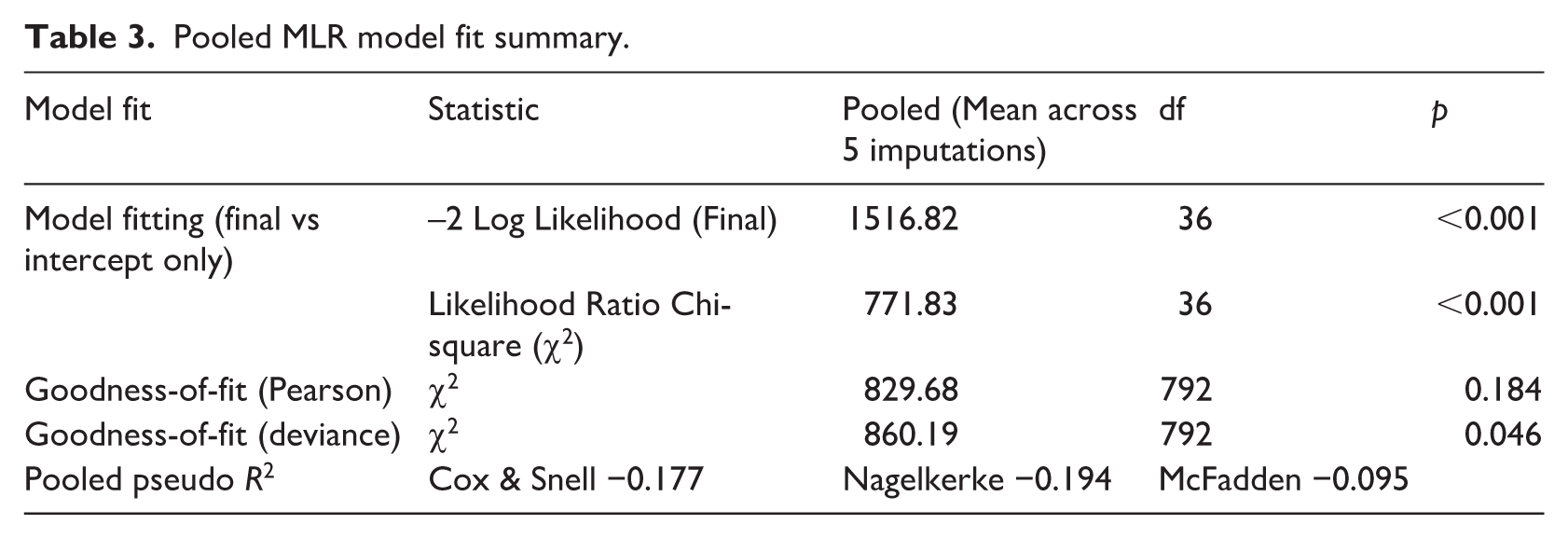
The Goodness-of-Fit statistics provide further validation of the model. The Pearson Chi-Square (χ2 = 829.68, df = 792, p = 0.184) indicates that the model fits the data well, as the p-values are greater than 0.05, suggesting no significant lack of fit. The Deviance Chi-Square (χ2 = 860.19, df = 792, p = 0.046) was marginally significant, a result consistent with large sample sizes and complex models. Overall, the model demonstrates satisfactory fit and internal consistency across all imputations.
The pseudo R-squared values offer an estimate of the model’s explanatory power. Cox and Snell’s R-squared is 0.177, Nagelkerke’s R-squared is 0.194, and McFadden’s R-squared is 0.095. These values indicate that the model explains between 9.5% and 19.4% of the variance in the dependent variable, signifying a reasonable amount of explanatory power. Overall, the model demonstrates a good fit and provides a meaningful explanation of the variance in the data.
Analysis using Likelihood Ratio Tests examined the impact of specific predictors of young people’s perceptions of support for religious equality at school. These tests confirm the model’s structure, showing that both teacher preparedness and faith equality are highly significant contributors. Conversely, school ethos showed a negligible impact on model fit (χ2 = 0.010, p = 0.995), reinforcing that the structural designation of the school is not the driving factor. Pupil religious identity was statistically significant (χ2 = 26.740, df = 16, p = 0.044), while pupil religious beliefs/practices showed a marginal effect (χ2 = 17.613, df = 10, p = 0.062).
Overview of statistically significant findings
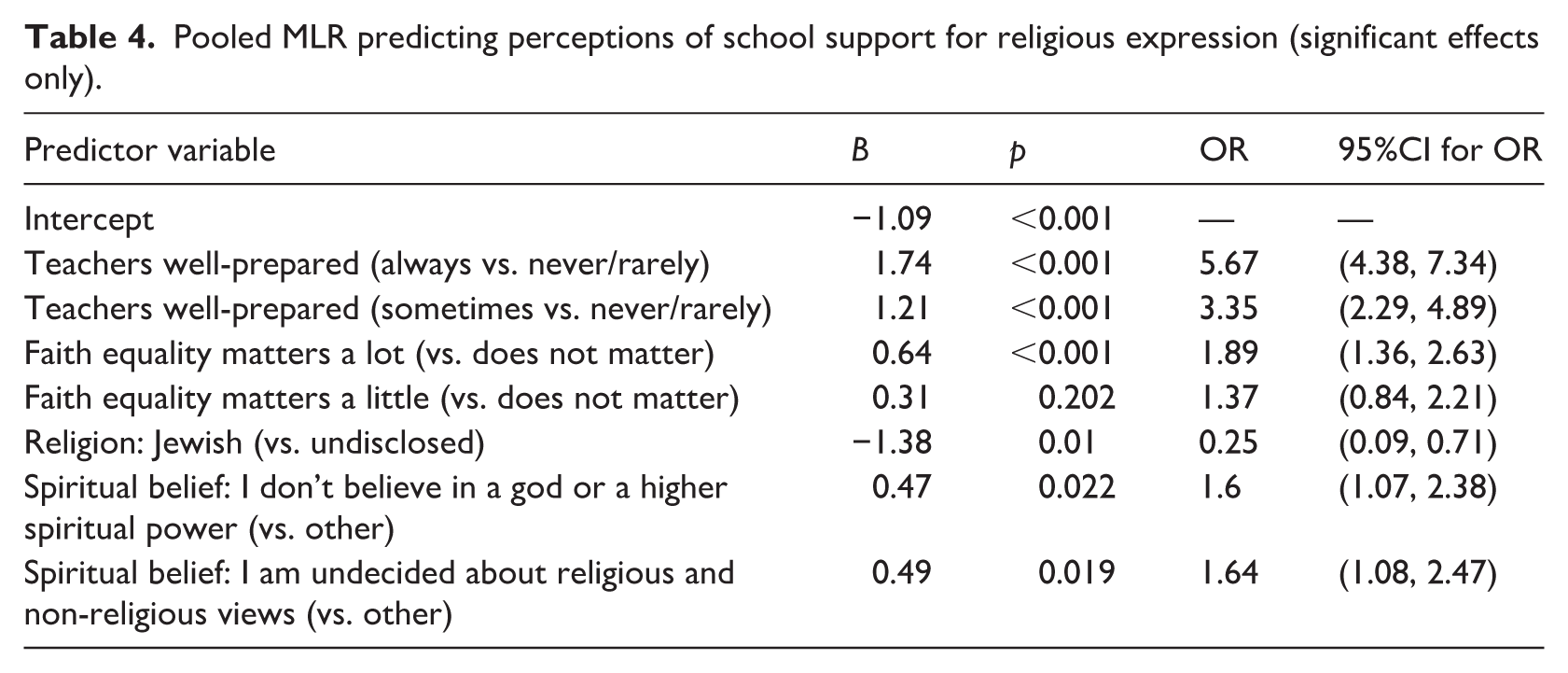
This section shows the overview of statistically significant findings from our regression after conducting Multiple Imputation. To summarise the findings in Table 4 below, perception of support for religious expression at school was statistically significantly related to pupil religious/non-religious identity, but not to their religious/non-religious practices or beliefs. The analysis shows that religious identity had a significant effect (χ2 = 26.740, df = 16, p = 0.044) while religious belief/practice showed a marginal effect (χ2 = 17.613, df = 10, p = 0.062; see Table 1 for a reminder of how religious identity and religious belief/practice were defined). It is worth reiterating here that the χ2 results are generated as a part of the MLR analysis and are appropriate for analysing the relationships between nominal variables like ours (please see the Analytical Approach section above).
Pooled MLR predicting perceptions of school support for religious expression (significant effects only).
Participants’ perception of support for religious expression at school was also significantly related to their view of teacher preparedness (see Table 1 for the definition of preparedness) but not to the school’s stated religious/secular ethos. Furthermore, the question of how much faith equality matters to participants had significant relationship to their perceptions of support for religious expression. Jewish pupils were the only religious group who raised concerns about support for religious expression that reached statistical significance.
In the following three subsections, we explore the statistically significant findings in further detail, drawing on Table 4.
The relationship between different religious identities and perceived support for religious expression at school
As noted above, we investigated how different young people’s religious identities influence the likelihood of them agreeing that “Pupils are supported to practice their religion or beliefs in my school.” Figure 1 presents a visual crosstabulation of participants’ responses, which we then elaborate on in terms of statistical significance.
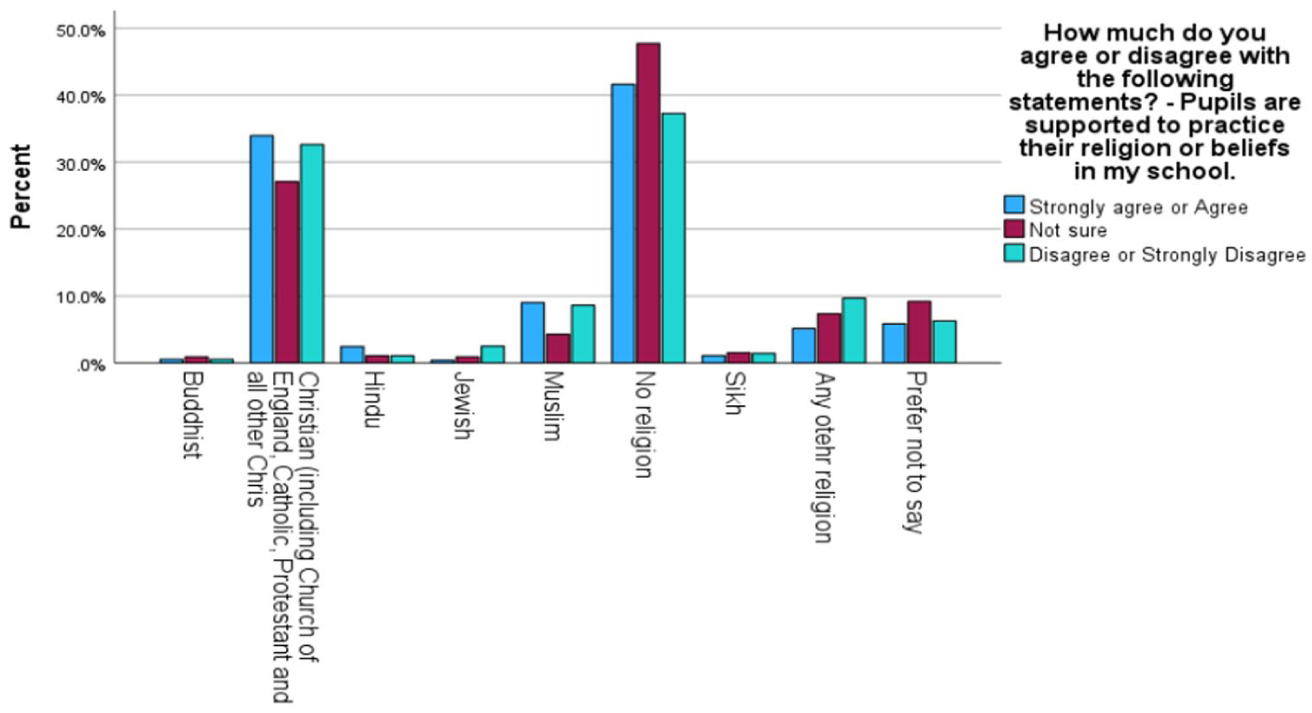
Participant religious identity and perceived support for religious expression at school.
A pooled MLR analysis was conducted using five imputed datasets created through Multiple Imputation (MI) with Fully Conditional Specification to compare religious groups to those who did not reveal their religious identity (reference category). This found some of the smallest groups, specifically Jewish and Sikh respondents, and those from another religious affiliation were less likely to agree that pupils are supported with religious expression. But as Table 4 shows, only Jewish respondents were significantly (almost 75%) less likely to agree that pupils are supported to practice their religion (B = −1.383, p = 0.010, OR = 0.251). Findings from Sikh participants and those from another religious affiliation were statistically not significant. In contrast, although also not statistically significant, Buddhist (B = 0.286, p = 0.749, OR = 1.331), Christian (B = 0.110, p = 0.644, OR = 1.116), Hindu (B = 0.693, p = 0.221, OR = 2.001), Muslim (B = 0.079, p = 0.792, OR = 1.082), and non-religious pupils (B = 0.119, p = 0.594, OR = 1.126) were more likely to agree that pupils are supported to practice their religion or belief at school than the reference category.
The relationship between teacher preparedness and perceived support for religious expression at school
Figure 2 presents a visual crosstabulation of participants’ responses on teacher preparedness versus perceived support for religious expression, which we then elaborate on in terms of statistical significance.
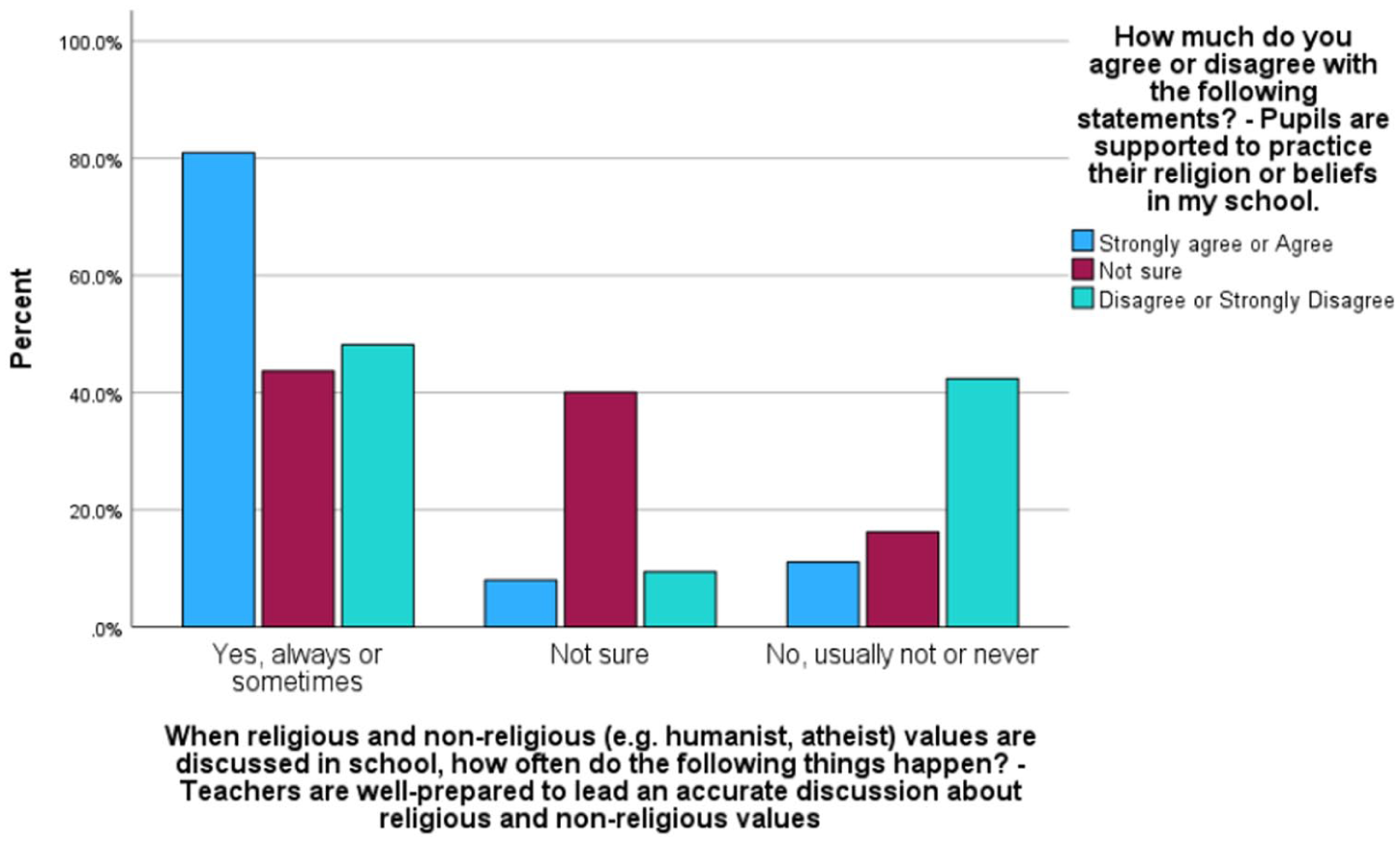
Teacher preparedness versus perceived support for religious expression at school.
Respondents who believe teachers are always or sometimes well-prepared to accurately discuss religious and non-religious values are significantly more likely (almost six times) to agree (B = 1.735, p < 0.001, OR = 5.670) that pupils are supported in their religious beliefs and practice at school compared to those who says teachers are “Usually not or never” prepared. Those who are “Not sure” about teachers’ preparedness show the highest likelihood of being unsure about support for religious expression (B = 2.232, p < 0.001, OR = 9.316). Those who are “Not sure” about teachers’ preparedness are also more likely to indicate perceived support for religious expression, although to a lesser extent (B = 1.208, p < 0.001, OR = 3.347).
The relationship between pupil commitment to faith equality and perception of support for religious expression at school
Figure 3 presents a visual crosstabulation of participants’ responses on their commitment to faith equality vis-à-vis their perception of support for religious expression, which we then elaborate on in terms of statistical significance.

Whether faith equality matters versus perceived support for religious expression at school.
The analysis reveals that when faith equality matters a lot or a little to the respondent, they are twice more likely to agree that pupils are supported in their religious expression at school (B = 0.637, p < 0.001, OR = 1.891) than those who says faith equality does not matter to them. Those who are unsure about whether faith equality matters to them show a non-significant increase in the likelihood of agreeing that pupils are supported in their religious expression (B = 0.312, p = 0.202, OR = 1.367). Twenty-two percent of participants stated they were not sure about whether religious expression is supported at school. Respondents who say faith equality matters to them were significantly more likely to be unsure about support for religious expression at school compared to those who say faith equality does not matter (B = 0.459, p = 0.020, OR = 1.583). Those unsure about faith equality show a highly significant and substantial increase in the likelihood of being unsure about support for religious expression (B = 1.063, p < 0.001, OR = 2.896).
The findings above clearly indicate that, while there is a substantial cohort of pupils who are not sure about whether religious expression is supported at their school, commitment to faith equality is strongly correlated with positive perceptions of support for religious expression at school. However, principled commitment to faith equality can co-exist with uncertainty about support for religious expression at school. We did not find any negative correlation between these two phenomena, indicating religious expression at school and commitment to faith equality have a complementary or at least benign relationship in young people’s experience. This likely reflects the importance of school support for religious expression to maintaining a positive stance towards equality.
Discussion and conclusion
Qualitative research in the field of child and youth religious agency in schools has provided important insights into the complex and layered ways that young people relate to their schools, teachers and peers on matters of religious and non-religious inclusion and exclusion (Hemming and Madge, 2012; Moulin, 2015). The data presented in this paper complements this work by providing larger-scale data which moves us towards a greater system-level understanding of perceptions of religious expression and equality in young people’s secondary school experience in England. This also advances the limited literature on the question of freedom of expression in schools more generally. This literature is typically focussed on higher education, and not on young people’s school experiences (Kitching et al., 2025).
Before proceeding to the implications, we must acknowledge certain limitations. While the cohort surveyed mirrored national demographics for religious identity at 14–15 years old and presents an effectively national resemblance (discussed above), highly significant response rate of over 3000 respondents across eight of England’s nine regions, we do not claim it to be definitively statistically representative of all England’s Year 10 state-funded mainstream school pupils. Moreover, due to system data constraints, it was not possible to conduct an analysis of the effect of majority/minority religious/non-religious pupil composition at the school level on young people’s responses.
Nevertheless, our findings yield important insights. As we have reported previously (Rahman et al., 2023), the majority (59%) of young participants in English secondary schools agreed that their schools support pupils’ religious expression. However, a notable minority (22%) disagreed, or were unsure (19%) about this question. Perceived support for religious expression was positively correlated with reports of teachers’ preparedness to accurately discuss religious and non-religious views. This is important, for two main reasons. First, it indicates that how the school’s mission is enacted potentially matters more to support for religious freedom than the stated ethos itself. Second, it emphasises the importance of teacher-pupil relationships and leading well-informed discussions to provide young people with opportunities to express themselves. These factors may be important to any intervention that seeks to ensure religious freedom is supported long-term, yet they need to be considered in the context of the below discussion.
We found no statistically significant effect of a school’s official Christian or secular ethos on participants’ perceptions of support for pupils’ religious expression at school. While some may view this as evidence of inclusive schooling in England across the board, from a Critical Secular perspective, we argue England’s “religious freedom regime” - as previous research indicates - normalises a blurred boundary between secularism and Christianity in state-funded public education. This regime also positions religious freedom as one dimension of a wider consumer freedom to school in a quasi-market, which likely lowers, or at least complicates the expectations of diverse young people, regarding support for non-Christian religious expression across different kinds of state-funded schools.
Importantly, 78% of our participants stated that faith equality mattered a lot or a little to them. This view correlated positively with their perceptions of support for religious freedom at school. This is arguably a positive outcome, which may indicate that, despite the current policy and political context, Britain’s legacy of liberal multiculturalism, formed through substantial struggles by religiously and racially minoritised communities (and visible, e.g. in state-funded Islamic schools and exemptions from Christian worship; Meer, 2010) offers basic protections against the development of such antagonisms amongst youth in England. At the same time, the likely low expectation of support for non-Christian religious expression in schools raises a note of caution about the school system’s resilience to growing attempts to use religious identity to exclude minorities. Christian identity has recently become a more visible feature of far-right politics in the UK (Camapanale, 2025; Strømmen and Schmiedel, 2020; The Guardian, 2025), and internationally, the extent to which different religious freedom regimes are resilient to the use of majority religious identity for overtly exclusionary purposes is under question. Previous quantitative evidence indicates that differing national policy and socio-political norms in countries like Russia and Italy will likely impact on young people’s perceptions of religious freedom (Breskaya et al., 2023). Yet despite their differences, right-wing Christian nationalist movements in both countries have gained popularity in part by making claims to the nation’s Christian values (Donà, 2022; Stoeckl, 2020).
Data on participants’ religious identity and religious beliefs/practices sheds some further light on young people’s expectations around support for religious expression. The fact that religious identity mattered more in statistical terms than beliefs/practices may suggest that youth view school support for religious expression in more general or multi-layered (cultural, political, or religious) terms of expressing oneself as a person from a particular identity group, and less in the terms of pursuing particular practices or beliefs. However, when we break this down in terms of detailed parameter estimation statistics by religious/non-religious group, statistical significance almost entirely disappears. This is likely because the smaller group sizes in the MLR analysis have less statistical power. We cannot conclude here that religious identity overall was insignificant however, given the heterogeneous ways young people from the same broad religious/non-religious identity group may experience school (Moulin, 2011; 2015). Similarity of experiences across (rather than within) religious and non-religious groups may have the effect of driving the influence of identity overall, while different groups’ internal heterogeneity may diminish it at an identity group level.
The only exception in terms of individual group statistical significance here was amongst Jewish respondents, which raises concerns. Jewish young people were almost 75% less likely to agree that pupils are supported to practice their religion compared to those who did not reveal their religious/non-religious identity. The most recent relevant qualitative education research in England may shed some light on these findings. Drawing on interviews with 28 Jewish youth in non-Jewish schools in England, Moulin (2016) reports experiences of peer antisemitism, misrepresentations of Jewish identity in RE in both Christian and secular schools, and a Christian-centric understanding of school holidays. From a Critical Secular perspective, and as indicated by the Runnymede Trust’s Facing Antisemitism report (Feldman et al., 2025), statistically significant (i.e. cross-school) findings such as these underline the importance of anti-racist and religiously inclusive efforts going beyond individual prejudice, to understand racisms and religious intolerance as patterned, shared, structural problems. This is particularly important given the ways in which right-wing commentators and media have neglected rising wider antisemitism in the British population, and implied other racially minoritised groups such as Muslims are exceptionally antisemitic, and thus in need of further policing (Feldman et al., 2025).
In policy and practice terms, from a Critical Secular perspective, the findings together raise the need to continuously critically interrogate who is included and challenge exclusions in the ways officially secular and religious school provision is understood, practiced and experienced. Both officially religious and secular schools are characterised by more or less explicit, local forms of contestation over what constitutes secularism and/or religiosity in those spaces (Kitching, 2020). A key example of explicit contestation in England in 2024, was a high court case taken by a mother arguing in part that her daughter’s school, a London-based non-faith academy, committed a “breach of her right to manifest her religious beliefs” and “indirectly discriminates against Muslim pupils,” who reportedly make up half of the school population, by banning prayer that is a religious obligation for such pupils, at lunch break (Pepinster, 2024; TBHMLFU v School, 2024). The ruling judge supported the school’s view that any interference with the pupil’s religious freedom and any “indirectly discriminatory effect” of the prayer policy was “justified” because “the performance of ritual prayer would conflict with the school’s ethos and behavioural rules.” He also noted the girl was aware of the school’s ethos, her mother wanted her to go there as it was strict, and no serious hardship would result in having to move to another more accommodating school. The school was later supported by the Secretary of State for Education (House of Commons Debate, 2024b). The headteacher who is a conservative public commentator who refers to herself Britain’s “strictest headmistress” (Barbalsingh, 2024), claimed after the judgement that the ban upheld ‘our British values”, and that in their “secular and multicultural” school, “we sing God save the King because our country and our flag unite us. Ethnic minorities should be able to identify as British.” Notably, the “British values” comment indirectly references a highly criticised statutory counterterrorism duty to promote individual liberty, democracy, the rule of law, and mutual respect and tolerance for those with different faith and beliefs, and those without faith (Vincent, 2018; Winter et al., 2022). From a Critical Secular perspective, collectively the high court decision and the headteacher’s comments indicate a problematic framing of equality as an “absence” of (minority) religion at school, in order to protect the integrity of “our” secular Christian nation, with quasi-market notions of freedom of school choice used to defend this position. While such discourses are markedly different from the politics that far-right Christian nationalists might espouse, it is important to hold in question whether English policies are capable of meaningfully addressing the exclusion of minorities in more mundane and more openly antagonistic forms.
Future research directions
Alongside its empirical contribution, this paper has laid the ground for a new field of quantitative inquiry into questions of religious expression in schools and their relationship to national, and potentially transnational policy and political dynamics. It opens up a number of lines for research, including comparative analysis of the relationship between religious freedom and equality in and across national contexts where majority religious freedom has been explicitly used by government, and not just social movements, to forge antagonisms against equality considerations for minorities. Further research may go into more detail regarding specific forms of religious expression (e.g. safe environment for public identification as (non-)religious; permission to wear religious symbols; space and time to pray) in terms of (a) diverse young people’s expectations that these forms of expression will be support, and their experiences of such support. While school religious composition data may be difficult to access, analyses drawing on such data will be able to assess the impact of peer group and individual schools’ majority/minority religious dynamics on young people’s experiences of religious freedom and equality.
Footnotes
Acknowledgements
Our thanks to the young people and their schools who participated in this survey. Thanks to our colleague Dr Tarek Mostafa for his methodological advice, and to the reviewers for their helpful comments.
Declaration of conflicting interests
The authors declared no potential conflicts of interest with respect to the research, authorship, and/or publication of this article.
Funding
The authors disclosed receipt of the following financial support for the research, authorship, and/or publication of this article: This work was supported by the Leverhulme Trust (Grant number: RPG-2022-063).
