



Abstract
The International Baccalaureate Diploma Programme for secondary education students requires the successful completion of the Creativity, Action, Service (CAS) component (more recently renamed Creativity, Activity, Service) which is based on the philosophy of experiential learning and Academic Service Learning. In this article, the technique of mixed content analysis is employed to examine the perceptions of students in an International Baccalaureate Greek private school regarding the implementation and effectiveness of CAS. The empirical results indicate that students perceive and conceptualise volunteering activities in two contrasting dimensions, namely idealistic-humanitarian and utilitarian-instrumentalist, implying that Academic Service Learning projects may need to be adjusted to achieve their objectives.
Keywords
Introduction
The standard academic learning environment has been criticised for insufficiently stimulating students’ creativity and emotional intelligence (Elias and Merriam, 2005; Furco, 2010). The classical approach imposes an abstract way of thinking that sterilises the experience, transforming it to a laboratory experimental section (Kolb, 1984). Experiential learning has been put forward as an alternative approach (Forbes, 2003; Furco, 2010). The objective of the experiential approach is to promote learning through experiential situations (Furco and Root, 2010). Students are encouraged by the exigencies of reality to exploit and develop knowledge and skills that might have remained untapped in typical academic settings (Kolb, 1984). Reflection on Academic Service Learning (ASL) aims to improve the effectiveness of the academic curricula, designing and implementing authentic learning processes.
In this article, mixed content analysis is employed to examine the perceptions of students in a Greek private school regarding the implementation of the International Baccalaureate (IB) Diploma Programme (DP) Creativity, Action, Service (CAS) programme and the programme’s effectiveness in serving its objectives. The first section includes a preamble to the concepts of experiential learning and ASL, and a survey of relevant literature. The aims and objectives of the IB CAS programme are also described. In the following section, the data collection process and the research methodology are introduced, after which the empirical results of the mixed content analysis are discussed and the research conclusions presented.
Background and context
Experiential learning
Research studies in cognitive psychology indicate that students rarely use the knowledge and methodologies taught in academic environments in solving everyday problems (Eyler and Giles, 1999). This raises the question of assimilation and application of academic knowledge. By emphasising the link to everyday life, experiential learning can deal with the problem of implementation of abstract academic knowledge and contribute to the development of higher cognitive functions (Hensley Kasitz, 2009: 7). Experiential learning is linked to experience but tries to go further. The experience in itself does not guarantee learning, as the latter is derived from the transformation of the former (Kolb, 1984: 28). By reflecting on the experience, learning can occur – learning that is more than just a process of recollecting what transpired during class or study time (Eyler and Giles, 1999). Therefore, learning can be considered a continuous and purposeful activity, evolving in line with the personality, cognitive and emotional background of the person and interacting with the environment. The type of learning model (or preferences) favoured by a person is not given or consolidated and is informed by endogenous and exogenous factors. To improve the effectiveness of the learning process, it may be appropriate to balance the learning environment and strategies depending on academic and other objectives and contingencies.
Academic Service Learning
ASL is an innovative learning strategy which, through reflection, links purposeful service activities to the community with the academic curriculum to enrich the learning experience, teach social responsibility and help the wider community (Eyler et al., 2001: 1–2; Hensley Kasitz, 2009: 4; Moely et al., 2002: 18). Unlike typical volunteering undertakings, ASL is conducted under the supervision of academic institutions in order to serve academic learning. Beach clean-up activities, for instance, will not constitute ASL unless students systematically study the geography of the area, examine the type of waste and its origin, collect information that they disseminate in appropriate public, environmental or economic agencies and build a plan to finance the collection of garbage (Hensley Kasitz, 2009: 6). The successful implementation of ASL necessitates that teachers ensure that voluntary activities and the academic curricula are intimately tied (Furco, 2010: 234). Trying to apply their academic knowledge to the everyday world, students are de facto forced to realise the purposes, processes and issues of communities and enhance their own personal development (Eyler et al., 2001: 3; Furco, 2010: 228; Leiderman et al., 2003: 3).
An important controversy concerns whether ASL should be optional or mandatory. According to some scholars, the education of future citizens and their active involvement in the political and social sphere can be shaped by the educational community (Leiderman et al., 2003: 8). Bringle and Hatcher (1996) indicate that students found volunteering more attractive if they were to earn academic credits (p. 231). Their research, however, does not examine the long-term effects of ASL on students’ attitudes and expectations. On the other hand, it is argued that if ASL becomes mandatory, it is enervated and loses essential features, such as real interest and motivation. If students see the ASL as an additional requirement in order to be awarded the Diploma, they may not be really interested to build trust and rapport with the community (Leiderman et al., 2003: 8).
Empirical works have indicated the effectiveness of ASL in primary and secondary education, despite the existing scepticism. Most of the relevant studies suggest positive effects on students who took part, with regard to the academic, political, personal, social, moral and professional development (Furco and Root, 2010: 16; Warner and Esposito, 2009: 510). Studying a sample of almost 1100 children in elementary and secondary schools, Weiler et al. (1998) found that ASL programmes improve academic performance in reading and language in a statistically significant way. In a large, longitudinal survey, using panel data from the 1988 to 2000 National Educational Longitudinal Study and a sample of 15,000 students, volunteering was correlated with slightly better performance in mathematics, science and history, although no statistically significant correlation with reading ability was found (Davila and Mora, 2007). Significant improvements in reading and language have been noted, however, in a number of other, well-designed studies (Furco and Root, 2010: 17) and positive effects of ASL have been found in terms of intrinsic motivation for learning, absenteeism, disciplinary problems, homework assignments and general responsiveness to academic tasks (Furco, 2010: 237; Moely et al., 2002: 22).
A quasi-experimental study, with a sample of over 1000 students aged 12–19 years, showed that working with experiential learning programmes enhances student interest and motivation and appears to assist autonomy, relationships with adults and peers and self-esteem (Conrad and Hedin, 1981). Other quasi-experimental design studies showed that ASL enhances knowledge regarding politics and promotes greater civic participation (Furco and Root, 2010: 17). The effects become more obvious in students involved in volunteering directly (e.g. teaching literacy) rather than indirectly (e.g. fundraising) (Furco, 2010: 239). Future engagement in voluntary work depends on the frequency of student participation in the programme. Voluntary involvement, however, is associated with the subsequent dedication to volunteering. Similarly, students who themselves choose to work voluntarily are more likely to later engage in voluntary activities than are those who were mandatory participants. The latter group often perceives voluntary activities as yet another academic requirement, associating activities with negative emotions (Furco, 2010: 238).
ASL also appears to exert influence on students in terms of leadership, self-esteem, sexual behaviour, preventing substance use, professional readiness and transition to adult life (Eyler et al., 2001: 6; Furco, 2010: 240; Furco and Root, 2010: 18). Furthermore, over a 3-year period, a sample of 840 high school students who were engaged in ASL programmes suffered significantly lower diminution in value attainment during the transition to adulthood with respect to altruism, respect, perseverance, citizenship and civic participation (Billig et al., 2008). In a sample of 540 students, meanwhile, under quasi-experimental conditions, ASL was associated with positive changes mainly in perceptions and self-assessment of skills for civic action, but also in leadership, including interpersonal problem resolution and perceptions of social justice (Moely et al., 2002: 21–23).
Collaborative ASL programmes, in which students and teachers act together with specific targets being set, enable the metamorphosis of traditional roles as students do not just copy the way teachers function, but cooperate with them (Warner and Esposito, 2009: 510). Learning is no longer limited to the academic content of the course, but is influenced by experiential and emotional elements. The contrasting experiences and behaviours experienced by students can also lead to development of problem solving and critical thinking skills (Warner and Esposito, 2009: 515–516). ASL activities that cross the boundaries and bring cognitive, physical and emotional challenges to young people to exit their comfort zones have been shown to enhance the development of students’ higher cognitive abilities (Engeström et al., 1995).
Successful engagement with ASL requires that the student approaches volunteering with a clear picture of ‘what’ is going to be achieved, ‘why’, ‘how’ and ‘for whom’ (Furco, 2010). If the experience is a collective project of the school community, then the needs and attitudes of the recipient should be carefully diagnosed, and the systematic involvement of all parties must be secured. While there is considerable literature on academic and moral benefits of ASL for students, research on the effects on the recipient community seems to lag behind (Blouin and Perry, 2009: 133; Leiderman et al., 2003: 3). Mutually beneficial activities require, inter alia, that the interaction is prioritised by both sides, including school administration (Bringle and Hatcher, 1996: 234) and that relations of trust and accountability are built and clear expectations are established regarding the role of students and teachers (Leiderman et al., 2003: 9–10).
Despite the considerable work that has been done, the bulk of research projects seems insufficiently connected to existing literature and, moreover, it is often difficult to assess the quality of projects as important details on the conceptual framework, research design, instrumentation and methodology are missing (Furco, 2010: 235–236).
The IB Diploma Programme
The IBDP is a demanding pre-university curriculum, designed for students aged 16–19 years (International Baccalaureate (IB), 2008b). It is a broad, 2-year programme, designed to support the appreciation of learning and inquisitive thinking by students, but also their community engagement and empathy. Particular emphasis is placed on developing intercultural understanding, open-mindedness, respect and evaluative skills based on students acknowledging the potential of a range of alternative views (Wilkinson and Hayden, 2010: 86, 90, 94). One requirement for the award of the IBDP is the successful completion of Creativity, Action, Service (CAS; more recently renamed Creativity, Activity, Service), which is based on the philosophy of experiential learning and seeks to involve the students in experiential learning activities in arts and humanities, sports and volunteerism. CAS requires students to build up new skills, learn more about themselves and make a difference in the communities in which they live (IB, 2012: 4). Students should be able to choose their own activities for the CAS programme, both locally and internationally. In other words, they must ‘own’ the programme. It is desirable that activities are initiated by the students rather than by the school (IB, 2008a: 14). Given the importance of feedback in transforming experience into knowledge (Kolb, 1984), CAS emphasises the stages of learning that include contemplation, planning, experimentation and decision, followed by actions and then reflection and review of actions, and perhaps goals (IB, 2012: 6).
Research methodology
Data collection
Semi-structured interviews were selected for the collection of research data i this study, recognising that knowledge can arise as an interaction between individuals. Interviews are neither subjective nor objective, but inter-subjective (Lang, 1967 in Cohen et al., 2007: 349). An interview constitutes a flexible, authentic form of communication (Bryman, 2001: 313) and therefore can result in spontaneous question answering that approximates complex real-life situations and allows for instant feedback (Holt, 2011). On the other hand, it is a lengthy process (Bryman, 2001: 322), during which biases may emerge. Participants may feel uncomfortable or tired, and there is also the issue of privacy. As a result, the interview may not be considered a highly reliable instrument (Cohen et al., 2007: 349, 352). Open-ended questions were used in this study to allow participants to voice their opinions and assumptions actively. It is essential to cultivate a pleasant climate during interviews, and open-ended questions can contribute to such a climate (Holt, 2011). As the interview is a social meeting, it is important that qualitative data such as non-verbal elements are carefully recorded (Cohen et al., 2007: 365).
Participants
A total of 12 schools, all private or international, offered the IBDP in Athens in 2013, according to IB data. School ‘P’ was chosen for this study for accessibility reasons. Students in the second year of the IBDP were approached, on the assumption that they would be more familiar with the programme than were those in the first year. Three students were interviewed, two females and one male (referred to here using the pseudonyms Elena, Zoe and Kostas, respectively, to protect their anonymity). The number of participants was determined on the basis of the need to sufficiently study the research question (Cohen et al., 2007: 361). Given that qualitative research does not aim at generalising, but at interpretation and understanding, participants were selected based on their ability to provide an in-depth description of the research phenomenon. None of the three participants was a student of the researchers/authors of this article when the research took place. It was hypothesised that this particular group of interviewees could help illuminate alternative features of the ASL programme.
Elena intended to study psychology and had transferred to School ‘P’ from a public high school in order to participate in the IBDP. She was a good student, an extrovert, lived in a relatively affluent suburb close to school and was the daughter of a colleague. The interview took place at her home. Zoe intended to study finance and had attended School ‘P’ since kindergarten. She had been the student of one of the researchers during her first year in the IBDP and had always been an excellent student, an introvert, living in a relatively affluent suburb close to school. The interview took place at the school premises. Kostas was intending to study Information Technology and had attended School ‘P’ since kindergarten. He was an average student, an extrovert and lived in a relatively affluent suburb close to school. The interview took place at the school. The interviews lasted 20–40 minutes. Transcripts were made by the authors using a professional digital audio recorder.
Method of analysis
Rejection of the positivistic and post-positivistic paradigms that embrace functionalist and deterministic approaches leads to the establishment of naturalistic-humanitarian research priorities (Pourkos, 2010: 67–85). Analysis was conducted using mixed content analysis. Qualitative mixed content analysis is based on the methodology of quantitative content analysis, following a systematic procedure with a system of categories as the basis of analysis – de-emphasising, however, the importance of quantification and also introducing practices of linguistic analysis and of the phenomenological and interpretative tradition (Bonidis, 2012: 2).
Qualitative mixed content analysis can be articulated around the phenomenological content structuring that identifies significant relations at the macro level, and ideal structuring, referring to the Weberian ideal types and, based on specific criteria, notes the emblematic quotations and patterns of the text (Bonidis, 2012: 8, 12). The units, the minimum units that are employed to record students’ perceptions about the effects of ASL, were classified into topics, depending on their relationship with the inductive system of categories that was inferred based on the data. The identification and analysis at the macro level were accomplished by structuring, identifying, paraphrasing and quoting from the units, and thus deriving the resulting topics.
The main research objectives set the criteria for the articulation of all analytical categories. After the interviews, the analytical system of categories was inductively established and made consistent with the objectives of the research (Bonidis, 2004: 117; Cohen et al., 2007: 368–369), codifying the empirical material (Clarke and Braun, 2013: 121). The transcribed material was then indexed and classified in a system of categories. The inductive categories that thus emerged were based on empirical observations that formed the basis for analysis of the perceptions of students about the CAS programme (Bonidis, 2004: 132–138; Clarke and Braun, 2013: 121) (see Figure 1).

The inductive system of categories.
Based on the above, the analytical system of categories of perceptions of students regarding the CAS programme was set up as shown in Figure 2.
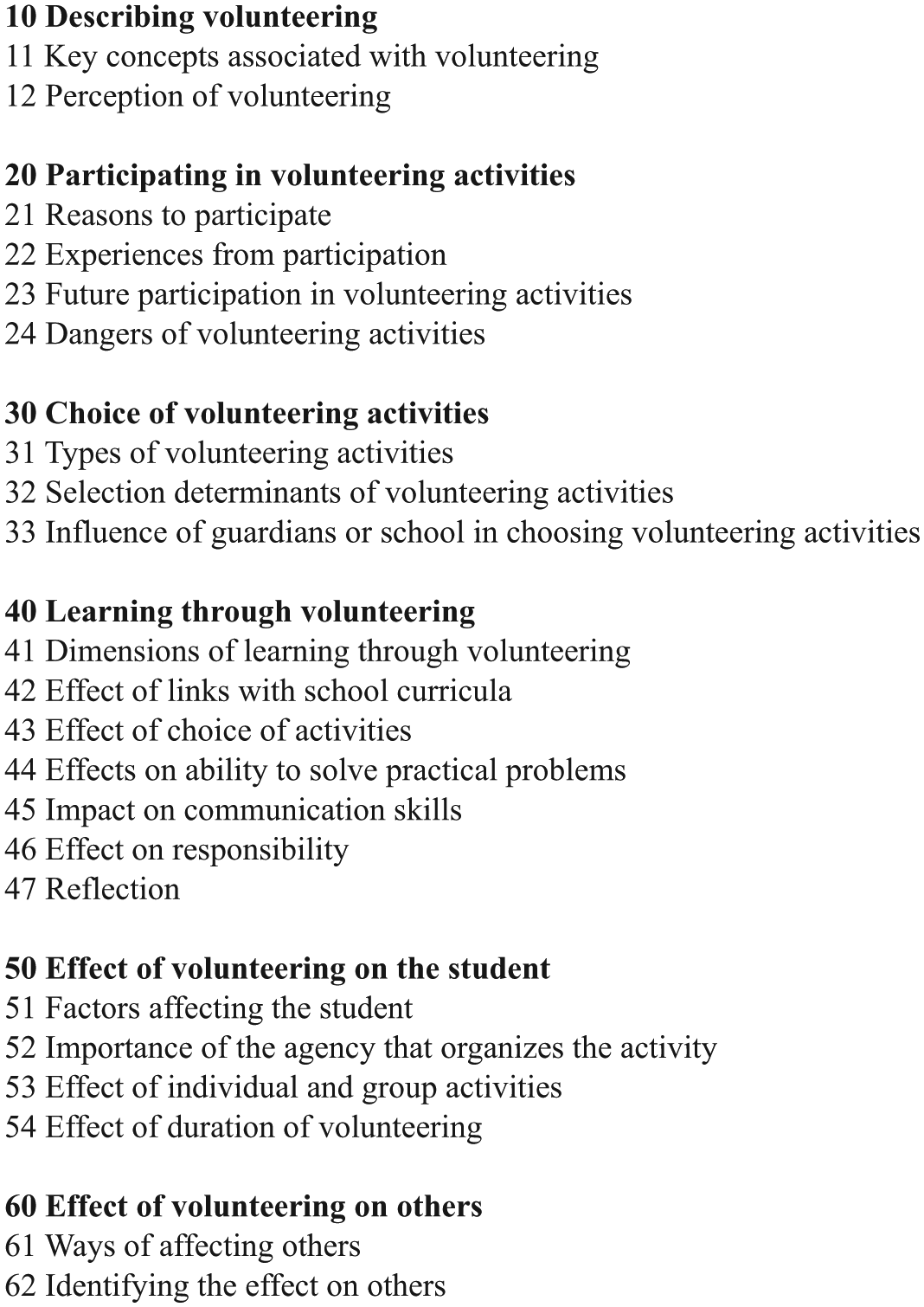
The analytical system of categories.
The analyses
10 Describing volunteering
11 Key concepts associated with volunteering
Asking students to recall three concepts related to volunteering, the following groups emerged, referring to the dimensions of volunteering as
An offer (‘offer’, ‘assistance from the heart’, ‘help’, ‘joy’);
Social group cohesion (‘unity’, ‘solidarity’);
Personal improvement (‘experience’, ‘self-awareness’).
12 Perception of volunteering
By studying keywords used by students, the concept of volunteering seems compatible with an idealistic, top-down perception. According to students’ responses, volunteering is idealised as a
Non-profit, humanitarian activity carried out with the aim to help from one’s heart, to offer and give joy to other people;
Way of reinforcing social cohesion, stressing solidarity between people in order to promote unity;
Method of personal development as well as providing experience, self-awareness and personal satisfaction.
20 Participating in volunteering activities
21 Reasons to participate
An idealistic notion of volunteering seems compatible with the reasons students chose for participating in volunteering activities; for example, ‘My soul feels great, and I think I have contributed something positive to the whole of society’. Students work selflessly as they ‘offer something to another, without receiving anything in return’. However, the apparently selfless nature of participation in volunteering may be contradicted when students realise that they are ‘involved to cover, our own insecurities or [to] feel good about ourselves’. Any doubts raised seem to focus on an atomistic or idealistic level, and students fail to consider more systemic factors that impact on volunteering.
22 Experiences from participation
Students at this time were required to complete about 50 service hours to complete the IBDP (IB, 2008a). They may then experience a contradiction between what is supposed to be a voluntary action according to the solidarity perception, derived from a ‘heartfelt motivation’, and that which may occur in practice, that is, another school task. As one student commented, ‘most students … do not want to deal with this issue, so they do it as a chore’.
23 Future participation in volunteering activities
Volunteering in the future is something that seemed to concern students, possibly because it is considered important in all three idealistic-humanitarian dimensions of solidarity, social cohesion and personal improvement. However, during their second IB year, these students faced the IBDP examinations and the need to secure admission in a foreign university, and they did not seem to consider future voluntary participation as a priority. The apparent downplaying of voluntary participation might conflict with the value system of the individual, causing a type of cognitive dissonance – as implied by their verbal as well as non-verbal behaviour: ‘well, I don’t know
24 Dangers of volunteering activities
From the students’ responses, there appeared to be no clear perception that they were threatened by any risks when participating in volunteering programs. However, statements such as ‘someone had asked me – is there some risk to catch a disease?’ may point towards underlying perceptions of latent, creeping racism and xenophobia. A distinction between ‘them’ and ‘us’ is compatible with the concept of volunteering as a top-down display of solidarity.
30 Choosing volunteering activities
31 Types of voluntary activities
This IB school provided a rather short list of voluntary organisations from which students were obliged to choose. The two girls chose to go to the non-governmental organisation (NGO) ‘Pathways of Life’ that focuses on socially excluded children and women, and they assisted immigrant children, most of them in elementary Greek schools, in their school chores. The male student decided to participate in an environmental project that was run by the Greek Ornithological Society. One of the girls then left the Pathways of Life for the environmental NGO because the former had more volunteers than were needed.
32 Selection determinants of volunteering activities
For students who opted for giving lessons to immigrant children, it appears that their choice was informed by all three dimensions of volunteering. For example, ‘I like that I had interaction with children, helped them to read for school, [and] the games, … I liked this contact more’ and ‘I learned a lot more about myself and I recognized my positive and negatives aspects’. The student who was working on the environmental project provided another dimension of volunteering as a duty: ‘some people [need] to do [something] in order to wake the others, meaning, let’s say, that if you throw garbage around you now, it will return to me’. The perception of volunteering as a duty may conflict with the idealistic-humanitarian perspective to the extent that it emphasises a utilitarian-functionalist approach (Lee and Wright, 2015: 591).
33 Influence of guardians or school in choosing volunteering activities
According to students, school or guardians did not influence their choice of volunteering activities. There may, however, be some indirect effects. The student who worked for the environment noted that he had taken part with his family in such activities. One girl said that her family approved of her participation in this type of voluntary activity, while the third student had received advice from the school in choosing activities related to the subject of her future studies.
40 Learning through volunteering
41 Dimensions of learning through volunteering
Volunteering can be a learning experience for students, particularly in areas related to self-improvement such as
Understanding subject material. For instance, ‘I often taught mathematics for a lower class … but I
Develop interpersonal skills. For instance, ‘I became more sensitive to the children’.
Strengthening self-awareness. For example, ‘I became more aware of myself, I realized things’.
42 Effect of links with school curricula
We found no evidence of a systematic effort to link the IBDP curriculum with volunteering activities. There were some exceptions, such as references to material from previous classes during remedial teaching (see Subcategory 41) and how learning theories studied in Psychology class helped a student to overcome her initial negative reactions towards her pupils’ slow progress: ‘I [then] realised what we were learning in Psychology theory … they [kids] didn’t understand something and I was saying, oh well, are they stupid?’, but these cases seem to be fortuitous rather than part of a well-formulated plan.
43 Effect of choice of activities
Because the CAS programme in the school offered only two choices for volunteering, the question was answered hypothetically. Even so, students acknowledged the importance of choice, indicating the strengths of personal involvement: ‘The fact that we don’t have too many choices, it is an issue on its own, I think’.
44 Effects on ability to solve practical problems
As was expected from theory, volunteering contributes to solving practical problems, even if it is happening indirectly, perhaps without participants fully realising it. For instance, ‘[f]rom there on, you should think about what makes more sense and what is right to do at that time and what to do later on’. The immediate examples were less numerous, for example: ‘and so we have started making … wooden signs for outdoors’.
45 Impact on communication skills
Seemingly perfectly compatible with the idealistic-humanitarian approach to volunteering, students appeared ready to confirm that the volunteering experiences helped them in communicating with others: there was a relationship, well, friendly … which in essence evolved into a very good communication, let’s say. That is, it sure helps in this, because you come into contact with other people and communicate with others in a structured and proper way and communicate better and there are misunderstandings, and [you] learn their communication codes [laughs] correctly.
Even when students were able to realise the possibility of faulty or incomplete communication, that seemed to be the exception rather than the rule. Moreover, they were unable to identify systemic differences in communication codes, suggesting a primarily interpersonal approach of the communication structure phenomenon.
46 Effect on responsibility
Students felt that CAS helped them to be more reliable and to better understand the consequences of their actions. They believed they had become more dependable and more organised. Their view can be seen in the context of conceiving volunteering as a personal self-improvement strategy.
47 Reflection
As reported in the literature, one of the most essential benefits of volunteering is the possibility of strengthening the capacity for self-reflection (Bringle and Hatcher, 1996). The students seemed to validate this view, claiming that ‘CAS essentially helps you to realize what you’re doing,
50 Effect of volunteering on the student
51 Factors affecting the student
Students felt that volunteering had affected them, perhaps significantly. The exact influence seemed to be directly related to the idealistic-humanitarian dimensions of volunteering, especially regarding the ability to understand the Other: it affected me to the extent that I was thinking [of doing] something like being a teacher or something because … there was contact with the children. They are so sweet, the children, you teach them stuff and they are looking at you as if you are god and this is fun.
The assumption that volunteering might radically change the lives of those involved can be considered in the broader context of the humanitarian perspective. Using available resources, students engage in actions which are meaningful to them, reproducing and redefining existing systems of meaning.
52 Importance of the agency that organises the activity
To some extent validating theory, students understood the implications of the organisation that arranged the volunteering activity on three axes:
Power/legitimacy
The authoritarian-legitimising framework was mainly mentioned in relation to the school unit. First, the school organises the CAS requirement and, therefore, it retains the right to decide whether an activity can constitute part of the programme. Moreover, as the successful completion of CAS is a prerequisite for obtaining the IBDP, the school is obliged to pressurise students into participating in voluntary activities until the conditions have been fulfilled: it is different because most students … do not even want to consider the issue, so they do it as a chore. Well, I cannot think of people in general who once the CAS has been completed, go to the municipality or elsewhere to continue.
The authoritarian-legitimising framework can be associated with the utilitarian-functionalist dimension of volunteering.
Interaction and field of work
Students’ choice of organisation is informed by the NGO’s field of operation and their organisational culture. Based on their comments, students seem to be influenced by the idealistic-humanitarian dimension of volunteering. For example, ‘[A big NGO that also focuses on children] has been approached by us … the climate with people [there] was not good, they were too uncouth, [and] the work had little to do with children’.
Organisation
Interestingly, one student did not hesitate to contrast the organisational and management mode of operation of municipal public agencies with those of a private school, although she admitted having no direct experience of the former. This may be related to the fact that the assumed lower efficiency of the public sector had been explored in her Economics class.
53 Effect of individual and group activities
Group activities were considered to provide a better climate, opportunities for cooperation and coordination and fun: ‘you work as a team so that responsibilities are taken by everyone, by all people … and you feel maybe a little better and a little nicer when you work with other people’. One of the students indirectly expressed her preference for individual activities, but this may be related to the fact that she enrolled in School ‘P’ just the year before from a public school.
54 Effect of duration of volunteering
Regular engagement in volunteering activity was deemed by students to significantly enhance its effects. This is consistent with the idealistic-humanitarian dimension of volunteering as it contributes to the strengthening of interaction links: ‘and this certainly plays a role … that is the regularity [of] going to see them, the children feel more familiar with you, that “ah, she does not forget us”’.
60 Effect of volunteering on others
61 Ways of affecting others
The effect of volunteering can extend to the direct and indirect recipients of the action, to the other team members and to the broader set of acquaintances of the volunteers. Perceptions regarding the impact on the (direct) recipients seem to follow the logic of idealistic-humanitarian approach to volunteering, for instance, the children certainly are helped very much and enjoy it, and the fact that they tell us that they sometimes face racism because they are children of immigrants, when they see that there are people who are not like that, well, they certainly feel better and that the world is not always like that.
The impact on the wider environment of the volunteer, friendly or collegial, seems to be governed by a remarkable diversity. The role of the volunteer can be seen as
Embodied in the group division of labour.
A role model. For example, ‘if they see you [being] the most active … I think they will also be affected’.
A facilitator of collective action. For example, ‘I started talking several times about this issue and then I tried … to make it clear to him … how nice and right it is, let’s say, to come volunteering’.
62 Identifying effect on others
The effects seem to be understood under the idealistic-humanitarian perspective of volunteering in two ways. First, the volunteer is able to empathise with the other person, without the mediation of oral communication, but through strong emotional contact thanks to the interaction and sharing of common meanings. For example, ‘it is a very indirect effect that you see, with the kids, you see it in front of you as it is done, and okay, you will not ask “did I help you?”’
Furthermore, by functioning as a role model, the volunteer intervenes and reformulates social behaviours, assuming a heroic role as perceived in the idealistic-humanitarian dimension. For example, many times … the kids say to me, when I see them now at school [in a lower voice], ‘you did well by telling us that, we can see it now that we [did] it your way’ … and I am glad to hear it.
The student’s non-verbal behaviour may reflect the reluctance to recognise and to accept that she may have assumed the behaviour of a heroine.
Discussion
The analysis of the system of categories implies that the volunteering phenomenon can be understood in two dimensions: the idealistic-humanitarian (Elias and Merriam, 2005) or decentred-therapeutic pedagogical (Cambridge, 2010: 205) and the utilitarian-functionalist or decentred-market pedagogical (Cambridge, 2010: 204). In the first dimension, volunteering is conceptualised as a(n)
Selfless offering, for example, ‘offer something to another, without receiving anything in return’.
Heroic event, for example, ‘you teach them stuff and they are looking at you as if you are god and this is fun’.
Humanistic interaction, for example, ‘it’s nice to have contact with children and with people in general’.
Empathetic interaction, for example, ‘but if I got angry then, well, I would feel sad I made the kid feel sad and saw that what I did was not pedagogically appropriate, so to speak’.
Self-improvement, for example, ‘I realized things and I think that as a person … which is one of my goals, I have improved’.
Harmonious cooperation, self-improvement ‘I had to cooperate with other [students] … so that we could … make them able to understand, to gain knowledge’.
In an idealistic-humanitarian perspective, volunteering becomes understood as a selfless offering in which the volunteer is seen as a hero or heroine who interacts with the world within a humanistic context. Empathy is acquired with respect to the feelings and attitudes of others, leading to self-improvement and to flawless cooperation, especially with members of the student group (Wilkinson and Hayden, 2010: 90–92). This frame of mind may be related to what Haywood (2015) categorises as ‘international mindedness as a jet-set commodity’ (p. 49).
In the utilitarian-instrumentalist approach, the meaning of volunteering is conceptualised as a
Self-serving task, for example, ‘if you throw garbage around you now, it will return to me’.
Short-term cooperation, for example, ‘with a group … you’ve got company; help each other and … time passes already’.
Social division of labour, for example, ‘everyone is helping in his own way and according to his abilities’.
This dimension of volunteering focuses on definite, instrumental objectives that directly improve the daily life of the volunteers, while helping to achieve specific objectives, to reinforce their communication capabilities, as part of the existing division of labour (Wright and Lee, 2014: 155). This implies an ideology of meritocratic competition based on educational continuity that serves a globally mobile clientele in the so-called ‘global knowledge economy’ (Cambridge, 2012: 232). This approach may seem compatible with the ‘global competition mindset’ analysed by Haywood (2015: 49) or the shift from decentred-therapeutic pedagogical methodologies to more market-oriented ones (Cambridge, 2010: 207–209) and is on a par with the inability of IB schools to realise symbiotic interactions with local communities (Bunnell, 2005: 46, 53; Kenway, 2013: 304; Lee and Wright, 2015: 591). Our results may be unexpected given that the literature mostly refers to the weak ties that international schools, the ‘classic’ or ‘ideal’ type schools (Peterson, 1972: 19) or Type B ‘ideological’ schools (Hayden and Thompson, 2013: 6), form with their local communities. However, our analysis seems to imply that weak symbiotic relationships may also characterise schools embedded in the national education system, as well as the so-called Type A ‘traditional’ international schools and the Type C ‘non-traditional’ international schools (according to the Hayden and Thompson taxonomy, 2013), to the extent that stakeholders adopt a utilitarian-instrumentalist view of the IBDP. Also, no evidence was found regarding the prognosis made by scholars that CAS activities can help develop archetypes of international awareness (Wright and Lee, 2014: 155) which seems to further corroborate the dominant role of the utilitarian-instrumentalist perspective.
Conclusion
The efforts of students to understand and ascribe meaning to the phenomenon of volunteering are exemplified by the idealistic-humanitarian and utilitarian-instrumentalist narratives. In both cases, understanding of volunteering is achieved through an individualistic approach, which seems to ignore wider social issues such as cultural matters, power, gender and income inequalities and exclusion (Elias and Merriam, 2005). The effectiveness of ASL projects such as the CAS component of the IBDP can be significantly affected by the ways in which students perceive and react to volunteering activities. It may also be beneficial if schools offering the IBDP – especially those belonging to the so-called Type A ‘traditional’ and Type C ‘non-traditional’ international school categories (Hayden and Thompson, 2013: 6) – carefully consider how students map their ways within the dimensions of the volunteering phenomenon, to enhance the effectiveness of experiential learning initiatives such as CAS.
The formulation of the inductive system of categories was based on interview data (as described above). However, to the extent that the authors’ preconceptions influenced the encoding and the structure of the categories, there is a risk that the resulting units and the content analysis may not adequately interpret students’ perceptions (Clarke and Braun, 2013: 122). Using triangulation methods in future research could strengthen the prospect of effectively understanding the empirical material (Cohen et al., 2007).
Future studies could investigate aspects of the triptych academic learning – inclusion in the community – resources, to clarify the impact on students’ attitudes and the ways they familiarise themselves with the volunteering experience and ASL. Furthermore, it is important to consider the role and the socio-demographic characteristics of students in conceptualising and participating in ASL programmes (Moely et al., 2002: 24). Combining other data collection methods, both qualitative and quantitative, could illuminate alternative dimensions of the volunteering phenomenon and help schools and educational policy-makers better design appropriate pedagogical initiatives.
Footnotes
Funding
The author(s) received no financial support for the research, authorship and/or publication of this article.