




Abstract
International Mindedness is an overarching construct related to multilingualism, intercultural understanding and global engagement (Hill, 2012). The concept is central to the International Baccalaureate (IB) and sits at the heart of its education policies and programmes. The aim of this research study was to examine systematically how schools offering International Baccalaureate programmes (so-called IB World Schools) conceptualise, develop, assess and evaluate International Mindedness (IM), and to understand related challenges and problems, with a view to improving practice in schools. Nine case study schools, identified as being strongly engaged with IM, were selected for in-depth scrutiny of their practice and thinking related to IM. Conclusions from this study will also inform on-going debate on other similar global initiatives.
Keywords
Background
Like it or not, we now live in a globalised society and economy. Technology, travel and commerce continue to shrink horizons and interconnect lives. This can offer great benefits for some, but distinct drawbacks for others. Many are simply not engaged with, or prepared for, such developments, while others overtly distrust the move towards a more inclusive, mobile society (Harwood & Bailey, 2012) and are advocating a more nationalistic agenda. In this complex environment, situations are constantly changing. To thrive in tomorrow’s world, our children and young people must understand and embrace its diverse cultures and interactions.
Increasingly, educators and policymakers have stressed the importance of life skills related to global understanding and values. For example, Global Citizenship Education (GCE) is one of the strategic areas of UNESCO’s current Education Sector programme (UNESCO, 2015). Similar and overlapping global education frameworks such as Global Mindedness, Development Education, Global Learning and Education for Sustainable Development (Marshall, 2007; Roberts, 2009) have also been advanced as desirable areas of learning to be pursued through the school curriculum. Humanitarian agencies such as Oxfam (2015) have developed materials for schools in the belief that global concerns should be understood from an early age, and analysis of seemingly local issues can benefit from global perspectives. Others such as Davies et al. (2005) have gone further in arguing that new forms of education need to be developed. A curriculum that merely serves the nation state is no longer sufficient.
Central among these global education frameworks is the philosophy of International Mindedness (IM), an overarching construct related to multilingualism, intercultural understanding and global engagement (Hill, 2012) which sits at the heart of all educational policies and programmes of the IB (IB, 2013). The IB has developed four programmes which are offered in over 4000 schools with more than one million students (IB, 2018): the Primary Years Programme (PYP), Middle Years Programme (MYP), Diploma Programme (DP) and Career-related Programme (CP) which, placed together, form a ‘continuum of international education’ (IB, 2002). The concept of IM is implied in the mission statement of the IB but is not clearly defined or directly referred to in formal literature (Belal, 2017). However, the IB conceptualisation of IM has evolved and matured through discussion and debate (see Singh and Qi, 2013). Based upon their systematic review of official IB documentation, Singh and Qi conclude that IM is supported by three key ‘pillars’ or strands. The first is multilingualism. This strand makes IM distinct from other global education frameworks. In the context of IM it means more than learning several languages; it is ‘a reconfiguration of how we think about languages that takes into account the complex linguistic realities of millions of people in diverse sociocultural contexts’ (IB, 2011 p.8). The second strand is intercultural understanding, when students are encouraged to explore and engage with their own values and cultures and to develop respect and empathy for those of others. The third strand is global engagement (Singh and Qi, 2013), defined as the commitment to address humanity’s greatest 21st century challenges in the classroom and beyond.
It has been noted (Van Oord, 2011) that contemporary global education frameworks (such as GCE or Global Mindedness) stem from a Western (or Minority World) culture, and are built on values and assumptions that may not be relevant for other cultures. This quandary has been highlighted by Andreotti & de Sousa (2008) who have sought to promote global issues from the perspectives of indigenous people who have a less powerful voice. Andreotti’s work distinguishes between ‘soft’ and ‘critical’ perspectives in GCE. These represent different pedagogical approaches towards GCE. The emphasis of the ‘soft’ approach is on campaigning towards pre-defined behaviour change outcomes. Content remains fairly descriptive, with an emphasis on raising awareness to encourage learners to help others less fortunate than themselves, for example by donating time, money and resources. Andreotti criticises this approach, saying that without critical reflection on the causes of inequalities, young people with good intentions and motivated to ‘save the world’ may inadvertently ‘project their beliefs and myths as universal, and reproduce power relations and violences similar to those in colonial times’ (Andreotti, 2006: 1). In contrast, Andreotti’s ‘critical’ approach encourages learners to question and reflect upon the political structures which underpin inequalities in power and wealth. It promotes change, not by telling learners what they should think or do, but by ‘creating spaces where they are safe to analyse and experiment with other forms of seeing/thinking and being/relating to one another’ (Andreotti, 2006: 7).
Despite its title, the IB has also been criticised for an overly close association with Western values and lack of a truly international perspective. It is acknowledged that the concept of internationalism is not universally popular, and has its detractors (Haywood, 2015). An analysis by Walker (2010) concluded that IB programmes (and hence IM) do indeed reflect the strong Western humanist foundations of the IB, but that this ethos appears to be growing in desirability worldwide. While this conclusion may be true, it supports the argument that a full and critical reflection on the nature of, and approach to, IM would enhance practice and contribute to the global education debate.
The aims of global education frameworks are commendable. They seek to equip young learners with the skills and understanding to enhance social justice and promote sustainable international development, with long term outcomes being a more equitable, viable and peaceful world. The concepts associated with these frameworks are often less well defined, and range from fuzzy concepts such as moral obligation through justice, equity and sustainability to precise concepts such as global governance. Whether and how IB schools recognise and work with these concepts was therefore of prime interest in this study.
International Mindedness (IM)
IB schools are situated in all continents of the world, and over half are within a state or public sector (Connor, 2008). Previous analyses of IB documentation and practices have indicated that, for the IB, education lies within the social constructivist paradigm (see e.g. Bullock, 2011) as associated with a Vygotskian perspective on learning (Vygotsky, 1978). Such analyses have shown an emphasis on the holistic development of the whole person so that the child will experience a ‘general education’ (Peterson, 1972) and understand that learning is a lifelong process (Hare, 2010). Further enquiries indicate that the IB believes that open mindedness and positive attitudes to wider cultures can enhance learning and bestow social advantages on young people (Bullock, 2011). It has been suggested that young people with an IM disposition are notable in terms of their wider, cosmopolitan attributes and well-adjusted behaviour (Gardner-McTaggart, 2016); also distinctive is their understanding of world politics and events (Cause, 2009). There is agreement (see e.g. Skelton, 2013; Pelonis, 2014) that IM is an attribute that should be nurtured from first entry to school and is, therefore, a key precept underpinning all IB programmes (Hill, 2012).
The IB currently defines IM as ‘an attitude of openness to, and curiosity about, the world and different cultures. It is concerned with developing a deep understanding of the complexity, diversity and motives that underpin human actions and interactions’ (IB, 2009: 4). The IB recognises that every school is unique and that individual IB schools will interpret IM in their own way according to their particular setting. The practice of IM can reflect the IB philosophy of learning while also being nuanced or adapted to suit a cultural setting. This flexibility is something that the IB has embraced. For example, the in-house publication IB World (January 2008) offers the following quote from a secondary principal who had worked across different contexts: ‘[A]pproaches to international-mindedness will differ from school to school … IB schools have huge connections and similarities. They also have quite specific contexts. Some aspects can seem more conspicuous than others. In Tanzania, perhaps, it was the concept of service, in China the feeling of ‘otherness’ and engagement with the host country. And in Thailand, we have a target to approach international-mindedness at three levels – global, personal and social (or community)’
Thus the on-going discussion relating to understanding and capturing IM is crucial. Despite the definitions articulated by the IB itself (IB, 2009) and a former IB Deputy Director General, Ian Hill (Hill, 2012), IM remains a complex and contested notion. It is variously seen as an aspect of school culture, a curriculum strand, and a desirable quality for students (Pelonis, 2014). The value of IM is clearly acknowledged in the IB context, but there is little consensus among wider stakeholders concerning definitions of the concept, the conduct of its development and associated pedagogy, or the efficacy of its outcomes. In addition, it can be challenging for schools to develop – not least because of the emotions and controversy it can evoke. It is acknowledged that ‘there is no single coherent picture of … “international-mindedness” within the individual that, presumably, international education aims to develop’ (Gunesch, 2007: 90).
In this context, the IB determined that a wider debate about the philosophical underpinnings and conduct of IM would strengthen its theoretical base. They therefore commissioned a study which would explore the reality of IM in schools committed to at least one of the IB programmes (Barratt Hacking et al., 2017). The study discussed in this paper used an in-depth, qualitative approach to investigate the ways in which schools conceptualise and deliver IM. The research team did not set out with a fixed understanding and definition of IM; rather the intention was to open up the concept by exploring the conceptualisations underpinning practice in schools. Thus the study explored how IM is defined, valued, approached and problematised by key school stakeholders. While this particular research focussed on the concept of International Mindedness in schools offering IB programmes, findings were drawn from worldwide locations, different programmes and different types of school, some of which were operating in challenging circumstances. They may, therefore, add to the wider debate about the definitions, nature and practicalities of global programmes within the whole school curriculum. As one school leader noted, there can be overlap between similar initiatives: ‘I don’t know if you think of global citizenship as part of international mindedness, or whether you put international mindedness as part of global citizenship.’ (Principal, Nile (PYP))
This paper reports on teachers’ and students’ perceptions of IM; how it is currently understood and practised, and its contribution to key transferable skills. All schools involved in the study have been anonymised, with pseudonyms allocated using the names of rivers.
Reesarch Design
From the outset the research team recognised that individual schools would interpret IM in their own particular way according to their unique setting. The study, therefore, was based on a case study approach in which nine fully-authorised ‘IB World Schools’ were purposefully sampled to reflect good and promising practice in IM. A decision to include promising practice was made in recognition that work around IM is not easy and may face a number of challenges. Good practice in a school in one context might not be appropriate or effective in others; thus focusing on good practice alone would not necessarily be helpful. Further, the research team conjectured that schools in challenging contexts (for example, schools where the concept of IM might prove contentious for political or religious reasons) might be exploring contextually sensitive practices. Thus the research aimed to find examples of practice in diverse and challenging contexts that showed promise, and where schools were actively working on IM, in order to identify practical examples of support and assessment of IM.
Initial nominations of schools with promising practice, including active engagement, were sought from IB regional associations, IB managers and well-informed contacts; 83 nominations were received for 79 different schools. Following a rigorous selection process involving a scrutiny of recommended IB World Schools’ own documentation and practice, a survey completed by shortlisted schools and discussions with the Expert Panel (see below), nine schools were selected and agreed to take part in the research. These operated in a variety of contexts, with three schools offering the DP, three offering the MYP and three offering the PYP, while four schools offered all three programmes. The sample represented a range of contextual factors (such as the number of IB programmes offered, and funding) which may impact on schooling and IM, recognising that promising practice may well look different in different socio-cultural, political and institutional contexts. Two further schools were selected to pilot the data gathering instruments. The cross-continental sample of participating schools with promising practice, together with the IB programme investigated, is shown in Table 1.
The cross-continental sample of schools selected as the case studies, together with the pilot schools.

The research consisted of four linked phases (see Table 2). The first phase was a literature review focusing on the practice of IM in schools rather than on theory or conception. This used the search terms ‘school’, ‘practice’, ‘teaching’, ‘learning’, ‘classroom techniques’ and ‘assessment’. The search was restricted to the phrase ‘international mindedness’ rather than related terms such as ‘global citizenship education’, ‘development education’ and ‘global learning’. The search returned 80 practice-orientated papers, which illustrates the emerging body of professional literature in this area. This literature review informed the development of the research methods as well as the sampling process (for example, Baker and Kanan, 2005; Lai et al, 2014; Tamatea, 2008).
The four phases of research.
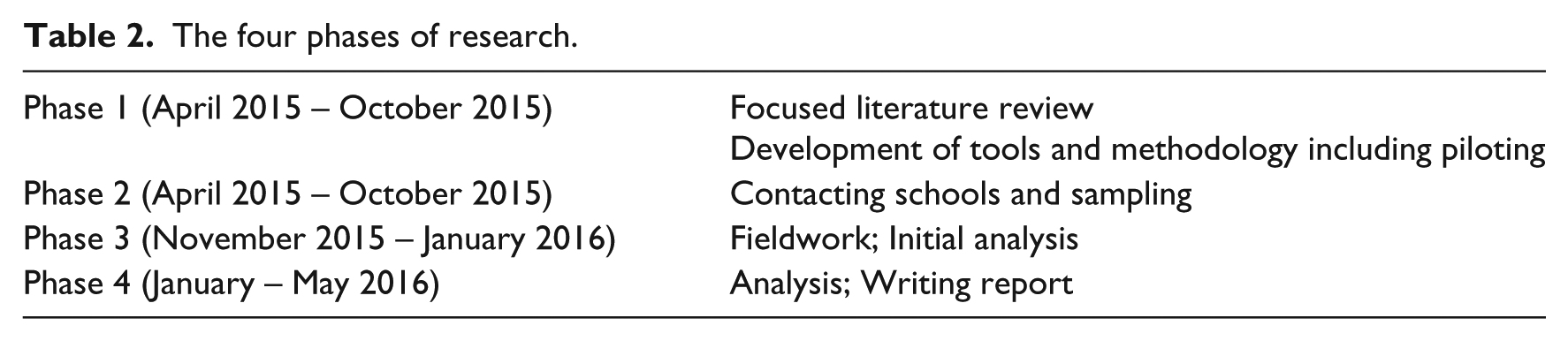
The research protocol was first piloted in two UK schools and the data gathering was completed in Phase 3. As appropriate for a multi-case study design, a multi-method approach was adopted, drawing on qualitative tools including interviews, focus groups, classroom observation, on-line surveys and the collection of documents and artefacts. This enabled a variety of perspectives and ideas to be captured from leaders, teachers, students and parents at each school, and the observation of the actual practices, behaviours and actions which occur in the school. Each case study school visit was completed over three days by one member of the research team and consisted of the following activities.
Interview with the School Director (plus feedback)
Student-led/ designed tour of the school
Focus Groups with Senior leaders Teachers Students (2 groups) [i] final year group, [ii] mixed year groups
Focused lesson observation with follow-up teacher interview
On-line survey (parents)
School audit
Collection of documents and artefacts / photographs
In Phase 4, the data were analysed in order to identify how IM is defined, practised, assessed and problematised across the schools. An iterative process was used to generate recommendations for promising practice.
The work of the researchers was supported by an Expert Panel of ‘critical expert friends’ who advised on selection of the sample, the combination and design of the research instruments, and the final analysis of results. This group of 15 members was assembled to bring together a mix of expert knowledge and experience with regard to IM, balancing practice, policy and academic research perspectives. The Panel included three IB Diploma Programme alumni, plus four current teachers or ex-teachers of the IB PYP, MYP and DP. Also included were three panel members with expertise in overlapping concepts, including the (Critical) Global Citizenship paradigm. The panel met at significant points in the project to support and advise the research team by asking provocative questions, offering critique of our work and providing fresh perspectives.
Findings
IM in schools
Definitions
Our findings confirmed that IM has many meanings, and that people express these differently depending on their context or personal interpretations. The nine case study schools had different ways of thinking about IM. For example, Colorado (DP) defined IM in terms of inter-connections, Nile (PYP) defined it in terms of respect, Peace (PYP) in terms of character building, Amazon (DP) in terms of local connections, and Tigris (MYP) in terms of balancing national and international perspectives. IM was variously described as ‘a way of thinking’, ‘a way of acting’, ‘a way of living’, and ‘a mind-set’: ‘I never really thought about … [the meaning of] international mindedness, until today. I just thought about [it as] more, like, part of life, and how I should be.’ (DP 1 student focus group, Mekong (DP)) ‘It’s not a question of international mindedness, it’s more a question of open mindedness. I think international mindedness is boxing people in.’ (Principal, Colorado (DP))
The lack of clarity in definition was not necessarily seen negatively. On the contrary, the range of interpretations was described as ‘a little bit of the beauty of it [IM]’ (Principal, Peace (PYP)). Participants were able to talk confidently about factors contributing to IM and its component parts. Additionally, they welcomed the opportunity to do so. The complexity surrounding the terminology relating to IM extended to ideas about culture, and about scale and locality. For example, what was understood to be ‘global’ or ‘international’ in one school, to another school was ‘local’. This was eloquently expressed by one of the Expert Panel members: ‘This to me raises questions about the perennial debate about terminology … because to me ‘international’ is often seen in terms of nation states and around the world whereas ‘global’ can be as much about the locality as somewhere else. The sense in which the school sees itself as global, which can mean relationship to the local community rather than international, is one perhaps to reflect upon.’ (Expert Panel member)
In the focus groups participants were asked to talk about the ideal internationally-minded student in terms of their head (knowledge), heart (values), and hands (skills). A wide variety of answers were given to these questions, as summarised in Table 3. These qualities could be referred to as intercultural competencies (Jokikokko, 2005) and are similar to the desirable attributes of ‘global citizens’ set out by Oxfam (2015, p5).
Analysis of Head, Heart, Hands responses.
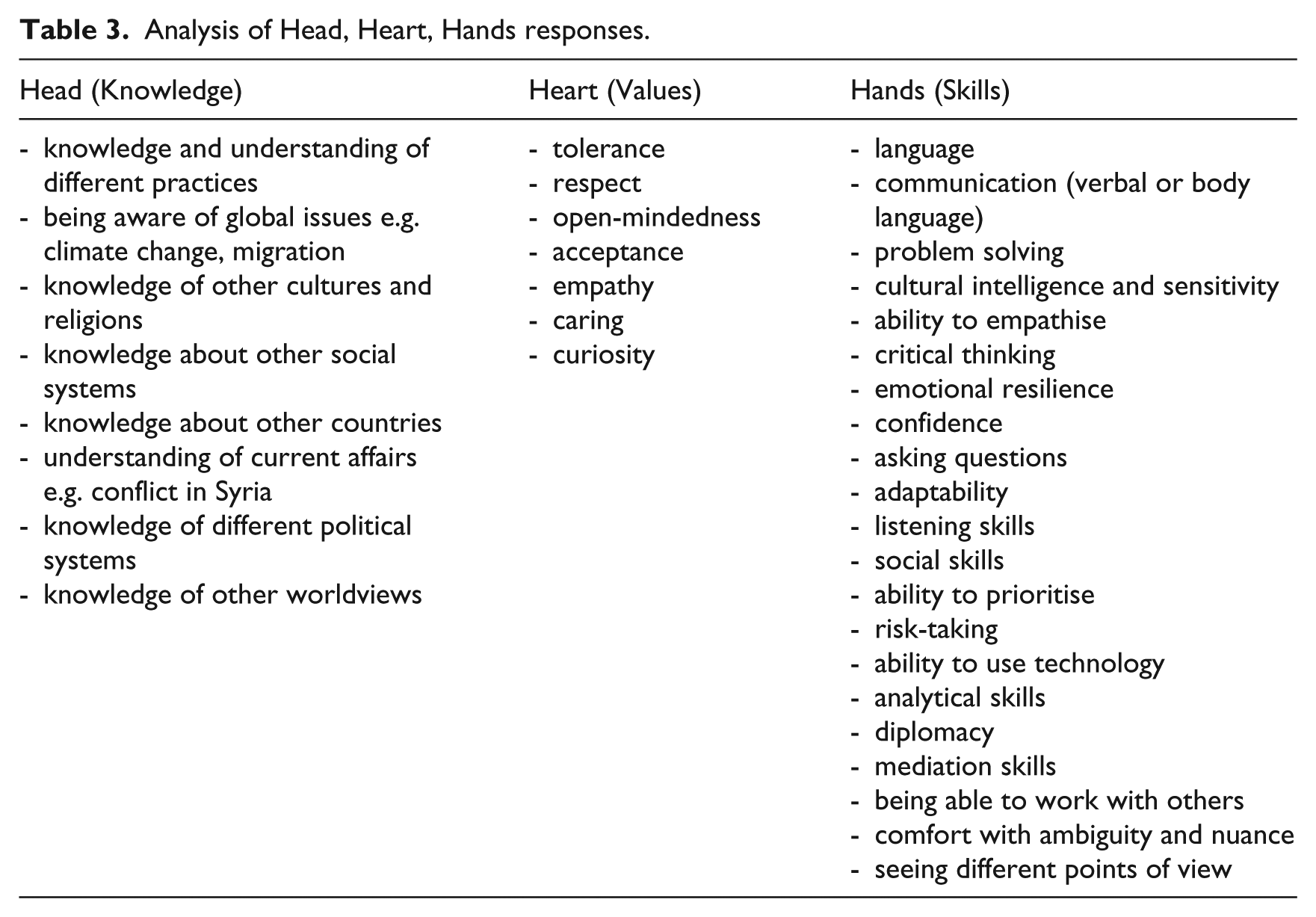
Many schools indicated that knowledge of international systems and issues was a firm foundation for developing long-term skills and values in IM. In some of the PYP case studies, the anticipated characteristics were noted as overlapping with those connected with behaviour management strategies. Some schools began with one particular value and emphasised this as part of IM. For example, Nile (PYP) based their interpretation of IM on the value of respect. This was overtly related to school literature and artefacts.
However, our promising practice case study schools had largely moved beyond personal competencies. These schools had in common that IM was understood to develop within interpersonal relationships. There was much consensus that IM is about reaching out to interact with others, people who have different perspectives than our own, learning to understand and respect their point of view even if we do not agree with them, learning to live in other cultural contexts and to adapt to new situations. In this, schools were seeking a change in attitude rather than an increase in knowledge. At the same time, many talked about the importance of reaching in and exploring our own sense of identity, challenging ourselves to grow as individuals, and learning to acknowledge and explore our own assumptions and limitations. This perspective was also observed by Belal (2017). IM is therefore about ‘reaching out’ to relate to others and ‘reaching in’ to understand ourselves. This understanding of IM involving interconnectedness and interdependency was very evident in all the schools visited, even though it is not explicit in the IB (2009) definition: ‘I do think that interconnectedness, interdependence [are more important than] leading people to think … in terms of international mindedness and global mind-set … [What is more important is] being able to relate to and understand other human beings, and their perspectives, and their point of views.’ (Principal, Colorado (DP)) ‘So, for two people to be internationally minded, they both kind of need to interact.’ (MYP Y9 final year student focus group, Danube (MYP))
Practice
One common factor in all the IB World Schools involved in this study, from the initial nominated sample to the eventual two pilot and nine case study schools, was their intentionality in respect of IM. That is, they were all intentionally thinking about and actively working on the conceptualisation and development of IM: it was not something that was taken for granted or left to happen as a result of adopting an IB programme. It was planned through the school’s vision, strategy, policy and practice. The schools had appointed IM champions and were actively promoting staff development to support IM activities in the classroom. Findings of this study strongly suggested that intentionality was one of the hallmarks of promising practice.
Many elements of a ‘soft’ style approach to IM (Andreotti, 2006) were offered as exemplars of promising practice in the schools. These activities mainly comprised the superficial sociability of sharing and celebrating the so-called 5 Fs (food, flags, festivals, fashion and famous people). Whilst the potential value and enjoyment of such activities were recognised, most of the case study schools had ventured beyond such events. The risk of stereotyping was a key concern and some sought more authentic and sustained experiences. Evidence of a more critical approach to IM (Andreotti, 2006) in examining one’s own assumptions about other cultures, for example, was noted. Indeed, one very interesting observation from the focus groups was the in-depth discussions that took place in the schools around cultural celebrations, special events and activities which are traditionally seen as significant for the development of IM. It was clear that stakeholders placed value on opportunities for discussion and conversation, and on students’ personal experiences in challenging assumptions and engaging with difference: ‘Discussing more real-life issues rather than hypothetical scenarios is a very practical and effective approach; we feel that this is what IM should be about’ (Expert Panel member, IB Alumnus). ‘When real things happen, and we’re able to address those things … deeper learning can take place … it’s going beyond the “pizza party and chocolates” to actually getting the kids to be excited and energised about impacting the world.’ (Principal, Trent (PYP)) ‘International days, international dancing, food tasting; quite often, I have the feeling that it’s superficial, cliché, often on the stereotype level.’ (Teacher focus group, Amazon (DP))
The value of debate was also emphasised by some Diploma Programme students who felt they had gained in IM from participation in Model United Nations (MUN) activities. MUN was mentioned by both students and staff as one of the most influential IM practices, through students having to understand other perspectives by arguing and defending viewpoints that are at odds with their own, and through the opportunities arising for social interaction from hosting and socialising with visiting students.
Similarly, community partnerships through the Creativity, Activity, Service (CAS) compulsory element in the Diploma Programme were highlighted by all three of the DP case study schools as an important driver for promoting IM. It was the very nature of CAS, with its focus on thought, action, and reflection, which made it a powerful mediator of IM. From talking to school leaders, teachers and students it was evident that CAS is a key priority for schools and for the promotion of IM. Teachers and students mentioned the benefits of not only thinking about IM but actually acting in an internationally minded way: ‘In my opinion, service is a really key component of being internationally minded, because as great as it is to have all these global ideas and beliefs … you have to act on it … sometimes, we lack the local perspective, which I think is equally important. CAS … kind of combines those two things … the combination of local service and international mindedness, because if we are not connected to the community we are directly in, as well as the global community, then I don’t think we are doing our job right as international citizens.’ (DP 2 student focus group, Colorado (DP))
One overarching finding was the importance of the teacher and the teacher’s mind-set in how the curriculum is interpreted and enacted. What seemed to be crucial was first, the choices a teacher makes (for example, in interpreting and implementing the curriculum or in planning lessons) and second, their own frame of mind or attitude. Thus, the opportunities the teachers themselves find to reflect on and develop IM are important.
Language learning and use was thought to support the development of IM. This accords with Singh and Qi’s (2013) conceptualisation of IM as having three dimensions (multilingualism, intercultural understanding and global engagement). Importantly, our findings show how the case study schools, including the state schools, were developing students’ home language(s) (language spoken in the home) as well as the school’s host languages (languages spoken in the national and local context of the school). This dual approach to language development was explained as supporting students’ positive self-identity whilst facilitating student relationships with the wider school community: ‘If you want to connect with someone, usually, you have to know the language.’ (MYP mixed year student focus group, Hudson (MYP – state school))
Our case study schools were all English medium, and for many parents this was an essential factor in selecting a school for their children. A key theme emerging from all of the schools was the importance of ‘home’ or ‘mother-tongue’ language in language policy and provision. Schools believed that language contributes to identity; allowing students to speak their own language sends the message to students that they and their languages are valued, forming an important part of the hidden curriculum. As well as helping students to express themselves, encouraging students to use home languages was part of a desire to go beyond the ‘dominant force’ of the English language (Principal, Nile (PYP)). Trent (PYP) aimed for every child to be able to read and write in their mother tongue, and encouraged students to bring their own books to read from home.
Transferable skills
Our school respondents stressed that IM is not achieved by osmosis. That is, it requires more than mixing with different nationalities and living in another country. However, as noted above, fluency in different languages was recognised as a key transferable skill relating to IM. Language was seen as a vehicle for discussing topics. At the early stages of language learning this might mean discussing topics such as food and clothes, moving on to thinking about ideas of friendship, education, belief and history as command of the language becomes more sophisticated. Researchers observed some excellent examples of language lessons across the schools including discussions of stereotypes through Spanish film (Mekong (DP)), the G7 summit in German (Thames (DP)), and English as an Additional language (Danube (MYP)).
Many of the case study schools had created systems for empowering the student voice, indicating the importance of respect in the schools’ practice of IM. These systems included peer support and guidance, councils and fora as well as approaches integrated into everyday lessons. Hudson (MYP) had a Guidance and Support Group (GSG) involving older students leading learning for younger groups. This example of distinctive practice illustrates the significance of peers as role models in developing IM. In one example a teacher reported hearing about the impact of a student’s personal story through a GSG programme session: ‘[P]icture a lesson, where the student leads, all the kids gathered round, and they [student leaders] start talking about immigration: “anybody want to share examples?” … and this girl was talking about how her parents came from Nicaragua, and how they had gone all the way through Mexico, they had to carry their suitcases across the bridge, and they are running, to get into America, and then they didn’t have a car, because it had broken down, and they couldn’t afford to get it fixed, so they took a bus to anywhere they could get to, and people [students] listening to the story are like “oh my gosh” and that is going to resonate with children who may just be hearing a parent saying “when are we going to close the borders!”; they hear a totally different side of it.’ (Teacher focus group, Hudson (MYP))
Danube (MYP) was also strongly committed to participatory approaches. A democratic approach to decision making was evident, for example, involving students and parents in formal decision-making processes. At Danube there was a student participation and action team, peer mediation, buddy system and a student council which was ‘very active; they visit our management team meetings, staff meetings, not often but also that’s important’ (Principal, Danube (MYP)). Each MYP class had a range of elected representatives participating in the student council, the eco team, Tukioppilaat1 (support students) and in UNICEF work. This participatory approach reflected something of the cultural and national context of the school (democracy in Finland) and it was clear that this context supported IM-related work. In sharing the highlights of the school’s IM work the Principal referred to ‘the students taking action, the student participation and action team’. The participatory approach can also be illustrated through the school’s anti-bullying practice where students were responsible for setting and monitoring targets against bullying.
Embedding IM
Awareness
At the time of the researchers’ visits, some schools were (or had been) working as a community on their definition of IM; rather than just accepting IM as unchallenged. They were actively engaged in making sense of the contested nature of the concept of IM in their own context. Ultimately, the findings of this study show that there is value in schools viewing IM as a journey both for the school and for its students. This journey, or process, was more important than any fixed definition to those schools involved. The framing and definition of IM was sensitive to contextual factors and changed with people and with local and global context. Ideas about IM differed across the schools. For example some, especially in PYP schools, framed it through the Learner Profile which sets out the personal attributes valued by IB World Schools. Others used a more skills- or values-based frame.
Importantly, each school in this study was making IM its own. Reflecting on this finding, one member of the Expert Panel observed that ownership ‘is one important element of being internationally minded; that is, the importance of reaching personal and institutional understandings and consensuses of what IM means rather than simply using a received interpretation’ (Expert Panel member).
Attitudes
Knowledge of cultural differences and global issues is important, but respondents stressed that it is the higher skill of becoming connected and involved with others that is vital for young learners. For many schools, delivering this was a complex and imprecise undertaking. Alongside formal activities, the hidden curriculum, social context and ethos of the school have great potential to nurture attitudes. This understanding generated a strong emphasis on reflection and discussion that permeated school practice. Teachers, parents and students were encouraged to reflect on their own experiences and viewpoints, and to consider how these related to others. Opposing views were heard and solutions to resulting tensions sought.
There was a clear view across many of the case study schools that student voice and participation contributes to the development of IM: ‘[E]ven with our youngest children we use, for example, the morning meeting, [where] they have to talk about what makes them comfortable, uncomfortable. It gives them a forum to have a voice, and I think even in that kind of a setting, because you are bringing children from different traditions, different ways of interacting with people, that in itself is a way of being internationally minded.’ (Principal, Peace (PYP))
Similarly, in sharing the highlights of the school’s IM work the Principal of Danube (MYP) referred to ‘the students taking action, the student participation and action team’.
Action
One prevalent argument was that young people need to be confident in their own environment before knowing about, accepting and learning from other cultures. Many participants talked about the importance of reaching in and exploring our own sense of identity, challenging ourselves to grow as individuals, and learning to acknowledge and explore our own assumptions and limitations. Only then can we reach out to interact with other people who may have different perspectives than our own, learn to understand and respect their point of view even if we do not agree with them, learn to live in other cultural contexts and adapt to new situations. IM is therefore about ‘reaching out’ to relate to others and ‘reaching in’ to understand ourselves (Figure 1).

International Mindedness as reaching out and reaching in.
There was recognition in some schools of the combination of multilingualism, intercultural understanding and global engagement as a way of defining IM (Singh and Qi, 2013), with multilingualism and intercultural understanding the most straightforward and specific. Global engagement was least recognised, and not a concept that most of the schools identified with or found useful; some schools recognised global engagement as farther afield and distant, whereas others interchanged global and local engagement. This reflects the overlap between the global and the local context in a globalised world and the difficulties of terminology in this field (Massey, 2005).
Lessons Learned
IM, Global Citizenship, and Education for Sustainable Development stem from a similar ethos and all have comparable aims and objectives. While focussed on IM, the findings of this study could also have lessons for similar school-based initiatives. The study suggested that International Mindedness need not be culturally based in Western traditions. It can respond to the ethos of the locality, school and students. Promoting an inclusive school environment by including and valuing everyone in the school community, regardless of background, language, culture or status (for example, the newest child to the most senior, and the domestic staff as well as the professional leaders) can act to model IM and provides the foundation for a school’s IM work.
Positive leadership and teacher mind-set are fundamental in creating an IM school. IM should be integrated into all professional development workshops rather than offered on a stand-alone basis. It should also be given importance in school-led professional development; this would help eschew the possibility of staff perceiving IM merely as the next thing they are required to do rather than as an embedded philosophy. It would also support those schools that need to provide high quality IM professional development for a changing staff population.
IM can be balanced with local and national mindedness in order to enable students to develop positive self-identity and appreciate the local or host culture. Self-reflection is a key component of IM. Strategies for enabling this are important. The tools used in the data gathering for this study were useful in eliciting conceptions and definitions of IM and, without exception, staff and students involved in the study welcomed them. In particular, the Head, Heart, Hands tool (Barratt Hacking et al., 2017) enabled teachers and leaders to identify and frame their aspirations for students in terms of IM.
Tensions associated with this approach can be usefully explored with students. Authentic cultural experiences and personal engagement with culture (such as the 5 Fs) are important in establishing international or global knowledge and understanding. They provide positive and memorable experiences and place value on one’s own and other cultures. Excellent practice moves beyond this by creating opportunities for discussion, reflection and critical analysis of multiple perspectives around the activities.
It was clear from researchers’ visits that those schools demonstrating promising practice in relation to IM believed that IM is an attribute that is developed through positive activities beyond the normal interactions of diverse student cultures and an enlightened curriculum (see also Belal, 2017). These activities need to be explicit, valued and inclusive. They are on-going, developed over time and embedded within the essence of the school. This in-depth study has suggested that IM is a process rather than a product; a journey rather than an arrival. IM is constructed and social. It begins with awareness of what it is and why it is important. With the right support, awareness develops into attitude. The final step is to gather the motivation to convert attitude to activity.
Footnotes
Funding
The author(s) disclosed receipt of the following financial support for the research, authorship, and/or publication of this article: The authors received financial support from the International Baccalaureate Organization for the research on which this article is based.