




Abstract
The term ‘international school’ encompasses a broad array of institutions offering a range of different programmes. However, the differences between these programmes have scarcely been explored in the existing literature. This article focuses on three popular international high school programmes (Advanced Levels, Advanced Placement, and International Baccalaureate Diploma Programme) by drawing upon in-depth interviews with international school counsellors, teachers, parents, and students in Shenzhen, China. We employed the Bourdieusian concepts of ‘promised capitals’ and the ‘global field of higher education’ to delineate differences amongst these international programmes. We argue that each international programme promises the accumulation of distinct combinations of capitals associated with different global circuits of mobility for higher education. At the same time, we also suggest that the extent to which the promised capitals are conferred is complicated by the ‘localisation’ of schools: this impacted the delivery of promises related to embodied cultural and social capital forms.
Introduction
International schooling has become a vibrant area of research, with one of the drivers the expansion of the international school sector. In 2022, there were an estimated 12,853 international schools worldwide serving 5.7 million students, up from 3.7 million students at 8,067 schools a decade earlier (ISC Research, 2022). The great majority of these schools operate in the fee-paying private sector, suggesting that more families are investing economic resources to send their children to an international school. Existing research demonstrates that international schools can act as sites for capital accumulation across national borders through internationalised education experiences and qualifications (Resnik, 2018; Wright & Lee, 2019; Tarc & Wu, 2021). Above all, international schools are channels of global mobility for higher education (Bunnell et al, 2021; Lee & Wright, 2016; Schippling & Abrantes, 2022). For families who can afford it, overseas higher education (especially in the Anglophone West) can yield advantages in home and global labour markets, thus reproducing social class advantages (Brooks & Waters, 2022; Kim, 2016).
A complexity is that international schools encompass an increasingly diverse range of institutions that may lead to different higher education pathways and outcomes. Hayden and Thompson (2013) divide international schools into three types. First, there are ‘traditional’ international schools that generally serve globally mobile families for whom the host country’s education system is considered inappropriate. Another type, fewest in number, is the ‘ideological’ international school underpinned by a commitment to global peace and intercultural understanding. Third are ‘non-traditional’ international schools established primarily for local middle-class families seeking an international alternative to mainstream education. It is this latter international school type that has accounted for the bulk of growth in recent years, representing a ‘transitionary phase’ of international schooling (Bunnell, 2020).
A further distinction between international schools is that they offer a range of programmes managed by various authorities, involve various curriculums, philosophies, and assessments, and are associated with various ‘circuits of mobility’. This has received less attention in the academic literature. Amongst the most popular programmes at the high school level are Advanced Level (A Levels), Advanced Placement (AP), and the International Baccalaureate Diploma Programme (IBDP). Schools offering these programmes make distinct claims around the advantages they offer students. In this article, we move research on international schooling forward by delineating the differences amongst these programmes regarding preparation and admission to higher education globally. To do so, we draw upon two analytical perspectives that extend concepts from Bourdieu’s theory of practice (see, eg, Bourdieu, 1984). First, the potential advantages of different international programmes are conceptualised as ‘promised capitals’ (Lomer et al, 2018) or pledged returns on investment for students and their families. We extend and adapt this concept by examining the planes of interaction between what is ‘promised’ on the ‘supply’ side—by schools and how this is understood by a range of stakeholders—and what is perceived to be conferred to students on the ‘demand’ side. Second, the research applies a conceptualisation of a ‘global field of higher education’ (Marginson, 2008) to compare how the capitals of different international programmes are perceived to position students for higher education worldwide, by enabling them to understand the often concealed ‘logic of practice’ associated with different sub-fields within this broader global field.
The research context was Shenzhen, a city of over 13 million in Guangdong province, mainland China where an international school sector has expanded considerably over the past decade. A small part of the sector comprises ‘Schools for the Children of Foreign Nationals’ that are most closely aligned with the ‘traditional’ international school type. The government mandates that these schools can only enrol foreign passport holders, residents of Hong Kong, Macau, and Taiwan, and Chinese citizens with at least one parent holding foreign permanent residency (Ministry of Education, 2014; see also Mo & Ulmet, 2019). In the current article we focus on another, more dynamic part of the sector under the ‘non-traditional’ international school type: ‘Chinese internationalised schools’ that retain Chinese characteristics and serve affluent local Chinese families (see Poole, 2020). In-depth interviews were conducted with school counsellors, teachers, parents, and students at eight international high schools (a term used here to indicate international schools catering for students of high school age) that offer A Levels, AP or the IBDP.
Overall, the article draws attention to the significance of international high school programme choice, given that the distinctive promised capitals of different programmes can set students on different pathways of global mobility for higher education. It also illuminates how promised capitals may not always be conferred as programmes are adapted to local contexts. We sought answers to two questions: (1) How do stakeholders perceive the promised and conferred capitals of different international high school programmes? and (2) How is the accumulation of capitals complicated by the localisation of international schooling in Shenzhen, China?
The ‘transitionary phase’ of international schooling
International schooling has entered a ‘transitionary phase’ (Bunnell, 2020). ‘Traditional’ and ‘ideological’ international schools remain, but the most significant change in the sector has been an expansion of the ‘non-traditional’ type. On the one hand, the transition means that international schooling has shifted beyond being the preserve of globally mobile families. The greatest demand for international schooling has been from a ‘local base of aspiring middle-class’ families looking for educational advantages for their children (Bunnell, 2020: 765). On the other hand, a growing number of governments have enabled international schools to expand into education systems. Many of the ‘non-traditional’ international schools are part of a ‘global education industry’ where profit-making is an accepted feature of a realm once ethically oriented to non-profit making activity (Bunnell, 2020: 765).
An under-researched component of the ‘transitionary phase’ of international schooling is the increasing range of international programmes on offer. As Hayden (2011) notes: ‘Growth in numbers and diversity of international schools has been accompanied by the development of curriculum programmes to cater for them’ (2011: 217). In expanding international school markets, school choice has become a global process where families can choose amongst an array of international programmes as an alternative to the host country’s education system, such as A Levels, AP, and the IBDP. Yet empirical studies comparing international programmes are thin on the ground. In one example, Hayden et al (2003) found considerable differences in relative importance given to languages, ‘international education’, academic subject-based study, and extracurricular and community-based elements across a range of international school programmes. Further studies have examined the relative advantages of different programmes for university admission and academic success (eg, Green & Vignoles, 2012; Wright & Lee, 2022).
However, understandings of school stakeholders’ perspectives with regard to the distinctive features of international programmes remain limited. Likewise, there has been limited research into how the local-national context of schools may shape implementation—ie, the localisation of international programmes, referring to how international schools and the programmes they offer may be adapted according to the cultural, social, and political context in which they are situated. Given the proliferation of international schools, it is crucial to understand how stakeholders perceive the different international programmes offered across different contexts, and how different international programmes position students in the global higher education landscape.
International high school programmes
This article focuses on three popular international high school programmes offered by international schools worldwide: A Levels, AP, and the IBDP. Other high school programmes offered by international schools and not discussed in this article include the French Baccalauréat, Ontario Secondary School Diploma, and Higher School Certificate of New South Wales.
A Levels are managed by awarding bodies in the United Kingdom. Most schools outside the United Kingdom offer ‘International A Levels’, which are international adaptations of the General Certificate of Education A Level offered by schools in England, Wales, and Northern Ireland. One of the largest A Level awarding bodies internationally is Cambridge Assessment International Education (CAIE). There were over 7,000 CAIE schools across 130 countries outside the United Kingdom in 2022, although not all offer A Levels (CAIE, 2022a). Most courses start as a one-year AS Level and extend to the full A Level in the second year. They are assessed through coursework and written exams across both years (CAIE, 2022b). Generally, universities require three or more A Level qualifications for admission. The awarding bodies all claim that A Levels are academically rigorous and recognised by universities worldwide. For example, it is stated that ‘the syllabuses develop a deep understanding of subjects and independent thinking skills’ and ‘thousands of learners gain places at leading universities around the world’ (CAIE, 2022b np).
The AP is administered by the College Board in the United States. It was established in the 1950s in collaboration with elite high schools and universities to offer ‘gifted’ students in the United States an opportunity to study university-level academic content (Kolluri, 2018). The AP has since expanded to a greater diversity of schools. Outside the United States, 1,559 schools offered AP courses in 2022 (College Board, 2022a). Students can take multiple AP courses, usually between two and five, which can be completed in one year and are typically assessed by exams. Those applying for university overseas may attain the AP International Diploma by meeting additional criteria (College Board, 2022b). While the main branding messages are associated with American universities, it is stated that ‘universities worldwide recognise AP’. The AP advertises that students get a ‘head start in high school’ by engaging with ‘college-level work’, and ‘an edge in college’ through the opportunity to earn credits and skip introductory courses at university (College Board, 2022c np).
The IB was established in 1968 in Geneva, Switzerland to meet the needs of international communities, such as expatriate families bringing up their children overseas. It was designed to provide this clientele with an education and associated credentials recognised by universities worldwide. Equally important to the IB was an emphasis on a broad-based and internationally-oriented education (Peterson, 1977; Tarc, 2022). By 2022, 3,614 schools were offering the IB’s DP across 157 countries (IB, 2022a). Over two years, IBDP students take courses in six subject groups: language and literature, language acquisition, individuals and societies, sciences, mathematics, and the arts. They also complete three ‘core’ requirements: Creativity, Activity, Service (CAS), which often involves community service; a Theory of Knowledge course; and a 4,000-word Extended Essay. The IB markets the DP as providing ‘excellent breadth and depth of knowledge’ and being ‘respected by the world’s leading universities’ (IB, 2022b np).
International schooling and promised capitals
In this article, we conceptualise international programmes as brands that promise capitals to students. ‘Promised capitals’ was devised by Lomer et al (2018) with reference to Bourdieu’s (eg 1986) conceptualisation of capitals to consider how the United Kingdom’s higher education sector, as a national brand representing universities and the country, was marketed as promising to transfer capitals to international students. In Lomer et al’s (2018) work, higher education in the United Kingdom was marketed as a ‘quality product’ that would create distinction for international students by accumulating educational capital (also known as ‘institutionalised cultural capital’) from a world-class education, embodied cultural capital from the ‘student experience’, and social capital through networks forged in internationalised higher education environments. Post-graduation, these capitals were promised to be convertible into economic capital through enhanced career prospects (Lomer et al, 2018: 143-145).
We apply and expand the promised capitals concept by applying it to international schooling. To an extent, the promises of international schooling cut across international programmes. A first promise is the educational capital of internationally validated qualifications that certify students’ potential for high achievement at university. A second is related to the embodied cultural capital of ‘long-lasting dispositions of the mind and body’ (Bourdieu, 1986: 47) that prepares students for overseas higher education. International schooling can yield ‘cosmopolitan capital’ as cultural and linguistic competencies for ‘globalising social arenas’, including an interest, openness, and capacity to engage with foreign ‘others’ (Weenink, 2008; Wright & Lee, 2019). A third promise, less thoroughly investigated in extant literature, is the opportunity to accumulate social capital through the provision of specialised knowledge of global higher education and connections to support students with university applications and the process of adjustment to universities overseas (Lee & Wright, 2016).
At the same time, we consider how different international programmes are associated with different promises for higher education. Moreover, the concept of promised capitals as it has been employed to date focuses on the supply-side; that is, on the way that education is ‘branded’ by those ‘selling’ it. We argue that there is need to further elaborate the concept by recognising that what is ‘promised’ is just one part of a transaction. It should not be assumed that promises from schools and what is conferred in practice to those on the demand-side—ie, students—are the same. Thus, we explore perceptions of the promised capitals of international programmes and how they align or conflict with what is conferred by schools.
The global field of higher education
A Levels, AP, and the IBDP all promise capitals for higher education globally. However, there are nuances amongst the international programmes. Specifically, the promised capitals of different programmes might position students differently in the ‘global field of higher education’ (Marginson, 2008) as a second Bourdieusian conceptual frame for this research.
Fields are relatively autonomous and bounded social universes that have their own rules or logic of functioning and are structured by a hierarchy of status and power (Bourdieu, 1993). Marginson (2008) argues that there are two main sub-fields within the global higher education field defined in relation to one another. One is an ‘elite’ sub-field of universities associated with scarcity and distinction. The other is an inclusive ‘mass’ sub-field of more commercialised and accessible universities. The global higher education field is highly unequal, as universities worldwide have various status and power levels (Marginson, 2016). The ‘elite’ sub-field comprises universities at the top of the global hierarchy, which subordinates the inclusive ‘mass’ sub-field of lower-status universities. The hegemonic power of these elite institutions is exemplified by their exclusivity, resources, and reputation. They include the ‘global super league’ of universities in the United States (eg, Ivy League) and the United Kingdom (eg, Oxford and Cambridge). The ‘elite’ sub-field also comprises research-intensive American universities (eg, leading state universities) and other universities with strong cross-border roles (eg, University of Sydney, University of Warwick) (see Marginson, 2008: 306).
We seek to consider the ways in which international schooling promises an understanding of the concealed ‘logics of practice’ (Bourdieu, 1990) in the preparation for and admission to overseas universities within this global field by conferring educational, cultural, and social capital. The global field helps conceptualise the layers of stratification associated with international educational relations (see, eg, Brooks & Waters, 2022), insofar as it comprises many smaller stratified networks and pathways or, in other words, sub-fields (Igarashi & Saito, 2014). These sub-fields of the global higher education field have their own logic of practice or ‘game’. The governing principles, or ‘rules of the game’, inevitably reflect the interests of the dominant groups within the sub-field (Bourdieu, 1990), and understanding them requires a specific set of capitals (Dai et al, 2020). Capitals accumulated through international school programmes may enable students to develop an understanding of the logic of practice of particular sub-fields of the global higher education field. In sum, this article delineates first, perceptions of how capitals promised by international programmes are valued differentially across sub-fields of the global higher education field with their own logics of practice, and second, the extent to which they are conferred to students in a localised context.
Research context
In 2019, there were over one million students from China studying abroad at higher education institutions, or 17.5 percent of all internationally mobile higher education students worldwide (UNESCO, 2022). Partly as a response to a desire for overseas higher education, the number of international schools in China reached 1,103 in 2022 (ISC Research, 2022), compared with 260 in 2010 (Brummitt & Keeling, 2013:30). The context for the current research was Shenzhen, a city that has been at the forefront of China’s international schooling sector. Yet only six of the 47 international schools at the high school level in Shenzhen are ‘Schools for the Children of Foreign Nationals’. By contrast, 41 are ‘non-traditional’ international high schools that cater to local Chinese families: 35 private bilingual schools and six international divisions of public schools. The typical student at these schools is part of an urban ‘new rich’ class who accumulated substantial wealth during China’s economic rise (Wright et al, 2022). For the parents, international school choice is often linked to personal experiences in mainstream education and aspirations to give their children an edge in an imagined competitive cosmopolitan world (Soong, 2022). However, China’s ‘new rich’ may lack forms of capital for global higher education and thus can be reliant on international schools and consultants to convert economic capital to overseas university preparation and admission (Ma & Wright, 2021).
Poole (2020) describes schools offering international programmes to local Chinese citizens as ‘Chinese internationalised schools’. First, all students must complete the Chinese national curriculum for the nine years of compulsory education, and those opting for international programmes are prohibited from the National College Entrance Examination (gaokao) for admission to Chinese universities. Second, the schools offer bilingual instruction combining English and Mandarin. Third, they tend to have a higher proportion of Chinese nationals in the teaching staff than in ‘traditional’ international schools in China. In 2021, the government tightened regulations over the ownership, management, and operation of ‘Chinese internationalised schools’, which Wu and Koh (2022) argue effectively represents the further ‘localisation’ of international schooling. Foreign textbooks have been banned during compulsory education. At the high school level, schools are required to integrate more nationalistic content into international programmes to ‘protect’ China’s cultural legacy and the legitimacy of the Communist Party (State Council, 2021). Despite this, Shenzhen’s ‘Chinese internationalised schools’ align with global trends in international schooling insofar as the most commonplace high school programmes are A Levels (11 schools), AP (11 schools), and the IBDP (8 schools).
Methods
We conducted in-depth interviews with stakeholders at ‘Chinese internationalised schools’ offering A Levels, the AP, and the IBDP to Chinese citizens in Shenzhen. Purposeful sampling was used to identify ‘information rich’ participants (Patton, 2002), including counsellors, teachers, parents, and students (see Table 1). They were recruited firstly via the research team’s host university network and secondly by snowball sampling, whereby participants were asked to recommend other participants. The final sample comprised five counsellors, 20 teachers, 16 parents, and 60 students at eight schools, including six private bilingual schools and two international divisions of public schools. The schools offered A Levels (three schools), AP (three schools), and the IBDP (two schools).
Details of interview participants.
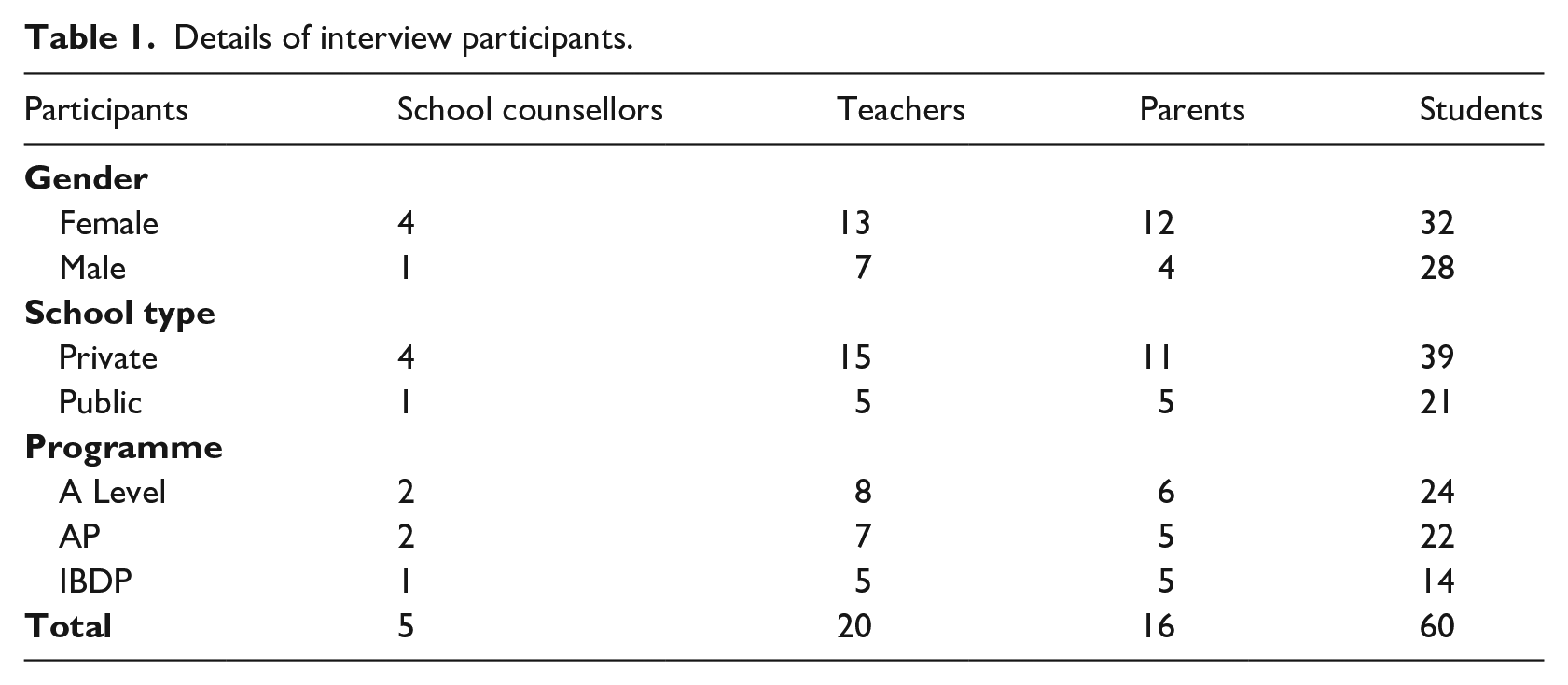
The interviews were semi-structured and lasted approximately one hour each. All participants were given the option of being interviewed by a member of the multilingual research team in their preferred language, including English (30 interviews), Cantonese (12 interviews), and Mandarin (59 interviews). The objective was to gain in-depth insights into the experiences and perceptions of international programmes in the Shenzhen context. The interviews investigated (1) international school and programme choice, (2) reflections on curriculum, pedagogy, and assessment, and (3) preparation for and admission to higher education overseas. The interviews were transcribed, translated into English as necessary, and each translation was cross-checked by the research team. The interview data were then qualitatively analysed using NVivo 12. ‘First cycle coding’ involved generating codes as initial labels that assigned symbolic meaning to interview data. ‘Pattern coding’ then grouped the first-cycle codes into broader themes or threads that tied together different parts of the interview data (Miles et al, 2014). The analytical process focused on illuminating participants’ perspectives on the promised and conferred capitals of international programmes, and how they position students in the global field of higher education. As the data were gathered from one Chinese city, caution should be taken regarding the generalisability of the findings to other contexts. Pseudonyms are used in reporting the findings, in order to protect the confidentiality of research participants.
Findings
The multiple promised capitals of international schooling
This section presents findings related to the perceptions of promises on the supply-side of international schooling. A key promise by schools to parents was a secure pathway to higher education overseas, particularly in the Anglophone West. The parents were typically anxious about their children’s prospects in a competitive national education system but, at the same time, tended to have high aspirations for their futures. Some emphasised how international programmes push students to ‘realise their full potential’ (Ms Zhao, parent) through an internationalised education aligned with overseas universities. For others, the reasoning was more conservative, with international schooling a strategy to offset the risk of academic failure in local schools and a blocked pathway to university. In all cases, the parents were able and willing to mobilise economic capital for international schooling with the promise of accumulating multiple capitals for the global higher education field.
The first promise of international schooling was the educational capital of internationally validated qualifications for overseas university admission. The students could sidestep the gaokao, as a high-stakes national university entrance exam ‘that decides the rest of your life’ (Feng, AP student). Although this barred the students from admission to universities in China, it was believed to significantly enhance opportunities in higher education globally. There was a perception that not only was international schooling less competitive than local schooling in China but that the educational capital attained had greater recognition in the global higher education field. This perception was captured by Ms Huang, a counsellor at a school offering A Levels: Some [overseas universities] accept gaokao exam scores, but usually they require very, very high scores. So, it is difficult for them, but if you take an international programme, it’s less competitive as they trust the qualification.
A second promise was embodied cultural capital through experiences aligned with higher education and society in Western Anglophone countries. Bilingual learning environments offered students an opportunity to improve their English proficiency. Students could also select from a broader range of subjects than in local schools, such as economics, psychology, and foreign languages other than English. The curriculum content, pedagogical approaches, and assessments were believed to be more internationalised, student-centred, and less exam-oriented. Beyond academics, the culture of international schooling was promised to be aligned with imaginaries of schooling in the West, such as familiarity with Western cultures, an emphasis on ‘whole person’ development, and ample extracurricular opportunities. Together, this was deemed to cultivate a social identity that supported a transition to higher education overseas. As Mr Wang, an AP teacher, described: The opportunities our students have are fundamentally different from other schools in China. The way we teach the students, assess them, and the overall environment is completely different. It is more like studying in Australia, the United States, or the United Kingdom. Speaking with our parents, that’s why they send their kids to us as they want them to go to those countries for university.
A third promise was social capital through networks with school counsellors, teachers, and alumni/ae with knowledge of global higher education. These networks were described as a valuable source of advice, know-how, and strategies for university applications. The interactions also helped to form aspirations around choices of institutions to attend. At a deeper level, networks forged with teachers and counsellors holding international experience promised opportunities to learn about their planned future destinations. Further to this, the schools had networks with alumni/ae at universities worldwide who could offer advice and support upon arrival. All this meant that students could ‘tap into’ networks, unavailable at most local schools, to facilitate a transition to overseas study. Junjun, an AP student, articulated this promise: My econ teacher told me about the University of British Columbia as they studied there before coming back to China. After that, it became my ‘dream school’. I talked with her about what is it like to live in Canada, the culture, the people . . . She put me in contact with someone from our school out there who is helping with my application.
A common theme was that parents had specific expectations for how the multiple promised capitals would work together in preparing students for overseas universities. Above all, they aspired for their children to enter the ‘elite’ sub-field of global higher education, a fact that counsellors and teachers were acutely aware of. Chunhua, an IBDP student, reinforced this outlook: For every international school student, it’s very important to get admitted to a highly-ranked university. Because first, you can learn lots of knowledge in highly-ranked universities with good teaching quality. You will meet outstanding students, and you can learn from them, and you can also improve yourself by studying and living with them. And a highly-ranked university can make finding a satisfying job easier.
International programmes and different promised capitals
The parents shared an ambition to send their children to an international school as a means to access global higher education. In this decision, the programme was typically a secondary concern. Other factors such as school location, personal networks and fees were equally, if not more, important considerations. Nonetheless, the choice of programme had a considerable bearing on their children’s experience and future mobility. As is presented below, A Levels, AP, and IBDP programmes varied in promised capitals.
Educational capital
The international schools all promised internationally validated qualifications, as educational capital. Yet, the participants further discussed dissimilarities in terms of the promised educational capital in different parts of the global higher education field. The educational capitals of A Levels and AP were believed to be nationally bound. A Levels were considered most valuable for the ‘elite’ sub-field of higher education through research-intensive British universities with strong cross-border flows and, to a lesser extent, former British colonies (eg, University of Hong Kong). The AP’s educational capital was directly related to higher education in the United States as well as Canada. The IBDP stood out as distinctive by positioning students for universities across the global field of higher education. However, as discussed below, the different promises of international programmes went beyond the qualification to encompass cultural and social capitals aligned to different contexts.
Embodied cultural capital
There were programme differences in promised forms of embodied cultural capital accumulation for overseas higher education. A Levels were highlighted as integral to a British-style education, commonly associated with ‘academic rigour’, ‘specialisation’, and ‘world-class standards’. For example, the participants perceived that A Levels promised embodied cultural capital for British universities due to close alignment with the English National Curriculum and a degree structure where students usually study one subject in-depth. Yewei (a student), for instance, explained how the promise of specialisation in A Levels aligned with her study plans in the United Kingdom: I have chosen four subjects at A Level, so I can focus more on the subjects I am interested in. For example, I want to study medicine at university. What I require the most is chemistry and biology, and a bit of mathematics and physics. In A Levels, I don’t have to study things like history or politics; you can choose the subjects you are interested in and the subjects you think are definitely going to benefit you at university.
The AP’s key promises were embodied cultural capital aligned with American higher education. Similar to A Levels, the AP courses were identified as an essential feature of schools promising to provide students with an American-style education. Although AP assessments are exam-based, the schools emphasised project-based learning, community service, and extracurriculars to cultivate ‘soft skills’ deemed important for admission to and success at American universities. Another distinctive AP promise was an ‘American-oriented’ curriculum, which could cultivate embodied cultural capital by familiarising students with the ‘dominant’ national cultures of the society. An AP student called Ying noted: I got to study American designed courses. If I’d only studied Chinese history, I would need to do a lot of catching up, but I have a pretty solid grasp of American history, which my teacher said is actually better than a lot of students at American schools.
The participants described how the IBDP promised embodied cultural capital for higher education globally. They perceived the IB to be more internationalised than other programmes, with a few adding that it was the only truly ‘international’ programme. Awareness of global issues and intercultural understanding were consistently cited as defining programme features, which prepared students for studying and living in diverse locations overseas. Bai, an IBDP student, explained: ‘The whole atmosphere in the IB, and the topics we learn about [have] a global perspective like global warming, global poverty, global conflicts.’ They also perceived that the experience of IBDP assessments beyond written exams was transferable to universities worldwide. As Xie, another IBDP student, reflected: The best feature of the Extended Essay is that we can learn in the process of studying instead of just revising for an exam. I improved my abilities, such as research and report writing, which will be part and parcel of university.
Social capital
Each international programme promised social capital through advice and know-how that was often specific to higher education in particular parts of the global higher education field. This was provided by counsellor, teacher, and alumni/ae networks aligned with the programme the schools offered. A Level schools typically promised social capital directly linked to the British higher education system, especially as some counsellors and teachers at these schools had previously studied in the United Kingdom. An A Levels student called Yufei, for example, recalled advice from his teachers: My teachers helped us a lot with the application. Some of them graduated from UK universities. They told us that getting good grades is the most critical thing in the UK, but they also showed us how to finish our personal statements to show off our extracurriculars.
Participants at AP schools discussed insights tailored for American higher education, but limited support for other destinations. The guidance focused on ‘going beyond’ high AP exam scores. Students applying to American universities were expected to emphasise extracurricular talents and accomplishments in application essays. As Ms Wu (an AP teacher) explained: They need so many things to apply to higher-ranking American universities. They need extracurriculars, like voluntary works, they need you to show achievements in competitions and prepare for their SAT test. And then they need to get a high GPA. So, I think we can provide that bit of guidance, so they stay on the right track.
By contrast, the participants at IBDP schools more commonly reported providing globally oriented social capital. Counsellors described how their guidance promised a broad perspective on the global higher education field. IBDP teachers and alumni/ae typically had more diverse global higher education experiences and, therefore, promised social capital for universities across different contexts worldwide. A corollary of this, however, was that IBDP students may have less access to specialised information from schools and alumni/ae about university in particular national contexts, compared to their A Level and AP peers who benefited from deep connections with their associated countries.
Conferred capitals and the localisation of international programmes
The international high school programmes each promised multiple capitals for the global higher education field. This section explores the overlap and discrepancies between the promised capitals on the supply side and what was perceived to be conferred to students on the demand-side, which was often complicated by the localisation of international programmes—ie, how international schools and the programmes they offer may be adapted according to the cultural, social, and political context in which they are situated.
A first promise of international programmes is an internationally validated qualification. At the school level, the programme value of educational capital was perceived to vary across the global higher education field, which was borne out in patterns of planned university destinations. IBDP students were more globally dispersed in intended university destinations than their counterparts taking A Level and AP courses, who mostly planned to attend universities in their programme’s national context (see Table 2). In most cases, the students had received offers from universities in the ‘elite’ sub-field of higher education in the United States (eg, Association of American Universities), the United Kingdom (eg, Russell Group), and other Anglophone countries (eg, Group of Eight in Australia). These findings suggest that what was promised by schools in terms of educational capital was successfully conferred, as the qualification provided pathways to global higher education.
Programme and students’ planned university destinations (N = 60).
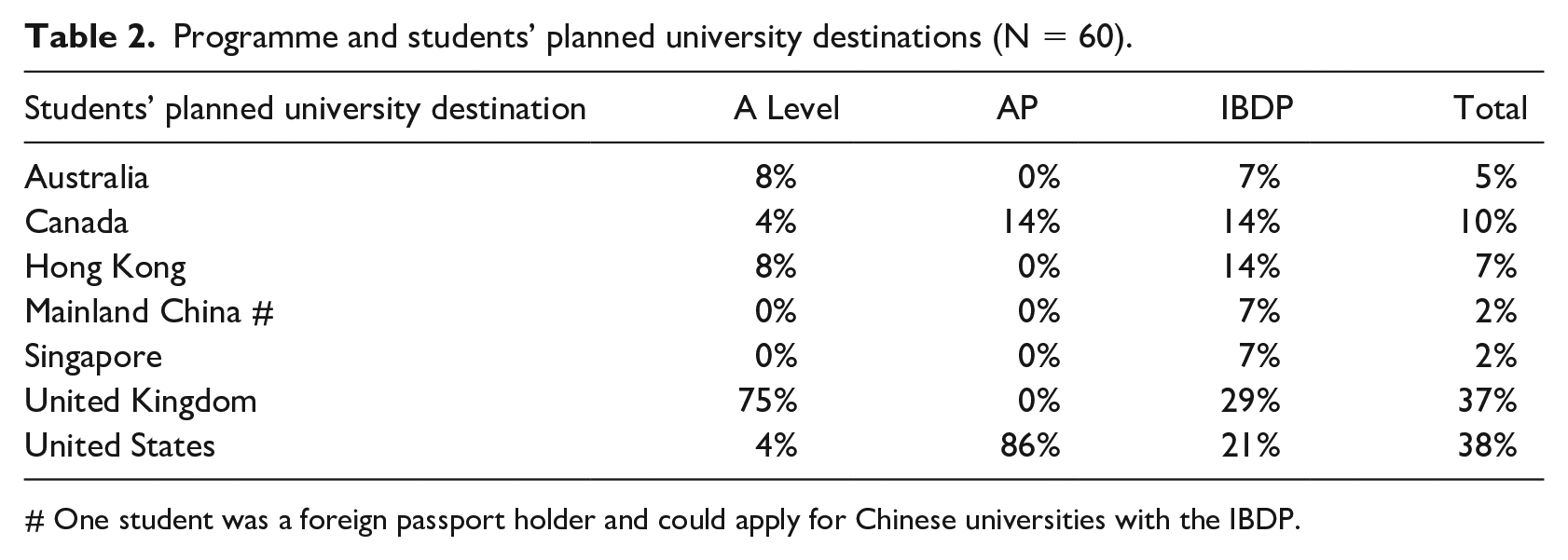
# One student was a foreign passport holder and could apply for Chinese universities with the IBDP.
The localisation of international programmes complicated the delivery of other forms of capital. There was evidence of impediments to the accumulation of embodied cultural capital for global higher education. One of the key promises made by each of the three programmes was an ‘international-style’ education aligned with overseas universities in the West. However, most students had taken the Chinese national curriculum for nine years of compulsory education until they were 15 or 16. In some cases, this schooling period was completed alongside or integrated into an international programme, such as iGCSE. Other students took the Chinese national curriculum before entering an international programme at high school, often with a bridging year. The transition to A Levels, AP, and the IBDP represented a significant change. Beyond the English language, the programmes consisted of radically different curriculum content and assessments. To support students, the schools sought to provide continuity in approaches to teaching and learning as well as bilingual instruction. This approach meant that, in practice, the schools provided a hybrid form of national-international schooling where localised aspects remained firmly in place. Hao, an IBDP student, believed that the school retained a ‘Chinese style’: The courses we learn are international but for other aspects like our schedule, classrooms, teachers are Chinese style, and you know we speak Chinese. So, you don’t always feel it’s like an international school.
In addition, the localised regulatory context meant that some curriculum content was prohibited due to political sensitivities, such as content related to Christianity and Islam, as well as to regional political issues around social unrest in Hong Kong and the status of Taiwan. Also, new regulations mandating that international schools increase Chinese political (patriotic, ideological) and cultural (language, history) content could come at the expense of or contradict the content of international programmes. Consequently, there are likely to be limitations in not only the issues that students are exposed to but also implicitly the nature of class discussions. While this was a difficult subject for interviewees to broach directly, some, such as IBDP student Weifeng, noted: ‘I mean it’s a tradition with communism. Basically, you have to obey the rules.’
Furthermore, the participants discussed how teaching and learning remained ‘localised’, and resultantly, may not prepare students for the approaches that are likely to be found at universities overseas. The teachers often described incorporating techniques focused on diligent learning of content, that they associated with ‘traditional’ Chinese approaches to pedagogy, into international programmes. This aligns with research showing that transmission of content-based knowledge and high teacher authority remain commonplace in China’s schools, despite widespread rhetoric of learner-centred education (see, eg, You, 2019). As one illustrative example, Ms Hao explained her approach to teaching A Levels: We know how to get high grades for students in A Levels. Basically, we would go through the syllabus step by step to give them the necessary knowledge. Then we give them past papers and do it over and over again until they get the hang of the exams.
The participants also discussed how idealistic aspects of international education, that may imbue embedded cultural capital for higher education overseas, often took a ‘back-seat’ in practice. Although the schools promoted extracurriculars as part of a ‘well-rounded’ education, high volumes of homework and private tutoring limited the time for non-academic pursuits. Relatedly, as families were paying high tuition fees, schools were under pressure to ensure their students attained high grades for university admission. Ms Cai, an IBDP teacher, explained: We care about 21st-century learning and global citizenship, but the bottom line is that we need our students to pass the exams to get into the right type of universities, as the parents have spent a lot of money to send their kids here.
Finally, parents and students perceived limitations to social capital in the form of guidance for applying to and studying at universities overseas. The schools in this study primarily employed counsellors and teachers educated at universities in China, with a minority of expatriates (typically English teachers) or Chinese staff with overseas higher education experience. Ms Ma (a parent) employed a private consultant for her son to compensate for a perceived lack of specialised guidance for university applications: The school provided him with some information to prepare for college, but we don’t think it’s enough. Actually, the counsellor he worked with had not even studied abroad herself, so we were worried if she could really help. That’s why we decided to hire an overseas study consultant, who can help him to do some preparation.
Discussion
This research illuminated the planes of interaction between ‘promised’ and ‘conferred’ capitals of international programmes at ‘Chinese internationalised schools’ in Shenzhen, China, and how they produce different opportunities within a stratified global field of higher education. In the below discussion, we unpack three main implications of the findings.
The first implication is identifying the nature of the multiple promised capitals of international schooling for the global higher education field. The findings offer insights into the educational strategies of affluent local families in China and worldwide who are willing to mobilise resources to pay high fees for international schooling. Bourdieu (1984) highlights how the calculated selection of academic qualifications with the ‘sense of investment which enables one to get the best return’ (p 142) is a significant feature of social class advantage. Most clearly, international schooling promised the educational capital of internationally validated qualifications. On the one hand, the students could gain a ‘sanctuary’ (Waters, 2007) from competitive local schools in China. On the other hand, the international high school qualifications promised greater recognition by overseas universities than those conferred by the national education system. As such, the educational capital could offset the risk of academic failure and simultaneously help to realise aspirations to enter the ‘elite’ sub-field of global higher education.
The research further identified how the promised capitals of international schooling extended beyond the qualifications attained. The international schooling experience promised embodied cultural capital as another form of advantage through familiarity with overseas higher education, combining ‘cosmopolitan capital’ of interest, openness, and capacity to engage with foreign ‘others’ (Weenink, 2008; Wright & Lee, 2019) with knowledge of education and societies in national contexts. The point is not that international schools were expected to offer students a seamless transition to studying abroad. Rather, a promise of international schooling was ‘start-up capital’ (Ong, 1999) to prepare students for future mobilities through exposure to assessments, curriculum content, pedagogy, and language aligned with higher education in Western countries. The students were promised not only that they would be better positioned to apply to overseas universities compared with their peers in local schools but also that they would encounter fewer challenges when adapting to studying and living overseas. Further, international schooling promised social capital through networks with counsellors, teachers, and alumni/ae. Through these networks, students could accumulate knowledge of the ‘rules of the game’ for overseas university admissions and support upon arrival at their destinations. The point here is that only through taking together the multiple promised capitals can the full potential rewards, and growing market demand (Bunnell, 2020), of international schooling for the global higher education field be captured.
This leads to the second implication: how different international programmes promised different capitals and global circuits of mobility for higher education. Each global circuit of higher education can be thought of as a sub-field (Dai et al, 2020; Marginson, 2008) that has its own specific internal logic and laws of functioning. A key point is that it is too simplistic to say that international schools provide a generalised pathway to global higher education. What is promised by each programme is effectively a means of accumulating capital for and learning the practices—in other words, the informal, coded, customary ways of doing things—of particular higher education sub-fields. A Levels and AP promised specific nationally-bound forms of educational, embodied cultural, and social capital affiliated with national higher education sub-fields. The IBDP, by contrast, was identified as distinctive through promising capitals with a greater amount of ‘global exchange value’ for admission, preparation, and networks for universities worldwide, although most students planned to attend universities in the Anglophone West (see also Schippling & Abrantes, 2022). Nonetheless, the IBDP stood out as yielding a distinctive form of ‘cosmopolitan start-up capital’ (Beech et al, 2021): a form of capital that was convertible in spaces across the global higher education field beyond national localities.
The findings contribute to a deeper understanding of the growing diversity of international schooling (Hayden & Thompson, 2013), even amongst schools within one city, catering to similar demographics of local students, and offering popular high school programmes. Overall, international programmes were found to have a significant bearing on the types of capital accumulated and the position of students in the global higher education field. This draws attention to the importance of the programme as part of school choice. For parents in the current study, the programme was typically a secondary concern, as the priority was for their children to attend an ‘international school’. Most were part of a ‘new rich’ class who often did not have deep knowledge of global higher education but aspired to accumulate capital for their children to study overseas (Ma & Wright, 2021; Wright et al, 2022). Even so, programme choice had significant implications in that the promised capitals of each programme were geographically heterogeneous. Above all, the international programmes contributed to the institutionalisation of the global field of higher education (Igarashi & Saito, 2014): they each created distinct pathways which facilitate student flows to various parts of the ‘elite’ sub-field of universities worldwide.
The third implication relates to the role of the ‘localisation’ of international programmes in complicating the conferral of promised capitals. A balance between founding ideals and an expansion of international programmes into diverse local-national environments represents an ‘enduring tension’ in international education (Tarc, 2022). As a type of ‘non-traditional’ international school, the characteristics of ‘Chinese internationalised schools’—including serving local students, bilingual medium-of-instruction, the requirement to teach the national curriculum for compulsory education, and teacher demographics—create a hybrid form of national-international schooling (Poole, 2020). This may be distinctive to ‘elite traditional international schools’ that are more well-established, cater primarily to mobile expatriates, and retain a core mission to cultivate international-mindedness (see, eg, Bunnell et al, 2021). In the current research, localisation interacted with the accumulation of embodied cultural capital owing to students’ experiences of the national curriculum, restrictions on ‘politically sensitive’ issues, and localised school cultures. New regulations mandating that schools integrate into international programmes more curricula content relating to the Chinese cultural legacy and legitimacy of the Communist Party underscore this point (State Council, 2021). Also, the prevalence of local staff at the schools often with limited experience of higher education internationally may restrict the social capital available to students to guide overseas university applications and offer advice on adapting to higher education abroad. Although not covered in this research, an exodus of expatriate teachers owing to COVID-19 restrictions (see Poole & Bunnell, 2022) may further localise the schools in this respect.
Crucially, the localisation of international programmes meant that the promised capitals might not be equally conferred to students. The international programmes each successfully fulfilled the role of a baseline credential as educational capital for entry into an elevated position within the global higher education field. However, ‘success’ in global higher education is dependent on a nexus of multiple forms of capital: it requires not just educational capital to secure entry but also embodied cultural capital to adapt to the ways of studying and living overseas, as well as the social capital of networks with those who could share informed advice and know-how. This research suggests that at least some of the promised capitals that would be of benefit in the transition to study in the West might not be fully realised. That said, the fact remains that ‘Chinese internationalised schools’, as a hybrid form of international schooling, still provide a strong grounding for global education mobility, compared to other students studying at local schools in China and, indeed, domestic students in the targeted university destination countries. These students must navigate a foreign academic culture in a foreign language, and in so doing, they will likely develop skills associated with success in global higher education. An important caveat is that at least some of the capitals that would be of benefit in the transition to overseas study may not be wholly covered. Thus, unlike students from more established ‘elite’ globally-mobile backgrounds whose families articulate ‘being able to live and thrive in a transnational space’ as a core facet of education choices (see, eg, Beech, 2021: 538), the students in our research may be less able to accumulate capitals that could be converted into a smooth transition to overseas higher education.
These findings open areas of further inquiry in the emerging international schooling arena. Future studies could investigate promised and conferred capitals of international programmes in other contexts, such as the Middle East: another geographical area of rapid expansion. Large-scale quantitative studies would also be valuable in identifying the global patterns of higher education mobility of students from various international programmes. Lastly, research would be welcomed into how graduates from different international programmes fare in terms of adaption and academic success across the global higher education field.
Concluding remarks
This article focused on international high school programmes at the school and individual levels. We sought to emphasise two key points. First, different international programmes promise distinct sets of capitals to aid in understanding the logic of practice within a particular sub-field of the global higher education field. Second, the delivery of the capitals is complicated by localisation: there can be discrepancies between what is promised and what is conferred.
To conclude, we wish to briefly reflect on the macro implications for global higher education. One of the primary functions of international schooling in China and elsewhere is to open up pathways to overseas higher education. As discussed in this article, international programme choice has significant implications for students’ mobility in the global higher education field. Given the role of A Levels and AP in providing capitals valued particularly in the United Kingdom and the United States, the ongoing growth of these programmes at international schools is likely to reinforce the hegemonic power of British and American universities. Similarly, while the IBDP promised global higher education choice, most students opted for universities in the national higher education systems of the United Kingdom and United States. Put differently, international schooling has the function of entrenching the dominance of the Anglophone West in attracting international students (Brooks & Waters, 2022). The gains to be had from inward flows of internationally mobile students to higher education systems are considerable. As Yang (2022) argues, international students provide economic capital through fees paid to universities, human capital through ‘brain gain’ of educated/skilled workers in domestic labour markets, and the symbolic capital of ‘goodwill’, global prestige/status, and ‘soft power’ of hosting countries (p 311).
This interpretation suggests that alongside the capital for students to access higher education overseas, the expansion of international programmes in China and elsewhere strengthens power relations in a hierarchical global field of higher education that currently favours the West. To date, the arrangement with Western higher education has been tolerated or even supported by the Chinese government: China is one of a handful of economies to benefit from outward flows of students, as a growing proportion return home after the completion of overseas studies (Mok et al, 2022). Less tangibly, these flows can benefit the country by providing a ‘bridge’ in the context of rising tensions with the West. The role of international schools, and the various programmes they offer in linking students with overseas higher education, places them at the frontline of this issue. As a result, if the balance of national priorities for China were to change, it is likely that international high school programmes would be subject to further restrictions and, by implication, further localisation in the coming years.
Footnotes
Funding
The authors received no financial support for the research, authorship, and/or publication of this article.