




Abstract
This article applies nonstandard analysis to study the generalized solutions of entropy and energy across one-dimensional shock waves in a compressible, inviscid, perfect gas. Nonstandard analysis is an area of modern mathematics that studies number systems that contain both infinitely large and infinitely small numbers. For an inviscid shock wave, it is assumed that the shock thickness occurs on an infinitesimal interval and that the jump functions for the field variables are smoothly defined on this interval. A weak converse to the existence of the entropy peak is derived and discussed. Generalized solutions of the Euler equations for entropy and energy are then derived for both theoretical and realistic normalized velocity profiles.
Keywords
Introduction
One of the most surprising results in theoretical gas dynamics is the prediction of a peak in the entropy profile across a shock wave. Solutions of the one-dimensional Navier–Stokes equations for flows in ideal gases with heat conduction yield solutions across shock waves that are not monotonically increasing in entropy.1,2 It has also been shown that the Euler equations produce generalized solutions, representing entropy jump functions, that have peaks in the shock layer.3,4
The theoretical solutions that exhibit a peak in the entropy are all based on the ideal gas equation of state. The ideal gas model implicitly assumes that the fluid is in thermodynamic equilibrium across a shock wave. Since shock waves, in general, are not in thermodynamic equilibrium, flow models that assume thermodynamic equilibrium should not be expected to accurately represent the basic physics of a shock wave. Recently, Margolin et al. 5 applied statistical mechanics to show that the entropy distribution across a shock wave that is not in thermodynamic equilibrium does not exhibit a peak in the entropy. That is, the assumption of thermodynamic nonequilibrium implies an entropy profile that is strictly monotonically increasing. Margolin et al. 5 further show that the entropy profile through a shock wave does not depend on the viscosity of the gas.
This paper studies generalized solutions of the entropy and energy for a one-dimensional, inviscid, compressible flow of a perfect gas. The Euler equations are used to model a flow field containing a normal shock wave moving into an undisturbed fluid with constant properties. It is shown that if the entropy jump function for an inviscid fluid is assumed to have a peak across a shock wave, then the entropy must locally satisfy the ideal gas law. Hence, a weak converse to the existence of the entropy peak occurs locally and implies the standard form of the entropy for a gas in thermodynamic equilibrium.
Generalized solutions of the Euler equations for entropy and energy are then derived using theoretical and self-similar velocity profiles. The relationship of the generalized energy solutions to the form of the entropy and the existence of an entropy peak is explored. Generalized solutions of energy derived from the inviscid integrals of motion produce entropy profiles that are strictly monotonically increasing and do not have peaks.
To clarify the analysis, the Euler equations are cast in nonconservative form and integrated along characteristic lines. Direct integration of the Euler equations in nonconservative form can lead to the multiplication of generalized functions. It is well known, however, that the standard algebraic product cannot be used to multiply generalized functions without logical and computational contradictions. To avoid such theoretical difficulties, theories of nonlinear generalized functions have been developed that allow the multiplication of generalized functions by embedding their linear spaces into quotient algebras, which support weak operations of multiplication. Theories of nonlinear generalized functions may be constructed using nonstandard analysis, which is a modern theory of infinitesimals.
Nonstandard analysis is a subdiscipline of mathematical logic that studies extensions of the real numbers,
Infinitesimal jump functions across a normal shock wave
The Euler equations governing the motion of a one-dimensional planar flow in a compressible, inviscid gas are given by




To analyze a particular flow field, assume that a one-dimensional, planar, shock wave is propagating in an infinite expanse of an inviscid gas. The characteristic curves for a one-dimensional shock wave are straight lines of the form
Integrating equations (1) to (3) with respect to ζ along a left-running characteristic yields



With appropriate values for the constants of integration, equations (5) to (7) may be shown to be equivalent to the algebraic equations expressing the integrals of motion for mass, momentum, and energy



Nonstandard jump functions for shock waves
To study shock wave jump conditions of equations (1) to (3) generalized solutions of these equations are assumed, which are traveling waves of the form




The introduction of generalized functions into the equations of motion leads to significant theoretical complexities, because equations (1) to (3) are nonlinear and formulated in nonconservative form. As is well known, nonconservative formulations of inviscid flow problems may yield products of generalized functions that cannot be solved directly with traditional analytical methods. 7 For example, the derivation of each field variable or integral of motion, equations (5), (6), or (7), requires the multiplication of the generalized function, K, for velocity, with the x-derivative of the generalized functions, Hx, Kx, or Mx, for specific volume, velocity, and energy, respectively.
For the present study, the functions,
A standard generalized function can be represented by uncountably many hyperreal predistributions. To specify a nonstandard generalized function, an infinitesimal interval,
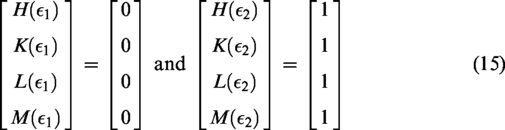


To simplify the nomenclature, the usual star notation for nonstandard objects is suppressed for predistributions of generalized functions. Throughout this paper the terms “nonstandard generalized function” and “predistribution of a generalized function” are used synonymously.
Normal shock waves jump functions
The field variable integrals summarized in equations (5) to (7) are now specialized to the case of jump functions for a normal shock wave. The energy integral of equation (7) depends on the constants α and β obtained for mass and momentum from equations (5) and (6). If an equation of state is specified together with equations (1) to (3), nontrivial solutions occur for the particular case of isentropic flow. 8 Because shock propagation is not an isentropic process, the inviscid equations cannot be solved for the Heaviside functions; only the relationships between the Heaviside functions may be determined.
Therefore, the field variable integrals of equations (5) to (7), the jump functions (11) to (14), and the boundary conditions (16) and (17) imply the normal shock wave relationships




The results of equations (18) to (21) are true for all inviscid fluids described by the Euler equations and are independent of the equation of state. More detail on the derivation of shock wave jump function relationships and nonstandard analysis may be found in Baty et al.4,6,8,9
Entropy jump functions
Recall from the second law of thermodynamics that the entropy for a reversible, perfect gas relating two states in thermodynamic equilibrium may be expressed by


Across a one-dimensional viscous shock wave, the entropy jump function, based on the equilibrium entropy of equation (23), exhibits a peak in the shock layer.1,2 A peak in the entropy jump function implies that the entropy is not a strictly increasing function through a shock, which is a surprising and counterintuitive result. A brief discussion of the history of the discovery of the entropy peak is given by Margolin et al. 5
Salas and Iollo
3
have shown that the entropy must have a peak across an inviscid shock wave using a theory of nonlinear generalized functions.12,13 The entropy jump function in the Salas and Iollo analysis must be represented as a sum of two Heaviside functions. Baty et al.4,6 have also proved that the entropy must have a peak across an inviscid shock using modern infinitesimals. The entropy jump function s constructed using nonstandard analysis may be represented in terms of a single predistribution of a nonstandard Heaviside function Q



The function Q in equation (25) depends on the jump functions for pressure and specific volume, equations (11) and (13), and satisfies the boundary conditions for a nonstandard Heaviside function

The entropy peak and specific energy for an ideal gas
Equation (24) representing the entropy jump function may be shown to have a peak across a shock wave by differentiating the equation with respect to the characteristic variable ζ. The resulting derivative is then demonstrated to vanish at a point in the shock layer by using a form of the Rankine–Hugoniot equation that relates a jump in specific volume
A weak converse to the existence of a peak also holds, which says that if the entropy has a local maximum at a point in the shock layer, then the fluid must satisfy the ideal gas equation of state and the entropy has the functional form of equation (23) at the location of the peak. To derive the converse result, equation (22) is expressed in terms of the energy jump function (using

Next, combining equation (11) with equation (13) through equations (17) and (18) through equation (21) yields


From the viscous flow case and empirical observations, the nonstandard Heaviside function H for the specific volume ν is assumed to be strictly monotonically increasing so that



So that combing equation (33) with

Recalling the Rankine–Hugoniot jump condition of equation (19)




From equation (38) it follows that if the entropy given by equation (22) has a local peak at

The entropy jump as a function of energy
In the previous section it was shown that if the entropy across a shock wave has a peak then the specific energy satisfies the ideal gas equation of state (at least locally). This section explores the relationship of the specific energy to the entropy peak in the shock layer.
Since the inviscid flow model holds for an isentropic fluid, the Euler equations (1) to (3) do not contain enough physical information to solve the flow variables for unique jump conditions across a shock wave. Whence, to study jump conditions through an inviscid shock, a jump function must be given. For this study, a velocity profile u across a shock wave is fixed and the other variables are determined from this jump function including specific volume ν, pressure p, specific energy e, temperature T, and entropy s. These jump conditions are computed from the inviscid integrals of motion given by equations (5) to (7) with the boundary conditions and jump function relationships as defined by equation (11) through (21). The jump conditions for specific energy and entropy found from the integrals of motion are also compared with the specific energy and entropy resulting from the ideal gas equation of state and the temperature ratio developed by Morduchow and Libby.1,2
Theoretical velocity profile
As a purely theoretical example, an


A shock wave is assumed to propagate into a quiescent fluid at standard conditions with a Mach number of 2. For this example, the fluid is assumed to be air at 1 atm and 293.15 K with the reference values

Figure 1 shows the Heaviside function used to represent the velocity profile; all graphs fix m = 500 in equation (40) and are plotted on the unit interval. Figure 2 shows the specific energy computed with the inviscid integrals of motion and is compared to the specific energy given by the ideal gas expression,
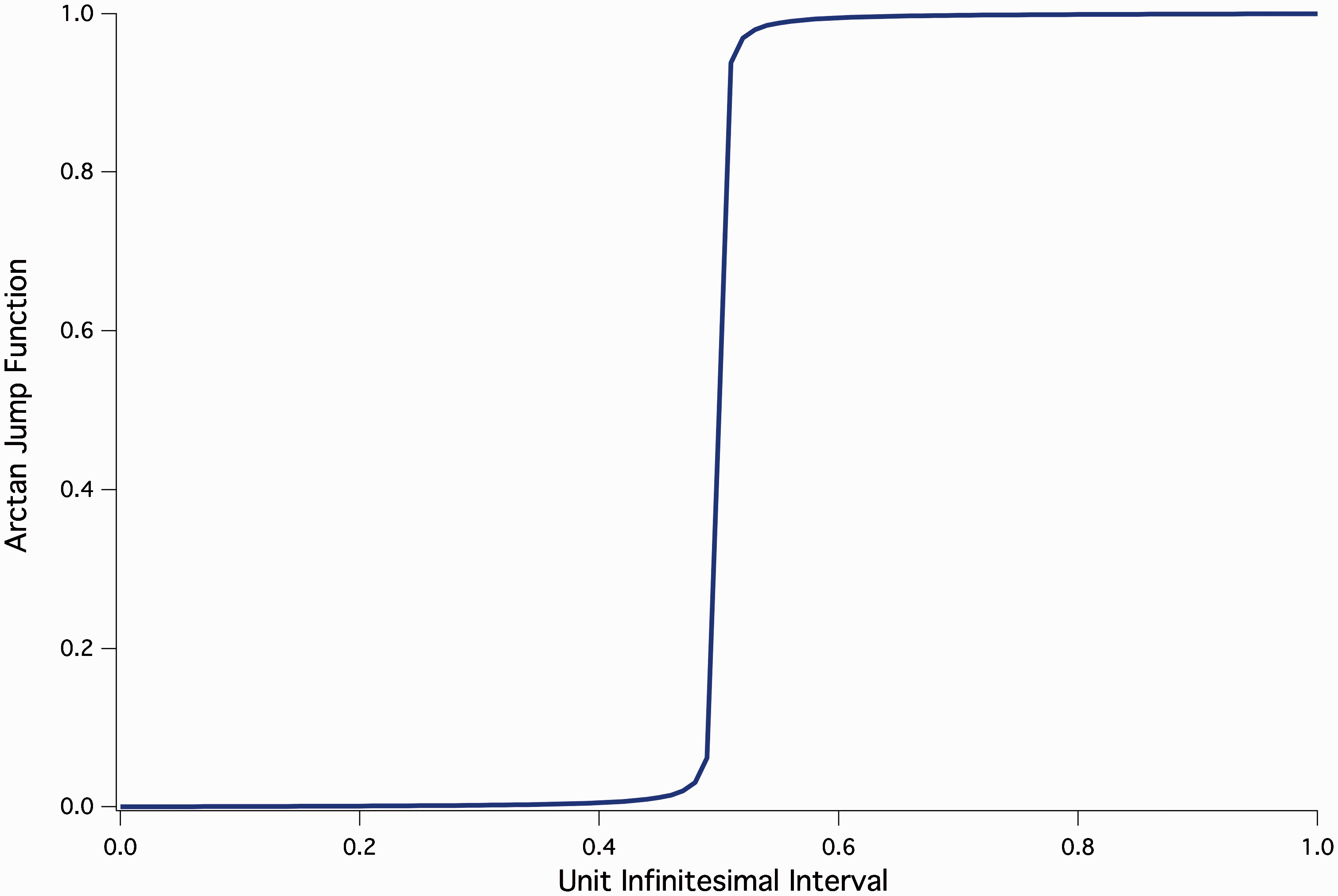
A smooth Heaviside function based on the

Specific energy across an inviscid shock wave using the arctan velocity profile: the solid red curve is the energy computed with the ideal gas relationship, while the dotted blue curve is the energy computed using the inviscid integrals of motion (See colour version of this figure online).

Entropy across an inviscid shock wave using the arctan velocity profile: the solid red curve is the entropy computed with the ideal gas relationship, while the dotted blue curve is the entropy computed using the energy integrals of motion (See colour version of this figure online).
Self-similar velocity profile
To explore the inviscid jump functions for a more physical example, a realistic velocity profile is assumed through the shock wave. The velocity profile for the shock is derived by Margolin et al.
5
and is an exact similarity solution for the viscous, heat conducting equations assuming a Mach number of

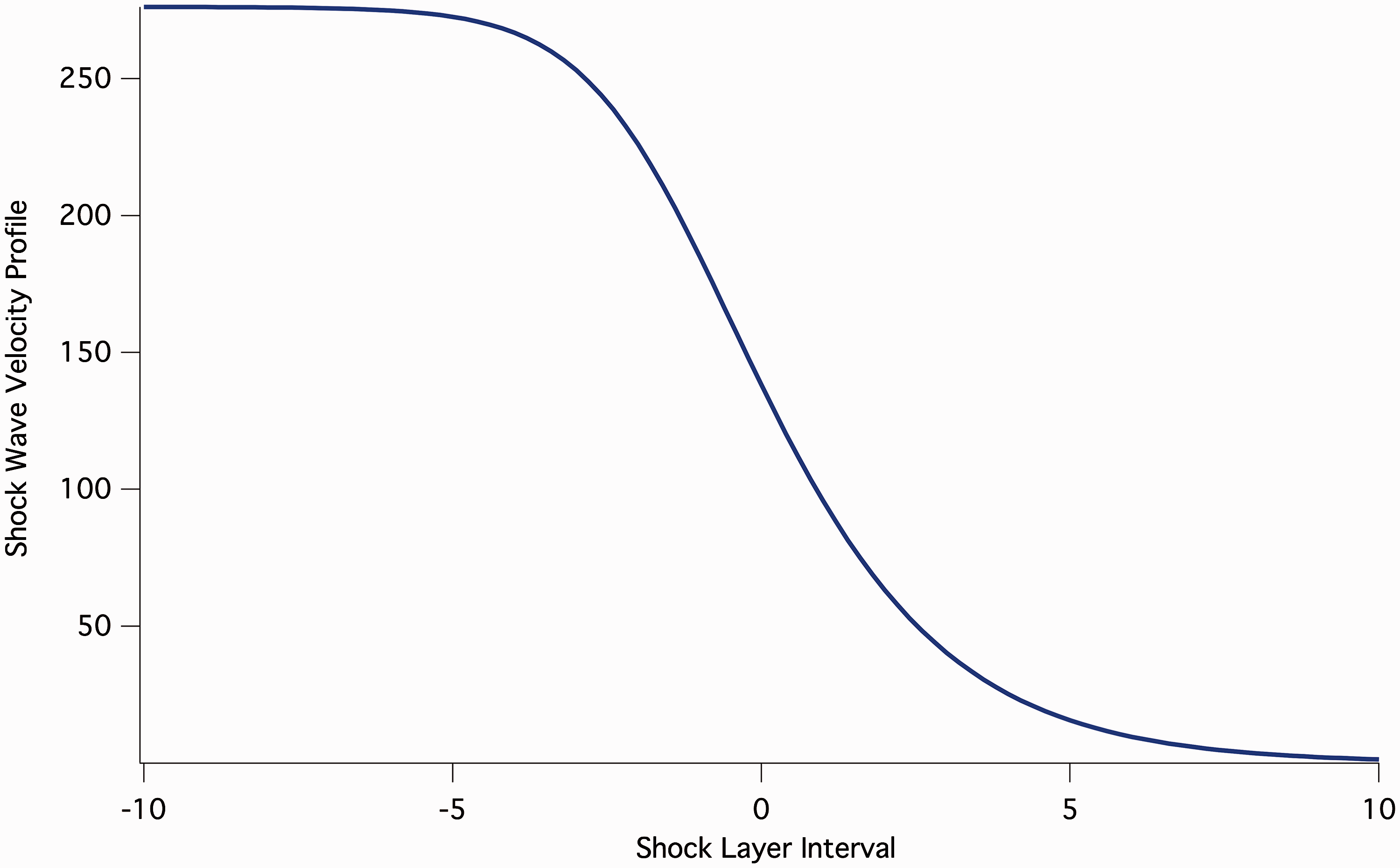
Exact self-similar velocity profile for the Navier–Stokes equations assuming argon with a Mach number of
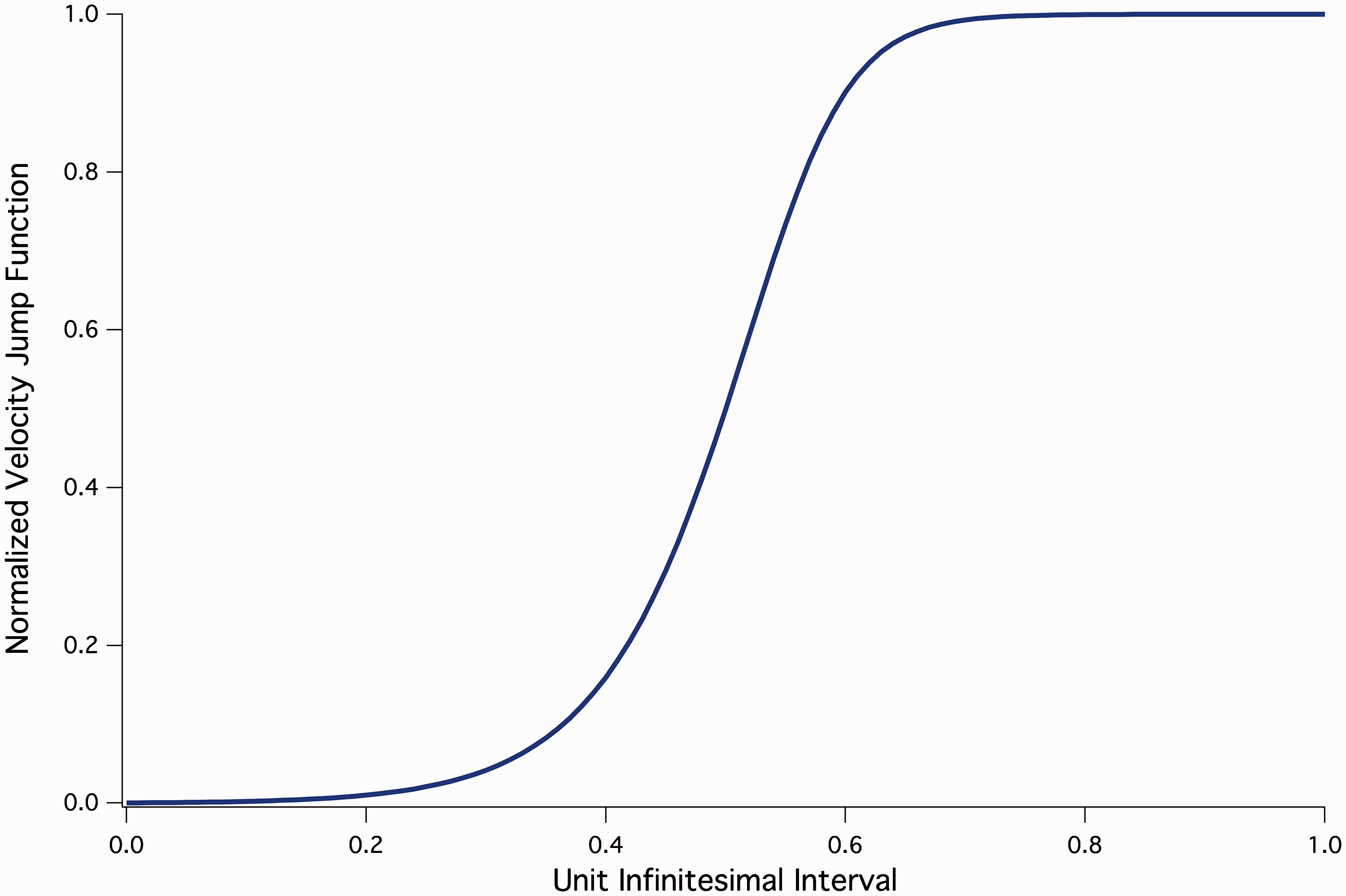
Exact self-similar velocity profile normalized to be a Heaviside function for a left-running characteristic and plotted on the unit interval (See colour version of this figure online).
To represent temperature across a shock wave, Morduchow and Libby
1
gave the following expression

For the self-similar velocity profile, a shock wave is assumed to propagate into quiescent argon at standard conditions with a Mach number of

Figure 6 shows the specific internal energy computed with the inviscid integral of motions and compares this jump function to the energies given by the ideal gas relationship and the temperature ratio of equation (44). The energy jump functions found from the integrals of motions and the Morduchow and Libby relationship, equation (44), both do not exhibit a peak across the shock layer, while the energy satisfying the ideal gas relationship has a sharp peak near the jump in the Heaviside function. Figure 7 then shows the entropy computed with the three energy forms exhibited in Figure 6. The entropy is computed using equation (22). No peak results if the energy is computed using the inviscid integrals of motion. This result, like the case for the
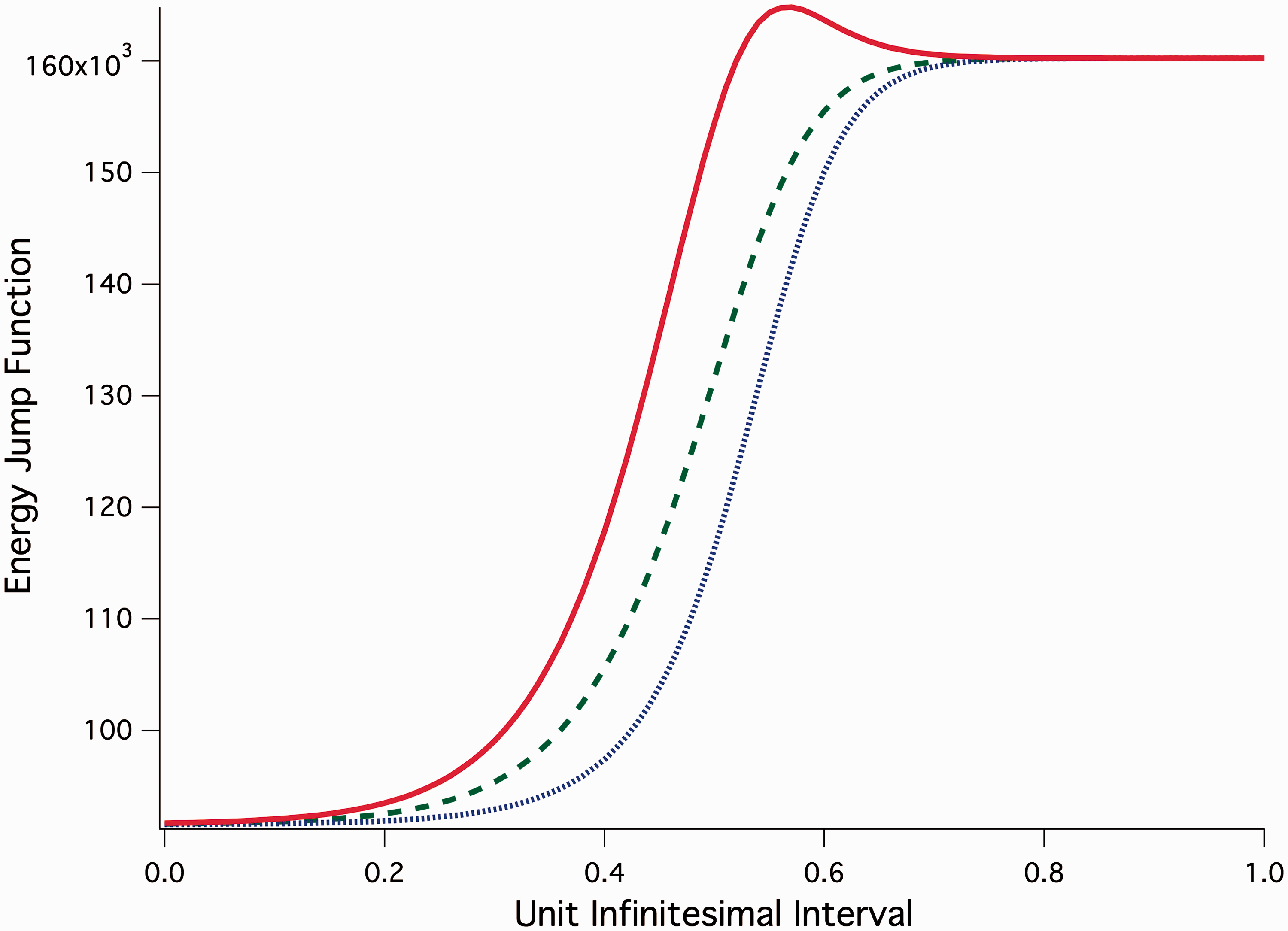
Specific energy across an inviscid shock wave using the self-similar velocity profile: the solid red curve is the energy computed with the ideal gas relationship, while the dashed green curve is the energy computed with the temperature ration and the dotted blue curve is the energy computed using the inviscid integrals of motion (See colour version of this figure online).
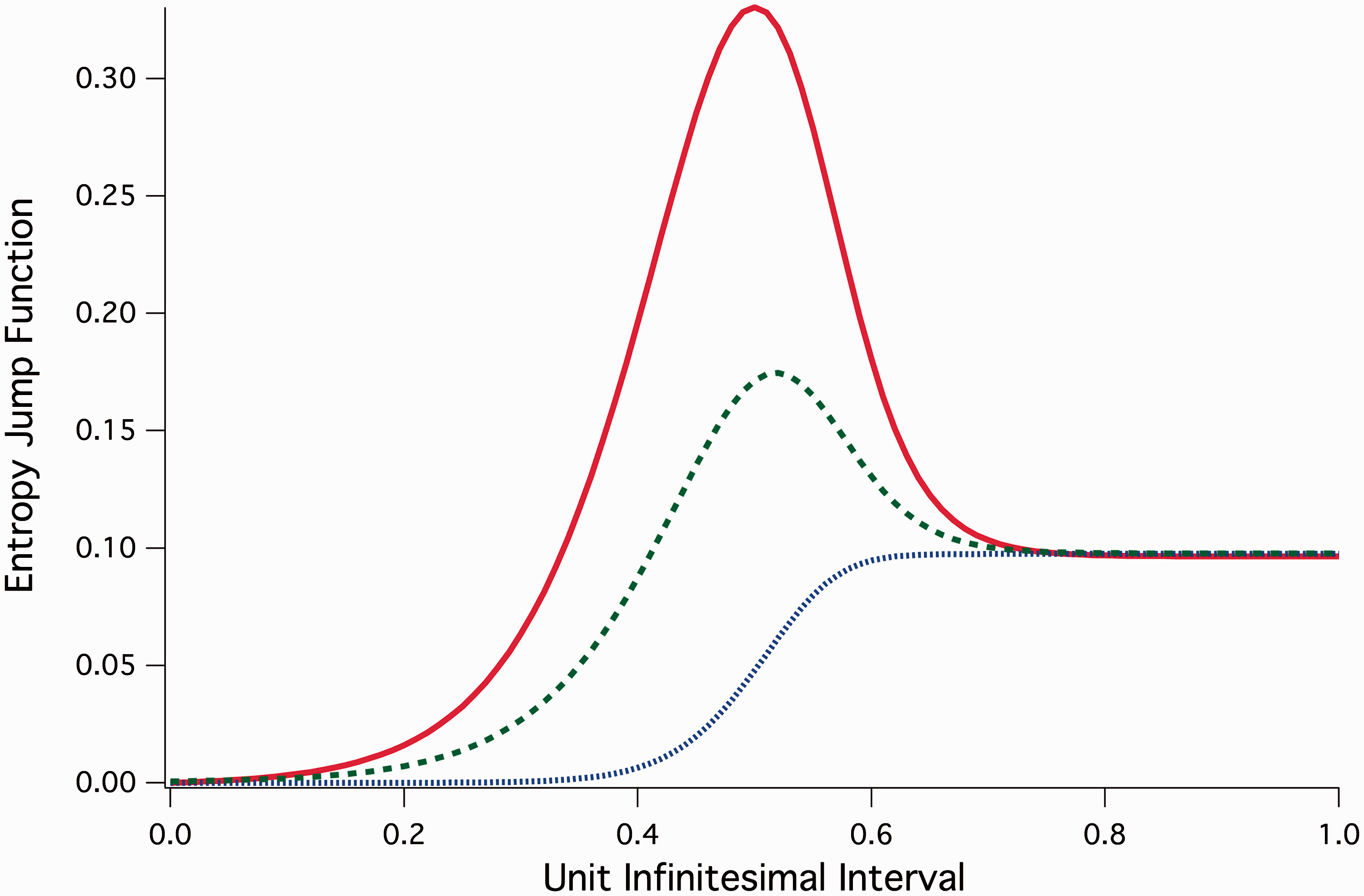
Entropy across an inviscid shock wave using the self-similar velocity profile: the solid red curve is the entropy computed with the ideal gas relationship, while the dashed green curve is the energy computed with the temperature ratio and the dotted blue curve is the entropy computed using the energy integrals of motion. Notice that the entropy computed with the energy integrals of motion does not produce a peak (See colour version of this figure online).
Summary and discussion
This article applied nonstandard analysis to study generalized solutions of the entropy and energy across one-dimensional shock waves in a compressible, inviscid, perfect gas. For the inviscid shock wave, it was assumed that the shock thickness occurred on an infinitesimal interval and that the jump functions for the field variables were smoothly defined on this interval. A weak converse to the existence of the entropy peak was derived and discussed. Generalized solutions of the Euler equations for entropy and energy were then derived for both
The key conclusions of the study are as follows:
If the entropy jump function for an inviscid fluid has a peak across a shock wave then the entropy must locally satisfy the ideal gas law; and the entropy locally must have the form of equation (23). The entropy jump function derived from the inviscid integrals of motions does not exhibit a peak. The generalized solution for entropy is consistent with the result found by Morduchow and Libby that shows an entropy peak does not occur if heat conduction is neglected. A peak in the entropy does not depend on a peak in the specific energy. Also, small changes in the topology of the energy jump function may result in an entropy peak across a shock wave.
As noted previously, the inviscid equations do not contain sufficient information to determine the detailed structure of a shock wave. The conservation laws do not speak to issues of thermodynamics and in particular, to the partition between internal and kinetic energy. The discrepancy between differing predictions of monotonicity of energy and entropy in the previous section is analogous to the situation in the theory of weak solutions of nonlinear hyperbolic equations as formulated, e.g., by Lax. 14 There, multiple solutions are possible, but a unique (physical) solution can be identified through an entropy principle. Typically, this entropy principle involves adding diffusion term(s) with constant, vanishing coefficient.
The detailed analysis of the full Navier–Stokes equations, including both physical viscosity and heat conduction, indicates that it is the thermodynamic entropy whose profile is not monotone through the shock.1,2,6 However, we believe that the general question of how to regularize the inviscid Euler equations is more complex than employing a constant diffusion. An alternate approach has been developed in the field of computational fluid dynamics.
Most practical simulations of high Reynolds flows, i.e. with shocks and/or turbulence, are performed with meshes that do not resolve the length scales of viscous dissipation. The earliest strategy to provide finite inviscid dissipation was proposed by Von Neumann and Richtmyer; 15 the strategy is termed artificial viscosity and involves adding a dissipative flux to the Euler equations whose length scale depends on the size of a computational cell rather than on any fluid or flow property. With some improvements, artificial viscosity remains in widespread use today.
The form of the Von Neumann–Richtmyer viscosity is nonlinear, depending on the square of the cell size and the square of velocity gradient; although not justified in von Neumann and Richtmyer, 15 that form has recently been derived theoretically in finite scale theory. 16 The appearance of a finite (nonvanishing) length scale is an essential feature of the finite scale theory.
The techniques described in this paper using nonstandard analysis seem well adapted for dealing with nonlinear regularization. In particular, the appearance of a nonvanishing length scale of the order of the shock width is well defined in the theory of infinitesimals. A key part of our analysis has been the availability of a characteristic solution and we note that a characteristic (traveling wave) solution has been constructed for the finite scale theory. 17
As commented above, the Euler equations do not contain sufficient physical detail to describe the structure of shocks. Indeed, the study of shock structure has many layers and one must go to the level of kinetic theory and the Boltzmann equation to reproduce the measured structure of shocks. With regard to entropy, the appearance of a peak within the shock structure is perhaps unexpected, but does not violate the second law of thermodynamics. This is discussed from a classical viewpoint in Morduchow and Libby 2 and from the more modern viewpoint of the Clausius Duhem inequality. 11
In thermodynamics, the only entropy is the equilibrium entropy defined in equation (22). However, it is possible to evaluate the nonequilibrium entropy of Boltzmann by integrating the (approximate) solution of the Boltzmann equation that underlies the Navier–Stokes equations in Chapman–Enskog theory. This has been done in Margolin, et al., 5 where it is shown that the profiles of density, velocity, temperature, and nonequilibrium entropy are all monotonically increasing through the shock.
At an even deeper level, it is well known in the experimental shock community that the Navier–Stokes equations do not reproduce the measured width and shape of shock profiles. 18 On the other hand, numerical simulations of the Boltzmann equation using direct simulation Monte Carlo very accurately reproduce the measured shock profiles of density, illustrating that the Boltzmann equation does have the necessary level of physical detail to describe the measured profiles of density in shocks accurately. 19 We note, however, that entropy is not a measurable quantity. There is at present no widely accepted continuum theory that improves on the Navier–Stokes equations for representing shocks.
Footnotes
Declaration of conflicting interests
The author(s) declared no potential conflicts of interest with respect to the research, authorship, and/or publication of this article.
Funding
The author(s) disclosed receipt of the following financial support for the research, authorship, and/or publication of this article: This work was performed under the auspices of the United States Department of Energy by Los Alamos National Security, LLC, at Los Alamos National Laboratory under Contract No. DE-AC52-06NA25396.
Appendix 1: Nonstandard generalized functions
This appendix summarizes the fundamental concepts required to define nonstandard generalized functions and is condensed from Baty. 6
Nonstandard analysis studies the extension of number systems and function spaces to quotient spaces, which contain idealized elements that are infinitely large and infinitely small. For example, the real numbers,
The equivalence relation ∼ is defined by selecting an ultrafilter on N. A resulting nonstandard set
Let  . Further details of nonstandard extensions may be found in Arkeryd et al.
20
. Further details of nonstandard extensions may be found in Arkeryd et al.
20
A nonstandard Dirac delta function results for any standard function g that satisfies
.
In standard constructions, the delta function results from abstract limits of regularizing sequences; on the other hand, in nonstandard constructions, the functional whose standard part produces the same result as the delta function can be represented by uncountably many internal hyperreal functions. These internal functions are called predistributions and are defined here for the space of locally integrable functions
As well as the delta function, the analysis of shock wave jump conditions requires the use of nonstandard Heaviside functions. The standard Heaviside function, H, can be represented by uncountably many functions or predistributions. To specify a nonstandard Heaviside function, let
Examples of predistributions for both the Heaviside function and the delta function are given in Baty et al. 4