



Abstract
Vertical axis wind turbines (VAWTs) can be suitably installed in urban regions. Although the power performance is essential, the noise generated by a VAWT may influence the living environment. An accurate prediction of power and noise performance is therefore necessary. In the present study, a precise aerodynamic and aeroacoustic performance assessment of a Darrieus VAWT is accomplished with the aim of exploring the effect of solidity parameter using a high-fidelity method. The improved delayed detached eddy simulation (IDDES) and the Ffowcs Williams and Hawkings (FW-H) acoustic analogy approaches have been utilized for predicting flow field and noise level. The simulations were performed in three different solidities at a specific tip speed ratio (TSR). It is shown that changing the solidity parameter affects both power and noise level remarkably. Change in the aerodynamic performance mostly occurs due to variation in instantaneous effective angle of attack which comprises many detailed discussions. The lower the solidity the higher the value of effective angle of attack. The noise level also affects by changing solidity as consequence of flow field variation. It is discussed here how the noise level would alter in terms of solidity, TSR, distance and azimuth angle. As the solidity increases, the sound pressure level (SPL) at blade pass frequency increases. Since design of quieter VAWT with application in urban regions recently is of the most interest and importance therefore such deep studies could appropriately address hybrid criteria and be helpful in future investigations.
Keywords
Introduction
Nowadays, due to the increasing environmental problems caused by the use of fossil fuels, utilizing the renewable resources such as wind and solar energy has attracted the attention of many researchers. In order to harvest energy from wind sources, wind turbines can be utilized. In a wind turbine rotor, the kinetic energy of wind transfers to mechanical torque as a result of creation of aerodynamic forces in blades. However, these forces also result in generating aerodynamic noise from rotor, although mechanical components of the wind turbine such as generator also produce noise. Wind turbines can be classified into two categories based on the rotor axis orientation which comprise of vertical and horizontal axis wind turbines. The vertical axis wind turbines (VAWTs) are mostly low capacity electricity producer devices. They benefit from lower noise production, simpler production, lower cost and easier installation compared to horizontal axis ones. 1
Due to the possibility of utilizing VAWTs in urban regions close to people’s residence, the generated aerodynamic noise can be a deterrent factor to expanding the use of VAWTs in future since it has destructive influence on people’s health.2,3 Exploring and finding the main sources of noise is a prominent step in attenuating the noise generated by VAWTs. Although there are many approaches for reducing the mechanical noise sources, 4 suppression of aerodynamic noise is still a problem . In order to design more efficient and quieter VAWTs, exploring the impacts of geometry parameters such as tip speed ratio and solidity on both power and noise performances can help researchers. Schematic of a 3-bladed H-type VAWT is shown in Figure 1. The definition of some basic geometry parameters such as rotor radius, blade span and chord length also are put in figure.

H-type VAWT schematic.
From aeroacoustic formulation point of view, Lighthill5,6 in 1952 proposed an inhomogeneous wave equation by combining Navier-Stokes and continuity equations. It was shown that the source terms in the wave equation are important only within the turbulent area. Lighthill compared the equation for producing acoustic density fluctuations in the real flow with the equation of generating density fluctuations in a linear ideal medium that occurs simultaneously with real fluid at great interval from the sources. It was concluded that the sound generated by turbulence region in a real flow is equivalent to the sound produced in an ideal stationary medium forced by Lighthill’s stress tensor quadrupole sources distribution. This theory is called Lighthill’s acoustic analogy. Curle 7 generalized the Lighthill’s theory with aim of accounting the impacts of solid boundaries, since most of the turbulence in a flow happens in the boundary layer region and the wake behind the bodies (quadrupole source type), and also due to unsteady surface forces (dipole source type). Due to the limitations of the Curle’s model, Ffowcs Williams, Hawkings and Hall extended the model to account arbitrary convective motion effects on the sound field.8,9 Therefore, this model can be utilized for aeroacoustic simulation of wind turbines and aircraft propellers.
Many empirical and semi-empirical models are proposed for predicting aerodynamic noise. However, in recent years, the Computational Fluid Dynamic (CFD) method is widely used due to the fast development of computer systems. Four different turbulence modeling approaches can be utilized for predicting aeroacoustic noise. The most common method is RANS (Reynolds-Averaged Navier Stokes), which are wildly utilized for the aerodynamic and aeroacoustic simulation of wind turbines. The second one is Large Eddy Simulation (LES) method. 10 In this method, unlike RANS models, all of the large-scale structures are resolved. While for the small eddies a general model is simply proposed. The third approach is Direct Numerical Simulation (DNS), which is the most accurate model but with very high computational cost. The last approach is called DES (Detached Eddy Simulation) which is a hybrid LES/RANS model. This model benefits from the advantages of RANS and LES models, with the aim reducing computational cost of LES approach. An improved version of DES model which is called Improved Delay Detached Eddy Simulation (IDDES) is utilized in the current study which was used by many researchers.11–13 In the aeroacoustic field, due to the presence of highly unsteady flow regions in VAWT application, using LES model is preferred over RANS models. However, due to computational cost limitation, using hybrid LES/RANS models is preferred in the present study.
Many investigations have been conducted in the field of horizontal axis wind turbine (HAWT) aeroacoustic,14–16 however, for the VAWT only a few works have been reported. For the noise problem of VAWTs, Mohamed
17
has used
Recently, Su et al. 21 have conducted a work to investigate the effect of turbulence intensity (TI) on the aerodynamic noise generated from a VAWT. The have used IDDES turbulence model for flow behavior prediction and FW-H aeroacoustic model for predicting noise spectrum. They selected three different TIs, 1%, 7% and 14%. It was shown that increasing TI would increase the noise generated by the VAWT since the interaction between turbulence and blades became stronger. Dessoky et al. 22 investigated the effects of adding wind-lens technology to a Darrieus VAWT on aerodynamic and aeroacoustic performance. It was shown that the power performance of the VAWT improved by 82% at a specific TSR. However, the aerodynamic noise was increased, which was mainly due to increment in loading noise sources.
Based on the current literature review, no prior investigation has been conducted based on high fidelity methods for predicting the effects of solidity on the aeroacoustic performance of a Darrieus H-type VAWT. It is notable that for aeroacoustic study using the more reliable than RANS techniques is crucial while in the previous works the validity of acoustic results are in doubt due to limitation of RANS which is only suited for power estimation. The IDDES is much reliable technique than all previous methods.
Therefore, the aim of present study is to fulfill the mentioned gaps in detail, which will provide a wider prospective for researchers to design efficient VAWTs from aerodynamic and aeroacoustic aspects. This work explores the mechanism of aerodynamic noise generation at different solidities using an accurate hybrid LES/RANS model called IDDES for the first time and also explores the effect of solidity on the power performance of VAWT. The simulations were performed two dimensionally (2 D). It should be mentioned that in the application of horizontal axis wind turbine 2 D simulation is not possible. However, in the field of VAWTs, 2 D simulation can be performed with the assumption of ignoring the effect of three-dimensional (3 D) phenomena such as blade tip vortex on aerodynamic and aeroacoustic performance.
The structure of this paper is organized as follows: the turbulence and acoustic models will be discussed in Methodology section; the details of the problem contains CFD setting, computational domain and overview of generated grid is presented in Problem description section; the results of grid and time step study are presented in Mesh and time step independency test section; in Validation against experiment section, the numerical result will be validated using experimental data of the reference VAWT; in CFD results and discussion section the main findings are presented and discussed in detail. Finally, some concluding remarks are drawn in Conclusion section.
Methodology
Iddes formulation
The Improved Delayed Detached Eddy Simulation (IDDES)
23
is utilized to solve unsteady flow around the rotor of VAWT. This model is the combination of Delayed Detached-Eddy Simulation (DDES)
24
and improved RANS-LES hybrid models. In the case of existing inflow turbulent, empirical modifications of this model will result in more captured turbulence activity near the wall. While for the case of zero inflow turbulent, the pure DDES approach will be performed. The defined sub-grid length-scale depends on grid spacings and wall distance. The length scale in IDDES can be defined as:
23

Aero-acoustic formulation
The FW-H
8
model is used for predicting the noise generated from wind turbine rotor. The model is the general form of the Lighthill acoustic analogy.
5
The FW-H can be used for the prediction of noise radiated from rigid body in random motion. This model is based on the acoustic analogy and is also an integral approach. The FW-H model is obtained by combining the continuity and momentum equations. As a result of this manipulation, inhomogeneous wave equation is provided. The FW-H equation can be represented as:25,26

In this equation,









The dot superscript in equations (4) and (5) over variables shows the source (or retarded) time differentiation of the variable. Vectors

In which
Problem description
A H-type Darrieus vertical axis wind turbine with 3 blades is chosen for this investigation. Due to the changes in aerodynamic forces on the blades of VAWT as a result of angle of attack variation and occurrence of unsteady phenomena such as dynamic stall, the simulation should be performed at unsteady condition. The steady solution can be used as the initial condition for the domain. The characteristics of the reference VAWT is shown in Table 1.
Reference VAWT properties. 28

For aeroacoustic calculations, some receivers are set in various positions with different phase angles (

Definition of (a) Phase angle and receiver position and (b) angle of attack.
CFD setup
The simulations were performed using a commercial software, Ansys Fluent 17, which was based on the finite volume approach for solving the Navier–Stokes equation. The incompressible IDDES turbulence model was utilized for aerodynamic calculation. The Pressure implicit with splitting of operator (PISO) algorithm is selected for coupling the velocity–pressure equations. A least square cell-based algorithm is gained for spatial discretization of gradients. Second order implicit scheme was used for transient algorithm. The second order scheme is used for discretizing the momentum, turbulent kinetic energy and specific dissipation rate. All simulations were performed with a small-scale system with 12 computational cores (AMD Ryzen 52,600X CPU with frequency of 4.2 GHz with 8 GB of RAM). A complete converged aerodynamic solution took about 250 hours.
Computational domain and grid
The computational domain contains two main parts; rotational and stationary. The blades are located in the first part. The schematic of computational domain with boundary conditions is shown in Figure 3. Five boundary conditions are used, which are velocity inlet, pressure outlet, wall, interface and symmetry. The free-stream velocity is set to be 9 m/s with a specific turbulence intensity (5%). A sliding mesh approach is used for capturing the interface surface between the rotating and the stationary meshes. The distance from rotor center to inlet and outlet boundaries is 7 and 14 times greater than the VAWT rotor radius.
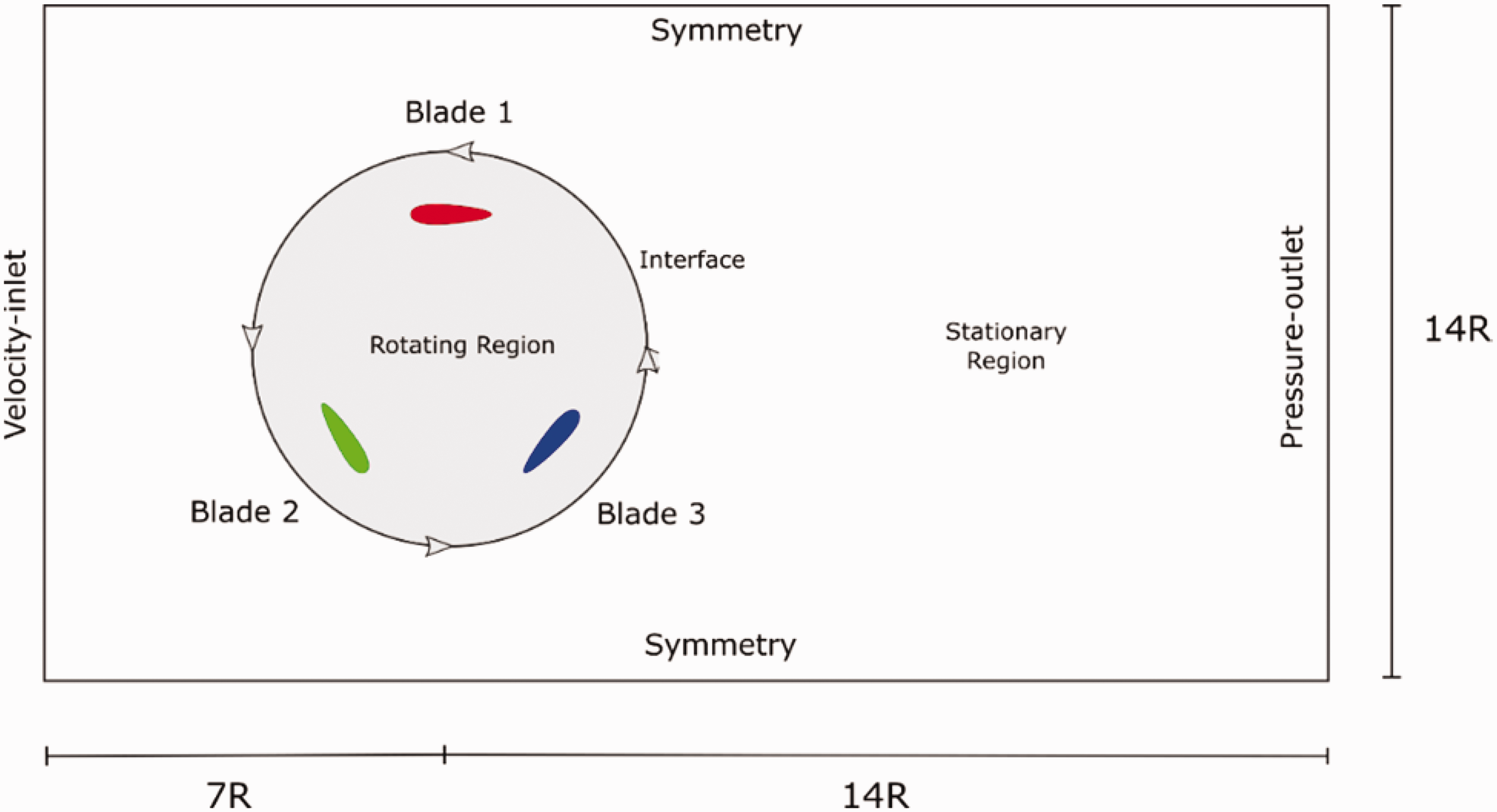
Schematic of the computational domain and boundary conditions.
In the mesh generation step, an unstructured mesh was used, while in the region close to the blades, boundary layer mesh was employed. The parameter y+ is set to be near one by setting the distance from the first node to blade surface equal to 0.00002 m. The number of layers near the blade is set to be 30 with growth ratio of 1.02. The quality of the generated mesh was checked using aspect ratio and skewness factors. An overview of the created mesh is shown in Figure 4 (number of cells was reduced for better presenting the created mesh).

Computational mesh: (a) closed view of rotating region and (b) airfoil.
Mesh and time step independency test
Performing mesh and time step sensitivity test is an important step in the CFD simulation. The quality of generated mesh and the value of time step can alter the numerical results. It should be mentioned that after 9 revolutions of VAWT rotor the steady oscillatory condition is achieved, so the result of last revolution (10th revolution) will be reported in the following sections. The criteria for selecting the converged solution is relative error less than 0.5 percent.
For testing the independency of unsteady numerical results from number of cells number, a study is performed. Four grid resolutions were tested with 1.7, 2.3, 2.6 and 2.9 million cells in the domain. The azimuthal increment,
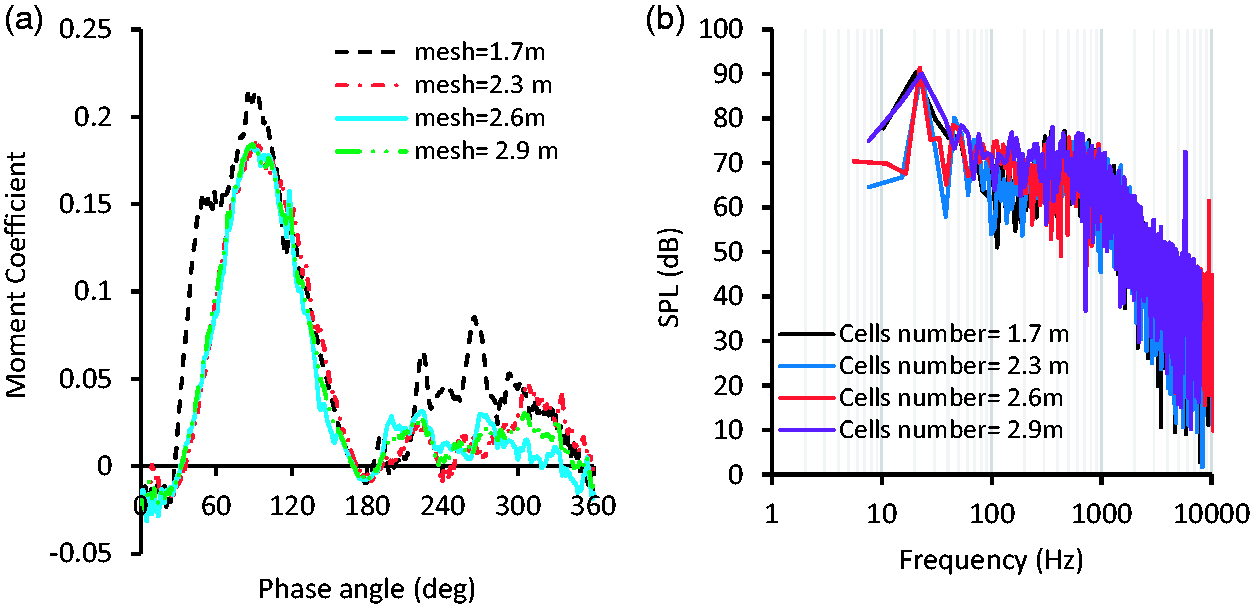
Grid independency test results: (a) instantaneous moment coefficient and (b) sound pressure level spectrum.
At the second stage, four different time steps were selected as

Time step (azimuthal angle) independency test.
Validation against experiment
A study is performed to validate the result of numerical model that is used in the current study. The aerodynamic validation is conduced due to the lack of acoustic experimental data for the reference VAWT, as it was conducted by some researchers.18,21 The experimental data of Castelli et al. 28 is utilized, as it is depicted in Figure 7. The power coefficient at different TSRs is reported while the free-stream velocity is set to be 9 m/s. It can be seen that there is a fairly acceptable agreement between the numerical and experimental results. The maximum error occurs at TSR = 3.3, while at two other TSRs the error is so low. It should be noted that the overprediction of CFD approach is because of ignoring the 3 D effects such as blade tip vortices.
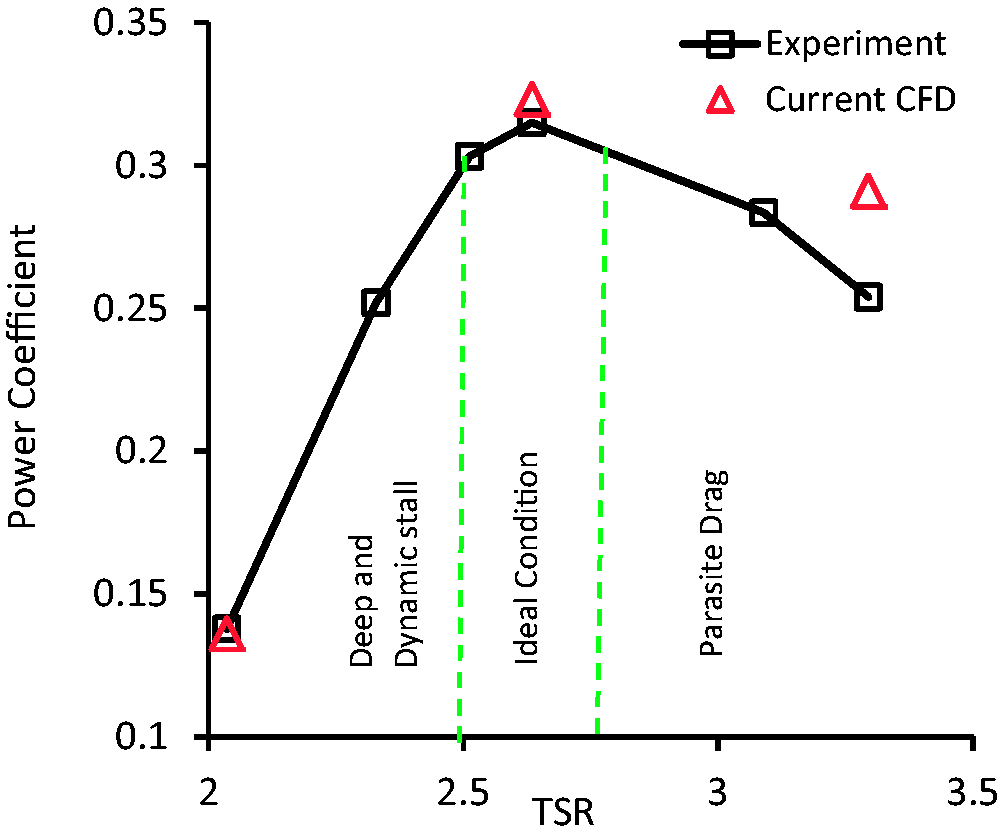
Validation of aerodynamic results with experimental data.
CFD results and discussion
The aerodynamic noise can be generated by three main sources which are loading, thickness and quadrupole sources. The first source is as a result of blade load variation. The second one corresponds to the displacement of fluid as a result of rotor rotation. Finally, the last source is mainly due to the nonlinearities in the flow. The last source can be neglected in low Mach number flows as in the case of wind turbine, while two other sources are mostly dominant. Another classification based on the frequency present the aerodynamic noise as tonal (discrete frequency) and broadband noise. In this study, the tonal noise which can be corresponded to the variation of angle of attack with blade passing frequency (BPF) and the broadband noise corresponds to the boundary layer phenomena such as interaction of turbulent boundary-layer with trailing edge at suction or pressure sides on VAWT blades, separated flow and vortex shedding. Figure 8(a) shows the contribution of quadrupole noise source at TSR = 2.6. The SPL value at BPF frequency of 22 Hz for total noise case is 59.18 dB and for the case of sum of loading and thickness sources is 57.9 dB. The difference is 1.28 dB, 2% percent of the total noise, which corresponding to the quadrupole noise source. It implies that the tonal peak corresponding to quadrupole noise source is at least 7 dB lower than the tonal peak corresponds to sum of loading and thickness noise sources. Comparing the SPL spectrum of the total noise case with the case of sum of loading and thickness noise sources shows the dominant effect of loading and thickness sources at frequencies less than 200 Hz. However, at higher frequencies, the difference of SPL between total noise and sum of loading and thickness noise sources cases increases. For instance, at frequency of 5000 Hz, the difference is about 7.2 dB, which is about 20% of the total noise. It implies that the SPL difference between the cases of quadrupole noise and sum of loading and thickness noise sources is high. This shows the higher order of nonlinearities at high frequencies, due to the influence of turbulent vortex structures in the wake behind the rotor and also due to the turbulent boundary-layer at the trailing edge of airfoils.

Sound pressure level spectrum (a) effect of different noise sources and (b) effect of distance from rotor.
Another important issue to be pointed is the influence of distance from rotor on SPL spectrum. As it is known, distance from noise sources plays a prominent role on the sound sensed by a receiver. It is reported by 18 and 21 that as the distance increases, the SPL value decreases. Figure 8(b) also shows the value of SPL for various distances from rotor center in the range of 2–30 meter. It should be noted that in all cases, the trend of SPL variation with frequency is almost same.
Effect of TSR on aerodynamic and aeroacoustic performance
Effect of tip speed ratio (TSR =

Effect of TSR on (a) blade moment coefficient and (b) SPL spectrum.
Figure 9(b) shows the SPL spectrum for all TSRs. It can be seen that as TSR increases, tonal noise value at BPF frequency also increases. It means that increment in rotor rotational speed will result in higher fluctuation of lift and drag forces on the blades, as it can be seen in Figure 10, and as a result increment in loading noise sources at BPF. For instance, as TSR increases from 2.03 to 2.6 and from 2.6 to 3.3, the tonal noise increases 1.9 dB and 1.3 dB, respectively. It also implies that the slope of increment in tonal noise at BPF decreases as TSR increases.
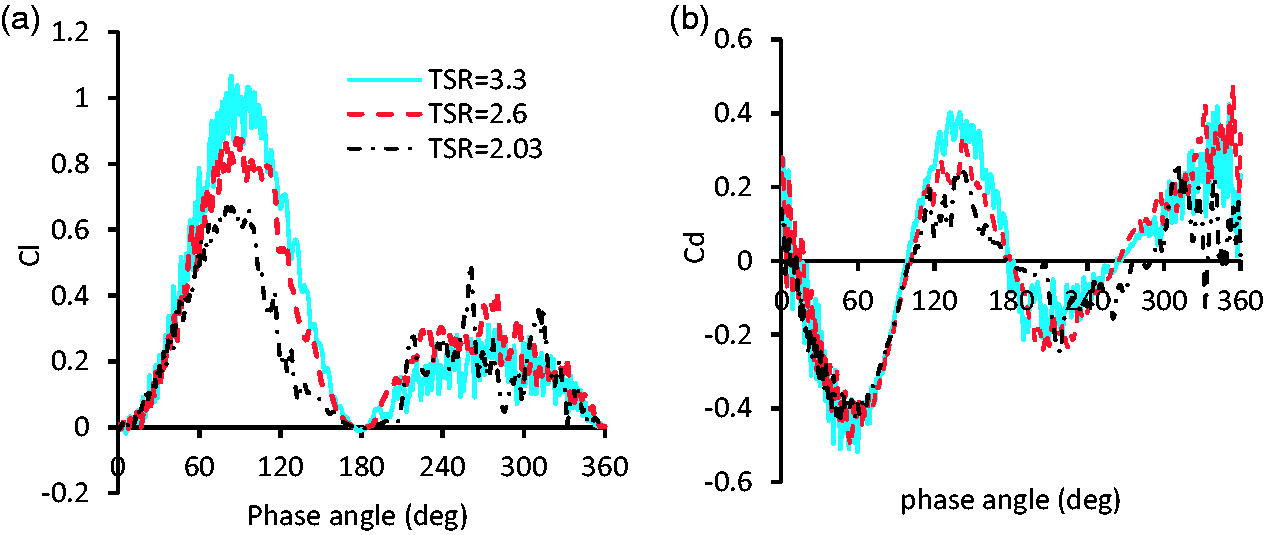
Aerodynamic force coefficient variation at different TSRs.
At
It should be noted that as the TSR decreases, the range of angle of attack variation also increases, which boost the probability of dynamic stall occurrence, as shown in Figure 11. At higher frequencies, increment in TSR parameter mostly will result in more SPL value. This is mainly due to the increment in relative velocity at blades location as a result of rotor rotational velocity increment, which will result in higher force fluctuation due to flow separation and BVI.
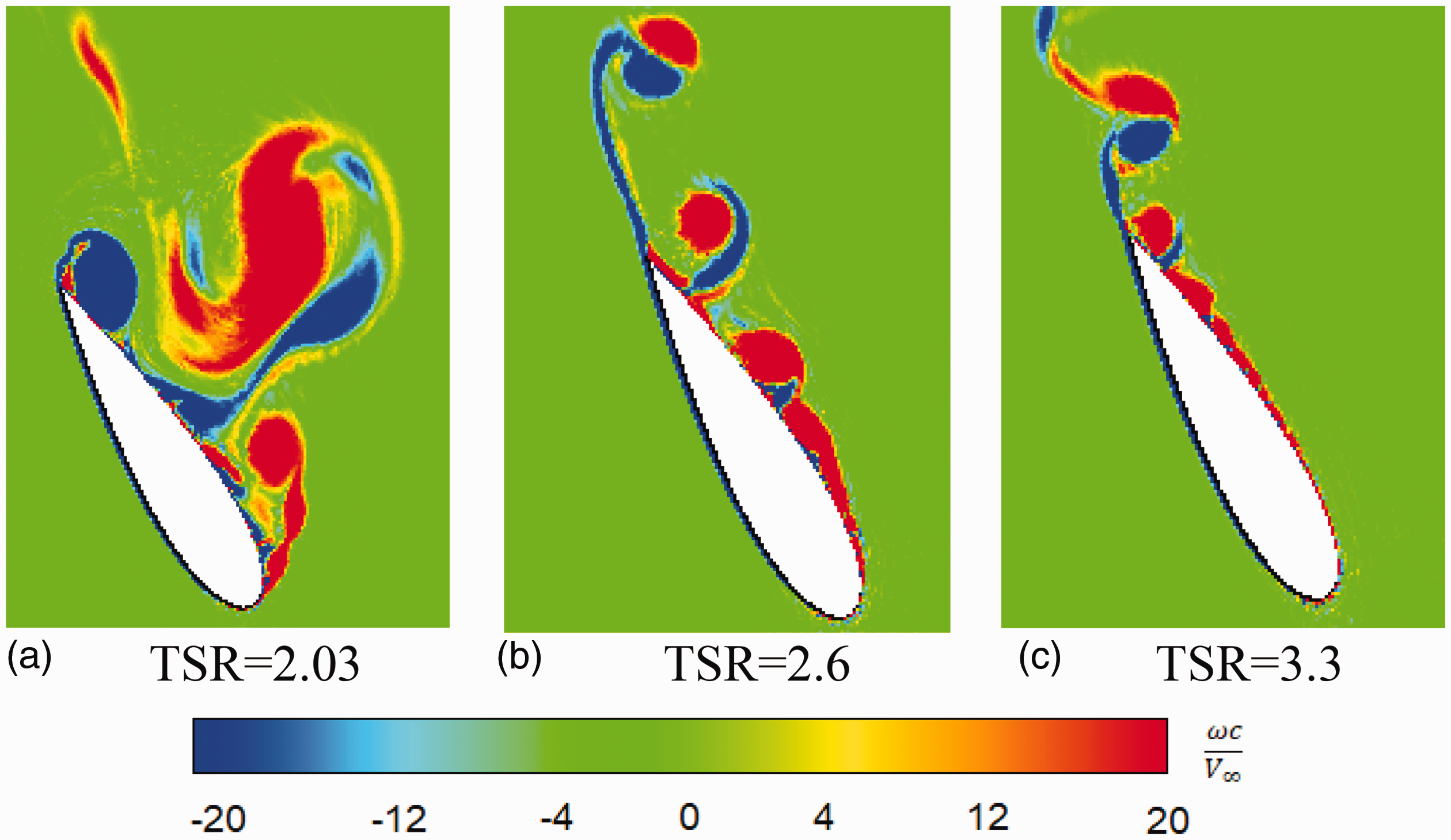
Vorticity contour for different TSRs at phase angle of 120°.
Effect of solidity on aerodynamic performance
The influence of solidity (solidity =
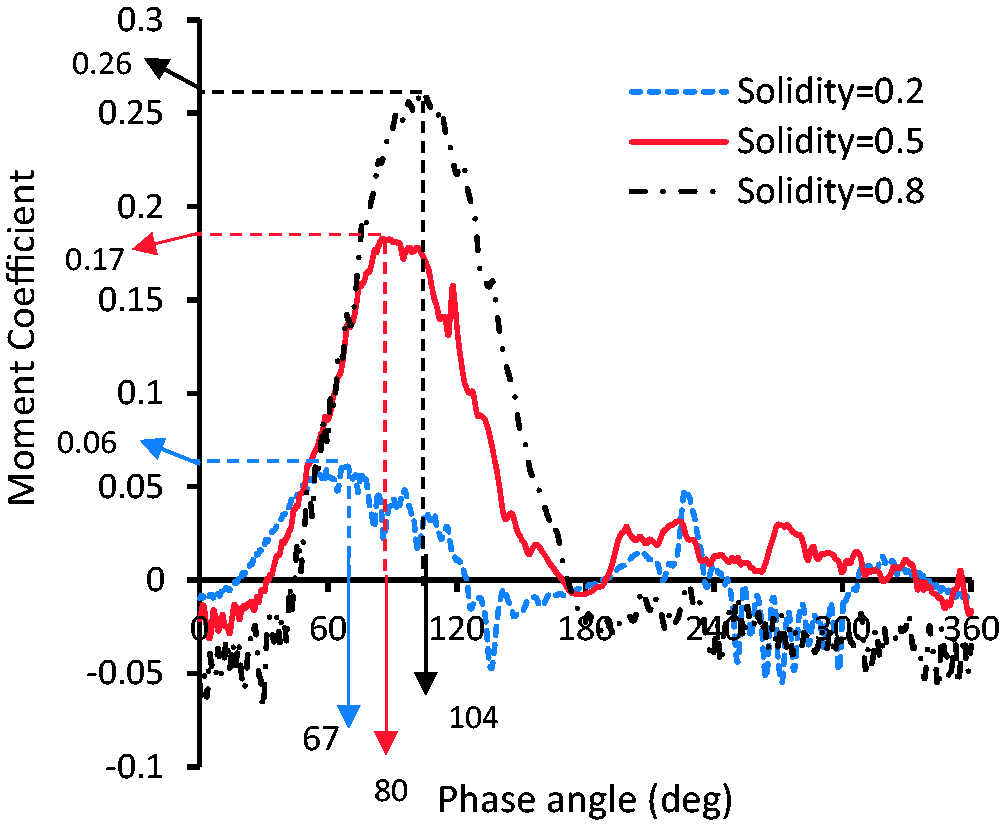
Effect of solidity on moment coefficient of one blade.
In order to show the effect of solidity on the effective angle of attack Figure 13 is presented, which shows the magnitude of vorticity in the flow field near the rotor at four different phase angles,
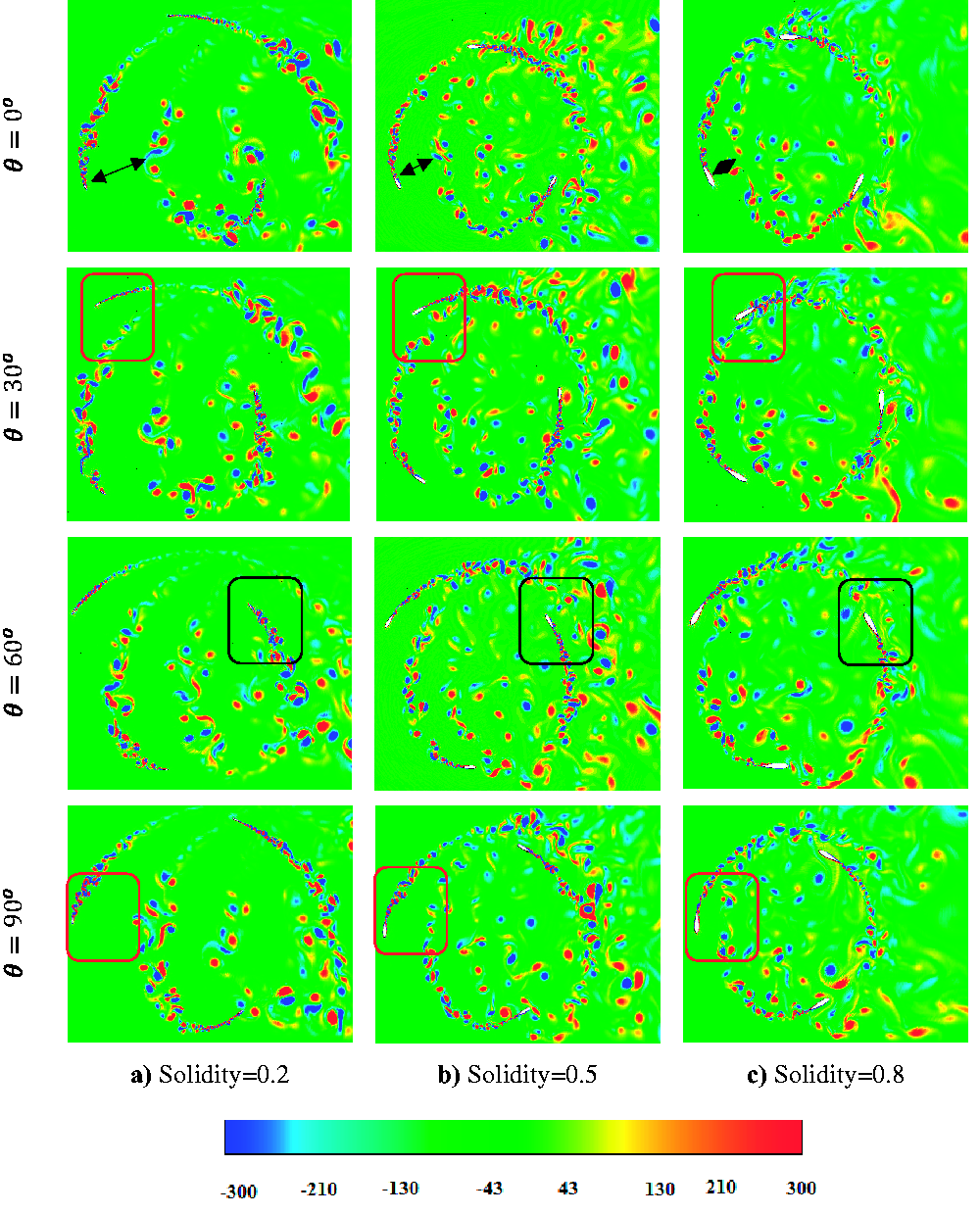
Vorticity contours at different phase angles and solidities.
Table 2 represents averaged value of moment coefficient and power coefficient for all solidities. Results show that the medium solidity, solidity = 0.5, possesses the highest power coefficient with respect to other solidities. The overall performance of a VAWT is important, although the instantaneous value is helpful for power performance improvement studies. The lowest solidity, solidity = 0.2, is not preferred since the overall power coefficient is very low. Comparison between the instantaneous and averaged results for solidity = 0.5 and solidity = 0.8 indicates that although the maximum coefficient of the latter case is more than the other case over 40%, also the performance of the latter case is better at
Averaged moment coefficient and power coefficient at different solidities.
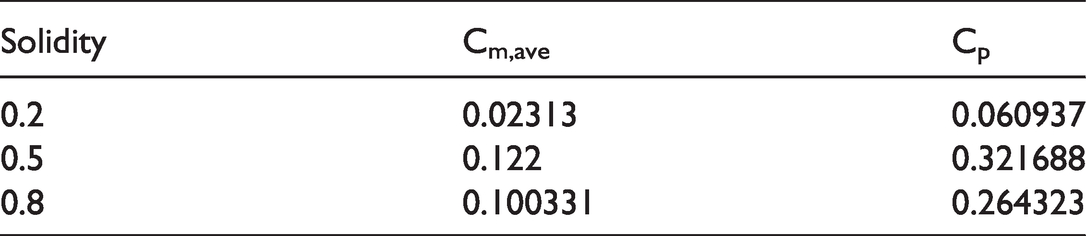
Figure 14 shows the velocity streamline over the blade of VAWT for all solidities, and
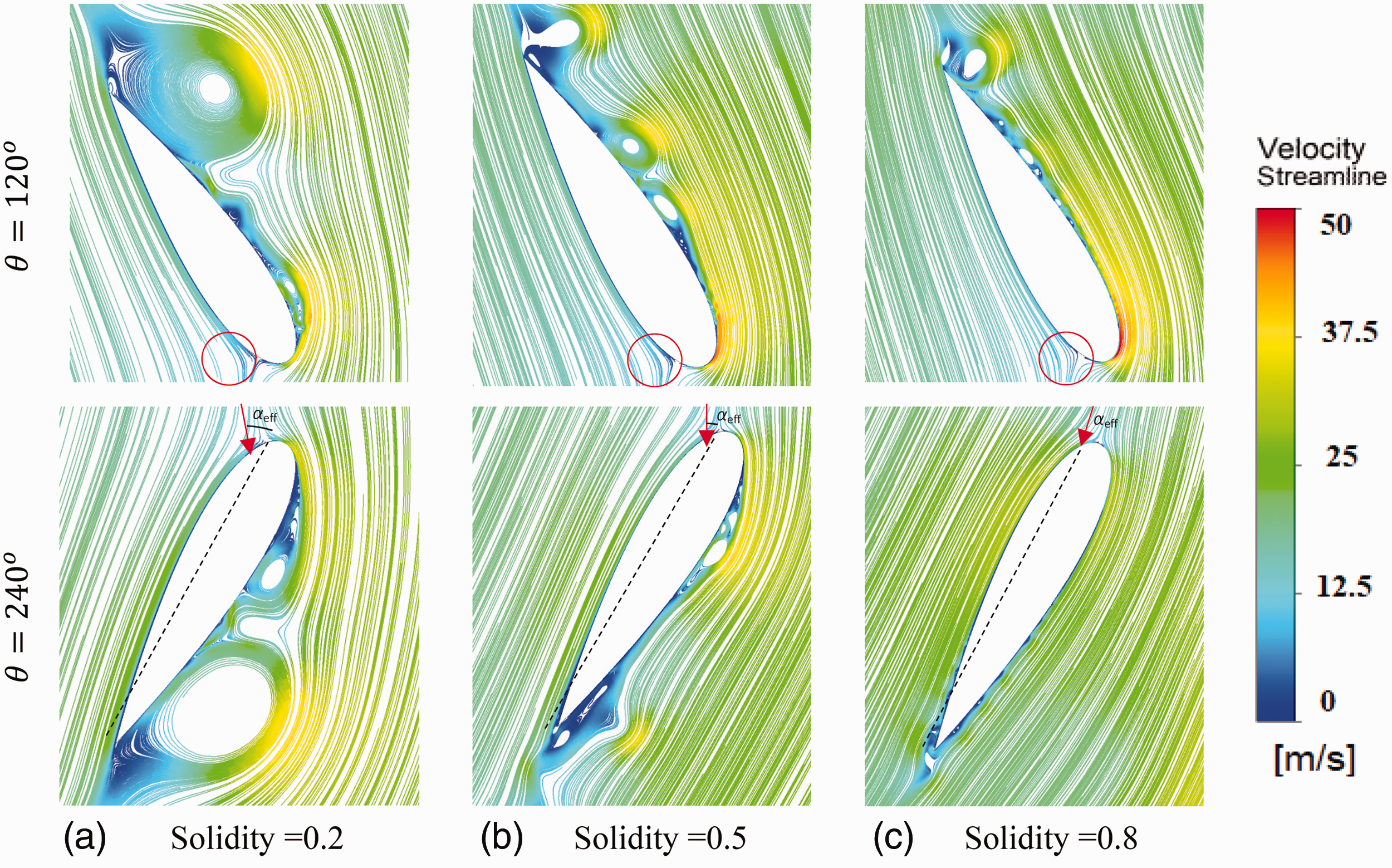
Velocity streamline contours at different solidities and phase angles TSR= 2.6.
Effect of solidity on aeroacoustic performance
Since the change in solidity parameter has a great influence on the VAWT aerodynamic, therefore, the amount of aerodynamic noise generated by the VAWT rotor depends on this parameter. In this section, the effect of this parameter on the aerodynamic noise emitted by the VAWT rotor is investigated. As it is stated, in wind turbine applications, monopole and dipole sources are dominant, due to changes in aerodynamic forces with a change in solidity, it can be concluded that dipole sources are highly influenced as a result of solidity variation. In this section, by using the SPL spectrum, OASPL parameter at different directions, and pressure and vorticity contours over VAWT blades, the effect of this parameter on aeroacoustic of the VAWT will be discussed.
In Figure 15, SPL spectra against narrow band and 1/3-octave frequencies are shown for solidities of 0.2, 0.5 and 0.8 at a distance of 10 m from the center of VAWT rotor in x-direction. The influence of this parameter at BPF is evident. As the solidity increased, the SPL also increased at BPF, which can be explained by greater variations in aerodynamic forces (as shown in Figure 12) with increasing solidity. As a result of increasing solidity from 0.2 to 0.5 and from 0.5 to 0.8, the SPL value changes from 32.8 dB to 49.7 dB and from 49.7 dB to 52.5 dB, respectively. It can be inferred that the rate of increment in SPL value decreases with increasing solidity parameter. Given the nature of broadband noise, a comparison can be made between SPL values at different frequency intervals and solidities. At frequencies below 200 Hz, SPL increases with increasing solidity. At frequencies between 200 and 1800 Hz, there is no particular trend with the change in solidity.
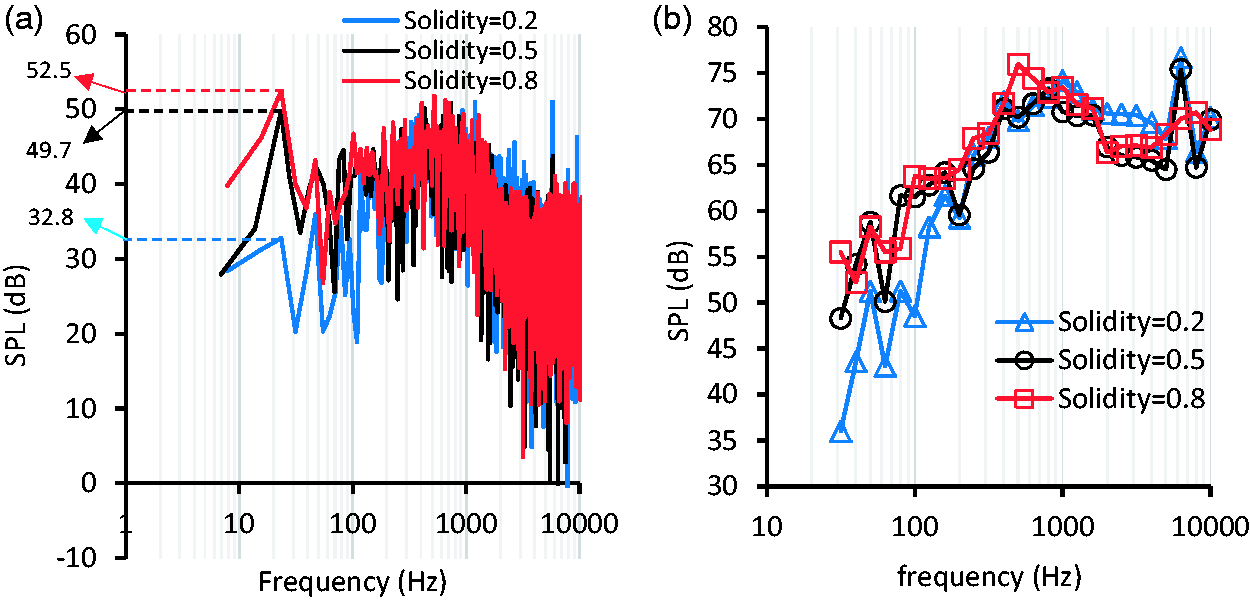
Effect of solidity on SPL spectrum at TSR = 2.6.
At frequencies between 1800 and 4200 Hz, the SPL value at solidity = 0.2 is greater than the other cases, which may be due to the increment in BVI due to the stall phenomenon. For frequencies above 4200 Hz, the SPL value at solidity = 0.8 is higher than other solidities, which is probably due to higher variation in the aerodynamic forces.
One of the important factors that affects the noise perceived by a listener is the distance from the noise source. It was shown in the previous sections that with increasing distance from the VAWT rotor, the OASPL value decreases, which can be justified by the nature of the noise propagation. Another factor that has a significant influence on the amount of noise that is heard by a listener at a constant radius from a VAWT is the location (the phase angle that the receiver is installed) of the listener. Since the noise generated by VAWT is a combination of monopole, dipole, and quadrupole sources, the OASPL distribution at a constant radius is as a result combination of these three sources. According to the portion of each of these sources, different distributions can be achieved. In Figure 16, the OASPL value for all solidities are shown at 30 m from the center of the VAWT rotor with interval of
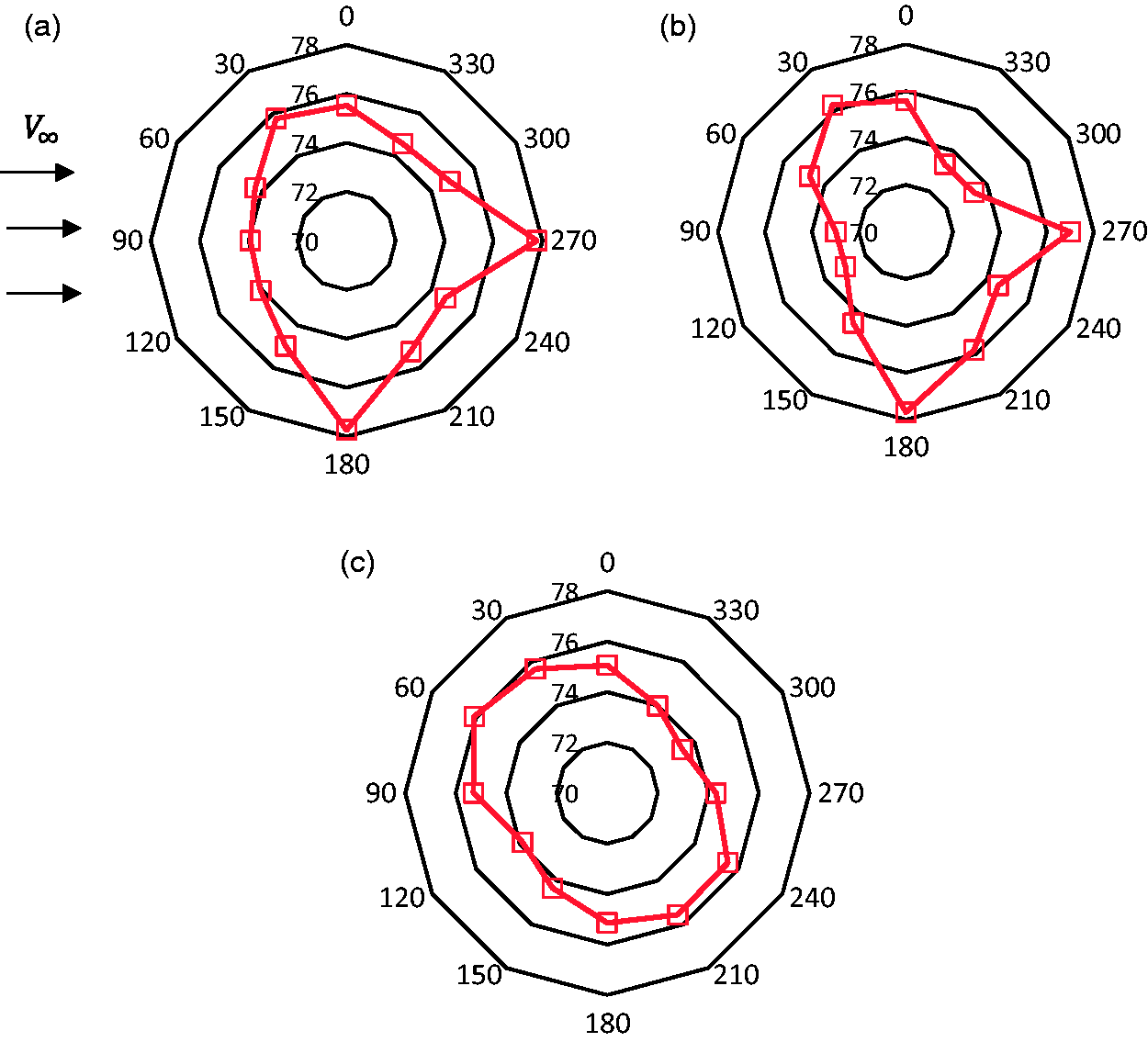
Effect of solidity on OASPL value at different positions (
Influence of solidity on the static pressure distribution on the VAWT blade is shown in Figure 17. For this purpose, three phase angles of 0, 120 and 240° are selected. X/C = 0 represents the leading-edge and X/C = 1 indicates the location of the trailing-edge. In most cases on the suction side of the VAWT blade, severe static pressure fluctuations are seen that cause noise generation, while pressure fluctuations increase with increasing solidity. The reason for these fluctuations attributed to the presence of small vortex structures on suction side of the blades, as it is shown in Figure 14. These small structures near the leading edge are separation bubble which occur as the flow transition from laminar to turbulence happens.29,30 Occurrence of bubble separation will result in generation of tonal noise.31,32 At the phase angle of 0°, on the pressure side also there are strong pressure fluctuations. The most pressure difference between the upper and lower surfaces of the blade occurs in the case of solidity = 0.5. This pressure difference, which is even greater in the leading-edge area, increases the leading-edge noise sources.
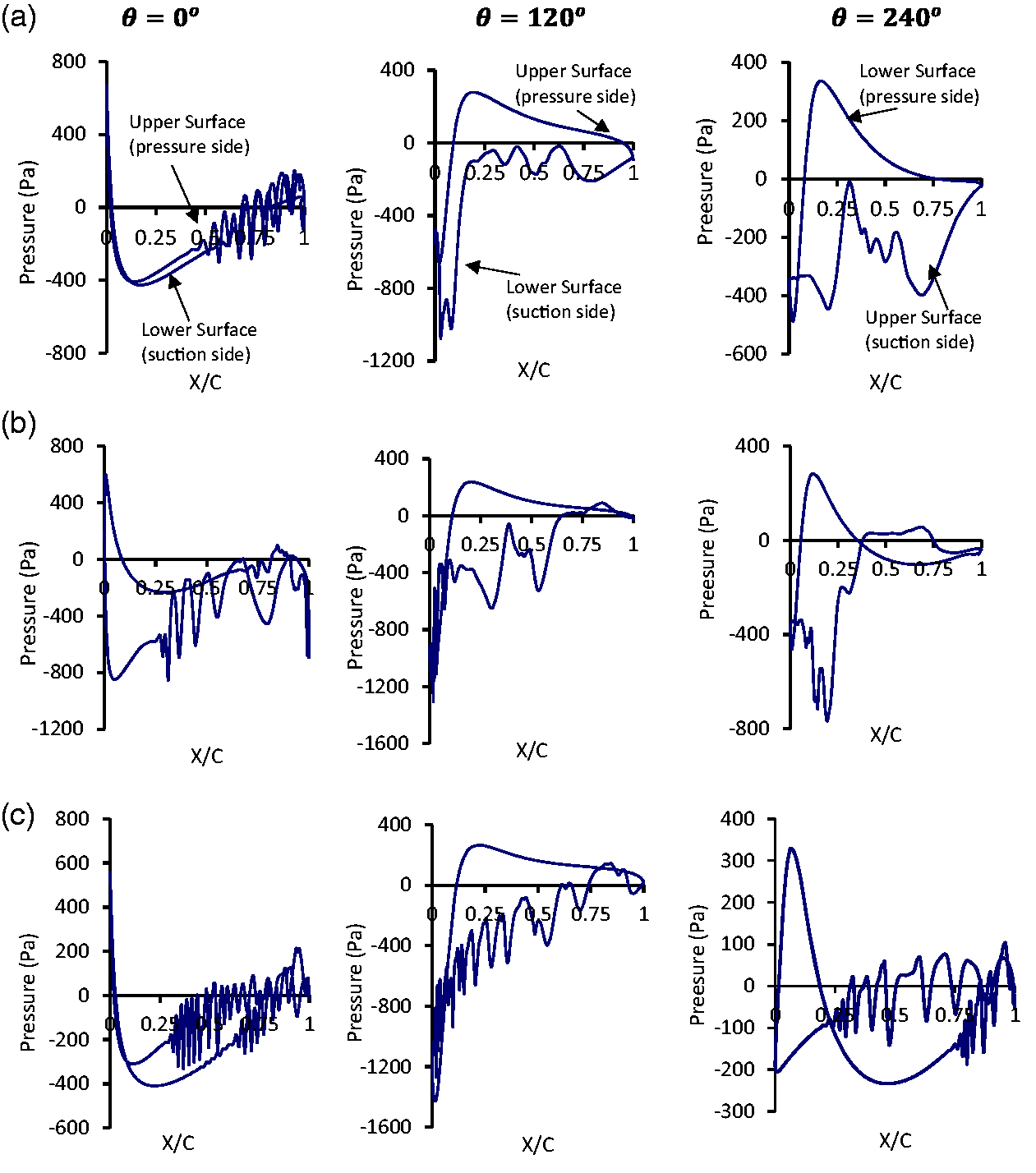
Static pressure distribution over blade surfaces in different phase angles for three solidities.
The pressure and vorticity contours at
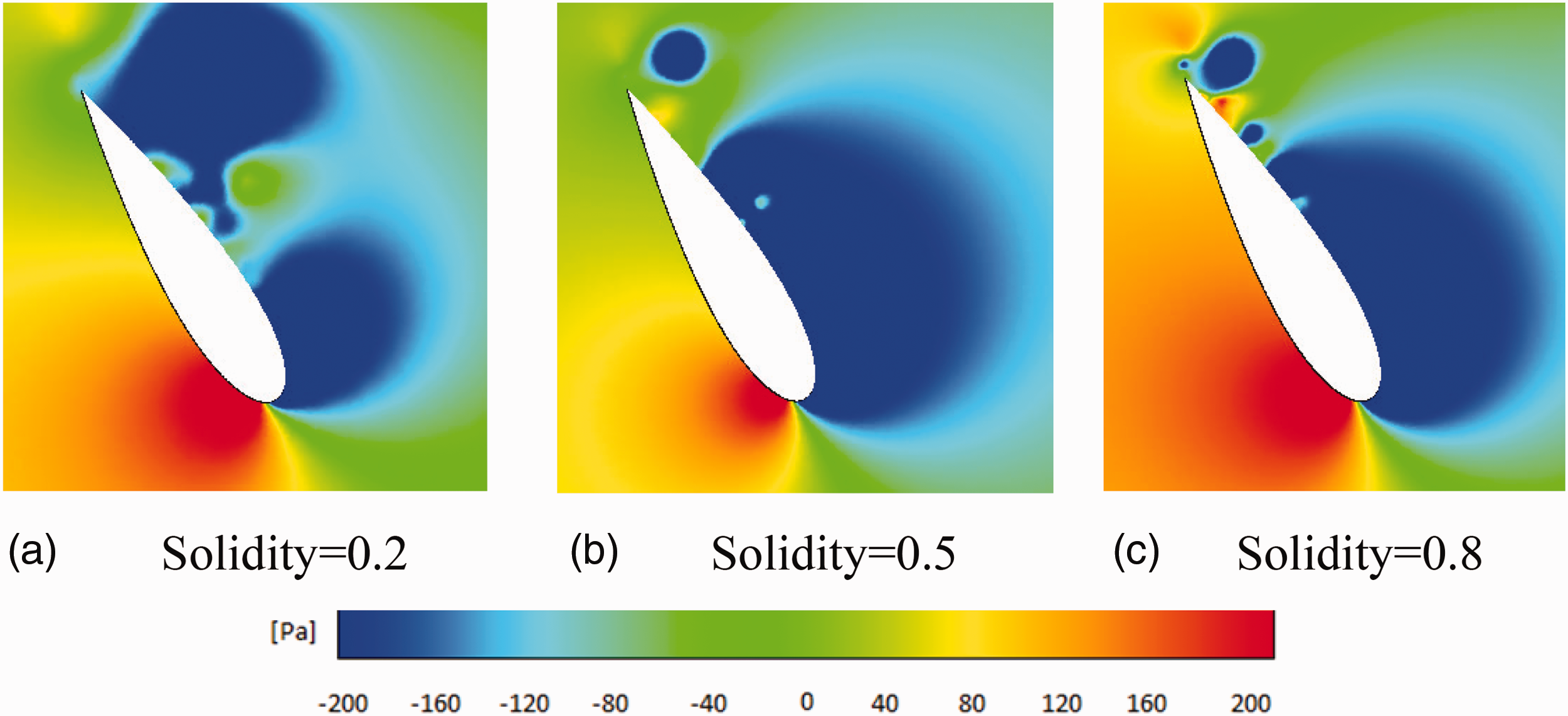
Static pressure contour at different solidities for
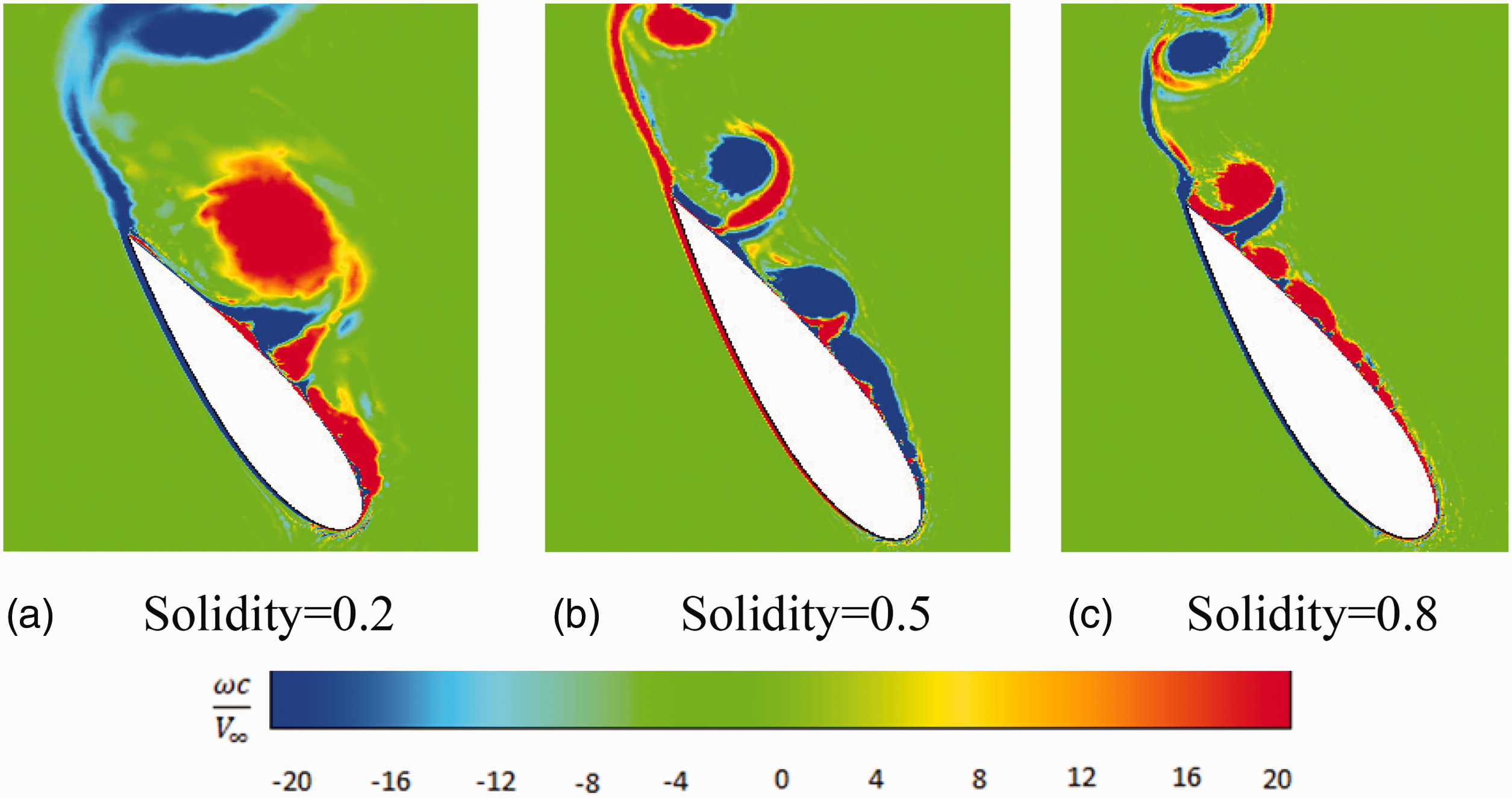
Vorticity contour for different solidities at
Conclusion
Darrieus wind turbines as more applicable VAWT can operate under low wind velocity and can be installed near living environments. Two key factors highly influential in evaluating the performance of a vertical axis wind turbine are power performance and noise level. In the current study, the aerodynamic and aeroacoustic performance of a Darrieus VAWT is investigated with the aim of exploring the effect of parameters in detail. In order to change the solidity while keeping the TSR constant, chord length has been altered. Beside the main study, the effect of TSR on aerodynamic and aeroacoustic performance also has been discussed. A hybrid LES/RANS method is applied for aerodynamic performance prediction. Consequently, based on estimated flow field, the FW-H method is used for noise level computation. The following results are obtained:
TSR is an influential parameter that highly affects the aerodynamic and aeroacoustic performance of the Darrieus VAWT; a moderated TSR is preferred from power performance viewpoint while low TSR condition is required for having a quieter wind turbine. Among three types of noise sources (loading, thickness and quadrupole), in the VAWT application, the loading and thickness parts are dominant. It is shown that the quadrupole sources can be neglected due to the low local Mach number in VAWT application. From aerodynamic view point, the power performance of the VAWT depends highly on the solidity parameter. It is shown that as solidity increases, the interference of blades with the wake region expedites which will result in more reduction of the effective angle of attack. Although the geometry angle of attack does not vary by changing solidity but induced velocity field essentially being different. The change in effective angle of attack has been observed and discussed based on streamline contours over VAWT blades. The reduction in effective angle of attack as a result of increasing the solidity parameter in downwind phase is more sensed. From aeroacoustic point of view, it is shown that as solidity increases, the SPL value at BPF, which attributes to the steady loading noise, increases. Comparison of OASPL values at different azimuth angles shows that the averaged OASPL, which can be calculated by averaging the value of OASPL at different positions, increases as the solidity decreases. Therefore, overally, the low solidity is not preferred.
To sum up, in current research the aerodynamic and aeroacoustic performance of a Darrius VAWT is explored in detail. It reveals that some details in aerodynamic analysis may results in different deductions in the acoustic study; therefore, using precise numerical methods is shown to be essential for aeroacoustic performance investigation. Along with the current study the authors are conducting the investigation of performance assessment for bigger VAWTs at different solidities finding similar or different trends.
Supplemental Material
sj-pdf-1-jae-10.1177_1475472X211003299 - Supplemental material for Effect of solidity on aeroacoustic performance of a vertical axis wind turbine using improved delayed detached eddy simulation
Supplemental material, sj-pdf-1-jae-10.1177_1475472X211003299 for Effect of solidity on aeroacoustic performance of a vertical axis wind turbine using improved delayed detached eddy simulation by Sepehr Rasekh and Saeed Karimian in International Journal of Aeroacoustics
Supplemental Material
sj-pdf-2-jae-10.1177_1475472X211003299 - Supplemental material for Effect of solidity on aeroacoustic performance of a vertical axis wind turbine using improved delayed detached eddy simulation
Supplemental material, sj-pdf-2-jae-10.1177_1475472X211003299 for Effect of solidity on aeroacoustic performance of a vertical axis wind turbine using improved delayed detached eddy simulation by Sepehr Rasekh and Saeed Karimian in International Journal of Aeroacoustics
Footnotes
Declaration of conflicting interests
The author(s) declared no potential conflicts of interest with respect to the research, authorship, and/or publication of this article.
Funding
The author(s) received no financial support for the research, authorship, and/or publication of this article.

References
Supplementary Material
Please find the following supplemental material available below.
For Open Access articles published under a Creative Commons License, all supplemental material carries the same license as the article it is associated with.
For non-Open Access articles published, all supplemental material carries a non-exclusive license, and permission requests for re-use of supplemental material or any part of supplemental material shall be sent directly to the copyright owner as specified in the copyright notice associated with the article.
