



Abstract
The present study experimentally investigates the aerodynamic noise from the flow around cylinders of square and equilateral triangle cross-sections at different angles of incidence (α). The cylinder models have a side dimension of 10 mm and a span of 300 mm. The free stream velocity (U 0 ) is in the range of 12–36 m/s, and the corresponding Reynolds numbers are 7.8 × 10³ to 2.3 × 10⁴, which is in the subcritical flow regime. The characteristic acoustic tones are generated at α = 30° and 45° for square and triangular cylinders. The frequency of acoustic tones linearly increases with the free stream velocity, and the corresponding Strouhal numbers are found to be in the range of 0.13–0.16. Depending on the angle of incidence, the overall sound pressure level is higher than the background noise by 4–24 dB for the square cylinder and 3–15 dB for the triangular cylinder at U 0 = 36 m/s. The highest noise level of the square cylinder is 90 dB at α = 45° and 79 dB at α = 30° for the triangular cylinder. The spectral scaling with the sixth power of the free stream velocity indicates the dipole behaviour of the acoustic tones. The mean and root-mean-square velocity profiles in the wake region characterise the noise emissions at different angles of incidence. The comparative acoustic study of the non-circular cylinders with a circular counterpart showed that the highest noise level is from the square cylinder at α = 45°. The directivity study shows that the noise level of the square cylinder at α = 45° at 90° angular location (θ) is higher by 6.5 dB than that at θ = 30°.
Introduction
The aerodynamic noise from the circular and non-circular cylinders has drawn interest owing to the wide range of practical applications. The flow mechanisms of these cylindrical bodies are widely studied, but the subsequent noise generation phenomenon attracts further attention. The aeroacoustic applications of cylindrical bodies are found in aircraft landing gears, parts of automobiles and high-speed trains, building architectures, columns of windmills and bridges, flame holders, etc.1,2 The noise generated from the flow over bluff objects in practical situations has detrimental effects on operational speed, human comfort level, efforts to curb noise pollution, and so on. The influence of solid surface on the aerodynamic noise generation was first studied by Curle 3 by developing Lighthill’s theory4,5 and showed that the noise radiated is proportional to the sixth power of the flow velocity. The vortex shedding from flow encountering slender bodies generates acoustic tones known as aeolian tones. Many seminal works6–8 studied the characteristics of aeolian tones from the circular cylinder and their dependence on flow mechanisms. The shape of the body greatly influences the vortex shedding characteristics. Non-circular cylinders, such as square and triangular cylinders, have sharp edges from where flow separates and forms the vortices. Also, unlike the circular cylinder, the orientation of the non-circular cylinder to the flow direction is significant since it alters the flow patterns around the cylinder. The laminar to turbulent transition in a flow past cylinder depends on the Reynolds number (Re), which further influences the flow structures, including the wake dynamics. The range of Reynolds numbers from 300 to 1.3 × 10⁵, where the flow remains laminar in the boundary layer and turbulent instabilities begin in the separated shear layers, is known as the subcritical regime.9,10 The recent research works11,12 focus on noise mitigation methods for quieter applications; hence the flow and acoustic studies on fundamental problems provide a better understanding.
Flow and acoustic studies in square cylinders
Flow past a square cylinder and associated phenomena are one of the benchmark problems in aerodynamics. Unlike circular cylinders, the sharp edges of the square cylinder and their orientation to the free stream flow strongly influence the boundary layer growth, separation, vortex shedding, and wake flow patterns. The surface pressure fluctuations and lift correlations of a square cylinder were experimentally studied by Vickery 13 at different angles of incidence for Reynolds numbers in the range of 4 × 10⁴ to 1.6 × 10⁵. In spectra of lift fluctuations, the major portion of the energy is concentrated about the frequency corresponding to the vortex shedding. The percentage energy within the 2% bandwidth of the shedding frequency decreases with an increase in the angle of incidence. Igarashi 14 carried out an experimental investigation of characteristics of flow around a square cylinder in subcritical Reynolds numbers from 3.85 × 10³ to 7.7 × 10⁴ for different angles of incidence. The main observations are (a) wedge-type flow at 0°–10°, (b) reattachment flow with separation bubble at 10°–30°, (c) asymmetric flow with perfect separation at 32°–40° and (d) symmetric flow with perfect separation at 40°–45°. The flow parameters, including the vortex shedding frequency, strongly depend on the angle of incidence, and above 16 m/s, the Strouhal number remains constant in the range of 0.13–0.15, depending on the angle of incidence. Ozgoren 15 experimentally characterized flow parameters behind circular and square cylinders in the Reynolds number range of 5.5 × 10² to 3.4 × 10³ with the digital particle image velocimetry (DPIV) technique. The Strouhal number for the square cylinder is found to be 0.13 for the normal position and 0.17 for the 45° oriented position. The square cylinder has a wider wake region with large-scale vortices near the rear side of the cylinder. An outward shifting of the vortex centreline is observed in the square cylinder wake with a higher concentration of small-scale vortices. Dutta et al.16,17 have experimentally investigated the influence of square cylinder orientations on the wake characteristics. The flow visualisation and hot-wire measurements at intermediate Reynolds numbers from 1.34 × 10³ to 9.99 × 10³ showed the increase in wake size accompanied by a smaller effective length scale of the shed vortex with an increase in the angle of incidence. 16 A detailed study with the particle image velocimetry (PIV) at Re = 410 showed that the drag is minimum at 22.5° due to the wake asymmetry and higher flow three-dimensionality. 17 Besides the angle of inclination, the wake properties are also a function of the cylinder aspect ratio. The transition of the vortex shedding from two-to three-dimensional at the beginning of the subcritical regime takes place through the formation of instabilities in the wake flow. Thompson et al. 18 have studied the wake instabilities of a circular cylinder for Reynolds numbers up to 300. The study shows that the mode-A instability, which appears first at Re = 180, is characterised by the regular vortex shedding with a spanwise wavelength of three times the diameter. The instabilities become the mode-B at Re = 230, which is more irregular in the spanwise direction with a wavelength of one diameter. In addition to the Reynolds number, the three-dimensional instabilities in non-circular cylinders are influenced by the angle of incidence.19,20 The characteristics of the wake behind the square cylinder with variation in the incidence angle are numerically studied by Sheard et al. 21 at a Reynolds number of 300. The incidence angle controls the transition of flow to three-dimensional through instabilities. The mode-A instability is observed in the incidence angle range of 0°–12° and 26°–45°, and mode-C instability is observed in the incidence angle range of 12°–26°, which has a spanwise wavelength of two times the diameter. At zero angle of incidence, quasi-instability similar to mode-A and mode-B is observed at the cylinder wake. The numerical study by Oka and Ishihara 22 at the Reynolds number of 104 showed that the aerodynamic and pressure coefficients of square prism vary with the angle of incidence and have a peak near 14° angle of incidence. The change in primary frequencies of drag and lift fluctuations is dependent on the transition of the wake flow with the angle of incidence. The numerical study of flow past a square cylinder inclined to the free stream flow in the laminar regime (Re ≤ 150) by Yoon et al. 23 showed that the flow field is greatly influenced by the separation point, which is controlled by the angle of incidence. Depending on the Reynolds number and angle of incidence, three wake flow patterns, namely main separation, vortex merging, and steady, are observed. Flow stability analysis indicated that symmetric configurations have mode-A instability and asymmetric configurations have mode-C instability. The experimental investigation by Yen and Yang 24 in the Reynolds number range of 4 × 10³ to 3.6 × 10⁴ showed that the flow past a square cylinder has three modes near the downside face, namely, leading edge separation, separation bubble and attached where the first and third modes are observed at lower and higher angles of incidence respectively. The aerodynamic coefficients became optima in the range of 12°–15° angle of incidence. Hutcheson and Brooks 25 have studied the noise generation from flow over various cylindrical configurations in the Reynolds number range of 3.8 × 10³ to 105. Experiments on the square bar showed a large tone corresponding to the vortex shedding frequency along with two harmonics, and the peak sound pressure level (SPL) is 6 dB higher than the base circular cylinder. The Strouhal number is in the range of 0.12–0.13, and the peak SPL varies with the sixth power of the flow Mach number. The experimental work by Fujita 26 at the Reynolds number of 1.8 × 10⁴ showed a strong dependence of wake fluctuations on the aeolian tones from cylinders of different cross-sections. A recent computational work by Jacob and Bhattacharya 27 studied the aerodynamic noise from circular and non-circular cylinders with the large eddy simulation (LES) approach at the Reynolds number of 1.98 × 10⁴. The solutions with the sound correction method predicted the aerodynamic noise characteristics, including the dipole nature, from long cylinders in subcritical Reynolds numbers. A comparison showed that the square cylinder has the maximum force coefficient and noise level.
In addition to the noise studies solely from the flow past square cylinders, numerous works have also been carried out on square cylinders of various other configurations, which are described in brief. Moreau and Doolan 28 experimentally investigated the flow-induced noise from a wall-mounted cylinder with circular and square cross sections in the range of Reynolds numbers from 1.6 × 10⁴ to 2.4 × 10⁴ and observed that the aspect ratio influences the noise generation significantly. The experimental investigation by Porteous et al. 29 at the Reynolds number of 1.4 × 10⁴ reported four vortex shedding regimes with a progressively higher number of tonal components when the aspect ratio is changed from 0.29 to 23. The effect of boundary layer thickness on the noise generation from finite wall-mounted cylinders at Re = 2 × 10⁴ is experimentally studied by Porteous et al. 30 A critical aspect ratio of 8.8 is observed, beyond which the sound level decreases with an increase in the boundary layer thickness. Samion et al. 31 have numerically investigated the use of a downstream wedge for passive noise control in a square cylinder at the Reynolds number of 2.2 × 10⁴ using the 2D unsteady Reynolds averaged Navier-Stokes (URANS) flow model and Curle’s acoustic analogy. Two flow regimes depending on the gap distance (G) between the cylinder and wedge were identified. Regime 1 has sound reduction up to 12 dB at G = 2D, and Regime 2 has a higher sound magnitude than a single-cylinder till G = 6D. The effects of wake modifications are studied for passive noise control in a square cylinder. The vortex shedding and the corresponding tonal noise can be controlled by placing wedges, 31 splitter plates, 32 and detached plates33,34 in the wake region.
Flow and acoustic studies in triangular cylinders
The works on the flow past triangular cylinders are scarce, and some significant studies are discussed. Similar to the square cylinder, the flow separation points of the triangular cylinder are fixed because of the sharp edges. An experimental study of El-Sherbiny 35 on flow past a prism of a right triangle cross-section at Re = 105 showed that the flow separation and the point of reattachment depended on the angle of incidence. At this point, shear layer separation controls the wake width and hence the vortex shedding frequency. Numerical and experimental analyses of the flow past a triangular flame holder are performed by Johansson et al. 36 at the Reynolds number of 4.5 × 10⁴. The unsteady vortex shedding in the wake strongly affected the momentum fluctuations, and it has a frequency corresponding to the Strouhal number of 0.25. De and Dalal 37 have numerically studied the laminar flow past a triangular cylinder at low Reynolds numbers (Re ≤ 250). They have noted the similarity between square and triangular cylinders in the vortex shedding mechanism. A flapping motion of the shear layer near the separation point is observed at Re = 250. The wake flow becomes more and more disorganized with an increase in the Reynolds number. Camarri et al. 38 have studied flow over a finite length wall-mounted triangular prism at the Reynolds number of 104 and observed lateral vortex shedding at a frequency corresponding to the Strouhal number of 0.15. A low-frequency vertical fluctuation of vortices from the free end is also found at one-third of the mean Strouhal number. An experimental study by Iungo and Buresti 39 on the effect of wind direction on aerodynamic characteristics of a vertical triangular prism at Re = 1.2 × 10⁵ showed that the wake structure is significantly altered with the angle of the free stream flow. The vortex shedding and associated fluctuating force signals depend on the wake width and the flow orientation. Agrwal et al. 40 have studied the wake patterns of a triangular cylinder of various apex angles at Reynolds number 520. The wake of the 60° apex angle cylinder has two stronger recirculation bubbles with longer recirculation and vortex formation lengths. The corresponding Strouhal number is found to be 0.198.
The past literature shows a considerable quantity of work in the noise studies of flow past non-circular cylinders, especially square cylinders in the subcritical range of Reynolds numbers over the years.25–34 However, noise studies on the flow past triangular cylinders are scarce, albeit a few flow studies are reported in the literature. In addition, the noise emissions from these cylinders at different orientations are a major lacuna in the literature that is addressed in the current paper. The noise generated from the flow past cylinders of square and equilateral triangle cross-sections under subcritical conditions with negligible compressibility effects is experimentally investigated. The subcritical Reynolds numbers considered in the experiments are up to 2.3 × 10⁴, and the corresponding flow velocities are of interest in many practical scenarios. The present work primarily explores the effects of an angle of incidence of square and triangular cylinders on aerodynamic noise generation. Since the flow characteristics are strongly influenced by the angle of incidence, as reported in the previous literature, the associated aerodynamic noise radiation phenomena need further analysis. The work is divided into three sections. The first and second sections discuss the flow and aerodynamic noise from the square and triangular cylinders, respectively. The third section depicts a comparison of noise emissions from square and triangular cylinders. The aeroacoustic characteristics of non-circular cylinders are comprehensively explained with acoustic and velocity fluctuations spectra, wake velocity profiles, sound pressure levels, and directivity patterns.
Experimental methodology
Test facility
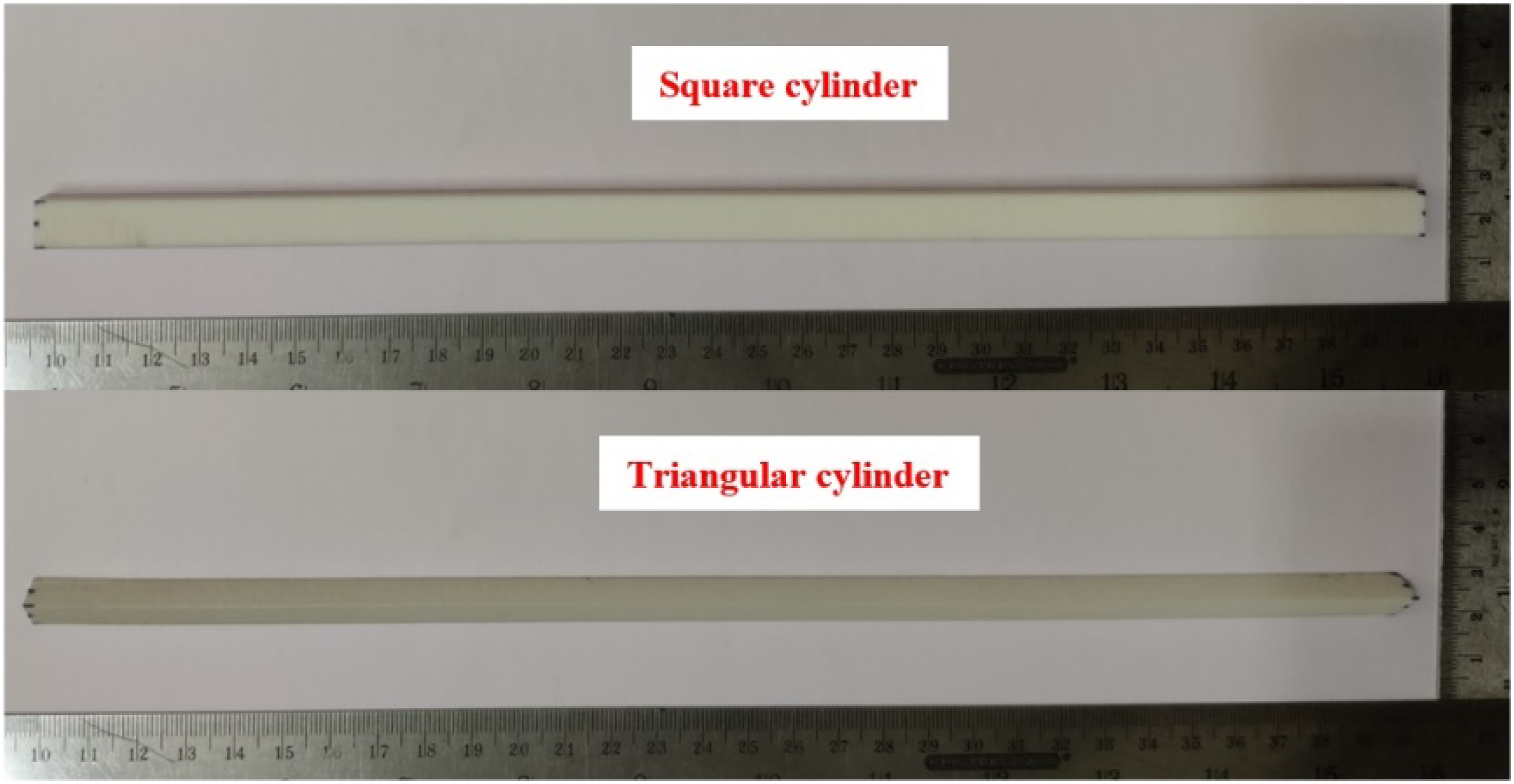
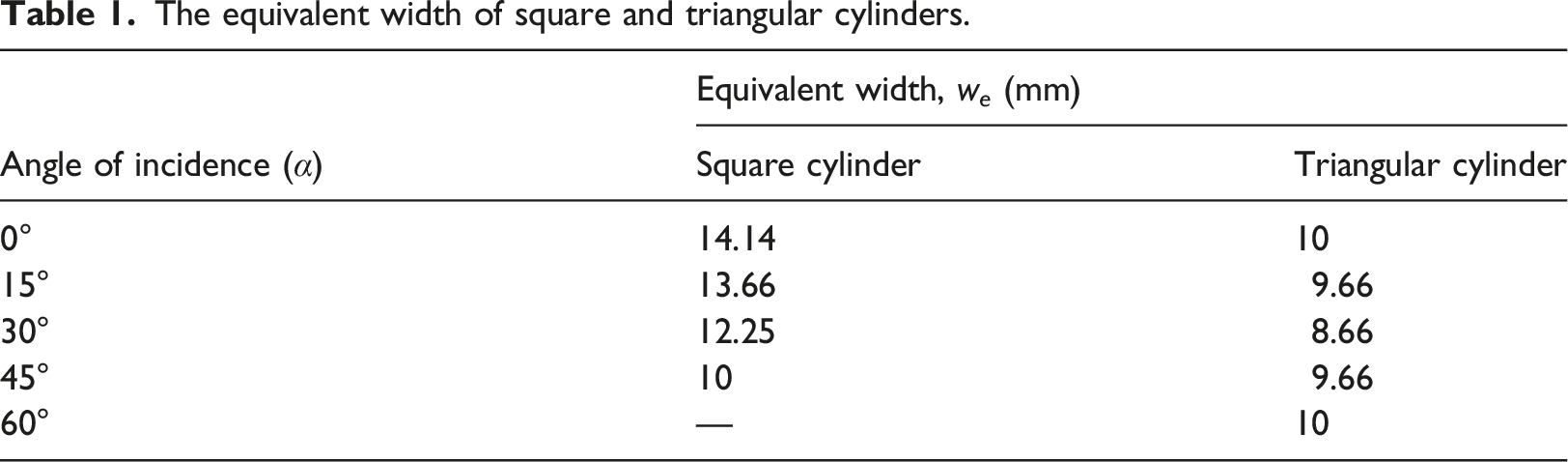
The acoustic measurements are carried out inside a semi-anechoic chamber. The chamber walls are pasted with wedges made of polyurethane foam to create a non-reflective acoustic field (Figure 1). The inner dimensions of the chamber are 3 m × 3 m × 3 m with a wedge tip-to-tip distance of 2.6 m. The cut-off frequency of the chamber is 300 Hz, above which an acoustic free field is created. The chamber houses an open-jet wind tunnel facility powered by a 10 HP centrifugal air blower. The duct connecting the blower to the chamber is coated with an acoustic liner to minimize external disturbances. A cubic contoured rectangular nozzle having exit dimensions of 20 cm width and 8 cm height (H) is used to obtain the uniform free jet flow. A mesh and honeycomb structure is placed behind the nozzle inlet in the air duct to minimize the free stream turbulence at the nozzle exit. A variable frequency drive unit is used to control the free jet velocity at the nozzle exit, and a maximum velocity of 40 m/s can be achieved in the test section. The cylinder models used for the experimental study are shown in Figure 2. The square and triangular cylinder models are fabricated by 3D printing with PLA (poly lactic acid) material and are finished by the grinding process to get a smooth surface. Square and triangular cylinders of 10 mm sides are used for the experimental study. The span of the cylinder remains constant at 300 mm for the cylinder models considered. The cross-sectional area of the non-circular cylinder facing the upstream flow varies with the angle of incidence. Hence an equivalent width (w
e
) is defined, which is the projected length of the cylinder in the vertical direction. The equivalent width of square and triangular cylinders is summarized in Table 1. (a) Photograph and (b) schematic diagram of the experimental setup. Test models used for the experimental study. The equivalent width of square and triangular cylinders.
Experimental procedure
The cylinder model is mounted in front of the nozzle, supported on both ends by acrylic sheets, as shown in Figure 1. These side plates ensure the two-dimensionality of the flow as well as minimize the interference by the free jet turbulence and thereby improving the acoustic measurements.26,41 The cylinder models are placed at a distance of x/H = 0.625 from the nozzle exit and within the potential core region of −0.46 ≤ y/H ≤0.46 of the jet. A free-field ¼ inch condenser microphone (PCB378C01) with a sensitivity of 2.0 mV/Pa is used for the acoustic measurements. The microphone is positioned at a distance of 60 cm from the center of the cylinder model to acquire the acoustic data. The directivity measurements are taken by rotating the traverse arm on which the microphone is mounted about the cylinder axis, as shown in Figure 1(a). The angular position of the microphone (θ), which is measured with reference to the downstream jet direction, is varied from 30° to 105°, and the 90° angular position represents the point directly above the cylinder. Noise data is acquired through a data acquisition system (NI PCI 6143) for one second at a sampling rate of 150 kSa/s. The data acquisition is repeated 6–8 times for each measurement. LABVIEW software is used for the data acquisition, and post-processing of the data is performed with MATLAB software. The Fast Fourier Transform with a bin size of 4096 is used for the spectral calculations, and the corresponding frequency resolution is 36.6 Hz. The orientation of square and triangular cylinders with respect to the direction of the free stream jet flow defines the angle of incidence (α), and it is varied by rotating the cylinder model about its spanwise axis (Figure 3). In the present experimental study, the angle of incidence is varied from 0° to 45° for the square cylinder and from 0° to 60° for the triangular cylinder. The symmetric orientations about the horizontal axis for square and triangular cylinders are avoided because of the measurement repeatability. The free stream velocity (U
0
) is varied in the range of 12–36 m/s, and the corresponding Reynolds number is in the range of 7.8 × 10³ to 2.3 × 10⁴, which is within the subcritical flow regime for a cylinder. The wake flow characteristics of square and triangular cylinders are measured with a one-dimensional hot-wire anemometer (Dantec Dynamics MiniCTA system). The hot-wire probe is positioned in the wake region at a distance (L) of 2w from the cylinder center and is traversed in the vertical direction, as shown in Figure 4. The velocity fluctuations are recorded at a sampling rate of 5 kHz at an interval of Δy = 2 mm. The hot-wire measurements are taken at 14.5 m/s free stream velocity, and the corresponding Re is in the subcritical range. MATLAB software is used for the post-processing of the acquired velocity data. Schematic showing the angle of incidence for (a) square and (b) triangular cylinders. Diagram is not to scale. Schematic of the hot-wire anemometer measurement grid. Diagram is not to scale.

The acoustic measurements showed that the overall sound pressure level is repeatable within ±1 dB for each trial. The ambient temperature inside the chamber varies within ±1°C during the course of experiments. The linear and angular positioning of the microphone has uncertainties of ±1 mm and ±1°, respectively. The flow velocity measurements are accurate within ±2.5% for the pitot-static probe digital anemometer used. The noise emissions from the flow past cylinders at different velocities are compared with the corresponding free jet noise (known as background noise). The background noise shows a maximum variation within ±3 dB along different angular locations and velocities. The free stream turbulence is measured with the hot-wire anemometer, and the turbulent intensity is found to be less than 1.5% at the nozzle exit and test section.
Results and discussion
Aeroacoustic studies in square cylinder
Figure 5 shows the acoustic spectra of the square cylinder at angles of incidence from 0° to 45° for free stream velocities in the range of 15–36 m/s. The acoustic spectra correspond to a microphone placed vertically above the cylinder (θ = 90°). It is observed that the spectral characteristics of the noise generated are strongly influenced by the angle of incidence. The spectra have dominant tonal components at 30° and 45° angles of incidence (Figure 5(c)&d) in the velocity range considered. But at the lower angles of 0° and 15°, as shown in Figure 5(a)&b, the spectra have wideband variations. It is noted that the power spectral density level of the noise increases with the free stream velocity, where the rise in the spectral level is predominant in the lower frequency range. The dominant tonal components in the acoustic spectra are due to the spanwise uniform and coherent vortex shedding behind the cylinder. The frequency of the tonal peaks, which is also known as the aeolian tone, is the same as the frequency at which vortices are shed from the cylinder into the wake region.26,43,46 Hence the generation of acoustic tones at higher angles of incidence is due to the organised vortex shedding at these orientations of the square cylinder. The frequency of the tonal peaks observed in Figure 5(c)&d increases with the free stream velocity since the vortex shedding frequency increases with the flow velocity. At 36 m/s, the tonal peaks observed has frequencies of 476 and 440 Hz at 30° and 45° angles of incidence, respectively. The wideband spectral variations at lower angles (α = 0° and 15°) of the square cylinder are attributed to the absence of uniform vortex shedding. The edge of the cylinder faces the upstream flow at α = 0° and 15°, and the flow separates from the edges at the rear side, which leads to a wider wake with small-scale flow structures. Further, the orientation of the square cylinder at α = 0° has a more aerodynamic shape, enabling smooth flow around the edges, resulting in a less turbulent wake region. This implies that as the square cylinder is rotated from 0° to 45°, the vortex shedding becomes uniform, the wake becomes more turbulent, and the corresponding noise becomes tonal. The spectral characteristics of the aerodynamic noise are further explained with hot-wire anemometer measurements of the velocity fluctuations in the wake region. Figure 6 shows the velocity spectra of the square cylinder at different angles of incidence at U
0
= 14.5 m/s. The hot-wire probe position is at y/w = +0.4 in the wake region. Similar to the acoustic spectra in Figure 5, the spectral variations of velocity fluctuations have peak tonal components at α = 30° and 45° and wideband components at α = 0° and 15°. This indicates the organised vortex shedding at higher angles of incidence of the square cylinder, which leads to the generation of acoustic tones. Acoustic spectra of the square cylinder at an angle of incidence of (a) α = 0°, (b) α = 15°, (c) α = 30° and (d) α = 45°. Spectra of velocity fluctuations for the square cylinder at U
0
= 14.5 m/s, y/w = +0.4 and L/w = 2
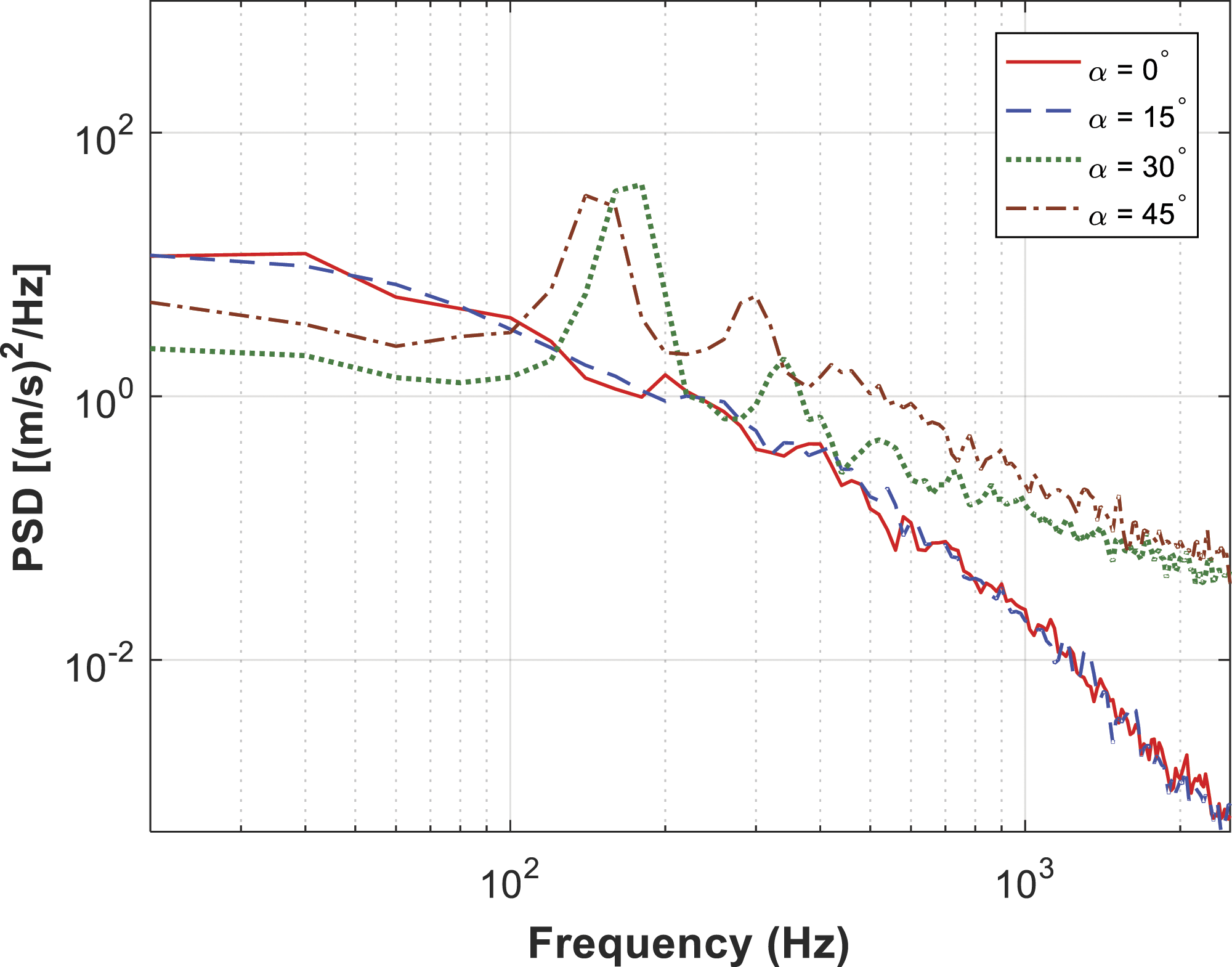
Figure 7 shows the comparison of acoustic spectra at different angles of incidence for the square cylinder at 36 m/s. The background noise spectrum under the same conditions is also included. The spectra show the disturbance to the background flow by the square cylinder and the subsequent rise in the noise level at the angles of incidence considered. It is noted that the effect of the square cylinder in the flow field is mainly up to 6 kHz, and beyond that, the deviation of the cylinder noise spectra from the background spectrum is negligible. In the case of acoustic tone generation, a significant amount of acoustic energy and noise is concentrated in the narrowband of tonal components. Since the power spectral density level is highest for the tonal peak at α = 45°, as shown in Figure 7, the corresponding noise level will be higher compared to the other orientations of the square cylinder. The spectral variations at lower angles (0° and 15°) are found to be approximately similar, and the corresponding noise levels will be lower due to the absence of peak tones. Figure 8 shows the mean and root-mean-square (RMS) velocity profiles in the wake region of the square cylinder at L = 2w for different angles of incidence at U
0
= 14.5 m/s. The flow separates at the edges of the square cylinder, and separation points shift downstream with a decrease in the angle of incidence. Fig. 8(a) shows that within −1.2 ≤ y/w ≤ 1.2, the mean velocity at α = 0° and 15° are lower, indicating a wider wake region. This could be due to the increase in the equivalent width (w
e
) with a decrease in the angle of incidence, as listed in Table 1. It is in line with the previous literature15–17 that the length scale of the separated shear layers decreases with an increase in the angle of incidence. The RMS component of the fluctuating velocity (Figure 8(b)) indicates the turbulence levels in the wake region. In the near-wake of −0.5 ≤ y/w ≤ 0.5, the average turbulent intensity levels at higher angles (α = 30° and 45°) are around 8.1%, and that at lower angles (α = 0° and 15°) are around 7.2%. Acoustic spectra of the square cylinder at U
0
= 36 m/s. (a) Mean and (b) RMS velocity profiles of the square cylinder at different angles of incidence at U
0
= 14.5 m/s and L/w = 2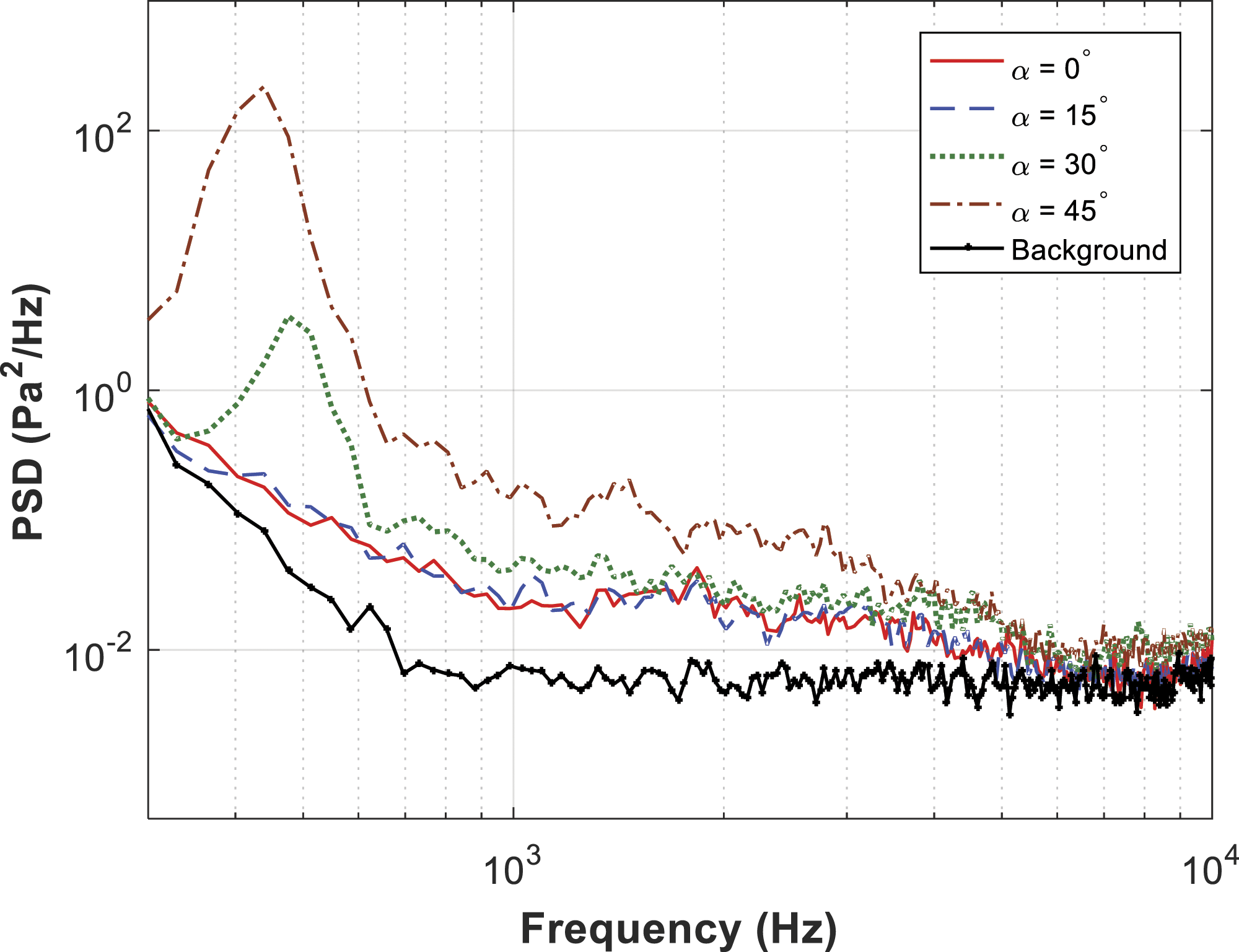

The pressure fluctuations at the solid surface when it encounters the flow have a dipole distribution, and the noise radiated from dipole acoustic sources varies with the sixth power of the flow velocity.
3
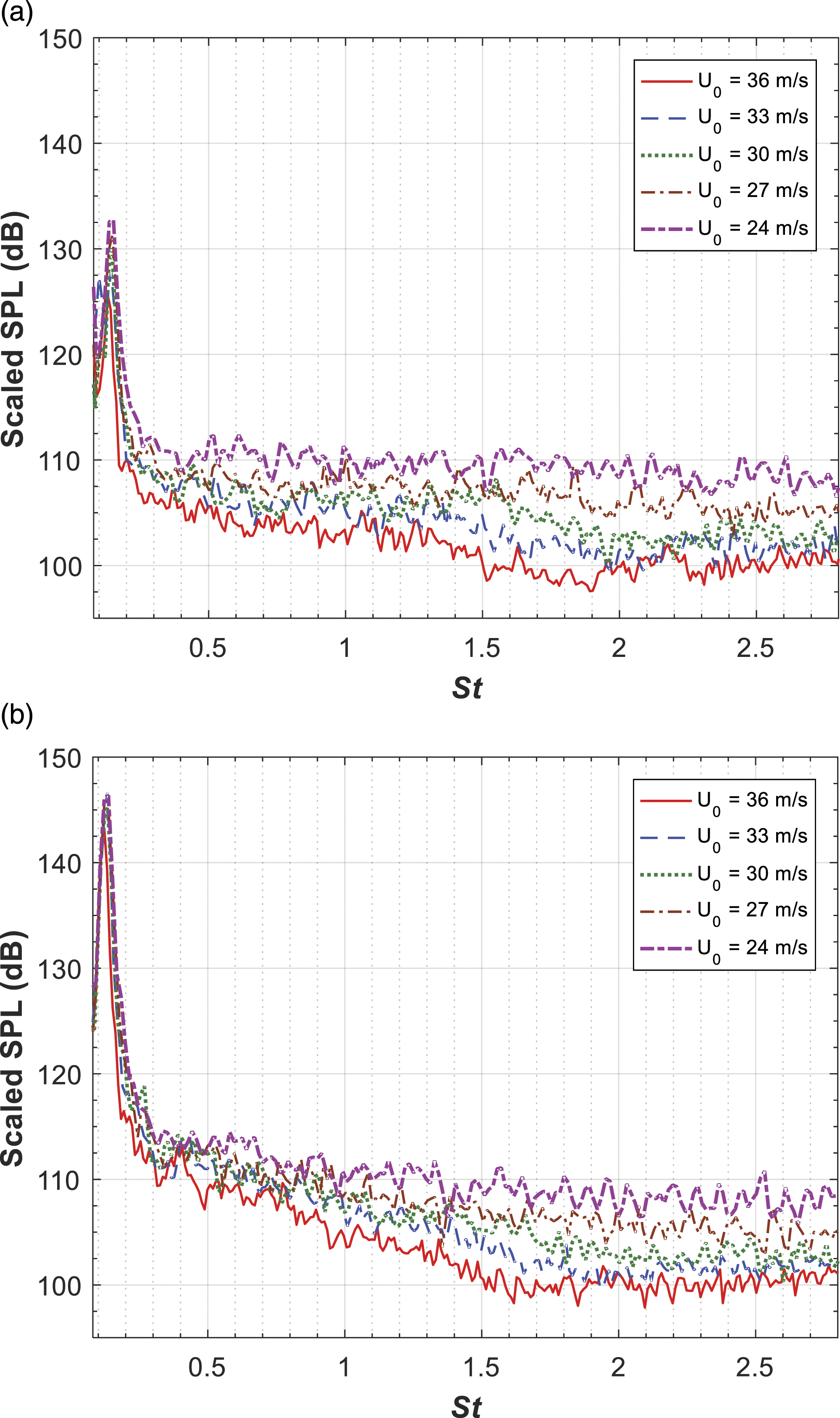
This is verified by scaling the spectral amplitude of the noise generated to the sixth power of the free stream velocity using Eqn. 1:
28
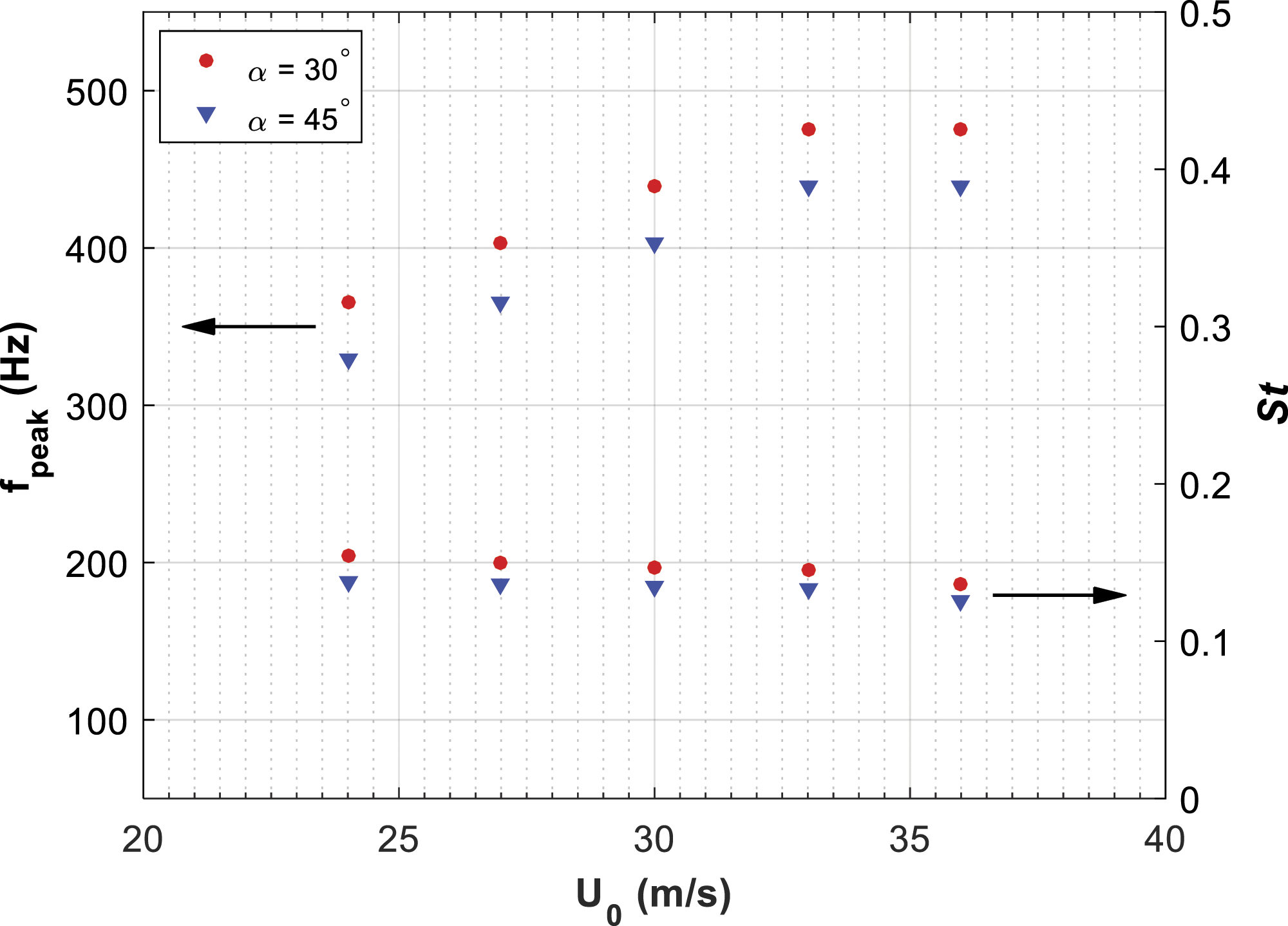
Scaled acoustic spectra of the square cylinder at the angle of incidence of (a) 30° and (b) 45°. Variation of peak frequency and Strouhal number with free stream velocity for the square cylinder at different angles of incidence. Comparison of Strouhal numbers based on cylinder side (St) and equivalent width (St
e
).

The overall sound pressure level (OASPL) is calculated in the range of 0.3–10 kHz from the acoustic spectra (Figure 5). Figure 11 shows the OASPL variation of the square cylinder with free stream velocity at different angles of incidence. The noise level of the background flow under the same conditions is also included. The OASPL variation shows that the aerodynamic noise generated from the square cylinder becomes significantly higher than the corresponding background noise beyond a free stream velocity of 18 m/s, which indicates smaller disturbances in the flow field by the cylinder at lower velocities. Generally, the noise level is observed to be larger at higher free stream velocities at all angles of incidence. The OASPL is found to be 4–24 dB higher than the corresponding background noise level at U
0
= 36 m/s, depending on the angle of incidence. And at this free stream velocity, the highest OASPL observed is around 90 dB at α = 45°, and the lowest OASPL is around 69 dB at α = 0°. The influence of peak tonal components (Figure 5(c)&d) in the overall noise is observed in Figure 11, where the noise level at 30° and 45° angles of incidence are significantly higher compared to that at two other orientations of the square cylinder due to the generation of peak tones. The sound pressure level analysis shows the strong dependence of the noise level on the cylinder orientation, where the OASPL increases with an increase in the angle of incidence from 0° to 45°. This variation is intriguing since it indicates an inherent noise suppression mechanism in the square cylinder wherein the noise level can be controlled by adjusting the orientation of the cylinder to the incoming fluid stream. A theoretical variation corresponding to the sixth power of the free stream velocity is shown in Figure 11 as a dotted line along with the OASPL curves. The slope of the OASPL curve at α ≈ 30o - 45° closely follows the sixth power dependence on the flow velocity. The reason for this behaviour can be depicted from Figure 9, where the major noise contribution at 30° and 45° is from the peak tones whose SPL has the sixth power velocity dependence. At the remaining angles of incidence, the slope is found to be less than that of the theoretical line. This could be due to the contributions from other flow features, such as spanwise variation in the vortex shedding and near-wake effects,6,43,44 as their spectral variations at these incidence angles are found to be wideband (Figure 5(a)&b). Variation of the overall sound pressure level with free stream velocity for the square cylinder at different angles of incidence.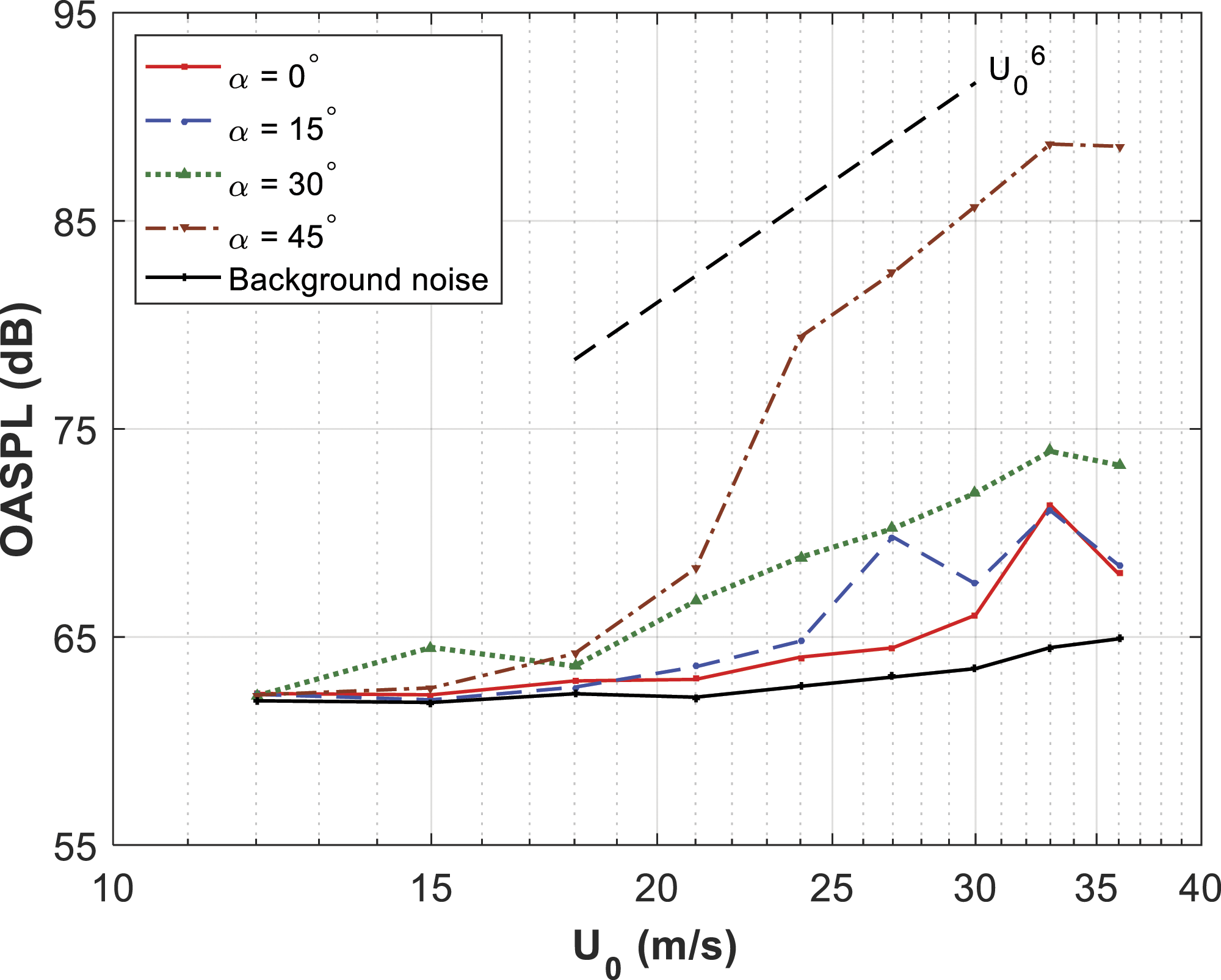
Aeroacoustic studies in triangular cylinder
Figure 12 shows the acoustic spectra of the triangular cylinder at angles of incidence from 0° to 60° in the range of 15–36 m/s free stream velocity. The acoustic spectra correspond to a microphone placed vertically above the cylinder (θ = 90°). Similar to the case of the square cylinder, the spectral characteristics of the triangular cylinder have tonal and wideband variations depending on the angle of incidence. Tonal components are observed at all angles except at 60°. It is noted that stronger tones are generated at α = 30° and 45° (Figure 12(c)&d), while acoustic tones at α = 0° and 15° (Figure 12(a)&b) are weaker. Hence three different spectral regimes (wideband, lower, and higher tonal) are identified in the case of the triangular cylinder with respect to its orientation. The spectral level of the tonal and wideband noise increases with an increase in the free stream velocity, mainly in the lower frequencies, which indicates the rise in the noise level. It is noted that the frequency of the acoustic tones (Figure 12(c)&d), which are generated due to the organised vortex shedding from the cylinder, increases with an increase in the free stream velocity. For instance, the peak tones at 30° and 45° have frequencies of 550 and 440 Hz, respectively, at 36 m/s free stream velocity. Further, hot-wire measurements are taken behind the triangular cylinder since the aerodynamic noise at different orientations is closely associated with the wake properties. Figure 13 shows the velocity spectra of the triangular cylinder at U
0
= 14.5 m/s when the hot-wire probe is at y/w = +0.4 in the wake region. It is observed that the spectral variations of velocity fluctuations have peak tonal components at all angles of incidence except at 60°. This is in concurrence with the acoustic spectra of the triangular cylinder (Figure 12). Hence the spectral variations of velocity fluctuations in the wake indicate the role of vortex shedding in the generation of acoustic tones at certain angles of incidence. Acoustic spectra of the triangular cylinder at the angle of incidence of (a) α = 0°, (b) α = 15°, (c) α = 30°, (d) α = 45° and (e) α = 60°. Spectra of velocity fluctuations for the triangular cylinder at U
0
= 14.5 m/s, y/w = +0.4 and L/w = 2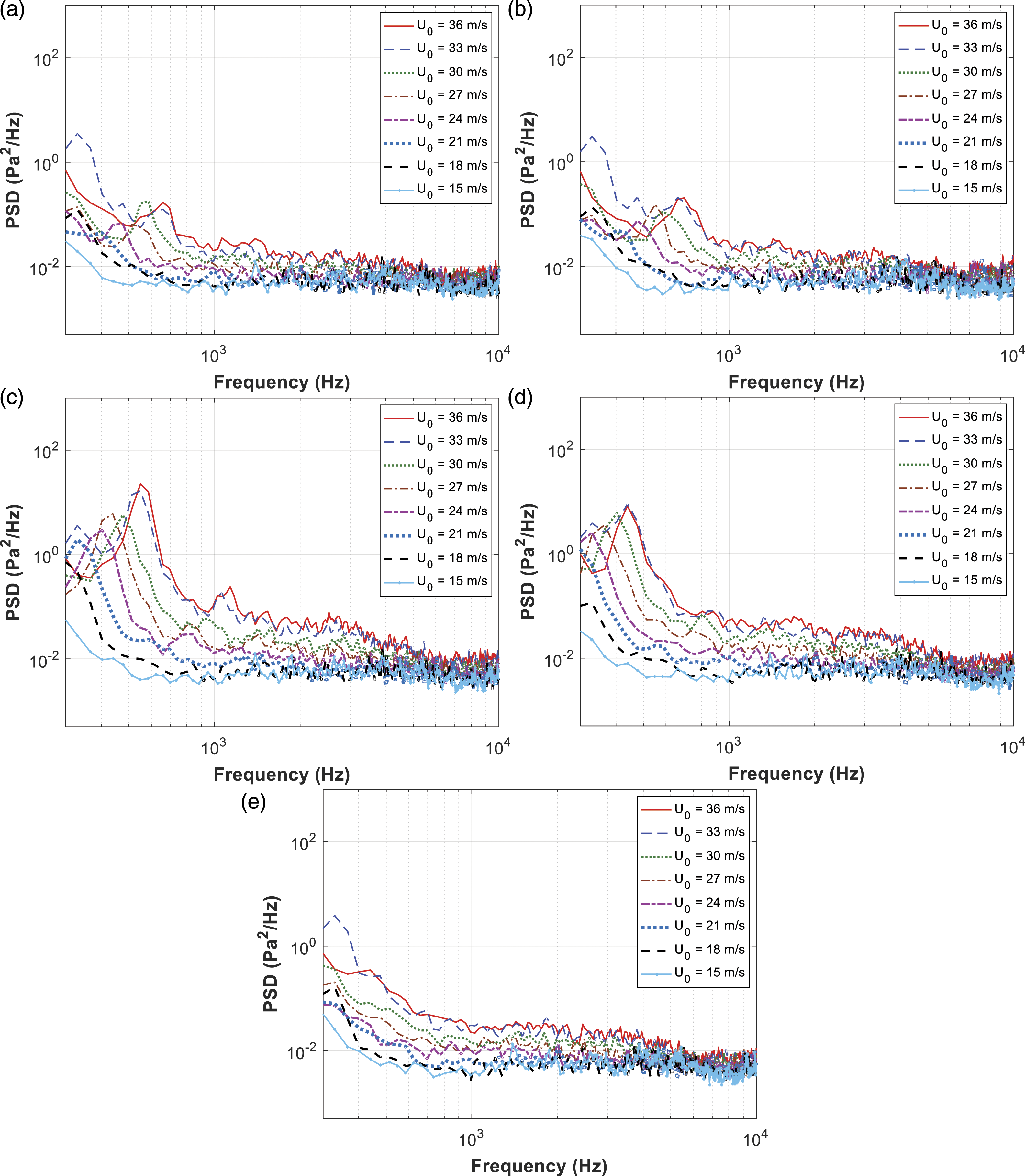
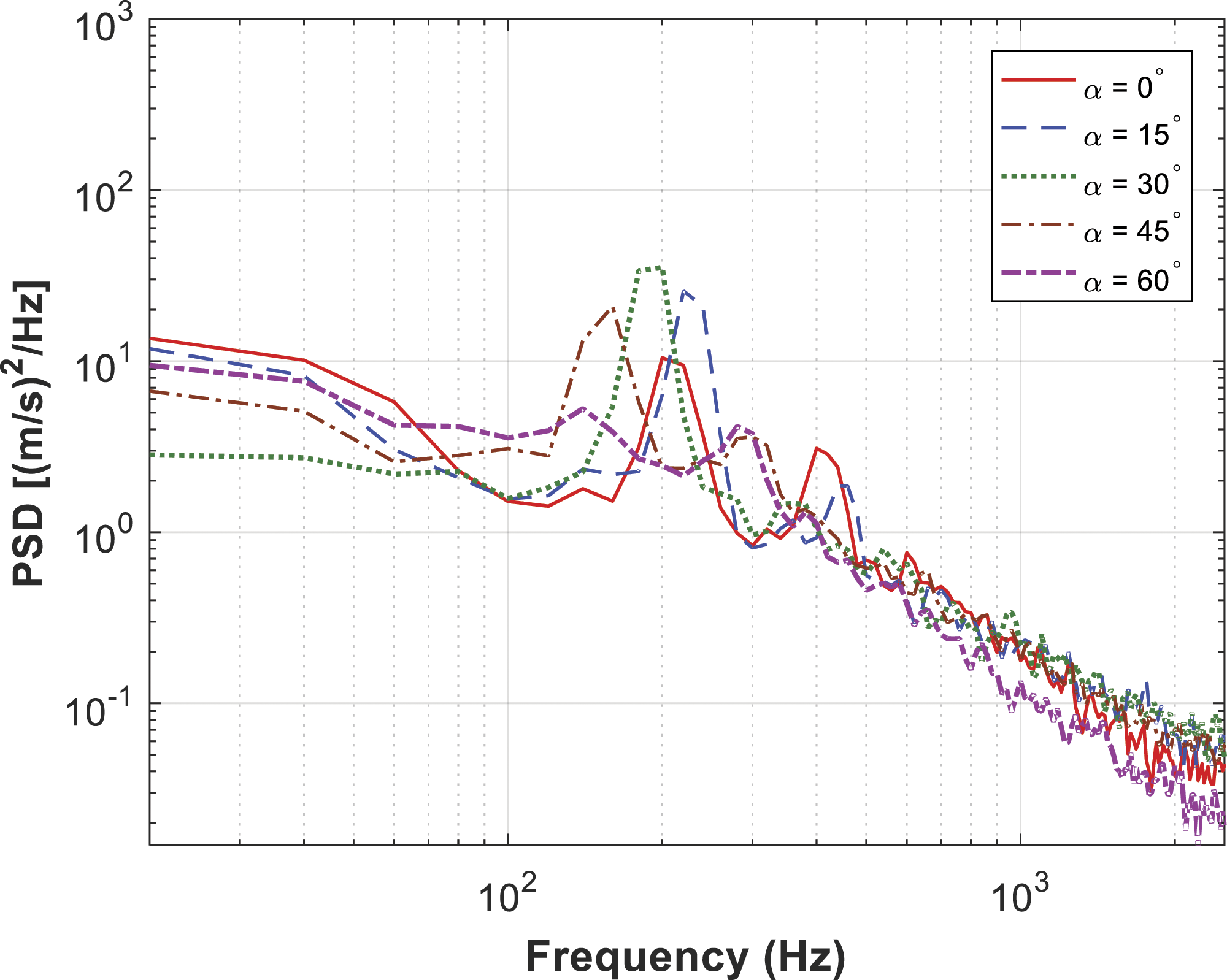
Figure 14 shows the comparison of acoustic spectra of the triangular cylinder at different angles of incidence for a free stream velocity of 36 m/s along with the background noise under the same conditions. A rise in the spectral level is observed at all angles of incidence from the background flow noise. The effect of the triangular cylinder is mainly in the frequency range of 0.3–6 kHz, and at the higher frequencies, differences in the spectral levels are very small. As discussed earlier (Figure 12), stronger tones are generated at 30° and 45° having frequencies of 550 and 440 Hz, respectively, and weaker tones of frequency 660 and 696 Hz are generated at 0° and 15° angles, respectively. It is noted in Figure 14 that the variation of the spectral level with the angle of incidence is gradual. The tones generated from the triangular cylinder become stronger with an increase in the angle of incidence, reach a maximum PSD level at 30°, then becomes weaker and eventually a wideband spectrum at 60° orientation. The frequencies of the acoustic tones in the lower tonal regime (α = 0° and 15°) are higher than that in the higher tonal regime (α = 30° and 45°) since the associated vortex shedding characteristics are closely related to the wake properties of the cylinder. Figure 15 shows profiles of mean and RMS velocity at L = 2w in the wake region of the triangular cylinder at different angles of incidence at U
0
= 14.5 m/s. It is reported in the previous literature35,39 that the wake width follows the flow separation points. The free stream encounters the edge at α = 0° and 15° and separates from the downstream edges. However, at the remaining angles, the free stream separates from the upstream edges. This shift in the separation points determines the peak frequencies of tonal components observed in Figures 13 and 14. The mean velocity profiles in Figure 15(a) show that within −1.2 ≤ y/w ≤ 1.2, the wake at α = 60° is wider, and the corresponding mean velocity is lower. The spectral variations at this orientation (Figures 13 and 14) are wideband. The mean velocity at α = 30° and 45° are relatively higher, and the corresponding acoustic and velocity spectra have peak tonal components. The RMS velocity profiles in Fig. 15(b) show that the wake turbulence levels at different angles of incidence vary within ±2%, with an average intensity of 9% in the wake region (−0.5 ≤ y/w ≤ 0.5). Acoustic spectra of the triangular cylinder at U
0
= 36 m/s. (a) Mean and (b) RMS velocity profiles of the triangular cylinder at different angles of incidence at U
0
= 14.5 m/s and L/w = 2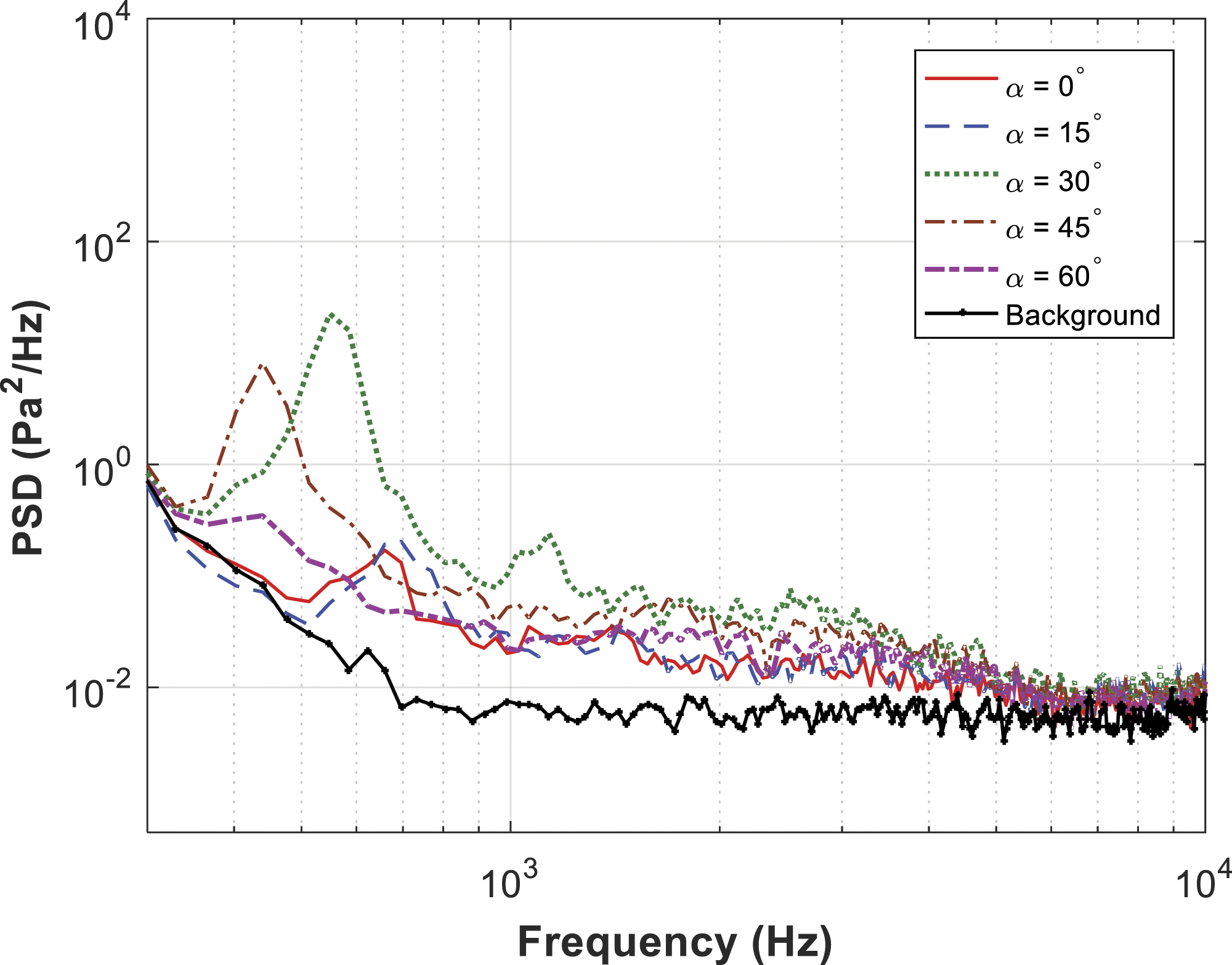

The acoustic tones generated at 30° and 45° angles of incidence of the triangular cylinder (Figure 12(c)&d) are scaled to the sixth power of the free stream velocity using Eqn. 1 to verify the dipole character. The spectral scaling of peak tonal components has good collapse in both Strouhal number and spectral amplitude, as shown in Figure 16, which indicates the dipole character of the acoustic tones generated. Along the abscissa, the peak tones collapse to a Strouhal number which is calculated based on the side dimension of the triangular cylinder. Figure 17 shows the variation of the peak tonal frequency at α = 30° and 45° and the corresponding Strouhal number with the free stream velocity. The tonal frequency increases linearly with the free stream velocity. It is noted that the peak frequency at 30° is higher, and the gradient of the frequency increment at both orientations are same. The Strouhal number based on the side dimension of the triangular cylinder remains approximately constant with an increase in the free stream velocity. It is observed in Figure 17 that at α = 30°, the Strouhal number is at around 0.16, and at α = 45°, the Strouhal number is at around 0.13 (Table 2). This range of Strouhal numbers obtained in the present work is in good agreement with previous studies on flow past triangular cylinders.38–40,42,45 Scaled acoustic spectra of the triangular cylinder at an angle of incidence of (a) 30° and (b) 45°. Variation of peak frequency and Strouhal number with free stream velocity for the triangular cylinder at different angles of incidence.
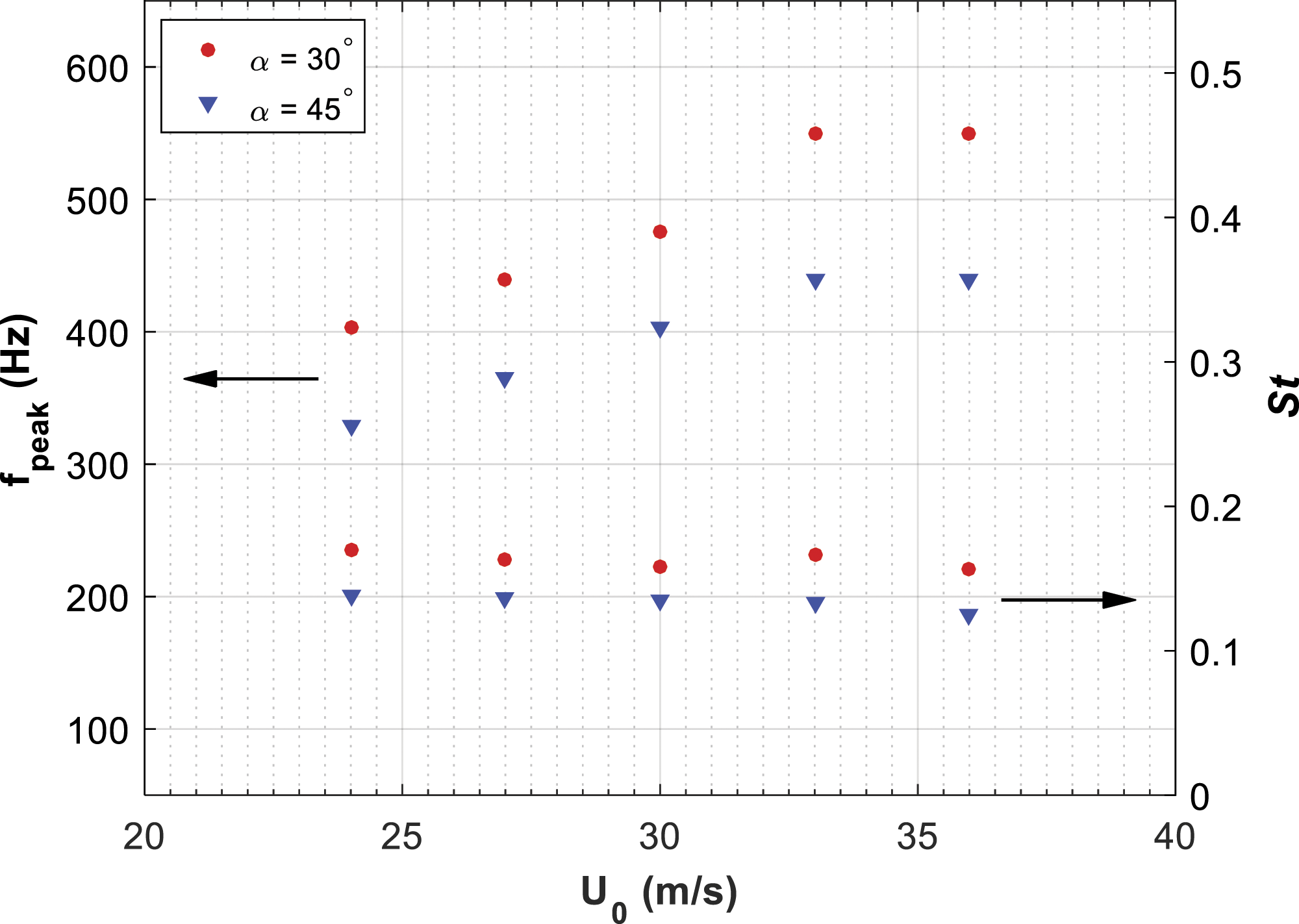
Figure 18 shows the variation of the overall sound pressure level of the triangular cylinder at different angles of incidence with the free stream velocity. The background noise level under the same conditions is also shown. The OASPL is calculated in the range of frequencies from 0.3 to 10 kHz from the acoustic spectra (Figure 12). The noise level becomes significantly higher than the corresponding background noise level beyond a free stream velocity of 15 m/s. It is observed that generally, the noise levels increase with an increase in the free stream velocity. At 36 m/s, the OASPL is found to be around 3–15 dB higher than the corresponding background noise level, depending on the angle of incidence. The highest noise level of around 79 dB is observed at an angle of incidence of 30°. Since the peak tonal components carry the major share of the acoustic energy in the spectra, the orientations where stronger tones are generated (α = 30° and 45°) have higher noise levels. And the noise levels are found to be lower at the orientations where tones are either weak (α = 0° and 15°) or absent (α = 60°). Hence, the overall noise level of the triangular cylinder is strongly influenced by the angle of incidence, and similar to the square cylinder, there is an inherent noise suppression mechanism wherein the noise level can be controlled by adjusting the orientation of the triangular cylinder. A theoretical linear fit corresponding to the sixth power variation of the free stream velocity is shown in Figure 18 as a dotted line along with OASPL variations. Similar to that observed for a square cylinder in Figure 11, the slope of the OASPL at α ≈ 30o - 45° resembles the theoretical variation, while it deviates for other angles of incidence (Figure 18). The major contribution to the overall noise level at α = 30° and 45° is from the acoustic tones, which are generated from the dipole sources. Figure 18 also shows that at the orientations where the noise generated is either weak tones (0° and 15°) or wideband (60°), the corresponding sound levels deviate from the theoretical line. Variation of the overall sound pressure level with free stream velocity for the triangular cylinder at different angles of incidence.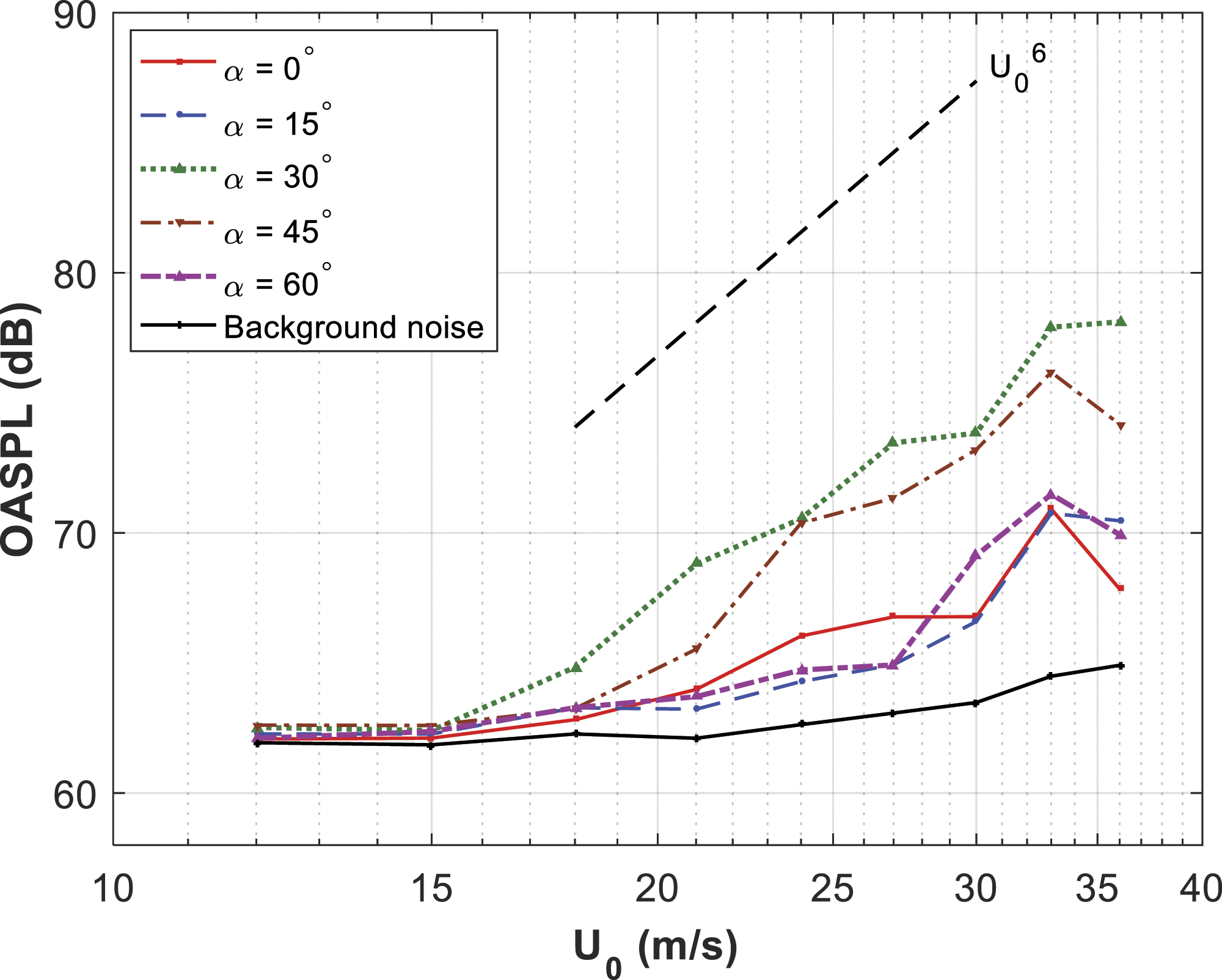
Acoustic characteristics of different non-circular cylinders
In this section, the aeroacoustic characteristics of square and triangular cylinders of the same side dimension (w = 10 mm) are compared to study the common features of noise generation. Acoustic results from a circular cylinder of 10 mm diameter and 300 mm span under the same experimental conditions are considered as a baseline case. One of the main interests is the generation of acoustic tones since the noise levels appear maximum at these orientations of the cylinder. Figure 19 shows the acoustic spectra of circular, square, and triangular cylinders at 36 m/s free stream velocity. The angles of incidence of non-circular cylinders correspond to α = 45° for the square cylinder and α = 30° for the triangular cylinder, where peak tones are dominant. It is noted that the frequency of the peak tonal component of circular, square, and triangular cylinders are 696, 440, and 550 Hz, respectively. Hence, the Strouhal number of the circular cylinder (St = 0.23) is relatively higher than its non-circular counterparts (Table 2). The spectral level of the acoustic tone generated from the square cylinder is observed to be the highest, which indicates a higher noise level compared to the other cylinder models. The sound pressure level analysis shows that the OASPL of the square cylinder at α = 45° is around 90 dB (Figure 11), and that of the triangular cylinder at α = 30° is around 79 dB (Figure 18). The OASPL of the circular cylinder under similar flow conditions is found to be 82 dB. Acoustic spectra of circular, square and triangular cylinders at U
0
= 36 m/s.
Figure 20 shows the mean and RMS velocity profiles at L/w = 2 in the wake of circular, square, and triangular cylinders at U
0
= 14.5 m/s. The flow separates from the edges of square and triangular cylinders, whereas the circular cylinder has no fixed separation points. The mean velocity profiles in Fig. 20(a) show that the wake of the circular cylinder is relatively narrow, and thus the corresponding peak frequency of the tonal component observed in Figure 19 is higher. Further, the mean velocity in −0.5 ≤ y/w ≤ 0.5 of the square cylinder is relatively higher. The RMS velocity profiles in Fig. 20(b) show that the wake velocity fluctuations are higher for the square cylinder and lower for the circular cylinder. The average turbulent intensity levels at the wake in the range of −0.5 ≤ y/w ≤ 0.5 are around 7.3% and 8.5% for the circular and square cylinders, respectively. The corresponding noise level of the square cylinder is higher compared to the other models. (a) Mean and (b) RMS velocity profiles of circular, square and triangular cylinders correspond to peak tone generation at U
0
= 14.5 m/s and L/w = 2
The Strouhal number based on the side dimension (St) and the equivalent width (St e ) of square and triangular cylinders are summarized in Table 2. The St e of the acoustic tones is found to be in the range of 0.13–0.19, which is equal to or higher than the St of the square cylinder. Similarly, the St e of the triangular cylinder is in the range of 0.12–0.14, which is lower than the St at corresponding orientations. This is in line with the variation of the equivalent width at different angles of incidence compared to the side dimension (Table 1).
In this section, the directivity of the aerodynamic noise generated from square and triangular cylinders is studied at a free stream velocity of 30 m/s. The OASPL at different angular positions in the range of θ ≈ 30°–105° with reference to the free stream direction are plotted as directivity plots in Figure 21. The directivity of the background noise at different angular positions is also included for comparison. It is noted that the background noise levels increase towards the free stream direction by around 3 dB, which is depicted by the influence of fine-scale turbulence.
47
Figure 21(a) shows the OASPL directivity of a square cylinder at 0° and 45° angles of incidence. The noise level at α = 45° is higher than that at α = 0° at all the angular locations due to the presence of tonal components in the former. An OASPL at θ = 90° for α = 45° is found to be higher by around 6.5 dB than that at θ = 30°. This is depicted as a dipole source distribution following approximately a cosine directionality.43,46 This can be understood from the spectral studies in Figure 9 that the noise generated from the square cylinder at α = 45° has tonal components behaving as a dipole source. However, directivity at α = 0° is observed to be dominant downstream, which could be due to the quadrupole effects of the flow wake at the lower θ values. The OASPL directivity patterns of the triangular cylinder at 0°, 30°, and 60° angles of incidence are shown in Fig. 21(b). The OASPL at α = 30° is highest at all angular locations because of the generation of stronger acoustic tones (Figure 12(c)) and has a maximum of 74 dB. The OASPL variations along the polar angles are within 3 dB at all angles of incidence. Unlike the case of a square cylinder, a cosine directionality is not noted in the case of triangular cylinders at all angles of incidence. This could be due to additional acoustic sources in the flow region of the triangular cylinders. The maximum difference in the OASPL at α = 0° and 60° is around 2.5 dB, and the difference becomes lesser towards the downstream. In summary, the OASPL directivities of square cylinders are found to be closer to the theoretical predictions at angles of incidence where acoustic tones are present compared to the triangular cylinders. Polar plots showing the directivity of the noise radiated from the (a) square cylinder and (b) triangular cylinder at U
0
= 30 m/s.
Conclusions
The present experimental work investigates the aerodynamic noise generation from non-circular cylinders at different angles of incidence. The acoustic experiments are carried out with cylinder models of square and equilateral triangle cross-sections having the same side dimension (w) of 10 mm. The free stream velocity (U 0 ) is varied from 12 to 36 m/s, and the corresponding Reynolds numbers are from 7.8 × 10³ to 2.3 × 10⁴, which is in the subcritical regime. The angle of incidence (α) is varied from 0° to 45° for the square cylinder and from 0° to 60° for the triangular cylinder. The acoustic spectra of the square cylinder have peak tonal components at 30° and 45° angles of incidence and have a wideband character at 0° and 15°. The noise generated from the triangular cylinder has weaker tones at α = 0° and 15°, stronger tones at α = 30° and 45°, and a wideband character at α = 60°. The spectral characteristics of the fluctuating velocity at the wake of the square and triangular cylinders are in concurrence with the acoustic spectra. The mean and RMS velocity profiles of the square cylinder indicate a wider wake at α = 0° and 15° with lower mean velocity. The corresponding turbulent intensity level is around 7.2%. The mean wake velocities at α = 30° and 45° of the triangular cylinder are relatively higher, with an average turbulent intensity level of 9%. The frequencies of acoustic tones increase linearly with the free stream velocity. The corresponding Strouhal numbers based on the side dimension are in the range of 0.13–0.16 for the square and triangular cylinders, and the Strouhal numbers based on the equivalent width are in the range of 0.12–0.19. The spectral scaling by the sixth power of the free stream velocity shows a good collapse of the peak tonal components indicating the dipole behaviour. At 36 m/s, the maximum OASPL from the square cylinder is higher than the corresponding background noise by 24 dB. Similarly, for the triangular cylinder, the maximum OASPL is higher by 15 dB than the background noise level. The square cylinder has the highest noise level of 90 dB at α = 45°, and the highest noise level of the triangular cylinder is 79 dB at α = 30°. A comparative study of the noise generated from the square and triangular cylinders with a circular cylinder of the same size showed that the highest noise level is from the square cylinder at α = 45°. The directivity study showed that the OASPL at α = 45° of the square cylinder at θ = 90° angular location is 6.5 dB higher than that at θ = 30°. However, at the 30° orientation of the triangular cylinder, the maximum OASPL is 74 dB, and the sound level variations are within ±3 dB. Thus, in summary, the aeroacoustic characteristics of square and triangular cylinders investigated in the present paper can be significant in designing noiseless landing gears, pantographs, etc. Further, studies can be carried out by considering other non-circular cross-sections and modifying their surface for devising better noise mitigation techniques.
Footnotes
Acknowledgments
The authors would like to thank the anonymous reviewers for their valuable comments and suggestions for improving the manuscript.
Declaration of Conflicting Interests
The author(s) declared no potential conflicts of interest with respect to the research, authorship, and/or publication of this article.
Funding
The author(s) received no financial support for the research, authorship, and/or publication of this article.
