




Abstract
The primary aim of the study was to examine the relationships between components of psychological literacy – defined as the ability to apply psychological knowledge and principles in personal, social and professional contexts – and components of professional competencies in in-service teachers. Two cross-sectional studies were conducted with Slovak teachers (N = 595 and N = 180), assessing psychological literacy (including psychological misconceptions, critical thinking dispositions, trust in science and ethical integrity) and self-perceived professional competencies (didactic competencies, teaching styles and interaction styles). Study 1 assessed misconceptions as knowledge accuracy, whereas Study 2 measured the degree to which teachers endorsed common psychological and educational beliefs. Across both studies, critical thinking dispositions – particularly critical openness and reflective scepticism – showed the most consistent associations with professional competencies. Psychological misconceptions were generally weakly and inconsistently related to professional competencies, although some learning myths demonstrated positive associations with several teaching practices. Trust in science and integrity showed a selective relationship with professional competencies. Overall, the findings suggest that dispositional aspects of psychological literacy, especially critical thinking, may be more strongly related to teachers’ professional self-perceptions than knowledge-based indicators alone.
Keywords
Introduction
Today, the teaching profession requires not only pedagogical expertise but also the ability to interpret and apply psychological knowledge in classroom contexts (Rapsová, 2021). Teachers regularly encounter psychological claims about learning, motivation, development and classroom management. How they evaluate and apply such claims may shape their instructional decisions and interactions with students. Psychological literacy was originally conceptualised as basic familiarity with psychological terminology (Boneau, 1990) but has since evolved into a broader construct referring to the capacity to apply psychological knowledge adaptively across contexts (Cranney et al., 2022; McGovern et al., 2010). It is commonly described as a multidimensional construct encompassing knowledge, scientific reasoning, critical thinking, ethical understanding and reflective application (Roberts et al., 2015).
In educational contexts, psychological literacy comprises competencies such as understanding psychological terminology, interpreting psychological assessments, working with support services, applying social psychology in classroom management, respecting ethical principles and addressing individual and cultural differences (Nutbeam, 2000; Rapsová, 2024; Sokolová et al., 2014). It also includes the ability to manage stress, resolve interpersonal conflicts, critically evaluate information and reject pseudoscientific practices – particularly within education.
Approaches to measuring psychological literacy vary considerably. While some authors propose comprehensive multidimensional frameworks (McGovern et al., 2010; Roberts et al., 2015), empirical studies often focus on selected components depending on research aims. In the present study, we focus on four components that are conceptually central to teachers’ epistemic engagement with psychological knowledge: psychological misconceptions, critical thinking, trust in science and ethical integrity.
Psychological misconceptions – widely held beliefs that contradict established psychological science – persist due to strong social reinforcement and are common among laypeople, professionals and psychology students (Lilienfeld et al., 2009; Rodríguez-Prada et al., 2022; Tulis, 2022). The prevalence of misconceptions in educational settings is concerning, as many pre-service and in-service teachers endorse these myths, potentially undermining the quality of teaching and learning (Menz et al., 2021; Tulis, 2022). Endorsement of misconceptions may influence teachers’ instructional choices and their evaluation of educational innovations.
Trust in science is a crucial prerequisite for psychological findings to be accepted as valid and evidence-based (Hartman et al., 2017; Lilienfeld et al., 2012). Due to limited methodological training, teachers often rely on peers rather than scientific sources, which can lead to the adoption of misconceptions aligned with prior beliefs (Bråten & Ferguson, 2015; Hendriks et al., 2021). This scepticism is further reinforced by media coverage of scientific errors and the persuasive power of misinformation (Hendriks et al., 2016; Hughes et al., 2013). In educational practice, trust in science may be relevant for teachers’ openness to research-informed approaches, as it supports teachers’ acceptance of evidence-based knowledge and reduces reliance on pseudoscientific beliefs.
Critical thinking, as a component of psychological literacy, involves interdependent cognitive skills and dispositions (Dwyer, 2023; Halpern, 2014). Dispositions such as openness, curiosity and reflective scepticism are vital for applying critical thinking across contexts. In education, fostering these traits supports learners’ development (Facione, 2011; Sosu, 2013). Dispositions are linked to academic success, professional performance and reduced cognitive bias (Clifford et al., 2004; Macpherson & Stanovich, 2007), underscoring the importance of cultivating cognitive skills and dispositions in schools (Kosturková & Ferencová, 2019). For teachers, critical thinking dispositions may be particularly relevant when evaluating competing pedagogical claims.
Ethical integrity involves commitment to truthfulness and moral principles, which are essential for teachers as role models (Schlenker, 2008). Hardy and Carlo (2011) found that individuals who align their personal goals with moral values regard these principles as central to the meaning of their lives. In educational contexts, promoting integrity supports ethical decision-making and accountability – qualities that are crucial for teachers as role models and facilitators of values-based learning. Integrity may shape how teachers respond to errors, feedback and ethical dilemmas in classroom contexts.
Taken together, these components of psychological literacy reflect how teachers engage with psychological knowledge, evaluate educational claims and regulate their professional decision-making. Such epistemic and moral orientations may plausibly relate to how teachers plan instruction, interact with students and enact their teaching roles in everyday classroom practice. Professional competencies represent observable and self-perceived dimensions of teachers’ practice. In this study, we focus on didactic competencies, teaching styles and interaction styles as key domains of professional functioning.
Didactic competencies refer to the ability to plan, organise, implement and evaluate lessons; foster a positive classroom climate; manage behaviour constructively and reflect on pedagogical practice (Rapsová, 2024; Sokolová, 2021; Šuťáková, 2017). Teachers with strong didactic competencies understand learners’ developmental needs, select appropriate teaching strategies and apply various assessment methods.
Teaching style is an individual, specific and consistent approach to teaching, encompassing behaviours, strategies and attitudes that a teacher prefers at a given time and within a particular context. One of the most well-known models is the Grasha–Reichmann model, which identifies five primary teaching styles: expert, formal authority, personal model, facilitator and delegator (Ford et al., 2016; Grasha, 2002; Mohanna et al., 2007). In the present study, we focused on four teaching styles derived from this model and related research (Ballová Mikušková, 2022): supportive, goal-oriented, knowledge-oriented and managerial.
Interaction style is defined as the teacher's approach to communication and behaviour regulation in interactions with students (Wubbels et al., 1987; Wubbels & Levy, 1991). It reflects a complex pattern of teacher responses to student behaviour and learning needs and may play a critical role in fostering motivation and engagement in the classroom.
Although psychological literacy has been widely discussed in the context of psychology education, empirical research examining its role among in-service teachers is limited. Little is known about how selected components of psychological literacy relate to teachers’ professional competencies. Some recent studies have begun to explore psychological literacy in teacher education through applied learning settings. For example, theory–practice interventions have been shown to foster selected attributes of psychological literacy among pre-service teachers and to support their reflection on behaviour and the application of psychological knowledge in practice (Horn et al., 2021). Similarly, quasi-experimental evidence suggests that such interventions can enhance pre-service teachers’ beliefs about the theory–practice relationship and their levels of reflection (Horn et al., 2024). However, this line of research has primarily focused on pre-service teachers and on the evaluation of specific instructional interventions rather than on the relationships between psychological literacy and professional competencies or on the validation of measurement instruments. Thus, despite growing interest in applied approaches, most existing research still emphasises conceptual definitions, with comparatively little attention paid to in-service teachers or to empirically examining the role of psychological literacy in professional practice (Chester et al., 2013). Therefore, it is essential to systematically investigate psychological literacy within the teaching population – not only descriptively, but also in relation to other teaching aspects, especially professional competencies. These competencies form the foundation of teacher qualification and effectiveness, encompassing pedagogical expertise, communication skills, the ability to build positive relationships and self-reflection. The study provides data to support innovation in teacher education and highlights psychological factors influencing teaching quality.
Current Study
The present research aimed to examine the level of selected components of psychological literacy among in-service teachers and to investigate their associations with self-perceived professional competencies. We addressed the following research questions:
What is the level of psychological misconceptions, critical thinking dispositions, trust in science and integrity among practising teachers?
How do components of psychological literacy relate to self-perceived professional competencies (didactic competencies, teaching styles and interaction styles)?
To address these questions, we conducted two cross-sectional studies. Study 1 examined these relationships using a measure of psychological misconceptions based on knowledge accuracy. Study 2 sought to replicate the analyses using an alternative measure that assessed the degree to which teachers endorsed common psychological and educational beliefs.
Study 1
The aim of Study 1 was to investigate the level of psychological literacy among practising teachers and to analyse its relationship with their professional competencies. Study 1 formed part of an Rapsová's (2023) rigorous thesis and was part of the larger project: https://osf.io/cxwp5).
Methods
Participants and Design
We sent an email containing a link to the survey to all primary and secondary schools in Slovakia (the list of contacts is publicly available; CVTI, 2021), asking school headteachers to forward the invitation to teachers within their institutions. The survey was created using the Survio platform, and data were collected online.
Data collection was anonymous, and all procedures were conducted in accordance with the standards of the American Educational Research Association, the American Psychological Association, and the National Council on Measurement in Education (American Educational Research Association et al., 2014). Participation in the study was voluntary. As an incentive for participation, respondents were entered into a prize draw for book vouchers and book packages provided by the institution where the research was conducted.
A total of 595 in-service teachers (10% men; this gender distribution reflects the gender composition of the teaching workforce in Slovakia, where women constitute the majority of teachers; TASR, 2025), aged between 20 and 72 years (M = 43.33, SD = 11.03), with an average of 17.50 years of teaching experience (SD = 11.82), participated in the study. The sample included 5% teaching assistants, 15% preschool and early years teachers, 13% teachers for the first stage of primary education, 27% teachers for the second stage of primary education, 24% teachers in upper secondary education, 9% headteachers and 8% of participants who identified their position as ‘other’.
After providing informed consent, participants were asked to indicate their sex, age, position and years of teaching experience. They then completed a battery of questionnaires and tests in the following order: the Questionnaire on Teacher Interaction – Self-Assessment, the Dirty Dozen (not used in this study), the Bem Sex-Role Inventory (not used in this study), the Didactic Competencies Questionnaire, the Psychological Information Questionnaire, the Slovak Teaching Style Questionnaire, the Critical Thinking Disposition Scale, the Credibility of Science Scale and the Integrity Scale.
Measurements
The instruments used to assess professional competencies (and most of those assessing psychological literacy) relied on teachers’ self-reports of their typical practices and tendencies rather than on objectively observed behaviour. Such measures capture teachers’ self-perceptions and self-evaluations. Self-report questionnaires are widely used in educational research to examine teachers’ beliefs, perceived competencies and professional orientations, which may influence instructional decisions and classroom interactions.
Professional Competencies
Interaction Styles
Preferred interaction styles were measured using the Questionnaire on Teacher Interaction – Self-Assessment (Ballová Mikušková, 2022; Verešová, 2021). Participants rated 40 statements describing their behaviour as teachers on a five-point Likert scale (1 = never; 5 = always). Scores were calculated for each of the eight sectors of teacher behaviour based on Leary's personality model (Leary, 1957): leadership (e.g. ‘I explain the subject matter clearly and understandably’), helpfulness (e.g. ‘When students cannot cope with something, I help them’), understanding (e.g. ‘I try to understand my students’), student–teacher responsibility (e.g. ‘I change my opinion when a student provides arguments’), uncertainty (e.g. ‘It is easy to throw me off balance’), dissatisfaction (e.g. ‘I think that students cheat or lie to me’), objection (e.g. ‘I make sarcastic or ironic remarks’) and strictness (e.g. ‘My expectations are very high’). Average scores were calculated for each interaction style, with higher scores indicating a stronger preference for that style.
Teaching Styles
Teaching styles were assessed using the Slovak Teaching Style Questionnaire (Ballová Mikušková, 2022). Participants rated 16 items on a five-point Likert scale (1 = strongly disagree; 5 = strongly agree). Average scores were calculated for four teaching styles: supportive (e.g. ‘I give students the opportunity to discover how to learn best’), goal-oriented (e.g. ‘The subject I teach has very specific educational goals that I aim to achieve in my teaching’), knowledge-oriented (e.g. ‘Facts, concepts, and principles are the most important content that students should acquire’) and managerial (e.g. ‘I encourage students to participate in the course of the lesson’). Higher scores indicated a stronger preference for the respective style.
Didactic Competencies
Didactic competencies were measured using the Didactic Competencies Questionnaire (Ballová Mikušková, 2022; Rapsová et al., 2021). Participants indicated the extent to which they apply 57 teaching procedures across five lesson phases (planning and preparation, e.g., ‘To what extent do you take into account students’ current level of development when planning a lesson?’; implementation, e.g., ‘To what extent do you systematically review and consolidate acquired knowledge, skills, and habits?’; classroom climate, e.g., ‘To what extent do you adopt a fair and individualised approach to students?’; diagnostics and evaluation, e.g., ‘To what extent do you take students’ individual differences into account when selecting diagnostic methods?’; and self-reflection, e.g., ‘o what extent do you reflect on the quality of your teaching practice?’), using a five-point Likert scale (1 = strongly disagree; 5 = strongly agree). Average scores were calculated for each didactic competence, with higher scores indicating more frequent application of competencies.
Psychological Literacy
Psychological Misconceptions
Psychological knowledge was assessed using 25 items from the Psychological Information Questionnaire (Kowalski & Taylor, 2009), adapted by Sokolová et al. (2017). Participants indicated whether each statement – representing either a misconception or a fact (e.g. ‘Most people use only 10% of their brain capacity’) – was true or false. The total number of correct responses was calculated, with higher scores indicating greater psychological knowledge.
Critical Thinking
Critical thinking disposition was measured using the Critical Thinking Disposition Scale (Sosu, 2013), which consists of 11 items assessing two dimensions: critical openness (e.g. ‘I usually try to think about the bigger picture during a discussion’) and reflective scepticism (e.g. ‘I often re-evaluate my experiences so that I can learn from them’). Participants rated each item on a five-point Likert scale (1 = strongly disagree; 5 = strongly agree). Average scores were calculated for both dimensions, with higher scores indicating a stronger disposition towards critical thinking.
Trust in Science
Trust in science was assessed using the Credibility of Science Scale (Hartman et al., 2017), a six-item instrument in which participants rated their agreement with statements (e.g. ‘People trust scientists a lot more than they should’) on a five-point Likert scale (1 = strongly disagree; 5 = strongly agree). The average score was calculated, with higher scores indicating greater trust in science.
Integrity
Integrity, defined as principled rather than expedient, was measured using the Integrity Scale (Schlenker, 2008). Participants rated 18 statements (e.g. ‘It is important to me to feel that I have not compromised my principles’) on a five-point Likert scale (1 = strongly disagree; 5 = strongly agree). The average score was calculated, with higher scores indicating a stronger commitment to ethical principles.
Data Analysis
SPSS was used for data analysis: the data were edited, and descriptive statistics, an assessment of the internal consistency of scales (McDonald's omega), and correlational and regression analyses were carried out. Data are available at https://osf.io/cxwp5/files/mzbh6.
Results
Descriptive statistics for all measured variables are presented in Table 1. Teachers reported that their interaction styles – leadership, helpfulness, understanding and fostering student responsibility – were above average in comparison to styles such as uncertainty, dissatisfaction and objection. Similarly, all didactic competencies and teaching styles were rated as well developed.
Descriptive statistics and internal consistency (Study 1).

N = frequency; M = mean; SD = standard deviation; min = minimum; max = maximum; omega = McDonald's omega.
Participants demonstrated a relatively low level of accurate psychological knowledge. The average score on the misconceptions scale was 9.47 out of 25 correct responses, indicating that many participants endorsed or failed to reject a substantial proportion of incorrect statements. On the other hand, they reported well-developed dispositions towards critical thinking, trust in science and integrity.
The kurtosis values for the interaction styles of leadership, helpfulness, understanding and fostering responsibility ranged from 1.926 to 8.847, indicating positive kurtosis. Internal consistency, estimated using McDonald's omega, was acceptable across scales (ω = .559 to .888). Because the items of psychological misconceptions represent heterogeneous knowledge statements rather than a single latent construct, internal consistency indices should be interpreted cautiously.
Relationships Between Professional Competencies and Psychological Literacy
To examine the relationships among the theoretically proposed components of psychological literacy, correlation analyses were conducted (see Table S1 in the Supplementary Materials). A positive correlation was found between psychological knowledge and trust in science. Critical thinking dispositions were positively associated with integrity. Furthermore, trust in science was positively related to teachers’ integrity.
Next, we examined relationships between all professional competencies and indicators of psychological literacy. Correlation analyses indicated several significant associations between psychological literacy components and professional competencies (see Table S2 in the Supplementary Materials). Correlation analyses showed that the critical thinking dispositions of critical openness and reflective scepticism were the most consistently related to professional competencies. These dispositions were positively associated with constructive interaction styles, didactic competencies and several teaching styles, and negatively related to less constructive interaction styles. Other components of psychological literacy, such as trust in science and integrity, showed more selective associations, while psychological misconceptions were generally weakly related to professional competencies.
Finally, we conducted a regression analysis to examine whether psychological literacy predicted professional competencies. Hierarchical multiple regression analyses were performed separately for interaction styles, teaching styles and didactic competencies as dependent variables. Sex and years of teaching experience were entered in the first step, followed by psychological literacy components in the second step.
Interaction Styles
Hierarchical multiple regression (see Table 2) revealed that sex and teaching experience significantly contributed to the regression models in Step 1. The inclusion of psychological literacy components in Step 2 explained an additional 3.8–11.9% of the variance in all interaction styles, except for the styles ‘dissatisfaction’ and ‘strictness’. The strongest predictor of interaction styles (excluding ‘strictness’) was the disposition towards critical openness. Across the models, critical openness emerged as the most consistent positive predictor of constructive interaction styles, including leadership, helpfulness, understanding and fostering student responsibility. In contrast, higher levels of critical openness were associated with lower levels of uncertainty. Psychological misconceptions and reflective scepticism showed more selective associations with interaction styles.
Standardised regression coefficients (β) from hierarchical multiple regression predicting interaction styles (Study 1).

Interaction styles: L = leadership; H = helpfulness; US = understanding; STR = fostering responsibility; UC = uncertainty; D = dissatisfaction; O = objection; S = strictness.
* p < .050, ** p < .010, *** p < .001.
Didactic Competencies
The hierarchical multiple regression analysis (see Table 3) revealed that in Step 1, sex and teaching experience significantly contributed to the regression models. The inclusion of psychological literacy components in Step 2 explained an additional 20.9–43.2% of the variance across all dimensions of didactic competencies. Psychological literacy components substantially increased the explained variance in didactic competencies. The strongest and most consistent predictors were the critical thinking dispositions of critical openness and reflective scepticism.
Standardised regression coefficients (β) from hierarchical multiple regression predicting didactic competencies (Study 1).
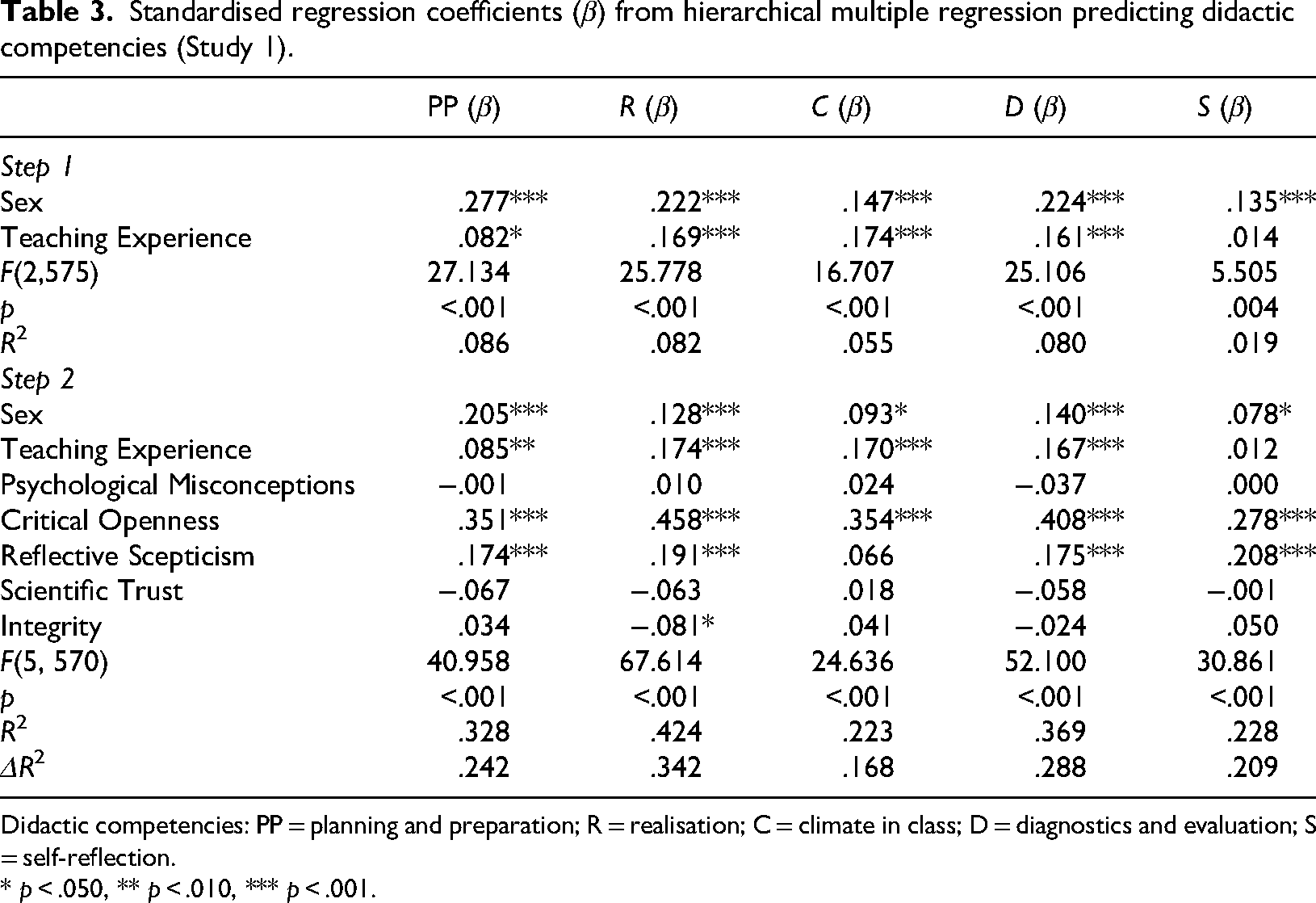
Didactic competencies: PP = planning and preparation; R = realisation; C = climate in class; D = diagnostics and evaluation; S = self-reflection.
* p < .050, ** p < .010, *** p < .001.
Teaching Styles
Similar patterns emerged for teaching styles. Critical openness and reflective scepticism were positively associated with several teaching styles, whereas psychological misconceptions were negatively associated with most of them. Trust in science showed selective negative associations with specific styles. The hierarchical multiple regression analysis (see Table 4) revealed that in Step 1, sex and teaching experience significantly contributed to the regression models predicting the supportive and managerial teaching styles. The inclusion of psychological literacy components in Step 2 explained an additional 12.6–36.1% of the variance in all teaching styles.
Standardised regression coefficients (β) from hierarchical multiple regression predicting teaching styles (Study 1).
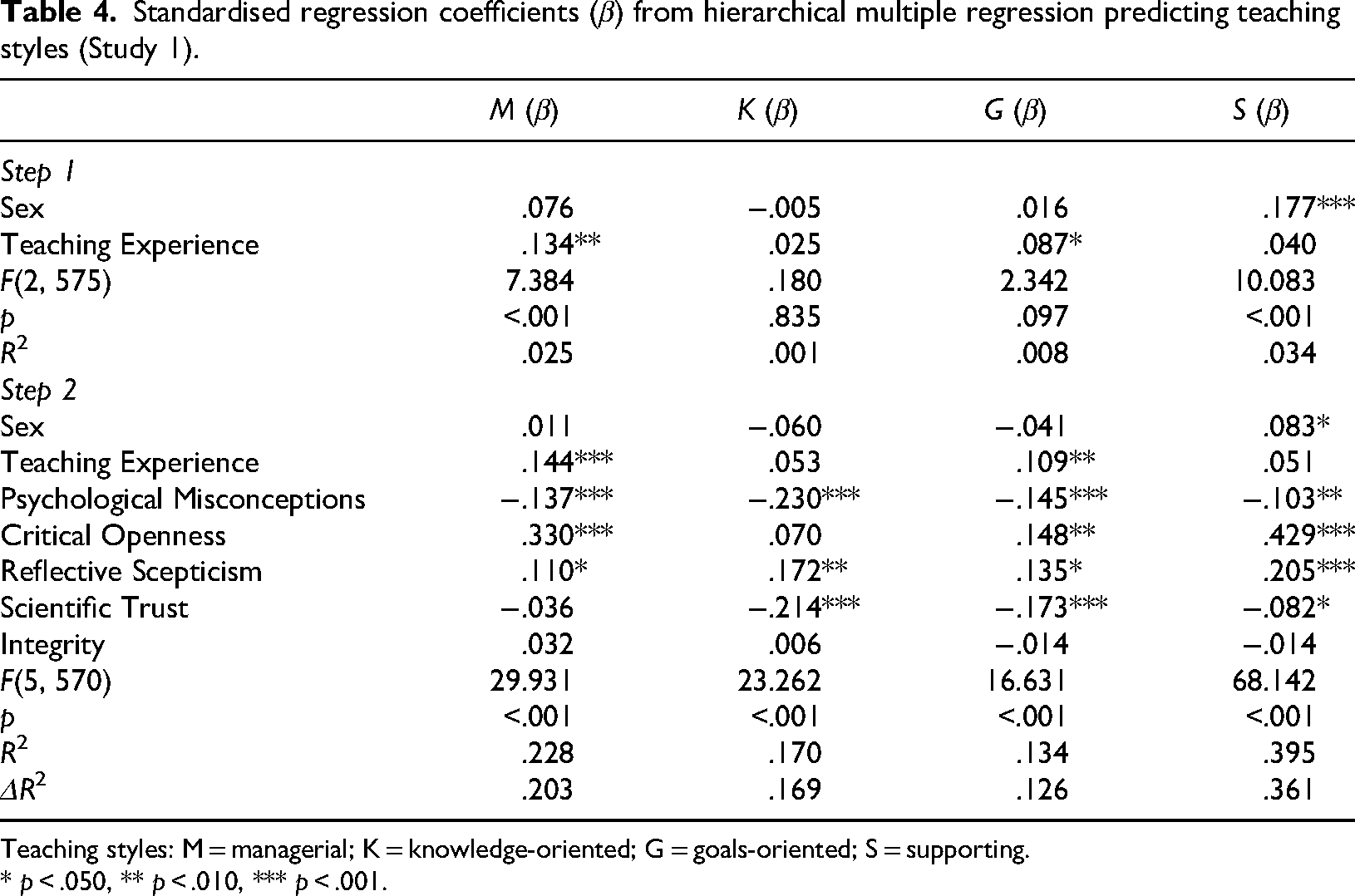
Teaching styles: M = managerial; K = knowledge-oriented; G = goals-oriented; S = supporting.
* p < .050, ** p < .010, *** p < .001.
Discussion
Study 1 examined the relationships between selected components of psychological literacy and teachers’ self-perceived professional competencies. Overall, the results suggest that several aspects of psychological literacy are associated with how teachers evaluate their professional functioning.
One notable finding concerns the relatively low level of accurate psychological knowledge. On average, participants answered fewer than half of the misconception items correctly, indicating that many teachers endorsed or failed to reject a substantial number of inaccurate psychological statements. Similar levels of misconceptions have been documented among both pre-service and in-service teachers in previous studies (e.g. Menz et al., 2021; Tulis, 2022), suggesting that such beliefs remain widespread in educational contexts.
At the same time, teachers reported relatively high levels of critical thinking dispositions, trust in science and integrity. This apparent discrepancy between self-reported dispositions and the accuracy of psychological knowledge may reflect the difference between teachers’ self-perceived cognitive orientations and their factual psychological knowledge.
We identified intercorrelations among psychological literacy components. These correlations suggest that some components of psychological literacy may reflect related epistemic and moral orientations. In particular, the positive associations between critical thinking dispositions, trust in science and integrity are consistent with theoretical frameworks that conceptualise psychological literacy as a multidimensional construct comprising interrelated competencies (e.g. McGovern et al., 2010; Roberts et al., 2015).
Across the analyses, the most consistent associations with professional competencies were observed for the critical thinking dispositions of critical openness and reflective scepticism. These dispositions were positively related to constructive interaction styles and to most didactic competencies and teaching styles. In contrast, the relationships between psychological misconceptions and professional competencies were generally weaker and less consistent. This pattern may indicate that dispositional aspects, compared to knowledge-based indicators of psychological literacy, are more strongly associated with teachers’ professional self-perceptions.
However, the interpretation of the results is limited by the instrument used in Study 1. The scale of psychological misconceptions showed relatively low reliability in the present sample. These limitations may partly explain the weak and inconsistent relationships between misconceptions and professional competencies observed in this study. Another explanation for weak relationships is the content of items: the scale measured only psychological information, but not pedagogical information. For this reason, Study 2 sought to replicate the analyses using a revised measure of misconceptions that was more closely aligned with educational practice and better suited to a teacher sample.
Study 2
Study 1 provided initial evidence regarding the relationships between components of psychological literacy and teachers’ self-perceived professional competencies. However, the measure used to assess psychological misconceptions in Study 1 had several limitations. The instrument assessed general psychological knowledge in a true–false format, which can be understood as reflecting respondents’ endorsement or rejection of commonly held misconceptions. Incorrect responses indicate the presence of misconceptions, whereas correct responses suggest their rejection (incorrect responses may reflect the presence of misconceptions, whereas correct responses indicate their rejection). Thus, knowledge accuracy serves as a proxy for belief in misconceptions, although it does not directly assess the strength or certainty of those beliefs. In addition, the scale showed relatively low reliability in the present sample. The measure used in Study 1 assessed misconceptions as errors in psychological knowledge. However, misconceptions in educational contexts often function not only as knowledge deficits but also as strongly held beliefs about learning and development. To better capture the belief-based dimension of misconceptions, Study 2 employed a scale assessing agreement with commonly held psychological and pedagogical statements. This approach allowed us to examine whether the relationships observed in Study 1 would replicate when misconceptions were operationalised as belief endorsement rather than knowledge accuracy.
Methods
Participants and Design
The design of Study 2 mirrored that of Study 1 in terms of recruitment procedure, survey administration, and analytical strategy. Teachers were invited to participate in an online survey created on the Survio platform via an email sent to all primary and secondary schools in Slovakia. Data were collected anonymously, and all procedures were conducted in accordance with the standards of the American Educational Research Association, the American Psychological Association, and the National Council on Measurement in Education (American Educational Research Association et al., 2014). Participation in the study was voluntary. As an incentive, participants were entered into a draw for book vouchers and book packages provided by the institution where the research was conducted.
A total of 180 in-service teachers (7.2% men; this gender distribution reflects the gender composition of the teaching workforce in Slovakia, where women constitute the majority of teachers; TASR, 2025), aged between 20 and 64 years (M = 44.61, SD = 10.50), with an average of 18.73 years of teaching experience (SD = 11.06), participated in the study. The sample included 16.1% preschool and early years teachers, 19.4% teachers for the first stage of primary education, 22.2% teachers for the second stage of primary education, 25.0% teachers in upper secondary education and 17.2% headteachers.
After providing informed consent, participants were asked to report their sex, age, position and years of teaching experience. They then completed a battery of questionnaires, including the Questionnaire on Teacher Interaction – Self-Assessment, the Didactic Competencies Questionnaire, the Psychological Information Questionnaire, the Slovak Teaching Style Questionnaire, the Critical Thinking Disposition Scale, the Credibility of Science Scale and the Integrity Scale.
Measurements
Professional Competencies
The same instruments used in Study 1 were employed to measure professional competencies (for a detailed description, see Study 1): the Questionnaire on Teacher Interaction – Self-Assessment, the Slovak Teaching Style Questionnaire and the Didactic Competencies Questionnaire.
Psychological Literacy
We also used the same instruments as in Study 1 to assess psychological literacy: the Critical Thinking Disposition Scale, the Credibility of Science Scale and the Integrity Scale.
To measure psychological misconceptions, we used 25 statements related to misconceptions in teaching practice, drawn from the Psychological Misconceptions scale (Tulis, 2013) and the General Psychology Misconceptions and Neuromyths Based on Educational Concepts scale (McAfee & Hoffman, 2021). Participants rated the extent to which they believed each statement (e.g. ‘Students learn more when the teaching style matches their learning style’) to be true on a five-point scale (1 = not true at all; 5 = definitely true), allowing us to assess the degree to which teachers endorsed common psychological and educational misconceptions.
An exploratory factor analysis, conducted to examine the underlying structure of the misconception items (see Table S3 in the Supplementary Materials), identified two sub-dimensions: social stereotypes and learning myths. Average scores were calculated for each sub-dimension, with higher scores indicating a greater endorsement of psychological misconceptions.
Data Analysis
SPSS and jamovi were used for data analysis. The data were edited in SPSS, and descriptive statistics, an assessment of the internal consistency of scales (McDonald's omega), and correlational and regression analyses were carried out using the jamovi (The jamovi project, 2024). Data are available at https://osf.io/cxwp5/files/8m7xk.
Results
Descriptive statistics for all measured variables are presented in Table 5. Teachers reported that their interaction styles – leadership, helpfulness, understanding and fostering student responsibility – were above average compared to styles such as uncertainty, dissatisfaction, and objection. Similarly, all didactic competencies and teaching styles were rated as well developed.
Descriptive statistics and internal consistency (Study 2).
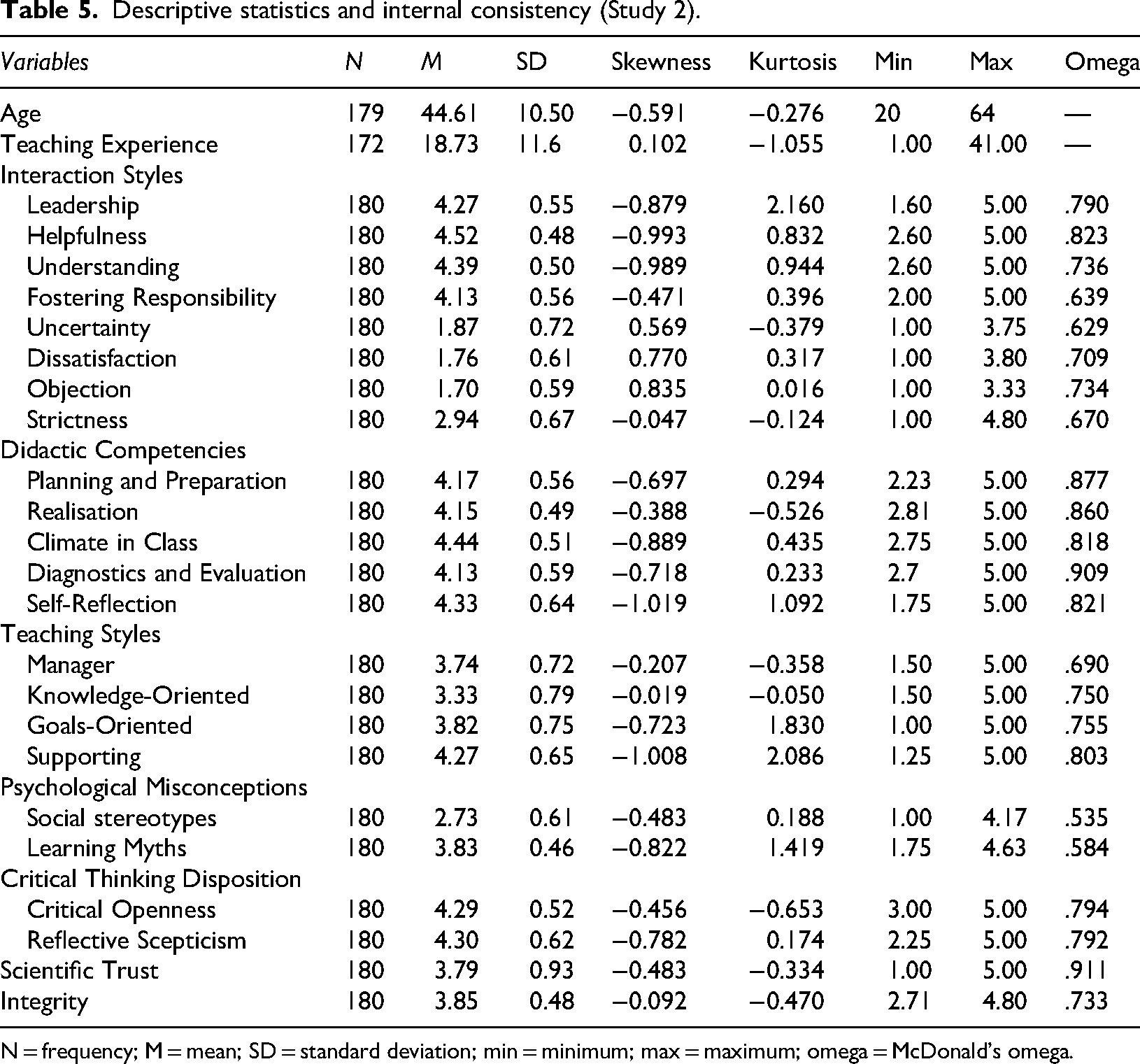
N = frequency; M = mean; SD = standard deviation; min = minimum; max = maximum; omega = McDonald's omega.
On average, participants showed moderate endorsement of several psychological and pedagogical misconceptions, indicating that some inaccurate beliefs about learning and development were relatively common among teachers. At the same time, they reported well-developed dispositions towards critical thinking, trust in science, and integrity.
The kurtosis values for the interaction style leadership and the teaching styles, goal-oriented and supportive, ranged from 1.830 to 2.160, indicating positive kurtosis. Internal consistency, estimated using McDonald's omega, was acceptable across scales (ω = .629 to .911).
Relationships Between Professional Competencies and Psychological Literacy
Correlation analyses revealed several consistent patterns between components of psychological literacy and professional competencies (see Table S4 in the Supplementary Materials). In particular, the critical thinking dispositions of critical openness and reflective scepticism were positively associated with constructive interaction styles (e.g. leadership, helpfulness, understanding and fostering responsibility), most didactic competencies and several teaching styles. These dispositions were also negatively associated with less constructive interaction styles, such as dissatisfaction and objection.
Learning myths showed a different pattern. Higher endorsement of learning myths was positively associated with several constructive interaction styles, most didactic competencies and several teaching styles. In contrast, social stereotypes were negatively associated with some interaction styles and showed weaker relationships with other professional competencies.
Trust in science demonstrated only selective associations with professional competencies, while integrity showed modest positive relationships with several constructive interaction styles and didactic competencies.
To examine whether psychological literacy predicts professional competencies, hierarchical multiple regression analyses were conducted separately for interaction styles, teaching styles and didactic competencies as dependent variables. Sex and teaching experience were entered in Step 1, followed by psychological literacy components in Step 2.
Interaction Styles
Hierarchical regression analyses showed that psychological literacy components explained additional variance in most interaction styles, even after controlling for sex and teaching experience (see Table 6). Across the models, critical openness emerged as the most consistent positive predictor of constructive interaction styles, including leadership, helpfulness, understanding and fostering responsibility. Reflective scepticism also positively contributed to some interaction styles, particularly helpfulness and responsibility-oriented interaction.
Standardised regression coefficients (β) from hierarchical multiple regression predicting interaction styles (Study 2).

Interaction styles: L = leadership; H = helpfulness; US = understanding; STR = fostering responsibility; UC = uncertainty; D = dissatisfaction; O = objection; S = strictness.
* p < .050, ** p < .010, *** p < .001.
Standardised regression coefficients (β) from hierarchical multiple regression predicting didactic competencies (Study 2).

Didactic competencies: PP = planning and preparation; R = realisation; C = climate in class; D = diagnostics and evaluation; S = self-reflection.
* p < .050, ** p < .010, *** p < .001.
Standardised regression coefficients (β) from hierarchical multiple regression predicting teaching styles (Study 2).

Teaching styles: M = manager; K = knowledge-oriented; G = goals-oriented; S = supporting.
* p < .050, ** p < .010, *** p < .001.
Social stereotypes were negatively associated with understanding and fostering responsibility, whereas learning myths were positively associated with these interaction styles.
Didactic Competencies
Psychological literacy components substantially increased the explained variance in didactic competencies. The strongest positive and most consistent predictors were the critical thinking dispositions of critical openness and reflective scepticism. In addition, endorsement of learning myths was positively associated with several didactic competencies, particularly planning and preparation, diagnostics and evaluation, and self-reflection (see Table 7).
Teaching Styles
Similar patterns emerged for teaching styles. Critical openness was positively associated with the managerial and supportive teaching styles, while reflective scepticism predicted the knowledge-oriented style. Learning myths were positively associated with some teaching styles, particularly managerial and supportive styles. In contrast, trust in science was negatively associated with the goal-oriented teaching style (see Table 8).
General Discussion
The present study aimed to explore the relationship between psychological literacy and professional competencies among in-service teachers. Across two cross-sectional studies, we examined how specific components of psychological literacy – psychological misconceptions, critical thinking dispositions, trust in science and integrity – relate to key professional competencies, including didactic skills, teaching styles and interaction styles. Despite using two different operationalisations of misconceptions – knowledge accuracy in Study 1 and belief endorsement in Study 2 – several consistent patterns emerged. In particular, the critical thinking dispositions of critical openness and reflective scepticism showed the most robust and consistent associations with professional competencies.
This study makes a significant contribution to the growing body of research on psychological literacy by extending its application to the teaching profession – an area where empirical evidence has been notably limited. Across both studies, psychological literacy was significantly associated with professional competencies, even after controlling for sex and teaching experience. The most consistent and robust predictor was critical openness, a disposition within critical thinking, which positively predicted constructive interaction styles (e.g. leadership, helpfulness, responsibility-oriented), didactic competencies (especially implementation and diagnostics), and managerial and supportive teaching styles. Reflective scepticism, another critical thinking disposition, was particularly associated with planning, evaluation and self-reflection competencies.
While the concept of psychological literacy has been well established in psychology education (Boneau, 1990; Cranney & Dunn, 2011; McGovern et al., 2010), its relevance for in-service teachers has only recently begun to attract scholarly attention (Rapsová, 2021; Roberts et al., 2015; Sokolová et al., 2017). By operationalising psychological literacy through its core components – critical thinking dispositions, trust in science, ethical integrity and psychological misconceptions – this study provides a multidimensional framework for understanding how psychological knowledge and reasoning skills relate to pedagogical practice.
The findings confirm and extend earlier theoretical propositions that psychological literacy is not merely a cognitive asset but a professional competency with practical implications (Cranney et al., 2022). In particular, the strong predictive power of critical openness and reflective scepticism supports prior claims that critical thinking dispositions are foundational to effective teaching (Dwyer, 2023; Facione, 2011; Sosu, 2013). These dispositions were consistently linked to a range of professional behaviours, including constructive interaction styles, reflective teaching practices and adaptive teaching styles – reinforcing the argument that psychological literacy enhances not only what teachers know, but how they teach and interact.
Moreover, the study adds nuance to the understanding of psychological misconceptions in education. The relatively high level of misconceptions observed in both studies is consistent with previous research showing that inaccurate beliefs about psychological processes are widespread among both pre-service and practising teachers (e.g. Hughes et al., 2013; Menz et al., 2021; Tulis, 2022). In Study 1, participants correctly answered fewer than half of the knowledge-based misconception items, while in Study 2, many respondents expressed moderate agreement with several inaccurate statements about learning and development. These findings align with earlier work demonstrating that misconceptions about memory, intelligence and learning strategies persist even among educated populations.
While previous research has highlighted the prevalence and risks of such misconceptions among teachers (Lilienfeld et al., 2009; Menz et al., 2021; Tulis, 2022), our findings suggest a more complex picture. An unexpected finding was the positive association between endorsement of certain learning myths and several professional competencies. One possible explanation is that teachers who engage more actively with pedagogical ideas may also encounter a wider range of educational claims, including scientifically unsupported ones. In this sense, endorsement of some myths may reflect engagement with pedagogical discourse rather than purely inaccurate knowledge. This challenges the binary view of misconceptions as purely detrimental and opens new avenues for exploring how teachers integrate, reinterpret or resist psychological information in practice.
The two studies also highlight the importance of how psychological misconceptions are operationalised. In Study 1, misconceptions were assessed as errors in psychological knowledge using a true–false format. In contrast, Study 2 measured the degree to which teachers endorsed commonly held psychological and educational beliefs. These approaches capture related but distinct aspects of misconceptions: the accuracy of factual knowledge and the strength of belief in particular claims.
Trust in science and integrity showed more selective effects. While trust in science was not a broad predictor, its association with self-reflection and the avoidance of authoritarian styles aligns with research on the epistemic foundations of teaching (Bromme et al., 2022; Hartman et al., 2017). Similarly, the link between integrity and supportive, ethical teaching practices underscores the moral dimension of psychological literacy, echoing findings from educational ethics research (Hardy & Carlo, 2011; Schlenker, 2008).
Taken together, across two studies using different operationalisations of misconceptions, the results consistently highlighted the role of critical thinking dispositions in teachers’ professional self-perceptions. In other words, the findings suggest that dispositional aspects of psychological literacy, particularly critical thinking dispositions, may be more strongly related to teachers’ professional self-perceptions than knowledge-based indicators alone.
It is also important to acknowledge that psychological literacy is a multidimensional construct encompassing a wider range of competencies than those examined in the present study. Previous frameworks include additional components such as communication skills, cultural awareness and the ability to apply psychological knowledge in diverse contexts (McGovern et al., 2010; Roberts et al., 2015). The present research focused primarily on epistemic and moral dimensions of psychological literacy – misconceptions, critical thinking, trust in science and integrity – because these components are particularly relevant for evaluating psychological claims encountered in educational practice. Similarly, the professional competencies examined in this study represent only a subset of the broader construct of teacher competence. We focused on didactic competencies, teaching styles and interaction styles as domains that capture teachers’ self-perceived instructional practices and interpersonal behaviour in the classroom.
Recommendations
The findings underscore the importance of integrating psychological literacy into teacher education programmes. Training should not only focus on pedagogical content knowledge but also on developing critical-thinking dispositions, fostering trust in science and promoting ethical integrity. Addressing psychological misconceptions – particularly those embedded in educational culture – should be a priority. However, this must be approached in a way that encourages reflection rather than defensiveness.
Since some misconceptions may be functional, even if scientifically inaccurate, they should not be dismissed outright. Instead, teacher education should present scientifically grounded alternatives that achieve similar or better outcomes. Decontamination of mindware should be reflective and focused on critical thinking, rather than on error correction.
Methods such as case studies, reflective journals and peer learning should be incorporated into training. Moreover, decontamination should be accompanied by the supplementation of correct mindware – that is, the integration of scientific knowledge and psychological literacy (e.g. understanding how memory, motivation and learning work), with an emphasis on practical application.
Limitations
This study has several limitations that should be acknowledged. First, the cross-sectional design limits the ability to draw causal inferences. Although significant associations were found between psychological literacy and professional competencies, the directionality of these relationships remains unclear. Longitudinal or experimental designs would be necessary to determine whether enhancing psychological literacy leads to improvements in teaching practice over time.
Second, the study relied on self-report measures of professional competencies. These instruments capture teachers’ perceptions of their own practices rather than externally observed classroom behaviour. Self-evaluations may therefore be influenced by social desirability or professional identity and may not always correspond to objective measures of teaching performance. Although validated instruments were used, future research could benefit from incorporating observational data, peer assessments or student feedback to triangulate findings.
Third, the sample was geographically and culturally specific, consisting solely of Slovak in-service teachers. While this provides valuable insights into a relatively under-researched context, it may limit the generalisability of the findings to other educational systems with different teacher training models, cultural norms or policy environments.
Finally, although the revised scale for psychological misconceptions in Study 2 showed improved reliability, it still requires further psychometric validation. The two-factor structure (social stereotypes and learning myths) offers a promising framework, but additional studies are needed to confirm its stability and predictive validity across diverse teacher populations.
Conclusion
Understanding psychology is not just for psychologists – it matters deeply in the classroom. We argued that teachers who think critically, reflect on their actions, and trust in scientific evidence tend to teach more effectively, interact more constructively and create more supportive learning environments. Psychological literacy, in this sense, is not merely about knowing facts – it is about how teachers think, make decisions and relate to their students.
As our findings revealed, psychological misconceptions – while scientifically inaccurate – may sometimes serve functional roles in pedagogical engagement. They also raise important questions: What if some of the ‘myths’ teachers believe actually reflect a deeper engagement with learning, even if imperfect? Can we afford to treat misconceptions as simply wrong, or should we explore what they reveal about how teachers make sense of complex ideas and manage the decontamination of mindware without causing harm?
Supplemental Material
sj-docx-1-plj-10.1177_14757257261452075 - Supplemental material for Psychological Literacy and Professional Competencies of Teachers
Supplemental material, sj-docx-1-plj-10.1177_14757257261452075 for Psychological Literacy and Professional Competencies of Teachers by Eva Ballová Mikušková and Lucia Rapsová in Psychology Learning & Teaching
Footnotes

Ethics Approval and Consent to Participate
All methods were carried out in accordance with APA standards. Informed consent was obtained from all subjects. The project, of which the study is a part, was approved by the Ethics Committee of Constantine the Philosopher University No. UKF-2023/888-2:191013.
Consent for Publication
All authors have read and approved the final version of the manuscript and agree to its submission and potential publication.
Author Contributions
All authors contributed to the study conception and design. Material preparation, data collection and analysis were performed by Eva Ballová Mikušková. The first draft of the manuscript was written by Eva Ballová Mikušková and Lucia Rapsová and both authors read and approved the final manuscript.
Funding
The study was supported by the Scientific Grant Agency of the Ministry of Education, Research, Development and Youth of the Slovak Republic as part of the Project VEGA 1/0255/24 ‘Professional Competencies and Psychological Literacy of Teachers’.
Competing Interests
The authors declare that there are no conflicts of interest.
Supplemental Material
Supplemental material for this article is available online.
Author biographies
References
Supplementary Material
Please find the following supplemental material available below.
For Open Access articles published under a Creative Commons License, all supplemental material carries the same license as the article it is associated with.
For non-Open Access articles published, all supplemental material carries a non-exclusive license, and permission requests for re-use of supplemental material or any part of supplemental material shall be sent directly to the copyright owner as specified in the copyright notice associated with the article.
