




Abstract
This article challenges the recent focus on practices as stand-alone phenomena, as exemplified by the so-called “Practice-Based View of Strategy” proposed by Bromiley and Rau. While the goal of “Practice-Based View of Strategy” points to the potential for standard practices to generate performance differentials (in contrast to the resource-based view), it marginalizes well-known insights from practice theory more widely. In particular, by limiting its focus to practices, that is, “what” practices are used, it underplays the implications of “who” is engaged in the practices and “how” the practices are carried out. In examining practices in isolation, the “Practice-Based View of Strategy” carries the serious risk of misattributing performance differentials. In this article, we offer an integrative practice perspective on strategy and performance that should aid scholars in generating more precise and contextually sensitive theories about the enactment and impact of practices as well as about critical factors shaping differences in practice outcomes.
Introduction
Economists have recently built up a stream of research identifying best practices in management and determining the effect of their implementation (Bloom et al., 2012, 2013; Bloom and Van Reenen, 2007, 2010). This work, primarily relying on survey methods and experimental manipulation of practice implementation, has highlighted the performance impacts of practice differences. It is on this basis that Bromiley and Rau (2014) have proposed their so-called “Practice-Based View of Strategy (PBV)” (p. 1249), focused on the “actual techniques managers might use to develop strategies or generally applicable firm practices.” Their goal is to take on the assumptions in the resource-based view that performance differentials cannot accrue from publicly known (and therefore not rare and inimitable) techniques. Yet, in focusing on practices in isolation, the PBV neglects insights drawn from two decades of practice-theoretic and related research, notably in the field of strategy-as-practice (Golsorkhi et al., 2015). We argue that partial models that focus only on “best” practices in isolation are liable to misattribute performance effects. The aim of this article is to build an integrative model in which the complex links between practices, the ways in which they are engaged, who engages them, and their potential outcomes can be fully recognized.
In particular, this integrative model goes beyond the issue of what practices matter, the main focus of economists’ work on practices. Drawing on practice theory, we first introduce the issue of who applies and transfers practices, including middle managers and consultants as well as senior executives. We argue that without recognizing the status and backgrounds of those who transfer and apply practices, we risk confusing effects arising from practices with effects arising from the legitimacy or skills of the practitioners involved. Second, we emphasize the importance of how these practices are actually enacted in the field. We argue that without close attention to the situated enactment of practices, observers are liable to overvalue formal practices while undervaluing practice adaptations in context. In what follows, we explain the “what,” “who,” and “how” (what those in the strategy-as-practice field call practices, practitioners, and praxis) that underpin a practice perspective. Next, we propose an integrative model that relates the what, who, and how to a range of performance outcomes. We then illustrate how our integrated practice perspective can uncover surprising and significant findings for strategic management by presenting recent research that helps rethink core strategy topics. We conclude with some final reflections on the risk of misattributing performance differentials by focusing narrowly on “best” practices as proposed by Bromiley and Rau (2014). We offer general guidelines for a more comprehensive program of practice-oriented strategy research and highlight implications of this model for managers and educators.
“What,” “who,” and “how” in practice theory
There are three elements of practice theory important to the “practice turn” current within the social sciences generally: we identify them here as the what, who, and how of practice (e.g. Feldman and Orlikowski, 2011; Jarzabkowski et al., 2007; Schatzki et al., 2001; Whittington, 2006). Crucially, outcomes depend on the interaction of all three aspects.
The “what” aspect refers to those practices that are taken up within organizations. Research in strategic management has already elucidated some of these practices (e.g. Bromiley and Rau, 2014; Dutta et al., 2003; Knott, 2003). Other, economics-based studies have named 18 management practices and clustered them into three broad areas of monitoring, targets and incentives (as summarized by Bloom and Van Reenen, 2010). In surveys across vastly different contexts of firms, industries, and countries, these scholars have shown that substantial gains in outcomes, such as profitability and sales growth, are correlated with best practice adoption. In short, they find that practices matter, and we agree.
However, from a practice theory perspective, it is important also to attend to who performs particular practices. Practices are developed, transferred, and enacted by practitioners, for instance, senior and middle managers (Balogun and Johnson, 2004; Floyd and Lane, 2000) or strategy consultants (McKenna, 2012). Practices and practitioners are entangled. Hence, the effect of practitioners may be an important omitted variable in the evaluation of the impact of practices. For example, when standard best practices are implemented in a poorly performing factory in India (Bloom et al., 2013), it may matter whether the people recommending the practice are prestigious international consultants (as in their study) or local middle managers. When attributing outcomes, therefore, it is necessary to consider how practice effects are intertwined with practitioner effects.
The practice perspective also insists on the importance of understanding how practices are enacted (i.e. praxis). Practices do not occur automatically and un-problematically. Rather, they are enacted in context, often in ways that vary considerably from their espoused pattern (Feldman and Pentland, 2003). Such variations are not necessarily failures of practice, but rather necessary adaptations or improvisations in changing circumstances. Lozeau et al. (2002), for example, showed how public-sector organizations adapted planning practices and quality management practices originating from the private sector into their specific contexts. Sometimes, such adaptations of practices are also strategic, such as when firms deliberately decouple what they say they do from what they actually do (Fiss and Zajac, 2004). These deviations can be enormously generative, enabling, for example, changes in firm strategy (Mirabeau and Maguire, 2014). In other words, there is often a gap between apparent practice and what happens on the ground, with improvisations and workarounds important for achieving desired outcomes. Hence, when assessing the effectiveness of espoused practices (i.e. those that can be described in a survey), scholars would be well advised to include an understanding for how practices are enacted in context.
A more integrated practice perspective holds that it is important to examine practices in context, attending to who engages them and how they work. Such a practice perspective also emphasizes that strategic outcomes depend on the interaction of the what, who, and how of practices. This leads us to propose an integrated model of strategy practice.
An integrative model of strategy practice
Figure 1 offers a model for an integrated practice-theoretic approach to strategic management research. This model contrasts with the “Practice Based View” proposed by Bromiley and Rau (2014), which focuses exclusively on the existence of standard, imitable practices across firms. In that model, practices are shown to mediate between frequently considered explanatory variables in strategic management and firm performance. Our model separates the elements and linkages between them in order to facilitate direct comparison with Bromiley and Rao’s Figure 3. As such, the model is deliberately schematic. In practice, the elements are highly entangled with each other: for example, practitioners are inseparably carriers of practices, while practices have only a virtual existence outside of praxis. However, with this model, we show that the relationship between practices and economic performance cannot be understood without taking into account not only “what” practices exist but also “who” implements them and “how.” In comparison with earlier strategy-as-practice frameworks (Jarzabkowski et al., 2007; Whittington, 2006), our model is also more explicit with regard to linkages between its elements, particularly with regard to outcomes.
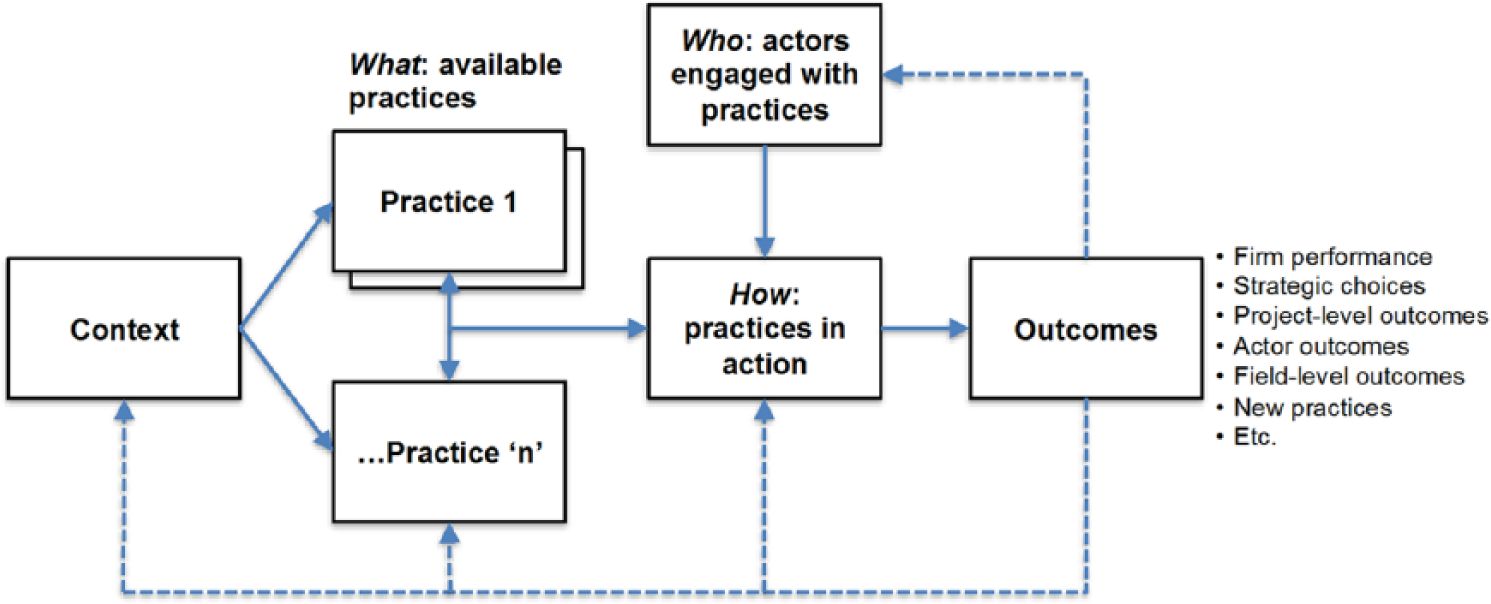
A schematic model of strategy practice.
It is by integrating the what, who, and how of practices that scholars can trace the links between firm practices and heterogeneous firm performance. However, while economic performance is one extremely important outcome, a practice perspective can also help us understand other, often more proximate, outcomes. In particular, our model underlines potential feedback effects on the practices themselves as well as on the actors and the way they enact the practices. While the elements of this model are not new to the field—as they have been well documented through 20 years of strategy-as-practice research and related studies in the broader strategic management field—the model does integrate the insights from practice research in a manner that explicitly connects practices to performance.
What practices?
Our model is similar to Bromiley and Rau’s (2014) proposal in seeing practices as fundamental to performance, but treats these practices differently in two key respects: in highlighting multiple interdependencies between practices and in attending to non-standard, and especially new, practices.
Figure 1 highlights the potential for interdependency of effects between many practices (Practice1 to Practicen). Strategy research has long highlighted the importance of considering complementarities in organizations (e.g. Teece, 1984; Whittington et al., 1999). This is equally important in the domain of practices. The effects of a practice will vary according to the presence or absence of other practices. Indeed, practice theory generally analyzes practices as “bundles” rather than singly (Nicolini, 2012; Seidl and Whittington, 2014). Pascale’s (1990) analysis of General Electric, while not explicitly a study of practices, highlights the kinds of interdependencies that are important. Here, he finds that the introduction of new strategic planning practices relied upon the strong financial and analytical practices that the company already had in place. Similarly, Mirabeau and Maguire (2014) show how practices of strategy articulation are entangled with mobilizing support, manipulating strategic context, and altering structural context. Moving beyond studies of isolated practices to investigate which practices are typically combined and how their interdependence shapes performance outcomes should avoid misattribution of the effects of any single practice.
Furthermore, it is important to understand not just existing “best” practices but the creation of new, non-standard strategy practices. As Ghemawat (2002) observes, the strategy field is particularly innovative in terms of practices. While there may be performance effects of the adoption of standard practices and techniques, practice innovation is potentially another source of competitive advantage. Strategy practices in particular are changing in contemporary conditions: for example, social media technologies are currently challenging old top-down strategic planning processes and generating new practices such as the strategy and innovation jams popularized by IBM (Bjelland and Wood, 2008; Whittington et al., 2011). With the decline of research on strategic planning practices (Ronda-Pupo and Guerras-Martin, 2012), such new practices are liable to be neglected.
Who engages in practices?
An integrative practice perspective moves beyond practices to include the human actors who perform them (Feldman and Orlikowski, 2011; Feldman and Pentland, 2003; Whittington, 2003). As Figure 1 indicates, practices are strongly shaped by the practitioners who develop and advocate them. The specific characteristics of different types of practitioners—in terms of cognitive traits (Powell et al., 2011), roles (Mantere, 2008), and organizational positions (Balogun and Johnson, 2004)—will have strong implications for practice use in different firms. This is consistent with Gavetti and Rivkin’s (2007) insight that Internet company Lycos, an organization dominated by engineers, had different strategy search practices to those of Yahoo, an organization dominated by marketers.
Accordingly, inferences about the relationships between practices and performance are insecure if we do not account for the practitioners involved and the varying effects they can have (Suddaby et al., 2013). The same practice may have different performance outcomes when introduced by a prestigious consulting firm, by a powerful CEO or by a middle manager. Similarly, strategy practitioners may be more or less successful in their use of particular strategizing practices, according to their social skills and the contexts in which they operate (Jarzabkowski, 2008).
Our model also suggests certain feedback effects of the use of practices on practitioners in terms of their identities, skills, and career prospects. For example, Oakes et al. (1998) show how the introduction of planning practices in a new context can change actors’ professional identities, hence altering their actions in successive planning episodes. Repeated engagement in strategy making may improve practitioners’ skills, as they learn to perform their practices more effectively (Jarzabkowski, 2008). And, some strategy practices, such as coalition building around particular cognitive frames, may enable some people who are quite low in an organizational hierarchy to gain power and therefore shape strategic choice and action (Kaplan, 2008; Lechner and Floyd, 2012). Indeed, Mantere (2005) shows that the adaptability of practices is critical in either enabling or disabling managerial attempts to influence strategy.
How are they practiced?
As shown in Figure 1, how practices are enacted mediates between practices and outcomes. It is, therefore, risky to consider practices without taking these dynamics into account. Gibbons and Henderson (2013) warn that detailed observation in the field to elucidate what managers actually do should be an essential complement to the Bloom and Van Reenen (2010) tradition of survey research on practices. The danger of superficial understandings of practices is one of misattribution: espoused practices are held out as examples to imitate and adopt, when it is improvisations and workarounds that are really making the practices work (e.g. Orlikowski, 1996). For example, the application of Total Quality Management (TQM) as a best practice has been shown to vary both from its technical specifications and in its use across firms, leading to varying attributions of success from practice adoption (Kennedy and Fiss, 2009; Zbaracki, 1998).
Practices are rarely blueprints that can simply be plugged into a context in unproblematic ways, as their use will be shaped by practical adaptations associated with specific contexts or practitioners’ needs (Mantere, 2005; Seidl, 2007). Moreover, close observation of practice adaptation may reveal sources of potential practice innovation. If we move beyond views of practices as largely transferred intact between contexts and actors, to understanding how those practices are enacted locally in practice, often in ways that make them barely recognizable to their originators, we may develop theories about the critical role of practice adaptation or even practice transformation in generating performance outcomes (Jarzabkowski and Kaplan, 2015).
What are the outcomes?
Our model also would inform a wider approach to practice outcomes that would allow researchers to consider not just firm performance but also impacts on the practices themselves. That is, the enactment of practices feeds back on those practices. For example, Fligstein’s (1993) study shows how adoption of practices of diversification and divisionalization by exemplar firms changes the stock of legitimate practices in other firms’ contexts, making them more likely to adopt these practices in following periods. Given these self-reinforcing effects, new practices need particular scrutiny. Strategy as a domain may be over-susceptible to novelty, thanks in part to consultants (McKenna, 2012): market failures make it possible for specious or dangerous strategy practices to take hold, as, for example, those surrounding the “dotcom” boom and bust (Ghemawat, 2002). New strategy practices demand research, not only because they may be sources of advantage but also because they can quickly have damaging impacts upon the economy at large (March, 2006).
Close observation of practice enactment can also illuminate other outcomes salient to both firms and individual practitioners (Guérard et al., 2014; Jarzabkowski and Spee, 2009). For example, Kaplan (2011) shows how practices associated with working on PowerPoint documents can shift who participates in strategy making by giving voice to people at different levels of the hierarchy. Langley (1989) shows how strategic analysis practices not only assist in strategic choices but also serve social and symbolic functions such as group cohesion and communications. Which functions are served depends in part on how the strategic analysis practices are enacted.
Rethinking strategy from an integrated practice perspective
To illustrate how the integrated practice perspective of our model can uncover surprising and significant findings for strategic management, we point to recent research in leading journals that helps rethink core strategy topics. For the purposes of illustration, we focus on insights for the resource-based view, the gap between deliberate and emergent strategies, and the alignment between corporate and business unit strategy. Each example attends to the what, who, and how of practices. In each case, we show how studies of strategy-as-practice call into question certain findings or suggest contextual or boundary conditions on what have been positioned as broad conclusions. We also highlight how in each case consideration of practices in isolation, as implied by Bromiley and Rau’s (2014) “Practice Based View,” obscures important effects.
New ideas about the resource-based view
The resource-based view of strategy assumes that initial conditions and path dependence lead to competitively distinctive capabilities across organizations (Amit and Schoemaker, 1993; Barney, 1991; Peteraf, 1993). Path dependence has traditionally been portrayed as a deterministic process (Stinchcombe, 1965) where changing paths is difficult (Dosi, 1982). By taking a practice perspective, however, Kaplan and Orlikowski (2013) demonstrate that it is possible to create new paths through attention to the temporal practices of strategy making. By closely observing the daily practices of strategy makers, they find that the past is as much subject to interpretation as is the future. Their study concludes that forecasts that take an organization in a new direction are only possible to the extent that the organization’s history is engaged in this new narrative. The espoused practice for the organization was “forecasting,” but the actual practice as enacted by strategy makers involved constructing strategic narratives. Thus, work to negotiate interpretations of the past, present, and future shape the degree and direction of deviations from an original path. This research suggests that history matters but not in a purely deterministic way. Instead, when new projections of the future lead to reimagining the past, organizations can follow newly constructed paths. These findings offer insights into the degree to which resources and capabilities can be valuable, rare, inimitable, and non-substitutable. For example, practices that were no longer valuable can become valuable again through new interpretations by actors that are constructed into new narratives about the future of the organization. The how of practice enactment transforms the what of the original practices.
Reconciliation of emergent and deliberate strategies
Many studies of strategy process portray it as an emergent pattern in a stream of actions (Brown and Eisenhardt, 1997; Mintzberg and Waters, 1985). Yet, it is obvious that organizations engage in deliberate strategy making, often through strategic planning practices (Brews and Hunt, 1999; Grant, 2003; Joseph and Ocasio, 2012; Menz and Scheef, 2014). A practice perspective helps to see that the assumed tension between deliberate planning practices and emergent strategies represents a false dichotomy. In-depth observations of practice show that managers’ different strategizing (Jarzabkowski, 2008), discursive (Rouleau and Balogun, 2011), and legitimizing practices (Paroutis and Heracleous, 2013) advance deliberate strategies. Furthermore, managers adapt their supposedly deliberate intentions continuously in response to the strategies that emerge from the autonomous actions of managers at multiple levels of the firm (Mirabeau and Maguire, 2014). Thus, the tension between deliberate and emergent strategizing in the literature exists because of assumptions that deliberate strategy practices, such as planning, are enacted as formally described.
By contrast, close study of strategy making as it happens shows how these practices are in fact interpreted, manipulated, and improvised in many different ways by actors, according to their social skill (Jarzabkowski, 2008; Paroutis and Heracleous, 2013), and their relative position as in the organization (Balogun and Johnson, 2004; Mantere and Vaara, 2008; Rouleau and Balogun, 2011). Hence, when we study the actual praxis of strategy making and widen the scope of study beyond top managers, we see that strategy is neither deliberate nor emergent. Rather, emergence involves continuous deliberation, in which who is doing the strategizing (e.g. operational, middle, or top managers) and how they do it shape the pattern that emerges in distinctive ways. As a result, the association of formal strategic planning practices wholly with deliberate strategy is a misleading exaggeration.
Rethinking the benefits of alignment between corporate and business unit strategies
Strategic alignment of corporate and business unit strategies, particularly within the multi-divisional or multinational firm, is typically considered to be a desirable objective for firms (Bouquet and Birkinshaw, 2008a, 2008b). Hence, there has been considerable empirical focus on the relative effects of corporate or business unit influence on firm performance (McGahan and Porter, 1997) and examination of the structures that best enable such alignment (Collis et al., 2007; Joseph and Ocasio, 2012).
However, a practice perspective—in examining the interactions between managers at different levels of hierarchy and in different geographic regions—shows us that making alignment work on the ground involves a great deal of local adjustment that may deviate from corporate policies, albeit often in positive ways for the firm. For example, multi-level studies of managerial influence suggest that misalignment, far from being damaging, may be critical for preserving key strategic markets, branding, and skills within business units (Balogun, Jarzabkowski and Vaara, 2011); generating strategic innovations that radically alter firm strategy (e.g. Regnér, 2003); and enabling firms to adjust to the complexities of delivering strategy in multiple contexts with diverse stakeholders (Rouleau and Balogun, 2011). Such findings run counter to the concepts of corporate control and strategic alignment that seek to understand how firms can perform consistently despite the complexity of the multiple contexts of their business units (Kreutzer et al., 2015; Luo and Park, 2001). Rather, an integrative practice perspective posits that perfect execution of alignment practices would actually be dysfunctional, while misalignments between the corporate center and divisions, with their associated conflicts, may be important mechanisms for enhancing strategic performance.
The few studies covered here only hint at the potential for an integrated practice perspective to change the way we think about core areas of strategic management research. A practice perspective can furnish insights into the who, what, and how of strategy making, bringing to the fore a wider range of actors than are typically studied in strategic management research, and examining what practices they use, including their discourses, technologies, and formal meeting structures, in order to explain how strategy is done. This can include not only strategy formulation and change but also how strategies emerge, how they are maintained, and what constitutes success for different actors in these endeavors.
Conclusion
This article was motivated by a concern about the narrow focus on “best” practices in strategy research as advocated by Bromiley and Rau (2014). Drawing on a recent stream of economics-based studies by Bloom and colleagues on the distribution of standard practices across organizations, industries, and countries (Bloom et al., 2012, 2013; Bloom and Van Reenen, 2007, 2010), Bromiley and Rau have called for studies in strategic management to focus on the effect of practices on firm performance. While we share their interest in practices, we warn against Bromiley and Rau’s neglect of two decades of practice-theoretic and related research.
Indeed, their attempt to relate practices statistically to performance may be inherently misguided and illusory for a variety of reasons, many of them raised by March and Sutton (1997). The chain of causality is too long and dependent and independent “variables” are not entirely separable (e.g. achieving economic performance is a practice too). The practice-theoretical perspective raised here shifts attention away from such variable-based reasoning, highlighting entanglement and interdependence. Bromiley and Rau’s (2014) elevation of practices above praxis and practitioners is thus liable to lead to faulty conclusions. Without an appreciation of the mutual dependence between the what, who, and how, strategy research runs the risk of misattributing performance differentials and, as a consequence, offering misleading advice to strategy practitioners.
In conclusion, in this article, we offer a practice perspective on strategy that integrates insights from different practice approaches and related research from the broader strategic management field. We show how this integrated perspective can help rethink core strategy topics and generate further research in these areas. By extending research to incorporate both a richer notion of interdependent practices and a more comprehensive focus on practitioners and their enactment of practices, scholars are more likely to come to robust conclusions regarding the efficacy of practices and their link to other outcomes. Our proposed integrative practice model will therefore aid scholars in generating more accurate and contextually sensitive theories about the enactment and impact of practices and the critical factors shaping variation in both processes and outcomes.
Footnotes
Acknowledgements
We would like to thank Ann Langley for her helpful comments on an earlier draft of this essay. The usual disclaimers apply.
Declaration of Conflicting Interests
The author(s) declared no potential conflicts of interest with respect to the research, authorship, and/or publication of this article.
Funding
The author(s) received no financial support for the research, authorship, and/or publication of this article.