



Abstract
Mergers and acquisitions research has principally focused on attributes of the acquiring firm and post-acquisition outcomes. To extend our knowledge, we focus on external factors, in particular rival responses, and explore when and how rivals respond to their competitor’s acquisitions. Leveraging the awareness–motivation–capability framework, we predict and find evidence that a rival’s dependence on markets in common with the acquirer, resource similarity between rival and acquirer, and a rival’s organizational slack increase the volume and, in some cases, also the complexity of a rival’s competitive actions following an acquisition. Furthermore, the type of acquisition positively moderates some of these relationships. The results extend our understanding of the influence of mergers and acquisitions on competitive dynamics in the marketplace.
Keywords
Introduction
Prevailing theory and conventional wisdom suggest that firms engage in acquisitions for various reasons, including diversifying into new market domains, capturing and leveraging synergistic resource exchanges between merging firms, and overcoming barriers to entry, among others (Hitt et al., 2001; Jensen and Ruback, 1983). Importantly, acquisitions also influence an industry’s competitive dynamics; Kim and Singal (1993) and Chatterjee (1986) found that acquisitions can reduce competitive rivalry, lead to collusion among competitors, and engender accommodation of the merging firms by their rivals, all creating a competitive context favorable to the acquirer.
Yet, empirical research has found that returns to acquisitions are often negative (e.g. Jensen and Ruback, 1983; King et al., 2004) and identified various internal costs and challenges in the acquisition process for the causes of weak merger performance. Explanations for poor returns include takeover premiums paid to the target firm’s shareholders, unanticipated post-acquisition integration costs, managers’ pursuit of personal interests via acquisition, and so on (Hitt et al., 1990; Sirower, 1997). Furthermore, there is evidence that rivals may act aggressively in the pre-merger phase, for instance, by bidding on a target to elevate its price, which reduces the returns to an acquisition (Brandenburger and Nalebuff, 1995). Moreover, Ghemawat and Ghadar (2000) found that rivals engage in bold strategic moves to exploit the distraction of acquirer management during the merger process.
The focus on the internal costs and rival behavior prior to and during an acquisition significantly limit our understanding of the disappointing outcomes (King et al., 2004). However, recent research on competitive dynamics and anecdotal evidence suggest the importance of the external, post-acquisition competitive context. Extant research suggests acquirers may gain advantages from acquisitions that negatively impact their rivals. We contend that some of the acquirer’s rivals do not accommodate the acquisition or collude with the acquirer, as previous work has shown. Instead, certain rivals view mergers and acquisitions (M&As) as stimulating hostility and competitive disruption, leading to a different competitive landscape post merger that weakens the acquirer’s post-acquisition performance. Additionally, Markman et al. (2009) suggest that acquisitions contribute to product market rivalry and also to factor market rivalry that can exacerbate and intensify product market rivalry.
Therefore, an important reason M&As often fail to meet expectations is the inability of the acquiring firm to account for the effects of rivals’ aggressive competitive responses following the acquisition (Haleblian et al., 2009). As a result, examination of potentially aggressive—rather than accommodating—responses to acquisitions is critical to better understand post-acquisition outcomes. Moreover, understanding the drivers of aggressive responses is essential to predict the potential success (or lack thereof) of M&As. The recent evidence on aggressive reactions by rivals suggests that examining the competitive context of M&As and the characteristics of the firms involved can advance our understanding of this important phenomenon. Prior research on competitive behaviors such as rivals aggressive or accommodating actions after an acquisition suggest the importance of identifying the organizational and competitive characteristics that prompt rival responses. Thus, our research question is as follows: Following an acquisition, which organizational and competitive conditions prompt rivals to compete more aggressively? We build on the awareness–motivation–capability (AMC) framework used in competitive dynamics research to predict when and how rivals respond (Chen, 1996; Chen et al., 2007).
Our study makes two concomitant contributions. First, answering the call for new theory to explain the consequences of M&As (Haleblian et al., 2009; King et al., 2004), we offer an alternative, competition-centric explanation for the generally weak performance of acquisitions. This cause of the weak performance is external to the deal and to the merging firms, specifically, competitive pressures engendered by the acquisition. Our study challenges previous work suggesting that rivals tend to accommodate M&As. Second, by exploring the link between corporate-level decisions (M&A) and competitive behavior (action repertoires), our study demonstrates the generalizability of recent research on product and factor market rivalry (Chen et al., 2007; Markman et al., 2009; Smith et al., 2001). Thus, it extends competitive dynamics into the domain of corporate strategy and its consequences. Our findings help to identify specific rival conditions—that is, dependence on markets in common with the acquirer, rival slack, and resource similarity between rival and acquirer—that motivate and enable rivals to respond aggressively to their competitors’ acquisitions.
A competition-centric view of M&A activity
Prior research examined the potential for acquisitions to reduce rivalry by decreasing the number of competitors, thus increasing market power, and the potential to produce gains from economies of scope (Clougherty and Duso, 2011). Alternatively, Chatterjee (1986) suggested that some acquisitions produce “collusive synergy”—that is, the ability of the acquirer to increase prices because of collusion among the industry participants. Similarly, Kim and Singal (1993) found that merging two rival airlines led to higher prices thereafter. These studies strongly suggest the exploitation of market power and tacit collusion between rivals associated with mergers.
Research on corporate strategy has traditionally conceptualized M&As based on a narrow cost-benefit analysis—related to market power, synergies, and so on. Related studies largely disregarded rivals’ responses in evaluating the outcomes of acquisitions. Others found that rivals concede exploitation of merger gains to the acquirer (e.g. Kim and Singal, 1993). Such a concession may take the form of increasing prices, reducing capacity, leaving markets, and so on. More recently, Clougherty and Duso (2011) found that approximately one-fourth of the large-scale, horizontal acquisitions (and rivals of the acquirers and targets) produced collusive synergies. Yet, the extant research does not explicitly and directly account for the broader competitive context; namely, the possibility of aggressive competitive responses by rivals that counteract some or all the potential benefits of M&A to the acquirer. Similar concerns regarding rival reactions to their competitors’ strategic moves have recently been suggested for research on strategic alliances (Park and Zhou, 2005) and factor markets (Capron and Chatain, 2008; Markman et al., 2009).
Competitive dynamics research suggests that the success of a firm’s actions depends on the number and range of rivals’ reactions. Simon (2005) found that rivals, in general, do not respond uniformly—either via accommodation or retaliation—to new entries into their market. Owing to a variety of organizational and competitive factors, some rival incumbents are strongly motivated to respond aggressively by carrying out a wide range of competitive actions—price cuts, product improvements, advertising campaigns, new products, and so on (Geroski, 1995)—while others are less motivated to respond aggressively. Furthermore, the intensity and form of the firm’s competitive responses to a rival’s actions are contingent on a number of important organizational and competitive conditions (cf. Smith et al., 2001). For instance, Silverman and Baum (2002) found that competitive intensity in response to the formation of an alliance by a rival depends on the specific nature of the alliance: horizontal, upstream, or downstream.
On completing an acquisition, the acquirer may realize an improvement in its competitive position or in its competitive advantage (Hitt et al., 2001). These potential benefits may signal that the acquirer has enhanced its capability to compete (Chen et al., 2007), thereby leading rivals to view the acquisition as a competitive threat (Garcia-Sanchez et al., 2014). Indeed, one study found that nearly 50% of rivals of acquirers lose market value because of the acquisition (Clougherty and Duso, 2011). 1 While price changes subsequent to an acquisition are easily observable and can be matched by rivals, the full range of an acquisition’s outcomes is harder for rivals to assess. Concerned with differential gains and losses relative to the acquiring firm, rivals are likely motivated to respond to an acquisition with aggressive competitive action in order to defend their positions in product and/or factor markets and also to minimize or neutralize the potential advantages gained by the acquirer (Capron and Chatain, 2008).
The business press highlights numerous examples of aggressive competitive responses carried out by an acquirer’s rivals. For instance, when Gillette acquired Duracell in 1996, top managers expected the deal to support earnings growth of the merged firms for several years into the future. Based on Gillette’s resources and market strength, management claimed that the combined firms would develop and market a successful premium-priced battery. Yet, rivals Rayovac and Energizer attacked with price cuts and special promotions. As a result of aggressive responses by rivals to the acquisition, Duracell lost overall market share and operating margins declined by one third (Business Week Online, 2000).
These considerations strongly suggest that a merger can increase competitive pressures and elicit aggressive competitive responses by rivals of the merging firms. Yet, M&A research has not fully explored the drivers of rivals’ responses. Drawing from core ideas in competitive dynamics, we argue that post-acquisition competitive behavior is a derivative of relevant and relative characteristics of competing firms in the industry.
Sources of competitive tension and observed competitive aggressiveness
Scholars in competitive dynamics have developed theory and empirical methods focused on firm strategy as a competitive action, defined broadly as observable, externally directed, market-based competitive moves taken with the intent to improve a firm’s relative competitive position (Grimm et al., 2006; Smith et al., 2001). Early research in this stream examined the action-response dyads (e.g. Chen et al., 1992; Smith et al., 1991), whereby the characteristics of a singular competitive action are important predictors of a rival’s singular competitive response. 2 In ongoing head-to-head competitive interaction, however, firms carry out an endless series of competitive moves and countermoves—for example, price cutting, introducing new products, marketing campaigns, capacity expansions, and so on—to keep rivals off balance, defend market share, and achieve/sustain superior performance (D’Aveni, 1994; Kirzner, 1973; Smith et al., 2001). In this vein, research has examined a variety of antecedents and consequences of the entire set of competitive actions completed in a given period of time, the competitive action repertoire (e.g. Ferrier et al., 1999; Miller and Chen, 1994, 1996). Our study, in effect, is the first to tap into both the action response and action repertoire levels of aggregation by examining how one firm’s singular corporate-level competitive action (an acquisition) influences two fundamental attributes of a rival’s competitive strategy: Action repertoire volume (how many actions the rival carries out) and action repertoire complexity (the extent to which the rival’s set of actions consists of a range of different types of actions).
Central to competitive dynamics is the conceptualization and measurement of competitive aggressiveness. Drawing from Austrian economics, Hypercompetition theory, and corporate entrepreneurship research (Covin and Slevin, 1991; D’Aveni, 1994; Kirzner, 1973), competitive aggressiveness is defined as the propensity for firms to directly challenge rivals by carrying out a sustained and diverse series of competitive actions (Ferrier, 2001; Ferrier et al., 1999; Ferrier and Lee, 2002). Beyond the number of competitive actions, the diversity of such actions is important because firms often respond uniquely to the particular character of the initial action (Chen and Miller, 2012). For instance, cost leaders may be more responsive to price cuts than quality leaders. We thus explore the conditions—that is, rival and acquirer firm characteristics—under which an acquisition made by a firm increases the competitive tension and triggers an aggressive competitive response among rivals in a given industry. 3
The emergent theoretical framework within competitive dynamics pinpoints three implicit drivers of aggressive competitive behavior—the awareness of rivals, the motivation to carry out competitive actions against one another, and the capability to carry out such actions—known as the AMC framework (Chen, 1996; Chen et al., 2007). Taken together, elements of the AMC framework manifest the competitive tension between rivals or “… the strain between a focal firm and a given rival that is likely to result in the firm taking action against the rival” (Chen et al., 2007: 101). In our study, an acquisition carried out by the initiating firm is viewed as a specific, observable, competitive action that often changes the competitive equilibrium between firms in the market thereby transforming the static competitive “tension” between the acquirer and its rivals into a dynamic, sustained, and potentially aggressive “interaction.”
A rival’s awareness of its interdependence with other firms is conditioned by the dependence of the rival on markets common with these firms and on the similarity of the rival’s resources to the firms (Chen, 1996). Market dependence refers to the proportion of revenues or profits a firm derives from a particular product market; the larger the proportion, the higher the market dependence. Resource similarity is the extent to which two firms have comparable resource endowments in type and amount. Given high market dependence, rivals are keenly aware of one another and their actions. Also, when market dependence is high, rivals are more likely to recognize the need to defend their market position from competitors whose actions, such as an acquisition, may threaten this position (Smith et al., 2001). Resource similarity makes rivals more aware of the potential consequences of strategic actions taken by their competitors and increases competitive tension (Chen et al., 2007).
Market dependence and resource similarity among competitors may also motivate them to respond to competitive actions of their rivals (Chen, 1996). When firms depend on specific markets, they may see the need to defend their market position if it is threatened by a competitor’s competitive actions. Firms with similar resources have similar strengths and weaknesses, are likely to pursue similar strategies, and believe that they have the capability to compete on an equal footing (Chen et al., 2007; Gimeno and Woo, 1996; Harrison et al., 1991). An acquisition as a competitive action, in particular acquisition, may shift the relative resource balance between two firms and weaken the position of the rival relative to the acquirer because it often provides access to scarce strategic factors providing a greater opportunity to secure an advantage (Markman et al., 2009). Consequently, resource similarity, similar to market dependence, can motivate aggressive rival responses to an acquisition.
The capability of a firm to respond to a competitor’s actions depends on the firm’s resources, such as financial and human capital (Chen, 1996). Organizational slack is a “cushion of resources” that allows an organization to more quickly and effectively adapt to external changes and modify its strategy relative to firms with fewer resources (Haleblian et al., 2012; Wan and Yiu, 2009). Slack resources can facilitate or enable a variety of strategic behaviors, such as being an early actor in a merger wave (Haleblian et al., 2012), initiating strategic change (Bourgeois, 1981), and carrying out a large number of competitive actions (Ferrier, 2001). A competitor’s acquisition can change competitive conditions, and slack allows firms not only to act in order to exploit specific opportunities but also to react to threats in the competitive environment.
Furthermore, an acquisition represents a unique type of competitive action within an industry, namely a horizontal acquisition, a diversifying move across industries, a vertical acquisition, or an unrelated acquisition. 4 Because related acquisitions are more disruptive to the focal industry than other acquisition types, essentially merging two competitors into a larger one, rivals are likely to be more aware of the acquisition’s implications and potentially more motivated to respond. In particular, a horizontal acquisition may pose a particular threat to some (or many) rivals, similar to horizontal alliances (Silverman and Baum, 2002). Though a horizontal acquisition reduces the number of rivals in an industry, it also combines the strengths of two competitors, reducing the relative value of the strengths held by the rival(s). Such an attack via horizontal acquisition can motivate a rival to respond aggressively, especially if it depends highly on this market and the resource balance across rivals in the industry is threatened. Our full theoretical model is depicted in Figure 1. These relationships have heretofore not been examined in depth in the M&A or competitive dynamics research.
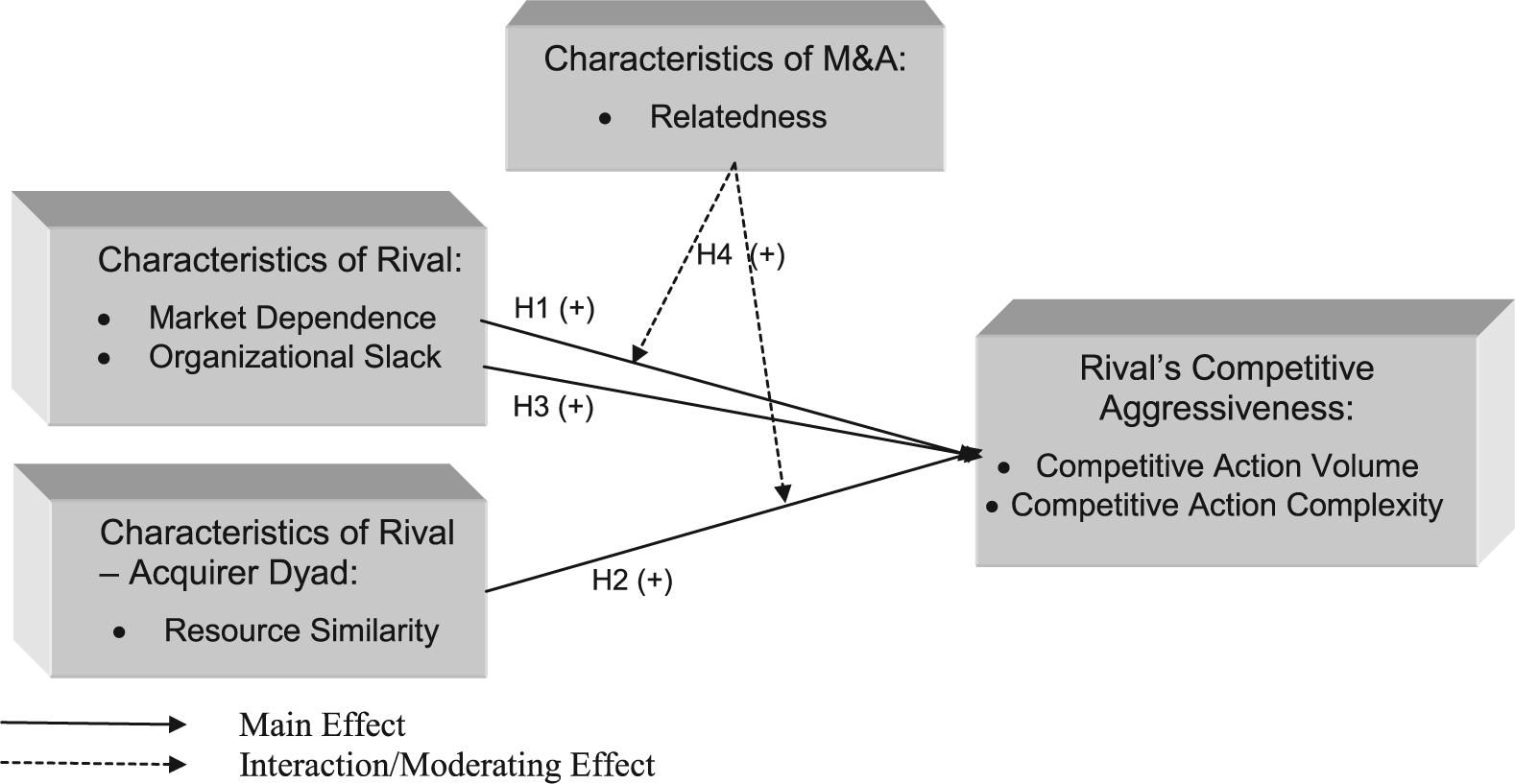
Drivers of rival response aggressiveness.
Hypotheses
Market dependence as awareness enhancing and aggressiveness motivating
The motivation to respond to an acquisition may hinge on the extent to which the rival is dependent on the acquirer’s primary markets (Chen, 1996). Dependence on the same product market gives the rival knowledge of the potential benefits associated with the acquisition. For instance, the acquisition may produce greater market power for the merging firms or provide the capability to create innovations potentially valuable to customers in the market. Rivals with high dependence on a certain market are likely to have more knowledge about these markets than rivals with lower dependence, for example, because of greater investments in monitoring those markets. Accordingly, this knowledge makes the rival more aware of the potential outcomes of the acquisition because the rival can better anticipate customer benefits and reactions to the acquisition. Furthermore, market knowledge may allow the rival to target its responses specifically at the resource advantages the acquirer will accrue from the acquisition. The heightened potential to reduce the acquirer’s gains—and to minimize the rival’s losses—from the acquisition can motivate a rival to react aggressively (Capron and Chatain, 2008; Yu and Cannella, 2007). Likewise, the rival’s knowledge of a particular industry and its experience in successfully overcoming competitive challenges, such as a merger, may additionally motivate targeted competitive responses that efficiently use the rivals’ resources.
Understanding the effects of the acquisition on customers and markets more clearly also reduces the uncertainty involved with an aggressive response. The higher the expected gains from the acquisition, for instance, an improved ability to serve customers, the stronger the potential reaction of the acquirer to aggressive rival behavior intended to reduce these gains. As the rival can more effectively anticipate the consequences of its aggressive behavior, uncertainty is reduced, incentivizing aggressive action over taking a defensive position.
Furthermore, if a rival is highly dependent on the market, it may operate only in one or few markets. Rivals with low market dependence must also operate in other markets but can potentially compete with the merging firms in several markets. Gimeno (1999) found that multimarket competition reduces rivalry as firms recognize that aggressive competitor actions and responses in one market can have detrimental consequences in the other markets in which they compete. Yet, higher market dependence suggests that the rival is less likely to be engaged in multimarket competition with the acquirer, thereby diminishing the motivation for mutual forbearance. Thus, we expect that the rival’s dependence on the acquirer’s primary markets decreases mutual forbearance and increases the likelihood of an aggressive competitive response.
Hypothesis 1. Following an acquisition, the rival’s dependence on the acquirer’s primary markets is positively related to an increase in the rival’s level of competitive aggressiveness.
Resource similarity as awareness enhancing and aggressiveness motivating
The similarity of the rival’s resources to those of the acquirer or its target may also affect the intensity of competitive rivalry following the acquisition (Chen, 1996). Some valuable resources and resource combinations may be attained only via acquisition of other firms. Consequently, threats to the resource balance among rivals via acquisitions can signal to rivals that the acquirer will be a more potent competitor, thereby heightening the level of competitive tension (Chen et al., 2007). For instance, acquisitions may allow the acquirer to overcome a competitive resource advantage held by a rival (Markman et al., 2009). More generally, with factor market rivalry, research suggests that acquisitions are particularly likely to result in an aggressive competitive response because they can allow acquirers access to the most valuable strategic resources, that is, resources that can produce a competitive advantage (Markman et al., 2009).
These concerns may be particularly salient to the acquirer that expects private synergies from the acquisition. Private synergies are advantages created from the integration of resources of the merged firms that no other potential acquirers, including rivals, can expect to gain from the acquisition (Barney, 1988). Private synergies represent a special incentive, as they are price-neutral. Rivals with resources similar to the acquirer will be particularly concerned about private synergies that can significantly change the existing resource balance among competitors. Additionally, only the acquirer will know how to bundle and leverage these resources gained in the acquisition. Because rivals cannot adjust their resource portfolio in the same way as the acquirer and accommodation of the acquirer will leave rivals with an enduring disadvantage (Capron and Chatain, 2008), rivals are likely to respond with a range of competitive actions, perhaps involving price reductions, new marketing campaigns, and so on. In this case, an aggressive response might even distract the acquirer and delay the integration with the target so that potential private synergies are not quickly or fully realized.
Furthermore, because many benefits from acquisitions are based on resource advantages (Hitt et al., 2001), rivals with resources similar to those of the acquirer are likely to have a clearer understanding of the acquisition’s potential resource advantages than rivals with less similar resources. Indeed, acquisitions provide acquirers with significant new resources, but the value of these resources is often difficult to realize because of the challenge to integrate the merging firms’ resources due to different cultures and operations. As such, it may be difficult for the acquirer to use the new resources effectively for new actions and to respond to rivals after the acquisition. A rival with high resource similarity vis-à-vis the acquirer and heightened awareness of the acquisition benefits is likely more able to develop and implement an effective, aggressive competitive response to the acquisition. This rival should also have a better understanding of its potential competitive vulnerability in the marketplace because of the acquisition (Chen, 1996; Markman et al., 2009). The potential for efficiency in its competitive response may likewise motivate this rival to respond aggressively (Yu and Cannella, 2007).
Prior research suggests that firms operating in the same market recognize their interdependence with close competitors and may limit behaviors that risk retaliation (Chen and Miller, 2012). However, research has shown that similarities between firms increase aggressive behaviors despite the potential for mutual forbearance (Gimeno and Woo, 1996). Moreover, similar resource endowments between competitors have produced rapid competitive responses (Grimm et al., 2006). Presumably, this is because firms try to avoid becoming resource disadvantaged when a competitor attempts to gain an advantage over its rivals. These arguments suggest that resource similarity at the time of an acquisition increases the rival’s motivation to engage in an aggressive competitive response.
Hypothesis 2. Following an acquisition, the level of resource similarity between the acquirer and the rival is positively related to an increase in the rival’s level of competitive aggressiveness.
Slack as aggressiveness enabling
The rival’s capability to respond to a competitor’s acquisition is partly dependent on resources that are not fully employed prior to the acquisition. That is, the rival’s competitive responses often draw on its organizational slack. With few slack resources, the speed and scope of a rival’s repertoire of potential competitive responses will be more limited, increasing the likelihood of competitive acquiescence (Smith et al., 1991). Without slack resources, the rival may choose to accommodate an acquisition and gain at least some benefit by reducing competitive tension. Conversely, abundant organizational slack allows the rival to aggressively respond to a competitive challenge (Ferrier, 2001; Ferrier et al., 2002; Smith et al., 1991; Young et al., 1996).
Research shows that firms with slack resources often engage in bolder, more risky competitive actions (Hambrick and D’Aveni, 1988). This is important because acquisitions are among the most visible, hard to reverse, and resource-intensive commitments that firms make (Hayward and Shimizu, 2006). Research also shows that actions with significant effects on the competitive context provoke a higher number of competitive responses by rivals (Chen et al., 1992). And, acquisitions often have a significant influence on the competitive context. Yet, aggressive responses to acquisitions involve high risk for the rival because they may threaten expected returns to the acquisition which can provoke a major counter response from the acquirer. To reduce the risk of a countermove by the acquirer, rivals might accommodate an acquisition unless they have slack resources that allow for a bold, aggressive response. Only rivals with the strength (slack) to engage in quick, significant, and effective actions are confident that their aggressive responses will succeed; their slack enables adaptation in strategy if needed and further responses to countermoves by the acquirer (Smith et al., 1991; Wan and Yiu, 2009).
Hypothesis 3. Following an acquisition, the rival’s organizational slack is positively related to an increase in the rival’s level of competitive aggressiveness.
Moderation by acquisition relatedness
Earlier, we indicated that different types of acquisitions have differential effects on rivals of the acquirer. While an acquisition of an unrelated target may provide the acquirer with very different resources, thus increasing the uncertainty of the acquisition outcomes, unrelated acquisitions produce entry into new industries thereby reducing market commonality between acquirer and rivals. Accordingly, a rival is less likely to react to a competitor’s unrelated acquisition. Related acquisitions, on the other hand, in particular horizontal ones, heighten the competitive tension between acquirer and rivals.
In related acquisitions, acquirer, target, and rivals operate in similar markets. Thus, rivals have a heightened awareness and the motivation to respond aggressively. On one hand, horizontal and related acquisition may lead to industry consolidation thereby reducing competitive pressures. Research has found that horizontal acquisitions result in reduced commitment of customers to the target firm (Berger et al., 1998), thereby creating growth opportunities for rivals. Yet, a related acquisition reduces a rival’s opportunities to engage in its own related acquisitions as it decreases the number of potential targets in the industry and can be likened to resource captivity (Markman et al., 2009). A rival with high dependence on the market in which a related acquisition occurred might be particularly threatened by this move because it reduces its own range of options. Thus, this rival is likely to take other actions to exploit the reduced commitment of customers to the target firm and perhaps capture greater market share.
Moreover, a related acquisition produces significant resource redeployment from the target to the acquirer (Capron et al., 1998), threatening the resource balance between the acquirer and rivals. An evenly matched competitor prior to the acquisition may now become a much more potent, capable competitor that threatens the market position of the rival thereby increasing competitive tension (Chen et al., 2007; Silverman and Baum, 2002). From the rival’s point of view, a related acquisition enables the acquirer to strengthen, for instance, product development, production facilities, and marketing capabilities that result in economies of scale and disadvantage the rival. As a result, the rival will seek different means to compete effectively. These arguments suggest that the type of acquisition moderates both the relationship between rivals’ dependence on markets common with the acquirer and acquirer–rival resource similarity and aggressive responses. However, the influence of the capability of rivals to respond (slack resources) is unlikely to be affected by acquisition relatedness.
Hypothesis 4. The positive relationships between (a) market dependence and (b) resource similarity with an increase in the level of rivals’ competitive aggressiveness, following an acquisition, is strengthened by the relatedness of the acquisition.
Methods
Sample
We tested our hypotheses on a sample of firms that designated one of three related industries—pharmaceutical preparations (Standard Industrial Classifications (SIC) 2834), biological products (SIC 2836), or surgical and medical instruments and apparatus (SIC 3841)—as their primary line of business. These industries are characterized by precisely defined boundaries, ensuring that competitive moves implemented by industry members are designed to enhance a firm’s industry position relative to rivals. Market appraisals of pharmaceutical and med-tech firms often rely in large part on estimates of long-term cash flows. Thus, companies widely announce competitive moves that are intended to boost future valuations. Furthermore, the Food and Drug Administration (FDA) approval process, the patenting process, and the marketing process (to doctors) in these industries are similar. Relative to other industry contexts, this allows us to more precisely observe the competitive moves by firms. Also, because research and development (R&D) expenditures by these firms are substantial and products generated from them have blockbuster potential, competitive interaction is intense. Whereas, most competitive dynamics studies focus on a single industry, we extended our sampling over several adjacent industries to improve generalizability and because acquisitions often occur in related industries.
For the firms in our sample, we captured all acquisitions carried out over an 18-year time frame (1995–2012) reported in the Thomson Reuters SDC M&A database. We also collected data on each rival’s competitive responses across a 3-year window: The year that the acquisition was announced (year t) and the 2 years following (years t + 1 and t + 2). We limited the sample to acquisitions in which more than 50% of the target was acquired to ensure a controlling interest by the acquirer and not simply a diversifying investment in another autonomous firm. For access to the necessary data and including only those firms and acquisitions that are sufficient in size to be notable by rivals, we sampled acquisitions where target and acquiring firms were both listed on a US stock market. This process yielded 422 acquisitions during our time frame by acquirers with their primary line of business in one of the three industries listed above. Not all targets were from these industries, and we control for the relationship between acquirer and target (see below).
For each acquisition, we identified the top 10 rivals of the acquirer based on rivals’ total assets in the acquisition year. We used firm size as a criterion when selecting rivals because the largest firms in an industry are more likely to view each other as direct competitors and often have their competitive actions more comprehensively and accurately reported in the media (Chen et al., 2007; Ferrier et al., 1999). Furthermore, because of the high barriers to entry in the industries studied—for example, numerous patents, licensing agreements, lengthy FDA approval process, and steep R&D spending (Hindle, 2008)—smaller competitors are more specialized than their larger rivals and can likely overcome only selected barriers. To check for potential bias, we ran analyses with only reactions of the largest five competitors and there were no significant differences.
We considered pharmaceutical and biotech companies to be rivals across several therapeutic domains and drug categories, so the top 10 rivals in both SIC codes were identified. We treated the surgical/medical instruments and apparatus industry as a separate set of competing firms from which we generated a separate list of top 10 rivals. However, there is sufficient evidence that firms in this industry have resources in common with, are subject to similar barriers to entry, and are often in multimarket competition with firms in the pharmaceutical and biotech industries. Financial data were collected on all acquirers, targets, and their rivals from COMPUSTAT.
Identification and coding of rivals’ competitive actions
Using structured content analysis of published news reports and press releases, scholars in competitive dynamics have developed a systematic procedure to retrieve and code news about a firm’s competitive moves into different action categories (Smith et al., 2001). Consistent with this approach, we used Factiva as the news source and conducted a comprehensive search for all published news reports associated with each firm in our sample over the study period. This yielded thousands of news reports that served as the basis for identifying potential competitive actions. We applied a set of keywords associated with six different types of competitive actions—pricing, marketing, new products, capacity increases, legal proceedings, and overt signaling—examined in prior multi-industry studies to establish our initial set of competitive actions (Ferrier, 2001; Ferrier et al., 1999). Then, following the example of prior research, we recalibrated the set of action categories to reflect some elements of competitive behavior unique to the pharmaceutical and med-tech industries. 5 We added four action types to the initial set of actions: product improvements, promotional campaigns, clinical trials, and licensing agreements. An example of news headline associated with a clinical trials action is Bristol-Myers, Liposome Begin Phase II Testing of ABLC Drug. An example of a promotional action is Eli Lilly to Donate Drugs to Battle Tuberculosis Crisis in Russia. An example of a pricing action is Abbott Laboratories has lowered prices on about 50 of its injectable anesthetics and intravenous products. Examples and the keyword coding scheme are presented in Table 1.
Action types coding keywords and example headlines.
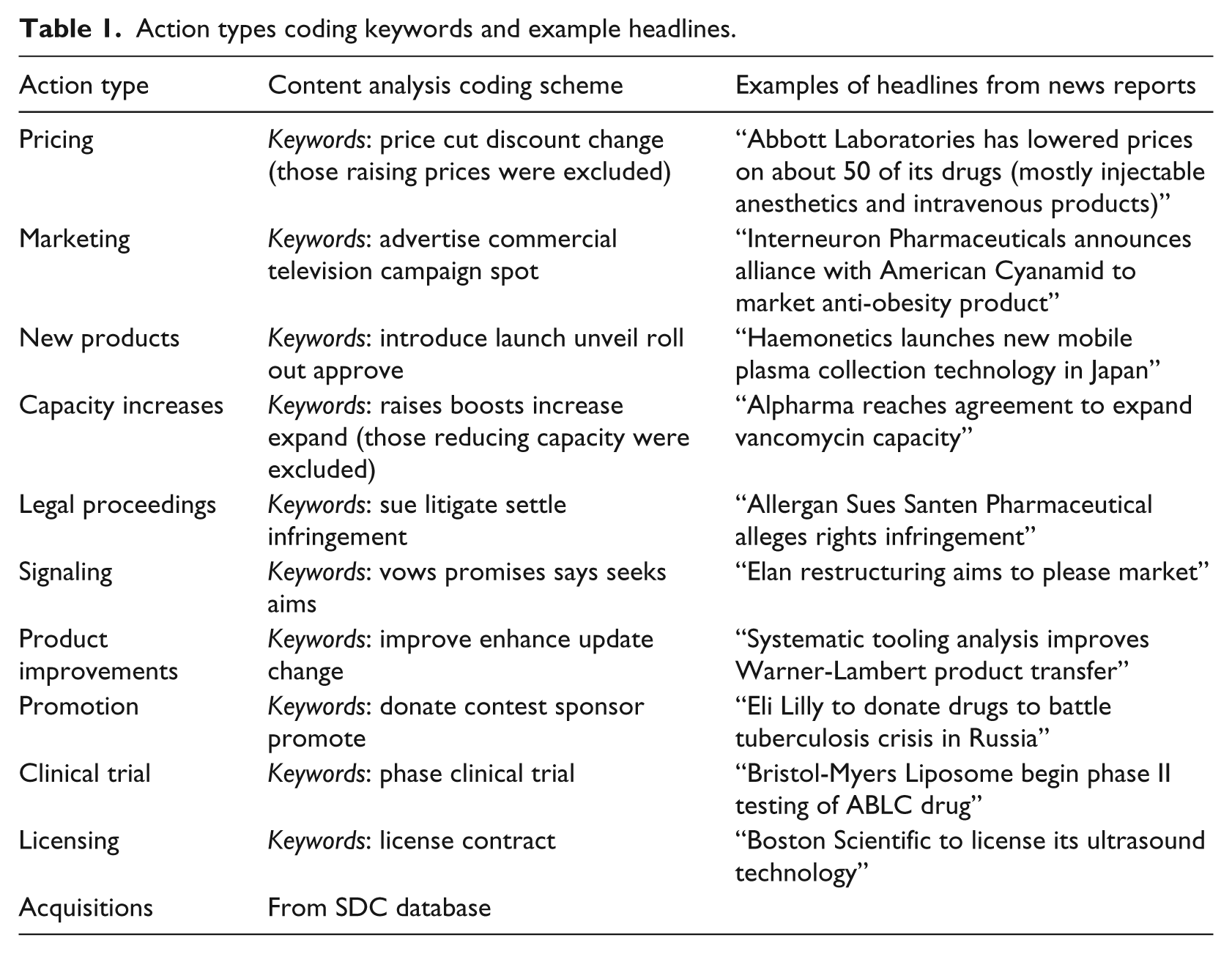
Drawing from announcements of M&As in the SDC database, we also captured acquisition events as an action category. In addition, we captured and coded two actions typically viewed in the M&A literature as accommodating to the acquirer: price increases and capacity reductions. The incidents of both were rare in the industries sampled. They were coded separately and included in our analyses as control variables for years t, t + 1, and t + 2. To ensure the reliability of our coding procedure, two experts in strategic management independently coded a representative sample (n = 300) of news headlines into one of the aforementioned action categories. Using Perrault and Leigh’s (1989) index of reliability, this categorization approach yielded a reliability index of 0.90, which exceeds the convention of 0.70 (Denzin and Lincoln, 2000).
Dependent variable
We measured competitive aggressiveness with two dimensions. The first—competitive action volume—captures the number of rival competitive actions carried out in a given year and has received robust support as a measure of this construct (cf. Ferrier et al., 1999; Gnyawali et al., 2006; Miller and Chen, 1996; Rindova et al., 2010; Young et al., 1996). Our second dimension—competitive action complexity—is the extent to which the rival’s set of competitive actions taken in a given year consists of a broad range—as compared to a narrow range—of different action types. Here, we used a Herfindahl-type index that accounts for the weighted diversity among all action types (Ferrier, 2001; Ferrier et al., 1999). This index accounts for both the number of action categories and the degree of concentration—or dispersion—of actions across action categories. For example, a set of actions consisting mainly of marketing actions is considered a simple action repertoire. By contrast, a firm engaging in a set of competitive actions that exhibits a representative balance among the possible action types is more complex.
Our data panel consists of measures for competitive action volume and competitive action complexity for each acquirer’s top 10 rivals for 3 years during and following an acquisition. Yet, for our analyses, we used the change in a rival’s volume and complexity scores 1 and 2 years following an acquisition event. For example, a rival’s change in action volume is represented as action volume in year t + 1 minus action volume in year t, and so on. This enabled us to capture increasing or decreasing levels of competitive aggressiveness in our analyses.
Independent variables
Market dependence
Similar to Gimeno’s (1999) approach, we calculated market dependence as the percentage of the rival’s sales derived in the primary SIC code of the acquirer relative to the rival’s total revenue. High scores indicate higher dependence on the focal market. The data were obtained for the year prior to the acquisition from the COMPUSTAT segments database.
Resource similarity
Consistent with prior studies in competitive dynamics, we calculate our measure of resource similarity between rival and acquirer for every acquisition. These studies use a Euclidean distance measure across several dimensions, pairwise with the rival and acquirer (Gimeno and Woo, 1996; Upson et al., 2012; Young et al., 2000). The variables chosen to compare resources ideally are both generalizable to other industries but also reflect salient resource positions particular to the industry studied. We selected four dimensions to include in our composite score for resource similarity. First, firm size, measured as total assets, is a powerful explanatory variable that reflects strategic capabilities, product–market strategies, and network strength (Gimeno and Woo, 1996; Josefy et al., 2015). Second, technological intensity, measured as the percentage of R&D spending divided by revenue, is particularly important in the pharmaceutical, biotech, and med-tech industries because of the risks and rewards associated with the new innovative treatments developed and the extent to which firms choose to invest in innovative capabilities (Das and Teng, 1998). Third, marketing and advertising intensity, measured by the marketing budget divided by revenue, indicates the capabilities of the firms to push their products to their customer base, a dimension with wide variance in the focal industries. Finally, market-specific experience, measured as the number of years each firm has operated in the primary SIC code of the acquirer, captures the industry-specific human capital and experience imprinted within the firm (Barney, 1991; Castanias and Helfat, 2001; Gimeno and Woo, 1996). The similarity score was calculated consistent with Gimeno and Woo (1996), for dimension d with rival r and acquirer a for acquisition q over the set of the four dimensions described above, s1 − s4. We subtracted the resultant resource distance score from 1 so that higher scores indicate resource similarity, as opposed to resource distance.
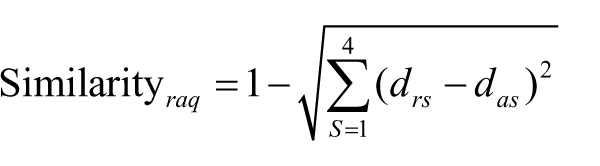
We also tested the effects of alternative combinations of these resource dimensions, as well as individual elements of our composite score. These efforts yielded substantively similar results. Yet, we included the composite measure with the four aforementioned dimensions because of its robust representation of resource similarity in our respective industries and because of its discriminant validity relative to our control variables.
Organizational slack
To measure the level of resources available for a rival to use in responding to a competitor’s actions, we calculated organizational slack as the ratio of working capital to sales (Bourgeois and Singh, 1983; Chakravarthy, 1986; Hambrick and D’Aveni, 1988). An alternative measure of slack, Selling, General, and Administrative Costs (SGA) to sales, produced essentially identical results.
Relatedness
We measured the moderating variable employing a 3-point scale—0 = unrelated (same two-digit SIC code or less), 1 = related diversified (same three-digit SIC code), and 2 = horizontal (same four-digit SIC code).
Control variables
Because size significantly influences firm actions, we controlled for the size of the acquirer (Josefy et al., 2015). We used the log of total sales as a measure of acquirer size. Small acquisitions are likely to produce fewer responses by the rivals, so we controlled for acquisition size as the log of the dollar value of the transaction. Given the close relationship between size and slack, we controlled for rival size (the log of total assets) in order to identify the effect of slack on the implementation of actions. Because there may be different industry-specific reasons for acquisitions, we controlled for industry at the four-digit SIC code level of the acquirer with dummy variables.
Financial constraints impact competitive actions. Thus, we controlled for capital and advertising intensity, which are substantial in the pharmaceutical industry, and research shows them to be important for complexity (Andrevski et al., in press; Hughes-Morgan et al., 2010). We measured capital intensity as the rival’s net fixed assets to total book assets, and advertising intensity as the rival’s advertising spending to total sales in the year prior to the acquisition.
Furthermore, we controlled for several variables that indicate the ability of the acquirer to effectively integrate the new entity as it could prompt rivals to respond in a more aggressive manner. As greater acquisition experience can ease acquisition integration, we controlled for the previous acquisition experience of the acquirer using the count of acquisitions by the acquirer over the last 10 years (Barkema and Schijven, 2008). As this attribute of the rival might influence its competitive aggressiveness, we also controlled for the acquisition experience of the rival as the count of acquisitions over the last 10 years. We controlled for pre-acquisition performance of the acquirer, measured as the return on equity for the year prior to the acquisition because prior firm performance may affect the ability to integrate the acquisition. We controlled for target performance as well, using the return on equity for the year prior to the acquisition. We controlled for pre-acquisition performance of the rival, measured as the return on equity for the year prior to the acquisition because this may affect the ability of the rival to respond.
Because the focal acquisition might be a response to a previous acquisition by a rival, we controlled for the time since the last acquisition in the industry (time since last acq.). Also, because several firms appear among the top 10 rivals in numerous acquisition cases and thus might respond extraordinarily aggressively, we control for this possibility with the number of times a firm appeared as one of the top 10 rivals to an acquirer (rival appearances). Due to difference in performance levels across the three industries that may affect the capability of firms to respond, we controlled for average industry performance for the 3 years after the acquisition (Ellis et al., 2011). As mentioned earlier, we controlled for rival accommodating actions, such as price increases and capacity reductions. We initially controlled for previous alliances between acquirer and target but found only few such cases in the SDC Joint Venture (JV) database with no effect, so this variable was omitted from later analyses.
Analysis and results
The unit of analysis for our study is the rival firm. Our data are structured such that each acquisition event corresponds to the competitive aggressiveness variables (action volume and action complexity) and organizational attributes (e.g. rival size, rival performance) of the top 10 rivals. This gives rise to repeated occurrences of acquirer attributes in the analyses. To account for this, we used generalized estimating equations (GEE) with the acquisition as the subject variable and each rival’s competitive actions as the within-subject variables. GEE uses weighted combinations of observations to extract the appropriate amount of information from correlated data (Hanley et al., 2003). For model-fit statistics, we use the quasi-likelihood–based model selection criterion (QIC) of the full model and compare it with the QIC statistic for the base model that includes only the controls. We found that adding the independent variables improves fit in models with significant results (Pan, 2001). Means, standard deviations, and correlations are reported in Table 2. Results of the GEE regression analyses are reported in Table 3.
Correlations and descriptive statistics.

p < 0.05 ** p < 0.01.
Regression analysis—main effects. a

GEE: generalized estimating equations; SE: standard error.
Results for industry dummies omitted; one-tailed tests per directional hypotheses.
n = 4220; *p < 0.05; **p < 0.01; ***p < 0.001.
Hypothesis 1 predicted that a rival’s dependence on the acquirer’s primary market would be positively related to an increase in the rival’s competitive aggressiveness. Our analysis indeed finds that market dependence of a rival is a positive and statistically significant predictor of its change in competitive action volume in both year 1 and year 2 following the acquisition. This indicates that when rivals are reliant on the markets in which a competitor makes an acquisition, they evidently responded quickly with an increase in the number of competitive moves and continue this aggressiveness in the second year. There was no statistically significant relationship with competitive action complexity. Thus, the results provide moderate support for Hypothesis 1 with a greater number of competitive actions.
Hypothesis 2 predicted that resource similarity between the acquirer and rivals would be positively related to an increase in the rival’s level of competitive aggressiveness. Our analysis finds that resource similarity of a rival is a positive and statistically significant predictor of its change in competitive action volume in both year 1 and year 2 following the acquisition. Thus, as for market dependence, rivals appeared to initially respond with an increase in the number of competitive moves and continue this aggressiveness in the second year. There was no statistically significant relationship with competitive action complexity. These results provide moderate support for Hypothesis 2 with a greater number of competitive actions.
Hypothesis 3 predicted that rivals’ organizational slack increases the likelihood they will engage in aggressive competitive responses subsequent to the merger undertaken by their competitor. As reported in Table 3, slack is a positive and statistically significant predictor of an increase in competitive action volume in the year immediately following the acquisition, however, not in the second year. Slack is also positively and significantly associated with an increase in competitive action complexity in the second year following the acquisition, but not in the first year. These results suggest that rivals’ level of slack increases their competitive responses in both the short and long term, with an immediate increase in the number of actions carried out, and a longer term increase in the variety of actions, providing support for hypothesis 3.
Hypotheses 4a and 4b predicted that the relatedness of an acquisition would moderate the relationships between market dependence and aggressiveness and resource similarity and aggressiveness, respectively. Based on the coefficient for the relatedness–market dependence interaction terms in Table 4, we find partial support for 4a, as related acquisitions moderate the relationship between market dependence and competitive action but only for response complexity in the second year. 6 For ease of interpretation, we graphed interaction effects as shown in Figure 2. Specifically, the upward slope for the high relatedness condition is reflective of the predicted main effect (H1) between market dependence and year t + 2 action repertoire complexity. Yet, in low relatedness acquisitions, the slope of the market dependence–complexity relationship is negative.
Regression analysis—moderation market dependence × acquisition relatedness. a
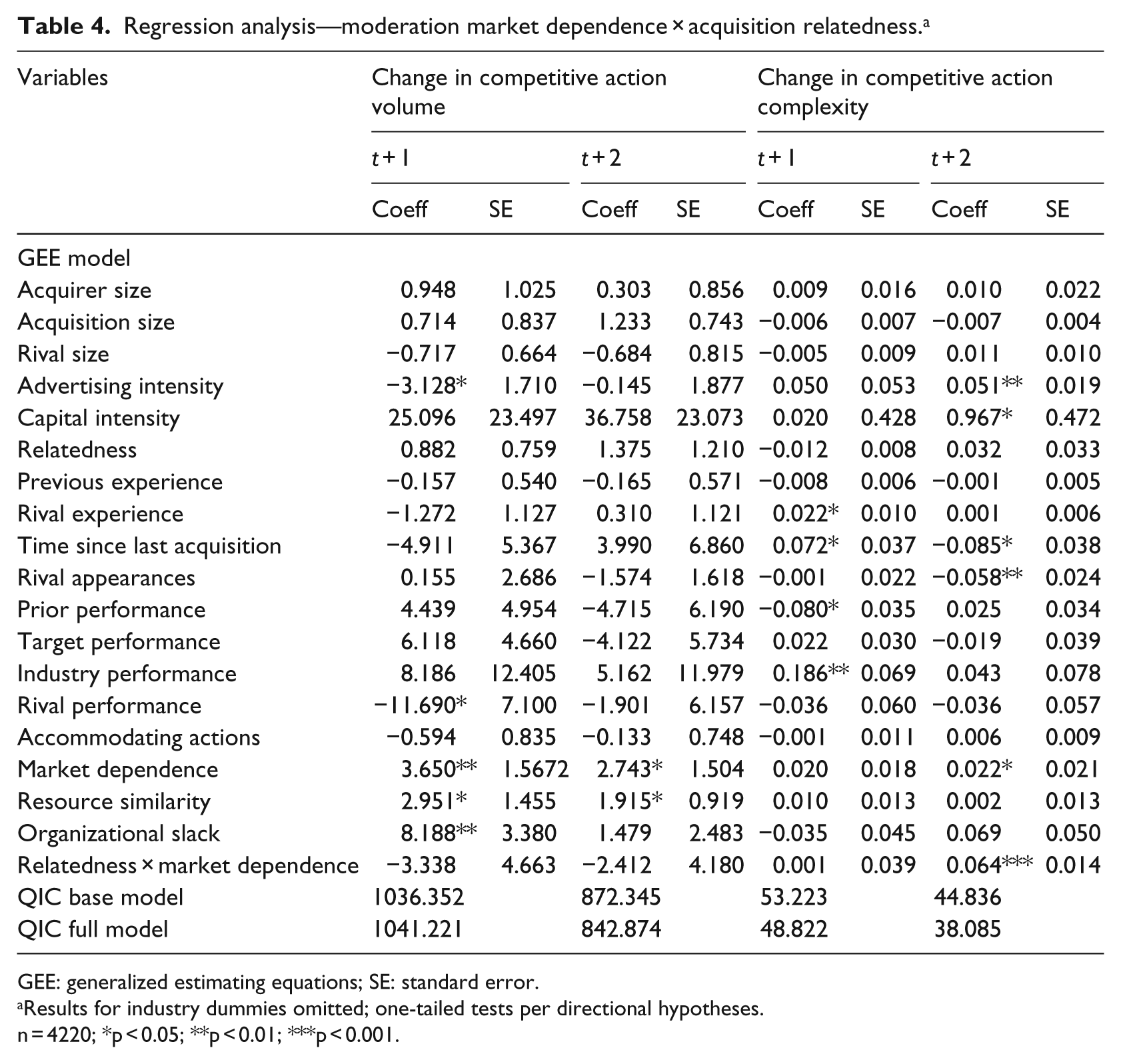
GEE: generalized estimating equations; SE: standard error.
Results for industry dummies omitted; one-tailed tests per directional hypotheses.
n = 4220; *p < 0.05; **p < 0.01; ***p < 0.001.
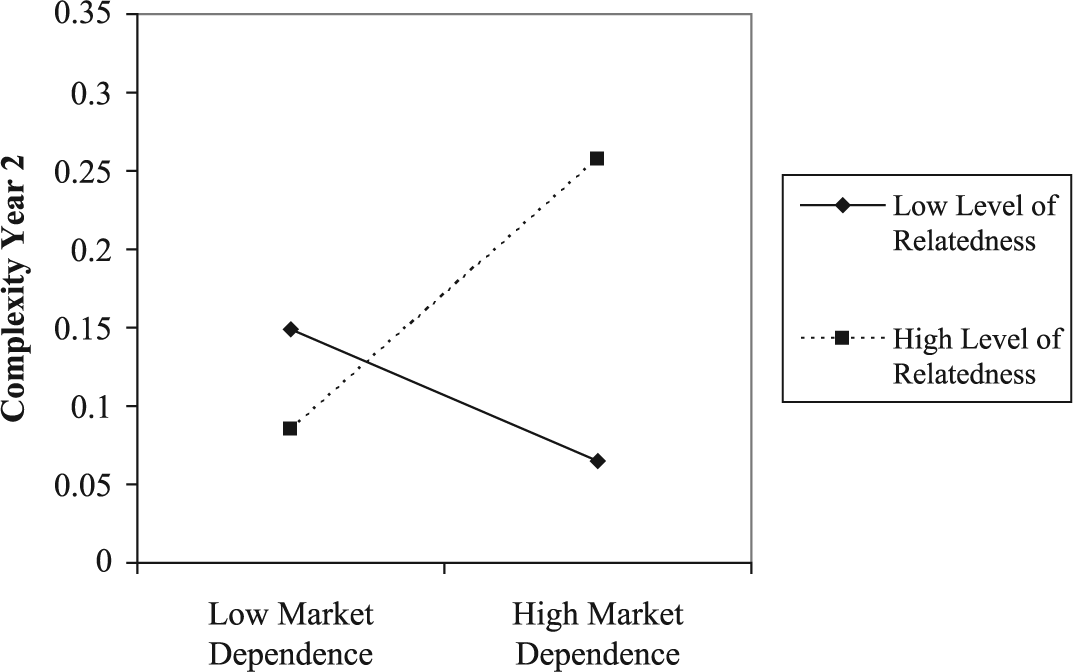
Effects on rival aggressiveness of the interaction of market dependence and relatedness of acquisition.
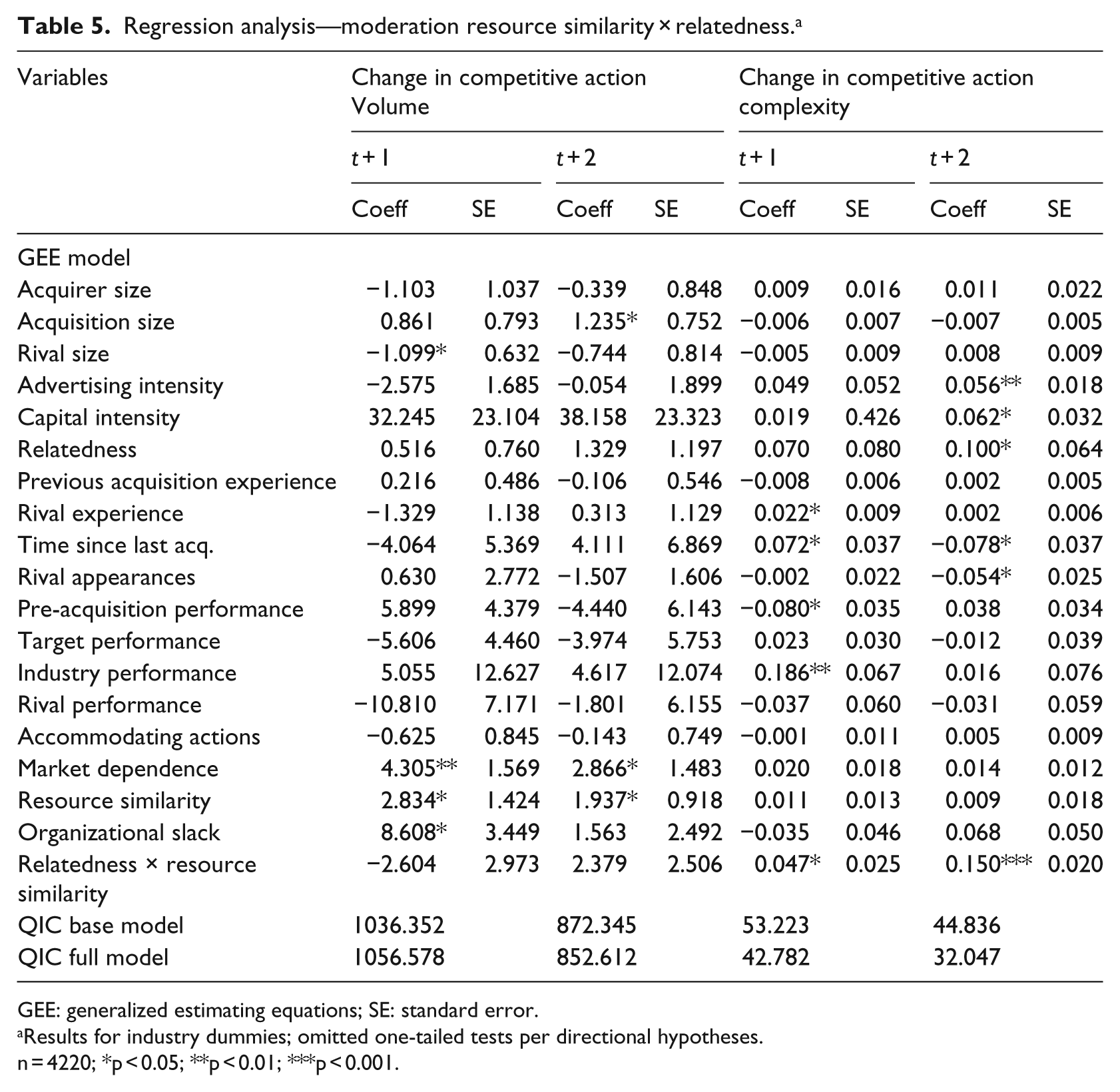
We find stronger support for hypothesis 4b, however. As shown in Table 5, the coefficients for the moderating effects are statistically significant for change in action complexity in both years subsequent to the acquisition. These interactions are depicted in Figure 3. Specifically, related acquisitions are associated with an increase in the positive slope of the resource similarity–complexity relationship. Yet, in low relatedness acquisitions, the slope of the resource similarity–action complexity relationship is negative for both post-acquisition years. None of the interactions tested, however, affected the volume of rival responses.
Regression analysis—moderation resource similarity × relatedness. a
GEE: generalized estimating equations; SE: standard error.
Results for industry dummies; omitted one-tailed tests per directional hypotheses.
n = 4220; *p < 0.05; **p < 0.01; ***p < 0.001.
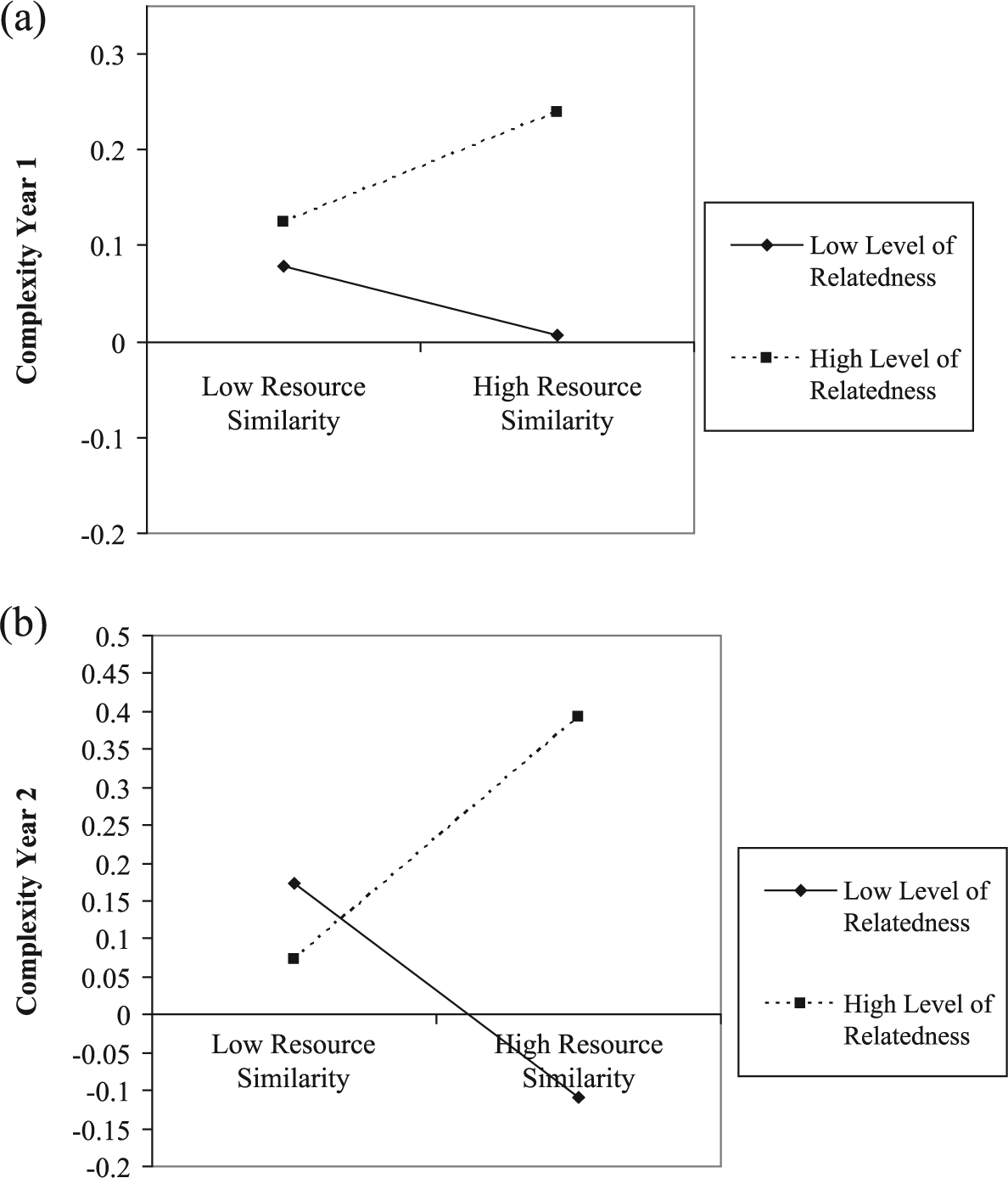
(a, b) Effects on rival aggressiveness of the interaction of resource similarity and type of acquisition.
Robustness test
To test the robustness of our findings and demonstrate a direct link between an acquisition and aggressive rival reactions, we conducted an event study identifying stock market (i.e. investors’) assessments of firm actions (e.g. announcement of an acquisition). The intensity of rivalry is critical for firm performance (Chen, 1996; Porter, 1980) and stock prices are affected by rival actions (Ferrier and Lee, 2002). Thus, investors likely take the probability of aggressive rival response to an acquisition into consideration when evaluating the value of the acquisition for the acquirer. Investors have access to information on rival awareness, motivation, and capability to respond to a merger. Following the example of previous M&A studies (e.g. Haleblian et al., 2009), we used event study methodology to identify the abnormal returns associated with the announcement of all acquisitions in our sample. We used the approach recommended by McWilliams and Siegel (1997) to measure the abnormal stock price returns of the firms. Using an estimation period preceding the event 250–50 days as recommended by McWilliams and Siegel (1997), we included the returns within a 3-day window that includes the day of the acquisition as well as the day before and after. Subsequently, we used the abnormal returns as the dependent variable in our GEE regression analysis instead of the rivals’ reactions.
We found that investors’ reactions were largely consistent with our findings: the results suggest that investors expect rivals to respond to an acquisition given market dependence, reducing the expected returns to the acquisition. That is, market dependence was associated negatively with abnormal returns to merger. We found the same result for rival slack. However, results for resource similarity were not statistically significant. Investors seem less concerned with resource similarity as a driver of aggressive competitive reaction to acquisition. Findings related to the moderating effects, however, demonstrated that those investors were concerned about the resource similarity with a related acquisition. The results for the interaction involving market dependence were not a statistically significant predictor of market returns. These findings indicate support for the robustness of the findings related to our hypotheses.
Discussion and conclusion
To understand weak returns to mergers, research largely focused on a cost-benefit analysis limited to conditions internal to the merger and the merging firms, such as takeover premiums and high integration costs. Research also suggests that mergers can create synergies based on complementary resources, economies of scale and scope, and other benefits that help achieve or maintain a competitive advantage. Yet, most of this work assumes a static competitive landscape, although they are dynamic, and shifts are often driven by acquisitions. Without an understanding of the external competitive context, we limit our power to explain the outcomes of M&As.
Given the potential competitive strengths an acquirer can gain from an acquisition, rivals can be expected to engage in aggressive competitive responses (actions) that limit or eliminate these anticipated advantages. Some research finds that rivals may accommodate mergers because they could receive peripheral benefits due to industry consolidation. But, competitive dynamics theory and anecdotal evidence suggest that rivals can also be threatened or harmed by competitors’ acquisitions. This study has highlighted conditions under which rivals appear to react aggressively to an acquisition, in contrast to prevailing theory in finance and economics.
Based on research in competitive dynamics, we found that under certain conditions related to rivals’ awareness and motivation—estimated by market dependence of rivals common with acquirers and resource similarity within the rival–acquirer dyad— and rivals’ capability—estimated by their organizational slack—they increase the number of competitive actions carried out subsequent to a competitor’s merger or acquisition. This increase in total actions is often sustained for somewhat longer periods. These findings complement those from prior research about the role of market dependence and resource similarity in competitive responses (e.g. Chen et al., 1992, 2007; Chen and MacMillan, 1992; Yu and Cannella, 2007). Moreover, when rivals have organizational slack, they may even respond with a broader repertoire of actions. This, however, is observed only in the second year following the acquisition which suggests that it takes time to decide on, develop, and carry out a comprehensive counter-attack. Our general findings suggest that future research should examine acquisitions as a strategic action within a dynamic, competitive environment.
Furthermore, our findings suggest that the complexity of rival responses based on resource similarity (and to a lesser degree based on market dependence) is influenced by the relatedness of the acquisition. Seemingly, firms that perceive an increase in competitive tension from a competitor’s acquisition are incentivized to react with a more complex response repertoire when the acquisition is related and thus creates an additional, more immediate threat to the rival. Likewise, less related mergers appear to reduce competitive tension making resource similarity less important. Previous findings showing accommodative behavior by rivals focused on industries in which horizontal (i.e. highly related) acquisitions are more common (e.g. commercial airlines). Potentially, accommodation through prices increases subsequent to merger may help fund other types of aggressive behavior, such as marketing or product actions. Alternatively, differences between industries may explain the extent to which industry-consolidating acquisitions are accommodated or aggressively contested—a question ripe for future research.
Viewed through the lens of competitive dynamics, our study contradicts many previous findings suggesting that rivals generally accommodate M&As. On a broader level, our research indicates that collusive behavior anticipated with acquisitions (Chatterjee, 1986; Kim and Singal, 1993) may result from the lack of awareness, motivation, and/or ability of rivals to react. Under conditions where rivals have significant resources to respond to a competitor’s acquisition or when rivals consider an acquisition to be a threat to their market position, they are unlikely to accommodate a competitor’s acquisitive actions; instead, they respond with a heightened number of actions, perhaps with greater breadth and complexity. These rival responses contribute to our understanding of acquirers achieving approximately zero or only small positive returns from acquisitions (Song and Walking, 2000). The inconsistent results from prior research regarding the effect of acquisitions on competitive pressures in industries may be resolved with a richer understanding of acquiring firms’ and rivals’ characteristics and the competitive landscape in which they operate. Accordingly, our study provides a foundation for the previously underexplored external context of M&As (Haleblian et al., 2009; Wan and Yiu, 2009).
Our research extends our understanding of competitive dynamics by exploring new drivers of competitive behavior (Chen and Miller, 2012; Smith et al., 2001). In general, our findings provide additional support for the AMC framework and highlight the value and generalizability of insights gained by work in competitive dynamics to the domain of corporate strategic actions. Although some of our findings mirror those from some prior research that adopted the action–response dyad level of action aggregation (e.g. Chen and MacMillan, 1992), we found that by adopting a hybrid action repertoire view of competitive response—a single competitive action provokes a competitive repertoire response—our results partially contradict findings from other extant research. This demonstrates the value of exploring a repertoire complexity response to competitive actions. Furthermore, whereas prior research has explored the relationships among a variety of organizational, managerial, competitive, and industry attributes and competitive repertoires (Gnyawali et al., 2006; Miller and Chen, 1994, 1996), our study is among the first to explore these effects over time. Indeed, we found differential effects between the organizational and competitive context variables in our models on action volume versus complexity over time. Moreover, the influence of acquisition relatedness suggests a critical contextual condition for the responses to this unique competitive action. It also lends early empirical support to recent theory associated with factor market rivalry (Markman et al., 2009).
Our research suggests that corporate-level strategy research needs to inculcate competitive rivalry similar to scholarly work on business-level strategy. We show that the two levels are not independent; rather, they appear to be interdependent, an important result for understanding the strategic outcomes. Aggressive business-level competitive actions may well be provoked by corporate-level actions of competitors. This supports our understanding of factor market rivalry suggesting that factor market actions, such as acquisitions, may exacerbate product market rivalry (Markman et al., 2009). Conversely, a competitive dynamics perspective of M&As could be extended by taking into account the product level. In addition to competing on the business and corporate level, pharmaceutical firms also compete on specific drugs, for example, Pfizer’s Lipitor against other cholesterol-reducing treatments. Therefore, rivals may respond to acquisitions in market segments in which they compete, as well as at the industry level. Our research specifically extends the emerging theoretical framework of competitive dynamics into a new, important strategic context, M&As, broadening the support for the AMC framework (Chen, 1996; Chen et al., 2007), and provides evidence on the implications of factor market rivalry (Capron and Chatain, 2008; Markman et al., 2009).
Our study also has significant implications for managerial practice. Previous research found accommodation as typical rival response to acquisitions. However, our research suggests that rivals may react aggressively, depending on rivals’ awareness, motivation, and capability to do so. Investors are also aware of this additional risk associated with acquisitions. Acquiring firm managers should be cognizant of the potential for rivals to react aggressively, even with the complex internal challenges typically present in executing M&As. Furthermore, managers might consider signaling to rivals that a specific acquisition is not an aggressive strategic move, but creates opportunities to reduce the level of competition within their industry, in order to prompt accommodating rather than aggressive rival responses (Chen and Miller, 1994).
Limitations
Although our study includes a broader set of industries than Kim and Singal’s (1993), our research is still limited to a set of related industries. Certainly, our results suggest that the Kim and Singal (1993) findings may be idiosyncratic to the airline industry or may stem from industry-wide characteristics typical of transportation industries that are not representative of the medical (and related) industries. Future research could fruitfully explore how industry attributes (via multi-industry studies) impact the aggressiveness of competitive reactions to M&As and consolidation is warranted. Multi-industry studies could also better examine rival reactions to diversifying acquisitions.
Our study also was unable to determine with certainty the intentionality of rival actions or if the focal acquisition actually was a response to a previous action by a rival. We attempted to minimize this concern by (a) using the change in rival actions, including change in competitive action repertoire, in years subsequent to the acquisition relative to pre-acquisition actions rather than absolute values as our dependent variables; (b) limiting our sample to large firms that are unambiguously direct rivals with each other; (c) an event study as a robustness test that more tightly links rival responses with a specific acquisition event; and (d) controlling for the time since the last acquisition in the industry before the focal one. In addition, the significant findings for hypothesis 4 are an indication that the rival actions indeed are associated with the acquisition; otherwise, the main effects we found would not have been modified by the acquisition relatedness. Nevertheless, more direct measures need to be developed for research on acquisitions and competitive dynamics surrounding them. Measurement issues might also contribute to weaker than expected findings for some of our main effects. For instance, with respect to the measurement of resource similarity, future research might take into consideration additional resource attributes, such as their mobility and versatility (Markman et al., 2009).
In conclusion, our findings indicate that further development of theory on the returns to M&As is needed. For instance, research could examine the link between competitive responses to an acquisition and post-merger performance of the acquirer. Furthermore, the competitive environment of acquirers should be considered. While we have identified some conditions that can increase the likelihood of aggressive competitive response to acquisitions, further work should examine additional motives and identify the abilities of rivals to undertake effective responses to competitors’ acquisitions. For instance, scholars might consider additional industry conditions. In industries with short product life cycles, firms have limited time to recoup investments, and competitive disadvantages must be eradicated rapidly to avoid major financial losses. An acquisition resulting in a significant advantage for the merged firm may lead to significantly higher returns, likely at the expense of rivals with little time to offset the consequences. Thus, in these markets, competitive advantage is rarely sustainable (Hitt et al., 2011). Because the consequences are of immediate significance to rivals in these fast-cycle markets, acquisitions are likely to produce swift and strong competitive responses. Taken together, this study adds new evidence to help us understand the returns experienced from acquisitions and advocates a new stream of research integrating scholarly work on M&As with research on competitive dynamics.
Footnotes
Acknowledgements
The authors wish to thank Laurence Capron and Ansgar Richter as well as seminar attendants at Arizona State University and EBS University for valuable feedback on earlier drafts of the article.
Declaration of Conflicting Interests
The author(s) declared no potential conflicts of interest with respect to the research, authorship, and/or publication of this article.
Funding
The author(s) disclosed receipt of the following financial support for the research, authorship, and/or publication of this article: The authors would like to thank their universities for funding the research, authorship and publication of the article.