




Abstract
In this article, we apply the idea of narrative to strategy and to the development of strategy in the higher education context. We explore how strategy is formed as an intertextual narrative in a comparative study of higher education in the UK. Existing research suggests that competition between narratives, such as that in higher education, should be problematic in strategy terms. We show that this is not necessarily the case. Unlike in other settings where new strategy narratives tend to drive out previous narratives, in higher education it is the on-going interaction between historical and new narratives that gives the content of strategy its essential voice. We show how apparently competing narratives are accommodated though appeals to emotion and values. The maintenance of strategic direction requires hope and a synthesis of societal values that maintains access to the past, the future, and multiple narrators. This approach helps us understand how universities perform the complex task of adapting the strengths of the university’s past to the challenges of external policy developments in strategy formation.
Keywords
Introduction
A growing number of studies of the strategic change process in the university focus on the issue of making the university a more significant player in shaping the knowledge economy. For example, studies have explored the commercialization of research through spin-outs (Rasmussen and Wright, 2015), the development of multi-disciplinary institutes (Mosey et al., 2012), and the role of university technology transfer offices (Chapple et al., 2005). Limits to this strategic change process are oftentimes attributed to the tension arising from the dual purposing of the university regarding its academic remit and the commercialization of knowledge (Ambos et al., 2008). Analysis of how strategic change and resistance to it unfolds in relation to policy (Siegel and Wright, 2015), as well as how the tension at the heart of the strategic challenges facing universities is resolved, is lacking. This is a notable gap in the literature given the need to conceptualize how universities can better sustain and enhance new business models faced with tension about the purpose of the university. We aim to fill this gap by applying a narrative approach to strategy in higher education (HE) exploring how strategic direction emerges over time in light of this tension.
We build on Barry and Elmes (1997) and others who have developed the narrative approach to strategy (Czarniawska, 1997). Narrative approaches in management and organizational theory (Czarniawska, 2004; Rhodes and Brown, 2005) focus on the role of language in the construction of social reality (Berger and Luckmann, 1967). Strategy as narrative sets a “discourse of direction” orientating the organization in its context and organizational members in their response (Fenton and Langley, 2011). At the same time, competing strategy narratives in organizations are seen as problematic, which are liable to undermine direction (Barry and Elmes, 1997; Boje, 1991).
There are two main and competing strategy narratives in HE, an older narrative of the “traditional” university associated with the past, and one strongly associated with the future, the narrative of the “enterprise” university (Barnett, 2011). There is an apparent competition between narratives, on one hand in policy, where narrative of the enterprise university dominates and, on the other hand, in the organization where there is still strong allegiance to an alternative narrative of the traditional university (Bridgman, 2007). This competition helps explain some of the mixed results regarding performance of “enterprise” universities (Rothaermel et al., 2007).
Strategy narrative has a significant role in organizational change, but few empirical studies explore how strategy narratives unfold over time (Vaara et al., 2016). Furthermore, research into the tension between narratives has generally examined the role of narratives in organizations where managers have a privileged role as narrators (e.g. Vaara and Monin, 2010) and can successfully call upon dominant narratives, thereby wielding rhetorical power (e.g. Vaara and Tienari, 2011). We know less about pluralistic settings involving a variety of potential narrators and a plurality of divergent narratives alongside less concentrated rhetorical power (Jarzabkowski and Fenton, 2006). Temporary resolution of tensions in such settings has been studied (e.g. Jarzabkowski and Sillince, 2007); however, we lack understanding of this resolution over time (Abdallah and Langley, 2014; Sillince et al., 2012; Vaara et al., 2016). We also lack understanding of how, in settings, such as HE, narratives embedded in policy that are in conflict with existing organizational narratives emerge (Morrell, 2006). Our research question therefore is, “how does the tension between competing strategy narratives play out in the HE setting?” Answering this question enables us to conceptualize the resolution of tension between strategy narratives over time. We therefore offer an explanation of how conflicts in the role of the university can be better managed at a time when policy makes strategy within the university a notable challenge.
We explore the development of competing strategy narratives in an inductive longitudinal case study (1992–2012) of two leading research-intensive universities in the United Kingdom. The United Kingdom is a site of intense reform with a long established HE sector that has been historically dependent on the State for funding. In this context, it would be expected that the strategic challenge in the commercialization of technologies and knowledge would be especially acute. Competition between narratives is long standing, and any accommodation between such narratives is well practiced (Tight, 2009). The competing narratives are anchored in the past and the future, respectively. This is theoretically significant since narratives anchored in the past (Brown and Humphreys, 2006; Erkama and Vaara, 2010) or an imagined future (Brown and Humphreys, 2003) can provide a powerful source of resistance to organizational change. In addition, there are many potential narrators of strategy, from individual academics to senior university management and key policymakers. They are each credible and, in some instances, equally powerful and public in their narration (Shattock, 2012). Thus, this is a setting in narrative terms where there are many voices that can each draw on competing narratives and hold them to be “truthful” accounts (Brown, 2004).
We make specific and general contributions to the narrative understanding of strategy. First, in the specific context of HE, we show how the tension between narratives is resolved and as a result how the repurposing of the university occurs, not in the wholesale transformation from one narrative to another, but through the melding of the past and the future. In other words, this happens in terms of the coming together of the notion of the traditional and entrepreneurial university. Second, we contribute by explaining how strategy emerges in a policy setting that is seemingly at odds with certain strongly held organizational ideals and gains traction within the organization, such as HE, becoming a key determinant of aspects of strategy narratives. We thereby offer a general contribution to explain how strategy narratives persuade over time, in the framing of resonance, through emotion and appeal to societal values. Third, we make a contribution by showing how the role of the past and the future in the narrative of strategy differs in settings where there is access to many and different narratives, and therefore less concentrated rhetorical power. In particular, we show how competition between narratives in such settings is ameliorated through framing. Framing supports different narrators and narrations of strategy, thereby maintaining the loosely coupled nature of the organization. Moreover, this framing allows the past, as well as the future, to feature. This contrasts with settings where the narrative is more easily in the control of dominant actors who oftentimes “re-story/re-narrate” the past and in settings where there are many narrators, where use of the past offers resistance to strategy. Fourth, we extend prior research by showing that competing narratives are not necessarily resolved in the same way, but may be resolved differently according to the different ways the past is used. Hence, our analysis shows that not only do different settings influence the nature of narrative approaches to strategy (e.g. diffuse vs concentrated rhetorical power) but that particular settings may themselves contain heterogeneity, the context of research universities in the cases addressed here.
Perspectives on strategy as narrative and its setting
Strategy in universities
Universities face increasing pressure on how they are financed and how they compete for value and resources. This context makes HE a site of intense policy pressures of reform, performance, and accountability that is changing universities (Deem, 2007). This reform agenda has been characterized by increased attempts at steering by the State (Ferlie et al., 2008). This shift is largely one where governments attempt to influence universities by applying soft rules, financial incentives, and evaluation of performance. Instead of direct rule, policy is coordinated through a complex set of regulations in a network that includes the universities themselves (Capano, 2011). Nonetheless, reform has severely constrained the strategic choices of individual universities (Shattock, 2009) not least by emphasizing a fundamental recasting of the role of the university in the knowledge economy (Bastalich, 2010). It requires a revised social contract between the State and the university, based on the close interrelationship between science, technology, and innovation, in the national interest (Kline and Rosenberg, 1986). There is an intensifying demand that the university becomes more commercial and entrepreneurial to enhance this interrelationship (Siegel and Wright, 2015; Wright et al., 2007). In response, the content of strategy has included the commercialization of research (Rothaermel et al., 2007), the development of new income streams (Zajac and Kraatz, 1993), improvement in research output (Dundar and Lewis, 1998), increased protection of intellectual property (IP) (Nelson, 2004), and international expansion (Marginson, 2006). Nonetheless, the tension arising from the dual purposing of the university, balancing academic research and teaching, on one hand, and the commercialization of technologies and ideas, on the other, creates a strategic challenge (Ambos et al., 2008: 1425). Tension between the university’s role and the requirements of policymakers is not new (Kerr, 1963). However, the strategic challenge remains and in this light, the mixed results from academic entrepreneurship are unsurprising, even accounting for (historical) context (Wright et al., 2007).
The mechanism for strategic change has tended to include a more “top-down” strategic planning model (Buckland, 2009) within otherwise traditionally loosely coupled organizations (Clarke, 2004; Kerr, 1963). Strategy has been systemically formalized through an increasingly professionalized management (Ferlie et al., 2008). The result is often a “quasi-strategy” disconnecting senior management from the strategy formation process (Buckland, 2009). Both the mechanism and content of organizational change are often seen at odds with the ideals, values, and practices within the sector (Barnett, 2011). This conflict can, we suggest, be understood in narrative terms.
Strategy as narrative
Narrative and organization
Organizations are story-telling systems where a multiplicity of voices and a variety of different discourses exists in perpetuity (polyphony) making up and shaping organizational reality (Hazen, 1993). It is argued that this shaping is made in narrative (Currie and Brown, 2003), where narrative is understood as a “thematic sequenced account […] that conveys meaning from implied author to implied reader” (Barry and Elmes, 1997: 431). People make sense of the world in shared narrative to make order (Humphreys and Brown, 2002). However, meaning is contested, and there is a constant struggle for interpretive control (Boje, 1991). Indeed, narrative is critical to the expression and exercise of power in organizations, dramatizing control, and compelling belief (Rhodes and Brown, 2005) and helping create a sense of acceptance or legitimacy for the organization or its activities (Vaara et al., 2006). Narrative can be used differentially to privilege certain accounts and interests over others (Humphreys and Brown, 2002) and extend the influence of a dominant societal values by reinforcing its “taken-for-granted” nature (Greckhamer, 2010). In the polyphonic organization (Hazen, 1993), there is always the potential for alternative forms of narrative, usually partial and fragmented, so-called “antenarrative” to emerge as narrative to provide resistance to or supplant established narrative (Boje, 2008).
Strategy as a coherent narrative
Within the organization, strategy is a significant form of organizational ordering and a means of political control, actively constructed by many different narrators (Barry and Elmes, 1997). Strategies are the on-going outcome of storytelling through texts in competition; the so-called “established” strategy narratives are widely shared constructions of the future (Vaara et al., 2016). An antenarrative provides potential new strategies, future directions, or resistance to existing ones and may be mobilized at any time (Vaara and Tienari, 2011). Furthermore, strategy is not made in isolation but draws upon narratives from the wider organizational setting, being relationally dependent on that setting (Fenton and Langley, 2011). Strategy narrative is therefore often made up of competing ideas, condensed to provide meaning and legitimized in their association with broader institutional narratives (Barry and Elmes, 1997; Vaara et al., 2016). The direction of strategy emerges through the “interaction of multiple levels of narrative among different people at different times” (Fenton and Langley, 2011: 1185), which we interpret as intertextuality (Kristeva, 1980). Intertextuality is premised on the view that text is always in a state of production in a relational dialogue between stakeholders across time and space (Kristeva, 1980) with other texts in a “co-constructed (re) blending which is continuously being reconstituted” (Keenoy and Oswick, 2003: 138). This reconstitution involves perpetual interplay that connects the reader to the text and the text with other texts, historically and contemporaneously (Allen, 2011; Kristeva, 1980). Furthermore, the social and historic relations embedded and built up within an intertextual narrative guide individuals and organizations, engendering mutual commitments (Fenton and Langley, 2011). This is because narrative does not just describe action but is constitutive of it (Czarniawska, 1997) as individuals and organizations become actors in their own stories. Shared experiences, mutual commitments, and understandings from previous encounters (Fenton and Langley, 2011) help construct a “prospective narrative” or a way of “telling yourself forward” (Deuten and Rip, 2000: 85) that coheres and persuades.
Existing studies provide some understanding of the intertextual production of strategy narrative and how a particular account coheres, comes to “dominate” and may even at times “stick,” but not necessarily how tension between competing narrative is resolved over time (Vaara et al., 2016). Narratives gain greater dominance by being used repeatedly and making multiple and deeper connections between texts (Vaara and Tienari, 2011). This dominance limits the availability of alternative narratives (Vaara, 2002) and the development of antenarrative into narrative (Boje, 2008), so competition between narratives is suppressed. Prior work on the intertextual production of strategy has focused on single sets of narrators, usually managers or in settings where non-managerial narrators were constrained (e.g. Vaara and Monin, 2010) or where intentional story-telling was privileged (Vaara and Tienari, 2011). If different narrators are suppressed, the narrative in the control of dominant narrators (managerial voices for instance) is naturally more dominant and available. Furthermore, studies have focused on settings where strategy has been made in the short-term or temporary conditions such as a merger or acquisition (e.g. Vaara et al., 2006), or focused on a single organizational goal in a university Business School (e.g. Sillince et al., 2012), or change program in a local government body (e.g. Llewellyn, 2001). Such strongly futuristic or temporarily focused strategies tend to reduce the availability of alternative narratives, notably those widely established in the organization and linked to the past (Brown and Humphreys, 2006).
Framing of strategy narrative in a pluralistic setting
Within pluralistic settings, such as HE, characterized by less concentrated rhetorical power, contradictory strategic demands and divergent objectives, and knowledge-based work, there are many available narratives. Here, “telling yourself forward” is accommodated within the many opportunities for competition between narratives and narrators and unresolved tension based on differing values and interests (Denis et al., 2001). Narratives that “stick” even where competition between narratives is much reduced must still be legitimate to be repeated (Vaara et al., 2006). Such legitimacy is a matter of resonance. The “reader” accepts “text” when they find some resonance with the message conveyed (Eco, 1981; Vaara et al., 2006). Resonance comprises probability and fidelity (Fenton and Langley, 2011). Probability concerns internal coherence and consistency and therefore whether the reader believes the narrative. Fidelity corresponds to the reader’s sense of values and understanding of the world and therefore whether the narrative is accepted (Brown, 1990). The content of the text and its rhetorical framing promotes resonance (Brown et al., 2012), through appeals at a deeper level (Heracleous, 2006) based on emotion and on wider societal values (Riad et al., 2012).
Emotional framing is a conceptual resource available for discursive deployment, enabling or constraining action (Edwards, 1999: 280). Emotion is entwined in the narrative processes of organizing (Mosiander et al., 2016) and is crucial where there is significant conflict between narratives arising from competing ideas and sets of values. Emotional appeal can stimulate flexibility of meaning, so that contradictions are “patched over” and promote belief and fit with reader’s values and therefore acceptance of the narrative (Brown et al., 2012). However, this appeal can be short-lived and unstable, creating even greater conflict (Mosiander et al., 2016).
Framing that draws on wider societal values is similarly discursively useful. The “taken-for-granted” nature of dominant values can be promoted in narrative (Greckhamer, 2010), but this dominance is not straightforward because there are many and different sets of social values that can contribute to establishing, maintaining, and changing social relations (Fairclough, 2003) such as the organization and strategy. This is especially relevant in pluralistic settings where conflict is often based on differing values, as well as differing interests (Denis et al., 2001). An appeal to wider social values inhibits or promotes changes, precisely because it embeds connection between social actions and cultural norms (Brown et al., 2012; Orr, 2003), providing resonance. However, this appeal is also potentially unstable and, even in settings where there is more concentrated rhetorical power, can support increased competition between narratives (Vaara and Tienari, 2011).
The framing within strategy narrative that enables resonance for different individuals and groups in pluralistic organizational settings has been explored but without fully examining how tension is ameliorated over time (Abdallah and Langley, 2014; Brown et al., 2012; Sillince et al., 2012; Vaara et al., 2016). We also lack understanding of how narratives embedded in policy but in conflict with organizational narratives are mobilized (Morrell, 2006; Mosiander et al., 2016).
The strategy narrative of the university
We argue that examining the “narrative of the university” provides insight into the ways organizational stakeholders create “a discourse of direction” central to strategy narrative, and it is the “telling” of this narrative that influences strategic choice and action (Barry and Elmes, 1997: 432). Conceiving strategy narrative in this way allows for investigation of a much broader constituency involved in strategic practice (common in pluralistic settings), as well as the influence of societal narratives on the organization and the development of strategy over time.
The narrative of the university has been influenced by various approaches over a century (Martin, 2012). Our argument is that competition between the narrative of the traditional university and a strongly policy-driven narrative of the enterprise university reflects competing visions of the true purpose of the university (Barnett, 2011; Kerr, 1963). The traditional university narrative is an amalgam of two broad historical visions: the elite university based on a collegiate structure, providing education for an elite and later the professions, and the research university, with a stronger focus on research (Martin, 2012). The enterprise university narrative is based on the vision of the university as serving the needs of the new knowledge economy (Barnett, 2011), fulfilling this purpose by being more like a business (Clarke, 2004). Each are underscored with idealized features (Martin, 2012). We now examine the interplay of narrative in a comparative case study of the development of strategy in a HE setting.
Research design and method
Research design
Our inductive approach focused on generating theoretical insights. The research design is based on the theory of texts “in dialogue” (Keenoy and Oswick, 2003: 138) in which social and historical relations are embedded (Fairclough, 1992), so-called intertextuality (Kristeva, 1980). We seek to identify the themes that link texts and thereby constitute the particular dialogue of strategy at an organizational level in narrative (Boje, 2008 Keenoy and Oswick, 2003). Thus, our longitudinal study is designed to examine text across different levels (macro, meso, and micro) and the links between them, over a period of 20 years. Our unit of analysis is the organizational strategy expressed as “the narrative of the university” (Figure 1). Organizational strategy is embedded in and draws from the historically constituted narratives over time (e.g. those found in policy documents that in turn are the “outcome” of a policy process) and in the rhetorical “speech acts” of key narrators of strategy (e.g. those found in corporate documents and among organizational actors) (Vaara, 2010). Within HE, the “narrative of the university” provides insight into the organization’s strategy as the on-going “stabilized” narrative made in exchange between narrators and their different accounts. To this end, we reviewed policy and corporate documents, carried out interviews in the two universities and wider policy nexus, reflecting on strategy narratives over time and accounting for the polyphony of organization in our selection of empirical material (Figure 1).
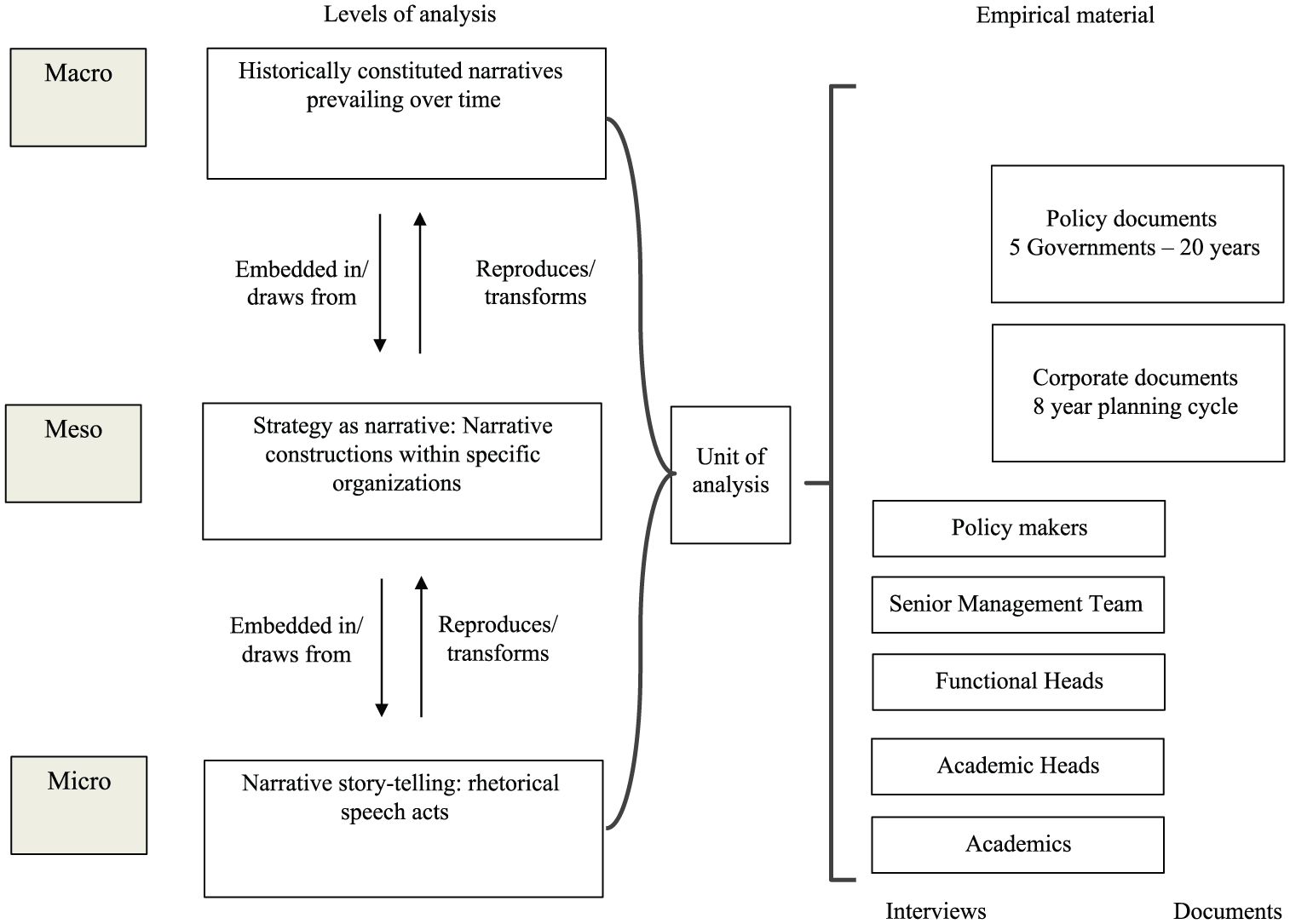
Strategy as an intertextual narrative (Adapted from Vaara, 2010: 33).
We chose 1992 as the start of our study period because the UK HE reform, notably around research funding (Lucas, 2006), gathered pace from that time. We focused on policy documents between 1992 and 2012 that directly related to science, research, and the broader HE agenda. This was a period covering five different governments.
We chose two universities to provide for depth and thereby the opportunity for thick description (Geertz, 1973) and to account for wider structural effects (Whittington, 1989), such as how the different narratives might be embedded.
Our selection criteria enabled us to reduce variance so that we could clearly focus on the particular strategic challenge (Ambos et al., 2008; Table 1). We chose two cases where the tension would be apparent as research-intensive universities and where there was intense competition for resources. At the same time, the pursuit of twin goals was a long-standing strategic choice and aligned to their founding purpose. Each case shares the same strategic planning model, thereby reducing variance in the interpretation of strategic direction. However, each had different strategies toward internationalization. Given our focus on the themes that link texts between different levels (Figure 1), we chose two cases where any variance in relation to access to policy would also be reduced. Similarly, we reduced variance between the cases in our selection approach within the study. Furthermore, acknowledging the role of the past in the resistance to organizational narratives (Brown and Humphreys, 2003) and the embedding of social and historic relations within strategy (Fenton and Langley, 2011), we sought two cases, where we could account for historical contingency. Because of anonymity undertakings to individual respondents, each university is given a pseudonym. Case 1 is “modern global university” (MGU) and case 2 is “regional city university” (RCU).
Selection criteria of cases.
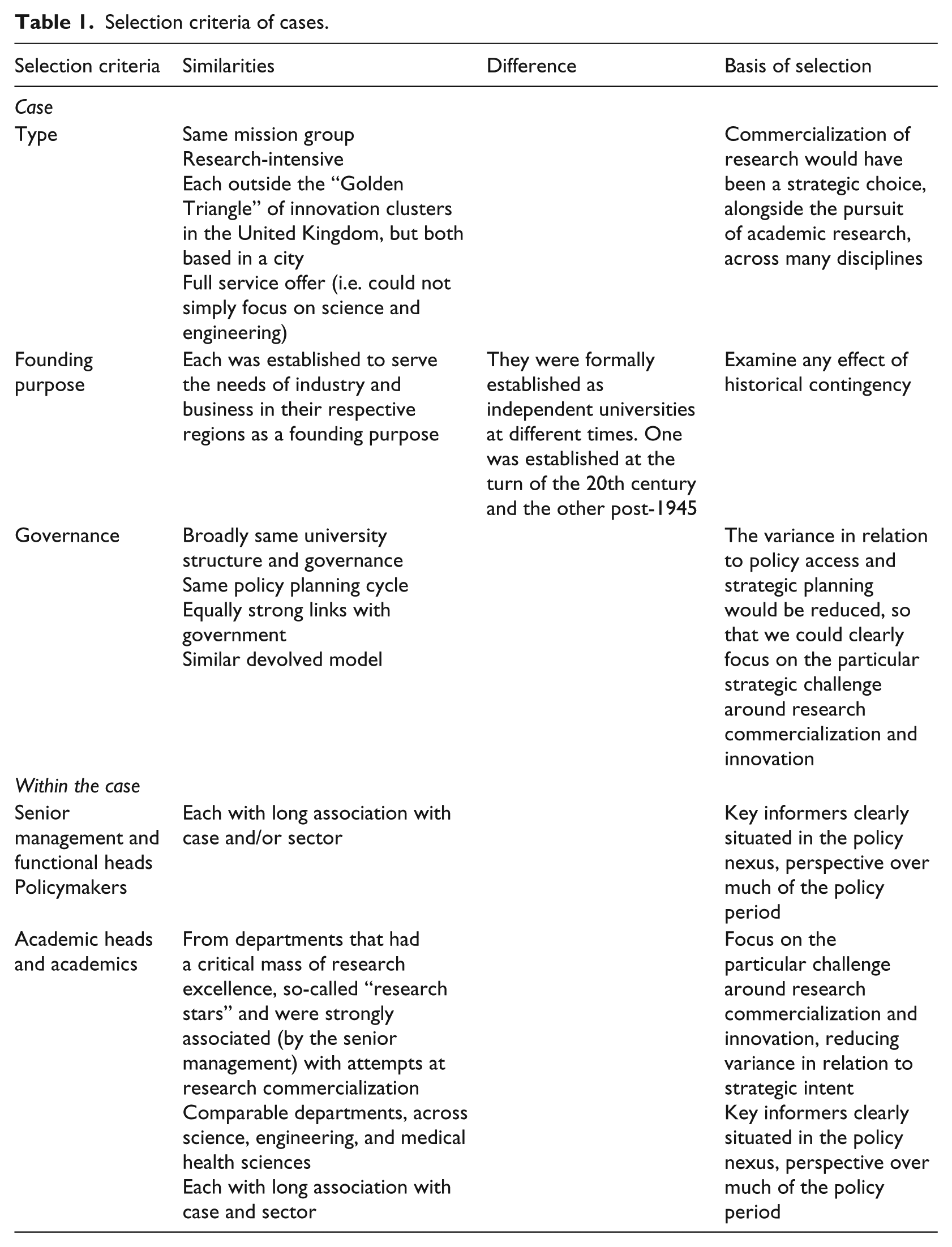
Participants were chosen from different groups and levels within the organization comprising members of the senior management team (12), functional heads (12), and individual academic leaders, with responsibility for a department and/or research priority group and academics (12), notably those that were leading researchers in the respective departments. This selection was evenly split across the two case studies. We also included policymakers (6) outside the organization, operating within one or more government administration, 1992–2015. Each participant was selected for “situatedness” within the policy nexus (Jarzabkowski, 2005), not least longevity and the ability to reflect on the narrative of the university over the policy period.
Data collection
We collected data over 18 months starting in August 2011. We used a variety of sources, supported by an approach that provided opportunity to examine tensions between competing narratives.
First, we reviewed government policy on research, science, and innovation (1992–2012), consulting over 60 individual policy documents across each government and relevant governmental departments. This was to account for narratives from the wider organizational setting drawn upon within the organization. We reviewed corporate documents covering a strategic planning period of 8 years (2008–2015) within two participating universities, amounting to 15 externally facing corporate documents and 44 pages from the universities’ websites. These are naturally occurring dominant forms of texts produced and re-produced in an intertextual narrative process (Brown, 2004) and provide insight into the “distilled” official narrative or an attempt at a dominance of a particular narrative.
Second, we interviewed 42 participants, chosen from different groups and levels, identified above. These interviews are also forms of text comprising the interview transcripts and contemporaneous reflections, a deliberate form of textual artifact construction, reflexive and consistent with the interpretative perspective. The interviews were guided by six topic themes—policy context, the role of the university, impact of policy, translation of policy into strategy, strategy and the functioning of the policy nexus. The interviews were dialogues that overtly reflected on the organizational narrative, from different “voices,” providing the discursive space (Holstein and Gubrium, 2012) to explore the organization and its setting. We were keen to reflect on the tensions between the narratives, challenge the framing in the strategy narrative, and account for any “gaps” that indicate how one narrative might “dominate” another (Kornberger et al., 2006).
Analytical approach
We collected a “substantial archival residue” (Gephart, 1993: 1469). Our analysis focused themes that cohere to connect texts, emotion that underpins connection between text and reader, and societal values representing the way the world is viewed that supports and embeds connection (Orr, 2003; Riad et al., 2012). Our analytical approach allowed the maintenance of the “whole” data, while partitioning it into recognizable themes and being able to progressively deepen the analysis (Corbin and Strauss, 1990). Individual extracts of text referring to “the university” were selected and cut out and placed loosely on A1 flipchart paper and moved around to achieve a better fit and to improve analysis (Alvesson and Sköldberg, 2009). Key themes were thus identified and within them a coherent narrative of the university. Examining the interrelationships between texts, we could identify coherent narratives of the university that had shifted over time. Further analysis exposed the intertextual rhetorical structure (Czarniawska-Joerges, 1995) of the text supporting the narrative of the university. We focused on metaphor and hyperbole in the text (Fairclough, 1992), as attempts to persuade on an emotional level (Edwards, 1999) and signals of attempts to construct symbolic order (Orr, 2003), thereby pointers to societal values (Van Dijk, 2008; Table 2).
Analytical schema.

UK plc refers to the consideration of the United Kingdom as if it were a commercial corporation.
We identified a rhetorical structure of “hope” and “fear” that supported a particular sense of direction (Table 2). Hope and fear are elevated emotional devices central to an active dimension of narrative time, in the expectation of both a future good and as a form of dread (Huskey, 2009). Similarly, we identified two clear sets of wider societal values (Table 2; Holstein and Gubrium, 2012: 262) around “market” and “civilization.”
Our analysis process and the development of our theoretical categories, together with the basis of the intertextual production of the university, within government policy and within the organization, are illustrated in the next section.
The production of the narrative of the university
We now focus on the intertextual narrative of the university, as expressed in the policy texts, corporate texts, and in the interviews. When we refer to “the university,” we mean the “idea” of the university as narrative. When we refer to either of our two cases, we use “the organization” or the pseudonyms we ascribe to them.
A coherent narrative of the university over time
Within policy
Between 1992 and 2012, there was a significant transition in the role of the UK university from science partner (Duchy of Lancaster, 1993: 12), to being part of an innovation process (Department of Trade and Industry (DTI), 2000: 3, 2002: 7; Lambert, 2003: 65), and then central in an innovation ecosystem (Department for Business Innovation and Skills (BIS), 2011: 4; Department of Universities, Innovation and Skills (DUIS), 2008: 6; Sainsbury, 2007: 4). This fundamental role shift in just over 15 years coheres in three intertextual themes—the application of research excellence, a role at a regional level, and a role at a national and international level, underpinned in emotion and appeals to wider societal values (Figure 2), illustrated in representative text (Appendix 1).
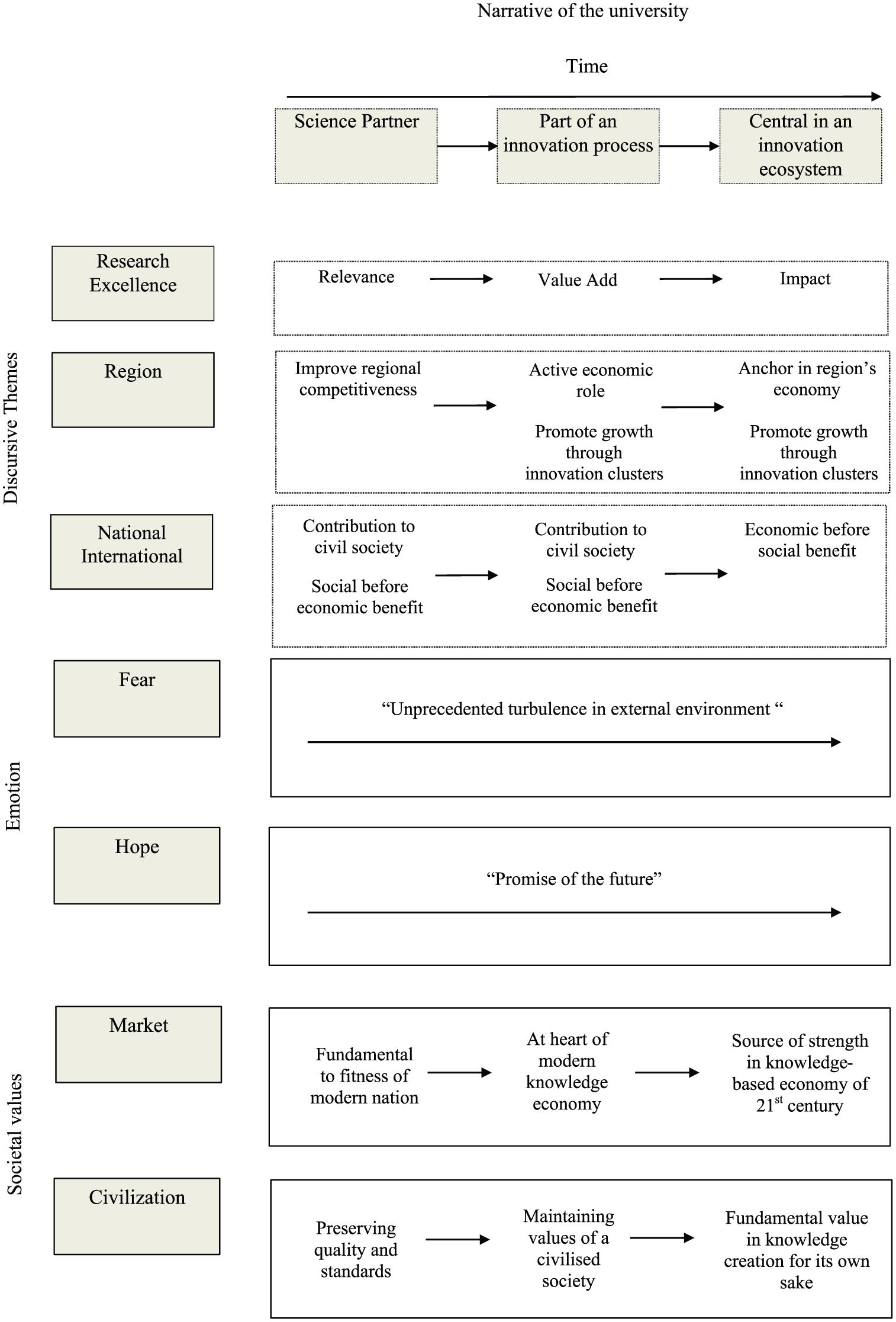
Plotting the narrative of the university in government policy over time.
First, research excellence has become inextricably linked with innovation, as “relevance” (Duchy of Lancaster, 1993: 26), in a “contribution to prosperity” (DTI, 1996: v), generating “start-ups” (DTI, 2000: 26), and “vital” to industry (DTI, 2000: 3–4). Excellence became more closely tied with value-added and impact to “professional practice” (Roberts, 2003: 5), a first “requirement for business” (Lambert, 2003: 79), and in “clusters of excellence” enabling the knowledge economy (Sainsbury, 2007: 24) and the prerequisite of any innovation ecosystem (BIS, 2009; DUIS, 2008), including local business (Witty, 2013: 8). Governments were committed to “maximizing value” of excellent research (BIS, 2011: 46). Research excellence was linked with social benefit (BIS, 2009, 2011, DTI, 1996; DTI, 2000; Sainsbury, 2007). However, this impact was no longer a nebulous notion of contribution to civil society and economic prosperity (DTI, 1996: v), but ascribed to a measurable and largely economic contribution within a specified framework (BIS, 2011).
Second, the university has been more closely implicated economically with its region throughout the period, contributing to “substantial economic development” and “competitiveness” (Duchy of Lancaster, 1993: 138, 157), and innovation to “every region” (DTI, 2000: ii). This new “active” economic role (Lambert, 2003: 9) involved the university at the heart of “dynamic” regional clusters (BIS, 2011: 47; Lambert, 2003: 65), shaping (DUIS, 2008: 64) and contributing to regional “economic development strategies” BIS (2009: 19) that promote economic growth, within a global innovation process and latterly ecosystem. This is a shift from a broader “compact” between the university and its region (Dearing Report, 1997) to the university as a leading economic actor or “anchor” in the region in place of government (Wilson Review, 2012: 73).
Third, the university’s national and international role was to create and apply new knowledge for “our national competitiveness and quality of life” (Duchy of Lancaster, 1993: 12), providing equally a social and economic benefit (DTI, 2000: 28). However, the social benefit of research became subservient to economic impact (BIS, 2009: 7, 2011: 16; DUIS, 2008: 2; Sainsbury, 2007: 1). As with its immediate predecessor (BIS, 2009), in the new government (BIS, 2011), this included required growth in response to the financial crash.
Within the organization
The university was central to a global innovation ecosystem (Figure 3), illustrated in representative text (Appendix 2).
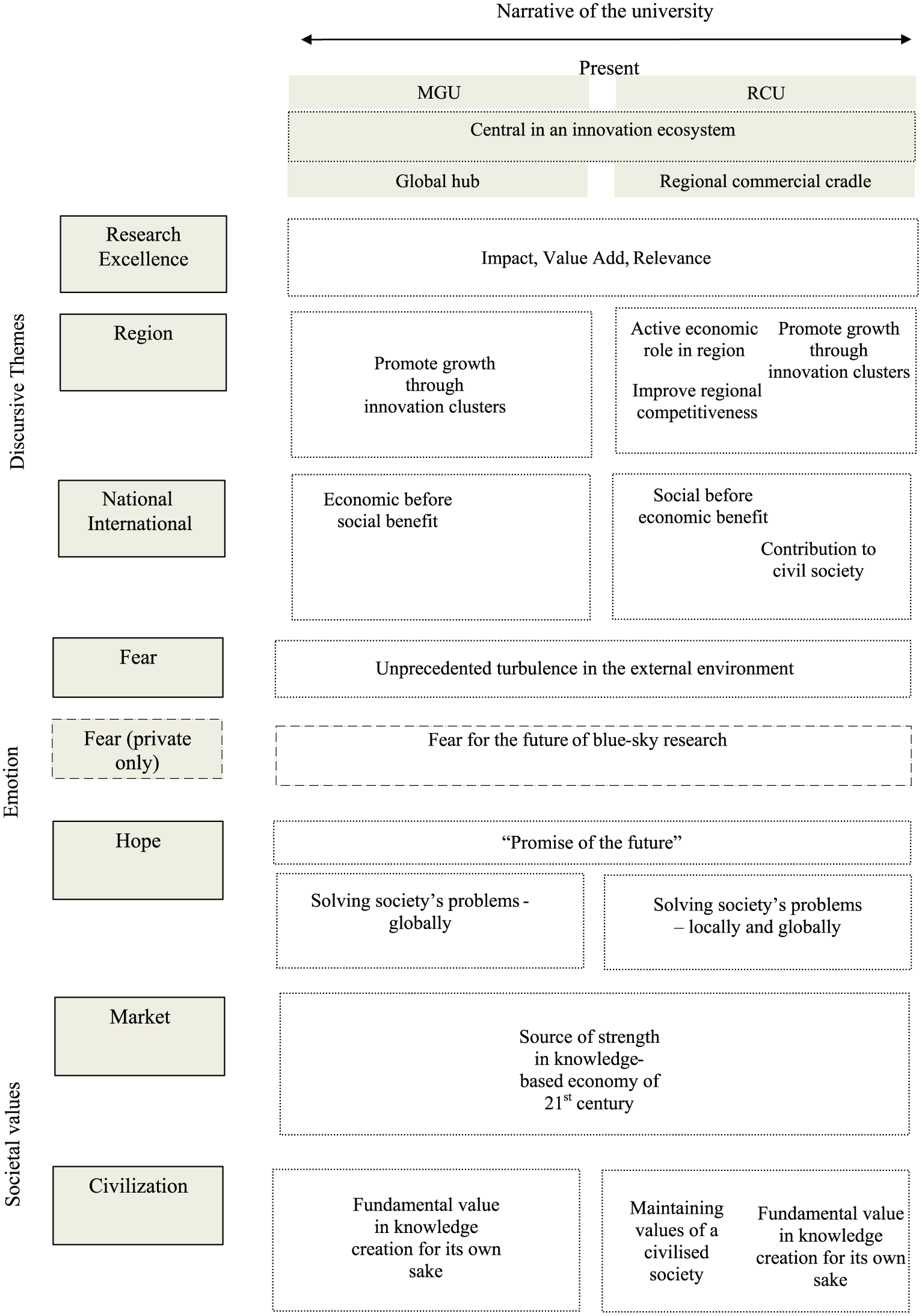
Plot of the present narrative of the university within each organization.
First, research excellence was linked with adding value and relevance, as part of the innovation ecosystem, although there was a broader understanding of “impact” than in government policy. For MGU, research excellence was the foundation for the success of “strategic partnerships” that made a “valued contribution within a global economy” (MGU, Strategic Plan). For RCU, it was “engagement on a global scale” which opened “the new avenues” for the translation of research excellence into a wider impact.
This place in the innovation ecosystem, and the contribution of world-changing research, was echoed among senior managers (SM) functional heads (FH), in each organization, who were “comfortable” with the need for impact and relevance in research (SM01), for “UK plc and wider” (FH01). However, in contrast, individual academics (AC) and academic heads (AH) were more likely to associate excellent research with a wider social benefit, before economic benefit and as the quid pro quo for research autonomy.
Second, within each organization, the university had a differently enacted regional economic role. For RCU, there is a clear link as “a commercial cradle” with its founding “civic” heritage and the need to deliver both “social and economic regeneration” (RCU, Strategic Plan). This is widely accepted among senior managers, functional heads, academic leaders, and individual academics. For MGU, the regional role is more prescribed as providing “research clusters” on a global stage (MGU, Strategic Plan). There is recognition of the new rhetoric around the importance of the local contribution of the university, but other relationships with the region are seen among some senior managers and wider academic staff as problematic (AC01).
Third, each organization had a wider national and international role, but again this is expressed differently. Within MGU, the university was strongly positioned as “a global hub” (MGU, Strategic Plan) and while “changing society for the better” (SM01) and finding solutions to “important social problems” (AH01), there was a heavy emphasis on economic contribution. In contrast, within RCU, its “commercial cradle” sprang from the organization’s “civic responsibilities” (RCU, Strategic Plan). The desire to make a broad social and economic impact, as part of a civic heritage was widely embedded. This makes RCU potentially closer to the anchor role (evident in government policy) in the regional economy than MGU.
Framing of the strategy narrative—emotion
The emotional framing of the text coalesced around two overarching themes—fear and hope (Figures 2 and 3) illustrated in representative text (Appendices 1 and 2).
Fear
In government policy documents, the university was set in a turbulent and rapidly changing world (DTI, 1996: vi, 1998: 5; Lambert, 2003: 15). There was no room for complacency (Duchy of Lancaster, 1993: 4). Here, there was change that attacked the old order (DTI, 1996: vi; DTI 2003), “pressing” concerns (DTI, 1996: vi), “real danger” (Department for Education and Skills (DFES), 2002: 13) and “worries [of a] a new intensity” affecting “Britain’s place in the world” (Lambert, 2003: 15). This turbulence was unprecedented (Sainsbury, 2007: 8; Wilson Review, 2012: Preface). Britain faced “Asian tigers prowling” (DTI, 1996), was engaged in a “race to the top” (Sainsbury, 2007: 1) while others such as the “burgeoning BRIICs (Brazil, Russia, India, Indonesia and China)” (BIS, 2011: 2) were “rapidly raising their game” (BIS, 2011: 8). These were existential threats.
Similarly, according to corporate documents, the university was set in a time of “remarkable turbulence” sustained by “the aftershocks” of the recent financial crisis (MGU, Strategic Plan) and “profound and long-lasting […] chill winds” (RCU, Strategic Plan). This danger was “time-bound” rather than “existential,” a temporary challenge for those otherwise strongly positioned. This is different from the threat in policy documents, which were wrestling with bigger questions of coping on a global scale and more long-term threats. Within the organization, at least publicly the threat was also long-term, but singly associated with a specific “event” rather than an on-going trend. Any other view could not be expressed publicly because it was “just not a winning ticket” (SM02). In contrast, a different view was widely held within the organization and among policymakers (PM), where there was the fear of “a perfect storm” (AC01) (SMO2) and “below the radar risks” (PM) threatening blue-sky research. There was doubt that this threat could be overcome.
Hope
Hope for the future was a strong feature in government policy documents. The university offered a promise for future prosperity and wealth (BIS, 2009: 2, 2011: 16; DTI, 1996: vi, 2000: I, 2003: 5). There was a widespread hope of a better “quality of life” (BIS, 2009: 2, 2011: 5; DTI, 1996: I, 2000: 2), social transformation (BIS, 2010: 2, DTI, 2003: 5; DUIS, 2008: 2), and “rescue from the problems caused by globalization” (Lambert, 2003: 15). The United Kingdom could “win the race to the top” for the benefit of its people “but only if we run fast” (Sainsbury, 2007: 8). Within corporate documents, hope for the future was equally strongly featured. Changing society for the better was primarily an international or global concern in MGU, a reflection of “our purpose” (MGU, Strategic Plan). In RCU, resources were “being brought to bear” on “societal needs,” as part of “becoming an academic force [for good]” both locally and globally (RCU, Strategic Plan). The hope for discovering things that could “benefit mankind” (AH01) and “solving society’s problems” (AC02) was widespread within the organization.
Framing of the strategy narrative—societal values
The intertextual production of the university is underlined by two sets of societal values (Figures 2 and 3) and illustrated in representative text (Appendices 1 and 2). The first is the primacy of the market implicated in the narrative of the enterprise university (Brown, 2011). The second is that of civilization, a long-standing framing of the evolving narratives of the university (Martin, 2012).
The market
The university is strongly supported by “the market,” as major agents of economic growth (DTI, 2000: 28; Sainsbury, 2007: 43), taking on this new mission (DTI, 2000: 28), fundamental to the fitness (Duchy of Lancaster, 1993: 1) and at heart of the new “modern” world (DTI, 1998: 5). This central role, as “agents” of economic growth (BIS, 2009; Sainsbury, 2007: 43), at the “heart of business clusters” (Lambert, 2003: 67), as a “steward” of knowledge (BIS, 2009: 7), as “anchor institution” in a global and regional economy (Wilson Review, 2012; Witty, 2013) was something for which the university “should assume an explicit responsibility” (Witty, 2013: 6). The university “just as castles provided the source of strength for medieval towns, and factories provided prosperity in the industrial age [is] the source of strength in the knowledge-based economy of the twenty-first century” (Wilson Review, 2012: Preface).
This primacy of the market was evident within the organization as home to “internationally-leading research clusters” (MGU, Strategic Plan) or as “big knowledge factories” (SM01) and where “innovation is fine” (AC01). Within RCU, the university is similarly “a commercial cradle for research innovation,” a “beacon of innovation” (AC02) echoing “a return” to its founding role (SM02). Among policymakers, there is a perceived need to “spell out that we are into innovation and actually we do really care about business. We’re not in our ivory towers focusing only on research” (PM).
Civilization
The primacy of civilization is seen whenever the university is associated with the preservation of “standards” (Duchy of Lancaster, 1993: 42), the values of a “civilized society” (Dearing Report, 1997: Summary), and a civilizing force upholding “the dignity of thought and learning” (Dearing Report, 1997: Foreward). The university is one of the “transmitters of culture” (DTI, 2000: 28; Sainsbury, 2007: 43), which is developed for “its own sake” (BIS, 2011: 47). The university “pushes back the frontiers of human knowledge” (DFES, 2002: 10). The university has “a fundamental value in the creation and transmission of knowledge for its own sake” “passing on preserving a set of shared societal values” (BIS, 2011: 47; BIS, 2009: 93).
Within the organization, “knowledge and learning” for “its own sake” was also fundamental, something valued by “all academic staff” (MGU, Strategic Plan) where the university was “pioneering” (FH01; AC01) and “weird and wonderful and completely off the wall” still had a place (SM01). This was also the case in RCU where this “sort of profile,” the pursuit of knowledge for its own sake “was really important to keep” (SMO2). However, within RCU, the university was more associated with the primacy of civilization, where “civic roots” were “cherished,” and there was a “commitment to rigorous academic curiosity” and “the crucible of debate” supported a “significant contribution to society and the global economy” (RCU, Strategic Plan). Furthermore, it was a place that stimulates a “change [in] the way civic society thinks about itself” (SM02).
Discussion
We begin by discussing how our findings shed light on our research question: how does the tension between competing strategy narratives play out in the HE setting? We then theorize how our findings in terms of strategy as an intertextual narrative extend previous studies before discussing implications and avenues for further research. We offer an explanation of the resolution of the competition between narratives.
How strategy is narratively constructed and direction-set in relation to policy
The HE setting provides a prime example of where strategy is framed within several intertextual themes that have evolved over time and which tell the organization forward in a way that apparently maintains direction. In this case, the narrative of the university has been progressively reformed. The university has moved from science partner to central player in an evolving innovation ecosystem, being an agent of economic growth and becoming an “anchor” and sponsor for that growth in the region, and adopting a more prescribed form of social benefit. In the individual organizations, each is positioned as central within a particular innovation ecosystem.
Actors can draw upon different narratives even when contradictory but the competing narrative is not simply re-storied as a problem and co-opted (Vaara and Monin, 2010). Rather, the narrative of the traditional university remains available and is part of any solution. For example, excellent research carried out under the principle of academic autonomy forms the basis of impact, which needs to be more than just socially useful. Within the organization, this availability is related to the past, but according to the particular past of each university. For RCU, its role in an innovation ecosystem was powerfully linked to its local founding. In contrast, in MGU, the link to the innovation ecosystem was made by “restorying” its founding as outward looking and now largely “global” rather than regional (which was considered “historically problematic” in MGU) in its outlook. This resources a different strategic direction; for RCU, it is the embedding of an innovation ecosystem in its local region and, for MGU, it is the development of global connections as part of an innovation ecosystem.
Strategic direction is set in an emotional context of fear and hope. The university is supported by vivid metaphors concerning unprecedented change where competitor countries were raising their game. Although this fear of losing out creates urgency for change as noted elsewhere (Vaara et al., 2006), here hope also forms urgency. Here, the future holds particular promises of improving the quality of life and contributing to society, a vital contribution echoing the broader values of the traditional university. This hope for improvement was often placed as the fulfillment of the promise of the university’s founding. The imperative to meet global challenges and provide “hope” by tackling them was also clearly and widely expressed within the organization. This was linked more with the founding mission in RCU and less so in MGU. At the same time, within the organization, there was a fear of the “loss” of the traditional university and “pure” research. However, this fear has not supported a different strategic direction. Strategic direction is framed in terms of societal value, with the university both a source of strength in the new knowledge-based economy and the protector of the fundamental value of knowledge creation for its own sake. Within government policy and in RCU, this framing includes the university maintaining the values of a civilized society.
How the tension at the heart of the strategic challenge facing universities is resolved
A key issue from a strategic narrative perspective is how tension between competing narratives is resolved. One of our singular findings is that, unlike in other studies (Vaara et al., 2006; Vaara and Tienari, 2011), the preeminence of one narrative does not negate competing narratives. We propose that the key factor resolving the tension between our two narratives is the role of hope about the future. As such, we extend previous studies that highligh framing to support resonance (Abdallah and Langley, 2014; Brown et al., 2012; Sillince et al., 2012). Hope makes each narrative coherent and consistent and therefore believable. The hope embodied in each narrative corresponds with the different sets of values and understanding of the world. Thus, otherwise competing narratives (e.g. Llewellyn, 2001) are each able to provide resonance and co-exist.
Each competing narrative places the university as the central actor to ameliorate society’s problems in a changing world. This strengthens the unification of meaning between the two competing narratives by drawing upon a broader and universal meaning of society. This unification is more than simply maintaining continuity in strategy planning to reduce tension (Erkama and Vaara, 2010) or providing for a strategically ambiguous goal (Sillince et al., 2012) or allowing for a temporary amelioration of tension (Abdallah and Langley, 2014). It supports a powerful unification of the past (the traditional university) and the future (the enterprise university) and allows multiple interpretations of the university without their being continually in opposition.
This co-existence of narratives maintains the multi-voiced or polyphonic organization. Different voices currently find space to “narrate” the university and a latent shared sense of an overarching meaning, drawing on history, about what a university means provides enough common ground and a sufficient antidote to the inevitable fear of change. The triumph of hope over fear mutes resistance to strategic change and holds competing narratives in check. This also explains how a unifying resonance about the significance of the university’s role as a special form of organization with transcendent values survives the contested space of the organization, unlike in other studies where competition between narratives can only have one winner (Vaara et al., 2004).
Strategy as an intertextual narrative
Previous studies (e.g. Sillince et al., 2012; Vaara et al., 2004, 2006; Vaara and Monin, 2010) point to the framing of narrative to encourage take-up in further narrative. This take-up is made through a framing that maintains availability and resonance of particular narratives. Where there is intense competition between narratives, otherwise available and resonant narratives are negated to reconcile such tension, which is temporary. Our key contribution is to show how this occurs differently, compared to settings where there is concentrated rhetorical power as well as other pluralistic settings. We show that competition is reconciled where narrative is framed so as to support wide availability and provides a unifying support resonance. This is done in the emotional register of hope and sustained through framing that provides unification of societal values. We also show that there may be heterogeneity within pluralistic settings and those organizations more anchored to the past.
In other studies, narrative has been controlled by the dominant narrators and/or there has been a strong future focus. In our study, the past is equally dominant and resources a competing narrative, accessible to many different narrators, notably in an organization where the past is more embedded. We propose that urgency (in this case through fear) may also support the unification of competing narratives, because it reduces the horizon of expectation, suppressing the past in support of the future. However, we also propose that a framing through hope underpinned in the unification of different societal values maintains many different voices or narrators and the past, which reduces tension between competing narratives over time. This framing, unlike in other studies, allows the past (as well as the future) and different voices to continue to prosper. The result is a synthesis of competing narratives that positively reconciles them, maintaining direction. Heterogeneity in strategic direction is supported by different uses of the past.
Policy and practice implications
Our findings offer insights for HE policy and practice. First, they place the artful crafting of text to promote improved understanding of strategy as a central concern in the narrative production of the university. Such wordsmithing could be a more active concern of those interested in reducing tension between narratives and, at the same time, maintaining the values of HE. Second, different uses of the past might be an explanation of variable performance in relation to research commercialization. We suggest that better accommodation with their particular past, at least in narrative terms, might improve how universities respond to strategic challenges. Third, individual university strategy narratives are contingent on their own constructed “past,” and this may offer insight into what constrains and enables choice in their future strategic direction.
Limitations and further research
Our study has limitations that open up opportunities for further research. First, we have examined the evolution of two universities in the UK policy context. Additional studies are warranted examining HE settings in different countries where the approach to research commercialization and entrepreneurial universities may be different, for example, where there are different constraints on the ownership of IP by university faculty and different landscapes of private and public universities. Furthermore, it remains to be seen whether continuing university reforms will shift the nature of the role of universities in the future, particularly as new entrants, such as for-profit HE providers, become bigger players in the sector. Second, we have focused on two universities that are leading research-intensive universities. Other universities may have scope for different portfolios of activities (Wright et al., 2008) and hence differing strategic narratives that may add to and identify the boundary conditions, notably around use of the past, to the insights were developed here. Third, further research might explore the nature of the heterogeneity within different pluralistic settings, where there may be higher degrees of political salience and its implications for narrative perspectives on strategy. Fourth, our research offers insight into settings where urgency is short-lived, for example, in a discrete strategy project, offering an explanation of where competition between narratives is only temporarily ameliorated.
Conclusion
Our study offers conceptual insight into the development of strategy narrative within HE and other pluralistic settings. We show how competing narratives are accommodated and have demonstrated that strategy involves a complex working and re-working through narrative of past, present, and future in a context of strong emotions of fear and hope. The maintenance of strategic direction requires hope and a synthesis of societal values that maintains access to the past, the future, and multiple narrators. As such, our study opens an agenda for greater understanding of the development of strategy in HE.
Footnotes
Appendix
Representative text within the organization

| MGU | RCU | |
|---|---|---|
| Central in an innovation ecosystem | ||
| Impact, Value add, Relevance | ||
| Excellence | [This] University provides the foundation for local and global research partnerships and collaborations. Research excellence is key to the success of our mission (MGU, Strategic Plan) Our experience in |
Engagement on a global scale will open new avenues for innovative research and provide opportunities to Our mission derives from our foundation […] a university of national eminence and global reach, and we cherish our […] roots. We have a fundamental commitment to rigorous academic curiosity, [ensuring] that we produce exceptional graduates and |
| I’m entirely comfortable that |
When it comes to research, innovation, the sorts of close relationships, we have recognise that we can’t carry on as before, |
|
| Promote growth through global innovation clusters | Active economic role in the region |
|
| Regional role | As a global Top […] university, |
Our aim is to create |
| But, the other dimension to it is the local or regional economic importance of universities now. […] The rhetoric is kind of reinforcing the role universities need to play in economic development (FH01, k) |
Actually, for quite a lot of what we do it [the city] really matters […] the university is the pivotal point in the health economy of the [region] so … of |
|
| Economic before social benefit | Social before economic benefit | |
| Role—National/international | The members of our academic community endeavor to produce |
While we |
| We have a significant role to play |
The idea is that it’s got to deliver tangible growth and it’s got to be how you engage with local industry to achieve that and clearly, there’s a really important role in terms of R&D universities and a role that I think has, over the last few years, been somewhat unfulfilled. It’s interesting. I think there is |
|
| MGU | RCU | |
| Unprecedented turbulence in the external environment | ||
| Emotion: Fear | We are living through a period of |
This plan is designed to chart the University’s course through the most significant changes in UK higher education for a generation and in challenging financial times. This last year has seen further changes […] Despite these |
| Fear for the fear of blue-sky research (private) | ||
| At the moment, there is a perfect storm [where] blue skies research could become a luxury because the prevailing winds say “let’s not take risks, let’s put money on a proven track” and that, if money is short, some of that makes sense but [you still need] to look for sort of slightly odd ball ideas (AC01, o) |
The other thing, of course, you can’t do in a university like this is you can’t say there’s a financial crisis because there isn’t. And so if I’d come here and said there is a financial crisis either people would have said “you’re being wholly mendacious” or they’d have said “you are being completely incompetent.” Either way |
|
| Promise of the future (what we already do) | ||
| Solving society’s problems—globally | Solving society’s problems—locally and globally | |
| Emotion: Hope | Our purpose, as a result of our international approach to research and teaching, is to be a significant catalyst |
A new global perspective is central to RCU, d
|
| MGU | RCU | |
| Source of strength in knowledge-based economy of 21st century | ||
| Societal values: Market | As a global Top […] university, |
Our aim is to create |
| Fundamental value in knowledge creation for its own sake | Maintaining values of a civilized society |
|
| Societal values: Civilization | All academic staff and students should be able to follow their academic interests in order to engage in research, teaching and learning of the highest quality. We value |
We are a university of national eminence and global reach, and |
| I think it exists to undertake high |
[…] if you look at many of the big advances, they’ve come from those sorts of studies where it’s not necessarily … you know, you’re not writing a grant that says “at the end of this grant we will have such and such.” |
|
MGU: modern global university (01); RCU: regional city university (02); SM: senior managers (01) and (02); FH: functional heads (01) and (02); AC: individual academics (01) and (02); PM: policymakers. Emphasis added.
Declaration of Conflicting Interests
The author(s) declared no potential conflicts of interest with respect to the research, authorship, and/or publication of this article.
Funding
The author(s) received no financial support for the research, authorship, and/or publication of this article.