



Abstract
We focus on the strategic implications of executive time horizons on a top management team. We argue that time horizon mean and diversity individually and interactively influence organizational ambidexterity, that is, a firm’s joint exploitation of current competencies and exploration of new opportunities. Drawing on the chief executive officer and top management team interface literature, we propose that effective CEO temporal leadership will enhance the joint effects of top management team time horizon mean and diversity on organizational ambidexterity. We tested our hypotheses by conducting multiple runs of surveys on a sample of 146 Chinese small- and medium-sized firms. Our study contributes to upper echelons theory and temporal research on strategy, being the first to examine the strategic consequences of top management team time horizon composition.
Keywords
Introduction
In today’s business environment, characterized by rapidly changing technologies and markets and increasingly intense competition, the issue of time has come to the forefront in strategic management research (Kunisch et al., 2017). Scholars have devoted significant attention to time horizons, which are considered a fundamental aspect of a firm’s strategic orientation (Ancona et al., 2001; Das, 1987; Reilly et al., 2016). Defined as the degree to which executives consider distant possible future outcomes of their current behaviors (Bluedorn, 2002; Strathman et al., 1994), time horizons shape how managers recognize opportunities in the market as well as how they allocate resources to seize opportunities (Lumpkin and Brigham, 2011; Marginson and McAulay, 2008; Souder and Bromiley, 2012). Studies have found that executives’ time horizons influence strategic planning (Das, 1987) as well as competitive behaviors such as aggressiveness (Nadkarni et al., 2016).
Despite these rich insights, studies have typically focused only on CEOs as primary decision-makers and rarely examined top management team (TMT) time horizons. Indeed, while recognizing the CEO as the leader of the TMT, upper echelons theory has highlighted top team as the dominant coalition and chief unit responsible for strategic decision making (Carpenter et al., 2004; Hambrick and Mason, 1984). As Hambrick (2007) noted, “leadership . . . is a shared activity, and the collective cognitions, capabilities, and interaction of the entire TMT enter into strategic behaviors” (p. 334). Thus, TMT time horizons may profoundly affect how its members attend to strategic stimuli, and interact, and thereby drive strategic behavior and outcomes.
We address this gap by exploring the strategic implications of TMT time horizon composition. Building on team research, we examine two distinct and widely recognized forms of team composition: diversity and mean (Barrick et al., 1998; Bell, 2007; Chan, 1998; Kozlowski and Klein, 2000). Whereas diversity reflects the degree to which team members vary on a particular attribute (Van Knippenberg and Mell, 2016), mean reflects the central tendency of the TMT as a whole (Chan, 1998). Traditionally, these two team attributes have been considered in isolation. However, team scholars increasingly recognize that because diversity and mean represent distinct qualities and induce different outcomes, the joint consideration of both can more fully surface and explain the behavioral ramifications of team composition (Barrick et al., 1998; Harrison and Klein, 2007). Although sparse, early evidence suggests diversity-mean interdependence, especially within TMTs (Barsade et al., 2000).
Proceeding from this premise, we examine both individual and interactive effects of TMT time horizon diversity and mean on organizational ambidexterity—a firm’s joint pursuit of exploiting current competencies and exploring new opportunities (Simsek, 2009; Tushman and O’Reilly, 1996). Organizational ambidexterity lies at the heart of innovation research and serves as a primary vehicle through which firms achieve efficiency to improve current product offerings while simultaneously pursuing new opportunities to develop new products and prepare for future challenges (Andriopoulos and Lewis, 2009; O’Reilly and Tushman, 2008). It is especially relevant in investigating TMT time horizon composition because exploitation and exploration are associated with different “time zones” (Ancona et al., 2001). Whereas, exploitation reflects incremental improvements to a firm’s current products, exploration is about creating new products that are attractive to future markets (March, 1991; Simsek et al., 2009; Smith and Tushman, 2005). Indeed, “time is at the heart of several key decisions managers must make when formulating . . . an ambidextrous strategy” (Mathias et al., 2017: 2).
Furthermore, drawing on the chief executive officer and top management team (CEO-TMT) interface perspective (Hambrick, 1994; Zaccaro and Klimoski, 2002), we argue that a CEO’s effectiveness at temporal leadership will positively moderate the interactive effect of TMT time horizon diversity and mean on organizational ambidexterity. Defined as the degree to which CEOs schedule deadlines, temporally synchronize behaviors, and allocate temporal resources, temporal leadership allows CEOs to “manage across multiple temporal orientations . . . and provide a timeless vision that both integrates and focuses temporal decisions” (Ancona et al., 2001: 659). Our core finding is that effective temporal leadership by a CEO can reconcile, integrate, and manage the divergent time horizons and priorities of TMT members to promote ambidexterity.
Our study makes several contributions. First, previous temporal research has examined temporal diversity in operational-level team settings and explored the moderating role of temporal leadership (Mohammed and Nadkarni, 2011). Our study extends temporal research by being the first to examine temporal composition in a strategic setting and simultaneously exploring two distinct facets of TMT temporal composition: diversity and mean. It shows that both TMT time horizon diversity and mean contribute to organizational ambidexterity. Importantly, this study cautions that these two compositional facets should not be considered in isolation, as has been done traditionally. Instead, our study reveals that TMT time horizon diversity and mean operate in concert in influencing organizational ambidexterity, and that CEO temporal leadership moderates such joint effects.
Second, our study contributes to the organizational ambidexterity literature by highlighting its temporal antecedents. As Mathias et al. (2017) emphasized, “time has played an important but [only] implicit role in ambidexterity research” (p. 4). By formally theorizing and testing the individual and interactive effects of TMT time horizon diversity and mean on organizational ambidexterity, as well as the moderating role of temporal leadership in this relationship, our study underscores the critical role of time in ambidexterity and provides a comprehensive understanding of its temporal antecedents.
Theoretical development and hypotheses
TMT time horizon composition
Time horizon refers to the extent to which individuals consider distant possible future outcomes of their current behaviors (Bluedorn, 2002; Wallace, 1956). Studies have demonstrated that time horizon is a stable cognitive temporal characteristic with high test–retest reliabilities (Strathman et al., 1994). Distinct from future focus that emphasizes the attention individuals devote to thinking about the future, time horizon captures the temporal distance into the future (e.g. short-term versus long-term) that an individual typically considers when contemplating events that may happen 1 (Shipp et al., 2009).
Because long-term and short-term oriented individuals attend to different information cues and behave differently (Mohammed and Harrison, 2013), time horizon has significant strategic implications (Souder and Bromiley, 2012). For example, executives with a relatively long time horizon direct attention to future developments that are not easily visible in the short-run (Das, 1987; Wang and Bansal, 2012). They can better prepare for seizing future opportunities by creating a strategic vision and selecting strategies to attain that vision. However, this does not mean that they completely ignore short-term opportunities. Rather, long-term–oriented executives typically amass supportive resources and develop a strategic plan to activate in the present so that firms can function effectively when the future arrives (Das, 2004; Le Breton-Miller and Miller, 2006; Miller, 2002; Nadkarni and Chen, 2014). In contrast, executives with a relatively short time horizon attend to current environmental feedback and act fast to satisfy immediate market demands (Crossan et al., 2005; Shipp et al., 2009). They orchestrate resource allocation to pursue opportunities that can yield immediate returns (Lumpkin and Brigham, 2011; Wang and Bansal, 2012). Studies found that CEO time horizon significantly drives a firm’s strategic planning (Das, 1987) and competitive behaviors (Nadkarni et al., 2016).
We extend existing research to focus on the prominent role of the TMT and examine two facets of TMT time horizon: diversity and mean. Diversity reflects how team members diverge on a particular characteristic (Bell, 2007; Van Knippenberg and Mell, 2016). Because time horizon serves as a cognitive orientation and represents different kinds of information individuals attend to (Shipp et al., 2009), time horizon diversity indicates a variety of information being processed among unit members (Mohammed and Harrison, 2013). On one end of the continuum, low time horizon diversity indicates that TMT members have similar time horizons. Such homogeneity results in similar interpretative bias and may lead TMTs to disregard valuable information in their external environments. On the other end of the continuum, high diversity indicates that TMT members collectively embrace a wide range of time horizons. TMTs with diverse time horizons can attend to both proximal and distal temporal information and consider a wide selection of alternatives and perspectives.
Time horizon mean captures the additive effects of individual member temporal characteristics for the team as a whole (Barrick et al., 1998; Mathieu et al., 2014). The higher the aggregate level of a characteristic in a team, the stronger will be its influence on functionally relevant team behaviors and outcomes (Chan, 1998). Research suggests that as team members interact with each other, their temporal tendencies become observable and become infused in team behaviors and outcomes (Mohammed and Harrison, 2013). Mean time horizon is an additive representation of individual members’ time horizon tendencies (West and Meyer, 1997).
In this study, we argue that TMT time horizon diversity and mean will individually and jointly influence organizational ambidexterity.
Organizational ambidexterity
Organizational ambidexterity, 2 defined as an organization’s simultaneous exploitation of existing competencies and exploration of new opportunities, has played a central role in innovation research (e.g. Andriopoulos and Lewis, 2009; March, 1991; O’Reilly and Tushman, 2008; Tushman and O’Reilly, 1996). Explorative activities are designed to meet the needs of future customers, technologies, and markets, more distant in time (O’Reilly and Tushman, 2013). Exploration requires new knowledge that breaks the status quo. It often requires experimentation and flexibility (Cao et al., 2009; He and Wong, 2004). In contrast, exploitative activities focus on current customers, markets, and products and are relatively short-term oriented (O’Reilly and Tushman, 2004). They broaden an existing knowledge base and are associated with refinement and efficiency (Raisch and Birkinshaw, 2008; Smith and Tushman, 2005). Research from the structural perspective has highlighted that firms’ ability to pursue exploration and exploitation simultaneously very much depends on the capabilities of senior executives (e.g. TMTs) (O’Reilly and Tushman, 2004, 2008; Smith and Tushman, 2005).
Specifically, ambidexterity requires TMTs to accomplish two critical tasks (O’Reilly and Tushman, 2011). First, in occupying a unique position at the apex of their organizations, TMTs are primary designers and users of their firms’ information processing systems (Hambrick, 2007). To achieve organizational ambidexterity, TMTs need to recognize the differences between existing and new business domains and be aware of opportunities and threats in their external environment, including potential changes in technology, customer characteristics, and competition (Smith and Tushman, 2005). Second, TMTs must shoulder the responsibility to acquire, accumulate, and coordinate resources (Hambrick and Mason, 1984). To have an ambidextrous firm, TMTs must be able to seize these opportunities by integrating, allocating, and reconfiguring organizational skills, resources, and assets (O’Reilly and Tushman, 2008, 2011). Empirical evidence has shown that TMT behavioral integration, TMT diversity, shared leadership, and transactive memory facilitate organizational ambidexterity (Beckman, 2006; Cao et al., 2010; Heavey and Simsek, 2017; Koryak et al., 2018; Lubatkin et al., 2006; Mihalache et al., 2014). We extend this line of inquiry to focus on two temporal antecedents of ambidexterity: 3 TMT time horizon diversity and mean.
TMT time horizon and organizational ambidexterity
TMT time horizon diversity
We argue that TMT time horizon diversity will be positively related to organizational ambidexterity. Because time horizon represents the temporal lens through which executives view business opportunities and problems (Das, 1987; Nadkarni et al., 2016), TMTs with ample time horizon diversity are able to assess a variety information from different time horizons and to be aware of both short-term and long-term strategic options (Gibson et al., 2007). In contrast, TMTs that are homogeneous in their time horizons may focus on fewer types of information and a narrower pool of perspectives (West and Meyer, 1997). Thus research suggests that an “enriched awareness” is necessary for organizational ambidexterity because it allows TMTs to avoid groupthink and recognize opportunities for both exploitation and exploration (Heavey and Simsek, 2017). Studies have found that consideration of multiple alternatives enhances ambidexterity (Cao et al., 2010; Mihalache et al., 2014).
In addition, research suggests that corporate investments or resource allocation inherently depend on executive time horizons (Reilly et al., 2016). TMTs with ample time horizon diversity may develop a deep understanding of the values of both short- and long-term strategic alternatives (Judge and Speitzfaden, 1995). As a result, they allocate resources to seize opportunities for both exploration and exploitation. Such an ability to orchestrate and coordinate the allocation of resources between existing and new business domains is essential to organizational ambidexterity (Jansen et al., 2008; O’Reilly and Tushman, 2013). As Mohammed and Harrison (2013) have highlighted, “greater temporal diversity is needed to ensure that both proximal and distal corporate objectives are achieved.”
H1: TMT time horizon diversity is positively related to organizational ambidexterity.
Mean TMT time horizon
Mean TMT time horizon reflects the central tendency of the time horizon of the whole team. We propose that the higher that mean, the more likely it is that the firm will be ambidextrous. Research suggests that a core challenge in achieving ambidexterity is to overcome short-term pressures from external environments (O’Reilly and Tushman, 2011). As technologies and customer demands change rapidly and competition becomes more intense, executives face significant pressures for survival and performance. Because local feedback in the form of customer demand and profits are readily available from exploitative activities, and firms can become quite efficient by using what they already know, firms often tend to devote most of their attention to the exploitative aspect of their business (Heavey and Simsek, 2007; Smith and Tushman, 2005). In contrast, returns from exploratory activities are uncertain, distant in time, and difficult to evaluate. As a result, TMTs are more likely to become trapped by existing commitments and to discount longer term threats routinely. “Organizations are often less effective at exploration and become vulnerable to technological and market changes” (O’Reilly and Tushman, 2008: 189).
We thus expect that more long-term–oriented TMTs will enable firms to overcome short-term pressures better and to devote more attention to explorative activities than more short-term–oriented teams. Because individuals with long time horizon tend to visualize long-term future events (Mohammed and Harrison, 2013), TMTs with longer time horizons have more of a “big picture” focus and prioritize longer term issues in decision making. TMTs’ attention to long-term changes enables them to recognize opportunities in emerging markets as well as future technological advances (Nadkarni et al., 2016). Their consideration of long-term consequences also allows them to make the difficult choices required to reconfigure assets to address future challenges, promoting exploratory activities. In contrast, the more short-term–oriented TMTs will devote little attention and fewer resources to uncertain explorative activities, thereby inhibiting organizational ambidexterity. West and Meyer (1997) found that TMT future orientations related positively to strategic change. Thus O’Reilly and Tushman (2008) concluded that organizational ambidexterity requires “the commitment of resources by senior leaders to encourage long-term thinking, and a senior management team that fosters a long-term mindset and promotes exploration” (p. 190).
Thus, short team time horizons tend to limit executives to devoting most of their attention to exploitative activities and thereby to neglecting longer term exploratory activities, teams with more expansive time horizons tend to be more open to exploration in the pursuit of extended, longer term goals. However, this does not mean that long-term–oriented TMTs disregard exploitative activities. Indeed, the pursuit of long-term objectives demands a focus on both long- and short-term considerations. Lumpkin and Brigham (2011) suggest that the long-term orientation of a firm’s dominant coalition motivates firms simultaneously to address the demands of day-to-day operations and to pursue aspirations over greater time spans. Achievement of long-term objectives requires exploitation activities that accumulate resources, build slack for capability development, and attain interim objectives (Das, 2004). Thus, to ensure that firms can function effectively when the future arrives, long-term–oriented TMTs pursue a more comprehensive set of opportunities, tending to ongoing exploitative activities that generate resources to nurture longer term initiatives (Das, 2004). In sum, more expansive team time horizons will result in more exploration and exploitation alike—that is—more ambidexterity.
H2: Mean TMT time horizon is positively related to organizational ambidexterity.
Interaction
In their influential paper on diversity, Harrison and Klein (2007) posited that the effects of diversity may be confounded by mean tendencies, and it is thus necessary to consider the diversity-mean interaction. In other words, the effects of diversity are not necessarily symmetric across different temporal means. We, therefore, argue that the effects of TMT time horizon diversity on organizational ambidexterity will not be the same under different mean time horizons. Specifically, a high mean team time horizon will strengthen the positive effect of time horizon diversity on organizational ambidexterity.
Research suggests that teams that are aggregately high (i.e. longer) in time horizons tend to develop a big picture view that conveys the essence of a situation and emphasizes key general and abstract features to provide a coherent representation or vision for the team (Mohammed and Harrison, 2013). Attention must be devoted to more immediate and ongoing factors in order to deal with emerging problems and managing the capability and resource development needed to achieve longer term exploratory goals, and also to manage the current business in order to amass the resources to fund these efforts (Lumpkin and Brigham, 2011). In contrast, teams with shorter time horizons are more apt to emphasize more concrete and contextual details. Although not in a team setting, Das (1987) found that executives with longer time horizon have a clearer vision and longer range set of plans. When TMT members have diverse time horizons and different perspectives regarding which opportunities and resources to emphasize, teams with longer time horizons will embrace a more global consideration of issues and more visionary thinking. Such vision helps them to identify, extract, and integrate diverse perspectives concerning tactical issues, and will motivate them to generate opportunities for resource allocation across exploratory and exploitative activities (Jansen et al., 2008). However, TMTs with aggregately shorter time horizons will dwell on details and be less effective at developing a vision to integrate the different perspectives required to achieve ambidexterity.
H3: Mean TMT time horizon moderates the relationship between TMT time horizon diversity and organizational ambidexterity. When mean TMT time horizon is longer, TMT time horizon diversity will be more positively related to organizational ambidexterity.
CEO-TMT interface: the moderating role of CEO temporal leadership
Premised on upper echelons theory (Hambrick and Mason, 1984) and team research (Zaccaro and Klimoski, 2002), the CEO-TMT interface perspective suggests that because CEOs are the leaders of TMTs and are responsible for rewarding, motivating, and coaching TMT members, they can enhance or inhibit the impact of TMTs on strategic behaviors and outcomes (Buyl et al., 2011; Jansen et al., 2008). As Hambrick (1994) has suggested, “the top group leader has a disproportionate, sometimes nearly dominating influence, on the group’s various characteristics and outputs” (p. 180). Jansen et al. (2008) found that CEO leadership style and TMTs’ characteristics jointly influenced organizational ambidexterity.
Drawing on this CEO-TMT interface perspective, we propose the moderating role of CEO temporal leadership. Originating in time, interaction, and performance theory (McGrath, 1991; McGrath and Rotchford, 1983), temporal leadership is defined as leadership behaviors for managing the temporal patterns of intra-group interaction: scheduling, temporal synchronization, and allocation of temporal resources (Ancona et al., 2001; Maruping et al., 2015; Mohammed and Nadkarni, 2011). Scheduling devises clear and well-understood schedules that specify when each event must occur and a set of interim deadlines and milestones for team members to track their progress. Temporal synchronization involves regulating the workflow of team members, and coordinating and adjusting individual work cycles. Finally, allocation of temporal resources refers to activities such as prioritizing task goals, building-in blocks of time for an unexpected condition, and efficiently allocating time to subtasks. Because scheduling, temporal synchronization, and allocation of temporal resources are interrelated and constitute a temporal structure for team-level activities, temporal leadership represents a unified and coherent construct (Halbesleben et al., 2003; Mohammed and Nadkarni, 2011).
We expect that the interaction between TMT time horizon diversity and mean TMT time horizon will be more positively related to organizational ambidexterity when a CEO exhibits effective temporal leadership. First, research suggests that CEOs with astute temporal leadership will establish clear timelines of when TMT team activities should be completed, and design a set of interim milestones (Chen and Nadkarni, 2017). Such transparent schedules allow CEOs to lead TMTs more effectively. For example, CEOs with strong temporal leadership can integrate the diverse proximal and distal temporal concerns and goals of TMT members. They also facilitate the pursuit of a long-term goal by providing a feasible roadmap and interim milestones. Second, CEOs with effective temporal leadership can synchronize various TMT members’ timelines and temporal priorities and create a coherent temporal framework to allocate resources efficiently (Maruping et al., 2015). Through such temporal synchronization, CEOs can simultaneously attend to both short-term and long-term concerns of TMT members, ensure the implementation of long-term goals, and create synergetic value across exploratory and exploitative initiatives. Accordingly, they can incorporate disparate demands in decisions and efficiently allocate temporal resources to realize organizational ambidexterity.
In contrast, CEOs with weak temporal leadership have more difficulty leading TMTs with diverse time horizons, and that will reduce any positive interactive effects of TMT time horizon diversity and mean on organizational ambidexterity. Although some TMTs may incorporate diverse time horizons and put more emphasis on long-term issues, they may lack a clear schedule or detailed plan of action when CEOs exhibit weak temporal leadership (Maruping et al., 2015). Similarly, under such weak leadership, TMTs will be less able to coordinate the timing and strategic execution of exploration and exploitation. They may lack the confidence and ability to manage such challenges. As O’Reilly and Tushman (2008) suggest, the extent to which firms are able to pursue organizational ambidexterity depends on “the ability of senior leadership to orchestrate the complex trade-offs” (p. 20).
H4: CEO temporal leadership moderates the interaction effect of TMT time horizon diversity and mean on organizational ambidexterity. When CEO temporal leadership is superior and mean TMT time horizon is longer, TMT time horizon diversity will be more positively related to organizational ambidexterity.
Methods
Sample and data collection
We chose small- and medium-sized enterprises (SMEs) operating in high-tech industries in China as the empirical context of this study, for several reasons. First, research suggests that large emerging markets (e.g. China) with volatile economic cycles and intense competition offer a unique setting in which to examine the antecedents and consequences of organizational ambidexterity (Cao et al., 2010). Second, top executives in SMEs play a critical role in achieving organizational ambidexterity because SMEs face significant competitive pressures to pursue exploitation and exploration simultaneously, but have limited slack resources (Cao et al., 2010). Finally, it is extremely difficult to obtain psychometric data on top executives in large firms because “it requires very intrusive access to large numbers of executives and TMTs, who are notoriously unwilling to submit themselves to scholarly poking and probing” (Hambrick, 2007: 337). Using a sample of SMEs also allows us to collect difficult-to-obtain data from CEOs and TMTs in different time periods and helps to ensure a good response rate and the validity of the study. Following the definition of the US Small Business Administration, we define SMEs as firms with fewer than 500 employees. We collected data from SMEs located in five high-tech industrial parks in Shandong province, which is the leading hub of high-tech industries and hosts the largest clusters of SMEs in China (Shandong Statistic Yearbook, 2016).
We followed an established back-translation practice to design the survey instruments. To improve face validity, we pilot-tested the survey instruments on 10 top Chinese executives whose responses were not included in the main sample. We first obtained from industrial park administrative offices a list of SMEs with fewer than 500 employees located in five high-tech industrial parks. These industrial parks are intended to facilitate the development of SMEs in burgeoning industries, including electronics, medical equipment, chemical products, environmental technology, biotechnology, advanced materials, electricity equipment, auto parts manufacturing, automation, testing and measuring devices, computer software, and information technology. The administrative offices of these industrial parks have developed specific support policies for individual companies to obtain resources to undergird their innovation efforts.
With support from industrial park administrative offices, one of the coauthors contacted the CEOs of the 498 SMEs on the list to explain the research project and the research process. The author also ensured the confidentiality of responses and promised to provide CEOs with an executive summary of findings when the research study was completed. Following previous TMT research (Colbert et al., 2008), we also asked CEOs to identify all of the TMT members with whom they work closely in strategic decision making and to send a memo to encourage their participation.
Following previous executive studies using primary data (Cao et al., 2010), we also hired an assistant from each administrative office to facilitate the data collection process. These local assistants had college degrees and had been working in the industrial parks for at least 3 years. Because these assistants were assigned by the local Chinese government to support the development of SMEs, they knew the top executives very well and had built strong personal relationships with them. Such relationships significantly improved our response rate. One of the coauthors hand-delivered the questionnaires to these administrative assistants and asked them only to distribute questionnaires and collect responses. Participants were instructed to return their responses in sealed envelopes with no visible identifiers such as name or job titles. The assistants also made reminder phone calls to non-respondents or visited non-respondents in person.
We collected data at multiple time periods. In time t1, we sent the temporal characteristics and demographic survey to CEOs and top executives. Specifically, we asked TMT members other than CEOs to fill out the temporal leadership scale. At time t2, 6 months later, after we had received the completed TMT surveys, we sent out the organizational ambidexterity survey, to be filled out by CEOs and TMT members. This temporal separation and multiple informants approach helped us to reduce common method biases (Herrmann and Nadkarni, 2014). Of the 498 SMEs in these industrial parks, 205 firms responded to surveys from these time periods. We did not find any significant mean differences in firm size (t = −0.66, n.s.) or firm age (t = 0.72, n.s.) between non-responding firms and responding firms. The response rate of 41% is considerably higher than the typical response rates of 12%–14% reported in previous survey studies of TMTs (Hambrick et al., 1993).
Although questionnaires were distributed to every TMT member identified by CEOs, because we asked each of them to provide detailed personal information and participate in two surveys at two different times, it was very difficult to get complete responses for the entire TMTs for all firms, even when aided by CEO memos. Consistent with prior studies of TMT diversity (Simons et al., 1999), we only included firms that provided responses from at least three TMT members (at a minimum the CEO and two other top executives) and we dropped 59 firms from which we received fewer than three responses. By including the CEO, who is the most influential person on the TMT, and at least two other TMT executives, we could ensure that the most relevant data were captured (Simons et al., 1999). Our final sample size is 146 firms. Among these 146 firms, 40 firms have responses from all TMT members, 51 firms have responses from 75% of TMT members, and the remaining firms have responses from at least 50% TMT members. The average team size for our sampled firms was 4.43, and the median size was 4. We received an average of 3.04 responses from the companies included in our sample.
Measures
TMT time horizon diversity and mean
We assessed time horizon with the future subscale of Consideration of Future Consequences Scale developed and validated by Strathman et al. (1994). This 5-point Likert-type scale (see the Appendix 1) has demonstrated strong validity and reliability and has been used in previous studies (Mohammed and Nadkarni, 2011). The alpha in our sample was 0.87. We followed Mohammed and Nadkarni (2011) to calculate diversity as the within-group standard deviation of time horizon because research suggests that within-group standard deviation is appropriate for measuring interval-level data (Harrison and Sin, 2006) and for predicting interaction effects (Roberson et al., 2007). We computed the mean TMT time horizon by averaging TMT members’ time horizon.
CEO temporal leadership
We measured CEO temporal leadership by adapting Mohammed and Nadkarni’s (2011) 5-point Likert-type scale (see the Appendix 1). Cronbach’s alpha was 0.83 at the individual level and 0.82 at the team level. Checks for aggregation of the CEO temporal leadership scale revealed acceptable values (ICC(1) = 0.58; ICC(2) = 0.83; mean rwg (j) = 0.97; F = 5.89, p < .001). We derived the CEO temporal leadership scores by averaging TMT members’ responses.
Organizational ambidexterity
Ambidexterity is defined as a firm’s simultaneous pursuit of both exploration and exploitation. Following Katila and Ahuja (2002) and He and Wong (2004), we consider exploitation and exploration as two distinct dimensions of learning behaviors, rather than two ends of a unidimensional scale. We used He and Wong’s (2004) 5-point Likert-type scale to measure exploitation and exploration; this scale has been widely used in existing research (Cao et al., 2010; Lubatkin et al., 2006). Specifically, we asked TMT members to rate their firm’s core strategic objectives of the past year (See Appendix 1). The first four items capture the firm’s orientation toward exploitation (alpha = 0.78), and the last four items (alpha = 0.82) pertain to the firm’s exploration.
We calculated organization ambidexterity in several steps. First, we computed exploration scores by averaging individual responses from TMT members; checks for within-group agreement on the scales revealed acceptable values (ICC(1) = 0.46; ICC(2) = 0.70; mean rwg (j) = 0.90; F = 3.21, p < .001). Second, we computed exploitation scores by averaging individual responses from TMT members (ICC(1) = 0.44; ICC(2) = 0.68; mean rwg (j) = 0.90; F = 3.04, p < .001). Finally, consistent with prior research (Gibson and Birkinshaw, 2004; He and Wong, 2004), we created an ambidexterity measure out of exploitation and exploration by multiplying the two.
Control variables
We controlled for several CEO, TMT, firm, and industry variables that could serve as alternative explanations for our findings. First, we controlled for CEO age because it influences the accumulation of knowledge and learning. Second, TMT demographics such as team tenure, size, and heterogeneity affect the skills, perspectives, and diversity of thinking among top managers and thus can shape a firm’s choices of exploitation and exploration (Cao et al., 2010). We measured TMT tenure by averaging the number of years TMT members had spent in the firm. We measured TMT size by the number of members constituting a TMT. We controlled for three types of TMT diversity: members’ functional background (Herfindahl-Hirschman index), educational background (Herfindahl-Hirschman index), and firm tenure (the standard deviation of the number of years TMT members had spent in the firm) (Hambrick et al., 1996).
Third, we controlled for three firm-level variables: size (logarithm of the number of employees), past performance (TMT members’ rating on a six-item scale developed by Brouthers et al., 2003), and slack resources (TMT members’ ratings on a scale developed by Ling et al., 2008). We included these variables as controls because they influence the resources available for exploitative and explorative activities (He and Wong, 2004). Finally, we adopted an industry-level control: environmental dynamism (the unpredictability of changes in an industry). Dynamic environments, in which technologies and competition evolve swiftly may have an impact on ambidexterity. We used (Simsek et al., 2009) four-item scale to measure environmental dynamism.
Analysis and results
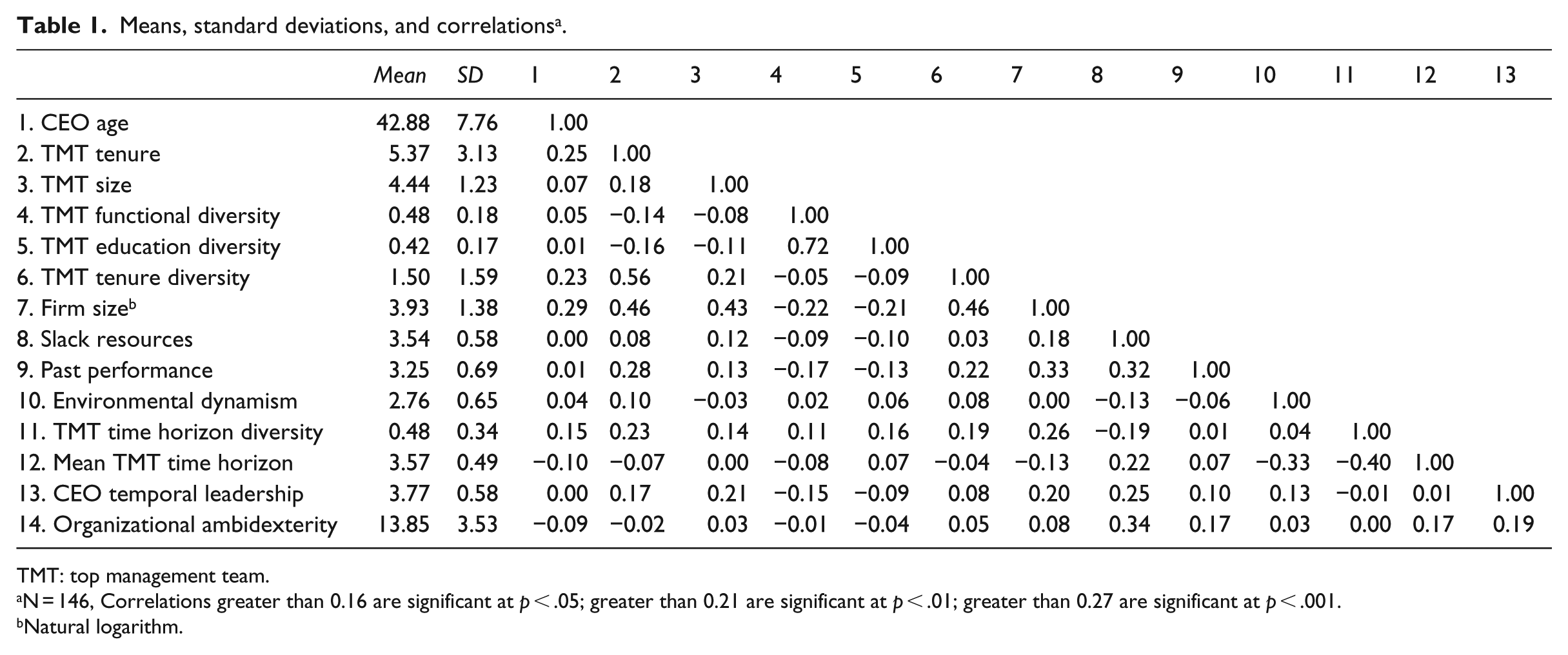
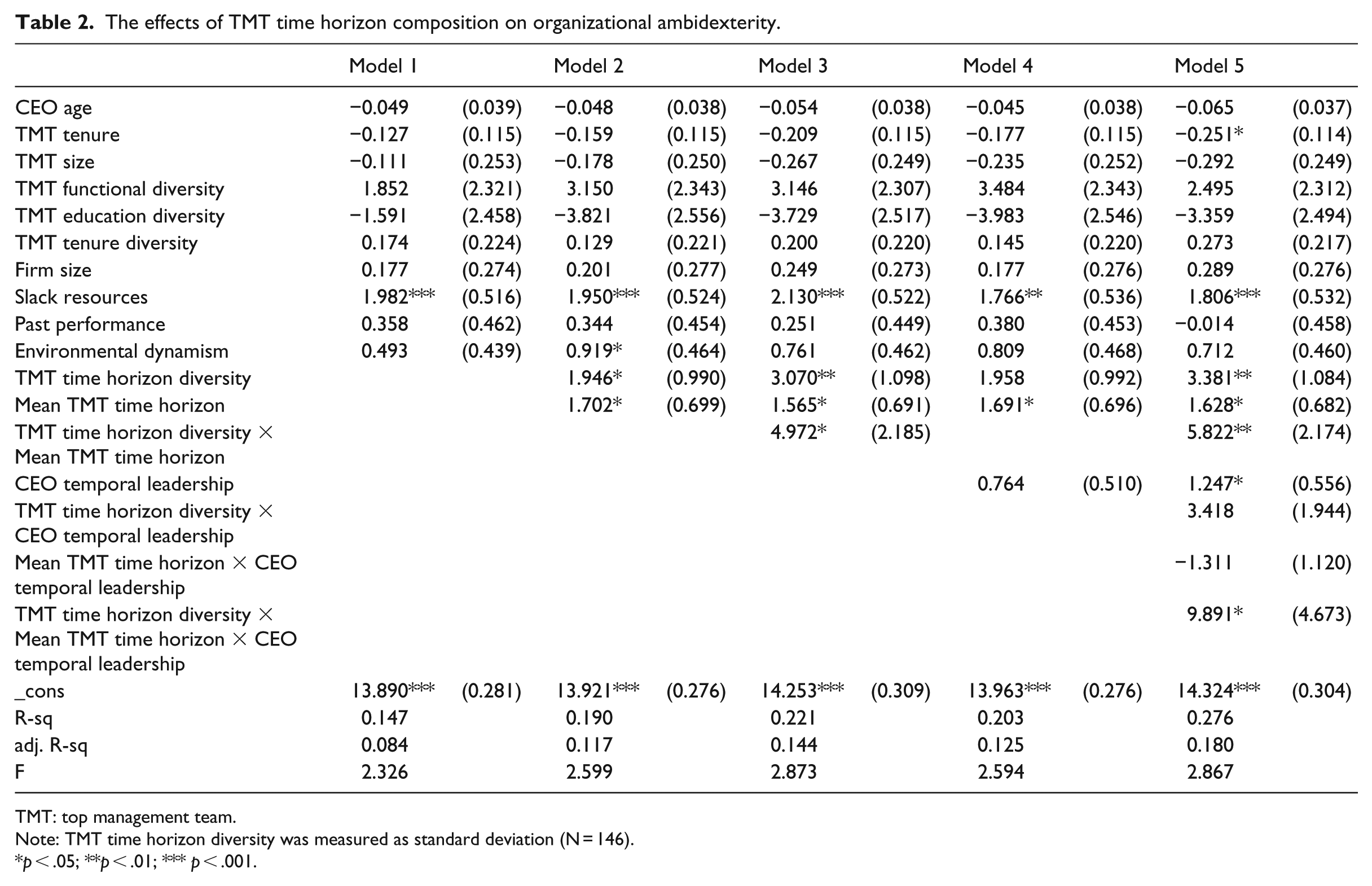
We employed hierarchical regression analysis to test our hypotheses. We mean-centered the predictor and control variables in all regression models to minimize multicollinearity (Aiken and West, 1991). We tested our model in several steps. First, we tested the main effects of TMT time horizon diversity and mean TMT time horizon diversity. Second, we tested the interaction effect by including the interaction term (TMT time horizon diversity × Mean TMT time horizon). Third, we tested the three-way interaction of TMT time horizon diversity, mean TMT time horizon, and CEO temporal leadership. Table 1 reports means, standard deviations, and correlations for all study variables. Table 2 presents the regression results. Figures 1 and 2 show the interaction plots.
Means, standard deviations, and correlations a .
TMT: top management team.
N = 146, Correlations greater than 0.16 are significant at p < .05; greater than 0.21 are significant at p < .01; greater than 0.27 are significant at p < .001.
Natural logarithm.
The effects of TMT time horizon composition on organizational ambidexterity.
TMT: top management team.
Note: TMT time horizon diversity was measured as standard deviation (N = 146).
p < .05; **p < .01; *** p < .001.
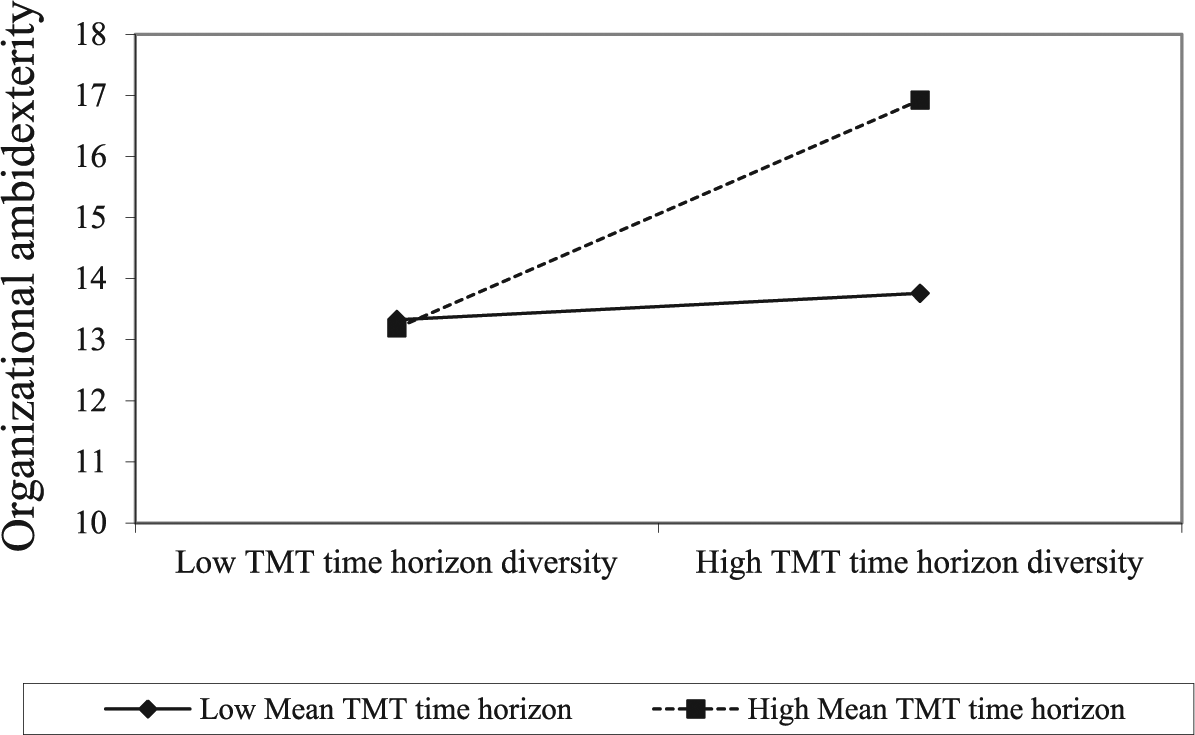
Interaction plot of TMT time horizon diversity and mean TMT time horizon.
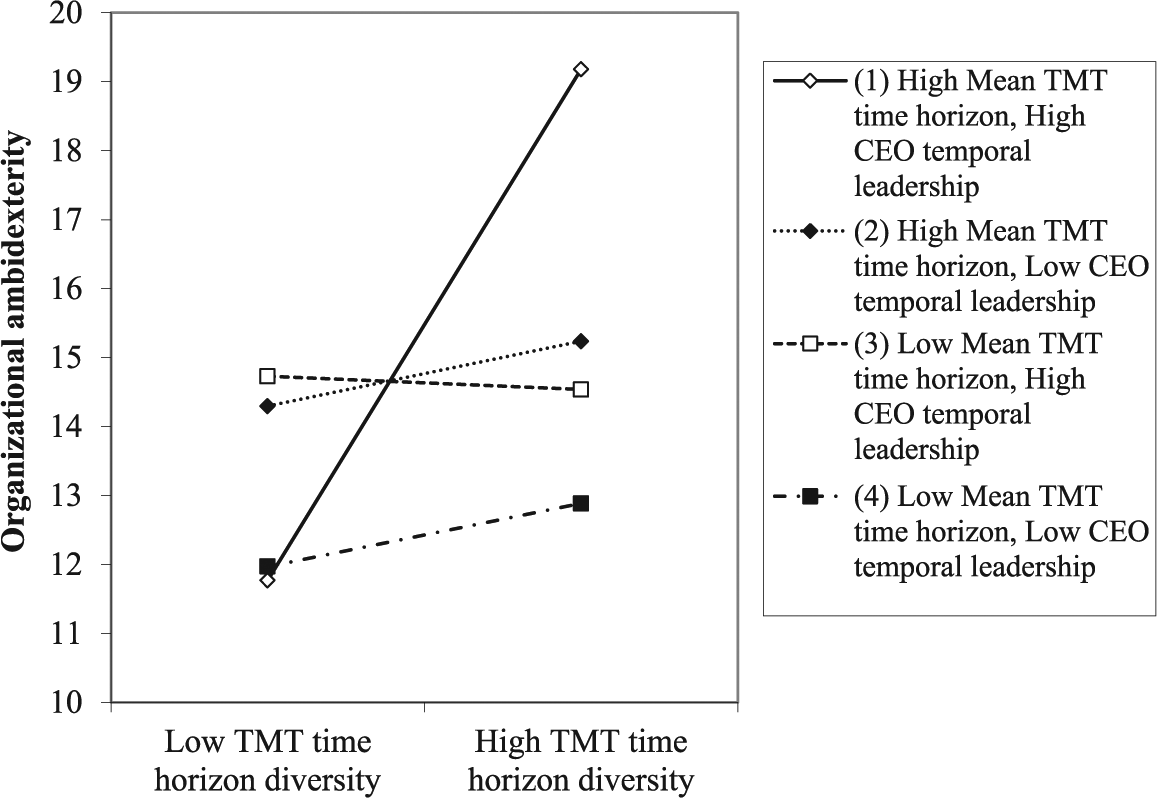
Three-way interaction.
H1 proposed that TMT time horizon diversity was positively related to organizational ambidexterity. As shown in Table 2, the coefficient of TMT time horizon diversity was positive and significant (B = 1.946, SE = 0.99, p < .05). Thus, H1 was supported. H2 proposed that mean TMT time horizon was positively related to organizational ambidexterity. As shown in Table 2, the coefficient of mean TMT time horizon was positive and significant (B = 1.702, SE = 0.699, p < .05). Therefore, H2 was supported.
H3 proposed that mean TMT time horizon positively moderated the effect of TMT time horizon diversity on organizational ambidexterity. The coefficient of the interaction term was positive and significant (B = 4.972, SE = 2.185, p < .05). To further examine this relationship, we plotted the effects at high (1 SD above the mean) and low (1 SD below the mean) levels of mean TMT time horizon (see Figure 1). TMT time horizon diversity was positively related to organizational ambidexterity when mean TMT time horizon was high, thereby supporting H3.
H4 hypothesized that CEO temporal leadership positively moderated the interaction effects of TMT time horizon diversity and mean TMT time horizon on organizational ambidexterity. The coefficient of the three-way interaction term was positive and significant (B = 9.891, SE = 4.673, p < .05). We further plotted the three-way interaction figure (see Figure 2), which showed that TMT time horizon diversity was positively related to organizational ambidexterity when mean TMT time horizon is long, and CEO temporal leadership is strong.
Supplemental analysis
To further examine the effect of TMT time horizon diversity and mean on organizational ambidexterity, we used Bonferroni’s test and Tukey’s honestly significant difference (HSD) test to perform pairwise comparisons among the four combinations of high/low TMT time horizon diversity and high/low TMT time horizon mean. We used the sample median as the cutoff point to compare high and low levels. The Bonferroni test indicated that the group with high time horizon diversity and high time horizon mean scored higher on ambidexterity than the other TMT subgroups (p < .01 versus the high diversity and low mean group as well as the low diversity, high mean group; and p < .10 versus the low diversity and low mean group). Pairwise comparisons using Tukey’s HSD tests yielded the same results.
Robustness checks
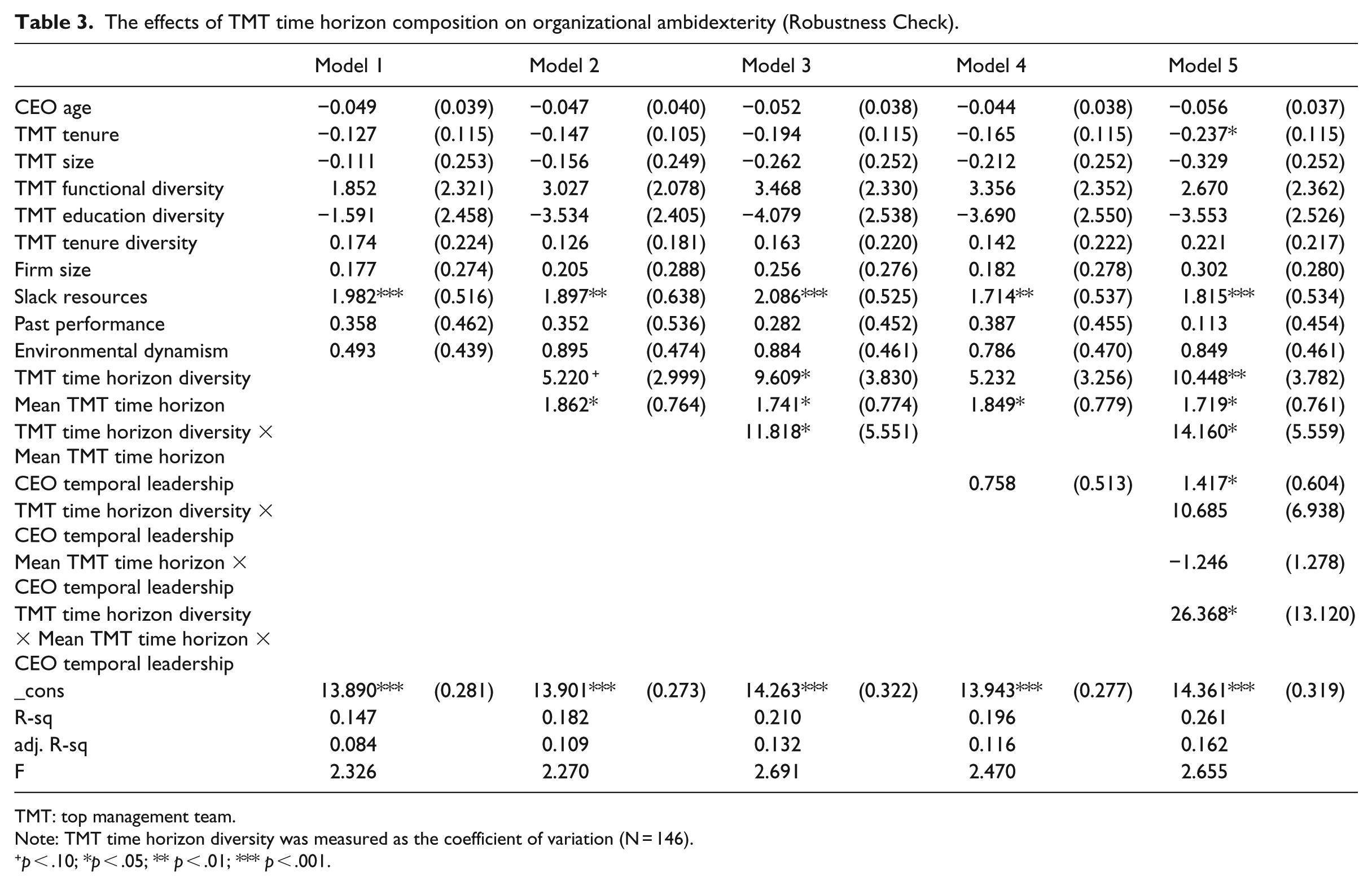
We conducted several additional analyses to establish the robustness of our results. First, we used the coefficient of variation instead of the standard deviation to assess TMT time horizon diversity (Table 3). Results remained consistent. To further establish robustness (results available from the senior author), we included additional controls—industry growth, firm age, CEO education, and CEO tenure. Also, we created an additive measure of organizational ambidexterity by adding the scores of exploration and exploitation, also producing consistent results. Finally, we controlled for the number of TMT member responses we received. Again, the results remain consistent.
The effects of TMT time horizon composition on organizational ambidexterity (Robustness Check).
TMT: top management team.
Note: TMT time horizon diversity was measured as the coefficient of variation (N = 146).
p < .10; * p < .05; ** p < .01; *** p < .001.
Endogeneity correction
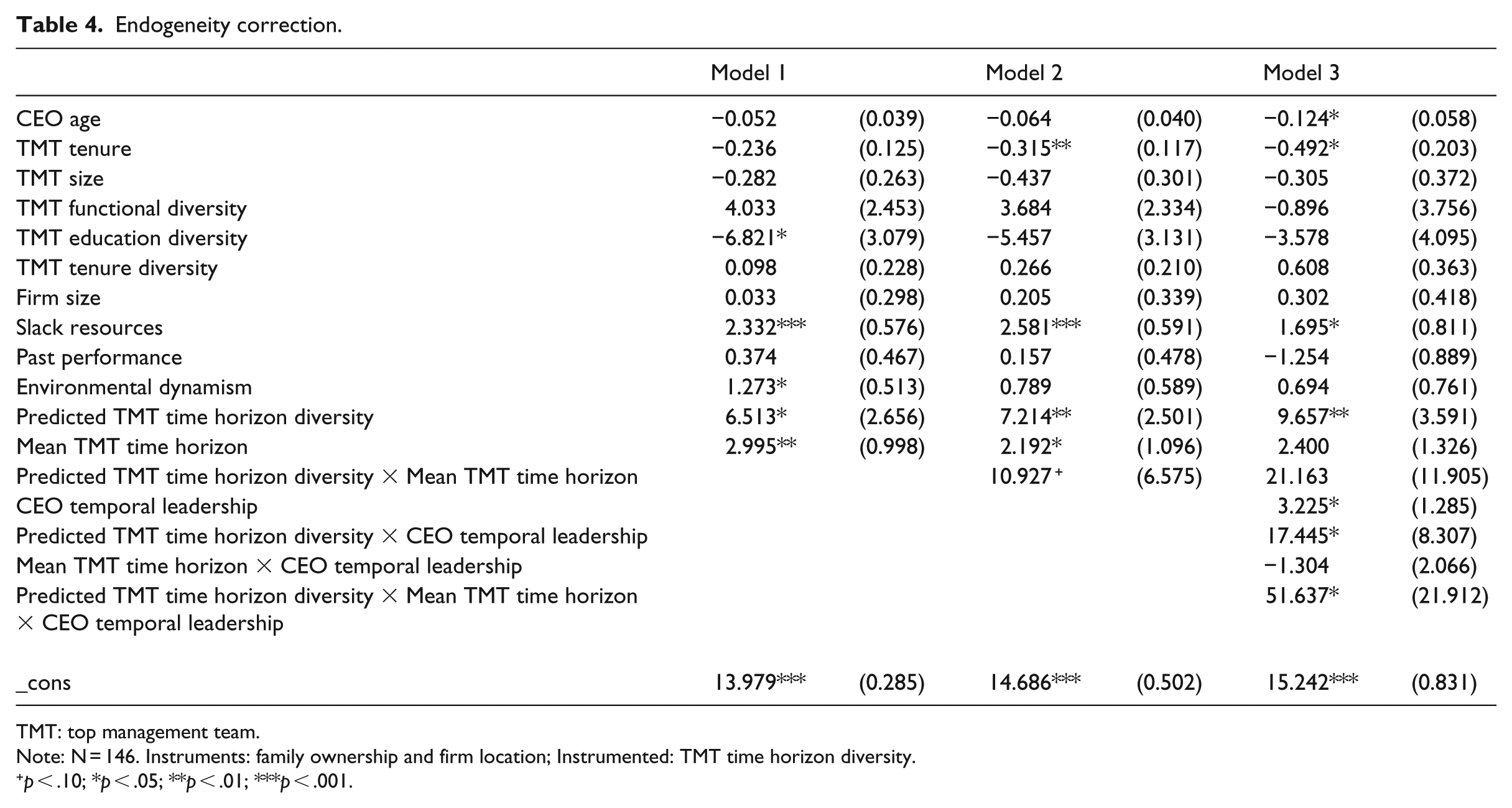
Because firms may differ in unobserved ways that explain TMT time horizon diversity as well as its effects on ambidexterity, we adopted Semadeni et al.’s (2014) instrumental variables’ approach to correct for such endogeneity arising from unobserved variables. We selected two instruments: family ownership (1 = non-family owned; 0 = family- owned) and firm location. Because TMT members in family-owned firms are more likely to be from the same families or fall closely in line with family priorities, they likely have more homogeneous time horizons than those in non-family firms (Miller and Le Breton-Miller, 2005). Research has shown that family ownership is not linked to organizational ambidexterity (Lubatkin et al., 2006). Similarly, firm location determines the scope of labor markets (Alcacer and Delgado, 2016). Firms in locations with highly diverse labor markets may have TMTs with more heterogeneous time horizons than firms in locations with less diverse labor forces. However, research has found that firm location was not significantly associated with ambidexterity (Cao et al., 2010). Because SMEs in our sample were located in two cities differing in labor market heterogeneity, we created a dummy to capture firm location.
We followed Semadeni et al. (2014) in conducting two tests of the validity of our instruments. First, the F test was highly significant (F = 13.12; p < .001), indicating that family ownership and firm locations are strong instruments. This F value exceeds the requisite 11.59 to ensure minimal instrumental variable bias. Second, we tested for overidentifying restrictions of the two-stage model using Woodridge’s χ2. The test was not significant (χ2 = 2.36; p = .12), suggesting that all instruments are valid. Finally, the Durbin-Wu-Hausman (DWH) test (p = .06) suggests that our independent variable is indeed endogenous. We report our results for endogeneity analysis in Table 4. Despite these confirmatory results, these tests cannot serve as proof of causal direction as we could find no instruments for TMT time horizon mean and CEO temporal leadership.
Endogeneity correction.
TMT: top management team.
Note: N = 146. Instruments: family ownership and firm location; Instrumented: TMT time horizon diversity.
p < .10; * p < .05; ** p < .01; *** p < .001.
Discussion
Integrating theory and research on team temporal diversity, CEO-TMT interface, and organizational ambidexterity, our study theorizes and tests the effects of TMT time horizon composition on organizational ambidexterity. It shows that TMT time horizon diversity and mean TMT time horizon individually and interactively influence organizational ambidexterity. Furthermore, CEO temporal leadership strengthens the positive interactive effects of TMT time horizon diversity and mean TMT time horizon on organizational ambidexterity. Our study has several theoretical implications on temporal research in strategy as well as ambidexterity.
Temporal research in strategy has typically considered CEOs as primary decision-makers and explores the strategic implications of CEO temporal characteristics (Chen and Nadkarni, 2017; Das, 1987; Nadkarni and Chen, 2014; Yadav et al., 2007). Our study moves beyond this line of inquiry by examining how temporal characteristics configure at the TMT level. It is critical to explore TMT temporal composition because team research has long contended that temporal diversity plays a very important role in driving team behaviors and outcomes (Gibson et al., 2007; Mohammed and Harrison, 2013). However, empirical evidence has been mixed. For example, West and Meyer (1997) showed that team time perspective diversity was positively related to strategic change. In contrast, Mohammed and Nadkarni (2011) did not find any effect of such diversity on team performance and suggested that time horizon diversity “may be more applicable in teams that simultaneously require the consideration and management of short-term and long-term goals, such as top management teams than in teams primarily tasked with meeting monthly project goals” (p. 501). In this study, we examine the impact of two facets of TMT composition: diversity and mean on a key strategic variable—organizational ambidexterity. Our results show that both TMT time horizon diversity and mean TMT time horizon are positively related to organizational ambidexterity.
Our study also advances existing research to theorize the mean-diversity interaction formally. Although team research has hinted at an interaction between personality mean and diversity (Harrison and Klein, 2007), only one study did exploratory analysis examining the interactive effects of TMT positive affect mean and TMT positive affect diversity on firm performance but did not find significant results (Barsade et al., 2000). We formally theorized a mean-diversity interaction and showed that TMT time horizon diversity was more positively related to organizational ambidexterity when mean TMT time horizon was longer. Thus, the overall central tendency of the TMT seems to offer a sufficient foundation to enhance the positive effects associated with TMT time horizon diversity. It is useful to note that because high time horizon diversity may be associated with a lower mean (r = –0.40), it is slightly less common to observe a TMT with both high diversity and high mean. Our sample of 146 observations contained 31 TMTs with that combination, and our subgroup analysis confirmed that this subgroup did indeed achieve the highest ambidexterity score vis-à-vis all other subgroups. Taken together, the non-symmetric effects of mean-diversity interaction further underscore the importance of comprehensively examining different compositional facets to develop a complete understanding of how TMT temporal composition shapes firm strategies.
Third, our study also highlights the central role of CEO temporal leadership. Mohammed and Nadkarni (2011) have formally theorized the moderating role of temporal leadership in the relationship between team time perspective diversity and team performance. However, they did not find a significant moderating effect of temporal leadership. Drawing on the CEO-TMT interface perspective, our study moves beyond to test the three-way interactive effects of TMT time horizon diversity, mean TMT time horizon, and CEO temporal leadership on organizational ambidexterity. It shows that high TMT time horizon diversity, longer mean TMT time horizons, and strong CEO temporal leadership maximize organizational ambidexterity. Our results suggest that CEOs with strong temporal leadership are more likely to facilitate organizational ambidexterity in TMTs that are diverse in time horizon but are aggregately long-term oriented. Accordingly, our study provides a new temporal lens on strategic leadership.
Finally, our study also advances organizational ambidexterity by being the first to theorize the role of time formally. Existing studies on organizational ambidexterity have paid ample attention to strategic leadership as a critical antecedent (e.g. Beckman, 2006; Cao et al., 2010; Heavey and Simsek, 2017; Lubatkin et al., 2006; Mihalache et al., 2014) and have examined the joint effect of CEO leadership and TMT characteristics (Jansen et al., 2008). Our study moves beyond this research to specifically focus on a set of temporal antecedents of organizational ambidexterity. To pursue organizational ambidexterity, firms need to strike a balance between addressing current business demands, and simultaneously anticipating how to prepare for future technology and market changes (Gibson and Birkinshaw, 2004). Thus, time is a central factor that decision-makers need to consider when formulating and implementing an ambidextrous strategy (Mathias et al., 2017). It is reasonable to expect that temporal factors will significantly influence organizational ambidexterity. Our results show that TMT time horizon diversity and mean TMT time horizon individually and interactively drive organizational ambidexterity. Furthermore, CEO temporal leadership moderates such joint effects. In doing so, our study highlights the role of time and underscores temporality as a central driver of ambidexterity.
Limitations and future directions
Our study has several limitations. First, we conducted our research in the Chinese setting. Such a unique context may limit the generalizability of our findings to countries with similar socio-cultural contexts. Second, we surveyed a sample of SMEs to capture the inherent temporal characteristics of top executives. Although, such an approach provides a relatively accurate estimation of executives’ traits (Hambrick, 2007; Miller and Dröge, 1986; Miller and Toulouse, 1986), future researchers could replicate our study on a sample of large established firms such as the S&P 500 or 1500. Finally, our endogeneity analysis only instrumented TMT time horizon diversity. However, it is possible that TMT time horizon mean and CEO temporal leadership are also subject to endogeneity concerns. Thus, our analysis cannot firmly establish causal directions. Future studies may seek to find unique instruments for each of these predictors.
In conclusion, our study highlights the importance of examining TMT time horizon composition. It shows that high TMT time horizon diversity, longer mean TMT time horizons, and strong CEO temporal leadership promote organizational ambidexterity. In doing so, our study deepens our understanding of executive and team temporal orientations in strategy and opens up new avenues for future research on their strategic implications.
Footnotes
Appendix 1
Acknowledgements
An earlier version of this article was accepted at the 2017 Academy of Management Conference. The authors would like to thank the three anonymous Academy reviewers, Wenpin Tsai, and Stephen Humphrey for their valuable feedback on earlier drafts of this article.
Declaration of conflicting interests
The author(s) declared no potential conflicts of interest with respect to the research, authorship, and/or publication of this article.
Funding
The author(s) received no financial support for the research, authorship, and/or publication of this article.
