



Abstract
Interstitial spaces are informal settings where interactions among actors from different organizational fields are more likely to succeed despite the institutional complexity that they face. Individuals acting as “catalysts” have been identified as being particularly important in the dynamics of these interstitial spaces. However, the focus to date has been on individuals interacting in interstitial spaces that have developed informally, and we know little about how formal organizations might purposefully create and manage interstitial spaces to initiate cross-field interaction. Using data from a study of six organizations involved in technology transfer activities between universities and industry in Italy, we explore how formal organizations use interstitial spaces to encourage cross-field collaboration and identify the set of formal and informal activities employed by catalysts to manage the complexity that arises. In addition, our analysis identifies two activities implemented at the organizational and field level by the formal organizations to support the interstitial spaces. Based on these results, we develop a model of the management of interstitial spaces by formal organizations.
Keywords
Introduction
Research has shown that collaboration between actors from different organizational fields is potentially conducive to the genesis of innovative, ground-breaking outcomes, but it is also challenging, as interaction between actors from different fields is often problematic and conflictual (Furnari, 2014; Villani et al., 2017). Researchers investigating cross-field collaborations “have found that collaborations can be difficult when the interests, goals, and practices of participants differ” (O’Mahony and Bechky, 2008: 424). Ironically, the same differences in organizational fields that lead to innovation in cross-field collaboration create barriers to collaboration, so the more potential for innovation that exists in a collaboration, the more difficult the collaboration is likely to be (Boxenbaum and Battilana, 2005).
Interstitial spaces have been recently identified as peculiar types of interaction settings conducive, at least in some cases, to successful cross-field collaborations (Furnari, 2014). More specifically, interstitial spaces represent informal settings where individuals positioned in diverse fields can interact without the conflict that usually accompanies such activity. Fablabs (Cartel et al., 2019), clubs, coffeehouses, salons, literary cafes, and other informal gatherings (Furnari, 2014)—such as, famously, the Homebrew Computer Club 1 —are all examples of interstitial spaces that occasionally and informally bring together people from different institutional fields (e.g. in the case of the Homebrew Computer Club electronic engineers and political activists) to discuss and experiment with matters of common interest (e.g. personal computers and associated software) (Cartel et al., 2019; Furnari, 2014).
Interstitial spaces provide micro-interaction contexts for occasional and informal interactions where the individuals interacting remain socialized into the institutions regulating their respective fields (Battilana, 2006). Putnam (2003) and Oldenburg (2001) discussed the importance of “third places”—intended as places where people can meet outside their work—for the achievement of innovative practices in the civic sector. Similarly, Morgan (2009) located the start of the practice of building “kitcars” (i.e. modular cars) in experimentation by diverse people interested in amateur car racing (e.g. aerospace engineers, journalists, mechanics, and doctors) who were members of the British 750cc Motor Club. These are all examples of interstitial spaces as they sit at the interstices between fields and bring together individuals socialized into very different institutional contexts, who occasionally and informally meet in these spaces to discuss ideas of common interest.
Although interstitial spaces are seen as promising contexts for facilitating experimentation and for the emergence of new activities and ideas through recombining different frameworks and practices (Barley, 2008; Hallett and Ventresca, 2006), the institutional diversity characterizing these settings can still negatively affect the ability of partners to work together effectively (Heimer, 1999). Accordingly, recent research has started to investigate what factors facilitate interactions in interstitial spaces. Catalysts, as “actors who sustain others’ interaction over time and assist the construction of shared meaning” (Furnari, 2014: 452), have been identified as one important micro-level mechanism for bringing forth, sustaining, and fostering social interactions in interstitial spaces (Furnari, 2014). They are mediators and facilitators of others’ interactions, working to assist interactions within interstitial spaces.
However, while interstitial spaces that develop informally (i.e. clubs and salons) have been shown to be effective contexts for individuals from different fields to interact, this raises the question of whether and how these special contexts might be used more strategically by formal organizations interested in initiating cross-field collaboration. Anecdotally, there are many instances of this including working groups, seminars, workshops, networking events, and other informal settings created by governments, companies, universities, and non-governmental organizations (NGOs) to bring together representatives of different fields to interact occasionally and informally around areas of common interest. If interstitial spaces can function informally to encourage and support collaboration between individuals, can they be created purposefully in an attempt to initiate cross-field collaboration among organizations? Furthermore, what is the role of catalysts in these kinds of interstitial spaces?
In order to explore these questions, we conducted a study of the activities of six technology transfer organizations in Italy and how they used interstitial spaces to promote cross-field collaboration. These organizations helped parties to span the boundaries of academe and industry, two fields characterized by markedly different logics: an “academic” logic that is primarily focused on basic scientific research and a “market” logic focused primarily on financial returns (Merton and Storer, 1973). More specifically, we studied two technology transfer offices (TTOs), two university incubators (UIs), and two university-industry consortia (UIC) that all work to assist organizations seeking to collaborate across the boundary between scientific research and industry.
Our study makes three key contributions. First, we identify and begin to explore empirically how formal organizations use interstitial spaces to initiate cross-field collaboration and the role of catalysts in these special spaces. While the existing literature on interstitial spaces has focused on individuals interacting in interstitial spaces that have arisen informally, there are many similar spaces that are created purposefully by formal organizations to facilitate the initiation of collaborations. In response, we provide two substantive empirical contributions: (a) a fine-grained analysis of the activities that catalysts use in managing the interaction that occurs within the interstitial space and (b) insight into the broader activities of the formal organizations at the organizational and field level to support the interstitial space.
Second, we contribute to our understanding of how interstitial spaces can provide a context for initiating cross-field collaboration. While previous literature has written about the role of interstitial spaces in enabling innovation, there has been little written to date on how interstitial spaces can function as spaces for the interactions and negotiations required to initiate cross-field collaborations. In this study, we show how interstitial spaces can play a role in the initiation of cross-sector collaborations between organizations and how these spaces can be purposefully created and managed by formal organizations. We therefore contribute to the collaboration literature by highlighting the important role that interstitial spaces can play in the “pre-history” of inter-organizational collaboration.
Third, our findings add to existing discussions of technology transfer by showing that, in addition to the familiar topics that dominate the technology transfer literature like venture capital, academic entrepreneurship, and the performance of TTOs (see Agrawal, 2001), the idea of an interstitial space can help us to better understand how the process of technology transfer between academe and industry functions and highlight the important role of interstitial spaces in creating the condition for collaboration to be initiated between academics and industry. In doing so, we highlight the important connection between TTOs and the literature on institutional complexity and add a significant new research area for exploring TTOs.
Interstitial spaces and the role of catalysts
Interstitial spaces
Interstitial spaces have been defined as small-scale settings where individuals positioned in different fields interact with one another informally around issues and activities of common interest (Furnari, 2014). Interstitial spaces are locations between organizational fields, bringing together members exposed to different logics and templates for action and organizing.
Interstitial spaces have a number of defining features. First of all, as the members interacting within interstitial spaces come from different fields and have been socialized into the different norms and institutions regulating their respective field. Interstitial spaces are built on institutional diversity (Kraatz and Block, 2008) and are characterized by institutional complexity (i.e. the situation in which divergent prescriptions from multiple institutional logics collide (Greenwood et al., 2011). However, by interacting in interstitial spaces, people do not lose or change their position within their home field. Accordingly, because interstitial spaces involve interactions between previously distant organizational systems, new ideas and activities are more likely to emerge. At the same time, these ideas and activities are often challenging to transform into new practices back in the participants’ home fields due to conflict and incompatibility between logics (Dunn and Jones, 2010).
Second, interaction occurring in interstitial spaces is temporally bounded, in the sense that it occurs at irregular and infrequent intervals. More specifically, the time that individuals devote to these common activities is limited if compared to the time they dedicate to the activities they carry out on a continuous basis in their respective fields. This “transitory” aspect of interstitial spaces reduces the negative impact of institutional complexity but also makes it more difficult to transform occasional activities into consolidated practices (Furnari, 2014). For example, the meetings of the British 750cc Motor Club were occasional and short compared to the time spent by the members in their regular work organizations.
The third distinctive feature of interstitial spaces is related to the fact that the interaction occurring in these settings is identified as a part-time activity. Members usually see these common activities as weakly and indirectly related to the main activities implied by their field positions and, therefore, unlikely to contribute to enhancing or undermining their position in the field to which they belong (Furnari, 2014). Continuing the example of the British 750 cc Motor Club, members kept their regular day jobs and carried them out in the same ways as before they joined the club.
Due to these characteristics, interstitial spaces are contexts that facilitate “collective experimentation processes” (Furnari, 2014: 446) and the “recombination of different practices into new activities and ideas” (Furnari, 2014: 446). Indeed, they have been highlighted as contexts having a potential to be highly innovative. This is due to the fact that interstitial spaces, drawing members from multiple fields with separate identities and logics, become the ideal setting for transposing, translating, and recombining practices across fields and for the generation of new practices (Boxenbaum and Battilana, 2005; Furnari, 2014; Zietsma et al., 2017).
Thus, for example, Powell and Sandholtz (2012) showed that new biotechnology firms were founded thanks to the transposition and reconfiguration of practices borrowed from different, external fields. Similarly, Granqvist and Laurila (2011) argued that the emergence of the US nanotechnology field, developed from the establishment of new practices, was possible through the collaboration of science, government, industry, and environmentalists as separate and distinct fields. And Furnari (2014) described the Homebrew Computer Club as an interstitial space hosting interaction between people from distant organizational fields—such as political activists and computer engineers—who innovated new practices that at a later time came to define the personal computer industry. Again, Anderson (2013) described how Fab Labs, as digital fabrication labs, constituted a place where architects, computer scientists, and visual artists experimented with new three-dimensional (3D) technologies, giving birth to the “manufacture-it-yourself” work practice (pp. 46–47).
However, the same features characterizing interstitial spaces may hinder the construction of shared meanings around these new ideas and activities and, therefore, their transformation into new practices, if not supported and coordinated appropriately (Furnari, 2014). Researchers have found that collaborations can be difficult when the interests, goals, and practices of interacting people differ (O’Mahony and Bechky, 2008; Villani et al., 2017). Thus, one open issue is how individuals interacting in interstitial spaces with very different cognitive templates for action and organizing are able to work together and construct shared meanings despite the potential for conflict and disagreement (Furnari, 2014). One answer to this lies in the role of catalysts in interstitial spaces.
Catalysts
The role of “mediators” in organizational theory has a long tradition. Studies on the management of cross-boundary interactions (Zietsma and Lawrence, 2010) have focused on the use of boundary objects (Kellogg et al., 2006; O’Mahony and Bechky, 2008; Star and Griesemer, 1989), boundary organizations (O’Mahony and Bechky, 2008), and boundary spanning actors (Bartel, 2001), which use processes and practices that “work to establish a shared context” (Carlile, 2002: 451). A boundary organizations’ primary task, for example, is to reinforce convergent interests of the different organizations involved in the collaboration, while allowing divergent ones to survive (Guston, 2001). In the same vein, project management software can facilitate coordination across groups and departments (Bechky, 2003).
Similarly, within interstitial spaces, catalysts as mediators act as facilitators, moderators, and organizers. They are “actors who sustain others’ interactions over time and assist the construction of shared meanings by coordinating and energizing common activities” (Furnari, 2014: 452). As such, catalysts are oriented toward fostering and sustaining interactions across organizational boundaries (Obstfeld, 2005). In doing so, they provide continuity across the occasional interactions taking place in interstitial spaces, and they help and facilitate the construction of shared meanings between interacting parties. However, although the importance of catalysts in making interactions between individuals with different cognitive templates possible and sustainable is clear, so far, we have only limited empirical research on how they perform these tasks (Furnari, 2014).
Indeed, while “social skills” (Furnari, 2014: 453) have been identified as necessary for catalysts in order to successfully perform their tasks, a “multivocal coordination” style is also required in order to satisfy individuals interacting in interstitial spaces who might otherwise perceive catalysts as inadequately representing their perspectives and opinions (Padgett and Ansell, 1993). Multivocality refers to a particular communication approach that uses words, labels, and other symbolic representations that are simultaneously understood by culturally diverse individuals (Furnari, 2014).
Furthermore, ineffective catalysts within an interstitial space may undermine the constitution of new activities and new practices. An illuminating example is provided by Furnari (2014) in discussing the different styles adopted by two people acting as catalysts in the Homebrew Computer Club. While both served as “moderators” in running meetings and structuring collective discussions, Lee Felsenstein’s coordination style was perceived as successful because he was “in sync” with the spontaneous interactions emerging in the Club’s interstitial space, providing at the same time order and stability to those interactions. In contrast, Gordon French was perceived as “out of sync,” as he tried to overtly and unidirectionally control the flow of interactions and get others to play by his rules (Furnari, 2014). An ineffective catalyst can get in the way of the interaction and innovation that characterizes these spaces.
Formal organizations and interstitial spaces
While there have been very interesting initial discussions of interstitial spaces and the role of catalysts, there has been little empirical work to date confirming and extending these discussions. Furthermore, while a number of examples of interstitial spaces have been discussed at length, there has been limited research into the variety of interstitial spaces that occur. For example, while authors have discussed a number of different informal spaces, they all tend to be informal clubs or gatherings that come into being through the voluntary activities of individuals. Anecdotally, there are many similar spaces created with many of the same characteristics that do not arise quite as informally. In fact, there are many of these sorts of spaces that are created by formal organizations to provide a context to bring together actors from different organizational fields in an effort to initiate cross-field collaboration. These interstitial spaces vary from single meetings of interested parties to more structured and enduring interest groups, task forces, working groups, and so on.
Our aim in this article is to expand our understanding of interstitial spaces and catalysts by studying how formal organizations use interstitial spaces to initiate cross-field collaboration and the role catalysts play in these special interstitial spaces. Summarized as a research question,
How do formal organizations use interstitial spaces to purposefully facilitate interaction between members of organizations from different fields in order to initiate cross-sector collaboration and what is the role of catalysts in this process?
Methods
In this study, we explore interstitial spaces that have been purposefully created by formal organizations, the role of catalysts in these interstitial spaces, and what happens as a result of their activity. More specifically, we studied six organizations dealing with technology transfer between universities and industry in Italy and a number of the interstitial spaces that they established. Our interest is explicitly not in the resulting collaborations—as that comes later in the sequence of events—but in how formal organizations create spaces where individuals from different fields can successfully interact, and in the role that catalysts play in these spaces. Our interest is in the “pre-history” of the collaborations that resulted, not in the collaborations themselves. In order to reduce potential biases associated with studying the interstitial spaces established by a single organization, our study included different types of organizations and multiple organizations of each type. This allowed for more rigorous analysis, not only in terms of reliability and richness, but also in terms of theory generalizability (Eisenhardt, 1989).
Research setting and level of analysis
Our study focuses on the interstitial spaces created by various kinds of technology transfer organizations to foster interaction between academia and industry in the hopes of encouraging the sorts of collaborations that support the transfer and exploitation of academic results for commercial purposes. For academics, industrial partners represented an alternative and complementary way to obtain resources and a means to develop applied research; for firms, academic researchers provided access to new knowledge in specific fields of interest. Therefore, technology transfer organizations create spaces where researchers and industry people can meet and interact, without the pressure of entering each other’s fields. Our focus here, then, is technology transfer organizations as formal organizations that create interstitial spaces for interaction by representatives of organizations from different organizational fields.
Accordingly, we are not interested in studying the resulting collaborations between academics and practitioners, nor in measuring the success of these collaborations or exploring the resulting outcomes; instead our purpose is to explore what happens in the interstitial spaces created by technology transfer organizations prior to the initiation of formal collaborations, and the role that catalysts play within them to facilitate and moderate interactions between academics and industry. Therefore, our level of analysis is the technology transfer organization, as the formal organization that creates a series of interaction occasions, sets of which represent an interstitial space for the interaction of academics and enterprises discussing shared interests and future collaborations. These interstitial spaces are made up of chains of events—workshops, seminars, meetings, and so on—that correspond to the occasional meetings of the clubs discussed in the existing literature. Thus, the multiple interstitial spaces established by technology transfer organizations are the places where we can observe and analyze what catalysts do to facilitate and sustain others’ interaction.
Technology transfer organizations operating in this way are a relatively new phenomenon in Italy. The first significant steps in this direction occurred in the late 1990s when important changes in legislation encouraging university-industry collaborations were first passed. Various reforms have occurred since that time aimed at improving the transfer of research results to industry and these reforms have had important consequences for both universities and companies. This made the context a particularly rich one as many organizations have been established within the university sector to deliberately create interstitial spaces to facilitate collaboration between academics and industry.
For our study, we selected the three most common types of organizations dealing with technology transfer in Italy at the time of the study: TTOs (i.e. offices dedicated to the promotion and support of university-industry collaborations), UIs (i.e. organizations hosting and supporting university spin-offs), and UIC (i.e. organizations dedicated to applying basic research to industry requirements). We selected two organizations of each type.
The specific organizations we studied were selected from universities identified using the performance measures of technology transfer activities in Italy, such as the ability to generate additional resources for universities (e.g. through licenses, spin-offs), and the production of positive spillover effects in the regional and national economy (e.g. through the commercialization of inventions) (Bax et al., 2014; Bianchi and Piccaluga, 2012). It is worth noting that more than 95% of the interactions created and supported by the technology transfer organizations we studied resulted in collaborations. In Table 1, we provide detailed information on our six technology transfer organizations including their year of founding, origin, positioning, number of employees, focus of activity, and approximate number of interaction occasions created.
Summary description of the technology transfer organizations creating interstitial spaces.

TTO: technology transfer offices; UI: university incubators; UIC: university-industry consortia.
These Foundations are private, non-profit, autonomous organizations established in the early 1990s in Italy, as a result of the law 218/90 (Amato law) which led to the privatization of the savings banks and of the Monte banking group.
Data collection
Data collection followed common prescriptions for case-study analysis (e.g. Eisenhardt, 1989; Yin, 2003), combining archival documents, preliminary interviews, formal semi-structured interviews, and informal discussions (see Table 2).
Typology of data and their use.

We conducted the data collection process in three phases. We began with an exploratory stage at the end of 2011 during which we conducted interviews with key informants in order to better understand the internal functioning of their organizations, the different tasks allocated to different employees, and the differences in culture and interests they experienced when dealing with their stakeholders. This phase was critical for the construction of our interview protocol and for defining the focus of archival data collection. We conducted five interviews during this phase with each interview lasting about 45 minutes. All of the interviews were recorded and transcribed. At the end of this process, we were convinced that the setting was appropriate for exploring our theoretical interests.
We conducted the second phase of data collection in early 2012. During this phase, we collected archival materials in order to develop a more in-depth understanding of technology transfer activities in Italy, the interactions between universities and industry, and the new norms and practices carried out at the field level. The archival materials we collected included research articles, texts of Italian and European laws, books, and various other documents produced describing the activity of the organizations.
During the third phase from January to August 2012, we conducted a further 48 interviews. With the exception of two Skype interviews, interviews took place in informants’ offices and lasted between 30 and 65 minutes. Our sample of respondents included not only the employees of the technology transfer organizations, but also academic researchers, executives, and industrial partners interacting within the interstitial spaces created by those organizations. The focus of the interviews was on specific instances of interaction and on the organizational practices adopted by the organizations during partners’ interactions. See Table 3 for a summary.
Description of interviews.

TTO: technology transfer offices; UI: university incubators; UIC: university-industry consortia.
Depending on the nature of our respondents’ involvement in technology transfer activities, we relied upon two separate interview protocols. Both the protocols were refined and adjusted over time as new themes emerged and to account for data saturation. For the members of the technology transfer organizations, we asked about the organization’s structure (e.g. How are the different tasks allocated within the organization?), organizational strategy (e.g. What is the main objective you pursue when dealing with academics and industry representatives? What are the main steps you follow in organizing the interaction process?), performance (e.g. How do you combine efficiency and effectiveness in managing interactions?), stakeholders (e.g. Do you plan different activities for the different stakeholders?), and the interviewees’ perception of the interactions occurring within the interstitial space (e.g. How do you measure the satisfaction of the different parties regarding the activities you organize?). In contrast, the protocol used for the interviews of academics and industrial partners was organized more around job characteristics (e.g. Can you describe your role at your organization? What are the main activities you are responsible for?), previous collaborations (e.g. Did you have previous experiences of interactions/collaborations with academics/enterprises? If yes, could you tell more about them?), experiences with the organizations creating the interstitial space (e.g. What is your relationship with the technology transfer organization? Did you have previous experiences with them?), and incentives (e.g. What is the benefit of making use of their expertise?).
Data analysis
Since empirical research on interstitial spaces and, more specifically, on how catalysts manage interaction between parties from different fields in these spaces, is limited, we adopted an inductive approach aimed at developing process theory (Furnari, 2014). Process theories explain how things and activities are sequenced over time and why they evolve in a specific way (Langley, 2007). Our analytic approach followed common practice in qualitative research (e.g. Gioia et al., 2013), and through an iterative procedure, we coded interviews and documents inductively with the aim of identifying important relationships between data, emerging themes, and the existing literature. Data analysis included three phases: (a) mapping the technology transfer process, (b) identifying and analyzing activities and practices used by catalysts at different points in the process, (c) differentiating between formal and informal activities, and (d) checking the validity of the theory (Glaser and Strauss, 1967; Lingo and O’Mahony, 2010).
Mapping the technology transfer process
We began by writing vignettes based on our informants’ descriptions of the interstitial spaces and what catalysts did throughout the process. The resulting vignettes were very useful for developing a map of the different phases characterizing the process as potential collaborators worked through how to collaborate (Langley, 1999; Lingo and O’Mahony, 2010). We identified four distinct phases: (a) pattern matching, (b) defining resources, (c) development and implementation, and (d) consolidation. This process map—which we checked with our informants—helped us to identify the different activities carried out in interstitial spaces, at what point in time they were carried out, and how earlier actions affected subsequent events. The identification of the four phases was possible following the criterion of continuity in the activities performed in each phase and the discontinuity between phases (Langley and Truax, 1994). Thus, for example, once possibly interested collaborators were identified and common objectives settled, the interaction could move to defining the resources needed to achieve those objectives. After that, it is important to monitor and support the interaction through ad hoc activities aimed at strengthening the relationship and avoiding inefficiencies. In each stage, we identified the formal and informal activities carried out by catalysts.
Identifying and analyzing the activities of the catalysts
In the second phase of analysis, the objective was to understand the role of the catalysts at each stage of the technology transfer process. We therefore coded our data with the aim of finding out what our catalysts did to deal with the institutional complexity that arose from university-industry interaction and the specific mechanisms and activities they used to manage it. In other words, the objective at this stage was to identify the common practices put in places by catalysts in acting as moderators and facilitators of interactions between academics and industry people.
The analysis began with an open coding process where we tried to abstract away from the context and construct general categories. Following Corley and Gioia (2004), we used in vivo (Glaser and Strauss, 1967) or first-order (Van Maanen, 1979) codes drawn from the lexicon used by the respondents or an evocative phase when no in vivo code was available. This open coding was refined over time, as we read and reread the transcripts, creating new, more precise codes and adjusting the existing ones. Through a comparative analysis of the text, the objective of this phase was to give the same code to events, acts, or happenings that share common characteristics. The identification of first-order codes allowed the initial segmentation of data according to recurrent elements and patterns. We then continued to refine the analysis over time and proceeded from raw data and first-order codes to second-order categories, which resulted in a categorization of the set of activities carried out by catalysts and formal organizations in interstitial spaces. For example, the first-order code “improving clarity” was grouped with “rationalizing technology transfer processes” under the second-order code/activity “designing interaction rules.” We also worked back and forth with the existing literature during this process to help us to clarify and extend our analysis.
In sum, we proceeded from “organizational categories” (Maxwell, 1996), which represent the broad subjects around which we organized our interviews, to substantive categories that constitute the first, descriptive segmentation of data, and, finally, to an abstract framework for outlining conclusions. We used tables to organize the data (Miles and Huberman, 1994) in order to facilitate the analysis during the identification of patterns and to minimize the likelihood of making a mistake in translating information. Moreover, throughout the analysis, we triangulated interviews with archival documents, so as to avoid possible bias during data analysis and to ensure a deeper understanding and reliability of results (Maxwell, 1996).
During our analysis we discovered that, in addition to the activities navigated by catalysts in interstitial spaces, other activities—activities supporting the catalysts efforts but which were carried out by other people within the technology transfer organizations—were also important for the management of university-industry interactions.
Differentiating between formal and informal activities
After having identified the activities performed in interstitial spaces—activities intended to support interactions between academics and industry people—we proceeded by differentiating between formal and informal activities. In particular, following Ramus et al. (2017), we codified as formal those activities that resulted in “rules and instructions that clearly defined the responsibilities, and procedures for performing specific tasks and activities” during the interaction process. As an example, consider the following statement from a catalyst: The importance of defining the rules of the game upfront is fundamental for making clear in a formal way the division of tasks between parties, the amount of time devoted to the project, the sequence of activities to be performed, etc. It is a complex process that ends when a written agreement is achieved. This represents the basis for setting the contractual conditions in the case the interaction results—as we hope—in a collaboration. (Manager, Gamma)
Conversely, we coded as informal those activities that “combined sharing information, performing tasks jointly, and participation in meetings” with the aim of improving communication between parties and reducing conflict. For example, consider the following statement from a catalyst: The effort I put in meeting the parties regularly and in acting as a mediator for their specific needs and requirements has to be intended as a buffering activity that has the goal of facilitating other kinds of activities. It seems useless, but it really has a lot of sense! (Manager, Beta)
The resulting data structure—organized according to the four phases—is presented in Table 4.
Activities carried out by catalysts and formal organizations.

TTO: technology transfer offices; SME: small and medium-sized enterprises.
Checking the validity of the theory
To check the accuracy of the theory produced, in the last step of the analytical process, the first author discussed the results with representatives of the technology transfer organizations we studied for review. They agreed with the conclusions provided and were enthusiastic about having a framework reporting a description of their work and a process dynamic of their activities. This step was very important to provide consistent results and, therefore, assess the internal validity of our theory.
Findings
In this section, we present two different types of findings: first, we report the catalysts’ individual characteristics and then the formal and informal activities they performed in each phase of the interaction process. Second, we show how the catalysts’ role is reinforced and extended by other activities enacted by other actors belonging to the technology transfer organizations that created the interstitial spaces.
Catalysts’ individual characteristics
Catalysts are figures who, thanks to their position, experience, knowledge, and attitude, carry out the job of bridging between people coming from different fields and belonging to different communities. An interviewee from Alpha confirmed that [A catalyst] is a type of person that is difficult to find, but one that really makes a difference. He has to combine specific skills with a particular attitude to decision-making. (IP agent, Alpha)
The catalyst’s job required “linking and balancing” (Chief executive officer, Epsilon) the different interests arising from the two different fields of academe and industry. In this way, the catalysts we studied did not belong to either of the communities they worked to bridge. Instead, they worked across the boundaries of the fields of the interacting parties. The catalysts’ main activity was to simultaneously span across multiple boundaries and bridging contexts that are characterized by different routines and behaviors. As the general manager at Alpha related, I represent the key figure for those academic researchers who decide to use our activity to get in contact with industry and vice versa. The basic idea is to help them to collaborate in an effective way. For this reason I have to pay attention to requests, needs and pressures coming from multiple sides, and know them as much as possible. (General manager, Alpha)
Due to the specific tasks they carried out, our informants repeatedly discussed how catalysts must possess specific characteristics to allow them to bridge diverse approaches. Since catalysts represented the most visible connection between academic researchers and industry partners, and since the confidence that each collaborating party had in the catalyst deeply affected the actual intention to start interacting in the interstitial space, catalysts generally occupied a key position within the formal organization. This means that they had significant decision-making power and great autonomy in order to be effective in choosing the best options for bridging across different fields. As an actor in Alpha said, “usually academics and industrial representatives with concerns about important issues related to the collaboration prefer to report directly to top-level people with the hope to have special care from the most influential figure in the subject.” (Exploitation manager, Alpha)
In addition, our informants emphasized the importance of having previous hybrid experience—both within academia and industry—as being fundamental for catalysts. Indeed, we found that people in charge of bridging between the two communities generally had significant experience of both fields. As an interviewee in Gamma explained about the general manager, His job is to assure actual mediation between the two communities . . . He tries to achieve this by talking a lot with people and meeting them regularly. It is often hard, but he seeks to leverage his hybrid skills to do that. (Communication agent, Gamma)
For example, in Epsilon, the manager acting as catalyst had more than 15 years of experience working in a company after his graduation from university. Following this, he spent 2 years at New York University and at Stanford University as a senior research fellow and teaching assistant. This combination of experience, education, and specific skills made him particularly good at managing relationships between academics and industrial partners. A statement from one of the managers at Epsilon shows how this hybrid experience was considered valuable for the work they do: The work we do is very tricky, not only for the issues we deal with, but also for the kind of relationships we have. If you fail to communicate with the stakeholders [academic researchers and industrial partners], it is over. The only way to avoid this danger is to employ people with previous experience in both environments. (Technology manager, Epsilon)
Formal and informal activities carried out in interstitial spaces
However, in addition to being characterized by specific capabilities and roles, catalysts were identified according to the activities they performed with respect to supporting cross-sector interactions. Specifically, by examining the interaction process over time, we identified a series of formal and informal activities that catalysts navigated depending on the different phases of the interaction process, potentially leading to the generation of new ideas and the initiation of a successful university-industry collaboration (see Table 4). We provide a visual representation of our findings (Langley and Ravasi, 2019) in Figure 1 and we will step through the elements of the model in the remainder of the session.
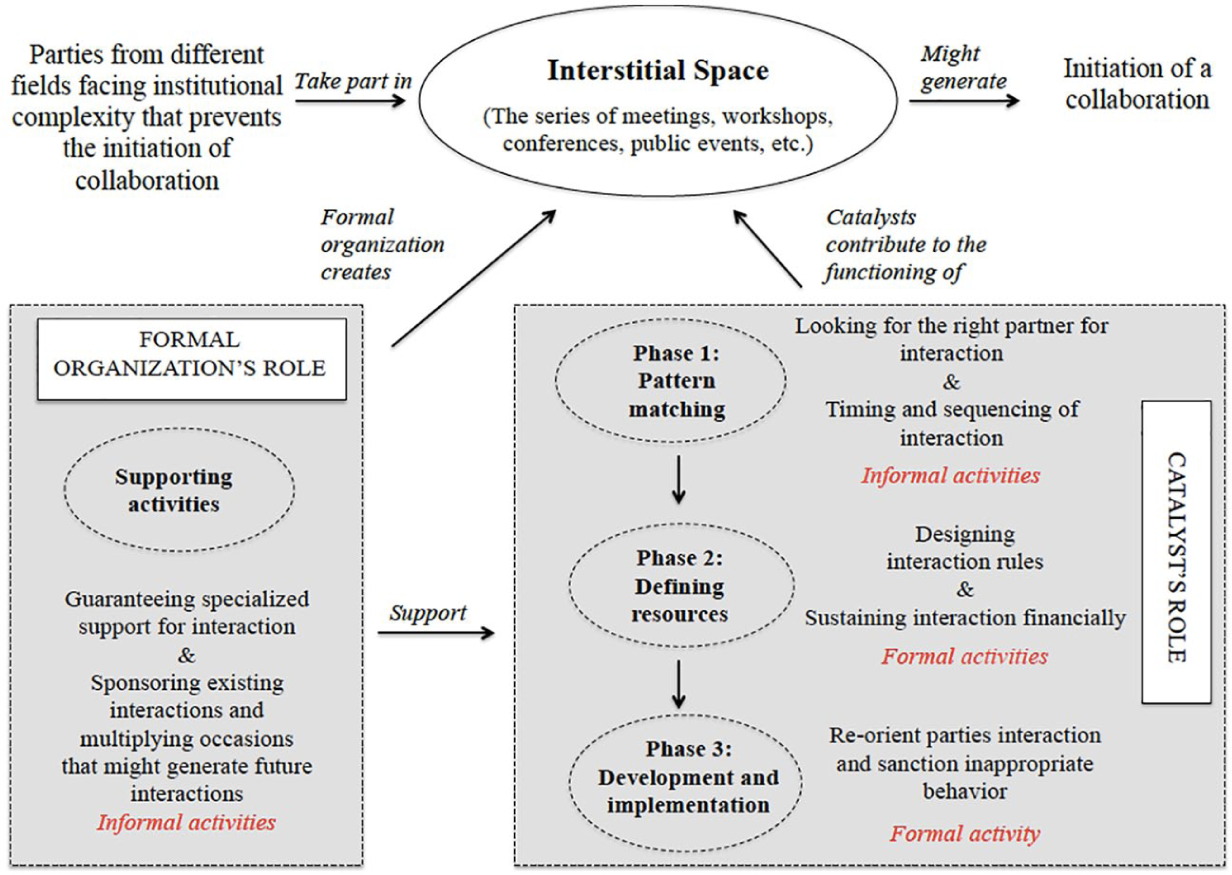
The management of interstitial spaces created by formal organizations.
Phase 1: pattern matching
At the inception of the interaction process, the job of the catalyst is primarily informal and aimed at searching for and selecting the right parties and establishing a positive connection. Because academics and industry people seldom know which specific counterpart might ultimately make a good match, the first activity that the catalyst navigated was looking for the right partner for interaction, that is, looking for actors where there is potential to exploitation of similarities while leveraging differences. Indeed, the creation of a constructive relationship depended on the accurate selection of the parties involved.
More specifically, technology transfer interstitial spaces are characterized by the trade-off between experimenting new ways of working—possibly leading to value-creating solutions and greater open-mindedness—and mistrust toward any new practice that differs substantively from those conventionally accepted within the actors’ field of reference. Accordingly, academics and practitioners were curious about new possibilities but are also often very skeptical. Thus, the selection procedure put in place by catalysts was crucial for increasing the likelihood of positive outcomes. As an industry representative belonging to the Alpha’s network told us, Nowadays competition is mostly based on efficiency and cost reduction. Our clients want fast answers, high-quality and cheap products. To meet their needs we have to deal with collaborators who understand our production process and bring constructive ideas. Mr. [name of the catalysts] was great in selecting the right academics . . . (Entrepreneur)
Catalysts carried out this informal activity of looking for the right partner for interaction through a screening process to find academics and enterprises having, at least “on paper,” the best fit. The fit is measured in terms of indicators like the knowledge that catalysts have of actors’ personal characteristics, the aptitude for teamwork, the willingness toward innovation, the intended objectives, and so on.
The second informal activity performed by catalysts in this initial phase relates to the timing and sequencing of interaction. Once the parties were identified, the next thing the catalysts did was to create a link between parties by working exactly on those synergies that were identified through the previous activity. Catalysts proceeded by clearly defining and developing common objectives for starting the interaction and possible outcomes, both in the case of short-term arrangements and long-term partnerships. The general pattern was to work first with one collaborator, then with the other, and only then to bring them both together to try and move the interaction forward. The approach was to share information with both parties separately in order to start identifying possible solutions to their problems before bringing them together.
For example, the general manager in Delta (one of our catalysts) described his typical working day as centered on meeting people and interacting with them. Each day he opened his agenda to check which joint meetings with which academics and industrial partners were scheduled for the following week. Then, he would typically phone each collaborator to fix an appointment—separately at each party’s office because people are more relaxed when in a familiar place—for the day before the official joint meeting. He did this in order to have the opportunity to discuss the most difficult aspects of the relationship—usually related to time allocation, priorities mismatch, tangible and intangible resources used, and so on—and prevent unproductive misunderstandings that would just strengthen mistrust and discourage curiosity at this initial stage of the interaction. By listening, talking, and explaining, the catalyst was often able to find a better solution than would have ever been obtained by simply bringing the two partners together. As one academic researcher observed, “the main barriers are related to the different rules and practices that university and industry use” and, most importantly, “neither academics nor industrial managers would be able to direct the interaction in a neutral and efficient way. Having someone acting this role every day for you is extremely important for encouraging our best intentions at most” (Academic researcher).
In this way, the catalyst was able to drive partners in the right direction, by devoting time to supporting as much as possible each partner’s needs and requirements, defining the specific issues to be addressed during the relationship, and the expected stages of future development. After this ad hoc repeated interaction, during the joint meetings with the academics and industrial partners, the catalyst was able to gain considerably more agreement than would have been attainable without previous boundary spanning activity.
Phase 2: defining resources
While the first phase of the technology transfer process focused on informal activities aimed at finding the right collaborators and establishing a positive relationship between them, the second phase, in contrast, focused on defining the formal arrangements that will form the basis of future collaboration. The most important outcome of this phase is to give potential collaborators a clear idea of the practical implications originating from their relationship. This was possible through two formal activities carried out by catalysts in the interstitial spaces created by the technology transfer organizations: designing interaction rules and sustaining interaction financially.
After the first set of informal activities, catalysts focused on formally designing the best rules to govern the future collaboration. This meant clearly establishing the specific contractual conditions to formalize the solutions to thorny issues such as intellectual property rights, confidentiality, outcome appropriation, and so on. It is at this stage that each actor needed to begin to understand each other’s priorities, but often failed to find the flexibility needed to agree on a shared solution. Thus, the inclination of each party was to impose the rules and practices from his or her original field, leaving little discretion for meeting the other party’s requirements.
In the design of the contractual framework, the catalyst acts as a formal advisor, managing a common-sense exercise that simplifies the interaction process. The approach they follow resembles a game where incentives and payoffs are distributed to the partner benefiting less from a particular norm. In other words, catalysts often made a real effort to design an incentives structure for each collaborator that compensated for possible losses or an unfavorable equilibrium.
For example, an important trade-off existed on issues related to publishing versus commercializing, and catalysts were generally able to overcome this. As one academic researcher told us, Since industrial partners always want to keep intellectual property rights and maintain secrecy over the results possibly coming out from the relationship, it becomes almost impossible to establish a profitable cooperation. The manager [the catalyst] in Beta was so clever in designing a smart solution to that and making both interests somehow satisfied: we agreed that firm Y kept the rights potentially deriving from patents built on inventions, but for every revenue coming from these patents it had to transfer the 40% to sustain our projects, either in the form of financing new people or buying technical equipment. (Academic researcher)
Similarly, in another case, a catalyst working for Gamma was able to design appropriate incentives for a number of start-ups interacting in an interstitial space with several academics. The start-ups disagreed about disclosing possible innovations through academic publications. In this case, the catalysts helped the parties involved to construct a system that combined the permission given to the academics to publish some possible relevant outcomes with a free consulting service offered by the academics to the start-ups for some relevant accounting and strategic issues. All these incentives defining the rules of a future collaboration were ad hoc, designed by the catalysts and based on their experience and close interactions with the parties, and a repeated and innovative matching among their requirements, expectations, and competencies.
Also, catalysts tried to determine upfront which resources each party could make available during a possible collaboration intended to achieve some particular results. They might, for example, suggest whether senior researchers were required for a project, or whether specific partners’ facilities would be needed and at which stage. As an entrepreneur explained, We were completely aware of what professor X expected from us in terms of people, technology and time, and the same was for him. Everything was balanced. (Entrepreneur)
Sustaining interaction financially is the other formal activity that catalysts perform at this stage of the process. This means that catalysts also dealt with searching for the financial resources needed to make the collaborative activities feasible. They therefore spent a lot of time looking for investors of various kinds to make the projects financially sustainable and impactful. Catalysts were absolutely aware that collaborative projects often fail due to financial constraints, especially when communication is difficult and parties retreat into their default positions. Accordingly, providing a solution to overcome this problem at the very beginning of the interaction process contributes significantly to increase actors’ confidence and commitment. As an academic interacting with an enterprise in Beta interstitial space told us, It is the first time I have experienced something different than doing basic research or teaching. Having someone dealing with the really tricky aspects of contractual agreements and financial resources is fundamentally important to increase the likelihood of really getting a collaboration that is fruitful and successful. I cannot imagine doing all this by ourselves . . . (Academic researcher)
This is an important activity that makes interacting partners feel greater responsibility for the project they are building, which is based on ideas that are highly uncertain in their result. The objective is to create synergy between the collaborating actors who are providing innovative ideas and the investors who are providing financial capital to develop those ideas.
Phase 3: development and implementation
This phase of the interaction process is characterized by one formal activity carried out by catalysts: re-orienting parties’ interactions and sanctioning inappropriate behavior. In order to make university-industry collaborations function in an effective way, not only is defining the issues that shape the direction of the interaction important, but also monitoring the process through its evolution. In this respect, checking up on the progress of the interaction is a fundamental step that catalysts carry out. Formal control is made through defining periodic milestones and linking them to specific tasks. These were summarized in a single document that academics and practitioners had to produce together on the progress of relevant and thorny matters about the evolution of their collaboration. The purpose of the document was control whether the approach used by the different partners was collaborative or destructive. As an entrepreneur reported, We spent a couple of days full of close, and sometimes conflicting, interactions with academics to figure out how to solve a tricky issue related to aero engines that was required for our next milestone. When you sit there it seems that you’re losing a lot of time that you could devote to other, more effective activities. Then you think that if you give up you actually lose even more. So, this controlling system is definitely useful for keeping us on along this interaction process in a fruitful way. (Entrepreneur)
Through this monitoring activity, catalysts can adjust the approach used by parties for negotiating, agreeing, and defining an issue. As an employee at Epsilon explained, “only those commonly accepted ideas and activities might eventually transform into practices that can be repeated in following interactions and collaborations. To achieve this result continuous improvements and adjustments from knowledgeable people are essential” (Business Manager, Epsilon). It sometimes happened that the interaction was not advancing as expected and, therefore, the catalyst had to spend time re-orienting the way the parties were doing things, as well as the behavior used by actors in the cooperative relationship.
For example, the public disclosure—“naming and shaming”—of the inappropriate behavior by one party by the catalyst during a meeting in a Beta interstitial space prevented the continuation of an unhelpful social dynamic. In the words of the catalyst, “we do not have what we expected today, because firm Z was not moving forward on its tasks” (General Manager, Zeta). This strategic move made by the catalyst was a good starting point, allowing him to re-adjust the interaction between firm Z and the academics from the biotechnology department by reconsidering appropriate conduct, re-setting milestones and objectives, and re-focusing the attention on the right issues. Starting to work on practical activities made immediately clear what inconsistencies and difficulties existed that could undermine the success of subsequent collaborations. In this respect, the role of catalyst in adjusting inappropriate behaviors and professional misconduct is critical in order to avoid the repetition of misunderstandings that could undermine actors’ trust and commitment.
Alongside the three phases: consolidation – supporting activities
In addition to the role played by catalysts, we found that other informal activities within interstitial spaces were important for anchoring the new ideas produced through university-industry interactions within the partners’ field of reference. These activities were carried out by actors other than the catalysts and were intended to support the catalysts’ activities during the three different phases. While the role of catalysts was essential at the level of individual micro-interaction, these other activities occurring within interstitial spaces and purposefully devoted to extending micro-interactions to a wider audience—to let them become widely accepted and diffused—were fundamental for making the transition from interaction to collaboration more likely. The higher level activities we identified were guaranteeing specialized support for interaction and sponsoring existing interactions and multiplying occasions that might generate future interactions.
Along with the role of catalysts, we found that technology transfer interstitial spaces were organized around formally structured teams that represented the interests of each community of actors. Whereas the formal and informal activities carried out by catalysts involved a specific kind of person performing a particular role, guaranteeing specialized support for interaction was implemented at an organizational level and functioned as a complementary informal activity with respect to what catalysts did for facilitating interactions between academics and business representatives.
Based on our analysis, in order to guarantee an effective collaboration between the different communities, both academics and practitioners required representation inside the interstitial space. In other words, interstitial spaces needed to reflect the diversity that they tried to bridge. Since the primary goal of interstitial spaces is to put together different parties and coordinate their interactions, it is important to have an intimate knowledge of the different contexts they are dealing with. We observed that the internal reproduction of the external institutional diversity allowed members operating within interstitial spaces to specialize in order to better understand and manage the different interests and identities that are brought together in the interactions they host. Although these spaces mediating interactions between different fields might be very informally organized, we saw that technology transfer interstitial spaces were quite different in this respect. Usually they are relatively small organizations, with about 10 employees, and they are very formally structured with quite specialized and differentiated tasks. As an employee in Gamma described, We do not have generalists in our organization. Tasks are subdivided according to employees’ specific expertise, but also, and no less importantly, according to the kind of network we have outside the organization. This is extremely important to effectively account for the different awareness and also to be confident you can speak with both of them. (Director, Gamma)
Although the existing literature has generally associated high degrees of differentiation and specialization with large enterprises in response to the complexity they confront internally, we found that the organizations we studied showed the same tendency but for very different reasons. Rather than reflecting a need to manage internal complexity, in the case of our organizations, differentiation and specialization allowed them to deal better with the different expectations coming from different external partners interacting in interstitial spaces, very often for the first time. As an industrial partner explained, We are and we remain external stakeholders. So, if you want your point of view to be taken into account, then you need to be somehow represented inside the organization. (Entrepreneur, SME)
The importance of specialization for dealing with the diversity of the potential collaboration partners was further reinforced by the ongoing learning processes of employees located in the two different groups within the formal organization. The fact that during his or her career each employee had extensive contact with the field he or she specializes in meant that the link between internal specialists and external communities became more and more developed and effective over time. As an employee in Alpha described, This is why issues related to business cannot be managed by people who do not have business knowledge and competence. The same is true for the other side of course. (Protection group manager, Alpha)
In summary, we found that, on one hand, academics and practitioners interacting in technology transfer interstitial spaces required specialized actors knowing and sharing the values they brought from their field of reference, and this was perceived as extremely important—both emotionally and practically—to keep a sense of connection to their community; on the other hand, they also received a lot of support thanks to the structural differentiation and specialization that provided different points of reference for academics and industrial partners, with a clear-cut division of work.
Sponsoring existing interactions and multiplying occasions that might generate future interactions was the other informal activity carried out in technology transfer interstitial spaces. This activity was aimed at supporting the job of catalysts and at increasing the effectiveness of university-industry interaction. The informal practices put in place by members of the technology transfer organizations created many occasions for interaction among academics and industry representative in order to let them to become more familiar with each other, and thereby demonstrate to the wider communities that university-industry collaborations are likely to produce new ideas and useful practices.
It is worth highlighting that each partner involved in the interaction process experienced a significant change when embarking on relationships with a partner from another field. This change led academics and industrial managers from a condition of stability before the interaction, to a condition of conflict and doubt when each party tried to defend their own practices and interests, and, finally, to a desirable re-stabilization in which each partner concluded that they were gaining something important from the interaction, and that the progress being made was worthwhile. However, this process did not occur by itself. Instead, it depended on the proactive role played by actors from the TTO within the interstitial spaces. These actors tried to strengthen university-industry relationships by promoting a series of activities that would make their interactions more known and visible to other people and, in particular, to people belonging to their communities of interest (i.e. university and industry).
This was done, for example, by finding opportunities, such as obtaining European Union (EU) funding for cooperative projects, regional funds for collaborative research, professional development workshops, and so on, that allowed parties to interact and get to know each other, make themselves more comfortable from an emotional point of view, and obtain peer recognition and approval. Thanks to the interest that these interactions attracted, the attitude of both communities changed significantly and made possible the creation of a stronger commitment toward these forms of interaction. In this respect, it is important to emphasize the role played by those people working to make the interstitial spaces effective. An industrial manager who collaborated with Alpha described it as follows: I really appreciated the efforts of Alpha to push our firm to participate in workshops and conferences in which academics were involved. At the beginning we didn’t understand why we should do this as, usually, what is of interest to us is not of interest to academic researchers. But then we realized that it is really important: we broadened our viewpoints and we became more open to different perspectives. In a sense, we blended our attitude with that of the academics thanks to the guidance and mediation of the TTO. This was possible only through attentive, knowledgeable, frequent interaction with the other party. And, you know, the fact that other firms started to ask about what we were doing and so on, this made us even more committed to the project. (Entrepreneur, small enterprise)
These additional activities were perceived as a successful way of extending new ways of working, potentially leading to innovative ideas and new practices. Actually, they contributed to making alternative models of interactions recognized and accepted, and at the same time, making feasible any deviations from institutionalized practices toward new ones. This was possible by attracting new actors and, therefore, widening the group of people using the interstitial spaces to interact. Making the experience of existing collaborations available, getting new actors involved in university-industry relationships, limiting social sanctions by enlarging the number of people involved in these forms of interaction, and promoting a positive emotional climate fostering open-mindedness and curiosity were all important results preannouncing the establishment of new practices in interstitial spaces and their diffusion outside these spaces. As one academic described it, It is sometimes difficult to explain to your colleagues why you’re spending time exploring new ways of working that have high potential but are highly uncertain. Spreading these new practices and letting them diffuse in our context is the best way to receive recognition, increase curiosity, and finally get legitimacy. Of course, if you feel accepted, your emotional attachment towards a challenging project increases and you are much more motivated. (Academic researcher)
Discussion
In this article, we have begun to explore how formal organizations use interstitial spaces to facilitate the initiation of cross-field collaboration. We have also deepened our knowledge of the role of catalysts as facilitators of cross-sector interactions in interstitial spaces. We have presented, first, their individual characteristics, in terms of the position they occupy in interstitial spaces, the autonomy they have and their previous experience, and, second, the specific activities they perform in these settings to increase the effectiveness of cross-sector interactions. Our analysis was revelatory for showing that while catalysts were of key importance in interstitial spaces, their role—important for micro-interactions at the individual level—was complemented by a series of other activities carried out by the technology transfer organization around the interstitial space. We believe our study provides a number of important insights that contribute to the growing stream of literature on interstitial spaces, to our understanding of the pre-history of cross-sector collaborations, and to the literature on technology transfer organizations.
Formal organizations and interstitial spaces
Our study contributes to the growing stream of literature on interstitial spaces (Furnari, 2014; Zietsma et al., 2017) by offering a deeper understanding of the creation and management of interstitial spaces by formal organizations, and by providing a novel and empirically supported understanding of the catalysts who function as facilitators of others’ interactions in this kind of settings. In particular, we offer two important and novel contributions: (a) we offer a fine-grained analysis of the activities that catalysts use in shaping their coordination style, and (b) we show that interstitial spaces as informal settings for cross-sector collaborations can be purposefully created and structurally managed by formal organizations. In these spaces, the activities carried out by catalysts at the individual level represent just one set of actions that are complemented by other activities carried out by other members of the formal organization (Furnari, 2014).
In relation to the first aspect, the interactions taking place in interstitial spaces are very likely to collapse if not facilitated appropriately (Zietsma et al., 2017). Thus, our findings support claims that catalysts are a key condition enabling the construction of shared meaning among the collaborating partners belonging to different fields (Furnari, 2014). They can be compared to boundary organizations (O’Mahony and Bechky, 2008) and conveners (Dorado and Vaz, 2003), but they act in special, precarious settings.
Although the role of catalysts as mediators and facilitators in interstitial spaces has been the subject of extensive theorizing, we still lacked an understanding about the activities that they need to carry out in order to take up that role (Furnari, 2014). Our article adds insights by offering a set of specific activities that catalysts engage in in their effort to bring together actors who inhabit different logics and facilitate their interactions. Looking for the right partner for interaction, timing and sequencing of interaction, designing interaction rules, sustaining interaction financially, and re-orienting parties’ interactions and sanctioning inappropriate behavior represent the enabling activities performed by catalysts as they supported micro-interaction processes occurring in interstitial spaces.
These activities also provide insight into the skills that catalysts need at the individual level. Accordingly, our second contribution lies in providing a better understanding of catalysts as key figures in interstitial spaces, which goes beyond what catalysts do to enable conditions for cross-field interactions and relates to who they are. We show that catalysts in successful technology transfer interstitial spaces often have previous hybrid experience, meaning that they have worked both in industry and academia, and have significant autonomy and influence in decision-making processes. In this way, we have answered the request in the recent literature to further explore the social skills of and the actions undertaken by catalysts (Fligstein, 2001; Furnari, 2014).
Our second contribution to the stream of literature on interstitial spaces relates more generally to the management of cross-sector collaborations in these settings. In particular, our study identifies other activities performed at a more macro level, which collaborating partners can take advantage of in their efforts to pursue collaboration across field boundaries.
Interestingly, previous research addressing the role of mediators in bringing together and coordinating disconnected parties (Marsden, 1982; Obstfeld, 2005; Simmel, 1950) have essentially focused and described the bridging role individual actors play in arenas where the rules and resources of different organizational fields are negotiated (Furnari, 2014). Marsden (1982), for example, addressed the conception of brokerage as a mechanism “by which actors facilitate transactions between other actors lacking access to or trust in one another” (p. 202); similarly, Simmel (1950) offered a description of the “non-partisan,” as the individual who “functions as an arbiter” balancing the contradictory claims in collaborations and eliminating what is incompatible in them (pp. 146–147). Following the same line, Obstfeld (2005) referred to the sustained tertius iungens as the actor who “introduces or facilitates interaction between parties while maintaining an essential coordinative role over time” (p. 104).
Empirical examples of these individual roles are provided by Burt (1997) in describing the activity of entrepreneurial managers who identify opportunities to add value within organizations and who join people together to develop these opportunities; by DiMaggio (1992) in reporting Paul Sachs’ role in connecting the university, museum, and financial worlds to help establish the Museum of Modern Art; and by Obstfeld (2005) in discussing the NewCar program manager’s strategy for the creation of a new unit connecting previously unconnected senior managers and units. Whatever the specific characteristics of these brokers, tertius iungens, boundary spanning individuals (Tushman and Scanlan, 1981), or catalysts, they have always been conceived as individual actors with a behavioral orientation toward connecting people by either introducing disconnected individuals or facilitating new forms of coordination among connected individuals.
However, the idea that other additional, complementary activities can help and support the catalysts’ job has received little consideration in the literature. In this respect, our study adds a novel addition to our understanding of interstitial spaces, providing a new perspective on their emergence and management. Indeed, we present the case in which formal organizations purposefully create interstitial spaces for interaction and support interstitial collaborations occurring in these spaces through structured activities. We show that collaborating partners can take advantage not only of specific social skills available at the individual level (Fligstein, 2001; Furnari, 2014)—in terms of the actions promoted by catalysts—but also of organizational activities and mechanisms that allow managing the institutional diversity present in interstitial spaces in a more formal and specialized way. Guaranteeing specialized support for interaction and sponsoring existing interactions and multiplying occasions that might generate future interactions are empirical examples of how this can work. They demonstrate that interacting partners may benefit from structured organizations, where multiple people with specific tasks have more specialized competences for the management of institutional complexity. This aspect represents an important positive effect with respect to what individual catalysts can achieve (Furnari, 2014; Zietsma et al., 2017). Accordingly, catalysts are a key element within a wider activity system purposefully designed in order to promote and support cross-sector collaborations for the achievement of effective outcomes.
Interstitial spaces and the initiation of cross-sector collaborations
To date, research on inter-organizational collaborations has proven to be rich, diverse, and somewhat fragmented. Whatever the specific approach adopted—resource dependence theory, transaction cost economics (Barringer and Harrison, 2000), strategic choice (Phillips et al., 2000), or social identity—researchers have agreed upon the fact that the common and primary reason for establishing inter-organizational collaborations has been their ability to develop new solutions to complex problems (Phillips et al., 2000) and for the potential they hold to solve problems in more innovative and creative ways (Austin, 2000).
Although the interacting partners are incentivized to establish cross-sector collaboration for sharing knowledge and resources to progress toward a joint goal that neither organization would be able to achieve alone (Jarvenpaa and Majchrzak, 2016), organizational theorists find that such collaborations are often very difficult as they frequently link organizations dominated by diverging logics and practices (Dorado et al., 2009; Phillips et al., 2000). Accordingly, cross-sector collaborations often fail due to the inability of the interacting organizations to deal with the tensions and contradictions that arise when organizations from different fields collaborate (Huxham, 1996).
Our article provides new insights into the challenges of cross-sector collaborations by shedding light on interstitial spaces as a potential context for the initiation of cross-field collaboration and on the role of catalysts as facilitators and mediators in these special settings. In particular, we highlight a new use for interstitial spaces that is different from the one discussed in previous literature, which discusses interstitial spaces mainly as settings for the production of new ideas and practices (Bucher and Langley, 2016; Cartel et al., 2019; Furnari, 2014). Instead, we demonstrate that, in addition, interstitial spaces are a good arena for the initiation of cross-sector collaborations. We show that partners collaborating in interstitial spaces find there a neutral setting where adequate support for the management of diverging interests and complex problems is provided by catalysts and formal organizations who are skilled at it.
Thus, the attempt to find more cooperative approaches between logics on their own is beyond their ability when each partner is deeply embedded in their environment without a sufficient knowledge and understanding of the other context. Indeed, given these cross-field interactions in interstitial spaces are temporary, occasional, and not characterized by specific obligations that ensure continuity over time, collaborating partners are usually interested in the final result, but avoid committing resources to the management of the process for getting that result. For these reasons, making use and taking advantage of a catalyst’s activities to facilitate and organize interactions in interstitial spaces represents a better option for managing the different needs and requirements characterizing cross-sector collaborations. This is especially true in those settings involved in the provision of public and social services (Pache and Santos, 2010), such as the technology transfer space, where the achievement of effective and useful results depends on the interaction of a wide variety of minor and major stakeholders belonging to diverse institutional contexts. In these cases, the diversity of interests makes the management of the complexity particularly challenging.
Accordingly, understanding the specific activities carried out in interstitial spaces adds important insights to the model that has been increasingly accepted with regard to the role of drivers and enablers for the initiation of cross-sector collaborations (Austin, 2000). Indeed, catalysts represent a fundamental enabling factor in dealing with the initiation of a cross-field collaboration. Thanks to the ad hoc activities that they adopt (i.e. looking for the right partner for interaction, timing and sequencing of interaction, designing interaction rules, sustaining interaction financially, and re-orienting parties’ interaction and sanctioning inappropriate behavior), catalysts enable the maintenance and the development of interactions beyond the parties’ initial engagement (Brass et al., 2004), by acting as a bridge between them.
Thus, within this theoretical framework, catalysts represent a specific type of enabling factor “deriving from structural elements defining the organizations or the collaborative arrangement” (Dorado et al., 2009: 371). More than that, we have gone beyond the simple intuition that catalysts are a key facilitator in cross-sector collaborations by clearly identifying the particular characteristics and activities that enable them to overcome initial differences between interacting partners in interstitial spaces. They essentially possess a set of qualities that encourage actors to get beyond the uncertain and skeptical reactions that usually characterize initial attempts at cross-field interaction. Also, our study has identified that the formal organizations creating the interstitial spaces support the job done by catalysts with other activities that are intended to facilitate the management of cross-sector interactions and encourage subsequent collaborations.
In sum, we believe we have extended what we already know from the existing literature on interstitial spaces by offering a novel perspective that goes beyond the idea of considering these spaces as simply a location useful for generating innovative ideas. Moreover, we extend understandings of cross-sector collaborations by offering a novel perspective on how organizations from different fields may be helped in initiating collaboration in the face of complexity, and how our understanding of these interactions can be facilitated by linking the stream of research on cross-sector collaborations with the literature on interstitial spaces and catalysts. Our work begins a conversation on interstitial spaces and the role of catalysts in them, which deserves much further attention from organizational theorists.
Interstitial spaces and technology transfer organizations
While we have not explored the potential ramifications at length in this article, our study also has important ramifications for the study of university-industry relationships. University-industry relationships, and their role in innovation, have been a long-standing area of study in various areas of management studies (Agrawal, 2001; Siegel et al., 2007; Wright et al., 2004). However, despite the range of theoretical approaches that have been used to study university-industry relationships, work is only beginning to be done using an organizational and institutional theory lens.
In particular, our work points to the value of applying ideas from the growing literature on interstitial spaces to the activities of technology transfer organizations. While these important organizations carry out a range of activities, a significant part of their role lies in creating interstitial spaces that facilitate the initiation of collaborations between industry and academic researchers. Looking at the activities of technology transfer organizations through this lens provides a new way to conceptualize what they do, and further discussions may well lead to further interesting new theoretical and practical implications.
In this sense, the propensity to co-author and to establish spin-off firms does not represent the only means to measure the effectiveness of the technology transfer activities undertaken by TTOs, incubators, and consortia, since the organizational mechanisms used may have an important impact on these activities. Since the recent increase in university-industry technology transfer managed through a TTO has led to a concomitant rise in the incidence and complexity of research collaborations involving universities and firms (Siegel et al., 2003), understanding the role of facilitating factors becomes particularly important as the success or failure of these collaborations very often depends on the coordination style used by catalysts (Furnari, 2014) and, more generally, on the specific activities put in place to facilitate these interactions.
Conclusion
Based on our analysis of six technology transfer organizations creating interstitial spaces where academic and industrial partners can collaborate in Italy, we have shown the important role that catalysts play in managing informal interactions that can lead to collaboration and, more generally, we have provided a different perspective on the emergence and development of interstitial spaces by highlighting the role of formal organizations in creating and maintaining interstitial spaces. Furthermore, we have identified the set of specific activities that catalysts employ to facilitate the management of institutional diversity at the micro-interaction level: looking for the right partner for interaction, timing and sequencing of interaction, designing interaction rules, sustaining interaction financially, and re-orient parties’ interaction and sanction inappropriate behavior. In addition, we have also shown the other complementary activities carried out at higher levels: guaranteeing specialized support for interaction and sponsoring existing interactions and multiplying occasions that might generate future interactions. In this respect, we believe we have made a significant contribution to the current debate on interstitial spaces and catalysts, and on cross-sector collaborations.
A multilevel approach to managing interstitial spaces
The analysis of our data revealed an interesting aspect of the management of the initiation of cross-sector collaborations in interstitial spaces. In particular, the actions undertaken by catalysts represent an important facilitator for getting more effective interactions between academics and practitioners but does not represent the whole set of activities supporting this kind of collaboration. Indeed, we have found that if catalysts’ activities operate at the individual level—at the level of micro-interactions between collaborating partners—there are other actions undertaken by technology transfer organizations hosting interstitial spaces that complement what is done by catalysts at the individual level at the organizational and field levels. We show that guaranteeing specialized support for interaction represents an organizational-level activity that together with sponsoring existing interactions and multiplying occasions that might generate future interactions at the field level, integrate the set of supporting mechanisms implemented for the effective functioning of interstitial spaces. In this respect, we have extended our knowledge about the management of interstitial spaces by providing a more comprehensive picture of the activities in support of cross-sector collaborations, which span different levels of analysis.
Our findings represent the beginnings of a multi-level account (Boxenbaum and Battilana, 2005) for understanding how formal organizations use interstitial spaces. Our argument is that different levels are inherently interconnected and that we cannot really understand how these special interstitial spaces function unless we also take into account each of the different levels where activity takes place. At the same time, much more research needs to be done and we hope our study inspires others to further examine this interesting application of interstitial spaces.
Limitations
Finally, it is important to mention some of the limitations of our study. While we believe our findings have general applicability, we do not claim that the activities we have identified represent an exhaustive list or that they will apply in all cases. Indeed, we are very sensitive to the fact that we need to be cautious about generalizing from a small number of case studies and we believe that extensive further research is needed to more fully understand the role of catalysts and technology transfer organizations in managing interactions in strategically constructed interstitial spaces. We therefore encourage other researchers interested in micro-interactions in interstitial spaces to extend and refine our analysis.
We also recognize that our organizations are all of a similar type as they are all focused on encouraging collaboration between academe and industry. This has the advantage of making the cases comparable, but it also limits the variation in our sample. The dynamics we observed need to be complemented by research into a much broader range of formal organizations focused on creating and maintaining interstitial spaces to encourage collaborative activity and initiate cross-sectoral collaboration. This will ensure the range of different activities that occurs is representative of the diversity that exists.
Finally, the Italian context of our study has certain specific characteristics that may limit the broad generalization of our results. In particular, the particular regulatory regime, history, and culture of Italy may all play a role in shaping the findings we have uncovered in idiosyncratic ways. While we believe the findings we have presented are generalizable, much additional work is needed in other cultural and legislative contexts to test the degree to which the broad social environment shapes the dynamics we observed.
Final remarks
Interstitial spaces are important settings in modern societies that encourage interaction among representatives of organizations from diverse organizational fields and facilitate the initiation of formal collaborations. The critical need to develop innovative solutions to complex multiparty problems like climate change, water security, global health provision and the like make understanding how these spaces work increasingly important, and gives organization studies a real opportunity to contribute to the better functioning of these spaces and therefore to the solution of these important problems. While we have begun to provide some insight in how catalysts operate in these special spaces and how formal organizations (in our case, TTOs) complement their activities, there is still much more research that needs to be done. We hope our article provides an impetus for further research and the development of a substantial body of work in this area through which organization studies as a field can make a real contribution to the solution of complex multiparty problems. We find this prospect very exciting and we hope other organizational researchers take up the challenge!
Footnotes
Declaration of Conflicting Interests
The author(s) declared no potential conflicts of interest with respect to the research, authorship and/or publication of this article.
Funding
The author(s) received no financial support for the research, authorship, and/or publication of this article.
