



Abstract
This essay offers insight into methods for qualitatively capturing emotions in strategic organization research, a theme that has attracted increasing interest in the literature, but that raises methodological challenges. We review how researchers have examined emotions in the following three domains of strategic organization research—organizational processes, institutional processes, and strategizing activities. We discuss the ontological assumptions about emotion in each of these areas, and explain how researchers in each area examine particular aspects of the multi-dimensional phenomenon of emotion. We identify specific challenges in capturing emotions in each area, as well as the strategies that researchers use to address them. We outline a repertoire of coding resources and guidelines for the convenient use of future researchers. Finally, we evaluate the strengths and limits of each approach, and identify avenues for future research.
Introduction
In recent years, emotion has attracted growing interest in organization theory (Elfenbein, 2007) and strategic management research (Brundin and Liu, 2015), and many studies have mobilized qualitative methods to generate insights. For instance, strategy scholars have analyzed the role of emotions in strategic change (e.g. Huy, 2002), and have also focused on how fleeting emotional episodes in meetings can have consequences for strategic decisions (e.g. Samra-Fredericks, 2004). Similarly, institutional theorists have recently begun to investigate the importance of emotions in the maintenance and change of institutions (e.g. Massa et al., 2017). By using qualitative research methods such as observation, video ethnography, and interviews, these studies have enriched and extended research in organizational and institutional theory.
However, due in part to the multi-dimensional nature of emotion, encompassing, for example, individual physiological arousal, motor expression, and subjective feeling (Frijda, 1988), researchers have also experienced challenges in determining how to capture, and especially how to code emotion qualitatively. The enterprise is further complicated by the different ontological positions adopted by different researchers. Indeed, emotions have been studied from psychological, evolutionary, cognitive, and sociological perspectives. For instance, researchers adopting a psychological perspective tend to focus on an individual’s intrapersonal reaction(s) to a stimulus, while researchers adopting a socio-psychological approach may explore the social functions of emotions in daily interactions (Elfenbein, 2007). At the same time, sociologists have argued that emotions are socially constructed (e.g. Turner and Stets, 2005). Sociologically focused researchers therefore emphasize the inter-subjective and collective nature of emotions (e.g. Goodwin and Pfaff, 2001). As a result, researchers’ ontological and epistemological positions shape how they define emotions, and determine the particular dimensions of emotions that they study. Each ontological and epistemological position raises its own challenges in data collection and coding that need to be addressed.
In this essay, we take stock of the recent and growing interest in the study of emotion (Zietsma et al., 2019) to review, summarize, and discuss how emotions have been qualitatively captured and coded (see Table 1) 1 with a view to inspiring future research. By considering the different types of emotionally relevant phenomena that scholars of strategic organization have sought to understand, we identify three major categories of qualitative emotion studies, dealing respectively with (1) emotions in organizational processes, (2) emotions in institutional processes, and (3) emotions in strategizing activities. For each category, we first introduce the major ontological positions of key authors working in that area. We then identify the challenges in collecting and analyzing emotion data that these scholars encounter, as well as their main strategies for addressing the challenges. We pay special attention to the emotion-coding guides that researchers have adopted and/or developed, constructing a repertoire of guides for the convenient use of future scholars. Finally, we evaluate the strengths and weaknesses of each approach and discuss our recommendations for future research.
Focus, challenges, and approaches to emotions.
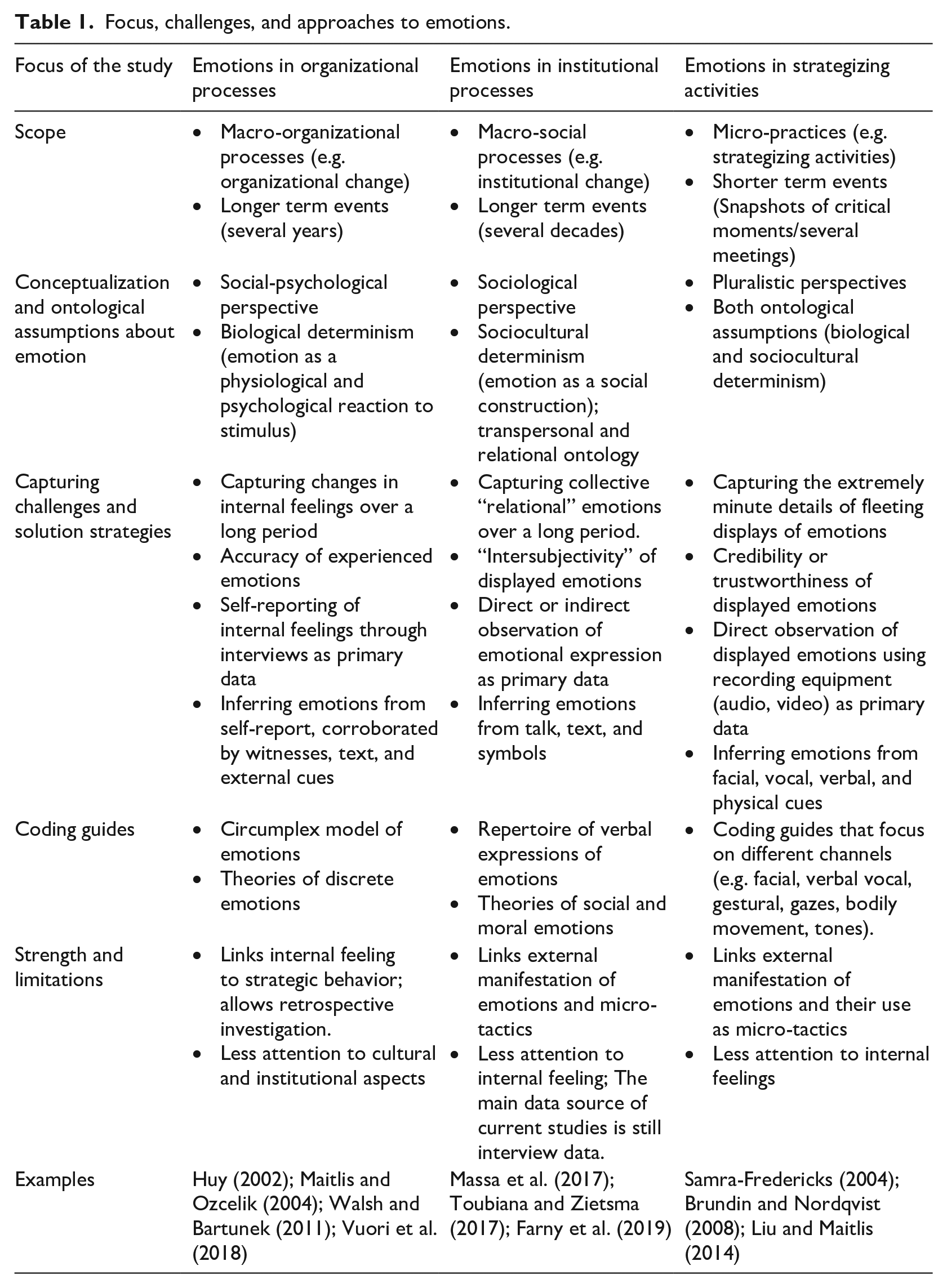
Emotions in organizational processes
This category of studies includes work that focuses on organizational members’ emotions during large-scale organizational initiatives. Huy et al. have been actively promoting this stream of research by studying, for example, emotions during strategic change (Huy, 2002), organizational-level innovation (Vuori and Huy, 2016), and capability (Huy and Zott, 2019). Other researchers have studied emotions in organizational processes such as organizational decision-making (Maitlis and Ozcelik, 2004) and entrepreneurial processes (Walsh and Bartunek, 2011). These studies seek to understand primarily interactions between individuals and their collective reactions and actions over longer time periods, usually over months or years. Their focus is to explain how emotion interacts with cognition in these organizational processes to produce organizational-level outcomes.
Conceptualization and ontological assumption
This perspective gives primacy to the internal feelings of individuals in their interactions with their social environment and to how these feelings influence their behaviors. The ontological assumption behind this focus on internal feelings is the biological determinism of emotions, which means that emotions are physiological and psychological responses to environmental stimuli (Scherer and Ekman, 1984). A common definition that reflects this orientation is that of Elfenbein (2007): Emotions refer to discrete and intense short-lived experience in reaction to a stimulus. The main goal of these investigations is to understand emotional experiences and subsequent reactions. Appraisal theory (Lazarus, 1991) is often used as an explanatory tool. For example, these researchers seek to understand emotional reactions such as “anxiety” in the strategic-change context (Huy, 2002). They pay attention to the hedonic tone (or valence) of emotions, such as negative emotions that create “toxicity” in organizational decision processes (Maitlis and Ozcelik, 2004), as well as to the level of activation. They also consider the intensity or level of activation of emotions. For example, Walsh and Bartunek (2011) examine how high or low levels of activation may impact entrepreneurial processes.
Challenges and solution strategies for capturing emotions
As these studies aim to understand “internal feelings,” the main challenge is how to access felt emotions and to measure internal changes in feeling states after organizational members are exposed to stimuli. The main concern here is the accuracy of emotions, that is, how do we know that the name/label we give to the emotion is actually what is experienced by participants? The researcher is therefore concerned about the risk of misinterpreting true feelings and of misidentifying the mechanisms that link the emotions experienced to the organizational processes studied. These challenges have implications for how to collect data and analyze emotions.
When collecting data, emotional experience reported by individuals is used as the main source of information, which can be problematic given that organizational processes take place over long periods of time, sometimes over years. For example, Walsh and Bartunek (2011) used a period of at least 5 years to understand how a new organization is created following organizational demise. Their main concern was to ensure “a sufficient time horizon for examining sequences of events and the evolution of social processes over time, both of which are central to answering process-oriented questions” (Walsh and Bartunek, 2011: 1020). The study of emotions in these organizational processes implies that the researchers are able to relate the evolution of events to changes in the emotional experiences of organizational members. Another example is Huy and Zott’s (2019) study of the link between emotions and dynamic capability. The authors followed entrepreneurs over a period of 7 years to analyze how their ability to regulate their own emotions and those of others enabled them to mobilize resources. In such studies, capturing how emotional states evolve becomes important. Moreover, the complexity of the processes and the large number of actors mean that researchers cannot observe all events, even when they adopt an ethnographic approach. In sum, the broad scope and the longer time scale of the process makes it unrealistic for researchers to capture all events and all emotions in detail. Thus researchers often sample some episodes within larger events as the focus of investigations.
As a result of these challenges, interviews are used as the primary tools for collecting emotion data, even in ethnographic studies (which normally would use observations as the primary tool). The advantage of interviews is that they allow individuals to share their emotional experience with researchers. For example, Dutton et al.’s (2006) study of compassion organizing uses mainly interviews as the means to access emotional experiences associated with past events. This approach can be problematic, however, especially when the interview is not close to the event. Relying on retrospective data is not an ideal way of capturing emotions in past events due to the risk of memory failure and ex-post rationalization. Vuori and Huy (2016) suggest that these risks can be mitigated by using different strategies such as multiple informants’ interpretations of the same event, “courtroom questioning” and event tracking, or asking informants to describe concrete events that oblige them to rely on their episodic memory. By using these techniques, the authors triangulated their data, thereby making them more trustworthy. Researchers can also supplement these interviews with direct observations and documents as data sources to capture emotions closer to real time (e.g. Huy, 2002).
When analyzing data (inferring and connecting emotions), the primary focus is on self-reported information about the emotion experienced, because the concern is to accurately describe internal feelings. The researcher draws on participants’ accounts of their own emotive expression to infer emotion. Most of the time, researchers in this category will use verbatim reports of feelings. For example, when the participants said in interview that they were angry, it is reported as “Anger” (Maitlis and Ozcelik, 2004). The excerpts are taken mainly from interviews. In some cases, self-reported emotions are also identified from documents using the same approach as the interview, which is inferring emotions from participants’ accounts of their own or others’ emotions described in the text (e.g. Huy, 2002; Maitlis and Ozcelik, 2004). To ensure greater accuracy, some researchers use at least two complementary strategies to corroborate self-reported emotions. This is particularly important to mitigate the risk of memory failure related to retrospective events discussed earlier and the risk of impression management that may cause respondents to disguise their true feelings. First, researchers use witnesses when they are unable to directly observe the event. They rely on information from other people who interacted with the respondent as the facts unfolded. The triangulation of information from these witnesses and the respondent can confirm the accuracy of the emotion identified (e.g. Maitlis and Ozcelik, 2004). This approach is also important in order to reflect the collective character of the experienced emotions when several members of the organization report sharing similar feelings (Vuori and Huy, 2016). Second, the researcher uses external cues or non-verbal expressions to corroborate the information. This is valuable in situations in which the researcher makes direct observations of events. The researcher may examine whether the behavioral cues correspond to the self-reported emotion and take into account only cases in which there are no discrepancies (e.g. Huy, 2002). It is important to note that this approach of observing the non-verbal expression of emotions is not usually the primary data source, but it can provide additional information, which helps to achieve greater accuracy.
Coding guides
Coding guides constitute an additional means to reach accuracy. The main tool used by researchers here is the Circumplex model of emotions, which helps to “capture almost the full range of emotional experiences across people” (Huy, 2002: 35). Several models exist (e.g. Feldman-Barrett and Russell, 1998; Larsen and Diener, 1992; Russell, 1980; Watson and Tellegen, 1985), and the researcher usually selects a model according to the purpose of the study. These models present two basic dimensions of emotional experiences, which are valence (e.g. pleasant/unpleasant; positive/negative; approach/avoidance) and intensity (e.g. activation/deactivation; high energy/low energy). The combination of these dimensions results in eight categories of emotions (see Appendix 1). These dimensions are important for the understanding of how emotional experience evolves over time in organizational processes. Thus, this tool is useful for identifying higher order constructs such as positive versus negative emotion, unpleasant versus pleasant, activated versus inactivated and low versus high emotions. For example, when the participant reports an experience of anger from an interview or other sources, the researcher may use the Circumplex model to code this experience as “unpleasant-activated emotion” (Walsh and Bartunek, 2011).
Although the Circumplex model appears to be dominant in the current literature, it is not the only tool that researchers can use. In fact, the Circumplex model is more useful to analyze the effect of the “core emotional experience” in terms of valence and level of activation, but is less useful when the researcher wishes to assess the effect and mechanism of a specific emotion related to an action. As Larsen and Diener (1992) emphasize, “[a] Circumplex with only two axes certainly cannot reflect all the important distinctions between various specific emotions, [and thus] it is incomplete in terms of representing a total understanding of emotional experience and expression” (p. 45). As a result, some researchers rely on conceptualization and on theory of specific emotions as their coding guide. For example, Vuori and Huy (2016) use appraisal theories of emotions (Lazarus, 1991), which indicate the “prototypical appraisal pattern” associated with each basic emotion, to code fear.
Strengths and limitations
This way of approaching emotions makes it possible to understand the social-psychological mechanisms related to organizational processes and their outcomes. In particular, authors have examined individual and collective emotional reactions to internal and external organizational events and how they interplay with organizational processes. Existing research is only the beginning and much remains to be done to develop this social-psychological perspective on emotions in strategic organization research. However, giving primacy to the participants’ internal experience may limit understanding of emotion-related mechanisms in organizations and within strategic processes. The way individuals interpret their own emotions and those of others is crucial in the social process, but this cannot always be captured by using the social-psychological approach to emotions. For example, individuals can hide their true emotions, complying, for instance, to normative team- or status-based expressions of emotion. In addition, displayed emotion is itself information that can shape the relationship between people. Emotional tactics are an integral part of social interactions, and they cannot be fully captured by focusing only on internal feelings. For this reason, some scholars suggest a more social constructionist approach to emotions (Thoits, 1989). That approach guides the next two categories of research we discuss in this article.
Emotions in institutional processes
This stream of research examines the mutual influence between emotion and institutions by adopting mainly a sociological perspective on emotion (Thoits, 1989; Turner and Stets, 2005), inspired by pioneering works such as those of Hochschild (1983) on emotion work, and recently promoted by institutional scholars such as Voronov, Zietsma, Creed and colleagues (e.g. Lok et al., 2017; Zietsma et al., 2019).
Conceptualization and ontological assumptions
These researchers advocate for a relational and transpersonal ontology (Zietsma et al., 2019) and for a sociological approach, which conceptualizes emotions as socially and culturally determined (Thoits, 1989). Emotion is defined as “one’s personal expression of what one is feeling in a given moment, that is structured by social convention and culture” (Gould, 2009: 20). In other words, both experienced and displayed emotions are understood as shaped by institutional context such as social norms and values.
Given this orientation, the unit of study should be supra-individual and focus on relations and collectivity (Zietsma et al., 2019). For example, drawing on symbolic interactionist theory, some researchers study the role of social emotions (e.g. trust, liking) and moral emotions (e.g. pride, indignation), both considered as relational in nature, in institutional work (e.g. Fan and Zietsma, 2017). Other researchers have used the social constructionist approach (Fineman, 2000) to understand how experiences and expressions of emotion are shaped by language and rhetoric and how emotions intervene in the domain of discursive institutional work (e.g. Moisander et al., 2016). These characteristics distinguish this stream of research from the previous category and raise different challenges.
Challenges and solution strategies for capturing emotions
A key challenge is how to access and capture collective and relational emotions through interaction in real time and over a long period. For instance, to capture the emotional energy that is generated among a large group of people at multiple gatherings is the most challenging task. Accessing collective emotions involves understanding how emotions are shared between actors through interaction and mutual influence. The implication for data collection is having access to these actors when interacting. Thus, researchers argue that real time studies through ethnographic investigation and direct observation are the best approach for studying emotions from this perspective (Zietsma et al., 2019). Interviews are used by these researchers as a complementary method to access the internal experience of emotion. In contrast to the social-psychological approach, these interviews are used to explore how internal experience is influenced by the institutional context. Although direct observation is perceived to be an ideal approach, it is not always realistic because of the nature of the phenomenon studied. Institutional work and change take place over a long period (several years or decades), and in many cases, the researcher cannot directly witness the episodes of interaction between actors when they happen. To address this challenge, some researchers use an approach that can be described as quasi-real time, that is, collecting archival material on the interactions and emotions recorded as they first unfolded. Archival videos, texts (e.g. speech, mail, reports), and messages posted on social media are often part of these materials. For example, Farny et al. (2019) used 1897 photographs and 12 hours of film, and Toubiana and Zietsma (2017) used 1849 comments from Facebook and 11,293 “likes” associated with comments. This approach fosters an “indirect experience” of the field and allows the researcher to reconstitute episodes of social interactions and to capture the relational aspect of emotions.
When analyzing data (inferring and connecting emotions), the researcher attempts to reflect the “intersubjectivity” of emotions (Zietsma et al., 2019). The main challenge is how to interpret the meanings of emotions within wider organizational and cultural contexts. The researcher will focus on how people give sense to emotions as a relational component of collective behaviors. Emotions expressed through talk, text, and symbols are the main foci in the strategy of analyzing and inferring emotions from the data sources. First, the researcher can infer emotions from the emotive expression of actors and respondents, captured from direct observations, interviews, and visual archives. For example, if the interlocutor says “I like,” it is considered to be an expression of the social emotion of liking (Fan and Zietsma, 2017). Researchers look at how these expressions relate to institutions (culture, norms, and values). Thus, the emotion experienced and expressed can be interpreted differently depending on the institutional context in which it occurs. When researchers immerse themselves in the research field for a long period, they are better able to identify the system of interpretation and meaning of these emotions and to make more relevant inferences.
Second, they can infer emotions from texts. This strategy is particularly useful in studies that focus on discursive processes. The researcher usually focuses on the texts to trace how these emotions are evoked and to understand the rhetorical tactics attached to them. For example, Moisander et al. (2016) show that the Finnish government’s report to the parliament elicits national pride in Finnish national identity by emphasizing that the country is more successful compared to lower performing countries. Third, the researcher can infer relational emotions from symbols used by individuals to collectively express an emotion. For example, Farny et al. (2019) identified collective hope about the recovery from the earthquake disaster in Haiti through symbols such as “Community School of Hope” displayed on a school building. Again, what seems important here is the subjective meaning that actors assign to these emotions, rather than accurately capturing the actors’ felt emotions.
Coding guides
Instead of using systematic coding tools, many of these studies rely on emotional theories to identify relational emotions. Researchers use these theories to ensure the credibility and trustworthiness of the coding. However, surprisingly, the Circumplex model (psychological model) is also used by some researchers. For example, Massa et al. (2017) used this model to trace emotions related to institutional evangelism. Their strategy was to depict the “relational” and “sociological” dimension of the emotional experience: Ultimately, by examining the language used by interviewees to describe their emotions and contrasting them with the Circumplex model, we identified three recurring emotion categories that reflected our observations and that were salient to the genesis of institutional evangelism: (1) “reverence,” (2) “elation,” and (3) “awe.” (Massa et al., 2017: 469)
Other studies use pre-established lists of emotions as a coding guide. For example, Toubiana and Zietsma (2017) use emotive categories from the Linguistic Inquiry and Word Count (LIWC4) dictionary, a textual analysis software, to trace social and moral emotions (e.g. anger, betrayal, mistrust, resentment, satisfaction, despair, frustration, and disappointment). Their interest was to show the relational and “sociological” dimensions of emotion: We first reviewed the entire series of comments closely, looking for keywords and expressions that were highly emotive, relational, and expressed, consistent with our purpose of capturing social, not physiological, emotive responses [. . .] We identified six to 12 keywords for each, which we cross-checked for reliability and appropriateness with the emotive categories of a 2012 LIWC4 dictionary. (Toubiana and Zietsma, 2017: 931)
Strengths and limitations
The strength of these studies is that they connect individuals’ micro-emotional tactics to macro-institutional changes. Unlike the previous category of studies, they explore emotion as a contextualized phenomenon. Considering the cultural and “transpersonal” aspects of emotion allows more flexibility in the interpretation of the role of emotions. However, given that this approach tends to favor how social context influences the construction of the meaning of emotion, it tends to put less emphasis on the internal experience of emotions, which, as researchers who follow the social-psychological approach would argue, remains important to fully understanding the role of emotions in strategic organization. Furthermore, although most researchers argue that, consistent with their ontological and epistemological positions, real time observation of displayed emotions of multiple individuals and/or collective emotions should ideally be privileged, they nevertheless use interview data often as their primary data source due to the challenges of collecting emotion data from multiple people in real time. A few researchers, such as Fan and Zietsma (2017), have endeavored to get as close as possible by integrating naturalist observations and on-site interviews in their data collection process.
Emotions in strategizing activities
The final stream of research focuses on emotion in everyday practices, activities, and routines. Researchers in this stream are interested in face-to-face, real time interactions, and examine how displayed emotions affect interpersonal dynamics and outcomes. Early work in this stream includes Rafaeli and Sutton’s (1991) study of the routine use of emotional expressions as a means of social influence in organizations. Recently, this perspective has been adopted in detailed, microscopic studies of very short but critical moments in strategizing activities (Brundin and Nordqvist, 2008; Liu and Maitlis, 2014; Samra-Fredericks, 2004). The argument that supports this focus of small snippets of data is that big strategy is made in small, pivotal, interactional moments (Samra-Fredericks, 2004), and that emotion plays an important role in these micro-interactions. Thus, the focus of these studies on emotions in the moment is different from the studies in the other two categories, whose foci are emotion’s role in longer term organizational or institutional change processes.
Conceptualization and ontological assumptions
These studies acknowledge that emotion is a multi-dimensional phenomenon, with each emotion having interconnected qualities (e.g. visceral, discursive, social interactional, ideological/structural) and that emotion is not “considered knowable” through a single theoretical frame (Sturdy, 2003: 82). Therefore, selectively choosing which components are to be examined and analyzed based on the researchers’ epistemological, methodological, and theoretical approaches is inevitable. As a result, while researchers in this category highlight the importance of displayed emotions in real time, they take different approaches as to how they collect emotional data and as to how they analyze and interpret the role of emotion in strategizing practices.
Researchers who take a strong sociological approach ground their data collection in the linguistically expressed emotions in strategists’ daily interactions, and draw on sociological theories (e.g. norms, cultural influence) to explain how organizational members “perform” emotional displays (e.g. Samra-Fredericks, 2004). Other researchers take a more pluralistic approach, whereby they draw on complementary emotion frameworks to examine the role of emotion. For instance, Liu and Maitlis (2014) emphasize that the focus of their study is “individuals’ displayed emotions, rather than their intra-psychic states” (p. 203), and their video-recorded data captured emotions displayed through verbal, vocal, facial, and bodily channels. Thus, following a sociological approach, they examine how emotional dynamics, that is, emotions displayed by multiple team members, influence how strategic issues are discussed. They nevertheless draw on social-psychological theories of emotion to interpret and explain the role emotional dynamics play in strategizing, thus taking a more pluralistic approach.
Challenges and solution strategies for capturing emotions
Capturing displayed emotions in real time calls for “methodological ingenuity” (Fineman, 2000). The greatest challenge is how to access and capture the minute details of fleeting displays of emotion. It is practically beyond any researcher’s ability to observe, write down notes about the emotions displayed, and, at the same time, try to fully observe the interactions. Therefore, when collecting data, these scholars prioritize audio- and video-based observation. Researchers in this category are the first group who started using audio and video recording to capture emotion in real time. Samra-Fredricks (2004) argues that audio recording is a more appropriate tool than field notes because it is “always on” (p. 1115). Liu and Maitlis (2014) highlight the power of video recording, which makes it possible not only to capture fleeting, nuanced, and rich emotional expressions in real time, but also to keep a faithful record of the data long after the fieldwork is complete, thus allowing for the repeated scrutiny of episodes during the data-analysis stage by multiple researchers (see also LeBaron et al., 2017). The latter authors also mentioned that in order to minimize the “intrusiveness” of camcorders, they set them up in the corners of the meeting rooms. The researchers’ longer immersion in the field helps the participants get used to the existence of the recorders.
When analyzing data (inferring and connecting emotions), these researchers’ biggest challenge is how to enhance the credibility or trustworthiness (Tracy, 2010) of the data they collect and of the meaning that they attach to displayed emotions. In order to establish credibility, these researchers often provide detailed description of how they coded each specific emotion. For instance, Liu and Maitlis (2014) provide a very detailed emotion-coding scheme illustrating the facial, vocal, verbal, and gestural cues that they use to code the emotions included in their study. We will explain their coding procedure in detail in the next “Coding guide” section, but would like to highlight here that it is one of the first studies in strategic management which takes a multimodal approach to analyzing emotion. They use facial expressions and verbal expressions as indicators of emotional valence, while vocal expressions and body movements as indicators for emotional intensity. Samra-Fredericks’ (2004) work, drawing on the conversation analysis tradition, provides minute details of emotions verbally displayed. As a result, the credibility of data-analysis is enhanced. In addition, although the critical episodes used in analysis are extremely short, these researchers often immersed themselves in the field for months or even years. They therefore argue that they were able to acquire a “store” of rich knowledge (Samra-Fredericks, 2004: 1116) that was essential for interpreting the meaning of emotions displayed in the small episodes of data that they analyzed. Therefore, the plausibility of their interpretation of the meaning and function of emotion is augmented. The store of rich knowledge also helps the researchers to provide thick descriptions of the organizations and their contexts, thereby addressing another major challenge that this approach faces, that is, how emotional interactions at the micro level achieve their effects at the organizational level.
Coding guides
These researchers have explored a wide range of emotions in organizational settings. Liu and Maitlis (2014) provide an exemplar method section that explains how they developed a displayed emotion coding guide to code emotion through facial, vocal, verbal, and gestural channels. They used the Circumplex model (Russell, 1980), the PANAS (Watson et al., 1988), and the basic emotion model (Ekman and Friesen, 1984) as the starting point to explore the potential emotions that they might identify in organizational settings. They then used the Circumplex model to develop coding schemes for emotions that have not been studied, drawing on the fact that the model maps emotions spatially on the two dimensions of valence and activation. This allowed them to develop their own coding scheme by considering emotions relative to one another in terms of their positivity/negativity and intensity. They further argued that the Circumplex model provided a helpful structure for them to build a holistic, multi-channel method to code emotion displayed through both verbal and non-verbal cues. The development of their coding scheme drew on and adapted several existing emotion-coding guides, supplemented with observations from their own data. This allowed them to identify the display of eight emotions: excited, amused, relaxed, angry, annoyed, frustrated, contemptuous, and neutral. Facial expressions and verbal expressions were the clearest indicators of emotional valence, while vocal expressions and body movements often provided the strongest data for emotional intensity.
Coding emotions displayed by body movements, gazes, and hand gestures are another feature that distinguishes this category of research from those in the other two categories, which, at the moment, draw on discourse, that is, emotions displayed through verbal or textual content. Appendix 2 provides a list of emotion-coding guides that they have drawn on. These can be used as a starting point for future researchers to build their own coding guides.
It is worth noting that strategizing research is a burgeoning research area, and that examining displayed emotions using real time observations and audio-video recordings are relatively new methods. As a result, it is hard for such studies to make their way to the top-management journals that we selected to review in this article. Nevertheless, some authors have published interesting papers elsewhere. For example, Ethel Brundin et al. have published on CEO and board of directors’ strategizing activities using real time audio-recorded emotion data (e.g. Brundin and Nordqvist, 2008). We are also aware that there are other on-going strategizing research projects in the pipeline. Therefore, it is fair to say that we could expect more such studies in the years to come.
Strength and limitations
The strength of this kind of study is that it can connect micro-practices and displayed emotional dynamics in face-to-face settings such as strategy meetings to more macro-strategic organizational processes and outcomes. Due to the richness of such data and the microscopic approach to analyzing it, any given paper discusses only a few selected episodes. As a result, justifying the importance of such data and the theoretical contribution of such analysis is challenging. The limitations, however, lie in the fact that some studies only focus on the emotions displayed. The participants’ experienced emotions, sometimes not displayed, may also be important to understanding what is going on. For instance, Brundin and Nordqvist (2008) gave the CEO an audio recorder to record how he felt, and compared his displayed emotions in meetings and his personal feelings afterward, which enabled them to identify the discrepancy between the CEO’s displayed and experienced emotions, and to explain how the discrepancy influences the power and status of the CEO. Another approach that might provide a more holistic picture is the “multimodal” approach, which pays attention to the combination of different modes, such as talk, gestures, gazes, tools, and movements that are used in concert to produce meaning (Streeck et al., 2011).
Future directions
Emotion research in strategic organization is in its infancy, with much remaining to be done. While the differences in the field are based on the different ontological beliefs about the nature of emotion, we see the possibility of enriching this field by adopting a more pluralistic view of emotion (Fineman, 2000). Due to the philosophical differences among these three bodies of research, researchers may be concerned about whether it is possible to adopt such a pluralistic view. We would like to cite Turner and Stets (2005) to support the pluralistic view on emotion: The sociological perspective can potentially offer a way to integrate the diverse elements involved in the arousal and flow of emotions. People occupy positions in social structures and play roles guided by cultural scripts. They are able to do so because of their cognitive capacities to perceive and appraise the situation (its structure and culture), themselves (as objects), others, and their own physiological responses. Emotions are ultimately aroused by the activation of body systems. This arousal generally comes from cognitive appraisals of self in relation to other, social structure, and culture. Once activated, emotions will be constrained by cognitive processes and culture. (p. 10)
Following Turner and Stet’s argument, we suggest that if we use the pluralistic view in a careful manner, we could address the limitations of extant research, and push the analysis of emotion in strategic organization research further. There are a few successful examples. For instance, examining how the institutional context influences interpersonal dynamics is an important avenue that can generate new insights, as indicated by the work of Vuori et al. (2018). These authors studied how masking negative emotion contributes to post-acquisition integration failure. They combine both the psychological theory of appraisal (Lazarus, 1991) and the sociological theory of emotional work (Hochschild, 1983) to show the behavioral and social consequences of emotional expressions. Similarly, researchers on institutional processes could combine their approaches with the psychological perspective. An example is provided by Jakob-Sadeh and Zilber (2019), who use this approach to examine emotion in the organizational response to institutional complexity, which they characterize as a “multi-faceted phenomenon.”
Adopting a “pluralistic” view on emotion in strategy research, however, demands multimodal methods for capturing and analyzing emotions, that is, to capture emotion through multiple channels. So far, a multimodal perspective has been promoted mostly by the strategizing activities category of research, which aims to capture emotion through the facial, verbal, body movements, and vocal channels in micro-interactions (e.g. Liu and Maitlis, 2014).
Jarrett and Liu (2016) proposed and illustrated a video-based multimodal approach that they term “zooming with,” in which the researchers go through critical moments in video-recorded top-management team meetings with the participants, and ask for participants’ interpretations of what is going on. This “zooming with” video-based method provides promising opportunities for future emotion research, especially for research in the strategizing activities category. It provides researchers with a more holistic view of the role of emotions, as well as with the flexibility of choosing where they want to ground their analysis—either in displayed or experienced emotions, or in both, or in the discrepancies between the two. In addition to the “zoom with” approach, it may prove useful for these researchers of strategizing activities to look into past events that provide social context to the emotions displayed in real time microscopic episodes. They can use video and documents of past events as a basis and to help them interpret what they capture in the moment.
Similarly, researchers could use multimodal methods to capture emotions in organizational and institutional processes. For researchers examining emotion’s role in organizational processes, capturing emotions through interviews and observations could be added to multimodal methods such as collecting data through traces of emails between organizational members regarding a particular change initiative over time, as well as video of organizational events and meetings. Another approach may be to video record town hall meetings in which particular strategic-change initiative is presented in consultation with all the members of a department or with the whole organization. In such meetings, people display different kinds of emotions, and, sometimes, similar collective emotions, that could be analyzed to corroborate data collected from interviews. Another data source for this multimodal approach is social media, which is largely used by institutional scholars (e.g. Barberá-Tomás et al., 2019), such as Facebook, Twitter, LinkedIn, and other platforms in which organizational members interact on organizational-level issues. By using multimodal methods, researchers are able to address the limitations of possible memory loss and the difficulty of tracking emotions’ changes over a longer period of time.
Emotional energy as a transitory and collective phenomenon generated between interacting individuals (Collins, 1993) is a growing interest among institutional scholars (e.g. Barberá-Tomás et al., 2019) and the two other categories—organizational process (e.g. Walsh and Bartunek, 2011) and strategizing (e.g. Brundin and Nordqvist, 2008), but it remains challenging to capture. Researchers can overcome this challenge by using a multimodal method. For example, Ruebottom and Auster (2018) used a multimodal method that collects data from participant observation, videoing of performances at events, interviews, and social media to capture the emotional energy generated among participants of social events. Although they could not include the music, lights, performance, and crowd movement in their paper to show the emotional energy, the photographs they included, together with excerpts from interview and social media, do provide the reader a flavor of emotional energy.
In summary, throughout this article, we try to highlight research opportunities, as well as related challenges and strategies. Our comments are based on the current state of the study of emotions, and are focused on three areas. Our intention is not to say that the current frameworks are the only valid ones for the study of emotion, but rather to provide some insights that will stimulate future research. We believe that, beyond what has been presented here, there is room for creativity to explore other innovative approaches and areas of study in strategic organization.
Footnotes
Appendix
Existing emotion coding schemes.

| Focus | Coding schemes |
|---|---|
| Facial expressions of diverse emotions | Ekman and Friesen (1984); Ekman and Rosenberg (1997) |
| Diverse emotions coded through multiple channels | Bartel and Saavedra (2000); Gottman et al. (1996); Roberts and Noller (2005); Shaver et al. (1987) |
| Emotions coded through verbal cues | Grandey (2008); Rusby et al. (1991) |
| Emotions coded through vocal cues | Scherer (1986) |
| Coding resources for specific emotions | Izard (1991) (Excitement, joy, surprise, anger, fear, sadness, shame, guilt, love, disgust); Retzinger (1991) (anger) |
Acknowledgements
The authors specially thanks Ann Langley for her helpful guidance as editor and the two anonymous reviewers who helped them to better articulate and refine this article. They also thank Curtis LeBaron, Joep P. Cornelissen, Matthias Wenzel, Nick Llewellyn, Anna Kim and the other attendees of the EGOS Tallinn (Estonia), as well as Linda Rouleau for their helpful feedbacks on the initial version of this article.
Declaration of conflicting interests
The author(s) declared no potential conflicts of interest with respect to the research, authorship, and/or publication of this article.
Funding
The author(s) disclosed receipt of the following financial support for the research, authorship, and/or publication of this article: The authors gratefully acknowledge the support of the Social Science and Humanities Research Council of Canada (Grant # IDG 430-2017-00529).
