




Abstract
Business-as-usual is likely to drive us to an unsustainable world. To solve the problems human industrial activity has created, such as climate change, species extinction, and biodiversity loss, business leaders (CEOs, top managers, and boards of directors) must be central to the solution for corporate sustainability. In particular, “heroic” leaders are needed to transform their companies into business beyond usual. In this essay, we briefly outline what researchers already know about microfoundational or socio-cognitive and motivational underpinnings of leaders that affect corporate sustainability. However, gaps remain in our understanding of affective drivers and values of leaders. We question whether microfoundations research has the potential to understand true business transformation for positive deviance and suggest that positive organizational scholarship and research on sustainability change agents can provide insights. We next highlight how empirical and research design shortcomings might be addressed. Finally, we discuss how to identify, develop, and empower leaders with transformational potential so that we can proactively create heroic leaders rather than wait for them to magically appear.
Keywords
Going about “business-as-usual” is likely to lead to an unsustainable outcome, a fact that has become increasingly evident over the last decade (e.g. Rosa and Dietz, 2012). Human industrial activity is the driver of serious environmental issues such as mass species extinction (Ceballos et al., 2017), global biodiversity loss (Cardinale et al., 2012), and rising greenhouse gas emissions in the atmosphere (Gattuso et al., 2015). If left unchecked, these dilemmas could have severe negative repercussions not only to our ecological systems but also to our social systems through food system disruption, disease spread, rising conflict and war, and mass migration (Hoegh-Guldberg et al., 2018). Recent crises like the COVID-19 pandemic underscore the impact such events have on business and society.
To curb our impact on the natural environment and society, we need to change our industrial activity and practice sustainable production and consumption. Business plays a central part in solving this puzzle because it is the most dominant and influential form of social organizing (Perrow, 1991). In fact, a World Economic Forum report asserts that the five biggest global risks to be addressed in business and politics are all linked to environmental topics such as biodiversity loss and climate change (Edmond, 2020). In response to such pressures and in the wake of post-pandemic economic recovery, government bodies such as the European Union (EU) have proposed new legislation that aims to achieve net-zero carbon emission by 2050. However, these goals will not be met unless we take more drastic measures (Harrabin, 2020). Along this line of thinking, Alok Sharma, President of the UN Climate Change Conference COP26, calls on “action from everyone—businesses, civil society and each part of the global financial system” (Carney, 2020). But doing so will require action beyond business-as-usual, in particular from the individuals who lead businesses.
Corporate leaders are not agnostic to this call for action. Recent surveys and CEO consortia show that sustainability and social and environmental stakeholder concerns are at the top of the corporate agenda (Business Roundtable, 2019; Gupta, 2019). Yet, even CEOs themselves worry that business is not doing enough to prioritize urgent issues like climate change and believe more responsible leadership action is needed (Ellyat, 2020; Gupta, 2019). This raises the question of whether leaders are doing enough about sustainability and whether we have the right leaders in place to begin with. Perhaps this is why Paul Polman, former CEO of Unilever, was “seeking a team of ‘heroic chief executives’ to drive a shift to a low-carbon, more inclusive way of doing business” (Butler, 2019).
Here, we explore what academic research knows and does not yet know about the types of leaders who could drive their companies to transform to business beyond usual. We also question whether current microfoundations research of corporate sustainability (CS) can truly explain transformative business action and offer some insights into how the literatures on positive organizational scholarship (POS) and sustainability change agents can enrich our understanding. We next discuss key empirical shortcomings and offer paths for future research design. We conclude that we cannot wait for heroic leaders to magically appear and instead need to take an active hand in creating them by identifying leaders with heroic potential, developing them, and empowering them.
Business leaders and CS
If leaders are capable of driving business transformation for sustainability, then it is important to uncover how individual-level psychological traits of leaders matter for corporate transformation. Some types of leaders may have a greater propensity to push the sustainability agenda, while others may be more effective at setting such policies and strategies in place. Business academics have long found leaders a fascinating topic of study, and research on CEOs, top managers, and board directors has a deep history. How leaders affect CS outcomes, however, is a topic area of research that is still emerging.
Measuring specific leader traits such as personality is a difficult task, as executives are “notoriously unwilling to submit themselves to scholarly poking and probing” (Hambrick, 2007: 337). Therefore, much of the research that seeks to link leadership characteristics to firm strategic decisions and outcomes relies on observable characteristics like demographics. Known as the upper echelons perspective (Hambrick and Mason, 1984), this early work considered demographic characteristics such as age, gender, education, and tenure as proxies to understand the psyche of managers. Later, scholars attempted to probe more deeply into the social psychological underpinnings of leaders to understand their motivations and values, resulting in the relatively new microfoundations research field in strategy and organization theory (e.g. Felin and Foss, 2005; Gavetti, 2005; Teece, 2007). This line of work seeks to find explanations for firm-level outcomes by considering the individual level of analysis (Felin et al., 2012, 2015). In the context of work on corporate executives and firm performance, it is also called “behavioral strategy” (e.g. Levinthal, 2011; Powell et al., 2011). Importantly, microfoundations research also takes into account the larger (business) environment or societal context, which makes microfoundations research very relevant for sustainability.
CS refers to the actions organizations take to manage their social and environmental footprint through products, management systems, stakeholder engagement, and strategy and policy setting (Montiel, 2008; Montiel and Delgado-Ceballos, 2014). Scholars have done a fair amount of work in understanding the institutional and strategic drivers of CS (Bansal and Roth, 2000; Hart and Ahuja, 1996; Hoffman, 1999), but the role of individuals within organizations, particularly the most influential individuals at the top, is a fledgling area of research.
What do we know about the role of leaders in CS?
Microfoundations research of CS peeks into the “black box” of how socio-cognitive aspects of leaders affect firm-level sustainability (Aguinis and Glavas, 2012; Christensen et al., 2014; Spiess et al., 2013). In a recent review of research on microfoundations of CS, Salaiz et al. (2020) outline that academic work has largely looked at the instrumental, relational, and moral motivational drivers of leaders, as well as some work on managerial cognition and personality attributes.
Instrumental motivations focus on self-serving aspects that leaders experience when engaging in CS (Aguilera et al., 2007). Leaders with such motivations will pursue CS only if there is a clear economic benefit, such as financial incentive alignments for CEOs (Berrone and Gomez-Mejia, 2009), or a need to alleviate pressure from stakeholder groups (Harjoto and Jo, 2011). Relational motivations refer to leaders’ desire to create value from responsible leadership through relations with stakeholders (Doh and Quigley, 2014; Maak et al., 2016; Pless et al., 2012; Waldman and Galvin, 2008; Waldman and Siegel, 2008). Through engaging with stakeholder interests (Cropanzano et al., 2001; Glavas, 2016), leaders adopt a more integrative approach toward CS (Maak et al., 2016). Moral motivations are based on leaders’ personal values and meaningful existence (Cropanzano et al., 2001; Rupp and Mallory, 2015). For example, other-regarding values of leaders benefit CS (Agle et al., 1999).
Microfoundations research also considers socio-cognitive approaches of CS. Managerial cognition refers to the mental processes in which information is perceived, understood, reasoned, and attended to shape corporate decisions (e.g. Dutton and Dukerich, 1991; Walsh, 1988). This research discusses how leaders’ cognitive frames such as “regulatory foci” or a sense of duty can catalyze CS (Gamache et al., 2020; Higgins, 1998). Leaders also apply cognitive filters based on their background or experience in CS (Howard-Greenville and Hoffman, 2003; Lewis et al., 2014; Walls and Hoffman, 2013). Expertise, in particular, can provide an important cognitive lens that is also a source of motivation, as seen in CEOs who have informal “expert power” through their knowledge of sustainability, which is positively associated with CS (Walls and Berrone, 2017). Finally, discrete personality attributes such as narcissism and hubris affect both CS and irresponsible CS (Petrenko et al., 2016; Tang et al., 2018).
What do we not (yet) know about leaders and CS?
While microfoundations research on CS is beginning to take root, it is also still a young field of study. As such, there is still a lot that we do not (yet) know about leaders and CS. Two aspects, in particular, remain elusive and are a result of theoretical gaps and related empirical snags researchers face in microfoundations research. First, microfoundations research falls short of digging deep into the psyche of leaders to understand how deeply rooted, often subconscious socio-cognitive and affective processes like emotions and values drive behavior. Second, microfoundations research fails to explain how leaders enact true transformation of their businesses, beyond business-as-usual.
Can leaders’ emotions predict CS?
Emotions determine how a person relates to their environment (Lazarus, 2008) and how much importance a person places on an event (Ekman, 1992). It is for this reason that research on moral emotions argues that self-directed emotions such as guilt, shame, or embarrassment (Rozin et al., 1999; Tangney et al., 2007; Tracy and Robins, 2004), as well as other-directed emotions such as contempt, disgust, or anger (Hutcherson and Gross, 2011; Rozin et al., 1999) drive prosocial and proenvironmental behavior (Eisenberg, 2000; Feinberg and Willer, 2013; Pizarro et al., 2011). However, at upper levels of management, display of negative emotions may discourage followers to behave entrepreneurially (Brundin et al., 2008) and with organizational citizenship (Koning and Van Kleef, 2015). Emotions play a role at lower levels of management and employee level in the context of CS (Fineman, 1996; Onkila, 2015; Russell and Griffiths, 2008), but we know little about emotions among C-suite executives and board directors in CS. Early indicators are that senior managers do express patterns of emotions in relation to CS (Walls and Bulmer, 2017), and executive’s (moral) emotions could be key to understanding micro-level processes of CS (Aragón-Correa et al., 2004; Hafenbrädl and Waeger, 2017; Weaver et al., 1999). In general, (transformational) leadership is an intrinsically emotional process both through leaders’ display of emotion and their attempt to evoke it in followers (e.g. Dasborough and Ashkanasy, 2002). However, emotions as an intrinsic driver of leaders’ motivation to pursue a vision for the greater good, for example, through stakeholder relationships, remain understudied.
Apart from the role of moral emotions, there are also emotions more directly connected to the natural environment. Biophilia and biophobia describe the love of and the fear of nature, people, and experience, respectively—acknowledging humans’ innate emotional connection to the natural world has implications for our behavior toward preserving nature (Kellert, 1996). Some argue that biophilia and biophobia emotions are ingrained and phylogenetic, an evolutionary development among humans, which affects how we respond and interact with nature (Olivos-Jara et al., 2020). Others propose that biophilia is a learned response, and that by exposing individuals to nature in a manner that creates a positive connection, they may be motivated to protect it (Simaika and Samways, 2010). Either way, understanding whether leaders experience such emotions might help both to explain their willingness to engage in CS.
Can leaders’ values predict CS?
Values are a set of beliefs individuals consider to be of ordered importance that act as a guiding principle for desirable goals (Schwartz, 1992, 1996). Values guide many actions in an individual’s life, but also environmental beliefs and behavior (Stern, 2000). Researchers in conservation psychology (see Clayton and Myers, 2015) developed a Value-Belief-Norm framework to describe the process by which internalized values translate into proenvironmental action (Stern et al., 1999). Drawing on Schwartz’s work, the values per the “New Environmental Paradigm” correlate with proenvironmental behavior (Dietz et al., 2005). Values are likely an important underpinning antecedent of sustainability behavior, although they may largely be subconscious and therefore difficult to capture.
Studies on leaders’ values are scarce, probably because they are difficult to measure and not obvious (Chin et al., 2013). Some scholars believe values are linked to other mechanisms of moral motivation such as moral intuition (Weaver et al., 2014) and political ideology (Borghesi et al., 2014; Chin et al., 2013). Others maintain that four universally held values by individuals worldwide—health, well-being, longevity, and environmental preservation—can serve as a guide for CS (Walls and Triandis, 2014). Underlying values explicitly expressed through leaders’ behavior, as seen in CEO sociopolitical activism, may also allow leaders to better align their companies’ activities with stakeholder expectations (Hambrick and Wowak, 2019). However, these latter studies are purely theoretical and need to be corroborated empirically. There are strong disincentives both among scholars and business leaders to move away from a business-case approach to sustainability toward one that is holistic and imbued with values (Ergene et al., 2020; Whiteman et al., 2013). To what extent values play a role in CS remains a topic to be explored.
Can microfoundations research explain truly transformative CS?
A major shortcoming of the microfoundations literature of CS is that to date it has only sought to explain social and/or environmental performance, without considering a more normatively desirable sustainability outcome to drive business beyond usual. Achieving ambitious targets, like the “1.5°C Pledge” set by the UN Global Compact which limits global temperatures to a 1.5°C above pre-industrial levels, requires “visionary leaders who commit” (UN Global Compact, 2019). To explain how leaders can enact such positive outcomes that go above-and-beyond requires deeper research than establishing a correlation between leaders’ attributes and CS.
To do so, we need to shift our focus from being “less unsustainable” to becoming “more sustainable” (Hoffman and Haigh, 2011). For example, some underpinning motivating drivers of leaders may be insufficient to push companies toward business beyond usual. In addition, cognitive limitations, ideological conflicts, social comparison behavior, and other processes (Gifford, 2011) may limit truly transformative actions of leaders. To drive true sustainability transformation, we therefore need to understand how and why leaders proactively and intrinsically aim for business beyond usual.
The core idea of such sustainability transformation is positive deviance (Cameron, 2007; Dutton and Sonenshein, 2007), or an intentional departure in behavior, with a broad social benefit, from the norm among a peer group (Baron, 2006; Hoffman and Woody, 2008; Spreitzer and Sonenshein, 2004). While we have many anecdotal examples of how CEOs like Ray Anderson of Interface Inc. have successfully transformed their companies, we have little scholarly research on positive deviance in microfoundations of CS. Two areas of research can provide insight into this topic: POS and sustainability change agents.
Insights from POS
POS concerns what makes individuals, teams, and organizations flourish (Dutton et al., 2006) through using the “positive” practices and outcomes to motivate organizations or individuals to go beyond the norm. This concept of positive deviance or flourishing is highly relevant in sustainability: by adopting a caring approach, a cultural shift can take place to transform individuals and businesses (Ehrenfeld and Hoffman, 2013). Instead of focusing on what we fall short on, a POS approach to CS emphasizes how we can positively contribute to sustainability by doing more and going beyond business-as-usual.
Academic work on positive deviance and CS, however, is rare. One study on the role of leaders and CS by Walls and Hoffman (2013) shows that board directors with the right type of experience in sustainability are more likely to lead their companies into positive deviance in environmental performance. An article on “supererogatory” actions by Mazutis (2014) laments the lack of POS research in management literature. Her work draws on Heyd and David (1982) to describe supererogatory actions as going beyond the call of duty, through overcoming self-interest and fear, and by engaging in self-sacrifice, beneficence such as showing kindness, and volunteering to offer services for a collective good. These ideas resonate closely with some concepts in the leadership literature (e.g. servant leadership, transformational leadership, ethical leadership) with the exception that the leadership literature tends to focus mostly on followers and less so on society and nature, even though CS can be an outcome of servant leadership (e.g. Van Dierendonck, 2011). Thus, it may be necessary to extend leadership theory to include the idea of positive deviance and adopt a new level of analysis that is also outward-looking to understand how leaders drive transformation across business and society as well as internally.
Insights from sustainability change agents literature
Transforming a business sustainability to be positively deviant is no small task and may require leaders of such businesses to become change agents. Change agents, also labeled champions, are emergent opinion leaders who can drive change effectively (Taylor et al., 2011). In the context of CS, change agents integrate sustainability into business processes, motivate and inspire teams and individuals to embrace new processes, and transfer their vision to society (Hesselbarth and Schaltegger, 2014). Academic scholarship on CS change agents among the upper echelons is growing and often takes a micro-level approach to understand what drives successful change. Brown (2012) discusses that successful CS change lies in how leaders design “meaning-making systems”—the type of meaning-making system a leader uses determines how leaders can drive change ranging from assertive to softer or unitive action. At the same time, leaders wishing to transform their organizations need to create a culture for positively deviant CS through “the many and varied interactions and minute events of everyday life” or micro-moments that influence how managers respond to such changes (Stokes and Harris, 2012: 597). What remains to be assessed is how leaders’ approaches through both meaning-making systems and micro-moments affect CS that goes beyond business-as-usual.
Other resources through which leaders can implement positively deviant CS is by looking outside of the organization. For example, leaders who exert their social influence via rich structural holes in their social network can implement CS transformation (Battilana and Casciaro, 2012). Because CS transformation requires a move away from the status quo, only well-positioned leaders can initiate and implement such positive deviance. Leaders’ social networks may therefore be a critical factor in empowering them to create transformative change. It seems that becoming a change agent is part-and-parcel for leaders who enact transformative CS, and more work needs to be done to explore how leaders can do so successfully.
What empirical shortcomings are there in studies on leaders and CS?
Our critique of the microfoundations research on CS has so far focused on the theoretical gaps, but often such lacunas exist because of the empirical challenges that need to be overcome to fill these holes. For example, measuring socio-cognitive characteristics or concepts such as personality, emotions, and values is difficult, especially among the upper echelons of large businesses. Here, we outline some of the important constraints that microfoundations researchers face and how these issues might be addressed.
Measuring leaders’ attributes
One of the most prominent obstacles facing scholars in microfoundational CS research is gaining access to corporate leaders, especially when it comes to asking them to participate in lab experiments or fill out surveys (Bednar and Westphal, 2006). For this reason, many researchers rely on demographic attributes (tenure, age, gender, education, etc.) to proxy for psychological constructs. While convenient, using proxies raises methodological questions. Internal construct validity is problematic and demographic proxies are often time-invariant and fail to capture underlying latent constructs (Priem et al., 1999). As an example, the same proxy (e.g. CEO tenure) may be used to represent different psychological constructs (e.g. power, experience, or fixed mindset of the CEO). Unsurprisingly, the use of demographic proxies has resulted in inconsistent evidence tying leaders’ attributes to corporate outcomes. Simply said, the use of demographic proxies promoted in upper echelons theory for the past 35 years falls woefully short of measuring underlying psychological constructs (Neely et al., 2020).
Researchers are well aware of, but not always able to easily overcome, the problem of using proxies. One approach is to adopt linguistic and textual tools such as LIWC (Linguistic Inquiry and Word Count). A textual analysis of individuals’ communication styles and language use offers a non-intrusive way to capture corporate leaders’ psychological attributes (Bowen et al., 2002; Shi et al., 2019) and also helps to reduce biases inherent in self-reporting (Uhlmann et al., 2012). Recently, scholars have used linguistic analysis on CEO annual letters to shareholders (e.g. Gamache et al., 2020) or meeting transcripts such as the Q&A section of firms’ quarterly earnings conference calls (Harrison et al., 2019). Such linguistic approaches can be extended to communication on CS, allowing for longitudinal and systematic analysis. However, researchers should use caution when attributing corporate reports and communication to understanding the socio-cognitive dynamics of leaders. Press releases and sustainability reports are often prepared by dedicated teams or professional consultants. Furthermore, researchers should be aware of possible legal implications and take precautions when collecting a large amount of private data on firm executives and board members. For example, collecting CEOs’ Tweets involves both legal and ethical obligations on the part of the researcher.
Another fruitful and nascent avenue of research is to measure leaders’ psychological traits more directly. For example, Harrison et al. (2019) developed a new way to measure the Big Five personality traits. While still using a linguistic approach, their measure was validated against previous psychometric instruments and found to be reliable. Other innovative and non-traditional techniques are also on the rise. In discussions with fellow scholars at conferences, approaches such as using facial micro-expressions (e.g. Walls and Bulmer, 2017) and facial attributes are new ways to capture leaders’ psychological constructs.
Measuring leaders in a vacuum
Leaders do not operate in a vacuum. Instead, they face many competing demands for their attention, making decision-making all the more difficult (Wong et al., 2011). For example, leaders may need to deal with conflict between external stakeholders, such as shareholders, and stakeholders that affect intraorganizational political processes (Pache and Santos, 2010). In addition, CEOs’ actions are constantly evaluated by external stakeholders. For example, while some stakeholders may view CEO activism on sustainability topics favorably, such actions can also alienate consumers and other stakeholders (Chatterji and Toffel, 2019). However, the authors find that how such topics are framed can affect how stakeholders view such actions. Thus, the perception of CS at least may depend in part on communication and could lead to a loss of corporate legitimacy even if CEO activism (for positively deviant CS) may ultimately be needed to drive transformation.
Leaders may also be affected by team dynamics and group processes among the board of directors and top management teams (Hambrick and Mason, 1984). Westphal and Zajac (2013) show how decisions made among the upper echelons of the firm are socially situated and socially constructed through the interactions between the CEO, top management team, and board of directors both within the firm and who have social ties to other boards. For example, ideological differences among board members can be detrimental to CS (Olthuis and Van Den Oever, 2020). As a result, the behavior of leaders should not be assessed in isolation, but should also consider the group-level processes that affect decision-making and firm-level outcomes.
Measuring CS
In addition to measurement problems on the side of the independent variable (leaders’ attributes), measuring the dependent variable (CS) also raises critique. Most empirical studies rely on archival data such as the MSCI ESG KLD STATS database, the Thomson Reuters ASSET4 ESG database, and the Trucost Greenhouse Gas Emissions database to measure CS-related outcomes because of their comprehensiveness and ease of application (e.g. Chiu and Sharfman, 2011). However, scholars have consistently critiqued such databases. For example, different CS data and ratings apply different assessment criteria or algorithms and lack convergence and consistency (Chatterji et al., 2016). As a result, replicating results becomes difficult as CS is measured in different ways. In addition, the most commonly used data are heavily biased toward US and Western companies. Other countries have their own versions of CS data, which means scholars cannot draw a comparison of CS between countries, and therefore results may differ.
A second problem is that CS is a multidimensional construct. For example, corporate approaches to environmental versus social sustainability differ drastically (Strike et al., 2006), and correlations between different CS actions and measures are low (Chatterji et al., 2016; Walls et al., 2011). Studies that adopt an overarching CS measure may therefore draw erroneous conclusions because equal weighting is assumed across all CS actions, which is difficult to justify theoretically (Carroll et al., 2016). Some studies use single dimensions or fine-grained measures of CS (e.g. environmental pollution, climate change, employee diversity). Using such CS outcomes is valuable for microfoundations research because it allows researchers to perform more precise matching between leaders’ psychological attributes and specific CS outcomes, allowing for a more nuanced understanding of what drives leaders to direct specific types of corporate action.
Research design and statistical modeling techniques
One of the most common critiques, especially in the peer review process, of microfoundations research on corporate-level outcomes is the topic of endogeneity and other biases such as sample selection bias (Certo et al., 2016; Semadeni et al., 2014). Scholars in this field also often face questions about self-selection bias (Hamilton and Nickerson, 2003) such as whether certain types of leaders and executives or directors are more likely to join (or be recruited by) firms that are compatible with their own values and preferences. Studies on microfoundations of CS need to address these topics through appropriate research design and modeling techniques (Felin et al., 2015).
Second, while archival databases are convenient for empirical research, understanding microfoundational drivers might also require other approaches. For example, grounded theory qualitative research could provide insights into how leaders enable transformation (Perego et al., 2016) and diffusion of CS practices as well as identify the processes by which leaders become change agents. By designing qualitative or field studies, scholars can uncover how and why some leaders embrace the paradoxes of CS for a more holistic outcome (Sharma and Jaiswal, 2018; Smith et al., 2016).
A third important debate focuses on whether and to what extent individual-level CEO factors can explain (a sufficient amount of) variance in corporate-level outcomes like CS (Fitza, 2017; Jaleha and Machuki, 2018; Quigley and Graffin, 2017). This critique has two implications for research design and methods. First, team-level dynamics need to be explicitly acknowledged and modeled in microfoundations research of CS to incorporate the impact of collective psychological and especially cognitive diversity (e.g. Miller et al., 1998) within and between top management teams and board directors (Barney and Felin, 2013; Contractor et al., 2019). Second, microfoundations CS research should use multi-level modeling techniques (Aguinis et al., 2013) to untangle the nuances between individual-, group-, firm-, and institutional-level processes and interactions. To date, our understanding of the link bridging strategic leaders’ motivations, cognitive attributes, and CS remains limited, and we need to account for unmeasured mediators (Aguinis et al., 2017) as well as external processes that influence CS transformation to truly gain insight into the causal and temporal dynamics of leaders as changes agents.
Waiting for, or creating, heroic leaders?
A truly sustainable business is one that adopts a broad and all-encompassing approach and actively seeks to create shared value for business, society, and nature from sustainability (Dyllick and Muff, 2016). For businesses to achieve such a beyond business-as-usual state, however, requires a fundamental shift in how we view the world around us and an explicit acknowledgment that humans are intertwined with nature and society (Hoffman, 2019). Leaders who adopt these views and aim for business transformation for sustainability must be trailblazers, courageously doing business in a new way (Walls, 2019). Sustainability leadership requires finding heroic company leaders who will step outside of their daily operational routines and comfort zones to take extraordinary action that carves a path for others. Transformation is risky and requires guts.
In an eye-opening but troubling personal conversation on corporate leaders with Professor James Westphal, we were told that CEOs of large US companies do not integrate sustainability concerns into the majority of their strategic decisions. Rather, the topic of sustainability comes and goes, and is only addressed when CEOs face immediate pressure. Possibly, many CEOs end up decoupling by only symbolically addressing sustainability issues, known as greenwashing (Bowen, 2014; Delmas and Burbano, 2011). In another personal discussion with a sustainability officer at a large multinational company, we were told that the entire management team wanted to do a lot more on sustainability, but their CEO was unwilling. Their only option was to wait for the incumbent CEO to retire. These insights substantiate the biggest fear of many business sustainability scholars: business leaders are not doing enough. And waiting for the “wrong” leaders to retire seems like the wrong approach.
The world cannot await heroic leaders to pop up of their own volition. Nor can we afford to wait around for those leaders who are intrinsically motivated to exert influence on their corporations. The issue is too urgent. Already, we have exceeded at least three of the nine planetary boundaries, are running out of time to bend the emissions curve, are in the Sixth Period of Mass Extinction (Ceballos et al., 2015; Steffen et al., 2015), and have to cope with a massive pandemic and associated economic downturn to boot. We need to act. We need to push the right people into leadership positions, enable them, and empower them.
How, then, do we create heroic leaders? Probably not through traditional business school education, which trains students to maximize shareholder value and largely omits integrating sustainability topics into its curriculum (Muff et al., 2013; Wymer and Rundle-Thiele, 2017). While we know that teaching sustainability in business schools improves CS (Medeiros et al., 2017), the focus on integrating sustainability into the curriculum is only now gaining traction and requires systemic change (Hoffman, 2020). Even if we manage to implement such changes, it may come too late to address the pressing problems of business and sustainability. Instead, we should leverage the resources at our disposal and identify leaders with heroic potential, develop this potential, and empower them to enact transformation.
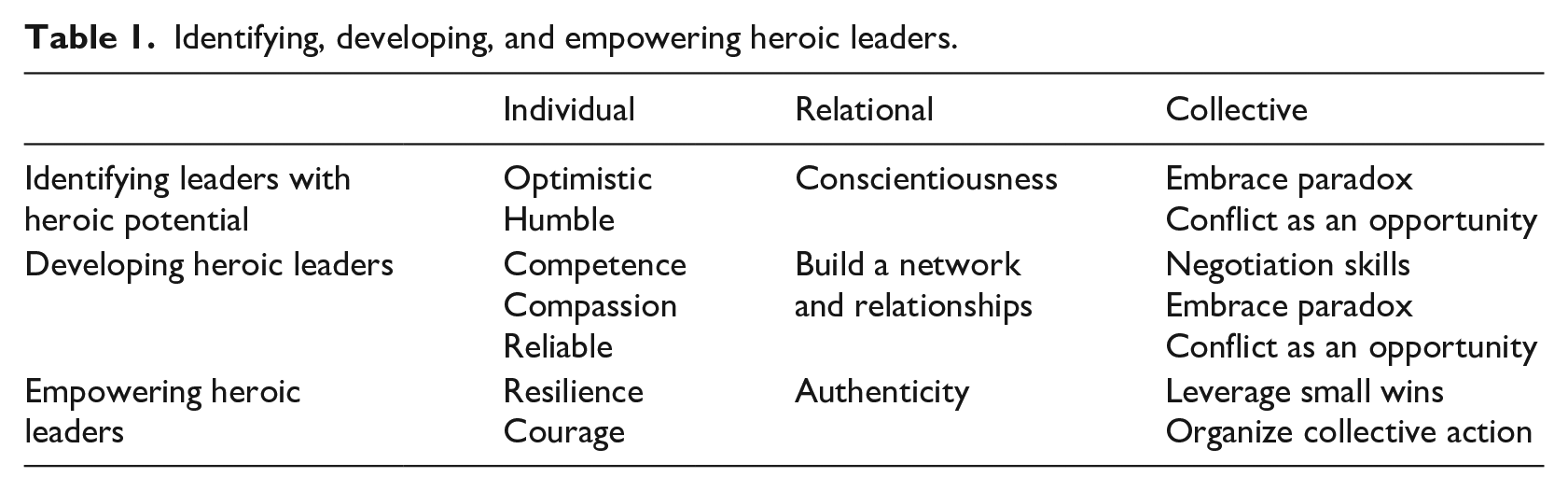
To create heroic leaders, we propose a 3 × 3 framework that first identifies leaders with heroic potential, then considers how to develop such leaders, and finally how to best empower them to enact change. We provide guidance at the individual, relational, and collective levels to connect the microfoundations aspects of leaders, to team and stakeholder dynamics, and finally systemic transformation (Table 1). In doing so, we drew insights from the POS, responsible leadership, and change agent—in particular tempered radicals—literatures and also our observation that emotions and values may play an important role. For the individual and relational levels, we root our ideas in the concept of trust because trustworthy leaders can create positively deviant change (Cameron, 2007). Trust can be observed intrapersonally and also interpersonally along several dimensions (Mishra and Mishra, 2012). At a collective level, the central idea rests on turning obstacles into opportunities, a characteristic found in change agents and tempered radicals (Meyerson, 2008).
Identifying, developing, and empowering heroic leaders.
Identifying leaders with heroic potential
Two intrapersonal qualities of trustworthy leaders that are readily observable during a hiring and promotion process are humility and optimism. Leaders with humility develop self-trust that is later converted into trustworthiness (Mishra and Mishra, 2012). Optimistic leaders have a strong desire to succeed in positive deviance (Pascale et al., 2010). At an interpersonal level, conscientious leaders and those who stay true to themselves can drive positive deviance (Cameron, 2012; Judge et al., 2002; Meyerson, 2008). Finally, at a collective level, we should look for leaders who view conflict as a chance to find creative solutions (Meyerson, 2008) and embrace paradox by shifting from an “either/or” to a “both/and” mindset (Smith et al., 2016) which is particularly important in CS (Hahn et al., 2014). These two traits can also fit in the next category of developing leaders, as mindset can be shaped as much as it is innate.
Developing leaders’ heroic tendencies
Leaders with heroic potential, once identified, can benefit from training and development to build these traits into skills. Here, the shift in focus is from innate characteristics to abilities that can be coached. For example, at the intrapersonal level, leaders can receive training to build their expertise on the topic of sustainability and how to implement it in their organizations, expanding their competence. Similarly, leaders can be sensitized for compassion through processes such as enabling attention and emotion (e.g. Dutton et al., 2006). Competence and compassion are two dimensions that shape trustworthiness and allow leaders to engage in positive deviance (Mishra and Mishra, 2012) and social entrepreneurship (Miller et al., 2012). The third dimension of trustworthiness that can be trained is reliability (Mishra and Mishra, 2012), a concept that resonates with the notion of responsibility that forms part of the “being” sub-competency of responsible leader trait dimensions (Muff et al., 2020). At an interpersonal level, heroic leaders can build their networks and relationships, and at a collective level, their negotiation skills (Meyerson, 2008). All these skills enable positive deviance, and when individuals are trained to apply such skills, they engage in more collaboration and develop more trust in stakeholders (e.g. Dadich et al., 2018; Muff et al., 2020).
Empowering heroic leaders
Empowering heroic leaders is an important final step in their personal growth, which helps heroic leaders to leverage their individual strengths, views challenges as a positive source of deviance, and develops micro-communities to support leaders (Spreitzer, 2006). At an intrapersonal level, leaders can benefit from enhancing their resilience, for example, through “booster shots” that imbue their actions with meaning, build positive relationships, and cultivate positive emotions (Dutton, 2009). Similarly, such leaders benefit from having permission to experiment and pursue their curiosity, which lifts their courage (Mishra and Mishra, 2012; Muff et al., 2020). Leaders can be further empowered by displaying authenticity in their interpersonal relations, which enhances trustworthiness (Mishra and Mishra, 2012). At a collective level, empowerment comes through leveraging small wins and organizing collective action, aspects evident in so-called tempered radicals (Meyerson, 2008).
Conclusion
A hero, per the Oxford dictionary, is a person admired for their courage, outstanding achievements, and noble quality. Leaders who embrace and enact these characteristics are heroic and have the power to create impact at a grandiose scale. We need heroic leaders in business in order to conquer the grand environmental and social challenges we face. Human industrial activity created the problem, but importantly business can also help us to solve it. The nascent field of microfoundations research on CS is a first step toward understanding the types of leaders needed to transform our business beyond the usual. But scholars need to make bigger strides forward. To do so, we can seek inspiration from fields such as POS, sustainability change agents, and environmental psychology. And we need to engage with practice to identify, develop, and empower heroic leaders, because the issue is urgent and the future is now.
Footnotes
Declaration of conflicting interests
The author(s) declared no potential conflicts of interest with respect to the research, authorship, and/or publication of this article.
Funding
The author(s) received no financial support for the research, authorship, and/or publication of this article.
