




Abstract
The incidence of childhood obesity amongst preschool-aged children has increased dramatically in recent years and can be attributed, in part, to a lack of physical activity amongst children in this age group. This study explores the social factors that stand to limit and/or enable children’s physical activity opportunities in outdoor settings in child care centres. In-depth qualitative interviews were conducted with 16 educators from four child care centres in Tasmania, Australia, to ascertain the educators’ perceptions of children’s physical activity and the child care centre policies and practices that stand to limit and/or enable physical opportunities on outdoor playgrounds in child care centres. The major finding of this study is that, despite educators’ positive perceptions of the importance of physical activity for preschool-aged children, child care centre policies and practices relating to children’s safety and supervision during outdoor times are limiting educators’ abilities to facilitate more structured physical activity opportunities for children in care. Educators also recognized that a lack of training limited their ability to provide physical activity opportunities. This article discusses the implications of these findings and concludes with a number of recommendations for future childhood obesity intervention strategies that can be implemented for preschool-aged children in child care centres.
Introduction
The prevalence of childhood obesity has increased dramatically in recent years and is seen to be ‘one of the most serious public health challenges of the 21st century’ (World Health Organization, 2010a). It is estimated that 42 million children under the age of five suffer from overweight and obesity worldwide. This is of particular concern to medical professionals, researchers, parents and teachers due to a number of well documented associated health risks, including the development of cardiovascular conditions, hyperlipidemia, high blood pressure, respiratory problems and the onset of type 2 diabetes (Burdette and Whitaker, 2005; Fulton et al., 2001; Oliver et al., 2007; Trost et al., 2003).
These findings have significant implications for children’s health not only now but also into adulthood. Research has found that the physical activity patterns of adults are established during the early childhood years (Cashmore and Jones, 2008; De Onis and Blössner, 2002; Klesges et al., 1995; Oliver et al., 2007; Trost et al., 2003). These findings suggest obesity in childhood will often result in obesity in adulthood (Whitaker et al., 1997). Furthermore, physical activity has also been found to be integral for children’s physical, emotional and cognitive development (Vives-Rodríguez, 2005).
Given that a growing number of young children (birth to five years old) are spending increasing amounts of time in preschools, these sites stand to become important settings for tackling childhood obesity. Yet recent research suggests that children at preschools are physically inactive for a significant amount of time each day (for a review of this research, see Tucker, 2008). The American National Association for Sport and Physical Education (2002) recommends that preschool-aged children participate daily in 60 minutes of structured moderate to vigorous physical activity and a further 60 minutes or more of unstructured free play. Recent studies have found that preschool aged children are consistently failing to meet the recommended daily requirements (Cashmore and Jones, 2008; O’Connor and Temple, 2005; Reilly et al., 2008; Tremblay and Willms, 2003; Tucker, 2008).
A number of individual, environmental and social factors undoubtedly influence children’s physical activity behaviours at preschools. Individual factors, such as gender (Tucker, 2008), parental patterns of play and physical activity (Birch and Davison, 2001), weight (Trost et al., 2003) as well as ethnicity (McKenzie et al., 1992, 1997) all have been shown to influence the physical activity behaviours of young children.
A number of studies have sought to determine the environmental factors that influence children’s physical activity behaviours. These researchers have explored if and how factors such as playground design (Dyment, 2005; Herrington and Studtmann, 1998; Moore, 1989), playground markings (Cardon et al., 2009), play equipment and programs (Cardon, et al., 2009; Hannon and Brown, 2008; Taggart and Keegan, 1997; Zask et al., 2001) and weather (Boldemann et al., 2006; Fisher et al., 2005; Ridgers et al., 2006) may be influencing children’s physical activity in child care centres.
A currently under-theorized aspect of the existing literature relates to the influence of social factors on children’s physical activity behaviours. These influences include factors such as policies and practices that govern preschools as well as the perceptions that are held in regards to the constraints and facilitating factors that educators perceive in relation to the physical activity of children in their care. A number of recent studies have explored educators’ perceptions of factors that limit/enable physical activity on child care centre play grounds (Davies, 1997; Dowda et al., 2004; Lawlis et al., 2008; O’Connor and Temple, 2005; Taggart and Keegan, 1997; Temple and O’Connor, 2004; Vives-Rodríguez, 2005) and found that many educators lack knowledge about the importance of physical activity for preschool-aged children; that they gave more priority to unstructured play opportunities than they do to games and structured movement activities; and, finally, that they lacked confidence in their ability to facilitate the physical activity of children in their care. Yet more research is needed, particularly in long child care settings (as opposed to family child care settings).
This article seeks to gain further insight into educator perceptions of the social factors that limit or enable the physical activity of children in long day care centres. Two research questions are examined in this article:
RQ1: How do educators’ perceptions of health and physical activity stand to limit/enable physical activity opportunities for preschool-aged children? RQ2: How do educators perceive the policies and practices of child care centres to limit/enable physical activity opportunities for preschool-aged children?
Definitions
A number of terms are used throughout this article that warrant clarification:
Physical activity is ‘any bodily movement produced by skeletal muscles that requires energy expenditure’ (World Health Organization, 2010b). The types of physical activity referred to in this study are structured physical activity (e.g. games and sporting activities) and unstructured physical activity (e.g. free play time).
Play: it is difficult to offer a definition of ‘play’ because it is not easily defined or categorized and, as such, is a contested term in the research literature (Ebbeck and Waniganayake, 2010; Wood and Attfield, 2005). For the purpose of this study, active functional play was seen as physical activity (e.g. chasey/tag, riding bikes, digging sand).
Methods
Setting
This study took place in four Australian preschools (Table 1). The centres were run by one organization and had similar directives and policies that guided their management and operation.
Features of the Childcare Centres.
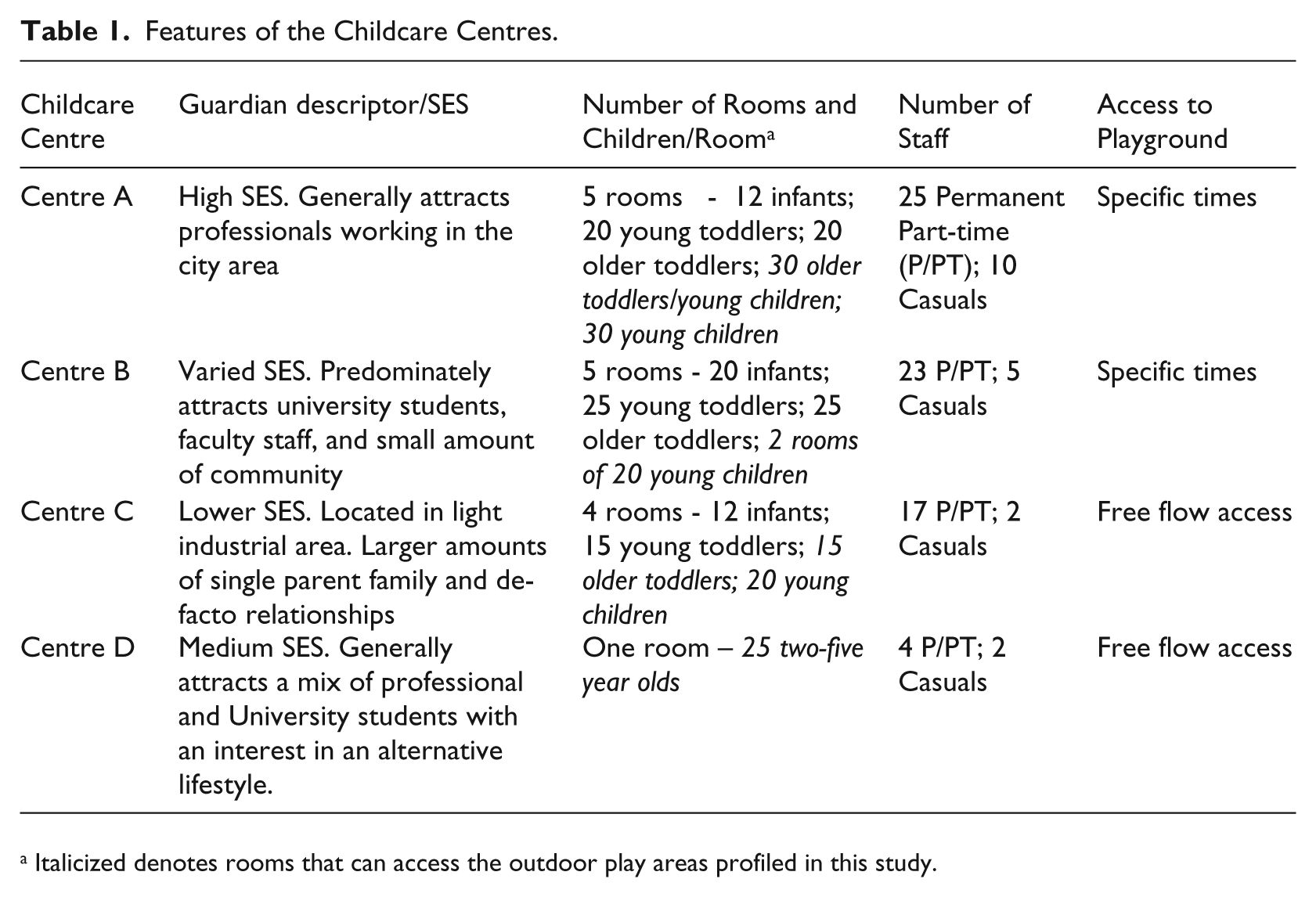
Italicized denotes rooms that can access the outdoor play areas profiled in this study.
The preschools were selected because they had been involved in a larger study that investigated the relationship between playground design and preschoolers’ physical activity patterns. For this larger study, the preschools were selected because their outdoor playgrounds contained a range of design elements. 1 Two of the preschools had a free flow access approach to outdoor playtime (i.e. children could decide when and how often they wanted to go outside), whereas the other two preschools had designated times where children could go outside. The playgrounds varied in size and design elements (see Figures 1–4).
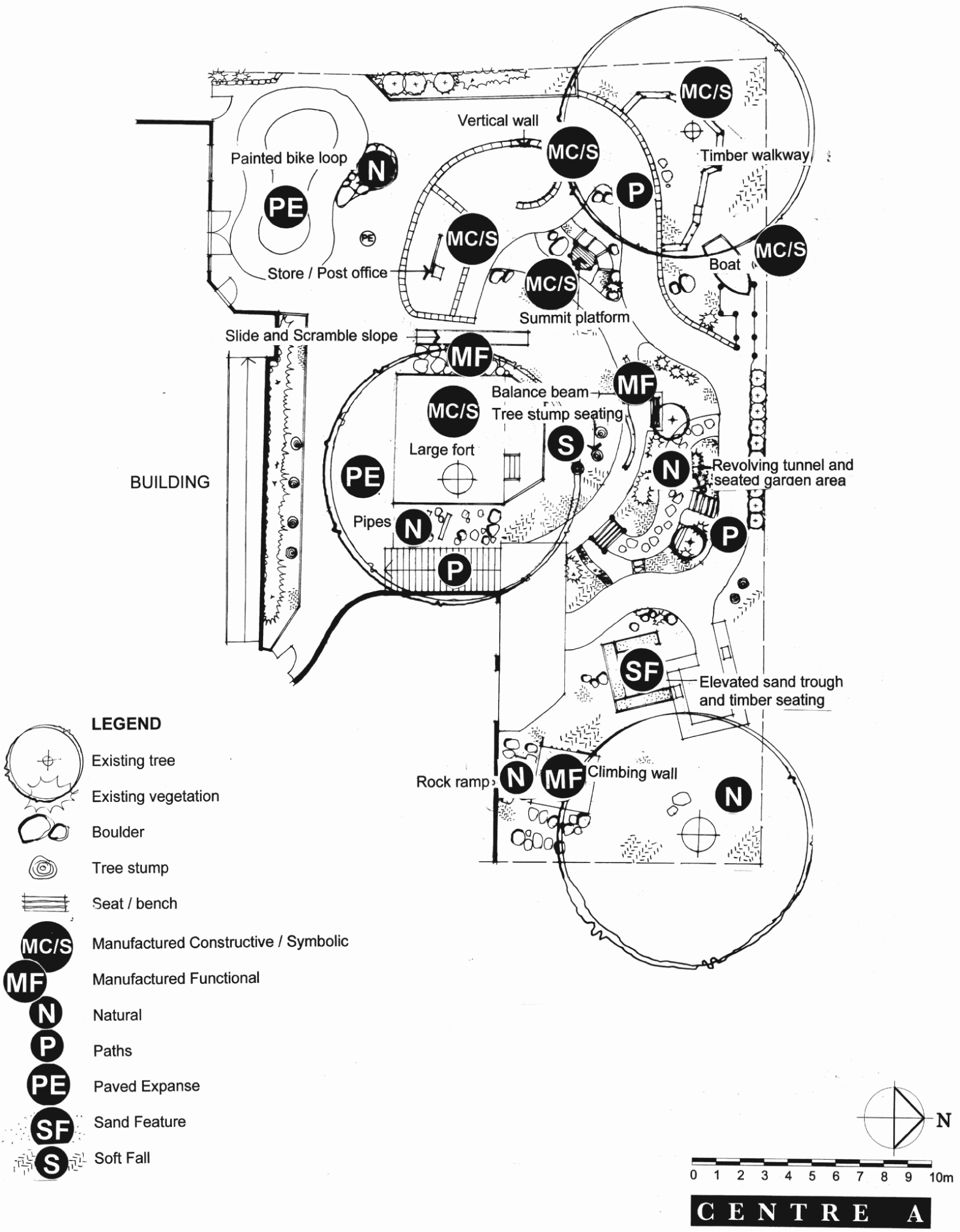
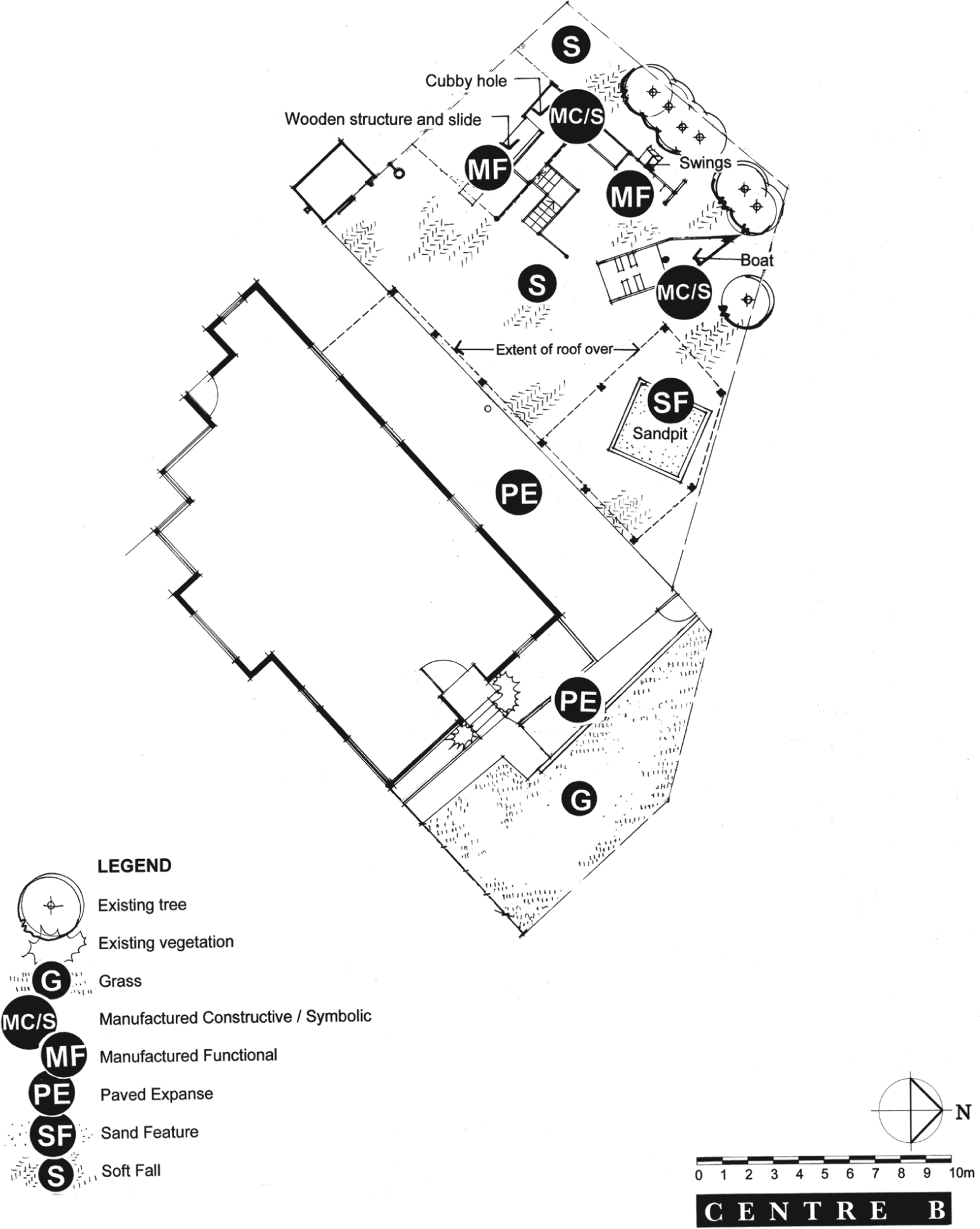
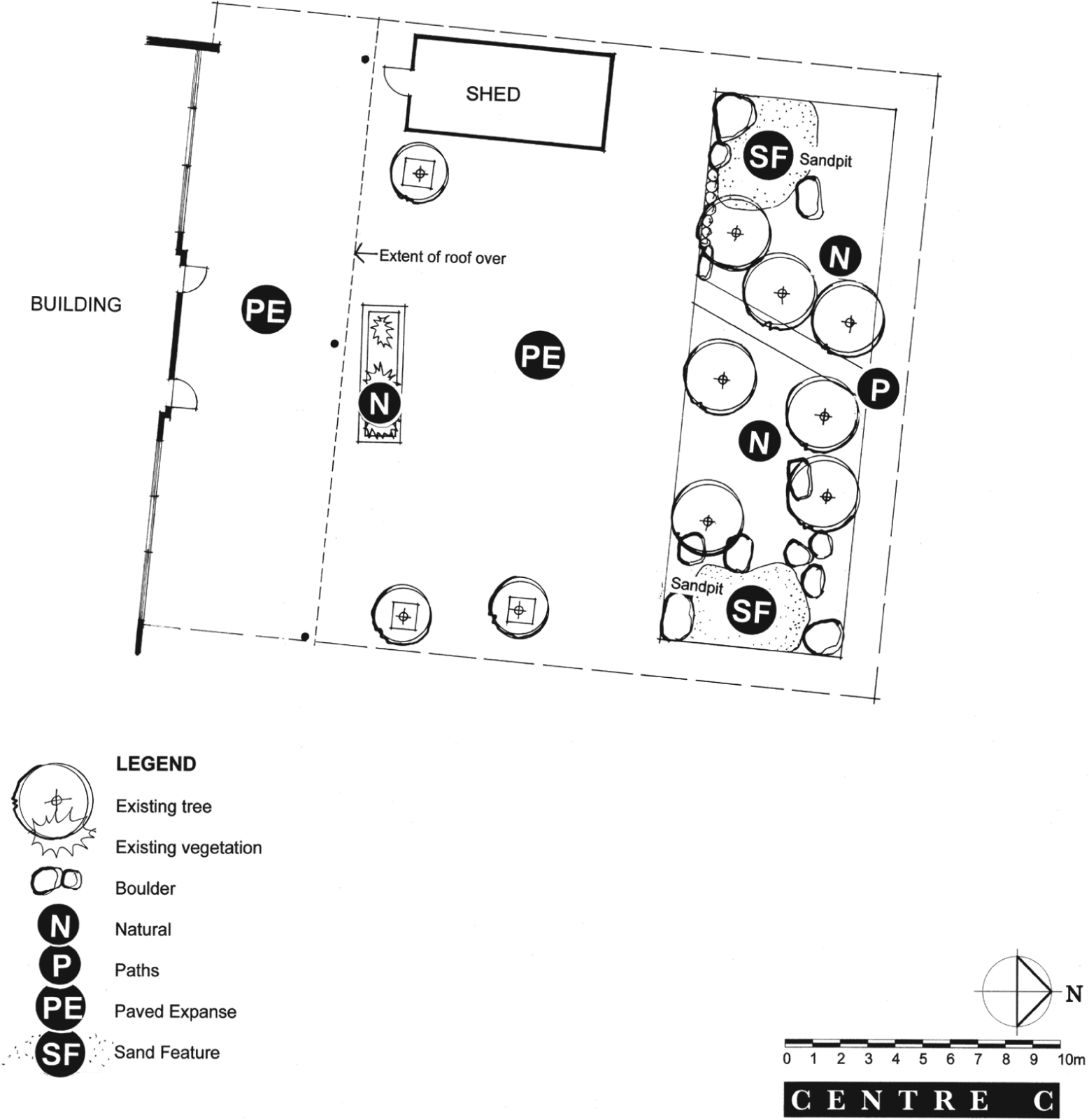
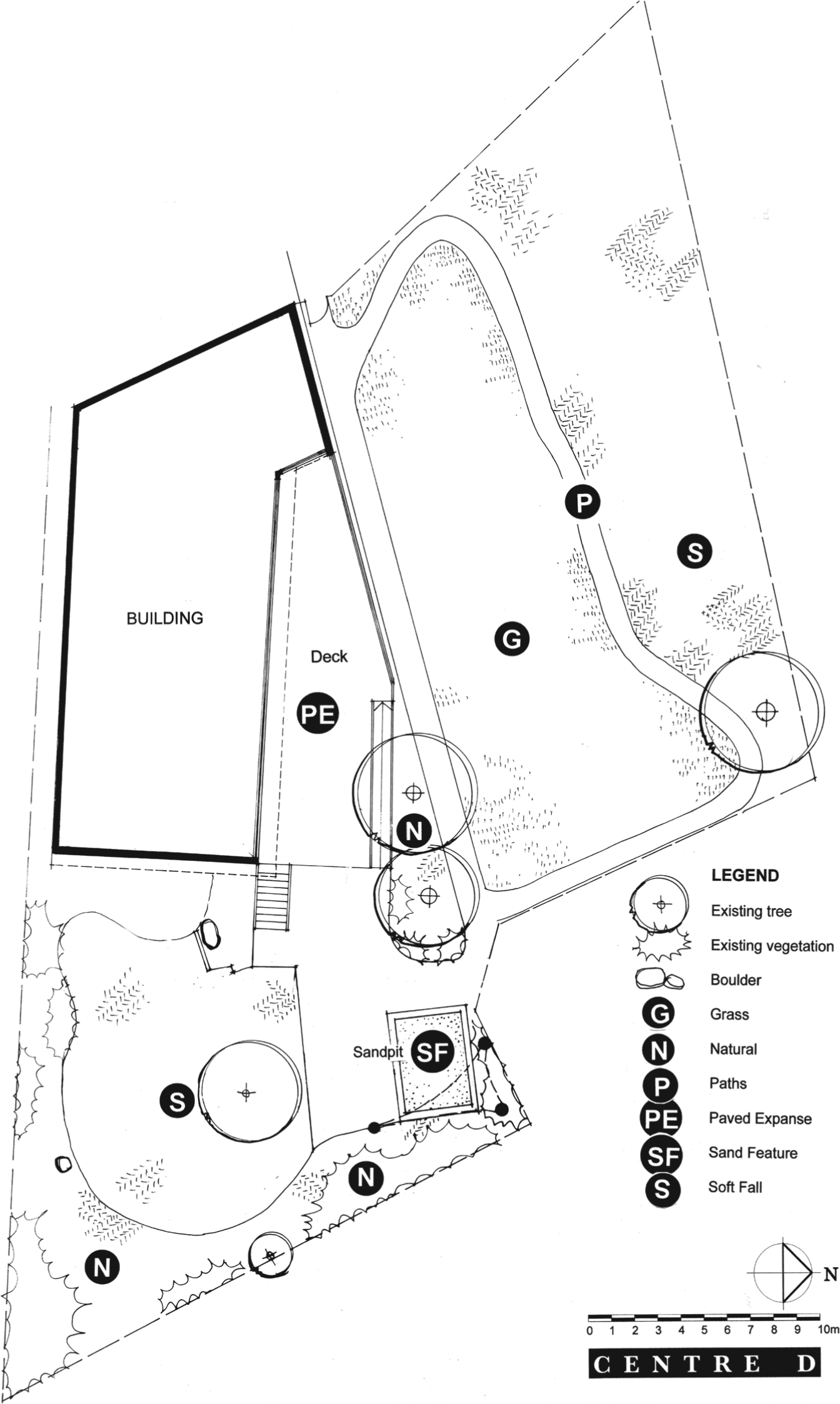
As noted in Table 1, the preschools had varying numbers of children (25 minimum to 112 maximum) and permanent/part-time staff (six minimum to 35 maximum). Three of the preschools provided services to children aged six weeks to five years old; one preschool catered only for two- to five-year-olds.
Interviews
With a view to gaining insight into educators’ perceptions of limiting and enabling factors, in-depth semi-structured interviews were conducted with 16 early childhood professionals (four educators and/or managers at each of the preschools) 2 (Mason, 2002; Travers, 2010). The interviews were taped and lasted between 30 and 60 minutes depending on how much information the educator had to offer. The interviews occurred at the preschool and consisted of a series of open and closed questions, such as:
How physically active are the preschoolers at your centre?
Are the preschoolers active enough during their time at childcare?
What do you see to be your main role during outside play time?
What factors limit/enable your ability to provide opportunities for physical activity?
Ethics
This study received ethical clearance from University of Tasmania. Information sheets were provided and consent for participation was secured from the following participants: a) the executive director of the overarching organization; b) the manager of each of the child care centres; and c) the early childhood educators who were interviewed.
Data analysis
The interviews were fully transcribed. After transcription, a thematic coding of the interview data was conducted using NVivo 8 qualitative data analysis software. Fifty-nine tree nodes were used to code the interview data. These included a priori codes sourced from the existing literature and inductive codes that emerged as a result of the interviews (Cresswell, 2008). A priori codes used in this study include ‘perceptions of health and physical activity’, ‘perceptions of role’ and ‘perceptions of limiting factors’. Inductive codes include ‘training’ as well as ‘confidence’. The interview transcriptions were then categorized into the appropriate codes and were examined to highlight commonalities and inconsistencies within the participants’ responses.
Interview data resulting from this study were analysed on a number of levels. First, data were analysed across all four child care centres to identify common themes between all four centres. Second, where it was possible, data were analysed on the individual centre level to compare the perspectives of educators from the same centre. Finally, in some instances, it was possible to identify differences between the perceptions of managers and on the ground educators. This three-tiered analysis allowed for greater depth of analysis by identifying trends across, between and within the child care centres.
Results and discussion
Initially, this section of the article was to be divided into two sections exploring educators’ perceptions of their role in physical activity (RQ1) and the policies and practices (RQ2) that they identify as limiting or enabling physical activity opportunities. A review of the interview data, however, has revealed that the educators’ perceptions and the actual centres’ policies and practices are closely inter-related. One cannot be divorced from the other. Accordingly, there will be some overlap between certain findings in this section. In order to limit potential overlap, this section identifies five key issues that educators perceive as limiting and enabling children’s physical activity and discusses them in reference to their relevance to either research question one (RQ1) or research question two (RQ2).
Perceptions of health and physical activity (perception – RQ1)
When asked about their perceptions of health and physical activity, educators interviewed in this study all agreed that physical activity was extremely important for preschool-aged children. At Centre A, educators indicated that a lack of physical activity was a major determinate of childhood obesity and that addressing childhood obesity through physical activity and healthy eating was a major element of their role as child care providers. Similarly, educators at Centre C and Centre D emphasized the role that physical activity plays in children’s physical development, while educators at the Centre B stated that physical activity was associated with good mental health and cognitive development. This finding is in direct contrast to the conclusions made by Vives-Rodríguez (2005) who argued that early childhood educators lacked an understanding of the important role that physical activity plays in the physical, social and cognitive development of preschool-aged children.
Thirteen educators in this study expressed a belief that the children in their centres were engaging in sufficient physical activity during their time in child care. Only three educators stated that children were not participating in enough physical activity during this time. When asked to describe the types of physical activity that children were engaged in at their respective centres, educators stated that running games, ball games and sandpit play were the most popular activities for children. While the majority of the educators stated that children were active enough during their day in child care, a number of recent studies have shown that children are engaged in predominately sedentary activities in child care centre playgrounds (Dowda et al., 2004; Pate et al., 2004, 2008; Story et al., 2006; Tucker, 2008). Indeed, Tucker (2008) conducted a systematic review of 39 recent students on children’s physical activity in preschool/child care centres. Tucker’s review of these studies revealed that only 54 percent of preschool-aged children met the recommended daily physical activity guidelines published by the National Association for Sport and Physical Education (2002). More recent studies have found similar results: Brown and his colleagues (2009b) found that children were engaged in sedentary activity 56 percent of the time during periods outside, while Hannon and Brown (2008) found that children were sedentary for 49 percent of outside time. These findings challenge the popular notion that children are busy and on-the-go during outdoor play time and indicate that, despite educators’ perceptions of children’s physical activity, children are not sufficiently active during time spent in child care. 3
Educators’ positive perceptions of children’s physical activity may be indirectly affecting the provision of physical activity opportunities for children in child care. If educators believe that children are engaging in enough physical activity, then they may not feel the need to provide additional physical activity opportunities beyond what is currently provided by their centres. While the fact that educators believe that physical activity is extremely important for preschool-aged children is encouraging and possibly enabling physical activity opportunities for children, educators’ responses during the interviews suggest that educators do not believe that there is any reason for concern about the provision of physical activity for children in their centres.
Supervision (perceptions, policy, practice – RQ1 and RQ2)
Consistent with the existing literature (Davies, 1997; O’Connor and Temple, 2005; Temple and O’Connor, 2004), the educators in this study stated that supervision of children is their primary concern during outdoor time. When asked to describe their supervision duties, educators gave differing interpretations of what was required of them during their supervision. Four educators stated that supervision involved standing back and giving children space to play their own games. Another four educators suggested that monitoring and alleviating safety hazards was their primary supervision concern. Two participants stated that effective supervision also required educators to help excluded children to find opportunities to enter into the play of others, while the remaining educators did not comment on their supervision duties. As indicated above, 12 out of 16 educators also believed that supervision involves interacting with children in their play.
Although on the ground educators appeared to have different interpretations of their supervision duties, all four managers were consistent in their expectation that educators should be engaged in a program of ‘active supervision’. These managers stated that active supervision involved watching children, interacting in children’s own games, providing opportunities for physical activity and ensuring children’s safety in the playground. These findings suggest that there are tensions between what managers expect of educators and what educators believe should be their supervision role in the outdoor space.
The supervision policies of the child care centres were identified by a number of educators as limiting their ability to facilitate and engage children in physical activity opportunities. 4 Temple and O’Connor (2004) found similar results with educators in their study asserting that child-to-educator ratios did not allow educators to take an active role in facilitating children’s physical activity. When asked about the supervision ratios, all of the educators in this study appeared to be very aware of the ratios and described them confidently. The educators gave mixed responses, however, when asked whether they felt the supervision ratios observed at their centres were adequate for the children. Most of the educators supported the supervision ratios with only three participants stating that they believed that supervision ratios needed revising if they were expected to do more than simply observe children during outdoor time.
Interestingly, managers at Centre A and Centre D argued that the supervision ratios were insufficient while all of the ‘on the ground’ educators at these centres believed them to be satisfactory. Samantha,
5
a manager at Centre A facility, provided the following explanation:
Obviously [the supervision ratios] are adequate in that they meet the [licensing] standards, but I think, as far as meeting high quality expectations in our class for children, I don’t think the ratios support that. I think it makes it very tough work on the educators to actually produce and support those learning outcomes for children with their ratios.
Despite only three educators stating that they felt the supervision ratios were inadequate, an additional eight educators echoed Samantha’s sentiments throughout the course of their interviews. These educators argued that the supervision ratios limited their ability to facilitate children’s physical activity as they restricted their opportunities to set up structured physical activities for the children. Lucy, an educator from Centre B, aptly summarized the perceptions of this group of educators:
I guess that if [supervision ratios] were purely for supervision, it would be fine. If you are meant to do programming and you are meant to be interacting with the kids and everything, it is not. It is really hard to interact with a group of five kids and play a game or something, [because] you’ve got another five kids that you are meant to be supervising as well, so it’s quite difficult to do activities with them, and supervise them at the same time.
These findings indicate that half of the educators in this study suggested that the current supervision ratios limited their ability to facilitate children’s physical activity at one point during their interview. Consistent with the conclusions made by Temple and O’Connor (2004), it appears that educators believe that in order to provide quality physical activity outcomes for children, supervision ratios need to be reduced or additional staff need to be employed to support educators in their role as facilitators of physical activity. 6
Safety (perception, policy, practice – RQ1 and RQ2)
All of the educators in this study agreed that ensuring children’s safety was their foremost concern when they were outdoors with children. Commenting on how they ensure children’s safety, educators mentioned that completing pre-outdoor time playground safety checks, continuously scanning the playground for safety hazards, keeping children off broken or unsuitable play equipment and maintaining climbing frame height restrictions were all tasks they completed on a daily basis. Indeed, safety issues and their relationship to preschool-aged children’s physical activity behaviours are addressed within a number of recent studies (Little and Wyver, 2008; Sandseter, 2007, 2009; Waters and Begley, 2007). These studies conclude that rough or challenging play is often considered an unacceptable risk to children’s safety by educators. Consistent with the findings of these studies, educators in this study also indicated that safety issues and concerns about risky play could limit children’s physical activity opportunities.
The educators interviewed perceived a strong link between issues of children’s safety and the physical environment of child care centre playgrounds. Throughout the interviews, five educators mentioned that elements of the natural environment that were incorporated into the playground often caused educators to worry about children’s safety. Emily, an educator from Centre A, for example, stated that the decorative rocks in the playground caused a number of accidents, while Josie, a manager at Centre A, felt that the trees in the playground were a major safety concern during windy weather. This finding is particularly interesting as recent research on school ground greening intervention programs has found a positive relationship between the incorporation of the natural environment into playgrounds and an increase in children’s physical activity behaviours (Bell and Dyment, 2006; Dyment and Bell, 2007, 2008). Potentially, what this means is that educators are reluctant to utilize the natural resources within the playground to facilitate physical activity because they are considered too risky for children.
Within the interviews, a consensus also emerged among educators that policies related to height restrictions to climbing frames were a major factor limiting children’s physical activity opportunities.
7
Managers interviewed in this study explained that implementing height restrictions on climbing structures was essential to ensuring that the child care centres met the requirements for licensing as child care providers. Several educators and managers, however, indicated the height restrictions on climbing frames limited children’s ability to physically challenge themselves. Tiffany, an educator at Centre D, for example, identified the implications of the height restriction policy as follows:
A lot of children, especially the older boys, are really keen to rearrange the equipment that we get out, like the jungle gym stuff, to challenge themselves further. They’re creating structures that are unsafe and we are not allowed to use them because of our policy of restrictions to height and to where you place high objects close to other objects. I would say that this restricts the children in their decision to be active.
Climbing appears to be a popular activity choice amongst children in attendance at the four child care centres. The practice of using portable climbing structures by the children was mentioned by nine of the educators in this study. Given children’s propensity for climbing, it appears that children would benefit from having access to higher, more challenging climbing structures. Lauren, a manager at Centre B, provided a possible solution to this issue stating that ‘when I was working in Queensland, we were able to build frames up higher but it would take one staff member to stay with the frame at all times’. This finding suggests that a lack of educators available to take on this role (due to possibly inadequate staffing ratios) may be contributing to limiting children’s physical inactivity in child care.
In contrast to the policies of the other centres, Centre D is the only centre that allows children to climb the trees in the playground. Jenny, the manager at Centre D, argued that tree climbing gave children an opportunity to test their physical boundaries, noting a desire to ‘not wrap [children] up in cotton wool’. While all three educators at Centre D believed that this policy enabled children’s physical activity, Tiffany, an educator at Centre D, acknowledged that the policy also caused further concerns about safety for her:
When children are climbing in the trees, they’ve sometimes gotten way too high, or have been swinging off the branch of the tree and then jumped down. That branch may not be strong enough for their weight. You might notice it bowing too much and [you] then have to come in and intervene in things that you perceive are not safe.
Despite indications from the educators that the Centre D policy enables physical activity, it is evident that tree climbing activities still result in concerns about risks to children. While it is essential that children’s physical activity is increased, it is also necessary to ensure their continued safety in the playground. This issue seems to be the major tension identified by educators across the four centres and appears to be only remediable through the provision of more educators in the playground to supervise children during ‘risky’ play. These findings are consistent with the existing literature that has determined that safety policies may restrict children’s ability to engage in ‘risky’ activities (Stephenson, 2003).
Concerns about children’s safety outdoors during certain weather types were expressed by a number of educators. All four centres implemented policies that restrict children’s play to small undercover areas or inside during both high UV rating days and inclement weather conditions to ensure children’s safety. When asked if these weather policies limited children’s physical activity opportunities, only two educators perceived these policies to be barriers to children’s physical activity opportunities. All other educators interviewed in this study believed that the indoor environment and the limited undercover spaces at their centre provided enough opportunities for children to be physically active. This finding may be significant as it suggests that educators believe that just being able to get children outside is providing enough opportunities for them to be physically active. From these responses it is uncertain whether educators are informed about how important it is for children to engage in moderate to vigorous physical activity.
Educator’s role in facilitating physical activity (perception – RQ1)
Davies (1997) has argued that educators in child care centres often simply ‘stand around and watch children play’ (p. 11) rather than engaging children in meaningful movement activities. Furthermore, Vives-Rodriguez (2005) found that there was a perception amongst educators that time spent outdoors was often a time for educators to take a break, relax and sit down as they supervise children. Educators interviewed in this study, however, strongly disagreed with these sentiment stating that they did not perceive the outdoor environment to be break time for them. Despite these positive indications, three educators did admit to witnessing others utilizing the outdoor space as a place to sit and chat with colleagues. At Centre A, Josie, the Manager, stated that they utilized a specific supervision policy that assigned educators to opposite ends of the playground to stop them from chatting while outside with the children. It is evident, therefore, that despite educators’ perceptions that the outdoor time was not a rest period for them, both educators and managers had observed others resting rather than engaging children in physical activity opportunities. Indeed, Samantha, a manager at Centre A, believed that this behaviour was potentially limiting children’s physical activity as children would often follow the example of the educator and also sit down while outside. This finding is consistent with those of Brown et al. (2009b) who found that girls in particular were less likely to be physically active if an adult were present. This may be a significant contributing factor to children’s lack of physical activity.
While educators interviewed in this study were adamant that safety and supervision were their primary roles in the outdoor space, educators also believed that they could take on a number of other roles to support children’s physical activity. In particular, all of the educators in this study believed that interaction with children during outdoor time was a part of their role as educator. While some researchers have argued that adult interaction with children during physical activity can have a negative effect on children’s physical activity patterns (Brown et al., 2009a; Cardon et al., 2008), a number of recent studies have identified that adult interaction with children during physical activity can increase the length and intensity of their play (Taggart and Keegan, 1997; Temple and O’Connor, 2004; Vives-Rodríguez, 2005). These researchers have suggested that children participate in longer periods of moderate to vigorous physical activity opportunities when adults are present. Consistent with these studies, 12 educators (including managers at Centre A, Centre D and Centre C) indicated that their involvement with children during their play should be limited to those times when children were not already successfully engaged in games and activities of their own making. In fact, three educators from this group actually stated that they believed that their involvement could sometimes hinder children’s play. Children, these educators suggested, can become disinterested and move away if adults become too involved in their play. The four remaining educators, however, did not mention involvement when asked about their role.
All three educators as well as the centre manager at Centre D indicated that their involvement was essential for stimulating children’s development and their acquisition of fundamental movement skills. Tiffany, an educator at Centre D, stated that her role involved challenging children to push their physical boundaries:
I’ve witnessed a child who really wants to try something and is determined to say that she can do it and I’ve gone through repetition [of the steps] with her. [She wanted to] jump off a height and she was really insistent that she wanted to do it, but needed to hold a hand and stuff like that. I definitely think there’s a place for adults and educators to encourage the children to gain independence by challenging their physical skills.
Two educators at Centre B agreed that their involvement in children’s play helped to teach children fundamental skills of ball games (for example, teaching students the correct way to kick a soccer ball, to return a totem tennis ball, or to hold a football). This finding indicates that these educators believe that children also benefit physically and cognitively from their interaction with them.
Within the responses, there was a perceptible tension between educators who believed that children required structured physical activity opportunities (for example, games) and those who asserted that children should be able to engage in their own self-directed activities in the outdoor environment. This tension was also evident within the findings of a study conducted by Vives-Rodríguez (2005) which concluded that educators felt that children would not enjoy structured outdoor activities because they closely resemble the education activities provided by educators indoors. Consistent with the conclusions made by Vives-Rodríguez, five educators stated that all outdoor activities should be of children’s choosing and that unstructured free play was an integral part of their program for children. Supporting this belief, an additional three educators believed that, if children are to participate in structured physical activities like ball games, the educator’s responsibility should be to provide equipment for children to make up their own variations of the games. All other educators in this study did not state their opinion on unstructured free play during their interviews. This finding indicates that, despite evidence within the literature that adult interaction with children in structured physical activity can increase their time spent in moderate-to-vigorous activity, not all the educators that participated in this study perceived involvement in children’s play to be a major aspect of their role. The result of this is that children could potentially be receiving different physical activity outcomes from educators based on their perceptions of their role in children’s physical activity.
Training and programming (perception, policy and practice – RQ1 and RQ2)
If educators are to assume the role of interacting with children and facilitating their physical activity, educators require training in how best to encourage children to be physically active. A lack of educator training in facilitating physical activity has been identified within the existing literature as a major factor that can limit on children’s physical activity in child care (McWilliams et al., 2009; O’Connor and Temple, 2005; Temple and O’Connor, 2004; Vives-Rodríguez, 2005). Confirming these findings, educators in this study revealed that they believed their lack of training limited children’s physical activity options. The practice of providing physical activity training to educators was not common at each of the four centres: only five of the educators acknowledged having received any physical activity training during their child care careers and all five educators had received that training interstate or at other child care centres. All of the educators that were interviewed stated that they had not received any specific physical activity training during their period of employment with the organization that operates the four child care centres.
Both educators and managers perceived a need for further training in physical activity. A number of educators suggested that the organization could provide in-service professional development workshops specifically aimed at providing educators with the skills and ideas to facilitate more structured physical activities, such as games and sports. Jenny, the manager at Centre D, clearly expressed the perceptions of most educators: ‘[you need] professional development in that area just to update your skills and learn different and new ideas and things like that because you only know as much as you have learnt’. Supporting Jenny’s statement, three other educators also requested more professional development opportunities as they believed that their repertoire of games and activities had become ‘stale’ (Josie) and ‘monotonous’ (Samantha). This finding may be significant as educators appear to be suggesting that their need to repeat the small number of activities that they know may be limiting children’s physical activity options.
Educators at Centre A and Centre B stated that the centres’ practice of employing an additional external educator to provide a weekly physical activity program for the children was a much needed opportunity for educators to learn additional games and skills. Educators at these centres stated that the program provided them with ideas that they could take back to their centre and use with children at a later date. Joan, an educator at Centre B, stated that she uses the activities that the external educator demonstrates during the program to provide structured physical activity opportunities to children that do not attend the centre on the day that the program operates. These educators, therefore, have indicated that the specific physical activity programming at Centre A and Centre B is a positive enabler of children’s physical activity. Interestingly, despite not being participants in the program, educators at Centre C and Centre D also expressed a desire to have an educator come in and help them facilitate children’s physical activity. This suggests that educators at these centres believe that the program could provide greater physical activity outcomes for the children.
The need for child care centre policies and practices that provide staff training in physical activity is highlighted by the success of outside physical activity workshops for educators in other child care centres. Brown et al. (2009b), for example, found that educator led workshops such as ‘track team’ (group running) and ‘dance party’ (group dancing) were successful in increasing children’s physical activity levels for short, sustained periods of time. The success of these workshops suggest that the provision of further staff training in physical activity facilitation may be a viable means of increasing children’s physical activity in child care.
Conclusions and recommendations
This study examined the social factors that influence the physical activity behaviours of preschool-aged children in child care centres. A series of qualitative in-depth interviews were conducted with 16 early childhood educators from four child care centres to ascertain the educators’ perceptions and child care centre policies and practices that stand to limit or enable physical activity opportunities for children in these centres.
This study had several limitations that are important to acknowledge. First, the sample size (16 educators from four preschools) is small and it is thus difficult to make broad generalizations from the data. Second, while the four preschools were managed by the same organization, there were important differences amongst them, including for example, number of children and staff, socioeconomic status of catchment area, as well as the size and design of outdoor play area. Third, staff members had been employed for varying lengths of times, making them more or less familiar with the issues addressed in the interviews. Finally, interviewees might have interpreted terms such as ‘physical activity’, ‘play’, and ‘supervision’ differently.
Despite these limitations, a number of potential strategies for increasing children’s physical activity levels in child care arise from the findings of this study:
Teacher education institutions and child care providers could provide pre- and in-service education workshops for early childhood educators with the goal of teaching educators age- and/or developmentally appropriate games and skills-based activities that they could use in the child care centre playground. Educators in this study revealed that they had not received any training in physical activity during their employment with their current child care centre. There is a real need, therefore, for continued physical activity training for early childhood educators beyond their initial vocational or university training.
Teacher education institutions and child care providers could also provide pre- and in-service education workshops to inform educators about the importance of physical activity for preschool children and to provide them with information about the actual levels of physical activity experienced by children in child care.
Child care centre providers could be more explicit with educators about their role in facilitating children’s physical activity. Child care centre managers in this study stated that educators need to be involved in children’s physical activity. While most of the educators interviewed agreed that interaction with children during outdoor time was an important part of their role, some educators were uncertain as to what was expected of them during children’s physical activity opportunities. Child care providers and centre managers could ensure that all educators are aware of all of their professional responsibilities in relation to children’s physical activity.
If possible, child care providers could increase educator to child ratios during outside times. When asked about the adequacy of current educator to child ratios (1:10), a number of educators interviewed in this study stated that staffing ratios limited their ability to facilitate physical activity for children. One educator stated that 1:7 would be a sufficient ratio. Child care providers could amend staffing ratios to reflect educators’ concerns.
Child care providers could provide more physical activity programming for children in child care. Two child care centres in this study provided for an externally operated weekly physical activity program for preschool-aged children. These programs provide opportunities for children to engage in structured physical activities, while also offering early childhood educators an opportunity to learn new skills and games to use in the child care centre playground.
The incidence of childhood obesity, particularly amongst preschool-aged children, is a serious concern. The five recommendations emerging from this study need to be considered alongside a range of other environmental and social interventions that are currently being used to tackle the obesity epidemic in preschoolers.