




Abstract
Building on literature concerning participatory research, this article explores the use of ‘buddy partnership’ as a technique to access the voices of young children. In this study, 5- to 6-year-old boys were paired with 11- to 12-year-old boys, and each dyad was asked to contribute towards the creation of an information DVD that would help teachers and parents understand the factors that influenced children’s engagement with reading. This article reflects on how this research technique addressed some of the methodological concerns of researchers conducting participatory research with young children. In particular, it addresses issues related to the ‘role of the researcher’ and the impact of presence of an adult researcher when researching young children’s views. This study revealed that the use of a buddy partnership with older children was a highly effective method in eliciting the voices of these young children. This article argues that the success of this research technique can be attributed to the cultivation of a strong and unique relationship that was built between the children throughout the duration of the project. It is concluded that the older children played a crucial role in the research, as their empathetic and playful approach meant that they communicated with the younger children in a context that was defined by the existence of ‘shared understanding’, which would not have been possible within an child–adult research relationship.
Keywords
Introduction
In recent years, the inclusion of young children’s voices in social and educational research has become increasingly evident. The term ‘participatory research’ is now commonly associated with early childhood research, and there is a growing body of literature that focuses exclusively on the views, beliefs, perceptions and attitudes of young children. As Scott (2000: 98) points out, constructions of childhood no longer regard children as ‘incomplete adults’, but as ‘actors within their own right’; as a consequence, researchers have recently developed a variety of strategies and tools to create pathways for young children’s voices to be heard within research.
This is an exciting and deeply welcome development in early childhood research, particularly as it is recognised that it was once common for ‘researchers to consider children below the age of seven or eight years as not viable as interviewees, partly because of their young age’ (Kellett and Ding, 2004: 167). Yet it would be a serious mistake to assume that ‘interviewing’ young children is unproblematic. First, it is clearly inappropriate to consider using traditional ‘interviews’ with very young children in the vast majority of cases. Such a context would be, at best, meaningless to a young child and therefore unlikely to yield useful data, but more importantly, it could be intimidating and possibly even frightening for the child, thus raising a number of ethical issues from the outset. However, researchers have recently developed a variety of effective and innovative ways in which to facilitate research conversations with young children (Clark and Moss, 2001; Jesuvadian and Wright, 2011), which are meaningful and enjoyable experiences for the children themselves.
While Punch (2002) agrees that it is important to include children’s voices in research, she issues a number of warnings for researchers of children, including the concern that ‘the problem of using innovative techniques is that the benefits and drawbacks of using them are not always scrutinized’ (p. 330). This is not to say that published research techniques lack methodological rigour; on the contrary, techniques such as The Mosaic Approach of Alison Clark and Peter Moss (e.g. Clark, 2004) have been enormously helpful in providing a platform for conducting participatory research with young children. However, Punch is alerting us to the fact that we should not assume that research techniques are methodologically robust simply because they are ‘child-friendly’. Indeed, there is a need to critically reflect on the affordances and limitations of such techniques, so as to be able to defend the viability of our own research design. Moreover, Punch makes the further point that even though researchers need to acknowledge that research with children is different to that of adults, it is important that this does not become translated into a belief that there is a certain way in which to ‘do’ research with children. In other words, Punch is arguing that it is necessary to recognise why research with young children is different from that of adults and to use this understanding to ensure that the research we design is fit for purpose.
With this in mind, the purpose of this article is to explore a particular participatory technique that was used recently in a study to access the voices of 5- to 6-year-old boys (Year 1, second year of statutory schooling in the United Kingdom) about their perceptions of reading. In brief, this study employed a ‘buddy partnership’, whereby twelve 11- to 12-year-old boys (Year 7, first year of secondary schooling in the United Kingdom) from a secondary school in South Yorkshire were paired with 5- to 6-year-old boys from three of the school’s ‘feeder’ primary schools. The aim of the study was to understand the factors that influence these boys’ engagement and confidence in reading and to explore how aspects of primary education can have an impact upon this. Using flip cameras, the boys contributed towards creating an information DVD that was published and distributed to all children and teachers involved in the project. The study will be described in more detail a little later, but it is important to stress that it is not the intention of this article to present the findings of this research, but to critically examine the extent to which the use of such a partnership worked as a viable methodological technique in accessing the voices of these 5- to 6-year-old boys. This article reflects on how this research technique addressed some of the methodological concerns of researchers conducting participatory research with young children. In particular, it addresses some of the issues related to the ‘role of the researcher’ and the impact of the presence of an adult researcher. In addition, this technique is also analysed regarding its potential to facilitate the acquisition of reliable data that could provide a fair and accurate account of the children’s beliefs.
Before this research is described, it is important to first consider how researchers have interpreted the term ‘participatory research’ and what this means in terms of research design. The next section begins with a brief look at the various ways in which this term has been interpreted and utilised by researchers of children. Following this, we explore how researchers have attempted to address some of the specific issues related to adult-presence when conducting participatory research with young children.
Literature review
The term ‘participatory research with young children’ has many different interpretations, however, most would agree that it has to involve listening to children and hearing their voices. It is not surprising, therefore, that many researchers of children situate their commitment to listening to the voice of the child in the domain of human rights. For example, Flutter and Ruddock (2004) argue that the United Nations Convention on the Rights of the Child (1989) became a ‘catalyst for change’ (p. 20) in supporting the view that children have the right to be viewed and treated as autonomous individuals in society. Subsequently, they stress that their work on pupil participation and consultation is based on ‘the child’s right to have a voice in matters concerning his or her life’ (Flutter and Ruddock, 2004: 20). Not surprisingly, other researchers of children have connected issues of empowerment and rights with participatory research. In their appraisal of participatory approaches to conducting research with young children, Pascal and Bertram (2009) claim that they themselves ‘operate through an ethos of empowerment of all participants, and aim for participatory research practice which has as its heart an active involvement in promoting the rights of children as citizens with voice and power’ (p. 249).
For others, participatory research is not just about listening to children but actually including them as co-researchers. This can mean inviting the children to work as collaborators within the research team (Hill et al., 2004; Pahl and Allan, 2011), which can include their involvement in all parts of the research process, such as choosing a research question, selecting the research methods, gathering the data and disseminating their findings (see, for example, Gray and Winter, 2011). Such research has been conducted with children as young as 4- to 5-years-old (Lundy et al., 2011), though this research team does acknowledge that ‘there are limits to what young children can and will want to do in the context of adult-led research studies’ (p. 714).
While these interpretations of the term ‘participatory research’ are quite specific, there is another broader definition of the term, which goes back to the fact that childhood researchers now consider it insufficient to carry out research ‘on or about children’ but need to conduct ‘research for and with children’ (Gallacher and Gallagher, 2008: 500).As highlighted in the introduction, changes in how children are perceived in society has had a direct impact on the ways in which researchers design studies, which now includes techniques to actively encourage children to talk, share their views and contribute directly to the data.
For the purposes of this article, the term ‘participatory research’ will refer to the broad concept of using conversation-based methodological techniques to include young children’s voices in research. Of course, such research can indeed be designed to empower and liberate, just as it can include the children as co-researchers, however, we are not limiting a definition to these specific research aims. Rather, our focus is on providing a critical reflection on the use of participatory techniques in research with young children. It is important to stress at this point that conducting participatory research with young children does, of course, raise a number of ethical as well as methodological issues; however, as the subject of ethics has tended to receive considerable attention in the literature (Gallagher, 2008; Morrow, 2005; Nutbrown, 2011), this article is focusing on the ways in which certain participatory techniques facilitate the acquisition of reliable data.Of course, this is an ethical issue in its own right; if we are serious about accessing the voices of young children, then we must also be serious about ensuring that the techniques we are using allow this aim to be fully realised. In other words, we need to carefully consider how our techniques actually allow for child participation in what is usually an adult-directed study.
The issue that is frequently cited as being of particular concern to researchers relates to the ways in which children may respond to adult questioning. For example, it has been regularly documented that children will provide an answer to a question from an adult, regardless of whether they ‘know’ the answer or have an opinion on the subject at hand (Scott, 2000; Waterman et al., 2001). It is not hard to understand why this happens, given that children are rarely given opportunities to express their opinions and beliefs within the context of their daily lives. Children who are at school may well be used to an ethos that expects them to provide answers (and indeed right answers) to questions that are asked of them, so it is no surprise that their responses may be influenced by what Gallacher and Gallagher (2008) refer to as ‘schooled docility’ (p. 506).
One of the ways in which researchers have attempted to navigate this issue is to introduce something of a ‘third party’ into the research, in the form of artefacts such as Persona Dolls (Jesuvadian and Wright, 2011), glove puppets (Levy, 2011; Robinson and Nurmsoo, 2009) or photographs and pictures (Dockett and Perry, 2005). Such artefacts are often used to soften the emphasis on adult–child interaction and encourage a more open dialogue that is not dependent on the child responding to adult-generated questions. Similarly, The Mosaic Approach (Clark, 2004; Clark and Moss, 2001) was also designed to provide a framework to listen and respond to young children’s perspectives, using tools such as child-conferencing, photography, map-making and child-led tours.
Tools such as these have often been designed with the specific purpose of encouraging the child to take on the role of ‘expert’ (Lancaster and Broadbent, 2003), which lies in opposition to the often-accepted belief that the adult is the ‘expert’. However, Gallacher and Gallagher (2008) argue that all notions of ‘expertise’ are unhelpful and should be abandoned in such research. They go on to claim that humans are all ‘emergent becomings – always-unfinished subjects-in-the-making’ (p. 511) and that this applies to everyone involved in the research process including researchers and those being researched. Gallacher and Gallagher (2008) therefore argue that from an ontological perspective, this means shifting from notions of ‘participation’, ‘agency’ and ‘intention’ to that of ‘emergence’, ‘becoming’ and ‘inexpertise’ (p. 511), which means cultivating an attitude of ‘methodological immaturity’ within such research.
While we agree that there is a need for researchers of young children to continually review their ‘methodological attitude’ and that it is naive to limit such critical reflection to the development of methods and tools alone, we do not accept that it is never appropriate to offer children the role of expert. Cigman (2001) reminds us that young children ‘have not begun to think realistically about themselves as persons amongst other persons’ and that ‘instead of trying to think realistically, very young children need to coast for a while on their hopefully boundless self-esteem’ (pp. 570–571).
Although Cigman is talking about how complex notions of success and failure should be addressed within the teacher–learner relationship, this has important implications for the researcher–child relationship. Just as it is not appropriate for a practitioner to insist that young children think realistically about their abilities (e.g. to become an astronaut/prima ballerina/pop star etc.), it seems equally inappropriate to insist that they are not ‘experts’ in their own lives, on the grounds that no human being achieves complete ‘expertise’. As already discussed, given that children are more likely to view adults as ‘experts’, which can have a serious impact on reliability of data, we would argue that tools and methods that use constructions of child expertise to encourage children to talk confidently about their own views, knowledge and opinions are to be welcomed.
However, Gallacher and Gallagher’s (2008) work does remind us of the need to continually critically reflect on the methodological issues that govern our research with young children. In particular, it is important to recognise that as Waller and Bitou (2011) point out, when designing participatory research, it is not the tools themselves that enable participation, but it is ‘the research design and relationships that confer real participation and engagement’ (p. 5).
As we designed the study reported in this article, we were mindful of the need to ensure that we designed participatory techniques that were carefully crafted to meet the overall aims of the research. We paid particular attention to the ways in which various relationships operated within the research design and actively used these as tools to access the voices of the young children in this study. The following section now outlines this research methodology and explains how a ‘buddy partnership’ was used to understand young boys’ thoughts and views about reading.
Methodology
This study was designed in order to respond to a request generated by a local authority in South Yorkshire, who was concerned about the achievement of boys in reading within parts of a particular city. The debate concerning boys’ achievement and engagement in literacy is both long-standing and complex (Department for Education and Skills (DfES), 2006; Millard, 1997; Moss, 2007; Skelton et al., 2007).As stated above, this article is not concerned with the substantive content, as findings from this study will be published elsewhere in due course. However, it was felt that the methodology used in this research was of equal importance to the content, given the ongoing need to develop participatory techniques with young children, as already identified.
The purpose of this study was to understand 5- to 6-year-old boys’ attitudes towards reading, including factors that promoted their engagement with reading and factors that put them off. We chose to conduct the research through the context of a ‘buddy partnership’ with 11- to 12-year-old boys. Over the years, ‘reading buddy’ partnerships have been used regularly in schools (Flint, 2010; Taylor, 1999; Theurer and Schmidt, 2008) as a way of encouraging both ‘buddies’ to enjoy the shared reading experience and promote positive attitudes towards reading. However, from what we can tell, there is little literature to suggest that the strategy has been used as a research tool.
On the advice of the Local Authority (LA), we contacted a secondary school in the target area (a relatively deprived part of the city) and made contact with the Head Teacher and the English Coordinator.Twelve 11- to 12-year-old boys were selected by the school; all the boys were identified as being of ‘core’ ability in English. We then contacted three local primary schools, all of which fed into the selected secondary school. Once again, we asked the teachers to select four boys from each school, all of whom were identified as being of ‘core’ ability in literacy. We then organised the boys into pairs, trying where possible to pair each 11- to 12-year-old boy with a 5- to 6-year-old child from his own original primary school. The fieldwork took place over the course of approximately 6 months. The structure of the research activity is illustrated in Table 1.
Research activity.
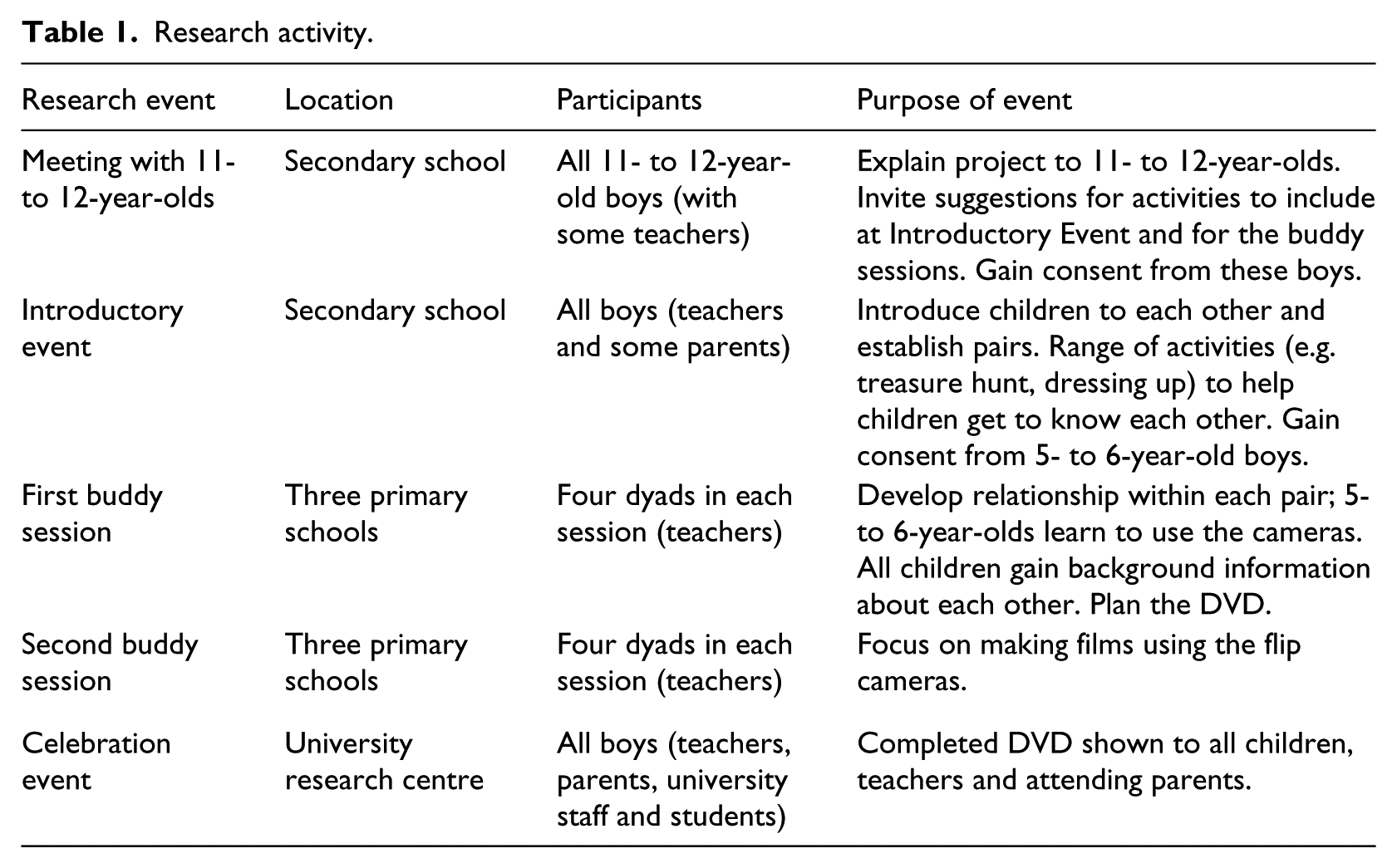
Having sought permission and consent from the teachers and parents, the two researchers initially met with all of the 11- to 12-year-old boys together at the secondary school. We introduced ourselves and the research study and explained that each boy would be paired with a 5- to 6-year-old ‘buddy’, with the eventual aim of each dyad contributing towards the creation of an information DVD that would help teachers and parents to understand more about the factors that influenced children’s engagement with reading.
This meant that the 11- to 12-year-old boys had a particularly important role in the research for a number of reasons. First, the purpose of creating a DVD was to allow all the children the opportunity to ‘inform’ the adult audience about their experiences, perceptions and beliefs, thus offering all of the children the role of ‘expert’ from the outset. However, in order to create films for inclusion on the DVD, the younger and older children needed to work together in activities that were directed by the 11- to 12-year-olds. This gave the older children the responsibility of nurturing relationships with the younger children as well as carrying out aspects of the research. For example, we suggested that the children interviewed each other about their experiences of learning to read. For the younger children, being interviewed by another child, even though the child was considerably older, meant that we were able to avoid having adults interviewing young children. However, and more importantly, the fact that the interviewer was a child himself (who had in the majority of cases attended the same primary school) meant that there was more common ground between the interviewer and the interviewee than there would have been if we adults had interviewed the children. In addition, the fact that the 5- to 6-year-olds interviewed the 11- to 12-year-olds meant that we were also able to include the ‘memories’ and perceptions of the older children about their own experiences of learning to read at primary school. Of course, the questions that the children asked each other were often as revealing and as interesting as the responses they offered. It must be recognised though that we did not consider the 11- to 12-year-olds to be co-researchers as such, but we did encourage them to take a fairly directive role in the whole process and offer their opinions about factors such as the content of the DVD. However, the overall research design remained the responsibility of the researchers.
The making of the DVD was a crucial factor in this study, as it gave each dyad a strong focus from the outset. The older boys were taught how to use the flip cameras during our initial meeting, so they could use the cameras themselves and teach the younger boys if necessary. The children were given opportunities to decide for themselves what they felt needed to be included in the DVD, but we did offer the following suggestions for inclusion: interviews about their experiences about learning to read, suggestions for texts that other children may like reading or have read to them, footage of children sharing books that they like, information for teachers about what encourages them and puts them off reading and suggestions for digital texts that other children may enjoy. Once the children had completed the two buddy sessions, the researchers edited the flip camera footage and collated the film into one information DVD. This DVD was shown at a celebration event at the end of the study, where all of the children and their teachers and parents were brought together.
Having observed the children as they worked together, using the video data itself alongside our observations of the children as they made the videos, it became increasingly evident that this participatory research technique was dependent on the relationship that was built between the younger and older children. Although, great care was taken at every opportunity throughout the research to provide opportunities for the boys to get to know each other and build their relationship, it was apparent that this methodological technique allowed the children to capitalise on this relationship. Having carefully observed how the children interacted with each other, we began to realise that three broad themes were emerging with regard to the ways in which the relationship facilitated the acquisition of data from the younger children. The next section explains how factors related to a shared understanding between the children, the use of the physical environment and the development of communication strategies, were all embedded within the relationship, which in turn promoted the acquisition of valid and useful data.
Building meaningful relationships
All of the 11- to 12-year-old boys were excited about meeting their young partner and took the partnership role seriously from the outset. They were keen to mentor, support and generally ‘look after’ the younger child; for example, during the Introductory and Celebratory events, many of the 11- to 12-year-olds were observed getting drinks and biscuits for their partner. From the very first meeting, the older boys seemed to take on a sense of responsibility and were gentle and caring in their manner when interacting with their partners. As a result, strong relationships were formed from the very beginning of the project, which had a profound impact on the study. The next section examines the ways in which this relationship facilitated the acquisition of quality data.
Shared understanding
The shared interests of the boys played a key role in deepening the relationships from the start of the research process. Popular topics for discussion were sports and food, and many of the boys drew upon these topics when chatting informally or interviewing each other for the DVD. Similarly, when it came to discussions about reading, the boys again seemed to draw on a shared understanding of what it meant to be a primary school child learning to read. For example, the following dialogue shows how Louie’s (age 11) understanding of textual difficulty helped Chris (age 5) to explain his interactions with joke books: I like reading jokes and I like telling people jokes and jokes are funny like (pause) and its kinda hard to read joke books cos you’re, when you’re like six or five you don’t know … (long pause). (Chris) lots of words that are there. (Louie) yeah, or if you’re four or three or two or one. (Chris)
This example shows how Louie was able to draw on his own knowledge of the format of joke books, in order to offer Chris support when he struggled to complete his response. This sense of shared understanding was evident in many exchanges between the children, but was especially apparent in connection to school-based reading. Having all experienced the process of learning to read, both younger and older boys were able to voice some of their frustrations and difficulties, in an honest and confident manner. For example, Toby (age 5) was reported asking his partner, ‘Why do they give me these books, they are for babies!’ It is particularly important to note that the partnership allowed this child to voice his frustrations, not just about the books, but the people who give him the books (presumably his teachers!) It therefore appears that the context of this conversation elicited honesty from this child that may not have been present if he were being interviewed by an adult. Similarly, Colin (age 12) told his partner that ‘primary school reading for me was a little bit easy and a little bit hard’, while Hamid (age 6) felt comfortable enough to admit that ‘Reading was a little bit hard because um some words I didn’t know and um some books were a little bit boring for me’.
The buddy partnership also seemed to provoke a feeling of empathetic understanding on the part of the older boys. This was illustrated when one of the older boys reported back on the interview he had conducted with his partner. He stated ‘The books that he gots, they are too babyish for him and he thinks that they are for girls – for example Rapunzel’. The fact that this boy is reporting that ‘the books are too babyish for him’, suggests a sense of agreement with the statement, and an understanding of the younger child’s frustrations.
There were also a number of occasions when it was clear that the 11- to 12-year-old boys had a far greater knowledge of the books that the 5- to 6-year-old boys were discussing, in comparison with the adults who were present. For example, when one of the researchers asked a group of children whether there were any books they would like to see at school, which they currently do not have, a 5-year-old boy (Jay) called out ‘I’ve got Last Airbender’. The researcher, unfamiliar with the title, asked whether he had said ‘Blast air-bender’ but was immediately corrected by three 11- to 12-year-olds who clarified, ‘Last Airbender’. (Hamid) It’s like a fiction book; they all have powers like air, water. (Jack) One’s water, earth and air and one controls earth against fire. (Malik)
The researchers later learned that the text that the children were discussing was Avatar: The Last Airbender, originally an American animated television series, where variants of Chinese martial arts are used to ‘bend’ the classical elements. However, it was clear from this account that this example of popular culture was extremely important to Jay, but it was not until these older boys not only clarified the title but also explained the context and its popularity, that the researchers were able to comprehend the significance of this text for Jay and others.
The fact that the 11- to 12-year-old boys entered the research situation with so much innate understanding about the lives and reading-lives of the 5- to 6-year-old boys meant that they were able to initiate and develop conversations with the younger children that may never have been possible for an adult. However, this was by no means the only advantage to this method, as now discussed.
Creating comfortable environments
Adult researchers, working with young children, often give considerable thought to the physical space that the research takes place in and strive to ensure that children are comfortable during the process. However, this present study demonstrated that the children seemed to naturally create very relaxed and comfortable environments when reading together and engaging in other research-related activities.
It became increasingly apparent that the older boys felt strongly that reading should be associated with ‘comfort’ and this was manifest in the environments they created when working with the younger children. This belief became evident during a mixed group discussion about reading at primary school when Joel (age 11) suddenly stated, When we were here (primary school) a lot of people like me, like didn’t really want to read, like, we were always like, stuck at a desk.
At this point, two other older boys interjected with,: You remember the comfy corner? (Colin) On the floor, comfy corner! (Hamid) Yeah, comfy corner, comfy corner! (Colin)
In addition, one other older boy described feeling ‘restrained to a desk’ and made the point that this prevented him from wanting to read at school. This may explain the fact that almost all of the 11- to 12-year-olds spontaneously took their younger partners to comfortable corners of the room (using bean bags, cushions or carpeted areas if available) when reading. On another occasion, the session took place in a school meeting room rather than a classroom, yet five out of the six pairs still chose to find small spaces on the floor to read, rather than sit on chairs.
These comfortable environments seemed to contribute towards the relaxed interaction between the boys. For example, one episode of film data shows four pairs of boys ‘snuggled’ against each other when sharing a book. Each of the pairs appears deeply involved in the activity and is not distracted by the camera. In three out of the four pairs, the younger child is holding the book and reading to the older child. In another video clip, five of the pairs are lying on the ground, with arms and legs touching naturally; younger boys climb over the older ones to get resources, and the older boys are observed leaning over the younger ones as they point out things in the books they are reading. As the children read together, there are also visible signs of relaxation and mutual enjoyment of the activity, such as laughter, conversation, close physical contact, smiling, nodding and regular eye contact.
This study demonstrated that the pairing seemed to promote the creation of comfortable and relaxed research environments. The older boys seemed to have an instinctive understanding of the younger boys’ needs in this respect, and they spontaneously and naturally created informal research spaces within the rooms in which they were working. Again, it seems unlikely that adult researchers would have been able to manipulate the research environment in quite the same way, without it feeling ‘staged’ – and therefore quite uncomfortable.
Moreover, it was also apparent that features of play and playfulness were evident throughout all aspects of the research process. In many ways, working with the 5- to 6-year-old boys seemed to offer the 11- to 12-year-old boys ‘permission’ to play, which they embraced with enthusiasm. During the initial introductory activities, the older boys both joined in and orchestrated role-play games, dressing up, paper-craft activity and playing with construction materials. This was not only highly enjoyable for the younger children but also contributed towards the creation of a relaxed and comfortable research environment.
Importantly, the inclusion of a playful attitude seemed to facilitate the acquisition of rich data from the younger boys. For example, as they read together, it was common to observe the children using ‘funny voices’ or walking their fingers over the book. In connection with the concept of ‘books and playfulness’, many of the boys (both age groups) spoke of enjoying what they called ‘finding books’: books that are covered in dense illustrations and invite the reader to find some object or character (Where’s Wally? is a classic example of this kind of text). On one particular occasion, two boys (Toby – age 5 and Max – age 12) were lying on the ground, searching for ‘monsters’ in a ‘finding book’. As they read the book, the boys chatted naturally, with Max suddenly asking Toby why he liked these kinds of books. Toby replied, ‘because it’s fabulous, I like finding stuff a lot, even I like Where’s Wally’. Having talked some more about the Monster ‘finding book’, Toby started talking about a reading scheme book called ‘Little Monster’; however, his feelings for this book were made evidently clear when he reported ‘It looks so boring. I don’t like right, right, right happy books’. This suggests that through the context of engagement in a relaxed and playful reading activity, this young child spontaneously offered some vital information about his perceptions of reading scheme texts.
Communication strategies
The project also revealed that while the older boys were able to interact in a playful and relaxed manner with the younger children, they were also able to use their communication skills effectively to encourage a depth of dialogue with their partners. Video data reveal numerous examples of the 11- to 12-year-old boys using techniques such as leading questions, gesture and prompts in order to encourage the younger boys to talk about their perceptions of reading. For example, when Tom (age 6) tells Deshi (age 11) ‘I don’t like reading cos I don’t like, I don’t like books’, the line of conversation could have ended there, however, as the following dialogue reveals, Deshi not only used skilled questioning to enquire more deeply about the kind of books that Tom did and did not like, he also offered prompts and suggestions to help the younger child to be more explicit:
What type of books don’t you like?
Peter Pan.
Peter Pan … mmm. Do you like fighting books?
Yes.
Do you like girl books?
Naaah (laughs).
Do you like story books?
A little bit.
Do you like running books?
shakes his head.
Do you like animal books?
No.
What books do you like?
I only like one book … a fighting book.
As expected, the 11- to 12-year-olds varied in their ability to use such communication devices. However, the invitation to be the older ‘buddy’ in the partnership seemed to encourage all of these boys to take on a role of responsibility that may not have been previously available to them. As a consequence, it seems likely that the structure of this project not only allowed the younger children to talk in ways that may not have been possible with an adult researcher but encouraged the older boys to develop and practise sophisticated communication skills for themselves.
Discussion and conclusion
This study revealed that the use of a buddy partnership between 5- to 6-year-old and 11- to 12-year-old children was a highly effective method in eliciting the voice of young children. In many ways, the success of this research technique can be attributed to the cultivation of a strong and unique relationship that was built between the children throughout the duration of the project. Therefore, this study strongly supports Waller and Bitou’s (2011) assertion that it is not the tools themselves that enable participation when working with young children, but ‘the research design and relationships that confer real participation and engagement’.
Given that the relationship between the children seemed to facilitate the acquisition of meaningful and honest data, this technique could clearly be used in other research situations. However, as Punch (2002) warned, it is important to scrutinise our participatory techniques and ensure that they are methodologically sound, rather than assume that they will be effective because they are ‘innovative’, ‘enjoyable’ or ‘child-friendly’.
In this article, we are arguing that the partnering of young children with older children was especially effective for the following reasons. First, although the 11- to 12-year-old boys clearly saw themselves as the ‘grown-up’ in the relationship, they were still children themselves. This meant that they were able to understand and empathise with many aspects of the younger children’s lives and experiences. The presentation of an empathetic and playful approach meant that these boys were able to communicate with the younger children on a level that suggested that a sense of genuine ‘shared understanding’ existed between the boys. While the adult researchers retained ultimate responsibility for the design and implementation of this project, they could not have replicated this kind of relationship with the children themselves.
Second, the fact that the older boys had recently left primary school was also an important factor and contributed towards the success of this research. Given that this study was designed to understand young children’s perceptions of reading, these boys were still close enough to their own primary education to be able to remember salient issues from their own experiences and draw on this when talking to their partners. However, as these boys had in fact moved to secondary school, they regarded themselves, and were indeed regarded by the younger children, as owning a facilitative role in the research. This meant that they not only enjoyed the sense of responsibility that came with the project but the research seemed to provide them with opportunities to develop and use a wide range of sophisticated communication skills and strategies in order to encourage the younger children to talk about their views and experiences.
In conclusion, this article has shown how ‘buddy partnership’ can be used in participatory research to access the voices of young children. This study only included boys; however, the findings suggest that this can be an effective technique to use with all children, regardless of gender of substantive content. However, this article has also demonstrated the importance of researchers taking time to scrutinise their methods and ensure that the participatory techniques that are designed allow for young children to have ‘real participation’ in the study. Above all, this article has focused attention on the crucial role that relationships play in participatory research. This is of course an issue for any researcher but remains a particularly salient issue for the researcher working with young children.
Footnotes
Funding
This project was jointly funded by The University of Sheffield and Sheffield Hallam University.