



Abstract
The Mathematical Development Beliefs Survey was developed to measure early childhood teachers’ beliefs about mathematics teaching and learning in the preschool classroom. This instrument was designed to measure beliefs concerning (a) age-appropriateness of mathematics instruction, (b) classroom locus of generation of mathematical knowledge (teacher vs child), (c) mathematical development as a primary goal of preschool education, and (d) confidence level in providing mathematics instruction. The reliability and validity of the instrument was examined through multiple phases of development, including two pilot studies and a final study with 346 pre- and in-service preschool teachers across three states. Methods included cognitive interviews with participants, literature reviews, and interviews with experts in the field, as well as statistical procedures such as analyses of variance between well-defined groups of in- and preservice teachers, correlations between measures of knowledge and beliefs, and confirmatory factor analysis. Reliability of the instrument was examined through the use of Cronbach’s alpha and item-total correlations. These statistical procedures provided very good to excellent support for both validity and reliability. Potential applications include informing development and evaluation of early childhood education teacher preparation programs and professional development interventions.
Keywords
Introduction
The purpose of this study was to develop a survey instrument that measures early childhood teachers’ beliefs about mathematics teaching and learning in the preschool classroom. The reliability and validity of the instrument was examined through multiple phases of development, including two pilot studies and a final study with 346 pre- and in-service preschool teachers across three states. The Mathematical Development Beliefs Survey (MDBS) is designed to measure teachers’ beliefs concerning (a) age-appropriateness of mathematics instruction, (b) classroom locus of generation of mathematical knowledge (teacher- vs child-centered), (c) mathematical development as a primary goal of preschool education, and (d) level of confidence in providing mathematics instruction.
The current view of many professionals in early childhood education (ECE) is that supporting early mathematical development is an important part of preschool curricula (Ginsburg et al., 2006). Extensive research over the past several decades suggests that we know what type of mathematics should be supported in the classroom (Baroody et al., 2006; Clements and Sarama, 2007; Ginsburg et al., 2008) and that teacher beliefs affect how and even whether such curricula are implemented (Copley and Padron, 1998; Lee and Ginsburg, 2007a, 2007b). However, validity-tested means to measure these beliefs are lacking. This study provides a tool to measure teachers’ beliefs about the teaching and learning of mathematics in their preschool classrooms.
Early childhood programs are increasingly required to implement mathematics instruction in classrooms. This policy emphasis on early mathematics instruction is due in large part to the understanding that participation in the modern world requires competence in mathematics, and that children’s early skills in mathematics provide the foundation for later learning (Baroody et al., 2006; Clements and Sarama, 2009; Duncan et al., 2007). Lack of early experiences that support mathematical development skills may lead to lower mathematical skill acquisition as well as lower overall educational attainment (Geary, 2000; Jordan et al., 2009; Organisation for Economic Co-operation and Development, 2010). Several research institutions have called for changes in the way early childhood teachers are educated in the domain of mathematics. Publications by the National Council of Teachers of Mathematics (NCTM), the National Association for the Education of Young Children (NAEYC), and the National Research Council (NRC; NAEYC and NCTM, 2002; NCTM, 2006; NRC 2000, 2009) recommend curricula that support young children’s mathematical development.
Research underscores two major challenges facing the ECE field regarding the support of mathematical development in the classroom of the young child: (a) a lack of effective teacher training in early mathematics (Baroody, 2004; Ginsburg and Ertle, 2008; Sarama and Clements, 2009) and (b) the effect of beliefs on the implementation of mathematics instruction in the early childhood classroom (Copley and Padron, 1998; NRC, 2009). The MDBS was developed to provide an instrument that measures beliefs that are known to affect implementation of mathematics in the early childhood classroom. The MDBS measures beliefs about the age-appropriateness and importance of the support of mathematical development in the preschool classroom. It also measures teachers’ beliefs about the locus of the generation of math knowledge (with the teacher or child, or both) and teachers’ confidence in related instruction. Researchers have repeatedly reported that these specific beliefs influence how and whether teachers implement instruction in their classrooms (Brown, 2005; Copley, 2004; Ginsburg et al., 2006, 2008; Sarama et al., 2004).
While past studies on teacher beliefs have provided us with valuable information, validation of multiple dimensions of beliefs known to influence classroom teaching practices was not the primary purpose of these studies (Kowalski et al., 2001; LeFevre et al., 2009; Sarama et al., 2004). This study’s contribution to the field is a psychometrically evaluated survey instrument that measures early childhood teachers’ beliefs about mathematics teaching and learning in the preschool classroom.
Theoretical framework
Beliefs serve as a filter for teachers’ teaching experiences and actions (Hofer, 2001; Muis et al., 2006; Pajares, 1992) and are not easily measured as they are not visible and may not be explicitly known to the individual who holds them. One way of understanding a person’s beliefs is to provide him or her with statements from which beliefs can be inferred, providing an opportunity to express degree of agreement or disagreement (Pajares, 1992). For example, if a teacher strongly agrees that children primarily learn through didactic mathematics teaching at the chalkboard, it could be inferred that he or she more than likely believes that teachers hold a great deal of the responsibility for the generation of children’s mathematical knowledge in the classroom setting.
Beliefs directly affect teachers’ classroom practices from curriculum implementation to changes in pedagogy (Fang, 1996; Ginsburg et al., 2006; Kagan, 1992; Stipek et al., 2001). It has been suggested that if any professional development, intervention, or preservice course is to be successful, then teachers must “buy into” the program. Increasing teacher support for children’s mathematical development requires more than just presenting new curricula to teachers (Klein et al., 2011).
Program administrators and instructors need to understand the beliefs of the teacher population they serve in order to design effective courses that address content, beliefs, and pedagogy. Researchers need to ascertain if teachers’ beliefs have changed through an intervention or educational program in order to evaluate the impact of the program on teachers’ beliefs and practices.
Measures of teachers’ beliefs
There are relatively few studies on preschool teachers’ beliefs about mathematics teaching and learning (Copley, 2004; Ginsburg et al., 2006; Sarama et al., 2004), in particular when compared to studies on elementary school teachers’ knowledge and beliefs about mathematics instruction (Franke et al., 2001; Ma, 1999; Philipp et al., 2007). However, over the past 20 years, several scholars have laid important groundwork in this domain (Kowalski et al., 2001; Lee and Ginsburg, 2007b; LeFevre et al., 2009; Sarama et al., 2004). While these studies have increased our knowledge in the field, the instruments used in the research have not undergone rigorous evaluations of their validity and reliability across a wide spectrum of early childhood teachers.
Belief dimensions
A number of beliefs have been identified as being important in determining whether mathematics instruction is implemented in early childhood classrooms. These beliefs generally fall into the following categories: (a) age-appropriateness of mathematics instruction, (b) classroom locus of the generation of mathematical knowledge (i.e. teacher vs child), (c) socio-emotional versus academic (specifically mathematics) development as primary goals of preschool education, and (d) teacher confidence in mathematics instruction. In the following sections, I will discuss each of these belief dimensions that affect how and whether mathematics instruction occurs in the classroom.
Age-appropriateness of mathematics instruction
Researchers have examined how teachers’ beliefs about the age-appropriateness of mathematics instruction affect their support of mathematics development in the preschool classroom (Sarama and Clements, 2009). Research over time has been dominated by a trend toward an appreciation of children’s mathematical competence. For decades, educators have debated the age-appropriateness of mathematics instruction (Ginsburg and Golbeck, 2004). These debates have generally been framed in the context of developmental appropriateness—are children developmentally ready for mathematics in preschool? As an example of early thinking on children’s mathematical abilities, Maffei and Buckley (1980) argued that perception drives preoperational children’s thinking, limiting their ability to reason. However, in the last three decades, research has demonstrated young children’s mathematical competence and capacity to learn. Observations by Greenes et al. (2004), some 25 years later, on their mathematics program for 4- and 5-year-olds indicated that during the play of mathematical board games, children considered both alternative moves and their consequences. These observations refer to a board game in which players are required to count the number of sides of a shape in order to move their pieces. Toward the end of the game, in order to know whether a particular shape is beneficial to their advancement on the board, players must count how many spaces are necessary to win the game and then subtract the number of sides on the prospective shape. This ability not only to determine the numerosity of the sides of a shape but to plan future moves based on this numerosity belies Mattei’s and Buckley’s stated constraints on young children’s mathematical thinking. In the past decade, several publications have supported the idea that children are capable of substantive mathematical understanding (Baroody et al., 2006; Ginsburg and Amit, 2008; Klein et al., 2011; Sarama and Clements, 2009). Evidence from teacher focus groups and detailed questionnaires indicates that age-appropriateness is a concept that continues to influence teachers’ implementation of mathematics instruction in the classroom (Ginsburg et al., 2006).
Classroom locus of generation of mathematical knowledge
Researchers have found that teachers’ beliefs about who is responsible for children’s learning of mathematics are related to how teachers provide support for learning in the classroom. Some teachers believe that children are solely responsible for the construction of mathematical knowledge, and thus, they view their teaching responsibilities as providing children with a stimulating environment and nurturing learning and express no interest in active teaching (Ginsburg et al., 2006) or that all activities should be child initiated (LeFevre et al., 2009). In contrast, some teachers believe that it is the teacher’s responsibility to set mathematical goals for young children (Lee and Ginsburg, 2007b). This polarity has implications for classroom instruction.
Mathematical development as a primary goal
Teachers vary in what they perceive to be appropriate goals of preschool. Some view the role of socialization to be the priority in preschool (Lee and Ginsburg, 2007a), while others view preschool as a time for stressing academics and feel that mathematical experiences in preschool are of top priority. In LeFevre et al.’s (2009) study of over 700 child-care providers, teachers, and administrators, the majority (74%) agreed or strongly agreed “that social and emotional development is the primary goal of early childhood education” (p. 65).
Two theoretical positions dominate this debate. The first is that academics should be saved until primary school, and that social and emotional development is of prime importance at this age (Elkind, 1997). The second position, that children are willing and able to benefit from early mathematics instruction, is held by many researchers who study early mathematical development (Baroody et al., 2006; Clements and Sarama, 2007; Fuson, 1988; Fuson et al., 2001; Geary, 2000; Greenes et al., 2004; Griffin, 2004; NRC, 2009). Finally, some longitudinal research suggests that both socio-emotional and academic development appear to be important outcomes and, therefore, goals of preschool (Hooper et al., 2010; Peisner-Feinberg et al., 2001). These beliefs may be related to those regarding the age-appropriateness of support for mathematical development in the classroom. Many who state that socio-emotional development is the primary goal of preschool also state that academic goals, such as mathematical development, are inappropriate for preschool-aged children and are better left for the elementary years (Ginsburg and Amit, 2008; Kowalski et al., 2001).
Confidence in mathematics instruction
Teachers’ confidence, or lack thereof, in their ability to teach mathematics appears to affect even their choice of occupation: “I was never good at math … that’s one of the reasons I chose early childhood … I don’t have to know math …!” (Copley and Padron, 1998: 3). Early childhood teachers are often uncomfortable with mathematics and lack information about mathematics standards (Sarama et al., 2004).
Research in the field of motivation suggests that perhaps one of the reasons that teachers do not teach mathematics in the preschool classroom is fear of failure (Wigfield and Eccles, 2002). For a teacher who feels he or she is not good at math, developing mathematics activities in the classroom may threaten their self-esteem. Covington and Beery (1976) suggest that one option in the face of such a threat, that is, avoidance, is frequently chosen. By implication, if no attempt is made to teach mathematics, feelings of incompetence can be avoided. Support for this point of view is evident in the results of a 5-year study of preservice early childhood teachers who report feeling more comfortable teaching reading and other language-related skills and express the belief that teaching mathematics is difficult (Copley, 2004).
Methods
The MDBS was developed over the course of four distinct phases, including a development phase, the administration of two pilot studies, and a final validation study. Pilot Study A consisted of cognitive interviews with 10 respondents on draft versions of the survey and draft survey completion without cognitive interviews with an additional ten respondents. Pilot Study B consisted of the completion of a refined draft of the survey by 55 respondents. The validation phase was conducted with 346 respondents using the final set of 40 revised items.
Item development
The rationale for selecting the items for the MDBS was drawn from three sources: (a) current research on teacher beliefs that influence classroom mathematics instruction, (b) actual statements and concerns of teachers, as reported in studies or anecdotal reports, and (c) activities that have been reported or observed in early childhood settings (Fuson, 1988; Ginsburg et al., 1999; Greenes et al., 2004; Klibanoff et al., 2006; Nunes and Bryant, 1996).
The steps in the development phase of the instrument included the creation of construct maps for each of the four belief dimensions (a series of statements/items that encompass the spectrum from one pole to the other extreme—for example, “Preschoolers are capable of learning math” to “Math is too hard for preschoolers”). The initial version of the MDBS contained 71 items, an average of 18 items per construct. It was expected that some items would be eliminated through the development and refinement of the instrument.
Format and design
Given the type of constructs and proposed uses of the MDBS, a six-point Likert scale (strongly agree, agree, somewhat agree, somewhat disagree, disagree, and strongly disagree) survey format was supported as the most appropriate by the literature (Dillman, 2007; Wilson, 2005). Likert scale surveys have the following features suitable for measures of the beliefs of large samples of teachers and prospective teachers: (a) simplicity of administration, (b) utility in various types of applications, and (c) ease of analysis. Given these requirements, more labor-intensive instruments are not advisable as they cannot easily be administered, scored, or analyzed and their use is costly and time consuming.
Validity and reliability
In this study, the method of establishing concurrent validity involved the use of contrasting groups. The logic is that individuals considered to have attained a higher level of knowledge (e.g. completed more semesters of instruction) than another group should be expected to score higher on an instrument that measures such knowledge. It was expected that mean scores for the four belief dimensions would differ by cohort (described later). Many researchers express the hope that higher qualifications, including more mathematics education training (Ginsburg and Ertle, 2008; NRC, 2009; Sarama and Clements, 2009), will affect both the beliefs that teachers hold about supporting mathematical development in the classroom and their practices therein. As teacher experience, education, and knowledge about children’s mathematical development increase, it could be expected that respondents were more likely to (a) view mathematics instruction as age-appropriate, (b) view both the teacher and child as classroom loci of the generation of mathematical knowledge, (c) indicate a belief in the importance of supporting mathematical development, and (d) report higher confidence in providing mathematics instruction in the preschool classroom. If analyses showed differences between cohorts, this would provide concurrent validity evidence that the items in each of these belief dimensions are representative of the construct. In order to establish cohorts with well-delineated boundaries that exemplify these differences in knowledge and experience, three cohorts were defined: (a) Cohort 1: preservice teachers with no ECE or experience at the beginning of their education and career, (b) Cohort 2: in-service teachers with two or more years of early childhood teaching experience and at the end of a 4-year ECE program, and (c) Cohort 3: in-service teachers with two or more years of early childhood teaching experience, enrollment in a master’s program, and exposure to an early math development course.
Knowledge in a subject domain can affect beliefs about the teaching of subject matter. An example of this relationship would be the expectation that those students with more knowledge about early mathematical development would also have more confidence in their mathematics instruction. Therefore, an analysis that correlated MDBS belief dimensions with a measurement of teacher knowledge of early mathematical development was judged to be useful. The Knowledge of Mathematical Development (KMD) Survey (Platas, 2014), a measure of teachers’ knowledge of young children’s early mathematical development, was developed by the author (simultaneously evaluated for validity and reliability). The KMD Survey was designed to measure pre- and in-service teachers’ knowledge about how children develop in the domain of early mathematics. The rationale for selecting the items for the KMD Survey was based on two premises: (a) the items included should reflect current established and researched knowledge on the mathematical development of young children and (b) the items included should reflect activities that can and do occur in early childhood care settings.
Construct validity for this study was investigated through conversations with experts in the field, a thorough literature review, and cognitive interviews. Construct maps were constructed to organize this information (Wilson, 2005). Each of the four construct dimensions extends from one pole to another. Age-appropriateness extends from very appropriate to not at all appropriate, classroom locus extends from teacher to child, goals from exclusively mathematic to exclusively socio-emotional, and confidence level from apprehension to very confident. Finally, confirmatory factor analyses (CFAs) were performed to further examine the structure of these constructs.
Reliability was assessed in this study with measures of internal consistency, including Cronbach’s alpha and item-total correlations. Reliability, as measured by Cronbach’s alpha, increases as interitem correlations increase and is measured by the extent to which the items on the surveys measure the same construct or content (Kaplan and Saccuzzo, 2005: 112).
Data sources
This section of the article is divided into three subsections. The first two are descriptions of the Pilot Studies A and B. These preliminary studies served to refine the instrument through item development as well as elimination of items that did not contribute significantly to validity and reliability. The third subsection describes the validation study, and examines the validity and reliability of the revised instrument.
While pilot studies can be costly, both in terms of time and money, they are an indispensable part of instrument design (Van Teijlingen and Hundley, 2001). Pilot Study A used an iterative method of refining 71 proposed items through interviews with 10 of the respondents. In all, Ten additional respondents were added to this early developmental pilot study to estimate statistical significance in the reliability of the instrument. Pilot Study B, with the 56 revised items, was conducted with 55 respondents in order to further examine reliability among a wider professional range of respondents.
Pilot Study A
The respondents were 20 adults, divided into two groups of 10. Respondents in the first group participated in cognitive interviews as they completed the surveys, and the second group completed the surveys without a cognitive interview. Participants had varied educational and professional backgrounds (from a preschool teacher with 24 units in ECE to a PhD student in a graduate school of education with extensive preschool and early mathematics assessment experience).
The 10 respondents participating in the cognitive interview were informed of the four belief dimensions to be measured and shown the construct maps. In addition, brief verbal descriptions of the constructs were provided. The respondents then read each item, checked the box that most aptly described their agreement/disagreement with the item, and asked questions if an item was unclear in any way.
Pilot Study B
Pilot Study B was designed to produce reliability estimates with a larger subject sample and extend the applicability to a wider population. The participants were 55 adults in five classes at three community colleges who were attending a beginning core ECE course. The MDBS contained an average of 13 items per construct, for a total of 56 items.
Validation study
Participants were recruited from community colleges and universities in three states using a stratified purposeful sampling method. These groups included pre- and in-service teachers with varying professional qualifications as described earlier. This method provides for the capturing of specific desired variables of particular subgroups of interest.
Participants were recruited from classrooms in California community colleges, California state universities, and universities with masters’ programs in ECE. In the community colleges, only students in beginning core courses were recruited. At the California state universities, students in both beginning core courses and advanced third- and fourth-year courses were recruited. At the masters’ level, students currently at the close of a mathematical development course or who had recently completed a mathematical development course were recruited.
All three of the mathematical development courses emphasized theories of mathematical development and teaching, understanding of young children’s mathematical thinking, and the development of activities based on those theories and that understanding. These courses were semester-long and carried a unit load of three credits. Contrary to this, exposure to knowledge of mathematical development at the community colleges and state universities included very limited textbook discussion or classroom interaction in child development or general curriculum courses.
Participants included students from four community colleges in the San Francisco Bay Area, three California state universities, and three masters’ programs in two states (western and eastern United States). In order to create the three cohorts, demographic information on ECE experience, ECE education, and exposure to early mathematical development courses was needed. A Demographics Questionnaire was created to obtain this information from the participants upon their completion of the MDBS. Table 1 lists pertinent demographics of the respondents.
Validation study demographics.

The validation study surveys were administered and collected in person by the author at the end or beginning of class time. For all recruits, a gift certificate of US$10 was offered as an incentive. Students were assured that the instructor would not be informed regarding participation/non-participation. Return rate for completed surveys by students present averaged 97 percent.
Results
The following subsections describe and discuss the results of each of the three studies. For each, validity and reliability estimates will be examined as applicable.
Pilot Study A
Validity
The results from the cognitive interviews informed a number of changes in the MDBS. First, the respondents did not consider 8 of the original 71 items to be part of the belief dimensions, and thus, these items were eliminated. These items were found to be related to the construct, but not directly indicative of the belief. Second, respondents recommended revisions in the format or sequence of items.
Reliability
For all of the MDBS belief dimensions, Cronbach’s alpha was .76 or greater. All the alphas indicated acceptable reliability estimates (Wiersma and Jurs, 2005). In summary, the results demonstrated the promise of the MDBS and information on item quality. The survey was restructured with 56 of the items from Pilot Study A.
Pilot Study B
The purpose of Pilot Study B was to produce reliability estimates with a larger sample and extend the range of the population. Validity was not examined in this phase. Similar to Pilot Study A, all reliability estimates in Pilot Study B fell well within accepted levels of reliability estimates.
Based on the reliability analyses, the number of MDBS items was reduced from 56 to 40 to create a more manageable instrument for respondents in the final validation study. Items were dropped by deleting items that decreased alpha levels and items that were semantically similar to other items in the survey. Abbreviated versions of the items are in Figure 1. Copies of the instrument are available from the author.
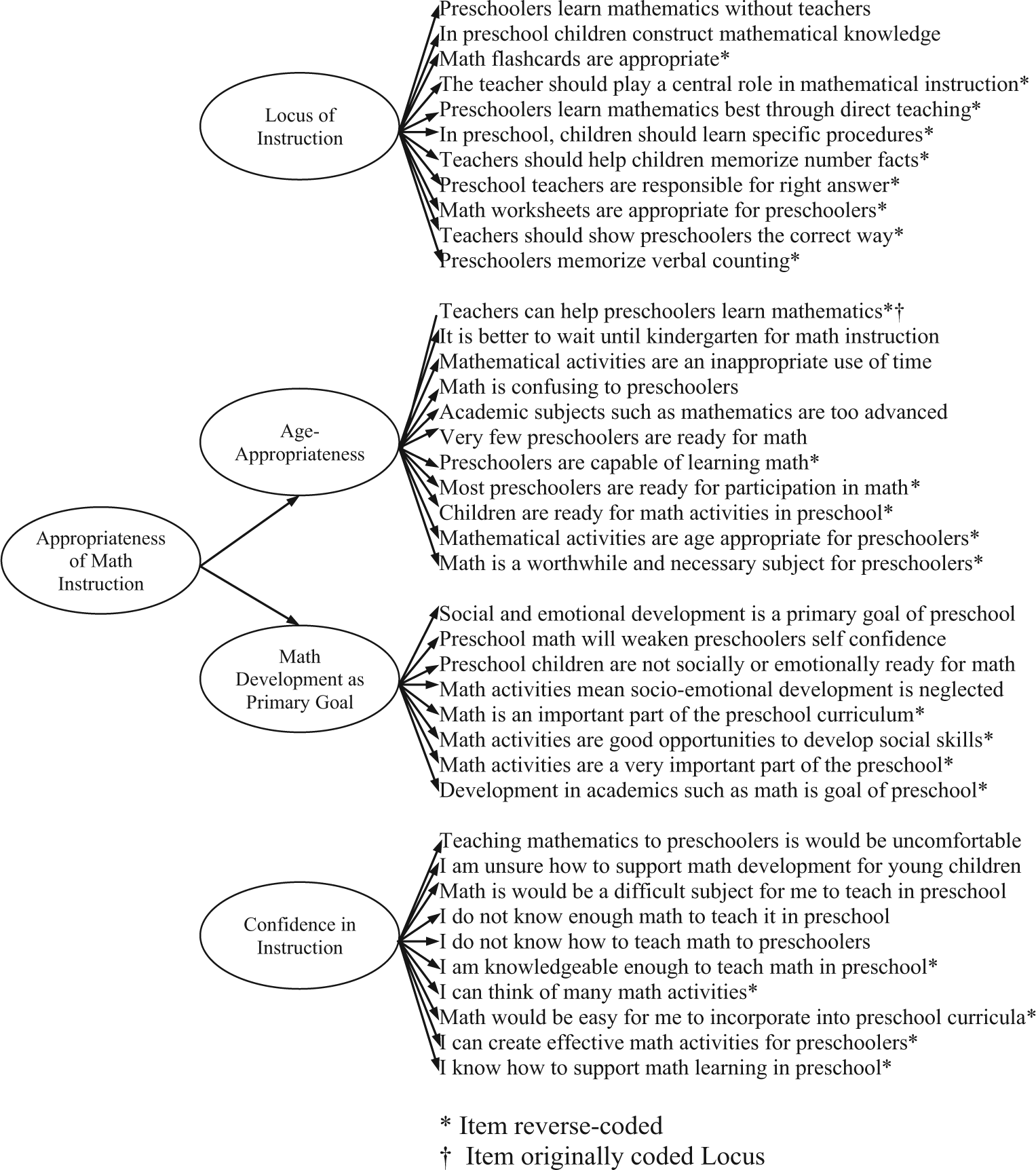
Second-order model.
Validation study
Validity
To examine the structure of the instrument as a whole, CFAs were conducted. An initial exploration of factor loading on the four dimensions suggested that one item on the locus dimension (“Teachers can help preschoolers learn mathematics”) was a better fit on the age-appropriate dimension (r = .11, p = .065 as compared to r = .65, p < .001). Therefore, for all analyses reported, this item was included in the age-appropriate dimension.
A correlations matrix was examined for evidence of correlations between constructs. Age-appropriateness of mathematics instruction and mathematical development as a primary goal were fairly highly correlated (r = .87, p < .001). Correlational analyses of the other dimensions showed either a moderate correlation or none at all (r2 estimates range from .001 to .386), indicating that they do not measure identical constructs.
Three models were examined using CFA: (a) the initially proposed four-dimension model, (b) a second-order model with the dimensions age-appropriateness of mathematics instruction and mathematical development as a primary goal loading onto a second-order factor titled appropriateness of mathematics instruction in the preschool classroom, and (c) a three-factor model with the correlated dimensions Age-appropriateness of mathematics instruction and mathematical development as a primary goal combined into one factor (Figure 1 illustrates the second-order model). For all of the factors in each of these models, all but one item was significantly correlated at p < .001 (the locus of instruction item “In preschool, children construct their mathematical knowledge without the help of a teacher” was correlated at an acceptable <.002). Factor loadings for all items are available from the author.
Table 2 illustrates the fit indices for these three models. As shown, all three models indicate almost identical fit. Because of the correlation between age-appropriateness of mathematics instruction and mathematical development as a primary goal, and research suggesting that teachers frequently think of these two factors as related (i.e. socio-emotional support is more age-appropriate than mathematical instruction in the preschool classroom; Ginsburg and Amit, 2008, Kowalski et al., 2001), the second-order model seems most appropriate.
Confirmatory factor analyses comparison.
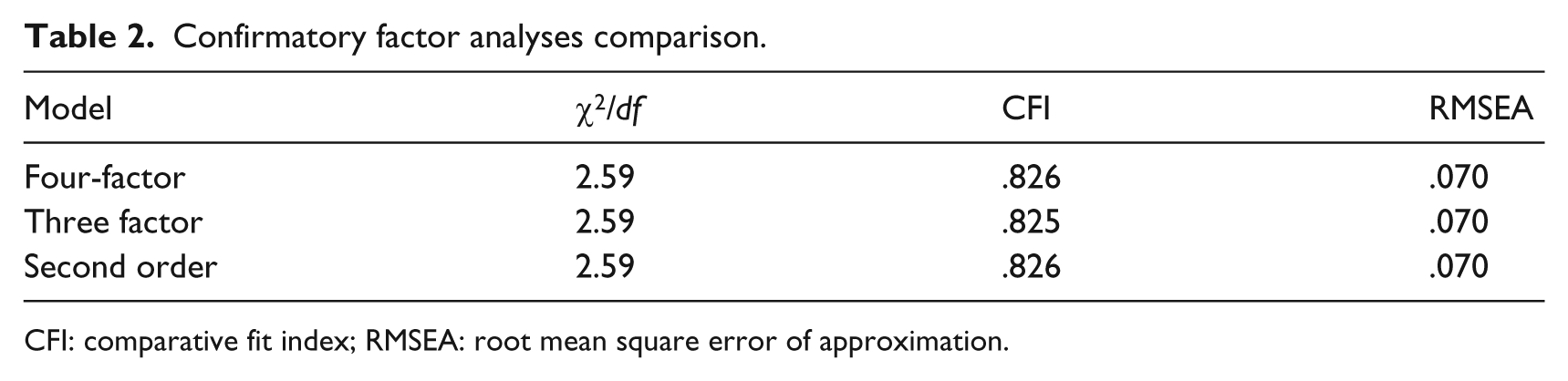
CFI: comparative fit index; RMSEA: root mean square error of approximation.
One-way analysis of variance (ANOVA) was used to compare mean scores of each of the four MDBS dimensions by cohort group. These means were created for each respondent by adding the scores for each item within a belief dimension (e.g. age-appropriateness of mathematics instruction) and dividing by the number of items in that dimension. The F-test for each of the belief dimensions was significant (p < . 001), signifying that the cohort means within each belief dimension were significantly different.
Table 3 contains the results for the cohort means (Likert scale of 1–6) for each of the belief dimensions as well as the significance of the difference between the means. Differences between Cohort 3 and the other two cohorts were significant for all belief dimensions.
Cohort means for belief constructs and significance of differences between means.
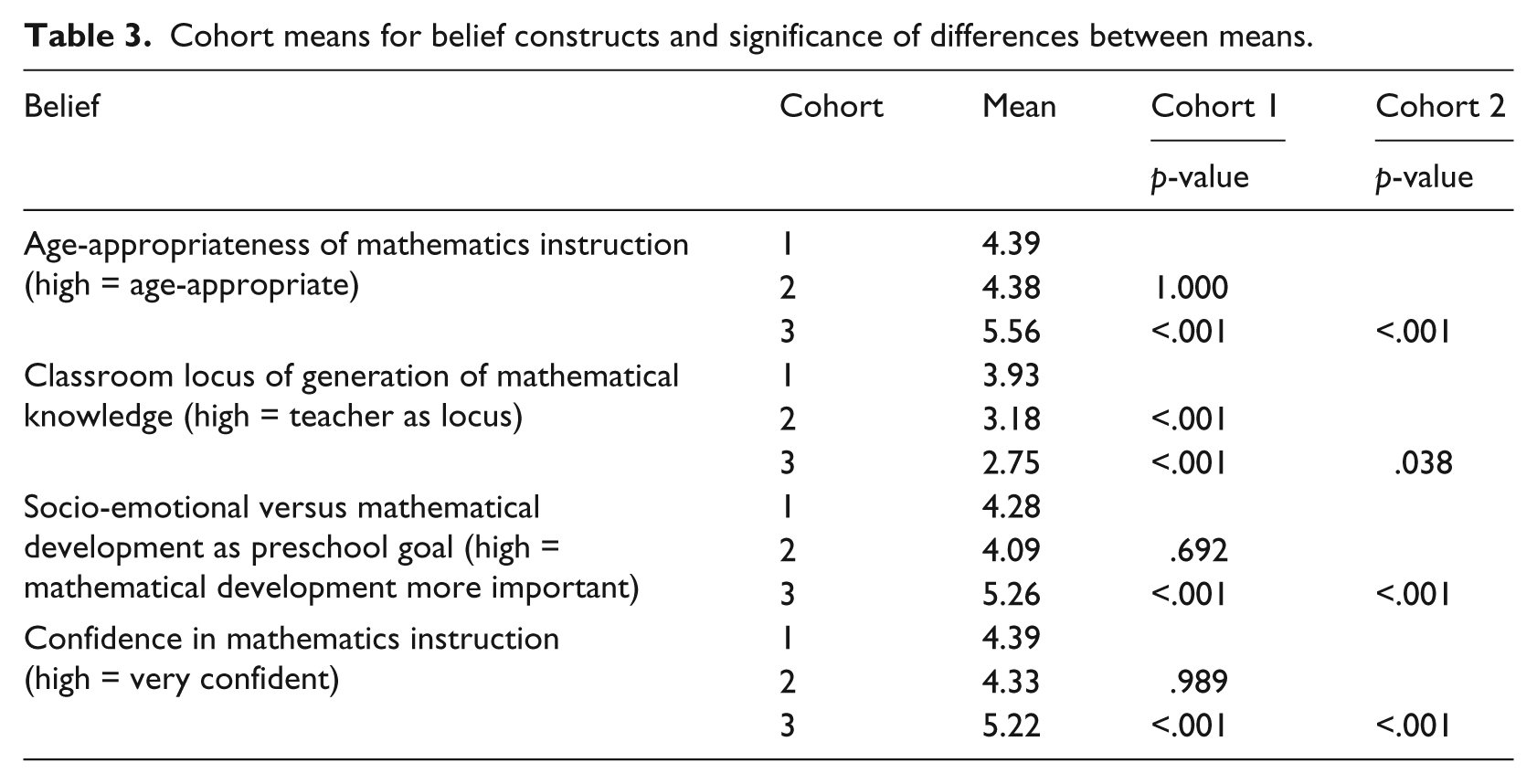
These results indicate that those respondents with the most experience, ECE education, and exposure to a mathematical development course were significantly more likely to indicate (a) that mathematics instruction was age-appropriate, (b) that the classroom locus of the generation of mathematical knowledge lies with both teachers and children (as opposed to just teachers), (c) that mathematical development is an important goal of preschool, and (d) that it increased confidence in supporting mathematical learning in the classroom.
In addition, for classroom locus of generation of mathematical knowledge results suggest that, with increasing experience and education, respondents were significantly more likely to express a belief that classroom locus lies increasingly with the child: Cohort 3 expressed a belief that the classroom locus lies almost directly in the middle of the child and the teacher (mean of 2.75), and Cohorts 1 and 2 expressed a belief that it lies primarily with the teacher (means of 3.93 and 3.18, respectively).
Correlation analyses indicate that dimension means correlated with the KMD Survey total score. Specifically, as respondents’ KMD Survey total score increased (and thus their knowledge of mathematical development), respondents were more likely to (a) view mathematics instruction as age-appropriate (r = .34), (b) view both the teacher and child as classroom loci of the generation of mathematical knowledge (as opposed to primarily the teacher; r = −.33), (c) indicate a belief in the importance of mathematics as a preschool goal (r = .26), and (d) report higher confidence in providing mathematics instruction in the preschool classroom (r = .25; all ps < .001). These results provide further support for concurrent validity in that scores on one instrument (MDBS dimension scores) predict scores on another (KMD Survey).
Reliability
As noted in Table 4 indices, all Cronbach’s alphas fell well within accepted levels of reliability estimates. These results, along with the satisfactory alpha estimations from Pilot Studies A and B, provide significant support for the reliability of the MDBS dimensions.
Cronbach’s alpha for validation study.
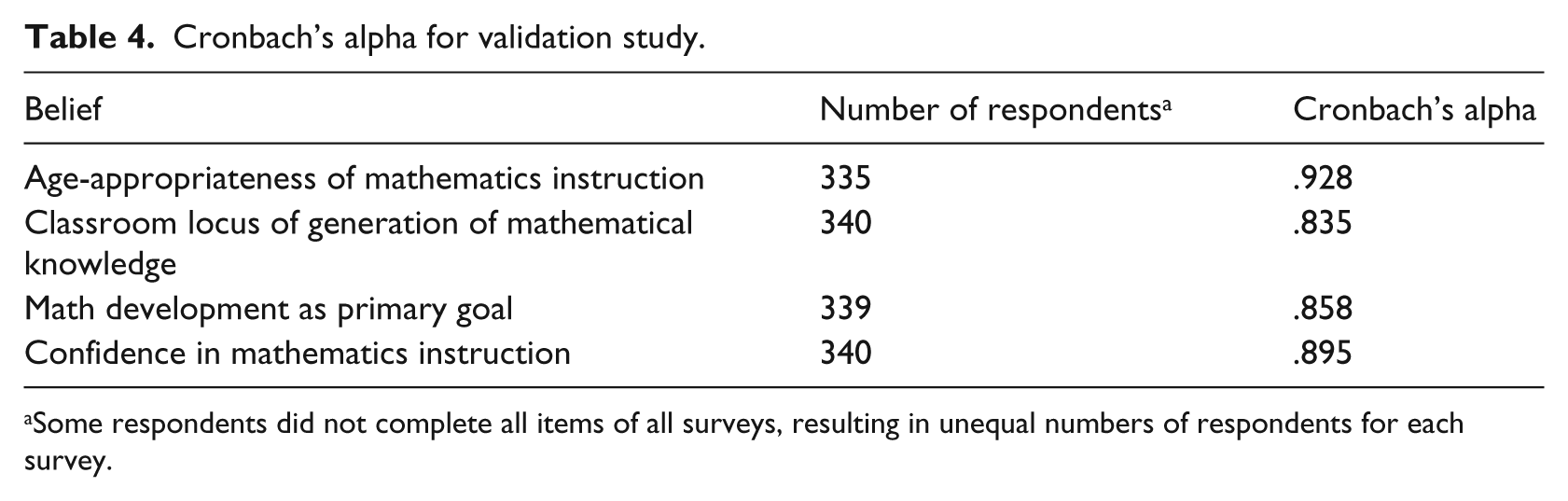
Some respondents did not complete all items of all surveys, resulting in unequal numbers of respondents for each survey.
Discussion
Overall, the validation study statistical analyses show very good support for both the validity and the reliability of the MDBS. These results, taken with the support provided by the results for Pilot Studies A and B, provide evidence that the MDBS provides a validity-tested measurement of teachers’ beliefs.
As predicted, MDBS dimension mean scores differed by cohort. Concurrent validity was also supported by correlations between respondents’ total KMD Survey score and their MDBS dimension mean scores. There is strong support for the four belief dimensions in the literature and in several of the analyses reported here, thus a second-order model where both age-appropriateness of mathematics instruction and the primacy of math instruction in the classroom loading onto a higher-order factor representing appropriateness of math instruction in the preschool classroom appears to be an appropriate model.
Cronbach’s alpha scores for the four belief dimensions ranged from .84 to .93 and are considered more than adequate for educational research. These scores provide evidence that the MDBS is a reliable instrument in the measurement of the four belief dimensions under study. Thus, the analyses included in this article represent important steps in the establishment of reliability and validity for the MDBS.
Conclusion and scientific importance of study
The purpose of this study was to design and examine the validity and reliability of an instrument that measures early childhood teachers’ beliefs about mathematics instruction in the early childhood classroom. The findings demonstrated that the MDBS has promise as a tool for informing the design and evaluation of ECE courses and programs. The instrument also has future utility in large-scale research comparing the effectiveness of pre- or in-service programs in changing the beliefs of varying populations of teachers.
While measuring validity and reliability was the primary goal of this study, an examination of the results of the ANOVA and correlational analyses can add to the discussion of the utility of the MDBS. These results are supported by the literature on teacher beliefs (Copley and Padron, 1998; Ginsburg et al., 2006; Lee and Ginsburg, 2007b). The mathematical development courses, through exposure to the extensive literature on children’s considerable early mathematical abilities, appeared to encourage belief in (a) the age-appropriateness of math instruction, (b) the classroom balance of child-initiated and teacher-supported activities, and (c) the importance of mathematical development (as opposed to only socio-emotional) as a primary goal of preschool. These same courses appear to provide abundant opportunities for teachers to hone their skills in creating developmentally appropriate mathematical activities for the classroom and increase their confidence in supporting mathematical development throughout the classroom environment.
There are limitations to all studies. In this study, it is important to note a possible confound of education level in Cohort 3. The only differences between Cohorts 2 and 3 are a mathematical development course and enrollment in a master’s program. The assumption is that the mathematical development course is related to teacher beliefs about the teaching and learning of mathematics. However, it is possible that those students who are admitted to a master’s program are, with regard to beliefs about the teaching and learning of early mathematics, in some ways fundamentally different from those who are finishing a bachelor’s program. It is unlikely that, given the overall lack of emphasis on mathematical learning and teaching in the field as a whole, simply being admitted to a master’s program changes one’s beliefs about teaching and learning mathematics in the preschool classroom. However, the only way to ascertain whether education level truly is a confound would be to sample bachelor’s ECE students who have taken a three-unit course devoted solely to mathematical development (although these courses are rare) as well as master’s ECE students who have not taken a mathematical development course.
While it was not possible to conduct classroom observations (many subjects were not yet in classrooms), future validation and reliability studies of this instrument should include additional analyses and concurrent validity measures. To that end, a recently published study examined 38 preservice teachers’ MDBS scores before and after an intervention involving clinical interviews with children between the ages of 5 and 8 years (Rosenfeld, 2010). Results indicated significant changes in all MDBS dimension scores following the intervention.
Major US policy stakeholders in early education have issued statements concerning the importance of including mathematics education in early childhood curriculum. As ECE programs build the infrastructure to support teachers in this endeavor, the use of the MDBS could play a role in this enterprise at multiple levels of the educational system: (a) instructors could use the instrument to measure the beliefs of students at the beginning of a semester or professional development workshop to inform instruction, (b) ECE programs could survey a cohort of students to inform the development of the content of a mathematical development course, and (c) researchers investigating teacher interventions could use the survey to compare outcomes of control and treatment groups. The use of psychometrically examined surveys, such as the MDBS, could provide results that can be replicated and minimize risk of measurement or design bias.
Footnotes
Declaration of Conflicting Interests
The author(s) declared no potential conflicts of interest with respect to the research, authorship, and/or publication of this article.
Funding
The author(s) received no financial support for the research, authorship, and/or publication of this article.