



Abstract
Working methodologically and theoretically with the hydro-logics of bodies of water, this article addresses the limitations of humanistic perspectives on water play in early childhood classrooms, and proposes pedagogies of watery relations. The article traces the fluid, murky, surging, creative, unpredictable specificities of bodies of water that enter an early childhood classroom during a collaborative ethnographic project with young children and early childhood educators.
Watery relations in the classroom
At a time of rapid species extinction, colonialist resource extraction and environmental crises, water has become a topic of debate in the land we now call Canada. Among critical feminist circles (Andrijasevic and Khalili, 2013; Chen et al., 2013 O’Reilly et al., 2009), these discussions point toward the need to care for ‘bodies of water on this planet’ (Neimanis, 2013: 163) politically and ethically. ‘Bodies of water’ include not only oceans, rivers, lakes and streams, but all of those ‘other human, animal, vegetable, geophysical and meteorological bodies that also comprise water’ (p. 24). ‘We are all’, Astrida Neimanis reminds us, ‘bodies of water’ (p. 24). Reimagining oneself as a body of water opens possibilities to address ‘the need to cultivate more ecologically responsible relations to water’ (Neimanis, 2013: 24).
In the unceded First Nation territories of what we call British Columbia, bodies of water are not strangers in early childhood education spaces. We use water many times daily to wash children’s faces and hands as well as toys, tables and other surfaces. We water the plants we keep inside the classroom and the gardens we grow outside in the summer. We cook our meals with water. Jars of fresh drinking water are placed on tables and passed around during lunch and snack times. Early childhood centres prepare for imminent earthquakes that might bring tsunamis. During our short summers, water becomes a staple for outdoor play as children are encouraged to explore water freely. In the rainy season, playing with raindrops and in puddles is a favourite pastime. Throughout the year, educators place water in the classroom water table with a multitude of other materials (straws, measuring cups, colanders, funnels, droppers and more). Water flows through pipes and intricate structures where children discover what water can do. As Gross (2012) writes in Dimensions of Early Childhood, ‘water is the source of life and, as such, can provide almost unlimited learning’ for young children (p. 4). Experiments with sinking and floating, making bubbles of all colours and sizes, measuring, observing, creating water mixtures and solutions, and studies of evaporation are among the most common ways in which water is managed for children’s learning. Water lives in early childhood pedagogies.
As familiar as we are with water in the early childhood classroom, last year we embarked with a group of children and early childhood educators 1 on an experiment to encounter bodies of water as strangers in a classroom in Coast and Strait Salish territories on Vancouver Island. Our goal was to think with water. In this article, we offer stories that flowed from, flooded, contaminated and froze our thinking with water. During our explorations and again while writing this article, we tried to live with water. We noticed many interesting things about water. We looked at raindrops on the window, and we noticed that water both reflects and diffracts. We could see ourselves in the water, yet what we saw was not the same; the image came back distorted as something else. Once a week for 2 months, we walked together to a large pair of lakes, named Beaver and Elk by settlers. Standing on the shore, we watched water hit the rocks and diffract, and we noticed that the waves bend and form other waves. We employ these and other movements and doings of water as our article’s methodology. The article is not a description of our project on water, nor an outline of what children learned during our investigations, nor a discovery of how educators changed their pedagogies. Instead, we follow water as it converges with the water–child encounters we include. We attend to what might come back, change direction, bend, reflect, diffract and form through those convergences. Through these processes, we seek out interruptions of anthropocentric (Lenz Taguchi, 2012; Taylor, 2013) pedagogies of water and put into motion watery pedagogies through hydro-logics (Neimanis, 2009) to make our pedagogies worldly (Haraway, 2008; Taylor, 2013).
Planetary hydro-logics, Neimanis (2012) writes, ‘are the movements and modes of existence according to which bodies of water make themselves intelligible, and the patterns of existence according to which certain bodies come to affect other bodies’ (p. 4, italics in original). Through these movements and modes of existence, ‘bodies transform, and transform each other’ (p. 4). The hydro-logics Neimanis (2009, 2012, 2013) developed (and that float throughout this article) include differentiation, communication, gestationality, dissolution, unknowability and archive. As she explains, these logics, movements and modes are tools that help us to explain our everyday lives, but ‘water will always ultimately escape such taxonomic efforts’ (Neimanis, 2009: 4). In this article, we play with some of her hydro-logics and think with other water modes of existence that bubble up from our classroom stories as we swim through the works of Indigenous artists Rebecca Belmore and Lawrence Paul Yuxweluptun.
Drawing on Neimanis’ (2013) hydro-logics, the stories we offer both challenge water play in early childhood education and invite water play to early childhood education. Our challenge is to a perspective on water that much of water play in early childhood education attends to: the notion that water is a resource to be managed. Typically, water is used as a resource to teach young children about scientific processes, from evaporation and absorption to porosity and emulsion. Water is brought into the classroom to encourage children to explore their senses, their interests and their skills. Reflections on water as a resource flood early childhood classrooms and scholarly work about water play (for examples, see Dove et al., 1999; Gross, 2012; Havu-Nuutinen, 2005; Sible, 2000). In challenging this perspective, we do not mean to suggest that it is bad to bring water into early childhood pedagogies. In contrast, we argue that we need to get closer to water, become worldly with water, bring water to what Taylor (2013) calls common worlds pedagogies. Our invitation, then, gestures toward the possibility of ‘adopting an attitude of humility and curiosity towards water’ (Neimanis, 2013: 37) by responding to water’s unknown qualities rather than attempting to master water (a colonial drive) and to see ourselves in water for the benefit of children’s learning. 2 So we ask, if we think with water through hydro-logics, what kinds of relations and responses can we cultivate in early childhood classrooms?
Attending to water’s specificities through hydro-logics in an early childhood classroom, we found, is no easy task. Water is life, water is us, water sustains us, water circulates, water pours and water flows creatively (Neimanis, 2013). These water specificities that gesture toward water’s creativity and fluidity are easy to live with in an early childhood classroom. A material such as water undoubtedly brings tensions into the classroom. For instance, we might become anxious when water splashes onto bodies or the floor, when it refuses to stay in the water table, in spite of our many reminders to the children. Yet, these discomforts that interrupt water’s fluidity are not difficult to overcome in practice. Often, these tensions and discomforts are managed, for example, when educators become attuned to notions of childhood competence embedded in what Rinaldi (2006) calls a pedagogy of listening. Through a pedagogy of listening, we are assured that it is important for educators to become listeners of children’s words, interests and actions. Therefore, the discomforts of wet clothes, wet floors and wet surfaces might evaporate when we follow, instead, children’s interests in playing with water.
In this article, and in our pedagogies, though, we want to splash out a little farther. Yes, we want to listen to children, but we also want to listen to water. And our listening expands as it immerses itself in water. Immediately we encounter an assumption which may not help us to account for all water specificities: the assumption that all listening is also hearing. Postcolonial scholar Spivak (2010) helps us pay attention to the impossibility of fully listening due to ‘established power differentials’ (Byrd and Rothberg, 2011: 6). Listening is never innocent and reception never complete. ‘Mislistening’ – distortions, failures, unwanted listening, unequal hearing, communication breakdowns – always needs to be accounted for when we think with water. We attempt to attend to the miscommunications that might take place when we listen to water in the classroom. Then, as Neimanis (2009, 2012, 2013) reminds us, our planetary hydro-logics extend beyond fluidity and creativity. Water also destroys, floods, contaminates, brings bad news, washes away, dissolves, differentiates, eludes us. During the summer in which we wrote this article, we kept hearing in the news about flooding in Calgary, Alberta. Thousands of people were displaced from their homes and the damages the raging waters brought to a wealthy city have been so large that they have not yet been completely assessed 2 months after the event. We wonder, then, what it might do to listen to water in early childhood education when water is not just fluid and creative, but also devastating and the bearer of bad news. We worry, too, that our listening to water might be uncontaminated; that is, it might not include the histories and pollutions that waters in this land have endured for millions of years.
Water’s ‘dangerous’ specificities – and the impossibility of knowing what water might do and say – are not so easy to live with in an early childhood classroom where children’s development and innocence are pedagogical staples. In the stories that follow, we dive into water’s more precarious specificities to address what water can teach us about pedagogy – without assuming we are fully listening. Our hearing and listening are always partial and imperfect because we are still learning to live with water.
We turn now to our experimentations in thinking with water.
Dissolving and absorbing questions
The Thinking with Water collective, a group of cultural studies scholars working in territories now known as Canada, inspires much of our thinking with water in the classroom (Chen et al., 2010, 2013). They ask, How do we entangle our common understandings of environmentalism with concerns of colonialism, capitalism, politics, and culture? Can thinking with water, both metaphorically and materially, work to significantly transform the fields of ontology, epistemology, citizenship, ethics and politics? How might thinking with water in this way work to unblock dominant paradigms and help flow more just and respectful relationships with water? (adapted from Chen et al., 2010)
These questions flow in and contaminate our minds as we struggle to make sense of how they might dissolve in our pedagogies. We work to absorb the flows from these questions into the intentions and focuses of our experiment to encounter bodies of water as strangers: Over the next few months we will be focusing on water. Our goal is to go beyond the sensory experiences we usually offer and view water through an unfamiliar lens. This means that we will invite ourselves to look at water as if we have no prior perspectives or assumptions of how water will be viewed by children, and instead begin to pay attention to how water moves in the classroom. By thinking with water for an extended period, we allow the possibility to build upon new experiences, to develop other relations, to spark water’s interests, and to ask unanswerable questions. We hope to learn alongside water, knowing that mastering water will be an impossible task. We are asking ourselves: How does water relate to us in the classroom? How does water impact us personally, culturally, and environmentally? What are the risks involved as we think beyond our educational experiences with water? How has water been viewed historically? How will our view of water shift as we engage in thinking with the water? We are intrigued by what other questions might arise during this process, even if they are just questions. (Collaborative reflection on Encounters with Materials project
3
)
We notice that our watery pedagogy become saturated as the questions put forward by the Thinking with Water collective stream in. Even when we are not sure what will happen when these questions surge into our pedagogies, we think we can let them simmer for a little while to see what might happen. Water might start feeling different for us, for the educators and for the children. It might flow into other spaces. It might spill and splash beyond children’s learning. It might wonder what exactly we (humans) are doing in the classroom. It might invite us to move differently as we see it pour from a cup into another cup over and over again. It might demand more questions from us. It might demand fewer answers from us. It might demand response-ability (Haraway, 2008). It might show us injustices. It might … it might …
What water might do is where, how and when we become entangled and implicated with water’s hydro-logics. Yet, water’s unpredictability has not always been accounted for; indeed, it has been contained, coopted and managed for power. We continue into the murky waters and discuss, with the help of Rebecca Belmore’s artwork, the entanglements of water and settler colonialism.
Fountains and water tables
As visitors in the land we call Vancouver Island, and as white and racialized settler academics inspired by the work of Indigenous artists and scholars, we cannot but engage the project of settler colonialism in our thinking with water. What are our colonial histories and presents with water? How does water participate in, and how is it damaged through, settler colonialism? What histories and presents are mobilized when children, for instance, explore sinking, floating, splashing at the water table?
To get into our histories and presents of settler colonialism, we cautiously explore the effects of sinking, floating and splashing waters. We carefully explore, through hydro-logics, movements made by the splashes of Anishinaabe artist Rebecca Belmore’s art piece with bloody water, ‘Fountain’. A video installation whose central concern is water, ‘Fountain’ provokes us to think about water’s more dangerous and precarious particularities. 4 The installation, presented at the 2005 Venice Biennale in Italy, was filmed at ‘an industrial beach near land belonging to the Musqueam First Nations’ (Francis, 2011: 164) in Vancouver. We watch as the video begins with footage panning across the beach when flames burst forth from a pile of driftwood. The camera stays with the flames, and we hear the crackling of the burning wood. Then, the camera moves to Rebecca Belmore struggling in the water. She is holding a bucket. We hear her breathing and gasping for air as she thrashes in the water and desperately tries to stand. Suddenly the waters are calm, and she rises up with the bucket. She walks over to the camera and throws a bucketful of blood at a screen between her and us (the audience). We watch as blood streams down the screen, blurring Belmore. As the performance ends, we hear her breathe.
Watching this piece makes us aware of the potential for dangers and violence in bodies of water, especially what some bodies of water may do to certain other bodies. The water from the sea becomes blood in Belmore’s bucket. The blood, then thrown toward us and splashing on the screen, acts within our encounter with Belmore. Francis (2011) describes how the bloody screen affects how we see Belmore: ‘Her face is blurred through the red screen, almost as if it has been smashed in a fight’ (p. 165). We see that Belmore’s body is disfigured by the blood on the screen. Encountering Belmore’s bloody body, we become aware of our own bodies in relation to hers. Waters do not affect us all equally. Splashing water, we notice, does not produce only relational and merging effects; it also produces differences, divergences and separations. We turn to Neimanis’ (2012) hydro-logics to help us think further about water’s unequal effects: Differentiation is a tricky logic. It calls on us to recall that watery bodies do not all flow into one amorphous puddle. Each body takes up a new instantiation, in always new forms, discerned by various thresholds and membranes that function in accordance with water’s various speeds and slownesses. Bodies are only intelligible because they are differentiated, and watery bodies, no less. Attending to water’s logic of differentiation reminds us to temper the romantic overtones of water’s relational logic. Just as dissolution is a necessary counter – or simply the other side of the coin – to gestationality, Differentiation balances water’s capacity for confluence. (p. 5, italics in original)
Attending closely to splashing, through Belmore’s ‘Fountain’, we begin to understand water’s tricky logics of both confluence and differentiation. Waters may flow together, and also split apart.
We continue experimenting with waters, and turn to the effects of floating. Belmore’s ‘Fountain’ pushes us to our limits of listening and what we claim to hear. We are aware of the distortions, what we cannot claim to hear of pain and survival. We think about how so much pain and violence continues to float in the water, as it becomes a messenger. Neimanis (2012) tells about the logics of water as messenger: Communication refers to a logic whereby water is medium and messenger. As the bearer of both good and bad news, of communications both planned and unplanned (as ocean current carrying islands of plastic; as flooded lands bearing refugees and migrants; as acid rain bearing toxic industrial run-off; in the intercorporeal circulations within our bodies, as well as those that circulate, intracorporeally, among and with other bodies into which we pee or out of which we drink), water articulates certain bodies with others. (p. 5, italics in original)
We think about everything that waters carry, and we are brought to the floating ships that spilled European invasion onto this land. Waters carry us back to Belmore’s ‘Fountain’, when she throws the bucket of blood at us and we see her through the blood. The blood spraying onto the screen is saying, ‘You’ve gone out and conquered, but now what are you going to do?’ And it asks ‘how we’re going to deal with water in the future’ (Belmore, quoted in Enright, 2005: 64). These questions and inquiries sink from Belmore’s ‘Fountain’ into our work with water and the children. We feel the depth of these questions reverberate through our work in the classroom. They help us take water play seriously and refract what Gross (2012) tells us about water play. Water play, she says, ‘can help children further their understanding of how the world works, where things come from, and how things are made’ (p. 11). Yet, we wonder if Gross’ description of water play sinks far enough. Belmore’s ‘Fountain’ tells us that water is not there for us to benefit from, but to live with.
We are also curious about the significance of the fountain in Belmore’s piece. Enright (2005) says that, ‘as a North American Aboriginal person’, Belmore ‘is aware that the fountain functions as an emblem of European culture and conquest’ (p. 64). We notice fountains like this one floating in the places we work. The university we both work at has a large fountain on its grounds. Belmore herself elaborates in the interview with Enright, which took place in Italy when ‘Fountain’ was shown at the Canadian Pavilion for the 2005 Venice Biennale: ‘I live in Vancouver, a fountain-obsessed city in which fountains are used as decoration and architectural enhancement’; yet, she notes, ‘I know that fountains are from this part of the world [Europe]. So for me as an Aboriginal person, to bring the fountain back to Europe is very meaningful’ (p. 64). Martin (2005) also writes that the fountain itself becomes a potent symbol of power and identity. In many instances, fountains have become universal monuments to our fascination with water, even as we deplete and defile this life-giving natural resource. (para. 4)
We move fountains and the questions Belmore asks into the water table that contains the water the children play with in the classroom (Figure 1). We follow the ripples, interferences and bends that formed through the splashes in Belmore’s piece into the image of the water table.

A blue metal-framed clear plastic water table.
What are the histories of the water table? Where did the water table come from? What about the water? How is it that the water arrives to the water table? What about all the pipes underground, networked to the lakes, transferring water to us? How did those pipes get there? We might consider the links to the colonial conquests of Captain James Cook, who ‘discovered’ Vancouver Island, and the ghosting of the First Nations people by the colonial language of ‘discovery’. Water supports the expansion of empires; for example, in London during the 1850s, the treatment of drinking water and the mass underground piping of the sewage system supported the rapid expansion of the European population. We might consider the links to European colonial settlement on First Nations’ land. Following the water, we might witness water travel onto and off the reserves that First Nations people were forced onto and now are blamed for being on. We might witness water becoming heating, drinking, washing, irrigation, electrical power, fountains, ritual, art, rain, ocean, river, contaminant, and sewage. All these particular histories and presents come together as we ‘play’ with water in the water table. Who and what made the water table? Why is the water table designed in that way with clear plastic and a blue metal frame? Why a table? We might think about the many different kinds of water tables. We can imagine the factories, materials, and processes involved in making the water table. Why is the water table so popular? Who is being silenced by the water table? What does the water table do? What possibilities does the water table open up and close down? (Collaborative reflection on Encounters with Materials project)
Following ‘Fountain’ into our work with the water table, we witness the surges and flows of watery bodies that make our work possible. Belmore brings, for us, another way of looking into water and water tables than as materials for free play, or as materials that can ‘build the foundation for understanding of a multitude of scientific concepts’ (Gross, 2012: 8). Following the ripples of ‘Fountain’, we might see water tables as containing danger and violence, and waters as floating European invasion and nourishing the expansion of empire. Waters are coopted and managed for power. We notice white settler fascinations with continually extracting life from watery bodies: electricity, drinking, fish and washing. Might a watery pedagogy that thinks with water offer the possibility to engage in flooding, ‘shattering long-held myths’, to borrow Martin’s (2005, para. 5) phrase, that are embedded in early childhood water pedagogies of water play tables?
We decide to remove the water table from our classroom. Yet, we cannot take water out of the classroom. We are water. Water seeps through our entire material existence (Neimanis, 2012). Without water, we have no being and no becoming. Neimanis (2009) writes, Gestationality is water’s capacity to bathe plural life into being, in a partial dissolving of itself into new iterations and manifestations. While this logic challenges the view of water as instrumentalized ‘passive backdrop’, it also importantly challenges the binary structure of agency versus inertia, or the active versus the passive. (p. 4, italics in original)
In place of the water table, we set out water in glass and metal bowls on wooden tables. Might water’s plural life-giving dissolve into something new as we attempt to engage Belmore? Belmore asks us to pay attention, become implicated and respond. She says, When I hurl the contents of the bucket and it washes the screen with blood and I stare at you from one side and you’re on the other side, I think that really is the question: How long do I have to do this? How long do I have to say ‘look at us and listen to us?’ (p. 64, emphasis added)
We take this invitation to think with water and its entanglement with settler colonialism into the classroom – not because we know the answers to these profound questions, but as a way to implicate ourselves, and our practices, into the troubled colonial past-presents to which we continue to contribute.
Responding to Belmore, we invite settler colonial entanglements into our classroom, with the help of Lawrence Paul Yuxweluptun’s paintings.
Wounded and uncontainable waters
Coast Salish artist Lawrence Paul Yuxweluptun and his political work on how environmentalism, global warming and capitalism affect the lives of First Nations peoples on Turtle Island become our inspiration and challenge (Yuxweluptun, n.d.). Of his contemporary-historical paintings, Yuxweluptun says, ‘I want you to feel what it’s like when you dig up my ancestors and brush them aside and say you want to put up an apartment building’ (quoted in Bachlakova, 2013, para. 4). But he is not interested in perpetuating the dominant ‘image of native culture as exotic, timeless, ‘other’ – a culture overly concerned with the past’ (Laurence, 1995: 51). Instead, he is interested in ‘issues that are very much in the present’, such as what happens to the environment when colonization continues (p. 51).
The paintings titled ‘Scorched Earth, Clear Cut Logging on Native Sovereign Lands, Shaman Coming to Fix’ and ‘Usufruct’ (The paintings can be viewed at http://lawrencepaulyuxweluptun.com/retrospective.html), speak of ‘the environmental terrorism and destruction taking place that breaks Yuxweluptun’s heart as much as it infuriates him’ (Bachlakova, 2013, para. 5). His devastated landscapes, ‘stripped of natural resources’ and populated with ‘flat, wooden pierced or hollowed-out figures’ (Laurence, 1995: 50), are striking. Our water pedagogy grows cold, we notice, when we respond to Yuxweluptun’s art. We begin to freeze when we see how we are all implicated in what he calls ‘an immoral universe’ (Laurence, 1995: 51). His art shatters the innocence of water play in our classroom. Figure 2 shows an image from our water play after we removed the water table.

Water in glass and metal bowls on wooden tables.
Water in glass and metal bowls sits on wooden tables and quickly spills on the floor. More water. More water. More water, we hear. Has water become a resource for us to manage in the classroom? Are we thinking of water as a ‘natural resource’? What happens when relationships are developed with waters as ‘resources’? We wonder how we might deepen our engagements and become more worldly with water. (Collaborative reflection on Encounters with Materials project)
Yuxweluptun’s paintings make us think about devastated ecosystems of trees and waters for the construction of colonial empires. His paintings make us think of how numb we have become in our classrooms to water’s gestational logic. They also bring to our attention water’s capacity to wash away life. Neimanis (2012) writes, Dissolution is water’s capacity to wash away life and recycle its matter(s). Sometimes erroneously referred to as a ‘universal solvent’, water still can affect many other bodies by dissolving them altogether … Water’s logics are neither benign nor benevolent towards all bodies. (p. 4, italics in original)
We look for signs of life and iteration in the frozen and shattered place of our watery pedagogy. What exactly are our responsibilities in places such as classrooms where water has been contained for so long?
5
This is the question that inundates our pedagogies. We cannot but become implicated in the issues of devastation that Yuxweluptun challenges us to see, hear and listen to with our minds and our hearts. But can we fully listen when waters are impossible to fully know? Water, Nishnaabeg scholar Renee Elizabeth Mzinegiizhigo-kwe Bedard (2008) says, ‘does not exist solely for use by human beings. All of life has access rights to the use of the water and its gifts’ (p. 98). Thinking with water, we soaked up the water spilled on the floor with towels. The children continued on, carefully pouring. Long and careful intra-actions (Barad, 2007) take place between the children, the water, and the jars and bowls. Watching the water poured from jar to container, we are struck by how the water continues to seep, drip, and escape the children’s efforts to contain it in jars and pitchers. Sometimes the children would deliberately pour the water onto the floor, as if attempting to control the water was pointless. Or perhaps we should say that the water escapes all management and control. The water always ends up on the floor and back into the towels and back again in the containers. What kinds of relations are being shaped between children and water, and what are the consequences of these relatings? Who heals and who is wounded? (Collaborative reflection on Encounters with Materials project)
Ours are not efforts of restoration and recovery, but only of partial recuperation as we attempt to work with the pain that Yuxweluptun brings to the ‘images of mountains, trees, rocks and streams that have faces and human or animal features’ (Laurence, 1995: 52). We cannot run away from these images anymore. They are in the classroom – even when we cannot fully know water: Unknowability, somewhat ironically, refers to water’s capacity to elude our efforts to contain it with any apparatus of knowledge. Unknowability is the logic of refusal. Or, put otherwise: despite all of our dam-building, mega-irrigation schemes, and cloud seeding efforts, water will always elude our total control, and our efforts to fully ‘know’ it. (Neimanis, 2012: 5, italics in original)
Are we becoming more knowledgeable of water in our watery pedagogies? If we just know more, can we overcome colonialism? What if we seek the limits of knowability? But is colonialism something that can only be responded to by knowing more? As the water and the children explore each other, we project the untitled art piece by Cody Lecoy, a Coast Salish artist, on the wall. This art piece is marked on the children’s bodies engaging with water. We wonder about the complexity of this moment. Lecoy’s perspective of the water and land is there on the wall and bodies, but it is also, at the same time, not there through the room. We also look to the marks of capitalism, of mass-produced chairs, tables, light fixtures, wall paint. We look to the marks of colonialism, to what bodies are present in the room, and what bodies are absent. We worry about appropriation. We wonder what this art piece is doing. We look back to Lecoy’s painting of water marking the children’s bodies as they engage with water, and we reach the limits of our knowability – providing spaces for new relations to emerge. (Collaborative reflection on Encounters with Materials project)
Yet, waters are not unknown within water pedagogies. We turn next to experimenting with the flows, and blocking the flows, of known waters and attending to the logics of both waters as storage and the storage of water.
Water remembering
In early childhood education, we have worked hard to know waters, to discover and chart waters in our classrooms (see Blatz et al., 1935; Gross, 2012). Waters are described and organized in tables and charts to help us learn concepts about water, such as buoyancy, flow, density and displacement. We are guided to think about how children may learn to measure waters through pouring and using various containers (Gross, 2012). These guides of known waters direct us in the classroom and support us in creating water activities. Following recommendations by Gross (2012), we may set up a water flow device so that children can learn about flow and what stops it.
We do not deny the importance of these concepts and of inviting water play into our pedagogies. Yet, we experiment with connecting these ways of representing water and getting to know waters, outside our classroom walls, to other ways water has been represented and known. We ask, what new turns, directions and channels might spring forth when we attempt to become worldly (Haraway, 2008) with waters outside our classroom?
As part of our attempts to become more worldly with waters, we experiment with connecting the represented and known classroom water pedagogies just described (see Blatz et al., 1935; Gross, 2012) to the state. We understand that waters have been known to the state for some time now in dominant representations. For example, Environment Canada (n.d.), a federal government department, represents waters in tables, charts and maps as part of their project variously described as ‘protecting the environment’, ‘conserving the country’s natural heritage’, ‘repair[ing] the damage of the past’ and ‘collect[ing] and pass[ing] on knowledge’ (paras 1–3). Tables rank the sizes of rivers in Canada based on drainage and length of annual total discharge; charts represent the rate of waters flow; lists depict the management and protection of heritage rivers; maps show sediment load in Canadian rivers. 6 Figure 3 shows an Environment Canada map depicting the continental watersheds.
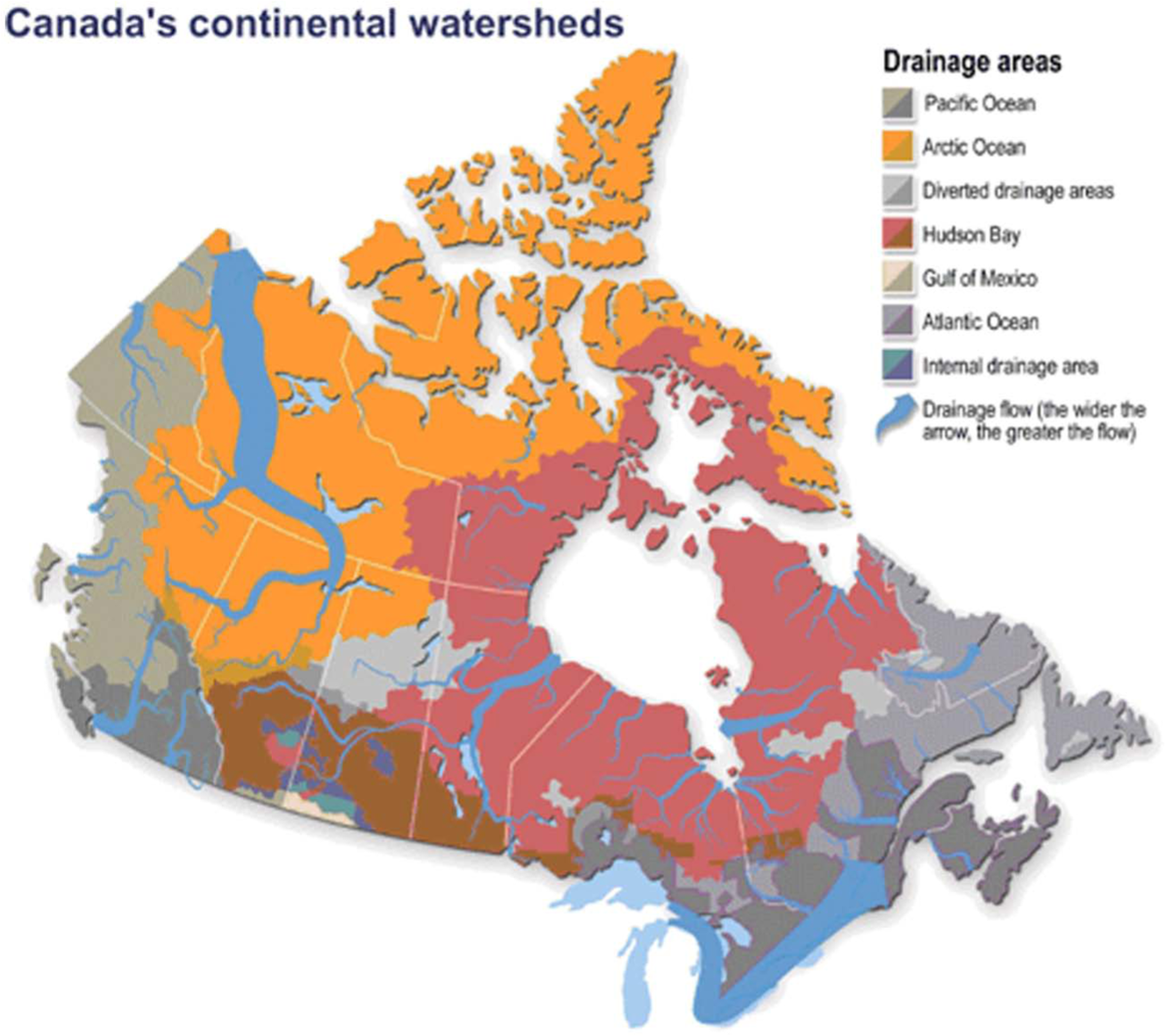
Map of Canada’s continental watershed.
Environment Canada knows waters through describing, for example, a river’s size, length, and rate of flow in tables, charts and maps. These ways of knowing waters rush into and converge with the classroom water pedagogy described by Gross (2012). These tables, charts and maps direct us toward what to know about waters, which waters are real, and what waters look like. In other words, these classroom water pedagogies (see Blatz et al., 1935; Gross, 2012) and Environment Canada give us an epistemology and ontology of water. Together these ways of knowing and being create a surge of rushing water. We worry what implications flow from these known and represented waters. We experiment further, by blocking these flows of rushing waters. We turn to Byrd (2011) to help us think more deeply about the violence of imperial epistemology and ontology. She describes a specific type of knowing and being, carried out through imperialism, which required the earth to be empty. She says that at the centre of European colonization were ‘discourses of savagery, Indianness, discovery, and mapping that served to survey a world into European possession by transforming indigenous peoples into homo nullius inhabitants of lands emptied and awaiting arrival’ (p. xxi). Maps, like the one in Figure 3, are continually produced, in support of empire, on ‘empty’ ground.
And so, in our experimentations with water, we change from knowers of water to wondering what water remembers. We ask, what if we attend to water, not as empty ground upon which dominant representations of knowing and being are mapped, to ask what water remembers of us? Again, we turn to Neimanis’ (2012) hydro-logics to think with waters. She tells of water’s bodily memory: Archive refers to water’s material capacity for storage and memory. Not only are flotsam, chemicals, bodies, detritus, sunken treasure and other chronicles of our pasts harboured in the ocean’s depths; water, as various oral traditions show, is a literal container of story and history that serve collective cultural remembrances. (Neimanis, 2012: 5, italics in original)
We explore the blocked flows in our water pedagogy for trickles of water as archive. We notice seeps and drops from water’s memory (both what touches and resides in it, and water as a storage of history) in our water pedagogies in the classroom: We turn from learning about waters to wondering what water knows about the classroom, us, the water table … What does water bring with it when it enters our classroom walls? We sit with the children as we watch it pour over their hands and down their sleeves, in containers, on the floor. It seems as if the water knows what to do, where to go, who to touch and how to touch. It leaves traces. Marino spends 45 minutes pouring water from a teapot into a jar and back into the teapot over and over again. We wonder if the water already knows what to do and how to move from the teapot into the container. And if the water knows how to move in the classroom, what else does she know? Does she come back to the classroom every day with ‘knowledge’? Does the water keep all our secrets? (Collaborative reflection on Encounters with Materials project)
In our water pedagogies, we wonder what water remembers about our classroom’s watery body and what other watery bodies it remembers. We question what water remembers in its material body. Does it bring with it chlorine? Attempts to purify, extract and manage it? Attempts to nourish various species? Attempts to iterate and manifest something new? We turn to waters as not ever having been empty. Yet, it is not as easy as just saying that waters are now full, and that we are in these blended and unequal watery bodies. We continue on experimenting with flows and blocking, and turn once again to Rebecca Belmore’s artwork. She helps us to think about water as storage and water as polluted in a piece titled ‘Reservoir’. 8
Belmore performed ‘Reservoir’ in 2001 at the grunt gallery in Vancouver (Laurence, 2002). We watch a shortened video of Belmore sprinkling white sand around the floor in a large rectangular area. The lights are low all around her, as we are guided to focus on her hands, working quickly and methodically to cover the floor with sand. Then, as discordant cello music sounds, she rolls a long spool of plastic over the sand, detaches a length of plastic from the spool, separates the layers of plastic to create a bag and then fills the bag with tap water. She repeats this action again and again until 13 long tubes filled with water rest on top of the sand. Images of rushing water and swimming fish are projected onto the bags and sand as she works. When Belmore finishes filling the plastic bags, she lights a candle and places it at the centre of the ‘reservoir’. Shimmering reflections dance off the plastic-bagged waters.
Connecting Belmore’s ‘Reservoir’ into the trickles that have seeped from our water pedagogies, we notice more waters spilling forth. As we experiment with turning to what water remembers, and to what waters store, ‘Reservoir’ brings us more complex relationships with water. We watch how Belmore works to stockpile waters in bags. We think about our efforts to contain and manage waters in the classroom, and we wonder if storing waters might flood our work with new life. Lee-Ann Martin (2005) describes how waters are stored in bottles, pipes and infrastructures. What if we experimented with storing waters in our classrooms? What might we learn from not accessing waters for play in the room, sitting instead with waters in storage? This piece by Belmore ‘meditate[s] on the politics and commodification of our most precious natural resource (and on the very notion of “natural resource”), on scarcity and abundance, clarity and contamination, ownership and expropriation, displacement and fragmentation, nature and culture’ (Laurence, 2002: 1). Working within these tensions, can Belmore’s artwork help us differentiate new ways of relating to waters in our classrooms? And can our newfound watery relations force us to think through these tensions, to respond and do something?
Carving crevices in our pedagogies
The collaborators in our ethnographic project – the children, the early childhood educators and we, the authors of this article – live on an island in the Salish Sea, and we cannot help but observe how waters shape the landscape over time. In this article, we used the water table, so familiar in the early childhood education landscape, to stand for a perspective on water as a manageable resource, a perspective that is part of the landscape of early childhood education. Just as we observe that waters shape our physical landscape, we can easily imagine that waters can carve out crevices in our pedagogies, make room for other ideas, other ways of being and becoming with water. This carving is not finished yet. We continue to learn how to live with a wounded and flooded water table.
We have aimed in our article to contribute to rethinking how we might respond to the hydro-logics of water in early childhood pedagogies. Through engaging with water’s creative, fluid, dangerous, precarious hydro-logics, we attempted to create possibilities for change in our pedagogies. We offer new ways to think about a relational watery pedagogy that focuses on how we might learn to respond to water differently within our common worlds pedagogies. This relational watery pedagogy requires that we bring the ethical and political aspects of our practices to the surface, that we implicate ourselves in the world at large and that we invite water to be an integral part of our classrooms.
Footnotes
Declaration of Conflicting Interests
The author(s) declared no potential conflicts of interest with respect to the research, authorship, and/or publication of this article.
Funding
The author(s) received no financial support for the research, authorship, and/or publication of this article.