



Abstract
New policy initiatives, such as those concerned with promoting young children’s positive mental health, highlight the need for good quality professional education in the early childhood education and care sector. However, although a wealth of literature exists from the school sector, little is known about professional education in early childhood education and care settings. This article presents an analysis of early childhood education and care educators’ perspectives about their professional learning during an initiative to promote young children’s mental health in 111 early childhood education and care centres in Australia. Questionnaires and feedback forms were collected from educators on four occasions over 2 years. In addition, programme facilitators rated the quality of implementation of the initiative in each centre. Thematic analysis indicated that the professional education was instrumental in building early childhood education and care educators’ knowledge about children’s social-emotional learning and mental health, increased educators’ self-efficacy for mental health promotion and encouraged a more collegial and collaborative workplace. Hierarchical linear modelling supported the learning gains identified in the qualitative analysis, but showed that the effect sizes for positive change depended on the quality of programme implementation. The findings highlight important synergies between opportunities for professional learning and workplaces that are conducive to transformation and renewal. Recommendations from participants for improvement included the need to ensure the relevance of content to local contexts, more extended learning opportunities, translation of unfamiliar language and more accessible timetabling of professional learning sessions. Issues concerning the need to advocate for, and sustain, professional education in early childhood education and care settings are discussed.
Introduction
The research reported in this article was undertaken during a time of sweeping policy and curriculum changes in the early childhood education and care (ECEC) sector in Australia, changes that are similar to reform agendas worldwide, such as in the United Kingdom (see Brock, 2012), in Japan (Organisation for Economic Cooperation and Development (OECD), 2011: 117–120), in China (David et al., 2010) and in Canada (Howe and Prochner, 2012).
Australian policy reforms such as the Early Years Learning Framework (EYLF) and National Quality Framework (NQF; DEEWR, 2009) reflect the need to enact change in light of research evidence related to children’s early learning. Similarly, the Early Years Workforce Strategy (Standing Council on School Education and Early Childhood (SCSEEC), 2012) participation and workforce reforms seek to address the social and economic conditions that impact on the quality of young children’s education and care. At the practice level, implementation of the reform agenda will require ECEC educators to review and reflect on ‘taken-for-granted’ knowledge and practices in early childhood education and care, and adapt or change those practices. This change process foregrounds the significant role of effective professional education for achieving curriculum and workplace reforms in the ECEC sector. To date, at least in Australia, professional education has not been embedded into the workplace practices of ECEC educators, compared to, for example, the school sector, where 60 hours of professional education over each 3 years, in line with National Professional Standards (Australian Institute for Teaching and School Leadership (AITSL), 2011), are required to maintain registration as a teacher.
Although research about professional education in the ECEC sector is relatively limited, comparisons can be made to the school sector, where a wealth of research has identified teacher learning as the means by which educational change can be achieved (Darling-Hammond et al., 2009; Fenstermacher and Richardson, 2005; Fullan, 2007; Hargreaves and Fullan, 1998). In fact, Desimone (2009) asserted that
Education reform is often synonymous with teachers’ professional development…Thus, understanding what makes professional development effective is critical to understanding the success or failure of many education reforms. (p. 181)
Turning specifically to knowledge about the relatively new area of mental health promotion in educational settings, the different types of knowledge suggested by Shulman (1987) and others (e.g. Borko and Putnam, 1996; Grossman, 1995), such as subject-matter knowledge and pedagogical content knowledge about mental health, are unlikely to have been addressed in pre-service education, and therefore will necessarily rely upon in-service professional education. But Borko (2004) wrote about the inadequate nature of much professional education, which is often fragmented and superficial, and which takes little account of how teachers learn (see also Feiman-Nemser, 2001). Little (1993), also writing about school teachers, highlighted a range of issues to be considered when designing professional education necessary to meet reform initiatives. She listed the relative value of providing technical training versus teacher-led inquiry; the capacity of organizations to formally allocate time for teachers’ professional investigations, reflections and discussions (e.g. through funding class time-release or the allocation of student-free time for teachers’ professional education); recognition of, and accommodation for, teachers’ personal contexts, and societal and political contexts; emotional investments in teaching; and financial and human costs.
Following an extended programme of work, Desimone (2009) and colleagues (e.g. Garet et al., 2001) provided a conceptual framework of five core features of effective professional education, namely (1) content focus, (2) active learning, (3) coherence, (4) duration and (5) collective participation. These five features were derived from an extensive analysis of the literature and thus align well with other research that addresses essential elements of quality professional education (e.g. Darling-Hammond, 2006; Ingvarson et al., 2005; Mitchell and Cubey, 2003). Content focus, regarded as possibly ‘the most influential feature’ of the five core features of professional development (PD) (see Desimone, 2009: 184), refers to the essential requirement to focus PD on the core knowledge (including skills and attitudes) to be learned. Active learning is broadly inclusive of the need for PD to incorporate interactive modes of learning such as discussion, or engaging in feedback following observation of practice, and more specifically refers to the need to move away from passive, didactic lecture style formats. Coherence covers both the need to align PD with the immediate context of ‘instruction’ that needs to be consistent with the current levels of staff knowledge and beliefs, and also within the broader context in which the PD is delivered, such as relevance and fit with changing educational policies and reform agendas. Duration is a feature that draws attention to the limited value of one-off PD sessions whilst not being prescriptive about the time that ought to be given to ensure optimal learning outcomes. The point that underpins Duration is that in order to achieve long-term, substantial change in practice, PD needs to be sustained over time. Collective participation encapsulates the idea that learning is facilitated through collegial exchange among staff who work together, for example, in the same school, at the same year level or with the same students.
With specific reference to professional education in ECEC, Sheridan et al. (2009) differentiated outside-in and inside-out, as well as initial versus ongoing notions of teacher learning:
Initially, professional development is expected to be an ‘out-side-in’ process, wherein the information necessary for behavior change or professional growth comes from external authorities, imparted through lectures, readings, demonstration, and verbal advice from peers, supervisors, coaches, or consultants. Later, however, professional development ideally progresses to becoming an ‘inside-out’ process in which individuals retain responsibility to direct their own ongoing growth and improvement through continued study of current and best practices and reflective personal goal setting in collaboration with respected colleagues. (Sheridan et al., 2009: 380)
However, very little is known about professional education in ECEC contexts, and even less is known about ECEC staff learning about mental health promotion. Therefore, the aim of the study reported in this article was to advance understanding of factors that contribute to effective professional education in ECEC settings, including a specific interest in examining the extent to which features of effective school-based teacher learning are relevant to ECEC contexts. The research questions that guided our study were as follows:
To what extent are identifiable features of teacher professional education consistent with educators’ experiences of a programme of professional education about mental health promotion in ECEC settings?
To what extent did involvement in a programme of in-service professional education have an impact on ECEC educators’ capabilities, knowledge, self-efficacy and professional practices related to promoting children’s mental health?
Terminology
In this article, we adopt the term ‘educators’ in preference to ‘workers’ with a view to better recognizing the fundamental educational role of staff working in ECEC settings. Similarly, while the terms PD and professional learning are often used interchangeably in the literature on teacher learning (Mayer and Lloyd, 2011), in this article we use the terms professional education and professional learning to capture the sense of active involvement of staff in their own learning that Knapp (2003) referred to as ‘changes in the thinking, knowledge, skills, and approaches to instruction that form practicing teachers’ or administrators’ repertoire’ (pp. 112–113). This use of professional education and learning highlights a shift in emphasis away from the ‘perceptions and the presumed baggage’ associated with poorly conceived, fragmented, one-shot and de-contextualized ‘in-service workshops’ (Mayer and Lloyd, 2011: 3). Although we prefer professional learning or professional education, we have not changed other authors’ or participants’ words if they referred to PD.
Design of the study
Context
This study was undertaken in the context of the 2-year pilot phase of the KidsMatter (Early Childhood) mental health promotion initiative, which was conducted in all States and Territories in Australia in 2010–2011. KidsMatter (Early Childhood) (2012) was developed in collaboration with the Australian Government Department of Health and Ageing, beyondblue, the Australian Psychological Society and Early Childhood Australia. The initiative aims to enable preschool and long day care centres to implement evidence-based mental health promotion, prevention and early intervention strategies to (a) improve the mental health and wellbeing of children from birth to school age, (b) reduce mental health problems among children and (c) achieve greater support for children experiencing mental health difficulties and their families. The aims are to strengthen protective factors for children’s mental health and minimize risk factors. Four Components, each to be covered over a 6-month time span, make up the core content – Component 1: creating a sense of community; Component 2: developing children’s social and emotional skills; Component 3: working with parents and carers; and Component 4: helping children experiencing mental health difficulties.
ECEC centres involved in the pilot phase were supported by eight facilitators (one facilitator allocated to each Australian State or Territory) who guided staff in identifying goals, strategies and resources to support the centres’ mental health promotion action plans, supported staff in the implementation of the KidsMatter risk and protective factors framework and delivered professional education about each of the above-mentioned four core-content Components. Approximately 3 hours of structured, face-to-face professional education for each Component was embedded into the programme, allowing for the timing of delivery to be adapted to the needs of specific contexts (e.g. as one 3-hour session or multiple shorter sessions) within the 6-month period allocated to the particular Component. In addition to support from facilitators, ECEC centres were supplied with a number of evidence-based resources to assist them in developing their capacity for promoting children’s mental health and wellbeing, and to respond to concerns about the mental health of the children within their care. The model for intervention was similar to Borko’s (2004: 4) figurative representation of elements of a PD system, with the three elements of facilitators, teachers and PD programme situated within an identifiable context.
Procedures
Ethical clearances were obtained from the University’s Social and Behavioural Research Ethics Committee, and from each participating ECEC centre. Informed consent was obtained from all participants.
Participants
Participating centres
Expressions of interest to be involved in the pilot phase of the KidsMatter initiative were received from approximately 380 ECEC centres, from which 111 were selected to represent the diversity of ECEC within Australia. Selected centres included community, government and privately owned organizations within metropolitan, regional and remote areas in all Australian states and territories. Other factors considered in the selection process included centre type (long day care or preschool), proportion of Aboriginal or Torres Strait Islander populations and centres that were culturally and linguistically diverse. Table 1 summarizes the background characteristics of participating staff.
Background characteristics of participants.
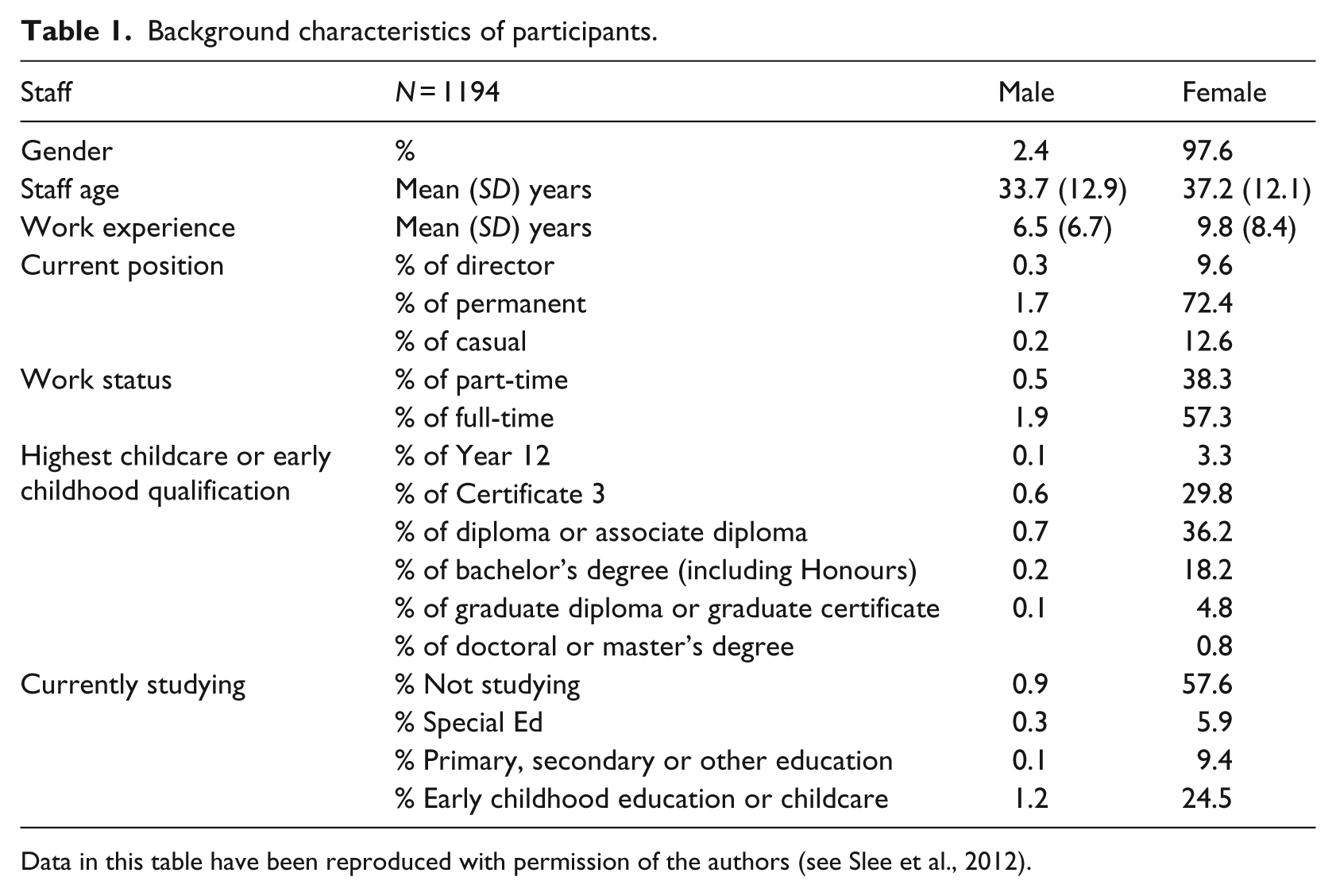
Data in this table have been reproduced with permission of the authors (see Slee et al., 2012).
Measures
Questionnaire for ECEC educators
Questionnaires were administered on four occasions (at approximately 6-month intervals to coincide with the centres’ anticipated completion of each of the four Components) to all educators responsible for the care of children aged between 1 and 5 years and who were in care 10 hours or more per week. The questionnaires included the following: (1) six items about the impact of the professional education on educators’ general capabilities for mental health promotion, (2) seven items related to educators’ knowledge about children’s mental health, (3) seven items about educators’ self-efficacy (confidence and competence) and (4) five items about educators’ professional practices.
Feedback about the professional education sessions
Feedback forms, comprised of eight items that were developed and administered as part of the KidsMatter initiative, were collected by facilitators at the completion of each of the professional learning sessions. The two open-response items (Items 7 and 8) completed by the ECEC educators were used for our thematic analysis, namely ‘What were the best aspects of the Professional Learning?’ and ‘Please provide any suggestions you might have to improve the Professional Learning’.
Questionnaire for state/territory facilitators
Near the end of the 2-year pilot initiative, the eight state/territory-based facilitators completed 33 multiple-choice and open-response questions about the quality of implementation of KidsMatter in the centres they had supported. The questionnaire items were designed according to three principles of implementation quality proposed by Domitrovich et al. (2008) as follows:
Fidelity: the degree to which an intervention is conducted as planned;
Dosage: the frequency and duration of specific units of the intervention and its resources;
Engagement with delivery: the implementation processes and responsiveness by staff and clients (adapted from Domitrovich et al., 2008).
Quality of Implementation Index
Using the data from the facilitator questionnaire, and following the method described by Askell-Williams et al. (2013), latent class analysis (MPlus) was used to create a Quality of Implementation Index containing 20 items (Fidelity 7 items; Dosage 5 items; Engagement with Delivery 8 items) that discriminated between ECEC centres. Using the Quality of Implementation Index, 54 per cent of centres were identified as High implementers, 32 per cent of centres were identified as Moderate implementers and 14 per cent of centres were identified as Low implementers. The ECEC centres’ scores on the Quality of Implementation Index were subsequently used as a covariate in models of change over time, as reported in the ‘Results’ section of this article.
Data analysis
Quantitative data analysis
The questionnaire items were subjected to confirmatory factor analysis using asymptotically distribution-free (CFA-ADF) methods available in AMOS (SPSS), which confirmed the factor structures of four groups of items, namely, Impact of Professional Learning, Knowledge, Self-Efficacy and Professional Practices. Following the CFA, three-level hierarchical linear modelling (HLM) was used to assess evidence of changes over time in ECEC educators’ responses to the four factors. (That is, four separate HLM models were analyzed, one for each outcome factor.) Level 1 of the HLM represented change over time, with four data collection points nested within each ECEC educator. Level 2 of the HLM represented ECEC educators, and Level 3 represented ECEC services. Calculation of the intra-class correlation coefficients indicated that multi-level modelling was appropriate for this data (Garson, 2013). Quality of Implementation Index score was included as a covariate at Level 3 of the HLM models. 1
Qualitative data analysis
The researchers read the professional education feedback forms and ascertained that there was little discernible difference between participants’ responses provided at the four different times of data collection. Therefore, the analysis was constrained to 1148 feedback forms collected following the professional education for Component 1 (Time 1). NVivo v9.1 software was used to support the thematic coding process. The researchers undertook repeated readings and discussions to reach agreement on the coding of responses to themes that represented the data. Finally, exemplar statements were identified in order to illustrate each theme.
Results
In this section, we combine the results from the HLM of the questionnaire data with the thematic analysis of the feedback forms, using nine overarching themes, namely, General Capabilities for Mental Health Promotion; Knowledge; Self-efficacy; Collaboration; Professional Practices; Opportunities for Active Learning; Reflection, Professional Identity; and Delivery. Each theme is more fully explained in the discussion that follows.
General Capabilities for Mental Health Promotion
General capabilities for mental health promotion acknowledges the specific context of this study – the KidsMatter (Early Childhood) mental health promotion initiative – and refers to the educators’ overall assessment of their professional learning experience in relation to capacity to support the development of children’s positive mental health. The significance of context for early childhood is salient here, perhaps even more so than for school settings given that professional learning is a relatively new focus of attention for ECEC educators. As indicated in Table 2, educators’ responses indicated a statistically significant improvement of a medium effect size in High Implementing centres, while in Low Implementing centres the improvement was significant and of a small effect size. It is notable that participants’ responses to this set of questionnaire items explicitly recognize that it was their engagement with the professional education that led to these improvements, not other factors such as ‘on-the-job’ learning.
Changes over time in HLM estimated mean scores.

HLM: hierarchical linear modelling.
Correlations of 0.10, 0.24 and 0.37 are indicative of small, medium and large effects, respectively (Kirk, 1996).
indicates p < 0.0001; ** indicates p < 0.001; * indicates p < 0.01; not significant (ns) indicates p > 0.01.
Knowledge
The factor Knowledge is embedded in Desimone’s (2009) core feature Content Focus. In our study, Knowledge represents subject-matter content related to information about children’s social and emotional learning and mental health and mental ill-health issues including prevalence, stereotypes and misconceptions. From Table 2, it can be seen that improvement in Knowledge was statistically significant and of a medium effect size in both High Implementing and Low Implementing centres.
Self-efficacy
The content of the KidsMatter professional education included modules designed to strengthen participants’ skills in communicating with children and families, including building knowledge of how to recognize and respond to signs of mental health difficulties and how to access external support agencies. As shown in Table 2, only educators in High implementing centres showed statistically significant improvements in self-efficacy, equivalent to a small effect size, and this was different from the response pattern in Low implementing centres, which indicated only minimal change. However, it can be seen that the mean scores for self-efficacy were already relatively high at Time 1, so there was little room for improvement (in other words, there was a ceiling effect in the data).
Collaboration and Impact on Professional Practices
The related themes of Collaboration and Impact on Professional Practice might be seen to fit with Desimone’s (2009) Collective Participation feature of effective professional education. However, our analysis distinguished between these two concepts on the basis of the process of professional learning. Whereas Collaboration was embedded in the design of the KidsMatter professional education sessions, participants’ reports indicated that changes in their professional practices were an outcome of, rather than part of, the structure of the professional education. Opfer and Pedder (2011) highlighted the need to consider the variety and complexity of contexts and systems in which teachers work. Even environments that may appear structurally the same (such as ECEC centres within the same cultural and geographic region) might be substantially different on a range of features, such as staff profiles, staffing budgets, consumer (family) profiles and child profiles. Differences between environments necessarily influence the processes of delivering professional education, and the processes by which educators engage with professional learning. Issues such as the non-linear nature of learning, and non-linear interactions between levels of systems, point to the need to consider both the content and processes of professional education.
In our study, exemplars of participants’ responses that were coded to the Collaboration theme, ‘I appreciate the opportunity to discuss points as a whole staff team (particularly as staff are part-time) and the ‘hands on’ approach not just listening, and ‘Sharing with other staff, feeling like we are all in this together’ illustrate how the professional education afforded opportunities to discuss and share (stories, ideas, experiences) with others and to learn from them, as well as to work together (e.g. on the plan, implement and review cycle of the KidsMatter Components).
Leading from that structural feature of their professional education, the theme Professional Practices captured participants’ accounts of improved collegial relationships among staff as well as stronger working relationships with families, broadened understanding of their own roles and responsibilities and increased opportunity to contribute to decision-making. Table 2 shows that educators in High Implementing centres reported significantly improved outcomes related to their professional practices, equivalent to a medium effect size. Low Implementing centres also reported higher levels of agreement that KidsMatter had positively impacted on their work, to a small effect size.
Opportunities for active learning
Consistent with social-constructivist theories of learning that identify effective learning environments as relational, interactive and cognitively engaging (e.g. Bransford et al., 2000), active learning emerged as a key theme from the thematic analysis of educators’ perspectives on their professional learning, indicating that professional education sessions were structured (a) to include group activities, role-plays and team-sharing exercises, such as ‘The diversity walk made me think about how a parent may feel different to others when they enter our centre’, (b) to be relevant, for example, ‘Information was understandable and easy to relate to our centre. Made me think about how I could develop and change to provide the children with better care’ and (c) to provide time for collegial exchange, for example, to ‘discuss issues and find good solutions’ ‘talk and work together’ ‘share ideas’ and ‘reflect on current practice’. An overarching sentiment was ‘Hearing other colleagues’ opinions. We don’t often get to chat on a professional level’.
Reflection
From the number and range of comments provided by ECEC educators across all participating centres, it was clear that the opportunity and impetus for reflection was regarded as an important feature of the professional learning that educators experienced. Reflective practice related to the ECEC centres generally was captured by feedback such as, ‘realizing the centre needs to improve in a lot of areas’ and ‘able to think about what our centre does and how to do better’. Comments about reflective practice also related more specifically to individuals, such as ‘self evaluation positive and negative’, ‘challenging thinking’, ‘think about how you act in the workplace, and how you are involved with parents, children and other staff members’.
Professional Identity
Professional Identity also emerged as a feature worthy of consideration in ECEC professional learning where, through exchange with colleagues, educators were able to develop a sense of clarity about their roles and responsibilities. Among the educators’ comments that captured the concept of Professional Identity were the following statements: ‘reinforcing and enlightening strengths and weaknesses, both personally and professionally’, ‘learning about myself in a professional way’, ‘gaining an overall (sense) of our individual uniqueness as carers’ and ‘how important my role is in children’s wellbeing’.
Delivery
The theme of Delivery identifies two related issues that emerged from our analysis of the ECEC educators’ professional learning experiences. The first theme concerns Duration, and is used in the same way that Desimone (2009) referred to this feature. The second is Timing, and is separately identified in recognition that issues related to this theme emerged in response to the specific early childhood context where professional education was not included in the working day.
Duration
The programmed pace of delivery was 6 months for each of the four above-mentioned professional education Components. Some educators lacked knowledge about the content and sequenced nature of the Components, with between 6 per cent and 14 per cent reporting on each occasion that they did not know which Component their centre was working on. By Time 4, there was consistent reporting from about 70 per cent of educators that they knew which Component was the focus.
While the professional learning was programmed across the 2-year trial period, its configuration of one 3-hour session per Component (in some centres delivered as 2 or more shorter sessions) would be considered inadequate, based on research evidence from the school sector (Darling-Hammond et al., 2009), and in relation to learning new subject matter in early childhood (Mitchell and Cubey, 2003).
Timing
In addition to Duration, Timing appeared to be an important consideration in delivering professional education in the context of ECEC. Participants indicated that they valued the professional learning opportunities, and wanted time to engage in discussions. However, many educators struggled with the timing of professional education sessions, such as when the sessions were delivered in a long session at the end of a working day. The overall analysis of participants’ statements about the time available for Professional Learning is that there was not enough time available, and that more opportunities for appropriately scheduled professional learning opportunities would be welcomed, exemplified in the following comment: ‘We only had a short period of time and I think that lessons should probably be a bit longer and to get a full understanding of topics than sort of just trying to get through …’
Coherence
Coherence refers to the alignment and consistency of the professional education related to mental health promotion with other early childhood programmes, policies and practices. From the data analysis, it was evident that the professional education associated with KidsMatter did connect educators’ learning with concurrent developments in the ECEC sector. Participants reported that sessions were instrumental in assisting them to understand the broader reform agenda and how to manage the change process. The educators indicated that the professional education sessions were beneficial for clarifying the connections between the Australian EYLF and the KidsMatter mental health promotion initiatives. Some participants reported that their understanding of the EYLF improved through their involvement with KidsMatter, and anticipated beneficial outcomes for ECEC centres and children’s social/emotional development when implemented together. Typically, participants noted that the professional education gave ‘Time to reflect and relate KidsMatter to EYLF, curriculum documents and national quality standards’.
Facilitation
Importantly, the delivery of professional education sessions relied on experienced facilitators. The quality of the facilitators’ input and support emerged as a recurring theme in participants’ reports. Comments included the value of ‘being led through the Components’, ‘learning from a skilled teacher’, ‘to have people come to us … rather than just going somewhere by yourself’ and the links facilitators were able to make with ‘useful suggestions/examples of practice’, anecdotes and strategies. In the context of a new domain of learning, in this case mental health promotion, it was evident that the ECEC educators placed value on being guided by, and given, meaningful and relevant materials and resources. Authentic examples, activities, personal stories and handouts were well received by participants.
In summary, the results of data analysis into the early childhood educators’ experiences of professional learning as part of a mental health promotion initiative have helped to unpack the essential features of professional education in ECEC contexts. It is also worth noting that the emerging themes highlighted professional learning as an ‘inside-out’ process as well as encompassing the ‘outside-in’ conception traditionally applied to professional education (see Sheridan et al., 2009). Educators’ evaluations revealed insights about both the structural (e.g. delivery, content, facilitators) and the functional elements of the learning process (collegial, active, invoking higher order thinking and reflection). Our research suggests, however, that these structural (planned, controlled features of professional education) and functional elements (features that the professional learning itself generates between and among participants) do not exist independently of each other, nor along a continuum as proposed by Sheridan et al., but rather they operate reciprocally and in relationship with each other. Figure 1 displays a conceptual map of the way the themes that emerged from this study might be represented, and potentially provides a basis for future research and analysis.
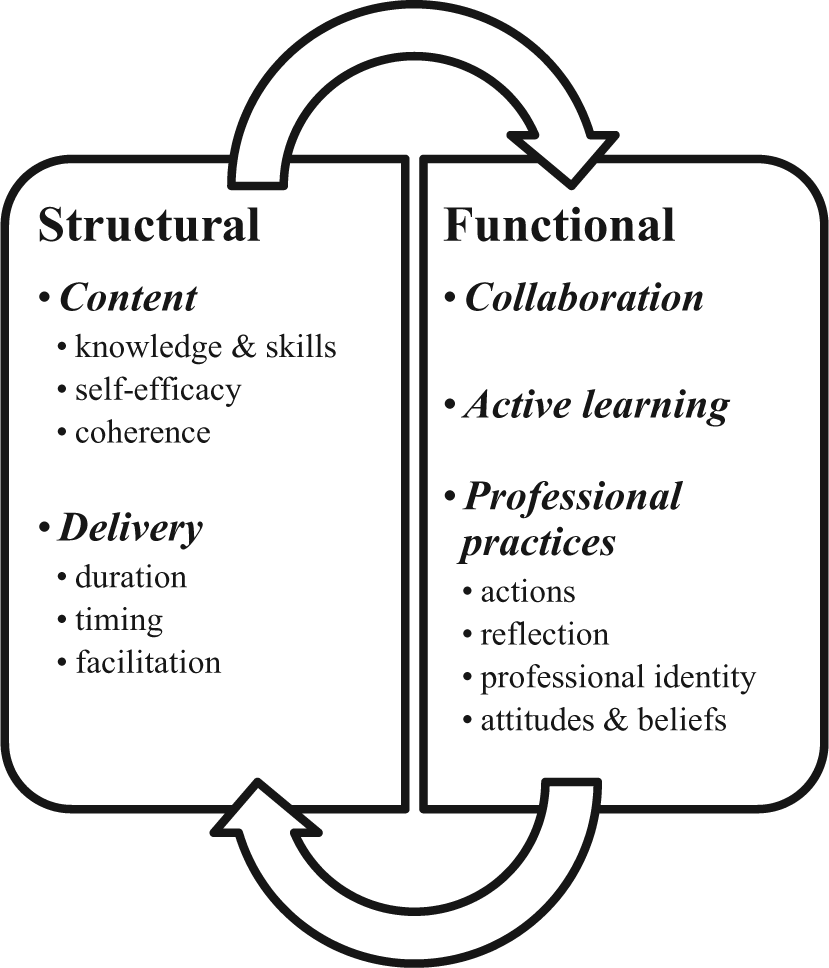
Relationships between the structural and functional elements of early childhood educators’ professional learning.
Discussion
The KidsMatter (Early Childhood) mental health promotion initiative, trialled over 2 years across Australia in 111 preschool and long day care centres, incorporated staff professional education as a central feature. Not only was mental health promotion a new area of learning for the participating ECEC educators, professional learning itself was a new undertaking for many staff working in ECEC settings.
Our first research question asked: To what extent are identifiable features of teacher professional education consistent with educators’ experiences of a programme of professional education about mental health promotion in ECEC settings? Thematic analysis showed that essential concepts reported in the learning sciences and school teacher professional education literature (e.g. Bransford et al., 2000; Darling-Hammond, 2006; Desimone, 2009; Fenstermacher and Richardson, 2005), including subject-matter knowledge, self-efficacy, coherence, duration and timing emerged from our participants’ accounts of their experiences of the KidsMatter professional education sessions. Notably, these constructs emerged in a relatively new context for formal professional learning, namely early childhood education and care, indicating some parity between the school sector and the early childhood sector. In particular, our participants highlighted aspects of the learning process that align with social-constructivist principles and which provided them with opportunities for active learning, collaboration and reflection.
In the ECEC context, the qualitative data analysis also identified a number of additional features aligned with effective professional learning, namely, Facilitation, Professional Identity and Reflection. While Desimone (2009) noted Professional Identity and Teacher Reflection as elements that were not included in her framework for teacher professional education, our findings suggest their inclusion is needed in designs for professional education in ECEC settings. Reflection, in particular, could be considered within the theme identified as Knowledge in relation to the seminal work of Argyris and Schön (1974) on theories of, and in, action. However, the identification of Reflection as a theme in its own right in our study seems warranted based on participants’ comments indicating that their reflection was prompted not only by the connections individuals made with their own practice such as: ‘Confirming information, beliefs, experiences, validating actions as a professional teacher’, but also by the collaborative engagement that the professional learning afforded such as ‘Reflecting on our own practice, sharing ideas on improvement’. This collective notion of reflection sits well with the importance given to constructivist, contextually relevant professional learning environments that promote higher level thinking. These features suggest that further consideration may need to be given to the core features of effective professional learning proposed by Desimone (2009) to meet the particular needs of ECEC educators and perhaps other educators (Opfer and Pedder, 2011).
Our second research question asked: To what extent did involvement in a programme of in-service professional education have an impact on ECEC educators’ capabilities, knowledge, self-efficacy and professional practices related to promoting children’s mental health? To answer this question, we employed HLM.
Although self-efficacy was relatively high at the outset of the study, the educators in High implementing centres reported feeling more self-efficacious in their ability to promote young children’s mental health after 2 years of professional education. The impact of the professional education on educators’ knowledge is an important finding in our study, providing evidence of improvement across the 2-year initiative in educators’ views regarding their knowledge about promoting children’s mental health. The overall extent of change over the 2-year period in both High and Low implementing groups indicated increases in knowledge about children’s mental health to a medium effect.
Notwithstanding this change, it is also noteworthy that by the end of the KidsMatter initiative about one third of educators did not indicate strong levels of agreement with questionnaire items about their knowledge. This suggests that there was still a feeling in this sizeable group of staff that they need to improve the levels of their knowledge related to children’s mental health and wellbeing and how to support children needing referral to external agencies. This is consistent with some respondents’ suggestions that professional education should be a (continued) future requirement of their employment in the ECEC sector.
The results of our study highlight the situated nature of professional education as discussed by Borko (2004). ECEC educators who find that their learning and reflection are supported by management and other staff who are themselves engaging with new learning, and a workplace culture that values trying out new ideas and has safety-nets in place to support and encourage such risk taking, are more likely to benefit from their professional education experiences (Feiman-Nemser, 2001). This need to embed professional education within receptive workplaces argues against earlier models of short-term, relatively isolated (personally and physically) modules of PD.
It is important to note, however, that, unlike in Australian schools where professional learning is an expected part of teachers’ work, ECEC educators work in a very different context. Many ECEC staff do not have degree level qualifications (36% of participants in this study had no tertiary qualifications and 58% were not studying at the time of data collection), work in settings where ongoing professional learning is not an expectation and are engaged in a work environment where stability and continuity of employment is not always provided (12% of our participants were casual employees, and nationally approximately 30% of ECEC educators work less than 20 hours per week).
The majority of extant literature about professional education is situated in school contexts, and also is often grounded in specific subjects, such as science or mathematics. Our study points to the need for the development of new knowledge about professional education and educators’ learning in ECEC settings. For example, ECEC educators’ practice is focused on improving or maximizing a range of developmental outcomes for children that may include, for example, feeling safe and secure, and improving the quality of staff–child interactions. Furthermore, the notion of instruction needs to go beyond a focus on the content of instruction, or on subject-matter pedagogy. Practice in the ECEC context is as much tied to the organizational structures within a centre (e.g. where and how children spend their time at the centre), the relationships developed with families and the extent to which families are supported, and how non-learning needs of the child are met.
Limitations
It should be noted that because the cross-sectional sample used in this study was not a random sample, caution should be taken if generalizing findings to other centres, staff or children in Australia. While participants reported that their capabilities, knowledge, self-efficacy and professional practices in relation to mental health promotion improved as a result of the professional education they received, further research will be needed to determine if these gains are sustained over time.
Conclusion
Educators’ perspectives about their experiences and learning during a mental health promotion initiative in 111 Australian ECEC centres confirm that mental health promotion is a new area of learning for many ECEC staff. Furthermore, professional learning itself is a new undertaking for many educators, including approximately 30 per cent without post-secondary qualifications. Our research contributes more detailed knowledge about what constitutes effective professional learning in ECEC settings, as well as about the effectiveness of a specifically designed programme of professional education that aimed to advance ECEC educators’ capabilities, knowledge, self-efficacy and practices related to improving children’s mental health outcomes.
Our results revealed positive experiences aligned with features identified in the school professional education literature related to Content focus, Active learning, Coherence, Collective participation, Reflection and Professional Identity. The feature of Duration highlighted problems such as insufficient exposure to learning modules, and timetabling difficulties. Implications for future policy and practice for ECEC staff professional education initiatives include costs of delivery and staff time-release; programming to meet the needs of full-time, part-time and casual staff; and curriculum design and delivery that address the wide diversity of background knowledge held by ECEC educators. Our analysis indicates that designs for professional education in early childhood education and care settings need to specifically consider contextual affordances and constraints, the curriculum content and the types of learning experiences that participants are exposed to. This is particularly relevant as imperatives such as cost and accessibility drive professional education into online modes of delivery.
This article highlights that in this time of radical change for Australia’s ECEC sector, meaningful and ongoing professional learning needs to be at the forefront of ECEC educators’ work. In the absence of a strong research base for what counts as effective early childhood professional education, since much of the existing evidence comes largely from school sector research, findings of this study provide valuable data for early childhood practitioners and policy makers alike.
Footnotes
Acknowledgements
The authors are grateful to Dr Grace Skrzypiec for her contribution to analysis of the qualitative data and to Dr Katherine Dix for her contribution to the analysis of the quantitative data reported in this article.
Declaration of Conflicting Interests
The author(s) declared no potential conflicts of interest with respect to the research, authorship, and/or publication of this article.
Funding
The author(s) disclosed receipt of the following financial support for the research, authorship, and/or publication of this article: The KidsMatter Early Childhood evaluation from which the data for this study were drawn was funded by beyondblue: the national depression initiative.