



Abstract
This study captures data from nearly 200 university campus-based child care center directors across the United States. It reveals the impacts directors believe their centers have had on the broader internal university community (e.g. student retention, research, teacher training in early childhood education) and the extent to which directors engage in leadership activities which demonstrate a “prehensive grasp” regarding the role of their center (e.g. the activities directors use to communicate the mission of their center and to integrate their center into the university).
Introduction
At public or private higher education campus-based centers, directors work daily to oversee the care for the children of student-parents, faculty, staff, and, in some centers, the children of community members. These centers could include the following types of programs: infant/toddler, preschool, full-time or part-time child care; drop-in, evening, weekend, or sick child care. This article is focused on the role such directors play in making their centers visible and successful.
Background literature and supporting research
In the United States, nearly half of the over 4000 higher education institutions provide early care and education programs (Carlson, 2003), with such campus-based centers including a variety of forms (Keyes and Boulton, 1995). For example, some campus-based centers are located within laboratory schools or teacher education departments; others in home economic departments, child development or Family Studies; and still others are within student or personnel service or family housing divisions. Such programs may be all-day, half-day, evening, weekend, or any combination of these. They may accept only children of students, faculty, and staff or may also open their enrollment to the surrounding community. Of these campus-based centers, about 75 percent are accredited by the National Association for the Education of Young Children or are in the process of accreditation. Given such standards, campus-based centers in general tend to meet a higher level of quality than do other forms of early care and education programs (Carlson, 2003).
The changing demographics of college students are factors for these university-based child care centers. Nontraditional students are older and often work, as well as have family responsibilities (Horn et al., 2002). Such older student populations have increased the demand for university-based child care, and research has shown that such student-parents view child care as a critical issue in their decision to enroll at a certain institution (Fadale and Winter, 1991). Finding quality child care is often a barrier for nontraditional students in reaching their educational goals (Gribbons and Meuschke, 2003).
Campus-based centers face a number of barriers to their success. Some studies indicate that financing is certainly a key issue, but so is the issue of appropriate role. For example, campus-based centers must meet the challenge of modeling quality curriculum in an appropriate context to combat the image of simply providing a day care service (Schwartz, 1991). The view that such centers are a secondary service to the primary focus of higher education continues to perpetuate problems of funding, housing of the center, staffing, and academic support (Keyes and Cook, 1988). This service view accounts for many of the struggles for campus-based centers’ survival and place in higher education (Schwartz, 1991). Research has found that campus-based centers as a whole still need to do a better job of linking to the overall academic mission of a university and to more carefully monitor and manage a center’s mission in regard to the teaching, researching, and service missions of a college and university system (Keyes, 1984, 1990; Townley and Zeece, 1991). The onus does not only fall on the campus-based center. Perceptions of the center by other university personnel may contribute as well to the image and mission of the center.
In reference to outcomes, Carlson (2003) found that high-quality on-site care results in less absenteeism, higher productivity, and higher retention rates of student-parents in their work place. Creange (1980) also found that benefits include recruiting nontraditional students to reduce enrollment declines, retaining students with young children, providing laboratory settings for research, reducing student lateness and absenteeism, showing a commitment to women and minorities, reducing faculty scheduling problems, attracting competent faculty and staff, and improving community–institution relationships. Student-parents using on-campus-based centers were also found to more likely remain in school, graduate in fewer years, and earn higher grades (Kappner, 2002).
Overall, previous research has shown that campus child care programs can offer a solution to the challenges of providing quality child care and early education, serve as models for the community and advocates for children, and offer resources for other departments and programs on campus (Keyes and Boulton, 1995). Previous research also reveals internal and external benefits such as employer-sponsored child care benefits to campus employees, services to employee and student-parents, and observation facilities for university students (McCorriston, 1992).
Problem statement and research questions
Previous research studies regarding campus-based child care centers are primarily descriptive in nature and have not offered a broad perceptual view of reasons these centers exist and their role in higher education settings. Many previous studies are dated, with publication dates in the 1980s or early 1990s (e.g. Corder, 1986; Keyes, 1980, 1989; McCorriston, 1992; Sparks, 1986), or have been localized, highlighting campus child care issues only within a given state, area, or campus (Gulley et al., 1985).
Our research was designed to update and expand current understanding of the interaction and roles between key stake holders of campus child care and internal success outcomes. The primary research question focused on ascertaining center director’s perspective of what on-site child care centers offer to a given higher education institution and its surrounding community. Other studies have investigated the directors’ leadership role to some extent (Bloom, 1998), but little has been done concerning campus director roles and opinions. Our research attempts to add knowledge regarding the dynamic and interconnected nature of these roles and their interactions within the university and broader community. In particular, data extracted from our larger study aim to address the following research questions:
What impacts do directors believe their centers have had on their internal university community (e.g. student retention, research, teacher training)?
To what extent do directors engage in activities which demonstrate a “prehensive grasp” regarding the role of their center (e.g. the activities directors use to communicate the mission of their center and to integrate their center into the university)?
To what extent do several input variables (e.g. activities undertaken by the center director and mission of center as understood by administrators) relate to the perceived internal successes of the center, including the level of integration into the university?
Theoretical lenses
David A. Bickimer’s Prehensive Leadership Model builds upon previous leadership theories of Chester I. Barnard and K.R. Andrews (1971) and Jacob W. Getzels (Getzels et al., 1968) translating them into practice for campus child care center directors. Both theorists studied organizational theory and leadership in organizations. David Bickimer builds on their foundation to relate the Prehensive Leadership Model and its concepts to the work of leadership and the campus child care setting. David Bickimer wrote an article that connected leadership theories to campus child care directors. His work is one of the few that applied leadership theory directly to this specific group of leaders. According to Bickimer (1989, 1991), organizational theory and a common professional jargon are often lacking for directors of campus-based centers. He advocates that leaders must pose a “prehensive grasp,” which involves looking and feeling within and outside of the center. Prehension is defined as the act of grasping or seizing—the apprehension by the senses or understanding.
Bickimer (1991) believes that a campus director must look and feel within his or her center to take in a sense of the whole situation (e.g. staff morale, center’s mission) and then work without (university) to communicate and interact. At times, the director must be personal while responding to situations and constituents and at other times, somewhat detached to analyze what must be done to increase the effectiveness and mission of the center within the higher educational setting. He views the director’s leadership responsibility to create and maintain the equilibrium between purpose, willingness, and communication—collectively, the “prehensive grasp” of what the center is about and the vision it portrays. Such a prehensive grasp, a solid organizational self-concept, can help a center director rise above the challenges and realities a center may face including staff turnover, low wages, and morale.
According to Bickimer (1991), his model can be applied to two common challenges that centers face: stepchild status and low morale. A stepchild who possesses a strong self-concept can be better adjusted and incorporated into their family environment. This analogy also applies to campus-based centers that may not be interwoven into the fabric of the university system, but may be on the “fringe.” If a campus center is experiencing stepchild status, it is imperative to have a strong sense of organizational prehension on the part of leadership, working both formally and informally to help integrate into the heart and soul of the university. Often, the interactions that happen in informal settings do more to shape, in this case, a center’s daily operations, then perhaps discussions and policies stemming from formal committee meetings or other formal means. Informal influences can help lift the center from its stepchild status.
Low morale, the second challenge discussed by Bickimer (1991), refers to low status on campus as well as working conditions at the center. Our study looks primarily at the connectedness of the center and campus and the director’s role. Again, the grasp of prehension is applicable. The prehensive life, soul, and spirit of a center first nourish the director’s soul. Bickimer (1991) contended that motivation meets needs in exchange for cooperation. An enthusiastic leader is one who has a “well-fed soul” that motivates others and lifts low morale. Bickimer also adds that prehensive theory does not justify the reasons for low morale. It can temporarily lessen the impact of low morale by encouraging a systematic approach to find solutions and thereby achieve long-term motivation.
The premise of Bickimer’s work is that campus center directors have the responsibility to grasp wholeheartedly the vision and big picture of what the center is all about—what it wants to accomplish and how and to whom this vision should be communicated. Utilizing concepts from Bickimer’s theory, our study examined the dynamics of the interaction between the center and university from the vantage point of a key figure, the director.
Research design and methods
Our non-experimental quantitative research design used a cross-sectional survey to study the internal, external, and operational roles of university campus-based child care programs at one point in time. The survey collected data to address questions regarding the perceptions of directors concerning campus child care centers in 2- and 4-year institutions, as well as to generalize inferences about these perceptions for the surveyed population.
Our sample consisted of campus center directors who were members of a professional organization and who were located at public and private 2- and 4-year colleges and universities. A description of the study, an invitation to participate, and the embedded link for the survey were distributed via e-mail to each campus center listed in the organization’s membership directory and through the listserv. Valid e-mail existed for 393 campus-based centers, and responses were received from 191 center directors (a 48% response rate).
Based upon knowledge gained from the literature review, as well as our own personal knowledge, we created an on-line instrument entitled the Campus Childcare Center Director Survey. The survey was developed to update data on the contextual description and current state of centers and to explore the perceptions of directors regarding the internal roles of the center within the university, external roles of the surrounding geographical community, operational status questions concerning challenges facing the center, and questions regarding the director’s role within the university or college. Content validity was obtained via pilot testing revision.
The survey contained a number of forced choice questions, using Likert-type response scales. Several ascertained the types of academic departments (i.e. teacher education, social work, psychology, kinesiology, and other) that were connected with their campus child care center, the frequency of such connections (from not at all to weekly), and details on the types of connections (i.e. observation, training, research, and other).
Using a 4-point scale of not at all to a great extent, other survey questions probed on the extent to which their center had been successful in accomplishing certain outcomes (e.g. providing opportunities for research and observation, providing work opportunities for students, supporting better class attendance for students with children, helping traditionally and nontraditionally aged students with children stay in school, attracting graduate students, enhancing the institution’s image, showing a commitment to women and minority, and attracting faculty and staff to the university). Using this same 4-point scale, directors were asked to note the impact of various barriers on their center (e.g. financial, lack of administrative and/or academic department support, staff and/or child turnover, low salaries, and/or staff morale); the types of activities they are engaged in as a center director (e.g. providing information as part of university student and/or faculty recruitment efforts, actively seeking grants or other research projects with various departments, collecting and reporting center usage and outcome date, communicating the center’s mission to various top-level administrators, formally and/or informally interacting with various top-level administrators); and the extent to which they felt their top-level administrators understood the mission of the center and its importance.
Numerous open-ended questions provided increased understanding and richness to the quantitative data, including what the directors envisioned the role their center could or should play in their surrounding geographical communities, what they felt their primary role was in developing and maintaining a relationship with the university, how they accomplished whatever level of integration with the university they had, and overall how important they felt their center was to the university and why.
While significant data were obtained via this survey, the lack of pre-established reliability and validity is a noted limitation of our research design. Both descriptive and inferential statistics, including correlations and multiple regressions, were used to examine the data.
Findings
In this article, we focus on our data related to the perceived internal success of the center within the university and the director activities influencing such success as perceived by the director. Let us begin with an overview of the respondents, followed by a summary of core director activities and perceived outcomes.
Campus center respondent demographics
In regard to types of institutions, 104 (54%) of the respondents were from 4-year public colleges and universities, 63 (33%) from community colleges, 19 (10%) from 4-year private colleges or universities, 7 (4%) from technical colleges, and 2 (1%) responded as other. The total data responses for this question (n = 195) were larger than the total respondents for the survey (n = 191) because participants could click on more than one answer choice. Thus, four directors did select more than one type of institution within their campus system.
Directors were asked to indicate the approximate number of students who attend their higher education institution. Numbers of both undergraduate and graduate students both full- and part-time ranged from 54 to 89,000 with a mean of 16,421 students. The total 89,000 represented four campuses within one university system.
The total number of years that the campus-based centers existed ranged from those that had just opened in 2008 to 80 years, with a mean of 28 years. The numbers of years respondents have been a director ranged from a year to 34 years, with the mean of 12.38 years.
The gender of the directors who responded to the survey is considered to be primarily, if not exclusively, female based on listserv and organizational directory observations. Directors are therefore referred to as females throughout the research study.
Director activities and perceived outcomes
Directors indicated the frequency they are involved in communicating the mission of their center to the university; formally or informally interacting with administrators; providing information for student, faculty, and staff recruitment; and seeking grant and research opportunities. The activities on which the directors spent the most time were communicating their center’s mission in a variety of ways with top-level administrators (28.6% to great extent; 40.5% to a moderate extent) and interacting with administrators in a formal manner such as meetings (21.2% to a great extent; 39.7% to a moderate extent). Actively seeking grants and/or research with others in the university occurred the least of the items on the list (only 15.5% to a great extent; 19.8% not at all). Table 1 displays the frequency, valid percents, and means, as listed from highest to lowest means.
Director activities.

1 = not at all; 2 = to a limited extent; 3 = to a moderate extent; 4 = to a great extent.
Directors were also asked to indicate the extent to which their centers have been successful in accomplishing various outcomes. In order of highest to lowest means, directors felt that their centers were to a large extent successful in modeling appropriate pedagogy and early childhood practices (85.1%), followed by providing work experience opportunities for students (83.2%), enhancing the institution’s image (63.9%), supporting better class attendance for student with children (69.1%), showing a commitment to women and minorities (53.0%), providing opportunities for research and observation (55.9%), helping nontraditionally aged students with children stay in school (64.8%), helping traditionally aged students with children stay in school (60.5%), attracting faculty and staff (25.7%), and finally, attracting graduate students to the university (20.1%).
Frequency, percentages, and means for all responses are displayed in Table 2, with items listed from highest to lowest mean. Directors could select “not sure” for this survey question, and for analysis purposes, this choice was not calculated with the frequencies and means. Also, the lowest n value in Table 2 indicates that 69 participants marked not at all for “attracting graduate students to the university,” as this choice would not apply to community (n = 63) and technical colleges (n = 7).
Center accomplishments.
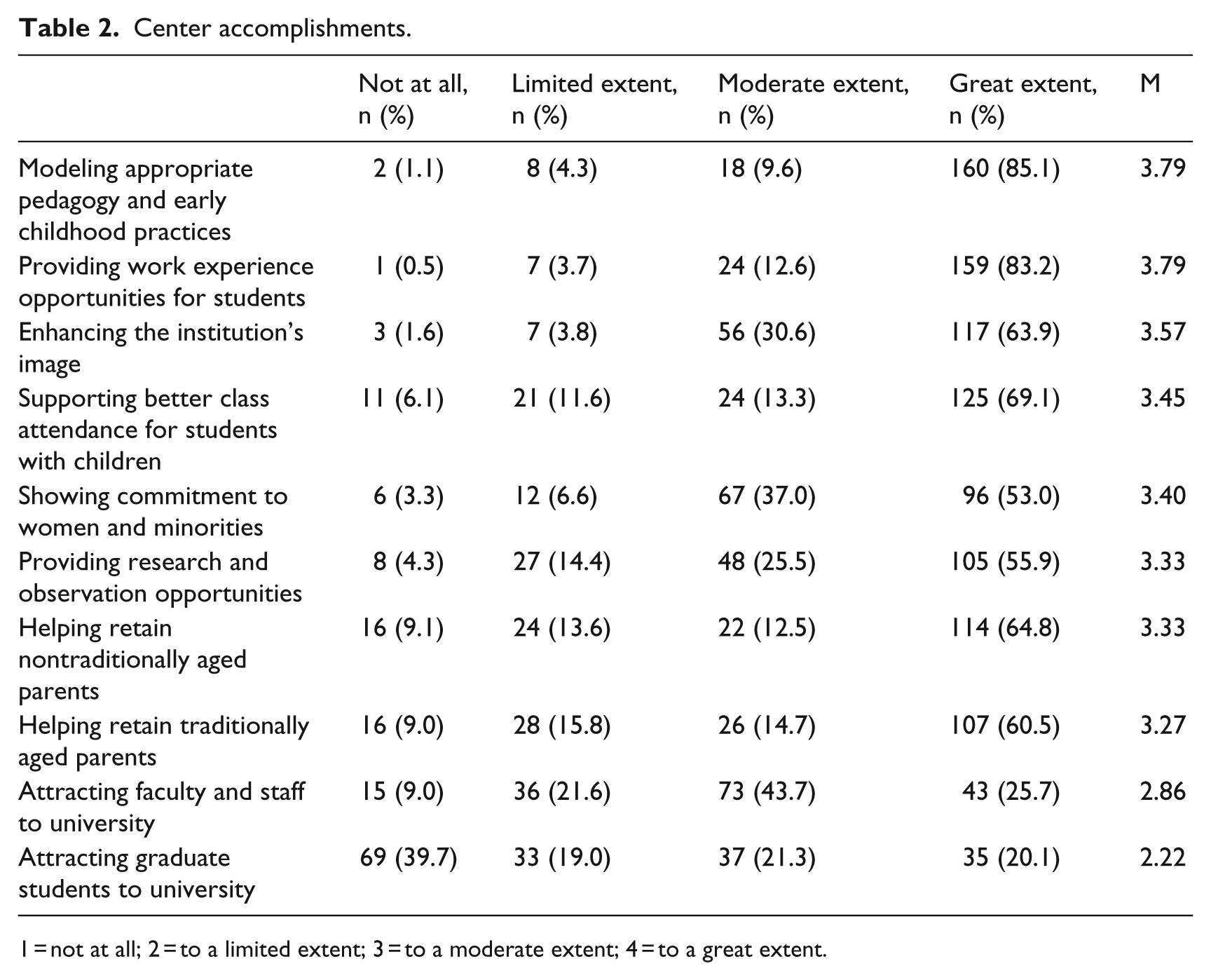
1 = not at all; 2 = to a limited extent; 3 = to a moderate extent; 4 = to a great extent.
Another aspect of the center about which directors were asked to respond involved how well they felt top-level administrators understood the mission and importance of the campus child care center. Types of administrators included the president, provost, chairs of departments who work with the center, faculty and administrators within departments who work directly with the center and those who do not work directly with the center, and finally, student affairs and non-academic unit administrators. Directors could select “not sure” for this survey question, and for analysis purposes, this choice was not calculated with the frequencies and means.
Directors felt that, to a great extent, the faculty and administrators within departments working directly with center (58.0%) understood the mission, followed by department chairs (61.2%), university and college presidents (35.0%), student affairs (29.7%), provost (30.8%), and finally, faculty and administrators who do not work with the center (3.8%). Table 3 displays the frequency, valid percents, and means, as listed from highest to lowest means.
Center mission understanding by higher education administrators.
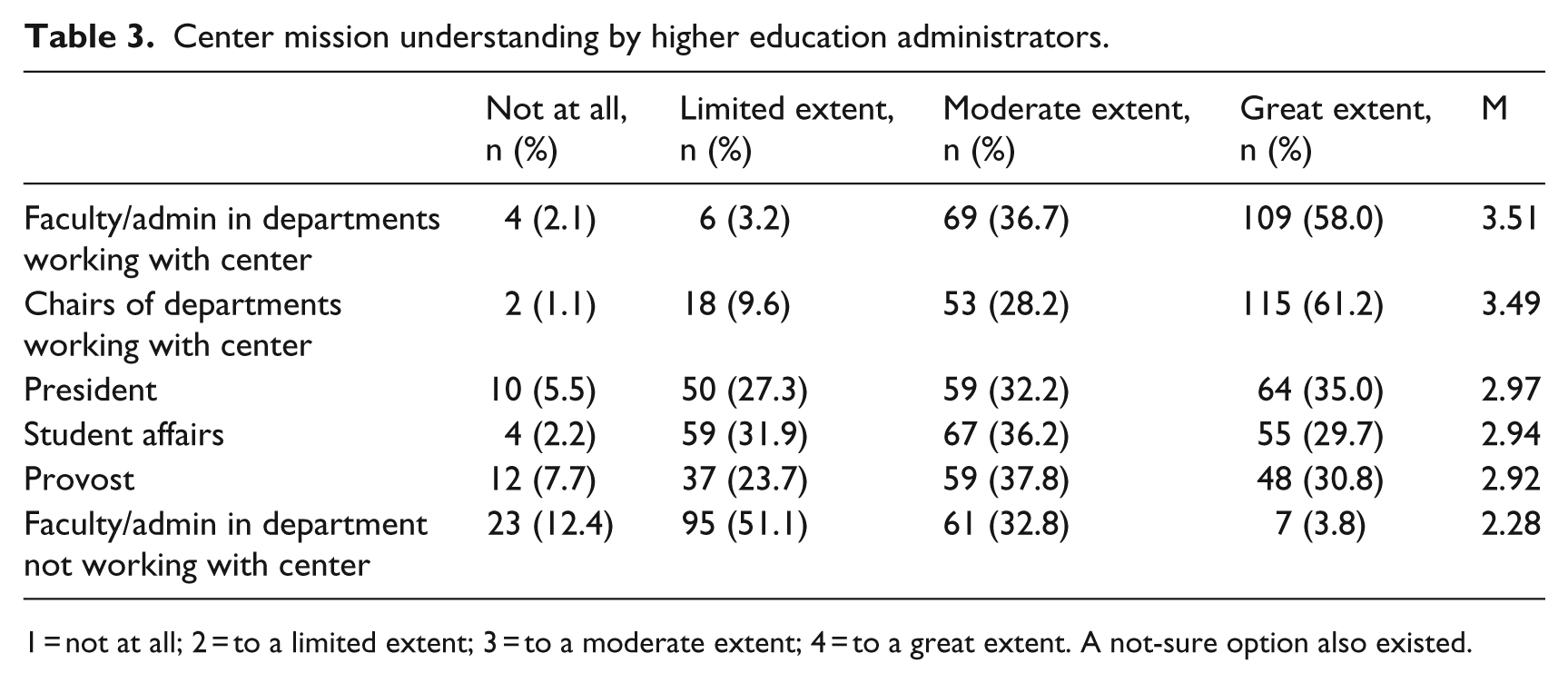
1 = not at all; 2 = to a limited extent; 3 = to a moderate extent; 4 = to a great extent. A not-sure option also existed.
Directors also indicated the extent to which they believed their center is fully integrated into the university as a whole. Nearly half of the directors indicated their center was integrated into the university to a moderate extent (49.2%), and nearly one-third indicated it was only to a limited extent (32.8%) or not at all (1.1%). Only 16.9 percent of directors believed their center was integrated to a great extent.
Finally, directors were asked to indicate the extent certain barriers affected the successful operation of their center. Directors felt that, to a large extent, the biggest barrier involved financial concerns (31.9%) with more than 70 percent of directors identifying this as either a moderate or great extent, followed by low salaries (21.0%), staff turnover (9.1%), lack of administrative support (7.9%), lack of academic support (6.1%), child turnover (4.8%), and finally, low staff morale (2.1%). Interestingly, the means for these issues are generally low in that directors did not report large barriers to the effective operation of their centers.
Table 4 displays the frequency, valid percentages, and means for the perceived barriers and challenges. Directors could select “not sure” for this survey question, and for analysis purposes, this choice was not calculated with the frequencies and means.
Barriers and challenges.
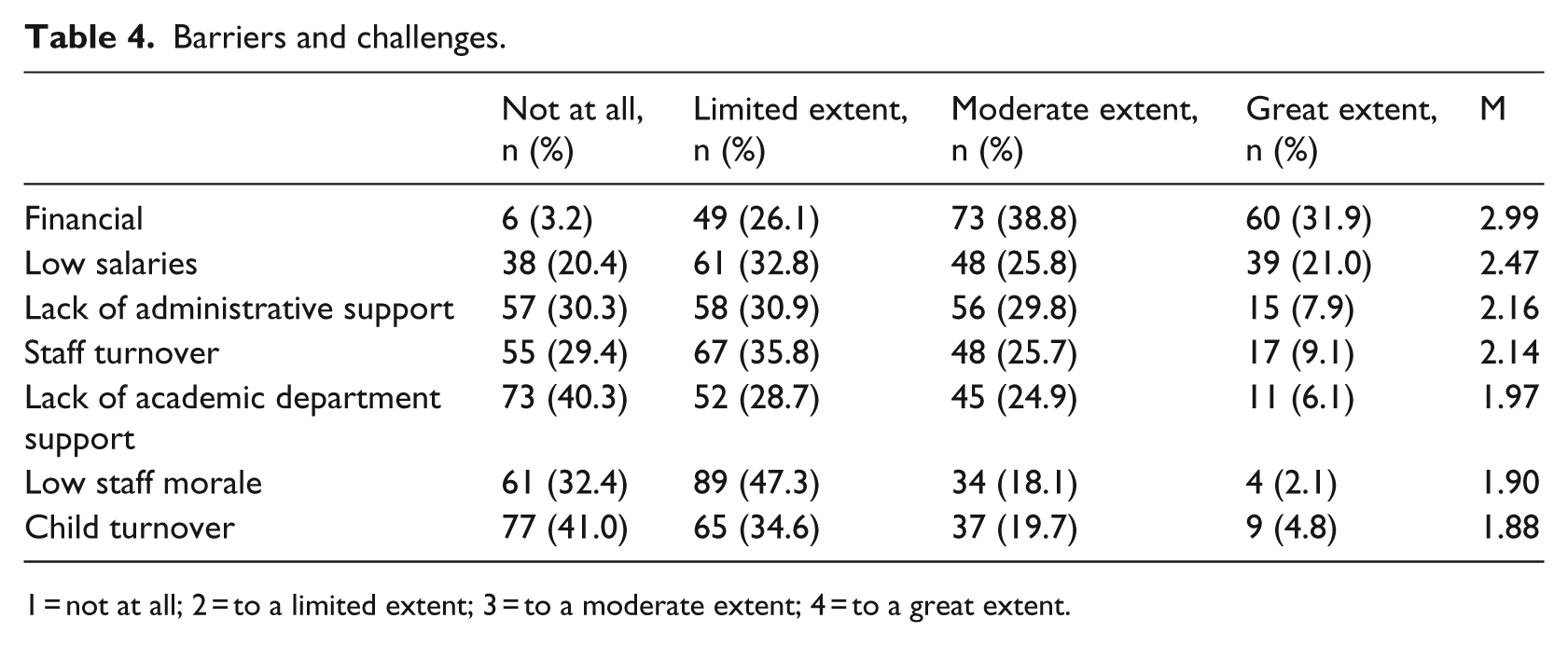
1 = not at all; 2 = to a limited extent; 3 = to a moderate extent; 4 = to a great extent.
Connections: perceived internal success outcomes as linked to director activities
After profiling what directors perceive to be key internal successes, the next step was to determine any connections between these outcomes and various director activities.
We examined correlations and then to what degree those relationships could be explained by various input variables (via regression analysis). A Pearson correlation revealed that significant correlations existed between each of the seven director activities (as listed in Table 1) and the 10 internal success outcome variables (as listed in Table 2). There were moderate to high correlations among the following variables:
Attracting Faculty AND Staff and Institutional Image
Collecting/Reporting Data AND Seeking Grants/Research
Formally Interacting AND Providing information for faculty/staff recruitment Communicating mission
Informally interacting AND Providing Information for Student Recruitment Collecting/Reporting Data Communicating Mission
Providing Faculty/Staff Recruitment AND Providing Information for Student Recruitment
Regression analyses were then used to investigate whether various director activities affect the level of various internal successes at her center, particularly in the areas of academics. Our analysis revealed that the director activity, Providing Information on Center for Faculty/Staff Recruitment, accounted for 18.6 percent of the variance for the Attraction of Faculty and Staff Recruitment variable. Another revealed that a Director’s Efforts to recruit faculty and staff accounts for 13.9 percent of the variance within the Institutional Image variable. A third regression analysis revealed that three variables (Providing Information on Center for Student Recruitment, Faculty and Staff Recruitment Efforts, and Seeking Grants or other research projects with departments) accounted for 8.5 percent of the variance within the Institutional Image variable. And finally, a fourth analysis revealed that a Director’s Efforts to Seek Grants or other research projects with departments, to Collect and Report Center Usage and Outcome Data to Administrators, and to Communicate the Mission with Administrators accounted for 7.9 percent of the variance within the internal success outcome variable of Providing Research and Observation Opportunities for the institution. Table 5 summarizes these statistically significant regression findings.
Statistically significant relationships between director activities and internal successes.
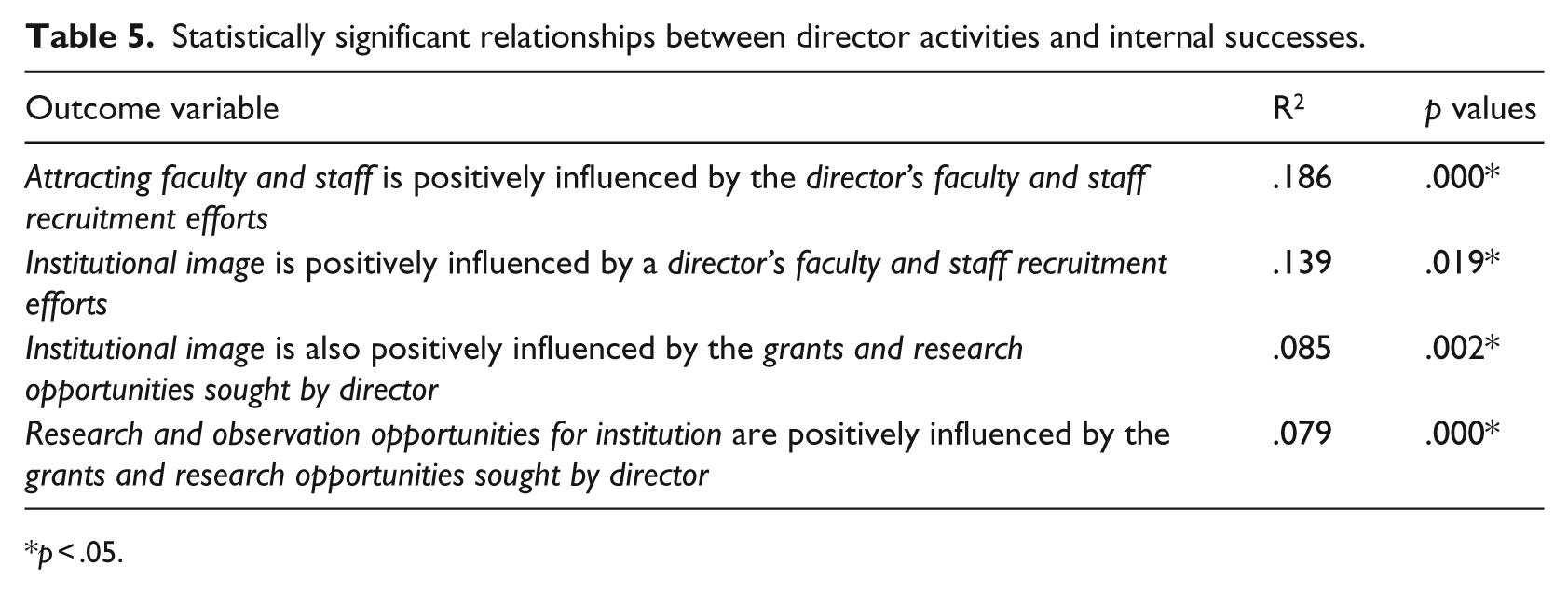
p < .05.
Connections: perceived center integration outcome as linked to director activities
Another focus of our research was to examine how various director activities were related to the perceived integration of the center into the broader institution through Likert scale and open-ended responses.
Director activities and integration
A Pearson correlation revealed that seven director-identified activities significantly correlated between the Level of Center Integration AND
Providing Information on Center (as part of University Student Recruitment Efforts);
Providing Information on Center (as part of University Faculty and Staff Recruitment Efforts);
Actively Seeking Grants (or other research projects with various departments);
Collecting and Reporting Center Usage and Outcome Data (to various university administrators);
Communicating the Mission of Center with Top-Level Administrators;
Formally and Informally Interacting with Various Top-Level University Administrators.
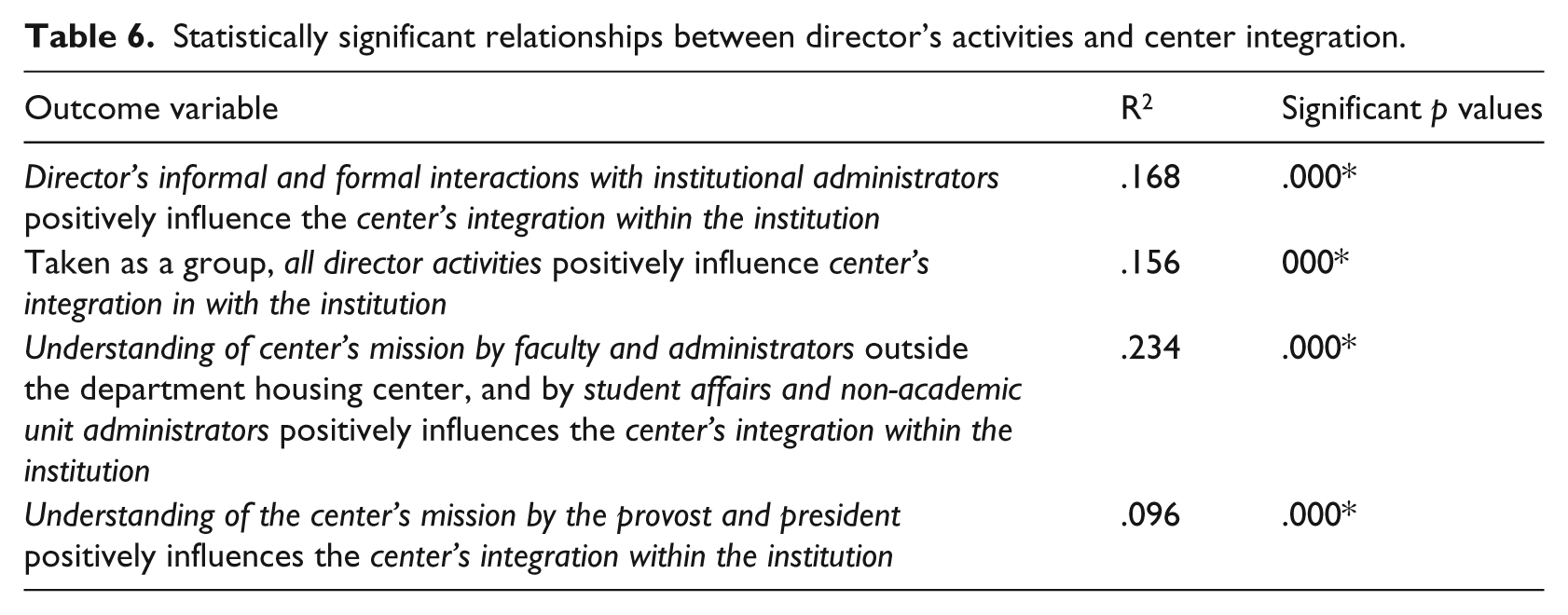
A regression analysis involving the variable Center Integration and a newly created variable that grouped two director activities together (the formal Interactions with Top-Level Administrators and such Informal Interactions, having a .730 Cronbach’s alpha) revealed that such grouped interactions accounted for 16.8 percent of the variance within the Integration variable. A second analysis involving the variable Center Integration and a newly created variable that grouped all seven significant Director Activities together (with a .793 Cronbach’s alpha) found that such director activities accounted for 15.6 percent of the variance within the Integration variable.
Additional regression analyses were also conducted for the variables Center Integration and Extent of Understanding the Center’s Mission by Administrators. Understanding by the Faculty and Administrators from Departments Not Directly Involved with the Center, and by Student Affairs and Non-Academic Unit Administrators accounted for 23.4 percent of the variance for the Integration variable, while understanding by the Provost and President accounted for 9.6percent of the variance. Table 6 summarizes these statistically significant regression findings revealing relationships between Director’s Activities and the level of Center Integration.
Statistically significant relationships between director’s activities and center integration.
Open-ended responses and center integration
In order to better understand director perceptions concerning integration of their center within the university systems, we captured responses to a number of open-ended questions. One focused on gathering information as to “how” they accomplished center integration into their broader organization (or not). Written responses were analyzed in a manner where the comments from those integrated to a moderate or high degree were reviewed separated from those indicating only limited (or no) integration. This information is insightful since the regression analysis revealed that various director activities were indeed predictive of center integration.
After reading the written responses numerous times, each was coded into one or more categories. The top categories of open-ended responses for those directors indicating a moderate or high degree of integration (N = 118) were “Relationship Development and Networking,” “Seeking Commitment and Support,” “Communication and Visibility,” and “Active Involvement.” Comments focused on these types of director activities represented about two-thirds of the comments received from these directors. Indeed, here are several illustrative quotes from these directors:
“My primary role is to keep lines of communication open with other departments and find purposeful ways for us to work together.”
“[My role is to] effectively communicating the program’s role and need it fulfills for all members of university community.”
“Relationships, relationships, relationships. I get out there and cultivate them constantly!”
“[I] speak about current center events on an ongoing basis at management meetings, and continue to invite upper management to events.”
“Our college has built us a new 6,000 sq. ft. building because of our importance to the community and college … and ‘gosh darn it’, we are good at what we do through the dedication of our staff. We have a 2 year waiting list and most parents know to get on our waiting list before they get pregnant. It takes that long to get into the program. WE work hard at community relations and it shows.”
On the other hand, a number of directors indicated that their centers were only integrated to a limited extent (or not at all). We reviewed their open-ended comments (N = 68) as to “why” and found the top categories to be “Low Profile of Center,” “Limited Knowledge About the Center,” and “Low Priority within Institution and Lack of Administrator and Faculty Support.” Such directors felt that their centers were not integrated at all or on a limited basis due to either the location of the center on campus or because the director and staff were not out in the various departments of the university often enough to create a stronger presence and relationship. Here are several comments illustrative of these responses:
“The center is not considered as important as other activities on campus because no one has taken the time to think about it. The center is just kind of ‘there’ unless someone needs it for something.”
“[There are] misconceptions regarding [the] program’s academic role in the department. Often seen by larger university community as a child care resource only.”
“I wish I had better documents and arguments for why we are important. The other thing is that when they do see us as important, it’s just to recruit and retain students—not what we are accomplishing with children—they do not care about the ‘early childhood education’ part.”
These director’s open-ended comments also revealed financial concerns, administrative changes, and a number of “I’m not sure” responses. But as a whole, they revealed few director efforts to help the broader institutional community understand the mission of these centers and to “help them care” about their value.
Overall, for those centers which are perceived to be more successfully integrated within their broader organization, the open-ended responses revealed that their directors pursue such integration and administrative support by administrators through the diligent building of relationships and communication with top-level administrators.
Summary and implications for early childhood leaders and directors
A major focus of our research was to examine how well campus-based child care centers are integrated into their universities, related director activities, and the extent to which directors demonstrate a “prehensive grasp” regarding the role of their center. Specifically, we examined how directors’ daily activities and grasp of the whole related to their centers’ integration within the larger institution.
We found that the internal success of improving institutional image was influenced by director self-report and perceptions of their activities including providing information for faculty and staff recruitment and by seeking grants and research projects with various departments. We found moderate and high correlations among the variables of communicating the mission, collecting and reporting data, and formal and informal interactions with top-level administrators. Regression analysis revealed that informal and formal interactions by the director with administrators positively influence integration, as well as the entire director activities grouped together. Thus, our major finding is that the campus child care director’s activities do influence the internal success of a center.
These findings concerning director activity and integration suggest the need for a more holistic model of what directors need to do, rather than simply completing isolated, individual functions. Indeed, as our open-ended data illustrated, a prehensive, holistic approach of the director being involved in a variety of campus activities increases the chances that the center will experience greater visibility, shared knowledge of purpose, and ultimately, increased integration throughout the university. According to Bickimer (1989), a leader by intuition moves back and forth between special (personal side of leadership) and general (outward, impersonal reflection) theories of leadership. The author stated, “An intuition is a simultaneous, unified grasp of multivariate realities” (Bickimer, 1989: 141). As stated, the director must also rely on the context of her sphere of influence as well as the systems her center is housed in. As noted by Bronfenbrenner (1989) and others, there is a need for multi-faceted relationships that the university child care center director must balance. Our study indicates many campus directors are indeed exhibiting behaviors that involve themselves in interactions and activities with administrators that, in turn, affect integration.
While our study did affirm aspects of the prehensive theory, one finding that was somewhat inconsistent involved the formal and informal aspects of what campus directors do. Barnard and Andrews (1971) stressed that the relationship between leaders and followers is often strengthened more through the informal aspects of the organization than the formal channels. Yet, we found that 21.1 percent of directors indicate they interact to a great extent with administrators on a formal basis (e.g. meetings) about the same amount (20.7%) as on an informal basis (e.g. activities at center or outside institution). In addition, a regression reveals that both types of activities significantly influence center integration. This finding expands the important role of formal activities not covered in previous theory.
Another aspect of the prehensive theory is that of the “stepchild status” of campus-based centers. Previously, this was discussed in relation to the importance of the director’s sense of prehension and moving from the fringe to the front of the university system. It appears that this aspect of prehension is somewhat strong, in that half of center directors felt their center is integrated to a moderate extent. Yet, only 16.9 percent of respondents indicate their center is integrated to a great extent, and nearly one-third perceived very limited integration. Could it be that although a director’s prehension might be somewhat strong and involve diligent work, communication, and relationship building (primary reasons for moderate to great integration), that the top reasons for limited integration, low profile, and limited knowledge are beyond her influence and ability to control? A center director’s ability to rise above circumstances and an intuitive “sense of the whole” may play a key role, but is not the only piece of the integration puzzle.
Some directors expressed through open-ended responses that the low profile of their centers on campus and limited knowledge of the center’s roles in the higher education setting are primary reasons for limited or no integration for their centers. An implication for combating these challenges is the hard, diligent work of directors to network and build relationships with staff and administrators, to communicate constantly and consistently, and to be visible on campus. Our data revealed that these activities, coupled with the activities of communicating the mission and formally interacting with administrators, lead to a moderate or great level of center integration. Our study also found that the primary role of the director in developing and maintaining the relationship with the university is via ongoing and frequent communication followed by cultivating those essential relationships. Thus, there appears to be connectivity between the roles and activities of the director in relation to center integration, as both involve relationships, commitment, support, and communication as well as the overall prehension of the director and health of the campus center.
In sum, our findings confirm that intentional activities of the campus child care director can significantly affect how successful the center will be within the university setting. Directors with a strong “prehensive grasp” can play an integral role as the liaison between their center and the broader university.
Footnotes
Funding
This research received no specific grant from any funding agency in the public, commercial, or not-for-profit sectors.