




Abstract
This study investigated the relationship between children’s attendance at different types of early childhood education and care programmes and their mathematical and verbal skills. Analyses of data from 1314 children participating in an Australian longitudinal study, the E4Kids project, revealed no relationship between children’s verbal ability and the early childhood education and care programme attended, but mathematics results tell a different story. At the first measurement, children who consistently attended only informal care outperformed children who either consistently attended a formal early childhood education and care service type or attended a mix of formal and informal care. The development of mathematical and verbal competencies between first and second measurements, 1 year later, did not differ between children who attended different types of early childhood education and care. Early childhood educators in Australia are required to provide programmes that incorporate both mathematical concepts and language development. However, many early childhood educators describe uncertainty about how to support children’s mathematical learning. Further professional development and support in this area is necessary.
Introduction
Early childhood education and care (ECEC) in Australia has been subject to significant change since 2009, change that is aligned with global recognition of the influence of early childhood education on children’s social, cultural, and academic learning trajectories through formal school (Gormley et al., 2013; Sylva et al., 2004; Weiland and Yoshikawa, 2013) and beyond to tertiary education and adult life (Campbell et al., 2002; Schweinhart et al., 1993). Historically, the Australian ECEC sector has been characterised by a distinction between early childhood education and childcare, having different fundamental purposes and evolutionary history. Despite this, all types of ECEC are subject to common national quality assurance processes that mandate the implementation of an approved learning framework (Australian Children’s Education and Care Quality Authority (ACECQA), 2011).
Mathematics and literacy teaching and learning in Australian ECEC programmes
The Early Years Learning Framework for Australia (EYLF) (Department of Education, Employment and Workplace Relations (DEEWR), 2009), or an approved alternative framework, guides early childhood educators when they plan learning experiences to support children’s emerging literacy and numeracy skills. This EYLF (DEEWR, 2009) stops short of setting learning targets or specific strategies for mathematical skills development.
Children who attend early childhood programmes that incorporate frequent and systematic play-based mathematics activities have been found to demonstrate significantly greater gains in concept formation than children attending programmes marked by infrequent and unsystematic incorporation of play-based mathematics activities (reference withheld). However, many early educators report uncertainty regarding the teaching of mathematical concepts and skills in early childhood (Lee and Ginsburg, 2007; Pearn et al., 2009; Perry, 2009) and express negative feelings about mathematics in general (Bates et al., 2011), and the assumption that teaching mathematics would not be a requirement in early childhood education appears to influence choices in favour of working in preschool programmes (Ginsburg et al., 2012). Nonetheless, many teachers would like to support children’s numeracy skills more effectively but describe uncertainty and anxiety about their own mathematics knowledge (Basit, 2003; Cook, 1996; Sarama, 2002). Opportunities for in-service professional learning in early childhood mathematics are limited.
Turning to the development of early literacy, this is conceptualised as an accepted and desirable social practice that occurs within early years programmes, encompassing interactions with others and use of wide-ranging text, and hence, early literacy is greater than simply facilitating the acquisition of narrow and discrete skills. Concurrently, acquiring a ‘linguistically-based symbol system supports children’s developing language, vocabulary and text awareness’ (Raban and Scull, 2013: 102), and peer-to-peer and adult–child social interactions are coupled with multiple opportunities to observe and participate in activities that build children’s understanding of text, through stories, songs, rhymes and painting.
Predictors of early mathematical and verbal abilities
The foundations of strong mathematical skills are laid very early in life, with mathematical achievement at the beginning of primary school being one of the best predictors of later academic achievement (Claessens et al., 2009; Stern, 2009). Similarly, early vocabulary has been argued to be a good predictor of later reading skills (Cunningham and Stanovich, 1997; Torgesen, 2002). These specific predictors of later achievement in school are influenced by other factors in turn. For instance, the impact of intelligence on the development of mathematical and linguistic competencies cannot be ignored, and intelligence has been shown to explain a substantial amount of variance in academic achievement (Gustafsson and Undheim, 1996; reference withheld). Children who are read to frequently or whose parents have a higher education, income or an occupation perceived to be more prestigious often perform better on cognitive tasks than children who are read to less frequently or who come from families with a lower socio-economic status (SES) (e.g. Aikens and Barbarin, 2008; Gubhaju et al., 2013; reference withheld; Department of Education and Early Childhood Development (DEECD) and University of Melbourne, 2013). In the Australian context, holding a Health Care Card is another indicator of low SES as these are issued to families with low incomes and also to individuals receiving a disability pension. Finally, a measure of social support or community characteristics may also be of importance when assessing child outcomes (Ishimine, 2011).
Studies have shown that children who attend formal ECEC programmes perform better on cognitive tasks (Biedinger and Becker, 2006; Walston and West, 2004). However, this predictive effect appears to depend on both the duration of their attendance and the quality of the programme (Sylva et al., 2004), as well as other characteristics of the programme such as the composition of the group of children attending the same programme (Palardy, 2008).
We turn now to the nature of ECEC programmes in Australia. For the purposes of this investigation, ‘formal’ education and care includes approved programmes that are provided by qualified early childhood professionals within kindergartens or preschools (typically providing programmes for 3- to 5-year-olds), long day care (LDC) centres (typically for children from 6 weeks to about 5 years of age) and family day care (FDC) homes (typically providing programmes for children from 6 weeks to school age and also after-school care). Adults who are neither the child’s parents nor childcare professionals also provide ‘informal’ education and care to children, for example, at homes of extended family or friends. Unlike formal education and care, informal care is not subject to government quality assessment and regulation processes.
The words ‘kindergarten’ or preschool (also called ‘kinder’) are primarily used in Australia to signify a play-based educational programme delivered by a teacher in the years before school. Kindergartens in Australia typically provide part-time education and care for children who attend several sessions each week, the duration of sessions ranging from 3 to 5 h. LDC provides full-time education and care to children who may attend a childcare centre from 1 day per week to 5 days per week, depending on the needs of the family. There is wide variability in children’s attendance, and this phenomenon distinguishes Australia from other countries such as the United States or Germany where the majority of children attend the same centre every day for several hours (e.g. Biedinger and Becker, 2006; Walston and West, 2004). Many Australian centres provide a kinder programme within LDC for children aged from 3 years old. FDC describes formal education and care programmes that operate out of private homes. Home-based FDC programmes are accountable through local FDC schemes or organising units that are subject to regulatory compliance and quality assurance reviews. The schemes also provide professional learning and related resource support to the FDC educators. Each FDC educator may generally care for no more than four preschool-aged children per day.
Historical distinctions between the various types of ECEC services in Australia have contributed to differences in the required qualifications for educators working in the different programmes. Kindergarten teachers typically are university degree–qualified teachers. LDC centre educators typically have completed children’s services certificates or diplomas or are actively working towards completing these qualifications. FDC educators must have or be actively working towards an approved Certificate III ECEC qualification. In addition, training courses differ widely with regard to subject matter. While numeracy, science and technology, health and physical education and creative arts are usually covered, and language and literacy are likely to receive major emphasis within the subject-specific content areas.
Research focus
To examine the relationship between children’s participation in different types of ECEC programmes over several years and their mathematical and verbal abilities (VAs), we asked the following research questions:
What is the relationship between early attendance at different ECEC programmes and children’s mathematical and verbal competence; and to what extent do different ECEC programmes explain children’s performance in these two areas when various child and family characteristics are controlled?
What impact does early attendance at different ECEC programmes have on children’s further development in both competencies?
All analyses are controlled for different individual and family characteristics, which are known to affect the development of children. Based on the findings from previous research (e.g. Sylva et al., 2004; Walston and West, 2004), we expected to find that children who had attended formal ECEC in the first 3 years of life would demonstrate greater mathematical and verbal competence than their peers.
Method
Sample
The E4Kids study is a longitudinal study currently being conducted in Australia to assess the effects of participation in childcare and kindergarten on children’s learning, development, social inclusion and well-being over a 5-year period. The study is following children from the ages of 3 or 4 years through different forms of ECEC and into the early years of formal school education.
To form the sample, all LDC, FDC and kindergarten programmes in greater Melbourne, greater Brisbane, Shepparton and Mount Isa were identified. Thereafter, a random selection of 141 ECEC services was drawn to include a range of high and low SES communities. The child sampling is a cluster-randomised sample of 2494 children who attended these programmes in 2010. In addition, 160 children not enrolled in ECEC programmes in 2010 were identified through Commonwealth Government sources and were recruited as a control group to the study. The programme and control groups did not differ significantly in terms of gender, community and family SES or the language spoken at home (p > .05 for all). The mean age of the merged sample was 48 months (standard deviation (SD) = 6.9 months; minimum = 24 months; maximum = 72 months). A total of 52 per cent of the children were boys; 4.1 per cent of the children spoke a language other than English as their main language. Different subsamples within the cohort were identified to investigate the relationship between attending different ECEC programmes and children’s learning outcomes. Based on the information obtained from the 2010 main caregivers’ survey, and supplemented by information from childcare centres, the participation of children in different ECEC programmes during the 3 years prior to the first measurement point in 2010 was taken into account. If attendance data were missing for any of the 3 years, all data for such children were excluded from further analyses for this article. Consequently, the sample size was reduced to a total of 1314.
Four categories were identified within this sample of children:
Children in the no programme group who received 3 years of only informal ECEC with relatives or other adults who were neither their main caregivers nor childcare professionals (N = 64);
Those who attended a combination of informal ECEC and formal ECEC programmes over the 3 years such as FDC, LDC or kindergarten, in addition to childcare by non-professionals (N = 743);
Those who consistently attended a combination of different formal ECEC programmes such as FDC or LDC and kindergarten during the 3 years (N = 87);
Those children who attended only LDC or FDC but no kindergarten during the 3 years (N = 420).
A comparison of children with full attendance data over the preceding 3-year period (N = 1314), and without (N = 1340), revealed that the two groups did not differ in terms of gender, temperament and behavioural problems. However, children for whom prior ECEC attendance data were missing showed significantly lower performance in cognitive outcome measures, came from lower SES backgrounds and had less contact with extended family. In addition, these children were slightly older, more frequently spoke a language other than English as their main language and were read to less frequently (p < .001 for all).
Study design and procedure
Families provided consent for their children to participate in the E4Kids study, and children’s verbal assent was elicited prior to commencing each individual assessment. Tests of children’s learning outcomes were conducted in 2010 and 2011 by trained research assistants using a battery of subtests from the Woodcock–Johnson III Tests of Cognitive Ability and Achievement (WJ III; Mather and Woodcock, 2001a, 2001b; McGrew et al., 2001). The children were tested individually in an area of the child’s classroom designated by the educator. Testing lasted approximately 50 minutes per child but was frequently conducted in several shorter sessions. To assess different co-variables, annual family surveys were conducted online or by providing main caregivers with paper copies.
Measures
The WJ III Applied Problems (AP) subtest evaluates the participant’s ability to analyse and solve mathematical problems by identifying an appropriate mathematical strategy. This requires quantitative reasoning and mathematical understanding, as well as the ability to disregard superfluous information (Mather and Woodcock, 2001a). Children’s verbal competence and language development were measured with the WJ III subtest VA Standard Scale. This subscale measures the narrow abilities of lexical knowledge (such as vocabulary knowledge) and language development in the form of spoken-language skills that do not require reading ability (Schrank, 2006). VA is a cluster of four subtests and includes Picture Vocabulary, Synonyms, Antonyms and Verbal Analogies. As a co-variable, the WJ III Brief Intelligence Ability (BIA) was used as a brief measure of intelligence. It is derived from three cognitive tests: Verbal Comprehension, Concept Formation and Visual Matching.
To include different individual and family characteristics into analyses, the main caregivers were requested to complete a questionnaire that includes a range of issues such as general demographics; questions regarding the child’s prior and current ECEC experiences, current health and well-being; questions concerning the home learning environment; and questions about social interactions and support. Children’s emotional and behavioural problems were assessed using the main caregiver-reported Strengths and Difficulties Questionnaire (SDQ; Goodman, 1997). An adaptation of the Short Temperament Scale for Children (Prior et al., 2000) was used to measure temperament. Here, children’s flexibility, sociability and perseverance were assessed, and higher values indicated a more favourable temperament. To indicate the SES of the sample children, the Australian Socioeconomic Index 2006 (AUSEI06) and the Socio-Economic Index for Areas (SEIFA) were used. The AUSEI06 is based on occupation data of the main caregiver, and the scale has a range from 0 (low status) to 100 (high status). The SEIFA is a summary of a broad range of social and economic aspects of the Australian population (Australian Bureau of Statistics, 2006). SEIFA scores were thus divided into 10 equal-sized groups (from 1 = lowest 10% of areas to 10 = highest 10% of areas).
Analyses
Multiple imputations (MIs) were used to include missing data within SPSS (IBM Corp, 2011). In this way, five complete data sets were created, and further data analyses were conducted separately for each. These results were averaged, allowing for variances both within and between the complete data sets. The MI procedure effectively treats missing data and leads to reliable and valid results (Graham, 2009; Peugh and Enders, 2004; Schafer and Graham, 2002).
After presenting descriptive statistics of all variables, correlations for all outcomes and control variables were calculated. Thereafter, regression analyses were used to predict scores in AP and VA at the first measurement point (t1). Three models were run. In the first model (Model 1), the impact of prior ECEC programmes on each outcome measure was analysed. As we identified four categories of prior ECEC usage by the children, three dummy variables were computed, each comparing one of the programmes against the combination of the others. In Model 2, important child characteristics such as gender, age, intelligence, main language, temperament and problem behaviour were included as control variables. Characteristics of the family and the community were controlled for in Model 3 by including income, education, and occupational status of the parents as well as information about the home learning environment, social networks, the community SES and whether the parents were Health Care Card holders.
Through additional regression analyses, the development of children’s competencies between t1 and t2 for both AP and VA were analysed. The regression analyses remained the same, except for (1) substitution of the outcome measures at t1 with the outcome measures at t2 and (2) introducing the outcome at t1 as the predictor in a new first model. A second, third and fourth models then reintroduced ECEC programmes, child characteristics and family characteristics. To facilitate interpretation of the results, several variables introduced into the regression analyses were adjusted by the mean as indicated in the ‘Results’ section.
Results
Descriptive statistics and correlations
The descriptive statistics of the sample with complete attendance data, which are used for the analyses that follow, are presented in Table 1. Information about gender is available for all children of the sample (N = 1314). Outcome measures for AP and VA were available for more than 85 per cent of the sample (NAP = 1127; NVA = 1130), whereas almost 20 per cent of the data on measures of temperament was missing (N = 1079).
Descriptive statistics for outcome measures and the control variables.
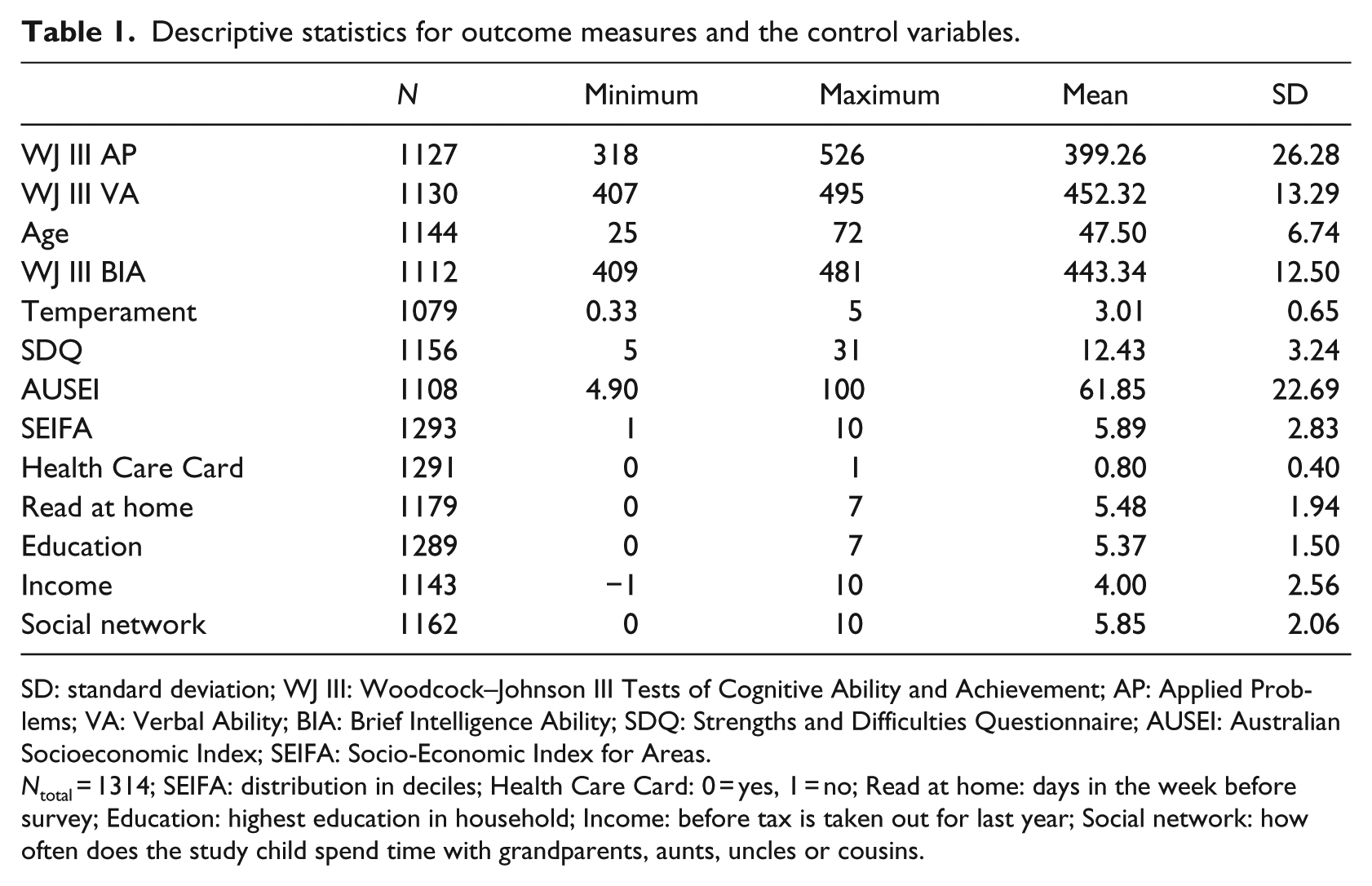
SD: standard deviation; WJ III: Woodcock–Johnson III Tests of Cognitive Ability and Achievement; AP: Applied Problems; VA: Verbal Ability; BIA: Brief Intelligence Ability; SDQ: Strengths and Difficulties Questionnaire; AUSEI: Australian Socioeconomic Index; SEIFA: Socio-Economic Index for Areas.
Ntotal = 1314; SEIFA: distribution in deciles; Health Care Card: 0 = yes, 1 = no; Read at home: days in the week before survey; Education: highest education in household; Income: before tax is taken out for last year; Social network: how often does the study child spend time with grandparents, aunts, uncles or cousins.
The four attendance subgroups differed with regard to intelligence and age of the child, as well as the socio-economic indexes for residential areas (SEIFA), social network and education and income of parents (p < .01 for all). Regarding other context variables, no significant differences between the four groups were found.
Pearson correlations were used to examine the relations between outcome measures and family and child characteristics for the sample with complete attendance data. A high correlation was found on the three cognitive measures of the WJ III, with slightly higher correlations between BIA and the outcome measures than between AP and VA (BIA–AP r = .71; BIA–VA r = .79; AP–VA r = .62). All WJ III measures showed significant, predominantly positive correlations with all control variables (except gender and the sum score of behavioural problems). Girls’ BIA performance slightly exceeded the boys’ scores.
Medium to high correlations were found between different SES-related measures such as education, income, AUSEI, holding a Health Care Card and SEIFA (between r = .14 and r = .56). As anticipated, these measures were also significantly associated with reading to children and with children’s main language. On average, children who spoke a language other than English as their main language or who came from families with lower SES had less contact with close relatives and were read to less frequently than children who spoke English as their main language.
A moderately negative correlation was found between temperament and behavioural problems. On the SDQ, low correlations with the SES variables and even lower associations with other variables were found. More problematic temperaments were associated with significantly lower cognitive outcomes but were not significantly associated with most SES variables. As anticipated, age was also highly positively correlated with the outcome measures, but few relevant associations were found between age and the other measures.
Regression analyses
AP
The results of the regression analyses to predict AP at t1 are shown in Table 2. The constant in the different models can be interpreted as the mean score a child would have achieved if all other variables included in the model had a zero value.
Results regression analyses WJ III Applied Problems.
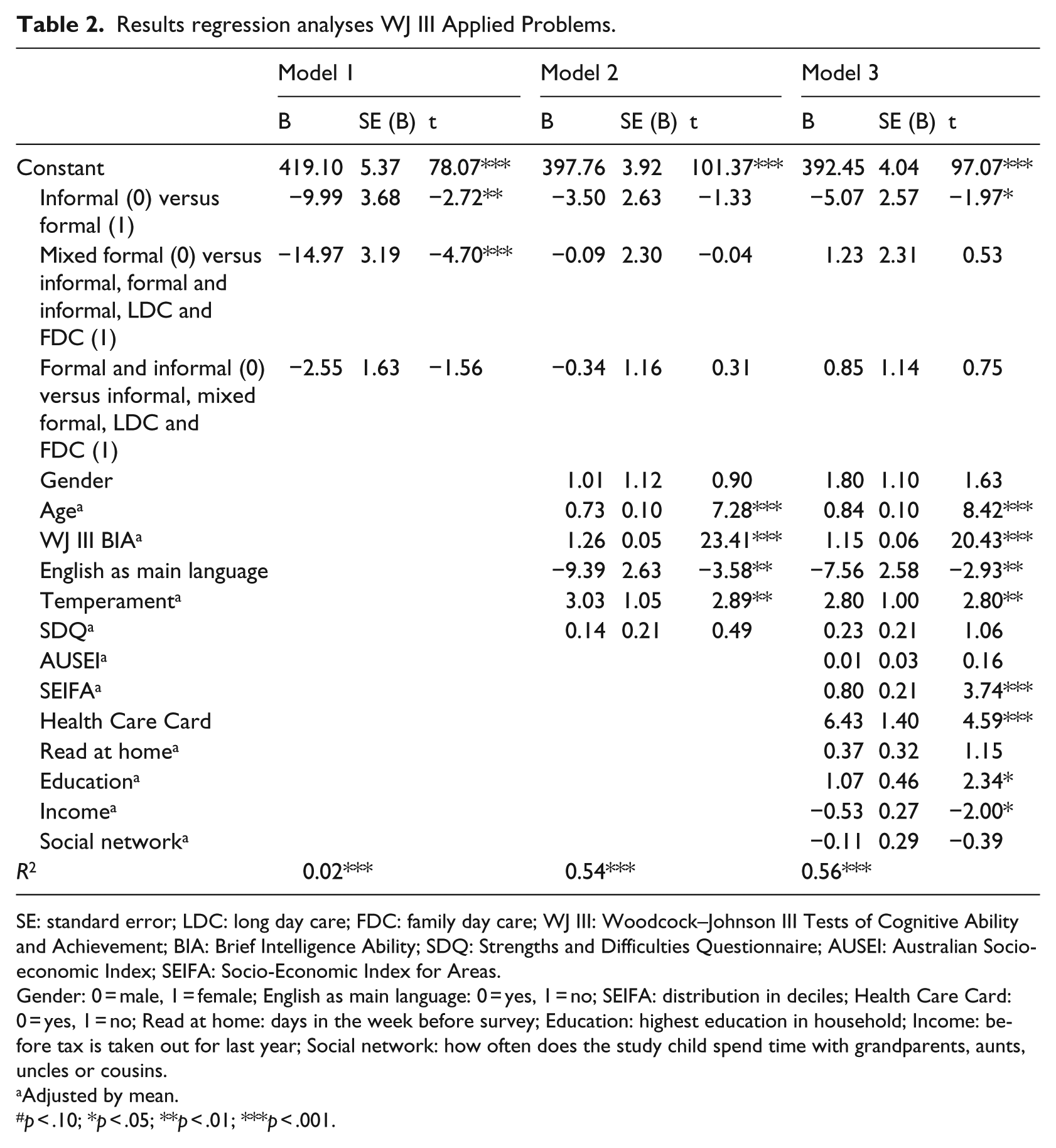
SE: standard error; LDC: long day care; FDC: family day care; WJ III: Woodcock–Johnson III Tests of Cognitive Ability and Achievement; BIA: Brief Intelligence Ability; SDQ: Strengths and Difficulties Questionnaire; AUSEI: Australian Socioeconomic Index; SEIFA: Socio-Economic Index for Areas.
Gender: 0 = male, 1 = female; English as main language: 0 = yes, 1 = no; SEIFA: distribution in deciles; Health Care Card: 0 = yes, 1 = no; Read at home: days in the week before survey; Education: highest education in household; Income: before tax is taken out for last year; Social network: how often does the study child spend time with grandparents, aunts, uncles or cousins.
Adjusted by mean.
p < .10; *p < .05; **p < .01; ***p < .001.
Model 1
Prior ECEC explains about 2 per cent of the variance (F(3, 1287) = 9.33; p < .001). The group who only attended formal ECEC programmes that included kindergarten programmes (mixed formal) demonstrated the highest performance and achieved the highest AP score, followed by children with only informal ECEC attendance and children who attended formal and informal ECEC. Compared with all other groups, the group who attended only LDC and/or FDC over the 3 years prior to t1 achieved the lowest AP score.
Model 2
Various child characteristics were included in the regression. Age, intelligence, main language and temperament proved to be significant predictors of AP. An additional 52 per cent of variance was explained by introducing these variables in the model (F(6, 1281) = 236.84; p < .001). When these variables were controlled for, no significant differences were found between the categories of ECEC programme.
Model 3
Measures of family and community SES were entered in Model 3. Holding a Health Care Card, SEIFA, highest education in the household and family income proved to be additional significant predictors of children’s outcomes for AP. An additional 2 per cent of variance was explained when these variables were included in the model (F(7, 1274) = 10.28; p < .001). Controlling for both child characteristics and family measures, children who attended informal programmes only, significantly outperformed children who attended a formal programme of some sort in the 3 years prior to t1 (p < .05). No significant differences between the other ECEC groups were found.
The development of mathematical competencies (AP) from t1 to t2 was unaffected by ECEC programme category whether controlling for individual and family background variables or not (p > .05). In addition to the initial competencies in AP at t1, only age and BIA proved to be significant predictors of the development in AP between t1 and t2 with older and more intelligent children showing greater competencies gain (p < .001).
VAs
The same analyses were repeated with VA as the outcome measure. The results are shown in Table 3.
Results regression analyses WJ III Verbal Abilities.
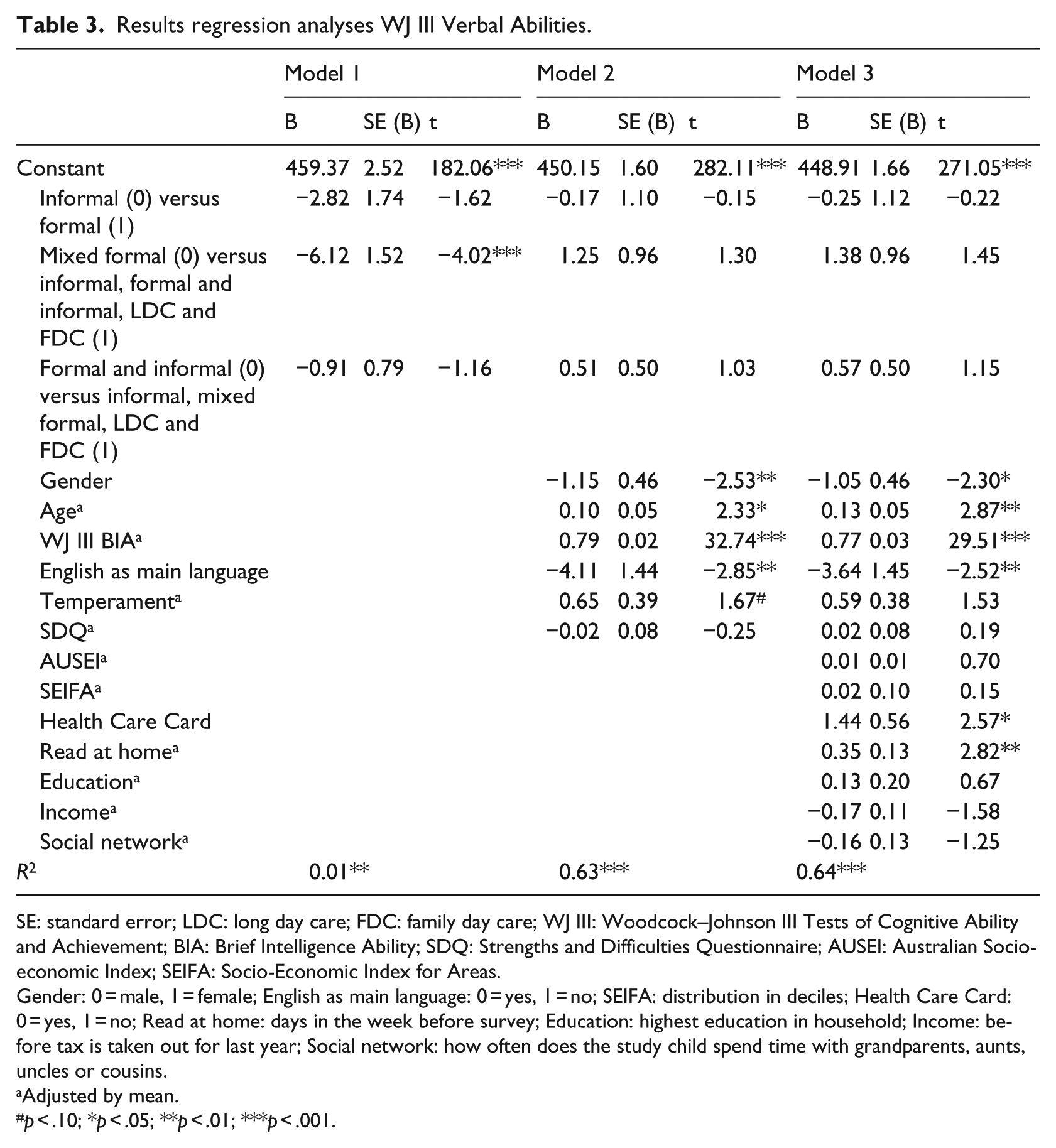
SE: standard error; LDC: long day care; FDC: family day care; WJ III: Woodcock–Johnson III Tests of Cognitive Ability and Achievement; BIA: Brief Intelligence Ability; SDQ: Strengths and Difficulties Questionnaire; AUSEI: Australian Socioeconomic Index; SEIFA: Socio-Economic Index for Areas.
Gender: 0 = male, 1 = female; English as main language: 0 = yes, 1 = no; SEIFA: distribution in deciles; Health Care Card: 0 = yes, 1 = no; Read at home: days in the week before survey; Education: highest education in household; Income: before tax is taken out for last year; Social network: how often does the study child spend time with grandparents, aunts, uncles or cousins.
Adjusted by mean.
p < .10; *p < .05; **p < .01; ***p < .001.
In Model 1, the different categories of prior ECEC attendance explained only about 1 per cent of variance of VA (F(3, 1287) = 5.90; p < .01). Only those children who attended mixed forms of formal ECEC (including kindergarten programmes) outperformed the other groups significantly. However, when child (Model 2) or family (Model 3) characteristics were used as control variables, no significant differences between the ECEC programmes were found (p > .05 for all). In Model 3, about 64 per cent of the variance of VA was explained (F(7, 1274) = 3.84; p < .001). Most important predictors of VA at t1 were intelligence, age, the frequency with which the child was read to, whether or not the family held a Health Care Card, the child’s main language and the child’s gender (boys outperforming girls).
The development of VA from t1 to t2 did not differ between different ECEC categories (p > .05) when controlling for the individual and familial context variables. In addition to the initial competencies in VA at t1, age, BIA, the child’s main language, temperament and SDQ, as well as SEIFA proved to be significant predictors of the development of VA (p < .05 for all). Here, older and more intelligent children living in communities with a higher SEIFA index as well as children with higher values in the temperament scales and children showing less problem behaviour show greater gains in VAs.
Discussion
Contrary to our hypothesis, the results show that children who received only informal education and care performed better on AP than their peers, while no significant differences in children’s performance on the VA subtest were found. There are several possible explanations.
We were not able to consider the duration of attendance, the general quality of the prior ECEC experiences and the actual mathematical and verbal stimulation that the children received in the prior 3 years in our analyses. The quality of ECEC programmes has shown to be a very important predictor of children’s outcomes (Burchinal et al., 2010; Sylva et al., 2004). In addition to the general process quality, the modality, frequency and structure of activities have a great influence on mathematical outcomes (reference withheld) and may vary in different ECEC programmes.
The composition of groups attending the same ECEC room may also influence children’s demonstrated competencies (Palardy, 2008). The ratio of educators to children is typically lower in formal ECEC programmes, than in informal programmes where adults are usually managing smaller numbers of children. Because higher adult-to-child ratios afford better opportunities for one-to-one discussions and engagements, there may be a ‘contact advantage’ for children accessing adults in informal programmes when there are fewer other children competing for attention. However, features such as ratios are found to be inconsistently related to child outcomes (Mashburn and Pianta, 2010), although when high adult to child ratios are specified along with specific kinds of education strategies child cognitive and language outcomes have significantly improved, such as in the Abecedarian studies (Ramey et al., 2012).
Differences between the Australian ECEC system and ECEC systems of other countries may account for the differing results. However, these explanations do not fully account for why there were no VA differences found across the four ECEC categories, despite the high correlation of the outcome measures of AP and VA. For this reason, we propose another explanation for these results. Given the fact that many early childhood educators describe anxiety about their own mathematics knowledge and negative feelings about mathematics in general, one can expect them to spend more time teaching literacy and paying attention to children’s VAs than mathematics (Bates et al., 2011; Cook, 1996; Sarama, 2002).
Our results suggest that informal programmes may be at least as good at facilitating children’s acquisition of mathematical understanding as currently approved formal ECEC programmes. Our finding was established at a time when clear concern about the development of mathematics had been noted but as yet, progress in the implementation of effective early interventions has only just begun. In light of earlier work by Blau (1999) connecting specialised training of staff to higher child outcome scores in mathematics, alongside studies by Mashburn and Pianta (2010) highlighting the influence of the nature of the interactions on child outcomes, our results may be highlighting a point-in-time just as initiatives to improve early learning are in conception.
Earlier ECEC attendance had no effect on the further development of competencies in the subsequent year. The development of mathematical and verbal skills between t1 and t2 did not differ for children who accessed different types of ECEC programme during the 3–4 years before children commenced participation in the E4Kids study. However, given first that attendance of ECEC programmes prior to t1 only was taken into account and second that we included initial performance at t1 as a predictor of the performance at t2, this was to be expected. Future analyses should also take the attendance pattern between t1 and t2 into account.
While age and intelligence proved to be important predictors of both children’s initial performance and the further development of competencies, the typical SES measures did not predict the child outcomes well when all variables were included in the analyses. In addition, similar to former studies, a child’s main language and the frequency with which the child was read to were significant predictors of initial VAs as well as of the development of these abilities between t1 and t2 (cf. Brooks-Gunn et al., 2007; reference withheld). Temperament proved to be a significant predictor of initial mathematical competencies and for the further development of verbal competencies between t1 and t2. This finding is somewhat surprising, given that temperament is often associated rather with behavioural than cognitive outcomes (e.g. Smart and Sanson, 2005). However, better persistency and flexibility are characteristics that also play a role in cognitive development. In our sample, boys outperformed girls in VAs when all other variables were controlled. This was somewhat surprising as in many studies, girls perform better in linguistic tests (e.g. Halpern, 2000).
Limitations and strengths
The composition of the four subsample groups is based primarily on information obtained from the main caregiver surveys. Even though the specific programmes were described precisely, given mixed use of these terms in the community, parents may have misclassified their child’s programme as ‘childcare’ or ‘kindergarten’. As children for whom data on prior attendance were missing were excluded in the analyses, the sample size for this study was reduced considerably. However, where missing information for all children was imputed, a tendency in the same direction can be seen and the reported results are thus not solely dependent on selection processes. Nonetheless, the effects of the selection process may be partly responsible for the findings. In addition, we were unable to control for the duration of attendance in formal ECEC programmes, the quality of the instructional support in centres and the composition of kindergarten groups. Another limitation concerns the measurement of mathematical and verbal skills using the WJ III. The subtests of AP and VAs may not be sufficiently discriminatory to describe the competencies of very young children.
Although the results have to be interpreted with caution, this study also has many strengths. First, despite the exclusion of some of the children, a large sample was included in the analyses, and these results should be representative of Australian children. Second, as this is the first large-scale study to explore the relationship between attendance of various ECEC programmes and early childhood competencies in Australia, the findings can act as a basis for future research in this area. Third, well-known, standardised tests were used to obtain child outcomes (McGrew et al., 2001), adding validity to our results and enabling comparisons to be made with results obtained by other studies using the same measures. Finally, a variety of important variables were controlled in the analyses. The differing outcomes in AP between children who attended only informal ECEC programmes as opposed to some form of formal ECEC programme are not only due to certain child or family characteristics. Indeed, the differences persisted even when controlling for important variables such as age, sex, intelligence, main language, family SES or reading at home.
Children’s early verbal and mathematical abilities are important for their further development, and consequently, it is important that children receive optimal support during the years prior to formal school education. However, our results indicate that attending ECEC programmes in Australia may not provide optimal support for children’s emerging mathematical competencies. This study suggests that early childhood educators require targeted support if they are to increase the quality of mathematics learning in play-based programmes in order to address their uncertainty or at times, anxiety, about how best to approach supporting children’s mathematical thinking and their acquisition of mathematical language in the years before school.
Footnotes
Acknowledgements
E4Kids is a project of the Melbourne Graduate School of Education at The University of Melbourne and is conducted in partnership with Queensland University of Technology. E4Kids is funded by the Australian Research Council Linkage Projects Scheme (LP0990200), the Victorian Government Department of Education and Early Childhood Development and the Queensland Government Department of Education and Training. E4Kids is conducted in academic collaboration with the University of Toronto Scarborough, the Institute of Education at the University of London and the Royal Children’s Hospital in Melbourne. The E4Kids team would like to sincerely thank the ECEC services, directors, teachers or staff, children and their families for their ongoing participation in this study.
Funding
This work was supported by a fellowship of the Research and Study Program on Education in Early Childhood of the foundation Robert Bosch Stiftung and a fellowship within the Postdoctoral Programme of the German Academic Exchange Services (DAAD).