




Abstract
The present study examined representational and non-representational activities in which children in a Head Start classroom participated. This was an investigation from the perspective of cultural-historical activity theory of how components (e.g. artifacts and division of labour) of classroom activities vary across and within types of activities. Participants included a class of 21 ethnically diverse 4- and 5-year-olds and two teachers. Data collection involved naturalistic observations of classroom members participating in indoor play, outdoor play, and notational activities (e.g. reading and drawing) over 8 days. Who was involved, artifact use, and artifact-related actions varied by activity. Furthermore, who was involved, actions, and division of labour were strongly linked in second-by-second analyses. The present study contributes research which situates children’s development within daily activities.
Introduction
The ability to interact with external representations (e.g. pictures and text) is important for child development for at least two main reasons. First, representations allow children to transcend limits of the here and now by representing past, future, fictional, hypothetical, or remote ideas (Piaget, 1951). Second, representations allow children to participate in cultural practices that rely upon these artifacts (Rogoff, 2003; Vygotsky, 1978). Several theories of representational development emphasize constructivist processes through which children construct an understanding of representations based on experiences with print, pictures, toys, and other artifacts (e.g. Piaget and Inhelder, 1969; Werner and Kaplan, 1963). These theories typically focus on the individual child as the unit of analysis and view the child as separate from his or her surroundings (Rogoff, 2003).
As predominant as constructivist approaches to representational development have been, they are limited in their ability to fully explain how children use and produce external representations. Variants of constructivism focus on the child and stimuli in the child’s environment, but they have little to say about (a) the conventionalized activities in which children and objects are situated; (b) the greater knowledge, wisdom, and accumulated experience adults (especially parents and teachers) hold in terms of stipulating the what, how, and when of children’s exploration of objects; or (c) the importance of ethnicity, socioeconomic status (SES), and other demographic characteristics which may shape access to and attitudes about different types of representations and representational activities. Among sociocultural approaches generally, “… the focus no longer is on the individual but on the transformation of societal activity that the participants collectively generate” (Maheux and Roth, 2013: 237). Here, the emphasis is on interactions among individuals and on interactions between individuals and artifacts (Holzman, 2006), recognizing the pervasiveness of cultural tools and settings throughout all aspects of psychological functioning (Cole and Engeström, 2007).
The present study seeks to demonstrate how a sociocultural approach, in particular a cultural-historical activity theory approach, may provide a more complete view of children’s use of representations through a comparison of two broad kinds of representing—through pretending and through the use of notations (especially pictures and text). The specific context involved teachers and children in a Head Start classroom who were observed participating in everyday activities over several days. As Göncü and Gauvain (2012) note, sociocultural views of learning are better suited for studying multicultural educational settings, whereas cultural goals, beliefs, identities, and the like tend to be peripheral or ignored in constructivist approaches. A secondary aim of the article is demonstrate one way in which quantitative analyses may be used to complement commonly used qualitative analyses of activities and activity systems.
Constructivist approaches to representational development
Constructivist theories of development view the child’s active exploration of her physical and social surroundings as driving development. For example, Werner and Kaplan (1963) formulated a well-known theory of representational development with a focus on spoken language. According to Werner and Kaplan, representational development arises from the “primordial sharing situation” in which infants and mothers jointly think about shared objects. The infant–mother dyads reference these objects nonverbally then verbally. During this process, children discover for themselves how to create conventional (spoken) representations and learn that representations and referents are separate entities.
Piaget’s views of representational development are also constructivist in nature. For Piaget, representational activities like pretense and drawing are manifestations of a general “semiotic function,” driven by accommodation and assimilation (Piaget and Inhelder, 1969). Children acquire representations, or “signifiers,” through accommodation, whereas the meanings of those signifiers are acquired through assimilation.
More recently, constructivist approaches have been applied to the development of pretense and drawing. Regarding pretense, Harris and Kavanaugh (1993) posited that play partners “flag” objects and actions as part of the pretense after play partners have signaled the beginning of a playful episode. Players jointly construct transformed identities for objects (e.g. blocks flagged as cars) or for actions (e.g. rubbing fingers on one’s teeth flagged as brushing). Regarding drawing, Wolf and Perry (1988) and others see exploration of art materials as the primary mechanism for the development of drawing strategies.
Likewise, many researchers have emphasized constructivist processes in literacy and numeracy development. Kamii and Manning (2002) argue that “[c]hildren construct their own theories of about the nature of our writing system” (p. 44), and these naive theories serve as the foundation for subsequent reading and writing development. Others have suggested that beginning readers/writers’ invented spellings arise through exploration (Richgels, 1995) and contribute to learning to read (Ouellette and Sénéchal, 2008). Kamii (1989) also proposed that children initially construct their own concepts of number then create idiosyncratic notations for these concepts. Teaching conventional notations can only follow children’s construction of underlying concepts (Kamii, 1989) and may be fostered by allowing children to integrate numeracy in their play when they can work with numbers in their own ways (Emfinger, 2009).
Despite the predominance of these approaches, several critiques of constructivism have been put forth by sociocultural theorists. For example, constructivism maintains a dualistic view of the child and the outside world (Liu and Matthews, 2005; Rogoff, 1998). In addition, constructivism focuses on the individual child as the unit of analysis, without fully acknowledging the inextricable connection between the child and situations in which the child engages (Lave, 1988). Sociocultural theories of development, alternatively, blur the divisions between individual and world (Nicolopoulou and Weintraub, 1998; Rogoff, 2003) and emphasize activities or practices in which children take part as the unit of analysis (Gauvain, 2001; Göncü et al., 1999).
Sociocultural perspectives on children’s use of representations and play
There are several, very distinct sociocultural perspectives to understanding learning and development, but these approaches are united in a focus on the mind and culture mutually shaping one another, an emphasis on artifact-mediated behavior and thinking, and acknowledgement of the role of historical change; these foci led sociocultural researchers away from dualistic views of individuals and their environments. Many current approaches originate in Vygotsky’s (1978) theory of tool mediation in which tools (or artifacts) mediate a person’s response to his or her environment. More recently, Engeström (1999) and others have formulated this relationship as part of a larger activity system involving broader communities, rules, and divisions of labour.
Sociocultural theorists, such as Lave and Wenger (1991), Hedegaard (2004), and Rogoff (2003), characterize learning as a shift in the learner’s participation within one or more “communities of practice.” Communities of practice involve individuals who share common goals, interests, and practices; and families, clubs, workplaces, and classrooms exemplify such communities. Increasingly, researchers interested in formal learning—regarding literacy especially—have taken sociocultural perspectives (Gee, 2010; Magnusson and Pramling, 2011; Nicolopoulou and Weintraub, 1998; Prior, 2006; Razfar and Gutiérrez, 2003; Serpell et al., 2005). These approaches are not necessarily Cultural-Historical Activity Theory (CHAT) approaches per se, however.
Several researchers and theorists have sought to understand representational development in and out of school from various strains of CHAT (Nussbaumer, 2012; Roth and Lee, 2007). For example, Russell (1995) analyzed writing instruction by looking at the tools, subjects, and objectives involved, whereas Nunez (2009) advocated analyzing children’s learning in mathematics classes using all of the components of an activity system as identified by Engeström. Interestingly, very few researchers seem to characterize the pretense and drawing development from a CHAT perspective. Göncü et al. (1999) discuss ways of investigating play through activity theory, but they did not focus on pretend (i.e. representational) modes of play.
Understanding how children participate in a broad range of representational activities within a community of practice would help educators and researchers to identify ways for children to become fuller participants in that community, as well as other communities. This also would help identify factors which facilitate or impede shifts toward fuller participation. Sociocultural approaches, such as CHAT, allow us to see how classrooms function as collective wholes, whereas constructivist approaches isolate students from teachers and other students and focus on students and artifacts without exploring the broader aspects of the classroom in which those students and artifacts are situated. Thus, the present study aims to examine young children’s participation in several representational activities in a preschool classroom, allowing comparisons in participation across representational and non-representational domains.
The Study : methodology
The present study addresses variations in and the interplay between artifacts, subjects, objectives, and division of labour in a preschool classroom following Engeström’s (1999) activity system model. Thus, the study primarily serves as an investigation of how various components of classroom activities vary among two types of representational activities (pretense and using notational systems) and one non-representational activity (non-pretend play).
A secondary contribution of the study is that it provides a quantitative approach to examining classroom activities through a CHAT lens, complementing the numerous qualitative studies that implement the same perspective. For example, Jordan and Smorti (2010) analyzed a science education program being implemented in a rural, New Zealand preschool, and the authors described the program in terms of all six components of Engeström’s model. Ljung-Djärf et al. (2005) examined how classrooms used computers in three Swedish preschools by focusing on differences in subjects (teachers and students), institutional rules, and the computer as artifact. Studies of formal educational settings using CHAT framework tend to be qualitative in nature (Nussbaumer, 2012), including those just cited. The present study complements this literature in that data collection was qualitative in nature in that it was (a) in non-numeric format, (b) relatively flexible and open-ended, and (c) collected in a natural setting (Staller, 2010), whereas data analyses were quantitative.
Two main research questions drove the analyses summarized below. First, do the duration of subject configurations (children only or adults and children), the duration of artifact use, the duration of artifact-related actions 1 (e.g. using/creating notations like text and pictures, on-lookingand pretending that a stuffed animal is alive), and the duration of different divisions of labour vary by activity? These activities involved (a) indoor play with toys, (b) outdoor play with toys orplay equipment, and (c) notation-related activities (e.g. reading, writing, drawing, using picture puzzles). It may be that adults and children spend more time interacting with one another (in contrast to children acting without adults) and spend more time directing notational activities like reading or writing compared to play activities.
There is mixed evidence regarding the nature of teacher–child play in preschool settings. Göncü and Weber (2000) found that preschoolers usually play with one another and not with teachers, with whom they are more likely to problem-solve because of unequal distributions of knowledge in the classroom. However, Ashiabi (2007) notes that teachers sometimes manage or direct students’ play through providing or suggesting rules, props, spaces, and roles and that teachers sometimes serve as equal partners during children’s play. I investigated differences in division of labour across play and non-play activities in order to add clarity to these findings.
There are few published comparative studies of indoor and outdoor play. These studies typically focus on what children do with peers but not with adults, and they tend to demonstrate that young children engage in more physical activity during outdoor play compared to indoor play (Louie and Chan, 2003; Sugiyama et al., 2012). Thus, I expected that children would engage in more non-pretend play outside than inside. Teachers may see outdoor play time as an opportunity to take a break from teaching and as an opportunity for children to engage in physical and social activity with one another (Davies, 1996). So I expected that teachers and children would interact longer during indoor play and notational activities than outdoor play activities.
As Hedegaard (2004) states, “[a]n important factor in understanding a person’s learning … is the institutional traditions and practices that specifies both what are objects of activities and what are means of activities (e.g., in home, school, at work etc.)” (p. 23). Thus, longer amounts of adult-guided participation (as a type of division of labour) may serve as more effective ways in which institutional schooling practices shape children’s participation in school-related activities. Also, one might expect longer durations of using books, paper, markers, and other artifacts tied to representational actions within activities for which these artifacts are essential (reading/inscribing activities).
Second, are there certain patterns of subjects, artifacts, actions, and divisions of labour that co-occur in time? To more fully understand how artifacts are used, it is important to examine the “institutional practices” (Hedegaard, 2004) in which the artifacts are embedded. Hence, the second research question explores what is happening in terms of who is engaged with certain artifacts and how those subjects are engaged with one another on a second-by-second basis. For example, it may be that artifacts which are not intended by adults to be representational (e.g. blocks or outdoor play equipment) tend to be used when children are leading the activity or when the division of labour is more equal as opposed to when a teacher is guiding the activity. It also may be that young children necessarily use artifacts intended to be used as representations in their intended ways or that young children necessarily use non-representational artifacts in their intended ways. A plastic block, for instance, may not be seen as representational by most adults, yet a child may use the block as a representation of food during pretense.
Method
Participants
Participants included a class of 21 children (including 11 girls) and two teachers (one female). The children were ethnically diverse (primarily Latino, African-descent, and European-descent) with a mean age = 4.90 years (standard deviation (SD) = .41 years; range 4.15–5.55 years). Both teachers were European-descent. Both teachers gave written consent for participation, and parents of all the children in the class gave permission for their children to participate in the study. The researcher who videotaped the class also asked children to assent to be recorded.
Procedure
Data collection relied on naturalistic observations, and children and teachers were not asked to do anything beyond what they normally did in class. Over 8 days, a researcher videotaped participants interacting during three types of activities: outdoor play (e.g. climbing, playing on swings), indoor play (e.g. playing with puzzles or blocks), and notational activities (e.g. reading, writing, counting, or other activities involving literacy). Another researcher segmented the videotaped records into distinct episodes. The presence of two or more individuals participating in an activity marked the start of an episode, whereas the presence of less than two individuals participating in the activity marked the end of the episode. Three episodes were dropped because they were longer than 2 SDs of the mean episode duration, and the final dataset included 39 episodes, mean length = 104.69 seconds (SD = 101.04 seconds; range: 5–448 seconds).
Data coding
Two additional coders noted the onset and offset times for (a) subject configuration, (b) artifact being used, (c) artifact-directed actions, and (d) division of labour within each episode. Subject configuration was coded as children only, adult only, or both children and adult(s) depending on who was involved in the activity within an episode. Coders also noted when participants used different types of artifacts. They categorized artifacts as representational if participants used books, calendars, writing/drawing materials, replica toys, or other objects which were created to or are usually intended to represent. An artifact was non-representational if it was not an object that is usually intended to represent (e.g. blocks, swings, and tricycles).
In addition, coders coded four types of actions involving artifacts. These were on-looking, pretending, non-pretend playing, and notation-related actions. On-looking involved watching someone else using an artifact. Pretending involved any actions with artifacts in which participants playfully transformed those artifacts (e.g. bouncing a doll in a manner to simulate walking). Non-pretend play actions included climbing, riding, digging, and building in which pretense was not evident. Notation-related actions included talking about pictures, writing with pens/crayons, drawing, and reading books.
Finally, coders noted onset and offset times for three divisions of labour. The first type involved actions or conversation guided by an adult, the second type involved actions or conversation guided by a child, and the third type involved social activity in which participants seemed equal and no one seemed to take on a leading role.
Separate pairs of coders coded approximately 20 percent of the videotaped episodes in order to determine inter-rater reliability for the start and stop times (to the nearest second) for the various action types for each second of videotaped data. Agreement (within 3 seconds) was acceptable for subject configuration, percent agreement = 98–99, Cohen’s κ = .89–.90; for artifact type, percent agreement = 83–84, κ = .64–.65; for action type, percent agreement = 80–84, Cohen’s κ = .74–.78; and for division of labour, percent agreement = 80–87 percent, κ = .55.70. Ranges in agreement varied depending on which rater is used as the reference (Bakeman et al., 2009).
Findings
Variations by activity type
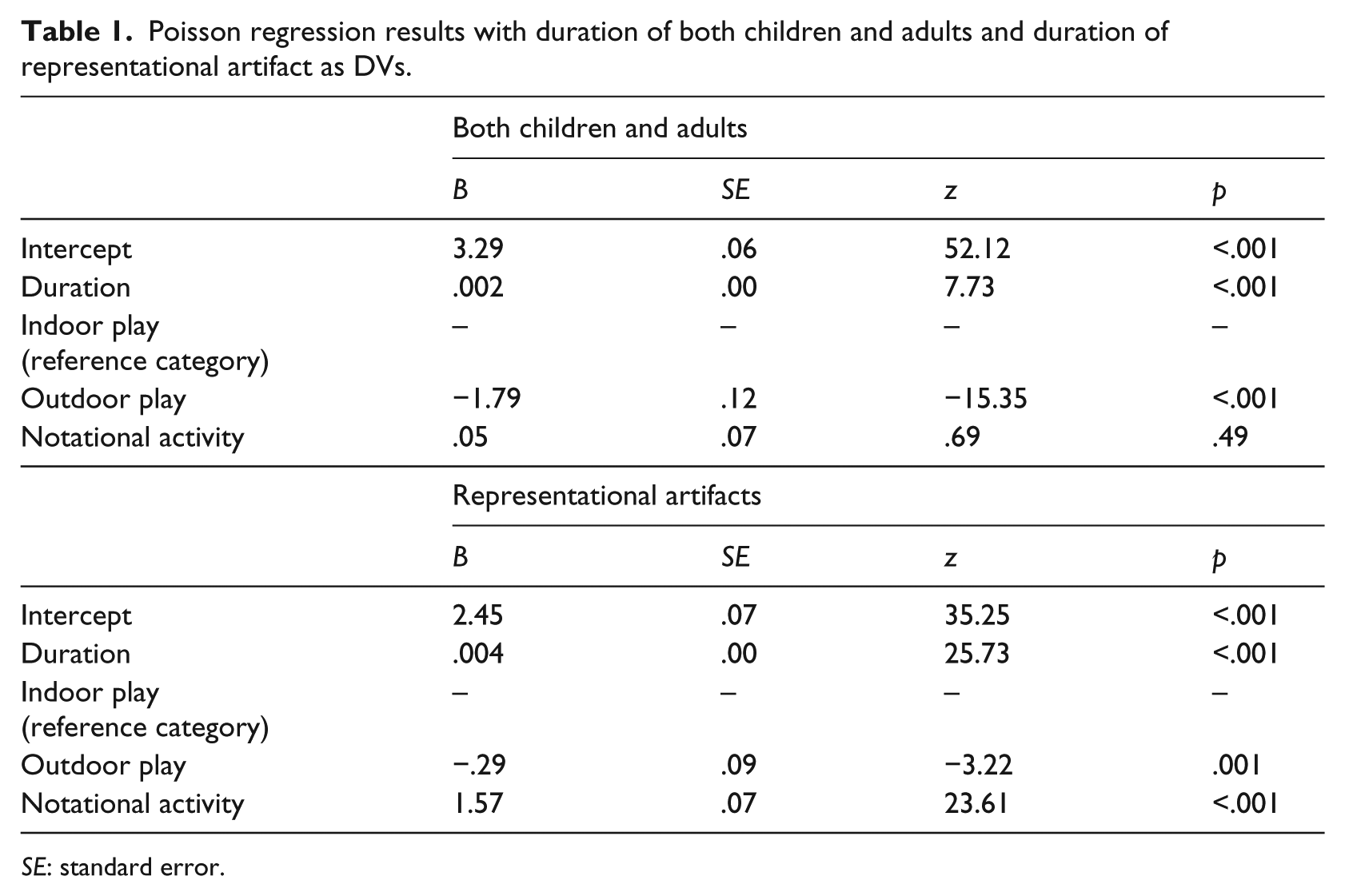
The unit of analysis for all statistical tests in this section was the episode, not the child. Of those 39 episodes, 12 entailed indoor play activities, 17 entailed outdoor play activities, and 10 involved notational activities. I conducted two types of analyses in order to address the first research question which involved the extent to which durations of subject configurations, artifact type, action type, and division of labour varied by activity. First, I computed a Poisson regression with duration of both children and adults as the predicted variable, and episode duration and activity (reading/inscribing, indoor play, outdoor play) as the predictor variables. Episodes involved children only or children plus an adult for the entire episode. Therefore, it was only necessary to analyze how long both children and adults were present. (The same applies below to why only representational artifacts were analyzed.) Poisson regressions were used instead of linear regressions because the distributions of durations were positively skewed with many zeros. The analysis yielded a significant effect of episode duration so that the length of time both children and adult interacted increased as episode duration increased. In addition, the length of time both children and adults interacted tended to be greater during indoor play activities relative to outdoor play activities, with no significant difference between indoor play activities and notational activities (see Table 1).
Poisson regression results with duration of both children and adults and duration of representational artifact as DVs.
SE: standard error.
A similar Poisson regression with length of time using representational artifacts as the predicted variable yielded significant effects of episode duration and activity type, as well. This regression yielded a significant effect of episode duration so that the length of time using representational artifacts increased as episode duration increased. The length of time participants used representational artifacts tended to be greater during notational activities relative to indoor play activities and shorter during outdoor play activities relative to indoor play activities (see Table 1).
Also, I computed a generalized estimating equation (GEE; see Liang and Zeger, 1986; Zeger and Liang, 1986) with division of labour length (in seconds) as the dependent variable (DV), the three types of division of labour as within-subjects independent variables (IVs), and episode duration as a covariate. The analysis used a Poisson probability distribution and an independent working correlation matrix structure to test a model that included episode duration, a main effect of division of labour, and an activity by division of labour interaction. The GEE yielded a significant effect of episode duration, Wald χ2(1) = 107.68, p < .001, and a significant effect of division of labour, Wald χ2(2) = 20.44, p < .001. The interaction between episode duration and division of labour was nonsignificant, Wald χ2(6) = 5.10, p = .53. Examination of parameter estimates showed that the length of time for any division of labour increased as episode duration increased, B = .01, standard error (SE) = .00, Wald χ2(1) = 107.68, p < .001. Also, the length of child-guided division of labour was less than the length of equal division of lab, B = −1.92, SE = .85, Wald χ2(1) = 5.11, p = .024. The mean lengths of equal, child-guided, and adult-guided divisions of labour were 71.77 seconds (SD = 97.79), 17.87 seconds (SD = 28.63), and 19.38 seconds (SD = 45.55) divisions of labour. There were no significant effects of activity.
The next analysis focused on children’s actions during the different activities. I computed a second GEE with action length (in seconds) as the DV, the four types of action as within-subjects IVs, and episode duration as a covariate. The analysis used a Poisson probability distribution and an exchangeable working correlation matrix structure to test a model that included episode duration, a main effect of action, and an activity by action interaction. This regression yielded a significant effect of episode duration, Wald χ2(1) = 82.15, p < .001, and a significant activity by action interaction effect, Wald χ2(6) = 31.92, p < .001.
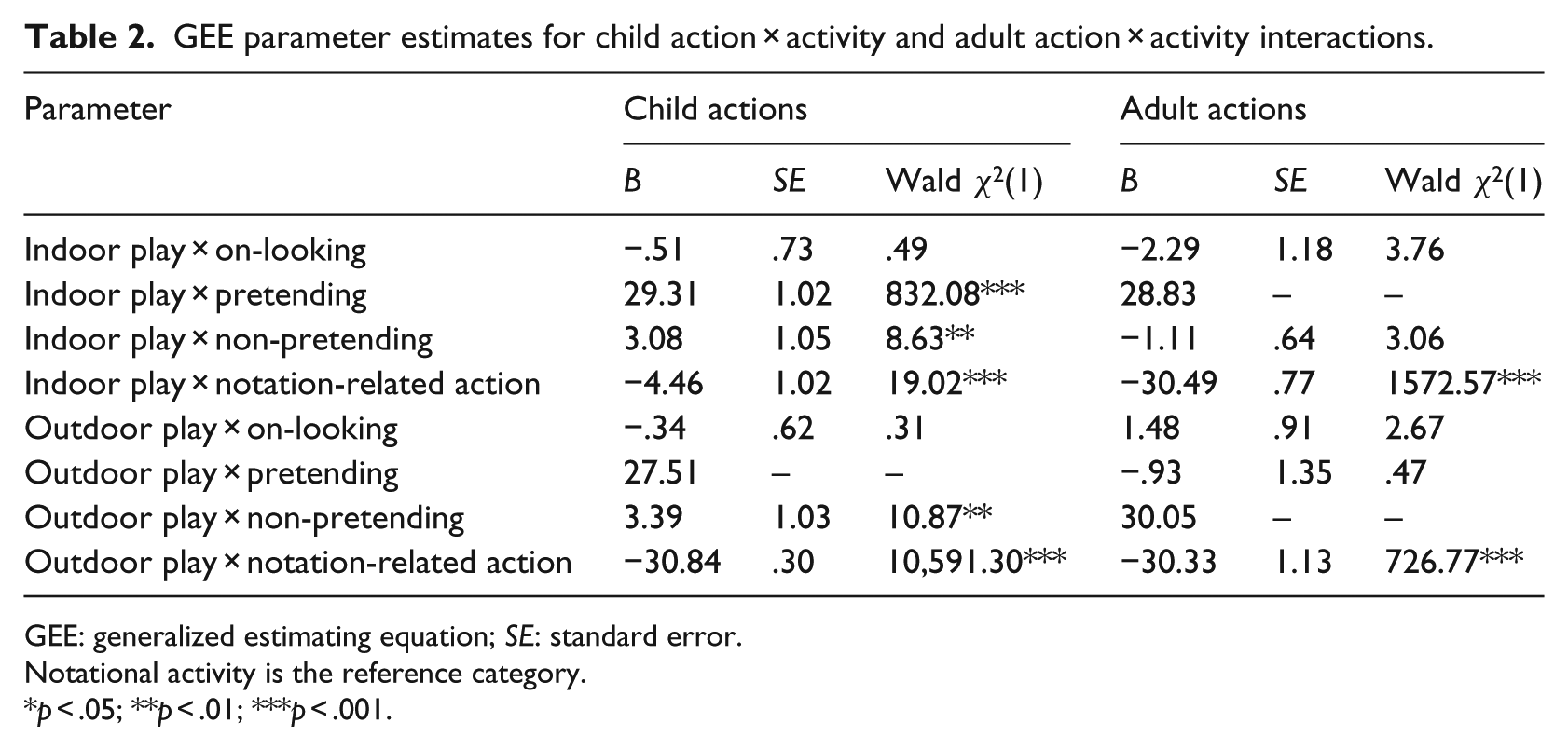
Examination of parameter estimates showed that children performed actions longer as episode duration increased, B = .01, SE = .00, Wald χ2(1) = 82.15, p < .001. Also, pretending during indoor play lasted longer than pretending during notational activities; non-pretend playing lasted during indoor play lasted longer than non-pretend playing during notational activities; notation-related actions during indoor play were briefer than notation-related actions during notational activities; non-pretend playing during outdoor play lasted longer than non-pretend playing during notational activities, and notation-related actions were briefer than notation-related actions during notational activities (see Table 2).
GEE parameter estimates for child action × activity and adult action × activity interactions.
GEE: generalized estimating equation; SE: standard error.
Notational activity is the reference category.
p < .05; **p < .01; ***p < .001.
A similar GEE was computed for adult actions with an unstructured working correlation matrix structure. This regression yielded a significant effect of action type, Wald χ2(3) = 13.34, p = .004, and a significant activity by action interaction effect, Wald χ2(2) = 26.22, p < .001 (see Table 2). The lengths of pretending (B = −28.62, SE = .98, Wald χ2(1) = 847.91, p < .001) non-pretend playing (B = −30.05, SE = .52, Wald χ2(1) = 3401.56, p < .001) were all shorter than notational actions. Parameter estimates related to activities revealed that adults spent significantly less time performing notational actions during indoor play and outdoor play activities relative to notation-related activities (see Table 2).
In sum, there were significant effects of activity durations of subject configurations, artifact type, and type of action. Division of labour, however, did not vary significantly across the three types of activity. Equal division of labour lasted longer on average than either child-directed or adult-directed participation.
Co-occurrences of activity components
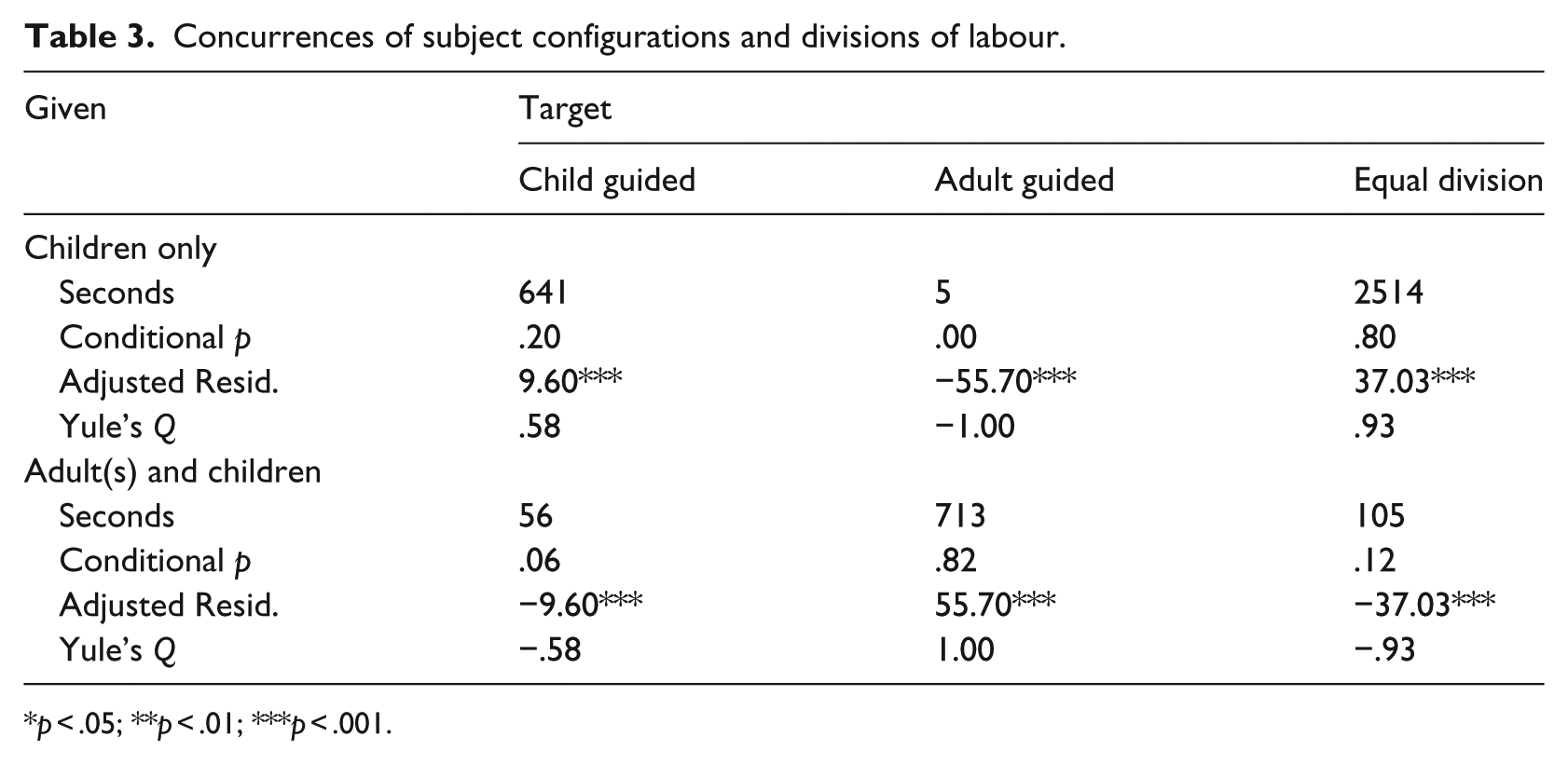
The second research question involved the extent to which certain aspects of activities tied to subjects, artifacts, action types, and division of labour co-occur. To address this question, I examined second-by-second co-occurrences of different configurations of subjects, artifacts, action types, and division of labour using GSEQ 5.1 (Bakeman and Quera, 2011). Data were collapsed across activities for these analyses to provide an adequate sample size for the sequential analyses. Division of labour tended to be egalitarian when children were involved only with other children, conditional p = .80. When adults were with children, the division of labour was more likely to involve adult-guidance than other divisions of labour, conditional p = .82 (see Table 3). These concurrences were greater than chance and effect sizes (using Yule’s Q) were “very strong,” following Bernard’s (2000) terminology.
Concurrences of subject configurations and divisions of labour.
p < .05; **p < .01; ***p < .001.
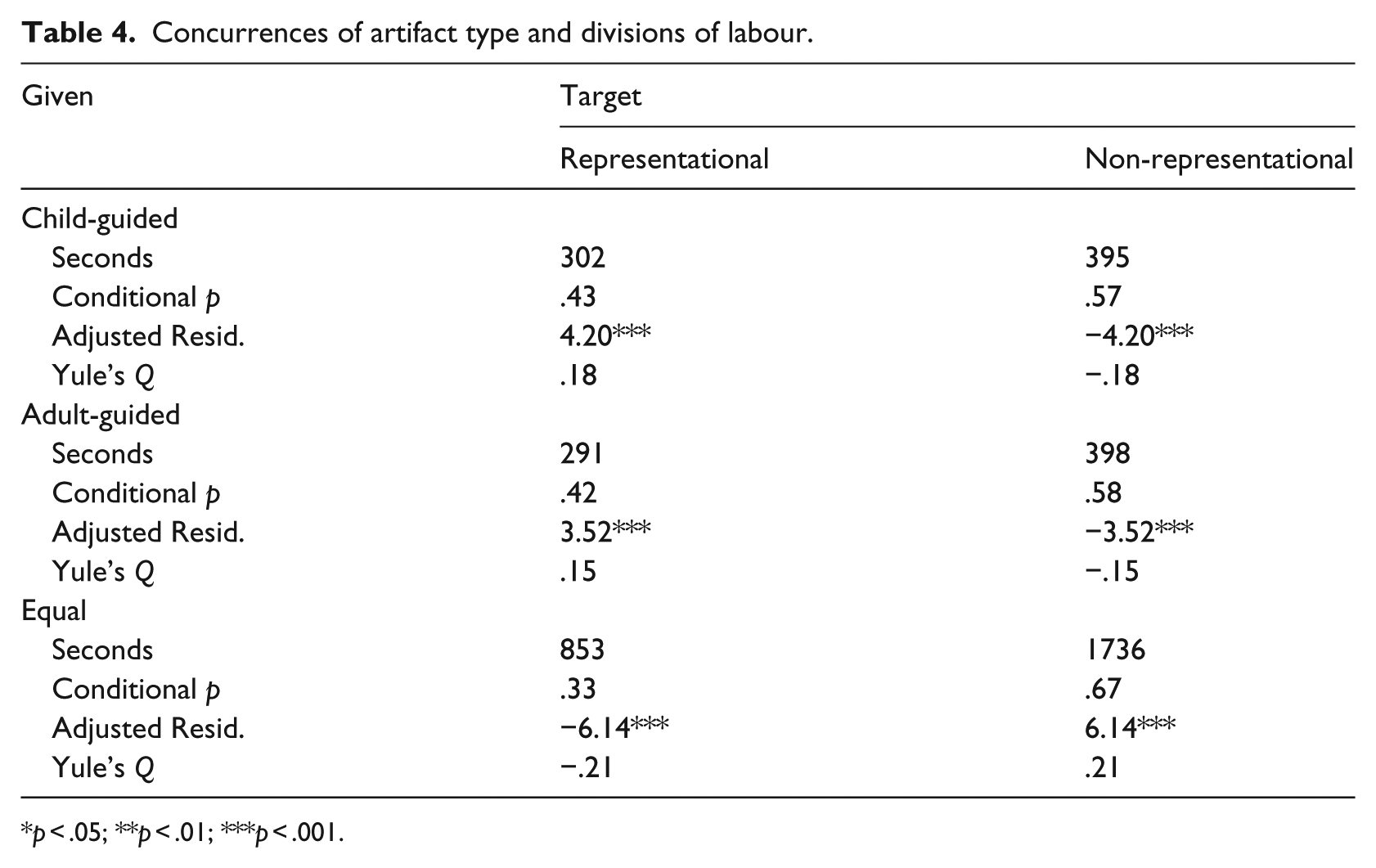
Probabilities of interacting with different types of artifacts did not vary much by division of labour (see Table 4), except that non-representational artifacts were more likely to be used (conditional p = .67) than representational artifacts (conditional p = .33) given equal division of labour. Although the adjusted residuals were significant, the effect sizes for these co-occurrences were all low (see Table 3).
Concurrences of artifact type and divisions of labour.
p < .05; **p < .01; ***p < .001.
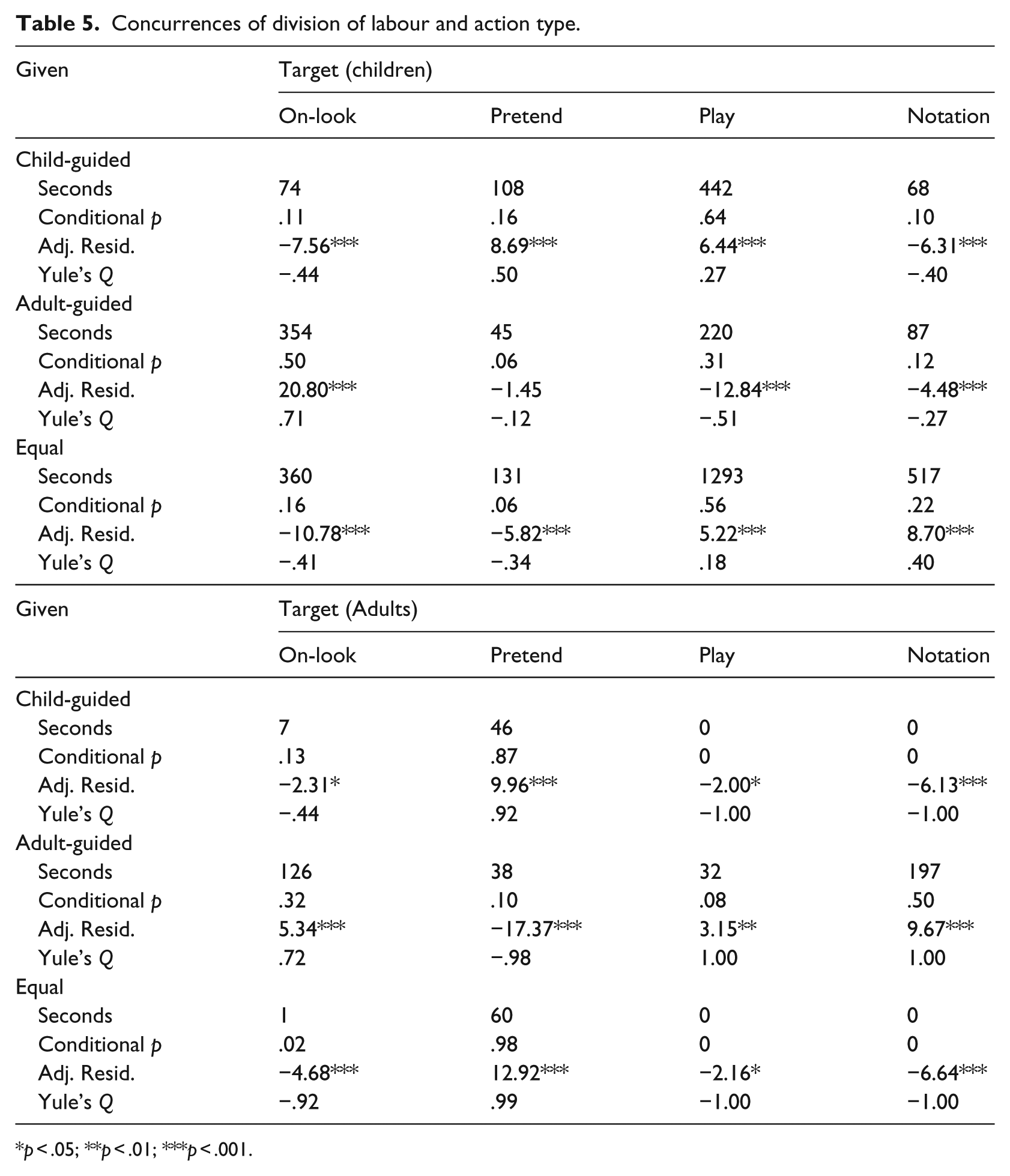
Children’s and adult’s artifact-directed actions varied greatly depending on division of labour, on the other hand. Given child-guided and equal divisions of labour, non-pretend playing was the most likely type of action, whereas adults were most likely to pretend in these situations. Given adult-guided moments of interaction, children most often engaged in on-looking (conditional p = .50) and adults most often engaged in notation-related actions (see Table 5).
Concurrences of division of labour and action type.
p < .05; **p < .01; ***p < .001.
Also, when both children and adults were present, they were more likely to interact with non-representational artifacts, conditional p = .61, than children without adults, conditional p = .39. Similarly, action with non-representational artifacts tended to co-occur with children participating without adults, conditional p = .64 (see Table 6). Adjusted residuals for these concurrences were significant, although the strength of association was low for each concurrence.
Concurrences of subject configurations and artifact type.

p < .05; **p < .01; ***p < .001.
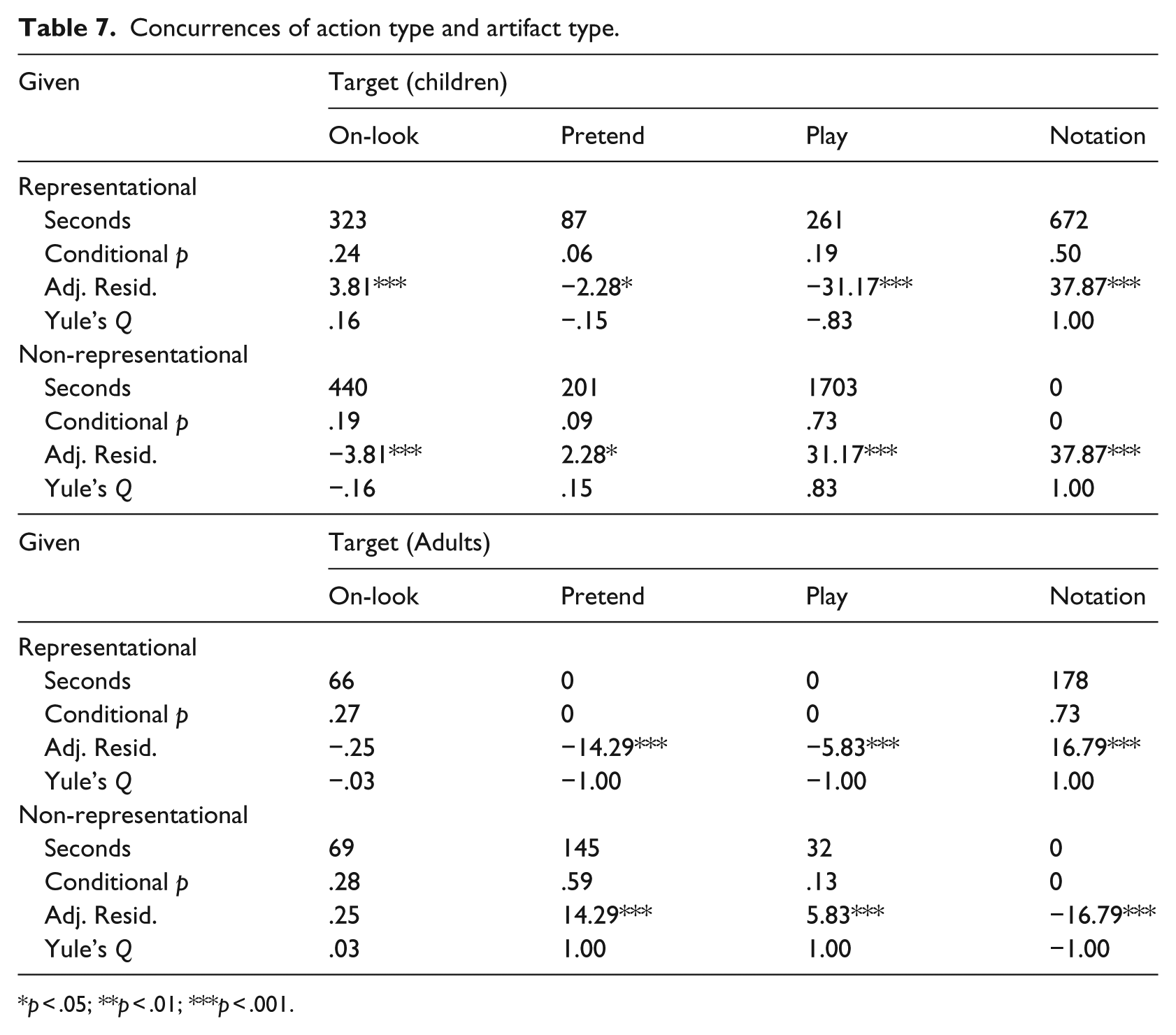
Given the use of representational artifacts, both children and adults were most likely to participate in notation-related actions. However, children and adults typically used non-representational artifacts in diverging ways. Children were mostly likely to engage in non-pretend play when using non-representational artifacts (conditional p = .73). Adults, on the other hand, were most likely to participate in pretense with non-representational artifacts (conditional p = .59). Effect sizes for these particular co-occurrences were very high (Table 7).
Concurrences of action type and artifact type.
p < .05; **p < .01; ***p < .001.
In sum, there were weak connections between artifact type and other aspects of activities, whereas division of labour, actions, and subject configurations did co-occur in distinct patterns. While children interacted without adults, they were usually egalitarian and participated in non-pretend play at the same time. When adults took the lead, children tended to act as on-lookers. Both children and adults typically used representational artifacts while participating in reading/inscribing actions; however, adults and children diverged in terms of actions used concurrently with non-representational artifacts.
Discussion
The present study contributes to a growing body of research which situates children’s behavior within daily activities and moves away from theories that focus on the efforts and/or ability of the individual child. This study contributes to the literature on cultural-historical activity theory by demonstrating how CHAT can frame differences in preschool classroom activity settings (e.g. teacher–child interactions were relatively more sustained during notational activities and indoor play activities compared to outdoor play activities). The results also demonstrate that how artifacts are used may be more important in determining their representational or non-representational nature than the intended uses of these objects (see Table 7).
Using the same dataset, a constructivist might look at the child as the subject and look at peers and teachers as aspects of the environment to explore (Piaget, 1932, 1981). Division of labour would not be of interest nor might the activity as context for children’s actions be of interest, either. In addition, a constructivist would not interpret classroom activities in terms of institutional practices being shared across generations of actors. Instead, play and using notations are seen as reflections of children’s cognitive development (Piaget and Inhelder, 1969), not in terms of the reproduction of socially constructed activity. Thus, attempts to address problems students may face in the classroom would focus more on how children’s difficulties with constructing their own understandings and less on broken connections between children, their peers, their teachers, and institutional practices.
The study’s first research question centered on relationships between how long classroom members participated in representational and non-representational activities and the durations of different configurations of subjects, artifacts, action types, and division of labour. The amount of time in which both adults and children were present and in which representational artifacts were used lasted longer during notational activities compared to the two types of play activities. Interestingly, lengths of divisions of labour did not vary across the three types of activity. This finding offers support to Ashiabi’s (2007) assertion that teachers may vary how much they play as equals or choose to direct children’s play.
The special role of teachers in notational activities, relative to play activities, could be due to two factors. First, the arbitrariness of notational representations may necessitate adult involvement to help children understand the artifacts and rules integral to literacy and numeracy. The fact that children spent a lot of time as on-lookers during reading/inscribing activities (compared to the two kinds of play activities) suggests that children use adults as resources to learn about text, numbers, and pictures. Second, adults have had sustained practice participating in notational activities, whereas expertise and practice with play usually fade in childhood. Although early childhood educators often place value on pretend play (Hirsh-Pasek et al., 2008), it is not the case that pretense is bound by conventions as rigid as those tied to reading, writing, and number use. Thus, it is possible that school’s institutionalized practices surrounding pretense deal more with providing opportunities for play instead of with guiding play.
The second research question involved how certain aspects of activity systems in the classroom depend on one another. When children and adults were present, participation at those moments tended to be adult-guided (in terms of division of labour). When adult-guided divisions of labour occurred, children most often acted as on-lookers while adults read, wrote, or participated in other notation-related actions. In addition, adults typically pretended given the use of non-representational artifacts (i.e. artifacts not designed as representations); perhaps adults were demonstrating the representational affordances of such objects. Together these findings support the view mentioned above that adult-directed activities with representations serve as vehicles for imparting what is possible with certain artifacts within the preschool.
The results of this study demonstrate that one cannot fully understand representational activity by only focusing on what a child does with artifacts which are designed to be representations. Likewise, one cannot fully understand the nature of artifacts without examining how they are used and without attending to how people use them within institutionalized practices. To view children’s learning in terms of changing participation in activities also has implications for understanding potential problems that low-income children may face academically. A major pitfall of locating development within the child is that “[t]heories that reduce learning to individual mental capacity/activity … blame marginalized people for being marginal” (Lave, 1996: 149). Some researchers attempt to move beyond this problem by considering contextual factors related to learning and development. In these cases, the focus is on characteristics associated with families with low SES as “risk factors” which disadvantage poor children (U.S. Department of Education, National Center for Education Statistics, 2001). This approach follows what Cole (1995) referred to as “context as that which surrounds” (p. 108).
As an alternative, Gutiérrez and Rogoff (2003) propose moving away from deficit models of SES and away from contexts as “that which surrounds” to view low-income children’s academic performance in terms of differences in cultural modes of participation. This approach fits Cole’s (1995) concept of “context as that which weaves together” (p. 109). By focusing on children’s participation in representational activities, the present study helps lay the groundwork for additional research on overlaps and mismatches in how low-SES children participate as members of very different communities of practice (e.g. home versus school or preschool versus elementary school).
The present study also advances CHAT by providing a starting point for analyzing activity settings through quantitative methods. The classroom observations could have described qualitatively, as illustrated in the following two examples. During a 72-second episode, a female teacher was sitting at a table. A female child was on her lap, and a male child was standing next to her. Both children watched as the teacher read a picture book about zoo animals. The teacher alternated between reading the text of the book and discussing what was happening in the pictures with the children. The boy shifted his attention between the book and a piece of paper on which he was writing or drawing. Eventually, a third child (a girl) joined the group and started talking with them about what was happening in the book. At the very end of the videotaped record, two other children ran over to look over the teacher’s shoulder as she read.
During a 15-second episode, a male child was sitting in a small chair in a corner among toy kitchen appliances. A female child brought a stuffed puppy toy to place in his lap, and she started to pet the toy. A second girl sat in a nearby chair and watched. The boy began to pet the puppy as the girl continued to do so, as well. These two children briefly exchange words that are inaudible on the video recording.
Both qualitative and quantitative analyses could identify patterns in these observations in terms of artifact use, division of labour, interactions between subjects, and so on. However, quantitative coding and analyses can inform a researcher or educator regarding how long different patterns or phenomena last and allow one to contrast these durations across different types of activities. Also, quantitative, sequential analyses can assist in identifying concurrences (or sequences, which I did not choose to investigate here) among different facets of activity systems.
The coding system presented here offers means to measure how long certain configurations of an activity system last and how facets of the activity co-vary from moment to moment. The system could be applied to investigating changes in activity systems over time, as well. Researchers could apply the system to relatively large datasets which do not as easily lend themselves to qualitative analyses. However, it is important to note that I am not advocating replacing qualitative analyses of activity systems, but supplementing with what is presented here.
Limitations and future directions
These contributions should be viewed in light of some limitations of the present study. For example, the recorded activities tended to be relatively brief. Additional research should involve longer school activities to determine whether the patterns observed here apply to more sustained participation in representational and non-representational activities. Future directions should include observing students and teachers over several months in order to investigate changes in the nature of the activity systems observed in the present study. Collecting data on many more activities would also help overcome the limitation of a relatively small sample size in the present study.
A second limitation is that the results cannot be generalized to samples from other SESs or from other types of preschools. Representational and non-representational activity systems may vary substantially according to different cultural modes of participation (Gutiérrez and Rogoff, 2003) and different institutionalized practices at non-Head Start types of preschools. Importing the methods and analyses of this study to other types of schools and to other populations would help extend the findings.
Conclusion
The present study contributes to our understanding of representational activity and young children’s participation in classroom activities in several ways. First, subject configurations, type of artifact used, and artifact-related actions significantly varied by activity, whereas division of labour did not vary by activity. Second, analyses revealed several strong links between subject configurations, artifact-related actions, and division of labour when examining second-by-second concurrences.
The results of the study may help social scientists, educators, and parents better understand how children become competent members of representation-using communities and how participation in classroom activities plays a role in shaping that competence. By focusing on activity, we can contribute to knowledge of how children become able to use shared representations through participation with other children and with adults within a community of practice. Conceptualizing the use of representations as a kind of cultural activity also may encourage further investigation of with whom and for whom children use various representations and further investigation into the reasons why children use (or do not use) certain representations. This emphasis on activity in context may help provide explanations for differences across cultural groups (and historical time) that are not fully accounted for by previous theories of external representations.
Footnotes
Acknowledgements
Many thanks to the children and teachers who participated in this project. Thanks also to Kristie Heins, Andrew Ritchie, and Chelsea Fellman for their assistance in collecting and coding data.
Declaration of Conflicting Interests
The author(s) declared no potential conflicts of interest with respect to the research, authorship, and/or publication of this article.
Funding
The author(s) received no financial support for the research, authorship, and/or publication of this article.