



Abstract
As educators begin to understand the need for a social-emotional learning curriculum for young students, finding opportunities to implement a curriculum that supports students’ social-emotional development is important. Research supports that using shared reading opportunities that are common in young students’ in-school and out-of-school routines to embed social-emotional learning could have potential impact for young students’ social emotional as well as academic development. This article describes an exploratory mixed-methods case study that examines the use of dialogic book reading strategies in promoting social-emotional skills of young elementary students in an after-school program in the United States. A pre–post case study design was employed to examine preliminary social-emotional outcomes. In addition, parent interviews were conducted to explore the perceived benefits of the intervention in the home environment. The results suggest that dialogic reading may be a helpful strategy to promote young students’ social-emotional learning. The implications for research and practice are discussed.
Keywords
There has been an increased focus on the necessity to integrate social-emotional learning (SEL) with academic instruction for students, especially those at risk for emotional and behavioral problems in the United States (Berger et al., 2011; Daunic et al., 2013; Elias and Haynes, 2008; Liu et al., 2017). Researchers have found that SEL is crucial for mental health and overall wellbeing (Denham, 2006; Heller et al., 2012), and is one of the most important abilities supporting school success later in life (Morgan et al., 2008). In addition, researchers have noted that students who drop out of high school and college report deficiencies in social-emotional skills, as opposed to intellectual shortcomings, that would equip them to deal with challenging life situations (Graziano et al., 2007; Zins et al., 2004).
Educators and state officials are beginning to understand the need for a SEL curriculum for young students (Denham et al., 2014; Durlak et al., 2011). According to an analysis conducted by Scott-Little et al. (2006), increasingly educators across the United States have integrated standards for SEL in their curriculum. In addition to state curriculum changes, national legislation has authorized the use of funds for research initiatives, technical assistance, training, and programming of SEL (Collaborative for Academic, Social and Emotional Learning [CASEL], 2010).
Alongside the importance of students’ SEL, literacy skill acquisition is a fundamental component of child development. Reading to young students is an important activity that occurs frequently in natural settings and promotes early development. Research has shown that interactive reading opportunities for students result in improved language outcomes and creates the foundation for later language and literacy development (National Early Literacy Panel, 2008). Because of these benefits, reading and literacy opportunities are often reflected in the core of early education settings. While the benefits of reading on language development and later reading skills may seem evident, interactive readings also present a natural opportunity to help children develop pro-social skills, such as reflection, perspective taking, and understanding social relationships (Browne, 1996); empathy and self-determination skills (Holm, 2012; Konrad et al., 2007); and language, creativity, problem-solving, and movement skills (Gabbei and Clemmens, 2005). Thus, engaging young students at risk for emotional and behavioral difficulties in frequent interactive reading opportunities can support their social-emotional development.
Researchers have found that interactive reading approaches, such as dialogic reading (DR), can promote literacy and SEL (Daunic et al., 2013; Doyle and Bramwell, 2006), and increase language and interaction opportunities for children with disabilities, such as autism spectrum disorder, who often exhibit social skills delays (Fleury et al., 2014; Towson et al., 2017). Similar DR outcomes for young children with and without disabilities have also been documented internationally (e.g. Fung et al., 2005; Opel et al., 2009; Valdez- Menchaca and Whitehurst, 1992). Whitehurst et al. (1988) first introduced DR as a type of shared, interactive book reading strategy that includes specific questioning and responding techniques to children while reading together. Similar to shared book reading and interactive book reading approaches, DR involves repeated readings and conversations about the books in groups or reading dyads. While language and literacy skills promotion within an interactive book reading opportunity is evident, opportunity for growth in social-emotional skills are possible when there is appropriate book selection combining with the use of DR techniques (Fettig et al., 2016). Books with social-emotional content display models of children and adults solving problems and interacting, which allows students to connect emotionally with characters in stories (Doyle and Bramwell, 2006). This emotional connection is related to attention, learning, memory, and decision-making skills, which leaves students with more accurate memories and pro-social skills (Fivush, 1998).
When a book with SEL components is selected, the reader, such as the teacher, counselor, or parent, is able to direct conversations on developing an understanding of pro-social skills. For example, if a student has a difficult time with sharing when playing games with others, the reader can select a book in which the main character deals with the dilemma of sharing. Following DR, the student is prompted to focus on certain aspects of the story and to answer questions regarding story content and character choices. Through the experience of the character in the story, the student may learn pro-social skills regarding sharing that are applicable to his or her own life.
In addition to the SEL and literacy development, students who participate in DR interventions in group settings are also learning important social skills. In a small-group setting, students have opportunities to learn to take turns, listen to others, and appropriately use their language. They also develop appropriate vocabulary for emotions when they are prompted to think about the story and what words mean in context. This social-emotional vocabulary development supports later growth in both academic and social-emotional domains (Doyle and Bramwell, 2006). Daunic et al. (2013) found preliminary support for engaging young students in DR on social-emotional development.
While the importance of SEL is well documented, implementing a social-emotional curriculum during the school day is becoming increasingly difficult due to demands in academic requirements. After-school programming could provide a space to embed SEL opportunities. In the United States, approximately 18 percent of students attend an after-school program, but the need is significantly greater to support continued learning and development to fill the gap between completion of the school day and workday (Yamashiro and Rinehart, 2014). Anderson-Butcher et al. (2000) also noted an association between participation in after-school programs and improved school performance and attendance, more positive adult and peer interactions, and enhanced pro-social skills and behaviors. In addition, benefits such as decreased academic failure, substance abuse and delinquency, as well as lower incidences of problematic behavior have been found (Anderson-Butcher, 2000; Anderson-Butcher and Cash, 2010).
After-school programs provide an appropriate environment for academic, behavioral, and social-emotional interventions. Given the flexible nature of programming, after-school programs can meet the various social-emotional development needs, while supporting academic learning. One way in which after-school programs can support young students’ social-emotional developmental needs is by small-group activities that incorporate interactive book reading, such as DR, that traditionally focus on language and literacy outcomes to promote these social-emotional skills (Miller et al., 2011; Ramirez et al., 2009; Sanacore, 2012).
Research has supported the use of DR for oral language development since the late 1980s (Arnold et al., 1994; Lonigan and Whitehurst, 1998; Valdez- Menchaca and Whitehurst, 1992; Whitehurst et al., 1988), thereby elevating its status to an evidence-based practice for promoting development in language and literacy domains (What Works Clearinghouse, 2007). However, there is limited research examining the outcomes of DR on promoting SEL with the exception of the work of Daunic et al. (2013), which found preliminary support for its application and efficacy for social-emotional skill development. This article describes an exploratory mixed-methods case study that examines the use of DR strategies in promoting social-emotional skills of young elementary students in an after-school program. As a relatively unexplored area of inquiry, it was hypothesized that DR would help to support SEL of young students. A pre–post case study design was employed to examine preliminary social-emotional outcomes. In addition, parent interviews were conducted to explore the perceived benefits of the intervention in the home environment.
Program description of Super Friends, Super Readers
The Super Friends, Super Readers (SFSR) program was designed as a language and social-emotional intervention in an after-school program setting that serves students who are at risk for emotional and behavioral problems due to environmental risk factors, such as low socioeconomic status (SES) and living in high-violence communities. The SFSR intervention consists of two components: dialogic storybook reading and social-emotional direct instruction.
Dialogic storybook reading
A DR approach was used to encourage children to take on an interactive role with the story through intentional scaffolding instructional sequence that begins with the adult posing a question to the child (Flynn, 2011). The storybooks were scripted using the mnemonics “PEER” and “CROWD” that represent DR steps and specific question prompts, respectively (Lonigan and Whitehurst, 1998; Whitehurst et al., 1994, 1988). During storybook reading, the adult reader employs the PEER acronym and Prompts a child with a question. When the child responds, the adult Evaluates the accuracy and Expands on the child’s response. Finally, the adult Repeats the prompt to guide the child to recite the response again for fluency. There are five specific types of prompts used in DR following the CROWD acronym: Completion, Recall, Open-ended, Wh-, and Distancing questions.
Mapping DR onto SEL core competencies
The Collaborative for Academic, Social, and Emotional Learning (CASEL; 2017) has identified five core competencies central to SEL: self-awareness, self-management, social awareness, relationship skills, and responsible decision-making. We used the CASEL framework to guide the focus of social-emotional skills within the SFSR program because of its research-informed recommendations, and the widely adopted framework of coordinated strategies across classrooms, schools, and homes and communities. We specifically targeted three key social-emotional skills that were identified as crucial skills for early elementary age students: problem-solving, turn-taking, and providing positive peer feedback (Bierman et al., 2008; Daunic et al., 2013; Nix et al., 2013). Books that include opportunities to teach the targeted social and emotional skills were selected and scripted to embed the DR approach. For example, the book Fix-It Duck by Jez Alborough was scripted to target problem-solving skills. A question, such as, “What are some solutions Duck can try to fix the leak on his roof?” would prompt students to think through how Duck might be able to solve the problem. Based on the student’s response, the adult reader could evaluate the plausibility or accuracy of the response and expand on the student’s knowledge. For example, the adult reader might evaluate and expand the student’s response of “The Duck can use tape” by saying, “That’s a great idea. The Duck could use very strong tape to tape the roof to fix the leak!” With this response, the reader can evaluate the response by indicating that the idea is plausible and expand by stating that a strong tape would be needed. Finally, the reader would ask students to repeat the expanded answers to the prompt. This PEER sequence—Prompt, Evaluate, Expand, Repeat—was used for each scripted prompt within the book. See Table 1 for a description of PEER and CROWD DR prompts and examples of prompts.
Dialogic reading strategies and examples.
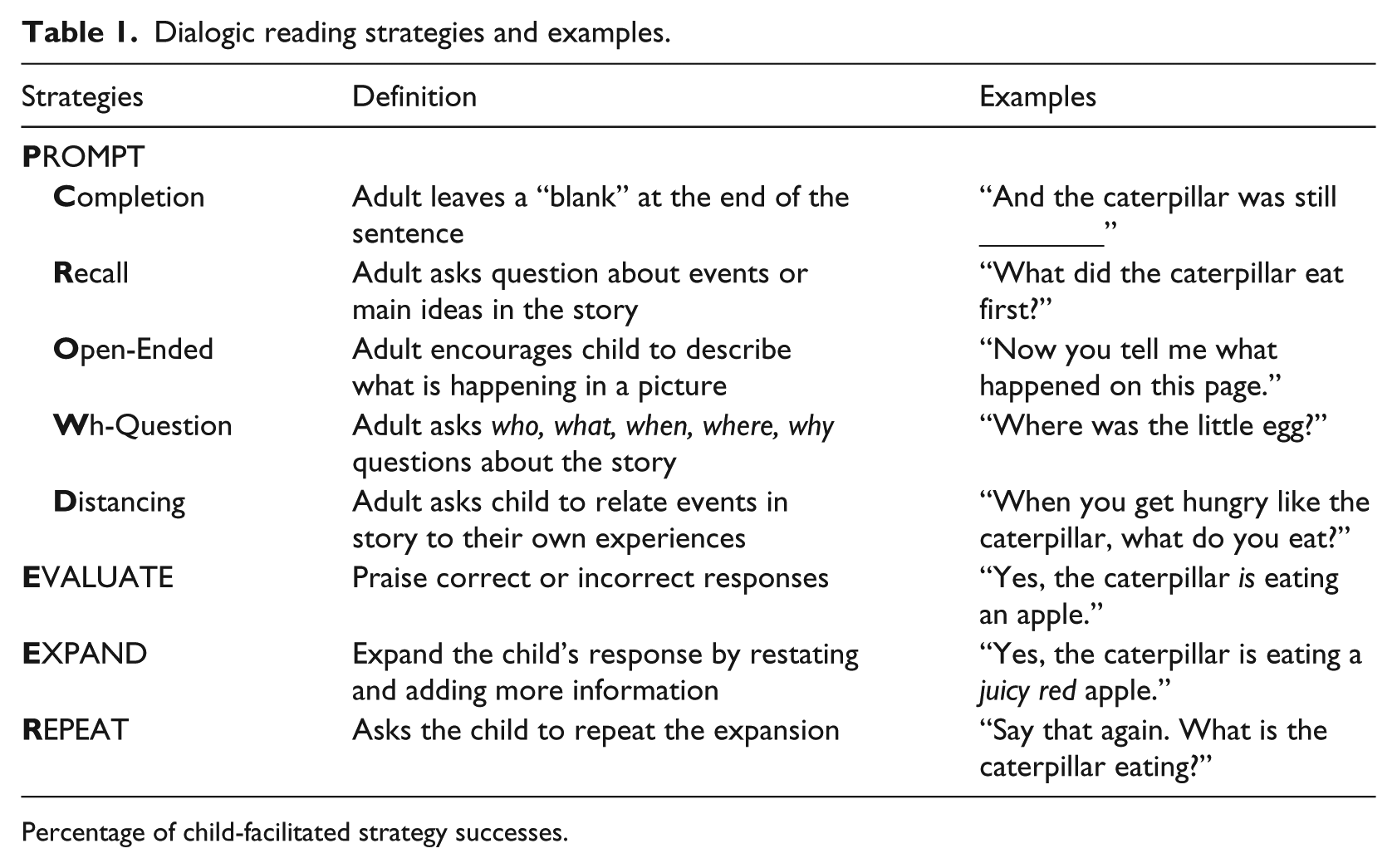
Percentage of child-facilitated strategy successes.
Social-emotional direct instruction
Following the DR storybook reading, the adult reader served as the facilitator and engaged children in a 15-minute small-group activity that was intended to extend and promote the use of the targeted social-emotional skill within the storybook. The activity typically involved engaging students in role-play or game during which the students could practice the targeted social-emotional skill. For example, following the DR session in which the targeted social-emotional skill was problem-solving, students were asked to generate a list of problems they encountered during a specific time period (e.g. on the playground at school, on their way to school, on the school bus). The facilitator engaged in role-play with students to act out each of the listed problems, and students were then encouraged to generate solutions. Through modeling and role-play, the facilitator guided students in assessing whether each of the solutions was safe and fair for everyone involved and whether or not it solved the problem at hand. At the end of the small-group instruction, the facilitator reminded students to continue to be good problem solvers throughout the day, like the Duck in the book. The goal of the direct social-emotional skill instruction was to encourage the students to translate skills learned from the DR session to other daily social interactions.
Case study and preliminary evidence of program effectiveness
The research team employed a mixed-methods case study design to explore whether the SFSR program that incorporates DR strategies may promote the development of social-emotional skills in early elementary age students. Through an explanatory sequential design (Creswell and Plano Clark, 2011), we first collected quantitative behavioral data of students’ social-emotional skills and subsequently conducted qualitative interviews with parents at the conclusion of the intervention.
Setting and population
Four Kindergartener and first graders who attended the Boys and Girls Club (BGC) after-school program in a Northeast United States urban city participated in this 6-month intervention program. This BGC serves approximately 207 children between the ages of 5 and 18 in a geographic zone targeted by the urban city for resource mobilization efforts due to high rates of poverty and social risk factors. At the time of study recruitment, 23 of the BGC members were in Kindergarten or first grade. The Kindergarteners and first graders who attended the BGC had the option of selecting after-school enrichment activities to participate in, including arts, science and technology, math, and writing programming.
Recruitment and participants
Early elementary age students were recruited through purposive sampling, open to Kindergarteners and first graders at BGC. A flyer was created and distributed to family members of the after-school program for recruitment. For the purpose of the study, enrollment in the SFSR program was capped after receiving four participants. Each student’s parent received information about the group as well as the consent form in Spanish and English. The parents of the four participating students enrolled their children in the SFSR program.
The four students who participated in the program were all boys between ages 5 and 6 with two in Kindergarten and two in first grade. All students identified English as their primary language, and two students also identified speaking Spanish at home. The participating students included one African American, one Caucasian, and two multiracial. All of the participating students attended the same neighborhood elementary school that was categorized as a Level 5 (underperforming) school due to its low performance in standardized testing and limited progress in closing the achievement gap. All of the participating students received free lunch at school.
Interventionist
A master’s student in early childhood education, who had experience in early childhood classroom settings, served as the interventionist for the SFSR program. The first author provided a 2-hour training for the interventionist on DR approaches and scripted all the books using PEER sequence and CROWD prompts to promote SEL. The first author also planned the extension activities for each of the intervention sessions. To train the interventionist, the first author modeled and demonstrated reading approaches and extension activities. The interventionist was provided with an implementation fidelity checklist for practice. The interventionist practiced with the first author and the small group of young students until fidelity of implementation reached 100 percent. Weekly meetings were held between the interventionist and the first author to go over the lesson for the week as well as to examine implementation fidelity and answer implementation questions the interventionist might have from the previous lesson.
Intervention
The 1-hour SFSR intervention program was delivered at the BGC weekly for 6 months. During each SFSR session, the students participated in the intervention, which consisted of dialogic storybook reading and a social-emotional extension activity. One pre-scripted book was read to the students during a 15–20 minute DR session. The DR session was followed by a 10–15-minute social-emotional extension activity. In the last 25–30 minutes, students engaged in a supervised play activity in which data collection occurred. During this supervised play activity, the interventionist was instructed to provide minimal support to the students. The interventionist was instructed to intervene only when students asked her a question, requested her help, if students were engaging in activities that were harmful to themselves or others (e.g. climbing on furniture, aggression toward others), or if a conflict occurred and resolution was not reached after 2 minutes.
Data collection and interobserver agreement
Two school psychology doctoral student gathered data for this study. Prior to the start of data collection, the data collectors met with the first and second authors to complete data collection training which included using an implementation checklist to assess intervention fidelity, operationally define the child behaviors to be coded, practice coding with small-group reading instruction, and recalibrate data collection procedures within the team. During data collection, when reliability dropped below 80 percent criteria, time was designated in the team meeting to discuss and calibrate procedures and guidelines.
Data were collected during the 25–30-minute supervised play activity immediately following the intervention session. Examples of activity included board/card games (e.g. Chutes and Ladders, Go Fish, Uno, and Candyland), dance charades, and interactive activities such as Simon Says and Follow the Leader. Prior to the start of the activity, participating students were reminded to use the skills they learned in the SFSR sessions with their friends. Data for the following three social-emotional skills were collected: problem solving, turn-taking, and positive peer feedback.
Problem-solving within this study was defined as the process children took to finding solutions to a situation or conflicts that arose. Within the 25-minute supervised play activity, data collectors tallied the number of situations or conflicts that occurred. Following the identification of each of these conflicts, the data collectors determined whether or not the conflict was resolved by the students or the interventionist. The percentage of student-resolved conflict was calculated by dividing the number of student-resolved conflicts by the total number of conflicts identified and multiplied by 100. A similar process was used to gather the percentage of incidence of student-facilitated turn-taking. Within each activity, such as game playing, students were required to take turns. Each turn-taking opportunity was considered to be completed when the opportunity to engage in activity was transferred from one student to the next. For example, when playing a game, once a student accomplished all necessary steps associated with his turn and the next student started his turn, the specific turn-taking opportunity was completed. The percentage of student-facilitated turn-taking was calculated by dividing the number of student-facilitated turn-taking by the total number of turn-taking opportunities identified and multiplied by 100. Finally, we gathered the percentage of positive peer feedback students provided to one another in each of the supervised play activities. Examples of positive feedback statements were “Good job,” “You are good at this,” and gestures, such as high-fives, fist bumps, and hugs. Examples of negative feedbacks were, “You suck,” “I hate you,” and “I don’t want to play with you anymore.” The percentage of positive peer feedback was calculated by dividing the number of positive peer feedback by the total number of positive and negative feedback identified and multiplied by 100.
Interobserver agreement (IOA) was conducted in 77 percent of all sessions across baseline and intervention sessions. A second school psychology doctoral student served as the IOA rater for the project. Point-by-point agreement was calculated by examining the agreement of skill opportunity identified for all three social-emotional skills as well as the determination of whether the skill was student-facilitated or adult-facilitated for problem-solving and turn-taking skills. IOA was calculated by the number of agreements on each skill opportunity, divided by the number of agreements plus the number of disagreements, and then multiplied by 100. IOA was calculated to be 73 percent across all three skills.
Parent interview
Semi-structured parent interviews were conducted individually at the end of the study and inquired about social-emotional skill improvement and utilization. The interviews lasted approximately 20–30 minutes for each parent. Sample interview questions included: (a) Please describe how your child’s behavior has been in the home and school during the past month. (b) Have you noticed a change in behavior since your child has been involved in the reading group? (c) Has your child’s teacher reported any changes in behavior since your child has been involved in the reading group?
Qualitative data analysis
The research team used qualitative content analysis (QCA) to identify themes related to SEL. We transcribed recorded interviews and developed a coding frame of themes by reducing interview data into small units of coding and meaningful subcategories, using structural coding (Saldaña, 2013). We then examined whether there were patterns and relationships between subcategories. Each level of data analysis was conducted independently and then examined together to interpret findings.
To ensure trustworthiness, two researchers, one of whom was not involved in conducting the interviews and transcribing, analyzed the recorded data independently. After completing the initial analyses, they compared their identified passages and relevant content following an iterative consensus process to discuss the differences and similarities of data analyses until consensus was reached (Kvale and Brinkmann, 2009). Through this process of triangulation, the investigators developed a final coding frame.
Results
The goal of the exploratory case study was to provide preliminary descriptive data on the effectiveness of employing a dialogic storybook reading intervention in supporting children’s social-emotional development. Data suggested that the percentage of student-facilitated problem-solving successes and turn-taking completions increased between baseline and intervention. For problem-solving, the percentage of student-facilitated problem-solving successes increased from 42 percent (range = 25–55) at baseline to 48 percent (range = 17–94) following intervention; the percentage of child-facilitated turn-taking successes increased from 74.3 percent (range = 48–100) at baseline to 84.4 percent (range = 60–100) following intervention. We also observed similar increases in positive peer feedback from 18.8 percent (range = 0–67) at baseline to 29 percent (range = 0–84) following intervention (see Figure 1).
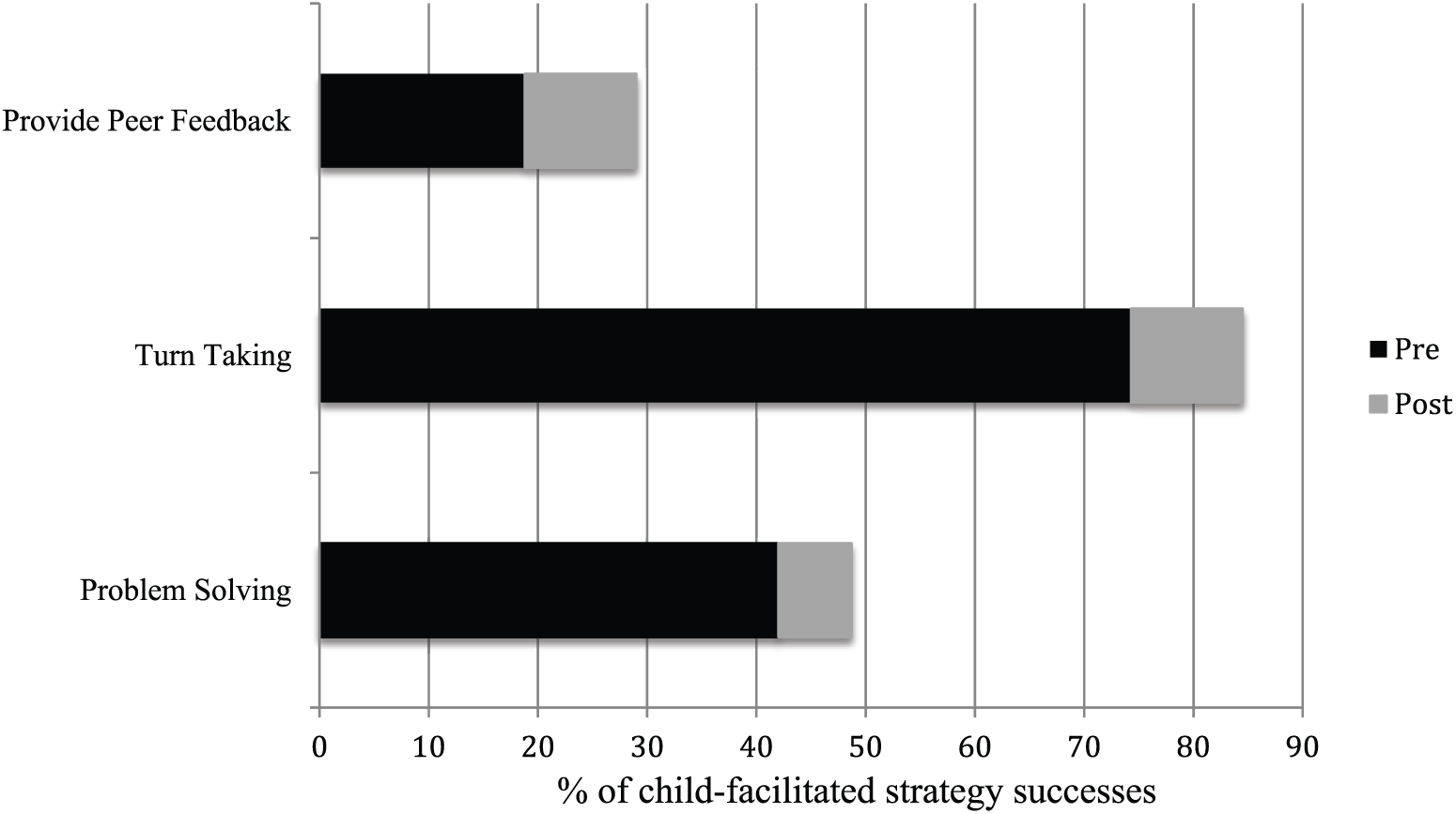
Percentage of child-facilitated strategy successes in social-emotional skills.
QCA of post interviews with parents resulted in a coding frame with one main theme of emotional regulation and two corresponding subcategories, verbal communication, and problem-solving ability. Parents described improvement in their children’s ability to manage frustrations and solve problems through verbalizing feelings and needs. Under the subcategory of verbal communication, parents observed an increase in ability to articulate concerns. For example, one parent shared, “I do find that he’s able to use his words more to describe a concern, but he does struggle with calming and coping mechanisms, but this is something he struggled with even before the reading program.” Another reported that although her son’s “behavior has stayed consistent through the reading program, he is more able to articulate his concerns when a problem arises.” Similarly, another parent described a general improvement in behavior. She described how, “His behavior has improved… before when he got upset, he would yell at family members or throw things. Now he is able to articulate his concerns and find a place to calm down.” In addition to improvement in coping with frustration and verbalizing feelings, parents described growth in skillful use of communication. One parent stated that, “He’s very outspoken. He expresses his feelings well.” Another described how “the words he uses are funny. He uses big people words sometimes, and it’s funny, and he uses them in the right context.” In addition, parents described an increase in their child’s participation in group activities in the classroom. For example, a parent shared that her son “participates more in discussion, something that he didn’t do as much before,” and another parent reported that her son is “working more in groups.” Overall, parents described improvement in communication skills to articulate their thoughts and feelings as well as to verbalize frustrations and negative emotions.
Another area of growth related to emotional regulation included improved problem-solving ability with peers at school and siblings at home. One parent reported that her son “rarely has conflicts at school, and when he does, he’s able to seek adult support to problem solve.” In this case, the child was able to reach out for support from an adult to resolve a problem with a classmate. Similarly, the parent who reported that her son used to yell and throw objects has replaced these challenging behaviors with problem-solving skills to address the issue at hand by articulating his concerns and finding a place to calm down. Another parent observed an improvement in her son’s ability to use words to solve problems with his brother. “I do notice he’s not completely patient with his brother all the time, but for the most part he’s able to talk through problems to solve that.” Overall, parents described growth in communication skills to express thoughts and feelings and to problem solve.
Discussion
This study sought to explore the preliminary effectiveness of employing a DR intervention to promote social-emotional skill development among students at risk for emotional and behavioral challenges. The DR intervention included shared group reading of storybooks with embedded SEL skills focused on turn-taking, problem-solving, and providing positive peer feedback. Following the shared reading session, students engaged in role-play practice of the SEL skill and subsequently engaged in free play, while the interventionist observed the presence of the target behaviors.
The data analyses suggested that the percentage of student-facilitated problem-solving successes, turn-taking completions, and frequency of positive peer feedback that occurred during free play increased between baseline and intervention by 6 percent (problem-solving successes) to 10 percent (turn-taking completions and positive peer feedback) overall. These preliminary findings add to the research base that suggests DR may be a helpful strategy to promote students’ SEL. Although the percentage increase in successful student-facilitated display of select social-emotional skills was small, the development of SEL is expected to unfold over time as children use their skills to successfully navigate social interactions and personal experiences (CASEL, 2017; Taylor et al., 2017). Furthermore, the qualitative findings from parent interviews suggested overall growth in social-emotional skills that parents attributed to the DR intervention, particularly in the areas of communication, self-regulation, and problem-solving skills.
The findings from this study align with the emerging body of literature that has identified DR and other shared reading interventions as a promising approach to promote SEL (Cook et al., 2017; Daunic et al., 2013). The use of DR with young elementary school children coincides with academic programming, thereby reinforcing literacy learning alongside social-emotional development (Daunic et al., 2013). It is also possible to deliver DR sessions with a focus on SEL to small groups and classrooms (Cook et al., 2018); therefore, its flexible delivery approach lends support for its implementation in elementary school settings.
Instituting a DR program for SEL for students who are at risk for emotional and behavioral problems could also be beneficial for teachers, administrators, and students. For teachers, implementing a comprehensive program in an after-school setting as well as having opportunities to embed SEL within existing classroom activities (e.g. storybook reading) would help SEL to be less fragmented and relieve pressure concerning achievement demands. At the school level, more thorough and continuous SEL could help improve the overall school climate (Hawkins, 1997; Learning First Alliance, 2001). Previous research has shown that SEL can both improve school climate and promote overall academic, social, and emotional benefits for students (CASEL, 2017). At the student level, DR could continue to improve literacy, while also targeting specific social-emotional skill development. As demonstrated in our exploratory case study, shared reading opportunities could be great platforms to promote SEL in young students.
A DR intervention that focuses on social-emotional skills development could also provide continued structure for SEL learning for young students past regular school hours. With appropriate staffing and support, after-school programs offer a fitting environment for such activities and opportunities for social skills development. It is important to note that lower staff-to-student ratios are recommended for such programing as they are associated with better student outcomes (National Youth Outcomes Initiative, 2014). That is, according to the 2014 BGC National Outcomes Report, member-to-staff ratios of 11 or higher are associated with lower rates of sense of belonging, physical and emotional safety, staff expectations, and recognition. Strategic planning and staffing is necessary in order to ensure that a program such as SFSR may benefit young students.
In addition to instituting structured DR programs in after-school settings, practitioners should encourage DR at home, especially for children at risk due to issues associated with social-emotional development and literacy in low-income homes. These risk factors are significant concerns for school readiness skills for young students in low-income communities (Nix et al., 2013). Bringing DR into students’ homes can help parents and guardians get directly involved with their children’s learning while also creating an environment that promotes SEL and literacy development (Huebner and Payne, 2010; Lam et al., 2013).
Limitations
The findings of this study have limitations. The intervention was carried out with four students in one after-school setting, which limits the ability to draw conclusions regarding the use of the DR intervention as an effective approach to support SEL in young elementary school children. The intervention also targeted three specific social-emotional skills (turn-taking, problem-solving, and peer feedback); thus, the findings do not apply across all areas of SEL. Furthermore, this study focused on targeted skill development as part of a complete treatment package, including the DR session and role-play activity, and did not measure each component separately. Therefore, the findings preclude the ability to understand which aspects of the intervention may have promoted social-emotional skill development. Finally, it is important to acknowledge the difficult nature of live behavior observations to capture behaviors (i.e. problem-solving, turn-taking, and providing peer feedback) that have yet to be clearly defined in the literature to capture as the dependent variable. This contributed to the lower IOA.
Future research
Additional research that focuses on better understanding the connection between DR and SEL is needed. Further study could utilize larger samples to investigate how shared reading strategies could support SEL in students across age groups and classroom settings. Programs instituting DR for SEL in an after-school setting could also benefit from conducting program evaluation research. It could also be useful to explore parent/caretaker engagement in DR groups within after-school settings to obtain a more complete understanding of the expression of SEL both in and outside of the home. Additional research that measures the combined impact on SEL and literacy skills may be a future direction. Although DR has been identified as an evidence-based practice to promote emerging literacy skills in young children (What Works Clearinghouse, 2007), the outcomes on literacy skill development have not been examined as part of a treatment package when combined with social-emotional skill development. Finally, future examination of this DR intervention could provide knowledge regarding how to best define social-emotional behaviors of interest (e.g. turn-taking, problem-solving) and how these behaviors can be captured meaningfully to provide evidence to this DR intervention approach.
Conclusion
Current barriers to students’ social-emotional and literacy development, specifically those faced by low-income families, continue to widen the achievement gap and delay school readiness. These barriers include lack of available resources, decreased quality time with parents, teacher characteristics, challenged emotional resilience, and harmful environmental factors. By teaching students SEL skills through DR, we provide the opportunities for young students to learn SEL skills and become intentional in their use of social-emotional skills to effectively navigate challenging situations and experiences.
Footnotes
Declaration of Conflicting Interests
The author(s) declared no potential conflicts of interest with respect to the research, authorship, and/or publication of this article.
Funding
The author(s) received no financial support for the research, authorship, and/or publication of this article.