




Abstract
Although 3-year-olds in the United States may attend prekindergarten prior to formal school entry in kindergarten, few investigations focus on the socioemotional foundations of classroom learning at age 3 and their relationship to later achievement. This study examined the relationship between age 3 readiness for group-based learning, modeled as the latent constructs, effortful control and social communication, and age 5 classroom adjustment and pre-academic outcomes. Data from the Early Head Start Research and Evaluation Project in the United States (n = 797) included observations, direct assessment, and examiner and teacher report. Children’s effortful control predicted classroom adjustment and their social communication predicted pre-academic outcomes. Readiness for group-based learning provides a way to describe key constructs of early skill development and a framework to support children’s classroom learning. Implications include promoting parents’ and educators’ capacities to support early developmental foundations for later adjustment and learning by fostering infants’ and toddlers’ effortful control and social communication. Efforts to support these skills simultaneously across diverse experiences in the home and classroom by focusing on children’s individual needs may prove advantageous.
Keywords
Researchers and practitioners recognize that children’s cognitive and socioemotional abilities promote readiness for early learning (e.g. Ladd et al., 2006; Lin et al., 2003; McClelland and Morrison, 2003). Yet, many 3-year-olds from low-income homes are not on target in these developmental skill areas (Tarullo et al., 2010). As calls for pre-kindergarten (pre-k) for children with risks increase, state-funded programs in the United States are funding more seats for these 3-year-olds (Mead, 2015), the typical age at which children are eligible to attend pre-k. However, policies aiming to support “school readiness” in children from low-income homes by improving literacy and math skills (Office of Planning, Research, and Evaluation, 2014) reflect insufficient emphasis on foundational skills that contribute to successful skill development during pre-k.
In this article, we argue that promoting the cognitive, social, and communication foundations of early learning should be the objective for very young learners because these foundational skills influence children’s classroom adjustment and emerging academic skills throughout pre-k. We bolster our argument with results indicating individual differences in foundational skills of 3-year-olds from low-income homes in the United States are predictive of pre-academic and classroom adjustment as they transition to kindergarten 2 years later.
Transitioning to the large-group learning environment
Before age 3, home-based care and classrooms can promote the foundations of early learning. For example, consistent with developmentally appropriate practice (Coople and Bredekamp, 2009), infant-toddler care settings in the United States involve a small group of siblings or peers and adults attuned to children’s individual developmental needs. Expectations for children to cooperate with others and comply with requests are highly scaffolded. Structured classroom curricula are centered on high-quality interactions and caregivers’ intentional construction of the learning environment (Fisher, 2011). Vygotsky’s (1978) sociocultural theory emphasizes that through these intentional and highly individualized practices, children learn how to effectively interact with the social world.
For 3-year-olds that enter pre-k, they must adjust to an unfamiliar learning environment with new rules for engaging others, a larger child-to-teacher ratio, and heightened demands. Vygotsky’s theory describes the emergence of self-regulation as a cornerstone for learning in these social contexts. Despite recognizing this, and acknowledging the frustrations teachers experience with children new to the classroom environment, few efforts have been made to fully operationalize the foundational dimensions of development that promote engagement in early learning at age 3 (Thompson and Goodman, 2009). Furthermore, little is known about how early foundational skills are related to classroom adjustment and pre-academic outcomes in pre-k and kindergarten classrooms.
In the United States, attendance in pre-k is not mandatory or universal. It may take on different forms and occur at different ages. These circumstances and associated policies may vary based on country. Yet, by understanding how the skills children possess at the start of pre-k impact future outcomes by allowing them to engage in the pre-k classroom more fully, greater emphasis can be placed on encouraging the development of these foundational abilities.
Goodrich et al. (2015) introduced a construct called readiness for group-based learning (RGBL), describing the interrelated set of skills aiding young children in successfully navigating the pre-k classroom. We presented and confirmed that a two-factor model of foundational skills best described these developmental skills and was distinct from general cognitive ability. RGBL draws on effortful control (EC) and social communication (SC) skills typically seen earlier than “school readiness” skills. Similar to Kagan and Rigby’s (2003) discussion of learning readiness, RGBL provides a way to describe key constructs of early skill development and a framework to support children’s classroom learning. This study builds on our prior work, demonstrating that individual differences in age 3 EC and SC influence age 5 classroom adjustment and emergent literacy and math abilities.
The foundations: readiness for group-based learning
Studies of kindergarteners, and to a lesser extent 3- and 4 year-olds, point to a number of broad developmental skills that influence children’s success in the classroom. They include EC, self-regulation of behavior, emotions, and attention (Arnold et al., 2012; Cuevas et al., 2012); responsive and engaging social engagement skills, such as cooperation and compliance with teachers and prosocial behavior (Ladd et al., 1999, 2006); and expressive and receptive language skills (Levy-Shiff and Hoffman, 1989). Prior research has not taken into account how these dimensions are interrelated (e.g. Arnold et al., 2012; Ladd et al., 2006) or the impact of children’s abilities at age 3 on future adjustment and academic preparedness. Studying children from low-income homes in the United States is important because they may face additional challenges, such as stressful home environments and fewer supportive opportunities that negatively impact the development of these skills (Evans and Kim, 2013).
Effortful control
Early EC is the foundation for many later competencies (Blair and Razza, 2007; McClelland and Cameron, 2012). It is defined by Kochanska, Rothbart, and others as the ability to self-regulate attention and inhibit and regulate emotional arousal and behaviors during stressful, challenging situations to engage successfully with individuals and achieve social goals (Lengua et al., 2007). It is considered a component of temperament (Rothbart et al., 2003; Valiente et al., 2011), although EC can be encouraged and reinforced. Young children possessing superior EC are able to switch tasks and change behaviors when requested and demonstrate concentration and persistence at tasks (Blair and Razza, 2007; Valiente et al., 2011). Children with attention difficulties throughout pre-k perform poorly on measures of pre-academic learning (Arnold et al., 2012; Lonigan et al., 1999), and later reading (Gray et al., 2014).
Social engagement
Initiating and responding prosocially, seen in cooperation, sharing, and taking turns, also is related to successful classroom adjustment and academic skills (Ladd et al., 2006). Greater prosocial behavior may attract more positive responses from teachers who then encourage children to engage and persist on tasks, thus building their skills (Arnold et al., 2012). Preschool teachers report that cooperation is one of the most important skills for at-risk children when entering formal schooling (Foulks and Morrow, 1989). Although studies have investigated learning-related social skills in relation to adjustment and success in kindergarten (e.g. McClelland and Morrison, 2003), scant research considers children’s cooperation and compliance in pre-k classrooms. Notably, Bierman et al. (2009) examined literacy and math outcomes in relation to classroom participation (comprised of behavior regulation and compliance), prosocial behavior, and aggressive behavior among Head Start children at age 4. Using a regression framework, they found classroom participation was the strongest individual predictor.
Language skills
Language proficiency is crucial to communicating wants and needs in the classroom (Lin et al., 2003), understanding and following teacher instructions and rules, and answering requests from children. Receptive language delays, prevalent in children from low-income homes, put them at a disadvantage. Pre-k and kindergarten teachers emphasize the ability to listen with understanding is critical to classroom success (Foulks and Morrow, 1989). Levy-Shiff and Hoffman (1989) found preschool teachers rated 3-year-olds with higher verbal communication skills as more adjusted to the classroom. Early language difficulties often continue into elementary school, affecting academic achievement (Catts et al., 1999; McClelland et al., 2000).
Classroom adjustment
Classroom adjustment means participating cooperatively in classroom activities and engaging in self-directed learning activities (Ladd et al., 1999). Other researchers (e.g. Fantuzzo et al., 2004; Li-Grining et al., 2010; Vitiello et al., 2011) use a child’s approaches to learning to conceptualize classroom adjustment. It reflects qualities of children’s involvement in learning experiences (initiative, engagement, persistence, motivation, positive attitudes and eagerness to learn, curiosity, cooperation) (Meng, 2014; Rikoon et al., 2012). We operationalize approaches to learning as part of teacher-reported classroom adjustment.
Rationale for the current study
This study investigates the relationship between age 3 developmental skills and age 5 classroom adjustment and pre-academic outcomes in a low-income sample from the United States. Ongoing large income disparities in children’s RGBL highlight the importance of this undertaking. While most studies consider these skills individually, by treating them as indicators of larger latent, unobservable constructs, we can depict EC and SC (social engagement and language) as interrelated constructs, accounting for measurement error in the assessment of individual skills (Brown, 2006). Informing the literature on how foundational skills contribute to later outcomes, the current study addresses the question: Do individual differences in RGBL at age 3 predict classroom adjustment and pre-academic outcomes at age 5?
Methods
Participants
Data were drawn from the Early Head Start Research and Evaluation Project (EHSREP; Raikes and Love, 2002). Early Head Start (EHS), a federally funded early intervention program aimed at enhancing development in children from low-income homes or with a disability in the United States, works with families during pregnancy through age 3 (Paulsell et al., 2002). Targets include improving children’s healthy development and social competence, parenting, and family functioning, achieved through home visiting and/or center-based services. The EHSREP is a large, rigorous evaluation that included 17 of the original 68 EHS sites from across the country. Randomly assigned to EHS or community services as usual, families with incomes at or below the federal poverty level were followed across time (Love et al., 2005). The current study focuses on data collected when children were 3 and 5 years old (n = 797). Slightly over half (53.7%) received EHS services, and 49.8 percent were boys. Since the impact of EHS was not evaluated in the current investigation and results did not differ by status, groups were combined. The sample was diverse: 31.3 percent of mothers were Black/African American, 24.8 percent Hispanic, 39.9 percent White/non-Hispanic, and 4.0 percent Other. At enrollment, 33.5 percent of mothers were under age 20, and nearly half (45.8%) of mothers had not completed high school or their general educational development (GED).
Procedures
At both ages, home visits were conducted to assess children’s development and behavior. Three assessment contexts were utilized: direct assessments of children’s skills, ratings of videotaped parent–child interactions, and examiner ratings of children’s behavior. At age 5, teachers completed a questionnaire assessing children’s classroom behavior. Bilingual examiners administered forms of standardized assessments in Spanish, adapting to children’s language preferences (n = 56, 7% of the sample).
Measures
Table 1 presents information on each of the measures and its associated indicators organized by latent construct, including the mean, standard deviation, and range of scores for each of the indicators in the current sample.
Descriptive sample statistics for the measures used in the latent factor model.

BRS: Bayley Rating Scales; MDI: Mental Development Index; PPVT: Peabody Picture Vocabulary Test; FACES: Family and Child Experiences Survey; SD: standard deviation.
RGBL foundational skills
EC
At age 3, the Bayley Scales of Infant Development – second edition (Bayley, 1993) were administered. From the Bayley Rating Scales (BRS), examiner ratings of seven Emotion Regulation items (adaptation to change, attention to task, persistence to complete task, cooperation, activity level, sensitivity to stimuli, and negative affect (reverse coded)) on a 5-point scale were averaged and included as an indicator (Cronbach’s α = .90). Higher scores indicate the child demonstrated the behavior to a greater degree.
From the mother–child Three-Bag and Puzzle tasks adapted from the National Institute of Child Health and Human Development (NICHD) Early Child Care Research Network (ECCRN) (1997), ratings of children’s sustained attention to objects and persistence were coded on a 7-point scale (1 = very low, 7 = very high) and used as indicators. Intraclass correlations ranged from .87 to .96 (Fuligni and Brooks-Gunn, 2013).
SC
Social engagement
At age 3, from the Bayley Rating Scales, examiner ratings of six Engagement/Orientation items (trusting or nonfearful behavior and social engagement with the examiner, interest in and exploration of the test materials, positive affect, and energy level) were averaged and included as an indicator (Cronbach’s α = .80). Children’s engagement of parent during the Three-Bag task and Puzzle task, each rated on a scale of 1 (very low) to 7 (very high), were also used as indicators (NICHD ECCRN, 1997). Intraclass correlation ranged from .87 to .96 (Fuligni and Brooks-Gunn, 2013).
Language skills
At age 3, the language facet score from the Mental Development Index (MDI) subtest of the Bayley (1993), a standard score for verbal and nonverbal receptive and expressive communication, was used as an indicator (range 0–14). Also, standard scores on the Peabody Picture Vocabulary Test (PPVT, third edition; Dunn and Dunn, 1997), a measure of receptive language, were used. It has high internal consistency (median α = .95) and test–retest reliability (median α = .92; Dunn and Dunn, 1997).
Age 5 outcomes
Pre-academic achievement
Children’s book knowledge and book comprehension (pre-literacy skills) were assessed using the Story and Print Concepts task drawn from the Head Start Family and Child Experiences Survey (FACES; Jeon et al., 2011). An examiner asked the child questions about the book Goodnight Moon (Brown, 1947). The task included nine items; eight were scored correct (1) or not (0) based on the child’s answer (“Show me the front of the book.”); one item was rated 0 to 3 based on the number of things the child could remember when asked, “Can you tell me some other things we said ‘goodnight’ to?” Scores ranged from 0 to 11. The items were organized into two subscales, Book Knowledge and Book Comprehension, which because of their similarity were averaged as an indicator. Test–retest reliability was .91 (Roberts and Neal, 2004).
The Woodcock–Johnson Psycho-Educational Test Battery-Revised (WJ-R; Woodcock and Johnson, 1990) and the Spanish version, the Bateria Woodcock-Munoz: Pruebas de Aprovenchamiento-Revisada (Bateria-R; Woodcock and Munoz-Sandoval, 1996) are norm-referenced assessments measuring general intellect. We utilized the Letter-Word Identification test (57 items), measuring ability to identify printed letters and words and the Applied Problems test (39 items), measuring ability to identify numbers and analyze and solve math problems presented orally. A summary score for both subtests were used in the current analyses. The internal consistency is .92 for Letter-Word Identification and .91 for Applied Problems (Woodcock and Johnson, 1990).
Classroom adjustment
Children’s classroom adjustment at age 5 was assessed using items drawn from the Teacher’s Child Report form of the FACES (Jeon et al., 2011) that tapped approaches to learning. For each item, teachers rated the highest level the child demonstrated in the classroom in the last week on a scale of 1 (low) to 5 (high). Six items were used as indictors: how well the child solves problems, works with other children, makes and builds things, engages in pretend play, follows music and movement directions, and exhibits an interest in reading activities. The Cronbach’s alpha was .85.
Data analysis
Longitudinal path analysis in structural equation modeling (SEM) using Mplus Version 7 (Muthén and Muthén, 2012) was utilized. Children’s RGBL was modeled as two latent variables at age 3. We used a SEM model to test direct paths between children’s EC and SC at age 3 (using the same two-factor model, previously published (Goodrich et al., 2015) but based on a smaller sample that included children that had data available at age 3 and 5) and their classroom adjustment and pre-academic outcomes at age 5. Across all variables, missing data ranged from <1 percent to 20.5 percent (see Table 1). Scores on the PPVT had the most missingness. To eliminate biased parameter estimates, full information maximum likelihood (FIML) was used to estimate missing data.
Results
Children’s assessment scores were typically low but highly varied. All correlations were in the expected direction and most were significant (Table 2). At ages 3 and 5, there were moderate to strong correlations between indicators from the same measure or task, indicating shared measurement, with few strong across-task correlations. Therefore, errors were correlated for indicators from the same measure in most models. The confirmatory factor analysis (CFA) for pre-academic outcomes was a just-identified model and did not provide enough degrees of freedom to correlate these indicators. In all of our models, the correlated errors and error variances were significant at p < 0.001. Results report standardized loadings and paths.
Correlations among indicators.

BRS: Bayley Rating Scales; MDI: Mental Development Index; PPVT: Peabody Picture Vocabulary Test; FACES: Family and Child Experiences Survey; WJ: Woodcock–Johnson.
p < .05. **p < .01.
RGBL at age 3
The 3-year-old model presented in Goodrich et al. (2015) was re-tested with the current smaller sample to confirm its fit. Results indicated that a two-factor model including EC and SC (social engagement and language) fit the data well (χ2 (15, n = 797) = 41.665, p < .001, comparative fit index (CFI) = 0.980, root mean square error of approximation (RMSEA) = 0.047, standardized root mean square residual (SRMR) = 0.037). All indicators significantly loaded on their respective latent constructs as initially proposed. However, the correlation between EC and SC was high (r = 0.890, p < .001), indicating the latent constructs might not be fully distinct. A one-factor model was tested as an alternative model. Although the fit of the model was appropriate (χ2 (16, n = 797) = 49.936, p < .001, CFI = 0.974, RMSEA = 0.052, SRMR = 0.039), it was not as good. A three-factor model (EC, social engagement, and language) was also determined to not be as good of fit to the data. Therefore, the two-factor model was the best fitting model.
Relationship between age 3 RGBL and classroom adjustment and pre-academic outcomes at age 5
A single latent variable model of pre-academic outcomes was tested in CFA and included emergent literacy and math abilities. It was a just-identified model; all indicators loaded significantly onto it. Similarly, a single latent variable model of classroom adjustment was tested in CFA and fit well (χ2 (8, n = 797) = 7.441, p = 0.490, CFI = 1.000, RMSEA = 0.000, SRMR = 0.009). All indicators loaded significantly onto this factor.
Our model, testing direct paths from EC and SC at age 3 to classroom adjustment and pre-academic outcomes at age 5, fit the data well (χ2 (110, n = 797) = 172.624, p < .001, CFI = 0.984, RMSEA = 0.027, SRMR = 0.035; Figure 1). The direct path from EC to classroom adjustment was significant (β = 0.502, p = 0.004), while the direct path from EC to pre-academic outcomes was not significant (β = 0.283, p = 0.125). The direct path from SC to pre-academic outcomes was significant (β = 0.837, p < .001), while the path from SC to classroom adjustment was not significant (β = –0.078, p = 0.742). Correlations between EC and SC (r = 0.896, p < .001) and pre-academic outcomes and classroom adjustment were significant (r = 0.162, p = 0.024).
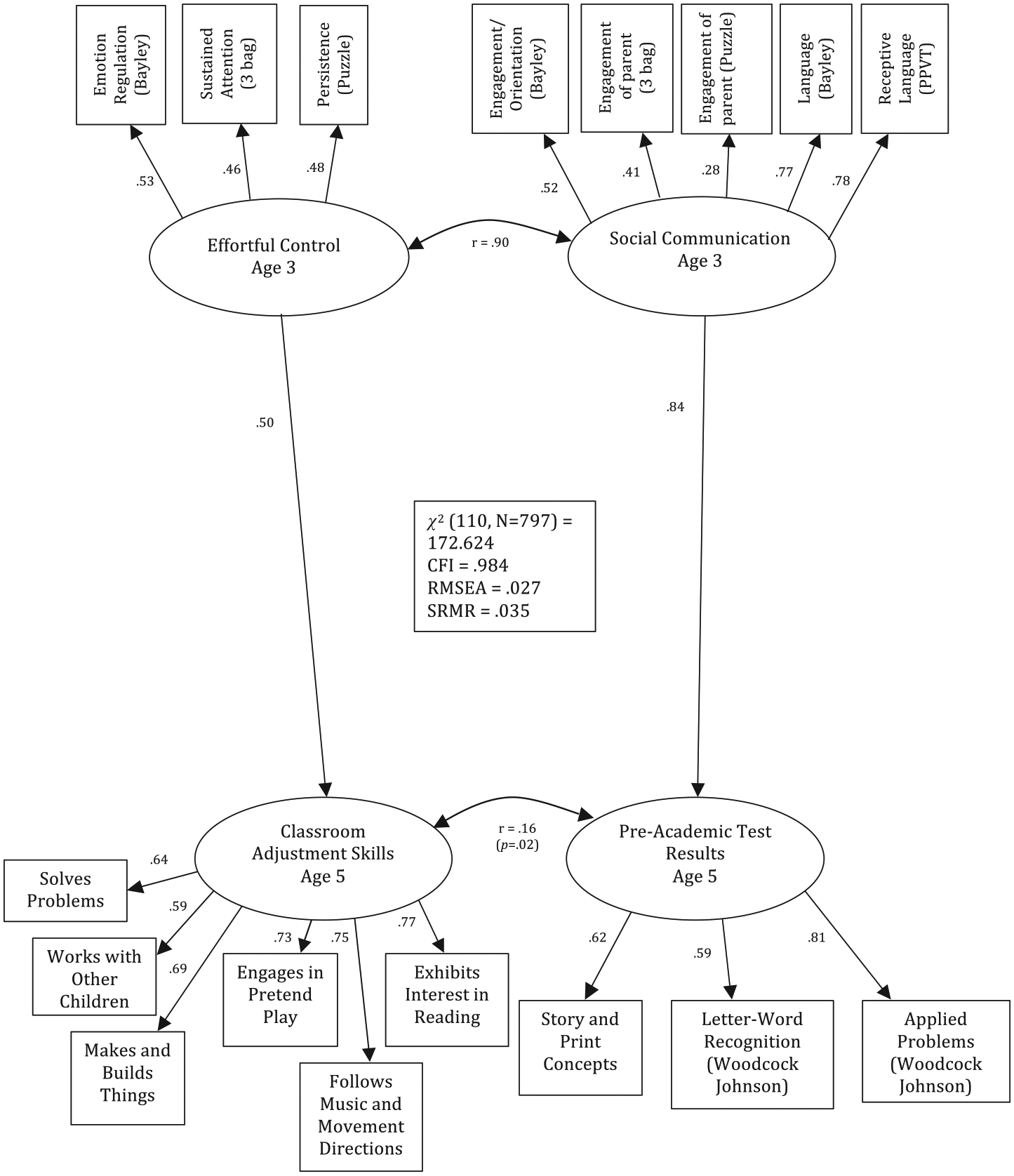
Relationship between age 3 readiness for group-based learning and classroom adjustment and pre-academic outcomes at age 5.
Discussion
The relationship between domains of children’s RGBL at age 3 and their adjustment to the classroom and pre-academic outcomes 2 years later was studied. EC and SC, although highly interrelated, had distinct, significant effects on outcomes at age 5. EC, but not SC, predicted classroom adjustment, while SC and not EC predicted pre-academic outcomes. The fact that children’s EC, but not SC, predicted classroom adjustment is not surprising. The abilities of problem solving, following directions, and persistence theoretically are more highly related to EC than to prosocial abilities. Engagement in pretend play, another classroom adjustment indicator, may also have stronger roots in EC than SC. Bodrova and Leong (2003) state self-regulation is the cornerstone to many aspects of play and learning in the pre-k classroom. Other research exploring classroom adjustment with similar indicators (e.g. Miller et al., 2004; Pianta et al., 1997) found a relationship with children’s prosocial abilities. Our results may differ because we treated EC as a multidimensional construct, measured by multiple informants across different tasks and environments; further study is necessary.
Consistent with other research (e.g. Catts et al., 1999; Ladd et al., 1999, 2006), children’s SC significantly and strongly predicted pre-academic abilities 2 years later. The strong association of language abilities with pre-literacy outcomes may partly explain this. However, the novelty of this study is its treatment of SC and pre-academic abilities as multidimensional constructs. Previous research (e.g. Arnold et al., 2012; Lonigan et al., 1999) finding a significant relationship between children’s EC and pre-academic abilities used measures of attention, not multiple indicators of EC. This is one of the first studies to examine these longitudinal readiness dimensions and outcomes as latent constructs in a large sample within the United States. It is also possible that the impact of EC on academic outcomes is not apparent until children are older. Consistent with some prior research (e.g. Miller et al., 2004; Pianta et al., 1997), these findings suggest our understanding of how EC is associated with classroom adjustment and pre-academic outcomes is still emerging (McClelland and Tominey, 2011).
Associations between latent constructs
As in our prior investigation, EC and SC at age 3 were strongly interrelated (r = .90). Although this can indicate these constructs are not distinct (Brown, 2006), these dimensions did not overlap entirely and model fit was superior when tested as two interrelated constructs. Children who were more effective social communicators were also better regulated and attentive at age 3. However, 2 years later, emergent literacy and pre-math knowledge were more strongly associated with earlier SC foundations (see zero-order correlations among measures in Table 2). The strong interrelatedness among EC, social engagement, and language skills may indicate they have a combined impact on classroom adjustment and academic achievement. For example, Valiente et al. (2011) found that children’s social functioning mediated the relationship between their EC and academic achievement. Given that classroom adjustment has often been measured through indicators that emphasize EC, such as persistence and attention (e.g. Fantuzzo et al., 2004; Ladd et al., 1999), future work should consider how social aspects of classroom participation contribute to adjustment to the classroom.
Surprisingly, teacher ratings of classroom adjustment and directly assessed pre-academic outcomes were only weakly related. Little research has explored the relationship between classroom adjustment and pre-academics. Instead, focus has been on the relationship between classroom adjustment and other socioemotional abilities, such as emotional competence (e.g. Miller et al., 2006) or peer relationships (e.g. Fantuzzo et al., 2005). Vitiello et al. (2011) found classroom adjustment, specifically task persistence, contributed positively to children’s academic achievement. Although the current findings are noteworthy because they drew from distinct informants, they should be explored more in the future.
Implications
Our results are consistent with the Vygotskian perspective that pre-k outcomes can be fostered through support of the foundational dimensions of development: EC and SC (Bodrova, 2008). Research indicates the stability of EC from age 2 to 5 (Cuevas et al., 2012; Graziano et al., 2011). Similarly, Arnold et al. (2012) propose that greater prosocial behavior may attract a more positive response from a teacher, where the teacher invests in the child to a greater extent, encouraging the child to persist on tasks. Therefore, intervention efforts should begin in infancy and toddlerhood and should concentrate on supporting children to practice communication and EC through play in order to assist in children’s developmental preparedness for learning in a group setting and ultimately their readiness to enter kindergarten. Acknowledging that differences exist in pre-k attendance policies and practices around the world, the support of children’s early emerging cognitive and socioemotional competencies will foster further skill development throughout pre-k and beyond.
One way to support early learning is through emotionally responsive adult–child interactions before age 3, consistent with Vygotsky’s (1978) ideas. In the United States, home visiting programs may be particularly poised to address these issues. By supporting emerging skills within the parent–child relationship, infant–toddler home visiting programs benefit children’s EC and SC skills (Barnett et al., 2012; Love et al., 2005; Olds et al., 2004). Strategies include encouraging parents to positively reinforce young children for persisting and waiting, using words to communicate, and engaging prosocially with others. Other research indicates fostering stimulating parent–toddler interactions that include joint attention helps prepare low-income children to enter classrooms with improved regulation and communication abilities (Martoccio et al., 2014).
The latent variable approach, through its framework of RGBL, suggests how to support more targeted education approaches. It provides greater specificity than an amorphous social-emotional domain of development and is broader than the highly specific pre-academic skills aligned with the Common Core of school-age curricula (Common Core State Standards Initiative, 2019) of the United States.
Continuing high rates of educational disparity between children from poor and middle class homes in the United States tell us that despite prevention and intervention efforts, many children enter the pre-k classroom with low levels of EC and SC. In addition to promoting these skills during infancy and toddlerhood, our data support that early learning foundations can be supported simultaneously across diverse experiences in the pre-k classroom; the high correlation between EC and SC suggests strong common purpose. Therefore, consistent with developmentally appropriate practice (Coople and Bredekamp, 2009), curriculum planning might include individualizing the games and activities offered through the Promoting Alternative Thinking Strategies (PATHS; Domitrovich et al., 2007) curricula to children’s developmental needs. A single activity such as the PATHS turtle move, where a child is taught to stop, breath, and explain what the problem is and how it makes him or her feel, supports self-regulation and promotes relationship-building skills by reducing the impulse to hit. The broader challenges children have within the pre-k classroom are often tied to slow developing EC abilities. Intentionally supporting this area of development by individualizing activities to children’s needs will be advantageous.
Especially for children from low-income homes, smaller group sizes and teacher–child ratios for 3-year-olds could better support these foundational abilities. Children need to receive high-quality classroom experiences (e.g. Justice et al., 2017; Landry et al., 2017). Training teachers on coaching at-risk children in these skills through modeling, structuring the classroom environment and day, and providing emotionally responsive care may strengthen children’s foundational abilities (Rosanbalm and Murray, 2017).
Limitations
This was a secondary data analysis; data were not collected for the current purposes, and some indicators were lacking. For example, parents’ perspectives of children’s skills at age 3 were unavailable. Children’s childcare histories were not examined. The impact of RGBL at age 3 on later classroom adjustment and pre-academic outcomes may differ based on the quality, type, and amount of exposure children had to classroom learning environments. Given pre-k provisions differ in the United States, children who entered higher quality pre-k environments at age 3 may have improved their classroom adjustment and pre-academic outcomes compared to those who entered classrooms later.
Future work should consider the interrelatedness among RGBL and classroom adjustment and academic outcomes in a more economically and educationally advantaged sample of young children. Our sample included children from low-income families and children with developmental disabilities, consistent with the mission of EHS. Covariation of scores at the low end of the distribution may be driving some of the strong inter-dependence of skills. In other samples, children’s abilities may not be so co-determined because variability is reduced around a higher mean and skill thresholds may be exceeded, thus having a different impact on later outcomes.
Conclusion
This study is one of the first to examine the relationship between dimensions of RGBL at age 3 and classroom adjustment and pre-academic outcomes during the kindergarten transition. Furthermore, EC, SC, and pre-academic outcomes are considered across multiple contexts and relationships. Prior to age 3, the foundations of early learning are supported in relationships with parents (Vygotsky, 1978) and through high-quality early learning experiences. As children enter classrooms, these skills are supported within teacher–child relationships. Exploring the interrelationship between these early developing dimensions and their association with later outcomes has important implications for preparing teachers to support children’s readiness to meet the challenges of the classroom. Infant, toddler, and pre-k age development should be an integral part of kindergarten and early childhood teacher training. Early learning standards recognize the crucial importance of social engagement and guide teachers to provide warm, supportive relationships with children (NAEYC, 2011). Through these relationships, young children’s autonomy and EC are best nurtured, as they become learners among peers.
Footnotes
Declaration of conflicting interests
The author(s) declared no potential conflicts of interest with respect to the research, authorship, and/or publication of this article.
Funding
The author(s) disclosed receipt of the following financial support for the research, authorship, and/or publication of this article: The findings reported here are based on research conducted as part of the national Early Head Start Research and Evaluation Project funded by the Administration for Children and Families (ACF), US Department of Health and Human Services under contract to Mathematica Policy Research, Princeton, NJ, and Columbia University’s National Center for Children and Families, Teachers College, in conjunction with the Early Head Start Research Consortium. The Consortium consists of representatives from 17 programs participating in the evaluation, 15 local research teams, the evaluation contractors, and ACF.
